Famous Rock Guitars Part 4

This is obviously the 4th edition of this series. Part 1, Part2, and Part 3 we covered Brian May’s Red Special, Willie Nelson’s Trigger, George Harrison’s Rocky, Eddie Van Halen’s Frankenstrat, Bruce Springsteen’s guitar, and Neil Young’s Old Black guitar.

Part 5 will be right after the holidays. Next week I will have a post on a not so famous guitar…one of my guitars with an interesting back story.

Today we will look at two Alpha males of their bands. Plus an odd Bonus!

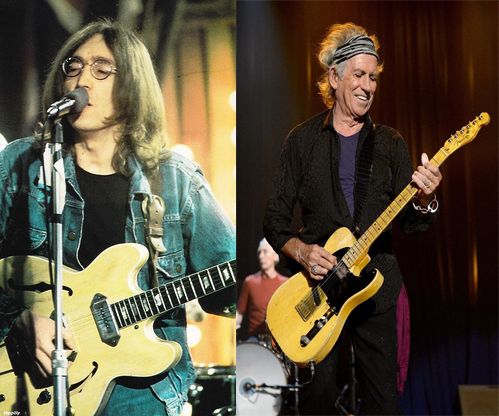
John Lennon’s Epiphone Casino and Keith Richard’s “Micawber” … + Bonus!

Image result for john lennon with casino

John was best best known for two guitars. His Rickenbacker 325 and this Epiphone Casino.

In 1964 Paul McCartney bought a 1964 Epiphone Casino and he would end up using on songs like Taxman and Paperback writer. In 1966 John Lennon and George Harrison would buy 1965 Casino’s for themselves.

John’s was a double-cutaway semi-hollow f-hole body, P-90 pickups, vintage tuners with small buttons, trapeze tailpiece and originally a sunburst finish. However, after hearing from Donovan Leitch that a guitar would sound better without a heavy finish, he decided to sand the paint off the instrument, leaving it with a natural wood finish.

John played this guitar on the White Album and Abbey Road. He continued to play it many times for the rest of his career.

Lennon was never a “gear” head. He was known as an impatient man and would just plug in and go. Rick Nielsen of Cheap Trick said he played around with the famous Rickenbacker at the Double Fantasy recording session but John didn’t play it on that album because it was in such bad shape. Rick said “the set list from Shea Stadium was still scotch-taped to the back of the guitar”…he said it was almost unplayable. It had rusty strings.

This video is about an Epiphone newer Casino model that was released it was inspired by Lennon’s guitar.

CUToday.info Member Bonus Total To Date Tops $114-Million

Bonus Guitar…John Lennon’s Sardonyx guitar 

John Lennon's Weirdest Guitar: The Sardonyx | John lennon guitar, Beatles  george harrison, Beatles george

This is a “Bonus” guitar…the one John Lennon used on the Double Fantasy recordings. One of the oddest guitars I’ve ever seen. It is a Sardonyx guitar made in the seventies. It had built in effects and the rails acted as a guitar stand.

John Lennon bought this guitar from Matt Umanov’s guitar shop in Manhattan’s West Village… which is the shop where Jeff Levin sold many of his guitars through. Ken Schaffer actually sold most of them. Ken sold Jeff’s guitars to Ian Hunter, Howard Leese, Jeff Lynn, Pappy Castro, and a couple bass models to Phil Lynott and Bootsy Collins. It was Ken who sold John Lennon his Sardonyx, directly.

It’s not famous but it was so odd I had to include it.

John Lennon's Weirdest Guitar: The Sardonyx | GuitarPlayer

Ken Schaffer: Months after John bought the guitar, I got a call from John’s personal assistant, who asked me to come to the Dakota. John had been impressed by the electronics I‘d stuffed into the Sardonyx, and asked to retain me to design the kill-all stereo he had in mind for the new apartment in the Dakota. In the small bedroom, which was to be Command Central for the system, hung above and behind the bed, vertically — the Sardonyx! MY Sardonyx! (Tears were welling up) … “Fred – you mean – John is using my guitar as a ($#%$&%*$) WALL ORNAMENT?!” Fred was John’s PA, and fought to settle me down, “No, man – wrong! He loves that guitar so much it hangs over his head when he’s sleeping!” (Tears dried) Whoa! And, in fact, there were pictures of this amazing guitar on the packaging of “Double Fantasy.” It was the guitar he used throughout.

Keith Richards’ Micawber

Keith Richards' Guitars and Gear – Ground Guitar

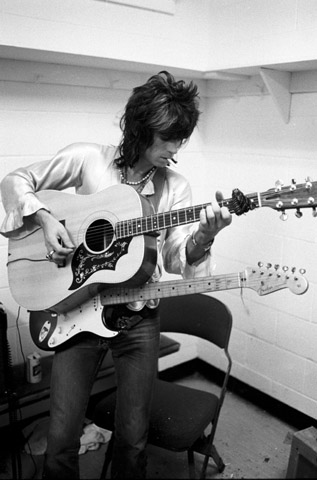
Micawber is a Butterscotch early fifties Telecaster Blackguard that Keith got around the recording of Exile on Main Street. The guitar was given to him by no other than Eric Clapton as a birthday present.

After the 1972 tour, Keith’s tech at the time, Ted Newman Jones III, replaced the neck pickup with a 50’s Gibson PAF humbucker upside down and the bridge pickup with a pickup out of a Fender lap steel which he chose because it was as close as he could find to the pickups used in a Broadcaster

In the 80’s Keith gave the guitar the nickname “Micawber” after a character in a Charles Dickens novel. Micawber has been Keith’s go-to for any song using Open G tuning.

In the eighties then guitar tech Alan Rogan made more modifications…Sperzel locking tuners and a modified brass bridge in which the low E saddle is removed to accommodate his five-string tuning.

I have used this 5 string tuning before. You can play a lot of the Stones catalog with that 5- string opening G tuning.

***Thanks to run-sew-read for pointing out this song by Barclay James Harvest called John Lennon’s guitar. It would be about the Epiphone Casino.

From Songfacts….Barclay James Harvest guitarist John Lees wrote this song. On the original recording of “Galadriel,” he played the Gibson Epiphone Casino that Lennon had played during the Beatles’ last ever live performance, in January 1969. This song describes that experience

https://www.youtube.com/watch?v=IJGiIyP0ke4

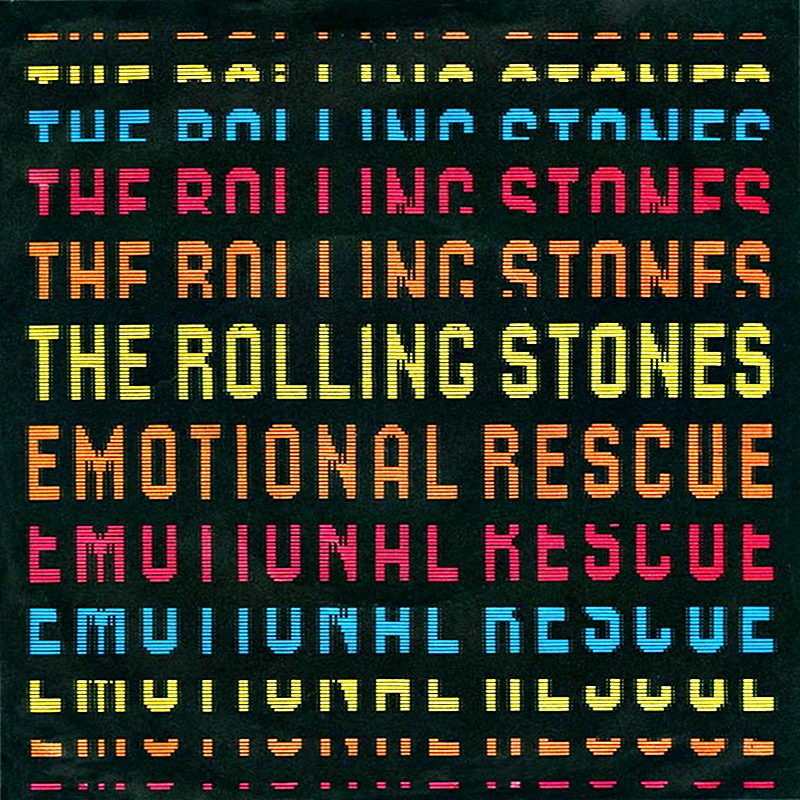
Rolling Stones – Emotional Rescue

Good morning everyone… hope you have a great Monday.

I bought the Emotional Rescue single when it was released.  I also bought the album and it was a let down to me after the great Some Girls album. The title track is heavily leaning toward disco and I do like it. What attracted me to the song is the superb bass line in the intro.

Ronnie Wood played bass on the song and Bill Wyman played synthesizer. Ronnie is a great bass player. He played bass on Rod Stewart’s Maggie May. The song peaked at #3 in the Billboard 100, #9 in the UK, and #1 in Canada.

The Stones played this for the very first time in concert on May 3, 2013, 33 years after they recorded the song. Keith Richards was not a fan of the  song and it never made a Stones setlist until the first show of their 50 and Counting tour at the Staples Center in Los Angeles.

Mick Jagger: ‘We were just doing dance music, you know. It was just a dance music lick I was just playing on the keyboard. Charlie has a really nice groove for that.” 

From Songfacts

This alienated many Stones fans who thought it was a sell out to disco, but it was still a Top 10 hit in the US and UK.

Mick Jagger sang much of this in a falsetto, which was the thing to do with disco songs. The Bee Gees did the same thing, but unlike The Stones, were never able to get back the fans they lost to disco.

Bobby Keys’ sax solo and Mick Jagger’s vocals were added almost a year after the rhythm track was recorded.

Jagger wrote this on an electric piano.

The video for this used the same thermal imagery effect as the album cover. It was cutting-edge visual stuff in 1980.

Emotional Rescue

Is there nothing I can say, nothing I can do to change your mind?
I’m so in love with you, you’re too deep in, you can’t get out
You’re just a poor girl in a rich man’s house
Ooh ooh ooh ooh ooh ooh ooh ooh
Yeah, baby, I’m crying over you

Don’t you know promises were never meant to keep?
Just like the night, they dissolve off in sleep
I’ll be your savior, steadfast and true
I’ll come to your emotional rescue
Ooh ooh ooh ooh ooh ooh ooh ooh
Yeah, the other night, cryin’, cryin’ baby yeah I’m cryin
Yeah I’m cryin, I’m your child baby, child,
Yeah I’m a child, I’m a child, I’m a child

You think you’re one of a special breed
You think that you’re his pet Pekinese
I’ll be your savior, steadfast and true
I’ll come to your emotional rescue
Ooh ah ah ah ah ah ah ah
Ah ah ah ah ah ah ah ah
Yeah, I was dreamin’ last night baby
Last night I was dreamin’ that you’d be mine
But I was cryin’ like a child
Yeah I was cryin’, cryin’ like a child
Could be mine, mine, mine, mine, mine all mine
You could be mine, could be mine, could be mine all mine

I come to you, so silent in the night
So stealthy, so animal quiet
I’ll be your savior, steadfast and true
I’ll come to your emotional rescue
Ah ah ah ah ah ah ah ah
Yeah, you should be mine, mine, ooh!

Mmm yes, you could be mine, tonight and every night
I will be your knight in shining armor
Coming to your emotional rescue
You will be mine, you will be mine, all mine

I will be your knight in shining armor
Riding across the desert on a fine Arab charger

Build-A-Band

Remember Build-A-Bear? Well this is the rock edition. I think this post may go under…” looked great on paper but…” but lets give it a try. Have you ever thought about if you could have a pick of any musicians living or dead and bring them together in their prime…what combinations would you come up with?

Who would you pick if you could pick anyone? We have a time machine so don’t worry…Jimi Hendrix is just a trip away.  This is a discussion my friends and I have once in a while. I always wondered what a band with Keith Richards and John Lennon together would have sounded like…probably as raw as you could have sounded…a band with Big Star’s Alex Chilton and the Beatles Paul McCartney? It would be interesting.

There are many musicians I have left out…most likely they were here in previous editions that I’ve gone through in the past few weeks.

Now… I would want to make at least two or three different bands…a rock, hard rock, and a pop/rock band.  Now I could go on and on…Soul, Blues, Funk, Country/Rock, and even Heavy Metal. Who would you pick? What would your “dream” band be? If I had time I would have listed around 10 different kind of bands…but these 3 will do for now.

width="144"Montreaux Switzerland 1972 by Dominic Lamblin : rollingstones500+ ALLMAN BROTHERS ideas in 2020 | allman brothers, allman brothers band,  southern rockJohn Paul Jones | Wiki | Bass Player Amino                  Resultado de imagen para charlie watts young | Charlie watts, Rolling  stones, Rhythm and bluesLeon Russell “Leon Russell” « Cool Album of the DayRod Stewart - Wikipedia

Rock  band.

  • John Lennon – Rhythm Guitar/vocals
  • Keith Richards – Rhythm guitar/vocals
  • Duane Allman – Lead guitar
  • John Paul Jones (Led Zeppelin) – Bass
  • Charlie Watts – Drums
  • Leon Russell – Keyboards
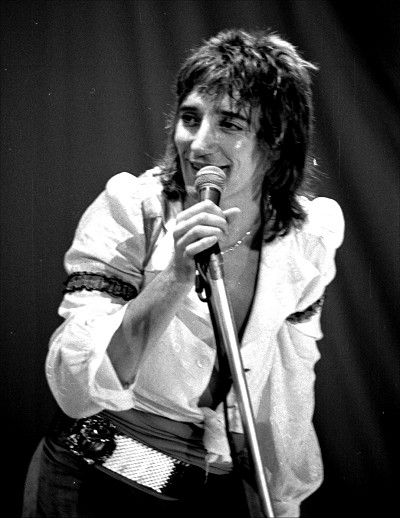
  • Rod Stewart (early seventies version) – Lead Vocals

Jimi Hendrix on Twitter: "I have a song on abortion and a song on Vietnam  and a song on just about any problem"Old Love by Eric Clapton | SetlistingJohn Entwistle | Wiki | Guitar Aminoyou may say i'm a dreamer — Young Keith Moon in the band the BeachcombersITCHYCOO PARK// FAKEGRAM - 1 - WattpadJon Lord - Wikipedia

Hard Rock Band

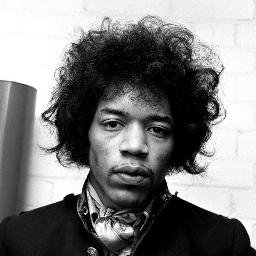
  • Jimi Hendrix – Lead guitar and vocals
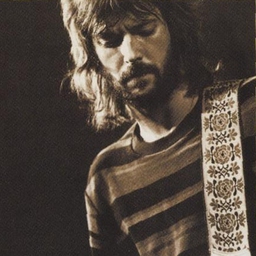
  • Eric Clapton – Lead guitar and vocals
  • John Entwistle – Bass
  • Keith Moon – Drums
  • Steve Marriott (Small Faces and Humble Pie) – Lead Vocals
  • Jon Lord (Deep Purple) – Keyboards

Silly Love Songs #TheBeatlesMania | Paul mccartney, John lennon beatles,  Ringo starrAlex Chilton, Big Star, Dead at 59 - GuitarVibe.comI Don't Want To Go To) Chelsea - Lyrics and Music by Elvis Costello & The  Attractions arranged by nrdcskbClem Burke InterviewBrian Wilson (@BrianWilsonRP) | Twitter

Pop/Rock Band

  • Paul McCartney – Bass/Lead Vocals
  • Alex Chilton (Big Star) – Guitar/Lead Vocals
  • Elvis Costello – Rhythm guitar/Lead Vocals
  • Clem Burke (Blondie) – Drums
  • Brian Wilson – Keyboards/Vocals

Rolling Stones – No Expectations…Sunday Album Cuts

This song will chill you out on this Sunday. No Expectations was on the 1968 album Beggars Banquet.  The song is a favorite of mine on the album. This one and Prodigal Son is a throwback to some of their older blues influences. The feeling and the emotion of this song is fantastic.

Brian Jones was on the album and made one of his last contributions with slide on this song. The following year Brian would die in a swimming pool at his home.

This is one of the great Stones album tracks.

Mick Jagger: “That’s Brian playing steel guitar. We were sitting around in a circle on the floor, singing and playing, recording with open mikes. That was the last time I remember Brian really being totally involved in something that was really worth doing. He was there with everyone else. It’s funny how you remember – but that was the last moment I remember him doing that, because he had just lost interest in everything.” 

From Songfacts

When Rolling Stones founder Brian Jones died in 1969, this song took on new meaning, as lyrics like “Our love is like our music, it’s here and then it’s gone” made it a fitting elegy. Jones’ slide guitar on the song was one of his last meaningful contributions to the group; after years of drug addiction and squabbles with the band, he was fired from the group in June 1969 and died less than a month later.

The Stones performed this on Rock and Roll Circus, a British TV special The Stones taped in 1968, but never aired. Brian Jones played this with a passion he was clearly losing as drugs took over his life. Rock and Roll Circus was released on video in 1995.

Nicky Hopkins, who also played with The Who and The Beatles, played piano on this.

Lenny Kravitz opened several shows for The Rolling Stones in 1994, and was invited onstage to jam with them at a Cleveland show. Kravitz helped out Mick Jagger in 2001, co-writing, performing on, and producing his song “God Gave Me Everything.” 

This song was featured in the 1978 ant-war film Coming Home, with Jane Fonda and John Voight

https://www.youtube.com/watch?v=6QjtZSN2-hs&list=RD6QjtZSN2-hs&start_radio=1

No Expectations

Take me to the station
And put me on a train
I’ve got no expectations
To pass through here again

Once I was a rich man and
Now I am so poor
But never in my sweet short life
Have I felt like this before

You heart is like a diamond
You throw your pearls at swine
And as I watch you leaving me
You pack my peace of mind

Our love was like the water
That splashes on a stone
Our love is like our music
It’s here, and then it’s gone

So take me to the airport
And put me on a plane
I’ve got no expectations
To pass through here again

Rolling Stones – Stupid Girl

This song is for Song Lyric Sunday for Jim Adams’s blog. This week’s prompt…Smart/Stupid. Hope everyone had a good safe Halloween.

Not a feel good song by the Rolling Stones. The song was on their album Afterman released in 1966. This was the B side to the great song Paint It Black. The Stones are known for a good amount of misogyny in their songs…this one and Under My Thumb are no exceptions.

Aftermath peaked at #2 in the Billboard Album Charts and #1 in the UK in 1966.

Stupid Girl was recorded at Los Angeles’ RCA Studios on 6–9 March 1966.

The Rolling Stones in 1967. #TheRollingStones #KeithRichards #MickJagger #StonesIsm #CrosseyedHeart

Mick Jagger: “It’s much nastier than Under My Thumb. Obviously, I was having a bit of trouble. I wasn’t in a good relationship. Or I was in too many bad relationships. I had so many girlfriends at that point. None of them seemed to care they weren’t pleasing me very much. I was obviously in with the wrong group”

Keith Richards: “Songs like “Under My Thumb” and “Stupid Girl” were all a spin-off from our environment – hotels, and too many dumb chicks. Not all dumb, not by any means, but that’s how one got.”

Stupid Girls

I’m not talking about the kind of clothes she wears
Look at that stupid girl
I’m not talking about the way she combs her hair
Look at that stupid girl

The way she powders her nose
Her vanity shows and it shows
She’s the worst thing in this world
Well, look at that stupid girl

I’m not talking about the way she digs for gold
Look at that stupid girl
Well, I’m talking about the way she grabs and holds
Look at that stupid girl

The way she talks about someone else
That she don’t even know herself
She’s the sickest thing in this world
Well, look at that stupid girl

Well, I’m sick and tired
And I really have my doubts
I’ve tried and tried
But it never really works out

Like a lady in waiting to a virgin queen
Look at that stupid girl
She bitches ’bout things that she’s never seen
Look at that stupid girl

It doesn’t matter if she dyes her hair
Or the color of the shoes she wears
She’s the worst thing in this world
Well, look at that stupid girl

Shut up, shut up, shut up, shut up, shut up
Shut up, shut up, shut up

Like a lady in waiting to a virgin queen
Look at that stupid girl
She bitches ’bout things that she’s never seen
Look at that stupid girl

She purrs like a pussycat
Then she turns ’round and hisses back
She’s the sickest thing in this world
Look at that stupid girl

Rolling Stones – 100 Years Ago

Don’t you think it’s sometimes wise not to grow up?

100 Years Ago has a good melody and it changes it’s focus in the last three-quarters of the way through…a good song with an interesting outro. It’s an album cut and you never hear much on the radio. It’s worth a listen. If you see them in concert and want to hear this song…don’t hold your breath.

It was only played on the first two performances of European Tour of 1973, and has not been performed live since. Come on guys! Play it again…it’s not like the world can’t do without another version of Satisfaction.

I took an instant liking to this song. It starts with a little country influence and then ends with a funky free for all. I have the new version of Goats Head Soup and this one cleaned up really well.

The album peaked at #1 in the Billboard 100, The UK, and Canada in 1973.

The Stones recorded this at Kingston’s Dynamic Sound Studios in November and December, 1972.  Jagger performs lead vocals and is accompanied by Mick Taylor on backing. Taylor performs the song’s guitars while Keith Richards and Charlie Watts perform bass and drums, respectively. Nicky Hopkins provides piano while Billy Preston performs clavinet.

“100 Years Ago”

Went out walkin’ through the wood the other day
And the world was a carpet laid before me
The buds were bursting and the air smelled sweet and strange
And it seemed about a hundred years ago
Mary and I, we would sit upon a gate
Just gazin’ at some dragon in the sky
What tender days, we had no secrets hid away
Well, it seemed about a hundred years ago
Now all my friends are wearing worried smiles
Living out a dream of what they was
Don’t you think it’s sometimes wise not to grow up?
Wend out walkin’ through the wood the other day
Can’t you see the furrows in my forehead?
What tender days, we had no secrets hid away
Now it seems about a hundred years ago
Now if you see me drinkin’ bad red wine
Don’t worry ’bout this man that you love
Don’t you think it’s sometimes wise not to grow up?
You’re gonna kiss and say good-bye, yeah, I warn you
You’re gonna kiss and say good-bye, oh Lord, I warn you
And please excuse me while I hide away
Call me lazy bones
Ain’t got no time to waste away
Lazy bones ain’t got no time to waste away
Don’t you think it’s just about time to hide away? Yeah, yeah!

Rolling Stones – Before They Make Me Run

A great “Keith” song on the great Stone’s album Some Girls released in 1978. Some of the lyrics make me laugh because of how honest they are. Maybe one of the best lines in Rock “I wasn’t looking too good but I was feeling real well”… It doesn’t get much more straightforward than that.

Some of the others are not so fun such as “Booze and pills and powders, you can choose your medicine, Well here’s another goodbye to another good friend.” In the world Keith was living in, it rang true. I’ve read that this line was about Keith’s good friend Gram Parsons who had died of a heroin overdose in 1973.

Richards recorded the song in five days without sleeping in March of 1978, a year after he was busted for heroin in Canada.

This and Happy are my favorite Keith Richards songs with the Stones. You Got the Silver is up there also. This is a Jagger/Richards song but Keith wrote most if not all of this one.

Great raw Rock and Roll song.

Keith Richards: “For sheer longevity – for long distance – there is no track that I know of like ‘Before They Make Me Run.’ That song, which I sang on that record, was a cry from the heart. But it burned up the personnel like no other. I was in the studio, without leaving, for five days… I had an engineer called Dave Jordan and I had another engineer, and one of them would flop under the desk and have a few hours’ kip and I’d put the other one in and keep going. We all had black eyes by the time it was finished… That’s probably the longest I’ve done. There have been others that were close – ‘Can’t Be Seen’ was one – but ‘Before They Make Me Run’ was the marathon.”

From Songfacts

This is about the rock and roll lifestyle that got Keith Richards in trouble. The song was recorded while he was out on bail after getting caught with heroin and arrested for drug trafficking in Toronto in 1977. He was found guilty of the lesser charge of heroin possession, and sentenced to probation.
Richards sang lead and did the majority of the work on this song. With Keith’s drug charges pending, Mick Jagger took a lot of control on the album, but this song was pretty much all Keith.
The original title was “Rotten Roll.”
Richard’s vocals were double-tracked to make them stand out.
A member of The Byrds, Parsons died in 1973 at age 26 after taking an overdose of alcohol and morphine. His corpse was stolen and burned in the Mojave Desert.
An engineer named Dave Jordan helped mix this song. He went on to work with groups like The Specials and The Pogues.

Before They Make Me Run

Worked the bars and sideshows along the twilight zone
Only a crowd can make you feel so alone
And it really hit home
Booze and pills and powders, you can choose your medicine
Well here’s another goodbye to another good friend

After all is said and done
Gotta move while it’s still fun
Let me walk before they make me run
After all is said and done
I gotta move, it’s still fun
I’m gonna walk before they make me run

Watched my taillights fading, there ain’t a dry eye in the house
They’re laughing and singing
Started dancing and drinking as I left town
Gonna find my way to heaven, ’cause I did my time in hell, oh yeah
I wasn’t looking too good but I was feeling real well

Oh after all is said and done
I gotta move I had my fun
Let us walk before they make us run

After all is said and done
I did alright, I had my fun
But I will walk before they’ll make me
I will walk before they’ll make me (run)
I will walk before they’ll make me run

So if it’s all been said and done
I gotta move I had my fun
Let me walk before they make me run

So let me walk before they make me run
I want to walk before they’ll make me run

Rolling Stones – Rip This Joint…Sunday Album Cut

This was recorded during an all-night session at Keith Richards’ rented villa in the South of France. The band rented houses in the area and used Keith’s basement as a studio.

This song was on Exile On Main Street and it’s an incredibly driven song. It comes right at you and never slows down.

Understanding lyrics in Rolling Stones songs has always been a challenge but Mick’s voice is lower than usual in this one. The song contains some obscenities and sexual references, but they are very hard to understand.
But no worries… just sit back and enjoy the ride and this song takes you on one. It also contains references to President Nixon and his wife Pat, but they are almost impossible to understand.

Exile on Main street peaked at #1 in the Billboard 100, Canada, and the UK in 1972.

It’s Sunday…just turn this up to full blast and enjoy it.


From Songfacts

The “Butter Queen” is a reference to a famous groupie known as “Barbara the Butter Queen.” Her real name was Barbara Cope, and she would do her thing when bands came through Dallas. She was very proficient, and had a killer gimmick: she would use a stick of butter when servicing the rock stars and crew. The butter supposedly made her activity smell like movie theater popcorn.

This song was particularly inspirational to Aerosmith’s Steven Tyler. He told Rolling Stone magazine: “When I went to my first rehab, at a place called Hazelden, I brought Exile on Main St. on cassette. I remember waking up the first morning there and realizing I hadn’t been sober once for the past 12 or 15 years, from LSD to heroin and cocaine and acid. The only way I could get a buzz at that point was to listen to ‘Rip This Joint.'”

Rip This Joint

Mama says yes, Papa says no
Make up your mind ’cause I gotta go
We’re gonna raise hell at the Union Hall
Drive myself right over the wall

Rip this joint, gonna save your soul
Round and round and round we go
Roll this joint, gonna get down low
Start my starter, gonna stop the show (Yeah)

Whoa, yeah!
Mister President, Mister Immigration Man
Let me in, sweetie to your fair land
I’m Tampa bound and Memphis too
Short Fat Fanny is on the loose
Dig that sound on the radio
Then slip it right across into Buffalo
Dick and Pat in ole DC
Well they’re gonna hold some shit for me

Ying yang, you’re my thing
Oh, now, baby, won’t you hear me sing
Flip Flop, fit to drop
Come on baby, won’t you let it rock?

Oh yeah! Oh yeah!
From San Jose down to Santa Fe
Kiss me quick, baby, won’tcha make my day
New Orleans with the Dixie Dean
To Dallas, Texas with the Butter Queen

Rip this joint, gonna rip yours too
Some brand new steps and some weight to lose
Gonna roll this joint, gonna get down low
Round and round and round we’ll go
Wham, Bham, Birmingham, Alabam’ don’t give a damn
Little Rock and I’m fit to top
Ah, let it rock

Rolling Stones – Let It Bleed

This song is why I first bought this album. I heard it and it’s country/blues/rock style stayed with me. The song sounds low down, dirty, and sleazy…that only the Stones can deliver.

Keith Richards’ fingers began to bleed as he played acoustic guitar for hours while Mick Jagger worked with an engineer on the drum track. The title came from Keith’s desire to record his track. At least that’s the story the Mick and Keith tells. The phrase “Let It Bleed” is an intravenous drug user slang for successfully finding a vein. The syringe plunger is pulled back and if blood appears, it is called letting it bleed.

This was recorded around the same time as The Beatles Let It Be, but the similar titles were just a supposed coincidence.

The Stones recorded this after the death of Brian Jones but before Mick Taylor joined the band as his replacement. As a result, Keith Richards played both acoustic and slide electric guitar, and Bill Wyman played bass and autoharp.

The song wasn’t a single but the album (also named Let It Bleed) peaked at #3 in the Billboard Album Chart in 1969.

From Songfacts

This was the first Stones song to also be the album title.

Ian Stewart, often considered “The sixth Stone,” played the piano. This was his only appearance on Let It Bleed.

There are many references to sex and drugs in the lyrics to this track – an example of the Stones writing about what they knew.

 Autoharp is a string instrument with a series of chord bars attached to dampers which, when pressed, mute all but the desired chord. An autoharp is not really a harp – it’s a zither. 

The English TV cook and author Delia Smith baked the cake on the album sleeve before she became famous. She got the gig through being a friend of the photographer, Don McAllester. In 1971, two years after the release of Let It Bleed, Delia Smith’s first cookery book, How To Cheat at Cooking, was launched and by the end of the decade she’d become the UK’s best known TV cook.

Let It Bleed

Well, we all need someone we can lean on
And if you want it, you can lean on me
Yeah, we all need someone we can lean on
And if you want it, you can lean on me

She said, my breasts, they will always be open
Baby, you can rest your weary head right on me
And there will always be a space in my parking lot
When you need a little coke and sympathy

Yeah we all need someone we can dream on
And if you want it baby, you can dream on me
Yeah, we all need someone we can cream on
Yeah and if you want to, you can cream on me

I was dreaming of a steel guitar engagement
When you drunk my health in scented jasmine tea
But you knifed me in my dirty filthy basement
With that jaded, faded, junky nurse oh what pleasant company, ha

Though, we all need someone we can feel on
Yeah and if you want it, you can feel on me, hey
Take my arm, take my leg
Oh baby don’t you take my head
Hoo

Yeah, we all need someone we can bleed on
Yeah but if you want it, well you can bleed on me
Yeah, we all need someone we can bleed on
Yeah yeah and if you want it baby why don’t ya
You can bleed on me
All over, hoo

Ah, get it on rider, hoo
Get it on rider
Get it on rider
You can bleed all over me, yeah
Get it on rider, hoo
Get it on rider, yeah
You can cream all over, you can come all over me, ah
Get it on rider ey
Let it out rider
Let it out rider
You can come all over me

Get it on rider
You can come all over me, yeah

Get it on rider

Rolling Stones – Bitch

Yeah when you call my name, I salivate like a Pavlov dog…One of the raunchiest riffs around. Combine that with the lyrics and you have a great little rock song. This is the Stones at the top of their game.

This song was the B side to Brown Sugar. Not a bad deal for your money. It’s another great song off of the Sticky Fingers LP. Here is a review of Sticky Fingers at Aphoristic’s site.

Below Andy Johns talks about the importance of Keith Richards…no matter if he was tardy a few times.

Andy Johns engineer: When we were doing “Bitch,” Keith was very late. Jagger and Mick Taylor had been playing the song without him and it didn’t sound very good. I walked out of the kitchen and he was sitting on the floor with no shoes, eating a bowl of cereal. Suddenly he said, Oi, Andy! Give me that guitar. I handed him his clear Dan Armstrong Plexiglass guitar, he put it on, kicked the song up in tempo, and just put the vibe right on it. Instantly, it went from being this laconic mess into a real groove. And I thought, Wow. THAT’S what he does

Bitch was written by Mick Jagger and Keith Richards, “Bitch” was recorded during October 1970 at London’s Olympic Studios, and at Stargroves utilizing the Rolling Stones Mobile studio.

From Songfacts

Love is the “bitch,” not any specific woman. Mick Jagger had many relationships he could base this on, including his breakup with Marianne Faithfull. He broke up with her after she tried to commit suicide while they were in Australia in late 1969 (Mick was filming Ned Kelly). As soon as Marianne recovered, Mick dumped her.

The Stones recorded this song, and many others on the album, at the Stargroves estate in Hampshire, England, using their mobile recording unit manned by engineer Andy Johns.

Despite (or maybe because of) the rather provocative title, this became one of the more popular Rolling Stones songs, often appearing in their setlists. It wasn’t released as a single but got plenty of play on rock radio.

In 1974, Elton John broke the “bitch” barrier on pop radio with “The Bitch Is Back,” which went to #4 in the US.

Along with “Under My Thumb,” this didn’t help the Stones’ image with women’s groups.

The album cover was designed by Andy Warhol. It was a close-up photo of a man in a pair of jeans complete with an actual zipper. The zipper caused problems in shipment because it scratched the record. They figured out that if they opened the zipper before shipment, it did minimal damage.

Speaking with Rolling Stone, Keith Richards said: “It comes off pretty smooth, but it’s quite tricky. There’s an interesting bridge you have to watch out for. Otherwise, it’s a straightforward rock and soul that we love. It’s Charlie Watts’ meat and potatoes.”

This features Bobby Keys on sax and Jim Price on trumpet. They provided horns on albums and tours for The Stones in the early ’70s.

The Goo Goo Dolls covered this in 1997 on the compilation album No Alternative.

The album title Sticky Fingers refers to the aptitude of a person who is likely to steal. It went well with the lawless image The Stones put forward.

Bitch

Feeling so tired, can’t understand it
Just had a fortnight’s sleep
I’m feeling so tired, I’m so distracted
Ain’t touched a thing all week

I’m feeling drunk, juiced up and sloppy
Ain’t touched a drink all night
I’m feeling hungry, can’t see the reason
Just ate a horse meat pie

Yeah when you call my name
I salivate like a Pavlov dog
Yeah when you lay me out
My heart is beating louder than a big bass drum, alright

Yeah, you got to mix it child
You got to fix it must be love
It’s a bitch, yeah
You got to mix it child
You got to fix it but love
It’s a bitch, alright

Sometimes I’m sexy, move like a stud
Like kicking the stall all night
Sometimes I’m so shy, got to be worked on
Don’t have no bark or bite, alright

Yeah when you call my name
I salivate like a Pavlov dog
Yeah when you lay me out
My heart is bumpin’ louder than a big bass drum, alright

I said hey, yeah I feel alright now
Got to be a
Hey, I feel alright now
Hey hey hey
Hey hey yeah
Hey hey hey
Hey hey yeah
Hey hey hey
Hey hey yeah
Hey hey hey
Hey hey yeah
Hey hey hey

My Favorite Guitarists

Here are some of my favorite guitarists. Being fast is not something I care about… I’ve always liked guitarists who play with feel more than finger tapping.


Roger McGuinn, Byrds – He will not rip off lightning licks but he plays the Rickenbacker 12 string like no one else. I like the tone and his understated style.

Image result for roger mcguinn playing guitar byrds

Neil Young – This may seem like an odd choice but when Neil plays the electric guitar…anything that can happen will. He plays by feel and feedback and God bless him for that.

Related image

Brian May, Queen– You can hum his solos. One of the most melodic lead guitar players I’ve ever heard.

Image result for brian may playing guitar young

Pete Townsend, Who – The king of the power chord. Pete does not have blinding speed but every note he plays is for a purpose.

Related image

Keith Richards, Stones – The Human Riff… When Keith found G tuning the Stones sound changed forever and it may have been the key to their longevity.

Related image

George Harrison, Beatles – After the Beatles, he reinvented himself into a great slide guitar player. Guitar players are still trying to find that tone. He had a great touch and taste in whatever he played.

Related image

Buddy Guy – For electric blues and the tone he gets Buddy Guy is the man. Below is a picture of Buddy at the Festival Express playing a great version of Money.

Image result for buddy guy festival express

Jimi Hendrix – Like Keith Moon…many musicians have tried to copy him but none have. It is controlled chaos but I like it.

Image result for jimi hendrix 1970

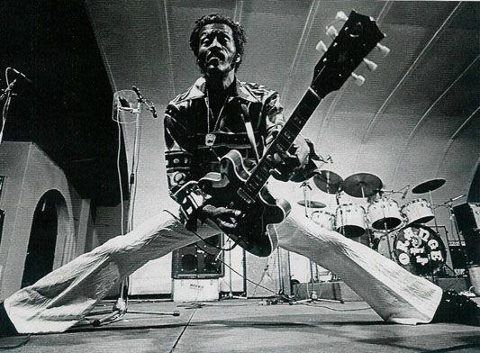
Chuck Berry – Rock and roll owes a lot to him…he has been copied more than anyone.

Related image

Scotty Moore, Elvis – The guitar player backing Elvis on his great 50s hits. Keith Richards said of Moore… Everyone else wanted to be Elvis, I wanted to be Scotty.

Image result for scotty moore 1955

Also

Robert Johnson, Eric Clapton, Duane Allman, Peter Green, Lindsey Buckingham, BB King, Joe Walsh, Jimmy Page

https://www.youtube.com/watch?v=tu4gbiZegP0&ab_channel=mistadobalina29


The Rolling Stones – The Under Assistant West Coast Promotion Man

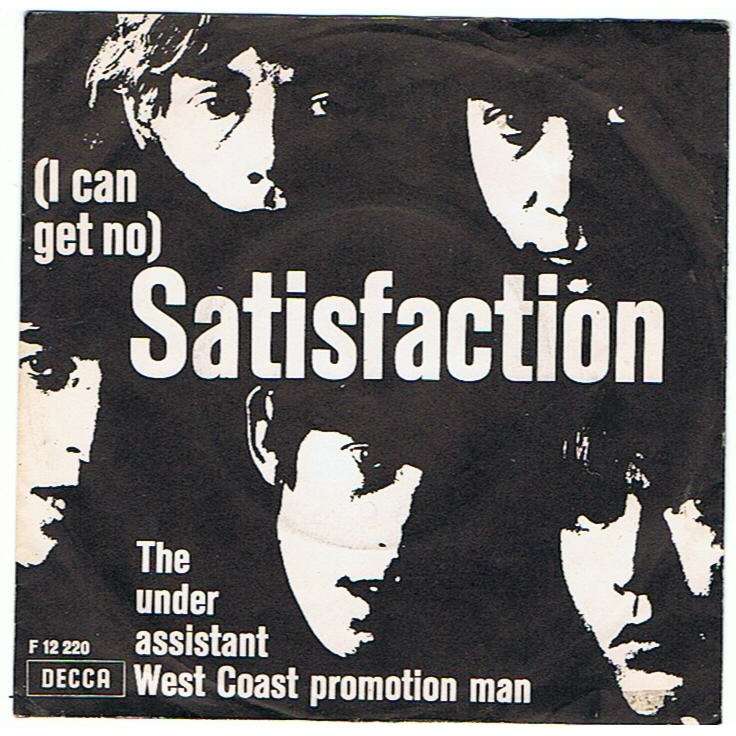
Not the most well-known song by the Stones but a lot of American’s owned it. I bought the single Satisfaction in 1979 and flipped it over and found this oddly named likable song. This was the American B side to Satisfaction. Not exactly Day Tripper/We Can Work It Out but a likable single all the same. The song was released in 1965.

The Stones recorded this in Chess studios in Chicago.

The song is about George Sherlock who was the London Records promotions man who accompanied the Stones to California. This was their response to having basically a chaperone.

Well, I’m waiting at the bus stop in downtown L.A.
But I’d much rather be on a boardwalk on Broadway

Well, I’m sitting here thinkin’ just how sharp I am
I’m an under assistant west coast promo man

Well, I promo groups when they come into town
Well they laugh at my toupee, they’re sure to put me down

Well, I’m sitting here thinking just how sharp I am
Yeah, I’m sitting here thinking just how sharp I am
I’m a necessary talent behind every rock and roll band

Yeah, I’m sharp
I’m really, really sharp
I sure do earn my pay
Sitting on the beach every day, yeah
I’m real real sharp, yes I am
I got a Corvette and a seersucker suit
Yes, I have

Here comes the bus, uh oh
I thought I had a dime
Where’s my dime
I know I have a dime somewhere
I’m pretty sure

Brian Jones: The Making of the Rolling Stones

A biography about Brian Jones who founded the Rolling Stones written by Paul Trynka. This is more of a sympathetic look on Brian than other books I’ve read. Trynka digs deep with meticulous research. He tries to be fair and Brian isn’t always shown as the nicest guy in the world but he also isn’t always the person that Mick and Keith seem to remember when they actually remember him at all.

This book is not just a rehash of the best-known things about Jones and the Stones. Some instances that Stones fans know like the period where Keith ran off with Brian’s girlfriend Anita Pallenberg, we get more information on what happened. He researched Brian’s childhood and adult life thoroughly and you feel like you know the man before the book is over.

This is not only a good book on Brian but also the birth of the Stones. After reading what I’ve read about Brian in past books, I had to wonder to myself, is this author trying to make Brian look better than he was? After reading more I didn’t think so. He interviewed over 100 people for this biography and many of them were either close friends or knew Brian. He was fair about the good and bad.

When you think of Brian Jones you can’t help but think of the way his life ended. Paul Trynka doesn’t miraculously find the definite answer to Brian’s death but he gives you the most recent events that have been uncovered and basic common sense answers to a mystery that probably will never be solved.

The Rolling Stones had three different lead/rhythm guitarists. Brian Jones, Mick Taylor, and Ronnie Wood. I make no secret of loving the Taylor period of the Stones. Saying that I will admit during the Brian Jones era they were more creative and tried different things. He was very important to their sound. Under My Thumb, Paint It Black, No Expectations, The Last Time, and Ruby Tuesday would not have been the same without Brian.

The book deals with the complicated relationship between Brian, Mick, and Keith. George Harrison and Brian Jones became friends and they had a lot in common. They were in a similar situation in their respective bands. The big difference was George had more of a support system than Brian did in his band. John and Paul had a monopoly on the songwriting but they would help George and he was given a chance to grow as a songwriter within the group. The Stones didn’t work that way.

Brian could be his own worst enemy and had a hard time handling fame but he was a very talented musician. Maybe the best musician in the band. Keith and Mick learned a lot from Brian. His musicianship, image, and outlook on life rubbed off on the more inexperienced Mick and Keith.

I would recommend this book to any Stones fan. You get a better picture of the earlier days. It is a reminder that it took more than Keith and Mick to get the Stones rolling.


A very good professional review of the book by Larry Rohter of the New York Times

Brian Jones is to the Rolling Stones what Leon Trotsky was to the Russian Revolution: organizer, ideologist and victim of a power struggle. Jones founded the group, gave it its name and recruited the schoolboys Mick Jagger and Keith Richards, who then marginalized him, eventually expelling him from the band. Since his death in 1969, a month after he was forced out, Jones has largely been airbrushed from the group’s history.

Paul Trynka’s biography “Brian Jones: The Making of the Rolling Stones” challenges the standard version of events, focused on Mr. Jagger and Mr. Richards, in favor of something far more nuanced. Though Mr. Trynka sometimes overstates Jones’s long-term cultural impact, his is revisionist history of the best kind — scrupulously researched and cogently argued — and should be unfailingly interesting to any Stones fan.

Specifically, “Brian Jones” seems designed as a corrective to “Life,” Keith Richards’s 2010 memoir. Mr. Trynka, the author of biographies of David Bowie and Iggy Pop, and a former editor of the British music magazines Mojo and Guitar, has interviewed Mr. Richards several times over the years and obviously likes him, but also considers his memory of events highly unreliable.

“History is written by the victors, and in recent years we’ve seen the proprietors of the modern Rolling Stones describe their genesis, their discovery of the blues, without even mentioning their founder,” Mr. Trynka remarks in the introduction. Without naming Mr. Richards, he also expresses his distaste for an assessment that appears in “Life,” that Brian Jones was “a kind of rotting attachment.”

The portrait of Jones that Mr. Trynka offers here is bifurcated. Though he is impressed with Jones’s “disciplined, honed sense of musical direction” and his dexterity on guitar and many other instruments, he does not hesitate to point out his subject’s more unpleasant personality traits: He was narcissistic, manipulative, misogynistic, conniving and dishonest about money. It’s not accidental that this book is called “Sympathy for the Devil” in Britain.

Mr. Trynka attributes Jones’s downfall to a conjunction of factors, some related to those character flaws but others external to him. Much has been written about the drug busts that swept up Mr. Jagger and Mr. Richards in the mid-1960s and their court battles, though Jones seems to have been even more of a target, because he was such a dandy and so successful with women.

But as Mr. Trynka tells it, Jones did not receive strong legal advice or fight charges as hard or as successfully as the Jagger-Richards team. After his first arrest, he pleaded guilty, which drove a wedge between him and other band members, who feared it would mean they could no longer tour abroad, all of which left him feeling crushed, isolated and vulnerable. That, in turn, increased his consumption of drugs and alcohol and made him less productive as a musician.

Nevertheless, Mr. Trynka demonstrates convincingly that the original Rolling Stones were Jones’s band and reflected his look, tastes and interests, not just the blues but also renaissance music and what today would be called world music. (He recorded the master musicians of Joujouka in the mountains of Morocco.) In “Life,” Mr. Richards describes his discovery of the blues-tinged open G guitar tuning, familiar from hits like “Honky Tonk Women” and “Start Me Up,” as life changing, and says it came to him via Ry Cooder in the late 1960s. But Mr. Trynka notes that Jones often played in that tuning from the band’s earliest days and quotes Dick Taylor, an original member of the Stones, as saying, “Keith watched Brian play that tuning, and certainly knew all about it.”

Some of Mr. Trynka’s account is not new, having appeared in “Stone Alone,” the often overlooked 1990 memoir of the Rolling Stones bassist Bill Wyman, or other books written by band outsiders. What makes Mr. Trynka’s book fresh and interesting, and gives it credibility, is the length he has gone to find witnesses to corroborate and elaborate on those stories.

It’s not just that Mr. Trynka has sought out those who worked with the band on the creative side, such as the singer Marianne Faithfull, the arranger Jack Nitzsche and the recording engineers Eddie Kramer, Glyn Johns and George Chkiantz. He has also interviewed those with more of a worm’s-eye view: drivers, roadies, office staff, old girlfriends and former roommates like James Phelge, whose surname the band would appropriate to designate songs that were group compositions rather than Jagger-Richard numbers.

“Brian Jones was the main man in the Stones; Jagger got everything from him,” the drummer Ginger Baker, who played in the band at some of its earliest shows and went on to become famous as a member of Cream, says in the book. “Brian was much more of a musician than Jagger will ever be — although Jagger’s a great economist.”

Citing those present at the creation, Mr. Trynka contends that Jones had a hand in composing some well-known Stones tracks, including “Paint It, Black” and “Under My Thumb.” He also claims that “Ruby Tuesday,” a No. 1 hit early in 1967, is actually a Jones-Richards collaboration — written not by Mr. Richards in a burst of inspiration and heartbreak in a Los Angeles hotel room, which is how the story is told in “Life” and elsewhere, but, according to Ms. Faithfull and Mr. Kramer, “labored over” by the pair in London for weeks.

“I used to say to Brain, ‘What on earth are you doing?’ ” Stan Blackbourne, the accountant for the Rolling Stones at their mid-1960s peak, recalls in the book. “ ‘You write some of these songs, and you give the name over as if Mick Jagger has done it. Do you understand, you’re giving ’em thousands of pounds!’ All the time I used to tell him, ‘You’re writing a blank check.’ ”

Mr. Trynka also looks into the circumstances of Jones’s death, on July 3, 1969, in the swimming pool at his home in East Sussex, once owned by A. A. Milne, but after all the Sturm und Drang that has come before, the subject is somewhat anticlimactic. In numerous books and in films like “Stoned,” it has been suggested that Jones was murdered, but Mr. Trynka painstakingly examines the flaws in each of the theories, and ends up close to the official verdict, “death by misadventure,” because of drug and alcohol consumption.

“The official coroner’s verdict on Brian’s death was perfunctory and lazy,” Mr. Trynka concludes. Nonetheless, “I’ve come to share their belief that Brian’s death was most likely a tragic accident” and to believe that “many of the existing theories that his death was in fact murder rely on unreliable witnesses.”

In the end, with the advantage of 45 years’ perspective, Mr. Trynka maintains, it is Jones’s music that matters. “It’s understandable why the survivors resent Brian Jones beyond the grave,” given his founder’s role, he argues, and also writes: “Brian Jones got many things wrong in his life, but the most important thing he got right.”


If you could have dinner with 9 people dead or still living…who would they be?

My list is pretty shallow sounding vs what some people would say… like Lincoln, Washington… Nope…no politicians, generals, or leaders…

1: John Lennon – He could be a walking contradiction but so were a lot of British rock stars but he was very intelligent and a superb songwriter. He loved to shock at times but could be very warm, generous and very honest. After he was killed his legend made him out to be some saint…he would have been the first to say he was not one….he didn’t suffer fools well.

2: Babe Ruth – What a guy… To me the best all-around player…Not only was he one of the best power hitters he was also a great left-handed pitcher…I would love to talk to him…get some dogs and beer and enjoy my time with the Babe. Yes, others have broken some of his records…but do they have 94 wins? On top of everything else… he had a huge personality.

3: Harpo Marx – The Marx brother that is my favorite. Yes Groucho is better known but Harpo was one of the most decent guys you could ever be around…he also hung out with the Algonquin round table crowd in the 1920s with writers Alexander Woolcott, brilliant playwright George Kaufman and many more. Harpo came from a very poor family at the turn of the century and he came to know some of the most brilliant minds of the 20th century.

4: Buster Keaton – Probably one of the best filmmakers of the 20th century. He gets overshadowed by Charlie Chaplin. Buster didn’t fake his gags…he didn’t cut away from shots…what you saw on film is what he did. He was a brilliant filmmaker.

5: Charlie Chaplin – Charlie and Babe Ruth were two of the best known celebrities of the 1920s. Charlie’s character The Tramp is still one of the most recognizable characters in history.

6: Jackie Robinson – Yes he was a Dodger and I’m a Dodger fan…but it’s more than that. He had to take so much abuse that probably contributed to his early death. He was a pioneer and should have been just another player if not for stupidity.

7: Keith Moon – I would prepare myself and sleep for as long as possible the day before and then try to keep up with him for as long as possible.

8: Clara Bow – My favorite actress hands down. The original and the only IT girl and could say more with her actions than anyone else with words…she lit up the screen.

9: Keith Richards – The only living member of my wishlist (though some would argue that fact) Keith is just cool period. If I had to describe rock and roll to an alien… I would hand them a copy of Brown Sugar and a picture of a 1972 Keith Richards… I love that he has survived…God Bless you, Keith.