It will be a little different today as this song was never a studio song. The Beatles never recorded this song for an album or single. Much later it was released in 1994 on Live At The BBC of them obviously doing it live.
They played this song regularly at the Cavern and Hamburg. The only known film footage of them playing in the Cavern is of them playing this song. It had been filmed on August 22, 1962 for Granada Television but the footage was grainy and they didn’t broadcast it until the Beatles hit big.
This is just a few days after Ringo became a Beatle. They had just got rid of Pete Best and you can hear at the very first of the Cavern footage a Pete Best fan saying “We Want Pete.” The footage is grainy but great. This was at the start of their rise. Love Me Do would be released two months later.
The Beatles loved to cover B sides and they had a knack for picking the right ones. I do wish they would have recorded this one in the studio but I don’t know if it would have captured the excitement of the live Cavern or BBC version. The song was written by Jerry Leiber, Mike Stoller, and Richie Barrett. Barrett released the song in 1962.
George Harrison: Brian (Manager Brian Epstein) had had a policy at NEMS of buying at least one copy of every record that was released. If it sold, he’d order another one, or five or whatever. Consequently he had records that weren’t hits in Britain, weren’t even hits in America. Before going to a gig we’d meet in the record store, after it had shut, and we’d search the racks like ferrets to see what new ones were there. That’s where we found artists like Arthur Alexander and Ritchie Barrett – ‘Some Other Guy’ was a great song.”
John Lennon: I’d like to make a record like ‘Some Other Guy’. I haven’t done one that satisfies me as much as that satisfies me.
The original, the BBC version, and the Cavern Version (it also shows a little of the original One after 909)…love Ringo’s drums on this.
Some Other Guy
Some other guy, now Is taking my love away from me, oh now Some other guy, now Is taking away my sweet desire, oh now Some other guy, now Just threw water, hold my hand, oh now I’m the lonely one, as lonely as I can feel, all right
Some other guy Is tippin’ up behind me like a yellow dog, oh now Some other guy, now Has taken my love just like I’m gone, oh now Some other guy, now Has taken my love away from me, oh now I’m the lonely one, as lonely as I can feel, all right
Oh oh oh oh
Some other guy Is making me very, very mad, oh now Some other guy, now Is breaking my padlock off my pad, oh now Some other guy, now Took the first girl I’ve ever had, oh now I’m the lonely one, as lonely as I can feel, all right now
We have here a Stones- Beatles collaboration…a slight one with Mick Jagger is said to be singing backups to this song.The John and Paul returned the favor on the Stones song We Love You.
I first heard this on the Magical Mystery Tour album. I love the bass sound that Paul got on this song.
The cool sounding instrument on this song is the the Clavioline which John plays. It was a forerunner to the synthesizer.
John Lennon and Paul McCartney wrote parts of this separately and combined it to make one song… something they would repeat on “A Day In The Life.” At one point, the song was called “One Of The Beautiful People.”
On August 7th, 1967, just three weeks after the single was released in the US, George Harrison and entourage decided to make a brief visit to the Haight-Ashbury district of San Francisco, California, to visit the highly publicized “beautiful people” of the area and played the song on an acoustic after one was produced from a growing crowd. George didn’t stay too long.
Near the end of the song legend has it that John sings “Baby, you’re a rich f*g jew” as a reference to Brian Epstein toward the end of the song. Whether it is…it’s hard to tell. Whatever is in your head when you listen…it can become that. I’ve never read where John admitted it…and if he would have done that…I don’t see him shying away from admitting it.
Eddie Kramer…future producer for the Jimi Hendrix played the vibraphone.
From Songfacts
This song is about how everybody can have the things that matter, and it has nothing to do with material possessions. The Beatles were rich, but they claimed that money was not that important to them.
It was rumored that The Beatles sang “Baby you’re a rich fag Jew” as a slur to their manager, Brian Epstein. He was rich, gay and Jewish, but The Beatles never said this was about him. Epstein died later in that year when he overdosed on sleeping pills.
The Beatles started working on this song with the intention of using it on the Yellow Submarine soundtrack. It was used in the 1968 movie, but didn’t appear on the soundtrack.
Mick Jagger sang backup. McCartney and Lennon returned the favor by singing on The Stones’ “We Love You.”
Brian Jones, the guitarist from The Rolling Stones, played an oboe on this. A few years earlier, Lennon and McCartney gave The Stones a song called “I Wanna Be Your Man,” which was one of their first hits, and helped convince Mick Jagger and Keith Richards that they should write their own songs.
This was released as the B-side of “All You Need Is Love.”
Lennon played clavioline and piano on the song and George Harrison played tambourine. There is actually no guitar on this song at all. Paul played bass and piano as well.
This was released in mono, but in 1971 it was remixed in stereo along with several other tracks for a German version of Magical Mystery Tour. The stereo version is the one that is now the most common.
The comedy rap trio The Fat Boys performed this song in their 1987 movie Disorderlies.
In 2010, this song was used at the end of the movie The Social Network to punctuate the raging financial success of the guys who invented Facebook. It was one of the few Beatles songs licensed to a movie in its original form, meaning the Beatles version was used. Apple Corp. is very particular about where Beatles songs are used.
At one point in this song, The Beatles ask, “How does it feel to be one of the beautiful people?” The phrase “beautiful people” was used a lot in 1967 as a derisive way to describe the social elite. A popular book by Marilyn Bender was published that year called The Beautiful People: a Candid Examination of a Cultural Phenomenon – the Marriage of Fashion and Society in the ’60s.
Baby You’re A Rich Man
How does it feel to be One of the beautiful people Now that you know who you are What do you want to be And have you traveled very far? Far as the eye can see
How does it feel to be One of the beautiful people How often have you been there Often enough to know What did you see when you were there Nothing that doesn’t show
Baby you’re a rich man Baby you’re a rich man Baby you’re a rich man, too You keep all your money in a big brown bag Inside a zoo, what a thing to do Baby you’re a rich man Baby you’re a rich man Baby you’re a rich man, too
How does it feel to be One of the beautiful people Tuned to a natural E Happy to be that way Now that you’ve found another key What are you going to play
Baby you’re a rich man Baby you’re a rich man Baby you’re a rich man, too You keep all your money in a big brown bag Inside a zoo, what a thing to do Baby, baby, you’re a rich man Baby you’re a rich man Baby you’re a rich man, too, oh Baby you’re a rich man Baby you’re a rich man (baby) Baby you’re a rich man, too Baby you’re a rich man Baby you’re a rich man Baby you’re a rich man, too
Back as promised…I know this isn’t everyone’s cup of tea so to speak but I hope you enjoy it. This is obviously the 5th edition of this series. In Part 1, Part2, Part 3, and Part 4. We covered Brian May’s Red Special, Willie Nelson’s Trigger, George Harrison’s Rocky, Eddie Van Halen’s Frankenstrat, Bruce Springsteen’s guitar, Neil Young’s Old Black guitar, John Lennon’s Casino + a Bonus, and Keith Richards Telecaster.
Today will we look at:
Paul McCartney’s Hofner Bass and Eric Clapton’s Blackie.
Paul McCartney’s Hofner Bass and the MISSING Hofner Bass
Paul’s bass is maybe the most iconic guitar/bass of all time in rock music. You see this bass and you think Beatles. I see the attraction to this bass. I have a Hofner copy and I’ve played a Hofner a few times. They are ultra light and have a nice feel to them. The Hofner is really easy to play.
Lets start with the Hofner he bought in Hamburg in 1961…we will call it The Cavern Bass or Hofner#1. It was played on some iconic Beatles recordings including their very first studio outing in June 1961 in Hamburg, their first single Love Me Do in 1962 and their first two albums, Please Please Me and With The Beatles in 1963. It’s the one you hear on “She Loves You, “Twist and Shout”, it was played in Hamburg, at The Cavern Club, and at Abbey Road.
In 1965 he sent it in to get it worked on…it was sprayed with a darker sunburst and the pickup guard removed.
It was last seen in the 1969 footage from Twickenham Studios, where the Beatles were filming “Let It Be.” Soon afterward, it was stolen, most likely from a closet at EMI’s Abbey Road studio, along with Harrison’s Gretsch Tennessean and second Ric 360-12. People are still looking for that bass guitar.
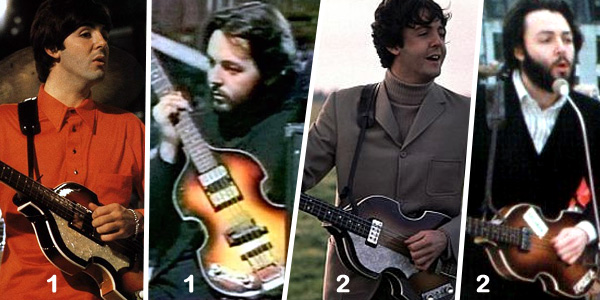
These two pictures show the same Bass…the Cavern Bass…notice the different colors and the removed pick guard…but same bass.
In 1963 Paul bought another Hofner bass that he used as his primary bass and played it from then on and still does. We will call it Hofner #2. He didn’t retire the Cavern Bass but just used it as a back up to Hofner #2.
Here are the two basses labeled…the #1 is the lost/stolen Cavern bass and the #2 is the 1963 bass he used throughout the Beatles. Paul is still looking for the Cavern Bass and the Hofner company has a webpage describing the bass and trying to get it back for Paul.
I have to wonder who has this bass. Odds are they don’t know what they have… if it survives. I hope Paul gets it back… he loves instruments and still has many of the instruments he used with The Beatles… Hey…lets go out and find this bass…that would be one way to meet him!
***From the mid-sixties on he would use a Rickenbacker bass which produced brighter and clearer bass sound. He famously used one on Sgt Pepper. He used both basses through the years.
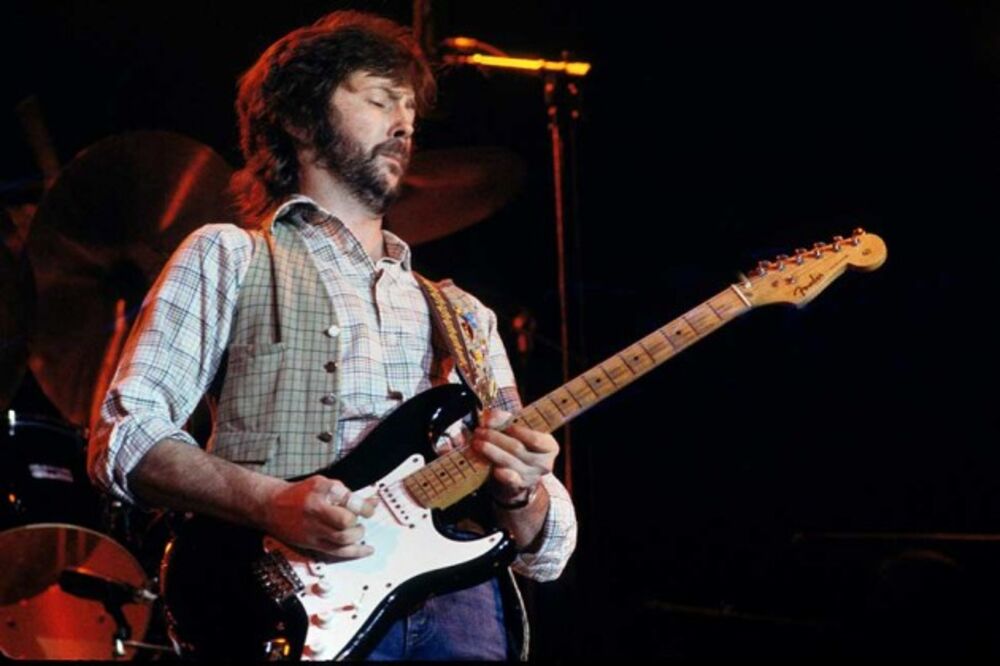
Eric Clapton’s Blackie
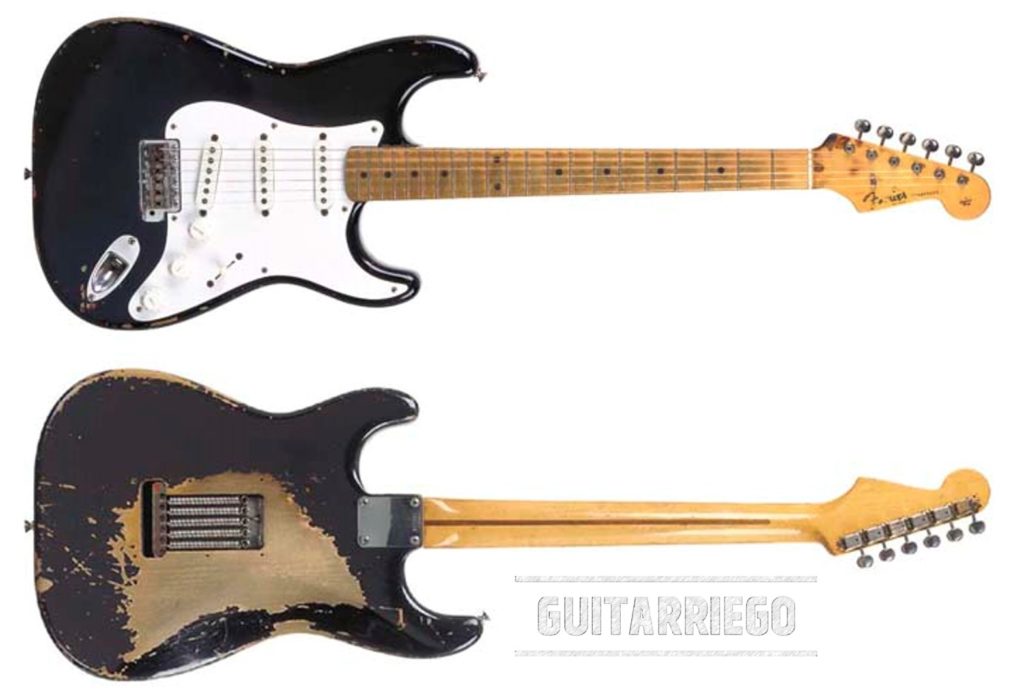
Eric built this guitar in around 1970 from different Fender Strats…here is Eric telling the story.
Eric Clapton: “I was in Nashville and I went into this shop called Sho-Bud where they had stacks of Fender Strats going for virtually nothing because they were so unfashionable and unwanted,”
“I bought a big pile of them all for a song – they were really cheap, like $300 or $400 each – and I took them home and gave them out. I gave Steve Winwood one, I gave Pete Townshend one, I gave George Harrison one and I kept a few, and I made Blackie out of a group of them. I took the pickups out of one, the scratchplate off another, the neck off another and I made my own guitar, like a hybrid guitar that had all the best bits from all these Strats.”
Blackie would be the main guitar used on every one of Eric’s albums for 15 years. During that time, Eric and Blackie would rack up an impressive number of hits, including “Cocaine,” “I Shot the Sheriff,” “Wonderful Tonight,” and “Lay Down Sally.”
in 2004, Eric worked with Christie’s to auction the legendary guitar off. The winner paid $959,000 for Blackie, with most of the proceeds again supporting Eric’s Crossroads Center.
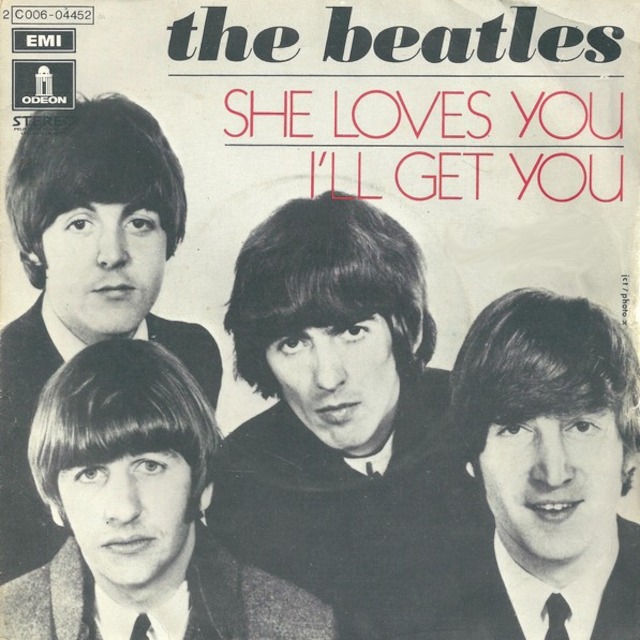
This song help kick off the sixties. The melody, music, the great harmonies and just the excitement of the song. She Loves You help define them and broke huge. Ozzy Osbourne made a statement about the song… “Imagine you go to bed today and the world is black and white and then you wake up, and everything’s in color.”
These great melodies that John, Paul, and later George would come up with lasted through their career. Even when their music got a little more sophisticated the melodies remained…they were underneath the early, middle, and late era Beatle music.
It’s best known for the yeah, yeah, yeah… Yeah, the Everly Brothers did it first, using a hook of “yeah, yeah, yeah, yeah” on their 1961 cover of the song “Temptation,” which was a #1 hit in the UK.
Paul McCartney’s dad wanted the Beatles to sing yes, yes, yes instead because he thought it sounded more dignified.…doesn’t have the same ring does it?
She Loves You peaked at #1 in the Billboard 100, Canada, the UK, and New Zealand in 1964.
In the UK, this is the biggest selling Beatles single. It held the record for top-selling UK single of all time until 1977, when Wings topped it with Mull Of Kintyre.
George Martin didn’t like the ending chord. He thought it sounded too much like the The Andrew Sisters but the Beatles liked it and over rode the producer on this one…and it works great.
in April 1964 The Beatles had the Top 5 Songs on the Billboard Top 100 Singles of the week. The closest any other artist ever got was 3 songs in the Top 10. But there they were- Can’t Buy Me Love, Twist and Shout, She Loves You, I Want To Hold Your Hand, Please Please Me, sitting at the top, along with 7 other Beatles songs in the Top 100 the same week.
Cynthia Lennon: “He was also romantic, a side of him I saw more often as our relationship deepened. He wrote love poems on scraps of paper and passed them to me at college. For our first Christmas he drew a card with a picture of me in my new shaggy coat, standing opposite him, our heads together, his hand on my arm. It was covered with kisses and hearts and he wrote, ‘Our first Christmas, I love you, yes, yes, yes.’ A few years later he used the same idea in one of the Beatles’ first hits, ‘She loves you, yeah, yeah, yeah.'”
John Lennon:“I remember it was Paul’s idea,” Lennon recalled, “Instead of singing ‘I love you’ again, we’d have a third party.”
Paul McCartney:“We were in a van up in Newcastle somewhere,” “and we’d just gone over to our hotel. I originally got an idea of doing one of those answering songs, where a couple of us sing about ‘she loves you’ and the other one sort of says the ‘yes, yes’ bit. You know, ‘yeah, yeah’ answering whoever who is saying it. But we decided that was a crummy idea anyway. But we had the idea of writing a song called ‘She Loves You’ then. And we just sat up in the hotel bedroom for a few hours and wrote it.”
From Songfacts
The Beatles tell quite a tale in this tidy pop song. Some poor guy thinks he has lost his girl for good, but he’s redeemed when he finds out from a friend that she still loves him. There’s even a moral at the end of the story: “Pride can hurt you too.” Good advice when arguing with a loved one.
This was an instant hit in the UK, but not in America, where it was released on Swan records, the only US label that would take it. Swan put it out in September 1963, but while The Beatles were huge in their homeland, they were still no big deal in America until February 1964. That’s when Beatlemania took hold and “She Loves You” became a US hit.
This was one of four Beatles songs that was never released in stereo. The others are “Love Me Do,” “I’ll Get You” and “You Know My Name (Look Up The Number).”
The Beatles released a German version translated as “Sie Liebt Dich” in the US in 1964. They learned some German when they became the house band at the Star-Club in Hamburg in 1962, but needed a German speaker to help them with the lyrics. They recorded the German version in Paris – it was the only time they recorded outside of England.
Apart from “My Bonnie,” which was recorded with Tony Sheridan in their early days in Hamburg, the only other song the Beatles recorded in another language, again German, was “I Want To Hold Your Hand.” “Komm Gib Mir Deine Hand” was recorded the same time as “Sie Liebt Dich.”
“Sie Liebt Dich” peaked at #97, the lowest position of the Beatles’ 71 Hot 100 charted songs.
Jack Paar played a video clip of The Beatles performing the song on his show January 3, 1964. The Beatles had appeared on news clips as part of stories about their success in England, but this was the first time they appeared on a US TV talk show. They also played it on both of their live Ed Sullivan Show appearances. When The Beatles agreed to do the show, they were not a big deal in America and took less money than most acts received for their fee. When The Beatles played The Ed Sullivan Show for the first time, it got the largest audience ever for a TV show. Sullivan began having regular musical guests from the world of popular music, and it became a showcase for groups like The Rolling Stones, The Supremes, Santana and Creedence Clearwater Revival.
Paul McCartney and John Lennon were inspired to write this after a concert at the Majestic Ballroom in Newcastle when they were part of a tour with Roy Orbison and Gerry & the Pacemakers. Says McCartney, “There was a Bobby Rydell song out at the time ‘Forget Him’ and, as often happens, you think of one song when you write another. We were in a van up in Newcastle-Upon-Tyne. I’d planned an answering song where a couple of us would sing ‘She loves you’ and the other ones would answer ‘Yeah Yeah.’ We decided that was a crummy idea but at least we then had the idea of a song called She Loves You. So we sat in the hotel bedroom for a few hours and wrote it; John and I, sitting on twin beds with guitars.”
In the UK, this hit #1 twice in 1963, first on September 4 and again on November 20.
Regarding the falsetto exaltation that occurs at the song’s manic peak, McCartney once explained: “The ‘wooooo’ was taken from the Isley Brothers’ ‘Twist and Shout.’ We stuck it in everything.”
These wordless vocalizations of joy were a Beatles hallmark; they most obvious example is the extended fadeout in “Hey Jude.”
The Beatles played part of this at the end of “All You Need Is Love,” which they recorded four years later.
This song was played at the conclusion of the concert sequence at the end of the film A Hard Day’s Night, although it wasn’t included on the soundtrack album.
Norman Smith, who was The Beatles engineer, told the story in his autobiography John Called me Normal about feeling his heart sink when he spotted the lyrics on the music stand. As he later relayed to Mark Lewinsohn: “She loves you, yeah yeah yeah, She loves you, yeah yeah yeah, she loves you yeah yeah yeah yeah… I thought, My God, what a lyric! This is going to be the one I do not like.”
Smith had a hit in 1972 with “Oh Babe What Would You Say” as Hurricane Smith. He also produced the first three Pink Floyd albums.
There is a very clear edit in this song between the lines “I think it’s only fair/Pride can hurt you too.” It appears that two version had been edited together.
In August 2009 the Official Chart Company compiled a list of the Beatles biggest selling hits in the UK, including re-issues. They revealed that this song was the Fab Four’s best seller in their native country, followed by “I Want To Hold Your Hand” and “Can’t Buy Me Love.”
The Melissa Manchester hit You Should Hear How She Talks About You was written as a contemporary take on this song, with the singer telling a friend that a guy is really into her.
She Loves You
She loves you, yeah, yeah, yeah She loves you, yeah, yeah, yeah She loves you, yeah, yeah, yeah, yeah
You think you’ve lost your love Well, I saw her yesterday-ay It’s you she’s thinking of And she told me what to say-ay
She says she loves you And you know that can’t be bad Yes, she loves you And you know you should be glad
She said you hurt her so She almost lost her mind But now she says she knows You’re not the hurtin’ kind
She says she loves you And you know that can’t be bad Yes, she loves you And you know you should be glad, ooh
She loves you, yeah, yeah, yeah She loves you, yeah, yeah, yeah With a love like that You know you should be glad
You know it’s up to you I think it’s only fair Pride can hurt you, too Apologize to her
Because she loves you And you know that can’t be bad Yes, she loves you And you know you should be glad, ooh
She loves you, yeah, yeah, yeah She loves you, yeah, yeah, yeah With a love like that You know you should be glad With a love like that You know you should be glad With a love like that You know you should be glad Yeah, yeah, yeah Yeah, yeah, yeah, yeah
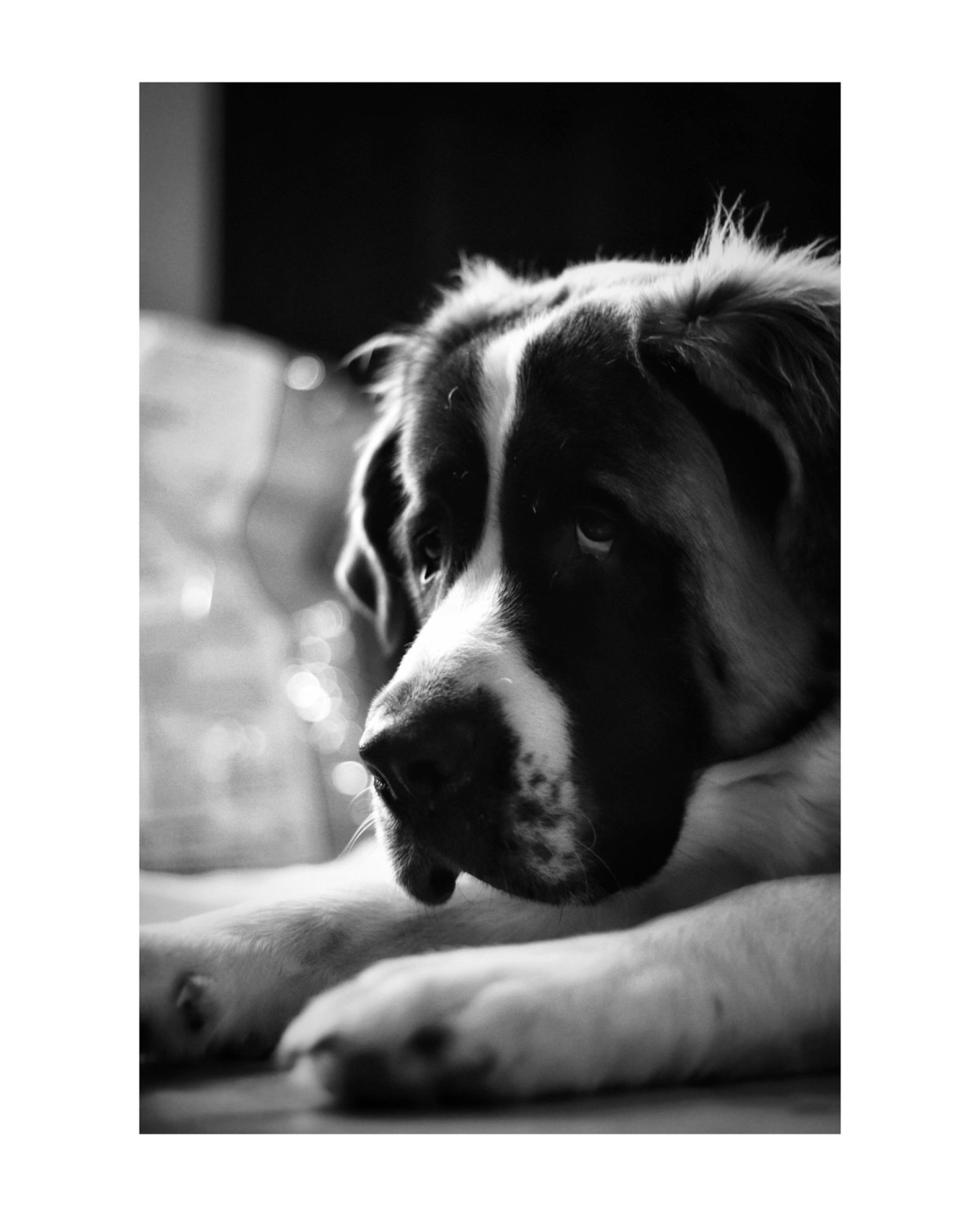
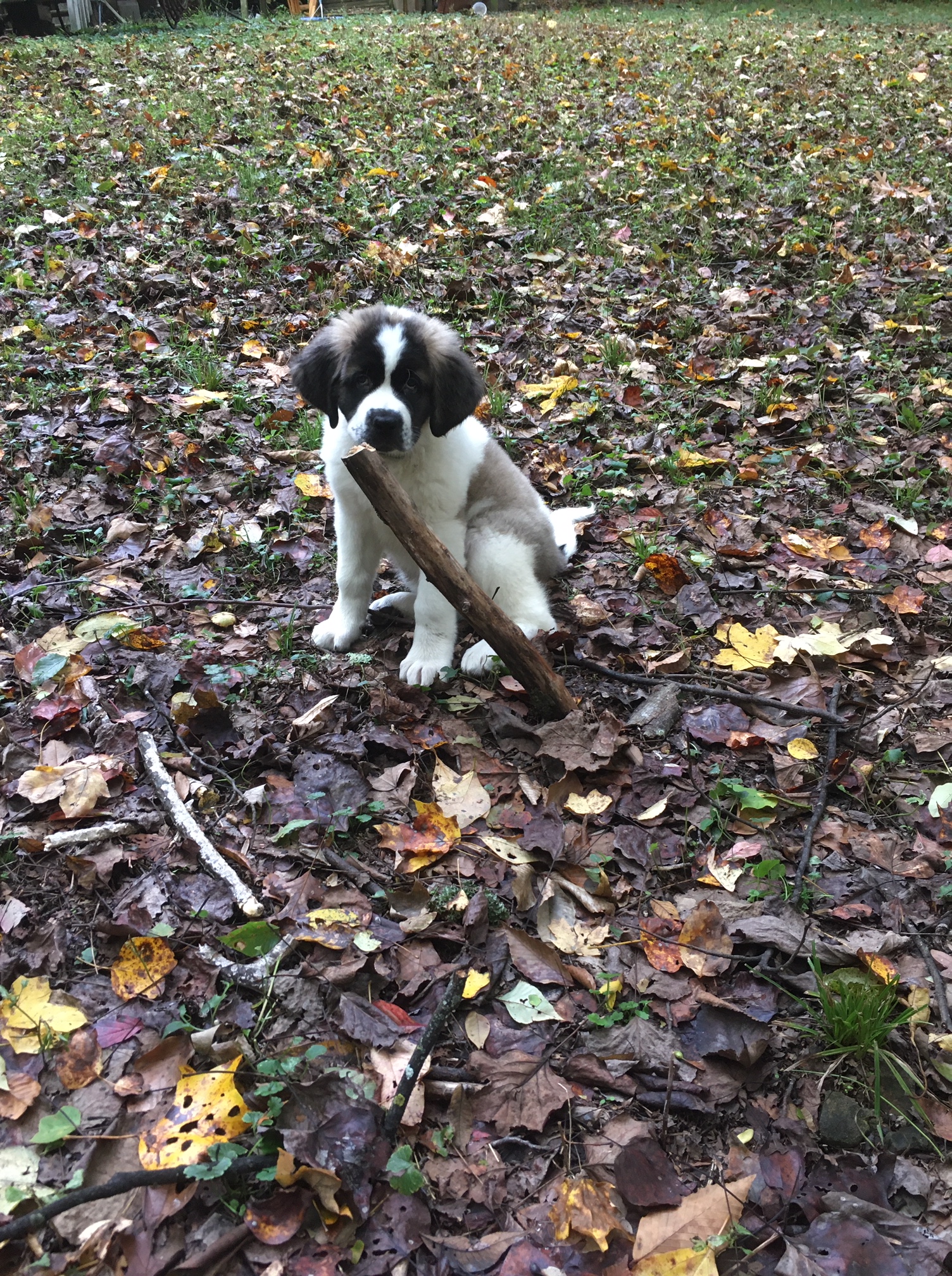
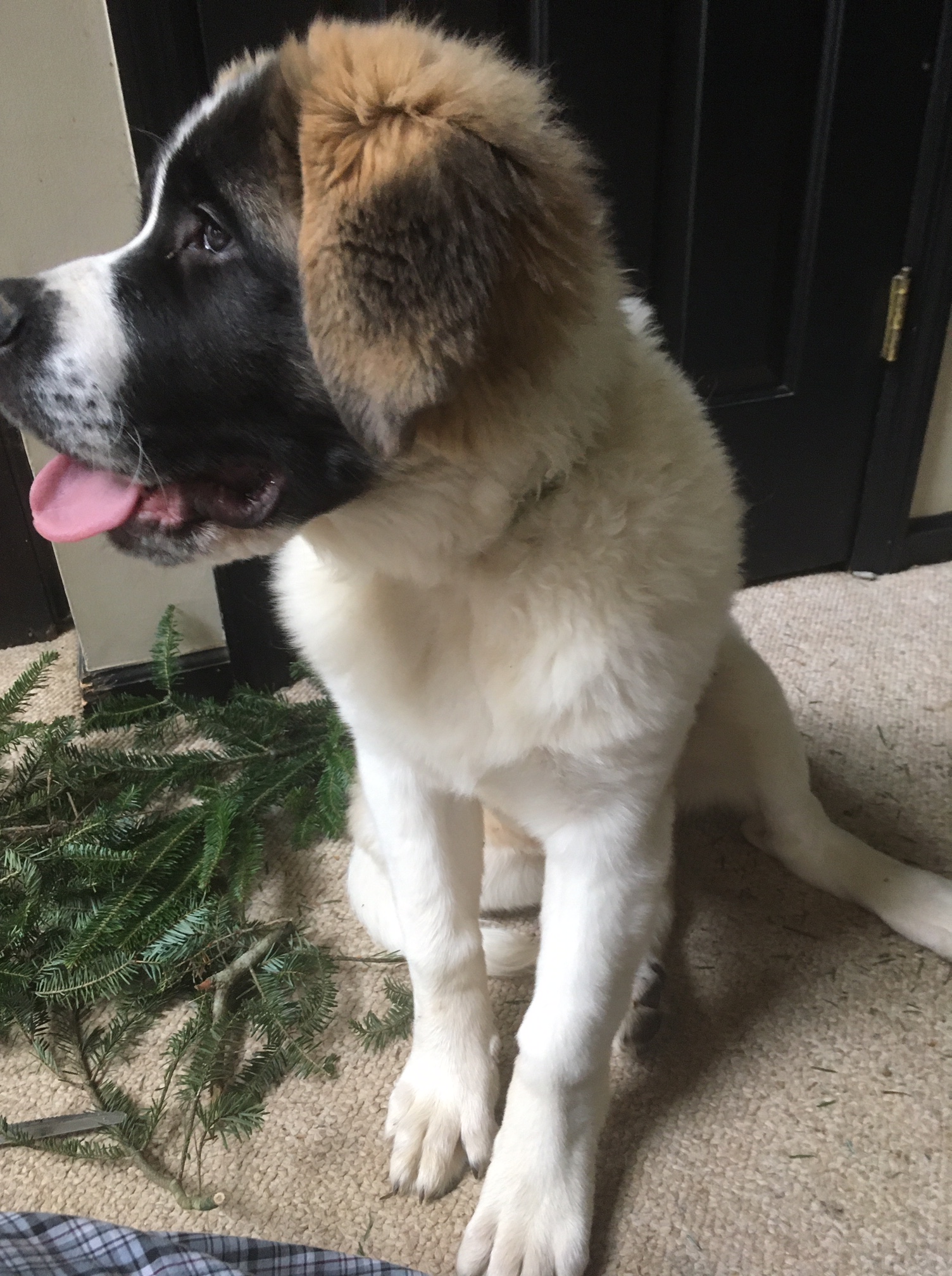
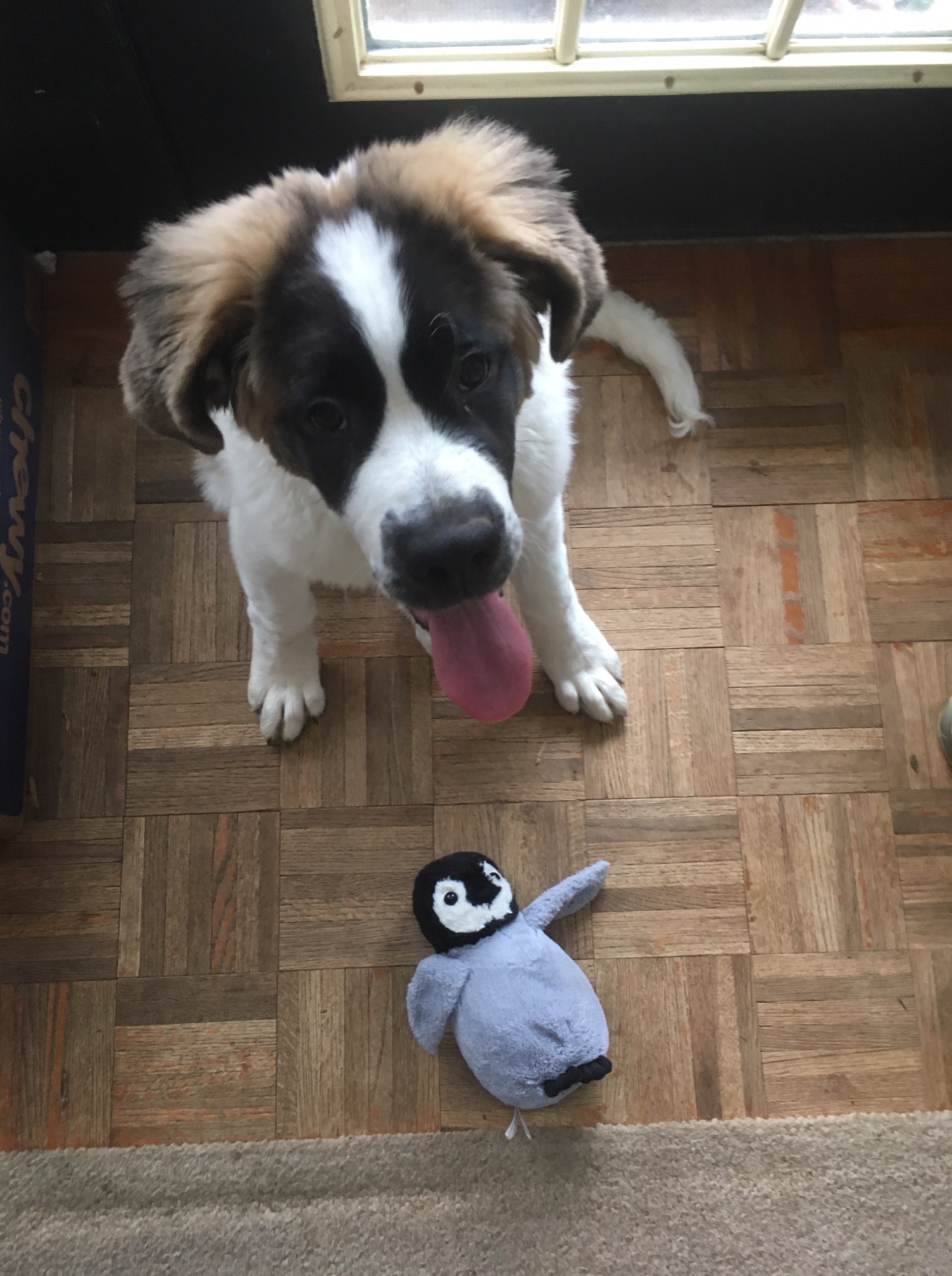
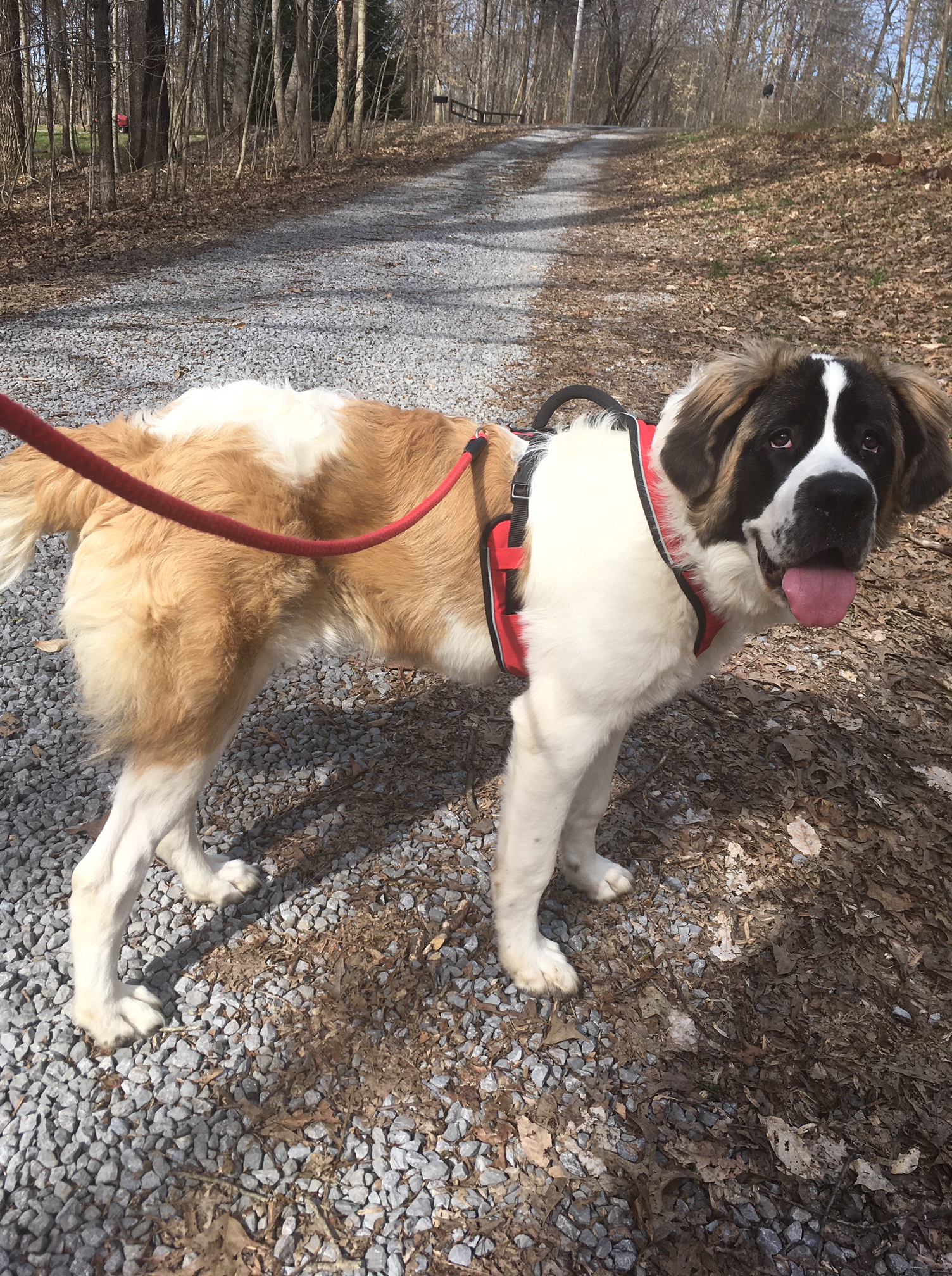
I had some requests to show an update on Martha. I was going to post an update on her on October 4th 2020…exactly a year after we got her but with my work right now I had to hold that off. Her birthday is August 18, 2019 so now she is one year and five months old.
She has settled down now a little bit. This is our third Saint and we never had one with this much energy but now she has matured a little.
We had one scare with her. This goes out as a warning to anyone who is taking their pet to get a rabies shot. We never had trouble with it at all with our other dogs… but around 12 hours after the shot…she started to get really sick. For three days she could not hold anything down and would not eat… and the vet kept telling us to give her Benadryl. She was allergic to the rabies shot. After the third day my son came home with a hamburger and she ate it. When she did that she started to get better and was soon back to normal.
So after your pet gets a rabies shot…keep a close eye on them.
Anyway she has free range in our house. After she was house broken AND we could trust her not to eat our couch… she no longer has to stay in her kennel.
She still has a lot of energy but nothing like she did a few months ago.
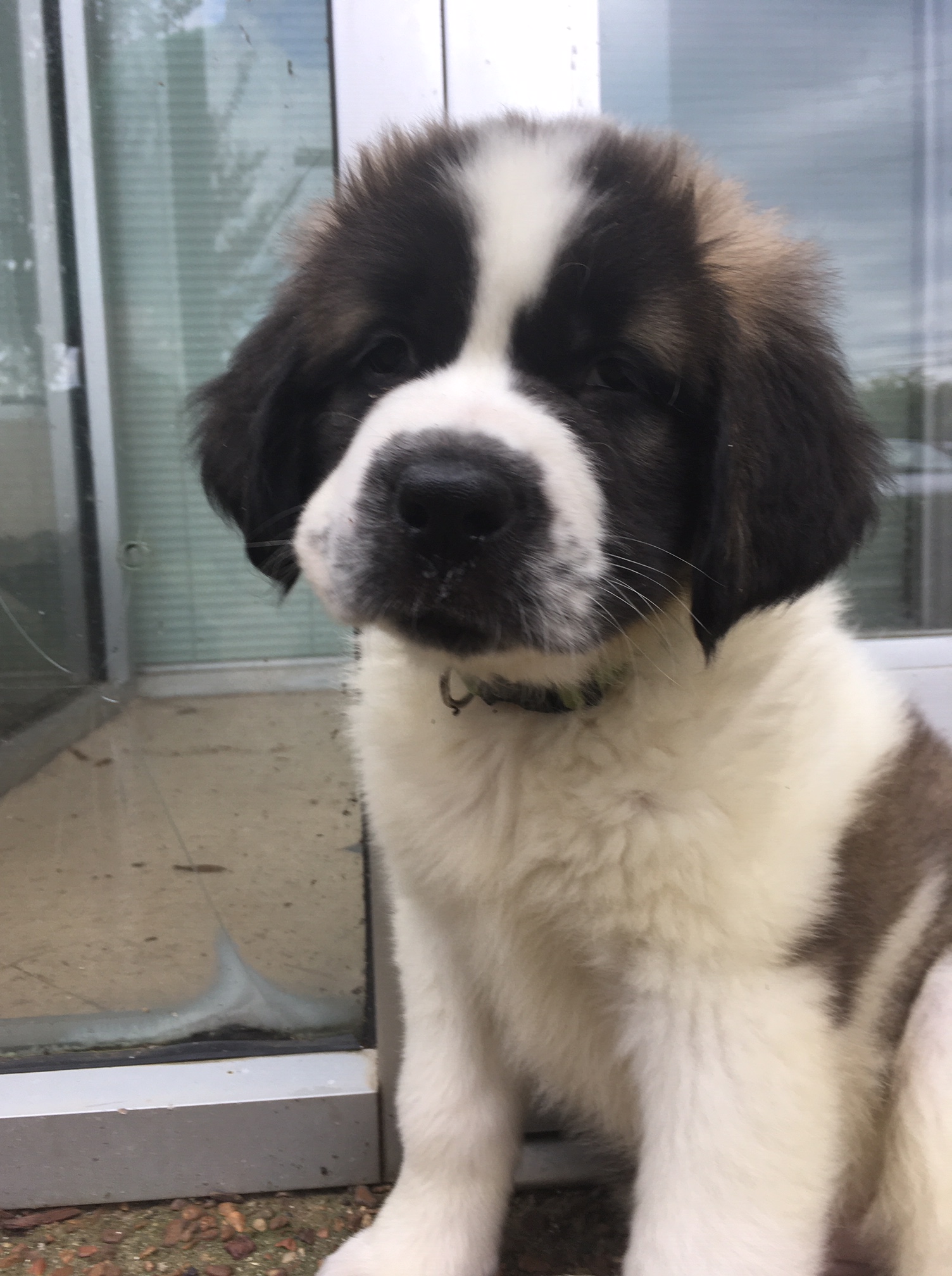
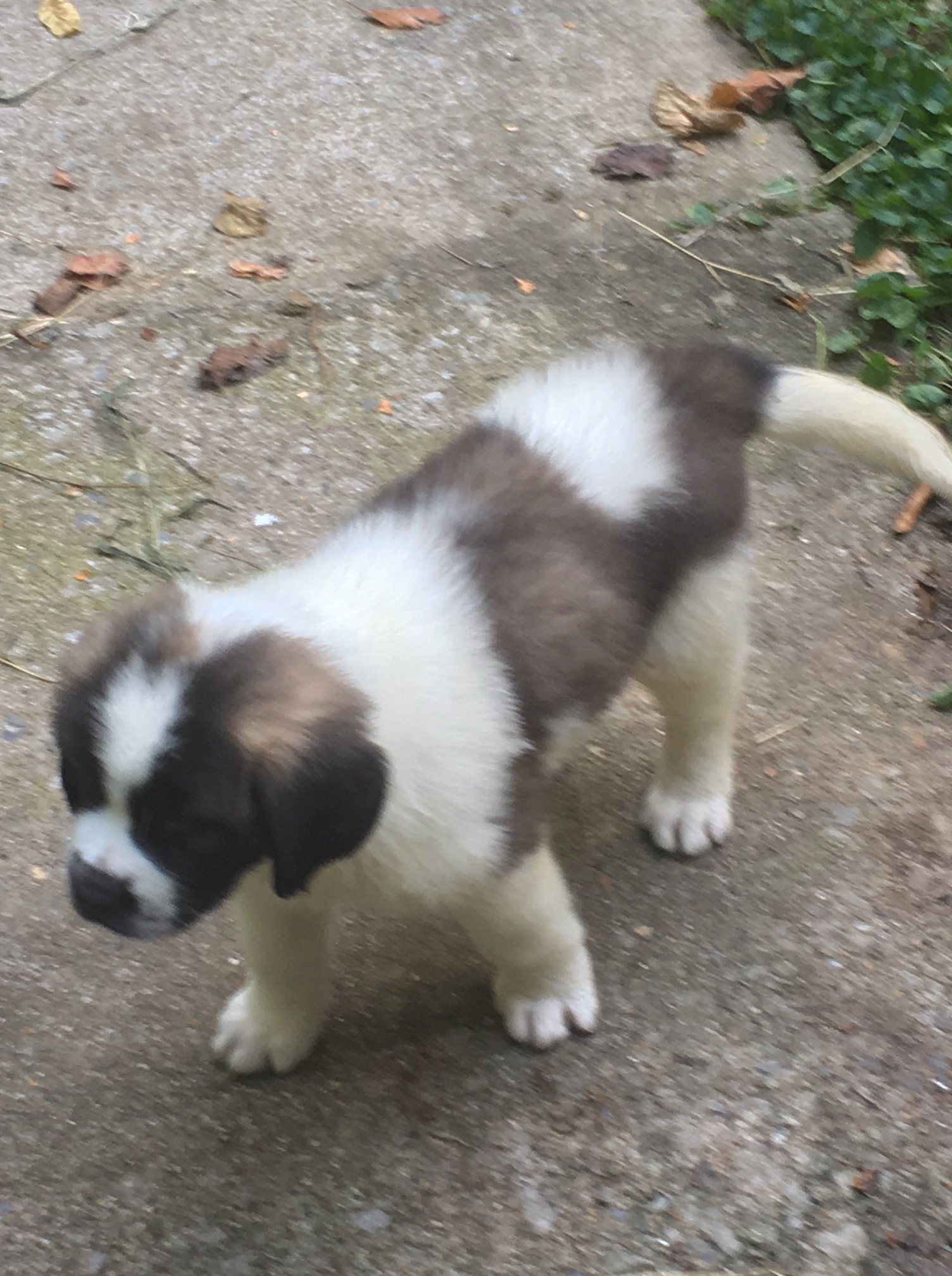
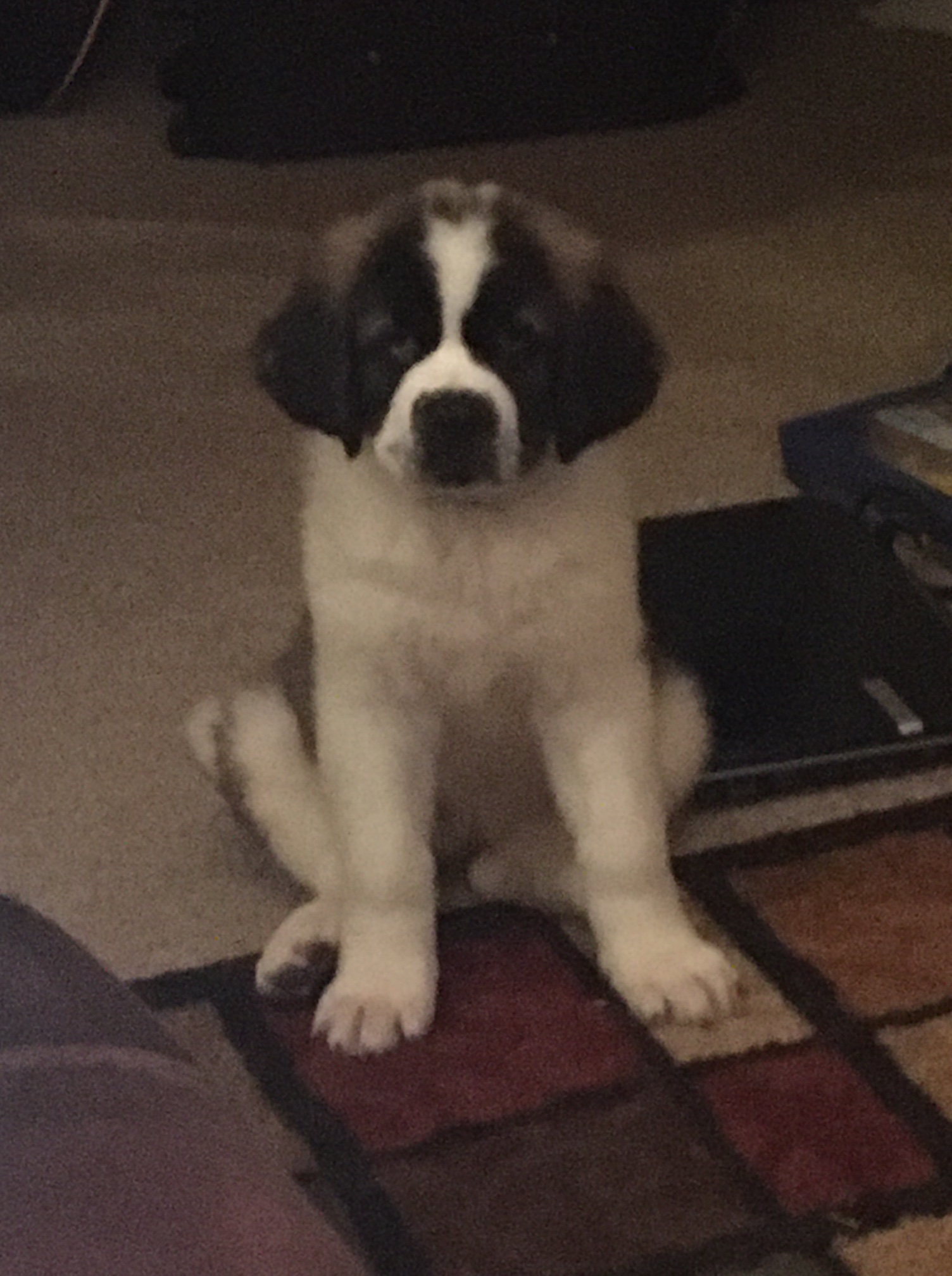
I’ll give you a few pictures for updates starting with the first ones.
Martha at 2 months old…Oct 4, 2019
Martha at 3 Months old
Martha at 4 Months old…she still has the penguin and plays with it.
Martha at 7 months and 8 days in our driveway…March 26, 2020
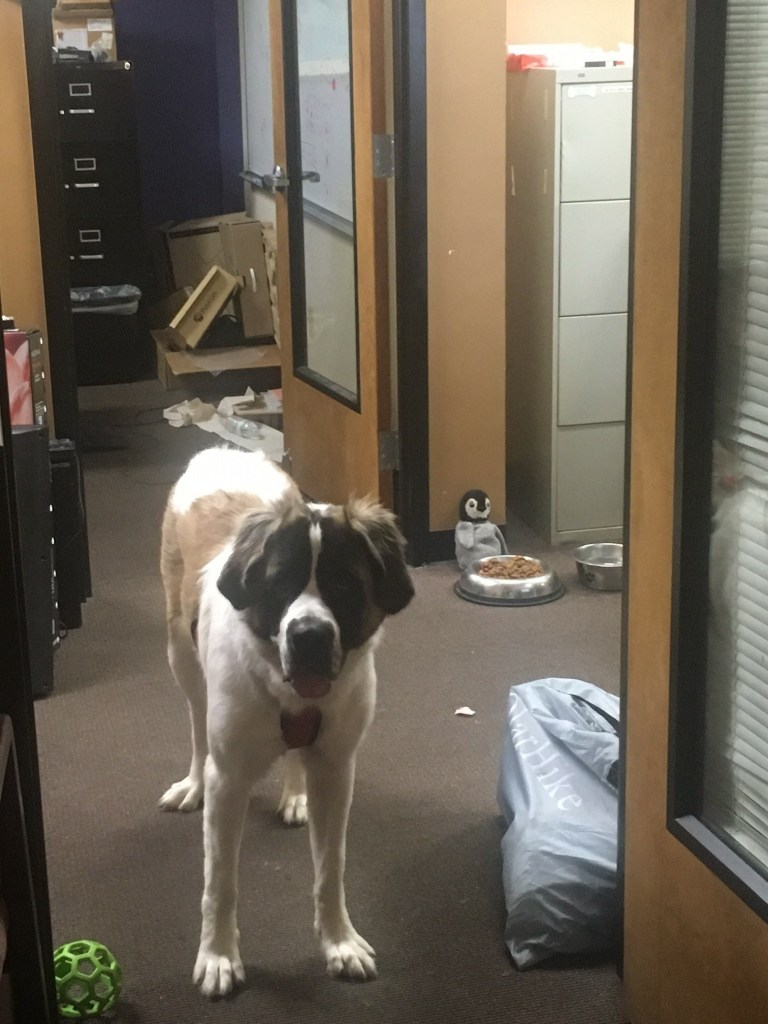
Martha now…I brought her along to work with me…since I’m the only one left in IT at this moment and I have it all to myself…I had her setup…we were a little messy that day.
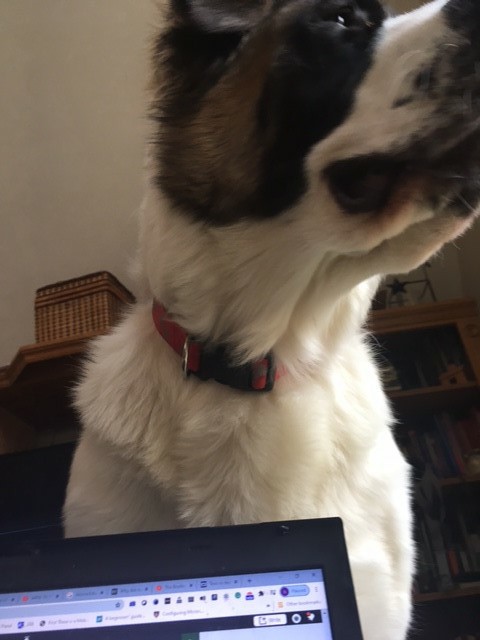
After coming home from work…logging in trying to get a few more things done at work…Martha has other ideas
The song that she is named after! “Martha My Dear”
John Lennon was primarily a rhythm guitar player but George Harrison briefly left the Beatles during the recording of Let It Be. John took the lead guitar part on this song and made a memorable solo. John was a very aggressive guitar player and on this one he was on the mark.
McCartney got the idea for the title “Get Back” from the line “Get back to where you should be” from a song George Harrison wrote called “Sour Milk Sea,” which was eventually recorded by Jackie Lomax. McCartney changed the line to, “Get back to where you once belonged”.
Early versions include the line “I dig no Pakistanis.” The song began as a commentary about immigration, telling people to “get back” to their own countries. It was meant to mock Britain’s anti-immigrant proponents. Paul McCartney, who wrote the song and sang lead, thought better of it and made the lyrics more palatable.
At the end of this album version, we hear cheering, followed by McCartney saying, “Thanks Mo” in response to Ringo’s wife, Maureen, who was clapping. Lennon then says, “I’d like to say thank you on behalf of the group and ourselves, and I hope we’ve passed the audition.” This part came from the live rooftop performance.
This song went number 1 everywhere. #1 in the Billboard 100, Canada, UK, New Zealand, The UK, Australia, Austria, Belgium, Ireland…and so on. The B side was Don’t Let Me Down…which personally I like more.
From Songfacts
“Get Back” was going to be the title of the album and the documentary film about making it. The Beatles stopped touring in 1966 and were worn thin by 1968, but they rekindled their passion for performance after shooting the “Hey Jude” promotional film in September that year before a live audience. Energized by the effort, they agreed to the documentary; the concept was The Beatles “getting back” to their roots and playing new songs for a live audience without any studio tricks.
The song “Get Back” came closest to capturing that spirit. Produced by George Martin, it was released as the follow-up single to “Hey Jude” in April 1969 (a month later in America) and was another blockbuster for the group, going to #1 in most territories.
The album became something completely different from the live set they planned. Glyn Johns, who engineered the sessions, was asked to put it together from what were really rehearsal tapes. After he assembled the album, it sat around while the Let It Be documentary was being edited from the film footage of The Beatles rehearsing in the studio and playing on the rooftop. During this time, The Beatles made the Abbey Road album, released it, and broke up.
Phil Spector, who had worked on John Lennon’s solo song “Instant Karma” (which George Harrison played on), was brought in to produce the Get Back album, which was re-titled Let It Be. Spector took the tapes and added orchestrations using his “Wall Of Sound” technique, and the album that was supposed to be the raw sound of The Beatles returning to their roots was released as a highly produced swan song on May 8, 1970, after they had broken up.
The Beatles famously performed this song from the rooftop of Apple Records on January 30, 1969, footage of which serves as the climax to their Let It Be documentary film. Knowing it would get shut down pretty quickly, the group kept mum about the performance, which was designed to promote the single and provide an ending for their film. They got in three takes of “Get Back” before police pulled the plug. The plan worked: Not only did they get their film ending, but the audio (including their banter) was used on various edits of “Get Back” to give it a live feel and add some character.
In their early days, The Beatles were musical warriors, playing in clubs for hours most nights. The “Get Back” single harkened to those days and was advertised as “The Beatles as nature intended.”
The single version runs 3:11 and contains a false ending at 2:34, after which McCartney comes back with a spoken verse:
“Get back Loretta, your mummy’s waiting for you, wearing her high-heeled shoes and her low-neck sweater, get back home, Loretta.”
The album version is a little shorter (3:09) and omits this section. It begins with a behind-the-scenes bit from the band tuning up during a session for the song on January 27, 1969. We hear John Lennon poke fun at the first line (“Jojo was a man who thought he was a loner, but he knew it couldn’t last”) by saying:
“Sweet Loretta fat she thought she was a cleaner, but she was a frying pan.”
Billy Preston played piano on this track and became the only guest artist to get a credit a Beatles single when it was credited to “The Beatles with Billy Preston.”
Preston was a salve and a spark for the group. On January 10, 1969, George Harrison quit and almost left for good. He came back to work on January 21, but the tension lingered. Preston showed up the next day and galvanized the group; he played on “Get Back” and “Don’t Let Me Down,” and participated in sessions for several other tracks.
The Beatles met Preston in 1962 when they were both playing in Germany, but they hadn’t seen each other since. It was Harrison’s idea to bring him in; after George left the Let It Be sessions, he saw Preston in concert with Ray Charles and arranged for him to join The Beatles. Having him in the studio eased the tension and made it easier for the group to put personal conflicts aside and record the album.
The press release to promote the single contains this quote from McCartney: “We were sitting in the studio and we made it up out of thin air… we started to write words there and then… when we finished it, we recorded it at Apple Studios and made it into a song to roller coast by.”
Lennon claimed this was basically a rewrite of their 1968 song “Lady Madonna.”
Beatles fans found lots of hidden meaning in their lyrics, and sometimes the band did too. In his 1980 Playboy interview, John Lennon claimed that Paul looked at Yoko in the studio when he sang the line “get back to where you once belong.” John was sure he was disrespecting her.
There was speculation that the character “JoJo” was based on Joseph Melville See Jr., Linda McCartney’s first husband, who was from Tucson, Arizona. McCartney denied this, explaining in his 1988 autobiography Many Years From Now that he and Linda were on good terms with See, who used the first name Melville, and that “JoJo” was “an imaginary character, half-man and half-woman.”
Linda attended the University of Arizona in Tucson, and in 1979 she and Paul bought a ranch there. As for Joseph Melville See, he never remarried, and in 2000 he killed himself in Tucson.
Billy Preston’s piano solo was spontaneous. he told New Jersey’s Asbury Park Press in 2000: “I was playing a Fender Rhodes on ‘Get Back.’ They just told me, ‘Take a solo!’ I wasn’t expecting to do a solo. When we were rehearsing, I wasn’t playing a solo.”
The last version of the song The Beatles played on the Apple rooftop can be heard in the widely bootlegged “rooftop sessions,” which finds McCartney mocking the police as they shut them down. You can hear him ad-lib the lines “You been out too long, Loretta! You’ve been playing on the roofs again! That’s no good! You know your mommy doesn’t like that! Oh, she’s getting angry… she’ll have you arrested! Get back!”
An edited version of the rooftop performances was released on the Anthology 3 collection in 1996.
Some of the artists to cover this song include: The Bee Gees, The Crusaders, Dizzy Gillespie, Al Green, Elton John, The London Symphony Orchestra, The Main Ingredient, Nitty Gritty Dirt Band, Billy Preston, Kenny Rogers, The Royal Philharmonic Orchestra, The Shadows, Status Quo, Rod Stewart, Ike and Tina Turner, and Sarah Vaughan.
In 2003, Paul McCartney and Ringo Starr gave permission to Apple Records to rework the album and remove Phil Spector’s production. The result is the stripped-down version called Let It Be… Naked, which McCartney claims is what the group intended.
McCartney played this at halftime of the 2005 Super Bowl. This was the year after Janet Jackson’s breast was exposed during the halftime show, so the NFL insisted on an act that wouldn’t incite controversy or push the envelope. McCartney fit the bill.
Get Back
Jojo was a man who thought he was a loner But he knew it wouldn’t last Jojo left his home in Tucson, Arizona For some California grass
Get back, get back Get back to where you once belonged Get back, get back Get back to where you once belonged Get back Jojo, go home
Get back, get back Back to where you once belonged Get back, get back Back to where you once belonged Get back Jo
Sweet Loretta Martin thought she was a woman But she was another man All the girls around her say she’s got it coming But she gets it while she can
Get back, get back Get back to where you once belonged Get back, get back Get back to where you once belonged Get back Loretta, go home
Get back, get back Get back to where you once belonged Get back, get back Get back to where you once belonged
Get back, get back Get back to where you once belonged Get back, get back, get back
I found this article about The Max Planck Institute in Germany conducting a study on the perfect pop song… the winner was Ob-La-Di, Ob-La-Da
As everyone here knows I’m a huge Beatles fan…but this one? I couldn’t disagree more with their conclusion but it is interesting on how they made the choice… I posted a couple of links.
This was the second “new” song by the Beatles to be released in the 1990’s and it was on the Anthology 2 album. I liked the song but it didn’t resonate with me like Free As A Bird did. Real Love sounded more like a Lennon solo song with the Beatles backing him…but I love Lennon’s solo output so I did like it but it wasn’t as “Beatle-ly” to me than Free As a Bird.
The song was more fully realized than Free As a Bird and didn’t take as much input by the other three shaping it. This is the only Beatles song where the songwriting credit is John Lennon alone instead of Lennon-McCartney or all four Beatles.
Paul McCartney did his best John Lennon imitation to help the lead vocal because the recording of John’s voice was low and spotty in some places. The lead vocal is actually a John and Paul duet.
The song with Lennon’s early takes on “Real Love,” recorded with just guitar and vocals, had also appeared on the soundtrack of the Imagine: John Lennon documentary before the Beatles got to finish it.
The song peaked at #11 in the Billboard 100, #12 in Canada, and #4 in the UK in 1996.
From Songfacts
This was an unfinished song written by John Lennon that was completed by the remaining Beatles. It was the second “new” release for the Anthology 2 album (“Free As A Bird” was the first). Yoko Ono supplied Lennon’s demos and gave the remaining Beatles permission to use them.
Jeff Lynne from The Electric Light Orchestra put this together. He has produced albums for George Harrison and played with him in The Traveling Wilburys.
Lennon recorded his demo on a small tape recorder, which posed a challenge when Lynne tried to mix it with updated tracks. He was able to use a noise reduction system to improve the sound.
According to notes in the John Lennon album Acoustic, when Lennon wrote this song, the original title was “Girls and Boys.”
Real Love
All my little plans and schemes Lost like some forgotten dreams Seems that all I really was doing Was waiting for you
Just like little girls and boys Playing with their little toys Seems like all they really were doing Was waiting for love
Don’t need to be alone No need to be alone It’s real love, it’s real Yes, it’s real love, it’s real
From this moment on I know Exactly where my life will go Seems that all I really was doing Was waiting for love
Don’t need to be afraid No need to be afraid It’s real love, it’s real Yes, it’s real love, it’s real
Thought I’d been in love before But in my heart, I wanted more Seems like all I really was doing Was waiting for you
Don’t need to be alone Don’t need to be alone It’s real love, it’s real It’s real love, it’s real Yes, it’s real love, it’s real It’s real love, it’s real Yes, it’s real love, it’s real It’s real love, it’s real Yes, it’s real love, it’s real It’s real love, it’s real
We are wrapping up Hanspostcard’s album draft…100 albums in 100 days. We went into extra innings extending four more picks from these categories… favorite Soundtracks, Greatest Hits, music related movie and now ending with Box Sets. This is my pick for the final round…the Box Set I would take to the island: Beatles Anthology 1
Now for my last pick in our draft. I’ve come full circle with the Beatles…back in July (hard to believe it was that long ago) it was the White Album and now the 1996 release of Anthology 1 that focuses on a happier but hectic time in the Beatles history.
I can’t explain how excited I was for this release. I was working at a wood shop…just a few months away from my first corporate IT job and I was about to buy this new Beatle CD with a new song. For the first time in my life I could buy a Beatle song that wasn’t recorded in the sixties called Free As A Bird. I had a friend I worked with that doubled as a distribution center driver during holiday season. My plan was to head to lunch the day it was released and buy it in a record shop…remember those? My friend came in with a thick CD case and said here you go…it was Anthology 1 and he said Merry early Christmas.
Anthology 1 covered everything in the time span of 1958-1964. You got a rare McCartney/Harrison song and a Lennon/Harrison song included. Also home studio taped songs and early Decca demos that were shopped and that I only read about until then. Many of the songs were listed in books but had been locked away in EMI’s vault. Also on this were live performances and alternate takes of the songs.
The Anthology series introduced the Beatles to a new generation. I had a couple of cousins who were all into New Kids On The Block…when Anthology came out they called me and said now they understood why I liked the Beatles and to this day they still do.
The other thing it did was to help Paul McCartney’s standing. After John Lennon was murdered he was put on a pedestal and Paul was a square. It was unfair. After the Anthology Paul’s reputation as a great songwriter and singer started to move up again in it’s rightful place…
Now to the song that really excited me. The first official new Beatle song in decades. Free As A Bird still stands up to me. George’s slide just cuts through you and it sounds modern yet older at the same time.
The video is hands down my favorite music video. It was still the mid 90s and CGI wasn’t what it would become just a just a few years later but this works well.
In Spite of All the Danger… a McCartney/Harrison song…the only one to be credited as such was recorded in 1958! One of the first recordings they ever did. You can hear those raw harmonies forming and this was part of the birth of the Beatles. They never properly recorded this song later on which is a shame. I like George’s solo on this one also. Paul will perform it in concert on occasion.
The home/demos were great to hear. Before the Cavern, Hamburg, and worldwide stardom…the start of it all. Hallelujah I Love Her So.
This Anthology covers so much and to see them grow just between 1958-1964 is something special…not to mention how much they grew with the two other Anthologies. Every band grows but usually not to this extent. So to my fellow castaways we have enough to keep us entertained. Thanks to everyone and thanks to Hans for hosting this. Hope to see you all back when the next draft starts.
If you want to hear an optimistic song look no further than this one. This is another Beatles song that was not released as a single. Harrison wrote it and sang lead, played acoustic guitar and used his newly acquired Moog synthesizer on this track. It was one of the first pop songs to feature a Moog.
George wrote “Here Comes The Sun” after he decided to not show up for a scheduled Apple business meeting in early Spring. He wrote this in Eric Clapton’s garden using one of Clapton’s acoustic guitars enjoying a spring day.
Here Comes the Sun was on the Beatles last studio album Abbey Road. The album contained two of George’s best known songs. Something and Here Comes the Sun. This is one of my favorite George songs.
George Harrison: “‘Here Comes The Sun’ was written at the time when Apple was getting like school, where we had to go and be businessmen: ‘Sign this’ and ‘sign that.’ Anyway, it seems as if winter in England goes on forever; by the time spring comes you really deserve it. So one day I decided I was going to sag off Apple and I went over to Eric Clapton’s house. The relief of not having to go and see all those dopey accountants was wonderful, and I walked around the garden with one of Eric’s acoustic guitars and wrote ‘Here Comes The Sun.'”
When The Beatles’ music was finally made available for download on iTunes in 2010, “Here Comes The Sun” was the top-selling song the first week.
From Songfacts
“It was just sunny and it was all just the release of that tension that had been building up on me,” Harrison said in a 1969 BBC Radio interview. “It was just a really nice sunny day, and I picked up the guitar, which was the first time I’d played the guitar for a couple of weeks because I’d been so busy. And the first thing that came out was that song. It just came. And I finished it later when I was on holiday in Sardinia.”
In the documentary The Material World, Eric Clapton talked about writing this song with Harrison: “It was one of those beautiful spring mornings. I think it was April, we were just walking around the garden with our guitars. I don’t do that, you know? This is what George brought to the situation. He was just a magical guy… we sat down at the bottom of the garden, looking out, and the sun was shining; it was a beautiful morning, and he began to sing the opening lines and I just watched this thing come to life.”
The music begins on the left channel and gradually moves to the right as Harrison’s vocal begins.
The instrumental break is similar to “Badge,” which Harrison helped Clapton write for his band Cream.
John Lennon did not play on this. Around this time, he was making a habit of not playing on Harrison’s compositions as the two were not on the best of terms. The two eventually settled their differences as George contributed quite a bit to Lennon’s album Imagine two years later.
The Beatles had stopped touring by the time they recorded this song, so they never played it live. The first time Harrison played it live was at the 1971 Concert for Bangla Desh, which he organized to bring aid to that country. He played it at a handful of appearances in the ’70s and ’80s, but didn’t perform it on a tour until 1991, when he joined Eric Clapton for 12 shows in Japan. This version can be heard on the album Live in Japan.
At the Concert for Bangla Desh, Harrison brought Badfinger lead singer Pete Ham to the front of the stage to sing it with him. Badfinger was signed to The Beatles’ Apple Records and had a hit months earlier with “No Matter What.” Harrison had them play on his first post-Beatles solo album, All Things Must Pass, in 1970, and used them as backing musicians at the concert. The Badfinger story, though, had a tragic ending. As Apple Records disintegrated, the group left the label and ended up in legal wranglings that left them angry and broke. Ham committed suicide in 1975.
In 1976, a cover by Steve Harley and Cockney Rebel was a #10 hit in the UK.
Richie Havens covered this in 1971. The Beatles’ version never charted, but his hit #16 in the US. Havens told DISCoveries magazine in 1994: “Fortunately, I can sing things that changed my mind and gave me articulation, like the songs of The Beatles. What they did was, they presented the language we speak in a very straightforward way. The images were totally clear. The influence of clarity – that was the whole influence of the British Invasion.”
Other popular covers were recorded by Nina Simone and Peter Tosh.
On November 20, 1976, Harrison performed this with Paul Simon on Saturday Night Live. On a previous show, producer Lorne Michaels offered The Beatles $3,000 (union minimum), to show up and perform. He said they could split it up any way they wanted, giving Ringo less if they felt like it. Lennon and McCartney were watching together in New York at the time and almost went. On the show when Harrison performed this, there is a skit where he is arguing with Michaels over the money. Michaels tries to explain that the $3000 was for the whole group, and he would have to accept less.
When Harrison died in 2001, many artists performed this at their concerts as a tribute. It was played at the induction ceremonies of the Rock and Roll Hall of Fame as part of the all-star jam.
George Harrison played a guitar solo that was placed at 1:02 into the song, but didn’t make the final cut. Here’s the clip where George Martin and Dhani Harrison listen to it.
Harrison released a follow-up song called “Here Comes The Moon” on his self-titled 1979 album. That song is a tribute to the moon, the “sun’s little brother” that acts like a mirror in the sky, reflecting our light.
In 2006, this was voted by the members of the GeorgeHarrison.com forum as their favorite song of his.
Take That’s Gary Barlow covered this for a 2012 advert for Marks and Spencer. It was the first song he’d recorded as a solo artist since his sophomore album, Twelve Months, Eleven Days in 1999. He said: “It’s a real a privilege to cover such an iconic track. You can’t better perfection but I hope we’ve given it a modern twist that will capture the mood of the nation and provide the perfect anthem for summer 2012.” The song’s exposure on the commercial resulted in the original Beatles recording charting in the UK singles top 75 for the first time.
Paul McCartney was also feeling the pain from Beatles’ business dealings around this time and wrote his own, far more pessimistic, song about it: “You Never Give Me Your Money,” which was also included on Abbey Road.
Tom Petty, who was Harrison’s good friend and played with him in the Traveling Wilburys, said of this song in Rolling Stone: “No piece of music can make you feel better than this. It’s such an optimistic song, with that little bit of ache in it that makes the happiness mean even more.”
At the 2016 Republican National Convention, Ivanka Trump, speaking before her father Donald took the stage, emerged with this song playing. The Harrison estate was not happy and voiced their displeasure on Twitter: “The unauthorized use of #HereComestheSun at the #RNCinCLE is offensive & against the wishes of the George Harrison estate. If it had been Beware Of Darkness, then we MAY have approved it!”
Naya Rivera and Demi Lovato sang this on the 2013 Glee episode “Tina in the Sky with Diamonds.”
Nina Simone’s version was used on the TV series Scandal in the 2015 episode “You Can’t Take Command.”
During the 2020 coronavirus pandemic, many found solace in this song. Some hospitals would play the song when a patient was discharged.
Harrison and Simon on SNL
Here Comes The Sun
Here comes the sun (doo doo doo) Here comes the sun, and I say It’s all right
Little darling, it’s been a long cold lonely winter Little darling, it feels like years since it’s been here
Here comes the sun (doo doo doo) Here comes the sun, and I say It’s all right
Little darling, the smiles returning to the faces Little darling, it seems like years since it’s been here
Here comes the sun Here comes the sun, and I say It’s all right
Sun, sun, sun, here it comes Sun, sun, sun, here it comes Sun, sun, sun, here it comes Sun, sun, sun, here it comes Sun, sun, sun, here it comes
Little darling, I feel that ice is slowly melting Little darling, it seems like years since it’s been clear Here comes the sun Here comes the sun, and I say It’s all right
Here comes the sun (doo doo doo) Here comes the sun It’s all right It’s all right
I like going back to the pioneers who started all of this. Those old raw recordings have been inspected, dissected, and copied to this day. All rock bands will do a Chuck Berry riff somewhere and most likely will cover at least one of his many songs.
I first was introduced to Chuck Berry by the Beatles faithful version. This song is a staple of early rock and roll. Everyone from George Harrison to Keith Richards were influenced by Chuck Berry. His songs were mini stories set against a fast guitar with a driving beat.
This song is about the rock ‘n’ roll craze that was taking over America. Beethoven and Tchaikovsky were classical composers who were being bumped aside by rock. At the time, many critics dismissed rock music as a passing fad…and the fad is still going on.
Berry started writing this song to rib his younger sister, Lucy, who played classical music on the family piano. Chuck was telling her to stop playing so he could play rock and roll.
The song peaked at #29 in the US Charts and #2 in the R&B Charts in 1956.
From Songfacts
Berry was careful to write lyrics that told a coherent story, which in this case follows a young many as he pursues his favorite music. Berry also took care to deliver his lyrics clearly so a wider audience could understand them. This helped him avoid the fate of many Little Richard songs: more popular, but sanitized covers by Pat Boone.
The line, “Early in the mornin’ I’m a givin’ you a warnin'” is a tribute to Louis Jordan’s 1947 track “Early In The Mornin’.”
Jordan, a jump-blues innovator, certainly earned the tribute: his 1946 song “Ain’t That Just Like A Woman” has a guitar intro (played by Carl Hogan) that Berry lifted for “Roll Over Beethoven.”
The Beatles released a version of this song in 1963, which they played at most of their early live shows. The following year, The Beach Boys released “Fun, Fun, Fun,” which copied the intro to “Roll Over Beethoven” nearly note for note.
This was used in the 1992 movie Beethoven, which is about a Saint Bernard.
The Electric Light Orchestra covered this in 1973, mixing in some of Beethoven’s music. It was their biggest hit at the time, going to #6 in the UK and #42 in the US.
ELO was inducted into the Rock and Roll Hall of Fame on April 7, 2017, less than a month after Berry’s death. They opened the ceremony with a performance of this song in tribute to Berry.
For a February 4, 1977 primetime special celebrating 25 years of American Bandstand, Berry performed this song joined by Seals & Crofts, Gregg Allman, Junior Walker, Johnny Rivers, the Pointer Sisters, Charlie Daniels and Doc Severinsen. This was one of the first “all-star jams” that would later become commonplace. This performance served as a showcase for the musicians, who were introduced as they performed by Paul Williams.
Iron Maiden spoofed this on their song “Roll Over Vic Vella,” which was used as the B-side to the single for “From Now to Eternity” It’s one of the few singles that featured a photograph of the band performing as cover art.
Leon Russell often covered this song. He performed it on the musical variety show Shindig! in 1964.
The Beatles version…the bands I’ve played in used more powerful amps in a small club than the Beatles had at that time for stadiums. They made it necessary to boost the power with larger amps…to this day I don’t see how they heard each other…they probably didn’t.
Roll Over Beethoven
Well, I’ma write a letter I’m gon’ mail it to my local DJ Yeah that’s the jumpin little record I want my jockey to play Roll over Beethoven, I gotta hear it again today
You know, my temperature’s risin’ The jukebox blowin’ a fuse My heart’s beatin’ rhythm And my soul keeps a-singin’ the blues Roll over Beethoven, tell Tchaikovsky the news
I got the rockin’ pneumonia I need a shot of rhythm and blues I caught the rollin’ arthritis Sittin’ down at a rhythm review Roll over Beethoven, they rockin’ in two by two
Well, if you feel and like it Go get your lover, then reel and rock it Roll it over and move on up just a Trifle further, then reel and rock it Wind another Roll over Beethoven, dig these rhythm and blues
Well in the mornin’ I’m givin’ you my mornin’ Don’t you step on my blue suede shoes Hey diddle diddle, I’ma play my fiddle Ain’t got nothin’ to lose Roll over Beethoven, tell Tchaikovsky the news
You know she wiggles like a glow worm Dance like a spinnin’ top She got a crazy partner Ya oughta see ’em reel and rock Long as she got a dime the music will never stop
Roll over Beethoven Roll over Beethoven Roll over Beethoven Roll over Beethoven Roll over Beethoven, dig these rhythm and blues
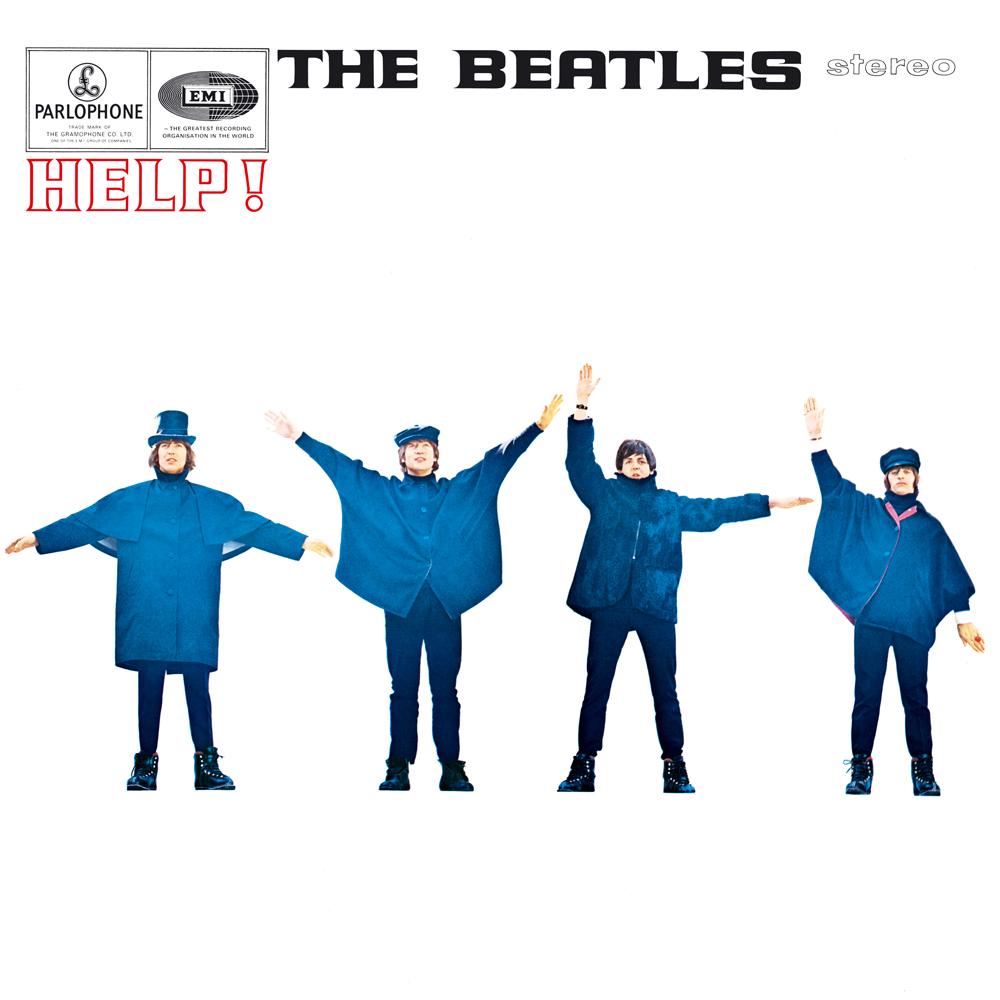
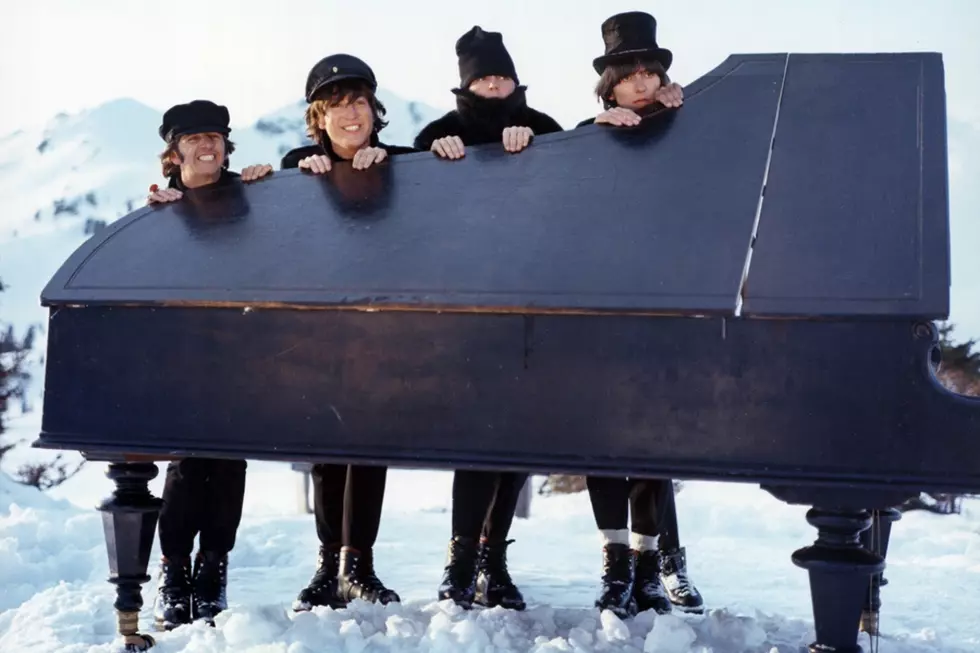
We wrapped up Hanspostcard’s album draft…100 albums in 100 days. We are going into extra innings and extending three more picks from these categories… favorite Soundtracks, Greatest Hits, and a music related movie. This is my pick for sountrack…Help! by the Beatles.
To avoid confusion I’m reviewing the UK version of Help! because that is the one that I own.
The movie Help! was an enjoyable movie. It was not nearly as good as A Hard Days Night but it had it’s moments. I love black and white movies but the color made Help! stand out. The Beatles knew it wasn’t as good as their first…John had a quote about it: “it was like being a frog in a movie about clams.” Nevertheless it was a fun movie and a pleasure to watch today.
They shot the movie in five different locations…London, Wiltshire, Berkshire, Austria, and the Bahamas.
It was the first Beatle movie I ever saw…I rented it from a video store in the mid-eighties. The Help! movie was the only Beatle movie they had at the time. With no internet, it was my only window to see the Beatles other than the documentary The Compleat Beatles.
The soundtrack is a great album on it’s own.
I picked this album/soundtrack because I always thought this was the transitional album between Beatlemania and The Beatles middle period. After this album would come Rubber Soul and the swinging sixties would officially be kicked off. Help! shows them making strides into the future. You can hear a some of their earlier work and get a hint of what was coming.
Here are a few songs…I’ll leave the big hits off of the preview.
You’ve Got to Hide Your Love Away is a good song with a noticeable Dylan influence.
One of my favorite songs on the album is The Night Before…I first heard it on the Beatles Rock and Roll Music compilation album. It’s another song that would have been a single for another band.
As soon as I heard I’ve Just Seen A Face…I learned it on guitar and have been playing it ever since. This is a song that you can see the change starting to take place…from the bouncy numbers to this folk influenced one. This song would be on the American version of Rubber Soul.
You’re Going to Lose That Girl has a catchy call and response chorus. The backup vocals are superb.
The title track is brilliant with John calling out for Help after being battered by Beatlemania. They also dipped into their club roots with a cover of the Larry Williams song Dizzy Miss Lizzy. The album had the hits of course…Help!, Yesterday, and Ticket To Ride…all #1 in the Billboard 100.
I’m ready to watch Help! now…can I smuggle a Blu-ray player on the island?
Help! The Night Before You’ve Got to Hide Your Love Away I Need You Another Girl You’re Going to Lose That Girl Ticket to Ride Act Naturally It’s Only Love You Like Me Too Much Tell Me What You See I’ve Just Seen a Face Yesterday Dizzy Miss Lizzy
This is the title song to the soundtrack album of the movie Magical Mystery Tour. In reality it was more of a very expensive home movie but I do like it. Like Paul McCartney said…where else would you see a video of the Beatles doing I Am The Walrus?
They began on the song two weeks after Sgt Pepper’s Lonely Hearts Club Band was released.
In the 60s a “Mystery Tour” was a bus trip to an unknown destination. They were popular in England at that time…many times they ended up to see the Blackpool lights.
The song peaked at #2 in the UK. It was not released as a single in the US. The song was written by Lennon and McCartney. Paul’s concept and Lennon helped with the lyrics.
“Magical Mystery Tour” was released as the title track to a six-song double EP in the United Kingdom on 8 December 1967. It was the first example of a double EP in Britain. In the United States, the double EP was stretched to an LP by adding five songs previously released as singles.
Paul McCartney:“’Magical Mystery Tour’ was co-written by John and I, very much in our fairground period. One of our great inspirations was always the Barker. ‘Roll up! Roll up!’
Paul McCartney: “It used to just be called a mystery tour, up north,” “When we were kids, you’d get on a bus, and you didn’t know where you were going, but nearly always it was Blackpool. From Liverpool, it was inevitably Blackpool and everyone would go, ‘Oooo, it was Blackpool after all!’ Everyone would spend time guessing where they were going, and this was part of the thrill. And we remembered those. So much of The Beatles’ stuff was a slight switch on a memory; in ‘Penny Lane,’ the nurse and the barber and the fireman were just people we saw on a bus route, but this time they’d be with us. So we’d always just heighten the reality to make a little bit of surreality. That we were interested in.”
From Songfacts
Five months after recording this, The Beatles started making a TV special with this as the title track. The special aired in the UK in 1967, but didn’t appear in the US until 1976 when it was released in theaters, becoming the fourth Beatles movie. The film, which was an early precursor of today’s reality TV shows, didn’t go over well with critics or fans.
When they started recording this, they only had the title, a little bit of music, and the first line. Paul McCartney wrote the verses, John Lennon the refrain.
The carnival barker at the beginning is Paul McCartney.
In the 1978 movie The Rutles: All You Need Is Cash directed by former Monty Python member Eric Idle, this song is parodied by the title “Tragical History Tour.”
Charles Manson used to refer to life as “A Magical Mystery Tour” after hearing this song. He later warped other Beatles songs (“Helter Skelter,” “Piggies,” “Blackbird”) to explain a race war named Helter Skelter. He used to say that the Beatles were telling it like it is.
Magical Mystery Tour
Roll up roll up for the Mystery Tour Roll up roll up for the Mystery Tour
Roll up That’s an invitation Roll up for the Mystery Tour Roll up To make a reservation Roll up for the Mystery Tour
The Magical Mystery Tour Is waiting to take you away Waiting to take you away
Roll up Roll up for the Mystery Tour Roll up Roll up for the Mystery Tour
Roll up They’ve got everything you need Roll up for the Mystery Tour Roll up Satisfaction guaranteed Roll up for the Mystery Tour
The Magical Mystery Tour is hoping to take you away Hoping to take you away
The Mystery Tour
Ah
The Magical Mystery Tour Roll up Roll up for the Mystery Tour
Roll up That’s an invitation Roll up for the Mystery Tour Roll up To make a reservation Roll up for the Mystery Tour
The Magical Mystery Tour Is coming to take you away Coming to take you away
The Magical Mystery Tour Is dying to take you away Dying to take you away Take you today
I always liked this rocking song by the Beatles. They threw a little Beach Boy feel in it also.
The song was written during the band’s visit to Rishikesh, India is early 1968, the intention being to study and practice Transcendental Meditation with the Maharishi.
In early 1968, the British government launched the “I’m Backing Britain” campaign to rally enthusiasm and boost their economy. McCartney was inspired by this and Chuck Berry’s Back In The U.S.A. The working title was I’m Backing the UK.
This song was on the double White Album released in 1968. The album peaked at #1 in the Billboard Album Chart, Canada, and the UK. There was tension between the members on this album.
Following an argument with McCartney over the drum part for this song, Ringo walked out on The Beatles. He flew to Sardinia for a holiday to consider his future. While there he received a telegram from his bandmates saying, ‘You’re the best rock ‘n’ roll drummer in the world. Come on home, we love you.’ On his return, he found his drum kit covered with flowers. A banner above read, ‘Welcome Back.’
Paul did end up playing drums on the track. It is credited to Lennon/McCartney but it is a McCartney written song.
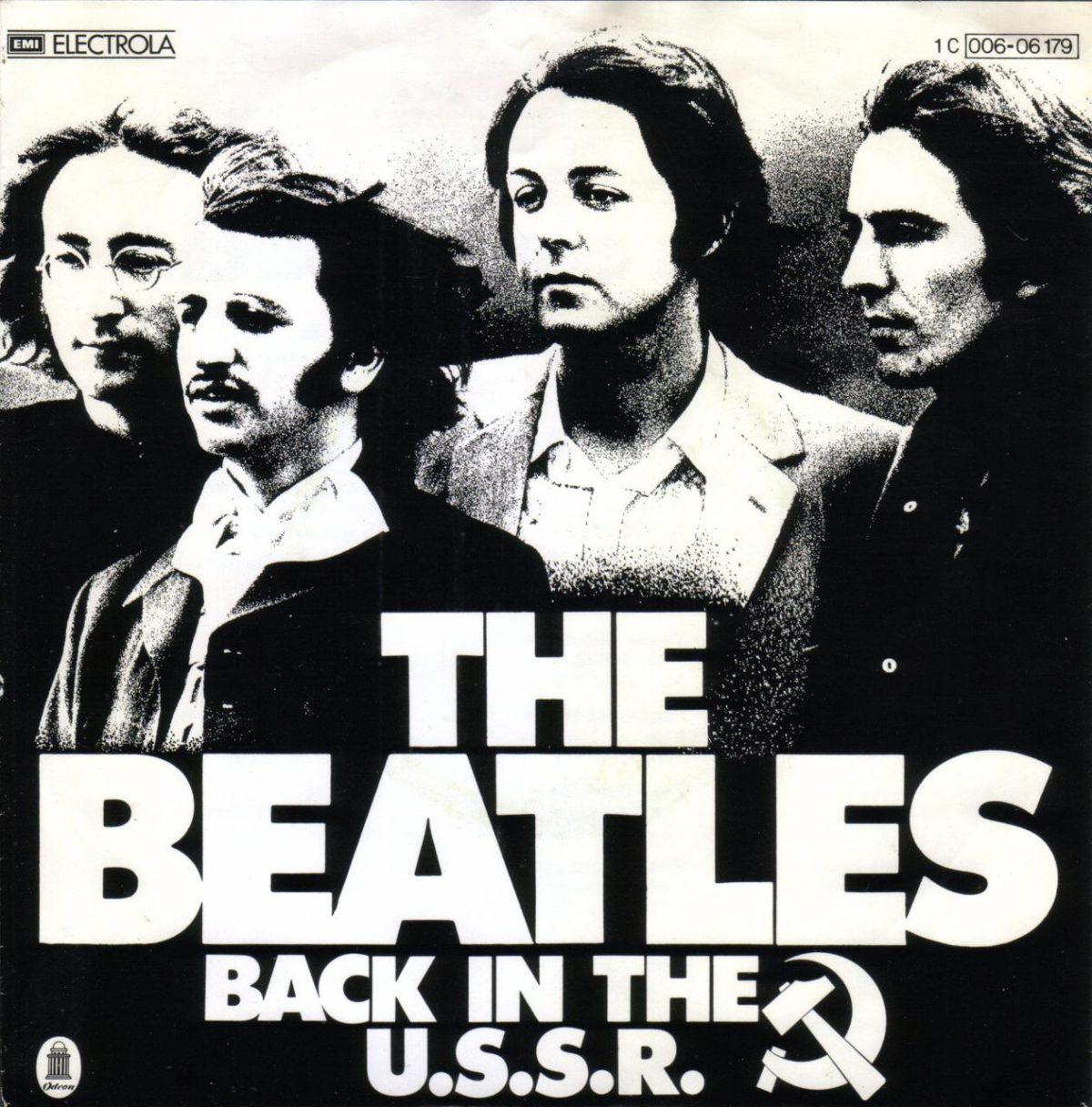
This song caused some controversy with conservative America, because it came out during Vietnam and the Cold War and it appeared to be celebrating the enemy. The John Birch Society accused The Beatles with promoting communism.
Paul McCartney:“Chuck Berry once did a song called ‘Back In The U.S.A,’ which is very American, very Chuck Berry, you know. He was ‘serving in the army and, when I get back home, I’m gonna kiss the ground,’ you know, ‘can’t wait to get back to the States.’ It’s very much an American thing, I always thought. So, this one, ‘Back In The U.S.S.R.’ was about, in my mind, a spy who has been in America for a long, long time. Some fellow who’s been in America for a long time and he’s picked up and he’s very American, but he gets back to the U.S.S.R., and he’s, sort of, saying ‘Leave it till tomorrow, honey to disconnect the phone,’ and ‘come here, honey,’ with Russian women, and all that.”
From Songfacts
The story of this song begins in Hrishikesh, India, where The Beatles were on a retreat learning Transcendental Meditation from their guru, Maharishi Mahesh Yogi. Also on the retreat was Mike Love of The Beach Boys, who told us: “Paul (McCartney) came down to the breakfast table one morning saying, ‘Hey, Mike, listen to this.’ And he starts strumming and singing, ‘Back in the U.S.S.R.,’ the verses. And I said, ‘Well, Paul, what you ought to do is talk about the girls around Russia, Ukraine girls and then Georgia on my mind, and that kind of thing.’ Which he did.
So I think it was the fact I was there, which caused Paul to think in terms of Beach Boys, and then my suggestion for what to do on the bridge, he took that suggestion and crafted, like only Sir Paul can, a really great song.”
McCartney was impressed with the idea and used some Beach Boys’ elements in this song: Instead of “California Girls” it was “Moscow Girls.” Plus, the definitive Beach Boy “Oooeeeeoooo” in the background harmonies.
The title was inspired by Chuck Berry’s “Back In The U.S.A.” The Beach Boys had been influenced by that song and also “Sweet Little Sixteen” to come up with “California Girls” and “Surfin’ U.S.A.”
Things were tense when they were working on this album, and Ringo walked out during recording, briefly quitting the band. Paul McCartney played drums in his place.
The line “Georgia’s always on my mind” in a play on the Ray Charles song “Georgia On My Mind.” It has a double meaning, since Georgia was part of the U.S.S.R.
Elton John performed this song when he toured Russia in 1979, and he got a huge response. This was the year before Moscow hosted the Summer Olympics, which the United States boycotted. Elton told Q magazine: “The first night as an encore I did ‘Back In The U.S.S.R.’ And they went apes–t. It was like playing ‘Philadelphia Freedom’ in Philadelphia. You just noticed that the people there were as ordinary and as good as the people you’d notice anywhere else.”
Billy Joel got a similar reaction when he played the song in Moscow in 1987.
This opens with the sound of an airplane flying from left to right across the speakers. Stereo was relatively new, so this was very innovative for the time.
Paul McCartney told Mojo magazine October 2008 that the song’s middle-eight was a spoof of the Beach Boys leading up to Pet Sounds. He added: “The rest is (sings first bars of the melody line of the opening verse) more Jerry Lee (Lewis). And the title is Chuck Berry, Back In The U.S.A., and the song itself is more a take on Chuck. You’d get these soldiers back from Korea or Vietnam, wherever the hell, and Chuck was picking up on that. I thought it was a funny idea to spoof that with the most unlikely thing of way back in Siberia.”
There was a rumor in the Soviet Union that The Beatles had secretly visited the U.S.S.R. and given a private concert for the children of top Communist party members. They believed the song was written because of the concert. Actually, some fans still believe so.
The wafer-thin actress and model Twiggy claimed that this song was written for her to sing on a tour of Russia that didn’t materialize. She and McCartney had met to discuss a film project, but it’s unlikely this song was written for her.
Paul McCartney used this as the title to an album he released only in Russia in 1989. In 2002, McCartney called his US tour the “Back In The US” tour.
In Stephen King’s 1979 novel The Dead Zone, a serial killer hums this tune as he contemplates his first murder.
Back In The U.S.S.R
Flew in from Miami Beach BOAC Didn’t get to bed last night On the way the paper bag was on my knee Man, I had a dreadful flight I’m back in the USSR You don’t know how lucky you are, boy Back in the USSR, yeah
Been away so long I early knew the place Gee, it’s good to be back home Leave it till tomorrow to unpack my case Honey disconnect the phone I’m back in the USSR You don’t know how lucky you are, boy Back in the US Back in the US Back in the USSR
Well the Ukraine girls really knock me out They leave the west behind And Moscow girls make me sing and shout That Georgia’s always on my my my my my my my my my mind Oh, come on Hu hey hu, hey, ah, yeah Yeah, yeah, yeah I’m back in the USSR You don’t know how lucky you are, boys Back in the USSR
Well the Ukraine girls really knock me out They leave the west behind And Moscow girls make me sing and shout That Georgia’s always on my my my my my my my my my mind
Oh, show me round your snow peaked Mountain way down south Take me to your daddy’s farm Let me hear your balalaika’s ringing out Come and keep your comrade warm I’m back in the USSR Hey, you don’t know how lucky you are, boy Back in the USSR Oh, let me tell you, honey
This has that Rickenbacker sound. This song was written by George Harrison, who was influenced by The Byrds song “The Bells of Rhymney.” This one has always been a favorite of mine by George.
If I Needed Someone was one of four songs Capitol Records held off of the American release of Rubber Soul. US audiences hadn’t heard the song until June 20th, 1966, which was the date of release for the American album Yesterday…And Today.
If I Needed Someone was the only George Harrison composition to have been performed live by The Beatles. The other songs that featured George on vocals were covers but this was the only original song before they stopped touring.
The Hollies received an early recording of “If I Needed Someone.” They proceeded to quickly record their own rendition of the song and release it as their next British single on December 3rd, 1965, the exact day that The Beatles’ released Rubber Soul.
The Hollies took the song to #20 on the British charts, and it became the first George Harrison composition to make the charts.
Roger McGuinn: “George Harrison wrote that song after hearing the Byrds’ recording of “Bells of Rhymney.” He gave a copy of his new recording to Derek Taylor, the Beatles’ former press officer, who flew to Los Angeles and brought it to my house. He said George wanted me to know that he had written the song based on the rising and falling notes of my electric Rickenbacker 12-string guitar introduction. It was a great honor to have in some small way influenced our heroes the Beatles.”
From Songfacts
It was not Ravi Shankar that introduced George to the wonderment of sitar, but Byrd traveler David Crosby shortly after Shawn Phillips had shown him the basic steps. In 1965 The Beatles toured the US and visited Ravi at World Pacific Studios where The Byrds had permanent residency. It was also here that Roger McGuinn’s Rickenbacker jingle jangle influenced Harrison’s “If I Needed Someone.” In turn, The Byrds were influenced by Harrison’s 12-string guitar work.
If I Needed Someone
If I needed someone to love You’re the one that I’d be thinking of If I needed someone
If I had some more time to spend Then I guess I’d be with you my friend If I needed someone Had you come some other day Then it might not have been like this But you see now I’m too much in love
Carve your number on my wall And maybe you will get a call from me If I needed someone Ah, ah, ah, ah
If I had some more time to spend Then I guess I’d be with you my friend If I needed someone Had you come some other day Then it might not have been like this But you see now I’m too much in love
Carve your number on my wall And maybe you will get a call from me If I needed someone Ah, ah











 PowerPop... An Eclectic Collection of Pop Culture