Lovin’ Spoonful – Do You Believe In Magic

All it took was for me to get a greatest hits album by the Lovin’ Spoonful and I was a fan. This song was their debut single and it’s still heard today on the radio and in advertisements. The song peaked at #9 on the Billboard 100 and #3 in Canada in 1965.

They turned down a deal from Phil Spector because they didn’t want to be swallowed up under his name, that was probably a smart move. The Lovin’ Spoonful signed to a new record label called Kama Sutra. This was the first song they recorded for the label, and it was the first of a string of hits for the group

Sebastian said the autoharp intro was inspired by Martha and the Vandellas Heat Wave.  “It had an ascending chord sequence that I was fascinated with. By chance, I was playing the autoharp, experimenting with electrifying it through this big amplifier. I realized that if I turned a few of the major 7ths to minor 7ths, I would have those chords. I also wanted that groove from  ‘Buzz Buzz Buzz.'”

This was written by John Sebastian, who formed The Lovin’ Spoonful with his friend, Zal Yanovsky. Sebastian and Yanovsky were in a group called The Mugwumps and made a name for themselves playing clubs in Greenwich Village.

When the other Mugwumps – Mama Cass Elliot and Denny Doherty – moved to California and formed The Mamas And The Papas, they formed the band and Sebastian began focusing on songwriting. The Lovin’ Spoonful started playing electric instruments to get away from the folk music sound and attract a younger contemporary rock audience.

As the ’60s drew to a close, The Lovin’ Spoonful disbanded and Sebastian started working on a variety of projects. He wrote music for the Care Bear series, published children’s books, made harmonica instruction videos, and, he wrote the theme song to the TV show Welcome Back, Kotter, which was a #1 hit. Dave’s site has a post about this song. 

John Sebastian: “We were playing pretty steadily for the local people from Greenwich Village who were part of the jazz scene or part of the kind of downtown ‘in crowd.’ They were ‘finger poppers,’ guys who played chess, ‘beatniks.’ But there was this one particular night as we were playing, I looked out in the audience and saw this beautiful 16-year-old girl just dancing the night away. And I remember Zal and I just elbowed each other the entire night because to us that young girl symbolized the fact that our audience was changing, that maybe they had finally found us. I wrote ‘Do You Believe In Magic’ the next day.”

Alan Merrill who wrote I Love Rock and Roll: “This was mid-’60s. The Lovin’ Spoonful were starting, and Laura Nyro said, ‘Why don’t you audition for the Lovin’ Spoonful? Now you know how to play bass, they’re looking for a bass player. But you’d have to quit school.’ And I said, ‘I don’t want to quit school.’ So I went over to her house after school one day, and she put this record on, and it was ‘Do You Believe In Magic.’ She just looked at me and said, ‘This is what you didn’t go to do.’ And I was like, ‘Oh, s–t, it’s gonna be a #1 record. I blew it. I could have been the 14-year-old bass player in the Lovin’ Spoonful.'”

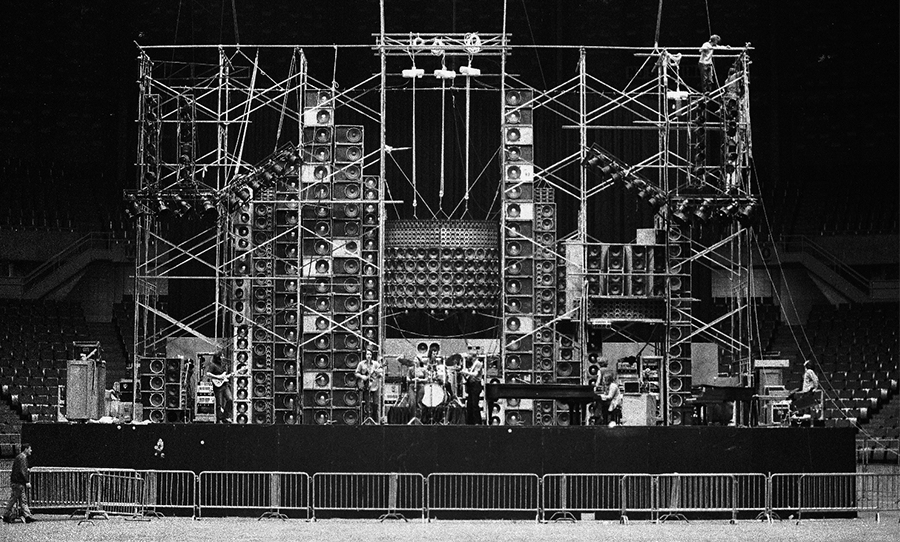
I wish I had this set…yea I would love to have it at home…the wife wouldn’t like it but I pick my battles well. And this one I would pick…and I’d take the Saint Bernard that appears also.

Do You Believe In Magic

Do you believe in magic in a young girl’s heart
How the music can free her, whenever it starts
And it’s magic, if the music is groovy
It makes you feel happy like an old-time movie
I’ll tell you about the magic, and it’ll free your soul
But it’s like trying to tell a stranger ’bout rock and roll

If you believe in magic don’t bother to choose
If it’s jug band music or rhythm and blues
Just go and listen it’ll start with a smile
It won’t wipe off your face no matter how hard you try
Your feet start tapping and you can’t seem to find
How you got there, so just blow your mind

If you believe in magic, come along with me
We’ll dance until morning ’til there’s just you and me
And maybe, if the music is right
I’ll meet you tomorrow, sort of late at night
And we’ll go dancing, baby, then you’ll see
How the magic’s in the music and the music’s in me

Yeah, do you believe in magic
Yeah, believe in the magic of a young girl’s soul
Believe in the magic of rock and roll
Believe in the magic that can set you free
Ohh, talking ’bout magic

Do you believe like I believe (Do you believe in magic)
Do you believe like I believe (Do you believe, believer)
Do you believe like I believe (Do you believe in magic)

Replacements – Waitress In The Sky

Songs like this are what made The Replacements the Replacements.

Waitress in the Sky” was written for one of Paul Westerberg’s sisters…Julie. She was a career flight attendant. In the song, Westerberg’s character came on like every stewardess’s nightmare passenger. “I was playing the character of the creep who demands to be treated like a king. I’d heard all the stories from my sister about how [passengers] would yell at the flight attendants and how then they’d ‘accidentally’ spill something on them.”

Later on, when they signed to Warner Bros and an executive told them to make a music video. That is something that they absolutely would not do. Westerberg was willing to compromise though.

He did joke with the executive with a quote worth remembering… ‘Tell you what… if you get The Replacements on Hee-Haw then I’ll lip-synch to ‘Waitress in the Sky.’

Warner Bros were not amused. The conversation did lead to a live TV gig though.  Westerberg didn’t think Warner Brothers would be able to swing a deal for a TV spot so he agreed. He would soon regret his decision. Yes, Warner Bros got them not only a TV gig but a live one. They were then scheduled on SNL and that led to being permanently banned from the show after Westerberg uttered a naughty word on national television.

They were stuck on the 18th floor waiting all day for SNL. To soothe the band’s nerves, soundman Monty Lee Wilkes smuggled some alcohol into the studio in a little road case. As they began to dip in, the show’s host, Harry Dean Stanton, said hello. Harry ended up joining in and becoming quite intoxicated. Word began to circulate that the host was getting drunk mere hours before the live show. Panic ensued until a production assistant dragged Stanton out of the band’s dressing room.

Sufficiently lubricated, their rehearsal set went off smoothly. Bob Stinson shocked everyone by donning a striped lady’s unitard. The only hitch occurred during “Bastards of Young” — Bob was late coming in on the solo. Westerberg would make sure he didn’t miss his cue during the live broadcast. Make sure he did… he cued Bob by saying to Bob, just off mic: “Come on, f****r.”

This was a low point for SNL…Michael Lorne had just returned and the show was rumored to be canceled…so he didn’t take this well. They were permanently banned from playing there again…although Westerberg played there later during his solo career.

The song was on the Tim album released in 1985. Tim was the fourth studio album by  The Replacements. It was released in October 1985 on Sire Records (a subsidiary of Warner Brothers). It was their first major-label release.

Looking back on their career…it gets maddening. They bucked at playing nice with industry figures, purposely tanked do-or-die shows, and antagonized producers until they quit. They wanted to make it on their own terms but ended up sabotaging themselves. They could have been up there with R.E.M. but they couldn’t get out of their own way.

Julie was indeed a lifelong flight attendant…or Waitress in the sky…she retired in 2019 from Delta Airlines

Paul Westerberg's sister Julie, 'Waitress in the Sky' inspiration, retires  after four decades as flight attendant

Their performance on SNL…sorry for the quality but this is the only one the SNL police will allow.

Waitress In The Sky

She don’t wear no pants and she don’t wear no tie
Always on the ball, she’s always on strike
Struttin’ up the aisle, big deal, you get to fly
You ain’t nothin’ but a waitress in the sky
Paid my fare, don’t want to complain
You get to me, you’re always outta champagne
Treat me like a bum, don’t wear no tie
‘Cause you ain’t nothin’ but a waitress in the sky
You ain’t nothin’ but a waitress in the sky, oh hoh
And the sign says, “Thank you very much for not smoking”
My own sign says, “I’m sorry, I’m smokin'”
Don’t treat me special or don’t kiss my ass
Treat me like the way they treat ’em up in first class

Sanitation expert and a maintenance engineer
Garbage man, a janitor and you my dear
A real union flight attendant, my oh my
You ain’t nothin’ but a waitress in the sky

Oh oh, ba ba, oh oh, ba ba, oh oh, ba, ba, oh oh

Grateful Dead – Don’t Ease Me In

I first noticed this song on the concert film The Festival Express a few years ago. I’ve heard the two studio versions but that live version is the one I like best. It’s something about it I really connect to. Garcia and Weir sound great singing together along with Pigpen playing the harmonica. It’s just a simple blues-type song but it works well for me anyway.

As soon as I heard it I took one of my acoustic guitars off the wall and kept running back the video file back and playing with them…I didn’t think they would mind.

This song was first released by the Dead in 1966 as their first single with Stealin on the flip side. That version is good and it reminds me of the band Them…not the voice but the music. They also released it again on their Go To Heaven album in 1980 but that version to me is a little too slick. The version on Festival Express shows all the ragged edges in the best way. It is pure Americana. They would do it live many times later on but I still go back to the Festival version.

They also covered it before they were the Grateful Dead. They started off as a jug band called Mother McCrees Uptown Jug Champions and most likely covered it when they were called the Warlocks.

They might have heard the version of the song by Henry Thomas…an old blues artist that lived from 1874 to around 1930. If you want to learn more in detail about Thomas and this song go here to Jim’s site. It also sounds close to a song by Jelly Roll Morton called Don’t You Leave Me Here. On the Go To Heaven album, it’s credited to “traditional arranged by The Grateful Dead.” The single that was released in 1966 was credited to Garcia but I’ve read where he didn’t authorize that and didn’t ask for a credit.

Speaking of the Festival Express…it was The Transcontinental Pop Festival… better known as the Festival Express. Great idea on paper… rounding up musicians in 1970 and placing them on a train going across Canada and stopping along the way to play festivals. What could go wrong? Actually, I would have loved to have been on that train. The lineup: The Band, The Grateful Dead, Janis Joplin, Buddy Guy Blues Band, The Fly Burrito Brothers, Sha Na Na, and Delaney & Bonnie & Friends.

There were artists that were not in the film like Traffic, Ten Years After, Tom Rush, Ian & Sylvia, Mountain, and more.

A DVD was released of this in 2004. All these musicians were on a train full of liquor and an assortment of drugs… liquor was the popular choice among the musicians on this ride. The tour was to have events in Montreal, Toronto, Winnipeg, Calgary, and Vancouver. The Montreal event was canceled as was Vancouver. In Toronto, protesters were saying the festival promoters were price gouging so The Grateful Dead played a free concert in a park nearby to ease tensions with the protesters.

When watching the film you can see the performers are having a ball jamming with each other because they didn’t get a lot of chances to do that on the road.

Here is the link to the full movie free on youtube…if you have time…it’s worth it!

Bill Kreutzmann (drummer for the Dead): We celebrated Janis Joplin’s birthday at the last stop the traditional way: with birthday cake. In keeping with our own kind of tradition, somebody—within our ranks, I would imagine—had secretly infused the cake with a decent amount of LSD. So it quickly became an electric birthday celebration. Allegedly, some generous pieces of that birthday cake made it to the hands and mouths of the local police who were working the show. “Let them eat cake!” (To be fair, I didn’t have anything to do with that … I was just another cake-eating birthday reveler, that night.)
And that was it for the Festival Express. It was a wonderful time and I think what really made it great was the level of interaction and camaraderie among the musicians, day and night, as we were all trapped on this train careening across the great north. It probably helped that we were all trashed the entire time. Whiskey was in the conductor’s seat on that ride.

I would recommend getting the DVD of this event. It’s a great time capsule of that time in music and culture.

Don’t Ease Me In

Don’t ease, don’t ease, don’t ease me in
I’ve been all night long coming home, don’t ease me in

I was standing on the corner, talking to Miss Brown
When I turned around, sweet mama, she was way across town
So I’m walking down the street, with a dollar in my hand
I’ve been looking for a woman, sweet mama, ain’t got no manDon’t ease, don’t ease, don’t ease me in
I’ve been all night long coming home, don’t ease me inThe girl I love, she’s sweet and true
You know the dress she wears, sweet mama, it’s pink and blue
She brings me coffee, you know she brings me tea
She brings about every damn thing, but the jailhouse keyDon’t ease, don’t ease, don’t ease me in
I’ve been all night long coming home, don’t ease me inDon’t ease, don’t ease, don’t ease me in
I’ve been all night long coming home, don’t ease me in

Talking to Miss Brown
Well I turned around, sweet moma
She was way cross town

So I’m walking down the street
With a dollar in my hand
I’ve been looking for a woman, sweet moma
Ain’t got no man

The girl I love
She’s sweet and true
You know the dress she wears, sweet moma
It’s pink and blue

She brings me coffee
You know she brings me tea
She brings ’bout every damn thing
But the jailhouse key

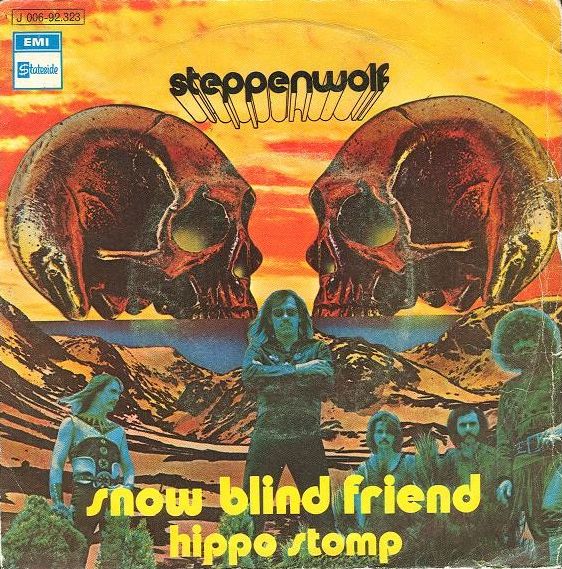
Steppenwolf – Snowblind Friend

The last time I posted a Steppenwolf song (Sookie Sookie)…a fellow blogger obbverse reminded me of this one and it had been a long time since I heard it.

Snowblind Friend was written by Hoyt Axton, who first released it on his 1969 album My Griffin Is Gone. The song was written about one of his musician friends who died of a drug overdose. Hoyt did not glamorize drug use in this song. He had his own problems with drug addiction and did what he could to warn of the dangers

Stoned on some new potion he found upon the wall
Of some unholy bathroom in some ungodly hall

Hoyt Axton wrote so many songs…one of them was Joy To The World, he wrote it around the same time as Snowblind Friend. Steppenwolf was offered Joy To The World but they passed. It ended up going to Three Dog Night… who took it to number 1. What I wouldn’t give to hear a Steppenwolf version of Joy to the World!

Songs written by Hoyt Axton | SecondHandSongs

This song introduced the word “snowblind” to the rock music lexicon to describe addiction, specifically to cocaine. The insidiousness of the drug and its grip on the user has never been conveyed so accurately and poignantly.

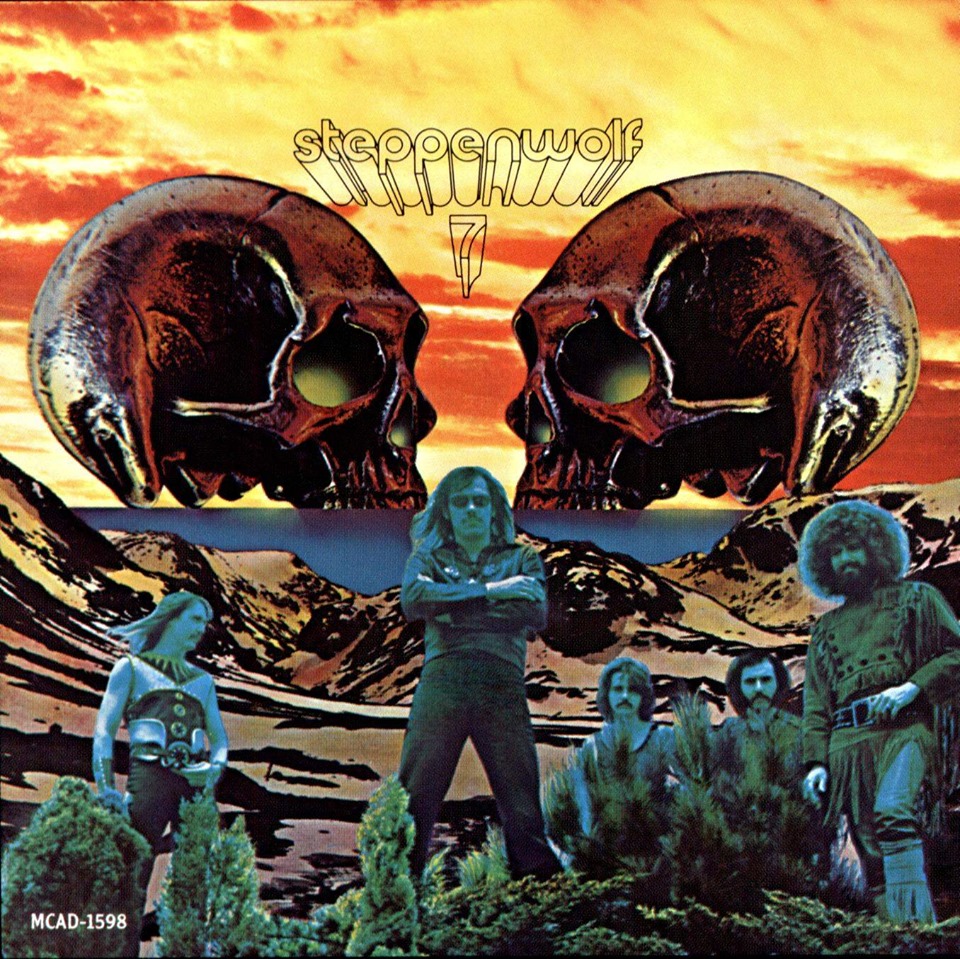
Steppenwolf 7

Snowblind Friend peaked at #60 in the Billboard 100 and #37 in Canada in 1970. It was on the album Steppenwolf 7 and it peaked at #19 in the Billboard Album Charts and #14 in Canada. This would be Steppenwolf’s last top 20 album in their career. They did have a Greatest Hits album that peaked at #24 the following year.

They are not in the Hall of Fame yet but were nominated in 2017 but didn’t make it. In 2018 the Hall did pick “Born to Be Wild” as one of the first five singles that shaped rock and roll to be inducted into the hall in its history.

Altogether they had 13 studio albums, 5 live albums, and 21 singles. 8 of the albums were in the top 40 and 7 of their singles were in the top 40. In Canada they were very popular…they had two #1’s in Born To Be Wild and Magic Carpet Ride and 11 singles in the top 40.

John Kay: “That song spoke to me because I knew the person that the song was written about. That’s why I decided, as a tribute to this young man, that we would do a version of it on the Steppenwolf 7 album.”

This is a TV special on the Steppenwolf 7 album

Snowblind Friend

You say it was this morning when you last saw your good friend
Lyin’ on the pavement with a misery on his brain
Stoned on some new potion he found upon the wall
Of some unholy bathroom in some ungodly hall
He only had a dollar to live on ’til next Monday
But he spent it on some comfort for his mind
Did you say you think he’s blind?

Someone should call his parents, a sister or a brother
And they’ll come to take him back home on a bus
But he’ll always be a problem to his poor and puzzled mother
Yeah he’ll always be another one of us
He said he wanted Heaven but prayin’ was too slow
So he bought a one way ticket on an airline made of snow
Did you say you saw your good friend flyin’ low?
Flyin’ low
Dyin’ slow

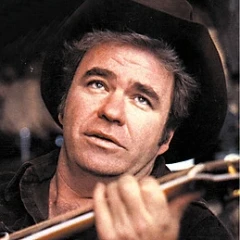
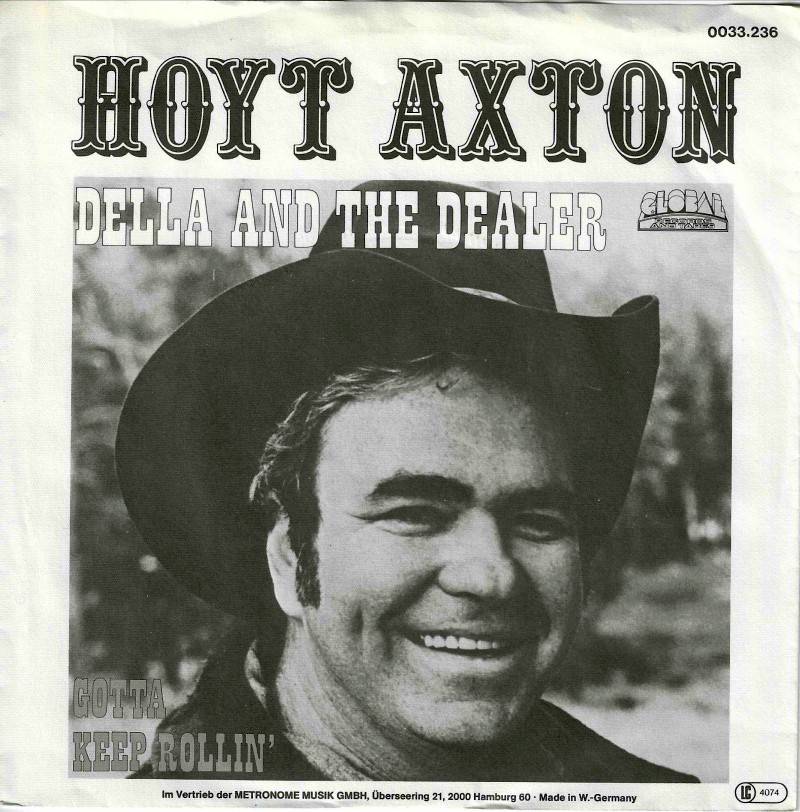
Hoyt Axton – Della And The Dealer

I cannot remember the first time I heard this song but I heard it alot growing up. The imagery of the lyrics is a lot of fun. It’s country but it’s also a little rock and a little blues. It’s hard to classify many of his songs although he was mainly known for being a country singer and songwriter. He also ventured out into garage rock, folk, and hard rock with his songs.

Hoyt Axton:  “I’m one of those fringe dudes: half folkie, half hippie, half Okie. My input has been very eclectic. I was always surrounded by all kinds of music, as my family moved around the country: jazz, classical, gospel, whatever… the influences enter from a lot of directions.”

Hoyt Axton was a talented artist. He was a singer, songwriter, and actor. We all know his songs. Joy To The World, Never Been To Spain, Snowblind Friend, The Pusher, The No, No Song, and When the Morning Comes. He was also in a number of movies, commercials, and tv shows. The movie I remember him most for was Gremlins. Axton always came off as incredibly likable.

Hoyt Axton’s mom could write songs herself…Mae Boren Axton, a songwriter, co-wrote the classic rock “Heartbreak Hotel”, which became a major hit for Elvis and an iconic rock song. Now that is a cool mom.

Axton had his big hits with other people singing his songs. His composition “Joy to the World”, as performed by Three Dog Night, was #1 on the charts for six straight weeks in 1971, making it the top hit of the year. He named his record label Jeremiah after the bullfrog mentioned in the song.

Axton had an addiction problem early in his career. He wrote songs about it like Snowblind Friend, The Pusher, and The No No Song which Ringo covered.

There are a lot of theories about this song. The dog and cat are real people. He is being purposely vague as they were all involved in some shady dealings…hanging out with what is obviously a drug dealer and murderer, but the narrator is no snitch….he’s a “cool cat.” There are a lot of theories about the song…it’s a fun story song regardless.

This song was released in 1979 and peaked at #17 on the Billboard Country Charts. It was on his album A Rusty Old Halo that peaked at #27 in the Billboard Country Charts and #14 in the Canada Album Charts.

Hoyt Axton passed away on October 26, 1999, at the age of 61.

On November 1, 2007, Axton and his mother were both inducted posthumously into the Oklahoma Music Hall of Fame in Muskogee, Oklahoma.

Tomorrow I have another Axton song but not with Hoyt singing.

Della and the Dealer

It was Della and the Dealer and a dog named Jake
And a cat named Kalamazoo.
Left the city in a pick up truck,
Gonna make some dreams come true.

Yea, they rolled out west where the wild sunsets
And the coyote bays at the moon.
Della and the Dealer and a dog named Jake
and a cat named Kalamazoo

If that cat could talk what tales he’d tell
About Della and the Dealer and the dog
as well
But the cat was cool, and he never said a mumblin word.

Down Tucson way there’s a small cafe
Where they play a little cowboy tune.
And the guitar picker was a friend of mine
By the name of Randy Boone.

Yea, Randy played her a sweet love song
And Della got a fire in her eye
The Dealer had a knife and the dog had a gun
and the cat had a shot of Rye.

If that cat could talk what tales he’d tell
About Della and the Dealer and the dog
as well
But the cat was cool, and he never said a mumblin word.

Yea, the dealer was a killer,
He was evil and mean
And he was jealous of the fire in her eyes.

He snorted his coke through a century note
And swore that Boone would die.

The stage was set when the lights went out.
There was death in Tucson town.
Two shadows ran for the bar back door
And one stayed on the ground

If that cat could talk what tales he’d tell
About Della and the Dealer and the dog
as well
But the cat was cool, and he never said a mumblin word.

Two shadows ran from the bar that night
And dog and cat ran too.
And the tires got hot on the pick up truck
As down the road they flew.

It was Della and her lover and a dog named Jake
And a cat named Kalamazoo.
Left Tucson in a pick-up truck
Gonna make some dreams come true.

If that cat could talk what tales he’d tell
About Della and the Dealer and the dog
as well
But the cat was cool, and he never said a mumblin word.

Home Before Daylight …My Life On The Road With The Grateful Dead …by Steve Parish

Home Before Daylight…My Life On The Road With The Grateful Dead  by Steve Parish

I bought this book thinking it was going to be another Grateful Dead history book by a roadie and manager. I was wrong on that account. Parish had no desire to retell what’s been told in so many books. It was more of his story and the brotherhood shared with the roadies and band. Yes…it is a book about sex, drugs, and rock and roll…make no mistake about that…but around the Dead things were different.

Parish’s story is worth hearing. How he worked himself up from a roadie working for free…to a paid roadie with this traveling circus of a band. After years of adventure, Garcia appointed him manager of the Jerry Garcia Band while also working as a roadie for them and The Grateful Dead. He was one of Jerry’s most trusted friends to the end.

He goes into all the members of the Dead…past and present and the members of that wild road crew. He got along with the band really well except for one…for a while anyway. Like I said at the beginning yes there was drink, drugs, and sex but these guys did work hard. The roadies would have at times, 16-20 hour days, especially in the 70s. At the time it was easy to see how drugs slipped into their world. What was amazing is how all of them cared about each other and wanted the best show possible for the band. That crew wielded an exceptional amount of power and influence. It’s safe to say more than any other road crew at that time and probably ever.

After driving all day and all night, Parish was in an accident while riding in the equipment truck in Texas. It’s a miracle no one wasn’t killed. Phil Lesh, the bass player for the Dead, pulled him aside later that night and told him he was relieved no one died and this would not happen again. Phil told him it was not worth this so they started to have regular drivers for the trucks so the roadies didn’t have to drive plus setup everything.

Parish also tells us of the tragedies through the years and the friends they lost. He also had an extremely large personal loss in the 80s but the band rallied around him and helped him through it. He also goes into detail about how the Hells Angels played a part in their world. I never knew how close they were to the roadies and a few members of the band.

He also talked about the Wall Of Sound. A giant PA system that Owsley Stanley designed. The wall was impressive to look at as well to listen to. It was created to prevent feedback and distortion. It took four semi-trailers and 21 crew members were required to haul and set up the 75-ton Wall. The sound had a reach of a quarter of a mile. It stood 3 stories high…just think of the work it took for the crew to set it up and take it down nightly. Some specs from wiki:

  1. 89 300-watt solid-state and three 350-watt vacuum tube amplifiers generating a total of 26,400 watts of audio power. 604 speakers total.
  2. 586 JBL speakers and 54 Electro-Voice tweeters powered by 48 McIntosh MC-2300 Amps (48 × 600 = 28,800 watts of continuous (RMS) power).

grateful dead wall of sound

Here is some grainy footage of the wall.

All in all…if you like rock and roll books…this one is really interesting.

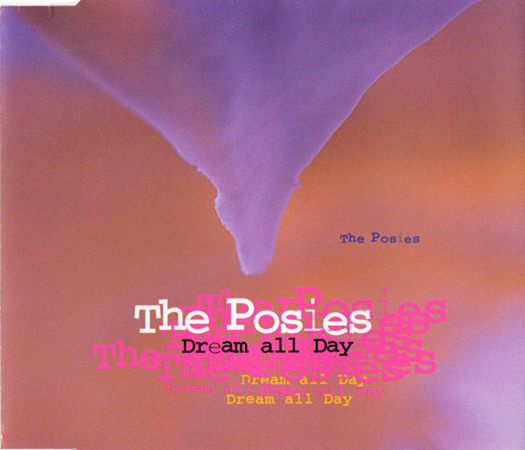
Posies – Dream All Day ….Power Pop Friday

Ken Stringfellow and Jon Auer started to write songs together while in High School in Bellingham, Washington in 1986. They were influenced by The Hollies, Hüsker Dü, XTC, Elvis Costello, Squeeze, and Big Star.

When they started out, a cassette of songs Stringfellow and Jon Auer traded back and forth went viral, which in the late ’80s meant copies got passed around and radio stations started playing them. The had one big problem though. They didn’t have an actual band together. Drummer Mike Musberger and bassist Rick Roberts were added as the first Posies rhythm section.

This song was on their third album released in 1993 called Frosting On The Beater. Dave Fox had replaced Rick Roberts by this time on bass. Dream All Day was released as the first single on the album.

The song peaked at #4 on the Billboard  Alternative Airplay Charts and #17 in the Billboard Mainstream Charts in 1993.

The Posies soon got signed to DGC and “Golden Blunders,” the first single from their Dear 23 debut on the label, became enough of a college radio hit that Ringo Starr recorded as part of his 1992 album Time Takes Time.

The made 8 albums altogether with the last one being in 2016.

In 1993 Ken Stringfellow and Jon Auer joined Big Star’s Jody Stephens and Alex Chilton to reform Big Star. They toured and released a Big Star album in 2005 called In Space. It came to an end in 2010 with the death of Alex Chilton.

Dream All Day

I’ve got a lot of thoughts
Got a lot of plans
I lost a lot of sleep
Trying to understand

I could dream all day

In a blackened room
Staring into space
Underneath a thousand blankets
Just to find a place
Where everything is reachable
Imagining is safe
I tried to make it so
I didn’t even know

I could dream all day

I dreamt I was awake
My mouth was colored grey
As the world revolved around me
I could only say

I could dream all day

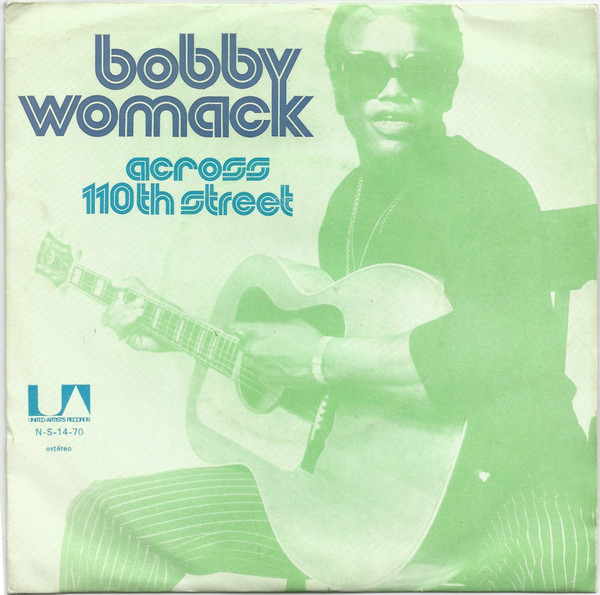
Bobby Womack – Across 110th Street

I first heard this song in the 80s and later on, I heard it in a Tarantino movie called Jackie Brown. You feel like you are walking down that Street in 1973 with this song. You can see the sights and feel the grime as the song finishes. It’s R&B, Soul, and a touch…just a small touch of Motown in the background.

Across 110th Street
Pimps trying to catch a woman that’s weak
Across 110th Street
Pushers won’t let the junkie go free
Across 110th Street
Woman trying to catch a trick on the street, ooh, baby
Across 110th Street
You can find it all in the street

Bobby Womack’s 1973 hit single Across 110th Street was the title song from Barry Shear-directed movie starring Anthony Quinn for which Womack provided the soundtrack music. The song peaked at #56 on the Billboard 100 and #19 in the R&B Charts. The song was written by Bobby Womack and J.J. Johnson.

It was used in the movie by Quentin Tarantino “Jackie Brown” in 1997 and featured in the 2007 movie “American Gangster.” I’m glad that it has had a revival of sorts and didn’t get lost in history.

Bobby Womack was asked if he noticed his audience changed after this song.

Bobby Womack: I did simply because, at that particular time, that was a change for me, to record with orchestration like that. Across 110th Street had meaning, because although I lived on Central Avenue in Cleveland Ohio [growing up], it was like Across 110th Street. That’s what made me in the frame of mind to write the lyric as I did, because it sort of typified me and my brothers growing up.

Carol Kaye plays bass on this song.

“Across 110th Street”
Ooh, ooh-ooh-ooh, ooh-ooh-ooh
Ooh, ooh-ooh-ooh, ooh-ooh-ooh-ooh

I was the third brother of five
Doing whatever I had to do to survive
I’m not saying what I did was all right
Trying to break out of the ghetto was a day-to-day fight

Been down so long, getting up didn’t cross my mind
But I knew there was a better way of life that I was just trying to find
You don’t know what you’ll do until you’re put under pressure
Across 110th Street is a hell of a tester

Across 110th Street
Pimps trying to catch a woman that’s weak
Across 110th Street
Pushers won’t let the junkie go free
Across 110th Street
Woman trying to catch a trick on the street, ooh, baby
Across 110th Street
You can find it all in the street

Ooh, ooh-ooh-ooh, ooh-ooh-ooh, oh-oh-oh

I got one more thing I’d like to talk to y’all about right now

Hey, brother, there’s a better way out
Snorting that coke, shooting that dope, man, you’re copping out
Take my advice, it’s either live or die
You got to be strong if you want to survive

The family on the upper side of town
Would catch hell without a ghetto around
In every city you’ll find the same thing going down
Harlem is the capital of every ghetto town
Help me sing it

Across 110th Street
Pimps trying to catch a woman that’s weak
Across 110th Street
Pushers won’t let the junkie go free
Oh, across 110th Street
A woman trying to catch a trick on the street, ooh, baby
Across 110th Street
You can find it all
In the street
Yes, you can

Oh, look around you, look around you
Look around you, look around you
Yeah
Yeah

Ooh, ooh-ooh-ooh, ooh-ooh-ooh

Ramones – The KKK Took My Baby Away

This and I Want To Be Sedated are my two favorite songs by the Ramones. I’ve been apprehensive about posting this one because of obvious reasons. UK #1s blog (Stuart) and I were talking a couple of weeks ago about how much we liked this song. It has a couple of really interesting stories that go with it as you might imagine.

There are two stories about how this song came to be. The most popular (but probably not true) is this one.  Johnny Ramone, the politically conservative member of the group, stole away liberal Joey Ramone’s girlfriend Linda Daniele, and Joey wrote this song about it. So Joey made the comparison of the KKK to Johnny in the song…not because Johnny was a racist but because of his conservative views and being a tad upset about the Linda thing. Johnny eventually married Linda, causing a huge strain on his relationship with Joey. 

More likely it’s this one. Joey’s brother, Mickey Leigh, has said that the song was written before he knew about Johnny and Linda. Leigh said their parents disapproved of interracial relationships. Joey was dating a black woman at the time and one day Leigh noticed they weren’t together anymore. He asked Joey what happened to the girl and Joey responded by saying “the KKK took my baby away.” The KKK was Joey’s parents who broke them up.

I seriously doubt if Johnny would have played on a song with him being referred to as the KKK. That being said…the marriage did cause a huge strain on Joey and Johnny’s personal relationship. Even before this, they were extreme in their political beliefs so they didn’t have an easy relationship anyway.

Monte Melnick the band’s tour manager on Joey and Johnny after the marriage: “They came to an agreement where they kind of tolerated each other, It’s like a business. You’re working with someone you don’t particularly like, but you’re still working there because you like your job.”

Linda Daniele: “So when it came time for Joey and me to break up, we understood. It was time to move on. Johnny was in love with me, I had been falling in love with Johnny. Joey knew that. For the first couple of years, I didn’t speak to Joey and then of all a sudden, this guy was doing a Ramones book. And out of the blue Joey called me. From that moment on, me and Joey always stayed in touch. I know people go, ‘Oh, you broke his heart.’ But Joey got another girlfriend right away after I left!”

The song was on their 1981 album Pleasant Dreams. The album peaked at #58 in the Billboard Album Charts.

Here are the Drive-By Truckers with a cover

The KKK Took My Baby Away

She went away for the holidays
Said she’s going to L.A.
But she never got there
She never got there
She never got there, they say

The KKK took my baby away
They took her away
Away from me
The KKK took my baby away
They took her away
Away from me

Now I don’t know
Where my baby can be
They took her from me
I don’t know
Where my baby can be
They took her from me

Ring me, ring me ring me
Up the President
And find out
Where my baby went
Ring me, ring me, ring me
Up the FBI
And find out if
My baby’s alive
Yeah, yeah, yeah

She went away for the holidays

The KKK took my baby away

They took my girl
They took my baby away

Creedence Clearwater Revival – Wrote A Song For Everyone

If I had to pick a favorite song of Creedence Clearwater Revival it would be hard… but this song would be a contender and probably my overall favorite. It’s the way Fogerty wearily sings the lyrics, he sounds so much older than he was at the time. The song is off of the “Green River” album.

Sometimes lines grab my attention and these did. Met myself a comin’ county welfare line. I was feelin’ strung out, Hung out on the line.

The album did very well…the Green River album peaked at #1 in the Billboard Album Charts, #2 in Canada, and #20 in the UK in 1969. If you want proof that life isn’t fair… Green River the title track was kept from #1 because of the novelty bubblegum song “Sugar, Sugar” by The Archies.

With Creedence…you won’t hear any “alternative takes” with the band. Fogerty destroyed all copies of the first version of songs because he never wanted any of his outtakes to make it into the public’s hands. This has been a regular practice of him throughout his career.

The album ended up charting 4 different songs. Green River, Lodi, Bad Moon Rising, and Commotion.  John Fogerty released a new version of the song on his ninth solo studio album, also titled Wrote a Song for Everyone. This version features Miranda Lambert and Tom Morello.

Jeff Tweedy of Wilco has cited this as a song that had a profound influence on him. A huge Fogerty fan, Wilco credits him with forming the foundation of the Americana genre.

John Fogerty: “Inspired by my young wife at the time. It was early ’69, and I was 23 years old. We had our first child, who, at the time, was two and a half. I was sitting in my room, writing the songs, pushing my career. Without the songs, the career ends. You might be a great band, but without the songs, you’re not going anywhere. At one point, my wife and I had a mild misunderstanding, I wouldn’t even call it a fight, She was miffed, taking our young son out, wishing I would be more involved. But there I was, the musician manic and possessed the only guy holding things up. Without me, it all collapses, so I’m feeling quite put upon. As she walks out the door, I say to my self, “I wrote a song for everyone, and I couldn’t even talk to you.” I looked at my piece of paper and changed gears. How many great leaders can’t even manage their own families? So I went with that. “Pharaohs spin the message/Round and round and true/Richmonds about to blow up” referring to nearby Richmond, California. It was actually a true emotion that took on a larger meaning. It’s still a special song in the sense that it keeps my feet on the ground. You sit and write these songs, yet you try to talk to your own son and daughter and maybe you’re totally inadequate, trying to explain life to a child. We used to record our album very quickly and I remember finishing five different songs in one afternoon. The fifth one didn’t work, and that was “Wrote A Song For Everyone.” I had to start over on that one.” 

“Wrote A Song For Everyone”

Met myself a comin’ county welfare line.
I was feelin’ strung out, Hung out on the line.
Saw myself a goin’, down to war in June.
All I want, All I want is to write myself a tune.

[Chorus:]
Wrote a song for ev’ryone,
Wrote a song for truth.
Wrote a song for ev’ryone
And I couldn’t even talk to you.

Got myself arrested, Wound me up in jail.
Richmond ’bout to blow up, communication failed.
If you see the answer, now’s the time to say.
All I want, All I want is to get you down to pray.

[Chorus]

[Chorus]

Saw the people standin’ thousand years in chains.
Somebody said it’s diff’rent now, look, it’s just the same.
Pharoahs spin the message, round and round the truth.
They could have saved a million people, How can I tell you?

[Chorus]
[Chorus]
[Chorus]

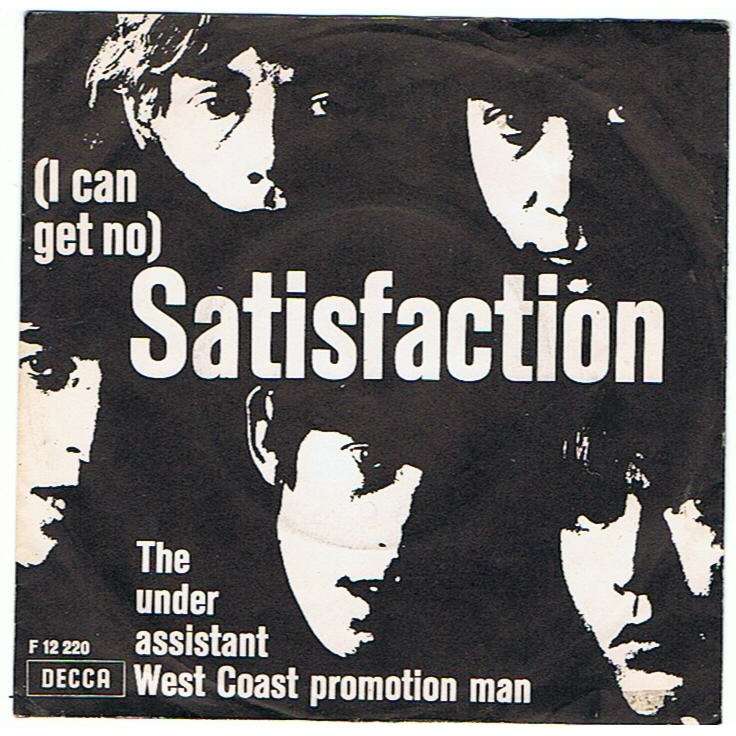
Rolling Stones – The Under Assistant West Coast Promotion Man

What if I told you this was one of The Rolling Stone’s largest selling singles in America? It was… but it was a package deal…the song on the other side of the single was Satisfaction.

Not the most well-known song by the Stones but a lot of Americans owned it. I bought the single Satisfaction in 1979 and flipped it over and found this oddly named likable song. This was the American B side to Satisfaction. Not exactly Day Tripper/We Can Work It Out but a likable single all the same. The song was released in 1965.

The song is about George Sherlock who was the London Records promotions man who accompanied the Stones to California. This was their response to having a chaperone who was a music executive in the early 60s. The Stones did not hide their disdain for him, giving him the nickname Surfer Baby, and they crystallized their feelings in the song.

The Stones recorded this in Chess studios in Chicago.  This song was written by Mick Jagger and Keith Richards who were becoming a great songwriting team. They likely borrowed the lick from Buster Brown’s song Fannie Mae.

Fannie Mae peaked at #1 in the R&B Charts and #38 in the Billboard 100 in 1960. He received more attention in 1973 when his song “Fannie Mae” was included in the film American Graffiti Soundtrack.

Buster Brown – Fannie Mae

Well, I’m waiting at the bus stop in downtown L.A.
But I’d much rather be on a boardwalk on Broadway

Well, I’m sitting here thinkin’ just how sharp I am
I’m an under assistant west coast promo man

Well, I promo groups when they come into town
Well they laugh at my toupee, they’re sure to put me down

Well, I’m sitting here thinking just how sharp I am
Yeah, I’m sitting here thinking just how sharp I am
I’m a necessary talent behind every rock and roll band

Yeah, I’m sharp
I’m really, really sharp
I sure do earn my pay
Sitting on the beach every day, yeah
I’m real real sharp, yes I am
I got a Corvette and a seersucker suit
Yes, I have

Here comes the bus, uh oh
I thought I had a dime
Where’s my dime
I know I have a dime somewhere
I’m pretty sure

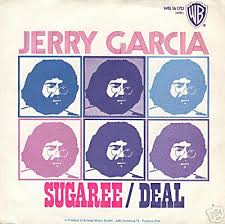
Jerry Garcia – Sugaree

I remember this song on the radio in the seventies. Of all places, it was played a lot at our local skating rink. It’s high on the list of my favorite songs. It wasn’t the best song written by Garcia and Hunter but I can listen to it at any time. Probably the first Dead…or close to a Dead song I ever heard. The song has stuck with me my entire life.

Jerry Garcia played most of the instruments on this album except drums and Dead drummer Bill Kreutzmann handled those. Sugaree was on the Garcia album released in 1972. He had teamed up with other players in the past but this was his first solo album. The song peaked at #94 on the Billboard 100 in 1972. I always liked the vague lyrics to this song. I first thought it was about death… you can take it a lot of ways.

The Grateful Dead did this live many times…Jerry Garcia and Robert Hunter wrote this song. The Dead made their reputation live. They got very little radio play and didn’t sell many albums, but they are one of the top-grossing concert acts of all time.

Like the Allman Brothers, they formed a family atmosphere with their crew and it extended to their audience. From the early Kool-Aid acid tests to later on allowing the audience to tape their shows drew their audience closer. They would later give them their own section to record in…while other bands like Led Zeppelin would send people to bust their tape recorder or head. Garcia commented: Well, my feelings are, the music is for the people…I mean after it leaves our instruments it’s of no value to us, ya know what I mean? it’s like, ya know…what good is it? So it might as well be taped, my feeling is that..and if people enjoy taping it and enjoy having the tapes to listen to, that’s real great. “

They never played the same show twice. They would take songs in different directions and Garcia has said that he couldn’t play something twice the same. He just wasn’t built like that. That made every show unique…not that every show was great. The Dead has admitted they had their share of bad ones.

On Deadheads following them around the country: “Well, it’s obviously very important to them. And more than that, it’s giving them an adventure. They have stories to tell. Like, “Remember that time we had to go all the way to Colorado and we had to hitchhike the last 400 miles because the VW broke down in Kansas.” Or something like that. Y’know what I mean? That’s giving them a whole common group of experiences which they can talk about. For a lot of people, going to Grateful Dead concerts is like bumping into a bunch of old friends.”

Bill Kreutzmann…if you get a chance read his book Deal: My Three Decades of Drumming, Dreams, and Drugs with the Grateful Dead. I covered it here a while back. It’s an education in the rock world…or the Dead world of the 60s through the 90s. If you are offended by drugs, sex, and great music…pass it by.

Robert Hunter: “Sugaree was written soon after I moved from the Garcia household to China Camp. People assume the idea was cadged from Elizabeth Cotten’s ‘Sugaree,’ but, in fact, the song was originally titled ‘Stingaree,’ which is a poisonous South Sea manta. The phrase ‘just don’t tell them that you know me’ was prompted by something said by an associate in my pre-Dead days when my destitute circumstances found me fraternizing with a gang of minor criminals. What he said, when departing, was: ‘Hold your mud and don’t mention my name.’

“Why change the title to ‘Sugaree’? Just thought it sounded better that way, made the addressee seem more hard-bitten to bear a sugar-coated name. The song, as I imagined it, is addressed to a pimp. And yes, I knew Libba’s song, and did indeed borrow the new name from her, suggested by the ‘Shake it’ refrain.”

Bill Kreutzmann Drummer for the Dead: The album, Garcia, was cut at Wally Heider Studios in July 1971 and released by Warner Brothers the following January. There are a lot of songs on there that became Grateful Dead mainstays, in addition to “Deal”—we’re talking about straight-up classics like “Sugaree,” “Loser,” and “The Wheel.” Also, “Bird Song” is on there, which, to this day, is one of my all-time favorite Dead songs and one of my absolute favorite songs to play live (along with “Dark Star” and “The Other One”).

When I want musicians I’m playing with to learn any of those songs, I give them the Garcia versions. They’re just so good. I had a really great time making that album. Dealing exclusively with Jerry was the most effortless thing in the world. I didn’t have to do anything other than be myself. And play.

Cocaine was our special guest throughout those recording sessions, but you’d never be able to tell because everything was very laid back. I have no idea how we were able to do that, because cocaine isn’t exactly known for its relaxing properties. Maybe it was just the dynamic between us that made it all so … easy.

Sugaree

When they come to take you down
When they bring that wagon round
When they come to call on you
and drag your poor body down

Just one thing I ask of you
Just one thing for me
Please forget you knew my name
My darlin Sugaree

Shake it, shake it Sugaree
Just don’t tell them that you know me

You thought you was the cool fool
Never could do no wrong
Had everything sewed up tight
How come you lay awake all night long?

Just one thing I ask of you
Just one thing for me
Please forget you knew my name
My darlin Sugaree

Shake it, shake it Sugaree
Just don’t tell them that you know me

You know in spite of all you gained
you still have to stand out in the pouring rain
One last voice is calling you
and I guess it’s time you go

Just one thing I ask of you
Just one thing for me
Please forget you knew my name
My darlin Sugaree

Shake it, shake it Sugaree
Just don’t tell them that you know me

Shake it up now, Sugaree
I’ll meet you at the Jubilee
If that Jubilee don’t come
Maybe I’ll meet you on the run

One thing I ask of you
Just one thing for me
Please forget you knew my name
my darling Sugaree

Shake it, shake it Sugaree
but don’t tell them that you know me
Shake it, shake it Sugaree
Just don’t tell ’em that you know me

Beatles – I Want To Tell You

This is a good George Harrison song off of Revolver. This song held the distinction of the first Beatles song where the bass was overdubbed after recording. it’s a great opening riff…a very underrated riff.

The first time I heard the song…what jumped out at me was the alarming flat-ninth notes played by Paul on the piano. It jars you but not in a bad way. The song has a strange structure and The Beatles had some trouble recording it. The timing was hard to nail down. Even artists that covered it later…one being Ted Nugent had a lot of trouble recording it because he kept jumping the time up.

Paul McCartney: “This track proved very difficult for us to learn,  I kept on getting it wrong, because it was written in a very odd way. It wasn’t 4/4 or waltz time or anything. Then I realized that it was regularly irregular, and, after that, we soon worked it out.”

Three Harrison compositions on a single Beatles album was unheard of at that time. George’s quality started to rise during this period.

With the sessions for the Revolver album winding down, The Beatles only needing four more songs to complete the album, George offered up his third composition for recording. He actually offered 4…his other song Isn’t It A Pity was rejected. I’m sure though that the song wasn’t the seven-minute opus we know today at that time.

I always thought with a little more work on this song…it could have been a single. It has the element of edgy power pop. Revolver had everything you could ask for from a band. Revolver peaked at #1 in the US, Canada, and the UK in 1966.

George Harrison: “The mind is the thing that hops about telling us to do this and do that. What we need is to lose the mind.” 

George Harrison:  “About the avalancheof thoughts that are so hard to write down or say or transmit.”

George Harrison: “All I needed to do was keep on writing and maybe eventually I would write something good,” George Harrison once stated. “It’s relativity. It did, however, provide me with an occupation.”

George Martin: “I think the trouble with George was that he was never treated on the same level as having the same quality of songwriting, by anyone – by John, by Paul or by me, I’m as guilty in that respect. I was the guy who used to say: ‘If he’s got a song, we’ll let him have it on the album’ – very condescendingly. I know he must have felt really bad about that…George was a loner and I’m afraid that was made the worse by the three of us. I’m sorry about that now.”

I Want To Tell You

I want to tell you
My head is filled with things to say
When you’re here
All those words they seem to slip away

When I get near you
The games begin to drag me down
It’s all right
I’ll make you maybe next time around

But if I seem to act unkind
It’s only me, it’s not my mind
That is confusing things
I want to tell you
I feel hung up and I don’t know why
I don’t mind
I could wait forever, I’ve got time

Sometimes I wish I knew you well
Then I could speak my mind and tell
Maybe you’d understand

I want to tell you
I feel hung up and I don’t know why
I don’t mind
I could wait forever, I’ve got time
I’ve got time
I’ve got time

Dwight Twilley Band – I’m On Fire ….Power Pop Friday

You know…I haven’t been living up to my page’s name. I’ve had very little power pop on powerpop.blog lately. I hope to solve that coming up. Here is a song I’ve always liked from the mid-seventies. Dwight Twilley is one of those artists who had great songs but only had 2 hits in his career…and this is one of them.

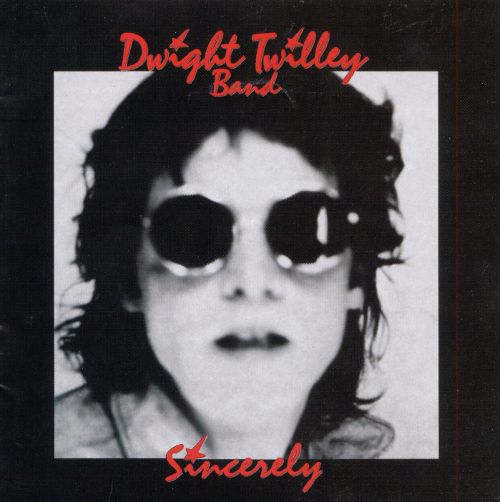
This is a great power pop song from 1975. It peaked at #16 in 1975 on the Billboard 100. The band was formed by Dwight Twilley and Phil Seymour. I always thought Twilley should have been more popular.

This was his first single from the album Sincerely. The song was released in 1975 and it did quite well.  There was one big problem… the label he was on was Leon Russell’s Shelter Records and they were barely making it. Shelter Records could not release the album until a year after this single was out which killed the momentum of the single.

Shelter Records was formed by Leon Russell and Denny Cordell in 1969 and ran until 1981 but Leon Russell left in 1976 as it was falling apart. Tom Petty was also part of the label for a while. It seems like many power pop artists are accompained by a story similiar to this.

Dwight Twilley: We thought we were indestructible. And we were proven
wrong really quick! We had so many problems right from the get-go. The album
didn’t even come out until a year after “I’m On Fire,” and it would have gone
gold if it had come out then. They believed in it so much they were going to
release two more singles before it came out. They released the second single
and then the company went under. 

Dwight Twilley on knowing Leon Russell: “I learned a lot from Leon. We were a Tulsa-based band when we were originally signed, and Leon lived here. And we ended up being signed to his label. A lot of people thought that Leon was the driving force behind it. But we didn’t really meet Leon until after we’d had our hit single ‘I’m On Fire.’ And I guess the surprising thing was just what a kind man he was, and how generous he was. He invited us into his own home studio and had us recording in his 40-track studio. And for little kids who six months ago had only been in a 4-track studio, that was a big deal. He was very kind and super talented, and he really didn’t say much. Just by following and by example we could see some of the things that he did that were just amazing. And I think he’s a terrific talent. I’m really proud of the way that he has sustained, that he’s out there still doing it.”

I’m On Fire

Got your lady on the line
Got your name on the cover
Though your friends are ninety-nine
Honey you ain’t got no lover
And you ain’t, you ain’t, you ain’t got no lover
And you ain’t, you ain’t, you ain’t got no other

I remember the feelin’ that I could be free
Now I know it could never ever be me
‘Cause I’m on fire
Got myself on fire 

Got your joker on the table
You’ve been told from time to time
I’ll be willin’, I’ll be able
You could read between the lines

But you ain’t, you ain’t, you ain’t got no lover, lover, lover
And you ain’t, you ain’t, you ain’t got no other

I remember the feelin’ that I could be free
Now I know it could never ever be me
‘Cause I’m on fire
I’m-a I’m on fire

But you ain’t, you ain’t, you ain’t got no lover, lover, lover, lover
And you ain’t, you ain’t, you ain’t got no other, other, other, other
And you ain’t, you ain’t, you ain’t got no lover, lover, lover

I’m on fire
I’m on fire (and you ain’t, you ain’t, you ain’t got no lover, lover, lover)
I’m on fire (lover, lover, lover, lover)
I’m on fire (lover, lover, lover)

TV Draft Round 7 – Pick 2 – Lisa Selects – Trailer Park Boys

Welcome to the Hanspostcard TV Draft. I hope you will enjoy it! Today’s post was written by Lisa at https://tao-talk.com/

TPB1

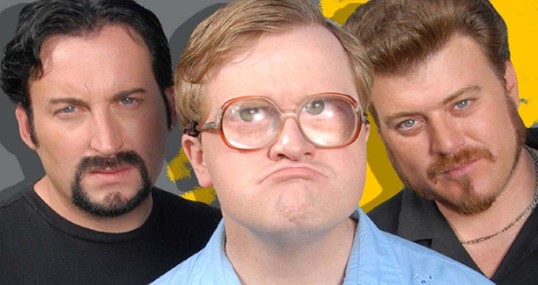
l.-r.: Julian, Bubbles, Ricky

I know that originally I was going to write about the mixed martial arts series, Kingdom, but it had too much of a Ray Donovan vibe, so I decided to write about Trailer Park Boys, a beloved series that I haven’t watched all episodes of but have watched dozens of them. The series started out with a movie pilot first in 1999, where the boys are introduced. Between 2001 and 2018, twelve seasons were made. Set mostly in Nova Scotia, Canada with also some in New Brunswick; but to be honest it doesn’t matter what geographical location it is set at because what matters is that it is set a trailer park. There is a wealth of very cool trivia on the show at imdb. This is one piece about “the” trailer park :

The first 4 seasons were filmed in different trailer parks in Nova Scotia, Canada. The pilot was filmed in Spryfield, Nova Scotia. The first season was filmed in Sackville, the second in Dartmouth, the third in Lakeside, the fourth in Dartmouth again (in a different park than the second). For the Christmas special and season 5 and onward, they have used a park they purchased in Dartmouth.

OK, where do I begin to talk about the varied residents of the fictional Sunnyvale Trailer Park?It’s probably best to introduce the three main characters, Ricky, Julian, and Bubbles, best friends from way back, all of them pretty shiftless petty criminals who love to smoke weed and scheme their harebrained schemes. Around them revolves an endlessly entertaining cast of characters. You wouldn’t think life in Sunnyvale could sustain a pilot movie and twelve seasons, but the comedic genius of creator, Mike Clatterburg, and through the comedic skills of the cast, its shine has not only been sustained but rebooted for new audiences to love and laugh with when Netflix added it to the roster.

Characters
John Paul Tremblay plays Julian. Dark hair, handsome, and always carrying a glass of rum and coke with clinking ice. He often comes up with ideas that sound like they might work if he had a crew that wasn’t so bat-sh*t crazy in their various ways. Inevitably, the plan goes awry, and if he and the crew are lucky all they get out of it is caught. Several times though, Julian is sent back to prison. He knows his boys will wait for him to get things going again once he’s out. Julian is fairly unlucky in love. He’s tried a few relationships but they aren’t sustained.

Rob Wells plays Ricky. Ricky is hands-down the most outrageous and shifty one of the three guys. Ricky has a potty mouth, and I’ll admit it took me a bit to get used to his profanity. Another bit of trivia from imdb about that:

Throughout Season 1 to Season 7, including the Christmas Special, but not the movies, the word “fuck” is said a total of 1,284 times (averaging 46 times an episode). The word “shit” is said a total of 967 times (averaging 31 an episode). From all uses of the words, 74.3% of the time, it is said from Ricky.

TPB2

l.-r.: Lucy, Sarah (in the back,) Mrs. Leahy, and Trinity

Ricky is the only one of the three that has a family. His on again, off again girlfriend, Lucy, played by Lucy Decoutere, lives most of time with her friend, Sarah, played by Sarah Dunsworth, who is always trying to talk Lucy out of having anything to do with Ricky; yet the chemistry is strong between Ricky and Lucy and they always keep getting back with each other, if only for a night. Ricky and Lucy have a daughter, Trinity, played by Jeanna Harrison. Ricky adores Trinity and makes it his mission – when he’s not scheming with his buddies or in prison – to teach Trinity the ropes about life in the trailer park. The things he teaches her are wildly inappropriate for a child or anyone who hopes to lead a law-abiding lifestyle. Ricky’s dad, Ray, played by Barrie Dunn, also lives in the park. Ray is in a wheelchair and collects disability checks from the government, but at some point you begin to wonder just how disabled Ray is. Another aspect of Ricky is his educational aspiration. Ricky has only made it to Grade 6, and his dream is to go on and get his Grade 7. Finally, Ricky is a smooth talker extraordinaire. You will be amazed at the things Ricky is able to talk his way out of!

Mike Smith plays Bubbles. I think part of the reason Bubbles has the nickname he does is his thick coke bottle bottom glasses which look like big bubbles over his eyes; the glasses give the effect of blowing his eyes way out of proportion to his face through magnification. He has a particularly humorous and endearing way of talking. Bubbles lives in a garden shed in somebody’s yard and has two great passions: shopping carts and kitties. He nabs the beat up carts that have rolled into the gully from the edge of the mall parking lot. I know he fixes them up and I think he sells them back to the mall. Bubbles is a soft touch for kittens and has turned his shed into both a sanctuary and a shrine to them. Bubbles has a strict moral sense about things and often speaks the voice of reason when it comes to some of Ricky and Julian’s schemes. Even so, he can be convinced to bend a little, and when he’s in, he’s in all the way. His love for his buddies is consistent and unshakable. In a later season, we meet Bubbles’ alter ego in the form of wise-cracking and cruel ventriloquist puppet named Conky.

Now that the three “boys” and a few others are introduced, it is time to meet some of the other residents of the park.

TPB3
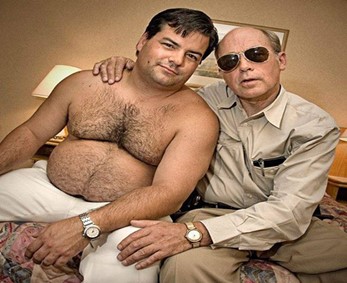
Randy and Mr. Jim Leahy

John Dunsworth (Sarah’s real-life dad) plays Mr. Jim Leahy. Jim is married to the owner of Sunnyvale, Mrs. Barb Leahy, played by Shelley Thompson. Jim is a “whole hog” functional alcoholic that is seldom, if-ever, sober. Jim is the manager of the trailer park, who is ever-vigilant about trying to bust the boys while they are carrying out their schemes, but is also extremely unsuccessful in doing so. They are just too wily for him. Jim is also gay. Jim’s somewhat younger lover is Randy, played by Patrick Roach. Randy has been a gigolo in the past, regardless of gender. He’s an opportunist. Randy’s trademark is white pants that ride under his big beer gut, which is always in view as Randy seldom (never?) wears a shirt. I can’t remember if Randy drinks, and it seems he’s trying to get Jim to slow down. Randy gets very sexually adventurous with Mr. Leahy. He also acts as Mr. Leahy’s joined-at-the-hip (in more ways than one!) sidekick in trying to bust the boys. When Mrs. Leahy catches on about Jim and Randy, they break up and she starts a relationship with Sam, played by Sam Tarasco. Sam is a veterinarian that can be handy to patch the boys up when they get into scrapes. Sam likes to grill out and have picnics.

TPB4

Cory and Trevor

Just when you think Ricky, Julian, and Bubbles have reached the bottom (or is it the top?) of the trailer park food chain, there is Cory, played by Cory Bowles, and Trevor, played by Michael Jackson. Cory and Trevor idolize Ricky and Julian and are on stand-by to assist in carrying out scams with them. Most of the time they don’t question their roles; yet even when something tells them it’s not a good idea, it doesn’t take much convincing to get their help.

TPB5

Tyrone and J-Roc

Aspiring rappers J-Roc, played by Jonathan Torrens and Tyrone, played by Tyrone Parsons, have their own entrepreneurial side schemes going on which are usually separate from the boys’ but sometimes they intersect.

Last but not least are law enforcement who keep getting called by Mr. Leahy, who used to be a police officer and so has somewhat of an “in” with them, to investigate the crimes the boys are involved with, but again, the boys are too slick for the law. Officer George Green, played by George Green is one; Detective Ted Johnson, played by Jim Swansburg, is another.

The format of the show is that a camera crew follows the boys around to document what living in a trailer park is like. Without going into the nitty gritty of the plots, now that you’ve met the characters you can imagine what kinds of hilarious plots they get engaged in. Although the show clearly is making fun of people who live in trailer parks, and with the folks in this show, they are definitely worthy of being made fun of, you also get to love each and every one of them.

I don’t think you can find these DVDs at your local library. They are being streamed on Netflix. You can probably find some out on YouTube. They are well-worth hunting down.

Genre: Comedy
Grade: 10
Etc.: Warning: extreme profanity; drug (weed) and crime-oriented themes; LGBTQIA+ friendly; some crazy gun play
Awards: 4 wins and 22 nominations

Warning: lots of profanity in the video

Sources:
imdb trivia
Julian, Bubbles, Ricky image
Lucy, Sarah, Mrs. Leahy, Trinity image
Randy and Mr. Leahy image