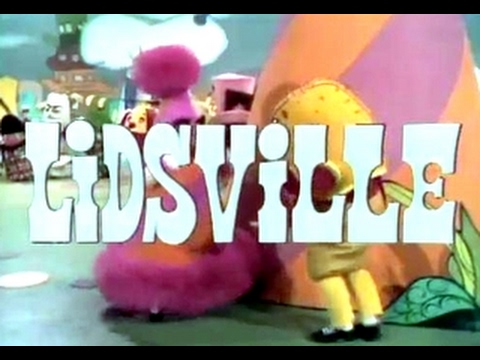
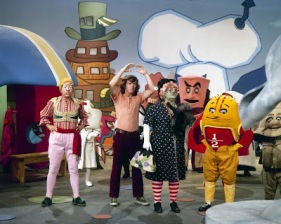
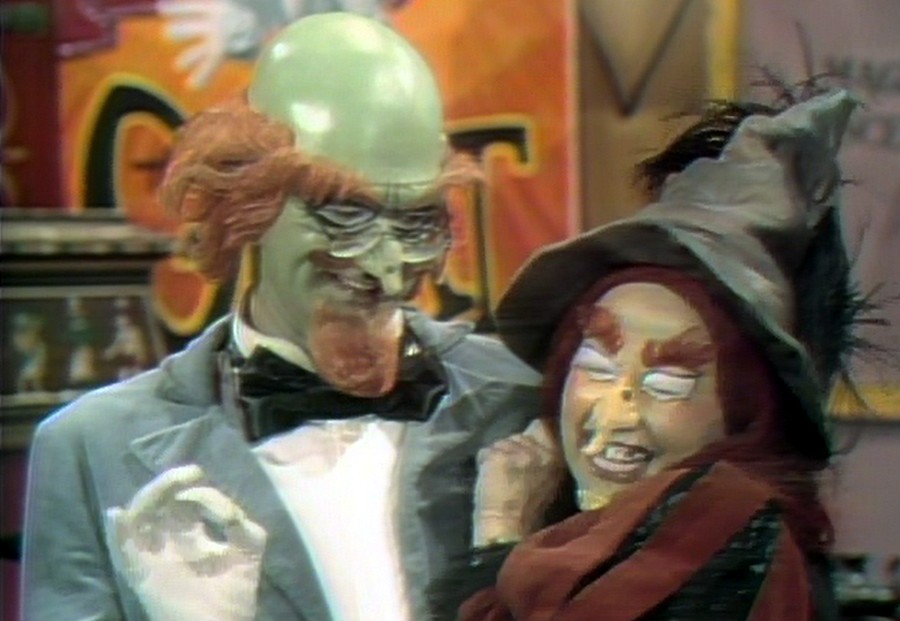
The show is just plain bizarre…for me, it is the strangest show Sid and Marty Krofft produced….and besides Land of the Lost, it’s my favorite Sid and Marty Krofft show. The show premiered on September 11, 1971.
It has been rumored that the Sid and Marty Krofft were inspired by hallucination drugs such as LSD. The brothers have always denied this claim. The title “Lid” is an old slang term for a hat, but by the 1970s the word “Lid” had taken on an entirely new meaning, namely as slang for an eighth of an ounce of pot. Whether they were or not…the shows they produced were NOT boring…they were very colorful and entertaining.
The show was conceived by Sid Krofft, who had a huge hat collection. He thought one day…what if all of the hats had different personalities? Sid was also influenced by Lewis Carroll and it is obvious.
The plot is: A boy (Mark), the original Eddie Munster, Butch Patrick falls down a large top hat at an amusement park and ends up in a land of Hats…there was also a genie named Weenie (Billy Hayes)…who played Witchiepoo in HR Pufnstuf. The bad guy was Charles Nelson Reilly the magician and he would go around zapping people. The seventeen episodes they made revolved around Mark’s attempts to return to the real world as Hoo Doo made life miserable for him and the good hat people.
It has a similar plotline as the more famous HR Pufnstuf…I remember the reruns through the seventies and I always hoped Mark would get out of Lidsville and back home…of course not knowing they made only 17 episodes…kinda like wanting Gilligan to get off that island.
I always liked Yogi Bear and would watch it when I got a chance…if only for the way he said pic-a-nic baskets.
Yogi first started out as a sidekick in a Hanna-Barbera show called The Huckleberry Hound Show in 1958. He was the first Hanna-Barbera character to break out.
In 1961 he was given his own show called The Yogi Bear Show. His show included other segments like Yakky Doodle and Snagglepuss. The show also featured episodes with Yogi Bear breaking away from the unadventurous life of other bears in Yellowstone Park.
The plot was basically Yogi raiding picnic baskets, dodging hibernation, being chased by Ranger Smith, and making money together with his more honest sidekick Boo-Boo Bear. The show also featured episodes of Ranger Smith trying to tame Yogi and Boo-Boo Bear.
Around this time the great baseball player Yogi Berra sued Hanna-Barbera for defamation. But Hanna-Barbera claimed that the similarity of the names was just purely coincidental. Eventually, Yogi Berra withdrew his suit. When Yogi Berra died the AP’s wire service mistakenly announced the death of Yogi Bear instead…that is sad.
Yogi starred in a feature film, Hey There, It’s Yogi Bear, in 1964.
Yogi’s personality was based on Art Carney’s character from The Honeymooners.
The Yogi Bear Show lasted only 2 season but other shows featuring Yogi continued on. Yogi Bear and Friends, Yogi’s Gang, Yogi’s Space Race, Galaxy Goof-Ups, Yogi’s Treasure Hunt, The New Yogi Bear Show, and Yo Yogi! Yogi was on the air from 1958 to the 1990s.
Daws Butler originated the voice of Yogi and did it from 1958 to 1988 when he passed away. He was replaced by Greg Burson who was personally taught by Butler on how to do Yogi’s voice and other characters.
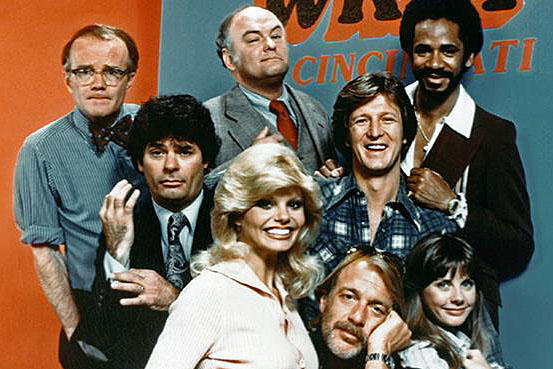
This show was not like the Mary Tyler Moore Show, Bob Newhart, or All In The Family. Those are great shows…some of the best ever sitcoms…but they were aimed more at adults while this one I always felt was largely aimed at teenagers. The show aired from 1978 to 1982. Rock and Roll on a sitcom was not common.
WKRP in Cincinnati” was produced by MTM – the studio Mary Tyler Moore and Grant Tinker built that produces shows such as The Bob Newhart Show, Mary Tyler Moore Show, Phyllis, The White Shadow, Rhoda, and many others.
The episode I remember the most having an effect on me was about the horrible event in 1979 when eleven people were killed at a Who concert in Cincinnati’s Riverfront Park. The show handled the tragic situation very well.
The plot…to make it short was about a Program Director (Andy Travis) who had a perfect record in turning bad radio stations around joins the staff at WKRP. The station is in the bottom of the ratings and he wants to change the format to Rock which is met with trepidation from the oddball staff.
The show would feature new rock music as well as old. Blondie gave the show one of their gold records in appreciation because the show played “Heart of Glass” and helped to make it number 1.
The extended theme song by Steve Carlisle Wkrp In Cincinnati peaked at #65 on the Billboard 100 in 1979…video at the bottom
The Cast
Bailey Quarters – Jan Smithers – A shy soft-spoken lady in charge of billing and station traffic soon worked herself up to an on-air personality and other duties. She and Jennifer on the show were a bit like Mary Ann and Ginger on Gilligans Island.
Andy Travis – Gary Sandy –Andy comes to the station as the new Program Director to turn the station around and finds the station’s employees…are like from the Island of Misfit Toys. He finds their strengths and tries to make it work. His character was based on real-life Program Director Mikel Herrington.
Dr. Johnny Fever – Howard Hesseman – Fun Fact…David Cassidy was offered this role but turned it down!
Johnny had been around for a while and was fired off a Los Angeles radio station for saying booger on air. He was probably my favorite character…next to Bailey…on the show when I first watched. Dr. Johnny Fever was based on real DJ “Skinny” Bobby Harper.
Venus Flytrap – Tim Reid – Venus was the night DJ and was one of the smoothest DJ’s ever…Venus wears 70’s type flashy clothes and in the series eventually becomes Assistant Program Director.
Herb Tarlek – Frank Bonner – Herb was a salesman and dressed very tacky and loud. He hits on Jennifer at every opportunity, despite being married… but gets turned down constantly.
Jennifer Marlowe – Loni Anderson – She was Ginger to Bailey’s Mary Ann. Mr. Carlson’s receptionist…she was the highest-paid employee at the station even though refusing to do most things that receptionists are required to do.
Arthur Carlson – Gordon Jump – The lovable but ineffective station manager who is the son of the station’s owner. He never wanted to know what was going on…, but when he tries to be hands-on…it leads to disastrous results (see Turkey’s Away episode)
Les Nessman – Richard Sanders – The incompetent News Director…Les was obsessed with the region’s hog farming industry…constantly mispronounced names… ignored obvious news stories for Hog Reports…but he would win the Silver Sow Award and The Buckeye Newshawk Award.
I have heard this called a psychedelic Country song… CMT named it one of the 100 greatest Country songs of all-time. You know when the Muppets cover you…you have a hit. I remember it early on as a kid and in more modern times when Bruce Willis was mouthing the words it in Pulp Fiction.
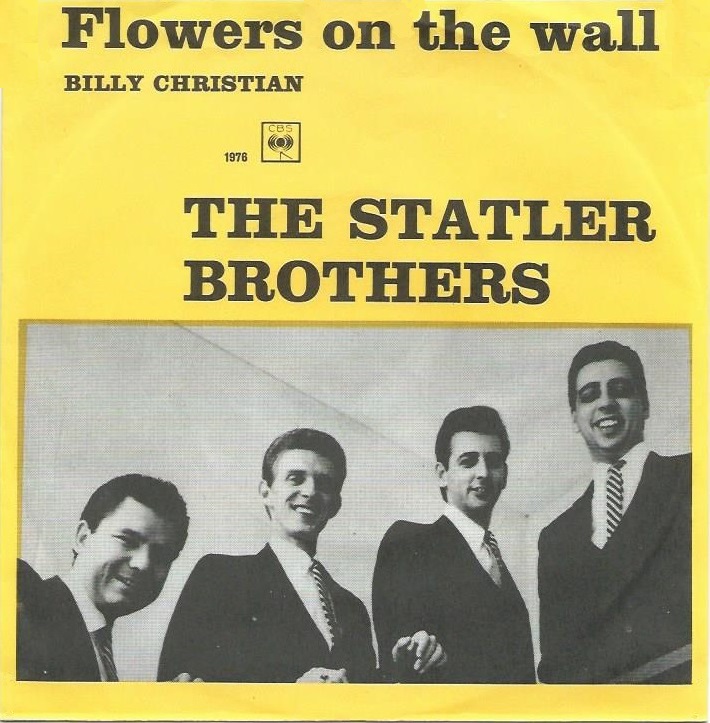
Lew DeWitt, the original tenor for The Statler Brothers, wrote “Flowers on the Wall. He described it: “We took gospel harmonies and put them over in country music.” However, it did crossover to the pop charts.
Buoyed by interest from the country fans, folk listeners began to demand that rock stations play Flowers On The Wall. In December, the song appeared on Billboard’s Hot 100. Nine weeks later, it had peaked at #4 in the Billboard 100 and #2 in the Billboard Country Charts in 1966.
All together the Statler Brothers had 66 songs in the top 100, 33 in the Top Ten and 4 number 1’s in the Billboard Country Charts. Flowers On The Wall was their only top 10 Billboard 100 hit.
In 1966 it won the Grammy Award for Best Contemporary Performance-Group (Vocal or Instrumental.)
From Songfacts
Written by Statler Brothers singer Lew DeWitt, this song is about a guy who has been left lonely and nearly catatonic by the one he loves. He’s in a pretty bad spot, counting flowers on the wall and playing solitaire with a deck that’s missing a card.
This appears on the soundtrack to the movie Pulp Fiction. Bruce Willis is singing along to the song, which is playing on his car radio, just before he runs over Marsellus Wallace at an intersection. There’s another Bruce Willis connection to the song as well: Willis mentions spending his suspension “Smoking cigarettes and watching Captain Kangaroo” in Die Hard With A Vengeance.
Flowers On The Wall
I keep hearin’ you’re concerned about my happiness But all that thought you’re givin’ me is conscience I guess If I was walkin’ in your shoes, I wouldn’t worry none While you ‘n’ your friends are worried about me I’m havin’ lots of fun
Countin’ flowers on the wall That don’t bother me at all Playin’ solitaire till dawn with a deck of fifty-one Smokin’ cigarettes and watchin’ Captain Kangaroo Now don’t tell me I’ve nothin’ to do
Last night I dressed in tails, pretended I was on the town As long as I can dream it’s hard to slow this swinger down So please don’t give a thought to me, I’m really doin’ fine You can always find me here, I’m havin’ quite a time
Countin’ flowers on the wall That don’t bother me at all Playin’ solitaire till dawn with a deck of fifty-one Smokin’ cigarettes and watchin’ Captain Kangaroo Now don’t tell me I’ve nothin’ to do
It’s good to see you, I must go, I know I look a fright Anyway my eyes are not accustomed to this light And my shoes are not accustomed to this hard concrete So I must go back to my room and make my day complete
Countin’ flowers on the wall That don’t bother me at all Playin’ solitaire till dawn with a deck of fifty-one Smokin’ cigarettes and watchin’ Captain Kangaroo Now don’t tell me I’ve nothin’ to do
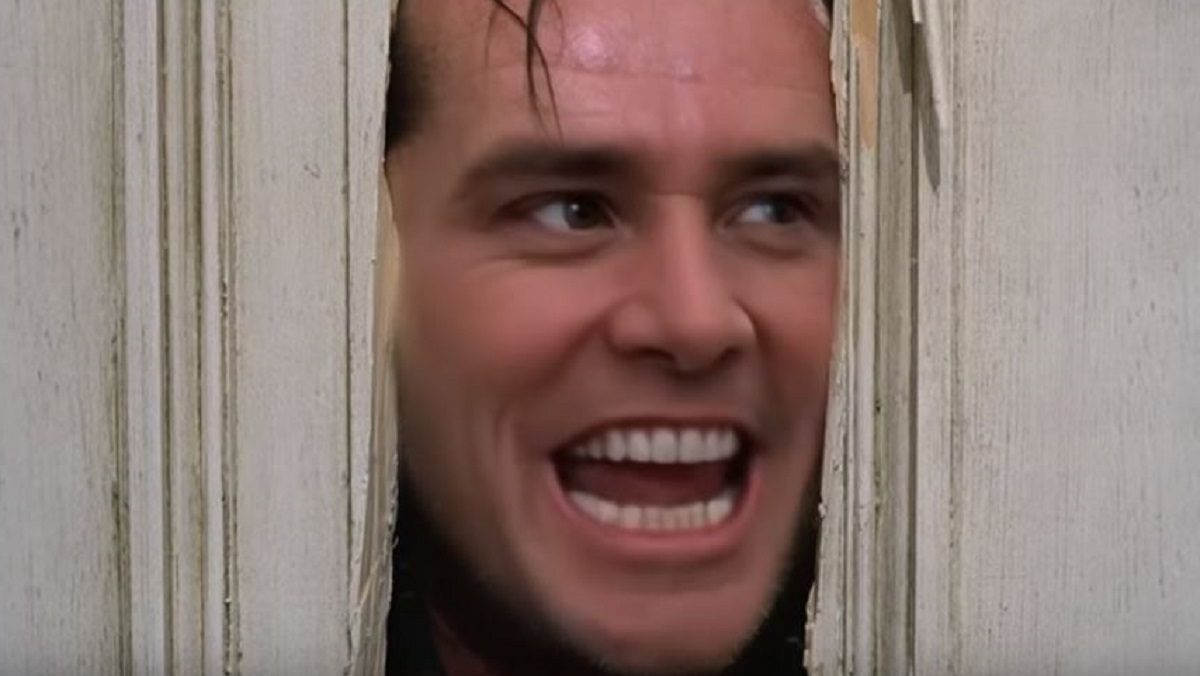
My son showed me a video on his phone and it fooled me at first. It’s easy to see why Robin Willaims and other actors and actresses have signed deals restricting their images for the future.
It’s not perfect You can tell when the actors turn their heads or in action scenes but one day it will be flawless…and these were made by a fan.
Under the YouTube username “Ctrl Shift Face,” this high-tech movie fan has used face swap technology to create some remixes of iconic movie scenes — complete with all new actors.
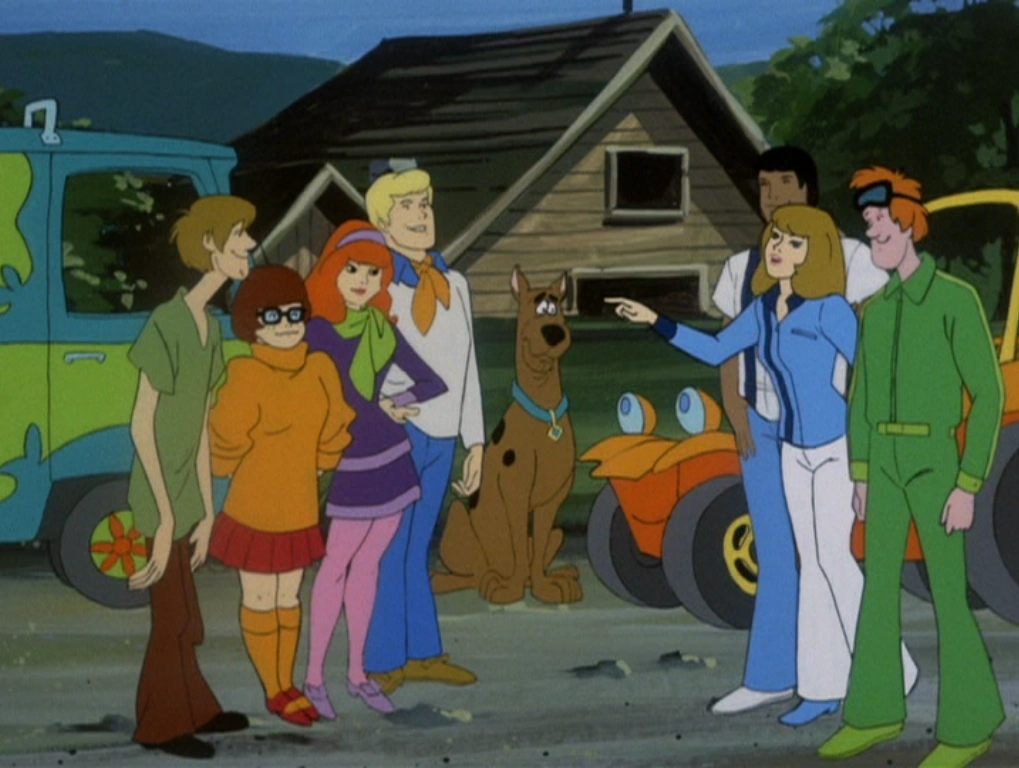
Ever notice that a few teenage characters in cartoons in the early seventies tended to look a lot like Shaggy from Scooby Doo?
Speed Buggy took its name from the main character–a talking orange dune buggy named “Speedy.” It also featured a trio of human characters who travel the world with Speedy to participate in races and win trophies… Mark, Debbie, and Tinker, the mechanic/driver…and Shaggy clone. The show was a huge success… it ended up airing on all three major networks.
Only sixteen 30-minute episodes of Speed Buggy were produced in 1973. It aired first run on CBS until 1975. Reruns aired on ABC in January 1976, replacing Uncle Croc’s Block, then on NBC, replacing the canceled McDuff, The Talking Dog, from November 27, 1976, until September 3, 1977 (thus completing the cycle of being on all three networks). Then was picked up by the USA Network for its Cartoon Express shows from 1982 to about 1990.
Not only is “Tinker” pretty much a copy of Shaggy… there are some similar character traits between Mark and Fred Jones (the blonde guy from Scooby Doo) and Debbie appears to be very similar to Daphne Blake in multiple ways.
Here is a picture of Speed Buggy cast and their doppelgangers from Scooby Doo
The voice talent comprised Mel Blanc as Speed Buggy, Michael Bell as Mark, Arlene Golonka as Debbie and Phil Luther Jr. as Tinker.
I’ve read where they based Speed Buggy off of Herbie The Love Bug
Hold the pickles, hold the lettuce Special orders, don’t upset us All we ask is that you let us serve it your way Have it your way
Ah, a company that cares! Burger King ran this commercial around 1974. Battling McDonald’s with the “Have it your way” campaign in 1973, Burger King put their service in the spotlight with the jingle, “Hold the pickle, hold the lettuce. Special orders don’t upset us.” The campaign increased ad awareness by 50%. The Little King was retired, and “Have it your way” was adapted to target children with ad efforts tagged “All kids are different” and “Pickle-less Nicholas.”
In 1976-77, Burger King changed advertising agents and went with “America loves burgers, and we’re America’s Burger King.” In 1982, they launched a “burger wars” effort with the slogan “Battle of the burgers,” comparing the Whopper with those of McDonald’s and Wendy’s.
The jingle’s upbeat, friendly tone made it feel like Burger King employees were singing just for you. It also helped that the melody was incredibly catchy—it got stuck in your head and stayed there.
Even decades later, people who grew up in the ’70s and ’80s can instantly recall that tune. In fact, when Burger King revived “Have It Your Way” in later years, they leaned heavily on nostalgia for that original “Hold the pickles…” jingle.
Anyway…I wish they would bring back those uniforms.
I don’t know if this is an iconic commercial of the time but it got my attention as a kid. I love the animation on it. I remember the green bottle of this shampoo and also “Gee Your Hair Smells Terrific” and I would mix them all together…I wasted a lot of shampoo but I was clean!
Clairol launched Herbal Essence in 1972 as “the most beautiful shampoo experience on Earth.” Most people remember the original green bottle, featuring a woman with long flowing hair surrounded by nature. The ad claimed the shampoo also contained scents of juniper, birch leaves, cinchona, melissa, and mountain gentian.
The scent of the shampoo changed when Proctor and Gamble bought Clairol in 2001 from Clairol who had owned it since the 50s.
In 1978 Mr. Whipple was named the third-best-known American — just behind former President Nixon and Billy Graham.
From 1964 to 1985, and over the course of more than 500 different TV commercials we saw Mr. Whipple lecture shoppers on squeezing the Charmin. Mr. Whipple was really neurotic with the Charmin.
Dick Wilson was a character actor who got the role as Mr. Whipple and turned “Please don’t squeeze the Charmin” into a national catchphrase as exasperated shopkeeper Mr. Whipple in the Charmin TV commercial campaign that ran for more than two decades
The character of Mr. Whipple was created by an advertising executive, John Chervokas. He is credited with developing the character, his persona, and his most memorable catchphrase, “Please don’t squeeze the Charmin!”
Procter & Gamble eventually replaced the Whipple ads with cartoon bears. When Mr. Whipple returned in 1999, he was shown coming out of retirement against the advice of his buddies for one more chance to peddle Charmin.
Andy Lambros filmed the Oscar Mayer bologna commercial, “The Little Fisherman,” that made him a commercial icon. Andy said: “It only took me an hour to learn the song because my two (older) sisters helped me.”
This Oscar Mayer commercial first aired in 1974 and aired continually for at least a decade after that.
Originally the plan was to recruit dozens of kids who would each sing a little bit of the song. The idea was that it would show how everyone loved Oscar Mayer bologna, and they filmed that for the commercial. The film crew had a few minutes of daylight left and asked if there was anyone there who could sing the song from start to finish. Andy Lambros said he could and did…and that’s why he asks, “How’s that?” at the end. When they were reviewing the footage, they knew that was the commercial they needed to use.
After this happened they started to add ad-libs in more commercials.
My Bologna has a first name,
It’s O-S-C-A-R.
My bologna has a second name,
It’s M-A-Y-E-R.
Oh I love to eat it everyday,
And if you ask me why I’ll say,
Cause’ Oscar Mayer has a way with B-O-L-O-G-N-A!!!!
When WKRP show came on I knew it was different than any show before it. The show had a great cast and every character had their own unique personality. The show started when Andy Travis came in as a program director and change the stale station to Rock and Roll…the writers wisely made it an ensemble show.
The two women on the show were smart and beautiful…Bailey Quarters and Jennifer Marlowe….played by Jan Smithers and Loni Anderson respectively.
Jan was born Karin Jan Smithers, on July 3, 1949. She grew up in Woodland Hills, California.
Jan was in high school when one of her friends asked her to go for surfing. At the beach, while she was watching her friend surf, she was approached by two men who carried cameras. They told Jan about their search for a Californian girl for one of their articles. She agreed, and that changed her life forever.
Jan was featured on the cover of the March 21, 1966 edition ‘Newsweek. An article in the magazine, titled ‘The Teen-Agers: A Newsweek Survey of What They’re Really Like, profiled Jan and six more teenagers. Jan was the only one of all the teenagers featured in the article who became a famous personality later. The article pushed her modeling career, and her mother helped break into Hollywood.
Jan got her breakthrough role of ‘Bailey Quarters’ in the ‘CBS’ sitcom ‘WKRP in Cincinnati.’ She continued her role for 86 episodes, from 1978 to1982.
Hanspostcard had mentioned he was reading this book and from what he said I had to give it a try. I got the audible version. The author Tom O’Neill has an interesting quote that sums up the book… “My goal isn’t to say what did happen—it’s to prove that the official story didn’t,”
When I first started to listen I thought it was going to be a big conspiracy book but I was pleasantly surprised…Tom O’Neill took pains not to go there. He is pretty open that he does not find the “answer” to the murders. He also made it clear he wasn’t trying to clear the guilty parties of the Tate/Labianca cases. They are no doubt guilty but it was more about the circumstances around the question of why and the Helter Skelter theory brought by Vincent Bugliosi. Vincent was the prosecutor in the case and later wrote the book Helter Skelter…the best-selling true crime book ever.
Manson’s parole officer Roger Smith was really baffling. Manson was on parole through the late sixties and did everything he could to break his parole…Smith kept giving him a pass, protecting his family, and even fostering one of Manson’s kids. Manson must have had a hell of a rabbit’s foot or someone or some organization was looking out for him. If any of us would get caught with an underage girl, stolen cars, and narcotics… a trip to jail would be in our immediate future…even in the 1960s…much less being on parole at the time.
O’Neill has the documents to back up his claims. Bugliosi did suppress evidence and most around the case are still afraid to talk. Some of the evidence yes could have got by him but not to this extent. Tom interviewed a countless number of people… including tense interviews with Bugliosi.
Tom spent 20 years on this book. The story of him writing the book is just as interesting as the story. He became depressed and obsessed with the murders. In 1999 he was writing an article for Premier Magazine and kept extending the deadlines for the 30th anniversary of the murders. Then in 2009, it was going to be a book published by Penguin for the 40th…that didn’t work out because he kept finding new leads and information. Finally this year the book was released for the 50th anniversary of the murders.
What I found interesting also was the other subjects that were brought up…COINTELPRO, Operation CHAOS, and MKULTRA…goverment secret programs that could come into play. There is much more in the book than I’ve touched on…I would recommend getting it…it makes you think and question.
Anissa was on the popular family comedy called Family Affair. Everyone knew her as Buffy and her TV brother (Johnny Whitaker) as Jody. I watched the show in the early seventies. I watched in syndication and I grew up with Buffy and Jody. It seemed unreal in 1976 when I heard on the news that Anissa Jones had died at the age of 18.
At eight years old, Anissa was cast as Buffy on Family Affair, which aired from 1966 until 1971. Just a year before she started on Family Affair, her parents had gone through a terrible divorce with a long and bitter custody battle for her and her little brother. Sadly, her father died shortly after he was awarded custody in 1973.
She did appear in an Elvis movie “The Trouble With Girls” in 1969. Family Affair was the last thing she did besides a Dick Cavett appearance.
She was known to be a caring person as a kid up until she died. Earl Graham was the janitor on the set of the show Family Affair. When he passed away during the third year of the show, the cast and crew attended his funeral. By the following Monday, everyone was ready to get back to work. To Anissa, it seemed like everyone was acting like Earl had never existed at all. Anissa went to her mother and asked if she could take an ad out in Variety saying goodbye to her good friend. The ad cost Anissa $400.00. Anissa’s Mom said that was one of her proudest moments as a mother.
She was up for the Regan MacNeil part in The Exorcist but the director was fearful that people would think “Buffy” had been possessed. Her friends and family said she was relieved when she was turned down because she wanted to be with her friends in school. She was also invited to try out for “Easy” Steensma in Taxi Driver but turned it down. She was very intelligent but fell into the wrong crowd.
In 1975 she started to skip school and take drugs and ended up in a juvenile hall for a bit. She eventually dropped out of high school working at restaurants until she was 18 in 1976 and she gained control of 180,000 dollars she got from Family Affair. She fell into the drug culture.
On August 28, 1976, Anissa died of a drug overdose. It was ruled an accidental with cocaine, PCP, Seconal, and Quaaludes found in her system. She was at a party with friends. The coroner would call it one of the most massive overdoses he’d ever seen.
I can tell you what I was doing 42 years ago on August 16, 1977… I was ten years old and played some baseball with the neighborhood guys and went inside in the afternoon. I started to watch Gilligans Island and then the news interrupted the show. Elvis Presley had died.
It really didn’t affect me too much at the time until I saw my mom and stepdad react. My mom was somewhat upset and although I knew Elvis’s music, the impact just wasn’t there until the news items started to roll across. I called my dad and talked to him and it bothered him…he had just seen Elvis a few years before in Murfreesboro Tn.
I really wouldn’t know how they felt until December 8, 1980, when Lennon was killed. It’s a shame what happened to Elvis because he was trapped by his fame, manager, and by his own excesses. After reading about him more it seemed like it was inevitable…I just wished it could have been different.