I found this article about The Max Planck Institute in Germany conducting a study on the perfect pop song… the winner was Ob-La-Di, Ob-La-Da
As everyone here knows I’m a huge Beatles fan…but this one? I couldn’t disagree more with their conclusion but it is interesting on how they made the choice… I posted a couple of links.
Being a bass player and a love for the bizarre this song has stuck with me. Les Claypool is a terrific bass player and this 1995 song added great bass playing with the odd song and I was onboard. It’s not a song I would pop in at any time…the video for me makes this song…and I hardly ever say that…but I do like the song.
I saw the video before I ever heard the song on radio…it just kept my attention all the way through over and over again. It was a Devo kind of attention getter…video wise that is.
At the time there were rumors that this song was about the actress Winona Ryder. Les Claypool denied this in interviews, pointing out that his Wynona is spelled differently and insisting the song has nothing to do with her. Ryder’s then-boyfriend, Soul Asylum singer Dave Pirner, didn’t buy it. He took offense and renamed one of his songs “Les Claypool’s A Big F–king Asshole” in concert. The song must have hit a nerve!
The song was written by Les Claypool, Larry LaLonde, and Tim Alexander. Primus has never had a Hot 100 hit, but this is one of their most popular songs, peaking at #12 Billboard Alternative Charts and #23 on the Mainstream Rock chart.
Now the video! You just have to watch it. I will say whoever made those suits did a great job.
Les Claypool: “I was fly fishing with a friend of mine up in Lassen County (California), and the sun was going down and we were heading back to the car,” he said. “He was off in one direction, and I went off in another direction. I come around this corner and I step into the creek. And just as I spied this thing, it spied me. It was this big, furry mass coming my way. It flipped and popped its tail and scared the s–t out of me, and I scared the s–t out of it. It was this giant beaver. I mean, it was huge.”
“It just happened that I had this bass part with all these triplets in it and it kind of fit real well with those lyrics,” “So when we did Punchbowl, we put the two together and that became the ‘Wynona’s Big Brown Beaver’ that everybody came to know.”
From Songfacts
Nice beaver. Thank you. I just had it stuffed.
This exchange is from the 1988 movie The Naked Gun, where Leslie Nielsen is admiring Priscilla Presley’s taxidermied beaver.
So it kind of got in my head. This big brown beaver, big brown beaver. Okay. Well, how can I make a song out of that? And then it became, ‘Wynona’s got herself a big brown beaver.’ And from there it just built into this little mythological character that obviously had a little double entendre to it.”
The band had much more modest ambitions for the song when they conceived it, at first considering it one of the filler pieces the band sometimes puts between their proper songs for comic relief.
The video was quite a production. Shot at a time when record companies were willing to shell out big bucks for videos (which MTV still played), this one featured the band in foam rubber suits dressed like cartoon cowboys. The film was shot 25% slower than normal (18 frames-per-second instead of 24) to create a sped-up, jerky look to match the cartoon theme when it was played back. This meant that the band had to mime to the song at a slower speed, so the song was played 25% slower so they could match their movements.
The band had some trouble convincing MTV to play it – Claypool says he met with a woman at the network who asked him some questions about the song. MTV ended up nightparting it.
Claypool says this song was “the bane of my existence for a while” because it made those who weren’t au fait with Primus assume they were a joke band. He eventually realized that those who didn’t get it never will, and decided to pay them no mind.
Les Claypool’s sideband Duo de Twang recorded this song on their 2014 debut album Four Foot Shack. This version was similar to the original vision of the song, which was more stripped-down.
Wynona’s Big Brown Beaver
Wynona’s got herself a big brown beaver and she shows it off to all her friends. One day, you know, that beaver tried to leave her, so she caged him up with cyclone fence. Along came Lou with the old baboon and said “I recognize that smell,Smells like seven layers,That beaver eatin’ Taco Bell!”.
“Now Rex he was a Texan out of New Orleans and he travelled with the carnival shows. He ran bumper cars, sucked cheap cigars and he candied up his nose. He got wind of the big brown beaver So he thought he’d take himself a peek,but the beaver was quick and he grabbed him by the kiwis, and he ain’t pissed for a week.(And a half!)
Wynona took her big brown beaver and she stuck him up in the air, said “I sure do love this big brown beaver and I wish I did have a pair. Now the beaver once slept for seven days And it gave us all an awful fright, So I tickled his chin and I gave him a pinch and the bastard tried to bite me. Wynona loved her big brown beaverAnd she stroked him all the time. She pricked her finger one day and it occurred to her she might have a porcupine.
This song is for Song Lyric Sunday for Jim Adams’s blog. This week’s prompt is (drum roll please…) Alligator/Crocodile/Lizard/Snake/Turtle…
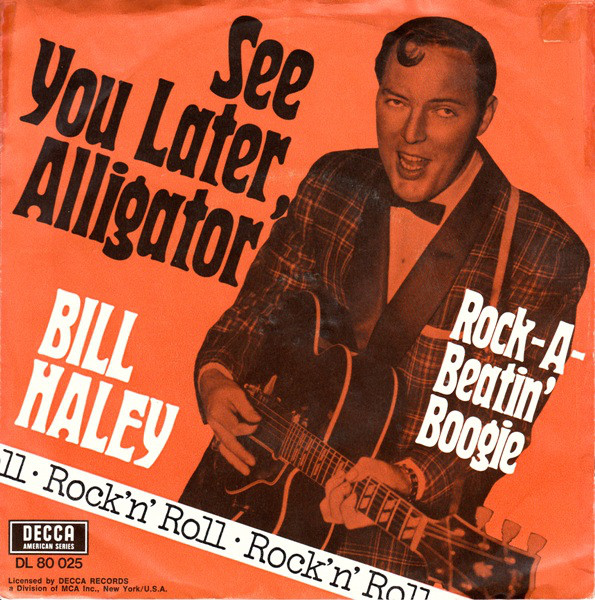
Sometimes I like going back to the era where Rock and Roll began as we know it. Bill Haley was an unlikely looking rock star but he did have some hits in the 50s. Rock Around the Clock was his best known song but he did have some other hits like Shake, Rattle, and Roll, and Crazy Man Crazy. His popularity and legacy didn’t last as long as some of his peers. I was introduced to him by the television show Happy Days.
See You Later Alligator was written by songwriter Robert Charles Guidry, who recorded it himself in 1955 under his stage name of Bobby Charles. However it was the Bill Haley version that took off. Guidry also wrote hits for other performers, most notably “Walking To New Orleans” for Fats Domino.
After while crocodile was/is a popular way of saying goodbye and this song made it more popular. The use of the phrase “See you later alligator” when taking one’s leave stemmed from this song. However… according to Brewer’s Dictionary of Modern Phrase & Fable, ‘alligator’ was already a term in the 1950s for a jazz or a swing fan, as someone who ‘swallowed up’ everything on offer.
The song peaked at #6 in the Top 100, #7 in the R&B Charts, and #7 in the UK in 1955.
So….to stay in the spirit of the song…Don’t Be Square…We’d better stop before we drop. Thanks for dropping by, McFly…and see you later…alligator!
Have a wonderful Sunday and thanks for reading.
From Songfacts
They don’t make ’em like they used to! This classic hails from a time when rock-n-roll bands had flashy names like “Bill Haley & His Comets” and played 12-bar blues songs like they knew where they were coming from. Bill Haley & His Comets is regarded today as one of the first true rock-n-roll bands, innovators who were white musicians bringing rock to a white audience.
Haley and his producer Milt Gabler had some experience turning catchy R&B songs into mainstream hits – they had done it with “Shake, Rattle And Roll.” They heard the Bobby Charles version of “See You Later Alligator,” which was climbing the charts, and knew that they had to get a version recorded and released quickly before someone else did. In mid-December, knowing that operations would shut down when hey got near Christmas, the band recorded the song on a weekend, and Gabler had to break into his own office to retrieve the Charles version of the song and the lyrics he had written down. Said Gabler: “My office had a frosted glass panel so I got a hammer, smashed the pane and robbed my own office. When the staff came in on Monday morning, they thought there had been a robbery. My secretary had a long face. She said, ‘Mr. Gabler, someone’s broken into your office.’ I said, ‘Yes, I know. It was me.'”
The Rosemarie Ostler book Dewdroppers, Waldos, and Slackers – A Decade-by-Decade Guide to the Vanishing Vocabulary of the Twentieth Century calls this style “Voutian” and credits the jazz musician Slim Gaillard with its invention.
If you’re thinking “Get on the bus, gus!”, then you have a good clue, Blue! Another song to use this rhyming-jive style is “Fifty Ways To Leave Your Lover.” Also see TV series such as I Love Lucy and other shows from the ’50s or set in the ’50s. Oh, yes, and in the film Grease, the master of ceremonies at Rydell High’s National Bandstand Dance-Off Contest explains the rules in rhyming jive. You can probably think of more examples, but do not confuse this with Cockney rhyming slang, which is a completely different speech pattern altogether.
See You Later Alligator
(See you later, alligator)
Well, I saw my baby walkin’ with another man today Well, I saw my baby walkin’ with another man today When I asked her what’s the matter This is what I heard her say
See you later alligator, after ‘while crocodile See you later alligator, after ‘while crocodile Can’t you see you’re in my way now Don’t you know you cramp my style
When I though of what she told me, nearly made me lose my head When I though of what she told me, nearly made me lose my head But the next time that I saw her Reminded her of what she said
See you later alligator, after ‘while crocodile See you later alligator, after ‘while crocodile Can’t you see you’re in my way now Don’t you know you cramp my style
She said I’m sorry pretty daddy, you know my love is just for you She said I’m sorry pretty daddy, you know my love is just for you Won’t you say that you’ll forgive me And say your love for me is true
I said wait a minute ‘gator, I know you mean it just for play I said wait a minute ‘gator, I know you mean it just for play Don’t you know you really hurt me And this is what I have to say
See you later alligator, after ‘while crocodile See you later alligator, after ‘while crocodile Can’t you see you’re in my way now Don’t you know you cramp my style
See you later alligator, after ‘while crocodile See you later alligator, so long, that’s all, goodbye
Lets continue browsing through famous guitars. In Part 1 we had a guitars owned by Brian May and Willie Nelson.
George Harrison and Eddie Van Halen’s guitars
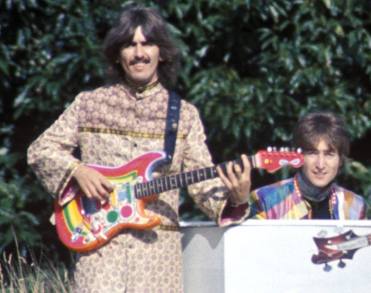
Today we will visit two more….George Harrison‘s Strat “Rocky” and Eddie Van Halen‘s “Frankenstrat”
Today we will start off with one of my favorite guitars for obvious reasons…and then Frankenstrat below Rocky.
“Rocky”
When The Beatles were in the studio recording “Help!“, John Lennon and George Harrison sent roadie Mal Evans out to go get a couple of Fender Stratocasters. Evans came back with matching 1962 Sonic Blue Strats. You can hear both of these guitars on Rubber Soul…especially both playing the solo on Nowhere Man in unison.
George Harrison: “During ’67, everybody started painting everything,” “and I decided to paint it. I got some Day-Glo paint, which was quite a new invention in them days, and just sat up late one night and did it.”
Harrison used some of his ex-wife Patti Boyd’s nail polish to paint the headstock. George played the guitar that year in the Beatles’ live performance of “All You Need Is Love” on the around the world satellite feed called Our World, the first global satellite TV program, and in the film Magical Mystery Tour, in the segment where the Beatles mime to “I Am the Walrus”
In 1969-1970 on the advice of the great slide guitar player Ry Cooder George set Rocky up for slide only.
The Harrison Estate still owns this guitar.
Following its announcement at NAMM 2020, Fender has now officially released its faithful recreation of George Harrison’s ‘Rocky’ Stratocaster…hmm I know exactly what I want for Christmas!
“Frankenstrat”
Eddie wanted to make a guitar that was a cross of a Gibson and Fender. To have the clean tone of a Fender and the ability to have the crunch of a Gibson.
In 1974 he visited Boogie Bodies guitars, whose parts were used on early Charvels, and bought himself a factory second unfinished body and neck, paying total of $130. The body he bought was the first one he saw laying around in the store, but he paid close attention to choosing the right neck – he looked for a wide neck with a really thin profile and big Gibson-style frets.
He painted the body black and wrapped masking tape around it and repainted the body white. He installed a Fender tremolo from a 1958 Stratocaster, Schaller tuners, and a Gibson PAF pickup from an old ES-335 which he dipped into paraffin wax in order to get rid of the feedback.
He played the guitar on Van Halen’s first album, and during the band’s first tour. Towards the end of the tour, the guitar was changed to feature a white pickguard and a rosewood neck.
He later changed out necks and hardware and painted it red with bicycle paint.
Frankenstrat was donated to the Hard Rock Cafe in 2004. In 2017 Frankenstrat had been stolen from the walls of the city’s Hard Rock Cafe but returned later.
Stevie Nicks always got more attention in Fleetwood Mac but I’ve always favored Christine’s songs. McVie has written some superb pop songs. This video I saw many times on the still new MTV.
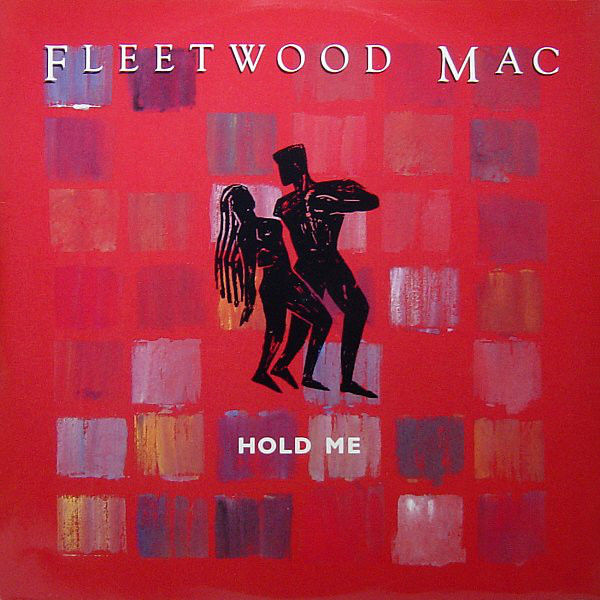
Fleetwood Mac singer/keyboard player Christine McVie wrote this song with Robbie Patton, a singer who had a US hit in 1981 with “Don’t Give It Up,” which features guitar by Lindsey Buckingham.
This song was inspired by Christine McVie’s relationship with Beach Boys drummer Dennis Wilson. After she split with Fleetwood Mac bass player John McVie, Christine dated Wilson for several years before they broke up in 1981. Wilson died in 1983 in a drunk-drowning accident.
Hold Me was on the Mirage album released in 1982. The band recorded the album at the Château d’Hérouville outside of Paris… they filmed the video for this song in the Mojave Desert outside of Palm Springs. The album peaked at #1 in the Billboard Album Charts, #5 in the UK, and #4 in Canada in 1982.
The song peaked at #4 in the Billboard 100, #7 in Canada, and #94 in the UK.
Christine McVie on Mirage getting overlooked: “It does, and I don’t know why,” she says. But, she adds, “As it stands today, a lot of people know every track on it. Which is quite unbelievable. So I just take it for what it is.”
I suppose we all felt in a way that what we were doing was kind of an homage to Rumours, in the sense that, obviously, after Rumours we went completely the opposite way and made a double album of an entirely different nature with Tusk. And for Tusk we had done this hugely long tour. Two world tours, I believe. Then we all disappeared for a few years. But we have a habit of doing that, Fleetwood Mac. Just kind of taking quite long hiatuses. And as we got together again, I think it was Mick who had this idea that perhaps we should enter another bubble-like situation, which was similar to what we had done for the Rumours album, when we recorded in Sausalito. Just taking us away from familiar things, like our families. There was the idea that maybe something would emerge from there that was completely different. Maybe it would make us more creative. And I think it worked, to an extent. It was definitely an unusual experience.
From Songfacts
Robbie Patton toured as an opening act with Fleetwood Mac in 1979 and McVie produced his albums Distant Shores (1981) and Orders From Headquarters (1982).
The video for this song was inspired in large part by the works of the Belgian painter Magritte, whose paintings appear in the clip. It was directed by Steve Barron and shot in the Mojave Desert. The combination of extreme heat and band tension made for a very difficult shoot. Christine McVie, Lindsey Buckingham and Stevie Nicks had all started solo projects, and getting the band to collaborate was a lesson in futility. The video’s producer Simon Fields said in I Want My MTV by Craig Marks, “John McVie was drunk and tried to punch me. Stevie Nicks didn’t want to walk on the sand with her platforms. Christine McVie was fed up with all of them. They were a fractious bunch.”
The video was subpar, but it was a fresh Fleetwood Mac video, which was good enough for MTV, which in 1982 was desperate for new clips by rock artists, especially established ones. Fleetwood Mac’s video for “Tusk” was one of the few they had available when they launched on August 1, 1981.
Christine McVie and Lindsey Buckingham share the lead vocals on this track.
Hold Me
Can you understand me Baby don’t you hand me a line Although it doesn’t matter You and me got plenty of time
There’s nobody in the future So baby let me hand you my love Oh, there’s no step for you to dance to So slip your hand inside of my glove
Hold me, hold me, hold me Hold me, hold me, hold me
I don’t want no damage But how am I gonna manage with you You hold the percentage But I’m the fool payin’ the dues
I’m just around the corner If you got a minute to spare I’ll be waitin’ for ya’ If you ever want to be there
Hold me, hold me, hold me Hold me, hold me, hold me Hold me, hold me, hold me Hold me, hold me, hold me
Hold me, hold me, hold me Hold me, hold me, hold me Hold me, hold me, hold me Hold me, hold me, hold me Hold me, hold me, hold me Hold me, hold me, hold me Hold me, hold me, hold me Hold me, hold me, hold me
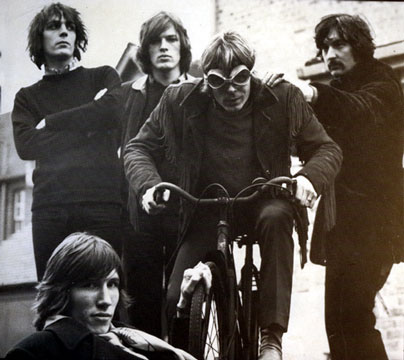
My journey through early Pink Floyd continues with this song called Bike written by Syd Barrett. It’s very British and like some of the other early songs you can hear the later Pink Floyd taking shape. This song was on the album The Piper At The Gates Of Dawn released in 1967.
The album title came from a chapter in the book Wind In The Willows, where The piper was Pan, the Greek god of music.
Barrett was 18 when he met 15-year-old Jenny Spires in 1964. They started dating the following year, which is when he wrote “Bike.” Barrett would often create artwork and poetry for Spires, and “Bike” was his version of a love song to Spires.
Pink Floyd drummer Nick Mason considers this one of Syd Barrett’s best songs.
From Songfacts
Pink Floyd guitarist Syd Barrett wrote this for his girlfriend, Jenny Spires. In the song, Syd shows her his bike, which he borrowed. He also shows her his mouse named Gerald, a clan of gingerbread men and a cloak. At the end of the song, Syd takes her to his music room.
The Piper At The Gates Of Dawn was the first Pink Floyd album and the only one dominated by Syd Barrett, who was booted from the band in 1972 when he became mentally impaired.
You’re the kind of girl that fits in with my world
I’ll give you anything, everything if you want things
Spires recalled him being “very loving.”
“The lyrics to this are so very Syd, astonishingly clever,” he told Rolling Stone. “It’s fun, but there’s a depth of sadness to them.”
Bike
I’ve got a bike, you can ride it if you like It’s got a basket, a bell that rings and Things to make it look good I’d give it to you if I could, but I borrowed it
You’re the kind of girl that fits in with my world I’ll give you anything, ev’rything if you want things
I’ve got a cloak, it’s a bit of a joke There’s a tear up the front, it’s red and black I’ve had it for months If you think it could look good, then I guess it should
You’re the kind of girl that fits in with my world I’ll give you anything, ev’rything if you want things
I know a mouse, and he hasn’t got a house I don’t know why I call him Gerald He’s getting rather old, but he’s a good mouse
You’re the kind of girl that fits in with my world I’ll give you anything, ev’rything if you want things
I’ve got a clan of gingerbread men Here a man, there a man, lots of gingerbread men Take a couple if you wish, they’re on the dish
You’re the kind of girl that fits in with my world I’ll give you anything, ev’rything if you want things
I know a room full of musical tunes Some rhyme, some ching, most of them are clockwork Let’s go into the other room and make them work
I was headed over to see my then girlfriend in 1985 and I was exiting off of the interstate. That is when I saw a beautiful girl hitch-hiking. She was stunning and conservatively dressed. So being a caring guy… I wanted to do a good deed! I stopped and asked her if I could help. She got in the car and was very nice and well spoken. She asked me where I was going and I told her to my girlfriend’s house.
Then came the question…did I want a “date” for that night…I told her my girlfriend would probably frown on that idea so I took her back where I found her and let her out…she was totally nice but yea I was a naïve 18 year old and ever since then this song reminds me of her…So this song is for her where ever she is now.
This is a great song that was on what was regarded as Creedence’s worse album.
The Mardi Gras album. By this time John’s brother had quit and the other two (Stu Cook and Doug Clifford) members had wanted more to do with the band’s direction. John told them for this album they would have more to do like writing and singing 3 songs each…they were not ready for that and the result was Mardi Gras…it was universally panned but there are some good songs on it…mostly the Fogerty contributions. It was their last studio album.
The song peaked at #6 in the Billboard 100, #1 in Canada, and #36 in the UK in 1971. The album peaked at #12 in the Billboard Album Charts and #11 in Canada.
From Songfacts
This was the first CCR album that John Fogerty did not dominate. Other members of the band had accused him of being a control freak, so Fogerty let them do more of the songwriting and have a more prominent role on this album. It was the beginning of the end for CCR, as the album was a flop and this song the last of their hits.
In the line, “We could make music at the Greasy King,” The Greasy King was the nickname for the local burger stand in Berkeley, California near their rehearsal space, which they called “Cosmo’s Factory.”
This was the first single CCR released as a trio – Tom Fogerty left before the album was recorded.
The band started a four-continent tour as this was released.
Since they did not have other new songs to go along with this track, it was released as a single a year before the Mardi Gras album was issued.
The follow-up single, “Molina”/”Sailor’s Lament,” was never released in North America. It was released in Germany and became a major hit there in late 1971.
Sweet Hitchhiker
Was ridin’ alongside the highway Rollin’ up the country side Thinkin’ I’m the devil’s heatwave What you burn in your crazy mind? Saw a slight distraction Standin’ by the road She was smilin’ there Yellow in her hair Do you wanna, I was thinkin’ Would you care?
Sweet Hitchhiker We could make music at the Greasy King Sweet Hitchhiker, Won’t you ride on my fast machine?
Cruisin’ on through the junction I’m flyin’ ’bout the speed of sound Noticin’ peculiar function I ain’t no roller coaster Show me down I turned away to see her Whoa, she caught my eye But I was rollin’ down Movin’ too fast Do you wanna, she was thinkin’ Can it last?
Sweet Hitchhiker We could make music at the Greasy King Sweet Hitchhiker Won’t you ride on my fast machine?
Was busted up along the highway I’m the saddest ridin’ fool alive Wond’ring if you’re goin’ in my way Won’t you give a poor boy a ride? Here she comes a ridin’ Lord, she’s flyin’ high But she was rollin’ down Movin’ too fast Do you wanna, she was thinkin’ Can I last?
Sweet Hitchhiker We could make music at the Greasy King Sweet Hitchhiker Won’t you ride on my fast machine?
The Animals were nasty sounding…more than the Stones on some of their records at this time.
This is one of the songs that have been said as having pioneered grunge music. The song was written by Eric Burdon, Vic Briggs, John Weider, Barry Jenkins, and Danny McCulloch.
This was in the middle of the psychedelic period…In 1966 the original Animals disbanded because of business mismanagement and were in debt. Eric carried on with the newly named Eric Burdon & The Animals. He left behind his Newcastle, hard-drinking ways behind, and became a spokesman for the counterculture in this period.
This song was released in 1967 and it peaked at #15 in the Billboard 100, #10 in Canada, and #45 in the UK.
Eric Burdon: “When I first wrote it I played it to George Harrison and his comment was ‘Great! You got to do more of this. You’ll know you’ll be able to sing this song when you are in your forties.’ Now I am in my 70s and I am still singing it.”
From Songfacts
“When I Was Young” was written by Eric Burdon and included on various Animals albums as well as being a single release.
Burdon’s composition marks an important turning point for the Animals: many of The Animals’ hits had been Brill Building productions, most notably the husband-and-wife team of Barry Mann and Cynthia Weil, which was an effort by their producer Mickie Most to make this British Invasion band sound more American. Burdon found this too restricting, and the group moved to Decca Records by 1966. This was amongst their first hits after this move.
Cover versions of this song include versions by Golden Earring, Eddie Fisher, Tina Turner, and The Ramones. It’s also been featured in film soundtracks such as Doris Dorrie’s Manner….
When I Was Young
‘The rooms were so much colder then My father was a soldier then And times were very hard When I was young
I smoked my first cigarette at ten And for girls, I had a bad yen And I had quite a ball When I was young
When I was young, it was more important Pain more painful Laughter much louder Yeah, when I was young When I was young
I met my first love at thirteen She was brown and I was pretty green And I learned quite a lot when I was young When I was young When I was young
Pain more painful Laughter much louder Yeah, when I was young When I was young
My faith was so much stronger then I believed in fellow man And I was so much older then When I was young When I was young When I was young
At the start of MTV my small town I lived in had yet to get cable…but it wouldn’t take too long. At that time I had to travel to relatives in Nashville before I got a chance to see it. I would spend the weekend and we would watch MTV for hours at a time. Binge watching before binge watching was a saying. We would wake up the next day bleary eyed and turn on more MTV.
I did find some music I never heard before. This band and song caught my attention. The song was released in 1982. It peaked at #7 in the Billboard 100, #1 in Canada, and #5 in the UK.
The song was on the The Rise & Fall album. They were different…they have been described as a British ska and pop band.
This was Madness only top 10 hit in the US. Much of the song’s success in America was helped out by the clever music video that was in heavy rotation early days of MTV.
The producers were Clive Langer and Alan Winstanley
Alan Winstanley: “At the time of doing Madness we were kind of flying along together,” adds Langer. “Alan’s very precise and very particular, and I’m more slapdash and in a hurry and probably tend to like rougher-sounding records. That’s a generalization, because in the end we do like the same records, but sometimes the whole process with Alan can be laborious for me. He normally does the vocal comps whereas I’ll do a lot more work in the rehearsal room on the arrangements, deciding what instruments should play what where, how long the chorus should be and things like that. Still, we’ve got on fine considering how long we’ve worked together.”
Graham “Suggs” McPherson lead singer :“This was the first time we worked with the string arranger David Bedford. It was clear to him what our records needed and he did great things for us. It’s strange now to think we were so philosophical about such everyday things.”
From Songfacts
This won the Best Song award at the 1983 Ivor Novello Awards.
This was played in a 2007 TV commercial shown in the UK for Bird’s Eye Fish Fingers, which featured Suggs. In the advert the Madness frontman is sitting with a family at tea time. The daughter is studying for her school exams and asks Suggs where Omega 3 can be found. He offers the answer of Birds Eye Fish Fingers.
The song’s video featured the band as a cloth-cap wearing family squashed into a terraced house. Drummer Dan “Woody” Woodgate recalled to Q Magazine August 2008: “The knocking-on-the-door bit where somebody comes out, goes, ‘Where are they?’ and the others sneak in and close the door… That’s The Flintstones. We stole lots of ideas from the Keystone Kops and Benny Hill.”
Our House
Father wears his Sunday best Mother’s tired, she needs a rest The kids are playing up downstairs Sister’s sighing in her sleep (ah) Brother’s got a date to keep, he can’t hang around
Our house, in the middle of our street Our house, in the middle of our
Our house, it has a crowd There’s always something happening And it’s usually quite loud Our mum she’s so house-proud Nothing ever slows her down and a mess is not allowed
Our house, in the middle of our street Our house, in the middle of our Our house, in the middle of our street Our house, in the middle of our (something tells you that you’ve got to move away from it)
Father gets up late for work Mother has to iron his shirt Then she sends the kids to school Sees them off with a small kiss (ah) She’s the one they’re going to miss in lots of ways
Our house, in the middle of our street Our house, in the middle of our
I remember way back then when everything was true and when We would have such a very good time, such a fine time Such a happy time And I remember how we’d play, simply waste the day away Then we’d say nothing would come between us Two dreamers
Father wears his Sunday best Mother’s tired, she needs a rest The kids are playing up downstairs Sister’s sighing in her sleep Brother’s got a date to keep, he can’t hang around
Our house, in the middle of our street Our house, in the middle of our street Our house, in the middle of our street Our house, in the middle of our
Our house, was our castle and our keep Our house, in the middle of our street Our house, that was where we used to sleep Our house, in the middle of our street Our house, in the middle of our street, our house
The ones, love us best are the ones we’ll lay to rest And visit their graves on holidays at best The ones, love us least are the ones we’ll die to please If it’s any consolation, I don’t begin to understand them
This song starts with a raw cool riff and a scream…how much more rock and roll can you get? The lyrics above is what got me into this song in the 80s.
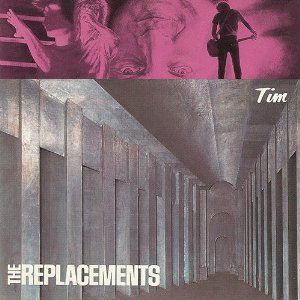
The song was on the album Tim released in 1985. The album was produced by Tommy Ramone. Alex Chilton also helped out with the album.
Why was the album called Tim? There was no reference to the name on the album. The bands manager said that he asked Paul Westerberg what the name of the album would be. Paul told him “Tim” and the manager asked why? Paul said “because it’s such a nice name. “
It was placed 136th on Rolling Stone’s 2003 list of the 500 greatest albums of all time, and 137 in a 2012 revised list. The album peaked at #186 in the Billboard Album Chart in 1986.
“Bastards of Young” was used in the 2020 film The New Mutants during the “party” scene where they are relaxing even though they are still confined.
Paul Westerberg working on the album:“”Writing songs like ‘Androgynous’ and ‘Answering Machine’ wasn’t difficult – presenting them to the group was. I’d been tinkering with stuff like that early on… It was hard getting across the idea we should just put the best songs on the record, even if there wasn’t always a place for Bob to have a hot lead. Bob was the hard one to get to acquiesce. So [Tim] ended up putting the chink in the armor of the idea of us as a four-piece rock band.”
From Songfacts
Fitting with the rebellious nature of The Replacements, this song is about a lost generation. The references to “Elvis” and the “Baby Boom” imply their parents, who see them as nothing more than tax deductions. “Bastard” is a derogatory term for a child born out of wedlock.
Some have speculated that the chorus is actually, “We are the sons of Norway” (somewhat fitting, given the Minnesota birthplace of all members) but, (famously) as no lyric sheet was ever provided by the band, it remains speculation.
The video is a black-and-white, single shot of a stereo system playing the song. He see a guy enter the frame, lie on the couch and smoke a cigarette, but we never see his face. At the end of the clip, he kicks over a speaker and leaves.
Bastards of Young
God, what a mess, on the ladder of success Where you take one step and miss the whole first rung Dreams unfulfilled, graduate unskilled It beats pickin’ cotton and waitin’ to be forgotten
We are the sons of no one, bastards of young We are the sons of no one, bastards of young The daughters and the sons
Clean your baby womb, trash that baby boom Elvis in the ground, there’ll ain’t no beer tonight Income tax deduction, what a hell of a function It beats pickin’ cotton or waitin’ to be forgotten
We are the sons of no one, bastards of young We are the sons of no one, bastards of young Now the daughters and the sons
Unwillingness to claim us, ya got no war to name us
The ones, love us best are the ones we’ll lay to rest And visit their graves on holidays at best The ones, love us least are the ones we’ll die to please If it’s any consolation, I don’t begin to understand them
We are the sons of no one, bastards of young We are the sons of no one, bastards of young Daughters and the sons
Young, young, young, young
Take it, it’s yours Take it, it’s yours Take it, it’s yours Take it, it’s yours Take it, it’s yours Take it, it’s yours Take it, it’s yours Take it, it’s yours Take it, it’s yours
Deke and Dave my Canadian friends both have mentioned them in their blogs. I like what I’ve heard from the band…I remember this band by the name Teenage Heads in the 1980s in America… but never heard much of their music then. They had some rock, punk, and power pop thrown in…what’s not to like about that?
They are from Hamilton, Ontario in Hamilton Weston High school… friends Frankie (Venom) Kerr and Gordon Lewis formed the group in 1975 with bassist Steve Mahon and Nick Stipinitz on drums.
They took their name from a Flaming Groovies song title and album. They quickly gained a loyal following on the Ontario club circuit for their shows, highlighted by Lewis’ guitar work and front man Venom’s on stage presence.
Their self-titled debut album was released in 1979, and it was distributed by Epic Records Canada. A year later, the group signed to Attic Records and released this album Frantic City, the album that put them on the international radar. The hit singles, “Something On My Mind” and “Let’s Shake” helped propel the album to platinum sales (100,000) in Canada.
Somethin On My Mind peaked at #20 in Canada in 1980.
After a couple of years Teenage Head was finally recognized by M.C.A. Records for their international potential and signed to a U.S. deal… but the deal came with conditions. The band was forced to change their name to “Teenage Heads” and that is the name I remember them by in the 80s.
***Updating this…the band has a new documentary out…Picture My Face***
Somethin’ On My Mind
If you go, ah well, you know I just won’t mind ‘Cause they say, a love like ours takes time Have to say, uh, that there’s something on my mind She’s a friend and I knew you wouldn’t mind
But if you, well, have to go That’s OK But if you decide to stay Please don’t go Please don’t go
If you stay, ah well, I won’t care anyway If you’re bad, well it’s the last chance that you have Can I say, uh, that a love is sometimes blind Now I see, all the things that went behind
But if you decide to go That’s OK But if you, well, plan to stay Please don’t go No no no
But if you, well, plan to go Please don’t go But if you decide to stay No no no Please don’t go
You don’t have to please me ‘Cause baby, you know I’m easy The last time that you went You burned all the cards I sent
But if this time it’s for good Uh, so it’s understood So, if you leave once more You’ll find out what’s in store
Have to say, uh, that there’s something on my mind She’s a friend and I knew you wouldn’t mind Have to say, uh, that there’s something on my mind She’s a friend and I knew you wouldn’t mind Have to say, uh, that there’s something on my mind
This song is for Song Lyric Sunday for Jim Adams’s blog. This week’s prompt…Bird/Cat/Dog/Fish/Pet…I hope everyone has a good Sunday and turns up Hot Dog!
I know some Zeppelin fans that don’t like this song. I guess it’s a guilty pleasure of mine. I love playing that intro on guitar. The intro sounds like a square dance riff from hell. Robert Plant does a great rockabilly vocal and they have the echo set perfectly.
This one is a fun song that Zeppelin sounds like they had a good time recording. Led Zeppelin played this live at the 1979 appearance at Knebworth and 1980 tour in Europe.
The song was on the album In Through The Out Door and it peaked at #1 in the Billboard Album Charts, Canada, The UK, and New Zealand. The song was the B side to Fool In The Rain. The song was written by Robert Plant and Jimmy Page.
A promotional video was shot. This was the closest Led Zeppelin came to a music video.
From Songfacts
This was influenced by American rockabilly music, which Robert Plant enjoyed. A hot dog is distinctly American cuisine.
Led Zeppelin had some heavy songs, but this was a fun, rollicking tune at a tough time for the band. Plant’s 5-year-old son, Karac, died in 1977 and they were all worn out from constant touring and recording.
The lyrics about a girl in Texas who “Took my heart” may have been based on a real woman in Plant’s life, but he called this a tribute to Texas and the state of mind of the people in Texas.
On a particularly cold day at a turn of the 20th century New York baseball game, no one was buying concessionaire Harry Stevens’ ice cream, so he begun selling sausages and rolls. He started calling out, “Red hot dachshund sausages!” and found they were very popular. Thomas “Tad” Dorgan, a sports cartoonist for The New York Journal, was in the press box and seeing this he attempted to draw a cartoon of a barking sausage steaming in its stretched out roll. He didn’t know how to spell “Dachshund,” so he wrote “hot dog” instead, a name which immediately caught on. (from the book Food for Thought: Extraordinary Little Chronicles of the World by Ed Pearce)
Hot Dog
(Oh, hot dog) Well, I just got into town today To find my girl who’s gone away She took the Greyhound at the general store I searched myself I searched the town When I finally did sit down I find myself no wiser than before
She said we couldn’t do no wrong No other love could be so strong She locked up my heart in her bottom drawer Now she took my heart she took my keys From in my old blue dungarees And I’ll never go to Texas anymore
Now my baby’s gone I don’t know what to do She took my love and walked right out the door And if I ever find that girl I know one thing for sure I’m gonna give her something like she never had before
I took her love at seventeen A little late these days it seems But they said heaven is well worth waiting for I took her word I took it all Beneath the sign that said “you-haul” She left angels hangin’ round for more
Now my baby’s gone I don’t know what to do She took my love and walked right out the door And if I ever find that girl I know one thing for sure I’m gonna give her something like she never had before
I thought I had it all sewn up Our love, a plot, a pick-up truck But folks said she was after something more I never did quite understand All that talk about rockin’ bands But they just rolled my doll right out the door Oh yeah, they just rolled my doll right out the door But they just rolled my doll right out the door
I mentioned this song a few days ago about how the intro sounds a lot like The Kinks Picture Book. It’s a good song that was on their album of the same name.
That song peaked at #31 in the Billboard 100 and #27 in the UK in 2000. Green Day recorded Warning at Studio 880 in Oakland. The facility was directly beneath a freeway, and, according to Billie Joe, each time a truck passed overhead “you could feel the console vibrating.”
The album peaked at #4 in the Billboard Album Charts, #2 in Canada, and #4 in the UK in 2000. The lead single Minority spent over a month at the top of the Billboard Modern Rock chart. The album was a turning point for Green Day as they introduced a sax, harmonica, and mandolin and limited Billy Joe’s distorted solos. Punk fans didn’t like the change but it setup their huge next album American Idiot that was released in 2004.
From Songfacts
This song is about how rules are made to be broken and warnings can be ignored. You live your own life, you make your own choices. Says bass player Mike Dirnt: “You gotta make your own decisions and choices. It’s not so much about what to think, it’s just to think. Question everything.”
Warning
This is a public service announcement This is only a test Emergency evacuation protest May impair your ability to operate machinery Can’t quite tell just what it means to me Keep out of reach of children Don’t you talk to strangers Get your philosophy from a bumper sticker
Warning, live without warning I say a warning, live without warning Without, Alright
Better homes and safety-sealed communities Did you remember to pay the utilities? Caution: police line: you better not cross Is the cop or am I the one that’s Really dangerous? Sanitation, Expiration date, Question everything Or shut up and be a victim of authority
Warning, live without warning I say a warning, live without warning I say a warning, live without warning I say a warning, live without warning Without Alright!
Better homes and safety-sealed communities Did you remember to pay the utilities?
Caution: police line: you better not cross Is the cop or am I the one that’s Really dangerous? Sanitation, Expiration date, Question everything Or shut up and be a victim of authority
Warning, live without warning I say a warning, live without warning I say a warning, live without warning I say a warning, live without warning
This is a public service announcement This is only a test
This was the second “new” song by the Beatles to be released in the 1990’s and it was on the Anthology 2 album. I liked the song but it didn’t resonate with me like Free As A Bird did. Real Love sounded more like a Lennon solo song with the Beatles backing him…but I love Lennon’s solo output so I did like it but it wasn’t as “Beatle-ly” to me than Free As a Bird.
The song was more fully realized than Free As a Bird and didn’t take as much input by the other three shaping it. This is the only Beatles song where the songwriting credit is John Lennon alone instead of Lennon-McCartney or all four Beatles.
Paul McCartney did his best John Lennon imitation to help the lead vocal because the recording of John’s voice was low and spotty in some places. The lead vocal is actually a John and Paul duet.
The song with Lennon’s early takes on “Real Love,” recorded with just guitar and vocals, had also appeared on the soundtrack of the Imagine: John Lennon documentary before the Beatles got to finish it.
The song peaked at #11 in the Billboard 100, #12 in Canada, and #4 in the UK in 1996.
From Songfacts
This was an unfinished song written by John Lennon that was completed by the remaining Beatles. It was the second “new” release for the Anthology 2 album (“Free As A Bird” was the first). Yoko Ono supplied Lennon’s demos and gave the remaining Beatles permission to use them.
Jeff Lynne from The Electric Light Orchestra put this together. He has produced albums for George Harrison and played with him in The Traveling Wilburys.
Lennon recorded his demo on a small tape recorder, which posed a challenge when Lynne tried to mix it with updated tracks. He was able to use a noise reduction system to improve the sound.
According to notes in the John Lennon album Acoustic, when Lennon wrote this song, the original title was “Girls and Boys.”
Real Love
All my little plans and schemes Lost like some forgotten dreams Seems that all I really was doing Was waiting for you
Just like little girls and boys Playing with their little toys Seems like all they really were doing Was waiting for love
Don’t need to be alone No need to be alone It’s real love, it’s real Yes, it’s real love, it’s real
From this moment on I know Exactly where my life will go Seems that all I really was doing Was waiting for love
Don’t need to be afraid No need to be afraid It’s real love, it’s real Yes, it’s real love, it’s real
Thought I’d been in love before But in my heart, I wanted more Seems like all I really was doing Was waiting for you
Don’t need to be alone Don’t need to be alone It’s real love, it’s real It’s real love, it’s real Yes, it’s real love, it’s real It’s real love, it’s real Yes, it’s real love, it’s real It’s real love, it’s real Yes, it’s real love, it’s real It’s real love, it’s real
Listen to the slap back echo on this song. I could just listen to the intro guitar on a tape loop for eons and eons. Sun records had the best echo of anyone. Everyone since has tried to capture that sound.
“Mystery Train” was written and originally recorded by Junior Parker in 1953 for Sam Phillips’ Sun Records…Phillips got a co-writing credit. Phillips would later claim that he made three major changes to the song, and that these were why he got the co-writing credit. The first was to give the song the title “Mystery Train”, which has been a big part of the song’s appeal ever since. The second was to insist that the number of coaches for the train should be sixteen . Parker had been singing “fifty coaches long”. And the final one was to suggest that the band start the song slowly and build up the tempo like a train gathering steam.
Elvis covered the song. There is a good chance he heard Jr. Parker perform it live.
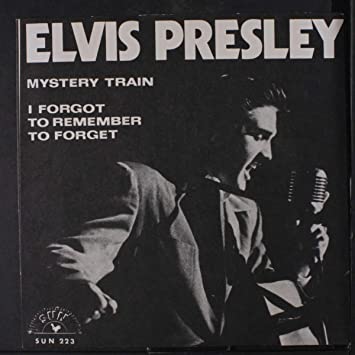
The song was released as the B side to “I’m Left, You’re Right, She’s Gone.” One of the best B sides ever. The song peaked at #11 in the Country Charts and #25 in the UK in 1955. RCA bought Elvis’s contract and reissued this single.
Scotty Moore who played guitar on the rack: ‘Mystery Train’ became like a signature thing for me” “That was the first one I played through my custom-made amplifier. It had the same slapback effect that Sam had been using on the overall record.”
Sam Phillips: When Elvis came in I found out that Mystery Train was so embedded in Elvis’ mind that when he started to sing it, it was a natural as breathing. If it’s natural it’s awfully hard to beat, like you’re just rolling off of a log. That’s the feeling you get with Mystery Train.”
His version was ranked #77 on Rolling Stone’s 500 Greatest Songs of All Time.
From Songfacts
Parker was a renowned Blues musician from Memphis who is best known for this song. He was known more for his singing than for his guitar playing, and never achieved the popularity of players like Buddy Guy and B.B. King. Parker was just 39 when he died in 1971 of a brain tumor.
Elvis Presley recorded the most famous version of this song, also on Sun Records, in 1955. and is his best-known song that was never a hit – it was released as the B-side of “I Forgot To Remember To Forget.” Other artists to cover the song include Bruce Springsteen, Paul Simon, Ricky Nelson, Tom Fogerty, and The Doors.
Neil Young’s 1983 version on his album Everybody’s Rockin’ has an interesting story behind it. After all, there’s never a short story behind a Neil Young song! Young came to cover “Mystery Train” by way of performing one of the most sarcastic take-that’s in rock history. As told in Neil Young: Long May You Run: The Illustrated History, Young had tried to make up for the PR nightmare that was the Trans album with an album even more countrified than Hawks & Doves, which would become Old Ways. However, Geffen’s record executives rejected Young’s new excursion, demanding that he make an album of “rock ‘n’ roll” songs instead.
Can you imagine someone with the audacity to think that they can tell Neil Young what to do? So, Young gave them exactly what they asked for, with the same kind of acidulous derision with which Lou Reed of the Velvet Underground delivered Loaded when Atlantic executives demanded an album “loaded with hits.” Young put together an album of ’50s-style rockabilly songs with a band he assembled and called “the Shocking Pinks.” And what jukebox classics they all are!
Geffen’s reaction was to slap Young with a $3.3 million dollar lawsuit alleging that his music had become “unrepresentative of his previous output.” This is also why Everybody’s Rockin’ is so short – Geffen literally pulled the plug on Young and the Shocking Pinks in mid-recording-session. Young responded in an interview with Musician magazine: “To get sued for being noncommercial after 20 years of making records, I thought was better than a Grammy.” He even told Q magazine that he told Geffen to back off, or his threat was that he was going to play country music forever. Is there a single Neil Young fan out there who doubts – for a fraction of a second – that just to go ‘nyah!’, he would have stuck to his guns and played nothing but country music to this day, had Geffen not backed down? Anyway, it’s a nice little cover of “Mystery Train,” isn’t it?
Mystery Train
Train I ride, sixteen coaches long Train I ride, sixteen coaches long Well, that long black train got my baby and gone
Train, train, comin’ ’round the bend Train, train, comin’ ’round the bend Well, it took my baby, but it never will again No, not again
Train, train, comin’ down, down the line Train, train, comin’ down, down the line Well, it’s bringin’ my baby ’cause she’s mine, all mine She’s mine, all mine
Train, train, comin’ ’round, ’round the bend ‘Round, ’round the bend Train, train, comin’ ’round, ’round the bend ‘Round, ’round the bend Well, it took my baby, but it never will again Never will again







:format(jpeg):mode_rgb():quality(40)/discogs-images/R-1113077-1545991259-4109.jpeg.jpg)




 PowerPop... An Eclectic Collection of Pop Culture