Johnny always needs more than he takes
Forgets a couple of chords, forgets a couple of breaks
And everybody tells me that Johnny is hot
Johnny needs something, what he ain’t got
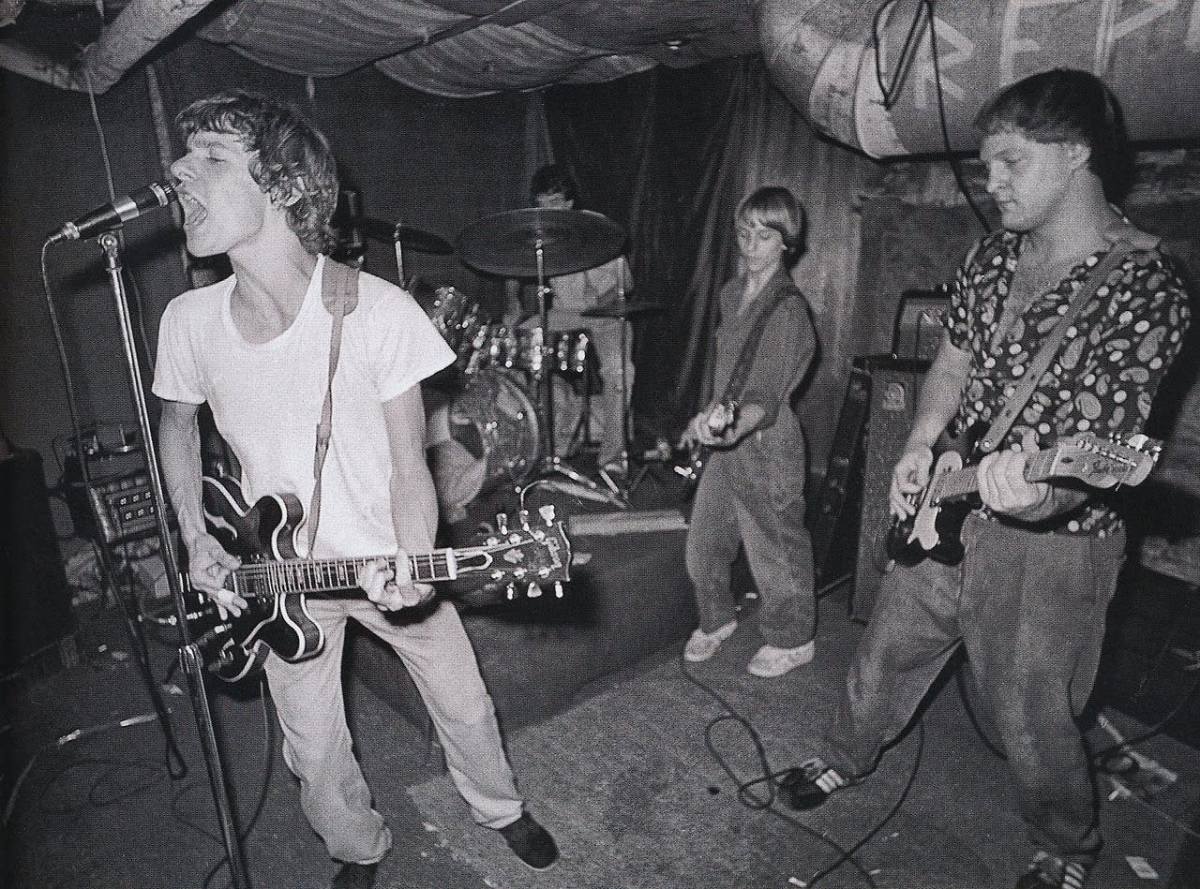
Almost anything off of a Replacements album is going to be an album cut. This one is off of their debut album Sorry Ma, Forgot to Take Out the Trash. The album was released on the small Minneapolis, Minnesota label Twin Tone in 1981.
I listened to them in the mid 80s but lost touch until recently. I’m going through all of their albums so I will be post some from every album coming up. I never knew their first album too much but I like it a lot. It’s punkish, rock, raw, with some great lyrics by Paul Westerberg. On this one Bob Stinson’s guitar playing feels like it may break down at anytime but stays on course and I love what he plays.
This song is about punk guitarist Johnny Thunders (John Anthony Genzale) who was a founding member of the New York Dolls. He also played with the punk band The Heartbreakers. He was in Minneapolis in 1980 with his band Gang War playing in a bar. The Replacements desperately wanted to open, but were beat out for the gig by Hüsker Dü.
He was physically struggling through the show, while battling an audience hurling objects, Thunders had been rendered a prisoner of his own addictions and cult infamy. Westerberg was in the audience and wrote this song about him.
You don’t see this happen everyday…I mean writing about “Johnny’s Gonna Die” when the guy is alive. Thunders did live a little longer…he died in 1991.
Paul Westerberg on watching Johnny Thunders: “He was frightening and beautiful and mean at the same time,” he said. “Like a child.”
“When Johnny was playing, it looked like he was walking dead, It was pitiful, like watching a guy in a cage.”
Johnny’s Gonna Die
Johnny always takes more than he needs Knows a couple chords, knows a couple leads Johnny always needs more than he takes Forgets a couple of chords, forgets a couple of breaks And everybody tells me Johnny is hot Johnny needs something that he ain’t got
And Johnny’s gonna die Johnny’s gonna die Johnny’s gonna die
Everybody stares and everybody hoots Johnny always needs more than he shoots Standing by a beach and there ain’t no lake He’s got friends without no guts, friends that never ache In New York City, I guess it’s cool when it’s dark There’s one sure way Johnny you can leave your mark
And Johnny’s gonna die Johnny’s gonna die Johnny’s gonna die
For me…this was one of those landmark songs that started a change in music. I liked it because it was a guitar players dream and it was raw without much of the 80’s production. I never was a big fan of them but I did like the throw back to the more rawer rock.
The song peaked at #7 in the Billboard 100 and #24 in the UK in 1988. When this was released as a single in 1987, it charted in the UK but flopped in America. It finally became a hit in the US when they re-released it in 1988 after “Sweet Child O’ Mine” hit #1.
The album Appetite for Destruction was huge. It peaked at #1 in the Billboard Album Charts, #3 in Canada, and #5 in the UK.
The video was shot at Park Plaza and 450 South La Brea in Hollywood. The band’s first video, it was very successful, winning at the 1988 MTV Video Music Awards for Best New Artist Video. Guns N’ Roses performed the song on the show.
Slash:“I was at my house and I had that riff happening and Axl came over and he got those lyrics together, and then the band sort of arranged it. We got an arrangement for the whole band, ’cause that’s how we work. Someone comes in with an idea and someone else has input and in that way everyone’s happy. That came together really quickly too, that was arranged in one day.”
From Songfacts
This song is about Los Angeles. It exposes the dark side of the city many people encounter when they go there to pursue fame. Guns N’ Roses knew this side of the city well: in 1985, they lived in a place on Sunset Boulevard in Los Angeles that they called “Hell House.” The house was often filled with drugs, alcohol and groupies.
Axl Rose wrote the lyrics when he was in Seattle, which gave him some perspective on the size of Los Angeles.
In 2007 Rolling Stone magazine ran a feature on the 20th anniversary of Appetite For Destruction. They explained that a famous lyrics from this song originated when Axl Rose spent a night in a Queens schoolyard before joining the band. Said Rose: “This black guy said, ‘You’re in the jungle! You gonna die.'”
On 93.1 WIBC FM, a radio station in Indianapolis, Indiana, Jake Query, a friend of Axle Rose, gave a different account, saying: “When Axl Rose hitchhiked to Los Angeles, California, on the last leg, a truck driver drove him to Los Angeles, and when Rose got out of the truck, the truck driver said, ‘Welcome to the Jungle.” >>
This was used in the 1988 Clint Eastwood movie The Dead Pool, where the band makes a cameo. It also plays in the opening sequence of the 1989 film Lean On Me, about an inner-city high school reformed by principal Joe Clark. Other movies to use the song include:
The Lego Ninjago Movie (2017) How to Be Single (2016) The Interview (2014) Megamind (2010) Selena (1997) The Program (1993)
This was the second UK single and third US single from Appetite For Destruction. The first single, “It’s So Easy,” was a flop.
Numerous college and pro sports teams use this to intimidate their opponents at home games. The Cincinnati Bengals of the NFL were probably the first. The Norwegian Soccer team Lillestrom SK uses this song before every home game.
This was the first track on Appetite For Destruction, which caused controversy because of its cover, a drawing of a robot apparently raping a woman.
The album was a raging success, selling 18 million copies in America by 2008, making it the best-selling debut album in history until 2018, when the RIAA certified Cracked Rear View by Hootie & the Blowfish at 21 million.
Slash re-recorded his guitar parts as he was dissatisfied with his first attempts. To produce the vicious yet pure tone, the Guns N’ Roses gunslinger used a Les Paul ’59 replica plugged into a Marshall JCM, aided most likely by some Jack Daniel’s.
This was used in the 2017 movie Jumanji: Welcome to the Jungle and the next installment, Jumanji: The Next Level (2019). The films are set in a virtual jungle.
When Axl says “my serpentine,” he’s describing his famous dance, which he copied from Richard Black, lead singer of the band Shark Island.
Slash left the band in 1996, leaving Axl Rose firmly in control. Rose kept the band going with new members and in 2001 got in yet another dispute with Slash when producers of Black Hawk Down wanted to use “Welcome To The Jungle” in the movie. According to Slash, Axl refused unless he could re-record it with the current members of Guns N’ Roses, meaning Slash and the rest of the Appetite For Destruction lineup would have lost out on royalties.
The song never made it into the film, which tells the story of an ill-fated US raid on Mogadishu in 1993. It was going to be used in a scene where Army Rangers are preparing for the raid – in real life, they really did blast the song before heading out. The Faith No More song “Falling To Pieces” was used in its place.
Guns N’ Roses made a surprise appearance at the 2002 MTV Video Music Awards where they performed this song. At the time Axl Rose was the only original member in the band, but there was great anticipation for their album Chinese Democracy, which was expected soon. The album finally appeared in 2008.
This song is used in the soundtrack to the Playstation 2 game Grand Theft Auto: San Andreas. Axl lends his voice to one of the radio stations.
In 2007, three teens at Booth Free School in Roxbury, Connecticut (one of them a janitor), were messing around with the public address system when one of them sang some lyrics to this song, including “You’re in the jungle baby; you’re gonna die.” This freaked out one teacher, who thought it was a threat, barricaded herself in a classroom and called the police, who came in and detained the three teens until they could clear up the misunderstanding.
A line from this song became a bit of a catch phrase for Axl Rose, who began screaming at crowds when performing it at shows, “Do you know where the f–k you are!?” Axl said it in 2006 when he introduced The Killers at the MTV Video Music Awards.
Guns N’ Roses opened for Aerosmith in the summer of 1988, culminating in a show on September 15 at the Pacific Amphitheatre in Costa Mesa, California. At this final show, Aerosmith’s road crew had some fun by dressing up in gorilla costumes and messing around on stage when G N’ R performed this song. It was all in good fun, as the bands got along great, with Axl expressing his admiration for Aerosmith at every show. When Aerosmith took the stage that night, they had Guns N’ Roses join them for an extended jam of “Mama Kin,” a song Guns often covered.
By the end of the tour, Guns N’ Roses was the hotter band – “Sweet Child O’ Mine” hit #1 the week the tour ended.
Slash’s gear for the entire Appetite For Destruction album was a Kris Derrig-built 1959 Les Paul replica guitar, and a rented S.I.R. (known to S.I.R. as Stock #36) Marshall 1959 Superlead Metal Panel modded by Frank Levi and Glenn Buckley (based on Tim Caswell’s modification to Stock #39).
This soundtracked a 2016 Super Bowl commercial for the Taco Bell Quesalupa featuring basketball player James Harden, soccer star Neymar, actor George Takei and “Texas Law Hawk” Bryan Wilson. In the spot, we learn that the cheesy treat will be bigger than Tinder, drones, and possibly even football.
Welcome To The Jungle
Welcome to the jungle We’ve got fun ‘n’ games We got everything you want Honey, we know the names We are the people that can find Whatever you may need If you got the money, honey We got your disease
In the jungle Welcome to the jungle Watch it bring you to your Knees, knees I wanna watch you bleed
Welcome to the jungle We take it day by day If you want it you’re gonna bleed But it’s the price you pay And you’re a very sexy girl That’s very hard to please You can taste the bright lights But you won’t get them for free
In the jungle Welcome to the jungle Feel my, my, my, my serpentine I, I wanna hear you scream
Welcome to the jungle It gets worse here everyday You learn to live like an animal In the jungle where we play If you got a hunger for what you see You’ll take it eventually You can have anything you want But you better not take it from me
In the jungle Welcome to the jungle Watch it bring you to your Knees, knees I’m gonna watch you bleed
And when you’re high you never ever wanna come down, so down, so down, so down, yeah!
You know where you are? You’re in the jungle, baby You’re gonna die
In the jungle Welcome to the jungle Watch it bring you to your Knees, knees
In the jungle Welcome to the jungle Feel my, my, my, my serpentine
In the jungle Welcome to the jungle Watch it bring you to your Knees, knees
In the jungle Welcome to the jungle Watch it bring you to your…
Back in 1981 I bought the album that this song is the title track to. I had their greatest hits of mostly their sixties hits and this album was the first new Kinks album I ever bought.
The song is a pure rock song with a huge punk edge. I read where a critic wrote that The Kinks were a great punk band who could actually play their instruments and with this song you see that.
This song is my favorite song off the album. While writing Low Budget, their previous album, Ray was watching American TV including “That’s Incredible” where people did dangerous and insane stunts. He writes a fair statement about the viewing public…now and then. Parts of it are crude but is true to life. When Oswald shot Kennedy, he was insane, But still we watch the re-runs again and again, We all sit glued while the killer takes aim…
The song tells the truth…violence sells.
Ray Davies:“What happens is the consumer is being used to entertain, to get high ratings, to sell products to consumers. It was going around in a circle. That’s a real con. And good shows were being dropped from TV. I’ve just written an outline, and I hope we’re going to get some money from RCA to do a videodisc because it’s a media-based album.”
From Songfacts
The title track to The Kinks 1981 album, “Give The People What They Want” was written by their frontman Ray Davies in response to what he saw on American TV when he was writing songs for their previous album, Low Budget. He noticed that TV was getting more and more sensational, and that viewers were fascinated with violence and tragedy – similar to how Romans watched Christians get fed to the lions.
One show Davies watched was That’s Incredible, where regular people performed dangerous stunts.
Ray Davies said that he took out the following verse:
The French Revolution was a crazy scene
All those aristocrats getting guillotined
The promoters cleaned up
The expenses were low
An execution costs nothing
It’s a wonderful show
Taken at face value with just the title for reference, this song can appear to be about The Kinks making an effort to please their audience by delivering a hit. That interpretation is way off, however, as the song is much more a social commentary on those who pander to the masses.
The Kinks went for a monster drum sound on this one in an effort to make it arena-friendly. To get his sound, they placed corrugated iron around the walls of Konk Studios in London, where they recorded the album.
Give The People What They Want
Hey, hey, hey Give the people what they want
Well, it’s been said before, the world is a stage A different performance with every age Open the history book to any old page Bring on the lions and open the cage
Give the people what they want You gotta give the people what they want The more they get, the more they need And every time they get harder and harder to please
The Roman promoters really did things right They needed a show that would clearly excite The attendance was sparse so they put on a fight Threw the Christians to the lions, it sold out every night
Give the people what they want You gotta give the people what they want The more they get, the more they need And every time they get harder and harder to please
Give ’em lots of sex, perversion and rape Give ’em lots of violence, and plenty to hate Give the people what they want Give the people what they want
When Oswald shot Kennedy, he was insane But still we watch the re-runs again and again We all sit glued while the killer takes aim “Hey Mom, there goes a piece of the president’s brain!”
Give the people what they want You gotta give the people what they want Blow out your brains, and do it right Make sure it’s prime time and on a Saturday night You gotta give the people what they want You gotta give the people what they want Give the people what they want Give the people what they want Give the people what they want
I posted a song from Face Dances a little while ago and Deke brought up a song on that album called The Quiet One. I really like that song also. It was written by who I think was the best bass player in rock ever…John Entwistle.
When I bought the album this is one of the songs I zeroed in on. I’ve always liked John’s writing that got overshadowed by Pete. John had had some black humor and wit in his songs.
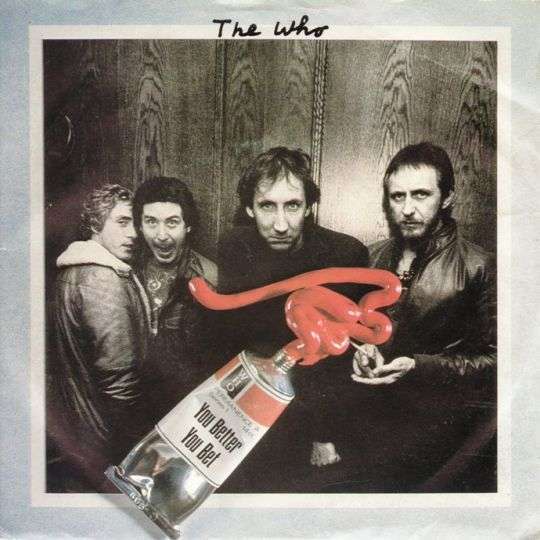
This song was the B side to the hit You Better You Bet released in 1981. On their farewell tour in 1982 he replaced his older song “My Wife” with this one on stage. In the later tours, this song was never played again… “My Wife” was brought back.
John Entwistle: “It’s me trying to explain that I’m not really quiet. I started off being quiet and that’s the pigeon hole I’ve been stuck in all these years. It started when I heard Kenney playing a drum riff and I thought ‘that would be really great for a song and give Kenney a chance to play that on stage.’ So I got Kenney to put down about three minutes of that and I worked along with it and came up with the chorus of ‘The Quiet One.’ I wrote ‘Quiet One’ especially to replace ‘My Wife’ onstage. I had gotten tired of singing that and ‘Boris the Spider.'”
The Quiet One
Everybody calls me the quiet one You can see but you can’t hear me Everybody calls me the quiet one You can try but you can’t get near me I ain’t never had the gift of gab But I can’t talk with my eyes When words fail me you won’t nail me My eyes can tell you lies
Still waters run deep so be careful I don’t drown you You’ve got nothing to hear I’ve got nothing to say Sticks and stones may break your bones But names can never down you It only takes two words to blow you away
Everybody calls me the quiet one But you just don’t understand You can’t listen you won’t hear me With your head stuck in the sand I ain’t never had time for words that don’t rhyme My headd is in a cloud I ain’t quiet – everybody else is too loud
Still waters run deep so be careful I don’t drown you You’ve got nothing to hear I’ve got nothing to say Sticks and stones may break my bones But names can never down you It only takes two words to blow you away.
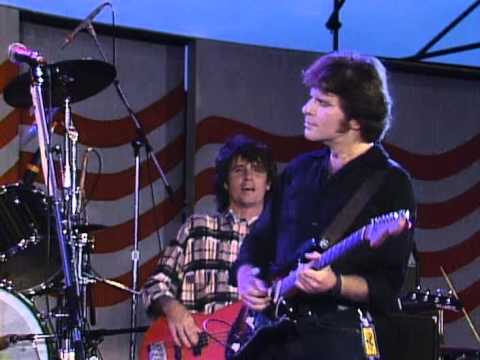
Big Train (From Memphis)” was the B-side of “The Old Man Down the Road”, the first 45 rpm single John Fogerty released in 1984. It was his first single release since “You Got The Magic” in 1976.
John Fogerty’s album Centerfield was released in 1985. No one was sure if Fogerty would release anything again at that point. This song has a Sun Records rockabilly feel.
Despite being in the middle of the eighties, Fogerty didn’t really alter his style for this album. Many of these songs would have fit perfectly well on a Creedence Clearwater Revival album. John played all the instruments himself on this album.
It peaked at #38 in the Billboard Country Charts. The Centerfield album peaked at #1 in the Billboard Album Charts, #2 in Canada, and #48 in the UK in 1985. The song was recorded at The Plant Studios in San Francisco.
Big Train (From Memphis)
When I was young, I spent my summer days playin’ on the track. The sound of the wheels rollin’ on the steel took me out, took me back.
[CHORUS:] Big Train from Memphis, Big Train from Memphis, Now it’s gone gone gone, gone gone gone.
Like no one before, he let out a roar, and I just had to tag along. Each night I went to bed with the sound in my head, and the dream was a song.
[CHORUS]
Well I’ve rode ’em in and back out again – you know what they say about trains; But I’m tellin’ you when that Memphis train came through, This ol’ world was not the same.
I want to make an announcement (clears throat) Saturday I will have something different…I will be interviewing a Disc Jockey…he will answer some of my and other blogger’s questions that I requested. He has been kind of enough to do this through email.
This song will always be linked to John Lennon to me. The reason for this is right after John was murdered this was huge and on the charts. I listened to the radio religiously back then and got to know this one well.
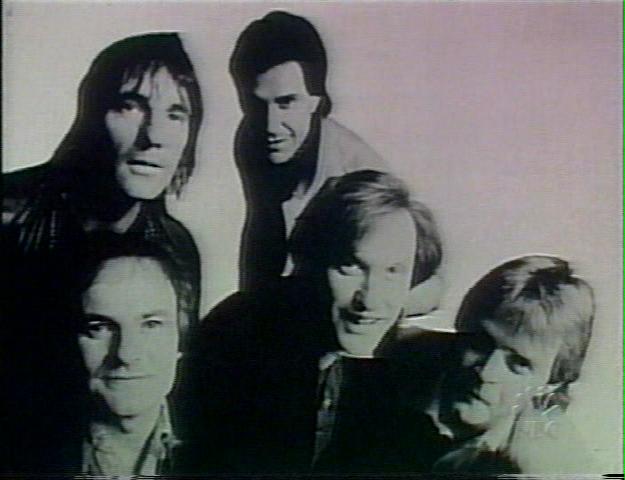
Steely Dan were essentially the duo Donald Fagen (vocals & keyboards) and Walter Becker (guitar & bass) who formed the partnership in 1972 and used an ever-changing cycle of musicians. They took their moniker from the name of a female sex toy featured in Naked Lunch by William Burroughs.
Becker and Fagen parted ways in 1980, leaving “Hey Nineteen” un-played until their 1993 reunion.
The song peaked at #10 in the Billboard 100 and #5 in Canada in 1981. The song was on the album Gaucho which peaked at #9 in the Billboard Album Charts, #18 in Canada, and #27 in the UK in 1980.
From Songfacts
In this song, an older man is seducing a 19-year-old girl. He’s a bit conflicted, as her inexperience frustrates him when she doesn’t even remember Aretha Franklin. However, on this particular night and with the help of some Cuervo Gold tequila, everything is wonderful.
Steely Dan used a variety of musicians on their albums. On this track, Hugh McCracken played guitar, Rick Marotta was on drums, and Victor Feldman and Steve Gadd added percussion. Walter Becker also added guitar, and Donald Fagen played the Fender Rhodes electric piano and the synthesizer.
Roger Nichols, who was one of the engineers on the Gaucho sessions, fashioned a drum machine they used on this track. Dubbed “Wendel,” it was one of the first of its kind, and it allowed them to record Rick Marotta’s drum parts and play them back with perfect precision.
The LM-1, which was the first programable drum machine sold to the public that sampled real instruments, was introduced in 1980, the year Gaucho was released, so many assumed that’s what Steely Dan used. They didn’t, but there was a connection. Roger Linn, who created the LM-1, told Songfacts: “By coincidence, Roger and I had both bought our first computers in around 1975 at a place called Computer Power and Light in Studio City, an area of Los Angeles. Wendel used that same computer and a early but high-quality digital audio interface, running a program he had written to enter simple looping beats on the screen. A very creative and talented guy.”
Hey Nineteen
Way back when in sixty seven I was the dandy of Gamma Chi Sweet things from Boston So young and willing Moved down to Scarsdale And where the hell am I
Hey nineteen No we can’t dance together No we can’t talk at all Please take me along When you slide on down
Hey nineteen That’s ‘Retha Franklin She don’t remember the Queen of Soul It’s hard times befallen The sole survivors She thinks I’m crazy But I’m just growing old
Hey nineteen No we got nothing in common No we can’t talk at all Please take me along When you slide on down
Nice Sure looks good Mmm mmm mmm Skate a little roller now
The Cuervo Gold The fine Colombian Make tonight a wonderful thing Say it again
The Cuervo Gold The fine Colombian Make tonight a wonderful thing
The Cuervo Gold The fine Colombian Make tonight a wonderful thing
No we can’t dance together No we can’t talk at all
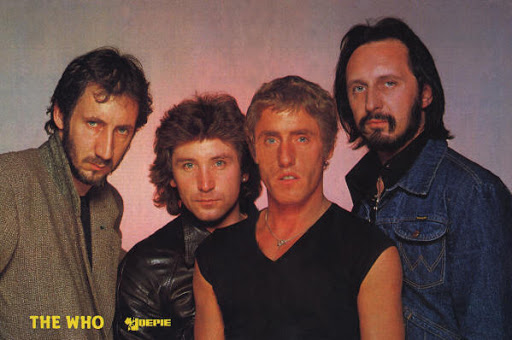
This was the first album the Who made without Keith Moon called Face Dances. Kenney Jones was playing drums and the album had a substantial hit with You Better You Bet. It was also the first new Who album I ever bought. The other ones had been collections of their older hits. I can’t say that I don’t the Moon version of the Who but the album did have some good songs on it.
This song is one of the best songs off of Face Dances. To my surprise it was not released as a single.
The album peaked at #4 in the Billboard Album Charts, #2 in the UK, and #1 in Canada in 1981.
Roger Daltrey:“Pete’s a very complicated bunch of people… And you never know which one of him you’re going to get. There’s one that’s so wonderful, so caring, so spiritual. But there are others that are horrendous-and I mean horrendous…. That’s the madness of genius, so I accept it. I don’t judge him. I love him. I love all of hims.”
Another Tricky Day
You can’t always get it When you really want it You can’t always get it at all Just because there’s space In your life it’s a waste To spend your time why don’t you wait for the call
(Just gotta get used to it) We all get it in the end (Just gotta get used to it) We go down and we come up again (Just gotta get used to it) You irritate me my friend (This is no social crisis) This is you having fun (No crisis) Getting burned by the sun (This is true) This is no social crisis Just another tricky day for you
You can always get higher Just because you aspire You could expire even knowing. Don’t push the hands Just hang on to the band You can dance while your knowledge is growing
(It could happen anytime) You can’t expect to never cry (Patience is priceless) Not when you try to fly so high (Just stay on that line) Rock and roll will never die (This is no social crisis) [etc.]
Another tricky day Another gently nagging pain What the papers say Just seems to bring down heavier rain The world seems in a spiral Life seems such a worthless title But break out and start a fire y’all It’s all here on the vinyl (No crisis) [etc.]
[Repeat verse 1.]
(Just gotta get used to it) Gotta get used to waiting (Just gotta get used to it) You know how the ice is (Just gotta get used to it) It’s thin where you’re skating (This is no social crisis) [etc.]
This book covers the last three years of Bon Scott, the lead singer of AC/DC.
Bon: The Last Highway is a fun read. It gives you more than just a look at Bon Scott. It gives you a peek in the world of Rock and Roll in the 1970s. It was a much more of a loose time then compared to now to say the least…both good and bad. The music business was a completely different ballgame than now.
Although this just covers the last three years of his life…you get to know Bon pretty well. I knew nothing about the guy until I read the book. He seemed to be well read, likeable, and a basically good guy to his friends and fans. O f course he did have substance abuse problems that haunted him.
There are a lot of stories about fans coming up to him and starting friendships. Fink interviewed other bands and most if not all had great things to say about Scott. He did find people who never have been interviewed and got stories that never have been published.
The working relationship between Bon and the Young brothers surprised me the most. Bon wrote the lyrics and they would censor what he wrote. Nothing political or controversial. They didn’t want the formula to be messed with. Offstage they didn’t tend to hang out as much with each other.
I never knew how popular Scott was in Australia even now. His grave site has become a cultural landmark; more than 28 years after Scott’s death, the National Trust of Australia declared his grave important enough to be included on the list of classified heritage places. It is reportedly the most visited grave in Australia.
The two things that author Jesse Fink concentrates on is how Bon died and if Bon did write some or most of the lyrics to the Back In Black album that was released after his death.
As far as the way the man died…Fink has some theories and they center around heroin. He interviewed some that has never been interviewed and got their story around Bon and the ones around him that night. The coroner’s report lists “acute alcohol poisoning” as the cause of death, classified under “death by misadventure.” Fink talked with people with him when he died on February 19, 1980.
The Young Brothers have denied they ever used any of his lyrics on Back in Black…but AC/DC did cut a deal with the Scott family for a share of royalties on the album. In interviews they have denied it but did contradict themselves in others.
Below is an excerpt from the book where more was said about the subject than any other time.
Then in 1998 Elissa Blake of Australian Rolling Stone caught him napping.
BLAKE: Have you ever thought about quitting?
ANGUS: The only time was when Bon died. We were in doubt about what to do but we had songs that he had written and wanted to finish the songs. We thought it would be our tribute to Bon and that album became Back In Black. We didn’t even know if people would even accept it. But it was probably one of our biggest albums and the success of that kept it going. We were on the road with that album for about two years so it was like therapy for the band after Bon’s death.
Bizarrely, before and since, Angus went with an altogether different story.
1981: “Some things we can’t do, you know, that was strictly Bon’s songs, and things.”
1996: “No, we were gonna start working on the lyrics with him the next week [after he died].”
1998: “The week he died, we had just worked out the music and he was going to come in and start writing lyrics.”
2000: “Bon was just about to come and start working with us writing lyrics just before he died.”
2005: “There was nothing [on Back In Black] from Bon’s notebook.”
It’s a line the band now doggedly sticks to despite mounting evidence that Bon’s lyrics were used. As Ian Jeffery admitted to me, cagily: “Not totally certain about Back In Black but I seem to remember a couple of words, lines [of Bon’s being on there]. Maybe not.”
Fink talked to Scott’s ex girlfriends and friends in his life and many claim that he did write many of the lyrics to You Shook Me All Night Long as well as other songs. Others say he had said some of the lines in letters. He basically gives you what he found and lets you make up your mind.
I would recommend this book to rock fans…and to AC/DC fans who mostly only know Brian Johnson as the lead singer.
David Byrne at his visual performance best with this video. According to David Byrne’s own words, this song is about how we, as people, tend to operate half-awake or on autopilot. Or perhaps a better way of explaining that statement is that we do not actually know why we engage in certain actions which come define our lives.
The members of Talking Heads…David Byrne, Tina Weymouth, Chris Frantz and Jerry Harrison – all contributed to the writing of this song along with the track’s producer, Brian Eno. And “Once in a Lifetime” itself originated from jam sessions. With this album the band wanted a more democratic process instead of Byrne writing all of the songs.
The song was on the Remain in Light album released in 1980. The song peaked at #103 in the US Billboard Bubbling Under the Hot 100 chat, #28 in Canada, and #14 in the UK in 1981.
In 1985 the song peaked at #91 in the Billboard 100 with a live version of the song off of the album Stop Making Sense.
The video was huge back in the early 80s and that is where I found the song. It was choreographed by Toni Basil.
For this album they would improvise in the studio and take bits and pieces out. Their own version of “sampling” and “looping.” The 1973 Afrobeat record by Nigerian musician Fela Kuti, became the inspiration for the album
Brian Eno:“It had all been done,” Eno says, “and the only thing left worth doing was some sort of urban pessimism of some kind, and that record is terribly optimistic in a way. It’s very up and, like, looking out to the world and saying, ‘What a fantastic place we live in. Let’s celebrate it.’ And I think we knew that was a fresh thought at the time.”
David Byrne: “Most of the words in ‘Once in a Lifetime’ come from evangelists I recorded off the radio while taking notes and picking up phrases I thought were interesting directions. Maybe I’m fascinated with the middle class because it seems so different from my life, so distant from what I do. I can’t imagine living like that.”
From Songfacts
This song deals with the futility of not being happy with the things you have. Like trying to remove the water at the bottom of the ocean, there’s no way to stop life from moving on. The forces of nature (like the ocean) keep you moving almost without your conscious effort – like a ventriloquist moving a puppet.
Some of these evangelist recordings also made their way to a 1981 album called My Life in the Bush of Ghosts, by David Byrne and Brian Eno.
This stalled at #103 in February 1981, but when MTV launched that August, they played the video a lot, giving the song much more exposure.
David Byrne’s choreography in the video was done by the Toni Basil, who had a hit as a singer with “Mickey.” It was a very odd video, and for many viewers it was the first look they got at the Talking Heads (or at least Byrne – the full band didn’t appear in a video until “Burning Down the House” two years later).
As you watch David Byrne spasm like a malfunctioning robot interspersed with gesturing in Martian sign language, ponder this excerpt from the book MTV Ruled the World – The Early Years of Music Video, in which Toni Basil fills in some details about the choreography for this video: “He [Byrne] wanted to research movement, but he wanted to research movement more as an actor, as does David Bowie, as does Mick Jagger. They come to movement in another way, not as a trained dancer. Or not really interested in dance steps. He wanted to research people in trances – different trances in church and different trances with snakes. So we went over to UCLA and USC, and we viewed a lot of footage of documentaries on that subject. And then he took the ideas, and he ‘physicalized’ the ideas from these documentary-style films.”
Basil adds: “When I was making videos – whether it was with Devo, David Byrne, or whoever – there wasn’t record companies breathing down anybody’s neck, telling them what to do, what the video should look like. There was no paranoid A&R guy, no crazy dresser that would come in and decide what people should be wearing, and put them in shoes that they can’t walk in, everybody with their own agenda. We were all on our own.”
Basil also directed and choreographed the video for the Remain In Light track “Crosseyed And Painless,” which features dancers from a crew called The Electric Boogaloos. None of the band members appear in it.
Some critics have suggested that “Once In A Lifetime” is a kind of prescient jab at the excesses of the 1980s. David Byrne says they’re wrong; that the lyric is pretty much about what it says it’s about. In an interview with NPR, Byrne said: “We’re largely unconscious. You know, we operate half awake or on autopilot and end up, whatever, with a house and family and job and everything else, and we haven’t really stopped to ask ourselves, ‘How did I get here?'”
Brian Eno produced this song and wrote the chorus, which he also sang on. David Byrne wrote the verses, which he talk/sings in an intriguing narrative style. Remain In Light was the fourth Talking Heads album, and the third produced by Eno, whose artistic bent and flair for the unusual were a great fit for the group.
Unlike their previous album, the songs on Remain In Light were mostly written in the studio (Compass Point, the Bahamas) and all credited to the four band members plus Eno.
A surprising number of musicians cite “Once In A Lifetime” as one of the best songs ever recorded. Here are three:
Charlotte Church, who named it the first song she fell in love with. “The first time I heard it, my mind was blown,” she told NME. “There’s so magic in that song. I think David Byrne is an absolute G.”
Nick Feldman of Wang Chung, who loves the “almost randomly cacophonous keyboard burblings, the wonderful bass line and rhythm section groove and David Byrne’s slightly preacher-like vocals.” He told Songfacts: “When my personal life started to unravel many years later, the lyrics to this song still resonated for me. Byrne’s mesmeric and intense physical performance in the video to this track still compels today, and compliments and reflects the music it is interpreting.”
Glen Ballard, who produced and co-wrote hits for Alanis Morissette, Dave Matthews and Aerosmith. “That song can’t be touched,” he said in a Songfacts interview. “I listen to it like once a month because everything about it is so perfect.”
The video broke new ground when it was exhibited at the New York Museum of Modern Art as part of a 1982 exhibition called “Performance Video.” The exhibit helped explain to parents what their kids were watching on MTV. It explained how the “Once In A Lifetime” video “expands upon the song’s complex interweaving of moods and images as well as Byrne’s interest in African music and percussion.”
When Talking Heads toured to support their next album, Speaking in Tongues, in 1983, Byrne did the movements from the video when he performed the song. Not only that, he added movements to other songs they performed on that tour as well, making for some very unorthodox visual expression. Audiences were used to seeing pyro and flashing lights, but had never seen anything like the full band running in place (“Burning Down the House”) or Byrne turning himself into a human corkscrew (“Life During Wartime”). The experience was so striking it got the attention of director Jonathan Demme, who filmed a few of the shows and turned it into the acclaimed concert film Stop Making Sense.
This was used in the pilot episodes of That ’80s Show (2002) and Numb3rs (2005). It was used twice on The Simpsons (“Days of Future Future” – 2014, “Trust But Clarify” – 2016) and in these series:
The Deuce (“Morta di Fame” – 2019) Being Erica (“Being Adam” – 2010) Chuck (“Chuck Versus the Suburbs” – 2009) WKRP in Cincinnati (“Real Families” – 1980)
It also shows up in these movies:
Hot Tub Time Machine (2010) Secret Window (2004) Rock Star (2001) Alice and Martin (1998)
The live version from Stop Making Sense was used in the opening sequence of the 1986 movie Down And Out In Beverly Hills, which shows a homeless Nick Nolte pushing his grocery cart of possessions around Los Angeles and doing some dumpster diving. His character is in a classic, “How did I get here?” situation, but soon his fortunes take a turn. This version of the song was re-released as a single that year and charted at #91 in America.
The Exies released a haunting version of this song in 2006, releasing a video to go with it. It has also been covered by Smashing Pumpkins and sampled by Jay-Z on his song “It’s Alright.”
Phish covered the entire Remain In Light album on Halloween, 1996 at the Omni Coliseum in Atlanta. It took up the entire second set of their show and featured guest brass players. The performance is considered one of the best Phish “album-cover” attempts.
Benin superstar Angélique Kidjo covered this song along with the rest of Remain in Light in 2018. She explained to Mojo: “I wanted to bring the resilience of the Africans, and the joy, despite everything they throw at us.”
On May 5, 2018, Kidjo sang “Once In A Lifetime” with David Byrne at Carnegie Hall. She told Mojo: “It was not rehearsed or planned. I think if I thought about it I wouldn’t have been able to sing one note.”
In his 2019 Broadway production American Utopia, David Byrne evokes this song a few times, doing the movements associated with it and at one point asking, “How did I get here?” He does the song in the play as well, and on February 29, 2020, Byrne performed it on Saturday Night Live with his cast members. Later that year, American Utopia was released on HBO as a movie.
Once In A Lifetime
And you may find yourself Living in a shotgun shack And you may find yourself In another part of the world And you may find yourself Behind the wheel of a large automobile And you may find yourself in a beautiful house With a beautiful wife And you may ask yourself, well How did I get here?
Letting the days go by, let the water hold me down Letting the days go by, water flowing underground Into the blue again after the money’s gone Once in a lifetime, water flowing underground
And you may ask yourself How do I work this? And you may ask yourself Where is that large automobile? And you may tell yourself This is not my beautiful house! And you may tell yourself This is not my beautiful wife!
Letting the days go by, let the water hold me down Letting the days go by, water flowing underground Into the blue again after the money’s gone Once in a lifetime, water flowing underground
Same as it ever was Same as it ever was Same as it ever was Same as it ever was Same as it ever was Same as it ever was Same as it ever was Same as it ever was
Water dissolving and water removing There is water at the bottom of the ocean Under the water, carry the water Remove the water at the bottom of the ocean! Water dissolving and water removing
Letting the days go by, let the water hold me down Letting the days go by, water flowing underground Into the blue again into silent water Under the rocks and stones, there is water underground
Letting the days go by, let the water hold me down Letting the days go by, water flowing underground Into the blue again after the money’s gone Once in a lifetime, water flowing underground
You may ask yourself What is that beautiful house? You may ask yourself Where does that highway go to? And you may ask yourself Am I right? Am I wrong? And you may say yourself “My God! What have I done?”
Letting the days go by, let the water hold me down Letting the days go by, water flowing underground Into the blue again into the silent water Under the rocks and stones, there is water underground
Letting the days go by, let the water hold me down Letting the days go by, water flowing underground Into the blue again after the money’s gone Once in a lifetime, water flowing underground
Same as it ever was Same as it ever was Same as it ever was Look where my hand was Time isn’t holding up Time isn’t after us Same as it ever was Same as it ever was Same as it ever was Same as it ever was Same as it ever was Same as it ever was Letting the days go by Same as it ever was And here the twister comes Here comes the twister
Letting the days go by (same as it ever was) Same as it ever was (same as it ever was) Letting the days go by (same as it ever was) Same as it ever was Once in a lifetime Let the water hold me down Letting the days go by
Well a person can work up a mean mean thirst after a hard day of nothin’ much at all
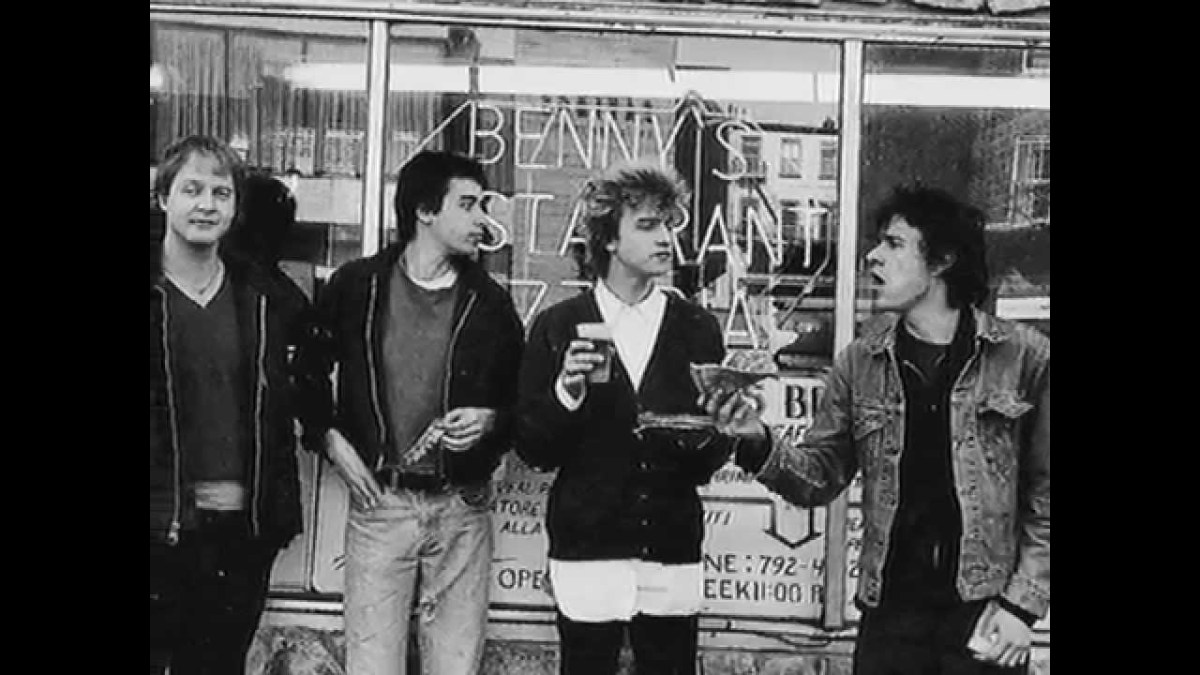
I can’t tell you how much I like this ballad by The Replacements. This song sounds so authentic that it hurts. I don’t normally try to interrupt songs. They mean different things to different people but this one hit home for me…I knew people like this and I spent my fair share of time in bars playing to drinking customers.
The song is sad but an honest portrait. It’s a lonely life but a comfort to have people to be lonely with… but it also is a signal that you could be spiraling slowly down. I have never been drinker but I did haunt some clubs (mostly playing music) in my earlier days nursing a drink into the night. I remember one night being at a club at 2am in the morning…thinking why the hell am I still here? That is when my days of being a regular stopped.
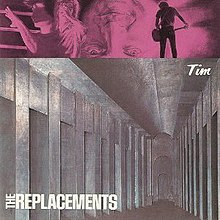
Tim is the fourth studio album by The Replacements. It was released in October 1985 on Sire Records. It was their first major label release. Paul Westerberg wrote this song and played acoustic.
You’re like a picture on the fridge that’s never stocked with food
I used to live at home, now I stay at their house
Here Comes A Regular
Well a person can work up a mean mean thirst after a hard day of nothin’ much at all Summer’s passed, it’s too late to cut the grass There ain’t much to rake anyway in the fall
And sometimes I just ain’t in the mood to take my place in back with the loudmouths You’re like a picture on the fridge that’s never stocked with food I used to live at home, now I stay at the house
And everybody wants to be special here They call your name out loud and clear Here comes a regular Call out your name Here comes a regular Am I the only one here today?
Well a drinkin’ buddy that’s bound to another town Once the police made you go away And even if you’re in the arms of someone’s baby now I’ll take a great big whiskey to ya anyway
Everybody wants to be someone’s here Someone’s gonna show up, never fear ’cause here comes a regular Call out your name Here comes a regular Am I the only one who feels ashamed?
Kneeling alongside old Sad Eyes He says opportunity knocks once then the door slams shut All I know is I’m sick of everything that my money can buy The fool who wastes his life, God rest his guts
First the lights, then the collar goes up, and the wind begins to blow Turn your back on a pay-you-back, last call First the glass, then the leaves that pass, then comes the snow Ain’t much to rake anyway in the fall
Back as promised…I know this isn’t everyone’s cup of tea so to speak but I hope you enjoy it. This is obviously the 5th edition of this series. In Part 1, Part2, Part 3, and Part 4. We covered Brian May’s Red Special, Willie Nelson’s Trigger, George Harrison’s Rocky, Eddie Van Halen’s Frankenstrat, Bruce Springsteen’s guitar, Neil Young’s Old Black guitar, John Lennon’s Casino + a Bonus, and Keith Richards Telecaster.
Today will we look at:
Paul McCartney’s Hofner Bass and Eric Clapton’s Blackie.
Paul McCartney’s Hofner Bass and the MISSING Hofner Bass
Paul’s bass is maybe the most iconic guitar/bass of all time in rock music. You see this bass and you think Beatles. I see the attraction to this bass. I have a Hofner copy and I’ve played a Hofner a few times. They are ultra light and have a nice feel to them. The Hofner is really easy to play.
Lets start with the Hofner he bought in Hamburg in 1961…we will call it The Cavern Bass or Hofner#1. It was played on some iconic Beatles recordings including their very first studio outing in June 1961 in Hamburg, their first single Love Me Do in 1962 and their first two albums, Please Please Me and With The Beatles in 1963. It’s the one you hear on “She Loves You, “Twist and Shout”, it was played in Hamburg, at The Cavern Club, and at Abbey Road.
In 1965 he sent it in to get it worked on…it was sprayed with a darker sunburst and the pickup guard removed.
It was last seen in the 1969 footage from Twickenham Studios, where the Beatles were filming “Let It Be.” Soon afterward, it was stolen, most likely from a closet at EMI’s Abbey Road studio, along with Harrison’s Gretsch Tennessean and second Ric 360-12. People are still looking for that bass guitar.
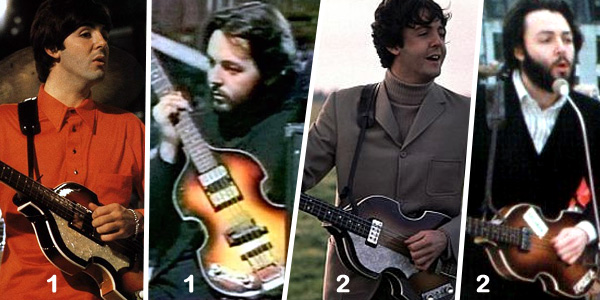
These two pictures show the same Bass…the Cavern Bass…notice the different colors and the removed pick guard…but same bass.
In 1963 Paul bought another Hofner bass that he used as his primary bass and played it from then on and still does. We will call it Hofner #2. He didn’t retire the Cavern Bass but just used it as a back up to Hofner #2.
Here are the two basses labeled…the #1 is the lost/stolen Cavern bass and the #2 is the 1963 bass he used throughout the Beatles. Paul is still looking for the Cavern Bass and the Hofner company has a webpage describing the bass and trying to get it back for Paul.
I have to wonder who has this bass. Odds are they don’t know what they have… if it survives. I hope Paul gets it back… he loves instruments and still has many of the instruments he used with The Beatles… Hey…lets go out and find this bass…that would be one way to meet him!
***From the mid-sixties on he would use a Rickenbacker bass which produced brighter and clearer bass sound. He famously used one on Sgt Pepper. He used both basses through the years.
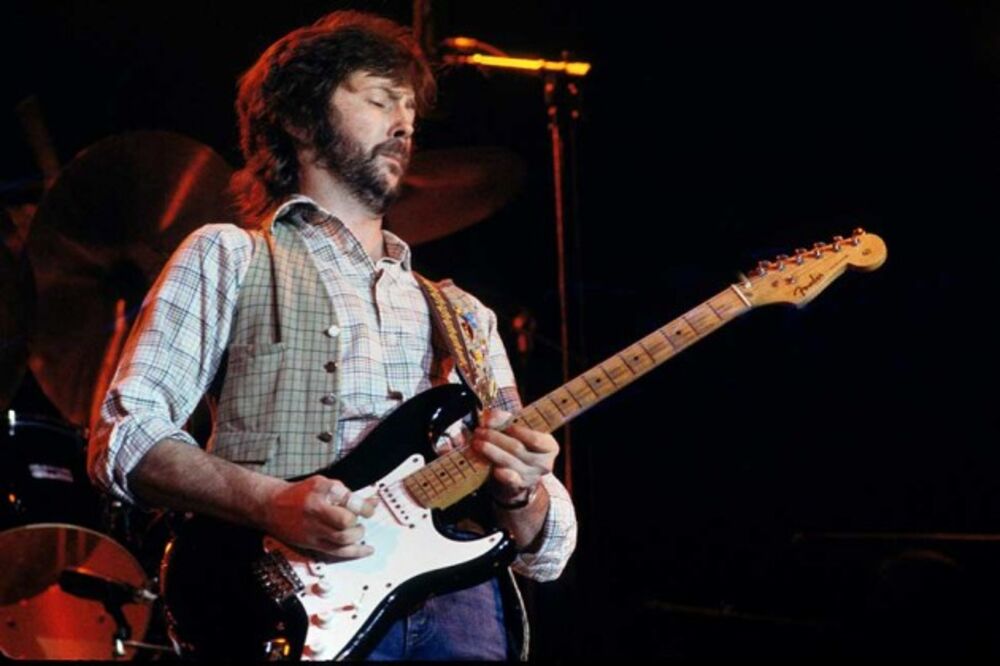
Eric Clapton’s Blackie
Eric built this guitar in around 1970 from different Fender Strats…here is Eric telling the story.
Eric Clapton: “I was in Nashville and I went into this shop called Sho-Bud where they had stacks of Fender Strats going for virtually nothing because they were so unfashionable and unwanted,”
“I bought a big pile of them all for a song – they were really cheap, like $300 or $400 each – and I took them home and gave them out. I gave Steve Winwood one, I gave Pete Townshend one, I gave George Harrison one and I kept a few, and I made Blackie out of a group of them. I took the pickups out of one, the scratchplate off another, the neck off another and I made my own guitar, like a hybrid guitar that had all the best bits from all these Strats.”
Blackie would be the main guitar used on every one of Eric’s albums for 15 years. During that time, Eric and Blackie would rack up an impressive number of hits, including “Cocaine,” “I Shot the Sheriff,” “Wonderful Tonight,” and “Lay Down Sally.”
in 2004, Eric worked with Christie’s to auction the legendary guitar off. The winner paid $959,000 for Blackie, with most of the proceeds again supporting Eric’s Crossroads Center.
You can hear, feel, and get a thrill from this song that was obviously influenced by early rock and roll. It’s like a car that hits you and just keeps rolling on…and you never catch the license plate…but you still feel honored to get hit by this one.
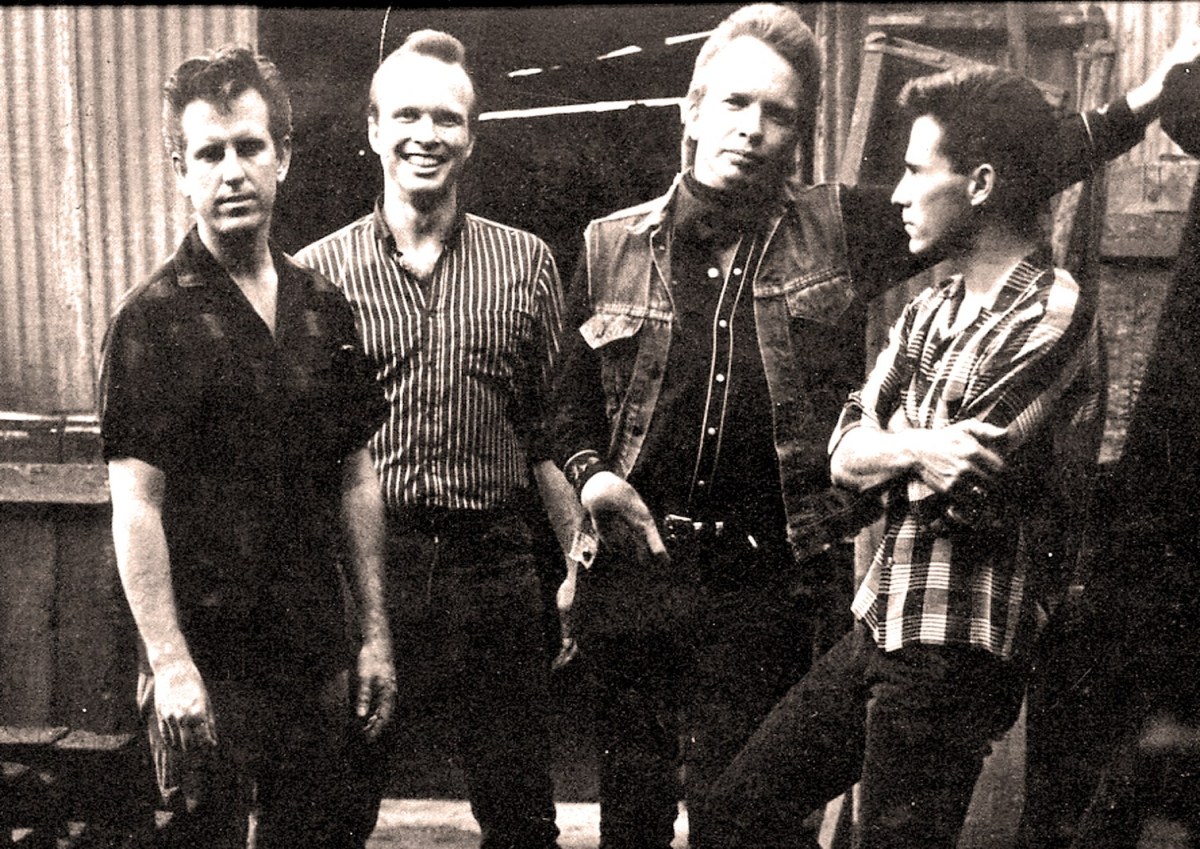
The Blasters released this song in 1981 and it was off of their self titled album.
The song was written by Phil Alvin wh o was the guitarist, singer, and main songwriter for the band. The band produced a range of “rockabilly, country, blues, and New Orleans roadhouse R&B.”
I have never known the band well but I have recently started to get into them. Just some great pure music with a groove.
Border radio’s greatest asset was the sheer reach of its signal. Free from U.S. regulation, signals ranged from 50,000 to 500,000 watts. Listeners could often hear radio signals coming through barb wire fences, bed springs and dental work. The signal was so powerful that the “X” stations would often overpower stations broadcasting from American soil. Signals from border radio stations could sometimes be heard as far away as Russia… Wolfman Jack came from a Border Radio station.
Border Radio
One more midnight, her man is still gone The nights move too slow She tries to remember the heat of his touch While listening to the Border Radio
She calls toll-free and requests an old song Something they used to know She prays to herself that wherever he is, He’s listening to the Border Radio
This song comes from nineteen sixty-two Dedicated to a man who’s gone Fifty thousand watts out of Mexico This is the Border Radio This is the Border Radio
She thinks of her son, asleep in his room And how her man won’t see him grow She thinks of her life and she hopes for a change While listening to the Border Radio
This song comes from nineteen sixty-two Dedicated to a man who’s gone Fifty thousand watts out of Mexico This is the Border Radio This is the Border Radio
They play her tune but she can’t concentrate She wonders why he had to go One more night and her man is still gone She’s listening to the Border Radio
This song comes from nineteen sixty-two Dedicated to a man who’s gone Fifty thousand watts out of Mexico This is the Border Radio This is the Border Radio
I heard this song quite a bit when covid started. I heard it yesterday and didn’t want to scream…it’s a song I like again. it was the lead single from their third album Zenyatta released in 1980.
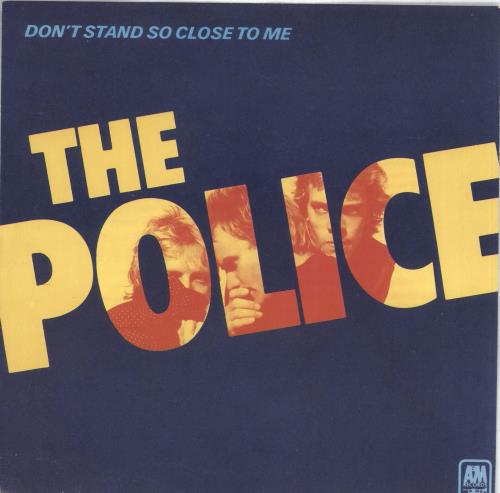
The music and lyrics of the song were written by the lead singer of The Police, Sting, who had previously worked as an English teacher. He has said though that it was not autobiographic…
The Police recorded this in Holland over a period of months. The song started as a Hammond organ-based soul track then evolved through various complex arrangements, until it was eventually reduced to it’s simplest elements.
The band made a video for this song in 1980 that MTV put in rotation when they launched the following year. This is another video I remember being played heavily on MTV.
The song peaked at #1 in the UK, #2 in Canada, and #10 in the Billboard 100 in 1980. The band re-recorded the song in 1986 as Don’t Stand So Close to Me ’86’ and it peaked at #46 in the Billboard 100, #24 in the UK, and #27 in Canada.
This won the 1981 Grammy Award for Best Rock Vocal Performance by a Group.
From Songfacts
This song is about a teacher who lusts after one of his students. Sting was a teacher before joining The Police, and was no doubt the subject of young girl fantasy, but he insists the lyric is not based on personal experience. Putting the speculation to rest, he explained on the DVD for his 2001 All This Time album that he made up the story.
The line, “Just like the old man in the book by Nabokov,” refers to the novel Lolita by Vladimir Nabokov, which is about an older man who pursues underage girls. Sting based this song on the book. Sting mispronounces the author’s name – the “bo” should be stressed. Also, in the novel Lolita, Humbert is not quite an old man.
In the UK, this sold 900,000 copies and was the best-selling single of 1980.
The Police reunited in 1986 to record updated versions of some of their old songs. The reunion brought out old hostilities, and this was the only song they completed. The new version was released as a single titled “Don’t Stand So Close To Me ’86,” and included on their greatest hits album Every Breath You Take – The Singles.
In 1985, Sting worked with Dire Straits on “Money For Nothing,” which has a chorus that sounds very similar to this (compare the lines “Don’t stand so close to me” with “I want my MTV”). Sting did not want a songwriting credit, but his record company thought he should get one so they could receive royalties.
In the video, the guys are larking about a school in graduation gowns, with Sting going through a few costume changes and taking his shirt off at one point. They’re clearly having fun and messing around with each other – it’s a good snapshot of how they could get on in their early years.
They also made a video for the 1986 version of the song, this one directed by Godley & Creme. No shenanigans in that one, just the band looking somber amid many dated special effects.
The race horse Zenyatta is named after the album Zenyatta Mondatta. The horse is owned by Jerry Moss, who signed The Police to his label A&M Records.
This is an example of Sting’s “work backward” method. “I pluck a title from the air, just free-associating, and then try to figure out a story that it could apply to,” he wrote in Lyrics By Sting. Fascinated by the dangerous obsession at the center of Nabokov’s novel, he “transposed this idea to a relationship between a teacher and his pupil. Wanting by this time to identify whatever my sources were, I conspired to get the author’s name into the song with one of the loosest rhymes in the history of pop. Well, I thought it was hilarious, but I caught some flak.”
This was used in The Simpsons episode “On a Clear Day I Can’t See My Sister” and in the Glee episode “Ballad” (2009).
On The Office, Kevin is the singer and drummer in a Police tribute band called Scrantonicity (a play on the album title Synchronicity). In the season 2 finale, “Casino Night,” Jim and Pam watch a video of Scrantonicity performing “Don’t Stand So Close To Me.”
This was featured in the first-season Friends episode “The One Where Underdog Gets Away,” where the character Joey appears on a poster for venereal disease treatment. The song plays when they show the posters all over New York City.
When Stewart Copeland put together the 2006 documentary Everyone Stares: The Police Inside Out, he created new versions of some of the songs using the original masters and outtakes. “The version of ‘Don’t Stand So Close To Me’ comes from both studio recordings because we re-recorded it – strangely, no one can remember why – but we re-recorded it in a different key and I jammed both of those versions together, which was a hell of a puzzle to figure out the transition keys,” he told Songfacts. “I used Sting’s overdubs because he did some amazing overdub work with the new version of ‘Don’t Stand So Close To Me,’ which I used on the original backing track.”
In the video, Sting is wearing a T-shirt for the band The Beat (known in America as The English Beat) in some scenes. The Beat was an opening act for some shows on the Ghost in the Machine tour.
Don’t Stand So Close To Me
Young teacher, the subject Of schoolgirl fantasy She wants him so badly Knows what she wants to be
Inside her there’s longing This girl’s an open page Book marking, she’s so close now This girl is half his age
Don’t stand, don’t stand so Don’t stand so close to me Don’t stand, don’t stand so Don’t stand so close to me
Her friends are so jealous You know how bad girls get Sometimes it’s not so easy To be the teacher’s pet
Temptation, frustration So bad it makes him cry Wet bus stop, she’s waiting His car is warm and dry
Don’t stand, don’t stand so Don’t stand so close to me Don’t stand, don’t stand so Don’t stand so close to me
Loose talk in the classroom To hurt they try and try Strong words in the staffroom The accusations fly
It’s no use, he sees her He starts to shake and cough Just like the old man in That book by Nabakov
Don’t stand, don’t stand so Don’t stand so close to me Don’t stand, don’t stand so Don’t stand so close to me
Don’t stand, don’t stand so Don’t stand so close to me Don’t stand, don’t stand so Don’t stand so close to me Don’t stand, don’t stand so Don’t stand so close to me Don’t stand, don’t stand so Don’t stand so close to me Don’t stand, don’t stand so Don’t stand so close to me Don’t stand, don’t stand so Don’t stand so close to me
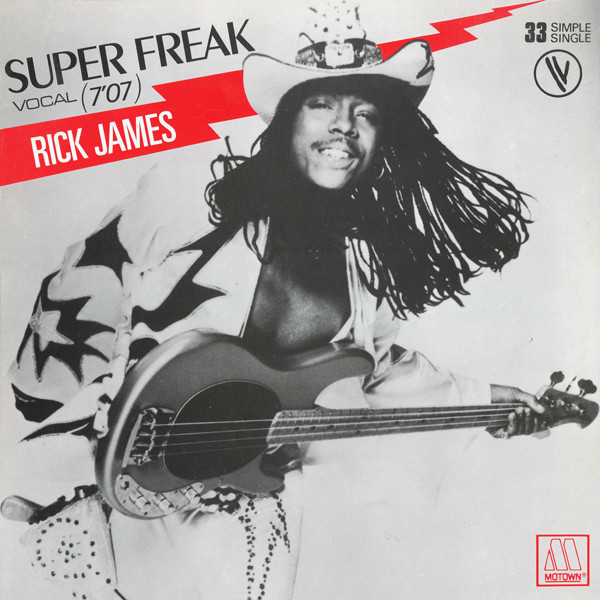
NOT to be confused with the MC Hammer song U Can’t Touch This…who sampled this classic intro. MC Hammer sampled the famous bass line for his biggest hit, U Can’t Touch This. James filed suit against Hammer, which ended in an out-of-court settlement giving James a songwriting credit on the track.
This resulted in Rick James only Grammy Award when “U Can’t Touch This” won in 1991 for Best R&B Song….Life just isn’t fair.
Super Freak peaked at #16 in the Billboard 100, #40 in Canada, and #4 in New Zealand in 1981.
When James exclaims, “Blow, Danny!,” he’s talking to his sax player Daniel LeMelle just before his solo.
The song featured backup vocals by The Temptations. You will hear James point it out in the song when he says: “Tempations sing.” Temptation member Melvin Franklin was Rick James’ uncle.
One story bout Rick James… He dodged the Vietnam War draft by heading across the Canadian border from his hometown of Buffalo. But as soon as he got into Toronto, three drunk guys tried to beat him up for going AWOL. Some other guys came over to help Rick out… Two of those guys were Garth Hudson and Levon Helm, then playing backup for Ronnie Hawkins…later The Band. He also became friendly with Joni Mitchell and she introduced him to Neil Young…Rick and Neil would soon form a band called the Mynah Birds.
Rick James: “I wanted to write a silly song. I was in the studio and everything else for the album (Street Songs) was done. I just put ‘Super Freak’ together really quickly. I wanted a silly song that had a bit of new wave texture to it. So I just came up with this silly little lick and expounded on it. I came up with the bass part first. Then I put a guitar on it and keyboards, doing the ‘ehh ehh,’ silly keyboard part. Then I found a tuning on my Oberheim OB-Xa that I’d been wanting to use for a long time – it sounds like ghosts. And I put a very operatic vocal structure on it ’cause I’m really into opera and classical music. You probably hear a lot of that in my music. So I put (sings in a deep voice) ‘She’s all right’; very operatic, sort of funny, stuff.”
From Songfacts
This song is about a girl who is very adventurous sexually, especially with members of a band. A “freak” is slang for someone willing to try various fetishes, thus a “Super Freak” will try just about anything. James was famous for his penchant toward “freakish” behavior, which got him in trouble with the law when he and his girlfriend were arrested for kidnapping another girl for sex.
Explaining how he came up with this song, James he told Musician magazine in 1983:
“Super Freak” was the biggest pop hit for Rick James, reaching #16 in the US. He had just modest success on the Hot 100 but had four #1 R&B hits and secured a legend as a prolific producer and innovator of funk. The big R&B hit from the album was “Give It to Me Baby”; “Super Freak” made #3.
This was released in the summer of 1981, around the time MTV went on the air. With director Nick Saxton, James made videos for “Give It To Me Baby” and “Super Freak,” hoping to get them on the network. At the time, however, MTV refused to play videos by black artists, and they rejected them, continuing to feed America a steady stream of rock and EuroPop. This refusal to play black music was a holdover from radio station programming, where conventional wisdom was that you would lose your white listeners if you played black music. The first black artist to make MTV with a new song was Musical Youth, who despite adapting a song about smoking marijuana, was a lot less scary to network executives than the glitter-vested James singing about kinky sex. This color barrier was shattered by Michael Jackson, who brought a new sound and sophistication to the network with the videos for his Thriller album.
Even though the network didn’t play this video, Rick James eventually made peace with MTV and put their co-founder, Les Garland, in the video for Eddie Murphy’s song “Party All the Time,” which James produced. As for exactly why MTV passed on “Super Freak,” their director of acquisitions, Carolyn Baker, explained in the book I Want My MTV: “It wasn’t MTV that turned down ‘Super Freak.’ It was me. I tuned it down. You know why? Because there were half-naked women in it, and it was a piece of crap. As a black woman, I did not want that representing my people as the first black video on MTV.”
Over the years, the word “freak” became very popular in hip-hop and R&B lyrics. It’s a versatile word that can be used as both a verb (“Freak Me”) and a noun (“The Freaks Come Out At Night”). Use of the word peaked in the mid-’90s with the phrase, “Get your freak on.”
The Dutch dance duo The Beatfreakz covered this in 2006. Their version reached #7 in the UK, the first time this song charted in Britain as Rick James original version wasn’t a hit there.
In the movie Little Miss Sunshine, the little girl Olive does a wonderfully inappropriate dance to this song in the Little Miss Sunshine pageant.
It also shows up in these movies:
A Madea Family Funeral (2019) Love, Simon (2018) Bohemian Rhapsody (2018) Suicide Squad (2016) Diary of a Wimpy Kid (2010) Transformers: Revenge of the Fallen (2009) Welcome Home, Roscoe Jenkins (2008) Norbit (2007) American Dreamz (2006) Biggie and Tupac (2002) Batman Returns (1992) Doctor Detroit (1983)
And in these TV shows:
Scandal (“It’s Handled” – 2013) The Simpsons (Treehouse of Horror XXIV – 2013; Treehouse of Horror X – 1999) Ugly Betty (“Derailed” – 2007) Two and a Half Men (“Squab, Squab, Squab, Squab, Squab” – 2005) Gilmore Girls (“We Got Us a Pippi Virgin” – 2004) King of the Hill (“Returning Japanese” – 2002) Boy Meets World (“Shallow Boy” – 1996) In Living Color (“The Black Man’s Guide to Understanding the Black Woman” – 1990) The A-Team (“The Heart of Rock N’ Roll” – 1985)
A Los Angeles DJ named Alonzo Miller is credited as a writer on this track along with James. Miller worked on the lyrics with James, helping tone them down so the song had a better chance of getting airplay and crossing over to a white audience. Miller was able to get the song played at the station where he worked, KACE.
Super Freak
She’s a very kinky girl, The kind you don’t take home to mother; She will never let your spirits down, Once you get her off the street.
She likes the boys in the band, She says that I’m her all time fav’rite; When I make my move to her room, It’s the right time; she’s never hard to please.
That girl is pretty wild now; The girl’s a super freak; The kind of girl you read about In the new wave magazines. That girl is pretty kinky; The girl’s a super freak; I’d really like to taste her Ev’ry time we meet. She’s all right; she’s all right; That girl’s all right with me yeah. She’s a super freak, super freak, She’s super freaky; super freak, super freak.
She’s a very special girl, From her head down to her toenails; Yet she’ll wait for me at backstage with her girlfriends, In a limousine.
Three’s not a crowd to her, she said; “Room 714, I’ll be waiting.” When I get there she’s got incense, wine and candles; It’s such a freaky scene.
That girl is pretty wild now; The girl’s a super freak; The kind of girl you read about In the new wave magazines. That girl is pretty kinky; The girl’s a super freak; I’d really like to taste her Ev’ry time we meet. She’s all right; she’s all right; That girl’s all right with me yeah. She’s a super freak, super freak, She’s super freaky; super freak, super freak. Temptations sing; oh, super freak, Super freak, the girl’s a super freak; oh.
She’s a very kinky girl, The kind you don’t take home to mother; She will never let your spirits down, Once you get her off the street.
This song I first heard and viewed on MTV. I didn’t hear it on radio a lot but I liked it. It was in a heavy rotation on MTV and the song was undeniably catchy.
Donnie Iris (Dominic Ierace) was a member of The Jaggerz, who had a hit in 1970 with “The Rapper.” He later became a member of Wild Cherry, where he met keyboard player Mark Avsec, and the two formed a musical partnership.
Donnie Iris and Mark Avsec wrote this song. It peaked at #29 in the Billboard 100 and #6 in Canada in 1981.
One way Iris got his sound was vocal stacking. The backups was overdubbed close to 60 times. They spent days in the studio just working on the backup vocals.
Iris and Avsec released their last studio album in 2010.
Donny Iris:“Mark and I wrote that together in my basement, around the piano, and originally Mark had the idea of an anti-war song. It started out just as a chant – it’s not a chick’s name, it’s not a certain person or individual, in particular. We wanted to have a hook, or a chorus, to the tune, that sounded almost like a Gregorian chant, and somehow Mark came up with the ‘Ah, Leah’ just like a chant. I said, ‘You know what, Mark, that’s a chick’s name,’ so that’s how we named it ‘Ah, Leah.’ It just so happens that there was a girl by the name of Leah who had dated one of the guys in The Jaggerz years ago, and I always loved that name. She was a very pretty girl, and I always loved her name. So instead of a war tune, which we messed around with and messed around with and didn’t have anything in there that we liked to make it an anti-war song, it just turned out as being a love song. It was a total change in direction, and that happened with several of our songs. We were coming up with stuff and, you know, sometimes you just do something and in the end you hate it. That’s what happened. We hated that… the way it was coming out as an anti-war song, and when we finally figured it was a nice way to do a love song, then we were happy with it.”
From Songfacts
Iris: “It sounds kind of passionate, when you talk about not being able to be with a chick, and every time you see this girl, you just go nuts, but it ain’t right, you know, something’s wrong with it. We thought that it was a passionate kind of tune.”
Iris credits the songwriting of Mark Avsec as key to their success. He explains how they come up with their songs: “We’ll go into the studio and put down rhythm tracks, and sometimes we’ll get together for 3 or 4 days and put down 15-20 different tracks of musical pieces. Then the group goes home, and Mark will take the songs home, write the lyrics, and we’ll check it out. If we like it, we’ll keep it if we think it’s good. If not, we’ll maybe go for another lyric, or a different track, but he’s unbelievable that way – just a brilliant songwriter, it’s like he does it in his sleep. And he brings them into the studio, and I’ll sit down, I’ll go over it with him, and together we’ll work out the melodies and stuff.” (Thanks to Donnie Iris for speaking with us about this song. In 2006, he released Ellwood City, which is available on donnieiris.com. Check out our interview with Donnie Iris.)
Ah! Leah!
Leah It’s been a long, long time You’re such a sight You’re looking better than a body has a right to Don’t you know we’re playing with the fire But we can stop this burning desire Leah
Ah! Leah! Here we go again Ah! Leah! Is it ever gonna end? Ah! Leah! Here we go again Ah! Leah!
I see your lips And I wonder who’s been kissing them I never knew how badly I was missing them We both know we’re never going to make it But when we touch We never have to fake it Leah
Ah! Leah! Here we go again Ah! Leah! Is it ever gonna end? Ah! Leah! Here we go again Ah! Leah! We ain’t learned our lesson yet
Baby, it’s no good We’re just asking for trouble I can touch you But I don’t know how to love you
It ain’t no use We’re headed for disaster Our minds said no But our hearts were talking faster Leah
Ah! Leah! Here we go again Ah! Leah! Here we go again Ah! Leah! Leah, Leah, Leah Ah! Leah! Here we go again
Ah! Leah! Leah We’re never, ever, ever gonna make it, yeah Ah! Leah! Here we go again Ah! Leah! We’re never gonna make it Ah! Leah!












 PowerPop... An Eclectic Collection of Pop Culture