“Frosty the Snowman,” debuted in 1969. It was by Rankin/Bass Productions, the same company that produced many holiday specials. Most of us had favorite Christmas specials we would watch. Mine was Rudolph, A Charlie Brown Christmas, The Grinch, and this one…Frosty The Snowman.
Narrated by the legend Jimmy Durante, the special involves a magic hat that transforms a snowman, Frosty, into a living being. The magician who owned the hat wants it back now that he knows it contained actual magic, so the kids had to get together and find a way to bring Frosty to the North Pole to keep him from melting. However, once there, Frosty sacrifices himself to warm up the little girl, Karen, who took him to the North Pole. He melts, but Santa Claus explains that Frosty is made out of special Christmas snow and thus can never truly melt. Frosty then comes back to life and everyone has a Merry Christmas.
The song was written in 1950 by Walter “Jack” Rollins and Steve Nelson. They wrote it for Gene Autry, especially, after Autry had such a huge hit with “Rudolph the Red-Nosed Reindeer” the previous year. It was later recorded by Jimmy Durante as we hear in this wonderful cartoon.
This wasn’t the only animation of Frosty…
In 1954, United Productions of America (UPA) brought Frosty to life in a short cartoon that is little more than an animated music video for a jazzy version of the song. It introduced the characters mentioned in the lyrics visually, from Frosty himself to the traffic cop. The three-minute, black-and-white piece quickly became a holiday tradition in various markets, particularly in Chicago, where it’s been broadcast annually on WGN since 1955.
This song is for Song Lyric Sunday for Jim Adams’s blog. This week’s prompt is Circle/Polygon/Square/Triangle…
The Who are my second favorite band…right behind the Beatles. This song is early Who at the time of My Generation. The song was known as “Circles (Instant Party)”, “Instant Party (Circles)” and “Instant Party”…the song has a complicated history. It was recorded during a time they were trying to leave their producer. The song was written by Pete Townshend and released in 1966.
Circles is an early example of what would become Power Pop. Pete Townshend was trying to write a song with a different sound. Pete found out that bassist John Entwistle could play trumpet, the band’s manager, Kit Lambert, decided to allow the band to try creating a song featuring Entwistle’s horns.
John Entwistle:When we recorded our first LP and wanted a bit of a different sound, Pete told our manager, Kit Lambert, that I could play trumpet. He thought Pete was joking at first but then said he’d give it a try. I showed him I could play the trumpet and in the end we used French horn.
The song was to be the follow up to the anthem My Generation…but the band was not happy with their producer Shel Talmy and secretly broke their contract with him and re-recorded Circles as the B-side to their new UK single “Substitute”.
Talmy sued the Who and a legal battle began.
Pete Townshend:We did two versions of “Circles”, which were both identical because they were both copies of my demo. Shel [Talmy] put in a High Court injunction, saying there was copyright in the recording. In other words, if you’re a record producer and you produce a song with a group, and you make a creative contribution, then you own that sound….He took it to the high-court judge and he said things like ‘And then on bar thirty-six I suggested to the lead guitarist that he play a diminuendo, forget the adagio, and play thirty-six bars modulating to the key of E flat,’ which was all total bullshit — he used to fall asleep at the desk…
They did get away from Talmy but it cost them dearly. It was agreed that Talmy would receive a percentage of each album going forward until the early seventies. So Talmy made a huge amount of money off of their best known albums that he had nothing at all to do with…like Tommy, Live At Leeds, and Who’s Next.
Circles (Instant Party)
Circles, my head is going round in circles My mind is caught up in a whirlpool Dragging me down
Time will tell if I’ll take the homeward track Dizziness will make my feet walk back Walk right back to you
[chorus:] Everything I do, I think of you No matter how I try, I can’t get by These circles, leading me back to you
Round and around and around and around and around and around and around and around and around
And round and round like a fool I go Down and down in the pool I go Dragging me down
[chorus]
There one thing could kill the pain of losing you But it gets me so dizzy then I’m walking right back again Back to you
Time will tell if these dreams are nearly fact Don’t know why I left, I’m coming back Coming on back to you
Now we continue our quest of famous guitars and the artists cherish them… Here was Part 1 and Part 2.
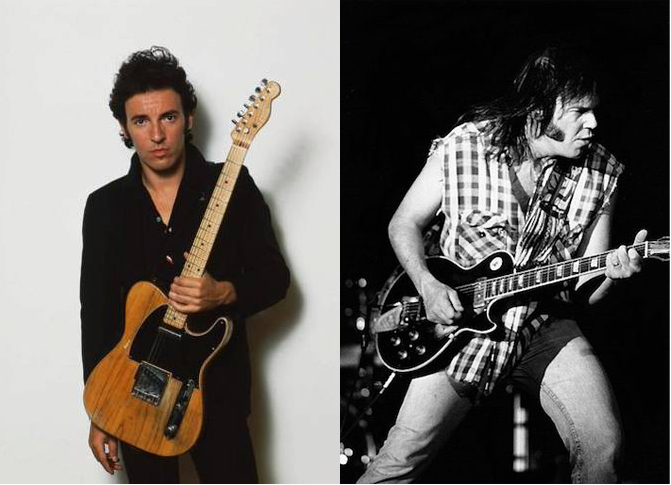
Bruce Springsteen and Neil Young’s guitars
Bruce Springsteen’s Guitar
Bruce has stuck with this guitar from the first album until now. You see this guitar on his Born to Run album. When I saw him in 2000 he was playing it. Bruce bought this in 1972 in Phil Petillo’s Neptune New Jersey guitar shop for $185. Now the guitar is said to be worth between $1 million and $5 million…pretty good investment Bruce!
The guitar is a composite assembled from parts from at least two other Fender guitars. The bolt-on neck dates from a 1950s Fender Esquire guitar. The Esquire decal on the headstock indicates that the neck came from the single-pickup variant of Fender’s more-popular two-pickup Telecaster. The body is a 1950’s Telecaster
The guitar had been originally owned by a record company and was part of the payola scams of the 1960s. It was rigged with four pickups wired into extra jacks that would each plug into a separate channel on the recording console.
Petillo removed the extra pickups and returned the guitar to original Telecaster shape before he sold it Springsteen, but a huge side effect of the routing was that the Tele was now really light, giving it a sound a feel unlike any other.
Bruce had Peillo modify it over the years. He added his triangular Precision Frets, a six saddle titanium bridge, and custom hot-wound waterproofed pickups and electronics so they could better survive a sweat-soaked 4 hour show.
Bruce has now retired the Esquire from road duty, so these days Springsteen plays clones on stage, but still records with the original.
Neil Young’s “Old Black”
Neil Young is known mostly as a singer songwriter but he is a hell of a guitar player. He is one of my favorite rock guitarists. He doesn’t play lightning quick and that is a good thing…it’s playing with feel that many guitar players forget about.
Neil Young acquired Old Black in 1968 through a trade with Buffalo Springfield member Jim Messina, who traded Old Black for one of Young’s orange Gretsch guitars (Gretsch 6120 Chet Atkins).
The guitar made a humming sound so he dropped it off at a guitar shop in LA. When he came back, the shop had closed for good and lost one of the pickups. To replace the lost pickup, Neil added a Gretsh pickup that didn’t quite sound the way he wanted, but it stayed that way until Larry Cragg found an old Firebird pickup and installed it. Then Old Black was restored to its former glory and that Firebird pickup is still installed on the guitar today. It was roughly resprayed to jet black, and received a new Tune-o-matic bridge (not available when the guitar was produced) and a B-7 model Bigsby vibrato tailpiece.
The neck pickup has always been the original P-90 pickup, but it is covered by a metal P-90 cover. Neil is still playing Old Black to this day and he said he will until he dies.
John Lennon was primarily a rhythm guitar player but George Harrison briefly left the Beatles during the recording of Let It Be. John took the lead guitar part on this song and made a memorable solo. John was a very aggressive guitar player and on this one he was on the mark.
McCartney got the idea for the title “Get Back” from the line “Get back to where you should be” from a song George Harrison wrote called “Sour Milk Sea,” which was eventually recorded by Jackie Lomax. McCartney changed the line to, “Get back to where you once belonged”.
Early versions include the line “I dig no Pakistanis.” The song began as a commentary about immigration, telling people to “get back” to their own countries. It was meant to mock Britain’s anti-immigrant proponents. Paul McCartney, who wrote the song and sang lead, thought better of it and made the lyrics more palatable.
At the end of this album version, we hear cheering, followed by McCartney saying, “Thanks Mo” in response to Ringo’s wife, Maureen, who was clapping. Lennon then says, “I’d like to say thank you on behalf of the group and ourselves, and I hope we’ve passed the audition.” This part came from the live rooftop performance.
This song went number 1 everywhere. #1 in the Billboard 100, Canada, UK, New Zealand, The UK, Australia, Austria, Belgium, Ireland…and so on. The B side was Don’t Let Me Down…which personally I like more.
From Songfacts
“Get Back” was going to be the title of the album and the documentary film about making it. The Beatles stopped touring in 1966 and were worn thin by 1968, but they rekindled their passion for performance after shooting the “Hey Jude” promotional film in September that year before a live audience. Energized by the effort, they agreed to the documentary; the concept was The Beatles “getting back” to their roots and playing new songs for a live audience without any studio tricks.
The song “Get Back” came closest to capturing that spirit. Produced by George Martin, it was released as the follow-up single to “Hey Jude” in April 1969 (a month later in America) and was another blockbuster for the group, going to #1 in most territories.
The album became something completely different from the live set they planned. Glyn Johns, who engineered the sessions, was asked to put it together from what were really rehearsal tapes. After he assembled the album, it sat around while the Let It Be documentary was being edited from the film footage of The Beatles rehearsing in the studio and playing on the rooftop. During this time, The Beatles made the Abbey Road album, released it, and broke up.
Phil Spector, who had worked on John Lennon’s solo song “Instant Karma” (which George Harrison played on), was brought in to produce the Get Back album, which was re-titled Let It Be. Spector took the tapes and added orchestrations using his “Wall Of Sound” technique, and the album that was supposed to be the raw sound of The Beatles returning to their roots was released as a highly produced swan song on May 8, 1970, after they had broken up.
The Beatles famously performed this song from the rooftop of Apple Records on January 30, 1969, footage of which serves as the climax to their Let It Be documentary film. Knowing it would get shut down pretty quickly, the group kept mum about the performance, which was designed to promote the single and provide an ending for their film. They got in three takes of “Get Back” before police pulled the plug. The plan worked: Not only did they get their film ending, but the audio (including their banter) was used on various edits of “Get Back” to give it a live feel and add some character.
In their early days, The Beatles were musical warriors, playing in clubs for hours most nights. The “Get Back” single harkened to those days and was advertised as “The Beatles as nature intended.”
The single version runs 3:11 and contains a false ending at 2:34, after which McCartney comes back with a spoken verse:
“Get back Loretta, your mummy’s waiting for you, wearing her high-heeled shoes and her low-neck sweater, get back home, Loretta.”
The album version is a little shorter (3:09) and omits this section. It begins with a behind-the-scenes bit from the band tuning up during a session for the song on January 27, 1969. We hear John Lennon poke fun at the first line (“Jojo was a man who thought he was a loner, but he knew it couldn’t last”) by saying:
“Sweet Loretta fat she thought she was a cleaner, but she was a frying pan.”
Billy Preston played piano on this track and became the only guest artist to get a credit a Beatles single when it was credited to “The Beatles with Billy Preston.”
Preston was a salve and a spark for the group. On January 10, 1969, George Harrison quit and almost left for good. He came back to work on January 21, but the tension lingered. Preston showed up the next day and galvanized the group; he played on “Get Back” and “Don’t Let Me Down,” and participated in sessions for several other tracks.
The Beatles met Preston in 1962 when they were both playing in Germany, but they hadn’t seen each other since. It was Harrison’s idea to bring him in; after George left the Let It Be sessions, he saw Preston in concert with Ray Charles and arranged for him to join The Beatles. Having him in the studio eased the tension and made it easier for the group to put personal conflicts aside and record the album.
The press release to promote the single contains this quote from McCartney: “We were sitting in the studio and we made it up out of thin air… we started to write words there and then… when we finished it, we recorded it at Apple Studios and made it into a song to roller coast by.”
Lennon claimed this was basically a rewrite of their 1968 song “Lady Madonna.”
Beatles fans found lots of hidden meaning in their lyrics, and sometimes the band did too. In his 1980 Playboy interview, John Lennon claimed that Paul looked at Yoko in the studio when he sang the line “get back to where you once belong.” John was sure he was disrespecting her.
There was speculation that the character “JoJo” was based on Joseph Melville See Jr., Linda McCartney’s first husband, who was from Tucson, Arizona. McCartney denied this, explaining in his 1988 autobiography Many Years From Now that he and Linda were on good terms with See, who used the first name Melville, and that “JoJo” was “an imaginary character, half-man and half-woman.”
Linda attended the University of Arizona in Tucson, and in 1979 she and Paul bought a ranch there. As for Joseph Melville See, he never remarried, and in 2000 he killed himself in Tucson.
Billy Preston’s piano solo was spontaneous. he told New Jersey’s Asbury Park Press in 2000: “I was playing a Fender Rhodes on ‘Get Back.’ They just told me, ‘Take a solo!’ I wasn’t expecting to do a solo. When we were rehearsing, I wasn’t playing a solo.”
The last version of the song The Beatles played on the Apple rooftop can be heard in the widely bootlegged “rooftop sessions,” which finds McCartney mocking the police as they shut them down. You can hear him ad-lib the lines “You been out too long, Loretta! You’ve been playing on the roofs again! That’s no good! You know your mommy doesn’t like that! Oh, she’s getting angry… she’ll have you arrested! Get back!”
An edited version of the rooftop performances was released on the Anthology 3 collection in 1996.
Some of the artists to cover this song include: The Bee Gees, The Crusaders, Dizzy Gillespie, Al Green, Elton John, The London Symphony Orchestra, The Main Ingredient, Nitty Gritty Dirt Band, Billy Preston, Kenny Rogers, The Royal Philharmonic Orchestra, The Shadows, Status Quo, Rod Stewart, Ike and Tina Turner, and Sarah Vaughan.
In 2003, Paul McCartney and Ringo Starr gave permission to Apple Records to rework the album and remove Phil Spector’s production. The result is the stripped-down version called Let It Be… Naked, which McCartney claims is what the group intended.
McCartney played this at halftime of the 2005 Super Bowl. This was the year after Janet Jackson’s breast was exposed during the halftime show, so the NFL insisted on an act that wouldn’t incite controversy or push the envelope. McCartney fit the bill.
Get Back
Jojo was a man who thought he was a loner But he knew it wouldn’t last Jojo left his home in Tucson, Arizona For some California grass
Get back, get back Get back to where you once belonged Get back, get back Get back to where you once belonged Get back Jojo, go home
Get back, get back Back to where you once belonged Get back, get back Back to where you once belonged Get back Jo
Sweet Loretta Martin thought she was a woman But she was another man All the girls around her say she’s got it coming But she gets it while she can
Get back, get back Get back to where you once belonged Get back, get back Get back to where you once belonged Get back Loretta, go home
Get back, get back Get back to where you once belonged Get back, get back Get back to where you once belonged
Get back, get back Get back to where you once belonged Get back, get back, get back
I found this article about The Max Planck Institute in Germany conducting a study on the perfect pop song… the winner was Ob-La-Di, Ob-La-Da
As everyone here knows I’m a huge Beatles fan…but this one? I couldn’t disagree more with their conclusion but it is interesting on how they made the choice… I posted a couple of links.
Lets continue browsing through famous guitars. In Part 1 we had a guitars owned by Brian May and Willie Nelson.
George Harrison and Eddie Van Halen’s guitars
Today we will visit two more….George Harrison‘s Strat “Rocky” and Eddie Van Halen‘s “Frankenstrat”
Today we will start off with one of my favorite guitars for obvious reasons…and then Frankenstrat below Rocky.
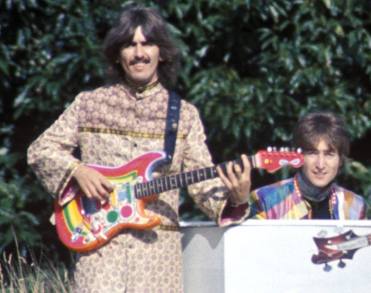
“Rocky”
When The Beatles were in the studio recording “Help!“, John Lennon and George Harrison sent roadie Mal Evans out to go get a couple of Fender Stratocasters. Evans came back with matching 1962 Sonic Blue Strats. You can hear both of these guitars on Rubber Soul…especially both playing the solo on Nowhere Man in unison.
George Harrison: “During ’67, everybody started painting everything,” “and I decided to paint it. I got some Day-Glo paint, which was quite a new invention in them days, and just sat up late one night and did it.”
Harrison used some of his ex-wife Patti Boyd’s nail polish to paint the headstock. George played the guitar that year in the Beatles’ live performance of “All You Need Is Love” on the around the world satellite feed called Our World, the first global satellite TV program, and in the film Magical Mystery Tour, in the segment where the Beatles mime to “I Am the Walrus”
In 1969-1970 on the advice of the great slide guitar player Ry Cooder George set Rocky up for slide only.
The Harrison Estate still owns this guitar.
Following its announcement at NAMM 2020, Fender has now officially released its faithful recreation of George Harrison’s ‘Rocky’ Stratocaster…hmm I know exactly what I want for Christmas!
“Frankenstrat”
Eddie wanted to make a guitar that was a cross of a Gibson and Fender. To have the clean tone of a Fender and the ability to have the crunch of a Gibson.
In 1974 he visited Boogie Bodies guitars, whose parts were used on early Charvels, and bought himself a factory second unfinished body and neck, paying total of $130. The body he bought was the first one he saw laying around in the store, but he paid close attention to choosing the right neck – he looked for a wide neck with a really thin profile and big Gibson-style frets.
He painted the body black and wrapped masking tape around it and repainted the body white. He installed a Fender tremolo from a 1958 Stratocaster, Schaller tuners, and a Gibson PAF pickup from an old ES-335 which he dipped into paraffin wax in order to get rid of the feedback.
He played the guitar on Van Halen’s first album, and during the band’s first tour. Towards the end of the tour, the guitar was changed to feature a white pickguard and a rosewood neck.
He later changed out necks and hardware and painted it red with bicycle paint.
Frankenstrat was donated to the Hard Rock Cafe in 2004. In 2017 Frankenstrat had been stolen from the walls of the city’s Hard Rock Cafe but returned later.
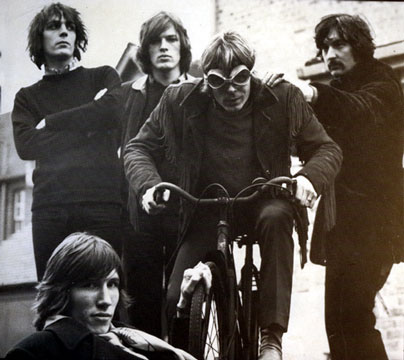
My journey through early Pink Floyd continues with this song called Bike written by Syd Barrett. It’s very British and like some of the other early songs you can hear the later Pink Floyd taking shape. This song was on the album The Piper At The Gates Of Dawn released in 1967.
The album title came from a chapter in the book Wind In The Willows, where The piper was Pan, the Greek god of music.
Barrett was 18 when he met 15-year-old Jenny Spires in 1964. They started dating the following year, which is when he wrote “Bike.” Barrett would often create artwork and poetry for Spires, and “Bike” was his version of a love song to Spires.
Pink Floyd drummer Nick Mason considers this one of Syd Barrett’s best songs.
From Songfacts
Pink Floyd guitarist Syd Barrett wrote this for his girlfriend, Jenny Spires. In the song, Syd shows her his bike, which he borrowed. He also shows her his mouse named Gerald, a clan of gingerbread men and a cloak. At the end of the song, Syd takes her to his music room.
The Piper At The Gates Of Dawn was the first Pink Floyd album and the only one dominated by Syd Barrett, who was booted from the band in 1972 when he became mentally impaired.
You’re the kind of girl that fits in with my world
I’ll give you anything, everything if you want things
Spires recalled him being “very loving.”
“The lyrics to this are so very Syd, astonishingly clever,” he told Rolling Stone. “It’s fun, but there’s a depth of sadness to them.”
Bike
I’ve got a bike, you can ride it if you like It’s got a basket, a bell that rings and Things to make it look good I’d give it to you if I could, but I borrowed it
You’re the kind of girl that fits in with my world I’ll give you anything, ev’rything if you want things
I’ve got a cloak, it’s a bit of a joke There’s a tear up the front, it’s red and black I’ve had it for months If you think it could look good, then I guess it should
You’re the kind of girl that fits in with my world I’ll give you anything, ev’rything if you want things
I know a mouse, and he hasn’t got a house I don’t know why I call him Gerald He’s getting rather old, but he’s a good mouse
You’re the kind of girl that fits in with my world I’ll give you anything, ev’rything if you want things
I’ve got a clan of gingerbread men Here a man, there a man, lots of gingerbread men Take a couple if you wish, they’re on the dish
You’re the kind of girl that fits in with my world I’ll give you anything, ev’rything if you want things
I know a room full of musical tunes Some rhyme, some ching, most of them are clockwork Let’s go into the other room and make them work
The Animals were nasty sounding…more than the Stones on some of their records at this time.
This is one of the songs that have been said as having pioneered grunge music. The song was written by Eric Burdon, Vic Briggs, John Weider, Barry Jenkins, and Danny McCulloch.
This was in the middle of the psychedelic period…In 1966 the original Animals disbanded because of business mismanagement and were in debt. Eric carried on with the newly named Eric Burdon & The Animals. He left behind his Newcastle, hard-drinking ways behind, and became a spokesman for the counterculture in this period.
This song was released in 1967 and it peaked at #15 in the Billboard 100, #10 in Canada, and #45 in the UK.
Eric Burdon: “When I first wrote it I played it to George Harrison and his comment was ‘Great! You got to do more of this. You’ll know you’ll be able to sing this song when you are in your forties.’ Now I am in my 70s and I am still singing it.”
From Songfacts
“When I Was Young” was written by Eric Burdon and included on various Animals albums as well as being a single release.
Burdon’s composition marks an important turning point for the Animals: many of The Animals’ hits had been Brill Building productions, most notably the husband-and-wife team of Barry Mann and Cynthia Weil, which was an effort by their producer Mickie Most to make this British Invasion band sound more American. Burdon found this too restricting, and the group moved to Decca Records by 1966. This was amongst their first hits after this move.
Cover versions of this song include versions by Golden Earring, Eddie Fisher, Tina Turner, and The Ramones. It’s also been featured in film soundtracks such as Doris Dorrie’s Manner….
When I Was Young
‘The rooms were so much colder then My father was a soldier then And times were very hard When I was young
I smoked my first cigarette at ten And for girls, I had a bad yen And I had quite a ball When I was young
When I was young, it was more important Pain more painful Laughter much louder Yeah, when I was young When I was young
I met my first love at thirteen She was brown and I was pretty green And I learned quite a lot when I was young When I was young When I was young
Pain more painful Laughter much louder Yeah, when I was young When I was young
My faith was so much stronger then I believed in fellow man And I was so much older then When I was young When I was young When I was young
Every Thanksgiving I listen to Alice’s Restaurant and this is the third year in a row that I’ve posted it on the 4th Thursday of November. Sorry if you are tired of it but it’s not Thanksgiving until Alice’s Restaurant is played…and the Last Waltz is watched but that is a different story.
The movie that Arlo movie made called Alice’s Restaurant is a fun watch.
It’s not Thanksgiving without listening to this 1967 song. This song did not chart but he did have another version that did chart…it was called Alice’s Rock and Roll Restaurant that peaked at #97 in the Billboard 100.
Many radio stations play this on Thanksgiving. This is usually the only time they play it, since the song is over 18-minutes long.
There have been mixed reviews about the movie that was made…I’ve always found it enjoyable. It’s not going to be confused with Gone With The Wind but it’s a fun period movie.
In 1991, Arlo bought the church where this took place and set up “The Guthrie Center,” where he runs programs for kids who have been abused.
From Songfacts
Running 18 minutes and 34 seconds, this song is based on a true story that happened on Thanksgiving Day, 1965. Arlo was 18, and along with his friend Rick Robbins, drove to Stockbridge, Massachusetts to have Thanksgiving dinner with Alice and Ray Brock. Alice and Ray lived in a church – the former Trinity Church on Division Street in Stockbridge – and were used to inviting people into their home. Arlo and Rick had been traveling together, Arlo working his way up in folk singing and Rick tagging along. A number of people, Arlo and Rick included, were considered members of the family, so they were not guests in the usual sense.
When Ray woke up the next morning, he said to them, “Let’s clean up the church and get all this crap out of here, for God’s sake. This place is a mess,” and Rick said, “Sure.” Arlo and Rick swept up and loaded all the crap into a VW microbus and went out to the dump, which was closed. They started driving around until Arlo remembered a side road in Stockbridge up on Prospect Hill by the Indian Hill Music Camp which he attended one summer, so they drove up there and dumped the garbage.A little later, the phone rang, and it was Stockbridge police chief William J. Obanhein. “I found an envelope with the name Brock on it,” Chief Obanhein said. The truth came out, and soon the boys found themselves in Obanhein’s police car. They went up to Prospect Hill, and Obie took some pictures. On the back, he marked them, “PROSPECT HILL RUBBISH DUMPING FILE UNDER GUTHRIE AND ROBBINS 11/26/65.” He took the kids to jail.The kids went in, pleaded, “Guilty, Your Honor,” was fined $25 each and ordered to retrieve the rubbish. Then they all went back to the church and started to write “Alice’s Restaurant” together. “We were sitting around after dinner and wrote half the song,” Alice recalls, “and the other half, the draft part, Arlo wrote.”
Guthrie, the son of legendary folk singer Woody Guthrie, greatly exaggerated the part about getting arrested for comic effect. In the song, he is taken away in handcuffs and put in a cell with hardened criminals.
In the song, Guthrie avoids the draft and did not have to serve in Vietnam because of his littering arrest. In reality, he was eligible but wasn’t drafted because his number didn’t come up.
Guthrie performed this song for the first time on July 16, 1967, at the Newport Folk Festival.
This reflected the attitude of many young people in America at the time. It was considered an antiwar song, but unlike most protest songs, it used humor to speak out against authority.
After a while, Guthrie stopped playing this at concerts, claiming he forgot the words. As the song approached its 30th anniversary, he started playing it again.
Guthrie made a movie of the same name in 1969 which was based on the song.
Over the years, Guthrie added different words to the song. He recorded a new, longer version in 1995 at The Guthrie Center
Alice’s Restuarant
This song is called Alice’s Restaurant, and it’s about Alice, and the
Restaurant, but Alice’s Restaurant is not the name of the restaurant,
That’s just the name of the song, and that’s why I called the song Alice’s
Restaurant.
You can get anything you want at Alice’s Restaurant
You can get anything you want at Alice’s Restaurant
Walk right in it’s around the back
Just a half a mile from the railroad track
You can get anything you want at Alice’s Restaurant
Now it all started two Thanksgivings ago, was on – two years ago on
Thanksgiving, when my friend and I went up to visit Alice at the
Restaurant, but Alice doesn’t live in the restaurant, she lives in the
Church nearby the restaurant, in the bell-tower, with her husband Ray and
Fasha the dog. And livin’ in the bell tower like that, they got a lot of
Room downstairs where the pews used to be in. Havin’ all that room,
Seein’ as how they took out all the pews, they decided that they didn’t
Have to take out their garbage for a long time.
We got up there, we found all the garbage in there, and we decided it’d be
A friendly gesture for us to take the garbage down to the city dump. So
We took the half a ton of garbage, put it in the back of a red vw
Microbus, took shovels and rakes and implements of destruction and headed
On toward the city dump.
Well we got there and there was a big sign and a chain across across the
Dump saying, “Closed on Thanksgiving.” And we had never heard of a dump
Closed on Thanksgiving before, and with tears in our eyes we drove off
Into the sunset looking for another place to put the garbage.
We didn’t find one. Until we came to a side road, and off the side of the
Side road there was another fifteen foot cliff and at the bottom of the
Cliff there was another pile of garbage. And we decided that one big pile
Is better than two little piles, and rather than bring that one up we
Decided to throw our’s down.
That’s what we did, and drove back to the church, had a thanksgiving
Dinner that couldn’t be beat, went to sleep and didn’t get up until the
Next morning, when we got a phone call from officer Obie. He said, “Kid,
We found your name on an envelope at the bottom of a half a ton of
Garbage, and just wanted to know if you had any information about it. ” And
I said, “Yes, sir, Officer Obie, I cannot tell a lie, I put that envelope
Under that garbage. ”
After speaking to Obie for about forty-five minutes on the telephone we
Finally arrived at the truth of the matter and said that we had to go down
And pick up the garbage, and also had to go down and speak to him at the
Police officer’s station. So we got in the red vw microbus with the
Shovels and rakes and implements of destruction and headed on toward the
Police officer’s station.
Now friends, there was only one or two things that Obie coulda done at
The police station, and the first was he could have given us a medal for
Being so brave and honest on the telephone, which wasn’t very likely, and
We didn’t expect it, and the other thing was he could have bawled us out
And told us never to be seen driving garbage around the vicinity again,
Which is what we expected, but when we got to the police officer’s station
There was a third possibility that we hadn’t even counted upon, and we was
Both immediately arrested. Handcuffed. And I said “Obie, I don’t think I
Can pick up the garbage with these handcuffs on. ” He said, “Shut up, kid.
Get in the back of the patrol car. ”
And that’s what we did, sat in the back of the patrol car and drove to the
Quote Scene of the Crime unquote. I want tell you about the town of
Stockbridge, Massachusets, where this happened here, they got three stop
Signs, two police officers, and one police car, but when we got to the
Scene of the Crime there was five police officers and three police cars,
Being the biggest crime of the last fifty years, and everybody wanted to
Get in the newspaper story about it. And they was using up all kinds of
Cop equipment that they had hanging around the police officer’s station.
They was taking plaster tire tracks, foot prints, dog smelling prints, and
They took twenty seven eight-by-ten colour glossy photographs with circles
And arrows and a paragraph on the back of each one explaining what each
One was to be used as evidence against us. Took pictures of the approach,
The getaway, the northwest corner the southwest corner and that’s not to
Mention the aerial photography.
After the ordeal, we went back to the jail. Obie said he was going to put
Us in the cell. Said, “Kid, I’m going to put you in the cell, I want your
Wallet and your belt. ” And I said, “Obie, I can understand you wanting my
Wallet so I don’t have any money to spend in the cell, but what do you
Want my belt for? ” And he said, “Kid, we don’t want any hangings. ” I
Said, “Obie, did you think I was going to hang myself for littering?”
Obie said he was making sure, and friends Obie was, cause he took out the
Toilet seat so I couldn’t hit myself over the head and drown, and he took
Out the toilet paper so I couldn’t bend the bars roll out the – roll the
Toilet paper out the window, slide down the roll and have an escape. Obie
Was making sure, and it was about four or five hours later that Alice
(remember Alice? It’s a song about Alice), Alice came by and with a few
Nasty words to Obie on the side, bailed us out of jail, and we went back
To the church, had a another thanksgiving dinner that couldn’t be beat,
And didn’t get up until the next morning, when we all had to go to court.
We walked in, sat down, Obie came in with the twenty seven eight-by-ten
Colour glossy pictures with circles and arrows and a paragraph on the back
Of each one, sat down. Man came in said, “All rise.” We all stood up,
And Obie stood up with the twenty seven eight-by-ten colour glossy
Pictures, and the judge walked in sat down with a seeing eye dog, and he
Sat down, we sat down. Obie looked at the seeing eye dog, and then at the
Twenty seven eight-by-ten colour glossy pictures with circles and arrows
And a paragraph on the back of each one, and looked at the seeing eye dog.
And then at twenty seven eight-by-ten colour glossy pictures with circles
And arrows and a paragraph on the back of each one and began to cry,
’cause Obie came to the realization that it was a typical case of American
Blind justice, and there wasn’t nothing he could do about it, and the
Judge wasn’t going to look at the twenty seven eight-by-ten colour glossy
Pictures with the circles and arrows and a paragraph on the back of each
One explaining what each one was to be used as evidence against us. And
We was fined $50 and had to pick up the garbage in the snow, but that’s not
What I came to tell you about.
Came to talk about the draft.
They got a building down New York City, it’s called Whitehall Street,
Where you walk in, you get injected, inspected, detected, infected,
Neglected and selected. I went down to get my physical examination one
Day, and I walked in, I sat down, got good and drunk the night before, so
I looked and felt my best when I went in that morning. ‘Cause I wanted to
Look like the all-American kid from New York City, man I wanted, I wanted
To feel like the all-, I wanted to be the all American kid from New York,
And I walked in, sat down, I was hung down, brung down, hung up, and all
Kinds o’ mean nasty ugly things. And I waked in and sat down and they gave
Me a piece of paper, said, “Kid, see the phsychiatrist, room 604.”
And I went up there, I said, “Shrink, I want to kill. I mean, I wanna, I
Wanna kill. Kill. I wanna, I wanna see, I wanna see blood and gore and
Guts and veins in my teeth. Eat dead burnt bodies. I mean kill, Kill,
Kill, kill. ” And I started jumping up and down yelling, “kill, kill, ” and
He started jumping up and down with me and we was both jumping up and down
Yelling, “KILL, KILL.” And the Sargent came over, pinned a medal on me,
Sent me down the hall, said, “You’re our boy.”
Didn’t feel too good about it.
Proceeded on down the hall gettin more injections, inspections,
Detections, neglections and all kinds of stuff that they was doin’ to me
At the thing there, and I was there for two hours, three hours, four
Hours, I was there for a long time going through all kinds of mean nasty
Ugly things and I was just having a tough time there, and they was
Inspecting, injecting every single part of me, and they was leaving no
Part untouched. Proceeded through, and when I finally came to the see the
Last man, I walked in, walked in sat down after a whole big thing there,
And I walked up and said, “What do you want?” He said, “Kid, we only got
One question. Have you ever been arrested? ”
And I proceeded to tell him the story of the Alice’s Restaurant Massacre,
With full orchestration and five part harmony and stuff like that and all
The phenome… – and he stopped me right there and said, “Kid, did you ever
Go to court? ”
And I proceeded to tell him the story of the twenty seven eight-by-ten
Colour glossy pictures with the circles and arrows and the paragraph on
The back of each one, and he stopped me right there and said, “Kid, I want
You to go and sit down on that bench that says Group W…. Now kid!! ”
And I, I walked over to the, to the bench there, and there is, Group W’s
Where they put you if you may not be moral enough to join the army after
Committing your special crime, and there was all kinds of mean nasty ugly
Looking people on the bench there. Mother rapers. Father stabbers. Father
Rapers! Father rapers sitting right there on the bench next to me! And
They was mean and nasty and ugly and horrible crime-type guys sitting on the
Bench next to me. And the meanest, ugliest, nastiest one, the meanest
Father raper of them all, was coming over to me and he was mean ‘n’ ugly
‘n’ nasty ‘n’ horrible and all kind of things and he sat down next to me
And said, “Kid, whad’ya get?” I said, “I didn’t get nothing, I had to pay
$50 and pick up the garbage. ” He said, “What were you arrested for, kid? ”
And I said, “Littering.” And they all moved away from me on the bench
There, and the hairy eyeball and all kinds of mean nasty things, till I
Said, “And creating a nuisance.” And they all came back, shook my hand,
And we had a great time on the bench, talkin about crime, mother stabbing,
Father raping, all kinds of groovy things that we was talking about on the
Bench. And everything was fine, we was smoking cigarettes and all kinds of
Things, until the Sargeant came over, had some paper in his hand, held it
Up and said.
“Kids, this-piece-of-paper’s-got-47-words-37-sentences-58-words-we-wanna-
Know-details-of-the-crime-time-of-the-crime-and-any-other-kind-of-thing-
You-gotta-say-pertaining-to-and-about-the-crime-I-want-to-know-arresting-
Officer’s-name-and-any-other-kind-of-thing-you-gotta-say”, and talked for
Forty-five minutes and nobody understood a word that he said, but we had
Fun filling out the forms and playing with the pencils on the bench there,
And I filled out the massacre with the four part harmony and wrote it
Down there, just like it was, and everything was fine and I put down the
Pencil and I turned over the piece of paper, and there, there on the
Other side, in the middle of the other side, away from everything else on
The other side, in parentheses, capital letters, quotated, read the
Following words:
(“KID, HAVE YOU REHABILITATED YOURSELF?”)
I went over to the Sargent, said, “Sargeant, you got a lot a damn gall to
Ask me if I’ve rehabilitated myself, I mean, I mean, I mean that just, I’m
Sittin’ here on the bench, I mean I’m sitting here on the Group W bench
’cause you want to know if I’m moral enough join the army, burn women,
Kids, houses and villages after bein’ a litterbug. ” He looked at me and
Said, “Kid, we don’t like your kind, and we’re gonna send you fingerprints
Off to Washington. ”
And friends, somewhere in Washington enshrined in some little folder, is a
study in black and white of my fingerprints. And the only reason I’m
singing you this song now is cause you may know somebody in a similar
situation, or you may be in a similar situation, and if your in a
situation like that there’s only one thing you can do and that’s walk into
The shrink wherever you are, just walk in say “Shrink, You can get
Anything you want, at Alice’s restaurant. “. And walk out. You know, if
One person, just one person does it they may think he’s really sick and
They won’t take him. And if two people, two people do it, in harmony,
They may think they’re both faggots and they won’t take either of them.
And three people do it, three, can you imagine, three people walking in
Singin a bar of Alice’s Restaurant and walking out. They may think it’s an
Organization. And can you, can you imagine fifty people a day, I said
Fifty people a day walking in singing a bar of Alice’s Restaurant and
Walking out. And friends they may think it’s a movement.
And that’s what it is, the Alice’s Restaurant Anti-Massacre Movement, and
All you got to do to join is sing it the next time it comes around on the
Guitar.
With feeling. So we’ll wait for it to come around on the guitar, here and
Sing it when it does. Here it comes.
You can get anything you want, at Alice’s Restaurant
You can get anything you want, at Alice’s Restaurant
Walk right in it’s around the back
Just a half a mile from the railroad track
You can get anything you want, at Alice’s Restaurant
That was horrible. If you want to end war and stuff you got to sing loud.
I’ve been singing this song now for twenty-five minutes. I could sing it
For another twenty-five minutes. I’m not proud… Or tired.
So we’ll wait till it comes around again, and this time with four part
Harmony and feeling.
We’re just waitin’ for it to come around is what we’re doing.
All right now.
You can get anything you want, at Alice’s Restaurant
Excepting Alice
You can get anything you want, at Alice’s Restaurant
Walk right in it’s around the back
Just a half a mile from the railroad track
You can get anything you want, at Alice’s Restaurant
I like this song a lot and I was drawn to it right away when I listened to it on my copy of Bob Dylan’s Greatest Hits…but I cannot connect to it like the listeners did in 64-65. It was more than a pop song.
Dylan wrote this in 1963 when the civil rights movement was underway and demonstrations against the Vietnam War were gearing up. It would become the anthem of his generation.
Sometime songs can sum up the generation and time they are released in and this one is one of the very few that does it.
The song was on Bob Dylan’s 3rd album The Times They Are a-Changin’ released in 1964. The song wasn’t released as a single until 1965 and it peaked at #9 in the UK.
On December 10, 2010 Sotheby’s in New York sold a single rather worn sheet of binder paper on which Bob Dylan wrote the original lyrics of his most famous song, The Times They Are A-Changin, probably in October 1963. This battered piece of paper with messy writing sold for $422,500.
The song was ranked number 59 on Rolling Stone‘s 2004 list of the “500 Greatest Songs of All Time.”
Bob Dylan:“I wanted to write a big song, some kind of theme song, with short, concise verses that piled up on each other in a hypnotic way. This is definitely a song with a purpose. I knew exactly what I wanted to say and who I wanted to say it to.”
From Songfacts
A call to action, “The Times They Are A-Changin'” became an anthem for frustrated youth. It summed up the anti-establishment feelings of people who would later be known as hippies. Many of the lyrics are based on the Civil Rights movement in the US.
Dylan recorded this song in October 1963. He first performed the song at a Carnegie Hall concert on October 26 that year, using it as his opening number.
On November 22, 1963, United States president John F. Kennedy was assassinated, which made this song even more poignant. This also presented a quandary for Dylan, who had to decide if he would keep playing the song; he found it odd when audiences would erupt in applause after hearing it, and wondered exactly what they were clapping for.
Dylan kept the song in his sets. It was issued on the album of the same name on January 13, 1964.
Dylan covered the Carter Family Song “Wayworn Traveler,” writing his own words to the melody and named it “Paths Of Victory”. This recording is featured on “Bootleg Series Vol. 1-3”. After writing that song, he re-wrote the words again, changed the time signature to 3/4, and created this, one of his most famous songs ever.
This was released as a single in the UK in 1965 before Dylan went there to tour. It became his first hit in that territory, climbing to #9 on April 21. British listeners liked what they heard from Dylan and made a run on his second album, The Freewheelin’ Bob Dylan (released in 1963), sending it to #1 on April 11. This marked the first time in two years that an album by a group other that The Beatles or Rolling Stones was #1 in the UK.
Dylan allowed this to be used in commercials for accounting firm Coopers and Lybrand in the ’90s. In 1996, he also licensed it for commercial use by the Bank of Montreal.
This song appears on the official soundtrack of the 2009 movie Watchmen. A cover of Dylan’s “Desolation Row” by My Chemical Romance also appears on the soundtrack. >>
Simon & Garfunkel covered this on their first album, Wednesday Morning, 3 A.M., in 1964. They were produced at the time by Tom Wilson, who also produced Dylan’s The Times They Are A-Changin’ album.
The Times They Are A-Changin’
Come gather ’round, people Wherever you roam And admit that the waters Around you have grown And accept it that soon You’ll be drenched to the bone If your time to you is worth savin’ And you better start swimmin’ Or you’ll sink like a stone For the times they are a-changin’
Come writers and critics Who prophesize with your pen And keep your eyes wide The chance won’t come again And don’t speak too soon For the wheel’s still in spin And there’s no tellin’ who That it’s namin’ For the loser now Will be later to win For the times they are a-changin’
Come senators, congressmen Please heed the call Don’t stand in the doorway Don’t block up the hall For he that gets hurt Will be he who has stalled The battle outside ragin’ Will soon shake your windows And rattle your walls For the times they are a-changin’
Come mothers and fathers Throughout the land And don’t criticize What you can’t understand Your sons and your daughters Are beyond your command Your old road is rapidly agin’ Please get out of the new one If you can’t lend your hand For the times they are a-changin’
The line it is drawn The curse it is cast The slow one now Will later be fast As the present now Will later be past The order is rapidly fadin’ And the first one now Will later be last For the times they are a-changin’
The guitar riff to this song is one to remember. When I heard Green Day’s song “Warning”I knew where they got the inspiration for their song.
Ray Davies wrote this about the nostalgic feel that comes from looking through photo albums. The song was originally written for a planned Davies solo project, but he relented and let The Kinks take a shot at it. It was recorded in May 1968 and released that November The Kinks Are the Village Green Preservation Society.
Davies, who also acted as producer, wanted the sound of the album to reflect its old-fashioned themes. He wanted it more low-fi.
The song was an album track but The song gained a new popularity when it was used on a Hewlett-Packard 2004 commercial promoting their digital cameras and printers that featured numerous “Pictures Of You” superimposed with each other.
Dave Davies: “Halfway through ‘Picture Book,’ I was trying to do a bit of jazz improvisation like Jo Stafford,” “You can almost hear Ray mimicking or singing across it, ‘scooby-dooby-doo,’ poking fun at what I was saying. That was quite a spontaneous album.”
From Songfacts
Along with Village Green‘s closing track “People Take Pictures of Each Other,” this song uses photography to drive home the album’s concept about holding onto and appreciating the past. “There’s more value in an old picture than there is now on iPhones,” Ray Davies told Rolling Stone in 2018. “I know a guy. He’s homeless and I chat with him sometimes in the street. He’s got a picture of his family in his pocket, and he’s always got a picture with him, he says, ‘For when things get really low'” (pause) “It’s all gotten cheaper because of iPhones.”
The vocal harmonies for the Village Green Preservation Society album were worked out by Ray Davies, Dave Davies and Pete Quaife round the piano. Dave Davies has fond memories of creating the sweet choirboy vocal harmonies to “Picture Book.”
Picture Book
Picture yourself when you’re getting old, Sat by the fireside a-pondering on Picture book, pictures of your mama, taken by your papa a long time ago. Picture book, of people with each other, to prove they love each other a long ago. Na, na, na, na, na na. Na, na, na, na, na na. Picture book. Picture book.
A picture of you in your birthday suit, You sat in the sun on a hot afternoon. Picture book, your mama and your papa, and fat old Uncle Charlie out cruising with their friends. Picture book, a holiday in August, outside a bed and breakfast in sunny Southend. Picture book, when you were just a baby, those days when you were happy, a long time ago. Na, na, na, na, na na. Na, na, na, na, na na. Picture book. Picture book. Picture book. Picture book.
Picture book, Na, na, na, na na, Na, na, na, na na, A-scooby-dooby-doo. Picture book, Na, na, na, na na, Na, na, na, na na, A-scooby-dooby-doo.
Picture book, pictures of your mama, taken by your papa a long time ago. Long time ago, Long time ago, Long time ago, Long time ago, Yeah, yeah, yeah.
This song is for Song Lyric Sunday for Jim Adams’s blog. This week’s prompt Begin/End/Finish/Start…This song is about the beginning and the end of love affairs.
I watched the Graduate in the mid-eighties and I sat there transfixed watching this classic film. How the music kept the movie going and this song hit me for some reason. I spent weeks (pre internet) tracking down the soundtrack of the film. I went to different record stores but with no luck but finally found it at the Great Escape, a second hand record store.
It was one of the first movies that I recognized how much music can make a movie. It was a great film regardless but without the music the movie would not have been the same.
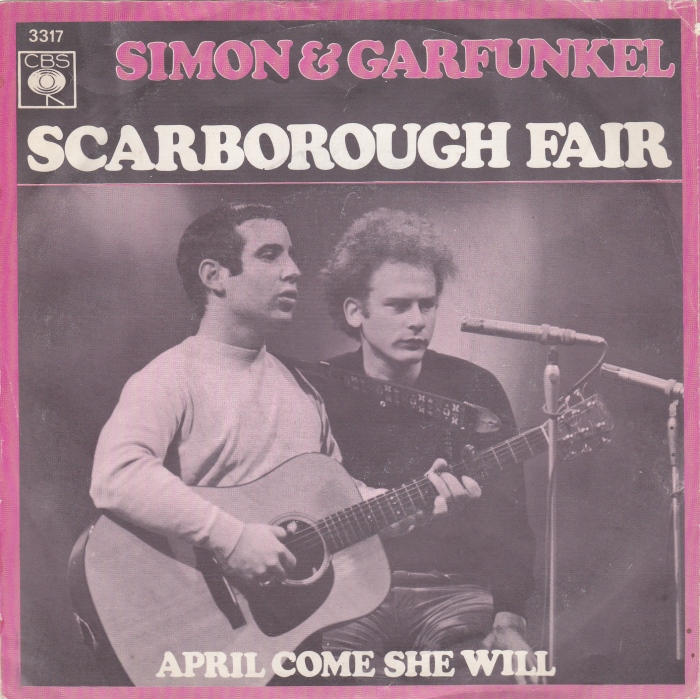
April Come She Will was composed by Paul Simon. Running just 1:51, it is the shortest track on the album Sounds of Silence released in 1966. It was also on the Graduate soundtrack.
The song was the B side to the Scarborough Fair single.
From Songfacts
This song is also featured in the soundtrack to the film The Graduate. Meant to evoke the capriciousness of a young girl while relating it to how the seasons change, the lyrics were inspired by a nursery rhyme recited by an English girl with whom Simon had an affair. It stands to reason, then, that this would go along with the plot of The Graduate.
Listen for an echo of this song in “For Emily, Whenever I May Find Her,” from S&G’s subsequent album Parsley, Sage, Rosemary & Thyme.
This song isn’t the only one with a classical lyric inspiration on that album; “Richard Cory” is also based on the poem of the same name by American poet Edwin Arlington Robinson.
April Come She Will
April, come she will When streams are ripe and swelled with rain May, she will stay Resting in my arms again June she’ll change her tune In restless walks she’ll prowl the night
July, she will fly And give no warning to her flight August, die she must The autumn winds blow chilly and cold September, I remember A love once new has now grown old
If you want to hear an optimistic song look no further than this one. This is another Beatles song that was not released as a single. Harrison wrote it and sang lead, played acoustic guitar and used his newly acquired Moog synthesizer on this track. It was one of the first pop songs to feature a Moog.
George wrote “Here Comes The Sun” after he decided to not show up for a scheduled Apple business meeting in early Spring. He wrote this in Eric Clapton’s garden using one of Clapton’s acoustic guitars enjoying a spring day.
Here Comes the Sun was on the Beatles last studio album Abbey Road. The album contained two of George’s best known songs. Something and Here Comes the Sun. This is one of my favorite George songs.
George Harrison: “‘Here Comes The Sun’ was written at the time when Apple was getting like school, where we had to go and be businessmen: ‘Sign this’ and ‘sign that.’ Anyway, it seems as if winter in England goes on forever; by the time spring comes you really deserve it. So one day I decided I was going to sag off Apple and I went over to Eric Clapton’s house. The relief of not having to go and see all those dopey accountants was wonderful, and I walked around the garden with one of Eric’s acoustic guitars and wrote ‘Here Comes The Sun.'”
When The Beatles’ music was finally made available for download on iTunes in 2010, “Here Comes The Sun” was the top-selling song the first week.
From Songfacts
“It was just sunny and it was all just the release of that tension that had been building up on me,” Harrison said in a 1969 BBC Radio interview. “It was just a really nice sunny day, and I picked up the guitar, which was the first time I’d played the guitar for a couple of weeks because I’d been so busy. And the first thing that came out was that song. It just came. And I finished it later when I was on holiday in Sardinia.”
In the documentary The Material World, Eric Clapton talked about writing this song with Harrison: “It was one of those beautiful spring mornings. I think it was April, we were just walking around the garden with our guitars. I don’t do that, you know? This is what George brought to the situation. He was just a magical guy… we sat down at the bottom of the garden, looking out, and the sun was shining; it was a beautiful morning, and he began to sing the opening lines and I just watched this thing come to life.”
The music begins on the left channel and gradually moves to the right as Harrison’s vocal begins.
The instrumental break is similar to “Badge,” which Harrison helped Clapton write for his band Cream.
John Lennon did not play on this. Around this time, he was making a habit of not playing on Harrison’s compositions as the two were not on the best of terms. The two eventually settled their differences as George contributed quite a bit to Lennon’s album Imagine two years later.
The Beatles had stopped touring by the time they recorded this song, so they never played it live. The first time Harrison played it live was at the 1971 Concert for Bangla Desh, which he organized to bring aid to that country. He played it at a handful of appearances in the ’70s and ’80s, but didn’t perform it on a tour until 1991, when he joined Eric Clapton for 12 shows in Japan. This version can be heard on the album Live in Japan.
At the Concert for Bangla Desh, Harrison brought Badfinger lead singer Pete Ham to the front of the stage to sing it with him. Badfinger was signed to The Beatles’ Apple Records and had a hit months earlier with “No Matter What.” Harrison had them play on his first post-Beatles solo album, All Things Must Pass, in 1970, and used them as backing musicians at the concert. The Badfinger story, though, had a tragic ending. As Apple Records disintegrated, the group left the label and ended up in legal wranglings that left them angry and broke. Ham committed suicide in 1975.
In 1976, a cover by Steve Harley and Cockney Rebel was a #10 hit in the UK.
Richie Havens covered this in 1971. The Beatles’ version never charted, but his hit #16 in the US. Havens told DISCoveries magazine in 1994: “Fortunately, I can sing things that changed my mind and gave me articulation, like the songs of The Beatles. What they did was, they presented the language we speak in a very straightforward way. The images were totally clear. The influence of clarity – that was the whole influence of the British Invasion.”
Other popular covers were recorded by Nina Simone and Peter Tosh.
On November 20, 1976, Harrison performed this with Paul Simon on Saturday Night Live. On a previous show, producer Lorne Michaels offered The Beatles $3,000 (union minimum), to show up and perform. He said they could split it up any way they wanted, giving Ringo less if they felt like it. Lennon and McCartney were watching together in New York at the time and almost went. On the show when Harrison performed this, there is a skit where he is arguing with Michaels over the money. Michaels tries to explain that the $3000 was for the whole group, and he would have to accept less.
When Harrison died in 2001, many artists performed this at their concerts as a tribute. It was played at the induction ceremonies of the Rock and Roll Hall of Fame as part of the all-star jam.
George Harrison played a guitar solo that was placed at 1:02 into the song, but didn’t make the final cut. Here’s the clip where George Martin and Dhani Harrison listen to it.
Harrison released a follow-up song called “Here Comes The Moon” on his self-titled 1979 album. That song is a tribute to the moon, the “sun’s little brother” that acts like a mirror in the sky, reflecting our light.
In 2006, this was voted by the members of the GeorgeHarrison.com forum as their favorite song of his.
Take That’s Gary Barlow covered this for a 2012 advert for Marks and Spencer. It was the first song he’d recorded as a solo artist since his sophomore album, Twelve Months, Eleven Days in 1999. He said: “It’s a real a privilege to cover such an iconic track. You can’t better perfection but I hope we’ve given it a modern twist that will capture the mood of the nation and provide the perfect anthem for summer 2012.” The song’s exposure on the commercial resulted in the original Beatles recording charting in the UK singles top 75 for the first time.
Paul McCartney was also feeling the pain from Beatles’ business dealings around this time and wrote his own, far more pessimistic, song about it: “You Never Give Me Your Money,” which was also included on Abbey Road.
Tom Petty, who was Harrison’s good friend and played with him in the Traveling Wilburys, said of this song in Rolling Stone: “No piece of music can make you feel better than this. It’s such an optimistic song, with that little bit of ache in it that makes the happiness mean even more.”
At the 2016 Republican National Convention, Ivanka Trump, speaking before her father Donald took the stage, emerged with this song playing. The Harrison estate was not happy and voiced their displeasure on Twitter: “The unauthorized use of #HereComestheSun at the #RNCinCLE is offensive & against the wishes of the George Harrison estate. If it had been Beware Of Darkness, then we MAY have approved it!”
Naya Rivera and Demi Lovato sang this on the 2013 Glee episode “Tina in the Sky with Diamonds.”
Nina Simone’s version was used on the TV series Scandal in the 2015 episode “You Can’t Take Command.”
During the 2020 coronavirus pandemic, many found solace in this song. Some hospitals would play the song when a patient was discharged.
Harrison and Simon on SNL
Here Comes The Sun
Here comes the sun (doo doo doo) Here comes the sun, and I say It’s all right
Little darling, it’s been a long cold lonely winter Little darling, it feels like years since it’s been here
Here comes the sun (doo doo doo) Here comes the sun, and I say It’s all right
Little darling, the smiles returning to the faces Little darling, it seems like years since it’s been here
Here comes the sun Here comes the sun, and I say It’s all right
Sun, sun, sun, here it comes Sun, sun, sun, here it comes Sun, sun, sun, here it comes Sun, sun, sun, here it comes Sun, sun, sun, here it comes
Little darling, I feel that ice is slowly melting Little darling, it seems like years since it’s been clear Here comes the sun Here comes the sun, and I say It’s all right
Here comes the sun (doo doo doo) Here comes the sun It’s all right It’s all right
This song will chill you out on this Sunday. No Expectations was on the 1968 album Beggars Banquet. The song is a favorite of mine on the album. This one and Prodigal Son is a throwback to some of their older blues influences. The feeling and the emotion of this song is fantastic.
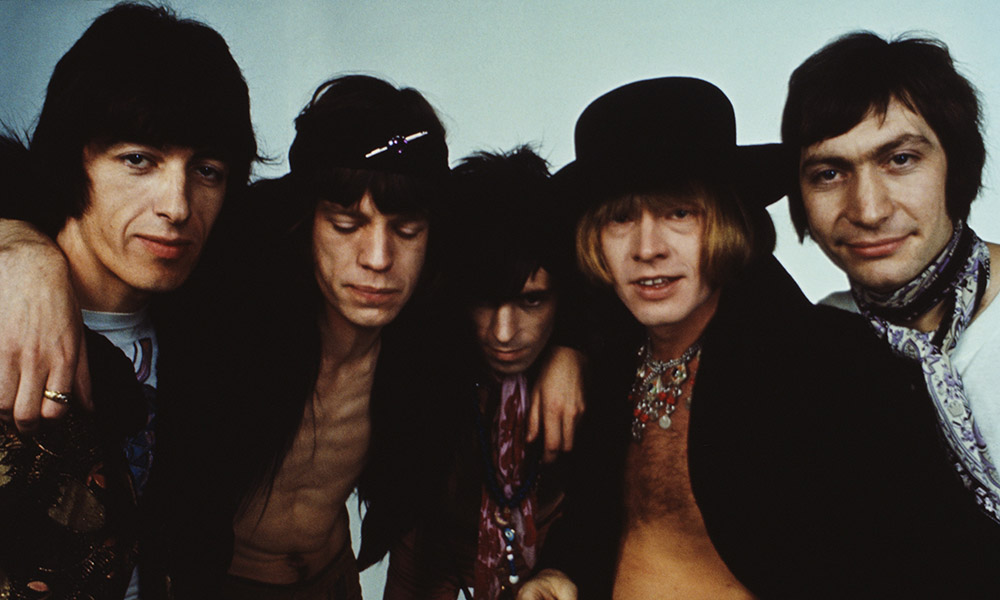
Brian Jones was on the album and made one of his last contributions with slide on this song. The following year Brian would die in a swimming pool at his home.
This is one of the great Stones album tracks.
Mick Jagger: “That’s Brian playing steel guitar. We were sitting around in a circle on the floor, singing and playing, recording with open mikes. That was the last time I remember Brian really being totally involved in something that was really worth doing. He was there with everyone else. It’s funny how you remember – but that was the last moment I remember him doing that, because he had just lost interest in everything.”
From Songfacts
When Rolling Stones founder Brian Jones died in 1969, this song took on new meaning, as lyrics like “Our love is like our music, it’s here and then it’s gone” made it a fitting elegy. Jones’ slide guitar on the song was one of his last meaningful contributions to the group; after years of drug addiction and squabbles with the band, he was fired from the group in June 1969 and died less than a month later.
The Stones performed this on Rock and Roll Circus, a British TV special The Stones taped in 1968, but never aired. Brian Jones played this with a passion he was clearly losing as drugs took over his life. Rock and Roll Circus was released on video in 1995.
Nicky Hopkins, who also played with The Who and The Beatles, played piano on this.
Lenny Kravitz opened several shows for The Rolling Stones in 1994, and was invited onstage to jam with them at a Cleveland show. Kravitz helped out Mick Jagger in 2001, co-writing, performing on, and producing his song “God Gave Me Everything.”
This song was featured in the 1978 ant-war film Coming Home, with Jane Fonda and John Voight
No Expectations
Take me to the station And put me on a train I’ve got no expectations To pass through here again
Once I was a rich man and Now I am so poor But never in my sweet short life Have I felt like this before
You heart is like a diamond You throw your pearls at swine And as I watch you leaving me You pack my peace of mind
Our love was like the water That splashes on a stone Our love is like our music It’s here, and then it’s gone
So take me to the airport And put me on a plane I’ve got no expectations To pass through here again
This song is for Song Lyric Sunday for Jim Adams’s blog. This week’s prompt…Days of the Week…Everyone have a good Sunday!
When I was 7 in 1974 I borrowed the Monkees debut album from my cousin. I listened to the album over and over. This song has been described by some critics of having a “proto-heavy metal guitar riff.” It does have a heavy riff and it is different than the other Monkees songs.
Being seven years old and listening to pop bands from my sister’s collection I thought this song was “hard rock” because it had a guitar with some distortion. The Monkees influenced a generation of young musicians. They made being in a band look fun and in the sixties many kids watched them and wanted to play music because of the Monkees. They don’t get the credit they deserve and are snubbed by Jann Wenner and the Rock and Roll Hall of fame.
At first they didn’t play their instruments but by the third album they all played plus Michael Nesmith wrote songs for many of their albums. Peter Tork and Nesmith were musicians to begin with and good ones…Micky Dolenz and Davy Jones soon learned their parts and contributed. Dolenz and Tork also wrote.
What is not mentioned is a lot of bands didn’t play their instruments on their first albums like the Mama’s and Papas and the Byrds. Many bands had studio musicians to help them out.
Ok…I’ll get off of my soapbox now. This song was written by David Gates (who wrote and sang in Bread). Saturday’s Child was not released as a single but it was a good album track released in 1966. The Monkees debut album The Monkees peaked at #1 in the Billboard 100, UK, and Canada.
Saturday’s Child
Monday had a sad child Always feeling low down, Tuesday had a dream child She’s always on the go So I’m in love with Saturday’s child
Every time you take her out at night (She drives me wild) You want to kiss and hold her way up tight (Gonna spend my time) You can tell the future’s looking bright (Making sure that Saturday’s child is mine)
If you love a Wednesday You live your life apart now And if you love a Thursday She’s gonna break your heart, So I’m in love with Saturday’s Child
Every time you hold her close you’ll see (She drives me wild) You can feel the thrill that’s gonna be (Gonna spend my time) Now the future has a guarantee (Making sure that Saturday’s child is mine)
Seven days of the week made to choose from But only one is right for me I know that Saturday’s got what it takes, babe. I can tell by the way she looks at me.
Friday likes the good life She’ll take you for a ride now And Sunday makes a good wife She wants to be your bride So I’m in love with Saturday’s child










 wrote the original lyrics of his most famous song, The Times They Are A-Changin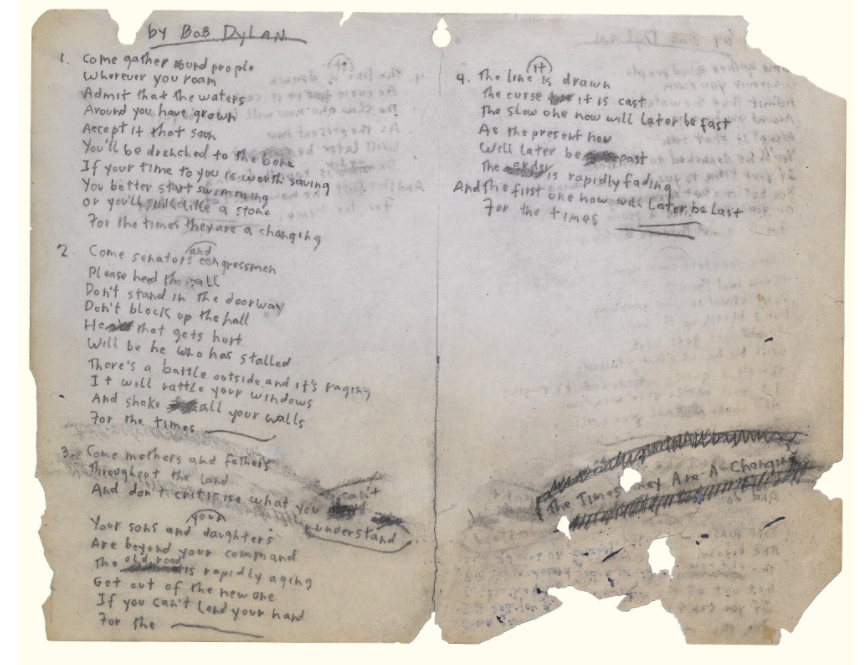




 PowerPop... An Eclectic Collection of Pop Culture