TV Draft Round 9 – Pick 2 – Max Selects – Saturday Night Live

I wanted to do a more modern show other than Life On Mars…and this would qualify as it…kinda. It has been on the air since 1975… a whopping 47 years. It’s been on life support at times but has always pulled through. It’s an institution at this point. There is not enough room on a post to go over every cast. Everyone has their favorites some were extremely funny and some were extremely bad (1980 – 1981 cast) and they all make up the history of this show. 

I’m going to concentrate on the original cast and how the show became SNL. Most of you have favorite different casts…usually, the one you grew up with. 

Even if you don’t like this show or what it’s become…it was a cultural landmark and no one can deny that. It changed television forever. The show started because Johnny Carson wanted more time off. NBC had been airing reruns of Johnny Carson’s Tonight Show on the weekends to fill space in their lineup. This allowed them to double-dip on profits from Carson’s outrageously popular show without spending another dime on production costs. He told NBC he would only be making four shows a week, which meant that best-of Carson shows that had been airing on Saturday nights would now need to be moved to a weeknight.

 NBC executive Herbert Schlosser sought to create a new show with an old format…a variety show to fill the slot on Saturday Night. He picked Lorne Michaels, a Canadian writer who only had a handful of credits to be the producer. Michaels started a show that was far different than Schlosser imagined but to his credit… Schlosser was behind it and pushed for it to be on the air. The first two shows were experiments but by the third show, they found the format they would keep to this day. The funny thing is…Johnny Carson never liked the show. 

Lorne Michaels made the show to appeal to baby boomers with a touch of Avant-Garde and “guerrilla-style comedy.” It was a game-changer much like All In The Family was to sitcoms. Late-night was never again a wasteland. This show helped open the doors for David Letterman and other shows to follow it. 

It started out as “Saturday Night.” The Saturday Night Live title belonged to ABC for a show hosted by Howard Cosell who was out of his league. After Cosell’s show was cancelled, ABC let Saturday Night have the “Live” part.

Who was the best cast through the years? This is a question that is debated over and over again. People argue and usually pick the cast they grew up with. I grew up in the Eddie Murphy and Joe Piscopo era. Personally, I always thought the original cast was the best era of the show. Yes, I thought the Murphy and Piscopo casts were very funny along with later casts that had Dana Carvey, Michael Myers, Chris Farley, Chris Rock, and many others that followed. The first five seasons had something extra that others would not and could not have. It had an underground feel that vanished after it became a pure comedy show. They had a massive amount of talent in that first class. 

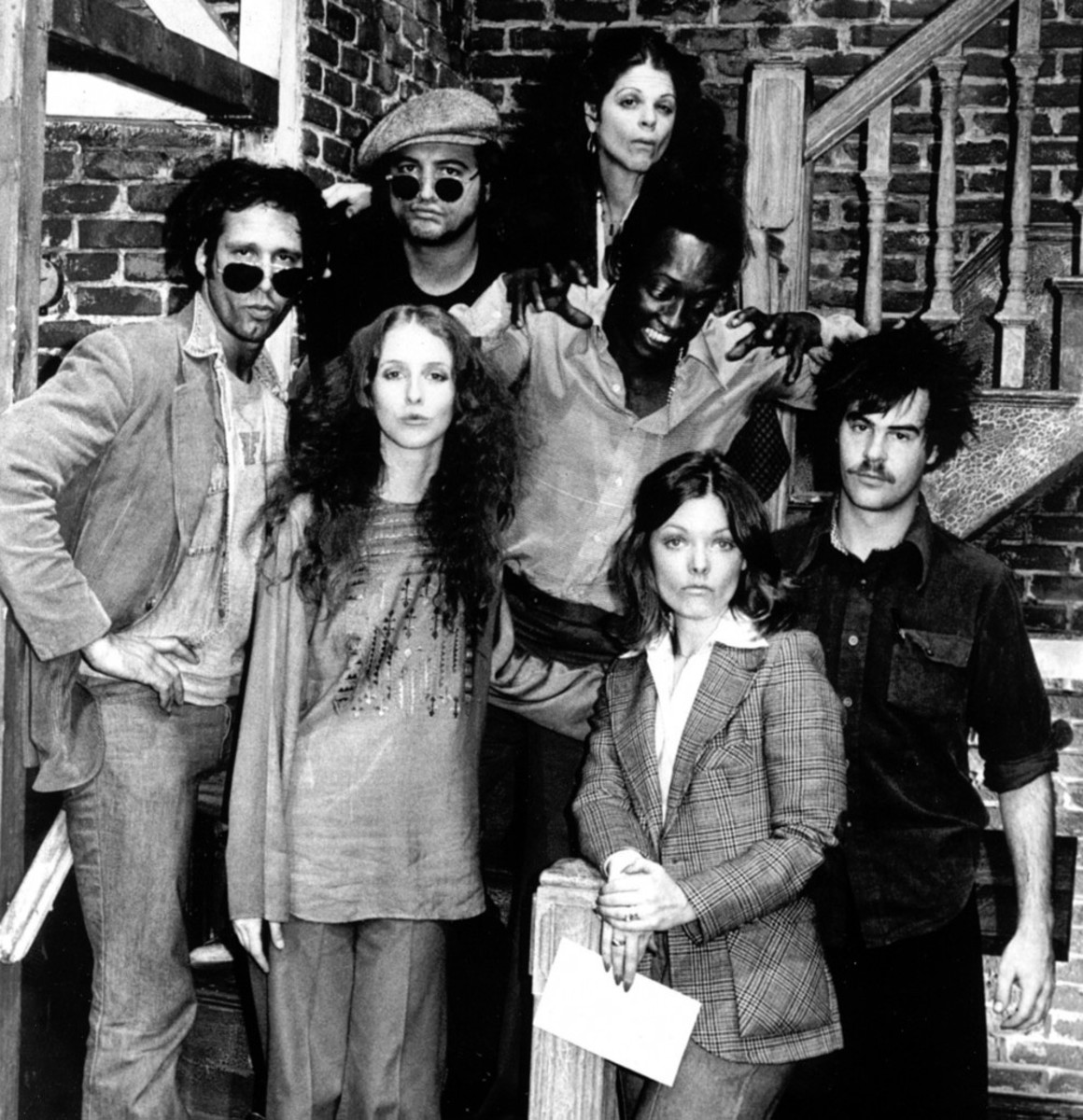
John Belushi, Dan Ackroyd, Chevy Chase (though I liked his replacement better…Bill Murray), Gilda Radner, Jane Curtin, Garrett Morris, and my favorite overlooked cast member Laraine Newman. They were the perfect cast for that time. 

Why do I like the original cast the most? They tried new things and went out on a limb. Some of the skits succeeded some fell flat but they were different from anything on TV at that time…and also at this time. That cast pushed the envelope and made the network executives worry. The host each week was usually under the radar actors, writers, comedians musicians, and sometimes athletes. The musical guests were mostly rarely seen performers that weren’t on tv…prime time or otherwise. Frank Zappa, Leon Redbone, The Kinks, Patti Smith, Ry Cooder, Kinky Friedman, and others. You would have more popular musicians like Paul Simon but the show gave you a great variety. 

No way would Michaels ever dream of that now…he usually gets whoever is the most popular to draw in ratings. He can no longer do what he did in the 70s because of that. He also used the complete ensemble. It was not Eddie Murphy, Joe Piscopo, and everyone else of the early eighties. It was about building an unknown cast and all of them having a shot…not a star-driven show that gave all the best bits to the big names. He made sure the entire cast had a lead in skits and parody commercials. Dick Ebersol who followed Lorne Micheals, was famous for getting stars in the cast and the show revolving around them.

A lot of the skits are now famous… Ackroyd’s Bassomatic, the Samurai, the uncomfortable but funny Word Association with Richard Pryor, The Killer Bees, The Mr. Bill Show, Weekend Update, Roseanne Rosannadanna, Land Shark, Bag of Glass, The Wild and Crazy Guys, the Coneheads, The Lounge Singer, Mr. Mike, The Blues Brothers and many more.

The writers for the show were not in the variety show comedy vein..they were not in the current SNL vein either. The style was more aggressive, especially with Michael O’Donoghue. He was a comedy trailblazer with National Lampoon and added black humor to SNL. Other writers were Franken and Davis, Rosie Shuster, Alan Zweibel, Marilyn Miller, Anne Beatts, Herb Sargent, Tom Schiller, and also Ackroyd and Chase.

The original group also did some serious skits along with comedy and trips into the bizarre (See the ultra-dark “Mr. Mike”). …It separated the original from any other cast.

I like the feel of the underground the first five years had but you can only be that for so long…popularity takes over. Those first 5 years (the first four were great…the fifth very good) set the foundation that holds to this day…just without the daring and danger.

Ann Beatts was one of the original writers who saw the popularity of the show rise beyond anything she ever imagined. She knew the risk-taking traits in the show would have to end because of it. “You can only be avant-garde for so long until you become garde.”

By the 5th season (1979-1980), it was a circus grown out of proportion. The cast by that time were usually bigger stars than the guest hosts.  Everyone left after that season along with Lorne Michaels. The show went on without him until 1985 when he rejoined. It was never the same again. Sometimes it was funny and sometimes not but it was never the same experimental show it was at the start. 

What other show would introduce “Acapulco Gold” and “Orange Sunshine” to a national television audience?
SNL2.jpg

The Bassomatic…something you cannot explain with words.

The best Star Trek parody…
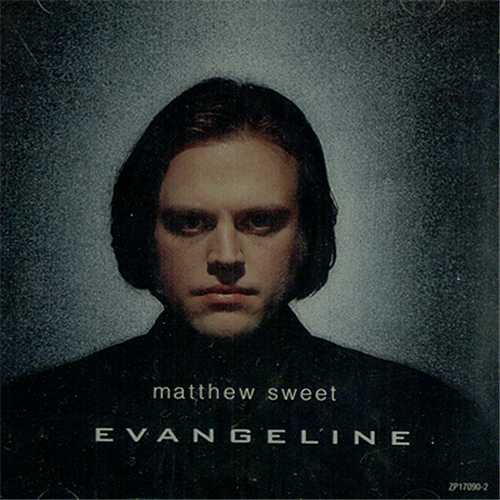
Matthew Sweet – Evangeline ….Power Pop Friday

When I heard the song”Girlfriend” for the first time on the radio I liked it right away. Matthew Sweet is a great contemporary power pop artist that doesn’t get played enough.

The album peaked at #100 on the Billboard Album Charts in 1991. The album was ranked number 61 on Paste magazine’s list of “The 90 Best Albums of the 1990s.”

He was a huge fan of R.E.M in high school and began a pen-pal correspondence with Michael Stipe that brought him to Athens, GA. He ended up meeting Stipe’s sister Lisa through that relationship. Both Sweet and Lisa were students at the University of Georgia and he formed his first band with her. Sweet and Lisa eventually married after he was divorced from his first wife.

Sweet is also known for his Under the Covers series, done in collaboration with Susanna Hoffs, lead singer of Bangles. The series features the pair covering classic songs. The first Under the Covers focuses on music from the ’60s, while the second draws from the ’70s. They also made a third entry which was comprised of ’80s music.

Evangeline is not your average boy-girl song. It’s about a girl, but not a real one. The song is set in the realm of the comic book series Evangeline, which was published from 1987 to 1989. The comic is set in the 23rd century after humans colonized space. The character Evangeline is a weapon-wielding nun out to avenge those who have been victims of religious persecution on behalf of the Vatican.

Evangeline

She’s on another planet
She’s in my dream
She’s some kind of angel
If you know what I mean
Try her on
She fits like a glove
Too bad she only thinks about
The lord above

Evangeline Evangeline
I think I love you
But Evangeline Evangeline
I want you

Now if I called you up
Do you think you
Could deliver my soul?
Won’t you take a drink
Little darlin’
The cup is full

And every night I bow to pray
But I’ll feel a whole lot better
Once you’re coming my way

Evangeline Evangeline
I think I love you
But Evangeline Evangeline
I want you

So come on down

So tell me how you want it
Come on, tell me how you want it
Just tell me how you want it

Just tell me how you want it
We won’t be seen
You can tell your father
It was all a dream
[try her on she fits like a glove]
Too bad the only man you trust
Is god above

Evangeline Evangeline
I think I love you
But Evangeline Evangeline
I want you

Now Evangeline Evangeline
I think I love you
But Evangeline Evangeline
I want you

She’s some kind of angel
If you know what I mean
Evangeline

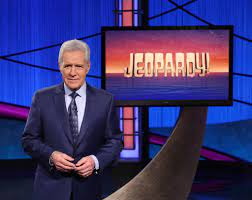
TV Draft Round 9 – Pick 1 – Dave Selects – Jeopardy

Welcome to the Hanspostcard TV Draft. I hope you will enjoy it! Today’s post was written by Dave at https://soundday.wordpress.com/

Today I’ll take “Great TV Shows” for $400. As you might have guessed the answer, and my next show to cover for this event, is Jeopardy!

Jeopardy! is a show so familiar it seems to hardly need any description. After all, it’s been around longer than many of its contestants, and longer than I (or many of the other columnists taking part here) have been. It’s been parodied on Saturday Night Live, sung about jokingly by Weird Al Yankovic and plays a part in the plot of Groundhog Day. Few and far between are those of us who’ve not at least seen part of an episode in passing somewhere along the line. Such an iconic part of the culture it’s become that even the opening theme with booming introduction – “this is JEOPARDY!” – is instantly identifiable by most. But that aside, let’s look at the show a little anyway.

Jeopardy! Is a long-running game show, in which three contestants play against each other trying to answer questions correctly to win. Or actually, answer “answers”…we’ll get to that. How long-running? It premiered in 1964, and has been running most of the time since, although in slightly different formats and shown on different providers. The current version has been running daily since 1984. Merv Griffin created it and also created the similarly-popular Wheel of Fortune which not coincidentally often runs right before or after Jeopardy! in many markets. Although he’s credited with creating it, and his name appears on the credits day after day, he credits his wife with being the one who had the basic idea.

Back around the end of 1963, he and his wife were sitting around, talking about his desire to create a game show for TV. She commented that quiz shows were popular and quite good, but there hadn’t been any since the 1958 “Game Show Scandal”, in which it was found certain contestants on the shows Dotto and Twenty-one had been given the answers so the producers could control who would win and come back, based on who they felt would be most popular with their viewers rather than their skill or even luck. The game idea was still good, but the concept had been tarnished. They wagered almost six years was enough time passed to give it another go. She then suggested the twist – why not give answers and have contestants guess the question. Merv recalled “she fired a couple of answers at me – ‘5280’ – and the question of course would be ‘how many feet in one mile?’” He liked it and quickly took the idea to NBC, who bought it sight unseen.

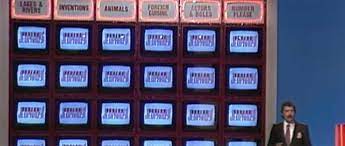
jeopardy early board

NBC ran it, filming in New York, weekdays from 1964 through ’75, and added a nighttime weekly version which they syndicated in 1974. All the time, Art Fleming was the host who introduced the contestants and asked the, err “answers.” It had finally run its course by summer ’75, but they resurrected it again for the ’78-79 season, again with Fleming at the helm in the Big Apple. That lasted just one season, but it didn’t stay gone too long. In 1984, a new version began, running daily (five days a week), still produced by Griffin’s company, but this time shot in L.A. and sold for syndication. It wasn’t exclusive to one network, but most local stations in the U.S. had an hour of free time to program what they wanted between the evening news and “primetime shows”, so in the vast majority of cities, (as well as in Canada), one station or another ran Jeopardy!  The basic show was still the same, but this time there was a new host – big-haired, moustached Alex Trebek, a Canadian with limited experience as a game show host but a personality that fit.

In case you’ve not seen it, the game is broken into three parts, “Jeopardy”, “Double Jeopardy” and “Final Jeopardy.” The first two take up most of the show, and consist of contestants picking mystery questions (or “answers”) from a board, which is made up of a grid of 30 boxes. There are six categories, and five question/answers in each. Each one is worth a certain value, in the first round being $200, 400, 600, 800 and 1000 and in “double Jeopardy” , you guessed it, double that amount. (If you didn’t guess it, you might not quite be Jeopardy! material.) Players who buzzed in first and gave the correct response for each won that amount of money…but if they were wrong, the amount was subtracted from their score. So it paid to be quick on the buzzer…and sure of your knowledge of the category. “Final Jeopardy” consisted of one answer all three would be given and had to answer (with the question) in 30 seconds. They could wager any or all of the amount of money they’d accrued so far in the game, and like the earlier bits, they’d win it if they were right, but lose it if wrong. Put together a run of correct answers and a bit of moxie in “Final Jeopardy” and you can do very well – James Holzhauer won a record $131127 in a 2019 episode. The game winner went home with that money, and got invited back to play the next day, whereas the second and third place finishers got a small consolation prize – typically $1000 and $2000 , which some bitterly noted didn’t pay their costs to actually go to L.A. and pay for a hotel … the show doesn’t pay expenses.

The game demands quick reflexes and a good, wide-ranging knowledge of…well, the more the better. While Art Fleming has criticized the “new” version (new as in the past 38 years), for being “dumbed down” by Hollywood, and it is true there are often some questions about pop culture, there are also still more about things like ancient history or American geography. Esquire tabulated many years of shows and found the most frequently-used categories were “Before and After”, “Literature”, “Science” , “Word Origins” and “American History” while the most-used ones for Final Jeopardy are “American Presidents” and “Word Origins.”  Readers Digest compiled the ten that seemed to be hardest for contestants, and they included “Classical Music”,and “Canadian Cities” (sample : “Residents of this Saskatchewan city are called ‘Moose Javians’” , for question “What is Moose Jaw?”) . But it wasn’t only Canadian geography the mostly-American contestants had trouble with; so too did their own American because “States that Flow Together” also made the difficult list. That one had two states, with the last letter of one being the first of the next. Somehow no one could figure out “MissourI and Illinois” for the clue “one has St. Louis, the other has East St. Louis!”  Of course, sometimes they like to have a little fun too, and at times the categories seem a little loopy – “Superb Owl” (all about owls on , yes Super Bowl week); “Songs for Your Cat,” “Hertz so Good” (about electricity)…

The show seems to hit the sweet spot between being so esoteric it requires a phD and so simple or celebrity-based anyone who watches Entertainment Tonight could run the board. Similarly, Alex Trebek hit the perfect spot as the host (for over 8000 episodes from ’84 until his death late in 2020; the final one he made aired in January ’21; until the final days of his illness he missed just one show…an April 1 edition where he traded places with Wheel of Fortune‘s Pat Sajak as an April Fool’s joke); warm and fatherly enough, with just enough self-deprecating humor to balance his occasional raised eyebrow and seeming hint of condescension when dealing with less-than-swift contestants. He won seven Emmys for it and became a household name and beloved celebrity; so much so that just who was going to replace him became headline news for months.  So far, the answer appears to be Ken Jennings, who along with Big Bang Theory-alum Mayim Bialik have hosted the vast majority of post-Trebek shows. Jennings is an obvious choice, himself being the most famous, and by some accouts, most successful contestant ever on Jeopardy! Jennings won 74-straight shows in 2004, winning over $2.5 million and later won $1 million more on a “Greatest of All Time” tournament between past big winners. (From time to time, they have special tournaments, like ones for college students and “Celebrity Jeopardy!” where stars – mainly actors, but some athletes, writers, even politicians – try to win money for charity. Takeaway from those – no wonder Stephen King can cram so many details into his novels. The man seems to know everything!)  Jennings turned his run on Jeopardy! Into several books, online and magazine columns and a rare level of celebrity based on…just being pretty darn smart!

The hype, for lack of a better word, surrounding Trebek’s unfortunate demise (losing a long battle to cancer) and picking his replacement has only helped Jeopardy! Its ratings have risen of late, with some of Trebek’s final episodes being watched by over 14 million at time or airing and many more later on streaming services; Entertainment Weekly reported this year that it currently is the most-watched “regular” TV show based on viewers watching it live…an amazing feat for a game show which through syndication doesn’t even necessarily play in every market. Maybe it’s Trebek and Ken Jennings, or maybe I hold out hope, it’s something different. At a time when everything seems to be being dumbed down from our news to our movies to our elected officials, maybe some of us are appreciating a show where it actually pays to be smart… to know a little about the Nile River or European history or great American literature.

Jeopardy! is a show I’ve enjoyed now and then since I was a kid and Trebek was young and had a huge Afro. As I got older and Trebek’s facial hair shrank, I actually found myself watching more, playing along. It was also one of the few shows my parents were both fond of too; my Mom sometimes would phone me up and ask in exasperation “did you see Final Jeopardy? How did they not know Dickens was the answer!!” or the like; when I spent about half a year living with my Dad as he got on in years, it became nearly a nightly routine for us to go down to the basement after dinner and watch Jeopardy!, trying to shout out the answers fastest. He never did well if it was about Lady Gaga or baseball, but he could rock the history and current events categories. Needless to say, I miss both my parents, and also Alex Trebek but I’m pretty glad I can still try to fit  a bit of Jeopardy! in to the routine still and learn a little something with it. Memorable contestants, every topic under the sun, learning while playing… what is “great game show” Merv?

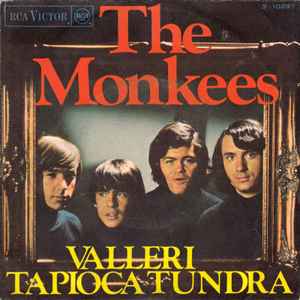
Monkees – Valleri

I remember this one off of their show. I like the vocals in the chorus with this one.

Valleri has an interesting history. This song was brought aboard at the very beginning of the Monkees…but it ended up being their last top ten hit. It was recorded with studio musicians at first and placed in a show but…not on an album because it was being saved for the second one. By the time the thought of using it came around…the Monkees had a new contract and per the contract… they had to play on and produce their album so this version of Valleri couldn’t be used.

When it was played in the show… the public wanted a record of it but now the Monkees would have to record it themselves because of the uprising they did to demand to play on their own records.

A couple of disc jockeys recorded the song off of the show and began to play it. They were playing this taped TV version on their radio shows, something that would happen many years later with the Friends theme. Listeners to the stations airing the rough mix of “Valleri” started writing the Monkees’ distributor Colgems Records, asking where they could buy a copy of the record that they had just heard.

Valleri was re-recorded and produced by the Monkees and Tommy Boyce and Bobby Hart the songwriters. It was released as a single in March 1968, 13 months after it was first performed on the TV show. Soon after the release, the Monkee’s TV show was canceled and they released their movie and LP Head. Peter Tork left the group in December 1968.

Valleri peaked at #3 in the Billboard 100, #1 in Canada, #4 in New Zealand, and #12 in the UK in 1968. The album The Birds, The Bees & The Monkees peaked at #3 on the Billboard Album Charts and #6 in Canada.

Valleri

Valleri I love my Valleri
There’s a girl I know who makes me feel so good
And I wouldn’t live without her, even if I could
They call her Valleri
I love my Valleri

Oh yeah, come on

She’s the same little girl who used to hang around my door
But she sure looks different than the way she looked before
I call her Valleri
I love my Valleri

Valleri I love my Valleri
I love my Valleri
I need ya, Valleri

….

So Many Roads: The Life and Times of the Grateful Dead …. by David Browne

I’ve read a few books about the Dead but this one is probably the best I’ve read. I just finished re-reading it after finishing it three years ago. It is their complete history from beginning to end. The book I enjoyed the most was Deal: by Bill Kreutzmann The Deads drummer. He has some great stories and Steve Parish’s book is good also…but as far as the history…this has been the best.

This is not like reading a book about the Beatles, Stones, Dylan, or even the Allman Brothers. The Grateful Dead were totally different in the way they came about and what path they took. They were such a hippy band but along the way they turned into a corporate organization…a different kind of organization but one all the same. Their crew was known to be loud and sometimes violent along with the Hells Angels by the mid-seventies and the craziness wore off on everyone around them.

I always thought of them as this loose ensemble that just loved playing. Yes, they loved playing but they weren’t above pointing fingers when something went wrong on stage. At one point Weir and Pigpen were “fired” although accounts differ on if they really were let go. In other words, they were human… like anyone else. They did however think differently and for a bunch of hippies…they were very ambitious.

Speaking of Pigpen (Ron McKernan)… that was a wonderful thing about this book…his importance is highlighted and you see how important he was to the Grateful Dead. Jerry wasn’t the key focus when they started…it was Pigpen. Although he looked like a biker…he was described as an incredibly nice and sensitive man. He was the showman of the band and Jerry commented that he was the best musician in the band in the beginning.

The book covers their entire career and along with the way, there are many twists and turns. They cover Garcia’s slide down until his diabetic coma in 1986 when he had to re-learn how to play guitar again. Less than a year later they were back on the road and then recorded the In The Dark album.

The band never had a big hit single and now…over 20 years of being together and touring they were suddenly huge with the song Touch Of Grey. They even agreed to play the game with the record company and they made a video. They were signed to Arista Records and the record company and band were at a meeting. Garcia suddenly asked, “I don’t have to do Dick Clark, do I?” With that, the executives laughed at the thought of the Grateful Dead appearing on American Bandstand.

There were points where it looked like Garcia would beat his addictions but the threat of him going back to heroin was always there. They also cover all the members rather well…Garcia wasn’t the only one with drug problems but his problem probably affected the band the most.

If you want to learn about their history…this is a really good read.

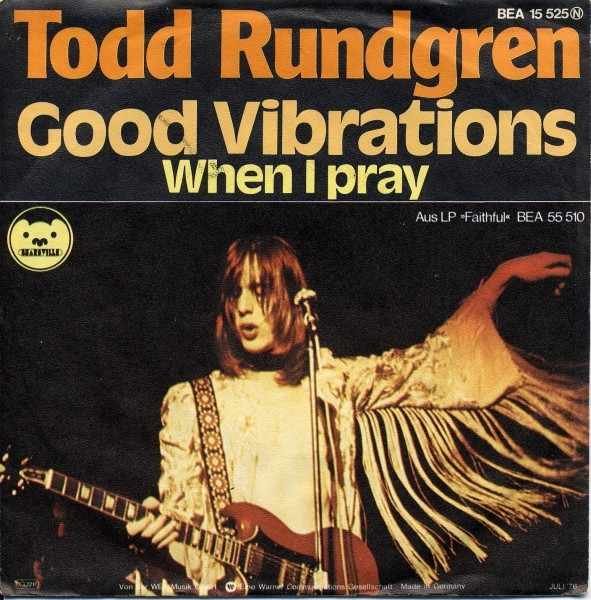
Todd Rundgren – Good Vibrations

Some songs you don’t expect to hear a cover of…this is one of them.

I bought this single in 1976 in a local record store we had in our small town called Sounds and Scenes (long gone but I love the name). I liked the song Good Vibrations and didn’t know at the time who did the original version. I was only 9 years old and thought I had the real thing. 

He made an album called Faithful, full of covers and he performed them to the letter. I’ve listened to the album and they are close but this one is really on it. He did Rain, Strawberry Fields, If Six Was Nine, and Bob Dylan’s Most Likely You Go Your Way And I’ll Go Mine.

Todd’s version of the song peaked at #34 in the Billboard 100 and #28 in Canada in 1976. The album Faithful peaked at #54 in the Billboard Album Charts.

Todd Rundgren is very talented and I’m a fan of him. He did a fantastic duplicate version of this song. My question now is why? He got so close…you have to wonder why he did it in the first place. But…who am I to question Todd Rundgren?

I usually don’t like when an artist covers a song and changes it so much you cannot tell what the song is… not a problem with this one. Todd does exactly what he says in the album name… he was very faithful to these songs.

Later on, Todd was asked what he gained after doing this album of covers. 

Todd Rundgren: Well, you gain an education. I haven’t done so many of those lately. In fact, I can’t recall anything since, for instance, The Ever Popular Tortured Artist Effect or a Small Faces song. Everything since then has been originals. In that particular instance, on Faithful, that was like 10 years after I had gotten into the music business and I was trying to give people who either had never experienced it or had forgotten it, a taste of what it was like to move through the culture at that time. What was on the radio, what they were playing in the boutiques or in the record stores, the kind of songs you would hear. So I took a cross-section of mostly songs that were popular in 1966 and did them as dead-on as I could. People were supposed to pretend that they were listening to ’66 radio or going from store to store in a hip neighborhood in 1966 and hearing what people were listening to then.

Good Vibrations

I love the colorful clothes she wears
And the way the sunlight plays upon her hair
I hear the sound of a gentle word
On the wind that lifts her perfume through the air

I’m picking up good vibrations
She’s giving me excitations
Good bop bop, good vibrations
Bop bop, excitations
Good, good, good, good vibrations

Close my eyes, she is somehow closer now
Softly smile, I know she must be kind
When I look in her eyes
She comes with me to a blossom world
I don’t know where but she sends me there

Oh my my my, what a sensation

Oh my my, what elation

Got to keep those loving good vibrations
Happening with her

Rolling Stones – As Tears Go By

The Stones were covering old blues songs at the start of their career. They needed a hit and one day they ran into two songwriters in 1963. Right in front of the Stones…John Lennon and Paul McCartney wrote a song that was in the Stone’s style. It was called “I Wanna Be Your Man” and became The Stones’ first UK top twenty record. Mick Jagger and Keith Richards were amazed at this display of songwriting prowess, which stuck with them.

The two bands stayed friends after that often coordinating releases so as not to release in the same week. Mick and Keith realized that if they were going to have staying power…they must start writing. Their manager Andrew Oldham locked them in a kitchen and told them they were not getting out until they wrote a song…obviously, it worked.

This was one of the first songs written by Mick Jagger and Keith Richards. The Stones manager gave it to a singer he also managed named Marianne Faithfull, who released it in 1964. It was going to be the B-side of her first single, but the record company decided to make it the A-side and it became her first hit. The Stones recorded it a year later. In 1966 Faithfull became Jagger’s girlfriend and that would last 3-4 years.

The original title was As Time Goes By but they changed it so it wouldn’t be confused with a song with the same title in Casablanca. The song peaked at #1 in Canada and  #6 on the Billboard 100 in 1966. Marianne’s version peaked at #22 in Canada and #9 on the Billboard 100, and #9 in the UK in 1964.

This was released as a single in the US and Canada because ballads were popular there at the time. The release in England was delayed 6 months because they did not want to compete with Yesterday by The Beatles. When they finally did release it there, it was as the B-side of 19th Nervous Breakdown.

Marianne would record this three times. The original version in 1964, for 1987’s Strange Weather, and again on 2018’s Negative Capability.

Keith Richards“suddenly, ‘Oh, we’re songwriters,’ with the most totally anti-Stones sort of song you could think of at the time, while we’re trying to make a good version of (Muddy Waters’) ‘Still A Fool.’ When you start writing, it doesn’t matter where the first one comes from. You’ve got to start somewhere, right? So Andrew locked Mick and myself into a kitchen in this horrible little apartment we had. He said, ‘You ain’t comin’ out,’ and there was no way out. We were in the kitchen with some food and a couple of guitars, but we couldn’t get to the john, so we had to come out with a song. In his own little way, that’s where Andrew made his great contribution to the Stones. That was such a flatulent idea, a fart of an idea, that suddenly you’re gonna lock two guys in a room, and they’re going to become songwriters. Forget about it. And it worked. In that little kitchen Mick and I got hung up about writing songs, and it still took us another six months before we had another hit with Gene Pitney, ‘That Girl Belongs To Yesterday.’ We were writing these terrible Pop songs that were becoming Top-10 hits. I thought, ‘What are we doing here playing the f–king blues, and writing these horrible Pop songs and getting very successful?’ They had nothing to do with us, except we wrote ’em. And it took us a while to come up with ‘The Last Time.’ That was the first one we came up with where Mick and I said, ‘This is one we can lay on the guys.’ At the time we were already borrowing songs from the Beatles – ‘I Wanna Be Your Man’ – because we were really hard up for singles. So they gave us a hand. In retrospect, during the ’60s the Stones and the Beatles were almost the same band, because we were the only ones in that position.”

Mick Jagger: “I wrote the lyrics, and Keith wrote the melody. It’s a very melancholy song for a 21-year-old to write: The evening of the day, watching children play – it’s very dumb and naive, but it’s got a very sad sort of thing about it, almost like an older person might write. You know, it’s like a metaphor for being old: You’re watching children playing and realizing you’re not a child. It’s a relatively mature song considering the rest of the output at the time. And we didn’t think of doing it, because the Rolling Stones were a butch Blues group. But Marianne Faithfull’s version was already a big, proven hit song… It was one of the first things I ever wrote.” 

Marianne Faithfull: “a marketable portrait of me… a commercial fantasy that pushes the right buttons.”

As Tears Go By

It is the evening of the day
I sit and watch the children play
Smiling faces I can see
But not for me
I sit and watch
As tears go by

My riches can’t buy everything
I want to hear the children sing
All I hear is the sound
Of rain falling on the ground
I sit and watch
As tears go by

It is the evening of the day
I sit and watch the children play
Doing things I used to do
They think are new
I sit and watch
As tears go by

Beatles – You Can’t Do That

I love B-sides and this is a good one. I liked You Can’t Do That much better than the A-side Can’t Buy Me Love.

John Lennon never liked his voice. He always wanted George Martin to add echo or anything else to cover it up. I never understood that…for me John was one of the best rock and roll singers out there. His thin nasal voice cut through the music and cuts into you.

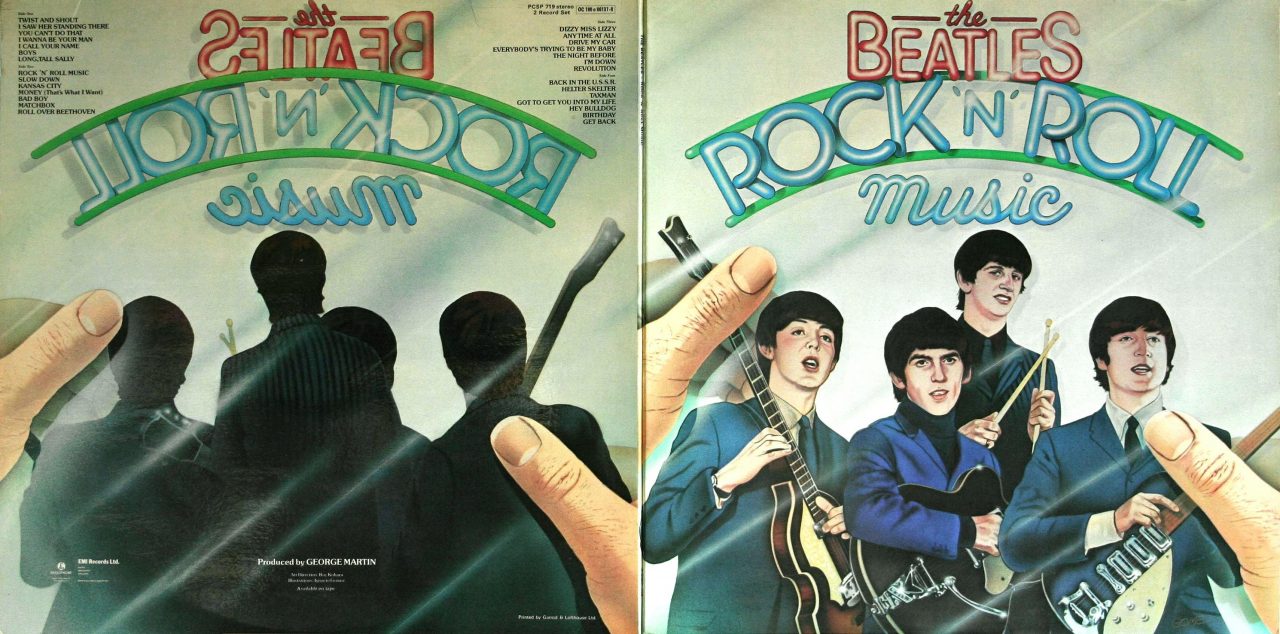
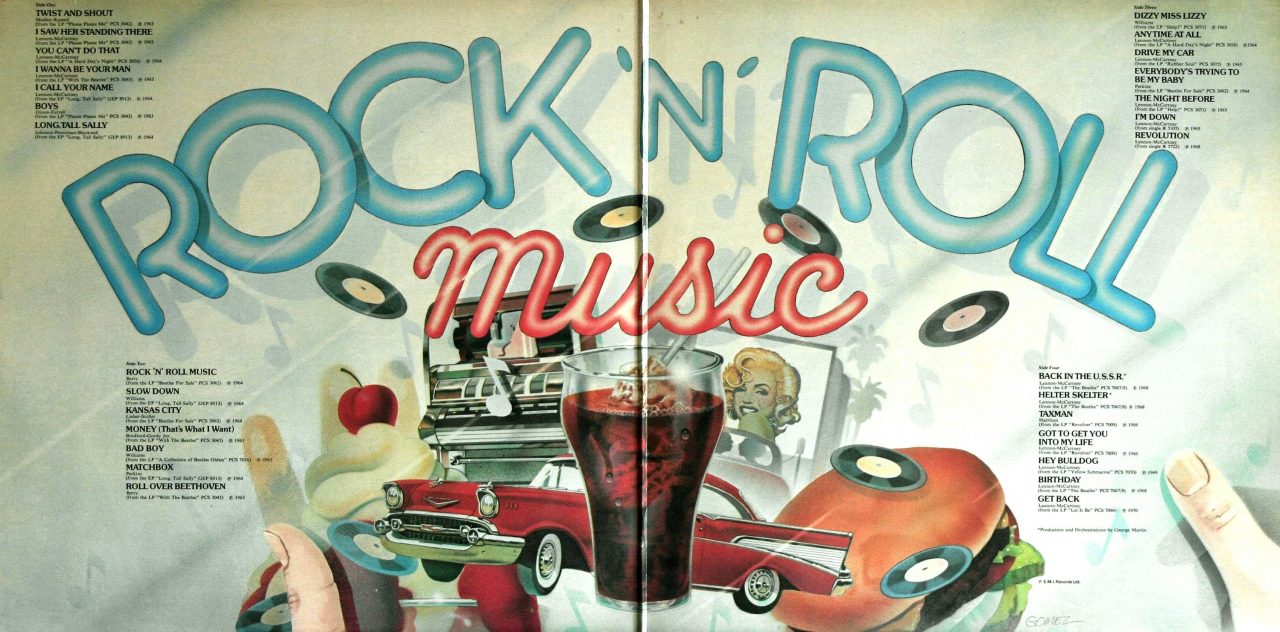
I first heard this song on a 1976 compilation album Rock and Roll Music. That was my second ever Beatles album. Capital put together one of the worse covers ever for that album.

Beatles Rock and Roll Music front and backBeatles Rock and Roll Music Gatefold

The cover made the Beatles look like they were from the 50s. A very few of the songs on the album were covers of 50s songs. Ringo Starr said: “It made us look cheap and we never were cheap. All that Coca-Cola and cars with big fins was the Fifties!” John Lennon told Capitol that the cover looked like a Monkees reject. He offered to design the cover but was declined. That doesn’t mean the album didn’t contain great music…a double album full of some great songs.

You Can’t Do That helped popularized the two-measure guitar riff…. a guitar riff that opens a song and continues through it. It laid the foundation for modern rock… with artists such as The Stones to Nirvana. The Beatles would use this frequently in songs such as I Feel Fine, Ticket To Ride, Day Tripper, If I Needed Someone, Paperback Writer and I Want To Tell You. The Stones made a career of it.

The song originally appeared on the UK soundtrack of A Hard Days Night. They recorded this in nine takes on George Harrison’s 21st birthday (February 25, 1964). The song was the B side to Can’t Buy Me Love but managed to peak at #48 in the Billboard 100 and #33 in Canada in 1964. Harry Nilsson covered it in 1967 and that version peaked at #10 in Canada.

This was the first Beatles song on which George Harrison played a 12-string guitar… John played the lead. Lennon said that Wilson Pickett was an influence on this song.

You Can’t Do That

I got something to say that might ’cause you pain
If I catch you talking to that boy again
I’m gonna let you down
And leave you flat
Because I told you before, oh
You can’t do that

Well, it’s the second time I’ve caught you talking to him
Do I have to tell you one more time, I think it’s a sin
I think I’ll let you down (let you down)
And leave you flat
(Gonna let you down and leave you flat)
Because I’ve told you before, oh
You can’t do that

Everybody’s green
‘Cause I’m the one, who won your love
But if they’d seen
You’re talking that way they’d laugh in my face

So please listen to me, if you wanna stay mine
I can’t help my feelings, I’ll go out of my mind
I’m gonna let you down (let you down)
And leave you flat
(Gonna let you down and leave you flat)
Because I’ve told you before, oh, you can’t do that

You can’t do that
You can’t do that
You can’t do that
You can’t do that
You can’t do that

Everybody’s green
‘Cause I’m the one who won your love
But if they’d seen
You’re talking that way they’d laugh in my face

So please listen to me, if you wanna stay mine
I can’t help my feelings, I’ll go out of my mind
I’m gonna let you down (let you down)
And leave you flat
(Gonna let you down and leave you flat)
Because I’ve told you before, oh
You can’t do that

TV Draft Round 8 – Pick 8 – Paula Selects – Curb Your Enthusiasm

Welcome to the Hanspostcard TV Draft. I hope you will enjoy it! Today’s post was written by Paula at http://paulalight.com

Curb Your Enth

Curb Your Enthusiasm

 Omgosh I love this show! Larry David, the co-creator of Seinfeld, created the Curb concept and launched the show post-Seinfeld in October 2000. He stars in every episode as a fictionalized version of himself ~ a wealthy entertainment professional living a posh life in Los Angeles who doesn’t quite get the hang of social interaction and focuses on what he considers insults while committing many missteps himself. I guess fictionalized Larry might be “on the spectrum,” though that isn’t discussed. Cheryl Hines stars as his wife/ex-wife and Jeff Garlin is hilarious as his manager. Susie Essman plays Jeff’s wife and imo she is the funniest character with the best lines. Also very funny is J.B. Smoove, a hurricane refugee whom Larry and Cheryl shelter; he ends up as a regular, living in Larry’s guest quarters. The episodes where Smoove tries to find a “Mary Ferguson” to take the place of a Mary Ferguson who ditched him and their travel plans are absolutely side-splitting.

But I’m jumping ahead ~ the MF eps are in S11 (the latest one). Yep, Curb goes up to 11, and Larry has confirmed that there will be a Season 12. I’m so excited! If you don’t watch this show, but are a Seinfeld fan, I highly recommend catching up. Curb is also about the minutiae of daily life and the small misunderstandings that can morph into big dramas and ruin relationships. The show was developed from a one-hour comedy show that Larry did in 1999, which was shot as a “mockumentary.” Curb continues that style, with Larry outlining each ep and then relying on the actors to provide funny improvisational dialog, which is called retroscripting (all info is from Wikipedia). The show has been a huge success ~ nominated for 47 Emmy Awards and winning the 2002 Golden Globe for Best TV Series (music/comedy).

One of my favorite eps is S3e9 when Larry and Cheryl are still married and she has her family over for the Christmas holidays. Larry is Jewish, and he has no idea that the cookies Cheryl and fam have baked are for a special manger scene they’re going to set up. He eats the baby Jesus and everyone is mad at him. Season 4 starts out with several great eps, including such fab guest stars as Mel Brooks and Ben Stiller. This Season features a theme of Larry getting one “free pass” from Cheryl to be unfaithful during their marriage and he wants to cash it in, resulting in several hilarious attempts. Cheryl and Larry renew their wedding vows during this season and have a big argument over whether to love each other until death (Larry’s preference) or for all eternity (Cheryl’s). In S6 and beyond, Cheryl and Larry split up for good, and we get to see Larry going on dates, getting served with a fatwa, opening a spite store, and being forced to cast a terrible actress in his new show when her burglar uncle drowns in Larry’s unfenced pool. Larry ends up trapped in a relationship with an unattractive city council member (Tracey Ullman) in hopes of revoking the law about fencing pools, and Smoove says Larry is putting “bad miles” on his penis.

Can’t wait for S12!

~*~

Paula Light is a poet, novelist, flash fiction fan, cupcake connoisseur, mom, grandma, cat mommy, etc. Her blog can be found at http://paulalight.com.

Sweet – Fox On The Run

The Sweet had the ability to sound like a different band on many of their hit singles. Little Willy, Ballroom Blitz, Love Is Like Oxygen, Blockbuster!, and Fox On The Run. My first introduction to this band was a bubblegum single that my sister bought called Little Willy.

There were two different versions of this song. The first one appeared on the European version of the 1974 RCA album Desolation Boulevard album.

The band was stuck with a perception of them being puppets of their songwriters Mike Chapman and Nicky Chin and producer Phil Wainman. They had to battle to play on their own singles at times.  Mike Chapman and Nicky Chin also were their managers. The Sweet were sometimes allowed to write their B sides but that was about it. After Desolation Boulevard was released, the band parted ways with Chapman and Chinn and produced their own material.

Their first effort was a reworking of “Fox On The Run,” which was originally produced by Chapman and Chinn but written by the band. The Sweet proved quite capable on their own, and the new version of Fox on the Run with a bright chorus became a global hit.

The re-worked Fox on the Run appeared on the American version of Desolation Boulevard. Capital Records released this version in America, Canada, and Japan. The album also contained Ballroom Blitz and peaked at #25 in the Billboard Album Charts and #5 in Canada.

The song peaked at #5 in the Billboard 100, #2 in the UK, and #2 in Canada in 1975. It was released in the US as the follow-up to their single Ballroom Blitz.

The song has been covered by the Red Hot Chili Peppers, Girlschool, and the Scorpions to name a few. Fox on the Run was also featured in Guardians of the Galaxy Vol 2.

The original version with Mike Chapman and Nicky Chin

The hit version

“Fox On The Run”

I don’t wanna know your name
‘Cause you don’t look the same
The way you did before
O.K. you think you got a pretty face
But the rest of you is out of place
You looked alright beforeFox on the run
You scream and everybody comes a running
Take a run and hide yourself away
Foxy is on the run
F-foxy
Fox on the run and hide away

You, you talk about just every band
But the names you drop are second hand (second hand)
I’ve heard it all before
I don’t wanna know your name
‘Cause you don’t look the same
The way you did before

Fox on the run
You scream and everybody comes a running
Take a run and hide yourself away
Foxy on the run
F-foxy
Fox on the run and hide away

F-foxy
Fox on the run
You scream and everybody comes a running
Take a run and hide yourself away
Foxy on the run
F-foxy
Fox on the run and hide away
Fox on the run
Fox on the run
Fox on the run
Fox on the run
Fox on the run

TV Draft Round 8 – Pick 7 – Keith Selects – Sherlock

Welcome to the Hanspostcard TV Draft. I hope you will enjoy it! Today’s post was written by Keith at https://nostalgicitalian.com/

Sherlock

We have come to the eighth round of the Hanspostcard TV Show Draft. I have already picked Columbo and Perry Mason, and for this round I have another mystery show. I’ve noticed a few of the other participants have picked some great BBC shows, so I guess it is now my turn. For this round, I pick Sherlock.

The series ran from 2010 – 2017. Series 1 aired in 2010, Series 2 in 2012, a Christmas mini-episode ran in 2013, Series 3 ran in 2014, a special “period” show aired in 2016, and Series 4 aired in 2017. What I love about this show is the modern take on a classic character. Having Sherlock Holmes solving crimes in modern day was the draw for me and it did not disappoint.

When-is-Sherlock-season-5-out-2332236

The Premise

The show features Sherlock Holmes, who is a “consulting detective”, along with his flatmate Dr. John Watson solving crimes in a modern-day London. He helps Detective Inspector Greg Lestrade, who at first is a bit suspicious of Sherlock. Over time, however, he realized Sherlock’s intelligence and ability to help solve various crimes and considers him an asset.

Dr. Watson documents their adventures on his personal blog and Sherlock becomes a sort of celebrity. This leads to a lot of press coverage and ordinary people and the British government seeking out Sherlock for help with cases.

The show features various crimes and villains, however, a recurring feature is the battle between Holmes and his archenemy, Jim Moriarty. Many of the stories in the series have been adapted from Sir Arthur Conan Doyle’s Sherlock Holmes books.

Who’s Responsible?

1478100200-gettyimages-579682418

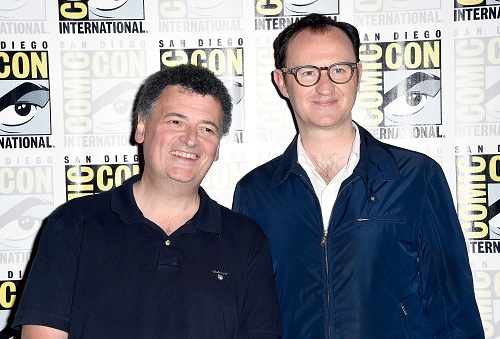
Steven Moffat and Mark Gatiss were both writers for another BBC show – Dr. Who. They were both huge fans of Sherlock Holmes. They were both no stranger to taking Victorian stories and adapting it for television. The two men spent many hours during train rides discussing creating a new series featuring Sherlock Holmes. Moffat’s wife suggested that the two begin developing the show before someone else stole the idea.

The Cast

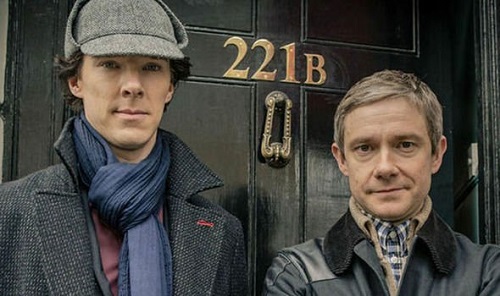
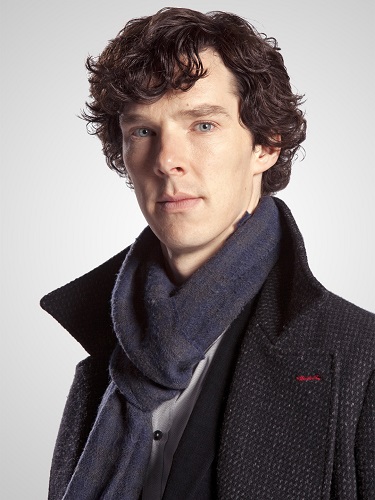
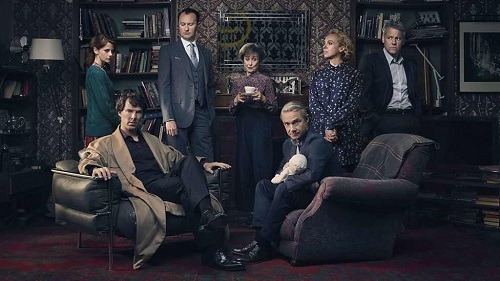
Sherlock Holmes – Benedict Cumberbatch

Sherlock

According to Moffat and Gattis, Benedict Cumberbatch was immediately the guy they wanted to play Holmes. They had seen him perform in Atonement and thought he was perfect. A producer said that he was the only one they actually saw for the role. According to one article: “The part is modelled as a charismatic secondary psychopath or “High functioning sociopath” as Sherlock self-describes, unlike Doyle’s rendering as a primary psychopath, thereby allowing more opportunity or ambiguity for traits of empathy.” Cumberbatch told the Guardian, “There’s a great charge you get from playing him, because of the volume of words in your head and the speed of thought—you really have to make your connections incredibly fast. He is one step ahead of the audience and of anyone around him with normal intellect. They can’t quite fathom where his leaps are taking him.”

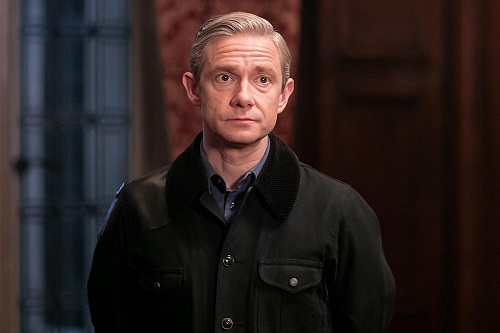
Dr. John Watson – Martin Freeman

Martin-Freeman-Sherlock-Season-5-pic

Actor Matt Smith was originally the actor Moffat and Gattis had in mind to play Watson, but there was something about him, the chemistry with Cumberbatch, and the way he played the character that they didn’t like (They would eventually cast him in Dr. Who). Eventually, Martin Freeman won the role. Moffat says of Freeman, (he is) “the sort of opposite of Benedict in everything except the amount of talent… Martin finds a sort of poetry in the ordinary man. I love the fastidious realism of everything he does.” Freeman, when considering his character, says he is “a ‘moral compass’ for Sherlock, who does not always consider the morality and ethics of his actions.

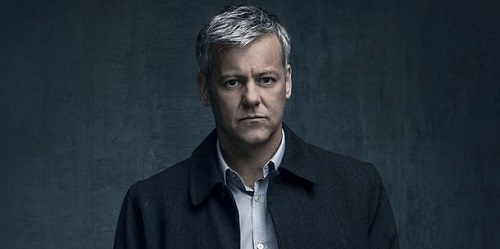
Detective Inspector Lestrade – Rupert Graves

lastrade

According to Moffat and Gattis, many auditioned for the role, but they all seemed to have a comedic take on the role. The creators liked Graves’ approach to it and he was cast. There is some great interplay between Lestrade and Holmes throughout the series. He works for Scotland Yard.

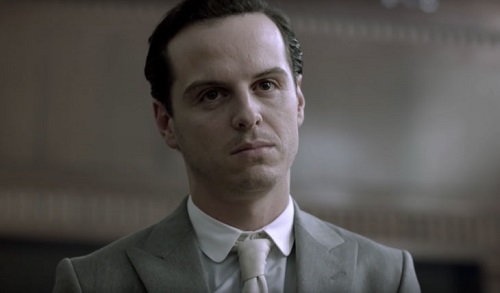
Jim Moriarty – Andrew Scott

james-moriarty-1

Scott is fantastic as Moriarty! Moffat said, “We knew what we wanted to do with Moriarty from the very beginning. Moriarty is usually a rather dull, rather posh villain so we thought someone who was genuinely properly frightening. Someone who’s an absolute psycho.” They certainly achieved this. There were times I was genuinely freaked out by his performance! The creators never intended to have a “confrontation” scene between Holmes and Moriarty, but then they saw Scott’s audition and they knew that they HAD to!

Other Cast Members

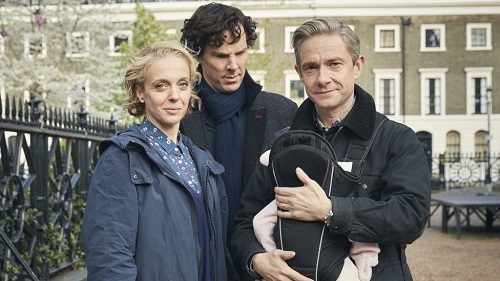
Amanda Abbington – Mary (Morstan) Watson

_93096723_freeman1_bbc

At the time of the series, Amanda Abbington was Martin Freeman’s real life partner. She was cast to play John Watson’s girlfriend/wife.

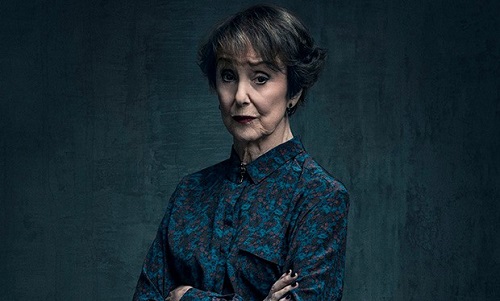
Mrs. HudsonUna Stubbs

Sherlock S4 - Generic

Mrs. Hudson is Holmes’ and Watson’s landlady. She brings a wonderful bit of comedic dialog to every interaction and scene. Interesting story – Una has known Benedict Cumberbatch since he was 4 years old and she has worked with his mother!

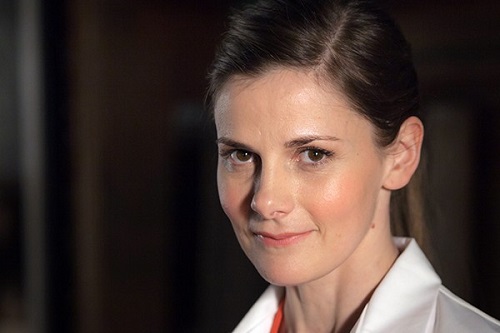
Molly HooperLouise Brealey

louise-brealey-600x400

Molly Hooper works at a morgue at a London hospital. She also has an apparent crush on Sherlock. Because of her work position and crush on him, Sherlock frequently exploits her to let him examine or perform experiments on victims’ bodies. In the first episode of the series she allows him to hit a corpse with a riding crop to see how it might bruise in post mortum.

Mycroft Holmes – Mark Gattis

sherlock-103-02345

(SPOILER ALERT) When Mycroft first appears in the series, you really have no idea who he is. He is this mysterious man who tries to get Watson to spy on Sherlock for him. You only learn later on that he is Sherlock’s brother. Mycroft is even more skilled at deduction, correcting Sherlock on occasion and beating him in deduction exercises, as well as lacking enthusiasm for “legwork”. His intellect is borderline superhuman. The sibling rivalry between the two lead to some very good scenes.

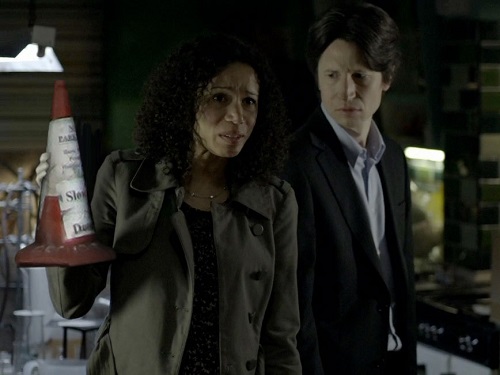
Sally Donovan & Phillip Anderson – Vinette Robinson & Jonathan Aris

tumblr_m2ns6fDmeZ1rslrfio1_r1_1280

Srgt. Sally Donovan often works with Lestrade on cases. She resents Sherlock’s presence at crime scenes and treats him with extreme disrespect and rudeness, cruelly calling him a “freak” to his face, and warns Watson that Sherlock is a psychopath who will one day get bored of catching killers and become one himself.

Phillip Anderson is originally a member of the Metropolitan Police’s Forensic Services. From the series opening, it is clear that Anderson and Sherlock have history of mutual dislike with Sherlock repeatedly humiliating Anderson and Anderson refusing to assist him at crime scenes.

Why I Picked It

Growing up, I had read a few of the Sherlock Holmes books. I has seen Basil Rathbone as Sherlock Holmes in movies, and certainly heard many old time radio shows featuring Holmes and Watson. I was intrigued to see just how Sherlock would play out in modern times.

I began to watch the first episode and all it took was the first meeting of Sherlock and Watson, and I was hooked. The way Sherlock is able to tick off things about Watson after just a couple minutes was awesome. Here is that scene:

Pardon me while I sort of digress for a moment.

One of the shows I considered picking in the draft was House, M.D. starring Hugh Laurie. I had heard it said that House was based on Sherlock Holmes. House would often make brilliant deductions about the his patients, and often was able to rattle off things about people because of his keen sense of observation – just like Sherlock Holmes. When I began to watch Sherlock, I immediately noticed just how much the two were alike.

The two characters are very similar. Check out the following links:

https://screenrant.com/house-ways-similar-sherlock-holmes/

https://screenrant.com/house-show-sherlock-holmes-comparison-similarities/

Now, back to why I picked it. I love a good mystery, obviously. I was fascinated by the way Sherlock worked and how he figured things out. Sherlock is a bit different that my earlier picks of Columbo and Perry Mason. I loved watching him sort through all the things that helped get him to the final conclusion.

I love good characters. This show is full of them. There are times I laugh out loud at some of the interactions. One of my favorite exchanges between Sherlock and Lestrade happens in the first episode. Sherlock, Watson and Lestrade are in a room and Sherlock yells, “Shut up!” Lestrade answers back, “I didn’t say anything.” Sherlock adds quickly, “You were thinking. It’s annoying!”

Holmes and Watson are the perfect team. They play well off each other. The same holds true for Cumberbatch and Freeman. Their chemistry is magical. I remember seeing the Sherlock Holmes movies with Robert Downey Jr. and Jude Law and thinking they had good chemistry, but Cumberbatch and Freeman’s chemistry is far superior.

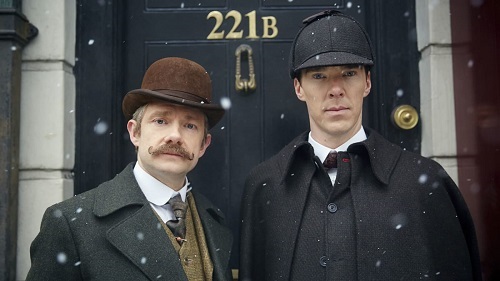
In between Series 3 & 4, Sherlock aired a special on New Years Day of 2016. The Abominable Bride was set in Victorian London. Set in the time of the original books, it takes Sherlock out of the modern day and places him back where we all know him from. Moffat stated that “The special is its own thing. We wouldn’t have done the story we’re doing, and the way we’re doing it, if we didn’t have this special. It’s not part of the run of three episodes. So we had this to do it … It’s kind of in its own little bubble.”

OLD

The special won an Emmy for Outstanding Television Movie at the 2016 Primetime Emmy Awards. If you only watch one episode – I’d suggest this one.

The final episode of Sherlock aired in 2017. Steven Moffat stated that He and Mark Gattis had fifth series plotted out, but weren’t ready to fully produce it. Whether or not a new series of shows will come to fruition is still up in the air.

SH3_Ep2rel_5.0

When Benedict Cumberbatch was asked about whether or not Sherlock would make more episodes, he said, “I’m the worst person to ask because my slate’s pretty, pretty full at the moment, as is Martin’s and all the other key players involved. So, who knows? Maybe one day, if the script’s right. And I say ‘the script,’ maybe it could be a film rather than the series. Who knows?” 

Sherlock is a multi award winning show full of mystery, adventure, comedy, and fun. If you have never seen it, I highly recommend it.

The game is on!!

The-Sherlock-series-of-BBC-s-tv-show-Gets-a-prank-back

Cat Stevens – Father And Son

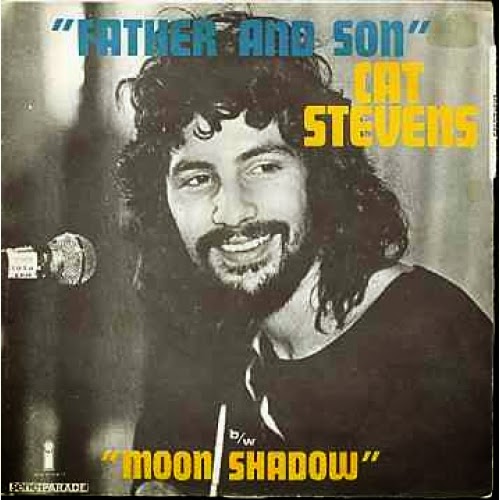
A truly beautiful song by Cat Stevens. It was used as the B-side of Stevens’ hit Moonshadow in some locations. 

His dad owned a restaurant in London and Cat (known to his dad as Steve Georgiou) worked there as a waiter right up until he signed a record deal at age 17. Stavros was hoping his son would join the family business.

Steven’s storyline for the song as he was writing it from the perspective of a father and son in a Russian family during the Russian Revolution (1917-1923). The son wants to join the revolution but his father wants him to stay home and work on the farm. Stevens, a huge fan of show tunes, wrote it in 1969 for a musical he was working on called Revolussia, which was set during the Russian Revolution. The song ended up on the Tea For The Tillerman album.

This is the song that got Stevens signed to Island Records. His first two albums were issued on Deram, a division of Decca. Stevens met with Island boss Chris Blackwell to talk about the musical he wrote this song for, but when Blackwell heard the song, he set his sights on getting Stevens on his label as an artist. Stevens’ first Island release was Mona Bone Jakon earlier in 1970; it was not just a new label for Stevens, but a new producer as well, with former Yardbird Paul Samwell-Smith taking the helm from Mike Hurst (ex-Springfields), who helped Stevens get his deal with Decca.

I’m really tired of superhero movies but I’m glad many songs of this era were included in Guardians of the Galaxy Vol. 2…including this one. It exposes a new generation to these songs. 

The song peaked at #52 in the UK in 1970. 

Cat Stevens on his dad: “He was running a restaurant and I was a pop star, so I wasn’t following the path that he laid out. But we certainly didn’t have any antagonism between us. I loved him and he loved me.”

Cat Stevens: “I was in a Turkish restaurant one day and it came on the radio, one of my children said, ‘Dad, isn’t that your song?’ I said, ‘Why, yes it is!’ It turned out to be Boyzone. It’s a nice version and I’m grateful it was a clean-cut group who did it. I went to meet them at Top Of The Pops and we had a nice time. They’re a good bunch of lads.”

Cat Stevens: “The song is a testament to the differences we represent to each other, especially in age and traditions. Traditions have a big impact on our lives, and sometimes you’ve got to walk away.”

Father and Son

It’s not time to make a change
Just relax, take it easy
You’re still young, that’s your fault
There’s so much you have to know
Find a girl, settle down
If you want you can marry
Look at me, I am old, but I’m happy

I was once like you are now
And I know that it’s not easy
To be calm when you’ve found
Something going on
But take your time, think a lot
Think of everything you’ve got
For you will still be here tomorrow
But your dreams may not

How can I try to explain?
When I do he turns away again
It’s always been the same, same old story
From the moment I could talk
I was ordered to listen
Now there’s a way
And I know that I have to go away
I know I have to go

It’s not time to make a change
Just relax, take it slowly
You’re still young, that’s your fault
There’s so much you have to go through
Find a girl, settle down
If you want you can marry
Look at me, I am old, but I’m happy

All the times that I’ve cried
Keeping all the things I knew inside
It’s hard, but it’s harder to ignore it
If they were right I’d agree
But it’s them they know, not me
Now there’s a way
And I know that I have to go away
I know I have to go

TV Draft Round 8 – Pick 6 – Liam Selects – Siskel & Ebert

Welcome to the Hanspostcard TV Draft. I hope you will enjoy it! Today’s post was written by Liam at https://othemts.wordpress.com/

  • Opening Soon at a Theater Near You (1975–1977) – WTTW, Chicago
  • Sneak Previews (1977–1982) – PBS
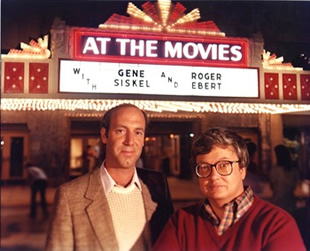
  • At the Movies (1982–1986) – Syndication
  • Siskel & Ebert & the Movies (1986–1999) – Syndication

In 1975, WTTW-TV (the local PBS outlet for Chicago) brought together two film critics, Gene Siskel and Roger Ebert for a movie review show called Opening Soon at a Theater Near You. Siskel wrote film reviews for the Chicago Tribune starting in 1969 while Ebert began his career as a film critic at the Chicago Sun-Times in 1967.  In 1975, Ebert became the first film critic to receive a Pulitzer Prize.  This was a time when there was a heated rivalry between the two Chicago newspapers, and members of the small field of film criticism, there was a professional rivalry between Siskel and Ebert as well, bordering on animosity.

The show started off roughly as each critic attempted to assert their personality and get one over on their opponent (not to mention that neither one had much experience in front of a camera).  Over time they gradually eased up and started having more of a conversation about the movies.   Working together proved to be more effective inspiring one another with insights.  Siskel and Ebert started to become friends in real life as well. Despite all of this, some of the best TV drama came when they disagreed and argued about a movie, but always with respect for their opponent as an individual.

After two seasons on WTTW, the show was retooled as Sneak Previews and broadcast nationally on PBS.  The pair left PBS in 1982 for a syndicated show produced by Tribune Entertainment called At the Movies.  In 1986, after a contract dispute, they created another syndicated show called Siskel & Ebert & the Movies (later shortened to Siskel & Ebert) produced by Walt Disney television. All the shows shared some common characteristics, reviewing a handful of new releases in each episode, with special episodes focusing on the Oscars, Siskel & Ebert’s best movies of the year, and a deep focus on the work of an individual artists.  The shows ended with a roundup of the movies discussed with Siskel & Ebert each giving a thumbs up or thumbs down for each movie.  “Two thumbs up” became a coveted phrase for movie promoters to include in their advertisements.

It’s unfortunate that the whole thumbs up/thumbs down thing became such a cultural touchstone, because Siskel & Ebert offered a much deeper appraisal of movies than that shorthand could ever offer.  I found a website called Siskel & Ebert Movie Reviews where full episodes of the show have been uploaded.  Watching some shows reminds me how deep they would go into their discussion of the films as well as sharing extended clips of the movies.  It seems a foreign concept today when everyone is so worried about “spoilers,” but I remember going to the movies back in the 1980s knowing a whole lot about what I was going to see thanks to Siskel & Ebert, and it helped me enjoy the movies more.

Siskel & Ebert essentially democratized film criticism.  When the show started in the 1970s, it was a time when foreign films were getting screened regularly in the U.S. for the first time, and older American movies were getting rereleased.  Siskel & Ebert loved “highbrow” art movies, and promoted them on their show but never in a snooty manner.  Instead they made these films more accessible to wider audiences.  In the 1980s, home video made even more movies more widely available and the always included home media releases in their shows as well.  The duo could also find great entertainment in “lowbrow” Hollywood movies and weren’t afraid to say what they liked and why they were still great movies.  Of course, they also didn’t hold back on bad movies, and covered them in features like “Dog of the Week” with Spot the Wonder Dog barking an introduction.

Gene Siskel died of a brain tumor in 1999.  A private man he did not share the extent of his illness outside his family so his sudden death took his partner Roger Ebert off guard.  Ebert continued the show with rotating guest hosts for a time before partnering up with Richard Roeper from 2000 to 2008.  Ebert was struck with cancer of the thyroid and salivary glands in 2002 and in 2006 had his lower jaw surgically removed.  Always contrary to Siskel, Ebert was open to sharing his health problems with the public, particularly in the intimate documentary movie Life Itself.  Unable to speak, Ebert continued to review movies in print, publishing them on his website RogerEbert.com until his death in 2013.

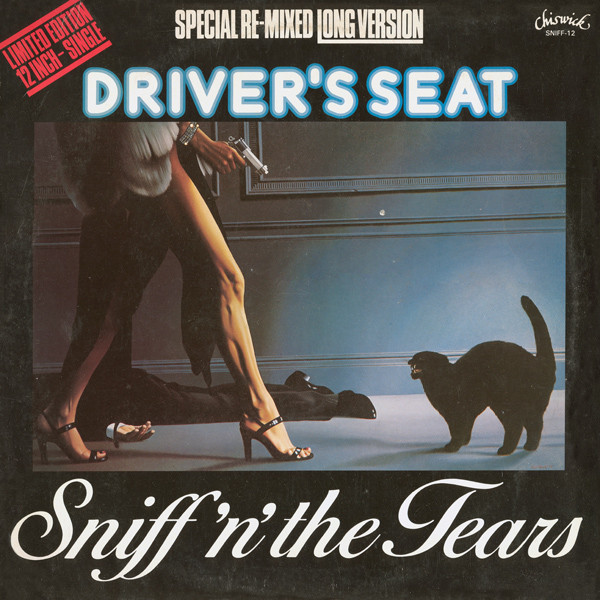
Sniff ‘n’ the Tears – Driver’s Seat ….Power Pop Friday

This song took a few listens but then I started to like it. It peaked at #15 on the Billboard 100, #17 in Canada, and #42 in the UK charts. The song ended up being Sniff ‘n’ the Tears biggest hit.

The song was a failure in the UK but more successful in the US where it hit the top twenty in 1979. It was a hit almost everywhere but in the UK. In the UK they were set up for success. They managed to snag a Top of the Pops appearance when it came out. They filled in for the Gang of Four who dropped out at the last moment.  The week after it was released… the EMI pressing plant went on strike and you couldn’t buy Driver’s Seat for four or five weeks.

An early version of this song was demoed back in 1973 by singer/guitarist Paul Roberts’ then-band Ashes of Moon for a French label. However, that band broke up, and, at the suggestion of drummer Luigi Salvini, Roberts reformed it as Sniff ‘n’ the Tears with guitarists Laurence “Loz” Netto and Mick Dyche, and bassist Chris Birkin.

They shopped the demo tape and signed with the London indie label Chiswick in 1977. Sniff ‘n’ The Tears found a good audience outside the UK until they broke up in 1983. They reformed in 1992 after Driver’s Seat featured in a Dutch TV ad for Pioneer Stereos. They were truly a one-hit-wonder in the US. They did have a single to peaked at #108 called New Lines on Love.

Paul Roberts (singer): It was a pretty massive hit everywhere apart from Britain, Britain is perverse in some respects, but it did get a lot of radio play. We were accused of ripping off Dire Straits. I never understood that, but I think it was more that we were different to the post-punk scene.

Driver’s Seat

Doing all right
A little jiving on a Saturday night
And come what may
Gonna dance the day away

Jenny was sweet
She always smiled for the people she meet
On trouble and strife
She had another way of looking at life

The news is blue (The news is blue)
Had it’s own way to get to you
What can I do? (What can I do? )
When I remember my time with you

Pick up your feet
Got to move to the trick of the beat
There is no elite
Just take your place in the driver’s seat
Driver’s seat, driver’s seat, yeah
Doing all right
A little jiving on a Saturday night
And come what may
Gonna dance the day away
Driver’s seat, driver’s seat, yeah
Jenny was sweet
There is no elite
Pick up your feet, pick up, pick up
Pick up your feet, gonna dance the day away
Driver’s seat, driver’s seat, yeah

Driver’s seat

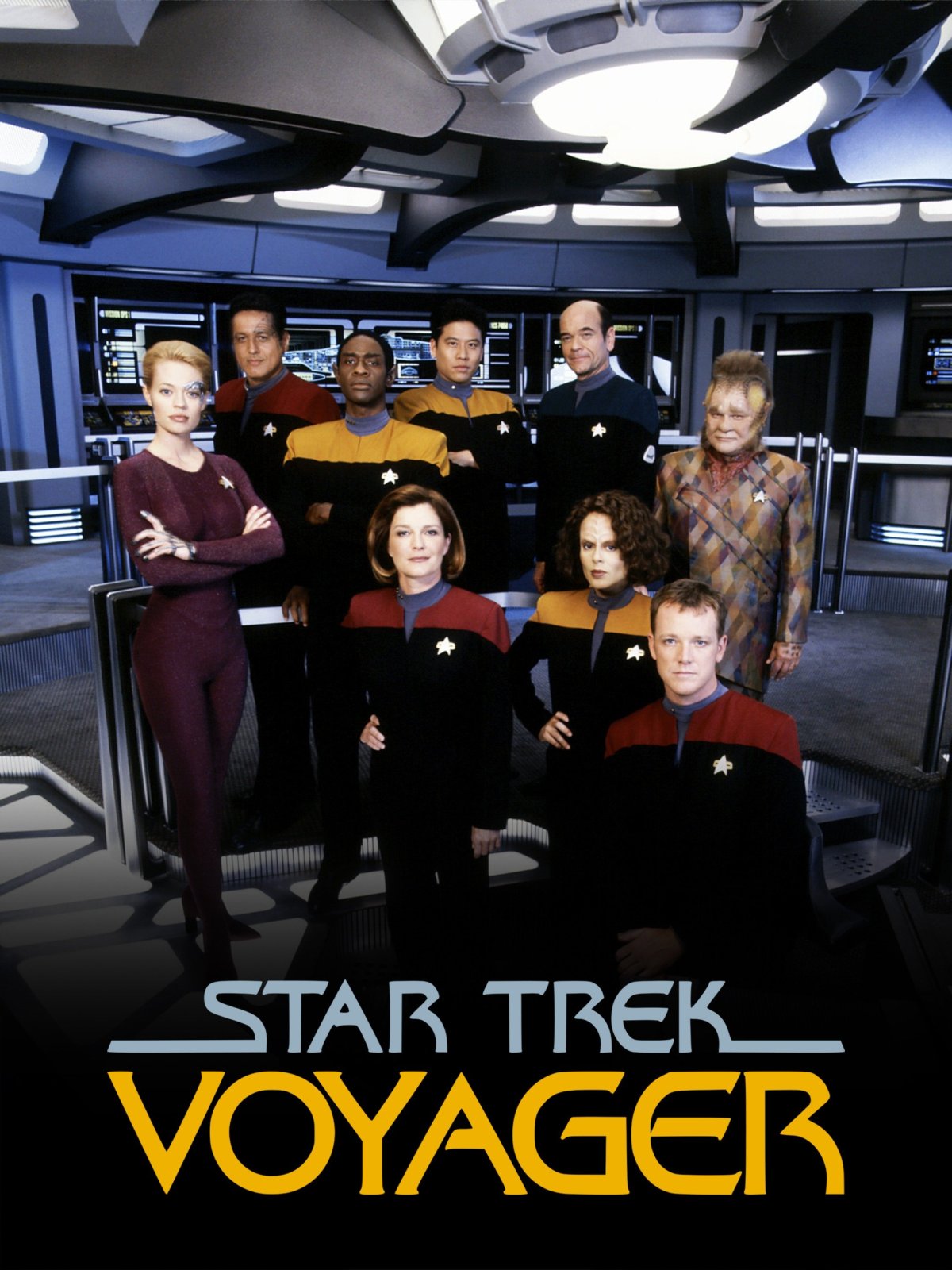
TV Draft Round 8 – Pick 5 – Mike Selects – Star Trek: Voyager

Welcome to the Hanspostcard TV Draft. I hope you will enjoy it! Today’s post was written by Mike at https://musiccitymike.net

Star Trek: Voyager

Let me begin by saying that I really don’t care much for science fiction. My family can confirm how I am on record for falling asleep in the movie theater for Star Wars and Lord of the Rings movies. I guess my brain finds little appeal for fantasy. So, what is it about Star Trek: Voyager that makes it different?

Well, this attraction started with Star Trek: The Next Generation which my family and I watched together and which I would likely pick as a favorite should there be a second round to this draft. Together, we binge-watched all of TNG on DVD, and in true geekiness, kept a spreadsheet where we rated each episode on a 1 to 5 scale. Our watching continued with Voyager, but our nerdom didn’t include the spreadsheet after Mom dropped out.

So, this leaves me to try and explain both how Star Trek overcome my disdain for sci-fi and why I favor (ever so slightly) Voyager over The Next Generation.

I guess what makes me somewhat of a Trekkie, is how these shows extend the history of our planet into the future and explore the unknown expanse of our galaxy. We see the development of technology (some of which has since come to pass) and experience the remarkable acceleration of the speed of travel (unlikely to ever happen). As a child, I always enjoyed books about the future and Trek provided me with a continuation of this fascination. Perhaps my attraction takes root in the fact that there is some probability to some of what is presented in Trek.

On the other hand, as the name itself implies, Star Wars focused more on wars and battles with much more emphasis on alien fantasy rather than the evolution of Earthlings.

As for The Next Generation, everything about it was fabulous and more than satisfied my needs. The casting was perfect, the technological advances were exciting and sometimes realistic, and the stories were fantastic. However, while the same can be said for Voyager, there was just something about it that attracted me even more.

As brilliant as Patrick Stewart was as Captain Jean-Luc Picard on TNG, so was Kate Mulgrew as Captain Kathryn Janeway on Voyager. Let’s just stop there and call it even. Likewise, both casts matchup well with Data on TNG and Seven of Nine on Voyager getting the nods as my favorites. Touché again.

But perhaps what puts Voyager over the top is simply the passage of time, both fictionally in the scripts and, as to the tools available for filming. As to the former, Starfleet technology advanced especially in the use of the Holodeck, a recreational device in which crewmembers freely interacted in an imaginary setting of their choice. To the latter, TV special effects just got better and for the first time in the Trek series were enhanced through the use of CGI (“Computer Generated Images). TNG had made a giant leap however in this regard when compared to the original Star Trek series which at times often completely lost the feel of traveling through outer space.

Voyager lasted seven seasons (1995-2001). It started just after and ran concurrently with Deep Space Nine which failed to catch my fancy along with the other subsequent Trek series that have maintained the franchise. So, if like me, sci-fi is not your thing, like me, you might find enjoyment in Voyager. On the other hand, if you regularly attend Trekkie conventions, where do you rank Voyager amongst the Star Trek canon?