In my teens, I got into the Doors. It happened at just the right time because their popularity rose in the 1980s. When I heard this song after listening to their other music…I thought wow this is very radio-friendly for The Doors. Some fans called them a sell-out…saying it was too top 40 which I don’t think is right…not their best song but a good one. Every song cannot have lyrics like “Don’tchase the clouds pagodas” in them.
I liked it and still do and I heard The Kinks All Day and All of the Night in the song. I wasn’t the only one that heard it. Morrison admitted it and would pay Ray Davies royalties after it hit. Morrison wrote this after seeing a beautiful woman in 1965 walking down a California beach. I also read that he helped popularize the pickup line…” Hello, I love you. Won’t you tell me your name?” that probably hasn’t worked for anyone…ok maybe Jim.
This song was on their demo to shop for a record deal…I have it at the bottom of the post. They didn’t put it on an album until 1968 when they needed material for their third album Waiting for the Sun. They needed more material for that album and pulled up this one from their original demo to re-record it. Although you can hear the Kinks in there… Krieger and Densmore borrowed the finished version’s rhythm from Cream’s Sunshine of Your Love. Robby Krieger also ran his guitar through a fuzz box to get a distorted effect like Cream’s “Sunshine Of Your Love.”
The song peaked at #1 in the Billboard 100, #1 in Canada, #12 in New Zealand, and #15 in the UK in 1968. Waiting For The Sun peaked at #1 on the Billboard Album Charts, #3 in Canada, and #16 in the UK.
I always liked Ray Davies’s response to the song’s similarities to his All Day and All of the Night.
Ray Davies:“The funniest thing was when my publisher came to me on tour and said The Doors had used the riff for ‘All Day And All Of The Night’ for ‘Hello, I Love You.’ I said rather than sue them, can’t we just get them to own up? My publisher said, ‘They have, that’s why we should sue them!’ (laughs) Jim Morrison admitted it, which to me was the most important thing. The most important thing, actually, is to take (the idea) somewhere else.”
This would be the Door’s last #1 song…Light My Fire is the first one. The R.E.M. song “Pop Song ’89” is a play on this. Instead of talking about sex, they talk to the girl about politics and the weather. This song was also used in the movies Platoon, Casualties of War, and Forrest Gump.
The demo of Hello, I Love You.
Hello, I Love You
Hello, I love you, won’t you tell me your name? Hello, I love you, let me jump in your game Hello, I love you, won’t you tell me your name? Hello, I love you, let me jump in your game
She’s walking down the street Blind to every eye she meets Do you think you’ll be the guy To make the queen of the angels sigh?
Hello, I love you, won’t you tell me your name? Hello, I love you, let me jump in your game Hello, I love you, won’t you tell me your name? Hello, I love you, let me jump in your game
She holds her head so high, like a statue in the sky Her arms are wicked, and her legs are long When she moves my brain screams out this song
Sidewalk crouches at her feet Like a dog that begs for something sweet Do you hope to make her see, you fool? Do you hope to pluck this dusky jewel?
Hello, hello, hello, hello, hello, hello, hello I want you, hello, I need my baby Hello, hello, hello, hello
But I shot a man in Reno, Just to watch him die… Johnny Cash
It doesn’t get much better than that.
The man in black was The Man. Not many performers can cross genres like Johnny Cash did and still does. He first recorded this song in 1955 at Sun Records as the B side to “S3o Doggone Lonesome” but it was the live 1969 version that hit.
The At Folsom Prison album helped revitalize Cash’s career. Up to this point, his last Country top 40 entry was in 1964. This was recorded live at Folsom Prison in California on January 13, 1968, and that album came to define his outlaw image. The record company told him it wouldn’t work but Johnny recorded at the prison anyway.
Folsom Prison Blues peaked at #1 on the Billboard Country Charts, #1 on the Canadian Country Charts, #32 on the Billboard 100, and #17 on the Canadian Pop Charts. The song and album generated a lot of interest in the rebellious Johnny Cash, who made prison reform his political cause of choice. He started regularly performing in jails, doing about 12 shows a year for free mostly in Folsom and San Quentin.
The album peaked at #1 in the Billboard Country Charts, #13 in the Billboard Album Charts, and #27 in Canada.
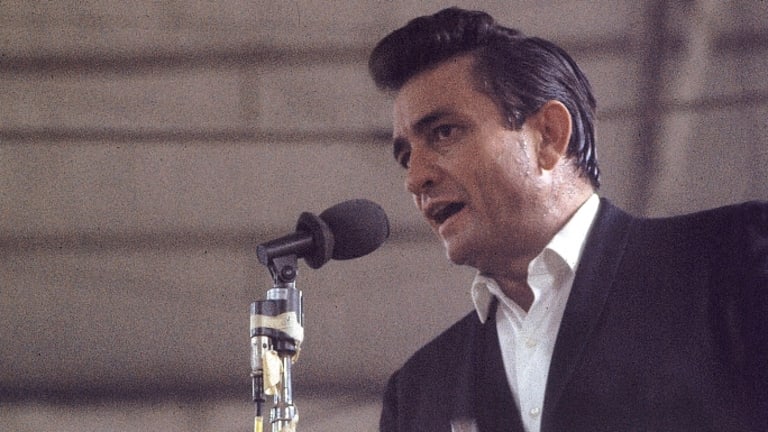
This iconic picture came from Folsom Prison. According to photographer Jim Marshall…he asked Cash to express what he thought of the prison authorities when he played the show. Marshall told Cash “let’s do a shot for the warden” and the picture was born.
Cash saw Crane Wilbur’s 90-minute film Inside the Walls of Folsom Prison while stationed in Germany. It left an impression on Cash, who emphasized the tale of the imprisoned men, and inspired him to write a song. Johnny Cash:“It was a violent movie, I just wanted to write a song that would tell what I thought it would be like in prison.”
Cash’s first prison performance occurred in 1957 when he performed for inmates at Huntsville State Prison. The favorable response inspired Cash to perform at more prisons through the years. His next hit, recorded in San Quentin Prison, was the humorous “A Boy Named Sue,” which proved that he could be clever and funny.
Cash came off as a champion for the oppressed. He got his own national TV show in 1969 and became one of the most popular entertainers of his era. His guests included Derek and the Dominos, Joni Mitchell, Bob Dylan, Linda Ronstadt, Kris Kristofferson, Mickey Newbury, Neil Young, Gordon Lightfoot, Merle Haggard, James Taylor, Tammy Wynette, and Roy Orbison.
Isn’t that list incredible? Cash was considered a Country-Folk artist but look at the range of performers. The late sixties and seventies were like this ….and it’s the reason I like them so much…all the generations intersected at that point in time. I mean you have Eric Clapton and then you have Tammy Wynette on the guest list.
The lyrics to this song were based on a 1953 recording called Crescent City Blues by a bandleader named Gordon Jenkins with Beverly Maher on vocals. After filing a lawsuit, Gordon Jenkins received an out-of-court settlement from Cash in 1969. I have to say it does sound really close.
Johnny Cash:“I don’t see anything good come out of prison. You put them in like animals and tear out the souls and guts of them, and let them out worse than they went in.”
Rosanne Cash:“He was a real man with great faults, and great genius and beauty in him, but he wasn’t this guy who could save you or anyone else.”
Folsom Prison Blues
(Hello, I’m Johnny Cash)
I hear the train a-comin’
It’s rollin’ ’round the bend
And I ain’t seen the sunshine
Since I don’t know when
I’m stuck in Folsom Prison
And time keeps draggin’ on
But that train keeps a-rollin’
On down to San Antone
When I was just a baby
My Mama told me, “son
Always be a good boy
Don’t ever play with guns”
But I shot a man in Reno
Just to watch him die
When I hear that whistle blowin’
I hang my head and cry (play it to the verse, yeah)
(Sue it)
I bet there’s rich folks eatin’
From a fancy dining car
They’re probably drinkin’ coffee
And smokin’ big cigars
Well, I know I had it comin’
I know I can’t be free
But those people keep a-movin’
And that’s what tortures me (hit it)
(Howdy-ho)
Well, if they freed me from this prison
If that railroad train was mine
I bet I’d move it on, a little
Farther down the line
Far from Folsom Prison
That’s where I want to stay
And I’d let that lonesome whistle
Blow my blues away
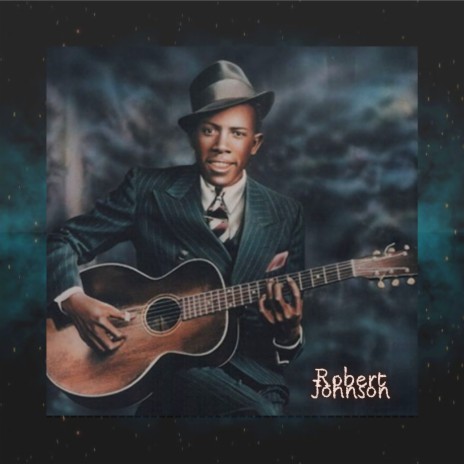
This is an old Robert Johnson song that I’ve always liked. I learned about this song from a bootleg of Leon Russell, George Harrison, Ringo Starr, and Eric Clapton many years ago. Eric wasn’t in the best of shape when this was recorded during the Bangladesh rehearsals. George takes the solo in this blues song and makes it fit really well. I added this version along with Johnson at the bottom of the post.
Robert Johnson recorded it on November 23, 1936, at the Gunter Hotel in San Antonio, Texas and it was produced by Don Law. Johnson only recorded 29 songs in total with 13 surviving outtakes. In one hotel room, Johnson performed and in a second adjoining room, the recording equipment was housed.
In 1990 the compilation album The Complete Recordings was released and peaked at #80 in the Billboard Album Charts. It also won a Grammy Award in 1991 for “Best Historical Album. This song has had over 100 known cover versions by other artists.
Robert Johnson was a huge influence on guitarists such as Eric Clapton, Jimi Page, Peter Green, Brian Jones, and many more. He sounded different than his peers at the time which could have contributed to him not being better known in the 1930s. His style was ahead of his time and it took til the 1960s for him to catch on. In 1961, King of the Delta Blues Singers was released with 16 of his songs on the album…a generation of musicians was influenced.
Johnson died in 1938 at the age of 27. Some say Johnson had been flirting with a married woman at a dance, and she gave him a bottle of whiskey poisoned by her husband…he died two days after drinking it. That is not known for sure but we will probably never know.
Eric Clapton – His music is like my oldest friend, always in the back of my head and on the horizon. It’s the finest music I’ve ever heard. I’ve always trusted its purity. And I always will.’ I don’t know what more you could say….”
Bob Dylan: If I hadn’t heard the Robert Johnson record when I did, there probably would have been hundreds of lines of mine that would have been shut down—that I wouldn’t have felt free enough or upraised enough to write.
Come On In My Kitchen
You better come on in my kitchen Well, it’s goin’ to be rainin’ outdoors Ah, the woman I love, took from my best friend Some joker got lucky, stole her back again You better come on in my kitchen It’s goin’ to be rainin’ outdoors
Oh, she’s gone, I know she won’t come back I’ve taken the last nickel out of her nation sack You better come on in my kitchen It’s goin’ to be rainin’ outdoors Oh, can’t you hear that wind howl? Oh, can’t you hear that wind would howl? You better come on in my kitchen Well, it’s goin’ to be rainin’ outdoors
When a woman gets in trouble, everybody throws her down
Lookin’ for her good friend, none can be found You better come on in my kitchen
Babe, it’s goin’ to be rainin’ outdoors Wintertime’s comin’, it’s gon’ be slow You can’t make the winter, babe, that’s dry, long, so You better come on in my kitchen, ’cause it’s goin’ to be rainin’ outdoors
Hello everyone and those of you who celebrate Thanksgiving I hope you have a great one with your friends and family! Those of you who don’t…have a great day and weekend coming up. I know Thanksgiving is an American holiday mostly but I have talked to a few who celebrate it from other countries…like Bruce my friend from New Zealand.
Every Thanksgiving I listen to Alice’s Restaurant and this is the fourth year in a row that I’ve posted it on the 4th Thursday of November. Sorry if you are tired of it but it’s not Thanksgiving until Alice’s Restaurant is played…and the Last Waltz is watched but that is a different story.
The movie that Arlo movie made called Alice’s Restaurant is a fun watch.
It’s not Thanksgiving without listening to this 1967 song. This song did not chart but he did have another version that did chart…it was called Alice’s Rock and Roll Restaurant that peaked at #97 in the Billboard 100.
Many radio stations play this on Thanksgiving. This is usually the only time they play it, since the song is over 18-minutes long.
There have been mixed reviews about the movie that was made…I’ve always found it enjoyable. It’s not going to be confused with Gone With The Wind but it’s a fun period movie.
In 1991, Arlo bought the church where this took place and set up “The Guthrie Center,” where he runs programs for kids who have been abused.
From Songfacts
Running 18 minutes and 34 seconds, this song is based on a true story that happened on Thanksgiving Day, 1965. Arlo was 18, and along with his friend Rick Robbins, drove to Stockbridge, Massachusetts to have Thanksgiving dinner with Alice and Ray Brock. Alice and Ray lived in a church – the former Trinity Church on Division Street in Stockbridge – and were used to inviting people into their home. Arlo and Rick had been traveling together, Arlo working his way up in folk singing and Rick tagging along. A number of people, Arlo and Rick included, were considered members of the family, so they were not guests in the usual sense.
When Ray woke up the next morning, he said to them, “Let’s clean up the church and get all this crap out of here, for God’s sake. This place is a mess,” and Rick said, “Sure.” Arlo and Rick swept up and loaded all the crap into a VW microbus and went out to the dump, which was closed. They started driving around until Arlo remembered a side road in Stockbridge up on Prospect Hill by the Indian Hill Music Camp which he attended one summer, so they drove up there and dumped the garbage.A little later, the phone rang, and it was Stockbridge police chief William J. Obanhein. “I found an envelope with the name Brock on it,” Chief Obanhein said. The truth came out, and soon the boys found themselves in Obanhein’s police car. They went up to Prospect Hill, and Obie took some pictures. On the back, he marked them, “PROSPECT HILL RUBBISH DUMPING FILE UNDER GUTHRIE AND ROBBINS 11/26/65.” He took the kids to jail.The kids went in, pleaded, “Guilty, Your Honor,” was fined $25 each and ordered to retrieve the rubbish. Then they all went back to the church and started to write “Alice’s Restaurant” together. “We were sitting around after dinner and wrote half the song,” Alice recalls, “and the other half, the draft part, Arlo wrote.”
Guthrie, the son of legendary folk singer Woody Guthrie, greatly exaggerated the part about getting arrested for comic effect. In the song, he is taken away in handcuffs and put in a cell with hardened criminals.
In the song, Guthrie avoids the draft and did not have to serve in Vietnam because of his littering arrest. In reality, he was eligible but wasn’t drafted because his number didn’t come up.
Guthrie performed this song for the first time on July 16, 1967, at the Newport Folk Festival.
This reflected the attitude of many young people in America at the time. It was considered an antiwar song, but unlike most protest songs, it used humor to speak out against authority.
After a while, Guthrie stopped playing this at concerts, claiming he forgot the words. As the song approached its 30th anniversary, he started playing it again.
Guthrie made a movie of the same name in 1969 which was based on the song.
Over the years, Guthrie added different words to the song. He recorded a new, longer version in 1995 at The Guthrie Center
Alice’s Restuarant
This song is called Alice’s Restaurant, and it’s about Alice, and the
Restaurant, but Alice’s Restaurant is not the name of the restaurant,
That’s just the name of the song, and that’s why I called the song Alice’s
Restaurant.
You can get anything you want at Alice’s Restaurant
You can get anything you want at Alice’s Restaurant
Walk right in it’s around the back
Just a half a mile from the railroad track
You can get anything you want at Alice’s Restaurant
Now it all started two Thanksgivings ago, was on – two years ago on
Thanksgiving, when my friend and I went up to visit Alice at the
Restaurant, but Alice doesn’t live in the restaurant, she lives in the
Church nearby the restaurant, in the bell-tower, with her husband Ray and
Fasha the dog. And livin’ in the bell tower like that, they got a lot of
Room downstairs where the pews used to be in. Havin’ all that room,
Seein’ as how they took out all the pews, they decided that they didn’t
Have to take out their garbage for a long time.
We got up there, we found all the garbage in there, and we decided it’d be
A friendly gesture for us to take the garbage down to the city dump. So
We took the half a ton of garbage, put it in the back of a red vw
Microbus, took shovels and rakes and implements of destruction and headed
On toward the city dump.
Well we got there and there was a big sign and a chain across across the
Dump saying, “Closed on Thanksgiving.” And we had never heard of a dump
Closed on Thanksgiving before, and with tears in our eyes we drove off
Into the sunset looking for another place to put the garbage.
We didn’t find one. Until we came to a side road, and off the side of the
Side road there was another fifteen foot cliff and at the bottom of the
Cliff there was another pile of garbage. And we decided that one big pile
Is better than two little piles, and rather than bring that one up we
Decided to throw our’s down.
That’s what we did, and drove back to the church, had a thanksgiving
Dinner that couldn’t be beat, went to sleep and didn’t get up until the
Next morning, when we got a phone call from officer Obie. He said, “Kid,
We found your name on an envelope at the bottom of a half a ton of
Garbage, and just wanted to know if you had any information about it. ” And
I said, “Yes, sir, Officer Obie, I cannot tell a lie, I put that envelope
Under that garbage. ”
After speaking to Obie for about forty-five minutes on the telephone we
Finally arrived at the truth of the matter and said that we had to go down
And pick up the garbage, and also had to go down and speak to him at the
Police officer’s station. So we got in the red vw microbus with the
Shovels and rakes and implements of destruction and headed on toward the
Police officer’s station.
Now friends, there was only one or two things that Obie coulda done at
The police station, and the first was he could have given us a medal for
Being so brave and honest on the telephone, which wasn’t very likely, and
We didn’t expect it, and the other thing was he could have bawled us out
And told us never to be seen driving garbage around the vicinity again,
Which is what we expected, but when we got to the police officer’s station
There was a third possibility that we hadn’t even counted upon, and we was
Both immediately arrested. Handcuffed. And I said “Obie, I don’t think I
Can pick up the garbage with these handcuffs on. ” He said, “Shut up, kid.
Get in the back of the patrol car. ”
And that’s what we did, sat in the back of the patrol car and drove to the
Quote Scene of the Crime unquote. I want tell you about the town of
Stockbridge, Massachusets, where this happened here, they got three stop
Signs, two police officers, and one police car, but when we got to the
Scene of the Crime there was five police officers and three police cars,
Being the biggest crime of the last fifty years, and everybody wanted to
Get in the newspaper story about it. And they was using up all kinds of
Cop equipment that they had hanging around the police officer’s station.
They was taking plaster tire tracks, foot prints, dog smelling prints, and
They took twenty seven eight-by-ten colour glossy photographs with circles
And arrows and a paragraph on the back of each one explaining what each
One was to be used as evidence against us. Took pictures of the approach,
The getaway, the northwest corner the southwest corner and that’s not to
Mention the aerial photography.
After the ordeal, we went back to the jail. Obie said he was going to put
Us in the cell. Said, “Kid, I’m going to put you in the cell, I want your
Wallet and your belt. ” And I said, “Obie, I can understand you wanting my
Wallet so I don’t have any money to spend in the cell, but what do you
Want my belt for? ” And he said, “Kid, we don’t want any hangings. ” I
Said, “Obie, did you think I was going to hang myself for littering?”
Obie said he was making sure, and friends Obie was, cause he took out the
Toilet seat so I couldn’t hit myself over the head and drown, and he took
Out the toilet paper so I couldn’t bend the bars roll out the – roll the
Toilet paper out the window, slide down the roll and have an escape. Obie
Was making sure, and it was about four or five hours later that Alice
(remember Alice? It’s a song about Alice), Alice came by and with a few
Nasty words to Obie on the side, bailed us out of jail, and we went back
To the church, had a another thanksgiving dinner that couldn’t be beat,
And didn’t get up until the next morning, when we all had to go to court.
We walked in, sat down, Obie came in with the twenty seven eight-by-ten
Colour glossy pictures with circles and arrows and a paragraph on the back
Of each one, sat down. Man came in said, “All rise.” We all stood up,
And Obie stood up with the twenty seven eight-by-ten colour glossy
Pictures, and the judge walked in sat down with a seeing eye dog, and he
Sat down, we sat down. Obie looked at the seeing eye dog, and then at the
Twenty seven eight-by-ten colour glossy pictures with circles and arrows
And a paragraph on the back of each one, and looked at the seeing eye dog.
And then at twenty seven eight-by-ten colour glossy pictures with circles
And arrows and a paragraph on the back of each one and began to cry,
’cause Obie came to the realization that it was a typical case of American
Blind justice, and there wasn’t nothing he could do about it, and the
Judge wasn’t going to look at the twenty seven eight-by-ten colour glossy
Pictures with the circles and arrows and a paragraph on the back of each
One explaining what each one was to be used as evidence against us. And
We was fined $50 and had to pick up the garbage in the snow, but that’s not
What I came to tell you about.
Came to talk about the draft.
They got a building down New York City, it’s called Whitehall Street,
Where you walk in, you get injected, inspected, detected, infected,
Neglected and selected. I went down to get my physical examination one
Day, and I walked in, I sat down, got good and drunk the night before, so
I looked and felt my best when I went in that morning. ‘Cause I wanted to
Look like the all-American kid from New York City, man I wanted, I wanted
To feel like the all-, I wanted to be the all American kid from New York,
And I walked in, sat down, I was hung down, brung down, hung up, and all
Kinds o’ mean nasty ugly things. And I waked in and sat down and they gave
Me a piece of paper, said, “Kid, see the phsychiatrist, room 604.”
And I went up there, I said, “Shrink, I want to kill. I mean, I wanna, I
Wanna kill. Kill. I wanna, I wanna see, I wanna see blood and gore and
Guts and veins in my teeth. Eat dead burnt bodies. I mean kill, Kill,
Kill, kill. ” And I started jumping up and down yelling, “kill, kill, ” and
He started jumping up and down with me and we was both jumping up and down
Yelling, “KILL, KILL.” And the Sargent came over, pinned a medal on me,
Sent me down the hall, said, “You’re our boy.”
Didn’t feel too good about it.
Proceeded on down the hall gettin more injections, inspections,
Detections, neglections and all kinds of stuff that they was doin’ to me
At the thing there, and I was there for two hours, three hours, four
Hours, I was there for a long time going through all kinds of mean nasty
Ugly things and I was just having a tough time there, and they was
Inspecting, injecting every single part of me, and they was leaving no
Part untouched. Proceeded through, and when I finally came to the see the
Last man, I walked in, walked in sat down after a whole big thing there,
And I walked up and said, “What do you want?” He said, “Kid, we only got
One question. Have you ever been arrested? ”
And I proceeded to tell him the story of the Alice’s Restaurant Massacre,
With full orchestration and five part harmony and stuff like that and all
The phenome… – and he stopped me right there and said, “Kid, did you ever
Go to court? ”
And I proceeded to tell him the story of the twenty seven eight-by-ten
Colour glossy pictures with the circles and arrows and the paragraph on
The back of each one, and he stopped me right there and said, “Kid, I want
You to go and sit down on that bench that says Group W…. Now kid!! ”
And I, I walked over to the, to the bench there, and there is, Group W’s
Where they put you if you may not be moral enough to join the army after
Committing your special crime, and there was all kinds of mean nasty ugly
Looking people on the bench there. Mother rapers. Father stabbers. Father
Rapers! Father rapers sitting right there on the bench next to me! And
They was mean and nasty and ugly and horrible crime-type guys sitting on the
Bench next to me. And the meanest, ugliest, nastiest one, the meanest
Father raper of them all, was coming over to me and he was mean ‘n’ ugly
‘n’ nasty ‘n’ horrible and all kind of things and he sat down next to me
And said, “Kid, whad’ya get?” I said, “I didn’t get nothing, I had to pay
$50 and pick up the garbage. ” He said, “What were you arrested for, kid? ”
And I said, “Littering.” And they all moved away from me on the bench
There, and the hairy eyeball and all kinds of mean nasty things, till I
Said, “And creating a nuisance.” And they all came back, shook my hand,
And we had a great time on the bench, talkin about crime, mother stabbing,
Father raping, all kinds of groovy things that we was talking about on the
Bench. And everything was fine, we was smoking cigarettes and all kinds of
Things, until the Sargeant came over, had some paper in his hand, held it
Up and said.
“Kids, this-piece-of-paper’s-got-47-words-37-sentences-58-words-we-wanna-
Know-details-of-the-crime-time-of-the-crime-and-any-other-kind-of-thing-
You-gotta-say-pertaining-to-and-about-the-crime-I-want-to-know-arresting-
Officer’s-name-and-any-other-kind-of-thing-you-gotta-say”, and talked for
Forty-five minutes and nobody understood a word that he said, but we had
Fun filling out the forms and playing with the pencils on the bench there,
And I filled out the massacre with the four part harmony and wrote it
Down there, just like it was, and everything was fine and I put down the
Pencil and I turned over the piece of paper, and there, there on the
Other side, in the middle of the other side, away from everything else on
The other side, in parentheses, capital letters, quotated, read the
Following words:
(“KID, HAVE YOU REHABILITATED YOURSELF?”)
I went over to the Sargent, said, “Sargeant, you got a lot a damn gall to
Ask me if I’ve rehabilitated myself, I mean, I mean, I mean that just, I’m
Sittin’ here on the bench, I mean I’m sitting here on the Group W bench
’cause you want to know if I’m moral enough join the army, burn women,
Kids, houses and villages after bein’ a litterbug. ” He looked at me and
Said, “Kid, we don’t like your kind, and we’re gonna send you fingerprints
Off to Washington. ”
And friends, somewhere in Washington enshrined in some little folder, is a
study in black and white of my fingerprints. And the only reason I’m
singing you this song now is cause you may know somebody in a similar
situation, or you may be in a similar situation, and if your in a
situation like that there’s only one thing you can do and that’s walk into
The shrink wherever you are, just walk in say “Shrink, You can get
Anything you want, at Alice’s restaurant. “. And walk out. You know, if
One person, just one person does it they may think he’s really sick and
They won’t take him. And if two people, two people do it, in harmony,
They may think they’re both faggots and they won’t take either of them.
And three people do it, three, can you imagine, three people walking in
Singin a bar of Alice’s Restaurant and walking out. They may think it’s an
Organization. And can you, can you imagine fifty people a day, I said
Fifty people a day walking in singing a bar of Alice’s Restaurant and
Walking out. And friends they may think it’s a movement.
And that’s what it is, the Alice’s Restaurant Anti-Massacre Movement, and
All you got to do to join is sing it the next time it comes around on the
Guitar.
With feeling. So we’ll wait for it to come around on the guitar, here and
Sing it when it does. Here it comes.
You can get anything you want, at Alice’s Restaurant
You can get anything you want, at Alice’s Restaurant
Walk right in it’s around the back
Just a half a mile from the railroad track
You can get anything you want, at Alice’s Restaurant
That was horrible. If you want to end war and stuff you got to sing loud.
I’ve been singing this song now for twenty-five minutes. I could sing it
For another twenty-five minutes. I’m not proud… Or tired.
So we’ll wait till it comes around again, and this time with four part
Harmony and feeling.
We’re just waitin’ for it to come around is what we’re doing.
All right now.
You can get anything you want, at Alice’s Restaurant
Excepting Alice
You can get anything you want, at Alice’s Restaurant
Walk right in it’s around the back
Just a half a mile from the railroad track
You can get anything you want, at Alice’s Restaurant
Fats Domino (Antoine Dominique Domino Jr.) was a one-of-a-kind artist. He wasn’t wild or flashy like his peers but he was just good or better. When I think of the fifties…this is just me personally…I think of Chuck Berry, Jerry Lee Lewis, Buddy Holly, Everly Brothers, Elvis, and last but not least… Fats Domino. Vastly different styles but all are great.
Domino was the youngest of eight children in a musical family, he spoke Creole French before learning English. At age 7 his brother-in-law taught him how to play the piano. By the time he was 10, he was already performing as a singer and pianist.
My Blue Heaven was released in 1956. It peaked at #19 on the Billboard Charts, #5 on the R&B Charts.
My Blue Heaven was written by Walter Donaldson and George A. Whiting in 1924. The lyrics were written by George Whiting and the music was composed by Walter Donaldson. The music was published by Leo Feist Inc. of New York, New York in 1927. The song was used in the Ziegfeld Follies of 1927.
Gene Austin released this song in 1928. It charted at #1 including one million sales of sheet music. This has been covered by the Smashing Pumpkins, Frank Sinatra, Glenn Miller, Al Jolson, and Dolly Parton to name a few.
There are two different movies called My Blue Heaven, and both used this song. The first was a 1950 musical where it was performed by the stars, Betty Grable and Dan Dailey. The second was a 1990 comedy starring Steve Martin and Rick Moranis. Fats Domino’s version was the theme song in that one.
My Blue Heaven
Day is ending
Birds are wending
Back to the shelter of
Each little nest they love
Nightshades falling
Lovebirds calling
What makes the world go round?
Nothing but love
When Whip-poor-wills call
And ev’ning is nigh
I hurry to
My blue heaven
I turn to the right
A little white light
Will lead you to
My blue heaven
You’ll see a smiling face,
A fireplace,
A cozy room
A little nest
That’s nestled where
The roses bloom
Just Mollie and me
And baby makes three;
We’re happy in
My blue heaven
doo doo doo doo doo
da da da da da
You’ll see a smiling face
A fireplace,
A cozy room
A little nest that’s nestled where the roses bloom
Just Mollie and me
And baby makes three;
We’re happy in
My blue heaven
When I was sixteen I was playing with our band in a bar…no we shouldn’t have been at that age… and the owner paid us one night to learn this song. Not exactly an energetic song to learn but it did go over very well. I didn’t like playing it because it was so slow but I’ve grown to like it and the memories of it. The crowd absolutely loved it.
This was written by Chicago’s trombone player, James Pankow, and sung by Terry Kath. Pankow came up with the melody on the road at a Holiday Inn on a keyboard. He also came up with a melody for flute, he couldn’t wait, so he woke up Walter Parazaider, the saxophone/flute player in the band, and they worked out the song in Pankow’s room.
After Kath’s death in 1978, the band did not play the song for several years, eventually bringing It back with Bill Champlin on vocals when he joined in 1981. Champlin soon got tired of singing it and handed it off to Robert Lamm. Since 2009, it has been sung by trumpeter Lee Loughnane. It gets handed down like a family recipe.
It was used as the B-side not once…but twice with Make Me Smile in April 1970, and as the B-side of “Beginnings” in June 1971. The song never charted.
James Pankow:“I titled it ‘Colour My World’ because it affected a lyric that again mirrors the emotion of love. In this case, I used the emotion of love and description as a Technicolor movie that takes places in my heart. It colors, it gives color and vivid definition to my life, like bringing this emotion to it.”
James Pankow:Frank Sinatra called our publicist and said, ‘Ask that kid to write another verse for that song.’ I thought about it, I called him back and said I can’t do it it’s like sewing another arm on your kid, I can’t do it.”
Colour My World
As time goes on
I realize
Just what you mean
To me
And now
Now that you’re near
Promise your love
That I’ve waited to share
And dreams
Of our moments together
Colour my world with hope of loving you
I learned about Carl Perkins through George Harrison and The Beatles. On their first tour, they all adopted “stage names” and George’s was George Perkins. A wonderful title for this song.
This gets kind of confusing. It was written by Carl Perkins, but it’s also very similar to another song by the same title by Alabama country singer Rex Griffon in 1936. Carl modernized it by the same sound he was getting out of Blue Suede Shoes.” Meanwhile, the melody was also borrowed from the Hank Williams song “Move It On Over” and “Mind Your Own Business.” Rock Around The Clock also borrowed from this. Anyway…it is credited to Carl Perkins.
Carl Perkins was on the rise fast in 1956. He just had 3 top-10 hits in that year. On March 22, 1956, Perkins was severely injured when the car he was riding in crashed on Route 13 between Dover and Woodside, Delaware. Perkins and his band were headed to New York City for a Mar. 24, 1956, appearance on NBC-TV’s Perry Como Show after playing a show in Norfolk, Virginia, on Mar. 21, 1956. Perkins had sustained three fractured vertebrae in his neck, a severe concussion, a broken collar bone, and lacerations all over his body. Perkins remained unconscious for an entire day.
Worse than that…his brother Jay Perkins had a fractured neck and severe internal injuries. Later he developed a malignant brain tumor and died in 1958. It had been planned on the Como show to present Carl with a gold record for Blue Suede shoes. When the wreck happened the song had peaked at #1 on the Country Charts and #2 on the Hot 100. Perkin’s career was never the same after that.
After 1956 he had 6 more top 40 hits in the country charts but never a top 10 hit again. One of those songs peaked at #31 in 1986 called “Birth of Rock and Roll.” Throughout the rockabilly revival of the 80s Perkins worked with Paul McCartney, George Harrison, and many more.
Carl Perkins continued to achieve many successes throughout his career, such as writing the 1968 number one country hit “Daddy Sang Bass” as recorded by Johnny Cash as well as Glen Campbell and The Statler Brothers. He played for about ten years with Johnny Cash, playing lead guitar on Cash’s number one country hit “A Boy Named Sue.” He even appeared on the Johnny Cash Show playing “Matchbox” with Derek And The Dominoes.
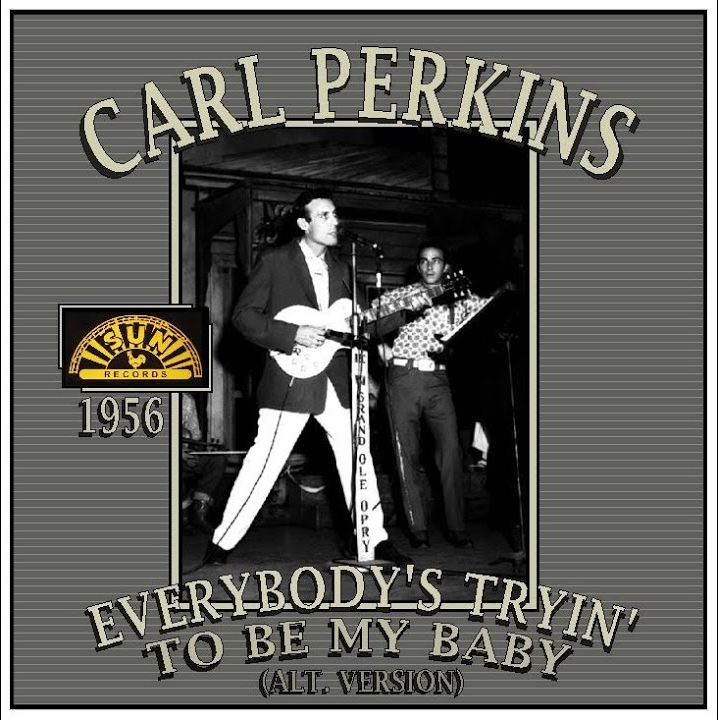
Everybody’s Trying To Be My Baby was recorded in March of 1956 in Sun Studios with no other than Sam Phillips producing.
The Beatle’s version was recorded their version on October 18, 1964. They did it in one take not counting Ringo overdubbing a tambourine and George doubling his voice. It was released on the Album Beatles for Sale released in December of 1964. It was not their best album by any stretch. They were worn out and the album included a lot of covers. The album was not available in the United States and Canada until 1987. The song appeared on their US-only album Beatles 65.
George Harrison sang lead because he was a huge fan of Perkins. It was his showcase song on early tours.
Everybody Is Trying To Be My Baby
Well they took some honey from a tree
Dressed it up and they called it me
Everybody’s trying to be my baby
Everybody’s trying to be my baby
Everybody’s trying to be my baby, now
Woke up last night, half past four
Fifty women knocking on my door
Everybody’s trying to be my baby
Everybody’s trying to be my baby
Everybody’s trying to be my baby, now
Went out last night, I didn’t stay late
‘Fore I got home I had nineteen dates
Everybody’s trying to be my baby
Everybody’s trying to be my baby
Everybody’s trying to be my baby, now
Went out last night, I didn’t stay late
‘Fore I got home I had nineteen dates
Everybody’s trying to be my baby
Everybody’s trying to be my baby
Everybody’s trying to be my baby, now
Well they took some honey from a tree
Dressed it up and they called it me
Everybody’s trying to be my baby
Everybody’s trying to be my baby
Everybody’s trying to be my baby, now
I enjoyed this book immensely. It’s almost like a fantasy book. You are a fan and suddenly you get thrown into the world with The Beatles as friends and co-workers. You move from the Beatles to the Stones, CSNY, Bob Dylan and the list kept growing.
I will say this… as a Beatle fan, this book gave me insight that I never had before. Chris O’Dell happened to meet Derek Taylor (press officer of the Beatles) in Los Angeles in 1968…she worked for him for a few weeks in LA as a PA. He told her she should come over to London to check out the new company that The Beatles were starting called Apple. He didn’t promise her a job but she took a chance and sold her records and borrowed from her parents to go to London. She was like Alice down the rabbit hole, O’Dell stumbled upon a life even she could not have dreamed of.
She took a chance and went over and that started her career working at The Beatles record company Apple. It took her a few months to get hired full time but after the Beatle’s inner circle knew she could be trusted she was there. She met Paul on her very first day. She said all of them were extremely nice and made her feel welcome. She spent the first few months showing up at the office and making herself useful and securing her place. She was especially close to George as a friend and later Ringo as a little more.
After all was said and done…she had 3 songs written about her. Two by Leon Russell called Hummingbird, Pieces Apple Lady, and George Harrison’s Miss O’Dell. She was also the “Mystery Woman” on the Rolling Stones Exile on Main Street cover. She was in the Joni Mitchell song “Coyote” with the line He’s got another woman down the hall…the song about Sam Shepard who Chris O’Dell and Joni Mitchell were seeing. She ended up singing on the Hey Jude recording in the final Na Na chorus.
She was one of the first if not the first female tour manager in rock. The tours she worked on were The Rolling Stones, CSNY, Santana, Bob Dylan, Earth Wind and Fire, Jennifer Warnes, Fleetwood Mac, Linda Ronstadt, Eric Clapton, George Harrison, Led Zeppelin, Phil Collins, Echo and the Bunnymen, ELO, and more.
We also get a glimpse into the personalities of Bob Dylan, Jagger and Richards, CSNY (and the disfunction), Eric Clapton, and more.
Like all of us through life…she made some cringe-worthy decisions. I’m not trying to play it down but most of the time everything worked out in the end. She was in the right place at the right time and took advantage of that. She remains close friends with Pattie Harrison, Ringo Starr (her son’s Godfather), and many of her old famous acquaintances.
This is not a kiss-and-tell book and she doesn’t trash people which made me happy. The only person to come out of this book bad at all is Eric Clapton who was admittedly jealous of Pattie and Chris’s friendship. After the Stones tour, she got into drugs really bad but managed to quit them only to start up again. She, later on, became a drug counselor and helped people.
This book is for more than just Beatle fans…it gives you what life was like on the road in the 1970s. Some of the highlights in the book for me were:
How the Apple Office worked including the Hell’s Angels visitors
How even the biggest stars had deep insecurities
Bob Dylan forgot his harmonicas before the Isle of Wight concert and Chris O’Dell arrived by helicopter to give them to him.
Keith Richards sending her to pick up a “package” in LA in the middle of a tour
Reading about David Crosby’s complaints of no “cross ventilation in his hotel room”
When Roger Taylor of Queen realized that she was Miss O’Dell from George’s song.
Insight into Pattie Boyd and Maureen Starkey who is hardly covered in Beatles books
Reading about how Bangledesh started and how George got his musician friends to participate.
Being on the roof during Get Back brief concert
Chris O’Dell: I think being a Beatle became very difficult for them. They had a different set of problems than the Stones and CSN&Y. They didn’t tour that much, they couldn’t go out of their hotel rooms, and they lived in a bubble. I think breaking up for them, and I can only guess, was a relief and very difficult at the same time.
Chris O’Dell:It was like being let go in Disneyland. That’s what it felt like. It’s like here are the keys to Disneyland, go and enjoy yourself. And I was constantly aware that I was watching history in the making and that was exciting. So every day had some, or certainly every week, had something, a twist to it that made it really exciting
Chris O’Dell now: I am happily remarried to a wonderful man who supports me and accepts me as I am. My twenty-three-year-old son is amazing and gives me some credibility as a parent! I have a private practice in Tucson, specializing in addiction and mental health counseling. My two dogs are happy and life is just better than I would have expected.
Excerpt from the book: On being in a room with Mick and Keith before the 72 tour.
“Listen to this fucking article in Rolling Stone about Harrison’s Bangladesh concert,” Keith said. He started reading from the article. “The Concert for Bangladesh is rock reaching for its manhood.” Keith raised an eyebrow. “Under the leadership of George Harrison, a group of rock musicians recognized, in a deliberate, self-conscious, and professional way, that they have responsibilities, and went about dealing with them seriously.” Keith looked at Mick and then at me. “Do you believe this shit? But wait, it gets better. Harrison is “a man with a sense of his own worth, his own role in the place of things… with a few parallels among his peers.” “Bollocks.” Keith laughed, tossing the magazine on the coffee table. “What a fucking load of shit.” I knew that Keith wasn’t really amused. He could be terribly insecure. What a paradox Keith was- a sweet sensitive soul who wrote songs about needing love to be happy and yet he lived his life as if he couldn’t give a shit about anything. But at that moment I wasn’t too interested in Keith’s feelings. I sat at the far end of the sofa, my legs and arms crossed, smoking a cigarette and drinking my Scotch and Coke as if it were straight Coke. I was pissed. Sure, I knew they were just being competitive, but I couldn’t stand listening to them make fun of George. I wanted to jump into the conversation and tell them to leave him alone. But what could I do? I worked for the Stones now, not the Beatles. This is weird, I know, and particularly strange in the context of the Stone’s remarkable longevity, but at that moment I had a sinking feeling that I was beginning my climb down the ladder. I’d started at the very top with the Beatles and now I was on the rung below. I found myself thinking at that moment that the Stones were sometimes a little too raw, too raunchy, too negative. I liked their music, and I liked each of them individually, but if I had to choose, the Beatles would win. “You know,” I said, trying to smile but having a hard time of it, “George is my friend.” Mick looked over at me as if he had forgotten I was there. “Oh yeah, Chris, you’re a Beatle person, aren’t you? Sorry about that” We let it go, then, but after I dropped Mick at his house and headed home through the dark canyons, I felt a sudden, intense longing to see Pattie and George. Mick was right. When it came right down to it, I was a Beatle person.”
Miss O’Dell
I’m the only one down here Who’s got nothing to say About the war Or the rice That keeps going astray on its way to Bombay. That smog that keeps polluting up our shores Is boring me to tears. Why don’t you call me, Miss O’Dell?
I’m the only one down here Who’s got nothing to fear From the waves Or the rice That keeps rolling on right up to my front porch. The record player’s broken on the floor, And Ben, he can’t restore it. Miss O’Dell.
I can tell you Nothing new Has happened since I last saw you.
I’m the only one down here Who’s got nothing to say About the hip Or the dope Or the cat with most hope to fill the Fillmore. That pushing, shoving, ringing on my bell Is not for me tonight. Why don’t you call me, Miss O’Dell?
I featured a song by The Shivvers a couple of years ago. Most of the songs I heard from them are very good. It’s a shame they couldn’t get a big label interested in the early 80s.
The Shivvers were a power pop band from Milwaukee, active from 1978 to 1982. Milwaukee was not exactly the center of the rock universe at the time. They had their roots in the 60s music, They were more new wavey than punk but retained from the latter a sense of urgency that could be heard in their sole single “Teen Line” released on the Fliptop independent label in 1980.
They thought about moving to LA or New York in the 80s but decided not to. It’s a shame because they did have some famous fans that included Lou Reed and Eric Carmen. In 1993, Kossoris moved to Nashville, where she worked with The Mavericks among others, and recorded a record, “Invisible,” released in 2001.
The Shivvers were Jill Kossoris (vocals), Jim Richardson (drums), Mike Pyle and Jim Eannelli (guitars) and Scott Krueger (bassist/songwriter).
Jill Kossoris:I’ve been influenced by so many different kinds of music. My parents listened to everything. My sister listened to everything. They were all into power pop like Badfinger, Big Star, the Flamin’ Groovies, Motown music. I liked really catchy, soulful, well-written songs.
Jill Kossoris: You can always look back and see how you could have improved your life in a lot of ways. But at one point, we were just so frustrated that we kind of imploded. You can really get stuck in that whole “bar band” thing. Back in those days, most bands played AT LEAST three- or four hour-long sets. Not to brag, but we were all pretty tight before we started doing that. We were all pretty seasoned musicians. Our time was there. We were ready. Everybody doesn’t get better by grinding it out on the club circuit for five years.
Teen Line
Last night I got a call on the telephone As long as it can ring I am not alone And the night don’t seem so far away It’ll be alright someday And the sun don’t have to shine Because my heart’s on a teen line
All you do is call in this love on a teen line
You say feel so fine, you’ve got everything You’ve got a big black car and bird that sings And it’s right, ’cause you called me yesterday And I had so much to say And the sun don’t have to shine Because my heart’s on the teen line
All you do is call in this love on the teen line Nothing matters at all (not at all) Give us just a little and call on your teen line Say that you love me and that you’ll think of me tonight
If we were older, we wouldn’t have to wait so long But as long as you love me, nothing really matters at all
Last night I didn’t know, I was wondering I sit by the phone waiting for your ring And the sound makes my heart beat fast ‘Cause you had so much to say And I know this love will last ‘Cause my heart’s on the teen line
All you do is call in this love on a teen line Nothing matters at all Give us just a little and call on your teen line Say that you love me and that you’ll think of me tonight
Love on the teen line makes me feel loved Love on the teen line Love on the teen line Love on the teen line Love on the teen line
I bought George Harrison’s Cloud Nine when it was released in 1987. I took it and recorded it on cassette to play in my car (sorry George). I always liked this breezy song.
I played it constantly. I started to notice a change was happening…classic rock was coming back old and new. In the 2 years that followed a great string of albums was released. The Traveling Wilburys, Keith Richards Talk Is Cheap, Tom Petty’s Full Moon Fever, Jeff Lynne’s Armchair Theatre, Roy Orbison’s Mystery Girl, and then another Traveling Wilburys. The older guys were back in the game again.
There is not a bad song on Cloud Nine. The one I played the less was ironically the biggest hit on the album…Got My Mind Set On You. Personally, I thought this album was his best since All Things Must Pass. The reviews at the time agree with that.
This song is about what I talked about in the first paragraph. George was poking fun at himself as a dinosaur rocker although he was only 45…that’s young in today’s world. The first verse says it all…
I’m not the wreck of the Hesperus Feel more like the Wall of China Getting old as Methuselah Feel tall as the Eiffel Tower I’m not a power of attorney But I can rock as good as Gibraltar Ain’t no more no spring chicken Been plucked but I’m still kicking But it’s alright, it’s alright
The title came from an 1842 Henry Wadsworth Longfellow poem of the same name that combined fact with fiction. Procol Harum also had a song on their 1969 Salty Dog album called The Wreck of the Hesperus but no relation to this one.
The Cloud Nine album peaked at #8 on the Billboard Album Charts, #6 in Canada, and #10 in the UK in 1987. This song was not released as a single. The best-known songs off of the album were Got My Mind Set On You and When We Was Fab. The album was produced by Jeff Lynne with guest appearances by Eric Clapton and Ringo Starr to name a few.
When I would buy albums I would explore every song good or bad. Many times I found songs I liked more than the singles that were pulled from it. This song did make me hunt down Bill Big Broonzy in the 80s…which wasn’t that easy but I did get my hands on some of his music and liked it…great blues player.
It’s funny how when you first hear something and what you think the lyrics are. I’ve been hearing them wrong since 1987.
What I thought I heard…
I slipped on the pavement “with no ice there” and Met a snake “carrying lanterns”
No on both accounts…
I slipped on a pavement oyster Met a snake climbing ladders
George Harrison: The song, it just came to me with this lyric. I don’t know. Maybe I was thinking from the point of view that people tend to think of you as somebody who’s passe, been and done. And it was just a sort of tongue-in-cheek kind of thing that… This was an old poem, but I was brought up [in] that period they sang, you know, the little catch thing they always said, you know, ‘you look like the wreck of the Hesperus.’ I never really knew what it was, I suppose, but it sounded good, kinda like some awful wreck. It was a shipwreck and a poem, an old Victorian poem. Anyway, that line just came to me and I just continued the lyric from there. [It’s] sort of [a] strange lyric. [Eiffel Tower] and rock as good as Gibralter, you know, it just gets silly. By end of it, I’m saying I’m not the wreck of the Hesperus, more like Big Bill Broonzy. You know, I don’t know. That to me is… I mean, as far back as I can remember [there was] Big Bill Broonzy with this big ol’ guitar playing. It was pretty groovy. I suppose now, it’s like that really. All of us are turning into– like Eric Clapton and such– I keep telling my boy, when you get older, he’s gonna be like, ‘that was Big Bill Broonzy, man, hanging around at our house!’ We’re all getting old as my mother.
George Harrison:“I’ve been friends with Eric for years. And I think I always will be. He’s a lovely fella and I love him very dearly. And he, [sic] and I called him up again and you know I’m doing an album, Eric could you come and play. Sure, he came over and played great stuff. Devil’s Radio, Cloud Nine [sic], he does a nice little solo on the end of That’s What It Takes and also the other one the second side The Wreck Of The Hesperus
The Wreck of the Hesperus
I’m not the wreck of the Hesperus Feel more like the Wall of China Getting old as Methuselah Feel tall as the Eiffel Tower I’m not a power of attorney But I can rock as good as Gibraltar Ain’t no more no spring chicken Been plucked but I’m still kicking But it’s alright, it’s alright
Poison penmen sneak, have no nerve to speak Make up lies then they leak ‘m out Behind a pseudonym, the rottenness in them Reaching out trying to touch me
Met some Oscars and Tonys I slipped on a pavement oyster Met a snake climbing ladders Got out of the line of fire (But it’s alright)
Brainless writers gossip nonsenses To others heads as dense as they is It’s the same old malady What they see is faulty
I’m not the wreck of the Hesperus Feel more like Big Bill Broonzy Getting old as my mother But I tell you I got some company (But it’s alright)
But it’s alright, it’s alright But it’s alright, it’s alright It’s alright, alright It’s alright
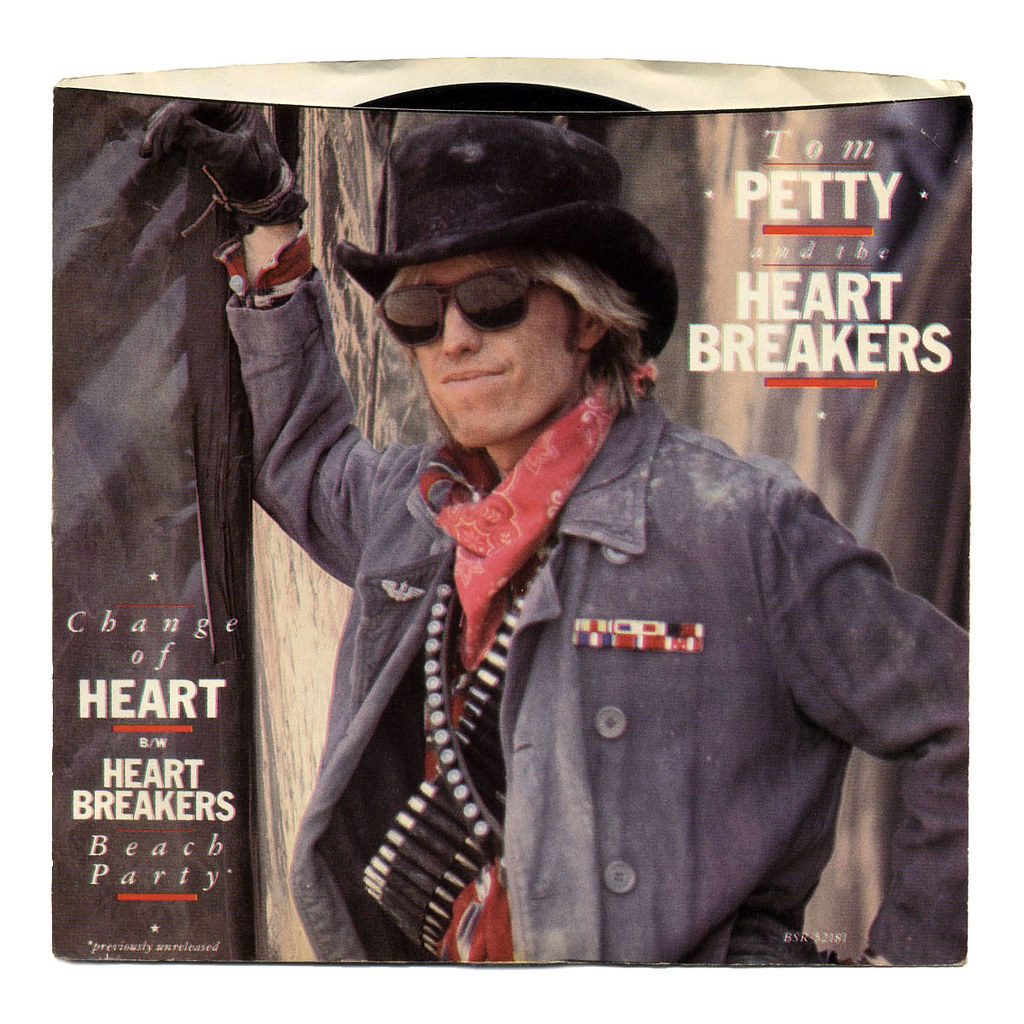
This was the first Petty song that I learned on guitar. This song is not his best, but it hasn’t got the “Free Falling” treatment by being played every day. This song was on the album Long After Dark.
Long After Dark was Tom Petty and the Heartbreakers’ fifth studio album released in 1982. The band used MTV to push the band further into stardom, but Petty wasn’t exactly happy with the album. It was the third album produced by Jimmy Iovine, who made executive decisions pushing the album more into upbeat rock, but Petty wanted to include a couple more acoustic, ballad-type songs.
I could hear the band change a little with the song You Got Lucky… A Change of Heart peaked at #21 on the Billboard 100 and #36 in Canada…it was the second single released from the album.
The bass player Ron Blair quit after the last album Hard Promises was released. This is the first album that featured Howie Epstein on bass. In the last couple of years of his first stint with the band, Blair was considering leaving and was not always available, thus being occasionally replaced with other bassists, including Donald “Duck” Dunn, on his last two albums. In spite of his departure in 1982, he would continue to make occasional guest appearances on studio albums all the way up to Southern Accents.
Epstein was fired in 2002 and then died in 2003 of a drug overdose. Ron Blair came back to his old position in 2002 and remained with the band until Petty passed away in 2017.
Ron Blair about quitting: “Some days I’ll think, ‘Couldn’t I have put up with it? At the time, it was really a gut decision. That’s kind of what I regret, that it wasn’t a real thought-out decision. I physically and verbally tuned out on an emotional level, rather than really thinking it out. Purely and simply it just ceased to be fun.
Change Of Heart
Well I fought for you I fought too hard To do it all again babe, It’s gone too far
You never needed me You only wanted me around It gets me down
There’s been a change, Yeah there’s been a change of heart Said there’s been a change You push just a little too far You make it just a little to hard There’s been a change of heart
I’ll get over you It won’t take long I’ve stood in yer gallery Seen what’s hangin’ from the wall
You were the moon and sun, Yer just a loaded gun now It gets me down
There’s been a change, Yeah there’s been a change of heart Said there’s been a change You push just a little too far You make it just a little to hard There’s been a change of heart
Whoa yeah, oh boy Looks like we finally found the turning point Oh me, oh my Looks like it’s time for me to kiss it goodbye, yeah kiss it goodbye
There’s been a change, Yeah there’s been a change of heart Said there’s been a change You push just a little too far You make it just a little to hard There’s been a change of heart
The first “shredding” guitar instance? Johnny Watson plays guitar in bursts in this recording from way back in 1954. When you keep that in mind while listening to it…it’s remarkable.
It’s not that this instrumental sounds so impressive…it’s the techniques used here by Watson that inspired a generation of guitarists, including Frank Zappa and Eric Clapton. You can also hear where Jimmy Page would have been inspired by this. Watson’s guitar work laid the groundwork for such guitar players such as Joe Satriani.
He pioneered the use of feedback and reverberation. Unfortunately for him and his recording label Federal Records, the public of the early 1950s, before rock-and-roll, was not prepared for his kind of music, and the record did not sell very well. He had greater success in 1955 with his song “Those Lonely, Lonely Nights,” recorded on the Modern label.
Space Guitar seemed ahead of it’s time. He has been cited as a pioneer of reverb and feedback and in the early fifties… fans had to be a little confused with the strange sound.
Johnny Watson:“Reverb had just come out. Everybody really didn’t understand what it was all about, man, and I was experimenting with it.”
Otis Redding (the writer of the song): “This girl has taken that song from me. Ain’t no longer my song. From now on, it belongs to her.”
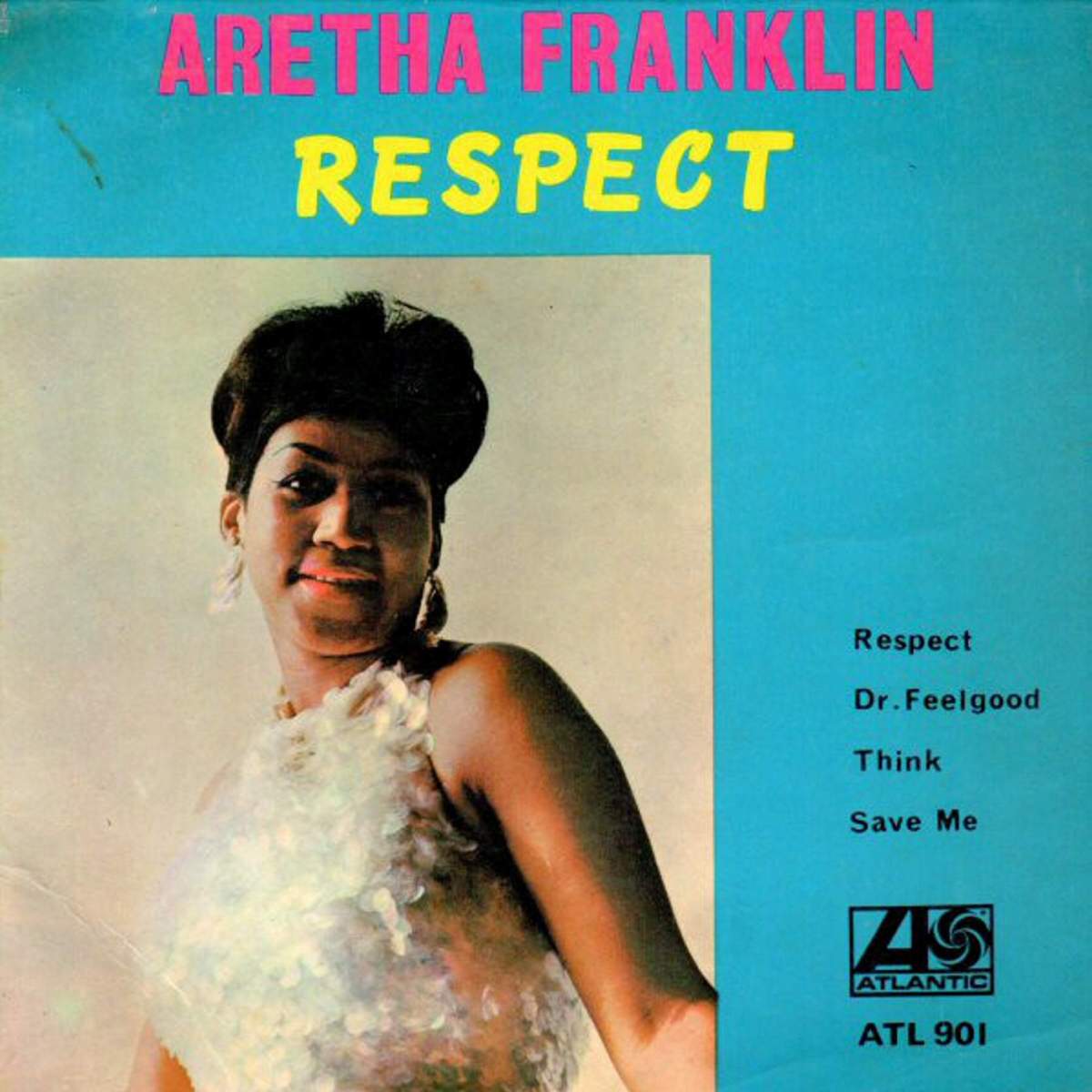
Aretha Franklin and Janis Joplin are my two top female singers of all time. When they are singing a song…there is no question about who it is.
Otis Redding wrote this and originally recorded it in 1965, with his version peaking at #35 on the Billboard 100 and #5 on the R&B Charts.
It was Aretha’s idea to cover this song. She came up with the arrangement, added the “sock it to me” lines, and played piano on the track. Her sister Carolyn, who sang backup on the album, also helped work up the song. It was different than Redding’s version. His version consisted of only verses. Aretha borrowed King Curtis’s sax solo from Sam and Dave’s When Something is Wrong With My Baby and used that for the bridge.
Franklin’s version is certainly the best-known version but the song was important in Otis’s career also. It helped establish Redding on mainstream radio. Otis also performed the song at the Monterey Pop Festival in 1967…this was a defining performance for the singer, who died in a plane crash six months later.
Aretha recorded this in New York City with the Muscle Shoals Rhythm Section. This was one of their first and most famous recordings. They went on to work with Wilson Pickett, Paul Simon, Bob Seger, and The Staple Singers. It was produced by the legendary producer Jerry Wexler and engineered by Tom Dowd.
Another fun fact…the “ree, ree, ree, ree…” refrain is a nod to Franklin’s nickname, Ree (as in A-Ree-tha). The song peaked at #1 on the Billboard 100, #3 in Canada, and #10 in the UK in 1967.
Respect earned Franklin two Grammy Awards in 1968 for Best Rhythm & Blues Recording and Best Rhythm & Blues Solo Vocal Performance, Female. Franklin’s “Respect” was also inducted into the Grammy Hall of Fame in 1987. In 2002, the Library of Congress added Franklin’s version of the song to the National Recording Registry.
Tom Dowd:“I walked out into the studio and said, ‘What’s the next song?’ Aretha starts singing it to me, I said, ‘I know that song, I made it with Otis Redding like three years ago.’ The first time I recorded ‘Respect,’ was on the Otis Blue album, and she picked up on it. She and Carolyn were the ones who conceived of it coming from the woman’s point of view instead of the man’s point of view, and when it came to the middle, Carolyn said, ‘Take care, TCB.’ Aretha jumped on it and that was how we did ‘Respect.'”
Otis Redding:“That’s one of my favorite songs because it has a better groove than any of my records. It says something, too: ‘What you want, baby, you got it; what you need, baby, you got it; all I’m asking for is a little respect when I come home.’ The song lines are great. The band track is beautiful. It took me a whole day to write it and about twenty minutes to arrange it. We cut it once and that was it. Everybody wants respect, you know.”
Aretha Franklin:“Everyone wants to be respected.”
Respect
What you want (ho) baby I got it What you need (ho) you know I got it (Ho) all I’m asking (ho) is for a little respect When you come home (just a little bit) Hey baby (just little bit) When you get home (just a little Bit) mister (just a little bit)
I ain’t gonna do you wrong while you’re gone I ain’t gonna do you wrong ’cause I don’t wanna All I’m asking is for a little respect when you come home (just a little bit) Baby (just a little bit) When you get home (just a little bit) yeah (just a little bit)
I’m about to give you all my money And all I’m asking in return honey Is to give me my propers when you get home (just a, just a, just a, just a) Yeah, baby when you get home (just a little bit) Yeah (just a little bit)
Ho your kisses (ho) sweeter than honey (ho) and guess what (ho) so is my money (ho) All I want you to do for me is give it to me when you get home (re, re, re, re, re, respect) Yeah baby whip it to me (just a little bit) When you get home now (just a little bit)
R-E-S-P-E-C-T find out what it means to me R-E-S-P-E-C-T, take care, T-C-B oh (Sock it to me)
A little respect oh yeah (just a little bit) A little respect (just a little bit) I get tired (just a little bit) Keep on tryin’ (just a little bit) You’re runnin’ out of fools (just a little bit) And I ain’t lyin’ (just a little bit) (Re, re, re, re) ‘spect When you come home (re, re, re ,re) Or you might walk in (respect, just a little bit) And find out I’m gone (just a little bit) I got to have (just a little bit)
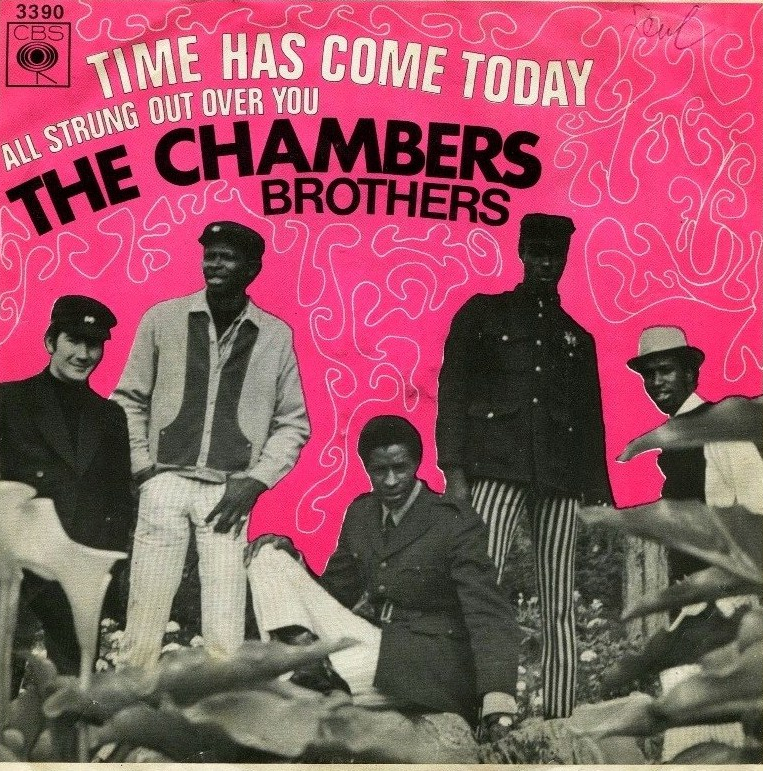
I’ve always liked this song. I will admit I never heard the song until 1988 on a great tv series called “Almost Grown” that starred Tim Daly… that of course was canceled midway through the first season. It’s a psychedelic rock/soul song. There are four versions…one in 1966 and two trippier versions in 1968..different in length only…and the album version…I prefer the album version (11:06). Any song that uses the word…I guess it’s a word…”psychedelicized” has got my support.
This song has worked extremely well in films and on television as a soundtrack of the sixties. It’s powerful and punchy and doesn’t let up.
It was released in 1968 and peaked at #11 on the Billboard 100 and #9 in Canada. After listening to it I want to wear tie-dye and protest something…anything. The Chambers Brothers were from Mississippi and started out as a gospel act. They wrote this song after relocating to Los Angeles, where they rented a two-story house.
It was written by two of the four Chambers brothers, Joe and Willie. Joe wrote most of the lyrics after sitting in on a class at UCLA with Timothy Leary and taking LSD. Willie put the music together and contributed the line, “My soul has been psychedelicized.”
Below is the “brilliance” of record executives…in this case Clive Davis. Davis tried to forbid them to record the song. The following is Willie Chambers telling the story (its a bit long but important):
“After we signed with Columbia Records, there was a big party with all the food and booze and all this stuff. All the important people were there and we got to meet all of the head hogs and Clive was there. He was there for a couple of hours and he says, ‘Well, I must be going, I have other appointments.’ He immediately leans back in the door, ‘Oh, by the way, that song ‘Time Has Come Today’ that you guys do, we won’t be doing that. We won’t do that kind of s–t on this label.’
That was it, and he walks away. I looked at my brothers, and we were looking at each other like, ‘What the heck?’ And our producer [David Rubinson], he was in tears now – he was crying. He says, ‘I’ve waited my whole life to record this song, now he’s going to tell us we can’t record it. Why?’
A couple of days went by and our producer came by and said, ‘I don’t give a s–t what he says, we’re going to record that song. When we get our recording date, you guys show up an hour early, we’re going to go in the studio, we’re going to turn on the tape, we’re going to play it live, we’re going to do it like a live performance. We’re going to record it and whatever we get we’re going to have to live with it. We can’t play back, we can’t overdub, we can’t splice, we can’t fix something if there’s a mistake, we’re just going to have to live with it.’ He says, ‘I’m probably going to lose my job, but that’s how important it is to me to record this song.’
Later on, Joe and I went to Columbia Records to have a pow-wow with Mr. Davis to have him explain to us just why he thought we shouldn’t record this song. We didn’t have an appointment with him, we just showed up. We were six-feet-four tall, angry black guys. So, we walk in to the receptionist and we say, ‘We need to speak to Mr. Davis.’
So, we kind of forced our way into his office and we said to him, ‘Why can’t we record this song?’ He says, ‘It’s not the kind of music that black guys produce or play.’
Clive says, ‘You’re four black guys, you’re going to be sending up that stream into the world, ‘Time Has Come Today.’ It’s too profound of a statement for four black guys to be saying to the world.’
That was his reason. He says, ‘We’ll get a white artist to record the song, it’s not your kind of music.’ My brother Joe says, ‘What do you mean it’s not our kind of music? We wrote this.’
So, after having that conversation with him, we were ready to do whatever the producer said. We were going to record it anyway.
When we got our moment, we went in the studio and did it in one take. ‘Time Has Come Today’ was done in one take. There was no listening back – we couldn’t listen back. When we came to the end of it, we had no idea where it was going to go. Once we ended it, we shut down the machines and then we left the studio and came back at the time we were supposed to.
Clive Davis didn’t find out about it until it had been mixed, prepped and released. When he found out, he fired everybody he could. He fired our producer, I think he fired the guy that opened the door for us. He fired everybody that got involved with recording that song.”
The Ramones did a great cover of this song.
Time Has Come Today
Time has come today
Young hearts can go their way
Can’t put it off another day
I don’t care what others say
They say we don’t listen anyway
Time has come today
(Hey)
Oh
The rules have changed today (Hey)
I have no place to stay (Hey)
I’m thinking about the subway (Hey)
My love has flown away (Hey)
My tears have come and gone (Hey)
Oh my Lord, I have to roam (Hey)
I have no home (Hey)
I have no home (Hey)
Now the time has come (Time)
There’s no place to run (Time)
I might get burned up by the sun (Time)
But I had my fun (Time)
I’ve been loved and put aside (Time)
I’ve been crushed by the tumbling tide (Time)
And my soul has been psychedelicized (Time)
(Time)
Now the time has come (Time)
There are things to realize (Time)
Time has come today (Time)
Time has come today (Time)
Time [x11]
Oh
Now the time has come (Time)
There’s no place to run (Time)
I might get burned up by the sun (Time)
But I had my fun (Time)
I’ve been loved and put aside (Time)
I’ve been crushed by tumbling tide (Time)
And my soul has been psychedelicized (Time)
(Time)
Now the time has come (Time)
There are things to realize (Time)
Time has come today (Time)
Time has come today (Time)
I learned about this band from Graham at Aphoristic Album Reviews. I think the subject of this song is brilliant. It’s the title song on the album Expert In A Dying Field. The album was released in September of 2022 and is their 3rd studio album to date. It peaked at #1 in New Zealand and #80 in Australia in 2022.
Through the years in power pop…the lyrics take a back seat to the music many times. The Beths music excites me because they don’t produce empty songs…they have substantial lyrics to go along with their irresistible hooks.
The Beths are a band out of New Zealand, that was formed by Elizabeth Stokes in 2014. The songs are full of guitar hooks along with Stokes’s clever writing and voice… make them fun to listen to. They have some 90s indie sound with a little of the 60s thrown in at times.
The members include Elizabeth Stokes ( lead vocals, rhythm guitar ), Jonathan Pearce (lead guitar, backing vocals), Benjamin Sinclair (bass, backing vocals)
and Tristan Deck (Drums, backing vocals).
After quickly building a fan base in New Zealand and Australia with their live shows, Auckland’s the Beths burst onto the broader indie scene with an infectious, hook-crammed debut, 2018’s Future Me Hates Me. As suggested by the album’s title, Elizabeth Stokes’ self-depreciating lyrics were part of its charm, and the follow-up, 2020’s Jump Rope Gazers, reflected an even more hapless outlook as it explored strained relationships caused by the band’s new life on the road. Without skipping a hook, third album Expert in a Dying Field delves still deeper into melancholy, with lyrics navigating a breakup as well as pandemic life. Churning fuzz and ringing lead guitar begin a downcast but nonetheless driving opening title track that asks, “How does it feel/To be an expert in a dying field?/How do you know/It’s over when you can’t let go?” The song’s chorus picks up multi-tracking, vocal countermelodies, group harmonies, and crashing cymbals by its final incarnation.
It could be said that much of the album continues in kind, with memorable melody after memorable guitar hook after air-drum-compelling fill on a series of songs that border on midtempo, but the way it plays out is something much more off-balance. The Beths lean on the accelerator three tracks in, on the polyrhythmic “Silence Is Golden,” for instance, a song whose punky, racing rhythms and guitar histrionics are matched by a rambling, lilting vocal that only stops to breathe before the chorus’s repeated “Silence is golden.” Nearing the halfway point of the track list, the two-minute “I Want to Listen” is a gentler, McCartney-esque ditty with more complex chords and shifting harmonic progressions than are typical for the onetime jazz majors. Later, the chanting “Best Left” (“Some things are best left to rot”), while still wistful in tone, plays to the arena crowds. The group have said that Expert in a Dying Field was made with live performance in mind, and on that point, it delivers, right up until the plaintive closing ballad, “2 a.m.,” which finds Stokes left alone in a flash of headlights (“There’s a song that never fails to make you cry”). The album also delivers on vulnerable, rock-solid songs, a juxtaposition the Beths continue to master.
Elizabeth Stokes: “I really do believe that love is learned over time. In the course of knowing a person you accumulate so much information: their favorite movies, how they take their tea, how to make them laugh, how that makes you feel. And when relationships between people change, or end, all that knowledge doesn’t just disappear. The phrase ‘Expert in a Dying Field’ had been floating around my head for a few years, I was glad to finally capture it when writing this tune.”
Elizabeth Stokes: “When I first started this band … I was looking back towards [what] I liked when I was younger, sweetly sung melodies and super depressing lyrics”
Expert In A Dying Field
Can we erase our history? Is it as easy as this? Plausible deniability I swear I’ve never heard of it And I can close the door on us But the room still exists And I know you’re in it
Hours of phrases I’ve memorized Thousands of lines on the page All of my notes in a desolate pile I haven’t touched in an age And I can burn the evidence But I can’t burn the pain And I can’t forget it
How does it feel (how does it feel) To be an expert in a dying field? And how do you know (how do you know) It’s over when you can’t let go? You can’t let go, you can’t stop, you can’t rewind Love is learned over time ‘Til you’re an expert in a dying field (How does it, how does it feel?)
The city is painted with memory The water will never run clear The birds and the bees and the flowers and trees They know that we’ve both been here And I can flee the country For the worst of the year But I’ll come back to it
How does it feel (how does it feel) To be an expert in a dying field? And how do you know (how do you know) It’s over when you can’t let go? You can’t let go, you can’t stop, you can’t rewind Love is learned over time ‘Till you’re an expert in a dying field
Can we erase our history? Is it as easy as this? Maybe in other realities The road never took this twist And I can close the door on us But the room still exists
How does it feel (how does it feel) How do you know (how do you know) Can’t stop, can’t rewind Love is learned over time ‘Til you’re an expert in a dying field











 PowerPop... An Eclectic Collection of Pop Culture