Slade – Merry Christmas Everybody

Merry Christmas Everybody… for all of the UK readers…I know I know…you are so tired of it. I’ve only heard it for the past two years or so. One of the comments from the past … (NO not that song again!)… there are a few Christmas songs along with Alices Restaurant that I reblog every year…and this is one of them.

This is fast becoming my favorite rock Christmas song second only to John Lennon’s Happy Xmas (War Is Over)

This is a great Christmas song that was released in 1973 and ever since it re-enters the charts every December in the UK. The song never hit in America but it went to #1 in the UK Charts. I first heard it on a Doctor Who episode in the mid-2000s and have liked it ever since.

This went straight in at #1 in the UK, selling over 300,000 copies on the day of its release, making it at the time the fastest ever selling record in Britain. It eventually became Slade’s best-ever selling single in the UK, selling over a million copies.

In the UK this has become a standard, and it is usually reissued in its original form each Christmas. On several occasions, the song has re-entered the Top 40.

UK copyright collection society and performance rights organization PRS For Music estimated in 2009 that 42 percent of the earth’s population has heard this tune.

The song was written by Noddy Holder and Jim Lea of Slade. It was produced by Chas Chandler formerly of the Animals.

From Songfacts.

This was based on a psychedelic song, “My Rocking Chair,” which Noddy Holder wrote in 1967. In 1973 the Slade vocalist decided to convert it into a Christmas song after a night out drinking at a local pub. He and the band’s bass player and co-writer Jimmy Lea camped out at Noddy’s mother’s house and got down to changing the lyrics to make them more Christmassy. Jimmy Lea incorporated into the verse parts of another song which he was then writing and Noddy re-wrote the words incorporating different aspects of the Christmas holiday season as they came to mind.

When Noddy Holder wrote the line “Look to the future now, it’s only just begun,” he had in mind the strikes that were blighting Britain at the time. He told the Daily Mail On Sunday November 10, 2007: “We’d decided to write a Christmas song and I wanted to make it reflect a British family Christmas. Economically, the country was up the creek. The miners had been on strike, along with the gravediggers, the bakers and almost everybody else. I think people wanted something to cheer them up – and so did I. That’s why I came up with the line.”

The harmonium used on this is the same one that John Lennon used on his Mind Games album, which was being recorded at the studio next door.

This was recorded at the Record Plant studios in New York while the band were on a tour of the States in the summer of 1973. When they recorded the vocals, they sang the chorus on the stairs in order to achieve the echo that they required. Guitarist Jimmy Lea recalled to Uncut magazine in 2012: “All these Americans were walking past in their suits thinking we were off our rockers singing about Christmas in the summer.”

Producer Chas Chandler opened the song with a howl recorded during some of Noddy Holder’s vocal exercises.

A few months before Slade recorded this song, drummer Don Powell was badly injured in a car crash. Though his physical recovery was quick, the mental scars took longer to heal. Noddy Holder explained to The Daily Mail December 18, 2009: “The doctors told us to get him playing drums again as soon as possible to boost his confidence. But he was suffering from short-term memory loss – he could remember our old songs, but not the new ones. So, instead of recording live, we built up Merry Xmas Everybody layer by layer. That gave it a more poignant, restrained sound. It was something new for us. But the fates were with us and it became our biggest hit.”

Noddy Holder explained to Q magazine January 2013 how the song was originally inspired by The Beatles: “I wrote the original verse with the lyrics, ‘Buy me a rocking chair, I’ll watch the world go by. Bring me a mirror, I’ll look you in the eye,’ in 1967 in the aftermath of The Beatles’ Sgt Pepper,” he said. I was being psychedelic. Dave (Hill) wrote another part to the song but it didn’t work so we put it away. Then in 1973 he remembered my verse one day when we were trying to write a Christmas single. We changed the words to, ‘Are you hanging up your stocking on the wall?’ and the rest fell into place.”

Noddy Holder’s earliest childhood memory served as inspiration for one of the song’s lines. He recalled to the Mail On Sunday’s Live magazine: “As a lad we used to knock sleds with old orange boxes and go tobogganing down this big old quarry in the snow at Christmas. It was the inspiration for the line ‘are you hoping that the snow will start to fall.’”

I want that hat he starts off with… in this video…very subtle.

Merry Christmas Everybody

Are you hanging up a stocking on your wall?
It’s the time that every Santa has a ball
Does he ride a red nosed reindeer?
Does a ‘ton up’ on his sleigh
Do the fairies keep him sober for a day?

Chorus:
So here it is merry Christmas
Everybody’s having fun
Look to the future now
It’s only just begun

Are you waiting for the family to arrive?
Are you sure you got the room to spare inside?
Does your granny always tell ya that the old are the best?
Then she’s up and rock ‘n’ rollin’ with the rest

Chorus:
So here it is merry Christmas
Everybody’s having fun
Look to the future now
It’s only just begun

What will your daddy do
When he sees your Mama kissin’ Santa Claus?
Ah ah

Are you hanging up a stocking on your wall?
Are you hoping that the snow will start to fall?
Do you ride on down the hillside in a buggy you have made?
When you land upon your head then you’ve been slayed

Chorus (4x)
So here it is merry Christmas
Everybody’s having fun
Look to the future now
It’s only just begun

Who – Circles (Instant Party)

This song is for Song Lyric Sunday for Jim Adams’s blog. This week’s prompt is  Circle/Polygon/Square/Triangle…

The Who are my second favorite band…right behind the Beatles. This song is early Who at the time of My Generation. The song was known as “Circles (Instant Party)”, “Instant Party (Circles)” and “Instant Party”…the song has a complicated history. It was recorded during a time they were trying to leave their producer. The song was written by Pete Townshend and released in 1966.

Circles is an early example of what would become Power Pop. Pete Townshend was trying to write a song with a different sound. Pete found out that bassist John Entwistle could play trumpet, the band’s manager, Kit Lambert, decided to allow the band to try creating a song featuring Entwistle’s horns.

John Entwistle: When we recorded our first LP and wanted a bit of a different sound, Pete told our manager, Kit Lambert, that I could play trumpet. He thought Pete was joking at first but then said he’d give it a try. I showed him I could play the trumpet and in the end we used French horn.

The song was to be the follow up to the anthem My Generation…but the band was not happy with their producer Shel Talmy and secretly broke their contract with him and re-recorded Circles as the B-side to their new UK single “Substitute”.

Talmy sued the Who and a legal battle began.

Pete Townshend: We did two versions of “Circles”, which were both identical because they were both copies of my demo. Shel [Talmy] put in a High Court injunction, saying there was copyright in the recording. In other words, if you’re a record producer and you produce a song with a group, and you make a creative contribution, then you own that sound….He took it to the high-court judge and he said things like ‘And then on bar thirty-six I suggested to the lead guitarist that he play a diminuendo, forget the adagio, and play thirty-six bars modulating to the key of E flat,’ which was all total bullshit — he used to fall asleep at the desk…

They did get away from Talmy but it cost them dearly. It was agreed that Talmy would receive a percentage of each album going forward until the early seventies. So Talmy made a huge amount of money off of their best known albums that he had nothing at all to do with…like Tommy, Live At Leeds, and  Who’s Next.

Circles (Instant Party)

Circles, my head is going round in circles
My mind is caught up in a whirlpool
Dragging me down

Time will tell if I’ll take the homeward track
Dizziness will make my feet walk back
Walk right back to you

[chorus:]
Everything I do, I think of you
No matter how I try, I can’t get by
These circles, leading me back to you

Round and around and around and around and around
and around and around and around and around

And round and round like a fool I go
Down and down in the pool I go
Dragging me down

[chorus]

There one thing could kill the pain of losing you
But it gets me so dizzy then I’m walking right back again
Back to you

Time will tell if these dreams are nearly fact
Don’t know why I left, I’m coming back
Coming on back to you

Famous Rock Guitars Part 4

This is obviously the 4th edition of this series. Part 1, Part2, and Part 3 we covered Brian May’s Red Special, Willie Nelson’s Trigger, George Harrison’s Rocky, Eddie Van Halen’s Frankenstrat, Bruce Springsteen’s guitar, and Neil Young’s Old Black guitar.

Part 5 will be right after the holidays. Next week I will have a post on a not so famous guitar…one of my guitars with an interesting back story.

Today we will look at two Alpha males of their bands. Plus an odd Bonus!

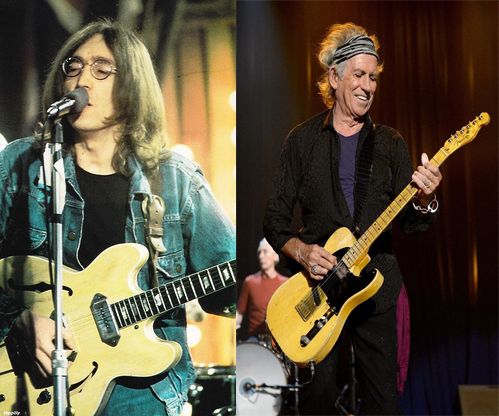
John Lennon’s Epiphone Casino and Keith Richard’s “Micawber” … + Bonus!

Image result for john lennon with casino

John was best best known for two guitars. His Rickenbacker 325 and this Epiphone Casino.

In 1964 Paul McCartney bought a 1964 Epiphone Casino and he would end up using on songs like Taxman and Paperback writer. In 1966 John Lennon and George Harrison would buy 1965 Casino’s for themselves.

John’s was a double-cutaway semi-hollow f-hole body, P-90 pickups, vintage tuners with small buttons, trapeze tailpiece and originally a sunburst finish. However, after hearing from Donovan Leitch that a guitar would sound better without a heavy finish, he decided to sand the paint off the instrument, leaving it with a natural wood finish.

John played this guitar on the White Album and Abbey Road. He continued to play it many times for the rest of his career.

Lennon was never a “gear” head. He was known as an impatient man and would just plug in and go. Rick Nielsen of Cheap Trick said he played around with the famous Rickenbacker at the Double Fantasy recording session but John didn’t play it on that album because it was in such bad shape. Rick said “the set list from Shea Stadium was still scotch-taped to the back of the guitar”…he said it was almost unplayable. It had rusty strings.

This video is about an Epiphone newer Casino model that was released it was inspired by Lennon’s guitar.

CUToday.info Member Bonus Total To Date Tops $114-Million

Bonus Guitar…John Lennon’s Sardonyx guitar 

John Lennon's Weirdest Guitar: The Sardonyx | John lennon guitar, Beatles  george harrison, Beatles george

This is a “Bonus” guitar…the one John Lennon used on the Double Fantasy recordings. One of the oddest guitars I’ve ever seen. It is a Sardonyx guitar made in the seventies. It had built in effects and the rails acted as a guitar stand.

John Lennon bought this guitar from Matt Umanov’s guitar shop in Manhattan’s West Village… which is the shop where Jeff Levin sold many of his guitars through. Ken Schaffer actually sold most of them. Ken sold Jeff’s guitars to Ian Hunter, Howard Leese, Jeff Lynn, Pappy Castro, and a couple bass models to Phil Lynott and Bootsy Collins. It was Ken who sold John Lennon his Sardonyx, directly.

It’s not famous but it was so odd I had to include it.

John Lennon's Weirdest Guitar: The Sardonyx | GuitarPlayer

Ken Schaffer: Months after John bought the guitar, I got a call from John’s personal assistant, who asked me to come to the Dakota. John had been impressed by the electronics I‘d stuffed into the Sardonyx, and asked to retain me to design the kill-all stereo he had in mind for the new apartment in the Dakota. In the small bedroom, which was to be Command Central for the system, hung above and behind the bed, vertically — the Sardonyx! MY Sardonyx! (Tears were welling up) … “Fred – you mean – John is using my guitar as a ($#%$&%*$) WALL ORNAMENT?!” Fred was John’s PA, and fought to settle me down, “No, man – wrong! He loves that guitar so much it hangs over his head when he’s sleeping!” (Tears dried) Whoa! And, in fact, there were pictures of this amazing guitar on the packaging of “Double Fantasy.” It was the guitar he used throughout.

Keith Richards’ Micawber

Keith Richards' Guitars and Gear – Ground Guitar

Micawber is a Butterscotch early fifties Telecaster Blackguard that Keith got around the recording of Exile on Main Street. The guitar was given to him by no other than Eric Clapton as a birthday present.

After the 1972 tour, Keith’s tech at the time, Ted Newman Jones III, replaced the neck pickup with a 50’s Gibson PAF humbucker upside down and the bridge pickup with a pickup out of a Fender lap steel which he chose because it was as close as he could find to the pickups used in a Broadcaster

In the 80’s Keith gave the guitar the nickname “Micawber” after a character in a Charles Dickens novel. Micawber has been Keith’s go-to for any song using Open G tuning.

In the eighties then guitar tech Alan Rogan made more modifications…Sperzel locking tuners and a modified brass bridge in which the low E saddle is removed to accommodate his five-string tuning.

I have used this 5 string tuning before. You can play a lot of the Stones catalog with that 5- string opening G tuning.

***Thanks to run-sew-read for pointing out this song by Barclay James Harvest called John Lennon’s guitar. It would be about the Epiphone Casino.

From Songfacts….Barclay James Harvest guitarist John Lees wrote this song. On the original recording of “Galadriel,” he played the Gibson Epiphone Casino that Lennon had played during the Beatles’ last ever live performance, in January 1969. This song describes that experience

Chuck Berry – Run Rudolph Run

Nice little Christmas song by the father of Rock and Roll Chuck Berry.  The song has a “Carol” vibe to it and that is never a bad thing.  It was one of the first rock and roll Christmas songs and it was released in 1958.

Berry based this song on “Rudolph The Red-Nosed Reindeer,” giving Rudolph a bit of an attitude as he delivers the toys. The song is credited to Johnny Marks and Marvin Brodie. Johnny Marks wrote Rudolph the Red Nose Reindeer.  Chuck puts his stamp on this song. 

The song is sometimes known as “Run Run Rudolph,” which is how it appears on some other covers. Other artists to record the song include Sheryl Crow, Bryan Adams, The Grateful Dead, Jimmy Buffett, Dwight Yoakam, Bon Jovi and Keith Richards.

The song peaked at #69 in the Billboard 100 in 1958 and has re-charted many times through the years…it peaked at #36 in the Billboard 100 in January of 2020…and I’m sure it is charting now.

The song appeared in a lot of films including Home Alone, Diner, The Santa Clause 2, Cast Away and Jingle All the Way.

Run Rudolph Run

Out of all the reindeers you know you’re the mastermind
Run, run Rudolph, Randalph ain’t too far behind
Run, run Rudolph, Santa’s got to make it to town
Santa make him hurry, tell him he can take the freeway down
Run, run Rudolph ’cause I’m reelin’ like a merry-go-round

Said Santa to a boy child what have you been longing for?
All I want for Christmas is a rock and roll electric guitar
And then away went Rudolph a whizzing like a shooting star
Run, run Rudolph, Santa’s got to make it to town
Santa make him hurry, tell him he can take the freeway down
Run, run Rudolph, reeling like a merry-go-round

Run, run Rudolph, Santa’s got to make it to town
Santa make him hurry, tell him he can take the freeway down
Run, run Rudolph, reeling like a merry-go-round

Said Santa to a girl child what would please you most to get?
A little baby doll that can cry, sleep, drink and wet
And then away went Rudolph a whizzing like a Saber jet
Run, run Rudolph, Santa’s got to make it to town
Santa make him hurry, tell him he can take the freeway down
Run, run Rudolph ’cause I’m reelin’ like a merry-go-round

AC/DC – Girls Got Rhythm

This one and Highway to Hell are two of my favorite AC/DC songs. The Rolling Stones could have written this song.  Great riff and great singing by Bon Scott. The song was written by Bon Scott and Malcolm and Angus Young. I’m going to turn 12 year…this song just plain out rocks!

Years ago I would never pay the Bon Scott era much attention…now it’s rapidly becoming my favorite of the band. That is not a knock on Brian Johnson. Both have one of a kind voices but I like the writing in the Bon era a lot. 

This was on their 1979 Highway To Hell album. It was their largest album to this point. It setup their next album Back in Black to be huge.

Highway To Hell was the first AC/DC album produced by Mutt Lange, who worked the band very hard and tried new techniques that made the band’s sound more appealing to the masses without softening their sound. He helped Bon Scott with sharpening his vocals along with Angus Young’s solos.

Lange was an up-and-coming producer at the time, but he would soon become a superstar, launching into the stratosphere with AC/DC’s next album, Back In Black. 

Highway to Hell peaked at #17 in the Billboard 100, #40 in Canada, and #8 in the UK in 1979.

The band also would launch into superstar status with their next album but sadly Bon Scott wasn’t part of it. He would die alone in a car Febrary 19, 1980. The official cause was listed on the death certificate as “acute alcohol poisoning” and classified as “death by misadventure.”

His grave site has become a cultural landmark; more than 28 years after Scott’s death, the National Trust of Australia declared his grave important enough to be included on the list of classified heritage places.[33][37] It is reportedly the most visited grave in Australia. 

From Songfacts

This lascivious rocker is one of the last tunes written by lead singer Bon Scott, who died six months after the album was released. It’s a classic Bon Scott lyric, as he finds myriad ways of explaining how his woman satisfies him, all while keeping the title squeaky clean and radio-friendly. It was released as a single in the UK and other parts of Europe, but didn’t chart. In America, the song did very well on stations with the Album Oriented Rock (AOR) format.

Note that there is no apostrophe in the title, which implies multiple girls having rhythm. The lyric suggests that an apostrophe is necessary, as Scott is singing about one specific girl, but it’s not likely that anyone challenged his grammar.

Girls Got Rhythm

I’ve been around the world
I’ve seen a million girls
Ain’t one of them got
What my lady she’s got

She’s stealin’ the spotlight
Knocks me off my feet
She’s enough to start a landslide
Just a walkin’ down the street

Wearing dresses so tight
And looking dynamite
Enough to blow me out
No doubt about it can’t live without it

The girl’s got rhythm (girl’s got rhythm)
She’s got the backseat rhythm (backseat rhythm)
The girl’s got rhythm

She’s like a lethal brand
Too much for any man
She gives me first degree
She really satisfies me

Love me till I’m legless
Aching and sore
Enough to stop a freight train
Or start the Third World War

You know I’m losin’ sleep
I’m in too deep
Like a body needs blood
No doubt about it, can’t live without it

The girl’s got rhythm (girl’s got rhythm)
She’s got the backseat rhythm (backseat rhythm)
The girl’s got rhythm

You know she moves like sin
And when she lets me in
It’s like liquid love
No doubt about it, can’t live without it

The girl’s got rhythm (girl’s got rhythm)
She’s got the backseat rhythm (backseat rhythm)
The girl’s got rhythm (girl’s got rhythm)

You know she really got the rhythm (girl’s got rhythm)
She’s got the backseat rhythm (backseat rhythm)
Rock ‘n’ roll rhythm (rock n roll rhythm)
The girl’s got rhythm

https://en.wikipedia.org/wiki/Bon_Scott

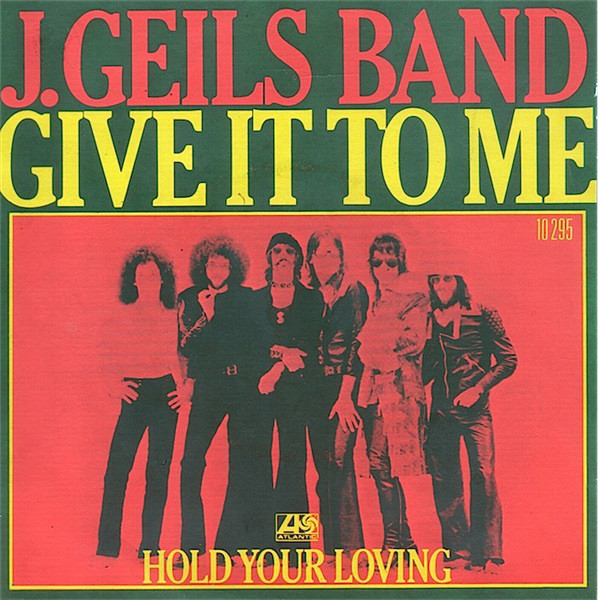
J Geils Band – Give It To Me

I would put Peter Wolf up with the best live front men in rock.

The J Geils Band sounded a bit different in the seventies. They had their biggest hits in the ’80s with “Freeze-Frame” and “Centerfold,” but that was the culmination of a long career that included lots of blues-based boogie music like this track.

This song peaked at #30 in the Billboard 100 and #39 in Canada in 1973. The song was on the album Bloodshot and peaked at #10 in the Billboard Album Charts and #17 in Canada. 

Peter Wolf wrote the song with the group’s keyboard player Seth Justman.

While the band was experiencing the greatest commercial success of its career and preparing a follow-up to Freeze Frame…the two main songwriters Wolf and Justman were not getting along. The band refused to record material Wolf had written with other writing partners…so Wolf left in 1983.

The band wanted to go in a more pop direction while Wolf wanted to continue the more blues/rock path they were going . 

From Songfacts

One of the most popular J. Geils Band songs from the group’s early years, this one is unusually carnal, with Peter Wolf making it very clear in his vocal delivery what he’s asking for in “Give It To Me.”

“Give It To Me” was cut down to 3:07 for radio play, but the full version runs a healthy 6:32, with showcase spots for many of the band members. Seth Justman gets a long solo on organ, which is followed by a guitar spot by J. Geils (the group’s guitarist was the band’s namesake) and an extended harmonica solo by Magic Dick. The song became a concert favorite, and one that established the J. Geils Band as a great live act. The live version from their album Blow Your Face Out is the one many radio stations play, as it captures the energy of their shows.

Heineken beer used this in commercials in 2002.

Bill Szymczyk produced the Bloodshot album, which was recorded at the Hit Factory in New York City. Szymczyk would later produce the Eagles, including their albums On the Border and Hotel California.

Give It To Me

You’ve got to give it to me

You’re so slick now, know every trick now
You know I want it, I want it so bad
You know I need it, I can’t believe it
So come on baby, Please relieve it

Now you’ve been bugging me, Every night now
You say you want it, You want it right now
I can’t get to it, I can’t get through it
So come on baby, Please

You’ve got to get it up (give it up)

Why keep me cold
When it’s so warm inside
Come on baby
Your love is too good to hide

Led Zeppelin – Houses of the Holy

As with a lot of Zeppelin songs…it’s the riff…that riff is a beautiful thing. It’s not a complex one like Black Dog but it works.

Houses Of The Holy is the name of Led Zeppelin’s fifth album, released in 1973. This song was going to be on it, but they decided to hold it back and use it on their next album, Physical Graffiti. I never understood that…Page has said that the song didn’t fit with the Houses of the Holy album’s other songs.

The song supposedly refers to the spiritual feel of their concerts.

In order to create the layered guitar introduction and fade-out, Page used a Delta T digital delay unit.

Delta-T 102 - Lexicon Delta-T 102 - Audiofanzine

Despite being a fan favorite and about their shows, this was never performed live. For all you audiophiles out there…The squeak of John Bonham’s drum pedal can be heard about 3 minutes in.

The song was not released as a single… the album Physical Graffiti peaked at #1 in the Billboard Album Charts, Canada, and the UK in 1975. The song was written by Jimmy Page and Robert Plant. 

Houses of the Holy

Let me take you to the movies
Can I take you to the show
Let me be yours ever truly
Can I make your garden grow

From the houses of the holy, we can watch the white doves go
From the door comes satan’s daughter, and it only goes to show, you know

There’s an angel on my shoulder, in my hand a sword of gold
Let me wander in your garden and the seeds of love I’ll sow you know

So the world is spinning faster are you dizzy when you’re stoned
Let the music be your master will you heed the master’s call
Oh Satan and man

Said there ain’t no use in crying ’cause it will only, only drive you mad
Does it hurt to hear them lying?
Was this the only world you had? oh oh

So let me take you, take you to the movie
Can I take you, baby, to the show
Why don’t you let me be yours ever truly
Can I make your garden grow, you know

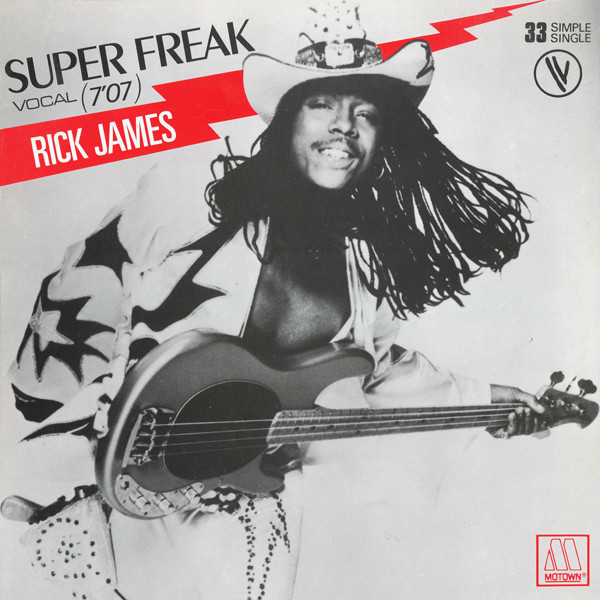
Rick James – Super Freak

NOT to be confused with the MC Hammer song U Can’t Touch Thiswho sampled this classic intro. MC Hammer sampled the famous bass line for his biggest hit, U Can’t Touch This. James filed suit against Hammer, which ended in an out-of-court settlement giving James a songwriting credit on the track.

This resulted in Rick James only Grammy Award when “U Can’t Touch This” won in 1991 for Best R&B Song….Life just isn’t fair.

Super Freak peaked at #16 in the Billboard 100, #40 in Canada, and #4 in New Zealand in 1981.

When James exclaims, “Blow, Danny!,” he’s talking to his sax player Daniel LeMelle just before his solo.

The song featured backup vocals by The Temptations.  You will hear James point it out in the song when he says: “Tempations sing.” Temptation member Melvin Franklin was Rick James’ uncle.

One story bout Rick James… He dodged the Vietnam War draft by heading across the Canadian border from his hometown of Buffalo. But as soon as he got into Toronto, three drunk guys tried to beat him up for going AWOL. Some other guys came over to help Rick out… Two of those guys were Garth Hudson and Levon Helm, then playing backup for Ronnie Hawkins…later The Band. He also became friendly with Joni Mitchell and she introduced him to Neil Young…Rick and Neil would soon form a band called the Mynah Birds.

Rick James: “I wanted to write a silly song. I was in the studio and everything else for the album (Street Songs) was done. I just put ‘Super Freak’ together really quickly. I wanted a silly song that had a bit of new wave texture to it. So I just came up with this silly little lick and expounded on it. I came up with the bass part first. Then I put a guitar on it and keyboards, doing the ‘ehh ehh,’ silly keyboard part. Then I found a tuning on my Oberheim OB-Xa that I’d been wanting to use for a long time – it sounds like ghosts. And I put a very operatic vocal structure on it ’cause I’m really into opera and classical music. You probably hear a lot of that in my music. So I put (sings in a deep voice) ‘She’s all right’; very operatic, sort of funny, stuff.”

From Songfacts

This song is about a girl who is very adventurous sexually, especially with members of a band. A “freak” is slang for someone willing to try various fetishes, thus a “Super Freak” will try just about anything. James was famous for his penchant toward “freakish” behavior, which got him in trouble with the law when he and his girlfriend were arrested for kidnapping another girl for sex.

Explaining how he came up with this song, James he told Musician magazine in 1983:

“Super Freak” was the biggest pop hit for Rick James, reaching #16 in the US. He had just modest success on the Hot 100 but had four #1 R&B hits and secured a legend as a prolific producer and innovator of funk. The big R&B hit from the album was “Give It to Me Baby”; “Super Freak” made #3.

This was released in the summer of 1981, around the time MTV went on the air. With director Nick Saxton, James made videos for “Give It To Me Baby” and “Super Freak,” hoping to get them on the network. At the time, however, MTV refused to play videos by black artists, and they rejected them, continuing to feed America a steady stream of rock and EuroPop. This refusal to play black music was a holdover from radio station programming, where conventional wisdom was that you would lose your white listeners if you played black music. The first black artist to make MTV with a new song was Musical Youth, who despite adapting a song about smoking marijuana, was a lot less scary to network executives than the glitter-vested James singing about kinky sex. This color barrier was shattered by Michael Jackson, who brought a new sound and sophistication to the network with the videos for his Thriller album.

Even though the network didn’t play this video, Rick James eventually made peace with MTV and put their co-founder, Les Garland, in the video for Eddie Murphy’s song “Party All the Time,” which James produced. As for exactly why MTV passed on “Super Freak,” their director of acquisitions, Carolyn Baker, explained in the book I Want My MTV: “It wasn’t MTV that turned down ‘Super Freak.’ It was me. I tuned it down. You know why? Because there were half-naked women in it, and it was a piece of crap. As a black woman, I did not want that representing my people as the first black video on MTV.”

Over the years, the word “freak” became very popular in hip-hop and R&B lyrics. It’s a versatile word that can be used as both a verb (“Freak Me”) and a noun (“The Freaks Come Out At Night”). Use of the word peaked in the mid-’90s with the phrase, “Get your freak on.”

The Dutch dance duo The Beatfreakz covered this in 2006. Their version reached #7 in the UK, the first time this song charted in Britain as Rick James original version wasn’t a hit there.

In the movie Little Miss Sunshine, the little girl Olive does a wonderfully inappropriate dance to this song in the Little Miss Sunshine pageant.

It also shows up in these movies:

A Madea Family Funeral (2019)
Love, Simon (2018)
Bohemian Rhapsody (2018)
Suicide Squad (2016)
Diary of a Wimpy Kid (2010)
Transformers: Revenge of the Fallen (2009)
Welcome Home, Roscoe Jenkins (2008)
Norbit (2007)
American Dreamz (2006)
Biggie and Tupac (2002)
Batman Returns (1992)
Doctor Detroit (1983)

And in these TV shows:

Scandal (“It’s Handled” – 2013)
The Simpsons (Treehouse of Horror XXIV – 2013; Treehouse of Horror X – 1999)
Ugly Betty (“Derailed” – 2007)
Two and a Half Men (“Squab, Squab, Squab, Squab, Squab” – 2005)
Gilmore Girls (“We Got Us a Pippi Virgin” – 2004)
King of the Hill (“Returning Japanese” – 2002)
Boy Meets World (“Shallow Boy” – 1996)
In Living Color (“The Black Man’s Guide to Understanding the Black Woman” – 1990)
The A-Team (“The Heart of Rock N’ Roll” – 1985) 

A Los Angeles DJ named Alonzo Miller is credited as a writer on this track along with James. Miller worked on the lyrics with James, helping tone them down so the song had a better chance of getting airplay and crossing over to a white audience. Miller was able to get the song played at the station where he worked, KACE.

Super Freak

She’s a very kinky girl,
The kind you don’t take home to mother;
She will never let your spirits down,
Once you get her off the street.

She likes the boys in the band,
She says that I’m her all time fav’rite;
When I make my move to her room,
It’s the right time; she’s never hard to please.

That girl is pretty wild now;
The girl’s a super freak;
The kind of girl you read about
In the new wave magazines.
That girl is pretty kinky;
The girl’s a super freak;
I’d really like to taste her
Ev’ry time we meet.
She’s all right; she’s all right;
That girl’s all right with me yeah.
She’s a super freak, super freak,
She’s super freaky; super freak, super freak.

She’s a very special girl,
From her head down to her toenails;
Yet she’ll wait for me at backstage with her girlfriends,
In a limousine.

Three’s not a crowd to her, she said;
“Room 714, I’ll be waiting.”
When I get there she’s got incense, wine and candles;
It’s such a freaky scene.

That girl is pretty wild now;
The girl’s a super freak;
The kind of girl you read about
In the new wave magazines.
That girl is pretty kinky;
The girl’s a super freak;
I’d really like to taste her
Ev’ry time we meet.
She’s all right; she’s all right;
That girl’s all right with me yeah.
She’s a super freak, super freak,
She’s super freaky; super freak, super freak.
Temptations sing; oh, super freak,
Super freak, the girl’s a super freak; oh.

She’s a very kinky girl,
The kind you don’t take home to mother;
She will never let your spirits down,
Once you get her off the street.

Donnie Iris – Ah! Leah!

This song I first heard and viewed on MTV. I didn’t hear it on radio a lot but I liked it. It was in a heavy rotation on MTV and the song was undeniably catchy.

Donnie Iris (Dominic Ierace) was a member of The Jaggerz, who had a hit in 1970 with “The Rapper.” He later became a member of Wild Cherry, where he met keyboard player Mark Avsec, and the two formed a musical partnership.

Donnie Iris and Mark Avsec wrote this song. It peaked at #29 in the Billboard 100 and #6 in Canada in 1981.

One way Iris got his sound was vocal stacking. The backups was overdubbed close to 60 times. They spent days in the studio just working on the backup vocals.

Iris and Avsec released their last studio album in 2010.

Donny Iris: “Mark and I wrote that together in my basement, around the piano, and originally Mark had the idea of an anti-war song. It started out just as a chant – it’s not a chick’s name, it’s not a certain person or individual, in particular. We wanted to have a hook, or a chorus, to the tune, that sounded almost like a Gregorian chant, and somehow Mark came up with the ‘Ah, Leah’ just like a chant. I said, ‘You know what, Mark, that’s a chick’s name,’ so that’s how we named it ‘Ah, Leah.’ It just so happens that there was a girl by the name of Leah who had dated one of the guys in The Jaggerz years ago, and I always loved that name. She was a very pretty girl, and I always loved her name. So instead of a war tune, which we messed around with and messed around with and didn’t have anything in there that we liked to make it an anti-war song, it just turned out as being a love song. It was a total change in direction, and that happened with several of our songs. We were coming up with stuff and, you know, sometimes you just do something and in the end you hate it. That’s what happened. We hated that… the way it was coming out as an anti-war song, and when we finally figured it was a nice way to do a love song, then we were happy with it.”

From Songfacts

Iris: “It sounds kind of passionate, when you talk about not being able to be with a chick, and every time you see this girl, you just go nuts, but it ain’t right, you know, something’s wrong with it. We thought that it was a passionate kind of tune.”

Iris credits the songwriting of Mark Avsec as key to their success. He explains how they come up with their songs: “We’ll go into the studio and put down rhythm tracks, and sometimes we’ll get together for 3 or 4 days and put down 15-20 different tracks of musical pieces. Then the group goes home, and Mark will take the songs home, write the lyrics, and we’ll check it out. If we like it, we’ll keep it if we think it’s good. If not, we’ll maybe go for another lyric, or a different track, but he’s unbelievable that way – just a brilliant songwriter, it’s like he does it in his sleep. And he brings them into the studio, and I’ll sit down, I’ll go over it with him, and together we’ll work out the melodies and stuff.” (Thanks to Donnie Iris for speaking with us about this song. In 2006, he released Ellwood City, which is available on donnieiris.com. Check out our interview with Donnie Iris.)

Ah! Leah!

Leah
It’s been a long, long time
You’re such a sight
You’re looking better than a body has a right to
Don’t you know we’re playing with the fire
But we can stop this burning desire
Leah

Ah! Leah!
Here we go again
Ah! Leah!
Is it ever gonna end?
Ah! Leah!
Here we go again
Ah! Leah!

I see your lips
And I wonder who’s been kissing them
I never knew how badly I was missing them
We both know we’re never going to make it
But when we touch
We never have to fake it
Leah

Ah! Leah!
Here we go again
Ah! Leah!
Is it ever gonna end?
Ah! Leah!
Here we go again
Ah! Leah!
We ain’t learned our lesson yet

Baby, it’s no good
We’re just asking for trouble
I can touch you
But I don’t know how to love you

It ain’t no use
We’re headed for disaster
Our minds said no
But our hearts were talking faster
Leah

Ah! Leah!
Here we go again
Ah! Leah!
Here we go again
Ah! Leah!
Leah, Leah, Leah
Ah! Leah!
Here we go again

Ah! Leah!
Leah
We’re never, ever, ever gonna make it, yeah
Ah! Leah!
Here we go again
Ah! Leah!
We’re never gonna make it
Ah! Leah!

Band – Ophelia

I believe I could listen to Levon sing anything. He makes a song feel like that old shirt with holes that fits perfectly that your wife wants to hide or throw away. You keep going back to it to wear it triumphally.

This was inspired by the Shakespeare play Hamlet.

The most famous Ophelia is a character in Shakespeare’s play Hamlet. She is caught between her love for Hamlet and the wishes of her father, Polonius, who uses her to spy on Hamlet. She feels she has no control of her life and descends into madness, eventually drowning after falling out of a tree into a brook.

It was on the album Northern Lights – Southern Cross released in 1975. It peaked at #26 in the Billboard Album Charts and #27 in Canada in 1976.

It wasn’t a huge hit but the song peaked at #62 in the Billboard 100 in 1976…

Robbie Robertson: There was another tune I was anxious to spring on Levon because I thought it had his name written all over it. The song dealt with the mysterious disappearance of Ophelia, and I had an old-timey-type chord progression to go with a whole new spin on the story. I liked having a modern-day Shakespearean character that Hamlet couldn’t get, and neither could I. Ophelia—they don’t have names like that anymore, or maybe they do in Denmark. I loved the way the track felt after we cut it. The combination of horns and keyboards Garth overdubbed on this song was one of the very best things I’d ever heard him do. It was definitely the cherry on the cake, and completed this musical odyssey. “Ophelia” became my favorite track on the album, even if it didn’t have the depth of some of my other songs. The pure, jubilant pleasure of that tune swayed me.

Band biographer Barney Hoskyns claims the song isn’t named for Shakespeare’s heroine, but for Hee Haw comedienne Minnie Pearl, whose real name was Sarah Ophelia Colley. I don’t know why Robbie just wouldn’t say that to begin with…he doesn’t seem to be a person that puts on airs.

From Songfacts

In this song The Band drummer Levon Helm sings about a woman named Ophelia who has skipped town. We know she left in a hurry and he would love to have her come back (“The old neighborhood just ain’t the same”), but we really have no idea who she is what her relationship is with the singer.

The song was written by the group’s guitarist Robbie Robertson, and the ambiguity was intentional. “I was always fascinated by that girl’s name,” he told Melody Maker in 1976. “I always like the mystery factor. I may be writing a song and the music may imply a certain lyric, or vice versa. It’s not that deliberate, or an intellectual exercise. It just comes out naturally.”

The character in this song could certainly be an analog to Shakespeare’s Ophelia, possibly driven mad by a lover.

A modest hit for The Band, this is a number they played at many of their shows, including their famous final show in 1976 that provided footage for the concert film The Last Waltz. In the film, we see Levon Helm belting it out from behind his drum kit.

This Ophelia has three syllables: “Oh-Feel-Ya,” giving it a rootsy sound. The more mannered pronunciation is “Oh-Feel-Ee-Ah,” which is how Tori Amos sings it in her Ophelia. In 2016, The Lumineers had a hit with a five-syllable Ophelia: “Oh-Oh-Feel-Ee-Ah.”

Artists to cover this song include Animal Liberation Orchestra, Jim Byrnes and My Morning Jacket. The Dead Ships played the song at a benefit concert in 2012 after Levon Helm passed away, and the following year released it as a free download on the one-year anniversary of Helm’s death.

In our interview with their frontman Devlin McCluskey, he talked about recording the song. “It was right after I came back from the funeral. We had a show in Pomona and we played this song. It’s got this big high note in it, and I can just remember pushing that so hard and being hit with this thing of, no matter how hard I go at it, no matter how hard I push for it, absolutely nothing is going to change. Nothing is going to bring him back.”

Ophelia

Boards on the window
Mail by the door
What would anybody leave so quickly for?
Ophelia
Where have you gone?

The old neighborhood just ain’t the same
Nobody knows just what became of
Ophelia
Tell me, what went wrong

Was it something that somebody said?
Mama, I know we broke the rules
Was somebody up against the law?
Honey, you know I’d die for you

Ashes of laughter
The ghost is clear
Why do the best things always disappear
Like Ophelia
Please darken my door

Was it something that somebody said?
Mama, I know we broke the rules
Was somebody up against the law?
Honey, you know I’d die for you

They got your number
Scared and running
But I’m still waiting for the second coming
Of Ophelia
Come back home

REM – Orange Crush

This song is for Song Lyric Sunday for Jim Adams’s blog. This week’s prompt is  Apple/Banana/Cherry/Olive/Orange/Strawberry… I hope all of you have a wonderful Sunday!

I really liked REM when this came out but with this album I became a huge fan. The song was off of their album Green. Orange Crush peaked at #1 in the Billboard Alternative Charts and Mainstream Rock Hits, #28 in the UK, and #5 in New Zealand in 1989. (sorry I could not find Canada)

Orange Crush was my favorite soda growing up but this one is not about that. They got this name from Agent Orange…an awful chemical used in the Vietnam war.

Agent Orange was used to devastating effect during the Vietnam war. A toxic mix of herbicides and defoliants, nearly 20 million gallons of the it was sprayed over forested areas by the US military over a nine-year period up to 1971.

The idea was to root out guerrillas from rural communities and force people into American-controlled urban cities. It’s estimated that 400,000 were killed or maimed and it caused 500,000 children to be born with severe defects. Veterans on both sides of the conflict, meanwhile, have shown increased rates of cancer and nerve disorders. Returning US soldiers were also subject to accelerated instances of their wives having miscarriages or infants born with abnormalities.

The song was credited to all members of REM as were their other songs. The drill sergeant heard in the background during the middle is an imitation by Stipe.

Michael Stipe: “The song is a composite and fictional narrative in the first person, drawn from different stories I heard growing up around Army bases. This song is about the Vietnam War and the impact on soldiers returning to a country that wrongly blamed them for the war.”

Guitar Player Peter Buck: “I must have played this song onstage over three hundred times, and I still don’t know what the f*** it’s about. The funny thing is, every time I play it, it means something different to me, and I find myself moved emotionally. [Playwright/composer] Noel Coward made some remark about the potency of cheap music, and while I wouldn’t describe the song as cheap in any way, sometimes great songwriting isn’t the point. A couple of chords, a good melody and some words can mean more than a seven-hundred-page novel, mind you. Not a good seven-hundred-page novel mind you, but more say, a long Jacqueline Susann novel. Well alright, I really liked Valley of the Dolls.”

From Songfacts

Orange Crush was an orange flavored soft drink. In this case, though, it was meant to refer to Agent Orange, a chemical used by the US to defoliate the Vietnamese jungle during the Vietnam War. US military personnel exposed to it developed cancer years later and some of their children had birth defects. The extreme lyrical dissonance in the song meant that most people completely misinterpreted the song, including Top Of The Pops host Simon Parkin, who remarked on camera after R.E.M. performed the song on the British TV show, “Mmm, great on a summer’s day. That’s Orange Crush.”

Stipe’s father served in Vietnam in the helicopter corps.

Stipe sometimes introduced this in concert by singing the US Army jingle, “Be all that you can be, in the Army.”

This was not the first R.E.M. song to deal with the Vietnam War. That distinction goes to “Body Count,” an early unreleased song that they played live many times.

This was used in the 2007 drama Towelhead, starring Maria Bello, Chris Messina and Summer Bishil.

The song’s meaning keeps changing for Peter Buck. He wrote in the In Time liner notes:

Orange Crush

(Follow me, don’t follow me)
I’ve got my spine, I’ve got my orange crush
(Collar me, don’t collar me)
I’ve got my spine, I’ve got my orange crush
(We are agents of the free)
I’ve had my fun and now it’s time
To serve your conscience overseas (over me, not over me)
Coming in fast, over me

(Follow me, don’t follow me)
I’ve got my spine, I’ve got my orange crush
(Collar me, don’t collar me)
I’ve got my spine, I’ve got my orange crush
(We are agents of the free)
I’ve had my fun and now it’s time
To serve your conscience overseas (over me, not over me)
Coming in fast, over me

(Follow me, don’t follow me)
I’ve got my spine, I’ve got my orange crush
(Collar me, don’t collar me)
I’ve got my spine, I’ve got my orange crush
(We are agents of the free)
I’ve had my fun and now it’s time
To serve your conscience overseas (over me, not over me)
Coming in fast, over me

Famous Rock Guitars Part 3

Now we continue our quest of famous guitars and the artists cherish them… Here was Part 1  and Part 2.

Bruce Springsteen and  Neil Young’s guitars

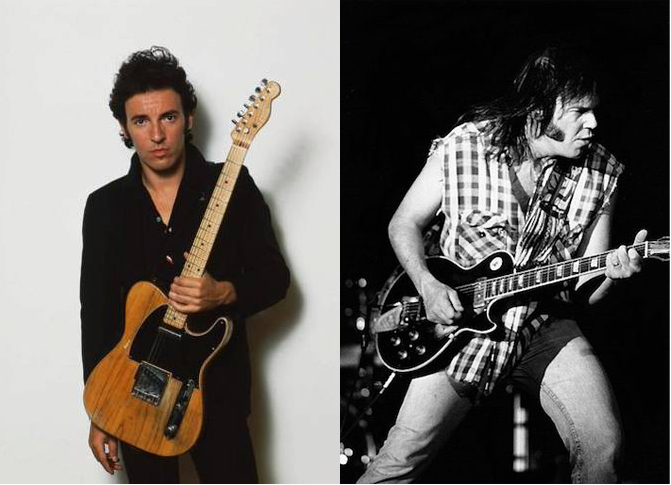
Bruce Springsteen’s Guitar

Bruce has stuck with this guitar from the first album until now. You see this guitar on his Born to Run album. When I saw him in 2000 he was playing it. Bruce bought this in 1972 in Phil Petillo’s Neptune New Jersey guitar shop for $185. Now the guitar  is said to be worth between $1 million and $5 million…pretty good investment Bruce!

The guitar is a composite assembled from parts from at least two other Fender guitars. The bolt-on neck dates from a 1950s Fender Esquire guitar. The Esquire decal on the headstock indicates that the neck came from the single-pickup variant of Fender’s more-popular two-pickup Telecaster. The body is a 1950’s Telecaster

The guitar had been originally owned by a record company and was part of the payola scams of the 1960s. It was rigged with four pickups wired into extra jacks that would each plug into a separate channel on the recording console.

Petillo removed the extra pickups and returned the guitar to original Telecaster shape before he sold it Springsteen, but a huge side effect of the routing was that the Tele was now really light, giving it a sound a feel unlike any other.

Bruce had Peillo modify it over the years. He added his  triangular Precision Frets, a six saddle titanium bridge, and custom hot-wound waterproofed pickups and electronics so they could better survive a sweat-soaked 4 hour show.

Bruce has now retired the Esquire from road duty, so these days Springsteen plays clones on stage, but still records with the original.

Neil Young’s “Old Black”

Neil Young is known mostly as a singer songwriter but he is a hell of a guitar player. He is one of my favorite rock guitarists. He doesn’t play lightning quick and that is a good thing…it’s playing with feel that many guitar players forget about.

Neil Young acquired Old Black in 1968 through a trade with Buffalo Springfield member Jim Messina, who traded Old Black for one of Young’s orange Gretsch guitars (Gretsch 6120 Chet Atkins).

The guitar made a humming sound so he dropped it off at a guitar shop in LA. When he came back, the shop had closed for good and lost one of the pickups. To replace the lost pickup, Neil added a Gretsh pickup that didn’t quite sound the way he wanted, but it stayed that way until Larry Cragg found an old Firebird pickup and installed it. Then Old Black was restored to its former glory and that Firebird pickup is still installed on the guitar today. It was roughly resprayed to jet black, and received a new Tune-o-matic bridge (not available when the guitar was produced) and a B-7 model Bigsby vibrato tailpiece.

The neck pickup has always been the original P-90 pickup, but it is covered by a metal P-90 cover. Neil is still playing Old Black to this day and he said he will until he dies.

Beatles – Get Back

John Lennon was primarily a rhythm guitar player but George Harrison briefly left the Beatles during the recording of Let It Be.  John took the lead guitar part on this song and made a memorable solo. John was a very aggressive guitar player and on this one he was on the mark.

McCartney got the idea for the title “Get Back” from the line “Get back to where you should be” from a song George Harrison wrote called “Sour Milk Sea,” which was eventually recorded by Jackie Lomax. McCartney changed the line to, “Get back to where you once belonged”.

Early versions include the line “I dig no Pakistanis.” The song began as a commentary about immigration, telling people to “get back” to their own countries. It was meant to mock Britain’s anti-immigrant proponents. Paul McCartney, who wrote the song and sang lead, thought better of it and made the lyrics more palatable.

At the end of this album version, we hear cheering, followed by McCartney saying, “Thanks Mo” in response to Ringo’s wife, Maureen, who was clapping. Lennon then says, “I’d like to say thank you on behalf of the group and ourselves, and I hope we’ve passed the audition.” This part came from the live rooftop performance.

This song went number 1  everywhere. #1 in the  Billboard 100, Canada, UK, New Zealand, The UK, Australia, Austria, Belgium, Ireland…and so on. The B side was Don’t Let Me Down…which personally I like more.

From Songfacts

“Get Back” was going to be the title of the album and the documentary film about making it. The Beatles stopped touring in 1966 and were worn thin by 1968, but they rekindled their passion for performance after shooting the “Hey Jude” promotional film in September that year before a live audience. Energized by the effort, they agreed to the documentary; the concept was The Beatles “getting back” to their roots and playing new songs for a live audience without any studio tricks.

The song “Get Back” came closest to capturing that spirit. Produced by George Martin, it was released as the follow-up single to “Hey Jude” in April 1969 (a month later in America) and was another blockbuster for the group, going to #1 in most territories.

The album became something completely different from the live set they planned. Glyn Johns, who engineered the sessions, was asked to put it together from what were really rehearsal tapes. After he assembled the album, it sat around while the Let It Be documentary was being edited from the film footage of The Beatles rehearsing in the studio and playing on the rooftop. During this time, The Beatles made the Abbey Road album, released it, and broke up.

Phil Spector, who had worked on John Lennon’s solo song “Instant Karma” (which George Harrison played on), was brought in to produce the Get Back album, which was re-titled Let It Be. Spector took the tapes and added orchestrations using his “Wall Of Sound” technique, and the album that was supposed to be the raw sound of The Beatles returning to their roots was released as a highly produced swan song on May 8, 1970, after they had broken up.

The Beatles famously performed this song from the rooftop of Apple Records on January 30, 1969, footage of which serves as the climax to their Let It Be documentary film. Knowing it would get shut down pretty quickly, the group kept mum about the performance, which was designed to promote the single and provide an ending for their film. They got in three takes of “Get Back” before police pulled the plug. The plan worked: Not only did they get their film ending, but the audio (including their banter) was used on various edits of “Get Back” to give it a live feel and add some character.

In their early days, The Beatles were musical warriors, playing in clubs for hours most nights. The “Get Back” single harkened to those days and was advertised as “The Beatles as nature intended.”

The single version runs 3:11 and contains a false ending at 2:34, after which McCartney comes back with a spoken verse:

“Get back Loretta, your mummy’s waiting for you, wearing her high-heeled shoes and her low-neck sweater, get back home, Loretta.”

The album version is a little shorter (3:09) and omits this section. It begins with a behind-the-scenes bit from the band tuning up during a session for the song on January 27, 1969. We hear John Lennon poke fun at the first line (“Jojo was a man who thought he was a loner, but he knew it couldn’t last”) by saying:

“Sweet Loretta fat she thought she was a cleaner, but she was a frying pan.”

Preston was a salve and a spark for the group. On January 10, 1969, George Harrison quit and almost left for good. He came back to work on January 21, but the tension lingered. Preston showed up the next day and galvanized the group; he played on “Get Back” and “Don’t Let Me Down,” and participated in sessions for several other tracks.

The Beatles met Preston in 1962 when they were both playing in Germany, but they hadn’t seen each other since. It was Harrison’s idea to bring him in; after George left the Let It Be sessions, he saw Preston in concert with Ray Charles and arranged for him to join The Beatles. Having him in the studio eased the tension and made it easier for the group to put personal conflicts aside and record the album.

The press release to promote the single contains this quote from McCartney: “We were sitting in the studio and we made it up out of thin air… we started to write words there and then… when we finished it, we recorded it at Apple Studios and made it into a song to roller coast by.”

Lennon claimed this was basically a rewrite of their 1968 song “Lady Madonna.”

Beatles fans found lots of hidden meaning in their lyrics, and sometimes the band did too. In his 1980 Playboy interview, John Lennon claimed that Paul looked at Yoko in the studio when he sang the line “get back to where you once belong.” John was sure he was disrespecting her.

There was speculation that the character “JoJo” was based on Joseph Melville See Jr., Linda McCartney’s first husband, who was from Tucson, Arizona. McCartney denied this, explaining in his 1988 autobiography Many Years From Now that he and Linda were on good terms with See, who used the first name Melville, and that “JoJo” was “an imaginary character, half-man and half-woman.”

Linda attended the University of Arizona in Tucson, and in 1979 she and Paul bought a ranch there. As for Joseph Melville See, he never remarried, and in 2000 he killed himself in Tucson.

Billy Preston’s piano solo was spontaneous. he told New Jersey’s Asbury Park Press in 2000: “I was playing a Fender Rhodes on ‘Get Back.’ They just told me, ‘Take a solo!’ I wasn’t expecting to do a solo. When we were rehearsing, I wasn’t playing a solo.”

The last version of the song The Beatles played on the Apple rooftop can be heard in the widely bootlegged “rooftop sessions,” which finds McCartney mocking the police as they shut them down. You can hear him ad-lib the lines “You been out too long, Loretta! You’ve been playing on the roofs again! That’s no good! You know your mommy doesn’t like that! Oh, she’s getting angry… she’ll have you arrested! Get back!”

An edited version of the rooftop performances was released on the Anthology 3 collection in 1996.

Some of the artists to cover this song include: The Bee Gees, The Crusaders, Dizzy Gillespie, Al Green, Elton John, The London Symphony Orchestra, The Main Ingredient, Nitty Gritty Dirt Band, Billy Preston, Kenny Rogers, The Royal Philharmonic Orchestra, The Shadows, Status Quo, Rod Stewart, Ike and Tina Turner, and Sarah Vaughan.

In 2003, Paul McCartney and Ringo Starr gave permission to Apple Records to rework the album and remove Phil Spector’s production. The result is the stripped-down version called Let It Be… Naked, which McCartney claims is what the group intended.

McCartney played this at halftime of the 2005 Super Bowl. This was the year after Janet Jackson’s breast was exposed during the halftime show, so the NFL insisted on an act that wouldn’t incite controversy or push the envelope. McCartney fit the bill.

Get Back

Jojo was a man who thought he was a loner
But he knew it wouldn’t last
Jojo left his home in Tucson, Arizona
For some California grass

Get back, get back
Get back to where you once belonged
Get back, get back
Get back to where you once belonged
Get back Jojo, go home

Get back, get back
Back to where you once belonged
Get back, get back
Back to where you once belonged
Get back Jo

Sweet Loretta Martin thought she was a woman
But she was another man
All the girls around her say she’s got it coming
But she gets it while she can

Get back, get back
Get back to where you once belonged
Get back, get back
Get back to where you once belonged
Get back Loretta, go home

Get back, get back
Get back to where you once belonged
Get back, get back
Get back to where you once belonged

Get back, get back
Get back to where you once belonged
Get back, get back, get back

AC/DC – It’s A Long Way To The Top (If You Wanna Rock ‘N’ Roll)

For my posts I have no system…no master plan…I just post randomly every day. I do have the occasional series but for the most part I keep it spontaneous. That sometimes leads to late nights frantically searching for songs  but it keeps it exciting…and me sleepy during the day.

I ran across this video from a seventies Australia TV show called “Bandstand” with Bon Scott fronting ACDC with bagpipes…I’m on board!!! I just had to post it. Bon was a good musician who could play drums, recorder, and a bit of bagpipes.

Angus and Malcolm’s older brother George suggested using bagpipes in this song. Bon Scott agreed despite having never played them before…Bon did play them on the recording and live until they were destroyed by fans.

This was an autobiographical song for AC/DC describing their struggles as they toured relentlessly trying to make it. At the time, they were just getting started and playing some seedy venues with even worse business associates. The band was sometimes labeled as a punk band…a label they hated. I have never thought of ACDC as a punk band…if you look on the single cover you will see “Original Punk Music.”

The song peaked at #9 in Australia in 1975. The song was written by Bon Scott with  Angus and Malcolm Young.

Brian Johnson said he will not sing this out of respect for Bon Scott.  Bon Scott’s band was opening for future lead singer Johnson’s band Geordie in the early 1970s. Bon Scott was impressed by Johnson’s performance and told his band about him.

Brian Johnson: “Bon Scott was up on stage singing, and we met and had a couple of beers. He watched us play, and God bless his cotton socks again, when he did join AC/DC he was talking to the boys and he did say something to the effect that the only rock singer that he’d seen that was worth a damn was me, which was really nice of him, and the boys never forgot that.”

Brian Johnson: “I think he embodied everything that was fun, everything that was like ‘never say die, live life to the full.’ And he had a terrible thing happen to him when he passed on. He wasn’t a wild, wild, wild man he was just as wild as the other boys were. He was just unlucky. We’ve all done stupid, dumb things where we’re young, but we got away with it. He didn’t. It was just one of them stupid things that shouldn’t have happened, and it was accidental and it was stupid. And I just won’t have a bad word said against him. We still talk about him like he’s a member of the band in the dressing room.”

From Songfacts

“It’s A Long Way To The Top” really summed us up as a band,” Angus Young told Rolling Stone. It was the audience that really allowed us to even get near a studio.

A study in contrast is the Boston song “Rock And Roll Band,” released in 1976. That song tells the story of a similar struggle, but it was completely made up: Boston was a studio act first and foremost and had immediate success with their first album.

According to Bon Scott’s biographer Clinton Walker, this tongue-in-cheek song “has become an anthem.” Heavy metal tracks are usually dominated by ego-tripping guitar solos; this song is unusual because instead of a lengthy guitar solo it features interplay between Angus Young on lead and Bon Scott on the bagpipes. Ronald Belford (Bonnie Scotland) Scott was born in Scotland – as were the Young brothers. The somewhat older Scott arrived in Australia with his family some 11 years before the Youngs emigrated; he learned recorder and drums, and was a proficient bagpipe player.

The song runs to 5 minutes 15 seconds, which is quite long for a single.

The band made a video to promote the single and the album. This was filmed on February 23, 1976 when they rode through the center of Melbourne on an open topped truck accompanied by three members of the Rats of Tobruk Pipe Band. The most noticeable feature of the video is that the vocalist was really enjoying himself, but, Walker adds, “it’s as if Bon acknowledges he’s living on borrowed time, and luckily at that.” It would not be such a long way to the top for AC/DC, but four years later almost to the day, it would all be over for Bon. On February 19, 1980 he was found dead on the back seat of a car in London, having literally drunk himself to death. 

In 2004, one of the streets in Melbourne near where this video was filmed was renamed “ACDC Lane” in honor of the band. The street was formerly known as Corporation Lane. 

Jack Black and the School of Rock band play a version of this at the end of the movie School of Rock. The interplay is between the singer and all the members of the band. 

It’s A Long Way To The Top (If You Wanna Rock ‘N’ Roll)

Ridin’ down the highway
Goin’ to a show
Stop in all the byways
Playin’ rock ‘n’ roll
Gettin’ robbed
Gettin’ stoned
Gettin’ beat up
Broken boned
Gettin’ had
Gettin’ took
I tell you folks

It’s harder than it looks
It’s a long way to the top
If you wanna rock ‘n’ roll
It’s a long way to the top
If you wanna rock ‘n’ roll
If you think it’s easy doin’ one-night stands
Try playin’ in a rock roll band
It’s a long way to the top
If you wanna rock ‘n’ roll

Hotel
Motel
Make you wanna cry
Ladies do the hard sell
Know the reason why
Gettin’ old
Gettin’ gray
Gettin’ ripped off
Underpaid
Gettin’ sold
Second-hand
That’s how it goes
Playin’ in a band

It’s a long way to the top
If you wanna rock ‘n’ roll
It’s a long way to the top
If you wanna rock ‘n’ roll
If you wanna be a star of stage and screen
Look out it’s rough and mean
It’s a long way to the top
If you wanna rock ‘n’ roll
It’s a long way to the top
If you wanna rock ‘n’ roll
It’s a long way to the top
If you wanna rock ‘n’ roll
It’s a long way to the top
If you wanna rock ‘n’ roll

It’s a long way
It’s a long way
It’s a long way
It’s a long way

Billy Squier – Christmas Is The Time To Say I Love You

If there ever was ever a year I was looking forward to Christmas…this is the one…This Christmas song that doesn’t get played a bunch here. I’ve always liked it since is was released. It was written by Billy Squier and was the B side to the single “My Kinda Lover.”

In 1981 MTV made it’s debut and Billy Squier’s career was going strong with the 1981 release of the Don’t Say No album. MTV at the beginning had a more family atmosphere. The crowd in this sing-a-long included technicians, the secretaries, the executives, the production assistants.

The video was filmed at the Teletronics MTV studio.

 VJ Nina Blackwood: “It was taped at our original Teletronics Studio on West 33rd Street and featured our original studio crew, who we all loved and were very close to, along with all the people from the MTV offices,” “Everybody traipsed down to the studio from 44th Street & 6th Ave for the taping. Billy Squier’s career was on fire at this time, and since he lived in NYC, he was a frequent guest at the studio, so it was appropriate that he was chosen for the video.”

“Pretty much what you see on camera is an accurate representation of the celebratory and fun feeling that was happening,” Blackwood said. “It was like one big happy family, which sums up the entire vibe of the early days of MTV. One of a kind experience. When I watch all of these early MTV Christmas videos, the overwhelming sensation I come away with is that of joyous love.”

Christmas Is The Time To Say I Love You

Christmas is the time to say “I love you”
Share the joys of laughter and good cheer
Christmas is the time to say “I love you”
And a feeling that will last all through the year

On the corner carolers are singing
There’s a touch of magic in the air
From grownup to minor no one could be finer
Times are hard but no one seems to care
Christmas Eve and all the world is watching
Santa guides his reindeer through the dark
From rooftop to chimney, from Harlem to Bimini
They will find a way into your heart

Christmas is the time to say “I love you”
Share the joys of laughter and good cheer
Christmas is the time to say “I love you”
And a feeling that will last all through the year

Just outside the window snow is falling
But here beside the fire we share the glow
Of moonlight and brandy, sweet talk and candy
Sentiments that everyone should know
Memories of the year that lays behind us
Wishes for the year that’s yet to come
And it stands to reason that good friends in season
Make you feel that life has just begun

Christmas is the time to say “I love you”
Share the joys of laughter and good cheer
Christmas is the time to say “I love you”
And a feeling that will last all through the year

So when spirits grow lighter
And hopes are shinin’ brighter
Then you know that Christmas time is here