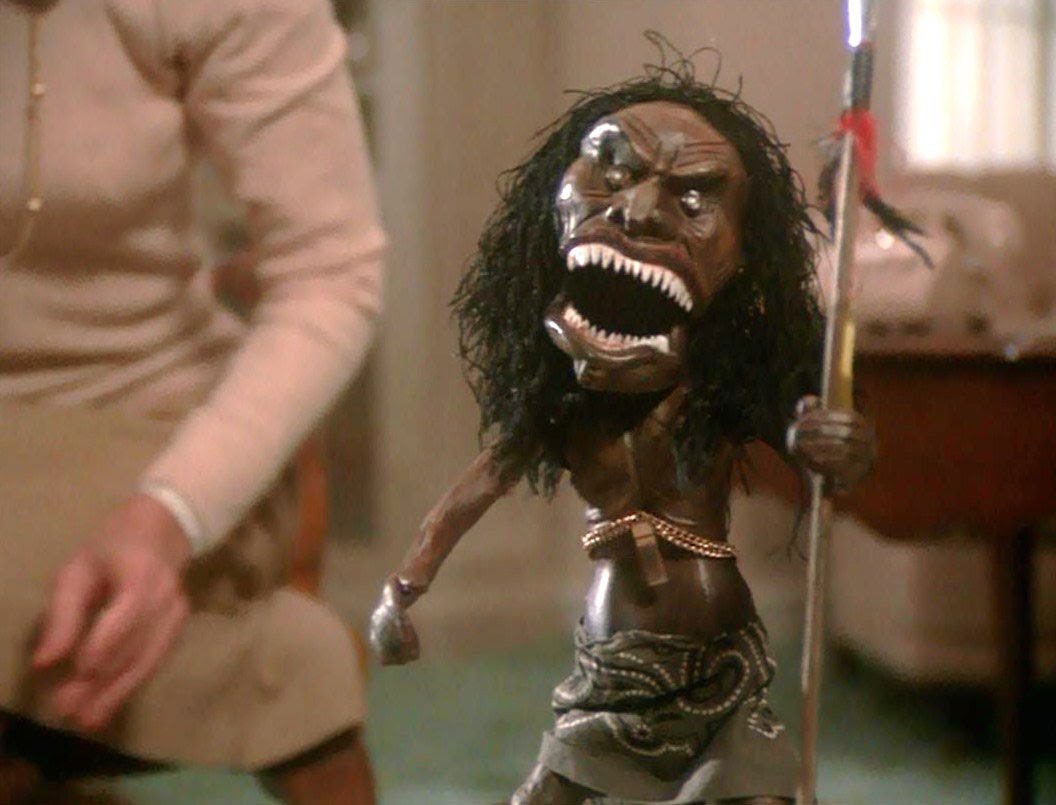
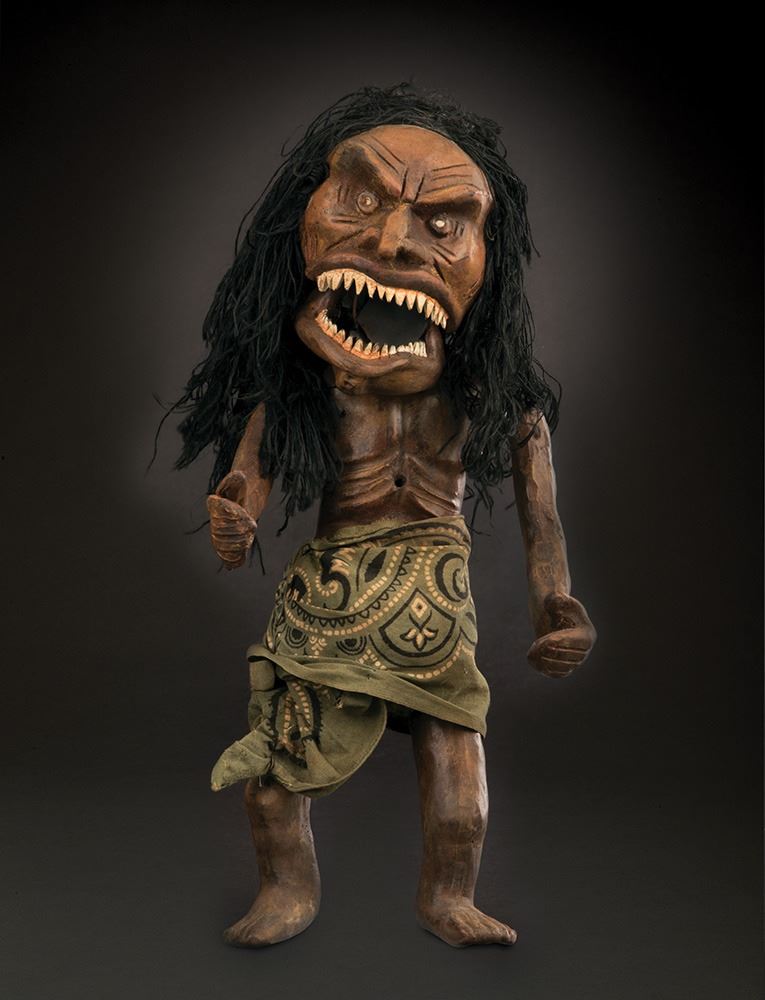
I did a few “Where is” posts a year or so ago and they were fun. I thought I would add this to the list. Most 1970s kids know this doll from the 1975 TV horror Trilogy of Terror. Karen Black starred and played 4 different charters in this horror anthology. Three stories are interwoven together. The first is about a college student infatuated with his teacher. The second is a paranoid tale of two sisters – one good, the other evil, and the third one is about a tribal doll that comes to life and terrorizes a woman in her apartment when it’s golden chain comes off.
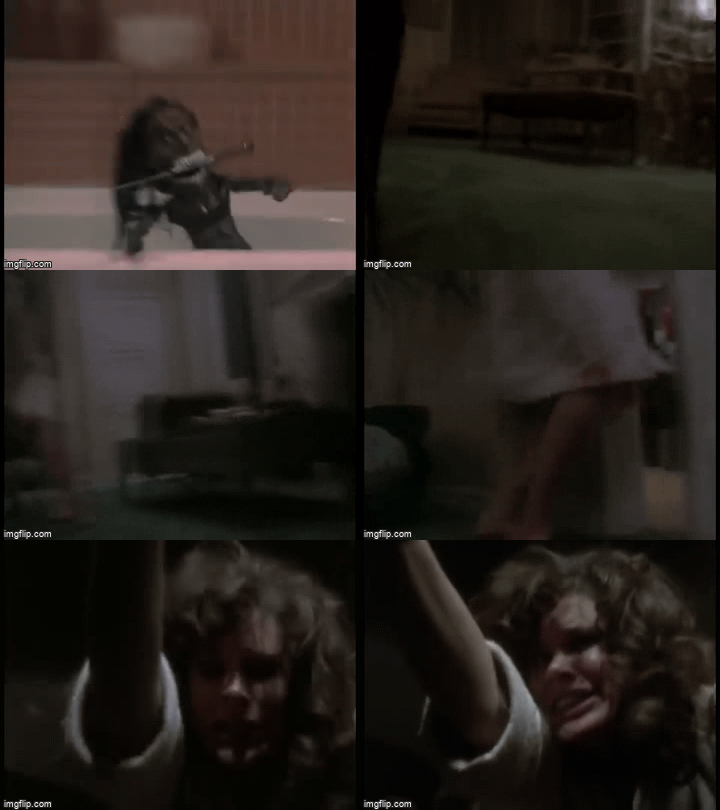
It’s the third one that most people remember although the first one is really good also. This doll terrorizes Karen Black’s character Amelia in her apartment and they did a good job on the special effects. They showed the doll just enough and not too much to make it look real. The story was based on Prey Prey written by the great Richard Matheson. In this presentation…this story is called Ameilia.
I watched this again for the 6th or 7th time and I wondered…did one of the dolls they used to film this survive? Yes, one survived and it was sold at auction. According to different sites… In 2019 when the Zuni doll went up for auction at “Profiles in History” a few years ago, it was expected to go for a price in the $12,000 to $15,000 range. Instead, it sold for more than $200,000! Including the buyer’s premium, the doll was purchased for a total of $217,600.
If you want one of these dolls (a copy of course) a little more affordable…you can get one on ebay. It would be a good conversation piece…just don’t turn your back on it.
ELVIS….otherwise known as The Big E, King Of Rock ’n‘ Roll, The Memphis Flash, The Jumpsuited One, The Vibrating Valentino, Ol ’Snake Hips, The Tennessee Troubadour, Mr. Sideburns, The Hillbilly Cat, The Cool Cat, or just EP. I think The Vibrating Valentino wins in the nickname department.
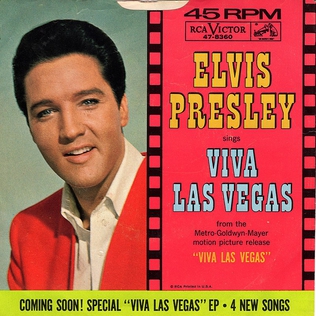
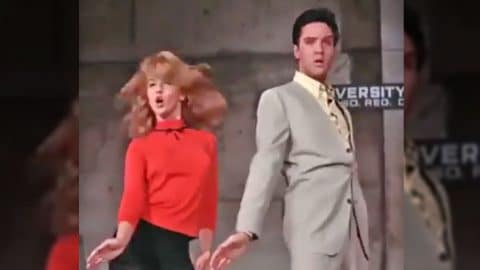
Viva Las Vegas was written by Doc Pomus and Mort Shuman as the title song for the film of the same name starring Elvis Presley…. better-known AS…no I won’t go through that again. Pomus and Shuman wrote several other songs for Presley as well. Among them: “Little Sister,” “Suspicion,” and “Surrender.”
In the movie, Elvis plays a race car driver who has to wait tables at a hotel in order to pay off a debt (no doubt to Colonel Tom Parker!). He performs this song at the hotel’s talent competition accompanied by various Vegas showgirls. Viva Las Vegas was the most successful of the 31 films Elvis starred in, returning more than $5 million to MGM Studios on an investment of less than $1 million.
I do remember this movie on TV. Why do I remember this Elvis movie more than others? No other than the co-star Ann-Margret.
The song peaked at #29 in the Billboard 100, #14 in Canada, #4 in New Zealand, and #17 in the UK in 1964. It did re-chart at #15 in the UK in 2007.
Billy Strange played guitar on this track. According to Strange’s son Jerry, musician’s royalties for the song came in for years thanks to slot machines that play the song.
The song was revived by ZZ Top, who took it to #10 in the UK, #16 in the Billboard Rock Charts, #34 in Canada, and #17 in New Zealand in 1992.
Everything that is famous about Las Vegas comes up in the song…such as roulette, neon, hot dice, pretty women, blackjack, one-armed bandits, and bright lights. The song has served as an advertisement for the city although having a small consolation for losing everything…If I wind up broke up well
I’ll always remember that I had a swingin’ time… Oh OK! A swinging time is worth it!
The Dead Kennedys also did a cover of the song…in their own unique way.
Viva Las Vegas
Bright light city gonna set my soul
Gonna set my soul on fire
Got a whole lot of money that’s ready to burn,
So get those stakes up higher
There’s a thousand pretty women waitin’ out there
And they’re all livin’ the devil may care
And I’m just the devil with love to spare, so
Viva Las Vegas, Viva Las Vegas
How I wish that there were more
Than the twenty-four hours in the day
Even if there were forty more
I wouldn’t sleep a minute away
Oh, there’s black jack and poker and the roulette wheel
A fortune won and lost on ev’ry deal
All you need’s a strong heart and a nerve of steel
Viva Las Vegas, Viva Las Vegas
Viva Las Vegas with you neon flashin’
And your one arm bandits crashin’
All those hopes down the drain
Viva Las Vegas turnin’ day into nighttime
Turnin’ night into daytime
If you see it once
You’ll never be the same again
I’m gonna keep on the run
I’m gonna have me some fun
If it costs me my very last dime
If I wind up broke up well
I’ll always remember that I had a swingin’ time
I’m gonna give it ev’rything I’ve got
Lady luck please let the dice stay hot
Let me shoot a seven with ev’ry shot, ah
Viva Las Vegas, Viva Las Vegas,
Viva Las Vegas, viva, viva Las Vegas
Welcome to the Hanspostcard TV Draft. I hope you will enjoy it! Today’s post was written by Liam at https://othemts.wordpress.com/
Opening Soon at a Theater Near You (1975–1977) – WTTW, Chicago
Sneak Previews (1977–1982) – PBS
At the Movies (1982–1986) – Syndication
Siskel & Ebert & the Movies (1986–1999) – Syndication
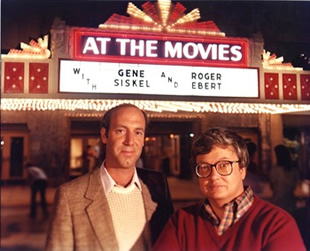
In 1975, WTTW-TV (the local PBS outlet for Chicago) brought together two film critics, Gene Siskel and Roger Ebert for a movie review show called Opening Soon at a Theater Near You. Siskel wrote film reviews for the Chicago Tribune starting in 1969 while Ebert began his career as a film critic at the Chicago Sun-Times in 1967. In 1975, Ebert became the first film critic to receive a Pulitzer Prize. This was a time when there was a heated rivalry between the two Chicago newspapers, and members of the small field of film criticism, there was a professional rivalry between Siskel and Ebert as well, bordering on animosity.
The show started off roughly as each critic attempted to assert their personality and get one over on their opponent (not to mention that neither one had much experience in front of a camera). Over time they gradually eased up and started having more of a conversation about the movies. Working together proved to be more effective inspiring one another with insights. Siskel and Ebert started to become friends in real life as well. Despite all of this, some of the best TV drama came when they disagreed and argued about a movie, but always with respect for their opponent as an individual.
After two seasons on WTTW, the show was retooled as Sneak Previews and broadcast nationally on PBS. The pair left PBS in 1982 for a syndicated show produced by Tribune Entertainment called At the Movies. In 1986, after a contract dispute, they created another syndicated show called Siskel & Ebert & the Movies (later shortened to Siskel & Ebert) produced by Walt Disney television. All the shows shared some common characteristics, reviewing a handful of new releases in each episode, with special episodes focusing on the Oscars, Siskel & Ebert’s best movies of the year, and a deep focus on the work of an individual artists. The shows ended with a roundup of the movies discussed with Siskel & Ebert each giving a thumbs up or thumbs down for each movie. “Two thumbs up” became a coveted phrase for movie promoters to include in their advertisements.
It’s unfortunate that the whole thumbs up/thumbs down thing became such a cultural touchstone, because Siskel & Ebert offered a much deeper appraisal of movies than that shorthand could ever offer. I found a website called Siskel & Ebert Movie Reviews where full episodes of the show have been uploaded. Watching some shows reminds me how deep they would go into their discussion of the films as well as sharing extended clips of the movies. It seems a foreign concept today when everyone is so worried about “spoilers,” but I remember going to the movies back in the 1980s knowing a whole lot about what I was going to see thanks to Siskel & Ebert, and it helped me enjoy the movies more.
Siskel & Ebert essentially democratized film criticism. When the show started in the 1970s, it was a time when foreign films were getting screened regularly in the U.S. for the first time, and older American movies were getting rereleased. Siskel & Ebert loved “highbrow” art movies, and promoted them on their show but never in a snooty manner. Instead they made these films more accessible to wider audiences. In the 1980s, home video made even more movies more widely available and the always included home media releases in their shows as well. The duo could also find great entertainment in “lowbrow” Hollywood movies and weren’t afraid to say what they liked and why they were still great movies. Of course, they also didn’t hold back on bad movies, and covered them in features like “Dog of the Week” with Spot the Wonder Dog barking an introduction.
Gene Siskel died of a brain tumor in 1999. A private man he did not share the extent of his illness outside his family so his sudden death took his partner Roger Ebert off guard. Ebert continued the show with rotating guest hosts for a time before partnering up with Richard Roeper from 2000 to 2008. Ebert was struck with cancer of the thyroid and salivary glands in 2002 and in 2006 had his lower jaw surgically removed. Always contrary to Siskel, Ebert was open to sharing his health problems with the public, particularly in the intimate documentary movie Life Itself. Unable to speak, Ebert continued to review movies in print, publishing them on his website RogerEbert.com until his death in 2013.
Love this song and movie. Back in 2018 my son and I caught the movie in an Art House movie theatre that is located in Nashville. It was cool seeing this 1972 movie on the big screen. On top of a great movie, we got to hear the Curtis Mayfield soundtrack with surround sound in the theater.
Quinten Tarantino was strongly influenced by this movie for Jackie Brown. The endings are very similar. This song popularized the word “fly,” which means unusual and exceptional, particularly when it comes to fashion.
Curtis Mayfield was working on the songs for the movie while it was shooting, and would often visit the set, bringing in demos so the cast and crew could hear how they would integrate into the film. He even appears in the movie, performing the song “Pusherman” in a bar scene.
After seeing the screenplay, Mayfield jumped into the project and was given complete creative freedom. He wrote the songs to suit the scenes, but he made sure they could stand on their own, telling the stories even without the visuals. “Superfly” works very well outside of the film, as the character Mayfield describes could relate to anyone trying to survive and thrive under difficult situations.
The song peaked at #8 in the Billboard 100 and #5 in the R&B Charts in 1972.
Curtis Mayfield:“It was a glorious moment for our people as blacks, Priest had a mind, he wanted to get out. For once, in spite of what he was doing, he got away. So there came ‘Superfly’ the song. He was trying to get over. We couldn’t be so proud of him dealing coke or using coke, but at least the man had a mind and he wasn’t just some ugly dead something in the streets after it was all over. He got out.”
Superfly
Darkest of night With the moon shining bright There’s a set goin’ strong Lotta things goin’ on The man of the hour Has an air of great power The dudes have envied him for so long
[Chorus] Superfly You’re gonna make your fortune by and by But if you lose, don’t ask no questions why The only game you know is Do or Die Ah-ha-ha
Hard to understand What a hell of a man This cat of the slum Had a mind, wasn’t dumb But a weakness was shown Cause his hustle was wrong His mind was his own But the man lived alone
[Chorus]
The game he plays he plays for keeps Hustlin’ times and ghetto streets Tryin’ to get over (That’s what he tryin’ to do, why’all) Taking all that he can take Gambling with the odds of fate Tryin’ ta get over [Repeat: x4] Woo, Superfly
The aim of his role Was to move a lot of blow Ask him his dream What does it mean? He wouldn’t know “Can’t be like the rest” Is the most he’ll confess But the time’s running out And there’s no happiness
When I became a Beatles fan way back when I was 8 years old…and up to my teenage years I hardly ever heard this one mentioned by people. I’ve seen its popularity grow through the years. My biggest problem with it is they should have spent more time on it. Lennon accused McCartney of subconsciously trying to destroy it. You could see Paul let out a big yawn while rehearsing in the Let It Be film but that probably had more to do with him being tired after hours of playing in a studio…but maybe Lennon had a point.
One of the reasons John got upset with Paul was because instead of getting professional backup singers or a choir…Paul went out the Abbey Road door and grabbed two “Apple Scruffs” to sing backup on the song. That version did not go on the Let It Be album, however. That version was on a charity album.
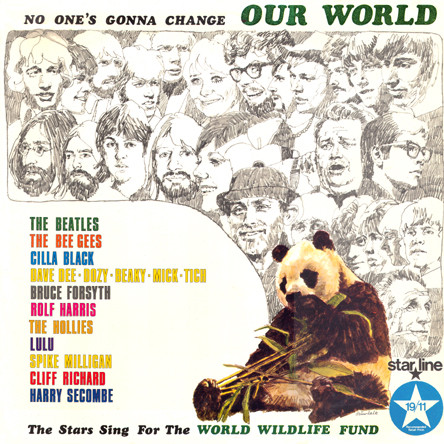
This first appeared on No One’s Gonna Change Our World, a 1969 charity album for the World Wildlife Fund. Bird noises were dubbed into this version to create a nature theme. It didn’t sound too bad.
When I bought the Let It Be album it took a few listens but soon this one intrigued me. The lyrics alone are enthralling because of the imagery. Since I first heard it, the song has taken on huge popularity.
It even had a movie that was made around its title and worked around Beatle lyrics in 2007. That alone boosted its popularity.
I always wondered about the Jai guru deva om phrase. “Jai guru deva, om” translates to “hail to the Heavenly Teacher” or “I give thanks to Guru Dev.” That was a mantra was invented by the Indian guru, Maharishi Mahesh Yogi – the late protégé of Guru Dev.
On February 4, 2008 “Across The Universe” became the first track to be beamed directly into space. It was transmitted through NASA’s antenna in the DSN’s Madrid Deep Space Communication Complex, towards the North Star, Polaris, 431 light-years from Earth. The broadcasting of the Beatles song was done to mark both NASA’s 50th birthday and the 40th anniversary of Across The Universe. Paul McCartney described the transmission as an “amazing feat” adding, “Well done, NASA. Send my love to the aliens!”
David Bowie also did a good version of this song. Liam Gallagher has cited this song as a huge influence on him starting to write songs.
John Lennon: “I was lying next to me first wife in bed, and I was irritated. She must have been going on and on about something and she’d gone to sleep and I kept hearing these words over and over, flowing like an endless stream. I went downstairs and it turned into sort of a cosmic song rather than an irritated song… it drove me out of bed. I didn’t want to write it, but I was slightly irritable and I went downstairs and I couldn’t get to sleep until I’d put it on paper.”
John Lennon: “It’s one of the best lyrics I’ve written. In fact, it could be the best.” He added: “It’s good poetry, or whatever you call it, without chewin’ it. See, the ones I like are the ones that stand as words, without melody. They don’t have to have any melody, like a poem, you can read them.”
John Lennon:“The Beatles didn’t make a good record of it. I think subconsciously sometimes we – I say ‘we’ although I think Paul did it more than the rest of us – Paul would, sort of subconsciously, try and destroy a great song… meaning we’d play experimental games with my great pieces, like ‘Strawberry Fields,’ which I always thought was badly recorded.”
The World Wildlife Fund
Across The Universe
Words are flowing out Like endless rain into a paper cup They slither wildly as they slip away across the universe Pools of sorrow waves of joy Are drifting through my opened mind Possessing and caressing me
Jai Guru Deva, Om Nothing’s gonna change my world Nothing’s gonna change my world Nothing’s gonna change my world Nothing’s gonna change my world
Images of broken light Which dance before me like a million eyes They call me on and on across the universe Thoughts meander like a Restless wind inside a letter box They tumble blindly as they make their way across the universe
Jai Guru Deva, Om Nothing’s gonna change my world Nothing’s gonna change my world Nothing’s gonna change my world Nothing’s gonna change my world
Sounds of laughter, shades of life Are ringing through my opened ears Inciting and inviting me Limitless undying love Which shines around me like a million suns It calls me on and on across the universe
Jai Guru Deva, Om Nothing’s gonna change my world Nothing’s gonna change my world Nothing’s gonna change my world Nothing’s gonna change my world
Jai Guru Deva Jai Guru Deva Jai Guru Deva Jai Guru Deva Jai Guru Deva
If you have the slightest bit of interest in documentaries or in silent movies, this is the series to watch. Not only is it a great wealth of info on the silent era…it’s one of the best documentaries I’ve ever watched. It is made up of 13 different one-hour sections. It’s quite a series at 676 minutes.
There is one misconception about silent films that most have. When you think of a silent film what do you think of? Some people think of the hard-to-see Keystone cops running about like they snorted Peru… that is NOT what most silent films looked like. They played at normal speed and the cinematography was breathtaking in many of them. They are as clear as any movie you will watch if the print has been taken care of or restored.
There was a problem with some prints after the silent era. The holes in the film were at a different gauge for the then-modern film projectors and they played them fast and transferred them fast…that meant everything was sped up.
This documentary is to the Silent Era what Ken Burns Civil War doc is to the Civil War. It starts with the pioneers of the movies to the very end when sound took over and changed and some people say ruined an art form. When movies were silent…they were international…no need for translations…just different text. The sound changed all of that and silent movies were at their height.
You get to know the great directors, actors, actresses, cameramen, stuntmen, and movie moguls.
They interviewed these ladies and gentlemen in the late seventies and it was many of their last appearances on film before they passed away. I’m thankful that Kevin Brownlow got this finished and we now have first-hand knowledge of films’ most exciting eras.
I do wish sound pictures would have been held off a few years. The studios weren’t ready for talking pictures. The first “talky” pictures were clumsy and still. The mics had to be placed in flower vases and other stationary places. The silent artists perfected the art of pantomime. Most had great quality (especially in the 20s) that looked better than movies 40 years later. One problem was with the early transfers from the films…now with Criterion and others cleaning up the transfers…we can watch these beautiful movies the way they were intended.
Just like today, you had your formula movies and your great movies. In my opinion, I think the best genre of silent movies is comedies. Not Keystone Cops…they are more like cartoons than films. For me, it would be Charlie Chaplin and Buster Keaton. They both had some of the most subtle and genius gags. Many of their gags have been copied to this day. There were others like Harry Langdon and Harold Lloyd that were popular.
I know it’s a big task BUT…if you like documentaries or silent movies…this series is worth it! Every episode is out there on youtube.
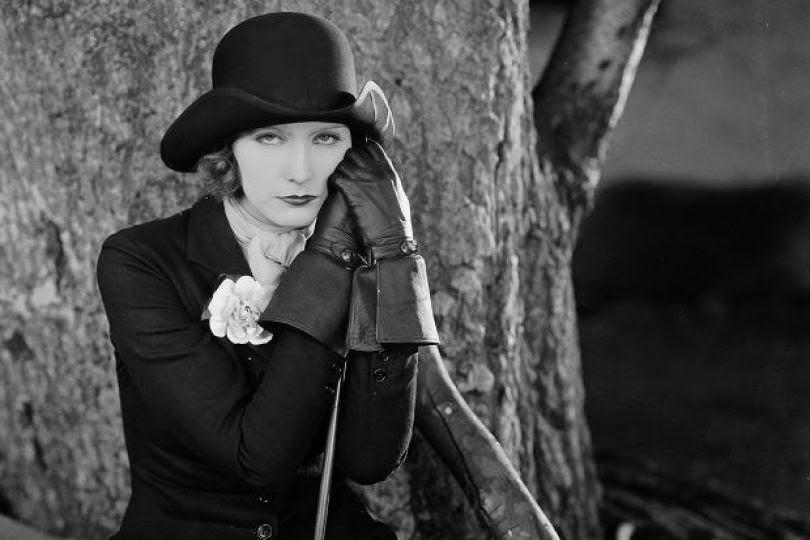
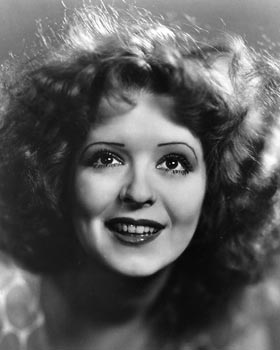
This is the 12th episode and it is about two people…John Gilbert and Clara Bow. Clara Bow is my favorite actress of all time…and yes that includes today.
The cast listing is below the video.
Actors
Mary Astor
Eleanor Boardman
Louise Brooks
Olive Carey
Iron Eyes Cody
Jackie Coogan
Dolores Costello
Viola Dana
Douglas Fairbanks Jr.
Janet Gaynor
Leatrice Joy
Lillian Gish
Bessie Love
Ben Lyon
Marion Mack
Tim McCoy
Colleen Moore
Charles ‘Buddy’ Rogers
Gloria Swanson
Blanche Sweet
John Wayne
Eva von Berne
Lois Wilson
Directors
Dorothy Arzner
Clarence Brown
Karl Brown
Frank Capra
George Cukor
Allan Dwan
Byron Haskin
Henry Hathaway
Henry King
Lewis Milestone
Hal Roach
Albert S. Rogell
King Vidor
William Wyler.
Choreographer: Agnes de Mille,
Writer: Anita Loos,
Writer: Adela Rogers St. Johns,
Press Agent/writer: Cedric Belfrage,
Organist: Gaylord Carter,
Cinematographers: George J. Folsey, Lee Garmes and Paul Ivano,
Writer: Jesse L. Lasky, Jr.,
Special Effects Artist A. Arnold Gillespie, Lord Mountbatten
Agent Paul Kohner
Producer/writer Samuel Marx
Editors William Hornbeck and Grant Whytock
Property Pan: Lefty Hough
Stuntmen Bob Rose, Yakima Canutt: Paul Malvern, and Harvey Parry, Rudolph Valentino’s brother Alberto Valentino
Dudley Moore is probably best known in America as Arthur and Peter Cook is not known much at all which is a shame.
This is one of my favorite comedies. Peter Cook and Dudley Moore were always a great team and in this movie, they work very well together. It’s the old story of selling your soul to the Devil for wishes…but as always the wishes are not exactly what the wisher has in mind.
Dudley Moore plays Stanley Moon who is a shy and pathetic figure who pines for a waitress (Eleanor Bron) who works at Wimpy’s Burger and is employed as a cook. Peter Cook is the devil… He is perfect for this part. He is a hilarious devil and at times likable but does the most annoying things like tearing the last page out of mysteries, scratching LPs, and just petty things to aggravate people.
The movie is very British and very funny. The chemistry is great between Moore and Cook and by this time they had been together for a while. There was a version of this movie released in 2000 but it is not as smart and subtle as this one. This is an offbeat quirky film.
This film also features Raquel Welch appropriately as Lust. She is only in it for a few minutes but she plays Lust to the hilt. The film had no name at first and in an interview, Peter Cook said he wanted to name the movie “Raquel Welch”…when asked why he wanted to name it after the actress when it wasn’t about her he said because the Marquee would read “Peter Cook and Dudley Moore in Raquel Welch”… The producers didn’t like that.
Eleanor Bron plays Margaret the waitress and the object of Stanley’s desire…she was also in HELP! with The Beatles.
Check this film out if you can. Personally, I think it beats the remake by a mile.
If you want to hear something else by them…check out Peter and Dudley as Derek and Clive.
This is a film I so wish they would clean up and release. I watched a bootleg version of it in the 80s VHS.
This was a film that covered Bob Dylan on his 1966 European tour backed up by the Hawks that eventually became The Band minus, Levon Helm. The film was to be shown on ABC television but ABC rejected and saying it was “incomprehensible” because Dylan himself was one of the editors and wanted the film to have more of an artistic feel.
It was filmed by D.A. Pennebaker who filmed Dylan’s 65 European tour when he played acoustically called Don’t Look Back. Don’t Look Back is terrific. This film is very disjointed. That is not saying I don’t like it. This is the Dylan period that probably is my favorite. The Hawks are raw and powerful and Dylan was
There are some highlights to this odd film. A spontaneous piano duet with Dylan and Johnny Cash, John Lennon and Bob Dylan very high riding around in a cab, and the famous concert where an audience member yells out “Judas” because of Dylan’s conversion to electric music. After the Judas remark, he proceeds to tell Robbie Robertson to play it loud and they kick off in a vicious “Like a Rolling Stone.” My favorite live version of that song. Those folk music fans were harsh.
The film is disjointed and frustrating to watch because some of the songs you want to see and hear are there…but only partly. You will be seeing Dylan performing something and then flash away to something else. Some of the concert footage and film from this ended up in the Martin Scorsese movie No Direction Home…I would recommend No Direction Home to everyone.
Bob was pale and nervous and there is no secret he was doing drugs heavily throughout this movie. After the tour, Dylan had a motorcycle wreck heard around the world and after he recovered he didn’t tour for years.
The cab ride with John Lennon is historical now. Both of them in sunglasses and Lennon trying to inject humor into the situation and Dylan is ok at first and then starts getting sick as the filming stops.
If you are a Dylan fan it’s worth a watch. I’m glad we have “No Direction Home” to see some clear film segments on that tour. Eat The Document has not been officially released but you can get a bootleg of it or watch most of it on youtube.
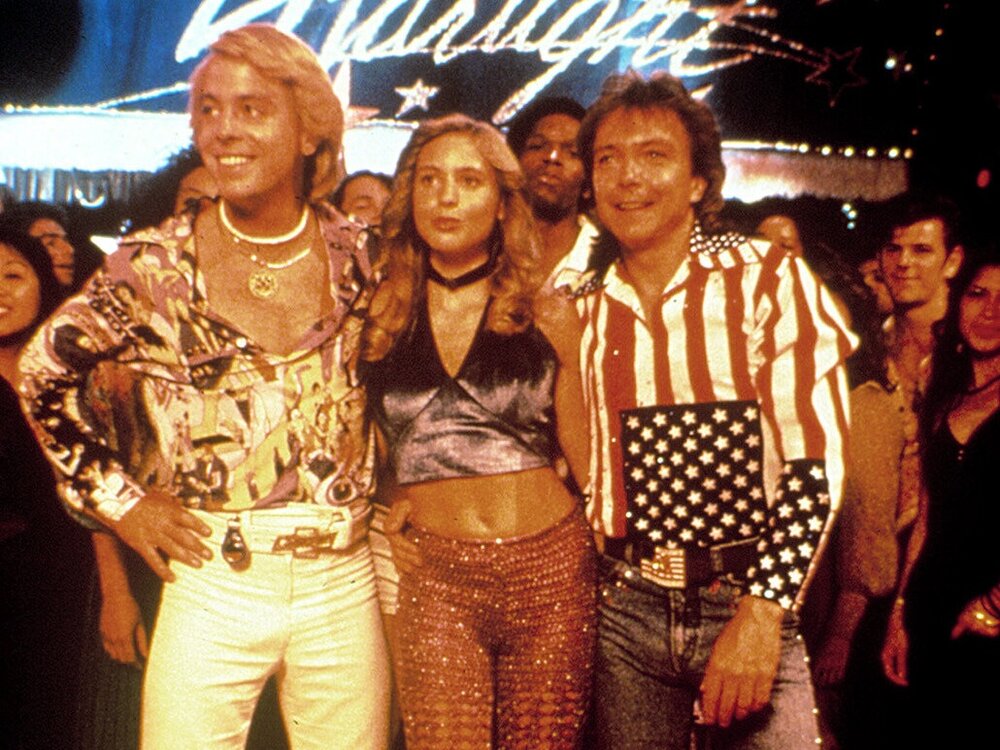
This movie is a B movie all of the way…and it plays up that fact… It was released in 1990 and if you are wanting to watch something that spoofs the 1970s… This movie is for you. You will also learn the word tetrahydrozoline.
This movie stars David Cassidy, Lief Garrett, Carl and Rob Reiner, and Olivia d’Abo… Citizen Kane, it is NOT. It’s a fun film about the future where all is gray and they lost every record because of a magnetic storm including the US Constitution.
Adam-11 (David Cassidy) has built a time machine because he wants to go to a beach…beaches don’t exist anymore in the future. The government wants him to use the time machine to go into the past to 1776 and get a copy of the US Constitution so they can rebuild their society with it. To make it work he needs a chemical that’s rare in the future… tetrahydrozoline (the main ingredient to a very popular item in the ’70s… Visine).
The government agrees to give him some tetrahydrozoline but sends two more travelers Chanel-6 (d’Abo ), Heinz 57 (Geoff Hoyle) with Adam-11 to retrieve the document…but instead of going back to 1776 the time machine malfunctions and goes to 1976.
Devo makes an appearance as the “Ministry of Knowledge”…
It’s a corny movie but they have the 70s down in many parts of the movie. After meeting up with two teenage stoners (The group Redd Kross) they look for the constitution but lose the tetrahydrozoline. If you are looking for a second Gone with the Wind…don’t watch this but it’s funny and silly enough to entertain you.
You have to know a little about the 70s to get some of the jokes…Like David Cassidy’s character looking around a garage in 1976 asking “am I going to be stuck here forever?” while looking at a Partridge Family lunch box.
If you are bored, try this one. The trailer is below the complete movie is below that.
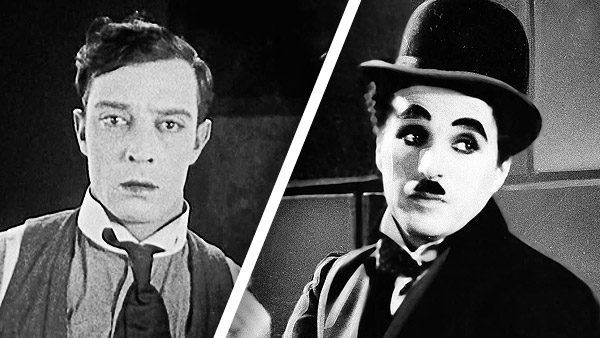
Back in the 90s I got into silent films. I would send off for VHS tapes of 1920s classics. The one actress I wanted to see was Clara Bow. After reading about her I started to learn more about Buster Keaton and Charlie Chaplin. I did know of Chaplin but had never seen one of his films. I still love silent cinema from that era.
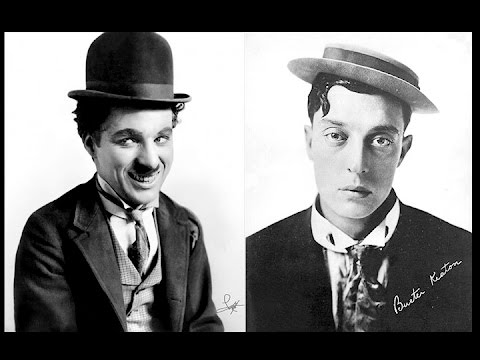
Charlie and Buster were two of the best screen comedians ever to walk the earth. They both had similar upbringings. Buster and his family in American vaudeville. Charlie worked in British music halls. Charlie rose to stardom in silent movies in the 1910’s beginning with Keystone, Mutual (where he made his best short comedies) Essanay and then he confounded United Artist with Douglas Fairbanks, Mary Pickford, and W. D. Griffith. After that Charlie went into full feature films.
Buster started silent shorts in 1917 with Roscoe Arbuckle. After Roscoe broke out on his own so did Buster….he did some more short films which were brilliant. He then went into full features. Buster was just so different than anyone else. He was so still while the world moved into chaos around him. He was a brilliant actor-director and also writer which he often didn’t take credit for doing. If Buster would have just made “The General” his place in film history would be cemented. The same can be said of Charlie Chaplin and his masterpiece “The Gold Rush.”
There was no competition between the two in popularity. Charlie won hands down over Buster and probably everyone else in comedy and drama. His character “The Tramp” was internationally loved. All in all, I’ve always thought Keaton was a better filmmaker but Chaplin the better character. The most recognized character in movie history. They were two different comedians. Chaplin would reach for pathos…sometimes a little too much. Keaton seemed much more real.
Keaton’s sight gags were incredible and sometimes dangerous to his health…like have a front of a building that weighed a ton (so it wouldn’t twist in the wind) fall on him with the upstairs opening clearing him around 2 inches on each side. He never smiled because it would have ruined his character. Both are worth watching and with Keaton’s films like Sherlock Jr…you wonder how he did some of the things he did with the primitive camera’s they used.
Both were funny men. The other big comedian was Harold Lloyd but he was more of an actor playing a comedian….he was really successful though… second to Chaplin in making money.
Charlie and Buster older both appear in Charlie’s Limelight. This is the only time they ever appeared together in a movie.
I remember this song well. In 1981 I was 14 and after I bought the Start Me Up single I went out and bought Tattoo You. Tattoo You was a good Stones album. In fact, I would say it was their last great album. I did like a few of the albums that would follow but this one had everything.
The Stones had dug down deep in their vaults for several songs. Some songs came from the Mick Taylor era. The Stones first recorded this song in 1978 at the Some Girls sessions. Lyrics were added and it was repackaged for Tattoo You.
The song is said to be pointed at the UK. The Stones rarely performed in England because of the huge taxes that were levied on entertainers… it was much more profitable for them to live and work elsewhere.
Hang Fire means a delay or delayed in taking action or progressing. The original title was said to be “Lazy Bitch,” supposedly aimed at a certain British prime minister.
The tour for this album was massive. I remember vividly wanting to go but they didn’t come to Nashville. It was the first rock tour I remember being publicized as an event rather than a concert. You must remember the Stones were getting “old.” People were saying this could be it for the band because they were over the hill. Mick was a whopping 38 years old in 1981. If only we knew what was coming!
The American leg was sponsored by Jovan which yea…I went out and got their cologne. It was the largest grossing tour of 1981 with $50 million in ticket sales. Roughly two million concert goers attended the concerts, setting various ticket sales records.
Most importantly about this tour. It was the last time the Stones toured without backup singers and musical help on stage. Yes, they sounded more ragged on this tour but…that fit them perfectly. I would have rather heard Keith sing backup than pitch perfect backup singers. I did get to see them in the 90s and in 2006.
A film of the tour was released in 1983 called Let’s Spend the Night Together directed by Hal Ashby.
From Songfacts
A “hang fire” is a delay from when a trigger is pulled on a flintlock gun and when it actually fires. The expression means a delayed response, but in this song could apply to the lazy people who won’t take action. It’s also a great phrase to sing, which Mick Jagger does a few different ways throughout the song, sometimes stretching out “fire,” and other times keeping it contained.
In the UK, “Hang Fire” wasn’t released as a single, but in America it was the third single from the Tattoo You album, which hung around for a while. The song peaked at #20 in May 1982, 10 months after the album was released.
MTV launched on August 1, 1981, giving The Rolling Stones instant access to a new audience in America. They were ready, having made several videos (known as “promotional films” back in the day) already with director Michael Lindsay-Hogg, who returned to helm the Tattoo You videos. “Start Me Up” was the first in the set, showing the band performing the song on an empty set. This was typical, as Lindsay-Hogg kept the focus on the band, which were adept performers with a lead singer who could pull focus. “Hang Fire” had a similar look, but with posters of the album artwork adorning the set. These low-budget videos did very well on MTV, which was thrilled to have The Stones in rotation.
Hang Fire
In the sweet old country where I come from Nobody ever works Yeah nothing gets done We hang fire, we hang fire
You know marrying money is a full time job I don’t need the aggravation I’m a lazy slob I hang fire, I hang fire Hang fire, put it on the wire baby Hang fire, hang fire put it on the wire baby, go ahead Hang fire
We’ve got nothing to eat We got nowhere to work Nothing to drink We just lost our shirts I’m on the dole We ain’t for hire Say what the hell Say what the hell, hang fire Hang fire, hang fire, hang fire, put it on the wire, baby Hang fire, hang fire, hang fire, hang fire Hang fire, hang fire, put it on the wire, baby
Doo doo doo Doo doo doo Doo doo doo Doo doo
Doo doo doo Doo doo doo Doo doo doo Doo doo, hang fire, hang fire, hang fire
Doo doo doo Doo doo doo Doo doo doo, hang fire, hang fire, put it on the wire, baby Doo doo
Doo doo doo Doo doo doo Doo doo doo Doo doo
Yeah ten thousand dollars, go have some fun Put it all on at a hundred to one Hang fire, hang fire, hang fire, put it on the wire, baby Doo doo Doo doo, hang fire, hang fire put it on the wire Hang fire, hang fire, hang fire, hang fire Put it on the wire, baby Put it on the wire
This was on the soundtrack to their 1968 trippy movie Head. Where else would you find Annette Funicello, The Monkees, and Frank Zappa in the same movie?
They may have been seeking some countercultural acceptance after their show ended. The movie blew the image of the Monkees up…some say deconstruction of the Monkees completely. It was a stream of consciousness black comedy that mocks war, America, Hollywood, television, the music business, and the Monkees themselves.
If kids went into the theater expecting the Monkees TV show…they were in for a big surprise. On the other hand, kids couldn’t watch the movie because of its R rating.
Carole King and Gerry Goffin wrote this song and Goffin produced it…even recording a porpoise for good measure.
I’ve watched the movie and it’s interesting but you have to remember what kind of movie it is. Jack Nicolson help write it with the band along with Bob Rafelson. Nicholson hung out with The Monkees for several weeks, even going with them on tour. Once this movie was made, Rafelson abandoned The Monkees and went off to bigger projects, starting with Easy Rider.
Mickey Dolenz – “It wasn’t so much about the deconstruction of the Monkees, but it was using the deconstruction of the Monkees as a metaphor for the deconstruction of the Hollywood film industry”
The Porpoise Song
My, my, the clock in the sky Is pounding away And there’s so much to say
A face, a voice An overdub has no choice An image cannot rejoice
Wanting to be To hear and to see Crying to the sky
But the porpoise is laughing Goodbye, goodbye Goodbye, goodbye, goodbye
Clicks, clacks, riding the backs of giraffes for laughs S’alright for a while
sings of castles And kings and things that go With a life of style
Wanting to feel To know what is real Living is a, is a lie
The porpoise is waiting Goodbye, goodbye Goodbye, goodbye, goodbye Goodbye, goodbye, goodbye Goodbye, goodbye, goodbye
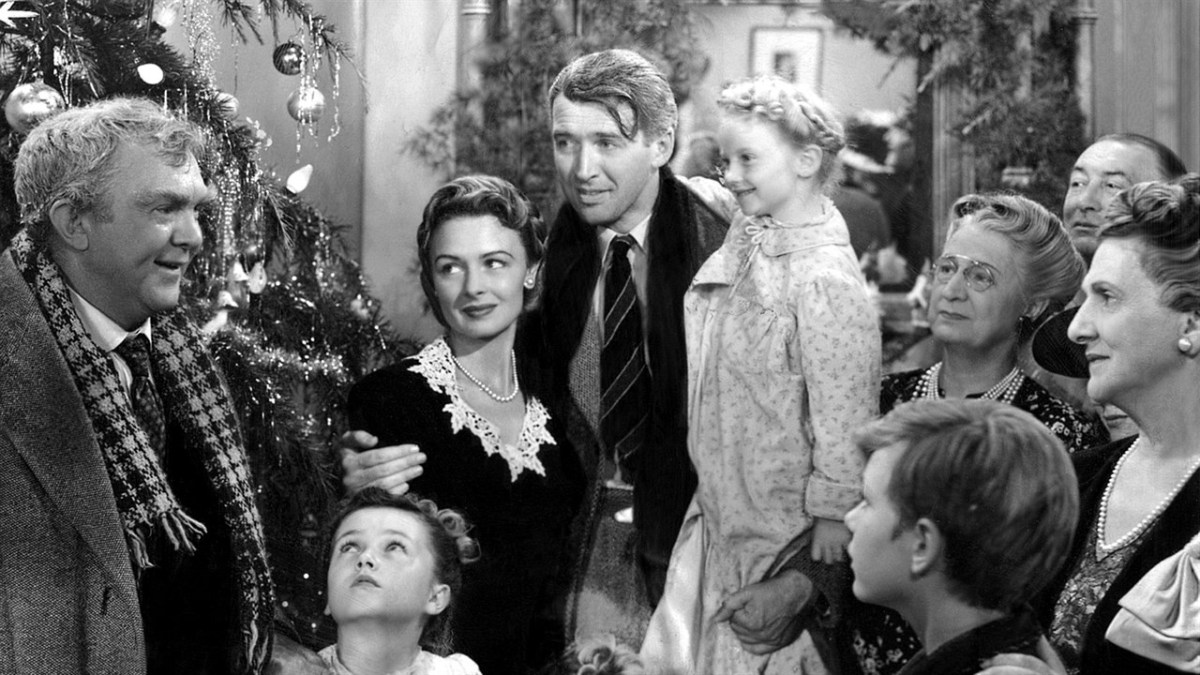
If someone said…you can only watch just one Christmas movie every year…this one would be it. It’s very close to a long Twilight Zone. I have seen this movie more times than any other…hands down.
I didn’t watch this great movie until the late 80s. All it took was one time and I haven’t missed a year of watching it. I don’t tear up very easy..but it never fails at the end of the movie when Zuzu says… Every time a bell rings, an angel gets his wings…it gets me every time. This movie was released in 1946.
Poor George Bailey. All he wanted to do was travel and get out of Bedford Falls to see the world. Every single time he gets close…so close that it hurts…something happens and George ends up doing the right thing.
Bedford Falls needs George Bailey…every town needs a George Bailey but many end up with only a Mr. Potter. There is one thing about this movie which was unusual. Mr. Potter was never punished for what he did…which drew criticism at the time but it was more in line with reality to me.
This is a Christmas movie but really only the last part of the movie is about Christmas. It is a movie for any time not just for December. We were thinking of names for our unborn child and couldn’t think of one…I was watching this movie in November of 1999 and it hit me…Bailey…so the movie means more than some movies do.
Here is a small summary from IMDB…don’t read it…watch the movie instead. If you haven’t seen it…give it a shot…whether it is Christmas or July.
George Bailey has spent his entire life giving of himself to the people of Bedford Falls. He has always longed to travel but never had the opportunity in order to prevent rich skinflint, Mr. Potter, from taking over the entire town. All that prevents him from doing so is George’s modest building and loan company, which was founded by his generous father. But on Christmas Eve, George’s Uncle Billy loses the business’s $8,000 while intending to deposit it in the bank. Potter finds the misplaced money and hides it from Billy. When the bank examiner discovers the shortage later that night, George realizes that he will be held responsible and sent to jail and the company will collapse, finally allowing Potter to take over the town. Thinking of his wife, their young children, and others he loves will be better off with him dead, he contemplates suicide. But the prayers of his loved ones result in a gentle angel named Clarence coming to earth to help George, with the promise of earning his wings. He shows George what things would have been like if he had never been born.
I watched this movie Monday night. It gets me in the mood for Christmas. Alastair Sim is such a pleasure to watch and he is the reason that this is my favorite interpretation of A Christmas Carol.
There have been many versions of this great story. This is the version that I like the most. The great Alastair Sim plays Ebenezer Scrooge and he is the reason I like this so much. When I think of the Scrooge… I think of him.
The movie is in black and white which turns some people off but it makes it that much better to me. They do have a color version but trust me…watch the black and white version. It gives the movie a darker feeling.
The effects they use are obviously not CGI but they get the point across well and serve the story. I like the scene where the ghost of Jacob Marley is warning Ebenezer of being greedy…the two were not on the set at the same time…it looked really good for being 1951…or anytime for that matter.
So get some eggnog or hot butter rum and sit back and watch this great movie.
From IMDB…spoilers
Ebenezer Scrooge (Alastair Sim) is a greedy businessman who thinks only of making money. For him, Christmas is, in his own words, a humbug. It has been seven years since his friend and partner, Jacob Marley (Sir Michael Hordern), died and on Christmas Eve. Marley’s ghost tells him he is to be visited during the night by three spirits. The Ghost of Christmas Past (Michael Dolan) revisits some of the main events in Scrooge’s life to date, including his unhappy childhood, his happy apprenticeship to Mr. Fezziwig (Roddy Hughes), who cared for his employees, and the end of his engagement to a pretty young woman due to a growing love of money. The Ghost of Christmas Present (Francis De Wolff) shows him how joyously is nephew Fred (Brian Worth) and his clerk, Bob Cratchit (Mervyn Johns), celebrate Christmas with those they love. The Ghost of Christmas Yet to Come (Czeslaw Konarski) shows him what he will leave behind after he is gone. Scrooge awakens on Christmas morning, a new man intent on doing good and celebrating the season with all of those around him.
My thanks to Cincinnati Babyhead (CB to be short) turned me on to this song. The guitar hooked me right away. The song has turned into a cult favorite.
Relentless came from the 1981 cult movie soundtrack Loveless staring Willem Dafoe. Eddy is not an easy guy to pin down to say the least. He has been an actor playing “Rock a Billy Guy” in the 1988 David Lynch TV Mini Series The French As Seen By… and the 1990 film Wild At Heart playing Rex. Dixon has also has been a musician playing rockabilly in New York clubs. He has been called a pioneer of the 1970s rockabilly movement in New York City.
Eddy has also performed out as Eddy Dixon and the the Dixonettes.
In the sixties Eddy was an art student who worked on some John Waters films. Later on he was friends with Willem Dafoe and he introduced Eddy to David Lynch. Eddy really ran the gamut working with Waters and Lynch.
I’ll let Eddy take over from here.
Eddy Dixon on music:1957. I was 7 years old and my best friend’s parents bought him a Fender Stratocaster. I would hang out at his house and started playing it and it just progressed from there. I went through the Dylan era and the folk era and the British Invasion era. I was playing in bands through the 60s with crazy names like The In Sex, then I got way heavy into country music towards the end of the 60s. Then in the 70s I moved to New York and started my own rockabilly band. I left Baltimore with 50 bucks, a trashbag full of clothes and a $20 guitar. I started doing all the showcases down on Bleeker Street and started hooking up with the real players, turned professional and started playing Max’s Kansas City and CBGBs.
Eddy Dixon on acting: I started off with John Waters back when I was a teenager in the late 60s. I did 5 John Waters films. He’s great – he’s very professional and knows what he wants. When I started, he was starting out and we were all art students in Baltimore living in a block in Bolton Hill. It was the most exclusive neighborhood in Baltimore at the turn of the century, but by this point everything was all run down. There were huge townhouses, gorgeous – 20-foot ceilings, marble fireplaces, mirrors from the floors to the ceilings – and they just sectioned them off and were renting them to the students. Some law firm bought up the whole block and kicked us all out. So we moved down to the docks, where we rented this 27-room double house with a courtyard – the whole deal for about $100 a month. One day my brother brought John Waters down – I think he met him at a party. So every Sunday we would pile into the Volkswagen, go out into the woods and film and that’s how it all started. My brother to this day still does all his sets. I did a Superfly sequel – I don’t know if it ever came out or not. The working title was ‘Don’t Call Me Boy’ and when they finished it they called it ‘The Hitter’. I did Run DMC’s movie – I played a cop in that.










 PowerPop... An Eclectic Collection of Pop Culture