TV Draft Round 9 – Pick 5 – Liam Selects – The Kids In The Hall

Welcome to the Hanspostcard TV Draft. I hope you will enjoy it! Today’s post was written by Liam at https://othemts.wordpress.com/

The Kids in the Hall

CBC Television (1988-1995)

HBO (1988-1992)

CBS (1993-1995)

Amazon Prime Video (2022)

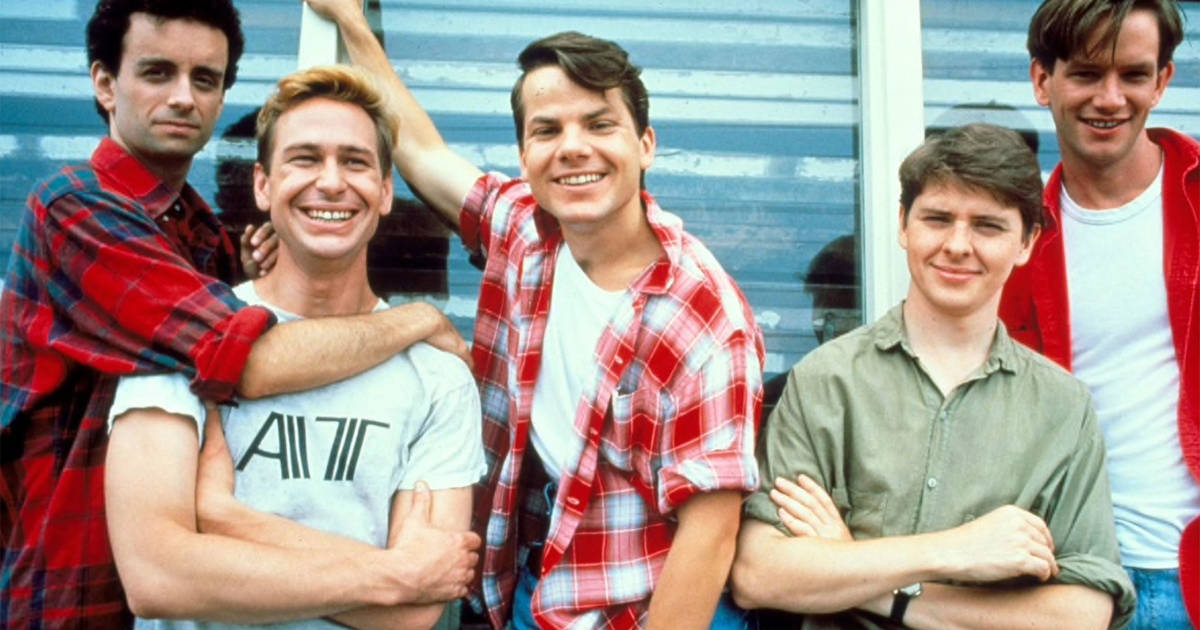
The Kids in the Hall are a sketch comedy troupe based out of Toronto, Canada.  You could say they are the Canadian Monty Python.  Or perhaps, the Canadian Saturday Night Live? Like Monty Python, they are an all-male group of 5 writer/performers (the Pythons had six) who create edgy sketch comedy often bordering on the absurdist, and frequently don wigs and dresses to portray female characters.  Like Saturday Night Live, their show was produced by Lorne Michaels and performed in front of a live audience (albeit, it was not broadcast live).  But at the heart of things, The Kids in the Hall are their own thing, creators of something outside the mainstream of comedy of the 1980s and 1990s and capturing the ethos of Generation X, paralleling the rise of alternative rock at the same time. A recently released documentary about the Kids calls them Comedy Punks.

Let’s meet the Kids!

Dave Foley (b. 1963) is the member of the troupe who feels most mainstream in his comedy approach, but that is on a relative scale.  His boyish good looks were often contrasted with antisocial behavior, such as a surgeon who kills all his patients or an axe murderer, both of whom get away with it because of their charm.  He was also considered the “hottest” of the Kids when dressed as woman. Not surprisingly, later in his career he starred in the American sitcom NewsRadio, and provided voices for the Pixar movies A Bug’s Life and Monsters University.

Bruce McCulloch (b. 1961) is probably the weirdest of the Kids in his comedy approach.  Inspired by art movies, his surreal monologues and filmed pieces evoked a mood of absurdity rather than just telling jokes.  Outside of the Kids in the Hall he has recorded music and directed several movies and tv shows.

Kevin McDonald (b. 1961) is probably a lovely person in real life, but has a talent for playing really annoying characters.  A lot of his self-deprecating humor contains a dark undercurrent of the volatility of his childhood growing up with an alcoholic father.  McDonald has provided his voice for the Disney movie Lilo & Stitch and its spinoffs and had a recurring role on That 70s Show.

Mark McKinney (b. 1959) specialized in creating characters and is probably the Kid most similar in comedy style to Saturday Night Live (and he did in fact join the cast of SNL from 1995 to 1997).  His most notable characters include Mr. Tyzik the Headcrusher and the Chicken Lady. Outside of his work with the Kids he’s appeared in numerous movies and tv shows, the strangest of which is Guy Maddin’s The Saddest Music in the World.

Scott Thompson (b. 1959) performs comedy informed by his gay identity with a definite emphasis on using comedy to advance LGBTQ equality, which was very bold in the 1980s and 1990s.  Most notably, he reclaimed the effeminate gay man stereotype through his character Buddy Cole who delivered hilarious monologues.  He also frequently portrayed Queen Elizabeth II, one of the rare celebrity impersonations on The Kids in the Hall.  His other work includes appearances in many movies and tv shows, including a regular role on The Larry Sanders Show.

Foley and McDonald met in the early 1980s in the Toronto comedy scene and became a writing and performing team.  Their partnership is the strongest among all the Kids and has remained so throughout the troupe’s history.  Meanwhile, McCulloch and McKinney met in Calgary where they performed with a group called The Audience.  Moving to Toronto to expand their opportunities, McCulloch and McKinney met Foley and McDonald and in 1984 they formed The Kids in the Hall.  The name came from an old Sid Caesar gag blaming bad jokes on the young writers who hung around the studio. Their shows in Toronto’s comedy clubs became a big attraction.  Thompson saw them perform and pretty much willed himself into a spot in the group. Early sketches like “Reg” showcased their humor style at its most sick and twisted.

Saturday Night Live producer Lorne Michaels saw the Kids perform in 1985 and hired McKinney and McCulloch to come to New York to be writers.  Eventually, Michaels determined that it would be better to keep the Kids together as a group and worked to get them their own show.  The pilot for The Kids in the Hall broadcast on CBC Television in Canada and on HBO in the United States in 1988, followed by a full series of 20 episodes in 1989-1990.  Enhancing the Gen X zeitgeist, the Toronto alternative rock band Shadowy Men on a Shadowy Planet provided the theme song, “Having an Average Weekend,” as well as the music to interstitials between sketches and performing live for the studio audience.  The band’s music is described as instrumental surf rock, however since the Shadowy Men recorded a track called “We’re Not a F*****g Surf Band,” so we’ll have discover a new genre for them.

The Kids and the Hall had several recurring characters, but carefully avoided the SNL habit of overexposing them to please the fans.  Characters appeared when they had a very good and very funny reason to be there.  A number of sketches revolved around the company A.T. & Love with characters ranging from an incompetent boss (Foley), hard-pressed businessman Danny Husk (Thompson), and the secretaries Kathie (McCulloch) and Cathy (Thompson). These characters had the versatility to appear in sketches together, on their own, or with a completely different group of characters. Another series of sketches focused on rebellious Gen X teen Bobby Terrance (McCulloh), his more conservative parents (McKinney and Foley), and his best friend, the stoner Bauer (Thompson).

While Thompson was the only gay member of the troupe, sketches with LGBTQ characters were common, including scenes of men kissing men when that was taboo on American TV (one of the many things that got edited between CBC and CBS transmissions).  The recurring sketch “Steps” featured three gay men discussing the issues of the day where the audience was laughing with them not at them. Despite the Kids being all men, they never saw dressing up in wigs and dresses as funny in of itself, unlike say Milton Berle. Instead they did their best to portray women as fully-formed characters and offer an honest female perspective.  Dave Foley even has a good attitude toward menstruation.

After five seasons and 101 episodes, the Kids were ready to pack it in, physically exhausted and drained of ideas. The final episode broadcast on April 15, 1995 showed them being buried alive in a shared grave.  The next step naturally appeared to be making movies, and in April 1996 they released Kids in the Hall: Brain Candy. The making of the film was a miserable experience for everyone involved and tensions ran high, especially toward Foley who everyone resented for signing a contract to star in NewsRadio while they were working on the film. The movie bombed although some fans consider it a cult classic (I am not one of them).  The Kids went their own ways for a few years but with reruns of the show in constant rotation on Comedy Central, the troupe’s fan base grew bigger than ever.

By 2000, tensions had eased enough to bring the Kids back together, this time returning to the stage for a North American Tour.  Performing in front of live audiences again energized the Kids creatively, and they were able to resume their close personal relationships as well.  The Kids went on the road for more tours, introducing new sketches.  In 2010, they returned to TV, stepping beyond sketch comedy for the first time in the darkly comic 8-part miniseries Death Comes to Town which aired on CBC.  I hadn’t heard of this series until recently so I haven’t watched it yet but I hear it’s good.  Just this May, seemingly out of nowhere, the Kids in the Hall TV series returned for season 6, with 8-episodes streaming on Amazon Prime.  While the Kids have physically aged, they haven’t lost a step and the new episodes are as funny as ever.  The final episode ends with the Kids getting buried again, but I think we’ll see the Kids in the Hall again soon! Until then, here’s one of my favorite sketches, “The Night of the Cow”

TV Draft Round 9 – Pick 2 – Max Selects – Saturday Night Live

I wanted to do a more modern show other than Life On Mars…and this would qualify as it…kinda. It has been on the air since 1975… a whopping 47 years. It’s been on life support at times but has always pulled through. It’s an institution at this point. There is not enough room on a post to go over every cast. Everyone has their favorites some were extremely funny and some were extremely bad (1980 – 1981 cast) and they all make up the history of this show. 

I’m going to concentrate on the original cast and how the show became SNL. Most of you have favorite different casts…usually, the one you grew up with. 

Even if you don’t like this show or what it’s become…it was a cultural landmark and no one can deny that. It changed television forever. The show started because Johnny Carson wanted more time off. NBC had been airing reruns of Johnny Carson’s Tonight Show on the weekends to fill space in their lineup. This allowed them to double-dip on profits from Carson’s outrageously popular show without spending another dime on production costs. He told NBC he would only be making four shows a week, which meant that best-of Carson shows that had been airing on Saturday nights would now need to be moved to a weeknight.

 NBC executive Herbert Schlosser sought to create a new show with an old format…a variety show to fill the slot on Saturday Night. He picked Lorne Michaels, a Canadian writer who only had a handful of credits to be the producer. Michaels started a show that was far different than Schlosser imagined but to his credit… Schlosser was behind it and pushed for it to be on the air. The first two shows were experiments but by the third show, they found the format they would keep to this day. The funny thing is…Johnny Carson never liked the show. 

Lorne Michaels made the show to appeal to baby boomers with a touch of Avant-Garde and “guerrilla-style comedy.” It was a game-changer much like All In The Family was to sitcoms. Late-night was never again a wasteland. This show helped open the doors for David Letterman and other shows to follow it. 

It started out as “Saturday Night.” The Saturday Night Live title belonged to ABC for a show hosted by Howard Cosell who was out of his league. After Cosell’s show was cancelled, ABC let Saturday Night have the “Live” part.

Who was the best cast through the years? This is a question that is debated over and over again. People argue and usually pick the cast they grew up with. I grew up in the Eddie Murphy and Joe Piscopo era. Personally, I always thought the original cast was the best era of the show. Yes, I thought the Murphy and Piscopo casts were very funny along with later casts that had Dana Carvey, Michael Myers, Chris Farley, Chris Rock, and many others that followed. The first five seasons had something extra that others would not and could not have. It had an underground feel that vanished after it became a pure comedy show. They had a massive amount of talent in that first class. 

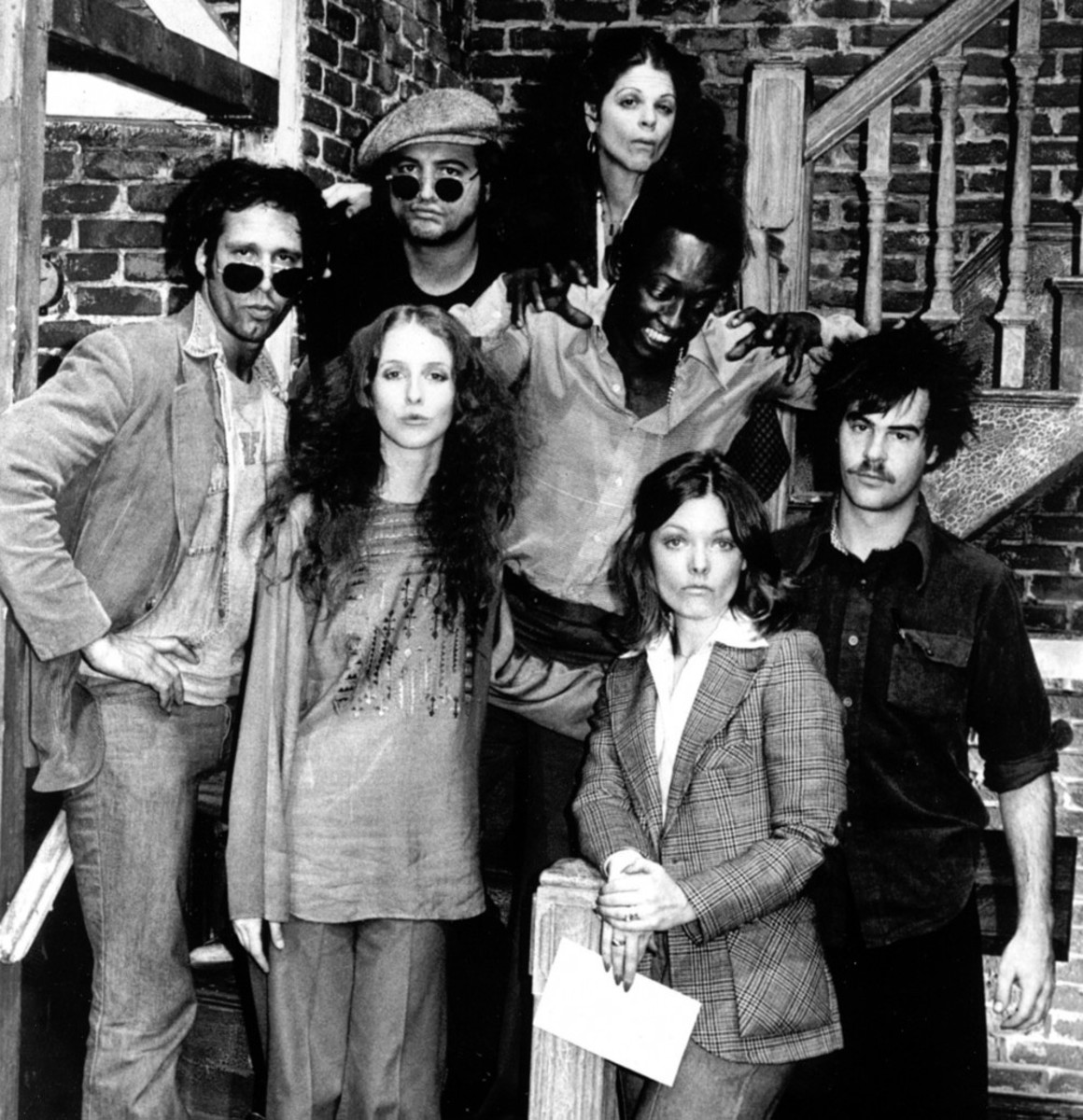
John Belushi, Dan Ackroyd, Chevy Chase (though I liked his replacement better…Bill Murray), Gilda Radner, Jane Curtin, Garrett Morris, and my favorite overlooked cast member Laraine Newman. They were the perfect cast for that time. 

Why do I like the original cast the most? They tried new things and went out on a limb. Some of the skits succeeded some fell flat but they were different from anything on TV at that time…and also at this time. That cast pushed the envelope and made the network executives worry. The host each week was usually under the radar actors, writers, comedians musicians, and sometimes athletes. The musical guests were mostly rarely seen performers that weren’t on tv…prime time or otherwise. Frank Zappa, Leon Redbone, The Kinks, Patti Smith, Ry Cooder, Kinky Friedman, and others. You would have more popular musicians like Paul Simon but the show gave you a great variety. 

No way would Michaels ever dream of that now…he usually gets whoever is the most popular to draw in ratings. He can no longer do what he did in the 70s because of that. He also used the complete ensemble. It was not Eddie Murphy, Joe Piscopo, and everyone else of the early eighties. It was about building an unknown cast and all of them having a shot…not a star-driven show that gave all the best bits to the big names. He made sure the entire cast had a lead in skits and parody commercials. Dick Ebersol who followed Lorne Micheals, was famous for getting stars in the cast and the show revolving around them.

A lot of the skits are now famous… Ackroyd’s Bassomatic, the Samurai, the uncomfortable but funny Word Association with Richard Pryor, The Killer Bees, The Mr. Bill Show, Weekend Update, Roseanne Rosannadanna, Land Shark, Bag of Glass, The Wild and Crazy Guys, the Coneheads, The Lounge Singer, Mr. Mike, The Blues Brothers and many more.

The writers for the show were not in the variety show comedy vein..they were not in the current SNL vein either. The style was more aggressive, especially with Michael O’Donoghue. He was a comedy trailblazer with National Lampoon and added black humor to SNL. Other writers were Franken and Davis, Rosie Shuster, Alan Zweibel, Marilyn Miller, Anne Beatts, Herb Sargent, Tom Schiller, and also Ackroyd and Chase.

The original group also did some serious skits along with comedy and trips into the bizarre (See the ultra-dark “Mr. Mike”). …It separated the original from any other cast.

I like the feel of the underground the first five years had but you can only be that for so long…popularity takes over. Those first 5 years (the first four were great…the fifth very good) set the foundation that holds to this day…just without the daring and danger.

Ann Beatts was one of the original writers who saw the popularity of the show rise beyond anything she ever imagined. She knew the risk-taking traits in the show would have to end because of it. “You can only be avant-garde for so long until you become garde.”

By the 5th season (1979-1980), it was a circus grown out of proportion. The cast by that time were usually bigger stars than the guest hosts.  Everyone left after that season along with Lorne Michaels. The show went on without him until 1985 when he rejoined. It was never the same again. Sometimes it was funny and sometimes not but it was never the same experimental show it was at the start. 

What other show would introduce “Acapulco Gold” and “Orange Sunshine” to a national television audience?

SNL2.jpg

The Bassomatic…something you cannot explain with words.

The best Star Trek parody…

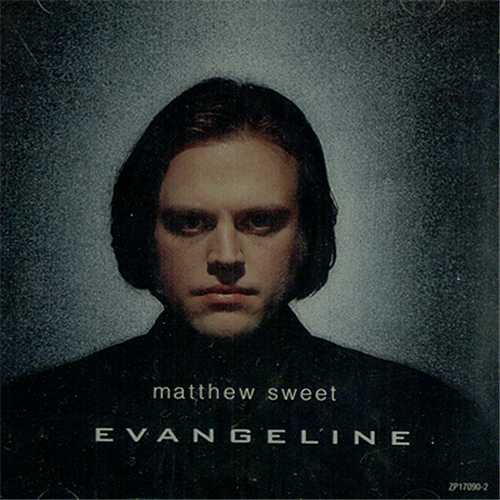
Matthew Sweet – Evangeline ….Power Pop Friday

When I heard the song”Girlfriend” for the first time on the radio I liked it right away. Matthew Sweet is a great contemporary power pop artist that doesn’t get played enough.

The album peaked at #100 on the Billboard Album Charts in 1991. The album was ranked number 61 on Paste magazine’s list of “The 90 Best Albums of the 1990s.”

He was a huge fan of R.E.M in high school and began a pen-pal correspondence with Michael Stipe that brought him to Athens, GA. He ended up meeting Stipe’s sister Lisa through that relationship. Both Sweet and Lisa were students at the University of Georgia and he formed his first band with her. Sweet and Lisa eventually married after he was divorced from his first wife.

Sweet is also known for his Under the Covers series, done in collaboration with Susanna Hoffs, lead singer of Bangles. The series features the pair covering classic songs. The first Under the Covers focuses on music from the ’60s, while the second draws from the ’70s. They also made a third entry which was comprised of ’80s music.

Evangeline is not your average boy-girl song. It’s about a girl, but not a real one. The song is set in the realm of the comic book series Evangeline, which was published from 1987 to 1989. The comic is set in the 23rd century after humans colonized space. The character Evangeline is a weapon-wielding nun out to avenge those who have been victims of religious persecution on behalf of the Vatican.

Evangeline

She’s on another planet
She’s in my dream
She’s some kind of angel
If you know what I mean
Try her on
She fits like a glove
Too bad she only thinks about
The lord above

Evangeline Evangeline
I think I love you
But Evangeline Evangeline
I want you

Now if I called you up
Do you think you
Could deliver my soul?
Won’t you take a drink
Little darlin’
The cup is full

And every night I bow to pray
But I’ll feel a whole lot better
Once you’re coming my way

Evangeline Evangeline
I think I love you
But Evangeline Evangeline
I want you

So come on down

So tell me how you want it
Come on, tell me how you want it
Just tell me how you want it

Just tell me how you want it
We won’t be seen
You can tell your father
It was all a dream
[try her on she fits like a glove]
Too bad the only man you trust
Is god above

Evangeline Evangeline
I think I love you
But Evangeline Evangeline
I want you

Now Evangeline Evangeline
I think I love you
But Evangeline Evangeline
I want you

She’s some kind of angel
If you know what I mean
Evangeline

TV Draft Round 8 – Pick 5 – Mike Selects – Star Trek: Voyager

Welcome to the Hanspostcard TV Draft. I hope you will enjoy it! Today’s post was written by Mike at https://musiccitymike.net

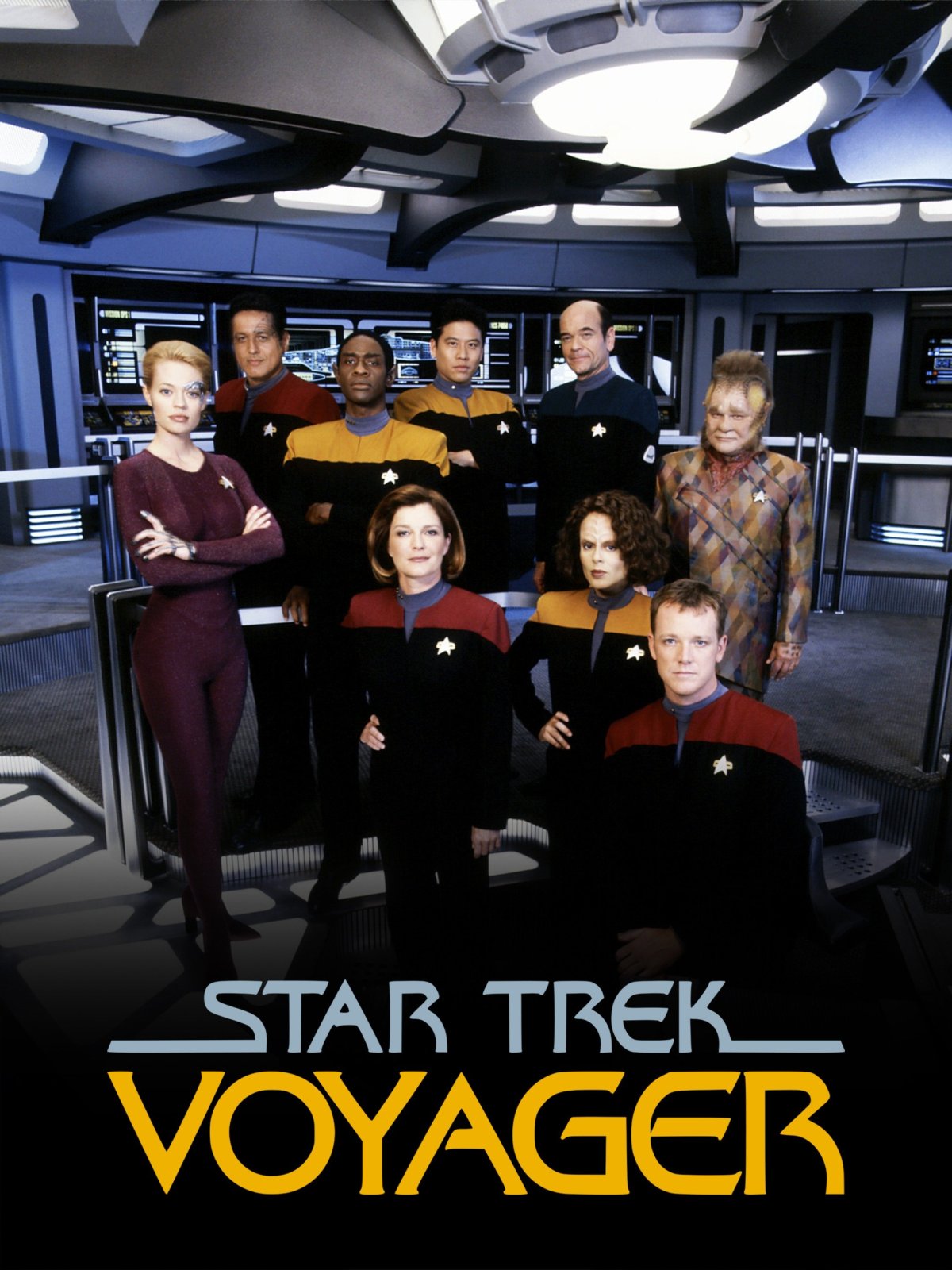
Star Trek: Voyager

Let me begin by saying that I really don’t care much for science fiction. My family can confirm how I am on record for falling asleep in the movie theater for Star Wars and Lord of the Rings movies. I guess my brain finds little appeal for fantasy. So, what is it about Star Trek: Voyager that makes it different?

Well, this attraction started with Star Trek: The Next Generation which my family and I watched together and which I would likely pick as a favorite should there be a second round to this draft. Together, we binge-watched all of TNG on DVD, and in true geekiness, kept a spreadsheet where we rated each episode on a 1 to 5 scale. Our watching continued with Voyager, but our nerdom didn’t include the spreadsheet after Mom dropped out.

So, this leaves me to try and explain both how Star Trek overcome my disdain for sci-fi and why I favor (ever so slightly) Voyager over The Next Generation.

I guess what makes me somewhat of a Trekkie, is how these shows extend the history of our planet into the future and explore the unknown expanse of our galaxy. We see the development of technology (some of which has since come to pass) and experience the remarkable acceleration of the speed of travel (unlikely to ever happen). As a child, I always enjoyed books about the future and Trek provided me with a continuation of this fascination. Perhaps my attraction takes root in the fact that there is some probability to some of what is presented in Trek.

On the other hand, as the name itself implies, Star Wars focused more on wars and battles with much more emphasis on alien fantasy rather than the evolution of Earthlings.

As for The Next Generation, everything about it was fabulous and more than satisfied my needs. The casting was perfect, the technological advances were exciting and sometimes realistic, and the stories were fantastic. However, while the same can be said for Voyager, there was just something about it that attracted me even more.

As brilliant as Patrick Stewart was as Captain Jean-Luc Picard on TNG, so was Kate Mulgrew as Captain Kathryn Janeway on Voyager. Let’s just stop there and call it even. Likewise, both casts matchup well with Data on TNG and Seven of Nine on Voyager getting the nods as my favorites. Touché again.

But perhaps what puts Voyager over the top is simply the passage of time, both fictionally in the scripts and, as to the tools available for filming. As to the former, Starfleet technology advanced especially in the use of the Holodeck, a recreational device in which crewmembers freely interacted in an imaginary setting of their choice. To the latter, TV special effects just got better and for the first time in the Trek series were enhanced through the use of CGI (“Computer Generated Images). TNG had made a giant leap however in this regard when compared to the original Star Trek series which at times often completely lost the feel of traveling through outer space.

Voyager lasted seven seasons (1995-2001). It started just after and ran concurrently with Deep Space Nine which failed to catch my fancy along with the other subsequent Trek series that have maintained the franchise. So, if like me, sci-fi is not your thing, like me, you might find enjoyment in Voyager. On the other hand, if you regularly attend Trekkie conventions, where do you rank Voyager amongst the Star Trek canon?

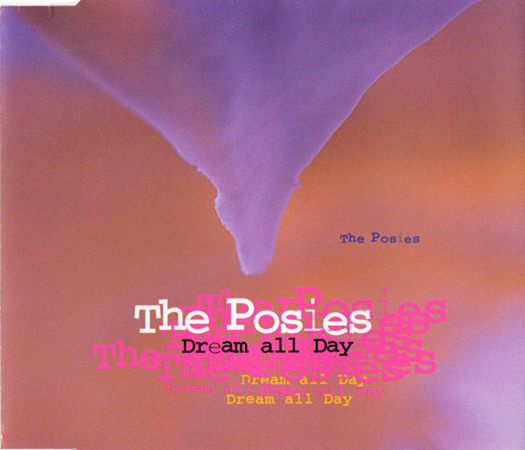
Posies – Dream All Day ….Power Pop Friday

Ken Stringfellow and Jon Auer started to write songs together while in High School in Bellingham, Washington in 1986. They were influenced by The Hollies, Hüsker Dü, XTC, Elvis Costello, Squeeze, and Big Star.

When they started out, a cassette of songs Stringfellow and Jon Auer traded back and forth went viral, which in the late ’80s meant copies got passed around and radio stations started playing them. The had one big problem though. They didn’t have an actual band together. Drummer Mike Musberger and bassist Rick Roberts were added as the first Posies rhythm section.

This song was on their third album released in 1993 called Frosting On The Beater. Dave Fox had replaced Rick Roberts by this time on bass. Dream All Day was released as the first single on the album.

The song peaked at #4 on the Billboard  Alternative Airplay Charts and #17 in the Billboard Mainstream Charts in 1993.

The Posies soon got signed to DGC and “Golden Blunders,” the first single from their Dear 23 debut on the label, became enough of a college radio hit that Ringo Starr recorded as part of his 1992 album Time Takes Time.

The made 8 albums altogether with the last one being in 2016.

In 1993 Ken Stringfellow and Jon Auer joined Big Star’s Jody Stephens and Alex Chilton to reform Big Star. They toured and released a Big Star album in 2005 called In Space. It came to an end in 2010 with the death of Alex Chilton.

Dream All Day

I’ve got a lot of thoughts
Got a lot of plans
I lost a lot of sleep
Trying to understand

I could dream all day

In a blackened room
Staring into space
Underneath a thousand blankets
Just to find a place
Where everything is reachable
Imagining is safe
I tried to make it so
I didn’t even know

I could dream all day

I dreamt I was awake
My mouth was colored grey
As the world revolved around me
I could only say

I could dream all day

TV Draft Round 4 – Pick 3 – Keith Selects – Columbo

Welcome to the Hanspostcard TV Draft. The remaining 7 rounds will be posted here. I hope you will enjoy it! Today’s post was written by Keith from https://nostalgicitalian.com/

TV Show Draft – Nostalgic Italian’s Round 4 Pick – Columbo

1_DN_C8fNcDozkX1U62VY81g

Welcome to my fourth round pick in the Hanspostcard TV Draft. Last round I chose Perry Mason, which was the ultimate court room “whodunit!” You never knew who committed the crime until the end of the episode. I thought it appropriate to choose Columbo for this round, because it is almost the exact opposite of Perry Mason, in that you know who the killer is right from the get go. It was called a murder mystery where the murder was no mystery.

Columbo_1971

The show pioneered the “inverted mystery” technique/format. Almost every show begins with a crime and the audience knows who the culprit is. Then enter the LAPD’s Lieutenant Columbo who spends the remainder of the show looking for clues, pestering the criminal, and eventually solving the case. The show was not a “whodunit” like Perry Mason, but rather it has been described as a “how’s he gonna catch him?”

The first season of Columbo began in September of 1971. I know that most of the shows being picked by others in the draft ran on a weekly basis. Columbo did not. Most episodes were featured as part of the NBC Mystery Movie rotation. It ran for 35 years with a total of 69 episodes.

The show was created by schoolmates Richard Levinson and William Link. The character first appeared in 1960 on The Chevy Mystery Show in an episode called “Enough Rope.” That episode was then adapted for a stage play entitled Prescription: Murder, which was then adapted for television in 1968. Columbo was played by Bert Freed in Enough Rope and by Thomas Mitchell in the stage version in 1962.

Bert Freed (L), Thomas Mitchell (R) – The Original Columbos

The writers of the show had originally wanted Lee J. Cobb to play Columbo, but he was unavailable. They next approached Bing Crosby, who turned down the role because it would take away from his time on the golf course. Peter Falk came across the script for Prescription: Murder and contacted Levinson and Link and said, “I’d kill to play that cop!”

d49177d8ebe31ebc60ac5405321cc143

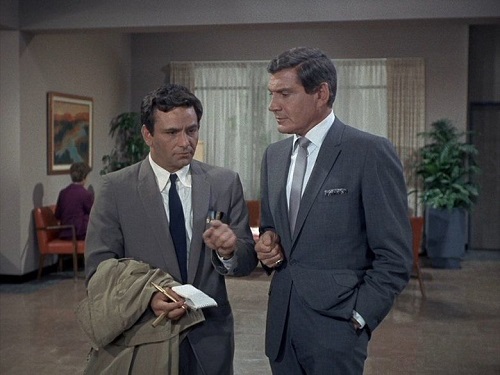
Peter Falk and Gene Berry

They weren’t really sure about Peter Falk, who was only 39 at the time. They envisioned the character as being older. He won the role, and he plays him as a much straighter, cleaner, and firmer Columbo in the first episode. It was a huge hit! The Columbo quirks and mannerisms that fans came to know and love would develop as he continued to play the role.

Peter Falk really threw himself into the role. He wore his own clothes. The suit was one that he had dyed brown, because he felt that looked better. He wore his own shoes. The world famous raincoat was one that he purchased in New York City while caught in a rainstorm. It cost him a mere $15. One difference between Peter and Columbo – Columbo preferred cigars, while Falk enjoyed cigarettes.

I am currently reading a fantastic book on the show written by David Koenig.

61PkSK63XvL

Columbo is like no other cop. Koenig says, “There was nobody or nothing like Columbo at all before him. All the detectives were these hardboiled, emotionless, tough guys. And he was the opposite of that in every way. He hated guns and violence.” He describes the show this way, “Columbo wasn’t really a cop show. It was a drawing-room mystery done backwards with a cop as the lead. It was an anti-cop show.”

66d61c24b86910ce17047005e8e44955

During the first few seasons of Columbo, it really set the standard for what some refer to as “event television.” There were some fabulous guest stars who played the murderer. Those stars included Gene Berry, Jack Cassidy, William Shatner, Dick Van Dyke, Ruth Gordon, Robert Vaughn, Anne Baxter, Janet Leigh, Robert Culp, Donald Pleasence, Eddie Albert, Leonard Nimoy, Johnny Cash, and Patrick McGoohan – just to name a few!!

After the murder, when Columbo finally shows up, his genius is hidden by his often confused look. It is also hidden by the way he is dressed and by his friendly demeanor. He is looked upon as a stupid fool. The killer has no idea what a brilliant man Columbo is and they are lured into a false sense of security. The killer becomes even more arrogant and dismisses Columbo as a dope, only to be caught in the end.

c89f5bdeafa35f81eb8f273b38196251

One of the things that certainly added to the character was his little idiosyncrasies like fumbling through his pockets for a piece of evidence, asking to borrow a pencil, or being distracted by something in the room in the middle of a conversation. Falk adlibbed those moments on camera while film was rolling as a way to keep the other actors off-balance. He felt that it really helped to make their confused and impatient reactions to Columbo more genuine. It really truly worked.

On the show, the murderer is often some famous person, or someone who is cultured or from high society. Either that, or some sort of successful professional (surgeon, psychologist, etc…). Paired up against Columbo, it is gold! The interactions between the two become such a marvelous part of the show and brings out Columbo’s character and cunning genius!

In those conversations Columbo is often confused. He doesn’t know anything about classical music, chess, fine wines, photography or pieces of art. One article on the show stated that his “ignorance” will often “allow him to draw in the murderer with a cunning humility that belies his understanding of human behavior and the criminal mind.”

Columbo

The last episode of Columbo aired in 2003 and was entitled “Columbo Likes the Nightlife.” Falk had planned for one final episode. It was to be called “Columbo’s Last Case” which was to begin at his retirement party. There was a lack of network interest and with his age and failing health, the episode was never to be.

Columbo remains as popular as ever. It was one of the most watched shows on streaming platforms during the pandemic. Author David Koenig says about the show, “It has stood the test of time for 50-plus years now. That character is still vibrant and alive, appealing to people. People love that central character, that basic format, the fact that it’s not political, it’s not violent, it’s not all the things television shows are today, it’s something different. And that is charm. That’s what people love about it.”

1-peter-falk-in-columbo-1971--album

Columbo Facts:

  • Steven Spielberg directed the first episode of Season 1 – Murder by the Book.
  • Peter Falk won 4 Emmy Awards for his portrayal of Columbo (1972, 1975, 1976, and 1990)
  • He also won a Golden Globe Award for the role.
  • Patrick McGoohan played a murderer more times than any other actor – 4 times. Jack Cassidy and Robert Culp each had 3 times, William Shatner and George Hamilton each played a killer twice.
  • Columbo’s name is never revealed – although a close up of his badge in the first season says it is ‘Frank.’ The creators of the show have stated that his first name was never known, so take that however you want to.
  • Columbo drives a 1960 Peugeot 403 convertible.
  • Columbo’s favorite food is chili and black coffee is his drink of choice.
  • In the 1972 episode entitled, “Etude in Black,” Columbo rescued a basset hound from the dog pound. The dog could be seen in many other episodes, and was as close to a sidekick/partner as Columbo ever got.
  • In 1997, the episode Murder by the Book was ranked #16 in TV Guide’s “100 Greatest Episodes of All Time” list.
  • In 1999, Lieutenant Columbo was ranked #7 on TV Guide’s “50 Greatest TV Characters of All Time.”
  • There is a bronze statue of Columbo (and his dog) in Budapest, Hungary. It was unveiled in 2017. Peter Falk is rumored to be a distant relative of the well-known Hungarian politician Miksa Falk (1828-1908).

EaPuKPLXkAUZFJ9

Columbo Statue in Budapest, Hungary

I thought I would close with little treat for you. In one of the Dean Celebrity Roasts, Frank Sinatra was the Man of the Hour. Now, these roasts were often edited down to make sure all the best stuff was shown on TV. In Lee Hale’s book, he stated that there was only one performance that was shown in its entirety – Peter Falk’s appearance during the Sinatra roast.

Falk appears from the audience – as Lt. Columbo. The entire 11 minute bit is just priceless. It is a must see. Enjoy:

TV Draft Round 3 – Pick 7 – King Of The Hill

Welcome to the Hanspostcard TV Draft. The remaining 8 rounds will be posted here. We will have 64 different TV Shows by 8 different writers. I hope you will enjoy it! Today’s post was written by Dave from https://soundday.wordpress.com/

First I’d like to thank Max for keeping this project running, and for inviting me to take part. There are so many good TV shows to choose from, it’s hard to know where to begin, but I’ll opt for one that seems to hit close to home for me (LOL – literally)… King of the Hill.

King of the Hill was a long-running animated prime-time cartoon that somehow had characters a lot more “real” than most of its contemporaries made with real actors. It ran on Fox Network for 259 episodes from 1997- 2010, and has been seen in re-runs in syndication and on some of the streaming services. I’m not a gigantic fan of Fox overall, but one thing they do well is cartoons!

It typically ran on Sunday nights after The Simpsons, – itself a hilarious and ground-breaking show – at 8:30 Eastern time. Fox seemed to clue in on how much of a good thing they had going with Sunday night cartoons aimed at adults and forever were searching for ones to lineup with their corporate flagship show and its yellow-skinned Springfielders. Some of them caught on (e.g. Family Guy or, though I can’t fathom why, Bob’s Burgers), others were come and gone faster than you could say “Eat my shorts” …anyone remember Border Town? Although a few of the post-Bart and Homer series might have now topped King of the Hill in episodes, I don’t think any have topped it for humor and creating characters we felt we could relate to. No wonder Time magazine once called it “the most acutely-observed and realistic sitcom about American life, bar none.” Perhaps all the more surprising since its main creator was Mike Judge, whose previous claim to fame was Beavis and Butthead.

King of the Hill revolved around Hank Hill and his family – wife Peggy, tween son Bobby and their dog, a lazy hound called Ladybird. And the niece who lived with them, to Hank’s mild disapproval, Luanne. They were a typical, middle-class Texan family living somewhere in the suburbs, in the city of “Arlen.” Hank sold propane, and propane products and was proud of it. Peggy was a substitute teacher, specializing in Spanish classes (although her knowledge of the language was barely functional) who loved Boggle and making green bean casseroles; a woman described as “confidant, sometimes to the point of lacking self-awareness.”  Like most Texans, they loved things like rodeos, pickup trucks and Dallas Cowboys football – in one memorable episode Hank tries to get together a movement to move the Cowboys training camp to Arlen, but they pick Wichita Falls. To which Hank replies that city which claims to be “north Texas! More like south Oklahoma if you ask me!” a pretty stinging insult in the Lone Star State! Bobby, to his dad’s chagrin, is chubby, has little interest in sports and wants to be a stand-up comedian or worse yet, a clown.

Joining Hank is a supporting cast of neighbors we all seem to know in real life. There’s Bill, balding, overweight veteran who’s lonely and cuts hair on the nearby military base for income and amusement. Boomhauer, the suave, thin ladies man with the weird hillbilly accent who always seems to have female companionship and little to do outside of that but drink beer with the other guys and watch the world go by. (In the final episode’s surprise twist, we see his wallet lying open and find he’s a Texas Ranger – the elite branch of the state police.)  And there’s Dale, a man ahead of his time. Chain-smoker, exterminator by day, full-time conspiracy theorist and paranoid political commentator at night. Somehow he’s married to the lovely Nancy, the local TV weather girl and they have a son, Joseph… who looks nothing at all like him nor the blonde Nancy…but suspiciously like John Redcorn, the Native “healer” who has been giving her lengthy massages for her migraines for years. Dale has trouble figuring out why Joseph looks like that…but thinks maybe his wife was abducted and impregnated by aliens.  And we can’t forget Cotton, Hank’s cranky old father, lacking the bottom of his legs due to a war injury, nor the Khans. The Khans are from Laos, and while their daughter, Kahn Jr. (Connie to her friends) has assimilated well and is Bobby’s erstwhile girlfriend, and mother Mihn tries, Kahn Sr. fancies himself a successful businessman and can’t believe his bad luck landing up on a street full of hillbillies and rednecks. Somehow, the men all seem to get along and bond over things like appreciation of a good garbage can or love of (in Khan’s case, grudging acceptance of) Alamo Beer.

For the most part, the stories were fully relatable. They never starred in freaky Halloween episodes nor a big Broadway show (although ZZ Top did guest star once and put Hank unwillingly into a reality show following him around) or get abducted by aliens, perhaps to Dale’s surprise. Instead there were events like Hank trying to get the city to rescind it’s bylaw necessitating water-conserving toilets, or camping out in the local Megalomart with Dale (which bears a lot of resemblance to another American big box department store)  trying to catch a rat. In one episode, Bobby gets picked on by bullies leading Hank to try to get the boy into a boxing class. Instead of that, Bobby ends up in a women’s self-defence course and learns to kick anyone he’s mad at in the testicles…Hank included. And one of the final episodes really amused me … I was born and raised near Toronto, if you didn’t know that already. In it, Boomhauer decides to take a vacation in Canada and temporarily trades houses with a Canadian family. Hank and the Canadian dad take an instant disliking to each other, with them competing over who brews the best beer and whose brand of lawn mower rules. End result? Both get arrested for DWI while mowing their lawns; Hank and his buddies eventually sell a “keginator” beer-pump to bail the Canuck out of jail, because that’s what neighbors do. “We’re Americans,” Hank declares “we’re the world’s welcome mat. It doesn’t matter if they’re from Canada, Laos, or God forbid, even California!”

The show had Greg Daniels co-writing early on, a good pedigree since he’d worked on Saturday Night Live, the Simpsons and co-wrote the Seinfeld episode “The Parking Space”… Music City Mike probably remembers that one.  When it first came on, I liked it and often watched it, but it took years for it to really grow on me and come to appreciate how fully nuanced the characters were and how much attention to detail of human nature it showed…all the while being hilarious. There was a great sense of humanity in it all. People like Hank were trying their best, having a hard time keeping up with the changing times (he was the holdout on the office’s love of Facebook, for example) but doing his best to understand and be better. Nancy had her ongoing affair, but called it off eventually when she realized it was wrong to do to her husband, wacky as he was. And Luanne, sweet as pie and about as dumb as one too, with her little Christian puppets trying to teach kids right from wrong, boyfriend Lucky in tow. Lucky got his nickname when he slipped on pee at a Walmart and sued them for hundreds of thousands! (That makes watching it a tiny bit sad as both of the voice actors are gone – Brittany Murphy who did Luanne, and the one and only Tom Petty who was ‘Lucky’). They were all good people and the shows funny. But once I came to Texas…boy howdy, it took to another level for me.

Judge spent time in the Dallas Metroplex when young and said he based it on the suburbs like Arlington and Garland, Texas. Once I saw Waco, it seemed like Waco was Arlen…or vice versa. There are so many details that ring true like the Bush’s beans at dinner or love of Whataburger. When Peggy wants to have a serious talk with Bobby, she’ll treat him to one of those burgers…leading him to suspiciously note last time she took him there, she told him about Doggie Heaven!

I started this thinking I wouldn’t have enough to say about King of the Hill. Turns out I have too much to say for one column really. So one more thing – I just reminded myself how funny the show was. I think I’m going to go watch a few now!

TV Draft Round 3 – Pick 2 – Seinfeld

Welcome to the Hanspostcard TV Draft. The remaining 8 rounds will be posted here. We will have 64 different TV Shows by 8 different writers. I hope you will enjoy it! Today’s post was written by Mike from https://musiccitymike.net

Seinfeld

I must begin by saying that I’m puzzled as to why it took me so long to decide what my next pick in the TV series draft would be. The number of Seinfeld YouTube clips I’ve watched should alone justify making the “show about nothing” my #3 overall pick.

My history with Seinfeld however is odd in that I did not watch a single episode in real time until I viewed the underwhelming series finale at a private corporate event on their then-expensive big screen. By then though I had at least seen some reruns but had yet to become passionate about the show. But not too long after the series ceased, I got hooked by watching many more reruns and running through my Dad’s DVD collection when I visited my folks. Watching Seinfeld soon became highly addictive for several reasons upon which I will elaborate.

Seinfeld ‘s obvious attractions are of course that it is very funny, all the characters are incredible, and like my prior two series picks, it is set mostly in New York City. And to that last point, the show’s brilliant production never once makes you think that it’s all done in a Hollywood studio. It really feels like it’s all happening in the Big Apple.

Remarkably, I have always been fascinated by how timeless Seinfeld is. Despite the lack of cellphones and the presence of Jerry’s dated haircut and his old Macintosh computer visible in the background, the storylines just seem so relevant to whatever decade you are watching them in. Relationship issues, comical character failures and the unabashed selfishness exhibited by the four main characters are things we can all forever relate to and laugh about.

Seinfeld’s impact on popular culture is also unprecedented. For a show that is now more that 20 years expired, there are so many expressions that are now accepted vernacular. Aside from the obvious “Yada Yada” and “No soup for you!”, quite often, personal situations have made me recall and reference old episodes. One recent example dealt with someone who was perpetuating an obvious lie until when like George Costanza, “He finally reached the end of the Hamptons!” Amazing how many people I said this to remembered that car ride ending in a walk when George didn’t admit to his fiancé’s parents that he didn’t have a house in the Hamptons until they all reached the Atlantic Ocean.

Each Seinfeld episode typically had three or four concurrent storylines and we often forget the classics that intersected with one another.  One was when the injured squirrel, for whom George paid for surgery to impress a girlfriend, got snatched away by a hawk during Kramer’s mock Merv Griffin Show. (After he found the old TV show set props in the trash bin.) On the same “show,” Jerry also was outed for drugging his girlfriend so that he could play with her rare vintage toy collection.

Being a baseball fan, having George work for the Yankees and seeing some real-life Yankees and Mets playing themselves on the show was something special. In fact, if I had to pick my favorite episode, it would be the one in which George suggested the Yankees wear cotton uniforms since cotton fabric breathes. Then came the problem when the non-polyester uniforms shrank making play difficult. This was also another great multiple story line show in which the gang watches the hapless Yanks from an Atlantic City hotel room where Jerry also accidently drowns the trained doves from Miss Rhode Island’s talent act. (Kramer was coaching Jerry’s girlfriend for the pageant.)

Writing about this show makes me want to watch it right now. It also makes me ponder where did Kramer get the money to live on and how many girlfriends did Jerry have? It’s hard to imagine what life would be like without the ability to go back and visit Jerry, George, Elaine, and Kramer on a regular basis.

Finally, while there never was an official Seinfeld reunion show, there was a short segment on Seinfeld co-creator Larry David’s Curb Your Enthusiasm where we did see the show’s main four characters in the future. Here’s a look at those snippets all combined in a clever update that makes you long for some more new Seinfeld. Maybe someday.

The Spirit of 76… Movie

This movie is a B movie all of the way…and it plays up that fact… It was released in 1990 and if you are wanting to watch something that spoofs the 1970s… This movie is for you. You will also learn the word tetrahydrozoline.

This movie stars David Cassidy, Lief Garrett, Carl and Rob Reiner, and Olivia d’Abo… Citizen Kane, it is NOT. It’s a fun film about the future where all is gray and they lost every record because of a magnetic storm including the US Constitution.

Adam-11 (David Cassidy) has built a time machine because he wants to go to a beach…beaches don’t exist anymore in the future. The government wants him to use the time machine to go into the past to 1776 and get a copy of the US Constitution so they can rebuild their society with it. To make it work he needs a chemical that’s rare in the future… tetrahydrozoline (the main ingredient to a very popular item in the ’70s… Visine).

The government agrees to give him some tetrahydrozoline but sends two more travelers Chanel-6 (d’Abo ),  Heinz 57 (Geoff Hoyle) with Adam-11 to retrieve the document…but instead of going back to 1776 the time machine malfunctions and goes to 1976.

Devo makes an appearance as the “Ministry of Knowledge”…

It’s a corny movie but they have the 70s down in many parts of the movie. After meeting up with two teenage stoners (The group Redd Kross) they look for the constitution but lose the tetrahydrozoline. If you are looking for a second Gone with the Wind…don’t watch this but it’s funny and silly enough to entertain you.

You have to know a little about the 70s to get some of the jokes…Like David Cassidy’s character looking around a garage in 1976 asking “am I going to be stuck here forever?” while looking at a Partridge Family lunch box.

If you are bored, try this one. The trailer is below the complete movie is below that.

The complete movie

The trailer

Dave having A Sound Day

Thanks to Max, aka “Badfinger” for giving me the chance to write something for his site today! He’s likewise written something cool about the band from which he took his screen-name, for my site, A Sound Day, (http://soundday.wordpress.com today)  One of the best things about writing a blog, for about four years now, has been getting to know other bloggers with similar interests and read their posts. Of those, Badfinger has been a favorite of mine almost since I came to WordPress. I’m amazed that he and I are similar in age and have very similar tastes in music, and in baseball as well. So, needless to say he’s a pretty cool guy!

What I do at A Sound Day is post daily articles generally involving things which have happened on that calendar day in the world of music – album releases, records hitting #1, musicians having birthdays, that sort of thing.  A simple enough idea, and one which I must admit wasn’t entirely original. A decade or so back, ex-Sex Pistol John Lydon (aka Johnny Rotten) ran a short syndicated radio bit called “A Rotten Day” which did the same basically, but in headline form delivered in his characteristically snarky persona. So, it’s not a unique idea, but I try to go beyond the headlines and tell a story.  Make it interesting. For example, we pretty much all know the song “Midnight Train to Georgia”, but how many knew it was indirectly inspired by a Mississippi songwriter talking to Farrah Fawcett? Lots of us like London Calling, but do we know that the big hit single on it, “Train in Vain” wasn’t included on the track listing printed on the record because it wasn’t supposed to be on the album? How about an avant garde new wave rocker who has a successful second career writing books about archaeology?  It’s the details that make the stories interesting and I try to find them… and remind people of some great music that they might have forgotten. Or introduce them to music I love that they might not have even heard. Grudgingly, I sometimes even cover music that, well, didn’t really get my motor running but was important in its own way, and try to listen to it with a fresh ear. If it was rock, or pop, or maybe even occasionally country, and it was from the ’60s to the end of the century, I’ve probably given it a look.  That’s kind of an overview of what I do there, but let me tell you a bit about why.

Music has always been important to me. A big part of my memories… so much so that it can be an almost Rainman-like, frustrating ability. I can barely remember the names of my teachers or classmates from 1974, for example, but I can probably name two-thirds of the #1 songs of that year without ever looking to Google or Wiki. I couldn’t tell you the name of a girl I might have danced with at a junior high dance, but I can still recall the song was “Car Wash” by Rose Royce.

Mind you, there weren’t a lot of dances for young me. I was rather ill a lot of the time, and had by 1970s standards, a very over-protective mother…although by today’s standards, she was pretty lax. At least I walked or cycled to school myself instead of being driven to the door. But if it was raining, or cold, I probably wouldn’t be going out with friends to hang out on the weekend – “you’d get sick.” So I was home (with chain-smoking adults) and prone to lots of asthma attacks and bouts of pneumonia. Things like reading, looking outside at the birds coming to the feeder and music took on an import to me that many wouldn’t be able to relate to. Music especially.

Both my parents liked music, and every vague memory I have of being very young seems to have included music somewhere in the background. One of my first memories was listening to Sgt.Pepper and marveling in the weird but delightful sounds coming from the big wooden-cabinet stereo in the living room, while being dazzled by the funny-looking cover of the record. I can’t say whether it was my Mom or my brother who had the album… my Mom loved the Beatles and my older brother was a rocker as long as I can remember. One time just after he was old enough to drive, my Dad let him drive the car home most of the way from a family Florida vacation. He played Wish You Were Here on 8-track for almost the entire ride. It took some years for me to be able to listen to that with happy ears, I can tell you!  Pop, Beatles, Glen Campbell, some old-school country now and again… there always seemed to be music on in the house when I was little.

Around when I was five, I was given a little transistor radio. Might have been for my birthday, might have been for Christmas. I can’t remember. What I do remember is that little black plastic, mono radio with its’ rotating dial and tiny earbud let me listen to my own music…and life was never the same. And here, I feel very lucky because I grew up near Toronto, Canada… so I got to mature listening to two of the coolest radio stations on the continent…CHUM when I was a kid, and CFNY as I grew towards adulthood.

The first station I seemed to find on that little transistor was 1050 CHUM. A Toronto “hits” station that was by far the most-listened to station in the entire country at the time. It had been around since, well about since Noah went looking for two giraffes and two hornets ( did you really have to take them…but I digress!) but one which had switched to rock and pop before the curve, in 1957. “All Shook Up” was the first song they played apparently, and their first #1 song. Madonna’s “Live to Tell” was its final one, 29 years later before it changed formats (the station still exists but is now talk sports apparently) so it covered my early school and junior high years. My tuner rarely swayed back then, even though my radios got better and better through the ’70s, to a big transistor with a big built-in speaker to one of those only-in-the-70s white, plastic stereos with rounded corners and a turntable on top. And I put that to use; while other kids were spending their allowances on chocolate bars or comic books, I was saving my coins til we went to the mall and I could buy “Chevy Van” or “Don’t Call Us, We’ll Call You” as singles. I still remember the first LP I bought – Elton John’s Greatest Hits. Nearly 50 years later, that still seems like a pretty decent place to start.

chumchart

CHUM was a pretty conventional “top 40” station, even though it actually had a “top 30”. And a cool thing about that was they actually published it weekly… I’d stop by the basement of Eatons and go to the records and pick up a little folder with the top 30 songs listed inside, as the picture shows. And take a look at that, a fairly typical example of one. Rock – how ’bout BTO or Rick Derringer? Country, dare you say? Umm, Tom T. Hall, John Denver. Cool pop? Elton John, Wings. Disco? It’s there. In fact, CHUM let us hear pretty much everything that was hot in the decade from Motown to Meco to McCartney. It was one of the great things about the decade, its music (which Max nicely reminded us last week with his 70s AM Radio series) and radio before it became too formulated and narrow in playlists. Plus, it mixed in a fair bit of Canadian content. That helped the homegrown artists and let us hear even more of a range of music. The world knew Anne Murray and BTO but we knew Wednesday (from my hometown, their biggest hit being a cover of “Last Kiss”) and Edward Bear too. Years before he was writing “Black Velvet” for his girlfriend Alannah Myles, we knew Christopher Ward as a decent singer of soft-rock ballads (www.youtube.com/watch?v=2E1VgsoS6i4 ) thanks to CHUM.

One thing Toronto was great for – many say best in North America – was being open to new sounds and “obscure” British music. By 1980, CHUM’s list of #1 songs included some classic rock mega-names – Led Zeppelin, John Lennon, Pink Floyd – but also things like “Turning Japanese” by the Vapors and “Making Plans for Nigel” by XTC. That might have been inspired a bit by the second great station that I lived with – CFNY.

cfny

CFNY-FM was a station started in the late-’70s in “the little yellow farmhouse” in the outer suburbs. It’s reach was only a few miles at first; it’s nickname “the Spirit of Radio”… yes the one and the same name Rush wrote a song about. It concentrated on finding and playing great music other stations ignored. If you were going to hear the Damned, solo Peter Gabriel or Depeche Mode years before other people would in Canada, it was going to be on CFNY. As time went by though the station relocated, bought more powerful transmistors and was broadcasting to half a million regular listeners from the CN Tower. And making bands like the Psychedelic Furs and The Smths huge, arena-selling artists in Toronto. Such was their sway in the area that soon other stations began copying them to some degree. Not many hard rock stations were playing A Flock of Seagulls or “music at work” stations The Stranglers, but in Toronto they were. They had to to compete. Now, don’t get me wrong. I actually liked Bruce Springsteen, John Mellencamp, even Madonna and I did hear them, once in awhile turning over to a hit station, or watching Much Music (our version of MTV) but by listening to so much CFNY I found incredible music by artists most elsewhere in North America never heard of – It’s Immaterial, Black (Liverpool singer Colin Vearncombe), (www.youtube.com/watch?v=koRT3HEmre4 )

Sinead O’Connor long before she flipped her wig and became a Saturday Night Live punchline.  And as with CHUM, CFNY highlighted a lot of great Canadian acts. A couple of them went on to become national heroes with a lengthy string of platinum records at home… while remaining anonymous outside the Great White North. Blue Rodeo and Tragically Hip. The latter had very Canadian-oriented lyrics that made them so endeared the Prime Minister attended their final concert… which was televised nationwide on the national network! The former mixed country and rock seamlessly to create a great music that at the time defied labels – alt country? Country rock? Later it would probably be described as one of the early examples of “Americana” music (www.youtube.com/watch?v=Mqa4YzKPrFw ), following the traditions of The Band before them. Something we took to by the millions up there… but wouldn’t likely have ever heard were it not for that one station championing them in the early days. See an example of one of their year-end charts below.

When I was six or seven, and coughing and my parents were fighting, I could be in my room listening to Jim Gold or the Doobie Brothers on that transistor radio…and feel kind of happy. A decade or so later, I didn’t fit in that well in many places but when I went to the indie record store and picked up the latest import 12” Depeche Mode single, I was everyone else’s equal… the equivalent of a Sheldon in Stuart’s comic book shop on Big Bang Theory. Music was my friend.

It still is, and I feel priviledged to be able to help you discover some of it, and make some human friends all the while doing so. Thanks again Max, for giving me this space today.

REM – Everybody Hurts

When I heard this song in the 90s…I knew then it was one of those songs that would become an instant classic.

Most of this song was written by R.E.M. drummer Bill Berry. It is an anti-suicide song. Berry wanted to reach out to people who felt they had no hope. He quit the band in 1997 shortly before recording their album Up after an aneurysm. After that album, the band almost broke up, but decided to continue as a trio.

While he wrote this, he did not actually play on it. They used a Univox drum machine. R.E.M. bass player Mike Mills claims he bought Univox drum machine for $20, but it was perfect for the song’s metronome-ish feel.

It was on the album Automatic For The People, considered by some as the best album they ever released. The album peaked at #2 in the Billboard Album Charts, #1 in the UK, #4 in Canada, and #1 in New Zealand.

The album title was inspired by Weaver D’s soul food diner in Athens, Georgia. They had a sign that said “Delicious Fine Foods – Automatic For The People.”

The song peaked at #29 in the Billboard 100, #8 in Canada, #7 in the UK, and #12 in New Zealand in 1993.  I’m shocked now that it wasn’t in the top 10 in Billboard.

The string arrangement was done by no other than Led Zeppelin bassist John Paul Jones.

Michael Stipe: “It saved a few. People have told me. And I love hearing that. That’s for me, that’s my Oscar, that’s my gold on a shelf right there… that something we did impacted someone’s life in such a profound way. That’s a beautiful thing.”

Mike Mills: Mike (Stipe) and I cut it live with this dumb drum machine which is just as wooden as you can get. We wanted to get this flow around that: human and non-human at the same time.”

Peter Buck: The reason the lyrics are so atypically straightforward is because it was aimed at teenagers.

From Songfacts

On many R.E.M. songs, Michael Stipe purposefully sings indecipherably. He sang very clearly on this one though, because he didn’t want his message getting lost. “I don’t remember singing it,” he noted in Part Lies, Part Heart, Part Truth, Part Garbage 1982-2011, “but I still kind of can’t believe my voice is on this recording. It’s very pure. This song instantly belonged to everyone except us, and that honestly means the world to me.”

The Nevada legislature commended R.E.M. for “encouraging the prevention of teen suicides,” noting this song as an example (Nevada has a high rate of teen suicide).

The music video was directed by Jake Scott, son of movie director Ridley Scott, famous for movies like Blade Runner (1982) and Gladiator (2000). Filmed on Interstate 10 in San Antonio, Texas, the clip is set during a traffic jam where people’s thoughts are revealed through subtitles.

The video won four MTV Video Music Awards: Breakthrough Video, Best Direction, Best Editing and Best Cinematography. When it won for Best Direction, Adam Yauch of the Beastie Boys, who were nominated for “Sabotage,” got to the podium before Michael Stipe. Dressed in character as his Swiss alter ego Nathanial Hornblower, he went on a rant, calling it a “farce” before being ushered off.

Disrupting an award for such a somber song is in poor taste, but it was hard to take this awards show seriously. Hosted by Roseanne Barr, it is best remembered for a cringe-worthy kiss between newlyweds Michael Jackson and Lisa Marie Presley. MTV didn’t harbor any resentment: they gave the Beastie Boys the Video Vanguard award in 1998.

This was used on an episode of The Simpsons when Marge is walking in a thunderstorm and thinks she has no friends. 

In February 2010 a charity cover was recorded by a collection of artists, Helping Haiti, to raise money for the victims of the earthquake that devastated the country. It sold over 200,000 copies in its first two days making it one of the quickest selling singles of the 21st century in the United Kingdom. Joseph Kahn directed a music video for the cover that features cameos from the performers and footage from the earthquake’s aftermath. Kahn is known for directing clips for the likes of Eminem, Britney Spears, Lady Gaga, and Taylor Swift.

This topped a poll compiled by PRS For Music, which collects and pays royalties to musicians in the UK, of the songs most likely to make a grown man cry. Second in the list came Eric Clapton’s “Tears In Heaven” followed by Leonard Cohen’s “Hallelujah.” PRS chairman Ellis Rich said: “From this chart, it is clear that a well-written tear-jerker is one that people can relate to and empathise with. It is this lyrical connection that can reach deep down emotionally and move even the strongest of men.”

In a rare authorized comedic use of this song, Mayim Bialik’s character on The Big Bang Theory plays this on the harp when she is upset over being left behind by her two girlfriends, who are shopping for bridesmaids dresses. Her “boyfriend,” played by Jim Parsons, comes by to cheer her up, resulting in an awkward cuddle scene.

Peter Buck likens the vibe of this song to Otis Redding’s “Pain in My Heart.” He wrote in the liner notes for Part Lies, Part Heart, Part Truth, Part Garbage 1982-2011: “I’m not sure if Michael would have copped that reference, but to a lot of our fans it was a Staxxy-type thing.”

This was used in the 1992 film version of Buffy the Vampire Slayer, starring Kristy Swanson, Luke Perry and Rutger Hauer. Speaking of the subsequent TV series, starring Sarah Michelle Gellar, Peter Buck said: “I’ve never watched Buffy the Vampire Slayer, but the idea that high school is a portal to hell seems pretty realistic to me.”

Pink and Kelly Clarkson sang this to open the 2017 American Music Awards. They were introduced by Jamie Foxx, who said the purpose was to “pay respect to all those affected by the events of the past year,” meaning the hurricanes, shootings and hate rallies that took place.

Another comedic use was on The Office in the season 2 episode “The Fire,” where Dwight retreats to his car and blasts the song after Michael takes Ryan’s side in a business discussion.

Everybody Hurts

When your day is long
And the night
The night is yours alone
When you’re sure you’ve had enough
Of this life
Well hang on
Don’t let yourself go
‘Cause everybody cries
And everybody hurts sometimes

Sometimes everything is wrong
Now it’s time to sing along
When your day is night alone (hold on)
(Hold on) if you feel like letting go (hold on)
If you think you’ve had too much
Of this life
Well, hang on

‘Cause everybody hurts
Take comfort in your friends
Everybody hurts
Don’t throw your hand
Oh, no
Don’t throw your hand
If you feel like you’re alone
No, no, no, you’re not alone

If you’re on your own
In this life
The days and nights are long
When you think you’ve had too much
Of this life
To hang on

Well, everybody hurts sometimes
Everybody cries
And everybody hurts sometimes
So, hold on, hold on
Hold on, hold on
Hold on, hold on
Hold on, hold on

Everybody hurts

You are not alone

Heaven and Hell – by Don Felder and Wendy Holden…Book

Let me start this out by being completely truthful. I am not an Eagles fan whatsoever but I like biographies and I do respect the band as musicians and songwriters. This is a good book for Eagles fans and rock fans in general. It covers a lot of history of the Eagles and rock in the 60s and 70s.

Felder by far was the most versatile of the band. He was offereded a teaching job at Berklee College of Music in Boston before he even joined the Eagles.

What made me want to read this book was…the documentary on the Eagles released in 2013 (I also love rock documentaries). One of the reasons they made the documentary was because of this book! Don Henley and Glenn Frey were livid about Heaven and Hell and wanted to tell their side. The funny thing is… they ended up proving Don Felder right on most of what he wrote.

It’s a good book…I liked it because it helped document an important time in rock music…the sixties and seventies. The book is interesting for more reasons than the Eagles. Florida in the 1960s was a hotspot for future rock and roll stars. Don Felder, Tom Petty, Allman Brothers, Stephen Stills, and Lynyrd Skynyrd just to name a few were all playing clubs on both coasts of Florida.

Don Felder grew up in Gainesville Florida and worked at a music store. He gave young Tommy his first guitar lessons…that Tommy would be Tom Petty. He played in a band with Stephen Stills in high school. He then met future Eagle Bernie Leadon and they started to play in bands together. Felder was taught slide guitar by no other than Duane Allman! They played many of the clubs that the Allman Joys did.

It’s worth reading just for his pre-Eagle days.

When the Eagles first formed, their goal was to divide the writing and singing equally. That way, they reasoned, nobody would become a star or feel like a sideman. That had happened in their previous bands, and they didn’t create the Eagles to go through all that again. After a while that plan went out the window and the problems started.

You learn about the dynamics of the Eagles and how everything changed after Hotel California. Henley and Frey took over the band and called the shots. The problem was Felder was a full member (owner) in the band unlike Timothy B Schmit and Joe Walsh who were just paid employees then and now. When Felder would sugggest something or would want to know where the money was going…he was ignored or pushed off to Irving Azoff the manager by Henley and Frey.

He also covers the problems that Bernie Leadon and Randy Meisner had with Frey and Henley….and the close friendship that he had with Joe Walsh.

This is not a gossip book. Felder doesn’t use the book just to slam Frey and Henley. Felder has faults and we see them in this book. He does seem to try to be even handed. As I’ve mentioned before…one look at the Eagles documentary and most of what he says will be verified. He covers their career…up until he was let go.

It’s an enjoyable book and I would recommend it. As I said, I’m not an Eagles fan but I enjoyed it.

Beatles – Christmas Time Is Here Again

It’s that time of year…and this is one holiday song that is on my list and not worn out. I first heard this in 1994 when I bought the Beatles Anthology album. I never knew of this song before. this song was never officially released until it appeared as the B-side to “Free As A Bird” in 1994. I’ve posted it every year since I’ve blogged and will continue to do so…it’s repetitive butI like it…it drives home the point.

My friend Dave posted this song a few days ago and he has more info than I do so check it out.

The song, credited to Lennon-McCartney-Harrison-Starkey. The original version was distributed to The Beatles fan club in 1967. It’s the only song ever written specifically for the Beatles Fan Club members. Along with the Beatles…actor Victor Spinetti  and roadie Mal Evans were on the recording.

Between December 1963 to December 1969, sent out 7 flexi discs that had  spoken and musical messages to their official fan clubs in the UK and the US at Christmas time.

The Beatles recorded this in 1967 and wasn’t released until 1994 paired with “Free As A Bird”. It is a fun Christmas song that will stick in your head. The Beatles did not release a Christmas song commercially… only to their fan club when they were active.

Many performers of this era like The Beach Boys and The Four Seasons released Christmas songs, but The Beatles never had an official Christmas release.

Christmas time is here again

Christmas time is here again

Ain’t been round since you know when
Christmas time is here again
O-U-T spells “out”

Christmas time is here again

Ain’t been round since you know when
Christmas time is here again
O-U-T spells “out”

Christmas time is here again

Ain’t been round since you know when
Christmas time…[music continues and fades to background]

[spoken]

This is Paul McCartney here, I’d just like to wish you everything you wish yourself for Christmas.

This is John Lennon saying on behalf of the Beatles, have a very Happy Christmas and a good New Year.

George Harrison speaking. I’d like to take this opportunity to wish you a very Merry Christmas, listeners everywhere.

This is Ringo Starr and I’d just like to say Merry Christmas and a really Happy New Year to all listeners

[a John Lennon pastiche at this point, very hard to understand]

Webb Wilder – Meet Your New Landlord

I first heard Webb Wilder in the late eighties with songs Poolside and Human Canon Ball. He looked and sounded different right away.

Webb Wilder looks like he dropped out of a 50’s black and white detective show. By 1991 I was walking through a street fair in Nashville and there he was playing with his band. He had just released an album called Doodad that got some local and national airplay. His music is a mixture of rock/country/rockabilly/punk and anything else he can throw in…including the kitchen sink.

He has described his music as “Swampadelic”, “Service-station attendant music”, “Uneasy listening”, “Psychobilly”…they all fit.

I purchased the Doodad album and this song is what I zero’d in on. The hit off the album was Tough It out which peaked at #16 on the Mainstream Charts.  It included guest appearances by Al Kooper and Sonny Landreth.

The guitar riff is instantly catchy and the first verse was about losing your house/land in a poker game. A great story telling song.

Wilder got some MTV exposure with Human Canon Ball and a lot of local play with a song caled Poolside. He is a fantastic performer to catch live. He has been an actor, disc jokey, and a great artist…a true original.

The two videos are the same version…some were getting video not found.

Meet Your New Landlord

Neon lights don’t never dim
In the kind of bars that never close
In a back room game T. Jim yells
“Saint Gabriel, I’m gonna steal the show.”
He slapped his cards down on the table
Said, “Boys, i got me a winning hand.”
But the sight that made old T. Jim tremble
Was the king that took his land

Mister, meet your new landlord
Heard you knockin’ upon my door
Mister, meet your new landlord
Plenty of room down on the floor

With a ticket burning in his hand
And the tip still ringing in his ear
Big Pete bet his whole life savings
As the race was drawing near

A shot was fired
The gates flew open
The years streaked right before his eyes
Too bad they were riding on a saddle
From the moment of ill advice

Mister, meet your new landlord
I heard you knockin’ upon my door
Mister, meet your new landlord
Plenty of room down on the floor

Other names and other places
Different rules but it’s all the same
Cause if that bug ever b***s you
The scar will bear you shame
Hey listen, son, you know you’re in trouble
When you wake up one morning in a daze
And as you peer into the mirror
The face leaning over says

Mister, meet your new landlord
I heard you knockin’ upon my door
Mister, meet your new landlord
Got plenty of room down on the floor

Mister, meet your new landlord
I heard you knockin’ upon my door
Mister, meet your new landlord
Plenty of room down on the floor

Hey, mister, meet your new landlord
Whooo