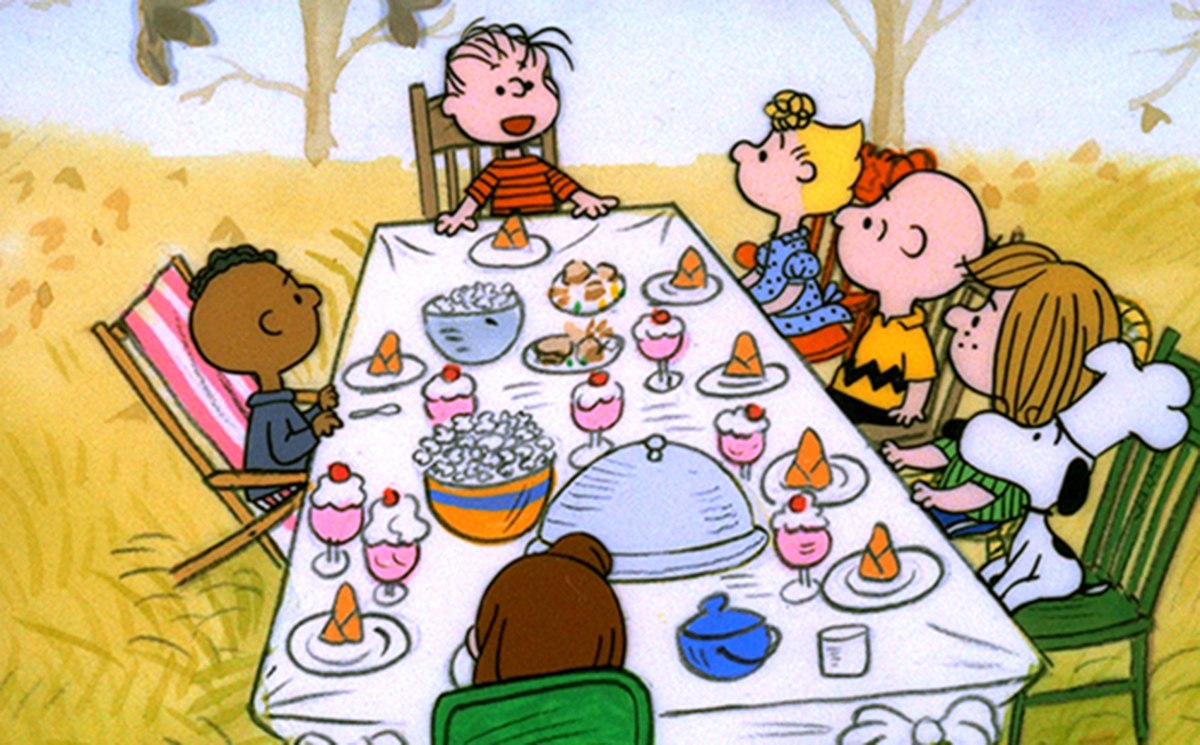
This first premiered on November 20, 1973, on CBS and won an Emmy Award. Great Thanksgiving special as always with the earlier Peanuts.
The Halloween, Thanksgiving, and Christmas Peanuts specials I always looked forward to. The way their world was only for kids where grownups were heard but only as noise in the background.
It starts off with Lucy tempting Charlie Brown with that football. Just one time I wanted to see Charlie kick the football…or Lucy at times.
It’s Thanksgiving and Peppermint Patty invites herself and Marcie over to Charlie Brown’s house but Charlie and Sally are ready to go to their grandmothers. Charlie talks to Linus and he suggests having two Thanksgiving dinners.
The only thing Charlie can come up with is feeding his friends toast and cold cereal which does not make Peppermint Patty happy whatsoever. She lets Charlie have it bad until Marcie remind her that she invited herself over.
Not going to give it away for those who have not seen this wonderful holiday cartoon. The music by Vince Guaraldi is excellent and makes every Peanuts cartoon special.
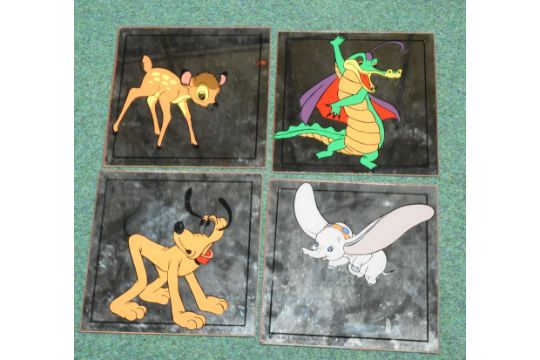
In the 1963 feature film The Pink Panther starring Peter Sellers, the Animated Credits opening featured our first look at the Pink Panther.
The cartoon series was made by DePatie-Freleng studios…the first short, “The Pink Phink,” won the 1964 Academy Award for Best Animated Short Subject…the first time an animation studio had won one with its very first cartoon.
What adds to the Pink Panther is Henry Mancini‘s popular theme music. The cartoon would not be the same without it. I bought the set years ago and showed them to my 6-year-old son at the time. He liked it as much as I did.
I watched it as a kid and it is probably the reason I ended up liking silent movies so much. Each show’s story has no dialog and is centered around the Pink Panther and “the little man” along with Mancini’s music.
There were 124 Pink Panther shorts were released between 1964 and 1978…there were some tv specials after the original series ended.
They tried having him talk in two episodes. It didn’t work and ruined the effect.
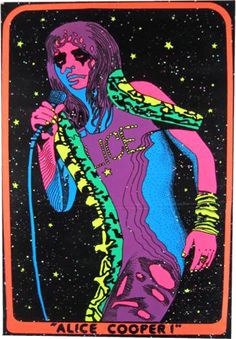
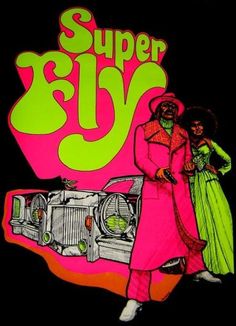
My sister went through a phase in the seventies when she had black lights and posters. I liked the effect and love some of the blacklight poster artwork. I claimed some of her posters when I got older. I did NOT claim her Osmond posters though. I left them to rot somewhere in a 1970s crawlspace. I loved the glowing effect of the black light posters and still do…
I’ve bought a few blacklight posters at yard sales through the years but they are getting harder to find all in one piece.
The black light poster has its roots in the 1950s with the introduction of fluorescent paint to the mass market. By the mid-1960s, fluorescent paints, and products found a massive audience in the psychedelic music scene.
For a while, this poster art was considered a relic of the 60s and 70s but according to Wiki, sales have surged since 2007 and five different companies are producing new posters now.
William H. Byler is credited with inventing the black light in 1935, and according to the University of Central Missouri, Byler graduated there in 1927 with a major in chemistry and physics.
These phosphors are what make things glow while under the light.
A blacklight poster is a poster printed with fluorescent inks which glow under a black light. The inks used contain phosphors which cause them to glow when exposed to ultraviolet light emitted from black lights.
I’ve seen vintage black light posters go between 100 – 600 dollars online.
If you have a burning desire to know more about black lights…go to the site below.
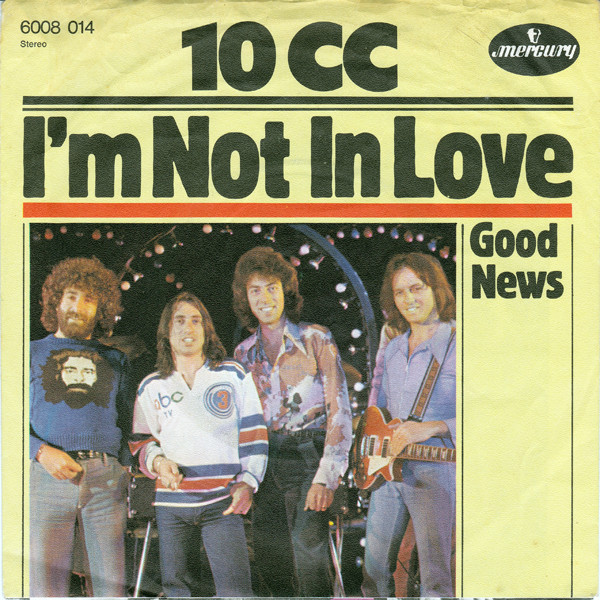
I always thought this was a clever song. The song peaked at #2 in the Billboard 100, #1 in the UK, and #1 in Canada. The overall wash sound was achieved by a total of 256 vocal overdubs in the background.
It was written by Eric Stewart and Graham Gouldman. Eric Stewart came up with the song by his wife telling him that he didn’t tell her he loved her enough. Eric said if I say it too much it would not mean anything.
“I met this gorgeous girl called Gloria at Halifax town hall. I was 18. She was 16. Three years later, we got married. A few years after that, Gloria told me: ‘You don’t say ‘I love you’ much anymore.’ I told her that, if I said it all the time, it would sound glib. But I started wondering how I could say it without using those actual words. So ‘I’m not in love’ became a rhetorical conversation with myself – and then a song.
I wrote the lyrics in a couple of days. The line, ‘I keep your picture up on the wall, it hides a nasty stain’ was about the crack in my bedroom wall at my parents’ house in Manchester. I’d put a photograph of Gloria over it. When I took the song to the band, they said: ‘I’m not in love’? What the f–k is that? You can’t say that!’ But Graham Gouldman, our bass-player and chord-master, agreed to work on it with me. We both liked The Girl From Ipanema, so we gave it a similar bossa nova style. Then Kevin Godley, our drummer, said it was crap.
We were about to scrap it and wipe the tape but, as I walked around the studio, I heard the secretary singing it and the window-cleaner whistling it. I knew we had a tune: we just hadn’t captured it properly. Kevin suggested doing it again, but with banks of voices. I thought that meant hiring a choir, but Lol Creme, our keyboard player, said we could do it using tape loops.”
I’m Not In Love
I’m not in love So don’t forget it It’s just a silly phase I’m going through And just because I call you up Don’t get me wrong, don’t think you’ve got it made I’m not in love, no no, it’s because..
I like to see you But then again That doesn’t mean you mean that much to me So if I call you Don’t make a fuss Don’t tell your friends about the two of us I’m not in love, no no, it’s because..
I keep your picture Upon the wall It hides a nasty stain that’s lying there So don’t you ask me To give it back I know you know it doesn’t mean that much to me I’m not in love, no no, it’s because..
Ooh you’ll wait a long time for me Ooh you’ll wait a long time Ooh you’ll wait a long time for me Ooh you’ll wait a long time
I’m not in love So don’t forget it It’s just a silly phase I’m going through And just because I call you up Don’t get me wrong, don’t think you’ve got it made I’m not in love I’m not in love
This is from Gregg Allman’s album Laid Back. Gregg started the album when the Allman Brothers were making Brothers and Sisters. He was having some problems with them and decided to make this one at the same time. The Allman Brothers originally performed Midnight Rider on their second album Idlewild South in 1970 but it wasn’t released as a single.
Gregg released this song in1974 and it peaked at #19 in the Billboard 100 and #17 in Canada.
Gregg Allman from his autobiography My Cross to Bear… Kim Payne was an Allman roadie.
On “Midnight Rider,” which is the song I’m most proud of in my career, I had all but the last part—so, as I like to say, I had the song by the nuts, I just had to reel it in. The third verse is really important because it’s kind of the epilogue to the whole thing. Basically, you state the problem in the first verse, you embellish on the problem in the second verse—like “let me tell you what a bitch she really is”—and then you usually have some music, to let you think about the words for a while and also get lifted up by that music. The bridge from the music to the third verse is when you want to be different, but you don’t want to go all the way from A to Z. You want something that contrasts things a little bit—kind of like matching a shirt with a pair of pants. You want it to be a little different, but not clashing. The bridge is where you say what you want to do about the problem, or what you’re damn sure going to do about it. Then the third verse is, like I said, the epilogue to the whole thing.
It might sound like I’m giving you a formula to write a song, but I’m not, because it’s never that simple. On “Midnight Rider,” I needed something to start the third verse, and Kim Payne came up with “I’ve gone by the point of caring,” which was exactly what I needed. “I’ve gone by the point of caring”—fuck it—and then, “Some old bed I’ll soon be sharing.” I’ve got another buck, and I ain’t gonna let ’em catch my ass, and then it’s just kinda off into the sunset.
Midnight Rider
Well, I’ve got to run to keep from hidin’, And I’m bound to keep on ridin’. And I’ve got one more silver dollar, But I’m not gonna let ’em catch me, no, Not gonna let ’em catch the Midnight Rider.
And I don’t own the clothes I’m wearing, And the road goes on forever, And I’ve got one more silver dollar, But I’m not gonna let ’em catch me, no Not gonna let ’em catch the Midnight Rider.
And I’ve gone by the point of caring, Some old bed I’ll soon be sharing, And I’ve got one more silver dollar,
But I’m not gonna let ’em catch me, no Not gonna let ’em catch the Midnight Rider.
No, I’m not gonna let ’em catch me, no Not gonna let ’em catch the Midnight Rider.
No, I’m not gonna let ’em catch me, no Not gonna let ’em catch the Midnight Rider.
This song peaked at #10 in the Billboard 100 in 1970 and #3 in the UK. The Marmalade were more successful in the UK by placing 10 top 10 singles in the UK charts but only charting Reflections of My Life in the Billboard top ten. It’s a song I heard many times when I was younger but didn’t know anything about it.
From Songfacts.
This dramatic ballad from the Age of Aquarius finds the singer describing a very bleak outlook on life and the times. The song was sort of a hippie version of the blues. >>
The Marmalade were a Scottish pop group who enjoyed several hits in the UK between 1968 and 1976. Originally a band called Dean Ford & The Gaylords, they changed their name to Marmalade in 1967. They are best remembered in Britain for their cover of the Beatles song “Ob-La-Di, Ob-La-Da” which topped the UK charts around Christmas 1968. In 1969, they signed to Decca Records, and their contract gave them complete freedom to write and produce their own records. The fruits of this arrangement was the recording of this song with its distinctive backwards guitar break, which was their only American hit.
This song was written by vocalist Dean Ford and the band’s main songwriter, keyboardist Junior Campbell. Campbell went on to pen the theme from the British TV series Thomas The Tank Engine, which was narrated in its first two seasons by Ringo Starr.
Reflections of My Life
The changing of sunlight to moonlight Reflections of my life Oh, how they fill my eyes
The greetings of people in trouble Reflections of my life Oh, how they fill my eyes
Oh, my sorrows Sad tomorrows Take me back to my own home
Oh, my crying (Oh, my crying) Feel I’m dying, dying Take me back to my own home
I’m changing, arranging I’m changing I’m changing everything Everything around me
The world is A bad place A bad place A terrible place to live Oh, but I don’t want to die
Oh, my sorrows Sad tomorrows Take me back to my own home
Oh, my crying (Oh, my crying) Feel I’m dying, dying Take me back to my own home
Oh, my sorrows Sad tomorrows Take me back to my own home
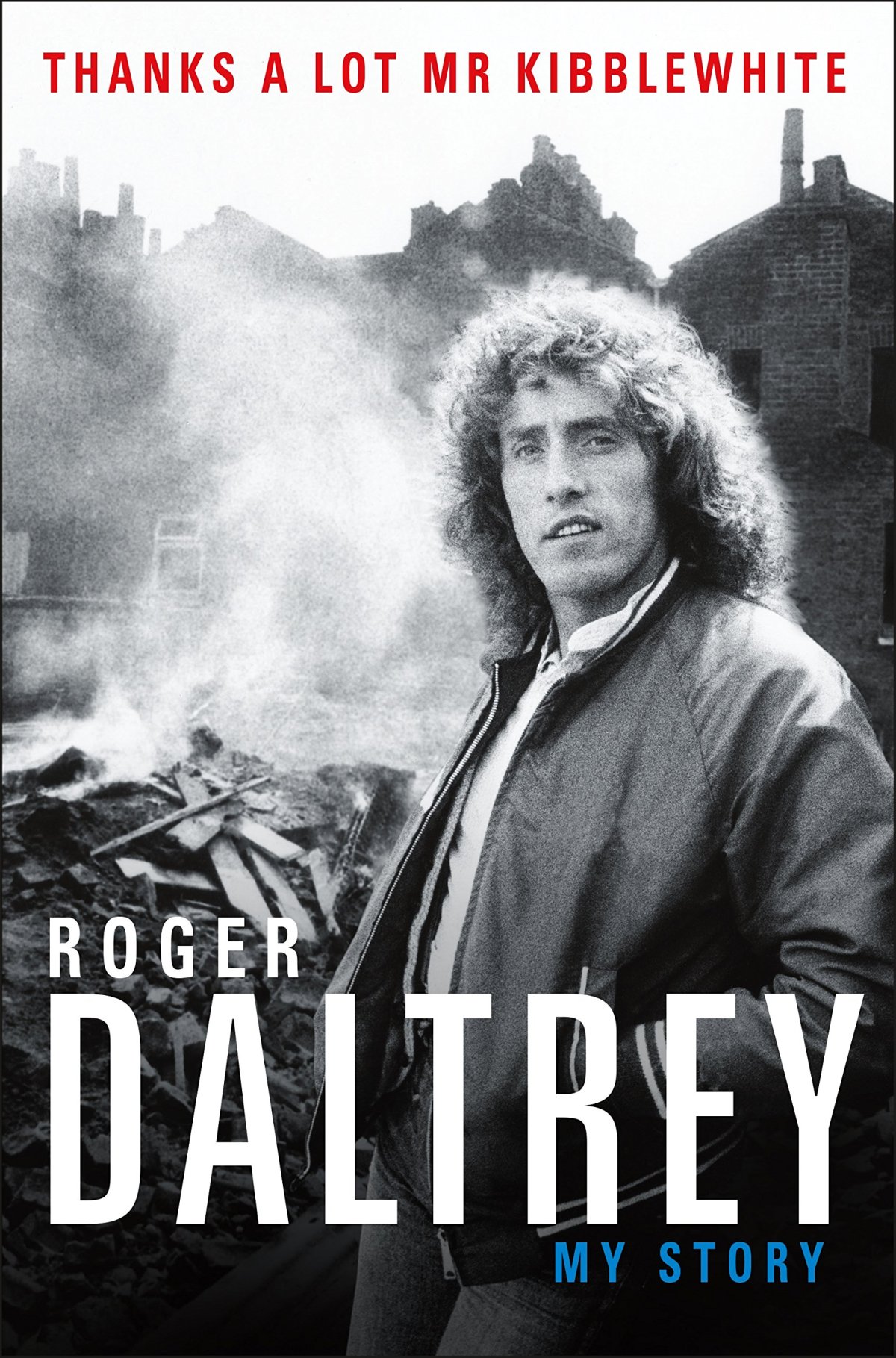
I just finished the audio version of this book. I’m a huge Who fan and I was looking forward to it. It was nice to hear the book narrated by Roger himself. It’s a solid book but I have only one complaint that I will get into below.
The positive about the book is you find out more about the different personalities of the Who and the reason they fought. Pete the artist, John the dark one, Keith the lunatic, and Roger blue-collar man of the band. We all knew those descriptions before but Roger tries to explain how it worked and didn’t work as a band. If you want to know The Who’s impact on rock music and culture go to Pete Townshend. If you want to get straight to the point with just the highlights…Roger is your man.
Roger is grounded, avoided most of the pitfalls in his profession, hard-working, and loves interpreting Pete’s music to the world. He goes into how he changed his singing style with Pete’s writing. How he became Tommy and the mod in Quadrophenia. He hits the highlights of The Who and his life without the Who in the 80s and part of the 90s.
The strongest part of this book is about his childhood and his collection of relatives. Roger seems very approachable, likable, and down to earth. Roger was the one constant in the band that you didn’t have worry about his on tour activities. He does talk about the high points of the Who and his acting career.
My biggest complaint is the book is too short. You get the impression that he didn’t think that anyone would want to hear any details whatsoever. He does give you some good stories but touches a subject and quickly leaves. It’s almost a cliff notes version as he didn’t dwell in any period long.
It is a quick and enjoyable read but leaves you wanting more.
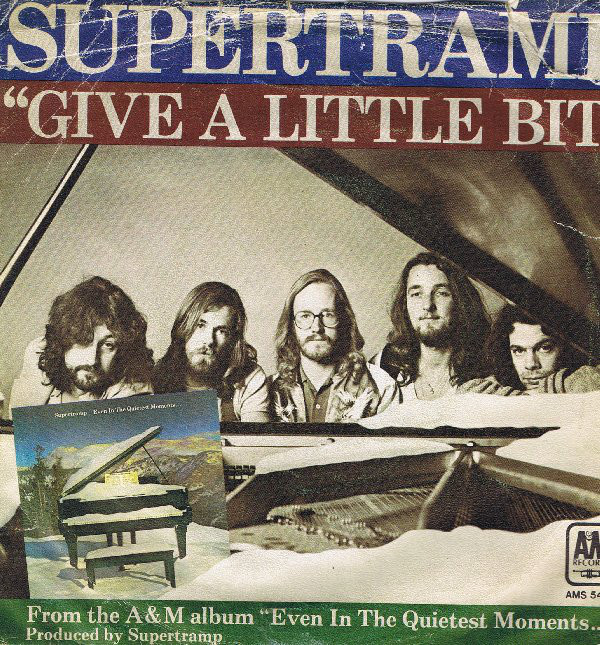
This is an extremely catchy song by Supertramp off of the album Even in the Quietest Moments… This was before their classic Breakfast In America. The song was inspired by “All You Need Is Love” by the Beatles.
The song peaked at #15 in the Billboard 100, #29 in the UK, and #8 in Canada in 1977.
The song was credited to Roger Hodgson and Rick Davies but Roger Hodgson wrote it. Roger Hodgson’s quote. “The song itself is such a pure, simple message that I think is really especially even more powerful today when the world has even more problems and it’s even more difficult sometimes to be compassionate and caring because we’ve got to put up all these barriers to survive; that it’s a song that really inspires people to give a little bit, not give a lot, just give a little bit and see how it feels and show that you care, and I know for me, every time I play it in concert, there’s something about that song.
I look out and people just start smiling straight away and sometimes they hug each other and they start singing with me. It’s a very unifying song with a beautiful, simple message that I’m very proud of and really enjoy playing today.”
Supertramp singer/guitarist Roger Hodgson wrote this song when he was a teenager, but didn’t record it until much later. It was about five years between when he wrote the song and when he brought it to the band. When we spoke with Hodgson in 2012, he explained: “I think it’s a great song. I didn’t realize it was when I first wrote it. It actually took me six years before I even brought it to the band. But I wrote it I think around 1970. That time, the late ’60s, early ’70s, was a very idealistic time, one of hope, a lot of peace and love and the dream of the ’60s was still very alive and maturing if you like.
That song has really taken on a life of its own, and I think it’s even more relevant today than when I wrote it. Because we really are needing to value love in a much deeper way, and also we’re needing to care. The song is basically saying: just show you care. You know, reach out and show you care. So in concert, it’s the perfect show closer because what I try to do in my show over two hours is unify the audience and unify all of us. So that at the end, when everyone stands up for ‘Give A Little Bit,’ they’re open and ready to open their hearts and sing at the top of their lungs and go away with a smile on their face. And that song really does, it has a very pure energy. The moment I start, people just start smiling. It’s amazing.”
Give A Little Bit
Give a little bit Give a little bit of your love to me Give a little bit I’ll give a little bit of my love to you There’s so much that we need to share Send a smile and show you care
I’ll give a little bit I’ll give a little bit of my life for you So give a little bit Give a little bit of your time to me See the man with the lonely eyes Take his hand, you’ll be surprised
Give a little bit Give a little bit of your love to me I’ll give a little bit of my life for you Now’s the time that we need to share So find yourself, we’re on our way back home
Going home Don’t you need to feel at home Oh yeah, we gotta sing
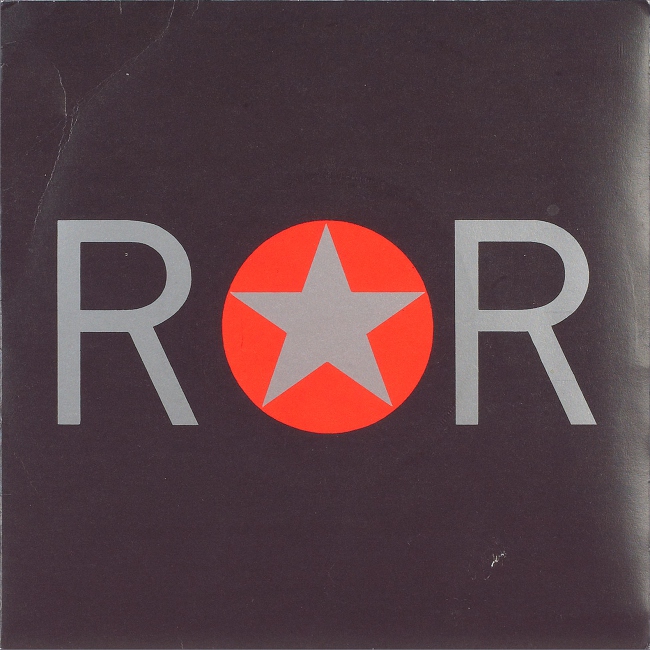
Ringo Starr and Robin Cruikshank formed a partnership in 1969 and they were located in the Beatles Apple building on Savile Row. In 1972 relocated with Apple to 54 St James Street.
Robin had originally worked for Ringo to design a stainless steel fireplace for Ringo and his wife Maureen. Ringo started to give Robin some suggestions and the two started to worked together on furniture and different designs for years after that. The partnership lasted until 1986 and after that Ringo let Robin use the name so Cruikshank could continue different projects.
If you ever run across anything made by RoR you probably have something very valuable.
Below was designed by RoR. I can’t imagine what it would have cost. I would take it in a second.
I remember seeing the below item on the news. Very expensive because they didn’t use reproduction parts…they all had authentic Roll Royce grills.
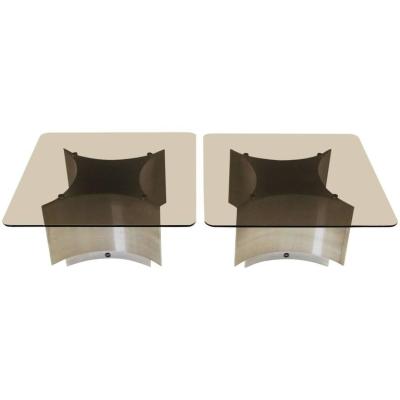
Here are some tables by RoR.
Below is Robin’s website featuring his new designs plus much more history.
I’ve always liked early Chicago when Terry Kath was part of the band. Love the intro to this song and it takes me back to when I first heard the song. Saturday in the Park peaked at #3 in the Billboard 100 and #2 in Canada. Robert Lamm who wrote the song openly admits he based the melody on The Beatles “You Won’t See Me.”
Robert Lamm on Saturday in the Park
“Saturday in the Park is a prime example of how I take from what I experience in the world. It was written as I was looking at footage from a film I shot in Central Park, over a couple of years, back in the early ‘70s. I shot this film and somewhere down the line I edited it into some kind of a narrative, and as I watched the film I jotted down some ideas based on what I was seeing and had experienced. And it was really kind of that peace and love thing that happened in Central Park and in many parks all over the world, perhaps on a Saturday, where people just relax and enjoy each other’s presence, and the activities we observe and the feelings we get from feeling a part of a day like that.”
Chicago’s main songwriter, Robert Lamm, wrote this after a particularly exhilarating 4th of July spent in New York’s Central Park, where there were steel drum players, singers, dancers and jugglers. Lamm and Peter Cetera sang lead on the track.
like most Chicago singles, this didn’t chart in the UK. In America, however, it was their biggest chart hit to that point and also their first gold single, which at the time meant selling more than a million copies (“25 Or 6 To 4” somehow was never certified gold).
This song contains some of the most famous nonsense singing in rock: after Robert Lamm sings the line, “Singing Italian songs,” he sings some made up words approximating the Italian language.
Saturday In the Park
Saturday in the park, I think it was the Fourth of July Saturday in the park, I think it was the Fourth of July
People dancing, people laughing A man selling ice cream Singing Italian songs Everybody is another Can you dig it (yes, I can) And I’ve been waiting such a long time For Saturday
Another day in the park I think it was the Fourth of July Another day in the park I think it was the Fourth of July
People talking, really smiling A man playing guitar And singing for us all Will you help him change the world Can you dig it (yes, I can) And I’ve been waiting such a long time For today
Slow motion riders fly the colors of the day A bronze man still can tell stories his own way Listen children all is not lost, all is not lost, oh no, no
Funny days in the park Every day’s the Fourth of July Funny days in the park Every day’s the Fourth of July
People reaching, people touching A real celebration Waiting for us all If we want it, really want it Can you dig it (yes, I can) And I’ve been waiting such a long time For the day, yeah yeah
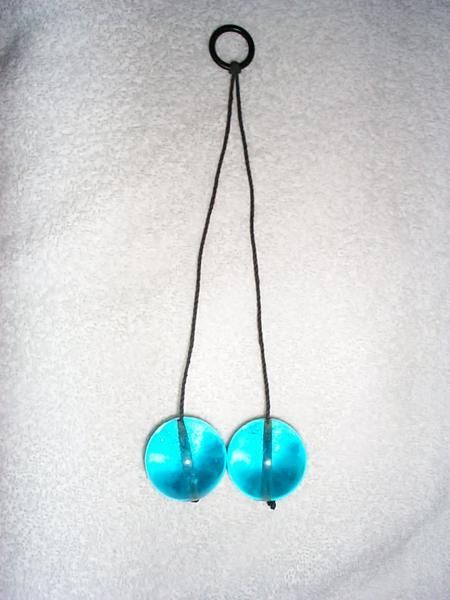
Clackers or… death on a string came out in the 1960s. They were also called Ker-Bangers, Klackers, Click-Clacks, Klik Klaks, Klappers, and Zonkers.
I remember a kid giving me his Clackers. The object I guess was swinging them up and down until they hit each other and made a “clack” sound. The sound I got the most was a thud sound with plastic hitting my skin. They were also known to shatter and the pieces fly in all different directions.
They were similar to Bolas…a weapon used by cowboys to throw at cattle or game to wrap around their legs…sometimes breaking them. Yep…lets redesign this and give it to kids.
I never minded somewhat dangerous toys but I didn’t get too much pleasure out of these.
I could pick about any ELO song and do fine. Jeff Lynne is one of the best pop/rock songwriters. In my opinion, he can write super catchy songs without being sugary. Telephone Line peaked at #8 in the Billboard 100, #7 in the UK and #1 in Canada in 1977.
Lynne once said that ELO will “Pick up where ‘I Am the Walrus’ left off.”
Telephone Line was originally recorded at Musicland Studios in Munich, Germany during July of 1976. This recording was for the backing track only. The orchestra was recorded later at De Lane Lea Studios, Wembley, England. Just before release, other minor edits (including the muted telephone intro) were done at Cherokee Studios in Los Angeles, California, USA. The early working title was Bad Salad Telephone (a play on the term “sad ballad”), so it appears that the telephone theme was an early concept for the song.
Telephone Effects: The telephone intro for the song has drawn a lot of attention over the years. There are two notable things about it. First, the ringback tone heard (as one would hear when waiting for the line to pick up) is a North American ringback tone which is quite distinctive from that heard in the U.K. at the time. The band was having much greater success in America at the time and this inspired them to use the North American sound rather than the British sound. To get the sound just right, the band called to an office in America in when they knew no one would answer. It was likely to have been the Jet Records office in California because the time zones from England or Germany to America would have likely meant the offices were closed when the call was made. The band did not simply record the tone and insert that into the record as has been stated in some interviews, but rather they studied the sounds and then recreated them on synthesizer. If one listens closely, they are clearly not a match.
The other interesting bit about the intro is the muted, mono telephone sound, as if the listener is listening through the telephone to the song’s intro. This was a very late addition to the song. The recording was completed and Jeff was bringing the tapes from England to California when he got the idea to add the effect to the song. So it was in Cherokee Studios in Los Angeles that engineers Duane Scott and Kevin Gray were instructed to manually add the effect to the completed stereo master. The song plays normally until the very first vocal line of the first verse when the mono, listening-on-the-telephone effect cuts in. This continues, along with the ringback tone, until the “lonely, lonely, lonely, lonely, lonely nights” line when the full stereo version of the song is slowly phased in and the ringback stops. In addition, the ringback tone is again heard mid-song, in the short bridge following the first chorus and before the third verse. In the alternate vocal version heard on the 2007 A New World Record remaster, which has a non-fading end, the ringback tone is heard yet again as the last notes of the song are waning.
Telephone Line
Hello. How are you?
Have you been alright through all those lonely lonely lonely lonely lonely nights?
That’s what I’d say.
I’d tell you everything, if you’d pick up that telephone.
Hey. How you feeling?
Are you still the same?
Don’t you realize the things we did we did were all for real? Not a dream.
I just can’t believe they’ve all faded out of view.
Blue days, black nights
I look into the sky
The love you need ain’t gonna see you through.
And I wonder why
The little things you planned ain’t coming true.
Telephone line, give me some time, I’m living in twilight
Telephone line, give me some time, I’m living in twilight
O.K. So, no one’s answering,
Well can’t you just let it ring a little longer longer longer
I’ll just sit tight, through the shadows of the night
Let it ring for evermore.
Blue days, black nights
I look into the sky
The love you need ain’t gonna see you through.
And I wonder why
The little things you planned ain’t coming true.
Telephone line, give me some time, I’m living in twilight
Telephone line, give me some time, I’m living in twilight
Telephone line, give me some time, I’m living in twilight
Telephone line, give me some time, I’m living in twilight
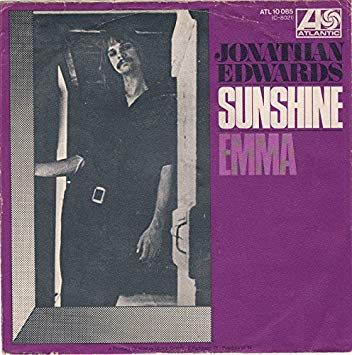
Always loved this song. Edwards sings this song like he means every syllable. This song was written by Edwards and peaked at #4 in the Billboard 100. Sunshine was off of Jonathan’s self-titled debut album in 1971. This would be Edwards only top forty hit.
A song that fit the times and the counterculture perfectly with a Us vs Them mentality.
“I just went, ‘How much does it cost? I’ll buy it.’ I was talking about freedom and talking about authority, my constant questioning of authority. ‘How much does it cost? I’ll buy it? Time is all we’ve lost. I’ll try it. He can’t even run his own life, I’ll be damned if he’ll run mine.’ That just came out as I was playing the song for these people.”
When he performs live, Edwards usually ends the first of his two sets with this song. “I often say, and it’s true, that if I had never done another song in my life, I’ll be happy to have come and gone with that,” he told us. “It was an anthem to many people and it helped a lot of people through Vietnam. It helped a lot of people through the drug culture of the last part of the ’60s and the early ’70s. It helped a lot of people cope with a lot of things that were going on during those tumultuous years. And I feel very proud to have done that and very happy with my contribution to our culture.”
Edwards performed this song at the Mayday protests on May 2, 1971. With the slogan, “If the government will not stop the war, we will stop the government,” the demonstration was organized by a group called the Mayday Tribe, with the goal of shutting down the government by blocking off key areas in Washington, DC. When the protests started on May 1, the government had thousands of troops ready and made mass arrests, which carried into the next day when Edwards played at the Washington Monument. “The sun was coming up and the National Guard was arresting people for protesting, for being on the grounds of the Washington Monument,” he recalled. “It was my turn to play and I just started playing that song. We got to the end and my bass player and I looked at each other and we went, ‘Let’s just start it over again.’ So we just kept playing that song. Because there’s no better song for the soundtrack of that movie. It had just come out. Some people had heard it, some hadn’t, but everyone heard it that morning, including the National Guard.”
Sunshine
Sunshine go away today, I don’t feel much like dancing Some man’s come he’s trying to run my life, don’t know what he’s asking When he tells me I better get in line, can’t hear what he’s saying When I grow up, I’m gonna make him mine, these ain’t dues I been paying
How much does it cost? I’ll buy it! The time is all we’ve lost I’ll try it! He can’t even run his own life, I’ll be damned if he’ll run mine–sunshine
Sunshine, go away today, I don’t feel much like dancing Some man’s come he’s trying to run my life, don’t know what he’s asking Working starts to make me wonder where fruits of what I do are going When he says in love and war all is fair, he’s got cards he ain’t showing
How much does it cost? I’ll buy it! The time is all we’ve lost–I’ll try it! He can’t even run his own life, I’ll be damned if he’ll run mine–sunshine
Sunshine, come on back another day, I promise you I’ll be singing This old world, she’s gonna turn around, brand new bells will be ringing
I had a waterbed in the early 80s as a young teen. I always liked it and thought it was comfortable. Two things I didn’t like about it was… if there was a leak you would not know until 2:30 am and on a school night…always. If the heater was either turned down or went out…you would wake up as a human popsicle at…you guessed it… 2:30 am. Nothing ever happened to it at noon on a Saturday.
in the early 1800s. Scottish physician Dr. Neil Arnott devised a water-filled bed to prevent bedsores in invalids.
In 1873, Sir James Paget, of St. Bartholomew Hospital in London, presented the waterbed designed by Dr. Arnott as a treatment and prevention of ulcers, a common condition at this time. Paget found that waterbeds allowed for even pressure distribution over the entire body. The only problem was that you could not regulate the water temperature.
In 1968 Charles Hall presented the waterbed as his Master’s Thesis project to his San Francisco State University design class. While showcasing their work, students rotated through workshops to see each other’s inventions. Once they reached Hall’s project – a vinyl mattress filled with heated water – the class never left. “Everybody just ended up frolicking on the waterbed,” Hall recalls.
Hall’s first waterbed mattress was called ‘the Pleasure Pit’ and it quickly gained popularity with the hippie culture of the 1960’s and 1970’s.
Time Magazine in 1971 about waterbeds. “Playboy Tycoon Hugh Hefner has one–king-size, of course, and covered with Tasmanian opossum. The growing number of manufacturers and distributors, with such appropriate names as Aquarius Products, the Water Works, Innerspace Environments, Joyapeutic Aqua Beds and the Wet Dream, can hardly meet the demand. They have sold more than 15,000 since August.”
Sex always sells… one ad stated. “Two things are better on a waterbed. One of them is sleep.” and “She’ll admire you for your car, she’ll respect you for your position, but she’ll love you for your waterbed.”
By the 80s waterbeds were in the suburbs and gaining in popularity. In 1987, waterbeds had achieved their peak, representing 22 percent of all U.S. mattress sales.
At the end of the 1980s waterbed sales fell off. Some say it was because they were too connected to the 70s that had fallen out of favor (the horror!)… but most think it was because of the maintenance and pain in setting them up and moving them. Also, you had to make sure your floor was braced enough to have one depending on the size and weight of it.
Today you can still buy them but most are designed thinner to hold less water in rolls instead of sleeping on a lake beneath you.
I had mine until I was 20 with plenty of patches but it still held water and me… but I left it behind when I moved.
This egg-shaped one below I would gladly take home now
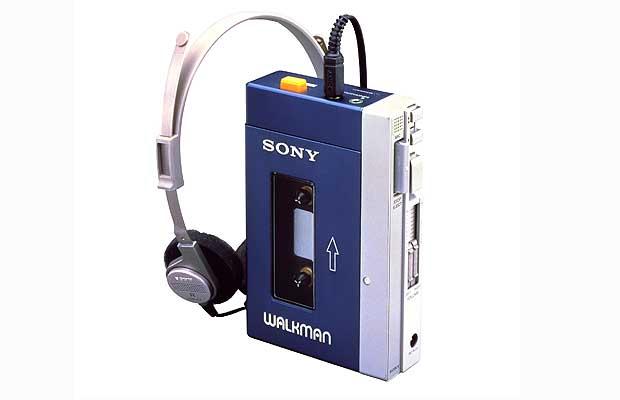
In July of 1979, the Sony Walkman was released to the public. You had portable music anywhere you went. It cost $150 ($546.21 in today’s money).
The 1980s was the Walkman’s decade. Cassettes started to outsell albums and this device was one of the reasons. By 1986 the word “Walkman” had entered the Oxford English Dictionary. Its launch coincided with the birth of the aerobics craze, and millions used the Walkman to make their workouts more entertaining.
Between 1987 and 1997 — the height of the Walkman’s popularity — the number of people who said they walked for exercise increased by 30 percent.
Sony continued to roll out variations on its theme, adding such features as AM/FM receivers, bass boost, and auto-reverse. Sony even made a solar-powered Walkman, water-resistant Sport Walkmans and even devices with two cassette drives. With the introduction of compact discs in 1982, the cassette format began to go the way of the dinosaur.
Sony was fairly quick to jump to new formats: it introduced the D-50 portable CD player a year after the first compact discs were sold, and later rolled out MiniDisc and MP3 players under the Walkman brand.
It caught on with the public in a big way. Today with iPods, iPhones and other devices we take it for granted are descendants from the 1979 Walkman.
















 PowerPop... An Eclectic Collection of Pop Culture