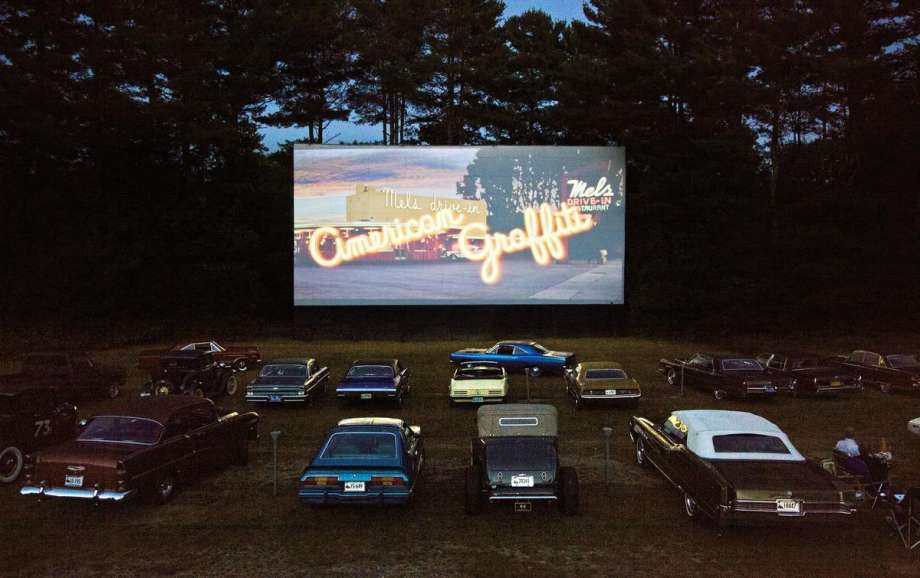
I remember Drive-In Theaters from way back. My sister is 8 years older than I am. When she was 16 I was 8 and mom made her take me with her on dates and that included the Drive-In. Most Drive-Ins charged by the person so guess where I was located? A mile up from the Drive-In I would know the routine…I would climb in the trunk. I remember smelling the old dirty tire and whatever else…I would hear us roll over the gravel and then the car would stop…my sister would let me out.
I would climb in the back seat and start watching. Although I make fun of her for this I actually enjoyed it. It was fun to do as a kid. I was a laid-back kid anyway. I remember the only movie showing one time was an R rated movie. It was called “Revenge of the Cheerleaders” from 1976…I got quite an education on the female anatomy. She would tell me don’t look now… then she and her date would go out and talk to friends parked around. I was of course looking and I never told mom…I knew I would not get to come back if I told her.
There are a few around here and once in a while, we will go see them. No Cheerleaders though.
In 1933, eager motorists park their automobiles on the grounds of Park-In Theaters, the first-ever drive-in movie theater, located on Crescent Boulevard in Camden, New Jersey. Richard Hollingshead opened it up. He thought of it because his mother was to large for theater seats. He charged just 25 cents per car.
The Drive-In didn’t really take off until the in-car speakers were invented by the late 40s. By 1958, the number of drive-ins peaked at 4,063.
Indoor theaters were more practical because they could show a movie 5-6 times a day and not have to worry about the weather or being light so the Drive-In’s started to get B movies (Revenge of the Cheerleaders!) and the fad started to slow down. Also, land value pushed the Drive-In’s out.
Now there are roughly 400 Drive-Ins left in America.
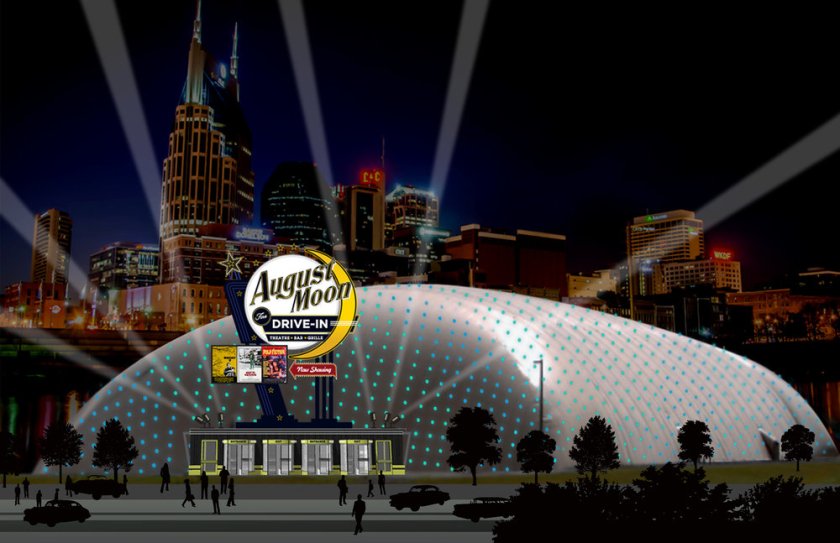
In Nashville, they are building an indoor Drive-In Theater. When it is finished I will check it out. You will not drive in with your car…you will walk in and sit in one of the classic cars they will have ready for you…I’m ready…but no trunks
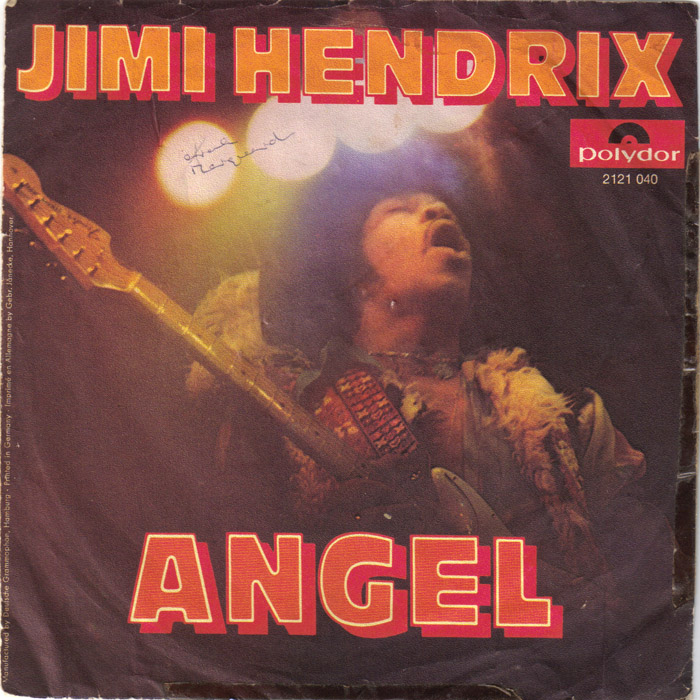
This is a beautiful spacey song by Jimi Hendrix. Hendrix started working on this in 1967 along with “Little Wing,” which was similar. He gave up on it, but pulled it out and recorded it on July 23, 1970 – just a few months before his death on September 18, 1970. The song takes you on a ride.
It was originally released on his 1971 posthumous album The Cry of Love. It was written by Hendrix and recorded at Electric Lady Studios with drummer Mitch Mitchell and bassist Billy Cox. Rod Stewart later covered this song…of course, he has covered about every song.
The song was inspired by a dream Hendrix had about his mother, Lucille. His vocal performance here is relaxed and almost whispered in places, as if the song wasn’t meant for a crowd at all, just for the person in the dream. Mitch Mitchell keeps it light, more brush than hammer, and Billy Cox anchors it without intruding. The whole thing feels like it’s floating.
Angel
Angel came down from heaven yesterday She stayed with me just long enough to rescue me And she told me a story yesterday, About the sweet love between the moon and the deep blue sea And then she spread her wings high over me She said she’s gonna come back tomorrow
And I said, “Fly on my sweet angel, Fly on through the sky, Fly on my sweet angel, Tomorrow I’m gonna be by your side”
Sure enough this morning came unto me Silver wings silhouetted against the child’s sunrise And my angel she said unto me, “Today is the day for you to rise Take my hand, you’re gonna be my man, You’re gonna rise” And then she took high over yonder
And I said, “Fly on my sweet angel, Fly on through the sky, Fly on my sweet angel, Forever I will be by your side”
Some of these restaurant chains, people will remember some won’t because it depends on where you live and if any were in your market. A few may have a handful open with Franchisees but for the most part, they are closed.
Steak and Ale -1966 – 2008 I liked the Mock Tudor building and the atmosphere inside…the food was good. They are trying to make a comeback…I hope they make it. Last time I ate at one was in the 90s in Huntsville Alabama.
Burger Chef – 1954 – 1996 They had over 1200 locations at one time. Many were bought out and turned into Hardees.
Rax Roast Beef 1967 – (handful open now)I liked the Roast Beef but the best thing was the chocolate chip milkshake. There are a few lone Franchisees left. I remember going to them in the 80s.
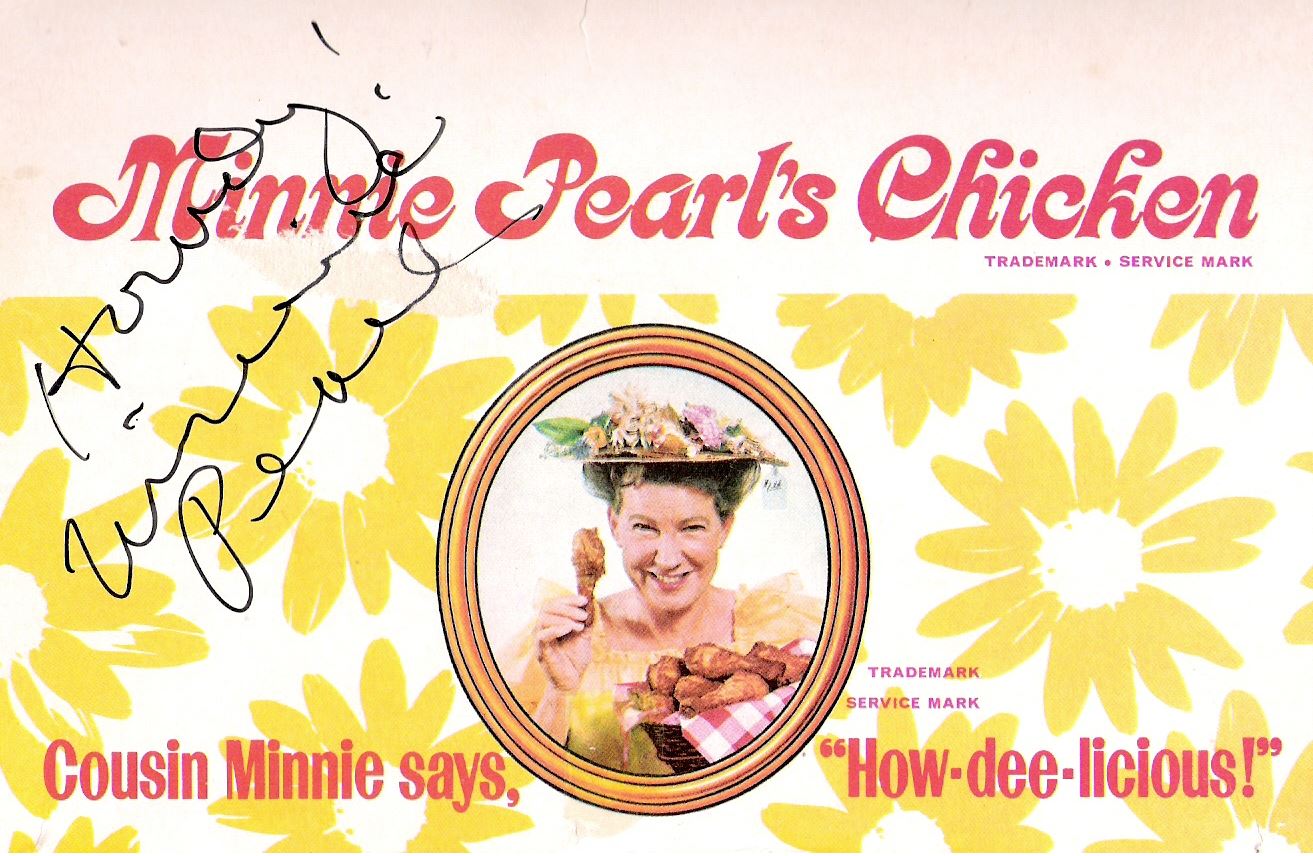
Minnie Pearl’s Fried Chicken 1968 to mid-1970s – How-dee-licious…indeed. It was actually really good. When I was in 2nd grade we would go to one in a nearby town once in a while…really good chicken… it went down because of faulty accounting… Great article here.
Bennigan’s 1976 – (Bennigan’s and Steak and Ale making a comeback together)An Irish Pub theme restaurant. I went there a few times. There are a few locations left…
Red Barn – 1961-1988 They were known for the “Big Barney” and Barnbuster burger. I see an old Red Barn where I work and now it’s a Mexican restaurant.
Howard Johnson’s Restaurant – 1953-2017 I do remember eating at a few of these traveling. In 2017 there was one left in New York but the owner was arrested and now it’s closed.
LUMS – 1956-1982 I did go to one but I was really young and traveling at the time.
Bonanza Steak House – 1963 – 2008 (bankruptcy) There are a few of these left… these and Ponderosa… Dan Blocker (Hoss Cartwright) was an original investor. In the late seventies before we would go to a movie we would stop at a Bonanza. I did go to a Ponderosa a few years back.
I first noticed Candian Gordon Lightfoot riding in the car with my sister …with the AM radio station playing this song. Sundown got a lot of airplay back then. It peaked at #1 in the Billboard 100, #1 in Canada, and #33 in the UK in 1974.
The inspiration for this song was his girlfriend Cathy Smith who would later have a romantic relationship with Richard Manuel of The Band and a fatal encounter with John Belushi.
The inspiration for this song came from Lightfoot worrying about his girlfriend, who was out at bars all day while he was at home writing songs. He recalled during a Reddit AMA: “I had this girlfriend one time, and I was at home working, at my desk, working at my songwriting which I had been doing all week since I was on a roll, and my girlfriend was somewhere drinking, drinking somewhere. So I was hoping that no one else would get their hands on her, because she was pretty good lookin’!”
“As a matter of fact, it was written just around Sundown,” he added, “just as the sun was setting, behind the farm I had rented to use as a place to write the album.”
Lightfoot most likely wrote this about the stormy relationship with his one time girlfriend Cathy Smith, who was later sentenced for delivering a lethal dose of heroin to John Belushi.
Sundown
I can see her lyin’ back in her satin dress In a room where ya do what ya don’t confess Sundown you better take care If I find you beenn creepin’ ’round my back stairs Sundown ya better take care If I find you been creepin’ ’round my back stairs
She’s been lookin’ like a queen in a sailor’s dream And she don’t always say what she really means Sometimes I think it’s a shame When I get feelin’ better when I’m feelin’ no pain Sometimes I think it’s a shame When I get feelin’ better when I’m feelin’ no pain
I can picture every move that a man could make Getting lost in her lovin’ is your first mistake Sundown you better take care If I find you been creepin’ ’round my back stairs Sometimes I think it’s a sin When I feel like I’m winnin’ when I’m losin’ again
I can see her lookin’ fast in her faded jeans She’s a hard lovin’ woman, got me feelin’ mean Sometimes I think it’s a shame When I get feelin’ better when I’m feelin’ no pain Sundown you better take care If I find you been creepin’ ’round my back stairs Sundown you better take care If I find you been creepin’ ’round my back stairs Sometimes I think it’s a sin When I feel like I’m winnin’ when I’m losin’ again
I remember most of these. Once in a while when I’m in a good mood at work…I will slip some of these in just to see the reactions. I’m in IT so I can get by with it…we are viewed as weird anyway. I never realized how much out of date slang there is out there. This doesn’t even scratch the surface.
Do Me a Solid – do me a favor
To the Max – I still use this one…it contains my name so it fits.
Disco Biscuits – Quaaludes
Cool Beans – Not a side dish but it’s cool
10-4 – good buddy – an understanding
Sweet! – very cool
Psyche – To fake someone out…love this one
Groovy – Everything is cool
Stop dipping in my Kool-Aid – Stop getting into my business
Do Me A Solid – Do me a favor
Catch you on the flip-side – See you later
Far Out – Cool and groovy
Can You Dig It – Do you understand
Wicked – Awesome
The Skinny – The lowdown
Good Night Johnboy – from the Waltons…a form of goodbye
Dy-no-mite! – JJ or Jimmy Walker from Goodtimes…something that is great.
Dream On – Saying something is unrealistic
The Man – Well this one is used today…the authority, corporations, police, government… the boss
Bitch’n – very cool
Gimme Five – This one has totally vanished…I’m updating this one…many do this with kids now…so I see a comeback.
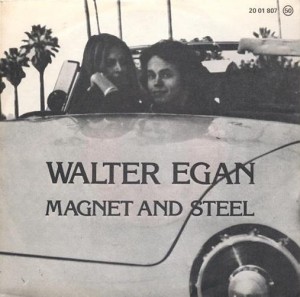
One of my favorite pop/rock songs. Beautifully crafted melody. In 1978 this song peaked at #8 in the Billboard 100. Walter wrote this song about Stevie Nicks and she sang on the track. The bass and drum sound in this song is fantastic.
Stevie Nicks sang on this track and provided inspiration for the lyrics. Walter Egan tells us about this song:
“In 1976 I was living in Pomona, California and I had a notion to write a song with the ‘stroll’ beat (made famous by Chuck Willis) and so began the rough outline of what was tentatively called ‘Don’t Turn Away Now.’ Now, this was also at the time of putting together my first album, Fundamental Roll, and my two new friends and producers, Lindsey Buckingham and Stevie Nicks and I were starting the recording process.
On the night when Stevie did the background vocals for my song ‘Tunnel o’ Love,’ my nascent amorous feelings toward her came into a sharper focus – I was smitten by the kitten, as they say. It was on my drive home at 3 AM from Van Nuys to Pomona that I happened to be behind a metal flake blue Continental with ground effects and a diamond window in back. I was inspired by the car’s license plate: “Not Shy.”
By the time I pulled into my driveway I had formulated the lyrics and come up with the magnet metaphor. From there the song was finished in 15 minutes.
It was especially satisfying to have Stevie sing on ‘Magnet,’ since it was about her (and me).”
This was used in the 1997 movie Boogie Nights.
This was Egan’s only Top 40 chart entry for his own recordings, though he also wrote Night’s first hit, “Hot Summer Nights,” which reached #18.
Magnet and Steel
Ooh ooh ah Now I told you so you ought to know Ooh it takes some time for a feelin’ to grow Ooh you’re so close now I can’t let you go Ooh and I can’t let go For you are a magnet and I am steel
I can’t hope that I’ll hold you for long Ooh you’re a woman who’s lost to your song Ooh but the love that I feel is so strong Ooh and it can’t be wrong
With you I’m not shy to show the way I feel With you I might try my secrets to reveal For you are a magnet and I am steel For you are a magnet and I am steel
This song was the first I heard from the Pretenders. When I think of The Pretenders I think of this song. it wasn’t their best song but it is memorable. Most Pretenders songs were written solo by Hynde, but the group’s guitarist, James Honeyman-Scott, is also a credited writer on this track. The song peaked at #14 in the Billboard 100 and #1 in the UK in 1979.
In a VH1 interview, Hynde admitted to loathing the song, and said that since so many fans love it, she continues to play it.
Lead singer Chrissie Hynde grew up in Akron, Ohio and was a student at Kent State University in 1970 when four students were killed by members of the US National Guard. She left for England in 1973, where she formed the group with three guys from Hereford.
Chrissie Hynde rarely explained what her songs were about, but she let on with this one in a 1980 interview with Sounds: “It’s very lightweight pop type of song, nothing heavy about it. It’s along the lines of the guy who is feeling very insecure, not about pulling a girl but, say, trying to be accepted by the guys down the pub. It’s a front he’s putting up. It’s like buying a pair of new boots and you feel great but then you get home and see you spots in the mirror. Or take a couple of dexies and you’re in gear for the evening but on the train home it’s different.”
She had clearly internalized the British argot. “Pulling a girl” means finding a companion for the evening; “dexies” are Dexedrine pills, which give the user a jolt of energy. At the time, dexy abuse was common in the UK, especially amongst musicians and clubgoers. The band Dexys Midnight Runners took their name from the pill.
The song’s title came about after The Pretenders first-ever UK gig, when they were in the communal dressing room with The Strangeways, who they were supporting. Chrissie Hynde wanted to know whose trousers were sprawled over the back of a chair. One of The Strangeways Ada Wilson said: “I’ll have them if there’s any brass in the pockets.”
When Chrissie inquired what he meant by brass, it was explained to her that brass is a northern slang term for money. Chrissie fell in love with the expression and was inspired to write the song.
It usually doesn’t show up in printed lyrics, but at the end of the song, Hynde coos the line, “Oh and the way you walk.” She says that’s an important part of the song; it’s her telling the insecure peacock that she approves of his offering.
In the video, directed by Mark Robinson, lead singer Chrissie Hynde plays a waitress, implying that “brass” was the change she got from tips. Hynde worked as a waitress in the US before moving to London.
This was the breakout hit from the first Pretenders album, which was a triumph by any measure. In the UK, three singles were released before the album appeared. The first was a cover of The Kinks song “Stop Your Sobbing,” which was released in January 1979 and reached #34 in March 1979. “Kid” followed in June, going to #33 in August. In November, “Brass In Pocket” was released; it rose to the top in January 1980, and stayed at #1 for two weeks.
The album was also released in January 1980, and went to #1 in the UK. In America, it took a while for the group to get noticed. “Brass In Pocket” was the first single there, going to #14 in May 1980. “Stop Your Sobbing” followed, reaching #65 in July. The album is consistently cited as one of the greatest debuts in rock.
In an interview with the Observer newspaper from December 12, 2004, Chrissy Hynde said, “When we recorded the song I wasn’t very happy with it and told my producer that he could release it over my dead body, but they eventually persuaded me. So I remember feeling a bit sheepish when it went to #1.”
Brass in Pocket
Got brass in pocket Got bottle, I’m gonna use it Intention, I feel inventive Gonna make you, make you, make you notice
Got motion, restrained emotion Been driving Detroit leaning No reason, just seems so pleasing Gonna make you, make you, make you notice
[Chorus:] Gonna use my arms Gonna use my legs Gonna use my style Gonna use my side step Gonna use my fingers Gonna use my, my, my imagination
‘Cause I gonna make you see There’s nobody else here No one like me I’m special so special I gotta have some of your attention give it to me
Got rhythm I can’t miss a beat Got new skank it’s so reet Got something I’m winking at you Gonna make you, make you, make you notice
[Chorus]
‘Cause I gonna make you see There’s nobody else here No one like me I’m special, so special I gotta have some of your attention Give it to me ‘Cause I gonna make you see There’s nobody else here No one like me I’m special, so special I gotta have some of your attention
Robert Plant, Paul Rodgers, Freddie Mercury, and Mick Jagger gets brought up when talking about great lead singers. I’ve had this conversation with friends and musicians. Who was the best rock bass player, guitar player, drummer, and lead singer?
Steve Marriott rarely gets brought up by anyone because he is sadly not remembered as well as he should be. I’ve listened to Marriott for years and the guy still amazes me. He could sing blues, R & B, Rock, and Pop. He could do anything because not only was he a great singer a good songwriter and he was a very good guitar player.
He influenced many singers from the 60s and beyond. Below is the Small Faces doing “You Need Lovin'” and I think Robert Plant was listening. This was before Zeppelin.
The Small Faces played Rock, R & B, and Blues music but what they are famous for are the two pop singles Itchycoo Park and Lazy Sunday. Marriott was upset about Lazy Sunday being released as a single because he’d recorded the song as a joke and it was released despite his objections. They are also known for one of the best albums of the sixties Ogdens’ Nut Gone Flake. Q magazine placed Ogdens’ Nut Gone Flake at number 59 in its list of the 100 Greatest British Albums Ever. Steve Marriott and Ronnie Lane wrote most of the album.
Because of bad management, a pop image, and a lack of a follow up to Ogedens’ Nut Gone Flake the Small Faces broke up. Marriott wanted to play harder music so he and Peter Frampton started a band called Humble Pie.
Humble Pie had some great songs but nothing really caught on with the masses. That’s not always a bad thing but they never had a big song identifiable to them as some other bands do. They did have four top twenty albums but were more known as a live band…check out Performance Rockin’ the Fillmore
Their manager was Dee Anthony who had connections with the Mob. Everything was ok until Steve wanted to know where the money was at. Marriott began openly questioning Anthony’s business practices, the singer was summoned to a meeting at a social club in New York’s Little Italy. According to Marriott’s ex-wife, among those in attendance were John Gotti and several other members of the Gambino crime family. Marriott was quietly persuaded to forget about any money he thought he had coming to him.
The Small Faces reunited, without Lane, between 1976-1978 but punk was taking over and they were not successful. In 1980 Humble Pie reunited but didn’t have much luck either.
In 1981 Steve and Ronnie Lane made an album together that wasn’t released until 2000 after both were passed away. It was called The Legendary Majik Mijits and I really like the recording. You can tell they recorded it in 1981 but it contains some hidden gems.
Steve played many club gigs in the 80s, some you can still see on youtube. In 1991 while working on an album with Peter Frampton he flew back home and went to sleep with a lit cigarette and died of smoke inhalation…he was 44 years old.
A sad ending to a performer who could have been huge. Perhaps if he would have lived longer he would have revived his career and been more remembered today.
Steve had a huge voice that came out of his 5 foot 5 frame. When Jimmy Page was looking for a singer for his new band Page had thought about Marriott but he was managed by the notorious Don Arden, who had reportedly responded by asking how well Page thought he would play guitar with 10 broken fingers.
What other artists say about Steve Marriott
Keith Richards has said that Mariott is in his top 5 favorite artists and considered having Steve in the Stones to replace Mick Taylor when he left…an idea that Mick Jagger rejected.
“Probably, really, my favorite other bands ever, Steve Marriott’s, very much from the English point of view, the Small Faces, then he had Humble Pie.
Chris Robinson of The Black Crowes To me it’s so obvious I’m a Steve Marriott rip-off that I never think about Rod. I admit it. Steve Marriott is the guy, him and Paul Rodgers and Gregg Allman.
Robert Plant (about the Song Remains the Same)I wanted to be like, “Come on!” I wanted to be Steve Marriott, for fuck’s sake.
Paul RodgersI was rooting around in my cupboard the other day, actually, just yesterday, and I found a bunch of Steve Marriott live stuff and I put it on and MY GOD, that guy was unbelievable!
Documentary about Steve Marriott
Humble Pie with Marriott and Frampton.
Steve and Ronnie Lane in 1981. Some very good songs
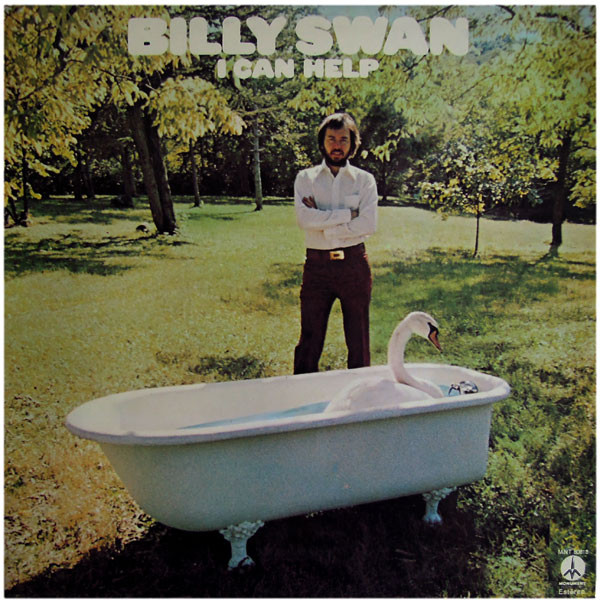
This song will stay with you…Billy was a one hit wonder but he did it right… #1 in the Billboard 100 in 1974. At the time Billy lived in Nashville and signed with Monument Records. He recorded the song in Young’un Sound Studio in Murfreesboro, TN. It is really hard not to like this song.
Fellow Beatle fan hanspostcard has mentioned this song sounds like a Ringo Starr type song…and I have to agree. Either way, it’s a good song. Now when I hear it…I hear Ringo singing it.
Kris Kristofferson and Rita Coolidge brought Billy Swan a little RMI organ as a wedding present. Billy was fiddling around with it when the chorus “I can help” appeared, and within a few minutes he had written the lyrics.
Swan often took his medium-sized dog to his recording sessions. While Swan was recording “I Can Help,” the dog became playful and started tugging at Swan’s pant leg. He finished the take – and earned the applause from the bandmates that is heard at the end of the released song.
Swan wrote Clyde McPhatter’s 1962 hit “Lover Please.” He went on to write some popular country songs, but this was his only hit as an artist
I Can Help
If you’ve got a problem, I don’t care what it is If you need a hand, I can assure you this I can help, I’ve got two strong arms, I can help It would sure do me good to do you good Let me help
It’s a fact that people get lonely, ain’t nothing new But a woman like you, baby, should never have the blues Let me help, I’ve got two for me, let me help It would sure do me good to do you good Let me help
When I go to sleep at night, you’re always a part of my dream Holding me tight and telling me everything I want to hear Don’t forget me, baby, all you gotta do is call You know how I feel about you, if I can do anything at all Let me help, if your child needs a daddy, I can help It would sure do me good to do you good, let me help
When I go to sleep at night, you’re always a part of my dream Holding me tight and telling me everything I wanna hear Don’t forget me, baby, all you gotta do is call You know how I feel about you, if I can do anything at all Let me help, if your child needs a daddy, I can help It would sure do me good to do you good, let me help
In the mid-seventies, I remember digital watches started to appear around our school. I thought they were really cool. I got one when the price came down. I had a friend named Paul who shunned me a little after I got it. He said he thought they were for only people would couldn’t tell time…no Paul.
After Roger Moore was seen with one in Live and Let Die it was the thing to have. It’s hard to believe a watch could make me so excited back then with its red numbers that only lit up when you clicked it because it would drain the battery if it stayed lit.
Later on, in the early eighties, I went to the now-defunct Service Merchandise and my mom bought me a digital display wristwatch for my birthday that played the Beatles Hey Jude…midi style. I would give anything for that watch now.
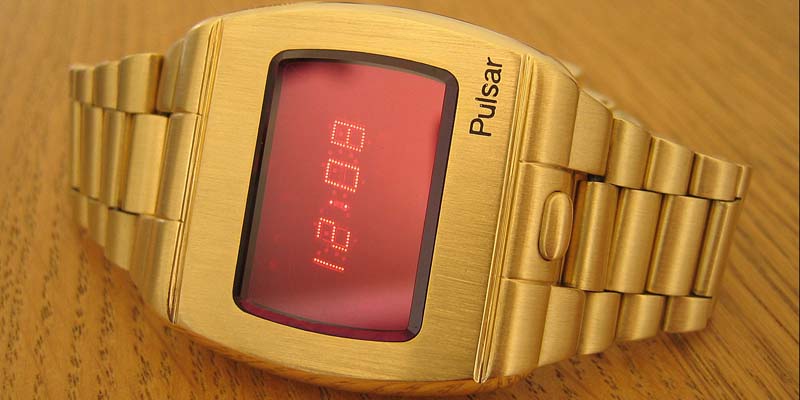
In 1972, Hamilton introduced the world’s first commercial electronic digital wristwatch. It retailed for the pricey sum of $2,100. The Hamilton Pulsar P1 was encased in 18-carat gold.
Roger Moore as the one and only James Bond…his arm anyway. The Pulsar II
The very first liquid crystal display (LCD) watch was introduced in late 1972. These Dynamic Scattering LCDs were power-hungry and unstable, and the market soon moved on to TN Field Effect displays. The Seiko 06LC was one of the first to use the new effect display and it stuck for decades.
Hamilton Pulsar Calculator Watch came in 1976. The buttons were extra small but every model had an improvement.
By 1977 the watches really started to fall in price. Star Wars watches were everywhere and they were a more affordable 16.95. A long way from the 18-carat gold watches.
In 1982 the Seiko TV Watch was released. It allowed owners to view live broadcast TV on a tiny blue/gray LCD screen embedded into the watch face. But…and there is a but…an external tuning device had to be connected to the watch. I don’t remember these but it is incredible they had these in 1982… If you had one of these please comment…were they clear at all?
Now with Apple watches that can tell you your heart rate and bank account…they have come a long way.
The audio version is 12 hours and it went by fast… I will get the hard copy of this book.
Kenney Jones was the drummer of three of England’s most influential bands – The Small Faces, The Faces and for a few years The Who. I was pleasantly surprised by this book. Kenney keeps the book interesting from his childhood, teen years, swinging London, the Swinging Seventies, up til now.
I never knew much about the Small Faces and Faces and this book answered some questions I had about both bands. He gave much more information than Roger Daltrey did in his book about Jone’s tenure as the drummer of the Who and their difficulties. Personally, I don’t think Kenney was the right drummer for the Who but then again…I don’t think anyone could have taken Moon’s place. He does give an interesting perspective on it though.
I didn’t’ realize that Keith Moon and Kenney were as close as they were. Kenney had played with the Who before in sound checks when the Small Faces and Who were touring with each other and Moon couldn’t be found. After Moon died a few strange things happened to Kenney right before Bill Curbishley (The Who’s Manager) called to see if he would join. The strange events helped him make the decision.
He goes over his career thoroughly and he doesn’t leave any gaps. He also talks about being in the band “The Law” with Paul Rodgers and now he is with The Jones Gang that had a #21 hit with Angel in 2005. He also owns a Polo club, is working on an animation of Ogden’s Nut Gone Flake, and fighting for the control of the Small Faces music which was lost a long time ago. He doesn’t need the money he just wants it put right.
Near the end, he sums up the three big bands he was involved in… The Small Faces were the most creative, The Faces were the most fun, and The Who were the most exciting and professional. You can tell though that his love is with the Small Faces and he does wonder how far they could have gone if they would have had decent management. He said they never realized how good of a band they were.
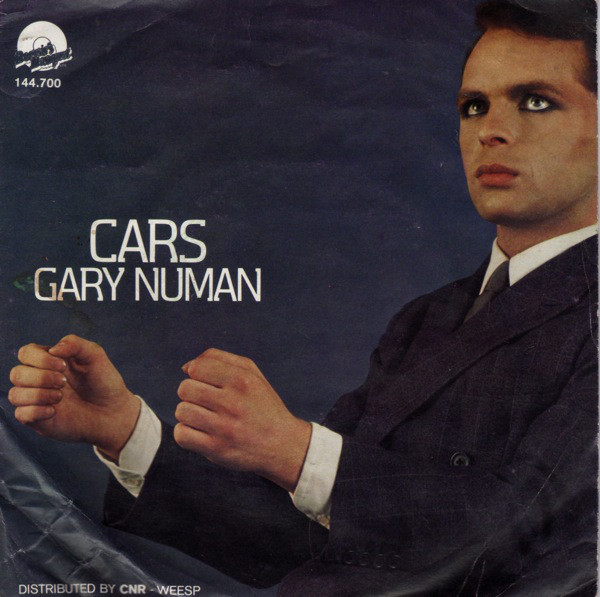
This song was released in 1979 was one of many signs a change was coming in music. The song peaked at #9 in the Billboard 100, #1 in the UK and #1 in Canada. The song was keyboard driven with a synth riff.
Gary Numan on the inspiration of the song. “A couple of blokes started peering in the window and for whatever reason took a dislike to me, so I had to take evasive action. I swerved up the pavement, scattering pedestrians everywhere. After that, I began to see the car as the tank of modern society.”
Numan has stated that he has Asperger syndrome, which is a mild form of autism, but until he was diagnosed, he had a lot of trouble relating to other people.
Even though the message of this song is that cars lead to a mechanical society devoid of personal interaction, it didn’t stop automakers from using it in commercials. Both Nissan and Oldsmobile have used it in ads.
A more clever approach came from Diehard, who created a commercial where Numan played the song on 24 car horns powered by just one of their batteries. Numan has no problem with his song being used in commercials, telling us, “I’m up for that, actually. I think any use of it at all. It would be great if it happened again.”
In the UK, this was used in an American Express commercial in the ’80s, as well as an ad for Carling beer that ran in 1996. The beer commercial gave the song new life in the UK.
TV series that have used this song in some form include The Simpsons, Family Guy, South Park and Two and a Half Men.
Numan made a video for this with special effects that look ridiculous now, but were cutting edge in 1979. When MTV went on the air in 1981, it was one of about 200 videos they had, so they played it over and over. This made the song a hit in the US.
Numan explained to Rolling Stone how he came up with this song’s synthesizer hook: “I have only written two songs on bass guitar and the first one was ‘Cars.’ I had just been to London to buy a bass and when I got home the first thing I played was that intro riff. I thought, ‘Hey, that’s not bad!’ In 10 minutes, I had the whole song. The quickest one I ever wrote. And the most famous one I’d ever written. More people should learn from that.”
Numan took his surname from a plumber in the telephone directory called Neumann Kitchen Appliances. He told NME he tried to find a two-syllable name, “because my real name Webb didn’t seem very cool.”
Cars
Here in my car I feel safest of all I can lock all my doors It’s the only way to live in cars.
Here in my car I can only receive I can listen to you It keeps me stable for days in cars.
Here in my car Where the image breaks down Will you visit me please If I open my door in cars
Here in my car You know I’ve started to think About leaving tonight Although nothing seems right in cars.
Great seventies soul song from 1970. The Five Stairsteps were formed in Chicago in 1965 and comprised of Burke family members Clarence Jr., James, Aloha, Kenneth and Dennis.
They got their name when their mom noticed that her kids looked like stair steps when stood next to each other according to age. The song peaked #8 in the Billboard 100 and #3 in Canada.
Since Dear Prudence is the B side of the single I’ve included it at the bottom of the page. Very interesting cover of the Beatles song.
Ooh-oo child Things are gonna get easier Ooh-oo child Things’ll get brighter Ooh-oo child Things are gonna get easier Ooh-oo child Things’ll get brighter Some day, yeah We’ll get it together and we’ll get it all done Some day When your head is much lighter Some day, yeah We’ll walk in the rays of a beautiful sun Some day When the world is much brighter Ooh-oo child Things are gonna be easier Ooh-oo child Things’ll get be brighter Ooh-oo child Things are gonna be easier Ooh-oo child Things’ll get be brighter
Some day, yeah We’ll get it together and we’ll get it all done Some day When your head is much lighter Some day, yeah We’ll walk in the rays of a beautiful sun Some day When the world is much brighter Some day, yeah We’ll get it together and we’ll get it all done Some day When your head is much lighter Some day, yeah We’ll walk in the rays of a beautiful sun Some day When the world is much brighter Ooh-oo child Things are gonna get easier Ooh-oo child Things’ll get brighter Ooh-oo child Things are gonna get easier Ooh-oo child Things’ll get brighter Right now, right now(You just wait and see how things are gonna be)
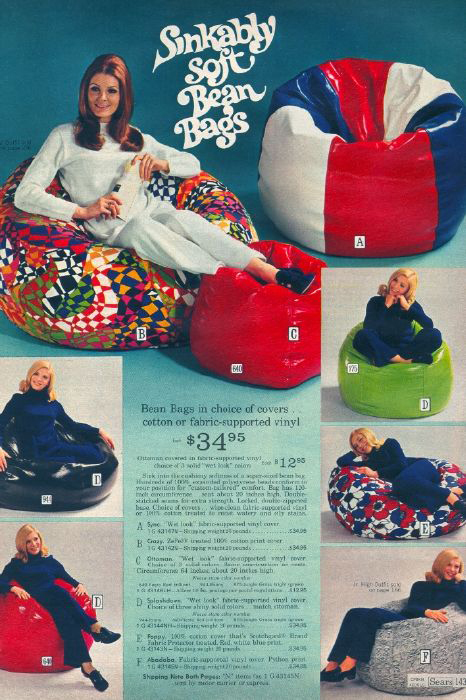
I have had a bean bag in my place of residence ever since I was a teenager. They are very handy to throw somewhere and sit. When you play guitar or want to watch a movie it’s a comfortable place to sit. They are also affordable and can be a good alternative sometimes to chairs.
The only part of owning one I don’t like is the inevitable end when the white small styrofoams like “beans” (expanded polystyrene) start coming out and going everywhere.
I would like to get an original leather bean bag one day.
According to some historians, bean bags were first invented by the ancient Egyptians sometime around 2000 B.C., and for thousands of years, they were used to play games and for other recreational diversions. The first bean bags were small, round and made of leather. They were most likely filled with dried beans or pebbles.
The first bean bag chairs as we know them were developed in the sixties. They were first called a Sacco chair, and released in 1969. They were designed by Cesare Paolini, Piero Gatti, and Franco Teodoro who were commissioned to create the piece by Zanotta Design in Italy.
Bean bags were huge in the 1970s and they were at first usually made of leather and filled with PVC (short for PolyVinyl Chloride) pellets. Soon nylon and polyester were used with expanded polystyrene (EPS) for filler. That combination proved to be more durable.
During the 1980s and 1990s, the popularity of bean bags declined greatly in popularity, but they were still being manufactured by several companies.
Now they are now experiencing a strong resurgence in popularity. You can get a regular bean bag or one pre-formed into a chair or couch. They are being sold for use as pet beds.
All the Young Dudes was written and produced by David Bowie. Mott The Hoople had a cult following in England and Bowie was a big fan but they were about to break up. To stop them from breaking up he offered to produce their next album and give them a song…this song.
Mott the Hoople does a great job on this. This era is my favorite of David Bowie… All the Ziggy Stardust music (which this was originally written for) and the Hunky Dory album…not that any era of Bowie is bad.
David Bowie on writing the song for The Rise and Fall of Ziggy Stardust and the Spiders From Mars album
“Ziggy was in a rock ‘n’ roll band, and the kids no longer want rock ‘n’ roll,” Bowie explained to Rolling Stone in 1974. “There’s no electricity to play it. Ziggy’s adviser tells him to collect news and sing it, ’cause there is no news. So Ziggy does this, and there is terrible news. ‘All the Young Dudes’ is a song about this news. It is no hymn to the youth as people thought. It is completely the opposite.”
The song peaked at #37 in the Billboard 100 and #3 in the UK in 1972.
All The Young Dudes
Billy rapped all night ’bout his suicide How he’d kick it in the head when he was 25 Don’t wanna stay alive when you’re 25
Wendy’s stealing clothes from unlocked cars Freddy’s got spots from ripping off stars from his face Funky little boat race The television man is crazy Saying we’re juvenile delinquent wrecks Man I need a TV when I’ve got T. Rex Hey brother you guessed I’m a dude
All the young dudes Carry the news Boogaloo dudes Carry the news
All the young dudes Carry the news Boogaloo dudes Carry the news
Now Jimmy looking sweet though he dresses like a queen He can kick like a mule It’s a real mean team We can love Oh we can love And my brother’s back at home With his Beatles and his Stones We never got if off on that revolution stuff What a drag Too many snags Well I drunk a lot of wine And I’m feeling fine Gonna race some cat to bed Is this concrete all around Or is it in my head Oh brother you guessed I’m a dude
All the young dudes Carry the news Boogaloo dudes Carry the news
All the young dudes Carry the news Boogaloo dudes Carry the news







:format(jpeg):mode_rgb():quality(40)/discogs-images/L-1308739-1503287571-2115.jpeg.jpg)










 PowerPop... An Eclectic Collection of Pop Culture