The first time our band played in front of an audience…this was our opening song in the high school theater when I was 16. We thought of it as an old song but we played it in 1983…by that time it was only 8 years old.
ZZ Top came up with this song before a gig at a rodeo arena in Florence, Alabama. They were practicing a few hours before the show when Gibbons hit on the opening lick. He kept the riff going, and Dusty Hill improvised a vocal. The song was on the Fandango album.
The song peaked at #20 in the Billboard 100 and #14 in Canada in 1975.
On a humorous note… ZZ Top considered changing the lyrics and performing this as “Bush” when they were asked to play for fellow Texan George W. Bush at his inauguration party in 2001. They decided against it.
The song was named the 67th best hard rock song of all time by VH1.
From Songfacts
In a 1985 interview with Spin magazine, bass player Dusty Hill explained: “Tush, where I grew up, had two meanings. It meant what it means in New York. Tush is also like plush, very lavish, very luxurious. So it depended on how you used it. If somebody said, “That’s a tush car,’ you knew they weren’t talking about the rear and of the car. That’s like saying, ‘That’s a cherry short.’ But tush as in ‘That’s a nice tush on that girl,’ that’s definitely the same as the Yiddish word. I don’t know how we got it in Dallas. All it could have took was one guy moving down from New York.”
According to guitarist Billy Gibbons, they got the idea for the title from a song called “Tush Hog” by the Texas musician Roy Head, released in 1967.
Like “Pearl Necklace,” “Tube Snake Boogie,” and “Velcro Fly,” this song has different meanings depending on the listener interpretation. Such ambiguity keeps the songs radio-friendly while appealing to ZZ Top’s core audience.
The band pointed out to anyone who may have been offended that this song is gender neutral – it can be sung by a man or woman. Their point was proven in 1981 when the group Girlschool covered it on their album Hit & Run.
This was the first national hit for ZZ Top, who were very popular in Texas but little-known elsewhere. They usually play it in their encore.
This was ahead of its time if you consider how many “booty” songs came out years later, including “Baby Got Back,” “Rump Shaker” and “Thong Song.”
Billy Gibbons played a Les Paul guitar on this track through a 1969 Marshall Super Lead 100 amp. In the solo, he used a slide. He also used an unusual processing device called a Cooper Time Cube. Gibbons explained in Guitar World: “In a small rack-mounted can sits a small speaker right up next to maybe 50 feet of one-inch rubber tubing, which is coiled, spring-like. The sound waves actually take longer to travel, having to make these corners, creating a type of delay which is quite unlike the familiar sound of a digital delay. Some of the guitar sounds that appear to be doubled on the early albums are actually the byproduct of that oddball Cooper Time Cube.”
Tush
I been up, I been down Take my word, my way around I ain’t askin’ for much I said, Lord, take me downtown I’m just lookin’ for some tush
I been bad, I been good Dallas, Texas, Hollywood I ain’t askin’ for much I said, Lord, take me downtown I’m just lookin’ for some tush
Take me back way back home Not by myself, not alone I ain’t askin’ for much I said, Lord, take me downtown I’m just lookin’ for some tush
First, let’s get this out of the way… wet–willy. Noun. (plural wet willies) (slang) A prank whereby a saliva-moistened finger is inserted into an unsuspecting person’s ear, often with a slight twisting motion… Oh yes…I’ve given them and have been on the receiving end. When you are 12 given wet willies were a lot of fun….oh wait…that was yesterday!
Wet Willie began as a blues-rock band during the Summer of 1969 down in Mobile Alabama. The original nucleus of the group that eventually became known as Wet Willie was called Fox. Wet Willie eventually moved to Macon Georgia and signed to Capricorn Records sharing the label with The Allman Brothers and The Marshall Tucker Band but they really didn’t have a southern rock sound.
They did open for their label mates and gained a following. Like many bands from that era if you were from the south you were automatically “southern rock”…
Keep On Smiling peaked at #10 in the Billboard 100 and #21 in Canada in 1974.
They broke up in 1979. They haven’t recorded anything new since then but they still tour. In 2012 Wet Willie released a new live CD “Miles of Smiles” on the Hittin’ The Note Records label. They continue to tour with three original members including original lead singer Jimmy Hall, brother Jack Hall on bass and vocals, sister Donna Hall Foster on vocals as well as other long time members, drummer T.K. Lively, Ric Seymour on guitar and vocals, Ricky Chancey on guitar and newest member, keyboardist Bobby Mobley.
Keep On Smilin’
Well you say you got the blues, You got holes in both of your shoes, yeah- You’re feeling alone and confused, You got to keep on smilin’, just keep on smilin’
Yeah, you’re- you’re bout to go insane, Cause your womans playing games, And she says that you’re to blame, You try to keep on smilin’, just keep on smilin’
Keep on smilin’ through the rain, laughin’ at the pain Just flowin’ with the changes, till the sun comes out again Keep on smilin’ through the rain, laughin at the pain Just flowin’ with the changes, and singin’ this refrain
Singing in a honky tonk cafe, Nobodys hearin’ what you play, yeah- They’re too busy drinkin anyway, You gotta keep on smilin’, brother keep on smilin’
Say you found a piece of land [Lyrics from: https:/lyrics.az/wet-willie/keep-on-smilin/keep-on-smilin.html] Gonna change from city boy to country man, yeah- Try to build you’re life with your hands And just keep on smilin’, keep on smilin’
Keep on smilin’ through the rain, laughin’ at the pain Just flowin’ with the changes, till the sun comes out again Keep on smilin’ through the rain, laughin at the pain Just flowin’ with the changes, and singin’ this refrain
You’re just hangin out- in a local bar, And you’re wonderin’- who the hell you are Are you a farmer – are you a star?
Smile on through the rain Laugh all through the pain Flow through to changes Till the sun comes out again
Keep on smilin’, smilin’ – smilin’, smilin’ Laughin, laughin- said laughin’, laughin’ Keep on flowin’, flowin’, flowin’ Yeah
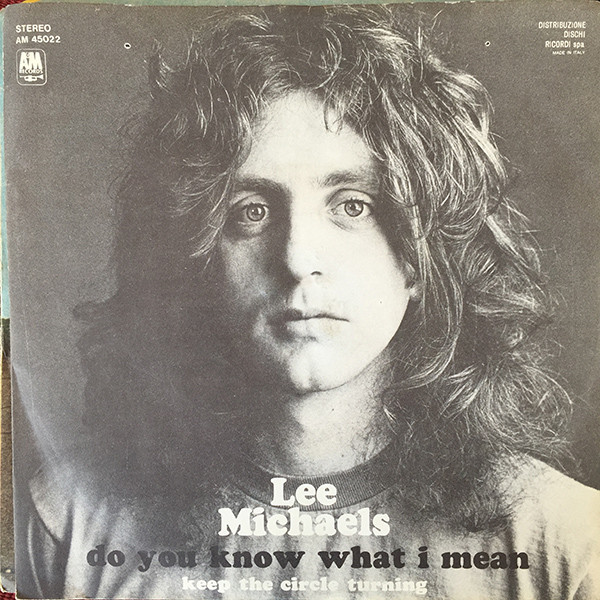
Between 1968 and 1973, Lee Michaels released six studio LPs and a live one. He only had two top 40 records. Can I Get A Witness and Do You Know What I Mean which peaked at #6 in the Billboard 100 and #12 in Canada in 1971. The song was on his fifth album appropriately named “5th” which peaked at #16 in 1971.
The one thing I noticed about Lee is what huge voice he had…it’s strange that this is the only song he had that hit big.
The song was recorded live in the studio in seven hours by Michaels on keyboards and bass pedals and Barry “Frosty” Smith on drums. The song was one of the many on the radio when I was growing up.
Australian musician Renée Geyer recorded a version in 1981. The song was released in October 1981 as the second single from her seventh studio album, So Lucky. The song peaked at number 29 on the Australian Kent Music Report and in New Zealand.
Renee Geyer’s version
Lee Michaels
Do You Know What I Mean
Been forty days since I don’t know when I just saw her with my best friend Do you know what I mean? Do you know, know what I mean?
I just saw her yesterday I just saw her, asked her to stay Do you know what I mean? Lord, do you know what I mean?
Her and Bobby were steppin out Her and Bobby didn’t know I found out Do you know what I mean? Do you know, know what I mean?
So I asked her if she still cared She didn’t hear me, she just stared Do you know what I mean? Lord, do you know what I mean?
And then she said Lee you haven’t loved me in nearly four years You haven’t noticed that I held back my tears And now you have, but it’s really too late Better find yourself another girl Better find another girl Better find uh, another place
She just left me yesterday She just left me, had nothing to say Do you know what I mean? Oh, do you know what I mean?
She’s a dandy, yes indeed She’s a dandy, but now she’s free Do you know what I mean? Lord, do you know what I mean?
Been forty days since I don’t know when I just saw her with my best friend Do you know what I mean? Lord, do you know what I mean?
I just saw her yesterday I just saw her, learn how to stay Do you know what I mean? Lord, Do you know what I mean?
Those crazy 70’s rock stars…a note left in red ink by no other than John Lennon.
This is a note from an upset John Lennon to Phil Spector. It seems that Keith Moon and Harry Nilsson supposedly…relieved themselves in the recording console in an unnamed studio. John was quite certain of that fact. The studio was threatening to evict them but John wasn’t having it. John didn’t date the note but it was from John Lennon’s “lost weekend” period between 73-75… the note sold for over $88,000.
This is what the note said.
“Phil –
See you around 12:30
Should you not yet know it was Harry and Keith who pissed on the console. Jerry now wants to evict us or that’s what Capitol tells us. Anyway tell him to bill Capitol for the damage if any. I can’t be expected to mind adult rock stars nor can May (Pang, Lennon’s personal assistant) besides she works for me not A+M. I’m about to p..s off to Record Plant (another recording studio) because of this crap.”
There are a million articles on this subject…here is one of the more complete ones.
Go to any music store basement right now and some beginner will be playing this riff on guitar. I’ve heard it murdered many times and I contributed to the count also. It’s one of the most popular guitar riffs in rock. I’m not saying best but maybe the most famous….it’s simple for a beginner and sounds great when played right. It was one of the first ones I learned.
This song was based on a true story that happened to the band. Smoke On The Water took inspiration from a fire in the Casino at Montreux, Switzerland on December 4, 1971. The band was going to start recording their Machine Head album there right after a Frank Zappa concert, but someone fired a flare gun at the ceiling during Zappa’s show, which set the place on fire when Deep Purple was watching.
Smoke on the Water peaked at #4 in the Billboard 100 and #2 in Canada in 1973. The song was credited to Deep Purple…Ritchie Blackmore, Ian Gillan, Roger Glover, Jon Lord, and Ian Paice.
Ritchie Blackmore:“Ian Paice (Deep Purple drummer) and I often used to jam, just the two of us. It was a natural riff to play at the time. It was the first thing that came into my head during that jam.”
From Songfacts
Deep Purple was in the audience for the show, and lead singer Ian Gillan recalls two flares being shot by someone sitting behind him which landed in the top corner of the building and quickly set it ablaze. Zappa stopped the show and helped ensure an orderly exit. Deep Purple watched the blaze from a nearby restaurant, and when the fire died down, a layer of smoke had covered Lake Geneva, which the casino overlooked. This image gave bass player Roger Glover the idea for a song title: “Smoke On The Water,” and Gillan wrote the lyric about their saga recording the Machine Head album.
The band was relocated to the Grand Hotel in Montreux, where they recorded the album using the Rolling Stones mobile studio. They needed one more song, so they put together “Smoke On The Water” using Gillan’s lyric and riff the guitarist Ritchie Blackmore came up with. The result was a song telling the story of these strange events just days after they happened – the recording sessions took place from December 6-21.
Frank Zappa, who is mentioned in the lyrics, lost all his equipment in the fire. He then broke his leg a few days later when a fan pulled him into the crowd at a show in England. This prompted Ian Gillan to say “Break a leg, Frank,” into the microphone after recording this for a BBC special in 1972.
Deep Purple bass player Roger Glover had some doubts about the title: he knew it was great but was reluctant to use it because it sounded like a drug song.
Ritchie Blackmore has an affinity for renaissance music, which he writes and performs in his duo Blackmore’s Night. He says that he first took an interest in the form in 1971 when he saw a BBC program called Wives of Henry VIII, and that there is indeed a trace of Renaissance in “Smoke On The Water.” “The riff is done in fourths and fifths – a medieval modal scale,” he explained on MySpace Music. “It makes it appear more dark and foreboding. Not like today’s pop music thirds.”
The band did not think this would be a hit and rarely played it live. It took off when they released it as a US single over a year after the album came out. Talking about the song’s merits as live material, Roger Glover said in Metal Hammer, “I think ‘Smoke On The Water’ is the biggest song that Purple will ever have and there’s always a pressure to play it, and it’s not the greatest live song, it’s a good song but you sorta plod through it. The excitement comes from the audience. And there’s always the apprehension that Ritchie (Blackmore) isn’t gonna want to do it, ’cause he’s probably fed up with doing it.”
When we spoke with Steve Morse, who became Deep Purple’s guitarist in 1994, he talked about performing this song live. “On a tune that I didn’t write like ‘Smoke On The Water,’ I try to tread a line between homage and respect and originality,” he said. “So, say, on the solo, I take it a out a little bit and do it my way for a little bit, and then bring it back to more like the original, and wrap it up with a lick that everybody would recognize. That’s about as much as I can suggest somebody do because there’s ingrained memories of the song in peoples’ minds.”
“Funky Claude,” as in the lyrics “Funky Claude was running in and out pulling kids out the ground,” is Claude Nobs, a man who helped rescue some people in the fire and found another hotel for the band to stay. He is the co-founder of the prestigious Montreux Jazz Festival.
Nobs explained to Gibson.com how this song arose out of the ashes: “Deep Purple were watching the whole fire from their hotel window, and they said, ‘Oh my God, look what happened. Poor Claude and there’s no casino anymore!’ They were supposed to do a live gig [at the casino] and record the new album there. Finally I found a place in a little abandoned hotel next to my house and we made a temporary studio for them. One day they were coming up for dinner at my house and they said, ‘Claude we did a little surprise for you, but it’s not going to be on the album. It’s a tune called “Smoke On The Water.'” So I listened to it. I said, ‘You’re crazy. It’s going to be a huge thing.’ Now there’s no guitar player in the world who doesn’t know [he hums the riff]. They said, ‘Oh if you believe so we’ll put it on the album.’ It’s actually the very precise description of the fire in the casino, of Frank Zappa getting the kids out of the casino, and every detail in the song is true. It’s what really happened. In the middle of the song, it says ‘Funky Claude was getting people out of the building,’ and actually when I meet a lot of rock musicians, they still say, ‘Oh here comes Funky Claude.'”
The B-side of the single was another version of the song, recorded live in Japan.
In 1989, Former members Ritchie Blackmore and Ian Gillan released a new version of this with Robert Plant, Brian May, and Bruce Dickinson. They called the project “Rock Aid Armenia,” with proceeds going to victims of the Armenian earthquake.
IN the 2002 “Weekend at Burnsie’s” episode of The Simpsons, Homer is heard crooning to this song after he uses medicinal marijuana. >>
Pat Boone covered this on In a Metal Mood. On the album, he performed heavy metal songs with string instruments and pianos, but in this case kept the famous guitar riff and even allowed a solo. Otherwise, it’s a very jazzy cover.
In a Songfacts interview with Boone, he said: “Ritchie Blackmore played some guitar on my recording – of his song. He had to do it to a track we sent him in Germany where he was recording in some castle. He played part of the guitar licks on ‘Smoke on the Water,’ but the other part is Dweezil Zappa, on a Hendrix Stratocaster. It was very authentic. I was very serious about treating these songs as good music – with big band jazz arrangements.
The famous guitar riff is performed in the 2003 Jack Black film School Of Rock.
On June 3, 2007 in Kansas City, Kansas, 1,721 guitarists gathered to play this song together and break the record for most guitarists playing at one time. The entire song was played, though only the one lead guitar played the solo. Guitarists from as far as Scotland came out for the event. The event was organized by radio station KYYS.
It’s hard to compete with outsourcing, however, and the record was beaten on October 26, 2007 when 1,730 guitarists gathered in Shillong, India to perform “Knocking On Heaven’s Door.”
This was used in commercials for Dodge trucks. The song plays on a jukebox that a guy is eyeing in an antique store. His wife gets her way and they take home a piece of furniture instead – the point being the large payload capacity of the truck. >>
According to an interview with Ian Gillian on VH1’s Classic Albums: Machine Head, the band did not have much money when recording this album and were renting a recording studio. They stayed past when they were supposed to get out. As they were recording this song, the police were knocking on the door of the studio to kick them out. >>
In a 2008 survey of students from music schools across London, this topped a poll to find the best ever guitar riff. Nirvana’s “Smells Like Teen Spirit” came second and Aerosmith’s “Walk This Way” third.
According to the London Times newspaper, Ritchie Blackmore was embarrassed to present this song to his fellow members of Deep Purple because it was such a Neanderthal tune for a guitarist of his caliber to come up with.
The lyrics, “Swiss time was running out” meant that their visas were going to expire soon. They wrote the songs and recorded them in a matter of weeks.
Many beginners try to play this when they pick up a guitar, and they usually play it wrong. Here’s how: Use the open G and D strings as the starting point and you pluck the strings with a finger each, not a pick. Lots of people play this from the 5th fret of the A and D string, which is wrong.
In Stephen King’s Dreamcatcher (2001), a character recalls losing his virginity to this song at a fraternity party.
Smoke On The Water
We all came out to Montreux On the Lake Geneva shoreline To make records with a mobile We didn’t have much time Frank Zappa and the Mothers Were at the best place around But some stupid with a flare gun Burned the place to the ground
Smoke on the water, a fire in the sky Smoke on the water
They burned down the gambling house It died with an awful sound Funky Claude was running in and out Pulling kids out the ground When it all was over We had to find another place But Swiss time was running out It seemed that we would lose the race
Smoke on the water, a fire in the sky Smoke on the water
We ended up at the Grand Hotel It was empty, cold and bare But with the Rolling truck Stones thing just outside Making our music there With a few red lights and a few old beds We made a place to sweat No matter what we get out of this I know, I know we’ll never forget
Smoke on the water, a fire in the sky Smoke on the water
“I just got paid today, got me a pocket full of change.”
That Little Ol’ Band From Texas has a great groove going on in this song. I was going to save this to a more appropriate Friday but for some of us the days are blending into each other at home so let’s just pretend.
This song was inspired by Peter Green’s opening riff in Fleetwood Mac’s “Oh Well.” Billy Gibbons was living in Los Angeles, sitting on the steps of his apartment and it was raining and he couldn’t go anywhere… he kept trying to learn that riff and as he said…it got tangled up and it stayed tangled up.
Just Got Paid was on their second album, Rio Grande Mud released in 1972. The album peaked at #104 in the Billboard Album Charts. The song didn’t chart in the Billboard 100 but it has become an FM staple.
Just Got Paid
I just got paid today, got me a pocket full of change. Said, I just got paid today, got me a pocket full of change. If you believe like workin’ hard all day, just step in my shoes and take my pay.
I was born my papa’s son, when I hit the ground I was on the run. I had one glad hand and the other behind. You can have yours, just give me mine. When the hound dog barkin’ in the black of the night, stick my hand in my pocket, everything’s all right.
I just got paid today, got me a pocket full of change. Said, black sheep, black, do you got some wool? Yes, I do, man, my bag is full. It’s the root of evil and you know the rest but it’s way ahead of what’s second best.
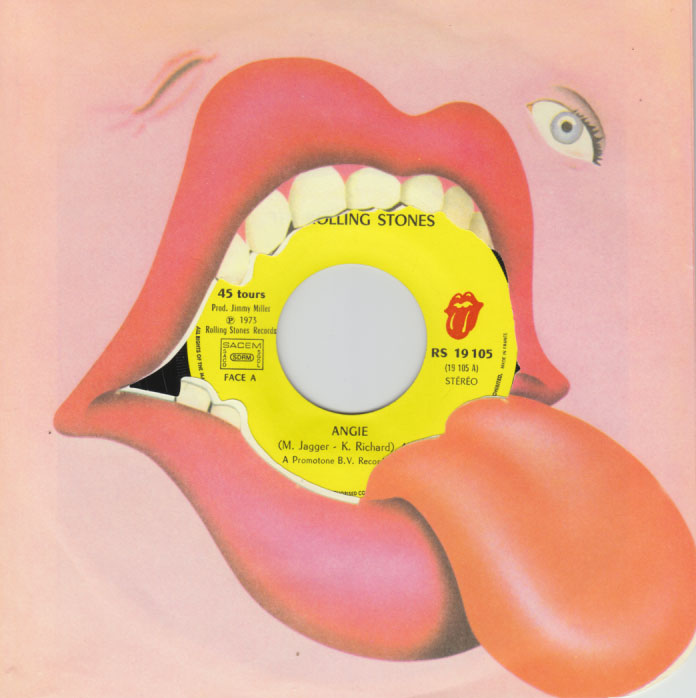
This song is a great ballad by the Rolling Stones. Keith Richards wrote this song in Switzerland after the Exile on Main St. album had been approved by the record company, but before it was released. “Angie” was one of the first songs The Stones recorded for Goat’s Head Soup.
It was on 20 October 1973 that the Rolling Stones secured their 7th US No.1 when ‘Angie’ made the top of the Billboard chart.
It has been speculated that it was inspired by Angie, David Bowie’s wife, or even Keith’s daughter. Keith, who wrote the majority of the song’s music and lyrics. Keith said in his autobiography that the name Angie came to him while in Switzerland detoxing from his heroin addiction. “I wrote ‘Angie’ in an afternoon, sitting in bed, because I could finally move my fingers and get them in the right place again…It was not about any particular person, it was a name, like “Ohhh, Diana””I didn’t know Angela was going to be called Angela when I wrote ‘Angie.’ In those days you didn’t know what sex the thing was going to be until it popped out.”
The song peaked at #1 in the Billboard 100, #5 in the UK, #1 in Canada, and #1 in New Zealand in 1973.
From Songfacts
The big rumor about this song is that it was written about David Bowie’s wife, Angela, who wrote in her autobiography that she once walked in on Bowie and Mick Jagger in bed together – a story Jagger denies. According to the rumor, Jagger wrote this song to appease her, but it was Jagger’s bandmate Keith Richards who wrote most of the song. Jagger had this to say about it: “People began to say that song was written about David Bowie’s wife but the truth is that Keith wrote the title. He said, ‘Angie,’ and I think it was to do with his daughter. She’s called Angela. And then I just wrote the rest of it.”
There was also speculation that Richards’ girlfriend Anita Pallenberg inspired this song, but Keith cleared it up in his 2010 autobiography Life, where he wrote: “While I was in the [Vevey drug] clinic (in March-April 1972), Anita was down the road having our daughter, Angela. Once I came out of the usual trauma, I had a guitar with me and I wrote ‘Angie’ in an afternoon, sitting in bed, because I could finally move my fingers and put them in the right place again, and I didn’t feel like I had to s–t the bed or climb the walls or feel manic anymore. I just went, ‘Angie, Angie.’ It was not about any particular person; it was a name, like ohhh, Diana.
A rare ballad for The Stones, this was the first single released from Goat’s Head Soup. It wasn’t typical of their sound, since most of the band’s material at the time was hard and aggressive. Still, it was a huge hit, and their only ballad that hit #1 in the US.
This is one of the few Rolling Stones songs that is acoustic.
The Angela Bowie rumor picked up steam in 1990, when she went on The Joan Rivers Show and claimed she once walked in on David Bowie and Mick Jagger in bed together naked. What’s even more shocking is that Rivers had her own talk show. She was quickly replaced by Arsenio Hall.
Nicky Hopkins played piano on this track. He became part of the band’s inner circle after working on the 1966 Stones album Between The Buttons.
In 2005 German chancellor Angela Merkel appropriated this acoustic ballad for her Christian Democratic Union Party. “We’re surprised that permission wasn’t requested,” said a Stones spokesman of Merkel’s choice of song. “If it had been, we would have said no.”
The line from this song, “Ain’t it time we said goodbye,” was used as the title to Robert Greenfield’s 2014 book, which chronicles his time covering the Stones’ 1971 British tour and their Exile on Main St. sessions for Rolling Stone magazine. Greenfield is not a fan of the song, however, calling it “soppy and far too sweet for my taste.”
Angie
Angie, Angie, when will those clouds all disappear? Angie, Angie, where will it lead us from here? With no loving in our souls and no money in our coats You can’t say we’re satisfied But Angie, Angie, you can’t say we never tried
Angie, you’re beautiful, but ain’t it time we said good-bye? Angie, I still love you, remember all those nights we cried? All the dreams we held so close seemed to all go up in smoke Let me whisper in your ear:
Angie, Angie, where will it lead us from here? Oh, Angie, don’t you weep, all your kisses still taste sweet I hate that sadness in your eyes But Angie, Angie, ain’t it time we said good-bye?
With no loving in our souls and no money in our coats You can’t say we’re satisfied But Angie, I still love you, baby Ev’rywhere I look I see your eyes
There ain’t a woman that comes close to you Come on baby, dry your eyes But Angie, Angie, ain’t it good to be alive? Angie, Angie, they can’t say we never tried
I always post music that I like…it would be hard for me to post something I didn’t like and write about it indifferently. This one…I have played on guitar more than I’ve listened to. I played in bands for years and when I was beginning, this one was taught to me. I never heard it before I played it but it’s pretty easy…if you take away all of the space effects. It was a few years after I’d played it at least 20 times before I heard the record.
Billy Thorpe, was an English-born Australian singer-songwriter, producer, and musician. He was in a band called Billy Thorpe and the Aztecs in Australia. their first major pop hit was a cover of “Poison Ivy” in 1964. The band broke up in 1967 but re-formed one year later, with Thorpe on guitar as well as vocals. Thorpe’s signature song in Australia was “Most People I Know (Think that I’m Crazy)” in 1972.
Children of the Sun made it to #41 in 1979. The song was written by Billy Thorpe and Spencer Proffer. This was his only hit in America.
Children of the Sun
People of the Earth can you hear me? Came a voice from the sky on that magical night And in the colors of a thousand sunsets They traveled through the world on a silvery light –More–(51%) The people of the Earth stood waiting Watching as the ships came one by one Setting fire to the sky as they landed Carrying to the world Children Of The Sun
All at once came a sound from the inside Then a beam made of light hit the ground [Lyrics from: https:/lyrics.az/billy-thorpe/children-of-the-sun-revisited/children-of-the-sun.html] Everyone felt the sound of their heartbeat Every Man – Every Woman – Every Child
They pa**ed the limits of imagination Through the doors – to a world – of another time On the journey of a million lifetimes With the Children Of The Sun – They started their climb
No more gravity, nothing holding them down Floating endlessly, as their ship leaves the ground through the walls of time – at the speed of light Fly the crystal ships on their celestial flight On their celestial flight.
On May 17, 1983, I know where I was…I was watching the Kinks play in Nashville at the newer Grand Ole Opry. This is a song I remember well from that show. The Kinks were still in their early 40s and they had more energy than their much younger opening band The White Animals.
The song was on the album Low Budget released in 1979. The album peaked at #11 in the Billboard Album Charts. Catch Me Now I’m Falling didn’t make the Billboard 100 but it was an FM hit. Another song off of Low Budget did chart… (Wish I Could Fly Like) Superman peaked at #41 in the Billboard 100 in 1979.
I will have to say that Ray borrowed liberally from the Stones Jumping Jack Flash as far as the riff goes…but the song is great.
Catch Me Now I’m Falling
I remember, when you were down And you needed a helping hand I came to feed you But now that I need you You won’t give me a second glance Now I’m calling all citizens from all over the world This is Captain America calling I bailed you out when you were down on your knees So will you catch me now I’m falling
Help me now I’m calling you Catch me now I’m falling I’m in your hands, it’s up to you Catch me now I’m falling
I remember when you were down You would always come running to me I never denied you and I would guide you Through all of your difficulties Now I’m calling all citizens from all over the world This is Captain America calling I bailed you out when you were down on your knees So will you catch me now I’m falling
Help me now I’m calling you Catch me now I’m falling I’m in your hands, it’s up to you Catch me now I’m falling
When you were broke you would come to me And I would always pull you round Now I call your office on the telephone And your secretary tells me that she’s sorry, But, you’ve gone out of town.
This is Captain America calling This is Captain America calling
Help me now I’m calling you Catch me now I’m falling I’m in your hands, it’s up to you Catch me now I’m falling
Catch me now I’m falling Catch me now I’m falling Catch me now I’m falling Catch me now I’m falling
I stood by you through all of your depressions And I lifted you when you were down Now it’s your chance to do the same for me I call your office and your secretary tells me That you’ve gone out of town
This is Captain America calling This is Captain America calling
Catch me now I’m falling Catch me now I’m falling
I was the one who always bailed you out Of your depressions and your difficulties I never thought that you would let me down But the next time you’re in trouble Better not come running to me
Now I’m calling all citizens from all over the world This is Captain America calling I bailed you out when you were down on your knees So will you catch me now I’m falling Catch me now I’m falling
Catch me now I’m falling Catch me now I’m falling Catch me now I’m falling Catch me now I’m falling
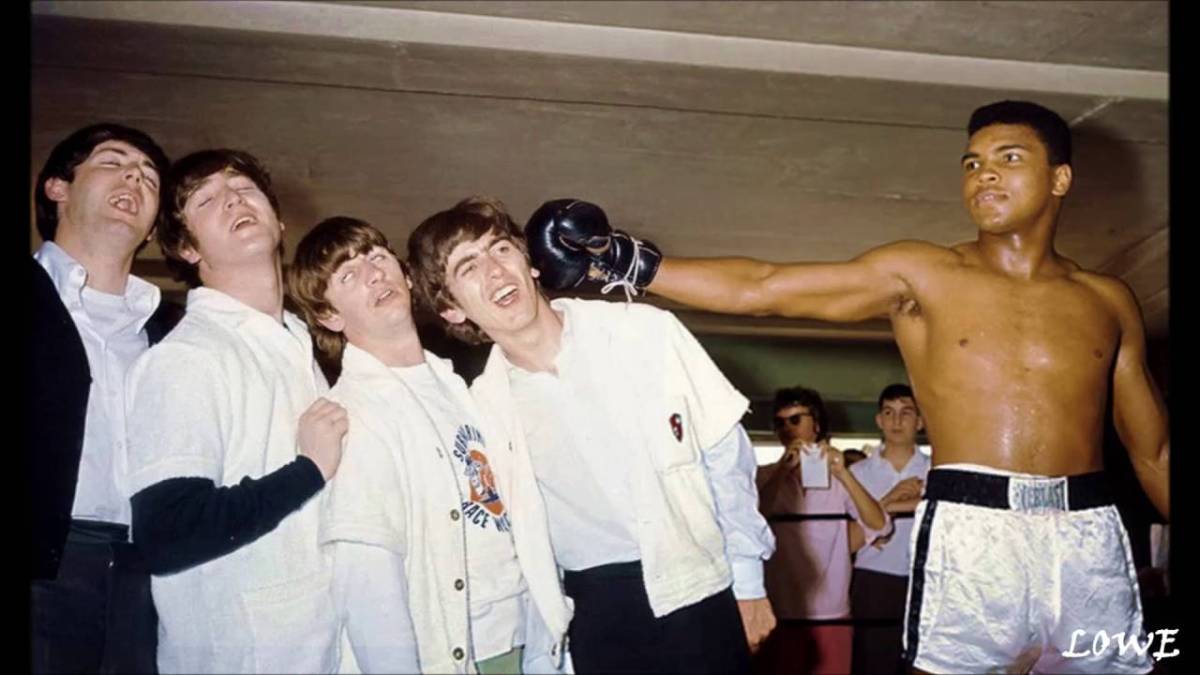
Just think of the photographs snapped of Muhammad Ali and the Beatles. Put together they would reach the moon and back. Muhammad Ali was probably the most famous person in the world in the 20th century. Kids on remote islands in the middle of nowhere knew about Ali. The two were truly the greatest in their fields.
Muhammad Ali played with the idea of reuniting the Beatles in the 1970s.
The two culture icons would meet on February 18, 1964 right after the Beatles broke through America. The Beatles wanted to meet Sonny Liston because he was favored 7-1 to win the match between him and Ali but Sonny declined to meet them.
By all accounts, Ali had no idea who The Beatles were. But he welcomed the opportunity for some extra publicity with them. Although The Beatles fumed because the soon-to-be-new champ was late and kept them waiting, when he arrived he quickly broke the ice with his opening line, which has since been reported as either: “Hey, Beatles, let’s go make some money!”; or the equally memorable: “Hello there, Beatles! We oughta do some roadshows together. We’ll get rich!”
At one point, Ali used one of his favorite lines at the time, telling the Beatles: “You ain’t as dumb as you look!”
Lennon… but of course… shot back: “No. But you are!”
After a nervous silence…everyone started to laugh. Ali made up one of his rhymes. “When Liston reads about The Beatles visiting me / He’ll get so mad, I’ll knock him out in three!” It actually took 6 rounds for Ali to win on February 25, 1964…Sonny wouldn’t return for the 7th.
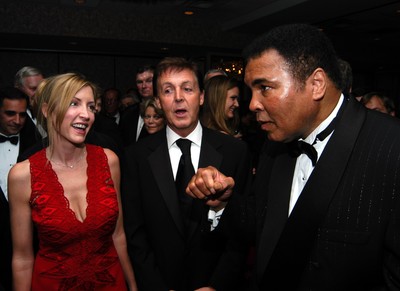
Joel Sacher was attending the inauguration gala for President Jimmy Carter. He was there as a personal guest of Muhammad Ali, maybe the most recognizable man on the planet at the time. Ali and Sacher were meeting with one of the few men who was almost as recognizable Ali. They were talking to John Lennon and his wife Yoko Ono, and while the conversation included plenty of nostalgia about meeting the Beatles in Miami long ago.
Ali was armed with a proposal, one that was the brainchild of Sacher and a business associate that had the potential to stun the world. They wanted to reunite The Beatles.
In 1976 inventor Alan Amron and businessman Joel Sacher partnered with Ali to promote The International Committee to Reunite the Beatles. They asked fans worldwide to contribute a dollar each. Ali said the idea was to use the proceeds to establish an international agency to help poor children. “This is money to help people all over the world”, he said. He added, “I love the music. I used to train to their music.” He said a reunion of the Beatles “would make a lot of people happy.” The Beatles were indifferent to the plan. No reunion happened.
Here is a PDF of a newspaper article describing Ali’s plan. It was a nice gesture. Ali and the Beatles.pdf
The International Committee to Reunite the Beatles released a single called “Get Back Beatles” and it was released by singer-songwriter Gerald Kenny.
The Beatles turned down big-time money in the seventies and didn’t reunite. Personally, I’m happy they didn’t…no way could they have lived up to people’s expectations.
After Muhammad Ali died
Paul McCartney:
“I loved that man. He was great from the first day we met him in Miami, and on the numerous occasions when I ran into him over the years. Besides being the greatest boxer, he was a beautiful, gentle man with a great sense of humor who would often pull a pack of cards out of his pocket, no matter how posh the occasion, and do a card trick for you.
Ringo Starr:
“I taught (Ali) everything he knew!” Starr said, before growing more – and less – serious. “That was a thrill, of course, and I was putting my money on Liston, so I really knew what was happening!”
Great album cut by The James Gang. Val brought this one to my attention a few weeks ago and I’ve been listening ever since.
Bill Szymczyk produced the second album for the James Gang called Rides Again which was released in 1970.
A big space was filled with “The Bomber,” which took up more than seven minutes of Rides Again‘s 35-minute running time, and ended up spawning a couple of classic James Gang stories in the process…while triggering a decades-long copyright battle and paving the way for the invention of industry-standard speakers in the bargain.
The Record Plant had just installed new expensive monitors, and Bill Szymczyk was the first guy to use them, which was a real mistake. During playback of “The Bomber” the speaker just physically blew out of the wall.
Bill Szymczyk: “We blew eight of those speakers up,” “The next day, [Record Plant co-founder] Gary Kellgren went to his maintenance guy, his head tech, who was Tom Hidley, and he said to Tom, ‘Make me a monitor that Szymczyk can’t blow up!’ That was the birth of the Hidley monitor, which is in hundreds of studios around the world at this point.”
“The Bomber” also included a passage from Ravel’s “Boléro,” which ended up costing the James Gang a fair bit of legal drama. “Ravel was French, and French copyright law and French law, in general, is insane. The French copyright, Ravel’s heirs and Ravel’s estate stipulated in the French copyright law that the piece had to be played in its entirety, top to bottom,” recalls Walsh. “You could never play little parts of it. And it had to be played by the full orchestra that it was written for. Well, we didn’t know that!”
The band was forced to remove the Boléro part but it was restored when the CD was released.
The Bomber
When I became of age my mama sat me down Said “Son, you’re growin’ up, it’s time you looked around” So I began to notice some things I hadn’t seen before That’s what brought me here knockin’ on your back door Oh, yeah
A closet queen, the busstop’s dream, she wants to shake my hand I don’t want to be there, she decides she can It’s Apple Dan, he’s just the man to pick fruit off your branches I can’t sleep, and we can’t keep this cattle on my ranches Oh, yeah
It’s too strong, something’s wrong and I guess I lost the feelin’ I don’t mind the games you play, but I don’t like your dealin’ God looked bad, the luck’s been had and there’s nothin’ left to smoke Will I be back tomorrow for the punchline of the joke?
Slade was very successful in the UK with 6 number ones, 16 top ten, and 24 top 40 singles. They could not duplicate their success in America where they only had two top forty singles…Run, Runaway, and My, Oh My both in the 80s.
Jim Lea and Noddy Holder of Slade wrote this song, and it was produced by Chas Chandler, who managed Jimi Hendrix before working with Slade. The song entered the UK charts at #1, becoming the first to do so since The Beatles “Get Back” in 1969. It was Slade’s fourth UK #1.
This song peaked at #98 in the Billboard 100 and #1 in the UK in 1973.
Americans know this song and Slade’s Mama Weer All Crazee Now more by Quiet Riot in the 80s. I’ve grown to appreciate Slade’s glam rock and wonder why they weren’t more successful in America.
From Songfacts
This is a glam rock classic. Slade performed loud, anthemic songs in flamboyant costumes, often with lots of makeup and plenty of energy. Glam rock was big in the UK in the mid-’70s, and this was one of the genre’s first hits. Slade also hit #1 with similarly misspelled songs “Coz I Love You” and “Mama Weer All Crazee Now.”
Most Americans know this song from the Quiet Riot cover, which went to #5 in 1983 and helped their album Metal Health become the first metal album to hit #1 on the Billboard 200. It was the band’s producer, Spencer Proffer, who asked them to cover the song; lead singer Kevin DuBrow wanted nothing to do with it, since he wanted the band to write every song on the album. He and the band cooked up a plan to sabotage the song, but it failed.
In a Songfacts interview with Quiet Riot drummer Frankie Banali, he told the story: “We were supposed to rehearse the song and go in and record it. The producer kept calling the rehearsal studio, ‘Are you working on ‘Cum On Feel the Noize’?’ And we’d say, ‘Yeah. It sounds great.’ But we never played it.
So the day came when it was time to record the song, and I came in early and told the engineer what was going on. I was honest with him. I said, ‘You might just want to record this for laughs and giggles.’
We went in, there was no intro, no nothing at all. There was a little bit of arguing as to how it was going to start, and finally, when I knew the engineer was rolling tape, I just started playing what became the intro. Rudy [Sarzo, bass] joined in, and then Carlos [Cavazo, guitar] joined in. Kevin was sitting at the corner of the studio, just giggling, waiting for this massive train wreck, and the train wreck never happened.
I had already done so many sessions in LA – even before the Metal Health record – that I knew, ‘Vamp long, there’s no click track on it,’ and all of that. And then when we were done, the producer says, ‘That sounded great. I wish we had recorded it.’ And the engineer said, ‘Come on in.’
He went in to listen, and Kevin grabbed me by the arm and almost dislocated my shoulder. He says, ‘What the hell was that?’ And I said, ‘I don’t know man. I just started playing it!’ He says, ‘Well, what am I supposed to do now?’ And I said, ‘Well, you can always sing it s–tty, can’t you?’ He smiled a little, but he was really pissed off.
The thing is, when you listen to the original Slade version and you listen to our version, Slade begins at a different part of the song. Slade did not have an intro – it just goes right in. And because we weren’t familiar with the song – and I definitely wasn’t familiar with the song – I think I either left out a verse or a chorus in our arrangement. So if you play them side-by-side, they’re not going to match.
I will say that there is a lot of similarities between Kevin’s voice and Noddy Holder’s. It was good call on the producer’s part to do that. And I understand why he did it: Quiet Riot was a new band, doing music that nobody else was doing, and he just wanted to have a ‘safety song’ that was a hit everywhere except for the United States. I get it. And the reality is, if we had not done that song, you’d probably be interviewing the drummer from another band right now.”
Quiet Riot had been recording since 1975 without a hit. After finding success with “Cum On Feel The Noize,” they had a minor hit with their next single “Bang Your Head (Metal Health)” and recorded another Slade song, “Mama Weer All Crazee Now.” After Metal Health, they never caught on and failed to enjoy the success of similar bands like Mötley Crüe and Poison.
In 2007, Quiet Riot lead singer Kevin DuBrow died of a drug overdose at age 52. The band re-formed in 2010 with a number of vocalists going through the ranks. James Durbin, the fourth place finisher on American Idol in 2011, took over in 2017.
The Quiet Riot version took off thanks to a video that got lots of airplay on MTV. At the time, pop radio was dominated by Michael Jackson, The Police, Madonna and other acts that were chasms away from metal, but MTV had plenty of wiggle room in their playlist and was looking for American rock bands in particular. The “Cum On Feel The Noize” video was sweet nectar to the young male audience they were trying to attract; one of this species stars in the clip, undergoing a metal assault in his bedroom. Mark Rezyka, who did all of Quiet Riot’s early videos, was the director.
Though little known Stateside, Slade was enormously popular in the UK, where they had 18 songs reach the Top 5, seven of them #1s.
Much of their musical output was produced by Chas Chandler, famous for managing Jimi Hendrix and a talented rocker in his own right, playing bass as a founding member of the seminal British rock band The Animals. But Glam Rock was buried in Britain by the late 1970s and Slade slid into semi-obscurity in the US until the release of Quiet Riot’s cover, which helped boost their own sales a bit.
Cum On Feel The Noize
Baby baby baby!
Yow!
So you think I got an evil mind, well I’ll tell you honey And I don’t know why And I don’t know why So you think my singing’s out of time, well it makes me money And I don’t know why And I don’t know why Anymore Oh no
So come on, feel the noise Girls, grab your boys We get wild, wild, wild We get wild, wild, wild So come on, feel the noise Girls, grab your boys We get wild, wild, wild At your door
So you say I got a funny face, I ain’t got no worries And I don’t know why And I don’t know why Say I’m a scruff bag well it’s no disgrace, I ain’t in no hurry And I don’t know why I just don’t know why Anymore Oh no
So come on, feel the noise Girls, grab your boys We get wild, wild, wild We get wild, wild, wild So come on, feel the noise Girls, grab your boys We get wild, wild, wild At your door
Yow! So you think we have a lazy time, well you should know better And I don’t know why I just don’t know why And you say I got a dirty mind, well I’m a mean go-getter And I don’t know why And I don’t know why Anymore Oh no
So come on, feel the noise Girls, grab your boys We get wild, wild, wild We get wild, wild, wild So come on, feel the noise Girls, grab your boys We get wild, wild, wild At your door
So come on, feel the noise (come on, come on) Girls, grab your boys (grab your boys) We get wild, wild, wild (we get wild) We get wild, wild, wild (yeah) So come on, feel the noise (feel it, feel it) Girls, grab your boys (grab ’em, grab ’em) We get wild, wild, wild (we get wild) We get wild, wild, wild (we get wild)
Come on, feel the noise (can you feel it, can you feel it?) Girls, grab your boys (feel the noise) We get wild, wild, wild (come on, get wild) We get wild, wild, wild (get wild) So come on, feel the noise (come on, come on, come on) Girls, grab your boys (feel the noise) We get wild, wild, wild We get wild, wild, wild
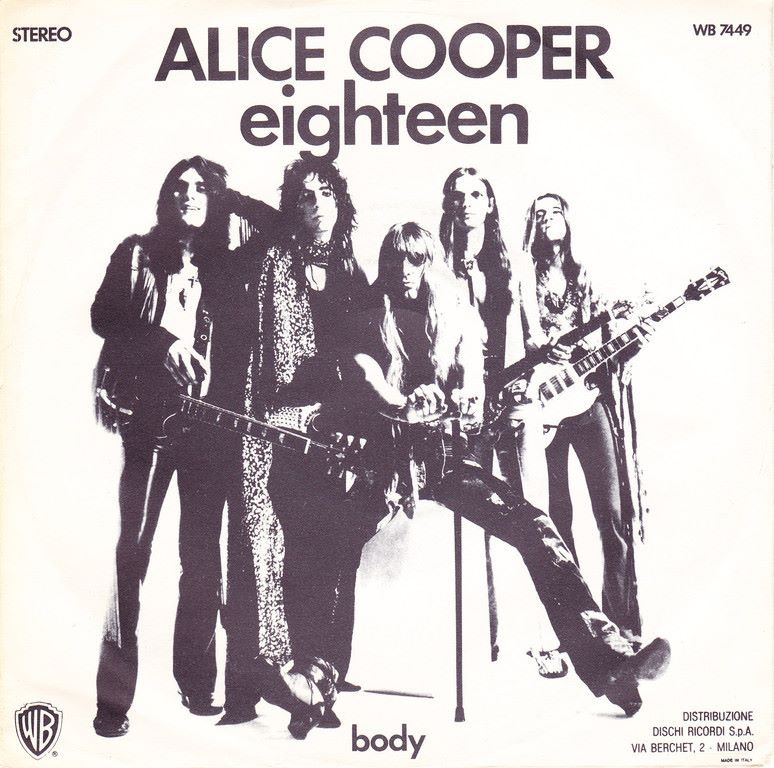
This song was an anthem for teenagers when it was released in 1971 . It remains one today.
Eighteen peaked at #21 in the Billboard 100 and #7 in Canada in 1971.
Most of the band’s support was in the midwest, and they often toured with Detroit groups like the Stooges, the MC5, and Bob Seger. They were usually very low on the bill, but when this song came out, they moved up a few rungs.
Neal Smith (drummer in the Alice Cooper Band) said: “The first show we did after they started playing ‘I’m Eighteen’ was the Detroit Auto Show. It was the big teen event of the year. It was the very first time we played a song where the crowd went crazy. That’s what we were trying for the whole time.”
John Lydon auditioned for The Sex Pistols by singing along to this song for the group’s manager, Malcolm McLaren. This took place in a pub, when Lydon was hanging out after closing and McLaren asked him to mime some songs. Lydon said that the jukebox was filled with “that awful ’60s mod music,” and that “I’m Eighteen” was the only song on it he could tolerate. McLaren gave him the job and renamed him Johnny Rotten.
From Songfacts
This song is about the feelings of a frustrated teenager, which described many of Alice Cooper’s fans. 18 was an interesting age in America at the time, as in many states, you had to be older to vote or drink alcohol, but you could be drafted to fight in the Vietnam War. The group’s drummer, Neal Smith, told us: “It was a song about growing up in the ’60s, with lines in it like you could go to war but you couldn’t vote. We had no idea it would become an anthem; we were just thinking it would be a cool song.”The band (“Alice Cooper” was the name of both the lead singer and the group at the time) wrote the song in the summer of 1970 when they were living in a dorm house in Cincinnati. Their drummer, Neil Smith, told us how the song came together: “We were getting a lot of work in Ohio and Michigan; we were working and writing all the time. We had access to a club and we rehearsed there if we weren’t playing a show. Mike Bruce (guitarist) had this idea for a song called ‘I’m Eighteen.’ At first it was almost like a Pink Floyd kind of thing. We’d always been two guitars, bass, drums and the lead singer. Michael was well versed as a keyboard player. So we got a Farfisa organ and he wrote the song on that. The intro was kind of a melodic, haunting tune that built and built.”“I’m Eighteen” was eight minutes long in it’s original form. The group had an elaborate stage show with lots of gore and histrionics, so they wrote longer songs that would give them time to build a story with their visuals.
An 8-minute freakout was fine for a live performance, but the group needed a hit: their first album had made #199 on the charts, and their next one didn’t chart at all. They were signed to Frank Zappa’s Straight Records label, but when Zappa’s interest waned, the Straight’s parent company, Warner, took over the band and made them produce a 4-song demo to prove their worth. They went to the producer Jack Richardson, who had worked with the Guess Who, looking for help. Richardson wanted nothing to do with them, but he dispatched a young producer working at his Nimbus 9 studios named Bob Ezrin to see the band perform. Ezrin went to New York and saw them perform this song at a club called Max’s Kansas City. The band was so raw that Ezrin thought Cooper was singing “I’m Edgy,” but he saw lots of potential in the group and in the song.
Alice Cooper recorded their four-song demo with Ezrin at RCA Studios in Chicago, and “I’m Eighteen” was the standout track. With Ezrin at the controls, they polished the song down to 2:56. The label was impressed, the song became a hit, and Ezrin continued to work with the band, helping them craft radio-friendly rock songs without compromising their caliginous image. Neal Smith told us, “We were playing every night on stage. We knew how to get a crowd excited. We were like a pot ready to boil over. But the heat wasn’t hot enough yet. We always worked with a total group effort, everybody collaborating, everybody making suggestions. But Bob became like the 6th member of the band. He was the one person who had the final word.”Cooper was not really 18 at the time. He was 23 when they recorded it.This song was released in November 1970 as the first single from Love It To Death, which came out in January 1971. The song got a lot of early support on the Windsor, Ontario radio station CKLW, whose signal went into Cleveland.
Lydon, who was always a huge fan of Alice Cooper, narrated a 2000 BBC documentary on Cooper and wrote liner notes for his 1999 boxed set. Creed covered this on the soundtrack to the 1998 movie The Faculty.In 1998, the publishing company that owned the copyright of this song sued Kiss, claiming that “Dreamin’,” from their Psycho Circus album, resembled this too closely. The case was settled a year later.Alice told Mojo magazine December 2010 how producer Bob Ezrin contributed to this song: “Eighteen was a jam that we’d warm up with, it wasn’t even a song, and Bob said, ‘That’s a hit.’ ‘How?’ we said. He kept saying, ‘Dumb it down. Make it simpler.’ He’d add a piano on the bassline, and we’d go, ‘You can’t put a piano on an Alice Cooper song.’ But he was absolutely correct. When we got done listening to Eighteen, we just could not believe it.”The single was issued with the title “Eighteen.” On the album, it’s listed as “I’m Eighteen,” which is how it’s most commonly known.Anthrax recorded this song for their first album, Fistful of Metal (1984). It was the only album Dan Lilker played on with the band, and his performance on the song was sometimes cited by Anthrax members as a reason for his departure, since it took him a long time to get it right.
In our interview with Lilker, he explained that the producer, Carl Canedy, made lots of little changes during overdubs, which caused problems. “After a while I would get confused and play a note the wrong way,” he said. “It took 25 or 30 takes for me to play that right because he kept changing the part – which was about a good 20 of them – and then I would f–k up, because all the tiny little changes that would mess me up. So a song that sounds relatively easy was actually very difficult.”
Eighteen
Lines form on my face and hands Lines form from the ups and downs I’m in the middle without any plans I’m a boy and I’m a man
I’m eighteen And I don’t know what I want Eighteen I just don’t know what I want Eighteen I gotta get away I gotta get out of this place I’ll go runnin in outer space Oh yeah
I got a Baby’s brain and an old man’s heart Took eighteen years to get this far Don’t always know what I’m talkin’ about Feels like I’m livin in the middle of doubt Cause I’m
Eighteen I get confused every day Eighteen I just don’t know what to say Eighteen I gotta get away
Lines form on my face and my hands Lines form on the left and right I’m in the middle The middle of life I’m a boy and I’m a man I’m eighteen and I LIKE IT Yes I like it Oh I like it Love it Like it Love it
Eighteen! Eighteen! Eighteen! Eighteen and I LIKE IT
I remember this show in the late seventies and early eighties. The performers included The Who, Rolling Stones, Bruce Springsteen, David Bowie, AC/DC, Elton John, Tom Petty, and more. You could tune in on the radio and hear concerts and interviews.
It all started on Feb. 18, 1973, when the King Biscuit Flower Hour debuted on the D.I.R. Radio Network…on FM stations across the U.S. The innovative Sunday night series featured recorded concerts and interviews with rock’s biggest stars. King Biscuit would expand its reach to more than 300 stations before it ceased the weekly production of new shows in 1993. Reruns continued until 2005.
The first KBFH show was broadcast on February 18, 1973 and featured Blood, Sweat & Tears, the Mahavishnu Orchestra, and Bruce Springsteen. Columbia Records was one of the sponsors of the first shows, along with Pioneer High Fidelity and Scotch recording tape.
The concerts were usually recorded with a mobile multi-track recording truck, then mixed and edited for broadcast on the show within a few weeks. In the 1970s, the show was sent to participating radio stations on reel-to-reel tape. They soon switched from tape to album and then to CDs.
Although closely associated with classic rock in its later years, the King Biscuit Flower Hour dedicated much air time to new and emerging artists, including new wave and modern rock artists in the late 1970s and early 1980s.
In 1982, a three-alarm fire damaged the Manhattan office tower that housed D.I.R. Broadcasting. Reportedly, many of the King Biscuit Flower Hour recordings were lost in the fire.
By the end of the KBFH series and the sale of its assets to Wolfgang’s Vault, DIR had impressively amassed over 850 rock concerts, approximately 200 live interviews, and almost 400 country music concerts, which the company recorded on its separate Silver Eagle brand, along with 150 comedy shows.
In 2006, the King Biscuit tape archives were acquired by Wolfgang’s Vault which began streaming concerts online and has made some available for download.
There weren’t many options back then to see or hear rock performers…Don Kirshner Rock Concert, Midnight Special, and some on SNL..and maybe a few specials.
I love the Clavinet in this song and it is what plays the opening riff. This song has been played a lot but it still sounds just as fresh as the day it was released.
This was recorded at Electric Lady Studios, which is where Jimi Hendrix recorded. The studios stayed active after Hendrix’s death, with artists like Miles Davis and Deep Purple also recording there.
Superstition was written for Jeff Beck, as part of an agreement between Beck and Wonder. The deal was for Jeff Beck to play on the recording sessions of his upcoming album Talking Book in return for Wonder writing him a song. Beck came up with the opening drum beat which inspired Wonder to improvise along with it, resulting in Superstition. After the recording of the album, Wonder went ahead and allowed Beck to record his own version of the song and release it
Berry Gordy released Stevie Wonder’s version of the song months ahead of Jeff Beck’s version and resulted in one of his best selling singles.
The song peaked at #1 in the Billboard 100, #6 in Canada, and #11 in the UK in 1973
This was Wonder’s second #1 hit in the US. His first was with “Fingertips (Part 2)” in 1963, which he recorded as “Little” Stevie Wonder.
From Songfacts
Wonder wrote this about the dangers of believing in superstitions. Some of the bad luck superstitions he alludes to include walking under a ladder, breaking a mirror (said to bring seven years of bad luck), and the number 13.
This was intended for Jeff Beck, who was brought in to play some guitar parts on the album in exchange for a song. At one of the sessions, Stevie came up with the riff and wrote some lyrics, and they recorded a rough version of the song that day for Beck. It took Beck a while to record the song, and by the time he released it, Wonder’s version had been out for a month and was a huge hit. Beck felt shortchanged, and made some statements in the press that Wonder didn’t appreciate. In 1975, Beck released an instrumental version of Wonder’s “Cause We’ve Ended As Lovers” on his album Blow By Blow. The album was a hit and helped solidify Beck’s reputation as an elite guitarist.
When Wonder turned 21, he was no longer obligated to Motown Records, and used his clout to sign a deal with the label giving him unprecedented control of his music. He got a large share of royalties and publishing rights, and Motown was not allowed to alter the albums once they were delivered. One thing Motown did control, however, were what songs they released as singles. Knowing Jeff Beck was about to record his version, Motown head Berry Gordy made sure this was the first single and released it before Beck could get his out.
Taking a cue from Marvin Gaye, who put musician credits on his album What’s Going On, Wonder included credits on Talking Book. On this track, Stevie played Hohner clavinet, drums, and Moog bass. Two of his band members also contributed: Steve Madaio played trumpet and Trevor Lawrence played tenor saxophone.
Jeff Beck finally recorded his own version of this song in December 1972 with bass player Tim Bogert and drummer Carmine Appice. They recorded as Beck, Bogert and Appice, and while their album did well, their version of this song was hardly noticed.
At the time, Wonder would keep the studio booked so he could record when inspiration hit. Stevie’s bass player at the time, Scott Edwards, told Songfacts this was not always convenient for his band. “Because he does not have sight, he’s not controlled by daylight,” said Edwards. “So he may begin his night at midnight. Which is bad, because if they want you to come do an overdub or something, he may call you at 4 a.m. and say, ‘Come on in.'”
Several artists besides Jeff Beck have covered this. None made much of an impact until Stevie Ray Vaughan released a live version as a single in 1986 on his album Live Alive. His version is still played on Classic Rock radio, and has grown even more popular since Vaughan’s death in 1990.
This song incorporates many elements of rock music, which helped Wonder extend his appeal to a white audience. Before Talking Book was released, Stevie went on tour with The Rolling Stones, which boosted his credibility in the world of rock. When “Superstition” was released, it was warmly welcomed on the same radio stations that played The Stones, earning Wonder many new fans. It also helped Wonder move past his image as a child star.
Wonder performed this song on Sesame Street in 1973 during the show’s fourth season. It was recorded at the show’s New York studios at a time when Wonder and his band were playing lots of gigs, and they treated the Sesame Street performance just like any other, extending it to nearly 7 minutes, complete with intricate musical shifts directed by Wonder. Video of the performance shows kids and puppets having a blast on the set, but the band remained focused, since getting distracted by a monster would not be a valid excuse for missing a change.
Wonder was the biggest musical act to appear on the show to this point, and other top talent followed: Johnny Cash appeared the next year and Paul Simon showed up in Season 8. In later years, just about anyone who grew up watching the show was thrilled to appear, so they had no trouble attracting musical guests. Rather than straight performances, the songs were typically re-written to fit the theme of the show or teach a lesson: R.E.M. did “Shiny Happy People” as “Furry Happy Monsters”; The Goo Goo Dolls turned “Slide” into “Pride.”
The album was called Talking Book because wonder considered the songs akin to chapters in a book that tell a whole story. On the cover is a rare photo of Wonder without his sunglasses on.
Raven-Symoné of The Cosby Show and Disney Channel’s That’s So Raven fame, recorded this for the 2003 Disney movie The Haunted Mansion, starring Eddie Murphy. >>
Wonder appeared in Bud Light commercials that debuted during the Super Bowl in 2013 as part of the “it’s only weird if it doesn’t work” campaign, which showed superstitious fans acting compulsively in an effort to steer their teams to victory. Wonder appeared as some kind of witch doctor in New Orleans (where the game took place), asking, “are you looking for a little mojo?” He then transports our hero to the big game, where he has a voodoo doll to help his cause. The song “Superstition” plays throughout.
The song also appears in the 2018 “Trick. Treat. Win!” campaign for McDonald’s, which sell the idea that you don’t need luck to win.
Superstition
Very superstitious, writings on the wall Very superstitious, ladders bout’ to fall Thirteen month old baby, broke the lookin’ glass Seven years of bad luck, the good things in your past
When you believe in things that you don’t understand Then you suffer Superstition ain’t the way
Very superstitious, wash your face and hands Rid me of the problem, do all that you can Keep me in a daydream, keep me goin’ strong You don’t want to save me, sad is my song
When you believe in things that you don’t understand Then you suffer Superstition ain’t the way, yeh, yeh
Very superstitious, nothin’ more to say Very superstitious, the devil’s on his way Thirteen month old baby, broke the lookin’ glass Seven years of bad luck, good things in your past
When you believe in things that you don’t understand Then you suffer Superstition ain’t the way, no, no, no














 PowerPop... An Eclectic Collection of Pop Culture