When I listened to this for the first time, my first thought was… Damn this is good! When I read music books about artists…one artist will talk about another and they will talk about another. It’s like a river with all the twists and turns and you never know who you will hear about next.
If you listen to this song grab some headphones and listen to his wonderfully smooth-rough voice. Also, keep an ear out for the fuzz guitar doing runs in the background. When you hear someone like Gregg Allman say that Bobby “Blue” Bland is one of his singing idols…you know something great is there waiting to be heard. This I have heard before and was impressed even without Mr. Allman’s recommendation.
“Ain’t No Love in the Heart of the City” was written by Michael Price and Dan Walsh, a pair of journeymen songwriters who wrote different kinds of music like The Grass Roots’ 1970 hit “Temptation Eyes.”
Bobby was the first to record this song and it was released on his 1974 album Dreamer. The song peaked at #9 in the R&B Charts and #91 in the Billboard 100.
Bland began his career in Memphis, Tennessee, with bluesman B.B. King and ballad singer Johnny Ace (all three were part of a loose aggregation of musicians known as the Beale Streeters). He had some hits in the 50s and early 60s but had some financial troubles in 1968 and had to break up his band.
His record company was then sold to ABC Dunhill and he started up his career again and continued to chart til the 1980s. Of all bands…Whitesnake covered this song in 1978 and it charted in the UK in 1980.
Boz Scaggs: “I made a point of getting to know him over the years, not that I knew him well. But he came down to the studio when we were making the Memphis record a couple of times. He sat in the control room and listened to the playback of some of the songs, and he was treating me very fatherly, where he’d say ‘Here’s where you’re going to go here,’ and he was singing to me as the track was playing back. Then we got a chance to talk.
“It was like a lot of that part of his life, his music, was intact, and he was very vivid about that, vivid in talking about his early influences, it was all there. He was obviously frail, and it was hard for him to get around, but when he settled down, he loved talking about his life and his craft.”
Gregg Allman:“We were doing “Turn On Your Love Light,” because we had heard Bobby “Blue” Bland do it, and, man, you talk about an original talent—there will be, and can be, only one Bobby “Blue” Bland.”
Ain’t No Love In The Heart Of The City
Ain’t no love in the heart of the city Ain’t no love in the heart of town Ain’t no love, and it’s sure ’nuff a pity Ain’t no love, ’cause you ain’t around
When you were mine Oh, I was feeling so good ‘Cause your love lit up this old neighborhood And now that you’re gone You know the sun don’t shine From the city hall to the county line That’s why I said
Ain’t no love in the heart of the city Ain’t no love in the heart of town Ain’t no love, and it sure is a pity Ain’t no love, ’cause you ain’t around
Every place that I go Oh, it seems so strange Without you there Things have changed The night time calls There’s a blanket of gloom Another teardrop falls In my lonely room
I said ain’t no love In the heart of the city Ain’t no love in the heart of town Ain’t no love, ain’t any pity Ain’t no love ’cause you ain’t around
And now that you’re gone Oh, the sun don’t shine From the city hall to the county line, I said
Ain’t no love in the heart of the city Ain’t no love in the heart of town Ain’t no love, it sure is a pity Ain’t no love ’cause you ain’t around ‘Cause you ain’t around
Ain’t no love in the heart of the city Ain’t no love in this great big old town Ain’t no love, and ain’t it a pity Ain’t no love ’cause you ain’t around
Ain’t no love in the heart of the city Ain’t no love in the heart of this town
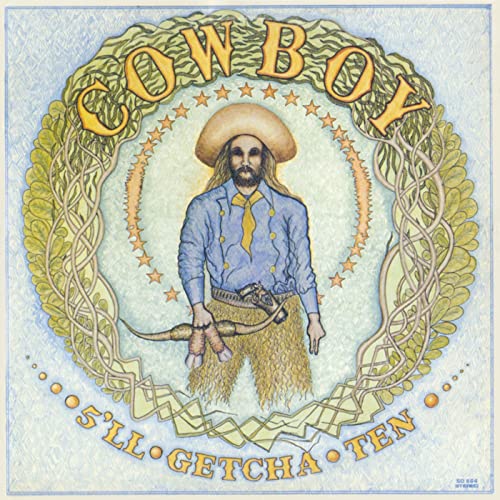
Beautiful melody and touching lyrics…this song is a lost gem. It would later be covered by Eric Clapton but I favor the 1971 original by Cowboy. If you don’t know this one…give the Cowboy version a listen.
Cowboy was a Southern folk-rock band formed in 1969 in Jacksonville, Florida, by singer-songwriters Scott Boyer and Tommy Talton. The band also featured pianist Bill Pillmore, bassist George Clark, guitarist Pete Kowalke, and drummer Tom Wynn.
Please Be With Me was one of the last songs Duane Allman recorded before his tragic motorbike accident on October 29, 1971. He played the dobro and it made the song. This song appears on 5’ll Getcha 10, the second record by Cowboy, a band that had landed a contract thanks to their friendship with Duane.
The band opened up for the Allmans on their 1970-1971 national tour. The album came out in October 1971. They would go on to release four albums in the early seventies.
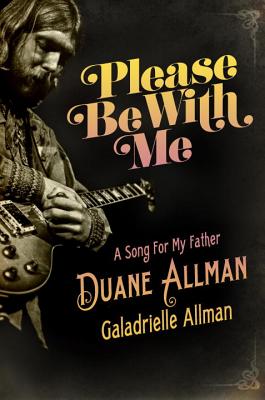
Galadrielle Allman, daughter of Duane Allman, used this song title for her book title instead of one of many Allman Brothers songs. It’s a very good book.
Butch Trucks (Drummer for ABB): ‘A few weeks after Duane died, when I still hadn’t really let loose or accepted it, I put on Please Be With Me and the dam burst and I started crying and crying, just racked with grief. I was sitting there listening to the song over and over and crying. To this day I can’t hear it without getting choked up.’
Scott Boyer:“I was sitting in this motel room all by myself and just for busy work I grabbed a pad and pencil and started writing freeform. Whatever popped into my head. About 10 minutes later and I had like 10 verses and three choruses, but nothing rhymed and nothing made any sense. It was just right out of my head and onto the paper. And I started connecting things. Put the third line from the third verse with the fourth line in the eight verse. Not necessarily because they made sense but because they rhymed. And I put together like three verses and a chorus and I put the pad down and I rolled over and went to sleep. And Duane (Allman) came into town the next day and said, ‘I want to play on this record with ya’ll but I want to play something brand new.’ We started tossing things around. And I said, ‘Well I wrote this thing last night. There’s nothing much to it.” And I played the song for Duane and (producer) Johnny Sandlin was also in the room and when I finished it they both went, ‘Wow, you wrote that last night, man? That’s beautiful.’ It is? [Laughs.] But that’s how the song got recorded because Duane wanted to play something brand new and I had this thing I had tossed off the night before. And I loved what Duane played on it. That dobro he played on it just comes to life when that thing comes on, man.”
Gregg Allman:The group Cowboy was on Capricorn, and we played their album 5’ll Getcha Ten quite a bit at the Big House. Scott Boyer had been in the 31st of February with Butch, and Cowboy had a sort of southern-folk sound to them.
Please Be With Me
Upon my word what does it mean? Is it love or is it me That makes me change so suddenly From looking out to feeling free?
I sit here lying in my bed Wondering what it was I said That made me think I lost my head When I knew I lost my heart instead
So won’t you please read my signs Be a gypsy Tell me what I hope to find deep within me And because you can find my mind Please be with me
Of all the better things I’ve heard Loving you has made the words And all the rest seem so absurd ‘Cause in the end it all comes out I’m sure
So won’t you please read my signs Be a gypsy Tell me what I hope to find deep within me And because you can find my mind Please be with me
This song was leftover from my AM Radio Gold week I had a while back. It’s one of those songs that take me back to when I heard it on the radio. It’s almost impossible for me to be unhappy when this song is on. Kinda like how I Can See Clearly Now affects me. It was unlike the origin of the song.
It was written by the keyboard player/songwriter Sherman Kelly in 1969 after a trip to the Caribbean island of Saint Croix, where he was attacked by natives and left for dead. While he was recovering from his injuries, he wrote this song as an alternate reality.
The first band to record this song was Boffolongo, which was fronted by Larry Hoppen. The group recorded their debut album in 1969, and for their next album, released in 1970, Sherman Kelly joined the band on keyboards and brought them his song “Dancing In The Moonlight.” Kelly’s brother Wells also joined the band; this original version of the song featured Hoppen on guitar, Sherman on lead vocals, and Wells on drums.
In 1971, Wells Kelly paid a visit to the band King Harvest, who was working on a new album in Paris (his former Boffolongo bandmate Dave “Doc” Robinson was in the band). Wells came armed with some albums from America and also a copy of Boffolongo’s “Dancing In The Moonlight,” which King Harvest decided to record, this time with a more keyboard-driven sound and smoother production. The single, with lead vocals by Robinson, was released in Europe but stiffed; it was rescued by an American label called Perception Records that issued the song Stateside.
King Harvest released this song in 1972 and it reached #13 on the Billboard Charts, #5 in the UK charts, and #5 in Canada.
British band Toploader had a #7 hit in the UK with a cover of this after it was featured in a Sainsbury supermarket TV advert.
Dancing In The Moonlight ended up being an enduring hit for the band, and their only song to make much of an impact (“A Little Bit Like Magic” made #91 a few months later) King Harvest were never The Who, Beatles, or the Stones but they contributed to the texture of the seventies. They did end up releasing 10 albums! The latest in 2015.
Songwriter Sherman Kelly: On a trip to St. Croix in 1969, I was the first victim of a vicious St. Croix gang who eventually murdered 8 American tourists. At that time, I suffered multiple facial fractures and wounds and was left for dead. While I was recovering, I wrote “Dancin In The Moonlight” in which I envisioned an alternate reality, the dream of a peaceful and joyful celebration of life. The song became a huge hit and was recorded by many musicians worldwide. “Dancin In The Moonlight” continues to be popular to this day.
The first band Boffalongo to record it.
Dancing In The Moonlight
We get it almost every night When that ol’ moon gets-a big and bright It’s a supernatural delight Everybody’s dancin’ in the moonlight
Everybody here is out of sight They don’t bark, and they don’t bite They keep things loose, they keep things light Everybody was dancin’ in the moonlight
Everybody’s dancin’ in the moonlight Everybody’s feelin’ warm and right It’s such a fine and natural sight Everybody’s dancin’ in the moonlight
We like our fun and we never fight You can’t dance and stay uptight It’s a supernatural delight Everybody was dancin’ in the moonlight
On a far distant radio a few days ago I heard It’s Raining Again and then this one. Sometimes I forget how big Supertramp was in the 70s and 80s…especially after this album.
In 1979 the album Breakfast In America was huge. The album had 4 singles in the Billboard 100. The album peaked at #1 in the Billboard Album Charts, #1 in Canada, #1 in New Zealand, and #3 in the UK…and won 2 Grammys.
The title song peaked at #62 in the Billboard 100 and #9 in the UK in 1979.
This album was released in 1979 and it came at the height of new wave and disco. Its domination of the single and album charts, and the airwaves, had to be unexpected by all concerned. Breakfast In America eclipsed anything they had done before and skyrocketed the band into the commercial stratosphere. Supertramp was never a typical chart band or obvious stadium touring giants. After this album, everything changed.
When they came to record the album, all five members had relocated full-time to the West Coast and bought apartments or houses there, and it was decided that the Colorado (Caribou Ranch) studio had been too sterile and so a new headquarters was found for Supertramp and co in Burbank, a home-from-home that was promptly given the name Southcombe. There, throughout 1978, they rehearsed the material and prepared the demos that would eventually be recorded at the Village Recorder studio in Los Angeles.
Roger Hodgson and Davies wrote most of the songs. They sometimes shared credit on songs… but Roger Hodgson wrote this song 8 years earlier. Davies and Rogerson had a disagreement over the first line in the song. Rick Davies didn’t like “Take a look at my girlfriend, she’s the only one I got.” Roger won the battle.
Roger Hodgson:“He never liked the lyric to ‘Breakfast.’ It’s so trite: ‘Take a look at my girlfriend.’ He’s much more into crafting a song. He would have been happier if I’d changed the lyric to either something funnier or more relevant. I tried, but it didn’t work out, so I was stuck with the original.”
Roger Hodgson:“The line ‘playing my jokes upon you,’ I think that kind of sums up the song. It was just mind chatter. Just writing down ideas as they came – fun thoughts all strung together. And I do remember the Beatles had just gone to America, and I was pretty impressed with that. That definitely stimulated my dream of wanting to go to America. And obviously seeing all those gorgeous California girls on the TV and thinking, Wow. That’s the place I want to go.”
Roger Hodgson:“I think I was 17 when I found this wonderful pump organ – a harmonium that you pump with your feet. I found it in this old lady’s house in the countryside near where I lived in England. I bought it for £26, and when I brought it back I proceeded to write all these songs on it: ‘Breakfast In America,’ ‘Two Of Us,’ ‘Soapbox Opera,’ even the beginning of ‘Fool’s Overture’ and ‘Logical Song.’ It’s amazing what this instrument pulled out of me.”
Here is a good live version…you are bloody well right!
Breakfast In America
Take a look at my girlfriend She’s the only one I got Not much of a girlfriend Never seem to get a lot
Take a jumbo across the water Like to see America See the girls in California I’m hoping it’s going to come true But there’s not a lot I can do
Could we have kippers for breakfast Mummy dear, mummy dear They got to have ’em in Texas ‘Cause everyone’s a millionaire
I’m a winner, I’m a sinner Do you want my autograph I’m a loser, what a joker I’m playing my jokes upon you While there’s nothing better to do
Ba-ba-ba-dow, ba-bow-dum-doo-de-dow-de-dow, de Ba-ba-ba-dow, ba-bow-dum-de-doo-de-dow Na na na, nana na na na na
Don’t you look at my girlfriend (girlfriend) She’s the only one I got Not much of a girlfriend (girlfriend) Never seem to get a lot (what’s she got, not a lot)
Take a jumbo cross the water Like to see America See the girls in California I’m hoping it’s going to come true But there’s not a lot I can do
Ba-ba-ba-dow, ba-bow-dum-doo-de-dow-de-dow, de Ba-ba-ba-dow, ba-bow-dum-de-doo-de-dow
Love this song and movie. Back in 2018 my son and I caught the movie in an Art House movie theatre that is located in Nashville. It was cool seeing this 1972 movie on the big screen. On top of a great movie, we got to hear the Curtis Mayfield soundtrack with surround sound in the theater.
Quinten Tarantino was strongly influenced by this movie for Jackie Brown. The endings are very similar. This song popularized the word “fly,” which means unusual and exceptional, particularly when it comes to fashion.
Curtis Mayfield was working on the songs for the movie while it was shooting, and would often visit the set, bringing in demos so the cast and crew could hear how they would integrate into the film. He even appears in the movie, performing the song “Pusherman” in a bar scene.
After seeing the screenplay, Mayfield jumped into the project and was given complete creative freedom. He wrote the songs to suit the scenes, but he made sure they could stand on their own, telling the stories even without the visuals. “Superfly” works very well outside of the film, as the character Mayfield describes could relate to anyone trying to survive and thrive under difficult situations.
The song peaked at #8 in the Billboard 100 and #5 in the R&B Charts in 1972.
Curtis Mayfield:“It was a glorious moment for our people as blacks, Priest had a mind, he wanted to get out. For once, in spite of what he was doing, he got away. So there came ‘Superfly’ the song. He was trying to get over. We couldn’t be so proud of him dealing coke or using coke, but at least the man had a mind and he wasn’t just some ugly dead something in the streets after it was all over. He got out.”
Superfly
Darkest of night With the moon shining bright There’s a set goin’ strong Lotta things goin’ on The man of the hour Has an air of great power The dudes have envied him for so long
[Chorus] Superfly You’re gonna make your fortune by and by But if you lose, don’t ask no questions why The only game you know is Do or Die Ah-ha-ha
Hard to understand What a hell of a man This cat of the slum Had a mind, wasn’t dumb But a weakness was shown Cause his hustle was wrong His mind was his own But the man lived alone
[Chorus]
The game he plays he plays for keeps Hustlin’ times and ghetto streets Tryin’ to get over (That’s what he tryin’ to do, why’all) Taking all that he can take Gambling with the odds of fate Tryin’ ta get over [Repeat: x4] Woo, Superfly
The aim of his role Was to move a lot of blow Ask him his dream What does it mean? He wouldn’t know “Can’t be like the rest” Is the most he’ll confess But the time’s running out And there’s no happiness
I love listening to Phil Lynott sing. Thin Lizzy could give you a lot of different-sounding songs. In this song, it sounds like Phil was listening to the Moondance album by Van Morrison.
The record company added the (It’s Caught Me In It’s Spotlight) so people would not confuse this with the old AM hit Dancing In The Moonlight by King Harvest that I’ll be going over this week!
It’s the way Lynott phrased his lyrics that added to the experience. Thin Lizzy also had some great twin harmony lead guitar parts that made their sound. They were unique, to say the least. You had a black Irish bass player fronting a rock band and singing like a cross between fellow Irishman Van Morrison and American Bruce Springsteen. They were not just a hard blues band. They mixed rock, country, blues, Celtic, and a little jazz in the mix.
The band’s name is a play on Tin Lizzie (“Thin” being pronounced “Tin” in an Irish accent). Tin Lizzie is either a reference to a robot character from TheDandy Comic or a nickname for the Model T Ford…
This song was on the Bad Reputation album released in 1977 and was written by Phil Lynott. It peaked #14 in the UK, #84 in Canada, and #4 in Ireland.
The album peaked at #39 in the Billboard Album Charts, #44 in Canada, and #4 in the UK in 1977.
Phil Lynott was the principal songwriter, but he encouraged the rest of the band to contribute their own material.
Scott Gorham (lead guitarist…one of them):“He taught us how to do this thing called ‘song writing.’ And until we got better and better at it and we could actually bring our own songs in, we brought in songs that were either partly finished or just ideas to put on one of his songs. We might bring in a song that was half finished, or a whole song minus the lyrics. And it was always minus the lyrics, because that was Phil Lynott’s domain. We knew that we weren’t ever going to touch or top his lyrics. So you just let him get on with it.”
Later on The Smashing Pumpkins covered “Dancing in the Moonlight (It’s Caught Me in Its Spotlight)” for various live performances.
Phil Lynott’s short life has been memorialized by a life-size bronze statue erected in central Dublin, just outside one of the famed bass player’s favorite pubs.
Thin Lizzy – Dancing in the Moonlight (It’s Caught Me in Its Spotlight)
When I passed you in the doorway You took me with a glance I should have took that last bus home But I asked you for a dance
Now we go steady to the pictures I always get chocolate stains on my pants My father he’s going crazy Say’s I’m living in a trance
But I’m dancing in the moonlight It’s caught me in its spotlight It’s alright, alright Dancing in the moonlight On the long hot summer night
It’s three o’clock in the morning And I’m on the streets again I disobeyed another warning I should have been in by ten
Now I won’t get out until Sunday I’ll have to say I stayed with friends But it’s a habit worth forming If it means to justify the end
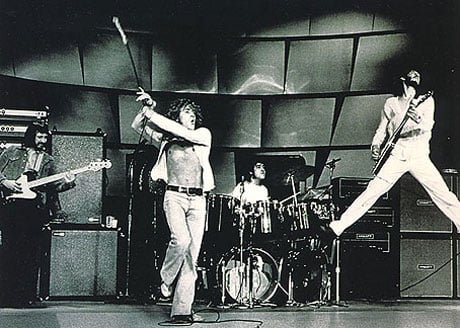
Young Man Blues was written by jazz artist Mose Allison in 1957. Mose’s version is jazzy and smooth. The Who took the song and set it afire with an explosive charge. Mose Allison called The Who’s version The “Command Performance” of his song. That’s a great compliment from the author. Pete was a big fan of Mose Allison. He has said that if he never heard this song he would not have written My Generation.
The Who version has great dynamics. The bass and drums are all over the place and yet perfect. The Who sound like they are driving near a cliff and you know the song is going to fall off but they save it at the last moment time after time. The song was on the Live At Leeds album released in 1970.
The key to this song and most Who songs was the rhythm section. Keith Moon and John Entwistle pushed each other to greatness. The frenetic chaotic bass and drums made it exciting. You had the lead guitar player punching in licks between the lead bass and drums. Later on, when Keith passed away and Kenney Jones took his place…they were not the same. That is nothing against Jones…he was one of the best British drummers at that time but that touch of insanity was gone permanently.
A year or so before John Entwistle died, Roger Daltrey was complaining about John’s volume on stage to Pete. Pete replied that without that volume and John’s style…they are not the Who. That was a true statement. I saw the Who with John and later on without him. It wasn’t the same. Was it a great show without him? Yes, the songs were great but that element of danger was gone. That is what both Keith and John added to the Who.
So I’ll take this note for myself… February 14, 1970… I’ll buy a ticket for Leeds University when I get my time machine working…I’ll take some cotton balls though.
Young Man Blues
Oh well a young man ain’t got nothin’ in the world these days I said a young man ain’t got nothin’ in the world these days
You know in the old days When a young man was a strong man All the people they’d step back When a young man walked by
But you know nowadays It’s the old man, He’s got all the money And a young man ain’t got nothin’ in the world these days I said nothing
Everybody knows that a young man ain’t got nothin’ Everybody! Everybody knows that a young man ain’t got nothin’ He got nothin’ Nothin’
Take it easy on the young man They ain’t got nothin’ in the world these days I said they ain’t got nothin’! They got sweet fuck-all!
Welcome to the Hanspostcard TV Draft. The remaining 7 rounds will be posted here. I hope you will enjoy it! Today’s post was written byKeith from https://nostalgicitalian.com/
TV Show Draft – Nostalgic Italian’s Round 4 Pick – Columbo
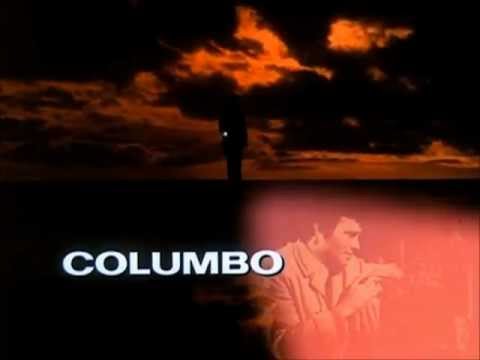
Welcome to my fourth round pick in the Hanspostcard TV Draft. Last round I chose Perry Mason, which was the ultimate court room “whodunit!” You never knew who committed the crime until the end of the episode. I thought it appropriate to choose Columbo for this round, because it is almost the exact opposite of Perry Mason, in that you know who the killer is right from the get go. It was called a murder mystery where the murder was no mystery.
The show pioneered the “inverted mystery” technique/format. Almost every show begins with a crime and the audience knows who the culprit is. Then enter the LAPD’s Lieutenant Columbo who spends the remainder of the show looking for clues, pestering the criminal, and eventually solving the case. The show was not a “whodunit” like Perry Mason, but rather it has been described as a “how’s he gonna catch him?”
The first season of Columbo began in September of 1971. I know that most of the shows being picked by others in the draft ran on a weekly basis. Columbo did not. Most episodes were featured as part of the NBC Mystery Movie rotation. It ran for 35 years with a total of 69 episodes.
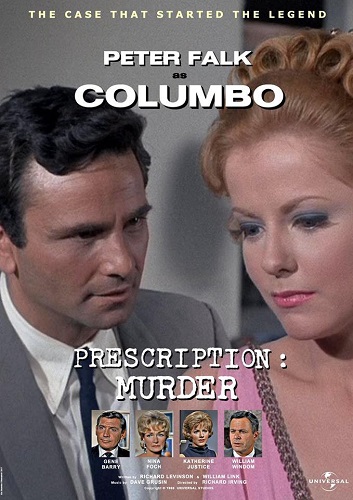
The show was created by schoolmates Richard Levinson and William Link. The character first appeared in 1960 on The Chevy Mystery Show in an episode called “Enough Rope.” That episode was then adapted for a stage play entitled Prescription: Murder, which was then adapted for television in 1968. Columbo was played by Bert Freed in Enough Rope and by Thomas Mitchell in the stage version in 1962.
Bert Freed (L), Thomas Mitchell (R) – The Original Columbos
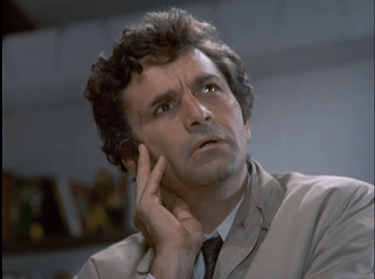
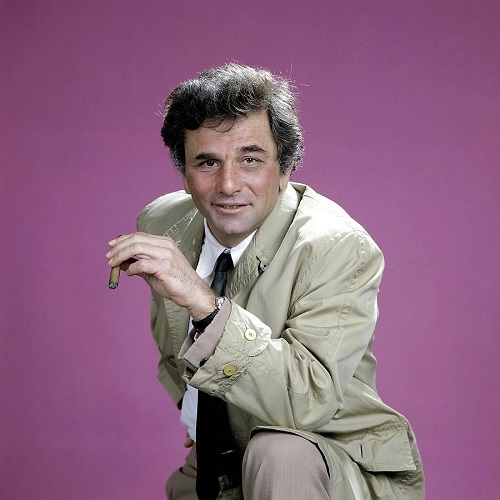
The writers of the show had originally wanted Lee J. Cobb to play Columbo, but he was unavailable. They next approached Bing Crosby, who turned down the role because it would take away from his time on the golf course. Peter Falk came across the script for Prescription: Murder and contacted Levinson and Link and said, “I’d kill to play that cop!”
Peter Falk and Gene Berry
They weren’t really sure about Peter Falk, who was only 39 at the time. They envisioned the character as being older. He won the role, and he plays him as a much straighter, cleaner, and firmer Columbo in the first episode. It was a huge hit! The Columbo quirks and mannerisms that fans came to know and love would develop as he continued to play the role.
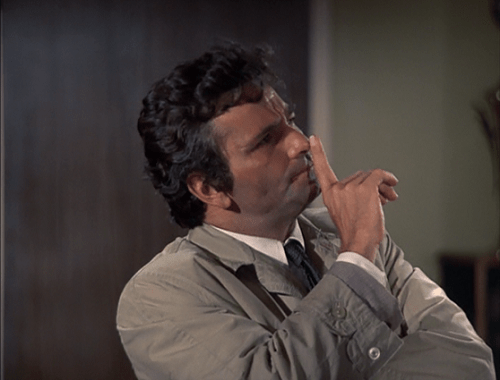
Peter Falk really threw himself into the role. He wore his own clothes. The suit was one that he had dyed brown, because he felt that looked better. He wore his own shoes. The world famous raincoat was one that he purchased in New York City while caught in a rainstorm. It cost him a mere $15. One difference between Peter and Columbo – Columbo preferred cigars, while Falk enjoyed cigarettes.
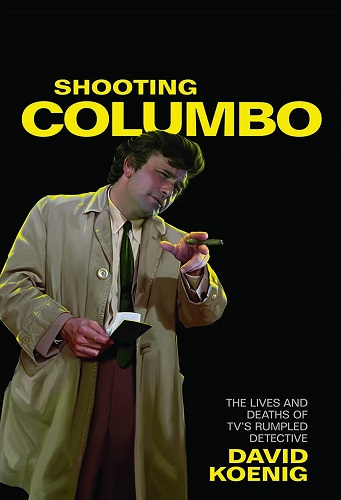
I am currently reading a fantastic book on the show written by David Koenig.
Columbo is like no other cop. Koenig says, “There was nobody or nothing like Columbo at all before him. All the detectives were these hardboiled, emotionless, tough guys. And he was the opposite of that in every way. He hated guns and violence.” He describes the show this way, “Columbo wasn’t really a cop show. It was a drawing-room mystery done backwards with a cop as the lead. It was an anti-cop show.”
During the first few seasons of Columbo, it really set the standard for what some refer to as “event television.” There were some fabulous guest stars who played the murderer. Those stars included Gene Berry, Jack Cassidy, William Shatner, Dick Van Dyke, Ruth Gordon, Robert Vaughn, Anne Baxter, Janet Leigh, Robert Culp, Donald Pleasence, Eddie Albert, Leonard Nimoy, Johnny Cash, and Patrick McGoohan – just to name a few!!
After the murder, when Columbo finally shows up, his genius is hidden by his often confused look. It is also hidden by the way he is dressed and by his friendly demeanor. He is looked upon as a stupid fool. The killer has no idea what a brilliant man Columbo is and they are lured into a false sense of security. The killer becomes even more arrogant and dismisses Columbo as a dope, only to be caught in the end.
One of the things that certainly added to the character was his little idiosyncrasies like fumbling through his pockets for a piece of evidence, asking to borrow a pencil, or being distracted by something in the room in the middle of a conversation. Falk adlibbed those moments on camera while film was rolling as a way to keep the other actors off-balance. He felt that it really helped to make their confused and impatient reactions to Columbo more genuine. It really truly worked.
On the show, the murderer is often some famous person, or someone who is cultured or from high society. Either that, or some sort of successful professional (surgeon, psychologist, etc…). Paired up against Columbo, it is gold! The interactions between the two become such a marvelous part of the show and brings out Columbo’s character and cunning genius!
In those conversations Columbo is often confused. He doesn’t know anything about classical music, chess, fine wines, photography or pieces of art. One article on the show stated that his “ignorance” will often “allow him to draw in the murderer with a cunning humility that belies his understanding of human behavior and the criminal mind.”
The last episode of Columbo aired in 2003 and was entitled “Columbo Likes the Nightlife.” Falk had planned for one final episode. It was to be called “Columbo’s Last Case” which was to begin at his retirement party. There was a lack of network interest and with his age and failing health, the episode was never to be.
Columbo remains as popular as ever. It was one of the most watched shows on streaming platforms during the pandemic. Author David Koenig says about the show, “It has stood the test of time for 50-plus years now. That character is still vibrant and alive, appealing to people. People love that central character, that basic format, the fact that it’s not political, it’s not violent, it’s not all the things television shows are today, it’s something different. And that is charm. That’s what people love about it.”
Columbo Facts:
Steven Spielberg directed the first episode of Season 1 – Murder by the Book.
Peter Falk won 4 Emmy Awards for his portrayal of Columbo (1972, 1975, 1976, and 1990)
He also won a Golden Globe Award for the role.
Patrick McGoohan played a murderer more times than any other actor – 4 times. Jack Cassidy and Robert Culp each had 3 times, William Shatner and George Hamilton each played a killer twice.
Columbo’s name is never revealed – although a close up of his badge in the first season says it is ‘Frank.’ The creators of the show have stated that his first name was never known, so take that however you want to.
Columbo drives a 1960 Peugeot 403 convertible.
Columbo’s favorite food is chili and black coffee is his drink of choice.
In the 1972 episode entitled, “Etude in Black,” Columbo rescued a basset hound from the dog pound. The dog could be seen in many other episodes, and was as close to a sidekick/partner as Columbo ever got.
In 1997, the episode Murder by the Book was ranked #16 in TV Guide’s “100 Greatest Episodes of All Time” list.
In 1999, Lieutenant Columbo was ranked #7 on TV Guide’s “50 Greatest TV Characters of All Time.”
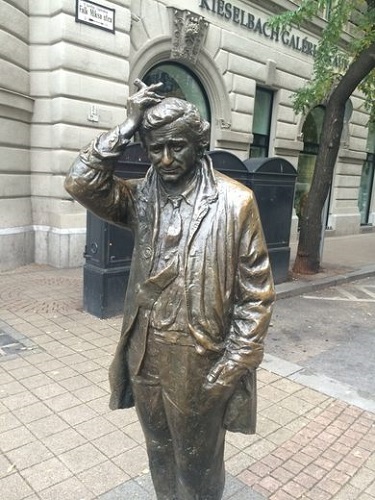
There is a bronze statue of Columbo (and his dog) in Budapest, Hungary. It was unveiled in 2017. Peter Falk is rumored to be a distant relative of the well-known Hungarian politician Miksa Falk (1828-1908).
Columbo Statue in Budapest, Hungary
I thought I would close with little treat for you. In one of the Dean Celebrity Roasts, Frank Sinatra was the Man of the Hour. Now, these roasts were often edited down to make sure all the best stuff was shown on TV. In Lee Hale’s book, he stated that there was only one performance that was shown in its entirety – Peter Falk’s appearance during the Sinatra roast.
Falk appears from the audience – as Lt. Columbo. The entire 11 minute bit is just priceless. It is a must see. Enjoy:
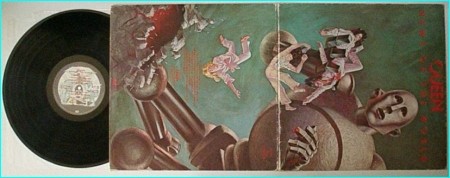
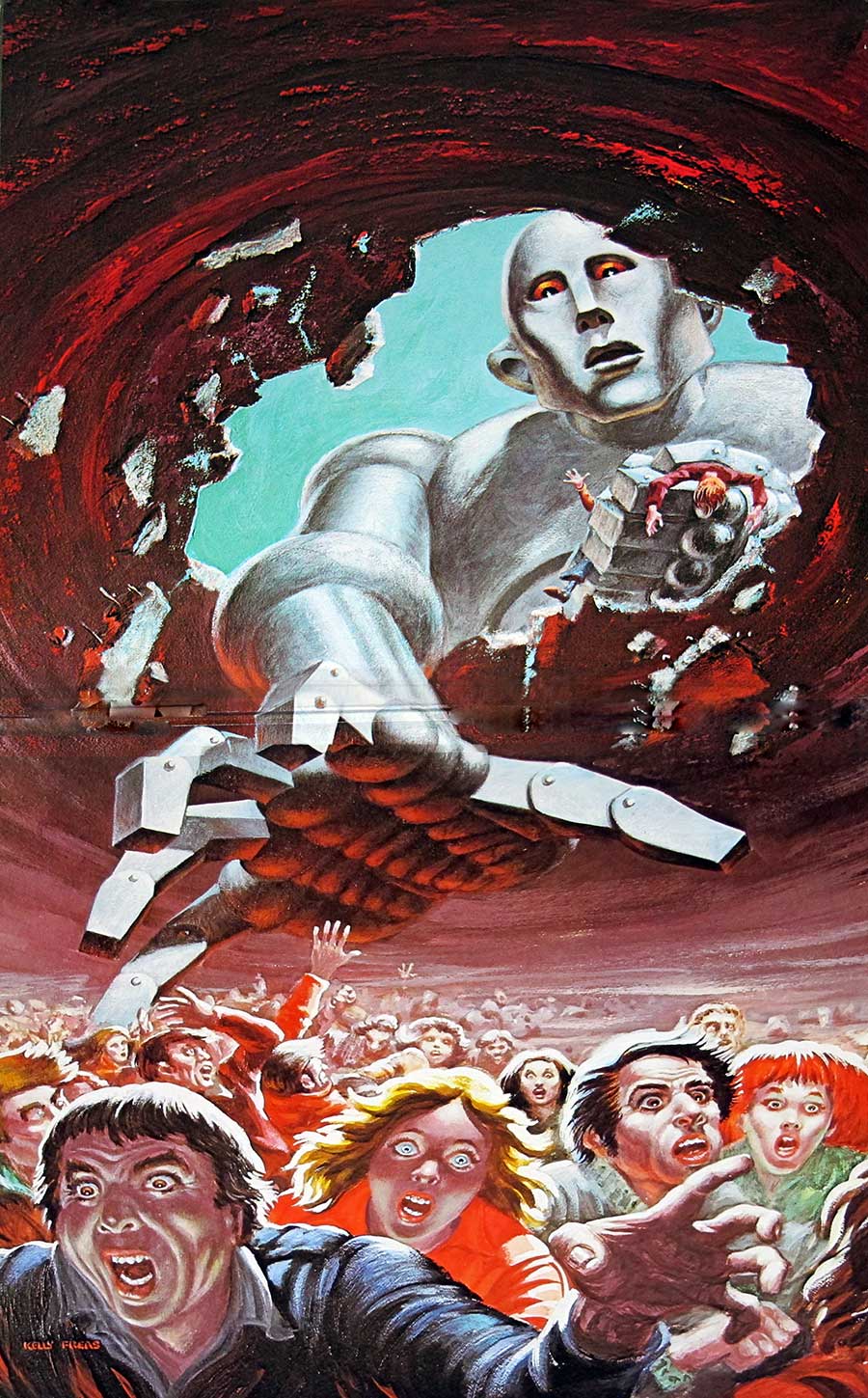
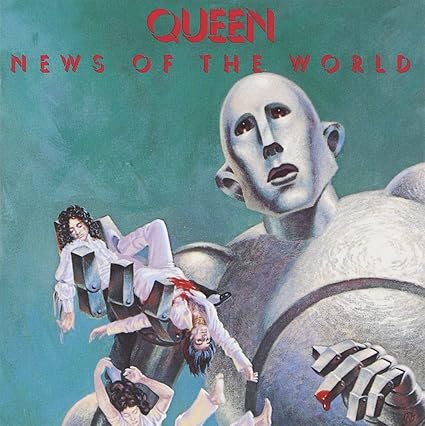
I just saw a post about the album cover for News Of The World at The Press Music Reviews. It made me think of the first time I saw the cover of this album and when I heard this song.
In 3rd or maybe 4th-grade recess we were all going outside playing kickball. A friend of mine named Paul brought this album to school. We all looked at it and couldn’t stop talking about that cool robot cover. That was before I listened to it.
When I first heard We Will Rock You… the guitar solo is what stood out to me. It’s so simple yet catchy like many of Brian May’s solos…it was more like a hook. It turned into an anthem with We Are The Champions. I made a vow that if I learned how to play guitar one day I would learn that solo. I forgot about that vow until a few years ago and I finally kept that promise to myself.
We Will Rock You was released as a double A-side single with We Are The Champions. Since the songs were released, the band has almost always used “Rock You” and “Champions” as a back-to-back encore number. The album peaked at #3 in the Billboard Album charts, #2 in Canada, #15 in New Zealand, and #4 in the UK in 1977.
On Queen’s next album, they had another set of songs disc jockeys played together. “Bicycle Race” and “Fat Bottomed Girls” were segued together on their album Jazz. Those songs were also released as a double A-side single.
While in the studio they had a visit from no other than Sid Vicious. He berated Freddie Mercury and asked him if he had brought ballet to the masses yet…referring to an earlier Mercury interview. Freddie said “I called him, I dunno, Simon Ferocious or something, and just pushed him out. I think… yeah, I think we passed that test.” Roger Taylor later called Vicious a moron and idiot.
Brian May: There were two occasions that inspired it. One I’ve spoken about a lot, which was at Bingley Hall [near Birmingham, England] where the audience sang every song and then we went off stage and they carried on singing and then they sang [the de facto Liverpool F.C. football anthem] “You’ll Never Walk Alone.” It was a transitional time in rock. You went to see Led Zeppelin and The Who, you’d bang your head but you didn’t sing along, that wasn’t cool. This was an invitation to sing along.
A light went off and I thought, “We shouldn’t fight this, we should embrace it!” People didn’t do that at the time at rock concerts. I thought, “How interesting — if I wrote something, the audience could participate it to the point that they could lead the band?” I went to sleep and woke up with “We Will Rock You” in my head. When you’re at a show you can hardly move, but you can stomp your feet and chant and clap and lead us.
Roger Taylor:“It only has one instrument apart from the voice: There’s no bass, no real drums — just feet and handclaps and only that guitar at the very end. It’s quite an odd song. It was designed as a sort of song for the audience, a joining-in song. But we never really envisioned that it would be taken up by sports. It’s one of delights of… I’ve spent my life being in a band, so it sidelined all sports. I reckoned I could meet more girls being in a band than playing soccer.”
The single was accompanied by a promo video that saw Queen perform the song in Roger Taylor’s back garden and We Will Rock You quickly became the opening number on the band’s winter tour.
We Will Rock You
Buddy, you’re a boy, make a big noise Playing in the street, gonna be a big man someday You got mud on your face, you big disgrace Kicking your can all over the place, singin’
We will, we will rock you We will, we will rock you
Buddy, you’re a young man, hard man Shouting in the street, gonna take on the world someday You got blood on your face, you big disgrace Waving your banner all over the place
We will, we will rock you, sing it We will, we will rock you
Buddy, you’re an old man, poor man Pleading with your eyes, gonna make you some peace someday You got mud on your face, big disgrace Somebody better put you back into your place
We will, we will rock you, sing it We will, we will rock you, everybody We will, we will rock you We will, we will rock you Alright
Welcome to the Hanspostcard TV Draft. The remaining 8 rounds will be posted here. We will have 64 different TV Shows by 8 different writers. I hope you will enjoy it! Today’s post was written by Max from https://powerpop.blog
Adam 12
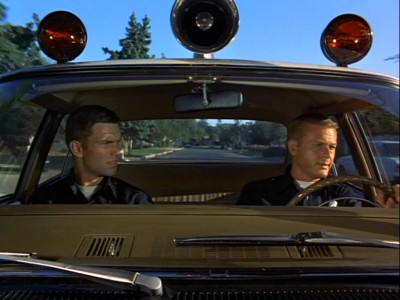
The show was simple… it focused on a pair of beat cops doing their everyday jobs… responding to calls and patrolling the city of Los Angeles
I watched this in syndication in the late seventies after school. I never thought much of it at the time. When I started to watch it as an adult, I was surprised at how good this show was. I thought it was strictly a kid’s show. I couldn’t believe how realistic it was for that time and some now. They covered subjects like child pornography, drug addiction, gangs, racial tension, and everything else criminally related. It was on for 7 seasons from 1968 through 1975.
Sometimes as an adult and you watch shows or movies you did as a kid you think wow…how did I like this? Now I’m thinking why didn’t I like Adam 12 more? The show starred Martin Milner as Officer Pete Malloy and Kent McCord as Officer Jim Reed. It was created by Jack Webb and Robert Cinader. The pair also created a spinoff from Adam-12…Emergency. Jack Webb also created Dragnet. Emergency and Adam 12 did crossover in a few episodes.
Before this show, Martin Milner was in the fantastic tv show Route 66 that would film in different locations every week. Kent McCord knew Ricky Nelson well and appeared on The Adventures of Ozzy and Harriett. They both knew Jack Webb and were cast for Adam 12.
How realistic was it? The LAPD would use some episodes as training guides for new policemen. The reason for that is that the LAPD worked with the show for realism. Kent McCord said that more than once while filming…someone would come up to them and thought they were real policemen.
They wanted to capture a typical day in the life of a police officer. There was no Dirty Harry on this force. These officers went by the book even if it would have benefitted them at times to stray off. The episodes were written around actual police cases to add some realism. They showed all that the censors would allow.
Some of the guest stars were… Tony Dow, Willie Aimes, Ed Begley Jr, Karen Black, David Cassidy, Micky Dolenz, Tim Matheson, Ozzie Nelson, and many others. It was odd seeing Robert Donner…who played Yancy Tucker on The Waltons a few years later…playing a heroin addict-informant.
Reed is happily married, and Malloy is the happy bachelor. The interplay is natural and not forced. The one big thing I like about the show is the continuity from beginning to end. You see a raw rookie in Jim Reed with Malloy slowly training him up and eventually both becoming friends as seasons pass by. The conversations that take place between the crimes happening are things we all talk about so you can relate to these two.
Los Angeles historians have a field day with the episodes. They show how the city was at that time. They recorded the bulk of this show on location. On youtube you can find “then and now” film segments. Many policemen have said that this show inspired them to join the force.
Martin Milner passed away in 2015. The LAPD hosted a ceremony in Milner’s honor at its downtown Los Angeles headquarters. I binge-watched this show last year and the quality never went down in the 7 seasons.
I first got Tea for the Tillerman back in the early eighties and got hooked on Cat Stevens although I do remember his songs growing up. He has one of those voices that when you first hear it…you know who it is without any doubt. This song I didn’t know about until I heard it in a movie.
This is the ultimate optimistic song about following your own path. Like the best of Cat Stevens songs, it will stay with you after a listen. It’s optimistic without going overboard.
I first heard this song in the dark comedy 1971 “Harold and Maude” where it was featured. Stevens wrote and performed all of the songs for the movie after being recommended by Elton John.
This song did not chart which really surprised me when I first heard it. The reason it didn’t chart was that was it never released as a single or on an album. The song was finally released in 1984 on a Cat Stevens Greatest Hits album called “Footsteps in the Dark: Greatest Hits, Vol. 2.”That was 14 years after the movie. The soundtrack for Harold and Maude wasn’t released until 2007.
I would recommend this movie to anyone who likes dark or offbeat comedies. The movie was directed by Hal Ashby. The music was a perfect fit for this movie. Both Bud Cort and Ruth Gordon were nominated for Best Actor/Actress in a Motion Picture -Comedy at the Golden Globes.
“If You Want To Sing Out, Sing Out”
Well, if you want to sing out, sing out And if you want to be free, be free ‘Cause there’s a million things to be You know that there are
And if you want to live high, live high And if you want to live low, live low ‘Cause there’s a million ways to go You know that there are
[Chorus:] You can do what you want The opportunity’s on And if you can find a new way You can do it today You can make it all true And you can make it undo you see ah ah ah its easy ah ah ah You only need to know
Well if you want to say yes, say yes And if you want to say no, say no ‘Cause there’s a million ways to go You know that there are
And if you want to be me, be me And if you want to be you, be you ‘Cause there’s a million things to do You know that there are
[Chorus]
Well, if you want to sing out, sing out And if you want to be free, be free ‘Cause there’s a million things to be You know that there are You know that there are You know that there are You know that there are You know that there are
How Do You Sleep? is very powerful…but you do feel for Paul McCartney. Paul did have lyrics on the Ram album about John and Yoko but you had to look for them. In this song…there is no looking…even the average fan would know exactly who he was singing about. To me, the most vicious line is The sound you make is muzak to my ears.
The song is on the album Imagine. This John Lennon song is direct and to the point. His feud with Paul was in the papers and after what John took as lyrics aimed at him and Yoko from Paul’s album Ram…it culminated with this song.
John has said that “How Do You Sleep” was like one of Dylan’s nasty songs and mentioned, “Like a Rolling Stone.” The big difference though was that Bob veiled the identity of his target. This song was vicious but not as vicious as it could have been if Ringo and other musicians hadn’t intervened.
Yoko and Allen Klein were feeding some lines about Paul to John during the recording. Ringo was upset with the content and simply said: “That’s enough, John”. Alan White ended up playing the drums on the track.
This song can be hard to listen to as a Beatle fan but it is a catchy dark gritty pointed song. I have always liked it. George Harrison’s slide guitar cuts through and doesn’t have the sweet sound he uses for his songs. It also shows you where George was at the time with Paul. This is not John’s best song by any measure but the music has an intensity about it and is very powerful. It’s ironic, but even without Paul being there he helped pull it out of John.
Paul did later admit that a few lyrics on “Ram” were pointed at John and Yoko but John, never one to hint…went for the throat. He would later soften and say the song was more about himself than Paul.
John and Paul would later repair the relationship…never to the point of working together again but on a friendly basis. They would keep in touch over the years by talking on the phone, in letters, and face to face at times.
John Lennon:“It’s not about Paul, it’s about me. I’m really attacking myself. But I regret the association, well, what’s to regret? He lived through it. The only thing that matters is how he and I feel about these things and not what the writer or commentator thinks about it. Him and me are okay.”
John Lennon:“You know, I wasn’t really feeling that vicious at the time,” “But I was using my resentment toward Paul to create a song, let’s put it that way. He saw that it pointedly refers to him, and people kept hounding him about it. But, you know, there were a few digs on his album before mine. He’s so obscure other people didn’t notice them, but I heard them. I thought, well, I’m not obscure, I just get right down to the nitty-gritty. So he’d done it his way and I did it mine.
Paul McCartney:“You hear the stories from various angles and apparently people who were in the room when John was writing that, he was getting suggestions for the lyrics off Allan Klein,” he said. “So, you see the atmosphere of ‘Let’s get Paul. Let’s nail him in a song…’ And those things were pretty hurtful.”
How Do You Sleep
So Sgt. Pepper took you by surprise You better see right through that mother’s eyes Those freaks was right when they said you was dead The one mistake you made was in your head
Ah, how do you sleep Ah, how do you sleep at night
You live with straights who tell you, you was king Jump when your momma tell you anything The only thing you done was yesterday And since you’re gone you’re just another day
Ah, how do you sleep Ah, how do you sleep at night
Ah, how do you sleep Ah, how do you sleep at night
A pretty face may last a year or two But pretty soon they’ll see what you can do The sound you make is muzak to my ears You must have learned something in all those years
Ah, how do you sleep Ah, how do you sleep at night
Welcome to the Hanspostcard TV Draft. The remaining 8 rounds will be posted here. We will have 64 different TV Shows by 8 different writers. I hope you will enjoy it! Today’s post was written by Vic from https://cosmic-observation.com/blog-posts/
I was raised in law enforcement. My dad was a Probation/Parole Officer, his younger brother, a city cop in our hometown and my first cousin became a deputy. Some years later, when my dad re-married, my stepmom was Parking Enforcement for the same city police department. I grew up watching every manner of cop TV show you could find, from re-runs of Dragnet to Hawaii Five-O to Kojak to The Rookies to Baretta to Adam-12 to The Rockford Files to Police Story…and everything in-between. My personal favorite was Starsky & Hutch. I had a “thing” for Paul Michael Glaser. His picture was one of four photos I kept as a kid and young teen. The others were Lindsay Wagner, Olivia Newton-John and John Schneider. I later regretted my attachment to him. I didn’t remember most of the episodes but, I was reintroduced to the show in the 90s with re-runs. ~Vic
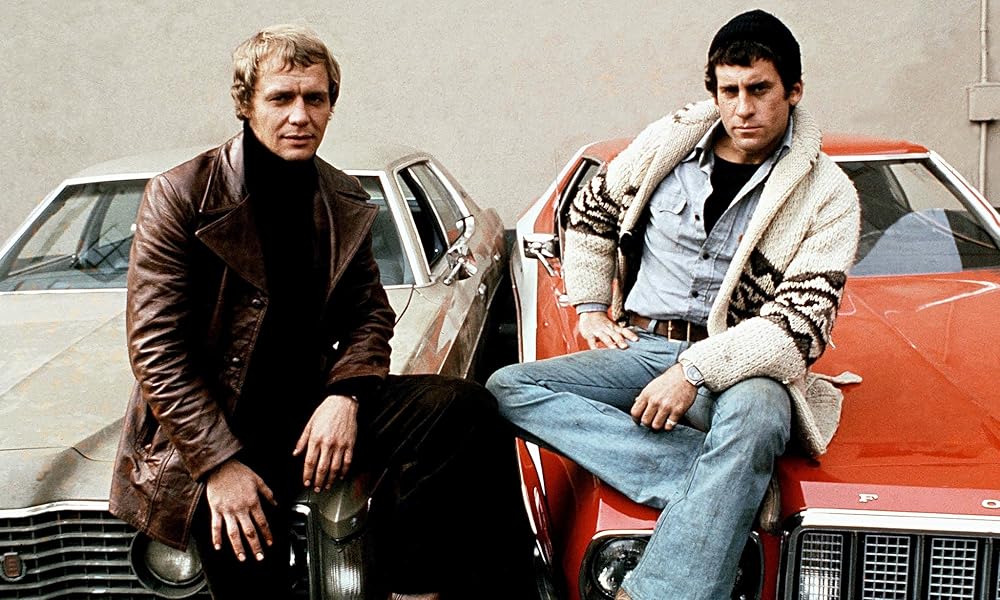
Created and written by William Blinn (Brian’s Song, The Rookies, Eight Is Enough & Pensacola: Wings of Gold), it starred David Soul (Det. Sgt. Kenneth Richard “Hutch” Hutchinson), Paul Michael Glaser (Det. Sgt. David Michael Starsky), Antonio Fargas (Informant Huggy Bear) and Bernie Hamilton (Captain Harold C. Dobey). In the Pilot TV Movie, Captain Dobey was played by Richard Ward. Sgt. Hutchinson was from Duluth, MN, was divorced and was a reserved, intellectual type. Sgt. Starsky was from Brooklyn, NY, was an Army veteran, had street-smarts and, could be intense & moody. Informant Huggy Bear was a flashy, ethically ambiguous bar owner that provided the two Sergeants with whatever street action knowledge he could gather. Captain Dobey was their barking & gruff but, fair boss. He had his hands full with those two. One of the main characters of the show was Starsky’s red, 1975 Ford Gran Torino (four of them, actually), nicknamed the “Striped Tomato.” In the show, Hutch calls the car that name in the episode Snowstorm (10-01-1975) but, that crack actually came from Paul Michael Glaser when Aaron Spelling showed him the car (First Season DVD Collection). Hutch’s vehicle was a beat-up, tan, 1973 Ford Galaxie 500, whose horn would blow when the door was opened.
Hutch & His Colt Python Photo Credit: IMDb & Amazon
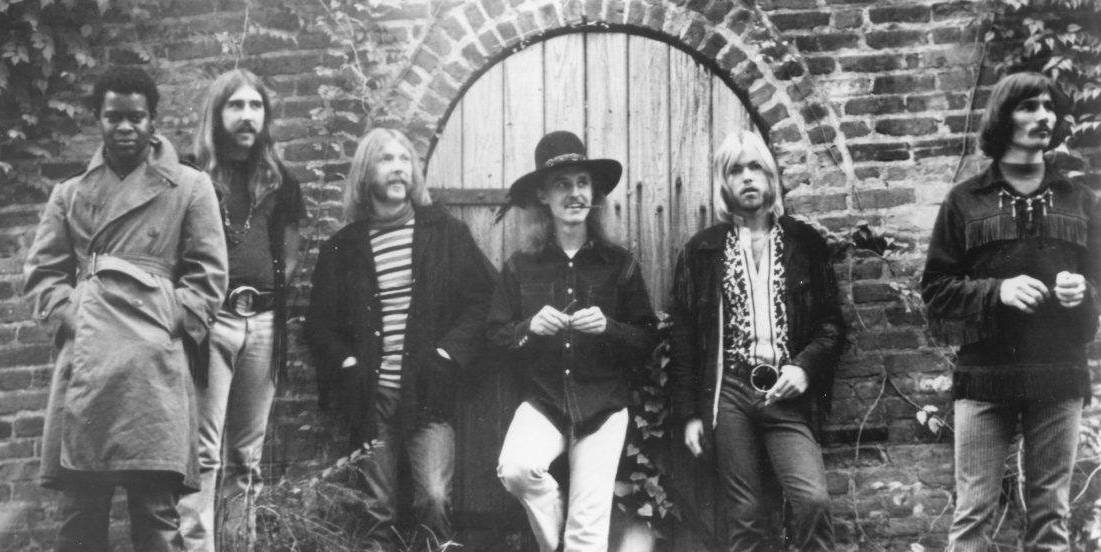
The Allman Brothers have such a unique style that you can recognize their music right off with the dual lead of Duane Allman and Dickey Betts. This band broke through by touring constantly and playing free shows in parks from Georgia to New York. They played a mixture of rock, blues, country, and jazz and were one of the best.
This was the first Allman Brothers song to chart, this peaked at #92 in the Billboard 100. This was the first original song the band recorded that was not written by Gregg Allman. Guitarist Dickey Betts wrote it.
It was the lead single from their second studio album, Idlewild South released in 1970. Named for a remote farmhouse/cabin the band rented for rehearsals, and where much of it was written and conceived, Idlewild South includes two of the band’s best-loved songs, In Memory of Elizabeth Reed and Midnight Rider.
This was the first Allman Brothers album produced by the legendary producer and engineer, Tom Dowd. During its recording, the band was constantly touring and their sound was road-tested, so much so that instead of doing it as a conventional multi-track recording, the band and Dowd opted to record most of the album live in the studio with minimum if any overdubs. The band was just that good.
In 1970 they moved into what they called The Big House in Macon Georgia. They didn’t have a lot of money, but their wives and girlfriends found this house to rent. Older big houses like this weren’t too expensive back in 1970 to rent.
It’s now the Allman Brothers museum…it’s on my list to visit.
Revival
People can you feel it? Love is everywhere People can you hear it? The song is in the air We’re in a revolution Don’t you know we’re right Everyone is singing, yeah There’ll be no one to fight People can you feel it? Love is everywhere People can you feel it? Love is everywhere People can you feel it? Love is everywhere People can you feel it? Love is everywhere People can you feel it? Love is everywhere People can you feel it? Love is everywhere Love is everywhere Love is everywhere Love is everywhere Love is everywhere Love is everywhere Love is everywhere Love is everywhere People can you feel it? Love is everywhere People can you feel it? Love is everywhere People can you feel it? Love is everywhere People can you feel it? Love is everywhere People can you feel it? Love is everywhere People can you feel it? Love is everywhere People can you feel it? Love is everywhere People can you feel it? Love is everywhere
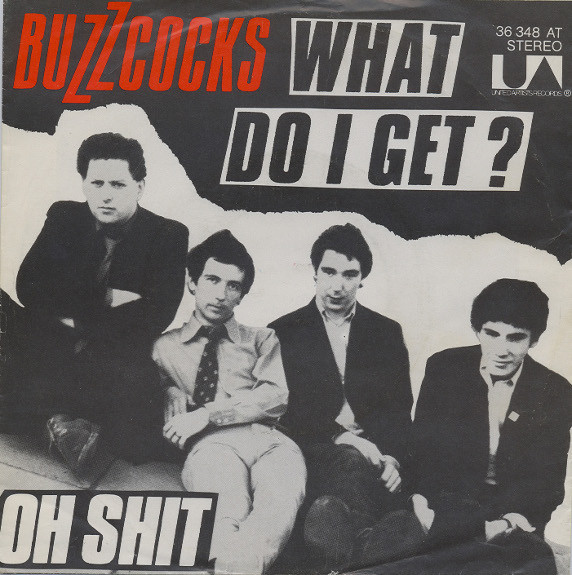
These guys blended punk and pop about as well as anyone. Once again I had a friend with their import records in the eighties. That was the only way I could hear them.
This was their first top 40 hit in the UK and it peaked at #37 way back in 1977. The B-side was a song called “Oh Shit.” I wish they would have hit in America but their name probably didn’t help them over here.
They chose the name Buzzcocks after reading the headline, “It’s the Buzz, Cock!”, in a review of the TV series Rock Follies in Time Out magazine. The “buzz” is the excitement of playing on stage; “cock” is northern English slang meaning friend. They were formed in 1976 by Pete Shelley and Howard Devoto after seeing the Sex Pistols. They were able to blend punk’s spirit and sound with pop.
They were invited by Nirvana to open select dates on the grunge outfit’s last ever European tour, in early 1994. Steve Diggle told about a memory he has of Kurt Cobain: “Doing two grams of coke is one of my famous stories with him.” They also opened up for Pearl Jam in 2003.
They released 3 albums and broke up in 1981 after a dispute with their record company. They reunited in 1989 and released 6 more albums. Pete Shelley continued to play with the band until his death from a heart attack in 2018. The band still continues to tour.
Steve Diggle:“Of course we partied and did drugs and had good times with the girls. Who wouldn’t? Certain things about being in a band and traveling about, people invite you to parties and clubs. Initially, it wasn’t supposed to be like that. But I realized you can’t break America, America breaks you.”
Jane Wiedlin: Our favorite band, the band that we always tried to emulate was the Buzzcocks, who had that great pop song done in a punky style.”
Billy Joe Armstrong: “Buzzcocks pretty much invented a style that would influence multiple generations of lonesome hearts and weirdos”
What Do I Get
I just want a lover like any other, what do I get? I only want a friend who will stay to the end, what do I get?
What do I get, oh-oh, what do I get? What do I get, oh-oh, what do I get?
I’m in distress, I need a caress, what do I get? I’m not on the make, I just need a break, what do I get?
What do I get, oh-oh, what do I get? What do I get, oh-oh, what do I get?
I only get sleepless nights Alone here in my half-empty bed For you things, seem to turn out right I wish they’d only happen to me instead
What do I get, oh-oh, what do I get? What do I get, oh-oh, what do I get?
Ah
I only get sleepless nights Alone here in my half-empty bed For you, things seem to turn out right I wish they’d only happen to me instead
What do I get, oh-oh, what do I get? What do I get, oh-oh, what do I get?
I just want a lover like any other, what do I get? I only want a friend who will love to the end, what do I get?
What do I get, oh-oh, what do I get? What do I get, oh-oh, what do I get?
Well, let me tell you now (What do I get?) (What do I get?) No love (What do I get?) No sleep at nights (What do I get?) Nothing that’s nice (What do I get?) Nothing at all, at all, at all, at all At all, at all, at all ’cause I don’t get you













 PowerPop... An Eclectic Collection of Pop Culture