One thing that strikes me about this song is the constant guitar. The song was on perhaps the most famous rock album…or album ever released. Sgt Peppers Lonely Hearts Club Band was released on May 26, 1967. No singles were pull off of this album when it was released.
Paul McCartney: “It’s an optimistic song,” “I often try and get on to optimistic subjects in an effort to cheer myself up and also, realizing that other people are going to hear this, to cheer them up too. And this was one of those. The ‘angry young man’ and all that was John and I filling in the verses about schoolteachers. We shared a lot of feelings against teachers who had punished you too much or who hadn’t understood you or who had just been bastards generally. So there are references to them.”
John Lennon had a bad acid trip during the recording. While doing the overdubs, John began to get very sick. He said, “I suddenly got so scared on the mike. I thought I felt ill and I thought I was going to crack. I said I must get some air.” George Martin took him up on the roof of the studios for air and John started walking towards the edge. Martin panicked, thinking that John would fall or leap off and that would be it. On the roof, when John saw Martin looking at him “funny,” he realized he was on acid. John decided he couldn’t do anymore that night, so he sat in the booth and watched the others record. Paul eventually took him home and stayed to keep him company, and he decided to drop some acid with John. It was Paul’s first LSD experience.
John Lennon: “I thought I was taking some uppers and I was not in the state of handling it. I took it and I suddenly got so scared on the mike. I said, ‘What is it? I feel ill.’ I thought I felt ill and I thought I was going cracked. I said I must go and get some air. They all took me upstairs on the roof, and George Martin was looking at me funny, and then it dawned on me that I must have taken some acid. I said, ‘Well, I can’t go on. You’ll have to do it and I’ll just stay and watch.’ I got very nervous just watching them all, and I kept saying, ‘Is this all right?’ They had all been very kind and they said, ‘Yes, it’s all right.’ I said, ‘Are you sure it’s all right?’ They carried on making the record.”
The idea of “Getting Better” came to Paul McCartney while he was walking his dog, Martha. The sun started to rise on the walk and he thought “it’s getting better.” It also reminded him of something that Jimmy Nichol used to say quite often during the short period when he was The Beatles drummer. This song was a true collaborative effort for Lennon and McCartney, with Lennon adding that legendary part about being bad to his woman. He later admitted to being a “hitter” when it came to women. He said “I was a hitter. I couldn’t express myself, and I hit.”
George Harrison played the tamboura, a large Indian string instrument. It is the droning noise about 2/3rds of the way through.
The string sound at the end was Beatles producer George Martin hitting the strings inside a piano.
Lennon contributed the pessimistic viewpoint, coming up with the line, “It can’t get no worse.” McCartney usually wrote much happier lyrics than Lennon. Lennon revisited this song when he used the lyrics, “Every day, in every way, it’s getting better and better” for his 1980 track “Beautiful Boy (Darling Boy).” This time, instead of taking the cynical side, he was affirming that life does just get keep getting better and better.
This was used in commercials for Phillips television sets in 1999. The living Beatles resent the use of their songs in advertisements, but cannot prevent it because they do not own the publishing rights; Michael Jackson does.
The Beatles had stopped touring by the time this was released. The first time McCartney played it live was on his 2002 “Back In The US” tour. That tour was made into a CD and a 2-hour concert film that aired on ABC and was released on DVD.
This was used in the 2003 movie The Cat in the Hat starring Mike Myers.
Getting Better
It’s getting better all the time I used to get mad at my school The teacher’s that taught me weren’t cool You’re holding me down Filling me up with your rules
I’ve got to admit it’s getting better A little better all the time I have to admit it’s getting better It’s getting better since you’ve been mine
Me used to be angry young man Me hiding me head in the sand You gave me the word I finally heard I’m doing the best that I can I’ve got to admit it’s getting better
I used to be cruel to my woman I beat her and kept apart from the things that she loved Man I was mean but I’m changing my scene And I’m doing the best that I can
I admit it’s getting better A little better all the time Yes I admit it’s getting better It’s getting better since you’ve been mine…
Rarely if ever do I say a song is a piece of art. This one would qualify in my opinion. I can’t imagine being a peer at the time and having to compete with this.
Paul McCartney wrote most of this song. It is said he got the name “Eleanor” from actress Eleanor Bron, who appeared in the 1965 Beatles film Help!. “Rigby” came to him when he was in Bristol, England and spotted a store: Rigby and Evens Ltd Wine and Spirit Shippers. He liked the name “Eleanor Rigby” because it sounded natural and matched the rhythm he wrote.
There is also a gravestone for an Eleanor Rigby in St. Peter’s Churchyard in Woolton, England. Woolton is a suburb of Liverpool and Lennon first met McCartney at a fete at St. Peter’s Church. The gravestone bearing the name Eleanor Rigby shows that she died in October 1939, aged 44. McCartney has denied that that is the source of the names, though he has agreed that they may have registered subconsciously.
This song was on the great Revolver album that peaked at #1 in the Billboard Album Charts in 1966. Eleanor Rigby peaked at #11 in 1966. This was on a double A-sided single paired with Yellow Submarine.
The Beatles didn’t play any of the instruments on this track. All the music came from the string players, who were hired as session musicians. A string section scored by Beatles producer George Martin consisting of four violins, two violas, and two cellos were used in the recording.
Paul McCartney:“When I was really little I lived on what was called a housing estate, which is like the projects – there were a lot of old ladies and I enjoyed sitting around with these older ladies because they had these great stories, in this case about World War II. One in particular I used to visit and I’d go shopping for her – you know, she couldn’t get out. So I had that figure in my mind of a sort of lonely old lady.
Over the years, I’ve met a couple of others, and maybe their loneliness made me empathize with them. But I thought it was a great character, so I started this song about the lonely old lady who picks up the rice in the church, who never really gets the dreams in her life. Then I added in the priest, the vicar, Father McKenzie. And so, there was just the two characters. It was like writing a short story, and it was basically on these old ladies that I had known as a kid.”
From Songfacts
McCartney explained at the time that his songs came mostly from his imagination. Regarding this song, he said, “It just came. When I started doing the melody I developed the lyric. It all came from the first line. I wonder if there are girls called Eleanor Rigby?”
McCartney wasn’t sure what the song was going to be about until he came up with the line, “Picks up the rice in a church where a wedding has been.” That’s when he came up with the story of an old, lonely woman. The lyrics, “Wearing the face that she keeps in a jar by the door” are a reference to the cold-cream she wears in an effort to look younger.
The song tells the story of two lonely people. First, we meet a churchgoing woman named Eleanor Rigby, who is seen cleaning up rice after a wedding. The second verse introduces the pastor, Father McKenzie, whose sermons “no one will hear.” This could indicate that nobody in coming to his church, or that his sermons aren’t getting through to the congregation on a spiritual level. In the third verse, Eleanor dies in the church and Father McKenzie buries her.
“Father Mackenzie” was originally “Father McCartney.” Paul decided he didn’t want to freak out his dad and picked a name out of the phone book instead.
After Eleanor Rigby is buried, we learn that “no one was saved,” indicating that her soul did not elevate to heaven as promised by the church. This could be seen as a swipe at Christianity and the concept of being saved by Jesus. The song was released in August 1966 just weeks after the furor over John Lennon’s remarks, “Christianity will go. It will vanish and shrink. I needn’t argue about that; I’m right and I will be proved right. We’re more popular than Jesus now.”
For the most part, the song eluded controversy, possibly because the lilting string section made it easier to handle.
In Observer Music Monthly, November 2008, McCartney said: “These lonely old ladies were something I knew about growing up, and that was what ‘Eleanor Rigby’ was about – the fact that she died and nobody really noticed. I knew this went on.”
This was originally written as “Miss Daisy Hawkins.” According to Rolling Stone magazine, when McCartney first played the song for his neighbor Donovan Leitch, the words were “Ola Na Tungee, blowing his mind in the dark with a pipe full of clay.”
The lyrics were brainstormed among The Beatles. In later years, Lennon and McCartney gave different accounts of who contributed more of the words to the song.
Microphones were placed very close to the instruments to create and unusual sound.
Ray Charles reached #35 US and #36 UK with his version in 1968; Aretha Franklin took it to #17 US in 1969. A year later, an instrumental by the group El Chicano went to #115. The song reached the chart again in 2008 when David Cook of American Idol fame took it to #92.
Because of the string section, this was difficult to play live, which The Beatles never did. On his 2002 Back In The US tour, Paul McCartney played this without the strings. Keyboards were used to compensate.
This song was not written in a normal chord, it is in the dorian mode – the scale you get when you play one octave up from the second note of a major scale. This is usually found in old songs such as “Scarborough Fair.”
Vanilla Fudge covered this in a slowed-down, emotional style, something they did with many songs, including hits by ‘N Sync and The Backstreet Boys. Their version of “You Keep Me Hangin’ On” was a #6 US hit in 1968. Fudge drummer Carmine Appice told Songfacts: “Most of the songs we did, we tried to take out of the realm they were in and try to put them where they were supposed to be in our eyes. ‘Eleanor Rigby’ was always a great song by The Beatles. It was done with the orchestra, but the way we did it, we put it into an eerie graveyard setting and made it spooky, the way the lyrics read. Songs like ‘Ticket To Ride,’ that’s a hurtin’ song, so we slowed it down so it wouldn’t be so happy. We would look at lyrics and the lyrics would dictate if it was feasible to do something with it or not.”
In 1966, this song took home the Grammy Award for Best Contemporary Pop Vocal Performance, Male. It was awarded to Paul McCartney.
In August 1966, the long-defunct British music magazine Disc And Music Echo asked Kinks frontman Ray Davies to review the then newly released Revolver album. This is how he reacted to this song: “I bought a Haydn LP the other day and this sounds just like it. It’s all sort of quartet stuff and it sounds like they’re out to please music teachers in primary schools. I can imagine John saying: ‘I’m going to write this for my old schoolmistress’. Still it’s very commercial.”
The chorus of this song was sampled as part of Sinead O’Connor’s 1994 song “Famine,” which is based on the story of the potato famine in Ireland. >>
In 2008 a document came to light that showed that McCartney may have had an alternative source for the Eleanor Rigby name. In the early 1990s a lady named Annie Mawson had a job teaching music to children with learning difficulties. Annie managed to teach a severely autistic boy to play “Yellow Submarine” on the piano, which won him a Duke of Edinburgh Silver Award. She wrote to the former Beatle telling him what joy he’d brought. Months later, Annie received a brown envelope bearing a “Paul McCartney World Tour” stamp. Inside was enclosed a page from an accounts log kept by the Corporation of Liverpool, which records the wages paid in 1911 to a scullery maid working for the Liverpool City Hospital, who signed her name “E. Rigby.” There was no accompanying letter of explanation. Annie said in an interview that when she saw the name Rigby, “I realized why I’d been sent it. I feel that when you’re holding it you’re holding a bit of history.”
When the slip went up for auction later that year, McCartney told the Associated Press: “Eleanor Rigby is a totally fictitious character that I made up. If someone wants to spend money buying a document to prove a fictitious character exists, that’s fine with me.”
This was released simultaneously on August 5, 1966 on both the album Revolver and as a double A-side with “Yellow Submarine.”
The thrash band Realm covered this song on their 1988 album Endless War. It is a speed metal version of the song that got them signed to Roadrunner Records.
McCartney told Q magazine June 2010 that after recording the song, he felt he could have done better. He recalled: “I remember not liking the vocal on Eleanor Rigby, thinking, I hadn’t nailed. I listen to it now and it’s… very good. It’s a bit annoying when you do Eleanor Rigby and you’re not happy with it.”
Former US President Bill Clinton has stated that this is his favorite Beatles song. >>
Richie Havens covered this on his 1966 debut album, Mixed Bag, and again on his 1987 Sings Beatles and Dylan album.
Eleanor Rigby
Ah look at all the lonely people Ah look at all the lonely people
Eleanor Rigby, picks up the rice In the church where a wedding has been Lives in a dream Waits at the window, wearing the face That she keeps in a jar by the door Who is it for
All the lonely people Where do they all come from? All the lonely people Where do they all belong?
Father McKenzie, writing the words Of a sermon that no one will hear No one comes near Look at him working, darning his socks In the night when there’s nobody there What does he care
All the lonely people Where do they all come from? All the lonely people Where do they all belong?
Ah look at all the lonely people Ah look at all the lonely people
Eleanor Rigby, died in the church And was buried along with her name Nobody came Father McKenzie, wiping the dirt From his hands as he walks from the grave No one was saved
All the lonely people Where do they all come from? All the lonely people Where do they all belong?
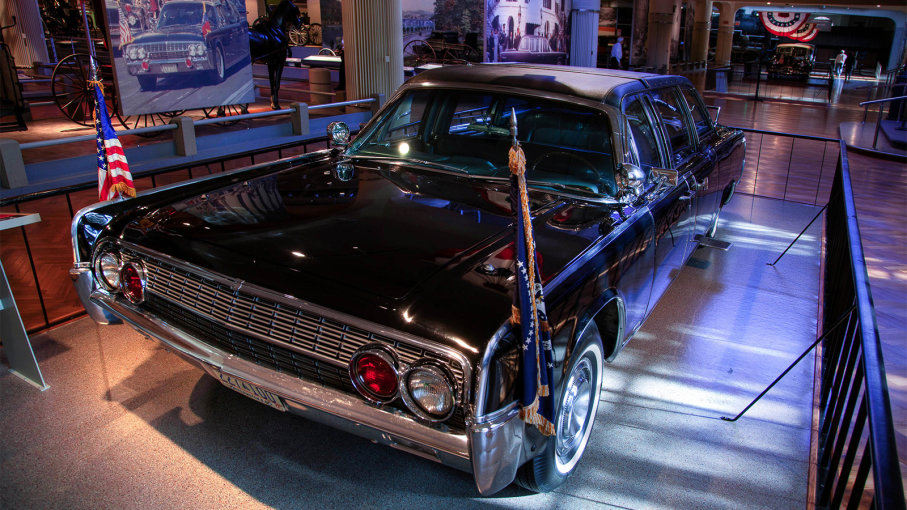
I would have thought this car would have been preserved and never touched after the Kennedy assassination on November 22, 1963…I was completely wrong.
The car started out as a standard 1961 Lincoln that had some upgrades of course. The changes and upgrades made to the car cost nearly $200,000 in 1961. After the changes, the car was known as the X-100.
The car’s special features included the removable steel and transparent plastic roof panels; a hydraulic rear seat that could be raised 10-1/2 inches to elevate the president; a massive heating and air conditioning system with auxiliary blowers and dual control panels; dark blue broadcloth lap robes with gray plush linings and hand-embroidered presidential seals housed in special door pockets; four retractable steps for Secret Service agents; two steps on the rear bumper for additional agents; flashing red lights; a siren; a blue mouton rug in the rear compartment; lamps that indicated when the door was ajar or the steps were out; dual flagstaffs and spotlights; auxiliary jump seats for extra passengers; two radio telephones; and interior floodlights.
I thought the car was retired after the assassination. But no… the X-100 was given a $500,000 redesign, complete with bullet-resistant glass, a roof and 1,600 pounds of armor.
The car got additional modifications in 1967 and was used by Presidents Johnson, Nixon, Ford, and Carter before it was retired in 1977.
It’s now on display at the Henry Ford Museum in Dearborn, Michigan
I think some of us will be thinking of this title soon if we haven’t already.
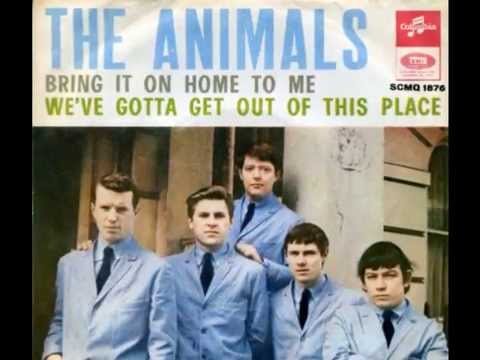
This was written by the husband and wife songwriting team of Barry Mann and Cynthia Weil. The Animals producer Mickie Most heard this song and had the band record it. He was looking for American material as he was trying to break the band in the States, and had a call out to the New York City songwriters in the Brill Building and 1650 Broadway looking for songs.
Eric Burdon:“I’ve always viewed myself as a punk. The Animals could have evolved that way. We had the energy and the anger, but we didn’t stick together. When the punk scene became commercial, I was all for the politics of the movement, but the music didn’t really stand up and ultimately, it was self destructive.”
The song peaked at #13 in the Billboard 100, #2 in the UK, and #2 in Canada in 1965.
From Songfacts
Mann had just signed a record deal and recorded this song himself, but his version was pulled when The Animals released the song. Mann and Weil were very productive in the mid-’60s, as they made the transition from writing fluffy pop songs like “Blame It On The Bossa Nova” to songs with more of a message, which appealed to rock bands like The Animals.
Animals lead singer Eric Burdon came in #57 in a Rolling Stone poll to find the greatest singers of all time. On this song, he delivers an anger and energy that was an influence on later punk bands.
There are two entirely different recordings of this song by The Animals. The US single version is an alternate take, shipped to MGM, The Animals’ American record label, by mistake. Nevertheless, this is a far superior version of the song. Unfortunately, it’s this version that’s played by almost all Oldies radio stations today.
Adrian Cronauer (the movie Good Morning Vietnam was based on his life) mentioned on a special Independence Day show on Sirius Satellite Radio that this was the most requested song on Armed Forces Radio when he was in Vietnam.
Other artists to record the song include Blue Oyster Cult, Grand Funk Railroad, and Ann Wilson of Heart.
TV series to use this song include:
Supernatural (“A Little Slice of Kevin” – 2012) Heroes (“Into Asylum” – 2009) Absolutely Fabulous (“The Last Shout: Part 1” – 1996) The A-Team (“Beneath the Surface” – 1986) Miami Vice (“Glades” – 1984)
Among the movies to use it:
Fahrenheit 9/11 (2004) Hamburger Hill (1987)
At the 2012 SXSW festival in Austin, Texas, Bruce Springsteen talked about this song when he gave the keynote speech. After reciting the lyrics, he said, “That’s every song I’ve ever written.”
Bruce was referring to his penchant for writing songs about getting away in search for something better in life.
Denmark + Winter recorded a dark electronic cover as part of their 2014 Re: Imagined album. Their version was featured on the season 5 episode of Pretty Little Liars “Taking This One to the Grave” to underscore a character’s death.
We’ve Gotta Get Out Of This Place
In this dirty old part of the city Where the sun refused to shine People tell me there ain’t no use in tryin’
Now my girl, you’re so young and pretty And one thing I know is true You’ll be dead before your time is due, I know
Watch my daddy in bed a-dyin’ Watched his hair been turnin’ grey He’s been workin’ and slavin’ his life away, oh yes I know it
(Yeah!) he’s been workin’ so hard (yeah!) And I’ve been workin’ too, baby (yeah!) Every night and day (yeah, yeah, yeah, yeah!)
We gotta get out of this place If it’s the last thing we ever do We gotta get out of this place ‘Cause girl, there’s a better life for me and you
Now my girl you’re so young and pretty And one thing I know is true, yeah You’ll be dead before your time is due, I know it
Watch my daddy in bed a-dyin’ Watched his hair been turnin’ grey, yeah He’s been workin’ and slavin’ his life away I know he’s been workin’ so hard
(Yeah!) I’ve been workin’ too, baby (yeah!) Every day baby (yeah!) Whoa! (Yeah, yeah, yeah, yeah!)
We gotta get out of this place If it’s the last thing we ever do We gotta get out of this place Girl, there’s a better life for me and you Somewhere baby Somehow I know it, baby
We gotta get out of this place If it’s the last thing we ever do We gotta get out of this place Girl, there’s a better life for me and you Believe me baby I know it baby You know it too
This was written by the multitalented Shel Silverstein, who later wrote several hits for Dr. Hook, including “Sylvia’s Mother” and “Cover Of The Rolling Stone.” He got the idea for the song from his friend Jean Shepherd – a guy who had to deal with a girl’s name.
Shel Silverstein sang his song ‘Boy Named Sue,’ and Johnny’s wife June Carter thought it was a great song for Johnny Cash to perform. And not too long after that they were headed off to San Quentin to record a record Live At San Quentin and June said, ‘Why don’t you bring that Shel song with you.”And so they brought the lyrics. And when he was on stage he performed that song for the first time ever, he performed it live in front of that captive audience, in every sense of the word.
When Johnny performed this song at San Quentin he read the lyrics from a sheet of paper on the stage.
The song peaked at #2 in the Billboard 100 and #1 in the Billboard Country Charts. The album Johnny Cash At San Quentin peaked at #1 in 1969.
Johnny Cash performed this song in the East Room of the White House on April 17, 1970, when he and his wife were invited by President Richard Milhous Nixon. Nixon’s staff had requested the song along with Okie From Muskogee and the song “Welfare Cadillac,” but Cash refused to perform those songs, saying he didn’t have arrangements ready.
Thanks to Victoria at The Hinoeuma for suggesting this Johnny Cash song.
From Songfacts
This is about a boy who grows up angry at his father not only for leaving his family, but for naming him Sue. When the boy grows up, he sees his father in a bar and gets in a fight with him. After his father explains that he named him Sue to make sure he was tough, the son understands.
Cash recorded this live at San Quentin Prison in February 1969. Shel Silverstein’s nephew Mitch Myers told us the story: “In those days in Nashville, and for all the people that would visit, the most fun that anyone really could have would be to go over to someone’s house and play music. And they would do what one would call a ‘Guitar Pull,’ where you grabbed a guitar and you played one of your new songs, then someone else next to you would grab it and do the same, and there were people like Johnny Cash or Joni Mitchell, people of that caliber in the room.
It wasn’t touched up, it wasn’t produced or simulated. They just did it, and it stuck. And it rang. I would say that it would qualify in the realm of novelty, a novelty song. Shel had a knack for the humorous and the kind of subversive lyrics. But they also were so catchy that people could not resist them.”
Shel Silverstein went on to write another song titled “The Father of the Boy Named Sue.” It’s the same story, but from the father’s point of view.
In the 2019 animated film Missing Link, the main character, a male Sasquatch voiced by Zach Galifianakis, is named Susan.
A Boy Named Sue
I want you to uh, I want to a, If you don’t mind Carl, I’d like you to stay out and help us on some songs I’d love to One of the greatest guitar players as well as song writers and singers in Memphis Appreciate a little help on guitar, alright. Thank you Carl
Well,my daddy left home when I was three And he didn’t leave much to ma and me Just this old guitar and an empty bottle of booze Now, I don’t blame him cause he run and hid But the meanest thing that he ever did Was before he left, he went and named me Sue
Well, he must o’ thought that is quite a joke And it got a lot of laughs from a’ lots of folk It seems I had to fight my whole life through Some gal would giggle and I’d get red And some guy’d laugh and I’d bust his head, I tell ya, life ain’t easy for a boy named Sue
Well, I grew up quick and I grew up mean My fist got hard and my wits got keen I’d roam from town to town to hide my shame But I made a vow to the moon and stars That I’d search the honky-tonks and bars And kill that man who gave me that awful name
Well, it was Gatlinburg in mid-July And I just hit town and my throat was dry I thought I’d stop and have myself a brew At an old saloon on a street of mud There at a table, dealing stud Sat the dirty, mangy dog that named me Sue
Well, I knew that snake was my own sweet dad From a worn-out picture that my mother’d had And I knew that scar on his cheek and his evil eye He was big and bent and gray and old And I looked at him and my blood ran cold And I said, “My name is Sue, how do you do Now you’re gonna die”
(yeah, that’s what I told him)
Well, I hit him hard right between the eyes And he went down, but to my surprise He come up with a knife and cut off a piece of my ear But I busted a chair right across his teeth And we crashed through the wall and into the street Kicking and a’ gouging in the mud and the blood and the beer
I tell ya, I’ve fought tougher men But I really can’t remember when He kicked like a mule and he bit like a crocodile I heard him laugh and then I heard him cuss He went for his gun and I pulled mine first He stood there lookin’ at me and I saw him smile
And he said, “Son, this world is rough And if a man’s gonna make it, he’s gotta be tough And I knew I wouldn’t be there to help ya along So I give ya that name and I said goodbye I knew you’d have to get tough or die And it’s the name that helped to make you strong”
He said, “Now you just fought one hell of a fight And I know you hate me, and you got the right To kill me now, and I wouldn’t blame you if you do But ya ought to thank me, before I die For the gravel in ya guts and the spit in ya eye ‘Cause I’m the son-of-a-bitch that named you Sue”
Well what could I do? What could I do? I got all choked up and I threw down my gun And I called him my Pa, and he called me his son And I came away with a different point of view And I think about him, now and then Every time I try and every time I win And if I ever have a son, I think I’m gonna name him.. Bill or George! Any-damn-thing but Sue!
Bob Dylan released his first album in 1962. He was primarily known as a folk artist. Dylan would play with his acoustic guitar and harmonica.
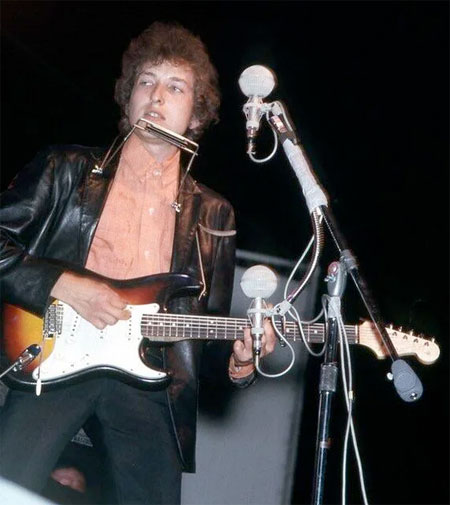
On Saturday, July 24, 1965, Bob Dylan played the Newport Folk Festival and he played an acoustic set that all of his fans wanted. He received great applause… After that, he walked back on stage with a rock band and plugged in his 1964 Fender Stratocaster and all hell broke loose. His folk fans did NOT want him playing an electric guitar with a rock band. He did receive some cheers but they were mixed with a lot of boos. Dylan’s appearance is one of the most iconic performances of rock and roll.
Even after the boos, he was determined to continue down his electric path. It has been known as the time when “Dylan went electric.”
He toured in 1965 and 1966 with “The Hawks” as a backing band. The Hawks changed their name after the 66 tour and became The Band. During those tours, the boos continued throughout but Dylan pressed on. On the British leg of the tour the boos intensified and in one concert a fan of the old Dylan yelled out “Judas!”
Now back to the electric guitar that Bob played at Newport.
Dawn Peterson thought she owned the guitar, her father was a pilot who flew music acts in the 1960s. He said Dylan left this guitar on his plane. Dawn didn’t believe it until she saw a documentary picturing Bob Dylan on that Newport stage playing a guitar that looked just like her dad’s.
Bob Dylan thought he still had this Stratocaster…but in 2012 on the PBS series History Detectives… The experts matched the wood grain on the guitar owned by Dawn from the pictures of the historical event in 1965. The guitar was a match and it was no doubt that Dawn’s guitar was the one. Also in the guitar case were some of Dylan’s lyrics that he was working on in 65.
Lawyers got involved but it was soon settled that Dawn could sell the guitar.
Indianapolis Colts owner Jim Irsay purchased Dylan’s Newport guitar in 2013 for $965,000 in an auction, making it the most expensive guitar to ever hit the auction block.
Within the case itself was another hidden gem: early-draft lyrics to three Dylan tunes (“Absolutely Sweet Marie,” “I Wanna Be Your Lover” and two others). Those pieces were estimated between $3,000 and $30,000 by the auction house.
The guitar was on display from November 2018 through November 2019 at the American Writers Museum in Chicago as part of Bob Dylan: Electric – an interactive exhibit curated by music journalist Alan Light chronicling Dylan’s impact on American writing and pop culture following the Newport performance.
This song is why I first bought this album. I heard it and it’s country/blues/rock style stayed with me. The song sounds low down, dirty, and sleazy…that only the Stones can deliver.
Keith Richards’ fingers began to bleed as he played acoustic guitar for hours while Mick Jagger worked with an engineer on the drum track. The title came from Keith’s desire to record his track. At least that’s the story the Mick and Keith tells. The phrase “Let It Bleed” is an intravenous drug user slang for successfully finding a vein. The syringe plunger is pulled back and if blood appears, it is called letting it bleed.
This was recorded around the same time as The Beatles Let It Be, but the similar titles were just a supposed coincidence.
The Stones recorded this after the death of Brian Jones but before Mick Taylor joined the band as his replacement. As a result, Keith Richards played both acoustic and slide electric guitar, and Bill Wyman played bass and autoharp.
The song wasn’t a single but the album (also named Let It Bleed) peaked at #3 in the Billboard Album Chart in 1969.
From Songfacts
This was the first Stones song to also be the album title.
Ian Stewart, often considered “The sixth Stone,” played the piano. This was his only appearance on Let It Bleed.
There are many references to sex and drugs in the lyrics to this track – an example of the Stones writing about what they knew.
Autoharp is a string instrument with a series of chord bars attached to dampers which, when pressed, mute all but the desired chord. An autoharp is not really a harp – it’s a zither.
The English TV cook and author Delia Smith baked the cake on the album sleeve before she became famous. She got the gig through being a friend of the photographer, Don McAllester. In 1971, two years after the release of Let It Bleed, Delia Smith’s first cookery book, How To Cheat at Cooking, was launched and by the end of the decade she’d become the UK’s best known TV cook.
Let It Bleed
Well, we all need someone we can lean on And if you want it, you can lean on me Yeah, we all need someone we can lean on And if you want it, you can lean on me
She said, my breasts, they will always be open Baby, you can rest your weary head right on me And there will always be a space in my parking lot When you need a little coke and sympathy
Yeah we all need someone we can dream on And if you want it baby, you can dream on me Yeah, we all need someone we can cream on Yeah and if you want to, you can cream on me
I was dreaming of a steel guitar engagement When you drunk my health in scented jasmine tea But you knifed me in my dirty filthy basement With that jaded, faded, junky nurse oh what pleasant company, ha
Though, we all need someone we can feel on Yeah and if you want it, you can feel on me, hey Take my arm, take my leg Oh baby don’t you take my head Hoo
Yeah, we all need someone we can bleed on Yeah but if you want it, well you can bleed on me Yeah, we all need someone we can bleed on Yeah yeah and if you want it baby why don’t ya You can bleed on me All over, hoo
Ah, get it on rider, hoo Get it on rider Get it on rider You can bleed all over me, yeah Get it on rider, hoo Get it on rider, yeah You can cream all over, you can come all over me, ah Get it on rider ey Let it out rider Let it out rider You can come all over me
McCartney wrote this song. John Lennon had said it was a Paul song and it is thought to be mostly if not all his song. The song was not a single but just added another great song to the album.
The song was on the Beatles arguably best album Revolver…and perhaps one of the best albums of all time.
George Martin called in Alan Civil to play the French horn in the solo.
Paul McCartney and George Martin about the French Horn : ‘Well, it goes from here to this top E,’ and I said, ‘What if we ask him to play an F?’ George saw the joke and joined in the conspiracy. We came to the session and Alan looked up from his bit of paper: ‘Eh, George? I think there’s a mistake here – you’ve got a high F written down.’ Then George and I said, ‘Yeah,’ and smiled back at him, and he knew what we were up to and played it. These great players will do it. Even though it’s officially off the end of their instrument, they can do it, and they’re quite into it occasionally. It’s a nice little solo.”
Most people would have never written that part for a French horn player because it was too high to play, but that was the note Paul wanted to hear.
Paul McCartney: “I was in Switzerland on my first skiing holiday. I’d done a bit of skiing in ‘Help!’ and quite liked it, so I went back and ended up in a little bathroom in a Swiss chalet writing ‘For No One.’ I remember the descending bass-line trick that it’s based on, and I remember the character in the song – the girl putting on her make-up.”
From Songfacts
Paul McCartney wrote this song sitting in a chalet while on holiday with his girlfriend Jane Asher in Klosters, Switzerland, March of 1966. The working title was “Why Did It Die,” and there is speculation that McCartney wrote the song about Asher, who was a successful London actress.
The theory is that Paul wanted her to cater to his schedule, tour with him, and be the “perfect Beatle wife,” but Jane had a life and career of her own, hence the “She doesn’t need you” lyrics. Paul has never said it was about Jane specifically, however he did say, “I guess there had been an argument. I never have easy relationships with women.” He knew what he was getting into when he got involved with Jane, and being that the song was written in 1966 and they didn’t break up until 1968, it’s likely that if the song was about Jane, it wasn’t a serious argument.
This was recorded on May 9, 16 and 19, 1966 by only two Beatles – Paul singing and playing the keyboard and bass, and Ringo on percussion.
Maureen McGovern recorded this and “Things We Said Today” as a 2-song medley for her 1992 album Baby I’m Yours.
McCartney used this in his 1984 movie Give My Regards to Broad Street.
Revolver was the last Beatles album to have different US and UK versions. In 2002, Rolling Stone readers voted it the greatest album of all time. The album cover was created by artist Klaus Voormann, who became friends with the band when they were playing clubs in Hamburg, Germany in the early ’60s.
For No One
Your day breaks, your mind aches You find that all the words of kindness linger on When she no longer needs you
She wakes up, she makes up She takes her time and doesn’t feel she has to hurry She no longer needs you
And in her eyes you see nothing No sign of love behind the tears Cried for no one A love that should have lasted years!
You want her, you need her And yet you don’t believe her when she says her love is dead You think she needs you
And in her eyes you see nothing No sign of love behind the tears Cried for no one A love that should have lasted years!
You stay home, she goes out She says that long ago she knew someone but now he’s gone She doesn’t need him
Your day breaks, your mind aches There will be times when all the things she said will fill your head You won’t forget her
And in her eyes you see nothing No sign of love behind the tears Cried for no one A love that should have lasted years!
For my eighth birthday, I was given the Chitty Chitty Bang Bang soundtrack. I loved the movie so much that my mom got it for me. The movie is a classic…and what’s not to like… a flying car…that is all it took to get my attention and the catchy theme song.
Chitty Chitty Bang Bang found fame in the 1968 children’s movie of the same name starring Dick van Dyke. The magical car not only traveled on land but could fly and also float on water. The car was designed by the film’s production designer, Ken Adam.
The original driving car that was used in the film and the final product weighed approximately 2 tons, was 17 feet long, and built on a custom made ladder frame chassis.
The alloy dashboard plate was from a British World War I fighter plane. All of this was built around a modern Ford V6 engine with Automatic transmission. Chitty rolled out of the workshop in June 1967 and was registered with the number plate GEN 11 given to her by Ian Fleming in his novel.
For the 1968 film, six cars were created, this one was the fully functional road-going car.
From 1970 to 2011, the Chitty Chitty Bang Bang car was owned by a man named Pierre Picton, who toured in the car, taking it to various auto shows around the UK. In 2011, the car was auctioned for $805,000.
The acclaimed Lord of the Rings director Peter Jackson purchased the car. Jackson has since used the vehicle to raise money for charities in various capacities. The car is kept in New Zealand where it is registered as GEN 1I, because the original Gen 11 Plate was already taken.
Star Trek was a great part of my childhood. The Starship Enterprise or USS Enterprise was as big of a character as Spock or Captain James T. Kirk.
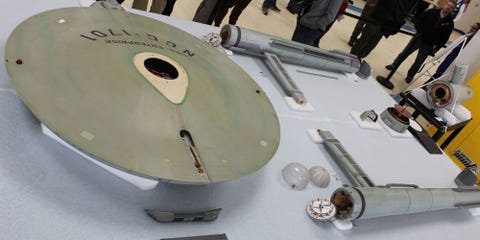
The USS Enterprise was designed by the original TV show’s Art Director Walter M. Jefferies, with input from series creator Gene Roddenberry. The ship’s registration number, NCC-1701, was inspired by Jefferies’ own 1935 Waco YOC airplane – which had the registration number NC-17740.
Two models of the Enterprise from the original series are still known to exist. The main model measures about 11 feet long, 32 inches high, and weighs about 200 pounds. That is a huge model.
It was made mostly of wood and formed plastic. The two engine pods were made using sheet metal tubes.
A second model, measuring about 18 inches long, was also used for some special effects shots in the series. It was made and fitted with blinking lights.
In 1974, the large Enterprise model was donated by Paramount Pictures to the Smithsonian Institute. It has been on display at their Air and Space Museum.
Walter’s brother John Jefferies owned the smaller model until December of 2001… it was then sold to a private collector.
So if you want to see the large USS Enterprise you will have to go to the Smithsonian. It is the one that appeared in every episode.
Every bar band who has ever played this song in hole in the wall bar… can relate to the lyrics. This song was the B-Side to Bad Moon Rising. CCR and The Beatles had the best double-sided singles of anyone in my opinion.
Lodi is a city in California located in the central valley, about 38 miles south of Sacramento and 87 miles away from Oakland. Fogerty and his earlier band (The Golliwogs) often performed in out of the way towns like Lodi.
Because of being the B side… Lodi peaked at #52 in the Billboard 100 while the A-side Bad Moon Rising peaked at #2 in 1969.
Drummer Doug Clifford on Lodi California: “There were nine people in there, they were all locals, they were all drunk and all they did all night was tell us to turn it down.”
From Songfacts
In Fortunate Son: My Life, My Music, John Fogerty explained that the inspiration for “Lodi” came from trips with his father around central California, an area of the world where he “felt very warm and special.” This seed of an idea grew into a story about a traveling musician whose career “is in the rearview mirror.” Fogerty was only 23 when he wrote this song about an aging musician.
This song is a reflection on John Fogerty’s days with The Golliwogs, an early version of Creedence Clearwater Revival. They had to struggle for success, playing wherever they could with dilapidated equipment and an often indifferent audience. He did not want a return to the Bad Old Days.
Al Wilson recorded a cover of this song. His version was issued on Soul City Records in America and on Liberty Records in the United Kingdom. It was played extensively in the few underground “Northern Soul” clubs of England during the late 1960s and early ’70s, getting its first exposure at the famous Twisted Wheel Club Allnighters in Manchester, England.
In a radio interview, John Fogerty said when he was young his parents took him and his brother to camp at Lodi lake (called Smith lake then) and they hated camping there. So later on they wrote a song about Lodi using their old hatred for the place.
Tesla did an acoustic version of this song that was included on their 1990 live album, Five Man Acoustical Jam. Each band member got to pick a song to cover for the set, and Tesla drummer Troy Luccketta chose “Lodi” since he was born there.
Lodi
Just about a year ago I set out on the road Seekin’ my fame and fortune Lookin’ for a pot of gold Thing got bad and things got worse I guess you know the tune Oh Lord, stuck in Lodi again
Rode in on the Greyhound I’ll be walkin’ out if I go I was just passin’ through Must be seven months or more Ran out of time and money Looks like they took my friends Oh Lord, I’m stuck in Lodi again
A man from the magazine Said I was on my way Somewhere I lost connections Ran out of songs to play I came into town, a one night stand Looks like my plans fell through Oh Lord, stuck in Lodi again
If I only had a dollar For every song I’ve sung Every time I had to play While people sat there drunk You know, I’d catch the next train Back to where I live Oh Lord, stuck in a Lodi again Oh Lord, I’m stuck in a Lodi again
Running Scared is a song written by Roy Orbison and Joe Melson. The song peaked at #1 in the Billboard 100 and #9 in the UK. Roy’s voice turns this into something more than just a pop song.
Something I’ve read about this session. Roy wasn’t happy with his first couple of takes. He felt he wasn’t singing that final verse loud enough. The orchestra seemed to be drowning him out. He’d been singing that final note in falsetto, and he finally decided to just sing it full-on, singing it as hard as he could. Orbison sang so hard the musicians in the orchestra stopped playing. They were stunned.
Running Scared, like many of his other songs, was recorded in RCA Studio B in Nashville with the session pros known as “The A-team.”
From Songfacts
A song called “Running Scared” delivered in the trembling tones of Roy Orbison sure sounds pretty bleak, especially when he starts singing about the girl’s past love and how she still feels for him. At the end, however, we find out that everything works out for the best, and the girl walks away with the singer. Orbison’s plaintive voice led many to believe that all his songs were based on misery, but he liked to point out that this one has a happy ending.
Orbison began his career with Sun Records in Memphis, where he was a Rockabilly singer – in 1956 he reached #59 US with “Ooby Dooby,” recorded with his group the Teen Kings. As a songwriter, he also cracked the charts with “So Long I’m Gone” (#72 for Warren Smith in 1957) and “Claudette” (#30 in 1958 for The Everly Brothers).
After moving to Monument Records, Orbison went to Nashville and teamed with fellow songwriter Joe Melson. The pair began writing more operatic songs that would become huge hits for Orbison and define his style – songs that “give you an up mood while you’re crying,” as Melson put it. Their first major success was “Only The Lonely (Know The Way I Feel),” which was followed by “Blue Angel,” “Up Town,” “I’m Hurtin'” and “Running Scared,” which the pair claimed they wrote in just five minutes.
The engineer on these sessions was Bill Porter, who gave this song an exaggerated dynamic range, meaning some parts are very quiet and others are very loud. While most songs of the era had a range of about 3 decibels, Porter said that this one has 24.
This was the last song Roy Orbison ever sung live. His final performance was on December 4, 1988, just two days before his sudden passing, at a Cleveland-area venue. As was his usual habit, Orbison closed the show with “Running Scared.”
Running Scared
Just runnin’ scared each place we go So afraid that he might show Yeah, runnin’ scared, what would I do If he came back and wanted you
Just runnin’ scared, feelin’ low Runnin’ scared, you love him so Just runnin’ scared, afraid to lose If he came back which one would you choose
Then all at once he was standing there So sure of himself, his head in the air My heart was breaking, which one would it be You turned around and walked away with me.
These are my favorite guitar solos. Some of these solos are intricate but some are pretty simple. I picked ones out that I have always liked. Some of them are not considered great but I always thought they were memorable. They caught my ear for one reason or another.
1. Cream – Crossroads – A live solo by Eric Clapton. He pulls notes out of the air and turns this cover of the Robert Johnson song into a great rock track.
2. Beatles – While My Guitar Gently Weeps – One of the few times someone else played on a Beatles track. This was Eric Clapton playing this solo. Eric played his guitar through a Leslie cabinet to make it more “Beatlely”
3. Jimi Hendrix – All Along The Watchtower – Jimi made this Bob Dylan song into his own.
4. Dire Straits – Sultans of Swing – I can hum this one all the way through. I know it better than the lyrics.
5. Elvis Presley – That’s Alright Mama – Scotty Moore nails this solo. It’s very simple but it’s perfect.
6. The Rolling Stones – Sympathy For The Devil – Keith’s solo compliments the song perfectly.
7. Led Zeppelin – Heartbreaker – My favorite solo by Jimmy Page
8. Tom Petty – Breakdown – Mike Campbell’s solo is just as part of the song as the lyrics are…
9. Queen – We Will Rock You – Not a difficult solo but catchy. This solo was one of the first ones that I ever noticed. Brian May plays solos you can hum.
10. Badfinger – Baby Blue – A very simple solo but it fits this great power-pop song.
I want to thank Val for bringing up this band and song whom she saw open for Led Zeppelin. I love this era of hard blues but I wasn’t familiar with the band. When I heard this song…I knew I heard it before but couldn’t place it…it was featured in the great movie…Almost Famous.
What struck me was singer-guitarist Mick Abrahams’s vocals.
Ahead Rings Out was the debut album by British blues-rock band Blodwyn Pig. It was one of just 2 albums the band released, the other being Getting To This in 1970. The band was formed by former Jethro Tull guitarist Mick Abrahams in 1968.
Blodwyn Pig recorded two albums, Ahead Rings Out in 1969 and Getting To This in 1970. Both reached the Top Ten of the UK Albums Chart and charted in the United States.; Ahead Rings Out
The group was finished by Abrahams’ departure after 1970’s Getting to This. They briefly reunited in the mid-’70s, and Abrahams was part of a different lineup that reformed in the late ’80s; they have since issued a couple of albums in the 1990s.
Dear Jill
Sorry babe, but I won’t be home, Won’t be home tomorrow. Sorry darlin’ but I got to let you Gotta let you down Your wasten’ my time Got no love Love left to give you anymore.
I gotta look for, I gotta find me a brand new Find me a brand new woman You know I gotta find, the one that won’t The one that won’t run around You took everything I had, but I got no love, Love left to give you anymore.
It wasn’t the highest-charting song (See Me, Feel Me peaked at #12) but probably the most well-known song off their concept album Tommy.
It was the last song written for Tommy. Townshend wrote it when he found out influential UK rock critic Nik Cohn was coming to review the project. Townshend knew Cohn was a pinball fanatic, so he put this together to ensure a good review. Cohn gave it a great review, and pinball became the main theme of the rock opera.
After writing this song for Nik Cohn, Townshend almost didn’t even mention it to the band because he hated it so much. They told him to play it and told him he had written a hit. Meanwhile, he thought it was a mindless, badly written song.
The song peaked at #19 in the Billboard 100, #4 in the UK, #6 in Canada, and #8 in New Zealand.
From Songfacts
This is part of Tommy, the first “rock opera.” Tommy is about a young man who is deaf, dumb, and blind, but becomes a pinball champion and gains hordes of adoring fans. It was made into a play and continues to run as an off-Broadway production.
Tommy was made into a movie in 1975 starring Jack Nicholson, Ann Margaret, Tina Turner, and Roger Daltrey (who played Tommy). Elton John made an appearance as The Pinball Wizard and performed this song. His version hit UK #7.
Pete Townshend wrote this. It existed mostly in his head while they were recording it, and the other members of The Who had no idea how most of the story would end until they finished it. Townshend was not credited as the only songwriter on the project – John Entwistle wrote “Cousin Kevin” and “Fiddle About,” and Keith Moon got credit for “Tommy’s Holiday Camp.”
The character Tommy played pinball by feeling the vibrations of the machine. Townshend liked how that related to listeners picking up the vibrations of the music to feel the story.
The single version was sped up to make it more radio-friendly.
This was the most famous and enduring song from the Tommy project. Along with “See Me, Feel Me,” it is one of 2 songs from the album that The Who played throughout their career.
The Who performed this at Woodstock in 1969. The song was still fairly new, so many in the crowd did not recognize it. The Who were given the early morning slot, so they ended up playing this as the sun came up.
The Who performed the entire album from start to finish on their subsequent tour. Two of the dates were in the Metropolitan Opera House in New York City.
The famous guitar riff was sampled by The Shocking Blue on their 1969 hit “Venus,” which was covered by Bananarama in 1986.
The album got The Who out of a financial mess. After a legal battle with their manager, Shel Talmy, and some bad business deals in England, they were facing bankruptcy if it didn’t sell.
According to the book The Duh Awards by Bob Fenster, Rod Stewart asked Elton John if he should accept an offer to sing in Tommy. Elton told him no way, “Don’t touch it with a barge pole.” A year later, The Who asked Elton John to sing the same song. Elton grabbed his barge pole and took the offer. “I don’t think Rod’s quite forgiven me for that,” he commented years later.
The Dutch group The Shocking Blue used the guitar riff from this song for their 1969 hit “Venus.”
Townshend played a 1968 Gibson SG Special guitar on this song.
This features in a commercial for the Toyota Supra GR that debuted during the 2019 Super Bowl between the Rams and Patriots. In the spot, a driver navigates a life-size pinball game in the vehicle.
Pinball Wizard
Ever since I was a young boy I’ve played the silver ball From Soho down to Brighton I must have played them all But I ain’t seen nothing like him In any amusement hall
That deaf, dumb and blind kid Sure plays a mean pinball!
He stands like a statue Becomes part of the machine Feeling all the bumpers Always playing clean Plays by intuition The digit counters fall
That deaf, dumb and blind kid Sure plays a mean pinball!
He’s a pinball wizard There has to be a twist A pinball wizard’s got such a supple wrist
‘How do you think he does it? I don’t know What makes him so good?’
Ain’t got no distractions Can’t hear no buzzers and bells Don’t see no lights a-flashin’ Plays by sense of smell Always gets the replay Never seen him fall
That deaf, dumb and blind kid Sure plays a mean pinball!
I thought I was The Bally table king But I just handed my pinball crown to him
Even on my favorite table He can beat my best His disciples lead him in And he just does the rest He’s got crazy flipper fingers Never seen him fall
That deaf, dumb and blind kid Sure plays a mean pinball!











 PowerPop... An Eclectic Collection of Pop Culture