Before chat rooms, My Space, Facebook, cell phones, WordPress, or messenger we had CB Radio. In the 1970’s this fad took off.
When Al Gross invented the CB radio in 1945, the Federal Communications Commission (FCC) quickly opened up radio services for personal users of the radio. in the 1960s businesses and hobbyist used the radio frequently.
In the early 1970s, the oil crisis caused gas to go up in price and the speed limit dropped to 55 mph. It was then people realized that CB’s could be used to spread the word about what gas stations had gas and what speed traps were set up ahead. Not only truckers were using the CB but it had caught on as a fad.
Movies such as Smokey and the Bandit helped popularize it more and also songs such as Convoy.
As a kid, I remember cars having the CB antennas and people at home. Everyone was getting into the game. People used CB slang and nicknames. Even The First Lady, Betty Ford, was on as “First Mama”…yea some cringe-worthy moments.
CB radio is still used today but the popularity is not like it was through the 70s and 80s… 10-4 (I just had to add that)
I first saw the video of this song on television in the seventies. I might have seen it on the SNL broadcast…probably a repeat. A good catchy song by George off of his Thirty Three & 1/3 album. The song peaked at #19 in the Billboard 100 and #19 in Canada.
The album peaked at #11 in the Billboard 200 and #10 in Canada.
In the music video, future Rutle Neil Innes played the nurse pushing George in a pram. George’s future wife Olivia Arias played one of the scantily dressed women standing next to his bed.
This song was inspired by Friar Park, a 120 room neo-Gothic mansion that Harrison lived in from 1970, until his death in 2001. The song’s title was Harrison’s nickname for his home.
Harrison’s line “It’s twoo, it’s twoo” was lifted from the movie Blazing Saddles. It was a line spoken by Madeline Kahn about what she had heard about black men. George loved offbeat comedies like that.
Crackerbox Palace
I was so young when I was born My eyes could not yet see And by the time of my first dawn Somebody holding me . . . they said
I welcome you to Crackerbox Palace We’ve been expecting you You bring such joy in Crackerbox Palace No matter where you roam know our love is true
While growing up or trying to Not knowing where to start I looked around for someone who May help reveal my heart – someone said
While you’re a part of Cracerbox Palace Do what the rest all do Or face the fact that Crackerbox Palace May have no other choice than to deport you
I welcome you to Crackerbox Palace We’ve been expecting you You bring us joy in Crackerbox Palace No matter where you roam know our love is true
Sometimes are good . . . sometimes are bad That’s all a part of life And standing in between them all I met a Mr. Grief – and he said
I welcome you to Crackerbox Palace Was not expecting you Let’s rap and tap at Crackerbox Palace Know that the Lord is well and inside of you
Chi Coltrane can sing rock, blues, and anything in between. I remember this son,g but I’m stunned that she didn’t have more hits. She was signed by Clive Davis and had this hit single and a couple of critically acclaimed albums. This song was her only hit back in 1972. It peaked at #17 in the Billboard 100, #4 in Germany, and #18 in Canada. She moved to Europe in 1977 and started a career there. She gained a large following with many hits and still performs to this day.
She is an excellent musician, producer, singer, and songwriter. She wrote Thunder and Lightning. Unlike some other singer-songwriters of the time…Chi was said to have been equal to a session musician in her piano playing.
Thunder and Lightning
Oooh, what a good thing I’ve got Oh, it’s such a good thing I’ve got I don’t think I can stand it
Thunder and lightning, oh yeah! I tell you it’s frightening, oooh! It’s thunder and lightning And you’re in control
I thought my life was complete But look what you’re doin’ to me Oh, you’re makin’ me crazy
Thunder and lightning, oh yeah! I tell you it’s frightening, ooohooo! It’s thunder and lightning And you’re in control
I don’t know how to handle it It’s more than I would dare I wouldn’t try to run from it It reaches everywhere
I’m feelin’ dizzy and weak You make me forget how to speak I can feel it happening
It’s thunder and lightning, oh yeah! I tell you it’s frightening, ooohooo! Thunder and lightning And you’re in control
Oh, thunder and lightning, ooohooo! I tell you it’s frightening, oh yeah! I tell it’s thunder and lightning, ooohooo! I tell you it’s frightening, oh yeah!
I tell you thunder and lightning, oh yeah! Don’t you know that it’s frightening, oh yeah! I know it’s thunder and lightning
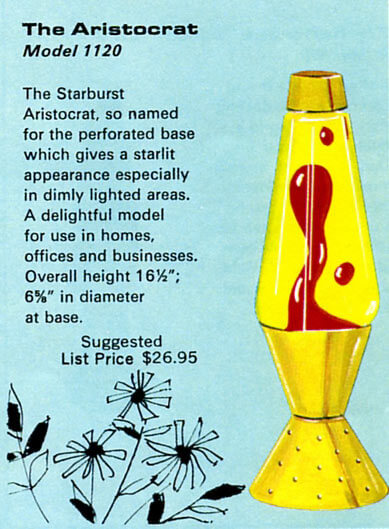
I own a couple of lava lamps and I run them quite a bit. I didn’t get my first one until the 80s and I still have it. They do nothing but do their thing…and they create a mood. I have one in my office at work…it helps at times.
The lava lamp was invented in 1963 by Edward Craven Walker. He was passing the time in a pub when he noticed a homemade egg timer crafted from a cocktail shaker filled with alien-looking liquids bubbling on a stove top. Craven Walker’s company was manufacturing millions of “Astro Lamps,” as he called them, per year. In 1965, he sold the U.S. manufacturing rights to a company called Lava Lite.
Lava lamps caught on in the sixties and continued to be big to the late seventies. The sales cooled off until the Austin Power movies and the sales started to pick up again in the hundreds of thousands a year. Now Lava Lite supplies millions of lava lamps to retailers.
At one time this novelty song was true…you wanted to be on the cover of Rolling Stone when it was a good magazine…but that is a different discussion. This song was released in 1972 and peaked at #6 in the Billboard 100 and #2 in Canada. Dr. Hook was very successful with 6 top ten hits in their career. They were also known as Dr. Hook and the Medicine Show.
This is a parody of the rock and roll lifestyle. It pokes fun at all the things that rock stars indulge in when they’re successful: groupies, shady characters hanging around, limo rides, etc.
The group had a funny side and a serious side, but it was the funny side that came out on stage and framed their image. The pirate theme added to the novelty of the group: originally known as the Chocolate Papers, they took the name Dr. Hook & the Medicine Show after the character in Peter Pan, which also played up the eye patch worn by their singer Ray Sawyer, who many people assumed was “Dr. Hook.” Sawyer wore the eye patch as a result of a car accident.
Cover of the Rolling Stone
Well, we’re big rock singers We got golden fingers And we’re loved everywhere we go (that sounds like us) We sing about beauty and we sing about truth At ten-thousand dollars a show (right) We take all kinds of pills that give us all kind of thrills But the thrill we’ve never known Is the thrill that’ll gitcha when you get your picture On the cover of the Rollin’ Stone
(Rollin stone) want to see my picture on the cover (Stone)Wanna buy five copies for my mother (yes) (Stone)Wanna see my smilin’ face On the cover of the Rollin’ Stone (that’s a very very good idea)
I got a freaky ole lady name a cocaine Katy Who embroideries on my jeans I got my poor ole grey haired daddy Drivin’ my limousine Now it’s all designed to blow our minds But our minds won’t really be blown Like the blow that’ll gitcha when you get your picture On the cover of the Rollin’ Stone
(Rollin Stone) want to see our pictures on the cover (Stone) want to buy five copies for our mothers (yeah) (Stone) want to see my smilin’ face On the cover of the Rollin’ Stone (talking) Hey, I know how Rock and roll
Ah, that’s beautiful We got a lot of little teenage blue eyed groupies Who do anything we say We got a genuine Indian Guru Who’s teaching us a better way We got all the friends that money can buy So we never have to be alone And we keep getting richer but we can’t get our picture On the cover of the Rollin’ Stone
(Rollin stone)Gonna see my picture on the cover (Stone) Gonna buy five copies for my mother (wa wa) (Stone) Gonna see my smilin’ face On the cover of the Rollin’ Stone On the cover of the Rollin’ Stone) Gonna see my picture on the cover (talking) I don’t know why we ain’t on the cover, baby (Stone) Gonna buy five copies for my mother (talking) We’re beautiful subjects (Stone) Want to see my smilin’ face (talking) I ain’t kiddin’, we would make a beautiful cover On the cover of the Rollin’ Stone (talking) Fresh shot, right up front, man I can see it now, we’ll be up in the front Smilin, man Ah, beautiful.
Oh, how this toy teased me as a kid. I would start drawing something halfway decent and then I would hit a wall because I would get so close to what I wanted and then make a wrong move…then came the shake part and start all over again. The definition of insanity would be this toy in my hands…but yet I still tried. Some people can do interesting things with it…I’m not one of those people.
In the late 50s French electrical technician André Cassagnes applied his experience with the clinging properties of an electrostatic charge to invent a drawing toy with no spare parts.
The Ohio Art Company took a look at the toy and invested $25,000. It has sold more than 175 million units worldwide since it hit stores on July 12, 1960.
They have new versions of it now with more options.
I’m not a big power ballad lover but this one I liked. I owned this single back in 1981. I also had the album “Nature of the Beast” which it came off of. The song peaked at #21 in the Billboard 100 and #22 in Canada. April Wine was the first Candian band played on MTV.
Through nine lineup changes, April Wine has been going continuously since 1969 up until the present day. The Nature of the Beast represents their commercial peak, selling over one million copies in the US. “Just Between You and Me” was also their greatest-selling single in the US, becoming the band’s defining power ballad. However, their career has spawned 32 hits on the Canadian charts, 21 of those in the top 40. Although they’ve been nominated eleven times for a Juno award, April Wine hasn’t won one yet. They have, however, been inducted into the Canadian Music IndustryHall of Fame, the East Coast Music Hall of Fame, and the Canadian Music Hall of Fame, along with being presented with a CMW Lifetime Achievement Award in 2009.
Just Between You and Me
Time and time again I see A love that seemed strong Was not meant to be Broken hearts don’t always mend Left too unsure to try love again
But just between you and me Baby I know our love will be Just between you and me Always I know our love will be Just between you and me
Lovers often seem to say Hearts can be blind to love gone astray Always it’s the same old song Someone’s been hurt by love that’s gone wrong
Just between you and me Baby I know our love will be Just between you and me Always I know our love will be Just between you Just between you and me
Words are sometimes hard to find The silence can be so unkind You always help me find my way The love that we share Grows stronger each day
Just between you and me Baby I know our love will be Just between you and me Always I know our love will be Seulement entre toi et moi Means that our love will always be Just between you and me Baby I know our love will be Just between you Just between you and me
I remember this song from when I was growing up. The Climax Blues Band had been playing since the late 60s, more of a blues-rock outfit at first (the name sort of gives that away). But by 1976, when they cut Gold Plated, the band shifted gears. Paul Carrack-style keyboards, funky guitars, and a dance-floor beat crept in. The result was this song, and it was a perfect slice of transatlantic pop.
This wasn’t supposed to be the single. The label wanted a hit, the band knocked this one together, and boom: lightning in a bottle. Climax Blues Band never really matched the success of Couldn’t Get It Right again, but that hardly matters. One song like this that still plays on classic rock radio and quietly fills dance floors decades later.
They scored with this song in 1976, which peaked at #3 on the Billboard 100, #8 in Canada, and #10 in the UK. Their other big hit was “I Love You,” released in 1979. A version of this band is still playing today.
This song is a great example of the dual vocal technique The Climax Blues Band was known for. Holt explains: “Colin Cooper used to sing the lead – the low vocal, and I used to sing an octave higher. And then, because 4 of us sang in the band, we used to harmonize. The fact that we had the dual singing the same line but with an octave split made the sound very unique, and it’s still very unique today. Whenever people use it I think it’s great. That was one of our trademarks, we just used to sing together in unison.”
Couldn’t Get It Right
Time was drifting This rocker got to roll So I hit the road and made my getaway Restless feeling, really got a hold I started searching for a better way
But I kept on looking for a sign In the middle of the night But I couldn’t see the light No, I couldn’t see the light I kept on looking for a way To take me through the night I couldn’t get it right I couldn’t get it right
LA fever made me feel alright But I must admit it got the best of me Getting down, so deep I could have drowned Now, I can’t get back the way I used to be
But I kept on looking for a sign In the middle of the night But I couldn’t see the light No, I couldn’t see the light I kept on looking for a way To take me through the night I couldn’t get it right I couldn’t get it right
New York City took me with the tide And I nearly died from hospitality Left me stranded, took away my pride Just another no account fatality
I kept on looking for a sign In the middle of the night But I couldn’t see the light No, I couldn’t see the light I kept on looking for a way To take me through the night I couldn’t get it right I couldn’t get it right
I kept on looking for a sign In the middle of the night But I couldn’t see the light No, I couldn’t see the light I kept on looking for a way To take me through the night I couldn’t get it right I couldn’t get it right
I kept on looking for a sign In the middle of the night But I couldn’t see the light No, I couldn’t see the light I kept on looking for a way To take me through the night I couldn’t get it right I couldn’t get it right
Billy Preston and Bruce Fisher wrote this song as well as “Nothing from Nothing” and You Are So Beautiful. Will It Go Around In Circles peaked at #1 in the Billboard and #1 in Canada. Billy Preston played with the biggest names including The Beatles and The Rolling Stones. When he was a teenager he played keyboards in Little Richard’s band and met The Beatles while they were still playing in Hamburg.
During the difficult recording of Let It Be George Harrison invited Billy to play with The Beatles and it eased the tensions with the group somewhat and Billy contributed to the album and movie.
This was borne out of a joke Preston made to his songwriting partner, Bruce Fisher, about having a song but no melody. The comment inspired the opening refrain, “I got a song that ain’t got no melody, I’m gonna sing it to my friends,” and set up similar proclamations, such as having a story with no moral and having a dance with no steps.
The song’s success allowed Fisher to finally quit his job in the mailroom at NBC in Burbank, California. He went on to collaborate with Preston on his next #1, “Nothing From Nothing,” and the Joe Cocker hit “You Are So Beautiful.”
Will It Go Round In Circles
I’ve got a song, I ain’t got no melody I’ma gonna sing it to my friends I’ve got a song, I ain’t got no melody I’ma gonna sing it to my friends
Will it go round in circles? Will it fly high like a bird up in the sky? Will it go round in circles? Will it fly high like a bird up in the sky?
I’ve got a story, ain’t got no moral Let the bad guy win every once in a while I’ve got a story, ain’t got no moral Let the bad guy win every once in a while
Will it go round in circles? Will it fly high like a bird up in the sky? Will it go round in circles? Will it fly high like a bird up in the sky?
I’ve got a dance, I ain’t got no steps, no I’m gonna let the music move me around I’ve got a dance, I ain’t got no steps I’m gonna let the music move me around
Will it go round in circles? Will it fly high like a bird up in the sky? Will it go round in circles? Will it fly high like a bird up in the sky?
Well Well Well Well
Will it go round in circles? Will it fly high like a bird up in the sky? Will it go round in circles? Will it fly high like a bird up in the sky?
I’ve got a song, I ain’t got no melody I’ma gonna sing it to my friends I’ve got a song, I ain’t got no melody I’ma gonna sing it to my friends
Will it go round in circles? Will it fly high like a bird up in the sky? Will it go round in circles? Will it fly high like a bird up in the sky?
Go round in circles Will it fly high like a bird up in the sky? Will it go round in circles? Will it fly high like a bird up in the sky?
One of my favorite toys growing up. To this day I like collecting any vintage lighting fixture like soft drink clocks or signs probably because of this toy. They came with designs that you could use to create different cartoons and clowns but I never used those. I liked to create my own masterpieces.
This toy allowed you to be creative in a very different way. It brought out the artistic side in you. You could design different things and it would light up your room in the dark with colors.
Lite-Brite was invented by Joseph M. Burck, a senior designer at Chicago toy and game design company Marvin Glass and Associates.
Of course…when I got older I would make crude messages on the Lite Brite for friends.
When someone says mood rings now…we think of the cheap dime store versions that are available. In 1975 they were not cheap. They were marketed as “portable biofeedback aids” and a silver one would cost $45 and a gold Mood Ring would be $250.
They supposedly could tell how the wearer was feeling…their mood. Marvin Wernick was the first to invent them but failed to patent it. Wernick got the idea when he saw a doctor use thermotropic tape on a child’s forehead. He then filled a glass shell with thermotropic liquid crystals and he attached it to a ring.
Since Wenick didn’t patent it Joshua Reynolds ended up with it and popularizing the ring. He marketed it as “portable biofeedback aids” and he made a million in a 3 month period in 1975. The company then went bankrupt because of the imitations out on the market. I had one of those imitations along with a free green finger that went with them.
They were a big fad for a while but started to die out. They never completely went away though… You can still buy them now.
Below is the color guide to see what “mood” you are in…groovy
It’s been 102 years since these organizations met in the World Series. Back then it was the Red Sox…with Babe Ruth against the Robins. In my lifetime they came close to meeting in 1978.
I’ve waited a long time for this, 40 years to witness the Dodgers play the Red Sox in the World Series. As a kid, I always loved to see Fenway Park on television with its vision of green and know that Babe Ruth once played there along with other greats. The team I love, The Dodgers, were winning their division in 1978 and I thought instead of playing the Yankees I could see the Dodgers play in Fenway. This was before Interleague entered the picture.
In 1978 The Red Sox had a commanding lead in the American League East division. They led the Yankees by 14 games in July I thought for sure the Sox had it. The teams ended up tied on the last day and it came down to a playoff game between the Sox and Yankees. The Yankees ended up winning the game and the American League pennant with the help of the famous Bucky Dent homer.
Now I’ll finally get to see it 40 years later in the World Series. Win or lose I’m looking forward to this World Series. Instead of Cey, Garvey, Lopes vs Lynn, Rice, and Yaz it will be Bellinger, Puig, Turner, and Kershaw against Betts, Bradley Jr., Martinez, and Sale.
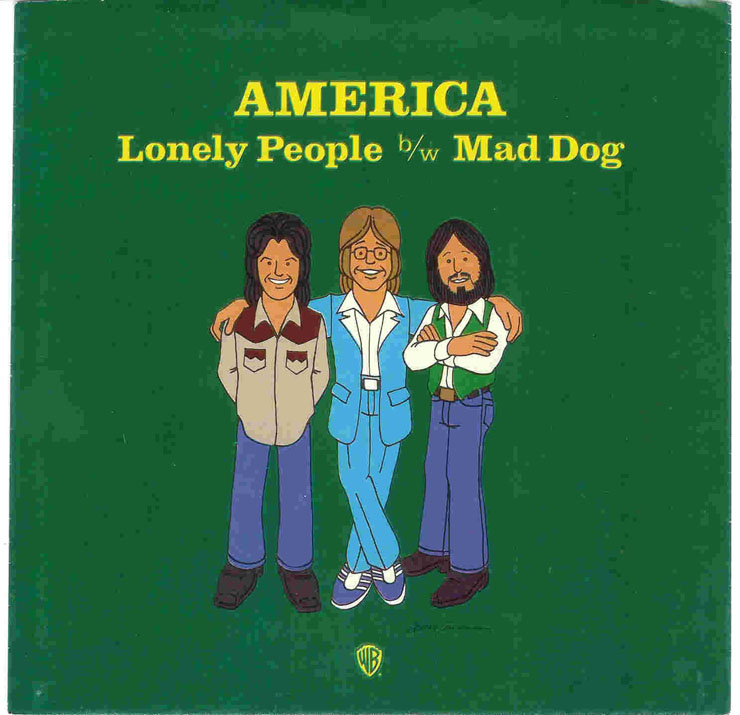
Maybe my favorite America song along with Sister Golden Hair. It peaked at #5 in the Billboard 100 and #16 in Canada in 1975. The song was a positive response to the Beatles Eleanor Rigby’s “All the lonely people: where do they all come from…where do they all belong”(according to wiki). Both songs were produced by George Martin.
Famed Beatles producer George Martin helmed this song along with the rest of the album in London. Peek recalled to Circus: “Gerry (Beckley) had been in England, and we’d talked about using George Martin as our producer. He’s such a hot arranger, thinking about all the stuff he’s done. There were several other people we wanted to use, but that idea sort of flashed and George was available. Gerry had a house outside of London where we knew we could rehearse.”
The trio met with George Martin in Los Angeles, at the offices of America’s managers, Geffen-Roberts. Peek remembered with a laugh: “The first thing he did was take his shirt, sweater and shoes off. He said it was too hot in L.A. He put everyone at ease, and we just got along well from the first second. He has a very musical mind, and as we began working we bounced ideas off of him quite a bit, with things like vocal arrangements and guitar parts. It was an amazing experience working for a mind-producer.”
Lonely People This is for all the lonely people Thinking that life has passed them by Don’t give up until you drink from the silver cup And ride that highway in the sky
This is for all the single people Thinking that love has left them dry Don’t give up until you drink from the silver cup You never know until you try
Well, I’m on my way Yes, I’m back to stay Well, I’m on my way back home (Hit it)
This is for all the lonely people Thinking that life has passed them by Don’t give up until you drink from the silver cup And never take you down or never give you up You never know until you try
This is one of the first songs I remember hearing. I’ve always liked the song and it remains my favorite of Jim Croce. It peaked at #17 in the Billboard 100 and #11 in Canada. Jim’s songs were about everyday people. Jim and Maury Muehleisen guitars blended perfectly with each other.
Jim Croce quote about Operator
“I got the idea for writing “Operator” by standing outside of the PX waiting to use one of the outdoor phones. There wasn’t a phone booth; it was just stuck up on the side of the building and there were about 200 guys in each line waiting to make a phone call back home to see if theirÔDear John’ letter was true, and with their raincoat over their heads covering the telephone and everything, and it really seemed that so many people were going through the same experience, going through the same kind of change, and to see this happen especially on something like the telephone and talking to a long-distance operator-this kinda registered. And when I got out of theArmy I was working in a bar where there was a telephone directly behind where I was playing and I couldn’t help but be disturbed by it all the time, and I noticed that the same kind of thing was going’ on. People checkin’ up on somebody or finding out who was Ð what was goin’ on, but always talking to the operator. And I decided that I would write a song about it. But I didn’t really start getting the idea for the song itself, the real outline of it until I was doing the construction work after I got out of the music business the first time, and I started carrying a cassette machine in the truck. I started ÔOperator’ on the way back, one afternoon, just singin’ into a cassette machine. But it’s-it’s one of those songs that kinda comes out of experiences that you watch for a long time, just to see if they’re really valid. I kinda like to write songs about things that a lot of people have experience with because it really makes the songs communicate.”
Operator
Operator, well could you help me place this call? See, the number on the matchbook is old and faded She’s living in L.A. with my best old ex-friend Ray A guy she said she knew well and sometimes hated
Isn’t that the way they say it goes? Well, let’s forget all that And give me the number if you can find it So I can call just to tell ’em I’m fine and to show I’ve overcome the blow, I’ve learned to take it well I only wish my words could just convince myself That it just wasn’t real, but that’s not the way it feels
Operator, well could you help me place this call? Well, I can’t read the number that you just gave me There’s something in my eyes, you know it happens every time I think about a love that I thought would save me
Isn’t that the way they say it goes? Well, let’s forget all that And give me the number if you can find it So I can call just to tell ’em I’m fine and to show I’ve overcome the blow, I’ve learned to take it well I only wish my words could just convince myself That it just wasn’t real, but that’s not the way it feels No, no, no, no that’s not the way it feels
Operator, well let’s forget about this call There’s no one there I really wanted to talk to Thank you for your time, ah, you’ve been so much more than kind And you can keep the dime
Isn’t that the way they say it goes? Well, let’s forget all that And give me the number if you can find it So I can call just to tell ’em I’m fine and to show I’ve overcome the blow, I’ve learned to take it well I only wish my words could just convince myself That it just wasn’t real, but that’s not the way it feels
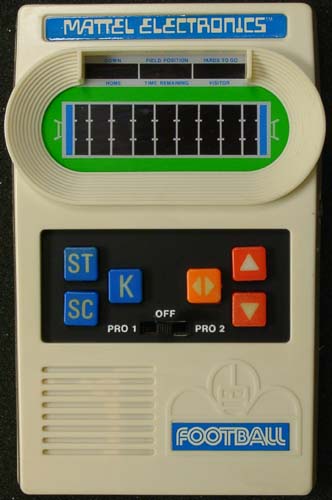
If you were 10-15 years old in 1977-78 you probably remember this game.
My friend had this game and I basically took it over every time we were on the bus and the times he would come over because he liked the auto racing game. I ended up buying it from him.
It was released in June of 1977 as the second game released by Mattel (Auto Race was the first) and sold through Sears. After less than 100,000 were made, Sears determined that the games would not be big sellers, and most of the production for Football and Auto Race was stopped. Well, Sears was wrong and had to restart the production.
By mid-February 1978 the sales figures were up to 500,000.
Who would think that red dashes could be so much fun?











 PowerPop... An Eclectic Collection of Pop Culture