Merle Haggard – I’m A Lonesome Fugitive

Whenever I hear this man’s voice, it takes me back to my dad, who would listen to his songs in our red Plymouth Valiant. Songs like Sam Hill, Swinging Doors, and others, he would have blasting at 7 in the morning. 

Merle was genuine through and through. He didn’t run from his past but used it to tell stories and warn people about going the wrong way. Merle wasn’t posing; he was the real deal. This song helped shape the outlaw country movement before it had a name.

Most people know that he spent his early adulthood behind bars for a failed attempt at robbery. While in San Quentin State Prison, Haggard wrote many songs while dreaming of freedom and life beyond the bars of a cell.

He knew a couple of inmates, James Rabbit and Caryl Chessman. Haggard and James Rabbit hatched a plan one night to escape (they would hide inside a desk he was building in the prison furniture factory), though at the last moment, Rabbit advised Haggard not to take part in the plan. Rabbit escaped, was recaptured, killed an officer, and was brought back to San Quentin to be executed. It was the first of many events to change something in Haggard’s criminal ways.

What is surprising is that Merle did not write this song. It was written by Liz Anderson and her husband, Casey Anderson, a songwriting couple who were fans of Haggard and knew of his prison past. When they sent the song his way, it clicked instantly. Haggard later said he related to it so personally that he felt like it had to be his.

The song peaked at #1 on the Billboard Country Charts, and the album of the same name peaked at #3 on the Billboard Country Album Charts. 

One of my biggest concert regrets is that I never saw this great artist live. 

I’m A Lonesome Fugitive

Down every road there’s always one more cityI’m on the run, the highway is my home

I raised a lot of cane back in my younger daysWhile mama used to pray my crops would failNow I’m a hunted fugitive with just two waysOutrun the law or spend my life in jail

I’d like to settle down but they won’t let meA fugitive must be a rolling stoneDown every road there’s always one more cityI’m on the run, the highway is my home

I’m lonely but I can’t afford the luxuryOf having one I love to come alongShe’d only slow me down and they’d catch up with meFor he who travels fastest goes alone

I’d like to settle down but they won’t let meA fugitive must be a rolling stoneDown every road there’s always one more cityI’m on the run, the highway is my homeI’m on the run, the highway is my home

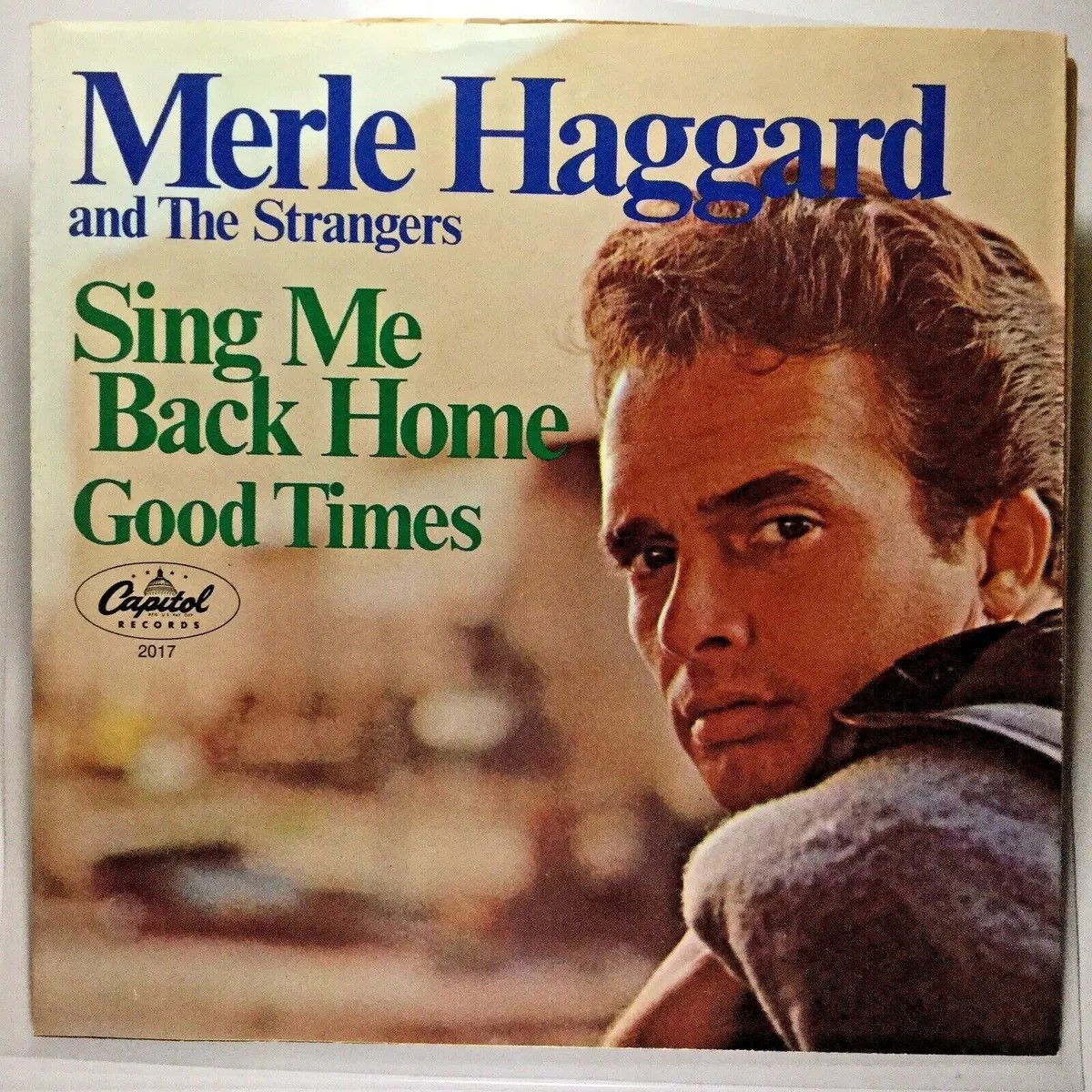
Merle Haggard – Sing Me Back Home

One of the many Haggard songs that my dad would play. This one along with a song called Sam Hill I heard a lot when I was a child. Sing Me Back Home was released in 1967, and it became one of Haggard’s most enduring hits.

Most people know that he spent his early adulthood behind bars for a failed attempt at robbery. While in San Quentin State Prison, Haggard wrote many songs while dreaming of freedom and life beyond the bars of a cell.

Sing Me Back Home was inspired by his fellow inmates James Rabbit and Caryl Chessman. Rabbit was executed in 1961 for killing a California Highway Patrolman, and Chessman was the first modern American executed for a non-lethal kidnapping.

Haggard and James Rabbit hatched a plan one night to escape (they would hide inside a desk he was building in the prison furniture factory), though at the last moment, Rabbit advised Haggard not to take part in the plan. Rabbit escaped, was recaptured, killed an officer, and was brought back to San Quentin to be executed. It was the first of many events to change something in Haggard’s criminal ways.

It is an incredibly sad song and you get it with the first two lines of the song. The warden led a prisoner down the hallway to his doom, I stood up to say goodbye like all the rest.  The song was on his Sing Me Back Home album released in 1968. The album peaked at #1 on the Billboard Country Album Charts. The song peaked at #1 on the Billboard Country Charts and #7 on the Canadian Country Charts.

Merle Haggard: “Something happened to me there, I came to the fork in the road and took it, you might say. And I kind of started back in the other direction, trying to make something out of myself rather than to dig myself in a deeper hole.”

Sing Me Back Home

The warden led a prisoner down the hallway to his doomI stood up to say goodbye like all the restAnd I heard him tell the warden just before he reached my cellLet my guitar playing friend, do my request

Let him sing me back home with a song I used to hearMake my old memories come aliveTake me away and turn back the yearsSing me back home before I die

I recall last Sunday morning a choir from ‘cross the streetCame to sing a few old gospel songsAnd I heard him tell the singersThere’s a song my mama sangCan I hear once before we move along?

Sing me back home, the song my mama sangMake my old memories come aliveTake me away and turn back the yearsSing me back home before I die

Sing me back home before I die

….

Merle Haggard – Swinging Doors

And I’ve got swinging doors a jukebox and a barstool
And my new home has got a flashing neon sign

This is country music I love. I’ve always been a bit jealous of the Country music genre in one area. I’m not sure they still have this but at certain times of year the musicians and artists are out and about and you can meet them. It was really big in Nashville through the years.

It was called Fan Fair.  It’s basically like a job fair but with country stars. Can you imagine Mick Jagger, Paul McCartney, Eric Clapton, and others in a building meeting and talking to their fans? How about going up to Bob Dylan and slapping him on the back…” Hey Bob” how are ya? No that would not happen.

I remember this happening in Nashville where you could go and meet Merle Haggard, Loretta Lynn, and more. Rock and Roll doesn’t have anything like that. Maybe it’s because Country is centered in Nashville where Rock is spread throughout the world? I think it was a great way to spread their music.

Swinging Doors - Song Lyrics and Music by Merle Haggard arranged by  OF_ALLAN_SVI on Smule Social Singing app

In 1966 Merle Haggard traveled to Nashville to record his first-ever collaboration project with The Strangers. They would later on become his backing band. At first, it just didn’t work but Haggard and the band continued. The album ended up with 12 tracks and Swinging Doors was the title track. Haggard wrote all of the tracks on the album. The album peaked at #1 on the Billboard Country Charts. His first number-one album. He would go on to record 66 studio albums and 8 live ones.

The song peaked at #5 on the Billboard Country Charts in 1966. Another song off of this album peaked at #5…The Bottle Let Me Down.

This song takes me back to being a kid. Early morning rides with my dad and him having a country station on.

Swinging Doors

This old smoke-filled bar is something I’m not used to
But if gave up my home to see you satisfied
And I just called to let you know where I’ll be living
It’s not much but I feel welcome here inside

And I’ve got swinging doors a jukebox and a barstool
And my new home has got a flashing neon sign
Stop by and see me anytime you want to
Cause I’m always here at home till closing time

I’ve got everything I need to drive me crazy
I’ve got everything it takes to lose my mind
And in here the atmosphere’s just right for heartaches
And thanks to you I’m always here till closing time

And I’ve got swinging doors a jukebox and a barstool
And my new home has got a flashing neon sign
Stop by and see me anytime you want to
Cause I’m always here at home till closing time

Yeah, I’m always here at home till closing time

Townes Van Zandt – Pancho and Lefty

After the country post on Saturday…I looked through a lot of lists you all made. I listened…I want to thank Lisa for bringing this one up. It’s high time I did a post on Townes Van Zant. He was one of the best songwriters of the 20th Century.

What a songwriter Towns Van Zandt was…this song is probably best known for the Merle Haggard and Willie Nelson cover in 1983. The song peaked at #1 on the Country Billboard Charts and #1 on the Canadian Country Charts in 1983.

Willie Nelson has said that his and Merles duet album was almost complete but it lacked THAT song to put it over the top. Nelson said his daughter Lana suggested to him to listen to Pancho and Lefty by Townes Van Zandt. Willie then asked Townes what the song was about…and Townes said he didn’t know. Nelson then cut the track with his band. Willie and Merle had never heard that song before.

Nelson recorded it that night with his band and had to go and drag a sleepy Haggard (who was sleeping on his bus) to do the vocal part. The vocals were recorded in one take that night. They made a video of it and invited Townes to be in it. He was in the video as one of the Mexican  Federales.

The royalties from this song helped Van Zandt through the years. He told a story of getting pulled over by a couple of policemen. His car sticker was out of date so he got into the police car and they asked him what he does for a living. He said he was a songwriter and the policemen shook their heads. He then told them that he wrote “Pancho and Lefty” and their eyes lit up and they started to grin. Pancho and Lefty were the policemen’s police radio code names. They let Townes go after that.

Van Zandt did not like fame or what came attached to it. It’s been reported that he turned down opportunities to write with Bob Dylan. He respected Dylan a great deal but it was the celebrity part he didn’t want. He never ended up on a major label through his career…by choice. Steve Earle counted Townes Van Zandt as his mentor, and the two formed a close bond in the years since their initial encounter in 1978.

Unfortunately, Earle also adopted Van Zandt’s drug and alcohol habits. So bad, in fact, that Van Zandt actually visited Earle during a rare moment in which Townes was sober. Earle told him “I must be in trouble if they’re sending you.” Earle eventually named his son after Townes Justin Townes Earle.

The original song was on Van Zandt’s 1972 album The Late Great Townes Van Zandt. 

For Willie’s Big 60 show, Bob Dylan and Willie Nelson sang Pancho and Lefty. Bob covered the song sporadically in concert during the 90’s. In 2004, Rolling Stone ranked “Pancho and Lefty” 41st on its list of the “100 Greatest Country Songs of All Time.

Townes Van Zandt on being invited to be in the video: “It was real nice they invited me,”they didn’t have to invite me and I made I think $100 dollars a day. I was the captain of the federales. And plus I got to ride a horse. I always like that. It took four and a half days and that video was four and a half minutes long…The money goes by a strange life, or elsewhere. I mean it doesn’t come to me. But money’s not the question. I would like if I could write a song that would somehow turn one five-year-old girl around to do right. Then I’ve done good. That’s what I care about.”

Townes Van Zandt:  “I realize that I wrote it, but it’s hard to take credit for the writing, because it came from out of the blue. It came through me and it’s a real nice song, and I think, I’ve finally found out what it’s about. I’ve always wondered what it’s about. I kinda always knew it wasn’t about Pancho Villa, and then somebody told me that Pancho Villa had a buddy whose name in Spanish meant ‘Lefty.’ But in the song, my song, Pancho gets hung. ‘They only let him hang around out of kindness I suppose’ and the real Pancho Villa was assassinated.”

Pancho and Lefty

Living on the road my friend,
Is gonna keep you free and clean
Now you wear your skin like iron,
Your breath as hard as kerosene.
You weren’t your mama’s only boy,
But her favorite one it seems
She began to cry when you said goodbye,
And sank into your dreams.

Pancho was a bandit boy,
His horse was fast as polished steel
He wore his gun outside his pants
For all the honest world to feel.
Pancho met his match you know
On the deserts down in Mexico
Nobody heard his dying words,
Ah but that’s the way it goes.

All the Federales say
They could have had him any day
They only let him slip away
Out of kindness, I suppose.

Lefty, he can’t sing the blues
All night long like he used to.
The dust that Pancho bit down south
Ended up in Lefty’s mouth
The day they laid poor Pancho low,
Lefty split for Ohio
Where he got the bread to go,
There ain’t nobody knows

The poets tell how Pancho fell,
And Lefty’s living in cheap hotels
The desert’s quiet, Cleveland’s cold,
And so the story ends we’re told
Pancho needs your prayers it’s true,
But save a few for Lefty too
He only did what he had to do,
And now he’s growing old

Five of my Favorite Country Songs

The good thing about Star Trek being over is…I can start posting a couple of music things on Saturday and Sunday.

I grew up near Nashville so it did leave its imprint on me but I don’t listen to modern country music. I do include some songs that are more country/rock but they fit what I like. They are in no particular order…well my favorite admittedly is the top one.

Hope you enjoy the small sample platter of country songs.

This song is my favorite of the Flying Burrito Brothers. It came off their great  album The Gilded Palace of Sin It didn’t chart at the time. Parsons wrote this song with Burrito bass player Chris Ethridge while the band was living in their San Fernando Valley house that was dubbed “Burrito Manor.”

Merle Haggard was a constant on the radio here with my parents. He wrote so many classic songs and this is one of them…Mama Tried.

Merle Haggard wrote this song while serving time in San Quentin prison for robbery. The song is based on his life, and how his mother tried to help him but couldn’t… Mama Tried came out in 1968 and peaked at #1 on the Country Charts and #1 in the Canada Country Charts in 1968.

The man had 38 number-one hits, 71 top-ten hits, and 101 songs in the top 100 in the country charts. Merle is one of my favorite country artists. If only the new ones would listen and learn.

Hank Williams is one of my favorite country artists. He could write songs of great quality but the ironic thing is…this one is one of the few he didn’t write. His nickname…The Hillbilly Shakespeare is true to form. Hank Williams released this song in 1949 and it peaked at #12 on the Country Charts. It was written by Leon Payne.

Loretta Lynn is my favorite female country singer with apologies to Dolly Parton. This is a song that she did with Jack White called Portland Oregon. If the modern country was like this…I would listen. Their voices go really well with each other.  Country radio would not play it but the album still peaked at #2 on the Country Charts and #24 on the Billboard Album Charts and #1 on the UK Country Charts in 2004.

They didn’t win any country music awards but came away with two Grammys.

I love the build-up to this song…Jack White builds this up and Loretta starts singing around 1:40.

Now to finish it out with 5 songs…I thought I would add Dwight Yoakam who was inspired by Buck Owen’s Bakersville Sound. The song peaked at #2 on the Billboard Country Charts and at #3 in Canada in 1993. It was written by Yoakam and produced by Pete Anderson.

The song was on Dwight’s album This Time. The album peaked at #4 in the Billboard Country Album Charts, #1 in the Canada RPM Album Charts, and #25 in the Billboard Album Charts.

Merle Haggard – Okie From Muskogee

I will say it again today, unfortunately….our power has been out since Friday. Right now I’m using the last charge on my laptop with my phone as a hotspot. I called the county department and our electric company… over 200 trees were blown over on power lines. Some have electricity and some don’t…our road has a tree over the power lines. We are pretty much stuck here in the dark…Our electric company has called in help from other states…but right now all we can do is wait. This is a pic of my road. So I won’t be commenting much if any until there is once again power. Funny how we take some things for granted. 

Now I have to go to my car to charge my dying phone again.

Tree on lines

I almost didn’t post this song at all. Everyone knows that I’m non-political to the core. Even for a song that is over 50 years old… this one has drawn its admirers and haters. Was it a parody or was he serious? It goes both ways.

I always wondered if Merle Haggard was serious in this song. I really didn’t think he was totally and as it turns out he wasn’t on most of it. The song started as a joke but more and more people took it on face value and the song became huge. Merle said:  “‘Okie’ made me appear to be a person who was a lot more narrow-minded, possibly, than I really am.”

As Haggard and his band were going to Muskogg Oklahoma he and drummer Eddie Burris started to write this song as a parody. Haggard spotted a sign that read, Muskogee, 19 miles, and he joked to Burris that they probably didn’t smoke marijuana in the small town. The rest of the band joined in and threw out other activities that probably wouldn’t be happening in Muskogee, and because of the times they were in, talked about the Vietnam War.

There are things Haggard didn’t like though… he didn’t like the protesters giving soldiers a hard time when Vietnam was going on when they didn’t have a choice but to go. When Johnny Cash visited the White House, Nixon wanted him to play this song. Cash refused and later said the song was a lightning rod for the anti-hippie movement.

I remember it as a kid very well. Country radio would play it to death back then. I would just sing along because it’s super catchy. There are a few country artists I really like. Merle Haggard, Johnny Cash, Willie Nelson, Waylon Jennings, Roy Clark, Buck Owens, Dolly Parton, Emmylou Harris, Loretta Lynn, Tanya Tucker, and the king of them all…Hank Williams Sr. I don’t care too much about what a fellow blogger…Jeff calls “Bro Country” which is on the airwaves now.

The song peaked at #1 in the Billboard Country music charts and #3 in the Canadian Country music charts in 1969-70.

I did find an interesting cover version by The Grateful Dead AND The Beach Boys together at the Fillmore in 1971. Mike Love is singing lead and you can hear Jerry Garcia’s guitar. The Dead also covered Mama Tried.

Merle Haggard: “We wrote it to be satirical originally. But then people latched onto it, and it really turned into this song that looked into the mindset of people so opposite of who and where we were. My dad’s people. He’s from Muskogee.”

Merle Haggard: “When I was in prison, I knew what it was like to have freedom taken away. During Vietnam, there were all kinds of protests. Here were these [servicemen] going over there and dying for a cause we don’t even know what it was really all about. And here are these young kids, that were free, bitching about it. There’s something wrong with that and with [disparaging] those poor guys. We were in a wonderful time in America and music was in a wonderful place. America was at its peak and what the hell did these kids have to complain about? These soldiers were giving up their freedom and lives to make sure others could stay free. I wrote the song to support those soldiers.”

Oki From Muskogee

We don’t smoke marijuana in Muskogee
We don’t take our trips on LSD
We don’t burn our draft cards down on Main Street
‘Cause we like livin’ right, and bein’ free

We don’t make a party out of lovin’
But we like holdin’ hands and pitchin’ woo
We don’t let our hair grow long and shaggy
Like the hippies out in San Francisco do

And I’m proud to be an Okie from Muskogee
A place where even squares can have a ball
We still wave Old Glory down at the courthouse
And white lightnin’s still the biggest thrill of all

Leather boots are still in style for manly footwear
Beads and Roman sandals won’t be seen
And football’s still the roughest thing on campus
And the kids here still respect the college dean

And I’m proud to be an Okie from Muskogee
A place where even squares can have a ball
We still wave Old Glory down at the courthouse
And white lightnin’s still the biggest thrill of all

And white lightnin’s still the biggest thrill of all
In Muskogee, Oklahoma, USA

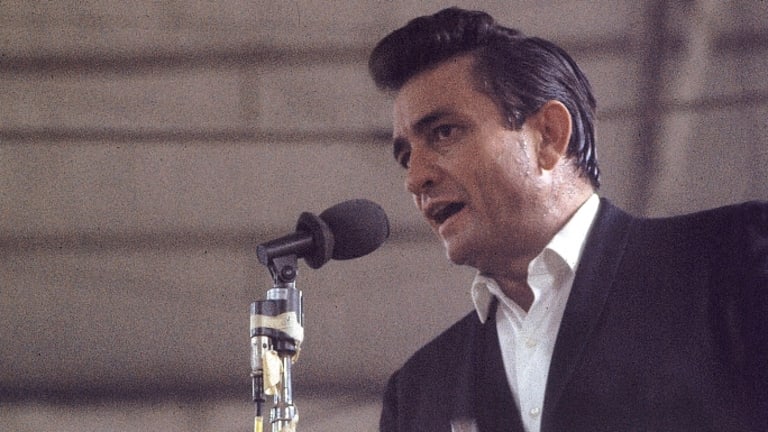
Johnny Cash – Folsom Prison Blues

But I shot a man in Reno, Just to watch him dieJohnny Cash

It doesn’t get much better than that.

The man in black was The Man. Not many performers can cross genres like Johnny Cash did and still does. He first recorded this song in 1955 at Sun Records as the B side to “S3o Doggone Lonesome” but it was the live 1969 version that hit.

The At Folsom Prison album helped revitalize Cash’s career. Up to this point, his last Country top 40 entry was in 1964. This was recorded live at Folsom Prison in California on January 13, 1968, and that album came to define his outlaw image. The record company told him it wouldn’t work but Johnny recorded at the prison anyway.

Folsom Prison Blues peaked at #1 on the Billboard Country Charts, #1 on the Canadian Country Charts, #32 on the Billboard 100,  and #17 on the Canadian Pop Charts.  The song and album generated a lot of interest in the rebellious Johnny Cash, who made prison reform his political cause of choice. He started regularly performing in jails, doing about 12 shows a year for free mostly in Folsom and San Quentin.

The album peaked at #1 in the Billboard Country Charts, #13 in the Billboard Album Charts, and #27 in Canada.

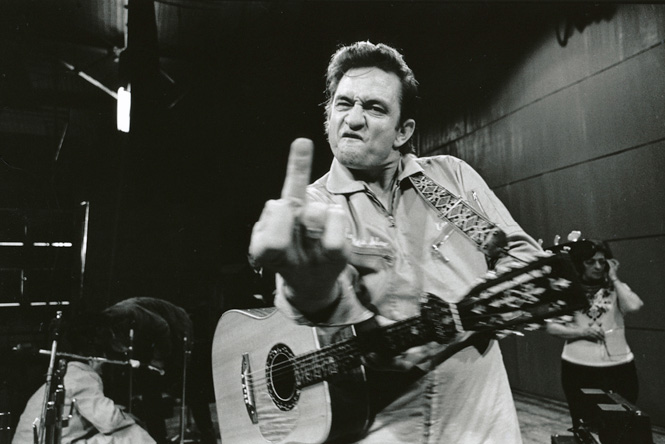
Johnny Cash Flipping Bird

This iconic picture came from Folsom Prison. According to photographer Jim Marshall…he asked Cash to express what he thought of the prison authorities when he played the show. Marshall told Cash “let’s do a shot for the warden” and the picture was born. 

Cash saw Crane Wilbur’s 90-minute film Inside the Walls of Folsom Prison while stationed in Germany. It left an impression on Cash, who emphasized the tale of the imprisoned men, and inspired him to write a song. Johnny Cash: “It was a violent movie, I just wanted to write a song that would tell what I thought it would be like in prison.”

Cash’s first prison performance occurred in 1957 when he performed for inmates at Huntsville State Prison. The favorable response inspired Cash to perform at more prisons through the years. His next hit, recorded in San Quentin Prison, was the humorous “A Boy Named Sue,” which proved that he could be clever and funny.

Cash came off as a champion for the oppressed.  He got his own national TV show in 1969 and became one of the most popular entertainers of his era. His guests included Derek and the Dominos,  Joni Mitchell, Bob Dylan, Linda Ronstadt, Kris Kristofferson, Mickey Newbury, Neil Young, Gordon Lightfoot, Merle Haggard, James Taylor, Tammy Wynette, and Roy Orbison.

Isn’t that list incredible? Cash was considered a Country-Folk artist but look at the range of performers. The late sixties and seventies were like this ….and it’s the reason I like them so much…all the generations intersected at that point in time. I mean you have Eric Clapton and then you have Tammy Wynette on the guest list.

The lyrics to this song were based on a 1953 recording called Crescent City Blues by a bandleader named Gordon Jenkins with Beverly Maher on vocals. After filing a lawsuit, Gordon Jenkins received an out-of-court settlement from Cash in 1969. I have to say it does sound really close.

Johnny Cash: “I don’t see anything good come out of prison. You put them in like animals and tear out the souls and guts of them, and let them out worse than they went in.”

Rosanne Cash: “He was a real man with great faults, and great genius and beauty in him, but he wasn’t this guy who could save you or anyone else.”

Folsom Prison Blues

(Hello, I’m Johnny Cash)

I hear the train a-comin’
It’s rollin’ ’round the bend
And I ain’t seen the sunshine
Since I don’t know when
I’m stuck in Folsom Prison
And time keeps draggin’ on
But that train keeps a-rollin’
On down to San Antone

When I was just a baby
My Mama told me, “son
Always be a good boy
Don’t ever play with guns”
But I shot a man in Reno
Just to watch him die
When I hear that whistle blowin’
I hang my head and cry (play it to the verse, yeah)
(Sue it)

I bet there’s rich folks eatin’
From a fancy dining car
They’re probably drinkin’ coffee
And smokin’ big cigars
Well, I know I had it comin’
I know I can’t be free
But those people keep a-movin’
And that’s what tortures me (hit it)

(Howdy-ho)

Well, if they freed me from this prison
If that railroad train was mine
I bet I’d move it on, a little
Farther down the line
Far from Folsom Prison
That’s where I want to stay
And I’d let that lonesome whistle
Blow my blues away

(yeah)

Lynryd Skynryd – Comin’ Home

This song wasn’t released during the lifetime of the original band. It was -released on the album Skynyrd’s First and…Last  in 1978 a year after the plane crash.

The album was recorded at Muscle Shoals Sound Studio in Alabama in 1971-1972. It was originally intended to be their debut album but it was shelved, making (Pronounced ‘Lĕh-‘nérd ‘Skin-‘nérd) their actual debut.

There are some really good songs on this posthumous album . Personally I wished this song would have made the debut album. The song is about being out on the road touring and finally making it back home. It was written by Ronnie Van Zant and Allen Collins. The song doesn’t have the crisp production of the debut album Prounounced but it’s a good song.

Ronnie Van Zant was a great and  sometimes under rated songwriter. The band members have  said that he never wrote lyrics down on paper. The band would be practicing and he would hear a riff or a chord progression he liked and would tell them to keep going through it over and over. After thinking about it he would start singing what he came up with. 

A year or so before the crash Ronnie thought venturing into country music. One of his musical influences was Merle Haggard.

Comin’ Home

It’s been so long since I’ve been gone
Another day might be too long for me
Traveling around I’ve had my fill
Of broken dreams and dirty deals
A concrete jungle surrounding me
Many nights I’ve slept out in the streets
I paid my dues and I changed my style
Seen hard times, all over now

I want to come home. It’s been so long since I’ve been away
And please, don’t blame me ’cause I’ve tried
I’ll be coming home soon to your love, to stay

I miss old friends that I once had
Times ain’t changed and I’ll be glad when I go home
I don’t know why the thought came to me
But why I’m here I really can’t see, and now

I want to come home. It’s been so long since I’ve been away
And please, don’t blame me ’cause I’ve tried
I’ll be coming home soon to your love, to stay
Coming home to stay
Coming home to your love, mama
I’ve seen better days

I miss old friends that I once had
Times ain’t changed and I’ll be glad when I go home
I don’t know why the thought came to me
But why I’m here I really can’t see, and now

I want to come home. it’s been so long since I’ve been away
And please, don’t blame me ’cause I’ve tried
I’ll be coming home soon to your love, to stay
Coming home to stay
Coming home to your love, mama
I’ve seen better days

Otis Gibbs

I came across Otis’s youtube channel and I think some of you would be interested. He is a singer songwriter but on his channel he has conversations musicians who have played or worked with Bob Dylan, Neil Young, Tom Petty, Waylon Jennings, just to name a few, and  his own stories about different musicians. For you music fans it’s worth your time. The guy doesn’t interview people…he lets people talk and tell their stories.  He is also a good story teller. I’m hooked on his channel.

He has stories about Jerry Reed, The Replacements, Dan Baird, Merle Haggard, Ry Cooder, Towns Van Zant, Bill Monroe, George Jones, Johnny Paycheck, John Prine, Mike Campbell and more.

He lives in Indiana but interviews many Nashville connected musicians. Check this guy out…His music is VERY good as well. I’m just checking that out more as I go… his music is classified as alt-country.

I just picked a few random youtube videos from his page below.

This is his youtube page:

https://www.youtube.com/user/otisgibbs

Chuck Mead – 90s Alternative Country band BR5-49…talking about when he toured with Bob Dylan

Kenny Vaughn – Lucinda Williams  guitar player at the time talks about touring with Tom Petty

Chuck Mead again with Keith Richards

Dan Baird on the Replacements

Otis Gibbs Wiki

https://en.wikipedia.org/wiki/Otis_Gibbs

Merle Haggard – Branded Man

***I have posted my 10 favorite covers of Beatle songs at Keith’s site nostaligicitalian ***

This takes me back to riding with my dad and him wearing a Merle Haggard 8-Track out completely. I knew so many of Merle’s songs before I was 6. One big regret I have is that I never saw Merle Haggard live. Haggard would be legally pardoned for his past crimes by California’s Governor Ronald Reagan in 1971.

This song peaked at #1 in the US Hot 100 Billboard Country Charts in 1967.

Merle Haggard went to jail for robbery in 1957, and was released in 1960. This song is about how he felt that no matter what he did, who would always be known for his time spent in jail “branded” as an inmate.

He was serving his time at San Quentin prison when Johnny Cash performed there. That event changed his life.

Future Eric Clapton drummer Jim Gordon played on this song.

Branded Man

I’d like to hold my head up and be proud of who I am
But they won’t let my secret go untold
I paid the debt I owed them, but they’re still not satisfied
Now I’m a branded man out in the cold

When they let me out of prison, I held my head up high
Determined I would rise above the shame
But no matter where I’m living, the black mark follows me
I’m branded with a number on my name

I’d like to hold my head up and be proud of who I am
But they won’t let my secret go untold
I paid the debt I owed them, but they’re still not satisfied
Now I’m a branded man out in the cold

If I live to be a hundred, I guess I’ll never clear my name
‘Cause everybody knows I’ve been in jai
No matter where I’m living, I’ve got to tell them where I’ve been
Or they’ll send me back to prison if I fail

I’d like to hold my head up and be proud of who I am
But they won’t let my secret go untold
I paid the debt I owed them, but they’re still not satisfied
Now I’m a branded man out in the cold

Now I’m a branded man out in the cold

Merle Haggard – Are The Good Times Really Over ——— Songs that reference The Beatles

Back before Elvis, before Vietnam war came along, Before the Beatles and Yesterday

I’m wrapping up the songs that reference the Beatles today…I thought  Merle Haggard and Frank Zappa would be a good stopping point. Hope you enjoyed the posts.

This song has staying power because every generation longs for the culture of the ones before it. One could easily insert 21st-century phrasing into his classic hit, interchanging microwaves with iPhones, etc. Every single generation looks for a Golden Age, a time where they could pinpoint that everything was right in the world.

This song peaked at #2 in the Billboard Hot Country Song Charts and #1 in Canada in 1982.

Merle had 38 number one hits, 71 top ten hits, and 101 songs in the top 100 in the country charts. It’s hard to wrap my head around 38 number one songs on any chart.


Are The Good Times Really Over (I Wish a Buck Was Still Silver)

I wish a buck was still silver
It was back when the country was strong
Back before Elvis, before Vietnam war came along
Before the Beatles and yesterday
When a man could still work and still would
Is the best of the free life behind us now
And are the good times really over for good?And are we rolling downhill like a snowball headed for hell
With no kinda chance for the flag or the liberty bell?
Wish a Ford and a Chevy
Would still last ten years like they should
Is the best of the free life behind us now
And are the good times really over for good?

I wish coke was still cola
And a joint was a bad place to be
It was back before Nixon lied to us all on T.V
Before microwave ovens when a girl could still cook, and still would
Is the best of the free life behind us now
Are the good times really over for good?Are we rolling downhill like a snowball headed for hell
With no kinda chance for the flag or the liberty bell
Wish a Ford and a Chevy
Would still last ten years like they should
Is the best of the free life behind us now
And are the good times really over for good?Stop rolling downhill like a snowball headed for hell
Stand up for the flag and let’s all ring the liberty bell
Let’s make a Ford and a Chevy
That would still last ten years like they should
‘Cause the best of the free life is still yet to come
And the good times ain’t over for good

Merle Haggard – Workin’ Man Blues

Merle Haggard had 38 number one hits, 71 top ten hits, and 101 songs in the top 100 in the country charts. I don’t listen to many country artists but Merle I do… Haggard wrote the song as a tribute to his working-class fan base. When the guitar riff starts up…I am hooked. Workin’ Man Blues” was a track on Haggard’s 1969 album A Portrait of Merle Haggard.

Haggard took the lead guitar lines himself, augmented by the great session player James Burton, who had made his reputation playing on all Ricky Nelson‘s great early hits and also played for Elvis Presley.

Lewis Talley added a third guitar on the track, with bass by Chuck Berghofer;  the drummer was Jim Gordon, known for his work with Delaney & Bonnie and as a member of Derek and the Dominos.

The song peaked at #1 in the Hot 100 Country Charts and #1 in the  Canadian RPM Country Tracks in 1969.

From Songfacts

“Working Man Blues” is about as obviously aimed as you can get, at the core audience of his fans, being blue-collar workers. Even at that, Haggard poses for the cover of the single in full business suit, tie, watch, and all. It’s sort of a cool solidarity with the audience, and a sympathetic bit of self-deprecating humor – “Don’t I look ridiculous like this?” The suit even seems to be tailored in a just-this-side-of-dandy fashion, just to make the point.

“Working Man Blues” is an excellent example of the country music sub-genre known as the “Bakersfield Sound.” Bakersfield, California was the locus of a back-to-basics breed of Country music in the ’60s and ’70s, popularized by Merle Haggard, Buck Owens, and the Buckaroos. It was kind of a “punking” of Country music, removing the slick studio production to focus on the bare essentials.

You can’t believe it thanks to the urban sprawl and metropolitan development today, but Bakersfield was once just as rural as the name suggests. As recently as 1970, it was just ranches and farms, from the freeway to the horizon, with a few “wide places in the road” for buildings. Today it’s the same smoggy concrete jungle that the rest of California is.

Haggard had an amazing work ethic, firing off an average of three albums in the space of a year. Critics noted that the prolific pace didn’t hurt the quality; music critic Mark Deming noted that a performer would be lucky to have the hits spanning a career that Haggard could pack into one album.

Working Man Blues

It’s a big job just gettin’ by with nine kids and a wife
I been a workin’ man dang near all my life 
I’ll be working long as my two hands are fit to use 
I’ll drink my beer in a tavern, 
Sing a little bit of these working man blues

I keep my nose on the grindstone, I work hard every day
Might get a little tired on the weekend, after I draw my pay
But I’ll go back workin, come Monday morning I’m right back with the crew
I’ll drink a little beer that evening, 
Sing a little bit of these working man blues

Hey hey, the working man, the working man like me
I ain’t never been on welfare, that’s one place I won’t be
Cause I’ll be working long as my two hands are fit to use
I drink a little beer in a tavern
Sing a little bit of these working man blues

Sometimes I think about leaving, do a little bummin’ around
I wanna throw my bills out the window catch a train to another town
But I go back working I gotta buy my kids a brand new pair of shoes
Yeah drink a little beer in a tavern,
Cry a little bit of these working man blues

Hey hey, the working man, the working man like me
I ain’t never been on welfare, that’s one place I won’t be
Cause I’ll be working long as my two hands are fit to use
I drink a little beer in a tavern
Sing a little bit of these working man blues
Yeah drink a little beer in a tavern,
Cry a little bit of these working man blues

Merle Haggard – Mama Tried

Merle Haggard wrote this song while serving time in San Quentin prison for robbery. The song is based on his life, and how his mother tried to help him but couldn’t… This song came out in 1968 and peaked at #1 in the Country Charts in 1968.

The man had 38 number one hits, 71 top ten hits, and 101 songs in the top 100 in the country charts. Merle is one of my favorite country artists. If only the new ones would listen and learn.

This song has been covered by a wide range of artists, including the Everly Brothers and the Grateful Dead.

From Songfacts

The song is largely autobiographical; Haggard’s father died when he was nine years old, and his mother, a devout member of the Church of Christ, tried to keep him on the straight and narrow with a strict upbringing based on her conservative values. This didn’t sit well with Haggard, who said he was an “incorrigible” child and constantly rebelling against her (“Despite all my Sunday learning, towards the bad I kept on turning”).

He was always hopping on freight trains (“The first thing I remember knowing was a lonesome whistle blowing”), an early indicator of his itinerant outlaw personality. He got into trouble for offenses like shoplifting and writing bad checks. Stints in reform school didn’t help, and in 1957 he landed in prison for burglary, where he spent his 21st birthday.

In this song, Haggard takes full responsibility for his choices and takes pity on his mother, who did the best she could (“No one could steer me right but Mama tried”).

Mama Tried

The first thing I remember knowing,
Was a lonesome whistle blowing,
And a young un’s dream of growing up to ride,
On a freight train leaving town,
Not knowing where I’m bound,
And no one could change my mind but Mama tried
One and only rebel child,
From a family, meek and mild,
My Mama seemed to know what lay in store
Despite my Sunday learning,
Towards the bad, I kept turning
‘Til Mama couldn’t hold me anymore

I turned twenty-one in prison doing life without parole.
No one could steer me right but Mama tried, Mama tried
Mama tried to raise me better, but her pleading, I denied
That leaves only me to blame ’cause Mama tried

Dear old Daddy, rest his soul,
Left my Mom a heavy load,
She tried so very hard to fill his shoes
Working hours without rest,
Wanted me to have the best
She tried to raise me right but I refused

I turned twenty-one in prison doing life without parole
No one could steer me right but Mama tried, Mama tried,
Mama tried to raise me better, but her pleading, I denied
That leaves only me to blame ’cause Mama tried