I had a business trip this past week driving a car for at least 10 hours to and from Atlanta and finished up this audiobook about the legendary manager Peter Grant. I have read one book about Grant by Chris Welch but I like this one better. Both of Grant’s kids were interviewed by author Mark Blake and they gave a perspective and info that has never been shared.
Grant had been a van driver, bouncer, stagehand, wrestler, and Don Arden’s assistant. He was 6’3″ and at one time over 300lbs… He road managed the tough and a little crazy Gene Vincent, Little Richard, Bo Diddley, and The Animals before he took over the Yardbirds which then turned into Led Zeppelin.
Grant changed the music business across the board. The promoters would enjoy a 60/40 split and better until Grant. He changed it all to 90/10 split with the artists actually getting the windfall instead of the promoters. His saying was 10 percent of Zeppelin was better than nothing. Now it is an industry-standard. The one other manager that I have read about is Brian Epstein who managed the Beatles. Grant and Epstein were complete opposites except for one thing. There was nothing they would not do for their respective bands. They were both loyal and trustworthy with the band’s finances unlike other band’s managers at the time. That is where the comparison ends.
Grant indeed was loyal to a fault…but he did business by suggestion and intimidation. Pouring water in bootleggers tape recorders, smashing film cameras by fans at concerts, and threating anyone that got in Zeppelin’s way or anyone who might be getting something they shouldn’t. He added to their already dark reputation. He started a Zeppelin label in the mid-seventies called Swan Song and signed Bad Company. He became their co-manager and traveled with them when Zeppelin wasn’t touring. He was even asked by Queen in 1975 if he could manage them…he turned them down because he didn’t have the time.
After Bonham died it became close to impossible to get him on the phone. His drug intake, already heavy, escalated during the early eighties. He did eventually get clean, lose weight, and turn into a living legend and he tried to be an English gentleman.
The book moves at a good pace and it goes over the hype and myths that Grant and Page built for Zeppelin.
If you are a Zeppelin fan or a fan of rock in the seventies it’s a good read. Although Grant could be tough, intimidating, and frankly scary at times…he did have a soft side for his family and of course…Led Zeppelin. I would give it 4.5 stars.
I did learn a new name for a certain drug… “Peruvian Marching Powder”
This song released in 1994 was on the album Teenage Symphonies to God. It has everything you would want out of a power pop song. They got the name of the album from something Brian Wilson said… “I’m writing a teenage symphony to God,”
The Velvet Crush formed in Rhode Island in 1989, although vocalist/bassist Paul Chastain and drummer Ric Menck first met and began performing together in Champaign, Illinois. There Menck founded his own small label, Picture Book, on which he and Chastain recorded solo material as well as singles under various group names like the Springfields, Choo Choo Train, the Paint Set, and Bag-O-Shells.
The band broke up in 1996 but re-formed in 1998 and has continued to record, releasing their most recent album in 2004. Vocalist/bassist Paul Chastain and drummer Ric Menck are the band’s core members and they share singing and songwriting duties. Their debut album In the Presence of Greatness was produced by Matthew Sweet,
Hold Me Up
Dead on the phone One is too alone Suffer as the days Linger on and on Miles and miles away Hold me up when I’m gone Hold me up when I’m gone
Time down the road Nothing much to show Suffer as the days Linger on and on Miles and miles away You hold me up when I’m gone Hold me up when I’m gone
Touching down and out of sight And being found to be alright
Life on the phone Wasted space at home Suffer as the days Linger on and on Miles and miles away You hold me up when I’m gone Hold me up when I’m gone You hold me up when I’m gone
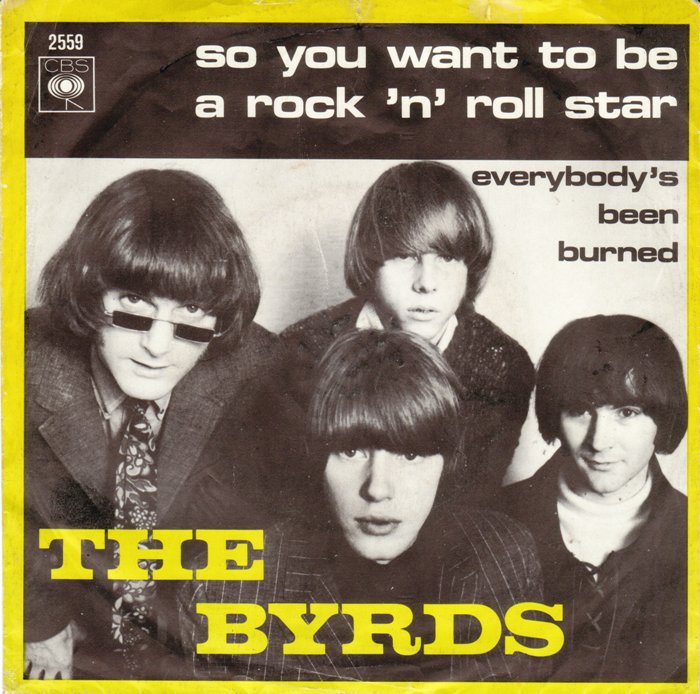
This song peaked at #29 in 1967 in the Billboard 100. This is the first hit song to use a variation of the term “rock star” in the title. Rock had been around since about 1955, but the term “rock star” didn’t get talked about until the ’70s, when it became a way to describe the most glamorous and intriguing artists.
The song was written by Roger McGuinn and Chris Hillman. It was written asa tongue-in-cheek look on fame and the pop music industry.
Tom Petty & the Heartbreakers often covered this song. Petty was a huge fan of The Byrds, and also loved a good cautionary rock star tale.
From Songfacts
Many interpreted it as a swipe at the success of manufactured rock bands like The Monkees, but Roger McGuinn has confirmed that he and Chris Hillman were not writing about The Monkees, but instead the whole music business.
Even after the term became ubiquitous, it was rarely used in song titles; the Dutch pop group Champagne hit #83 with “Rock And Roll Star” in 1977, but it wasn’t until 2007, when the rock era had long since ended, that songs with that title in the term began to proliferate. That year brought us:
“Party Like A Rock Star” – Shop Boyz (#2) “Rockstar” – Nickelback (#6) “Do It Just Like A Rockstar” – Freak Nasty (#45) “Rock Star” – Hannah Montana (#81)
It was mostly hip-hop acts that used the term from then on, notably Rihanna with “Rockstar 101” and Post Malone with “Rockstar.”
The recording was dubbed with the sound of screaming girls, taped at a Byrds show in Bournemouth, England during the band’s 1965 UK tour.
South African jazz musician Hugh Masekela contributed the clarion trumpet solo.
So You Want To Be A Rock ‘n’ Roll Star
So you want to be a rock and roll star? Then listen now to what I say Just get an electric guitar Then take some time
And learn how to play And with your hair swung right And your pants too tight It’s gonna be all right
Then it’s time to go downtown Where the agent man won’t let you down Sell your soul to the company Who are waiting there to sell plastic ware
And in a week or two If you make the charts The girls’ll tear you apart The price you paid for your riches and fame
Was it all a strange game? You’re a little insane The money, the fame, and the public acclaim Don’t forget who you are
You’re a rock and roll star La, la, la, la, la, la, la
This song and Hey Hey What Can I Do are my top two favorite Zeppelin songs.
Jimmy Page wrote this and first recorded it when he was still with The Yardbirds. I’ve read where Yardbirds singer Keith Relf wrote some of the lyrics originally and was given some of the credit but the record company turned it down for release. Later on, Jimmy would use it on the 3rd Zeppelin album with his lyrics.
This was the last Zeppelin song Page wrote without any input from Robert Plant. It’s also the only track on Led Zeppelin III for which Plant didn’t write the lyrics.
At the time the album got mixed reviews from critics and fans alike. Many fans wanted the same heavy albums as the first two. This album had a mix and they perfected it on their next album.
This was used at the end of the 2000 movie Almost Famous in a scene where a bus drives away…I thought the song was brilliant in that scene in the movie.
From Songfacts
Robert Plant would sometimes introduce this at concerts by saying: “This song is for our families and friends and people we’ve been close to. It’s a song of love at its most innocent stages.”
Jimmy Page played a pedal steel guitar on this track. He told Guitar Player magazine in 1977: “On the first LP there’s a pedal steel. I had never played steel before, but I just picked it up. There’s a lot of things I do first time around that I haven’t done before. In fact, I hadn’t touched a pedal steel from the first album to the third. It’s a bit of a pinch really from the things that Chuck Berry did. Nevertheless, it fits. I use pedal steel in ‘Your Time Is Gonna Come.’ It sounds like a slide or something. It’s more out of tune on the first album because I hadn’t got a kit to put it together.”
Why does this song fade to silence a few seconds in? Jimmy Page explained when previewing the song for Melody Maker in 1970: “That’s commonly known as a false start. It was a tempo guide, and it seemed like a good idea to leave it in – at the time. I was trying to keep the tempo down a bit. I’m not so sure now it was a good idea. Everybody asks what the hell is going on.”
Led Zeppelin played this during acoustic sets on their early tours.
This was the second Zeppelin song named after a fruit. “The Lemon Song” was the first.
According to Jimmy Page, this song was dedicated to Jackie DeShannon, who was his girlfriend when he wrote the song. DeShannon, a member of the Songwriting Hall of Fame, had hits as a singer with “What the World Needs Now Is Love” and “Put a Little Love in Your Heart.”
This was recorded on April 4, 1968 at one of the last studio sessions for The Yardbirds, under the title “Knowing That I’m Losing You.” This first version performed by The Yardbirds, featured music almost identical to “Tangerine” by Led Zeppelin, but with different lyrics (vocals by Keith Relf), and was never officially released. It was supposed to be included on the Cumular Limit compilation (which was released in 2000), together with other materials from the same sessions, but interestingly enough, Page vetoed the release of the song. Since then, the version from The Yardbirds has leaked onto the internet, and Page has been accused of ripping off a Yardbirds composition, simply changing the majority of the lyrics (probably initially written by Keith Relf) in order to avoid any problem with the other members of his previous group. This would explain his veto against the release of the original song. It is not easy to ascertain the above, as the remaining members of The Yardbirds haven’t spoken about the subject so far.
Tangerine
Measuring a summer’s day, I only finds it slips away to grey The hours, they bring me pain
Tangerine, Tangerine, living reflection from a dream I was her love, she was my queen, and now a thousand years between
Thinking how it used to be Does she still remember times like these? To think of us again? And I do
Tangerine, Tangerine, living reflection from a dream I was her love, she was my queen, and now a thousand years between
I bought Teaser and the Firecat because I enjoyed Steven’s album Tea For The Tillerman so much. I wasn’t disappointed…this was the first song I connected with on the album.
The song peaked at #30 in the Billboard 100 in 1971. The album peaked at #2 the same year.
Cat Stevens on the song: ” “I was on a holiday in Spain. I was a kid from the West End (of London) – bright lights, et cetera. I never got to see the moon on its own in the dark, there were always streetlamps. So there I was on the edge of the water on a beautiful night with the moon glowing, and suddenly I looked down and saw my shadow. I thought that was so cool, I’d never seen it before.”
He wrote part of the story of an animated short film that featured this very song. It was shown at the Fantastic Animation Festival in 1977. It begins with a still of the two characters from the “Teaser and the Firecat” album cover who then come to life.
From Songfacts
Stevens wrote this about finding hope in any situation. Be present and joyful. See life as it is, right now, and don’t compare it to others’ lives, or other times in your life. Every moment in life is rich and unique; whether we are aware of it or not, we are always leaping and hopping on a moonshadow – the inescapable present moment. If we are wrapped up in our whirlpools of worry and concern about what could be, or what has been, we are missing the richness of life as it is.
In the bridge of the song, Stevens seems to be speaking of faith, indicating clearly that, although he is experiencing this ecstasy in the present, despite all the losses and suffering of existence, it is the light that has found him, and not the other way around. He is surrendering to a power greater than himself – the “faithful light.”
Stevens, now known as Yusuf Islam, considers this his favorite of his old songs. It’s one of the songs that convinced him to release a Greatest Hits record of his work as Cat Stevens. He felt its uplifting message could help people.
Director John Landis wanted to use this song in his 1981 horror comedy An American Werewolf in London. The film featured a number of songs with “moon” in the title (“Moon Dance”, “Blue Moon”, etc.) but Stevens, who had recently converted to Islam, refused permission because he did not like the subject matter of the film.
Stevens has in recent years called this song the “Optimist’s anthem.”
This song was used for a “Teaser And The Firecat” animation. The cover of the album came to life as the boy and cat ride on the moon while this song plays. It can be found on the Cat Stevens – Majikat (Earth Tour 1976) DVD.
Artists to record this song include LaBelle, Roger Whittaker and Mandy Moore.
Moonshadow
Oh, I’m bein’ followed by a moonshadow, moon shadow, moonshadow Leapin and hoppin’ on a moonshadow, moonshadow, moonshadow
And if I ever lose my hands, lose my plough, lose my land Oh if I ever lose my hands, Oh if I won’t have to work no more
And if I ever lose my eyes, if my colours all run dry Yes if I ever lose my eyes, Oh if I won’t have to cry no more
Oh, I’m bein’ followed by a moonshadow, moon shadow, moonshadow Leapin and hoppin’ on a moonshadow, moonshadow, moonshadow
And if I ever lose my legs, I won’t moan, and I won’t beg Yes if I ever lose my legs, Oh if I won’t have to walk no more
And if I ever lose my mouth, all my teeth, north and south Yes if I ever lose my mouth, Oh if I won’t have to talk
Did it take long to find me? I asked the faithful light Did it take long to find me? And are you gonna stay the night
Well, tell him this is his last chance to get his daughter in a fine romance, Because a record company, Rosie, just gave me a big advance… That is a liberating lyric and sold the song to me.
After appearing on the covers of Time and Newsweek in October 1975, Springsteen sometimes changed the words to “Tell your papa I ain’t no freak, ’cause I got my picture on the cover of Time and Newsweek” when he performed it live.
I’ve seen Bruce do this song live and it is special. It’s one of the best live songs I’ve ever heard along with The Who’s Won’t Get Fooled Again. The song is exciting as he pleads with Rosie and calls out the nicknames of their friends.
The song was his second album The Wild, The Innocent And The E Street Shuffle peaked at #59 in the Billboard Album charts in 1975.
From Songfacts
This is Springsteen’s musical autobiography. After touring relentlessly around the Jersey Shore, he finally signed a record deal and got some money. Springsteen called the song, “A kiss-off to everybody who counted you out, put you down, or decided you weren’t good enough.”
Springsteen considers this the best love song he ever wrote, which he would often declare before performing it. It’s proof that a love song does not have to be slow or sappy.
This is one of Springsteen’s most popular live songs, and a dependable capper. It was the last song before the encore at most of his shows from 1973-1984; in 1999 during his E Street Band reunion tour, Springsteen played 15 sold out shows at the Continental Airlines Arena (later known as the Izod centre) and he used this song to close out the final show of the stand. This became very popular in England when British TV aired a clip of Springsteen performing this at a concert in Phoenix in 1978.
The live film clip of this is the closest thing Springsteen had to a music video until he started making them in 1984, starting with “Dancing In The Dark.”
The first time Springsteen performed this song was at a concert at Joe’s Place in Boston on January 5, 1974.
This was one of the first songs to showcase Clarence Clemons on sax. With his bright suits and imposing size, he quickly became the most popular member of the E Street Band.
The audience always went crazy when Springsteen sang: “The record company, Rosie, just gave me a big advance.” He got a $25,000 advance from Columbia Records when he signed his first record deal, proving to his father and others who doubted him that he did have a real job.
Springsteen never liked his nickname “The Boss,” and sometimes sang: “You can call me Lieutenant, Rosie, but don’t ever call me Boss.”
Springsteen wrote this to be a live show-stopper. He was inspired by the soul revues in the ’60s where the artists would pour all their energy into their final song, and just when it seemed to be over, keep playing. He knew his audience would remember this when he played it.
According to Diane Lozito, who was Springsteen’s girlfriend around the time he was writing this song, he got the title from the name of her grandmother, Rose (“Rose Lozito” “Rosalita”).
Rosalita (Come Out Tonight)
Spread out now Rosie, doctor come cut loose her mama’s reins You know playin’ blind man’s bluff is a little baby’s game You pick up little dynamite, I’ll pick up little gun And together we’re gonna go out tonight and make that highway run You don’t have to call me lieutenant, Rosie, and I don’t want to be your son The only lover I’m ever gonna need’s your soft, sweet, little girl’s tongue And Rosie, you’re the one
Dynamite’s in the belfry, baby, playin’ with the bats Little gun’s downtown in front of Woolworth’s tryin’ out his attitude on all the cats Papa’s on the corner, waitin’ for the bus Mama, she’s home in the window, waitin’ up for us She’ll be there in that chair when they wrestle her upstairs, ’cause you know we ain’t gonna come I ain’t here on business, baby, I’m only here for fun And Rosie, you’re the one
Rosalita, jump a little higher Senorita, come sit by my fire I just want to be your lover, ain’t no liar Rosalita, you’re my stone desire
Jack the Rabbit and Weak Knee Willie, don’t you know they’re gonna be there Ah Sloppy Sue and Big Bone Billy, they’ll be coming up for air We’re gonna play some pool, skip some school Act real cool, stay out all night, it’s gonna feel alright So Rosie, come out tonight, little baby, come out tonight Windows are for cheaters, chimneys for the poor Oh, closets are for hangers, winners use the door So use it, Rosie, that’s what it’s there for
Rosalita, jump a little higher Senorita, come sit by my fire I just want to be your lover, ain’t no liar Rosalita, you’re my stone desire, alright
Now, I know your mama, she don’t like me, ’cause I play in a rock and roll band And I know your daddy, he don’t dig me, but he never did understand Your papa lowered the boom, he locked you in your room, I’m comin’ to lend a hand I’m comin’ to liberate you, confiscate you, I want to be your man Someday we’ll look back on this and it will all seem funny But now you’re sad, your mama’s mad And your papa says he knows that I don’t have any money Oh, your papa says he knows that I don’t have any money Oh, so your daddy says he knows that I don’t have any money Well, tell him this is his last chance to get his daughter in a fine romance Because a record company, Rosie, just gave me a big advance
And my tires were slashed and I almost crashed, but the Lord had mercy And my machine, she’s a dud, out stuck in the mud somewhere in the swamps of Jersey Well, hold on tight, stay up all night, ’cause Rosie, I’m comin’ on strong By the time we meet the morning light, I will hold you in my arms I know a pretty little place in Southern California, down San Diego way There’s a little cafe, where they play guitars all night and all day You can hear them in the back room strummin’ So hold tight, baby, ’cause don’t you know daddy’s comin’ Everybody sing
Rosalita, jump a little higher Senorita, come sit by my fire I just want to be your lover, ain’t no liar Rosalita, you’re my stone desire
Yesterday I posted a Wings song so today I’ll even it up with John.
Great song but every time I hear it…it’s December 1980 again and I’m watching news stories about Lennon’s death. Double Fantasy was a strong comeback album for John…a little more Yoko than I would have liked but a good album all the same.
When it was released Ringo had said John Lennon sounds like Elvis at the beginning of this song…then he said no…he doesn’t sound like Elvis…he is Elvis. John Lennon himself said: “All through the taping of ‘Starting Over,’ I was calling what I was doing ‘Elvis Orbison.’ It’s like Dylan doing Nashville Skyline, except I don’t have any Nashville, being from Liverpool. So I go back to the records I know – Elvis and Roy Orbison and Gene Vincent and Jerry Lee Lewis.”
The song peaked at #1 in the Billboard 100, #1 in the UK, #1 in Canada and #2 in New Zealand.
From Songfacts
This song embodied the sense of renewal in Lennon and Yoko’s professional and personal lives during the writing and recording of Double Fantasy. “It was kinda obvious what ‘Starting Over’ was about,” said journalist David Sheff, who did the last major interview with Lennon, to Mojo. “He’d been untrusting of Yoko, she’d been untrusting of him, all that kind of stuff. But in that one song was this incredible optimism and joy.”
This was released in the United States October 27, 1980, which was the same day Mark David Chapman bought the gun he would use to kill Lennon on December 8. “Starting Over,” which came out in the UK on October 24, was Lennon’s first release since 1975. The Double Fantasy album was issued on November 17.
Lennon wrote this while vacationing in Bermuda earlier in the year.
Despite being the first single in five years from one of the most famous musicians on the planet, this song took a while to catch on. In America, it entered the Hot 100 on November 1, 1980 at #38 and made a slow but steady climb up the chart. Here’s the progression:
When Lennon was killed, fans quickly scooped up the single along with lots of other Lennon material, but it took a few weeks for the chart to reflect these sales. When it hit #1, it stayed there for five weeks.
This was recorded at The Power Station in New York City. Musicians included Tony Levin on bass, Earl Slick on guitar, and Andy Newmark on drums.
Double Fantasy was released on David Geffen’s record label, DGC. Many labels were competing for the album, but Geffen impressed Lennon when he wrote directly to Yoko and agreed to release it without hearing it first. All of Lennon’s previous albums were released on The Beatles’ label, Apple.
John and Yoko were considering doing a tour when this was climbing the charts.
This was one of the last songs recorded for the album. Lennon was not sure he should record it, but his producer and session musicians convinced him it would be a hit. It became the first single from Double Fantasy.
The day this was released, Yoko Ono hired a skywriter to write “Happy Birthday” above New York.
The copy of Double Fantasy that Mark Chapman asked Lennon to autograph might be the most valuable record in the world. The record, which figured in the court case, not only has Lennon’s autograph but also boasts Chapman’s fingerprints on the cover. In 2003, the record was sold for £525,000 but its value has since rocketed.
(Just Like) Starting Over
Our life together Is so precious together We have grown, we have grown Although our love is still special Let’s take a chance and fly away Somewhere alone
It’s been too long since we took the time No-one’s to blame, I know time flies so quickly But when I see you darling It’s like we both are falling in love again It’ll be just like starting over Starting over
Everyday we used to make it love Why can’t we be making love nice and easy It’s time to spread our wings and fly Don’t let another day go by my love It’ll be just like starting over Starting over
Why don’t we take off alone Take a trip somewhere far, far away We’ll be together all alone again Like we used to in the early days Well, well, well darling
It’s been too long since we took the time No-one’s to blame, I know time flies so quickly But when I see you darling It’s like we both are falling in love again It’ll be just like starting over Starting over
Our life together Is so precious together We have grown, we have grown Although our love still is special Let’s take a chance and fly away somewhere
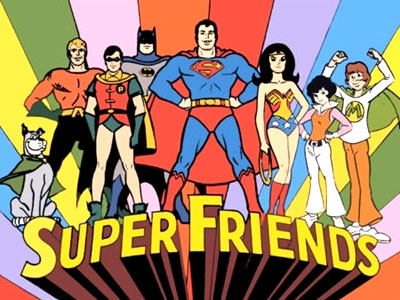
This was a must on Saturday morning. I wouldn’t find out till later but…Ted Knight did some of the dialogue such as “Meanwhile, at the Hall of Justice…” I think the first year (16 episodes) was the best. Altogether the show was on and off during its 13-year run and they ended up with 109 episodes.
Super Friends was produced by Hanna-Barbera in 1973. The show brought all the DC superheroes together and it told their stories. The first season was comprised of only 16 episodes, which were re-run through August 1974. The show was then canceled. Presumably from less than anticipated ratings.
The success of the Wonder Woman TV show in 1975, and probably the early development interest in the Superman movie led ABC to reconsider Super Friends. The original 16 episodes were re-run beginning in early 1976, while production began on a new series. To help promote the new series, DC also began publishing a Super Friends comic. While the stories there were independent of the show, they followed much the same style of the original series.
Beginning in mid-1977, E. Nelson Bridwell, writer of the Super Friends comic, learned of some of the cast changes (notably, the replacement of Wendy and Marvin with Zan and Jayna) after working on the book for several months and wrote the change into his stories, so by the time the new season of the show began in September 1977, the comic had already made the transition to the new characters.
The comic only survived until mid-1981, while the show continued into 1982. However, the show was only re-runs for the 1982-83 season and was canceled outright in the fall of ’83. The show was brought back again in 1984 and ran until September 1986.
The below link will give much more history to the show.
This was the first song recorded by Paul McCartney’s group Wings to feature another member on all lead vocals. It is an anti-drug song sung by lead guitarist Jimmy McCulloch (ex-Thunderclap Newman). Colin Allen, who was the drummer in the band Stone The Crows with McCulloch, wrote the lyrics, and McCulloch wrote the music.
Jimmy McCulloch was a guitar prodigy… He was playing in a band called The Jaygars when he was 11. He was in the band One In A Million supporting The Who when he was 14 and in the band Thunderclap Newman in 1969 when he was 16. He went on to play with John Mayall (Mayall knew how to pick guitar players) and Stone the Crows… He then went to play with Paul McCartney and Wings in 1974. He gave Paul’s songs an edge and I wish he would have stayed in Wings longer.
He left Wings to play with the reformed Small Faces in 1977. In 1979 he sadly died of heart failure due to morphine and alcohol poisoning. You have to wonder how much more Jimmy could have achieved if he would have lived.
The version I’m most familiar with is the live version from Wings Over America. The song was originally on the Venus and Mars album. Venus and Mars peaked at #1 in 1975 in the Billboard Album Charts and Wings Over America peaked at #1 in 1977.
Medicine Jar
What’s wrong with you? I wish, I knew You say, time will tell I hope that’s true
There’s more to life than blues and reds I say, I know how you feel Now your friends are dead
Dead on your feet, you won’t get far If you keep on sticking your hand In the medicine jar
Now don’t give up Whatever you do You say, time will tell I hope that’s true
If you go down and lose your head I say, I know how you feel Now your friends are dead
Dead on your feet, you won’t get far If you keep on sticking your hand In the medicine jar
I said, “Dead on your feet, you won’t get far If you keep on sticking your hand In the medicine jar”
Check it
What can I do? I can’t let go You say, time will heal But very slow
So don’t forget the things you said I say, I know how you feel Now your friends are dead
Dead on your feet, you won’t get far If you keep on sticking your hand In the medicine jar
Dead on your feet, you won’t get far If you keep on sticking your hand In the medicine jar
Medicine jar Medicine jar Medicine jar Medicine jar Medicine jar Medicine jar Medicine jar
Medicine jar Medicine jar Medicine jar Medicine jar Medicine jar Medicine jar
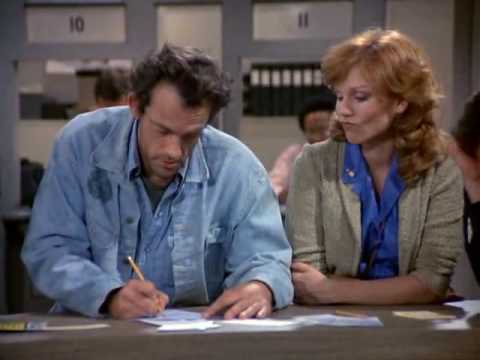
One of the funniest scenes in any sitcom is when Reverend Jim is taking his driver’s test. Taxi is smartly written and they use the ensemble much like The Mary Tyler Moore Show did. Reverend Jim played by Christopher Lloyd is my favorite character and one of my favorite characters of all time.
“Have you ever experienced loss of consciousness, hallucinations, dizzy spells, convulsive disorders, fainting, or periods of loss of memory?” “Hasn’t Everyone?”
This is my favorite Taxi episode of all time. Jim is a child of the drug culture of the sixties and still feeling the effects. Taking something as simple as a drivers test and turning it into this, Characters: Alex Reiger, Elaine DeNardo, Latka Gravas, Louie De Palmer, Bobby Wheeler, Tony Banta, Reverend Jim Ignatowski, Tommy Jeffries, Jeff Bennett,
The cab drivers are hanging out at Mario’s when Christopher Lloyd as Reverend Jim Ignatowski wanders in. They recognize him but he doesn’t recognize them, even though they remind him he performed a wedding for Latka 8 months earlier. But when Latka started talking to him in his gibberish language, Jim remembered.
The cabbies want to get Jim to have a job, make something of himself, but what can he do with no skills and no education? Drive a cab. At first Louie will not hear of it, until Rev Jim slips a tranquilizer into Louie’s coffee. Louie becomes mellow, starts singing show tunes in the garage, and gladly accepts Jim.
The big hurdle, of course, was to have Jim pass the driver’s test. They go down to the DPS office with him, help him fill out forms, his name, his weight, height, and color of eyes. Finally Bobby says, “OK, Jim, now you are ready to take the test.” “What?”, says Jim, “I thought that was the test.”
He then takes the test and the below is what transpires…You can see Tony Danza and Marilu Henner trying unsuccessfully not to laugh.
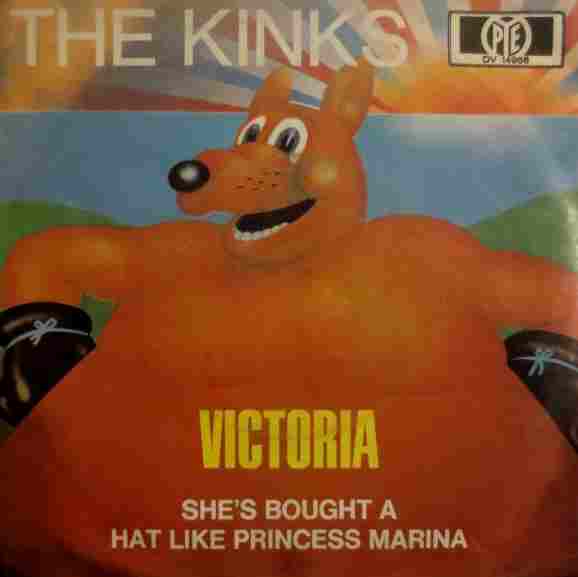
I asked my son Friday night…What are you listening to? He told me Victoria by the Kinks… so Victoria it will be.
Victoria was written for Arthur (Or The Decline And Fall Of The British Empire), a soundtrack to a British TV play on which Ray Davies collaborated with dramatist and screenwriter Julian Mitchell. The program was canceled at the last minute when the producer was unable to secure financial backing and has never been produced. However, Davies’ music was still recorded by the Kinks and released as a concept album.
The album peaked at #105 in the Billboard 100 in 1969. The song Victoria peaked at #62 in the Billboard 100 and #33 in the UK in 1970. It was the band’s first release to reach the chart since their Top 20 hit “Sunny Afternoon” in 1966.
From Songfacts
“Victoria” is a typically satirical Ray Davies song, containing many of his themes from his late ’60s material such as English nostalgia and the little people. It finds him fusing the image of the historical 19th Century UK queen and the grim realities of her downtrodden subjects’ life during her reign with the British rule of its Empire, which had reached its peak in Queen Victoria’s reign.
Musically, “Victoria” finds Ray Davies balancing the nostalgic music hall and rock sides of his songwriting. While the track is centered on a thumping rock electric blues guitar riff, the triumphant “Land of hope and gloria” bridge enhances the remainder of the song.
Commercially, “Victoria” represented a relative return of form for The Kinks. In the US, the song was chosen as the lead single from Arthur. It peaked at #62 on the Billboard Hot 100.
“Victoria” was released as the album’s third single in the UK, and was the only one to chart, reaching #33.
A cover version by The Fall was the Manchester band’s second UK Top 40 hit in 1988 peaking at #35.
Victoria
Long ago life was clean Sex was bad, called obscene And the rich were so mean Stately homes for the Lords Croquet lawns, village greens Victoria was my queen Victoria, Victoria, Victoria, ‘toria
I was born, lucky me In a land that I love Though I am poor, I am free When I grow I shall fight For this land I shall die Let her sun never set Victoria, Victoria, Victoria, ‘toria Victoria, Victoria, Victoria, ‘toria
Land of hope and gloria Land of my Victoria Land of hope and gloria Land of my Victoria Victoria, ‘toria Victoria, Victoria, Victoria, ‘toria
Canada to India Australia to Cornwall Singapore to Hong Kong From the West to the East From to the rich to the poor Victoria loved them all
Victoria, Victoria, Victoria, ‘toria Victoria, Victoria, Victoria
I read this book about Led Zeppelin over a year ago…and recently while waiting for a Beatles book to get released I went through it again. The book is much better than The Hammer Of The Gods released in the 80s. There are many things in this book that I didn’t know. Overall I liked it…but..
Mick Wall would do these interludes that are supposed to be some kind of interior monologue by the protagonists (but in second person). The book is well researched and he would be going along great and then all of a sudden he would try to get into each member’s head and have a monologue (in cockney many times) on what they were thinking at that moment…I don’t care how much you researched someone you do not know what they were thinking at that time.
He would sprinkle these monologues out so it’s not like they are the entire book but it was totally unnecessary to me…and it was annoying.
Here is a small example of a Jimmy Page interlude…and “G” is Led Zeppelin’s manager Peter Grant. Now it’s down to just the two of you, Jimmy and G. And of course, the name, for what it’s still worth: the Yardbirds. Or maybe the New Yardbirds – G’s suggestion. That way, at least, it won’t be like starting again from scratch, he says. Not entirely, anyway. And you can still get paying gigs. Keep the wolf from the door until you can come up with something better. That’s the plan anyway, this long, rainy summer of 1968…
From 1968 to 1980 Led Zeppelin were together and left a giant legacy and myth behind. The book is solid and I found out many things I didn’t already know. I am a fan of some of their music…the less indulgent side of them anyway. I’m not the person who wants to listen to a 25-minute live version of No Quarter.
The author does go in-depth about Page’s infatuation of black magic and the dark image of the band. He also goes into the songwriting and about how they got the sound they did…so he covers the personalities, the music, and events that happened.
Things were going great for them until 1975 when Robert Plant was in a car wreck with his family and from that point on everything started to go downhill. This book covers everything you would want and it covers what happened after John Bonham died. They did think about regrouping many times through the decades but it was always Robert who had doubts…and after what he went through I cannot blame him. His wife was almost killed in the car wreck and Plant’s leg was badly hurt…then when he recovered his young son (Karac) died of a stomach virus and 3 years later Bonham died.
After Zeppelin unlike Plant and Jones, Jimmy Page didn’t adjust as well to life without the band. The book was written in 2009 and he does cover the O2 Arena reunion.
If you are a Led Zeppelin fan or a fan of classic rock through the seventies…this is a good book. Out of five stars, I would give it 3.75 out of 5 for the information it gives…without the monologues, I would consider a 5.
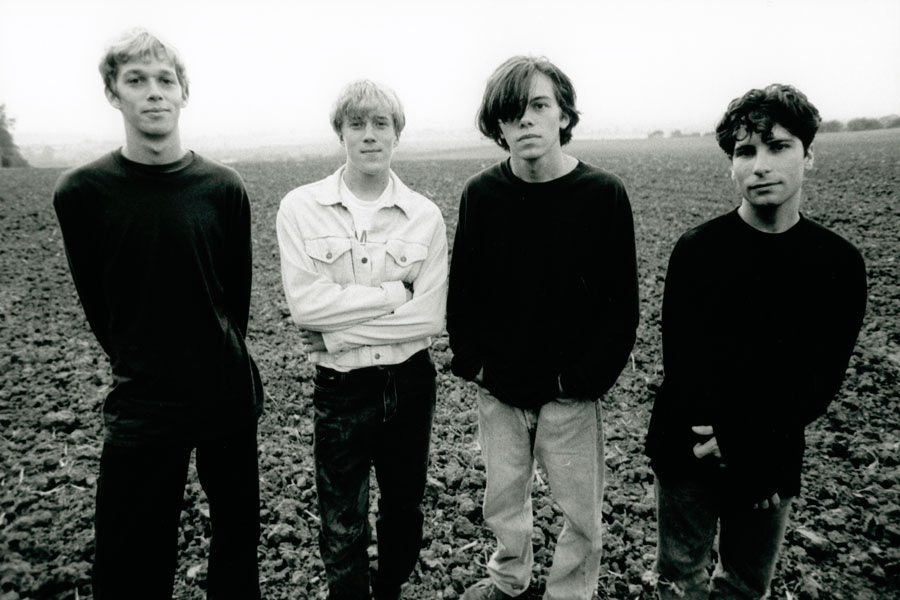
This is a fantastic sounding song by a band named Ride.
Ride were formed in 1988 in Oxford by school friends Andy Bell and Mark Gardener, before recruiting drummer Loz Colbert at the Oxfordshire School of Art & Design and local bassist Steve Queralt.
They broke up in 1996 because of differences between Andy Bell and Mark Gardener. Gardener wanted to go forward in a more dance style of music…Bell didn’t but both wanted to go more contemporary style. Bassist Steve Queralt said: The band had two future directions open to them, and they chose the wrong option.
They reunited in 2014 and released their first album in 21 years in 2017.
Twisterella peaked at #12 in 1992 in the Billboard Alternative Charts and #36 in the UK. The song was on the Really Going Back album and it peaked at #5 in the UK in 1992.
The band had 1 top ten song, 6 top 40, and 10 top 75 songs in the UK charts.
Twisterella
Any minute you will feel the chemistry Vibrations in the brain can’t ever be explained Slip away and out of sight, feel the magnet of a night The circus that you see is where you have to be
If I’ve seen it all before why’s this bus taking me back again? If I don’t need anymore why’s this bus taking me back again?
Feel the weight letting go, feel more lightness than you’ve ever known You can’t see when light’s so strong, you can’t see when light is gone
If I’ve seen it all before why’s this bus taking me back again? If I don’t need anymore why’s this bus taking me back again?
This song is an example that Badfinger was more than just their hits. Pete Ham’s ability to write memorable pop songs never wavered. Take It All was inspired by the band’s work on George Harrison’s Concert for Bangladesh project. Some of the band members were a little miffed on why Pete Ham got to play with George Harrison in the spotlight and they didn’t.
Take It All was on the album “Straight Up” This is my favorite album by them. It has Baby Blue and Day after Day but a host of other good songs. Money, Name of the Game, Suitcase, Sweet Tuesday Morning, and I’d Die Babe.
The album peaked at #31 in 1972 in the Billboard 100.
Take It All
In a way the sun has shone on me Makes it easy to make it hard Take an inch, take a yard, take it all I don’t need it at all
Any day the sun could shine on you Makes it silly to make it bad Take it good, take it glad, take it all
Don’t you know there’s a stronger thing Keeping us together Don’t you know there’s a song to sing Sing on, let the feeling take you high
Don’t you know there’s a stronger thing Keeping us together Don’t you know there’s a song to sing Sing on, let the feeling take you high
Any day the sun will shine on you Makes it silly to take it bad Make it good, take it glad, take it all I don’t need it at all, I don’t want it at all No, no, no
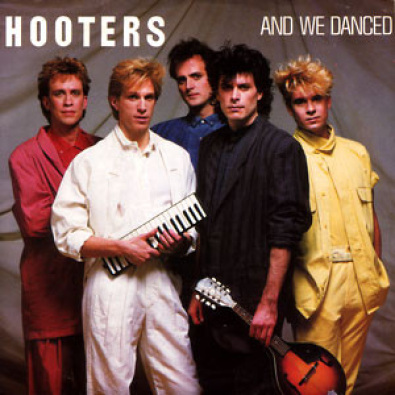
I remember hearing this song in the mid eighties and thinking that they were different than the usual bands at the time. Many bands from that era had an inflection in their voice that was down…monotoned…The Hooters were up…actually happy sounding.
The song peaked at #26 in the Billboard 100 in 1985.
Eric Bazilian and Rob Hyman are the founding members of The Hooters. They played most of the instruments on Cyndi Lauper’s 1983 debut album She’s So Unusual, and Hyman co-wrote “Time After Time.” The same year, The Hooters released their first album on an independent label and grew their following in the Philadelphia area. When Lauper’s album became a huge hit, it got the attention of Columbia Records, who signed the band.
From Songfacts
Rob Hyman told us: “Eric and I would take road trips to do writing. We would get away and especially since the band was playing so much, we would just kind of hole ourselves up. In this instance, we went into the Poconos outside the Philadelphia region and we rented a couple little cabins, brought some recording gear, set up a 4-track studio and threw around a lot of ideas. As is often the case for me, I think we did 10 or 12 tracks, and the last thing we did, probably on our last day, was write the chorus to ‘And We Danced.’ It had a slightly different feel, but materially it was there. That was the strongest bit we brought back from that writing trip. We had that flash – this is something really great, we’ll finish it another day. Had we just stayed with it that moment more, maybe we would have done it, but it ended up taking a lot more time. We threw around a lot of verses and rhythmic ideas. It was a different feel, and then it got into more of a rock and roll feel.”
The Hooters played this at Live Aid in 1985. They were the first band to perform on the Philadelphia stage, going on after an introduction ceremony that included Joan Baez singing “Amazing Grace.” Eric Bazilian told us how they got there: “That was a stroke of genius on the part of our manager, Steve Mountain. He managed to finagle that with Bill Graham and Larry Magid to get us on that stage. Our first record was just coming out, and it was the perfect time. That was our moment in destiny.”
The distinctive sound that leads off the song and plays throughout is a Melodica, a combination keyboard/harmonica instrument they played. The band called it a “Hooter,” which is where they got their name.
Regarding the images he came up with in the lyrics, Hyman told us: “The Bop Baby on a hard day’s night, the union hall – we just felt it was kind of a basic, workingman’s rock and roll record. In a sense, a bit of territory that maybe Springsteen or somebody would cover, a little of that nostalgia, a little of the no-frills kind of straight ahead lyrics. I think the ornamentation and the embellishments that the band did with the melodica and the mandolins and the sounds that we were dabbling in put a different flavor to it. But at its heart, it’s a simple rock and roll song that evokes some of those same feelings that Chuck Berry or The Beatles had. I think those images were just straight-ahead pictures for us.”
In addition to their work with The Hooters, Hyman and Bazilian have written and produced songs for many artists, including Joan Osborne, Ricky Martin, Dar Williams and Jon Bon Jovi. Bazilian wrote Osborne’s hit “One Of Us.” (Thanks to Rob and Eric for speaking with us. To learn more, check out their websites at http://www.robhyman.com and http://www.ericbazilian.com.)
And We Danced
She was a be-bop baby on a hard day’s night. She was hangin’ on Johnny , he was holdin’ on tight I could feel her coming from a mile away. There was no use talking, there was nothing to say When the band began to play and play.
And we danced like a wave on the ocean, romanced We were liars in love and we danced Swept away for a moment by chance And we danced and danced danced.
I met my be-bop baby at the Union Hall She cold dance all night and shake the paint off the walls. But when I saw her smile across a crowded room Well I knew we’d have to leave the party soon As the band began to play out of tune.
And we danced like a wave on the ocean, romanced We were liars in love and we danced Swept away for a moment by chance And we danced and danced danced.
The endless beat she’s walking my way Hear the music fade when she says Are we getting too close, do we dare to get closer The room is spinning as she whispers my name
And we danced like wave on the ocean, romanced We were liars in love and we danced Swept away for a moment by chance And we danced, danced, danced.









 PowerPop... An Eclectic Collection of Pop Culture