Joni Mitchell – Big Yellow Taxi

I heard this song the other day, and I thought to myself, “I would LOVE to post about it, but I probably already have.” I checked, and to my surprise, I had never posted it before. This is one of the first songs I remember from my youth. I was three years old when it was released but I remember it through the seventies.

She wrote “Big Yellow Taxi” in 1970, inspired by her first trip to Hawaii. When she woke up in her hotel room she was struck by the contrast between the mountains in the distance and the large parking lot below her window. The difference between natural beauty and urban development influenced the song’s opening line, “They paved paradise to put up a parking lot.” Mitchell said: I wrote ‘Big Yellow Taxi’ on my first trip to Hawaii. I took a taxi to the hotel and when I woke up the next morning, I threw back the curtains and saw these beautiful green mountains in the distance. Then, I looked down and there was a parking lot as far as the eye could see, and it broke my heart […] this blight on paradise. That’s when I sat down and wrote the song.

This is probably one of the best environmental songs out there. There are a few good ones like Rocky Mountain High, Mother Nature’s Son, Going Up Country, Beds Are Burning, Fall On Me, and Lynyrd Skynyrd’s  All I Can Do Is Write About It

The song appeared on her album Ladies of the Canyon released in 1970. The album’s title references Laurel Canyon in Los Angeles, a hub for musicians and artists during the 1960s, where Mitchell resided at 8217 Lookout Mountain Avenue. Her home became a gathering place for notable musicians, including David Crosby, Stephen Stills, and future boyfriend Graham Nash. Laurel Canyon had a vast array of talent with CSN, James Taylor, Canned Heat, The Doors, Eagles, Linda Rondstadt, and more. My friend Dave wrote a great article about that music scene that happened in the late sixties and early seventies. 

The song peaked at #67 (I checked that twice!) on the Billboard 100, #15 in Canada, and #11 in the UK. I would have bet the farm that it peaked higher than 67 here. There is a “but” to this song though…a live version came out in 1974 and that one did better. It peaked at #24 on the Billboard 100. Sometimes though it doesn’t matter where it charts. Some songs become ingrained into pop culture. Songs like In My Life by the Beatles never was released as a single and many artists have songs we all know and love that didn’t chart high or at all. And some charting songs are never remembered anymore. 

Her guitar playing is unusual, to say the least. She doesn’t use traditional chords as much as other players. She makes up different tunings in open chords. That is why when you see her play, most of the time she is using a finger to bar all of the strings. I would hate to be her guitar tech. I can’t imagine how many guitars she takes on tour with her. I used an open G chord while playing Rolling Stones songs so I would take another guitar already tuned in G so I wouldn’t have to retune my guitar in many songs. 

Big Yellow Taxi

They paved paradise, put up a parking lotWith a pink hotel, a boutique, and a swingin’ hot spot

Don’t it always seem to goThat you don’t know what you’ve got ’til it’s goneThey paved paradise, put up a parking lot(Ooh, bop-bop-bop-bop, ooh, bop-bop-bop-bop)

They took all the trees put ’em in a tree museumAnd they charged the people a dollar an’ a half just to see ’em

Don’t it always seem to goThat you don’t know what you’ve got ’til it’s goneThey paved paradise, put up a parking lot(Ooh, bop-bop-bop-bop, ooh, bop-bop-bop-bop)

Hey farmer, farmer put away that DDT nowGive me spots on my apples, but leave me the birds and the beesPlease

Don’t it always seem to goThat you don’t know what you’ve got ’til it’s goneThey paved paradise, put up a parking lot(Ooh, bop-bop-bop-bop, ooh, bop-bop-bop-bop)

Late last night I heard the screen door slamAnd a big yellow taxi took away my old man

Don’t it always seem to goThat you don’t know what you’ve got ’til it’s goneThey paved paradise, put up a parking lot (ooh, bop-bop-bop-bop)

I said don’t it always seem to goThat you don’t know what you’ve got ’til it’s goneThey paved paradise, put up a parking lot (ooh, bop-bop-bop-bop)They paved paradise, put up a parking lot (ooh, bop-bop-bop-bop)They paved paradisePut up a parking lot

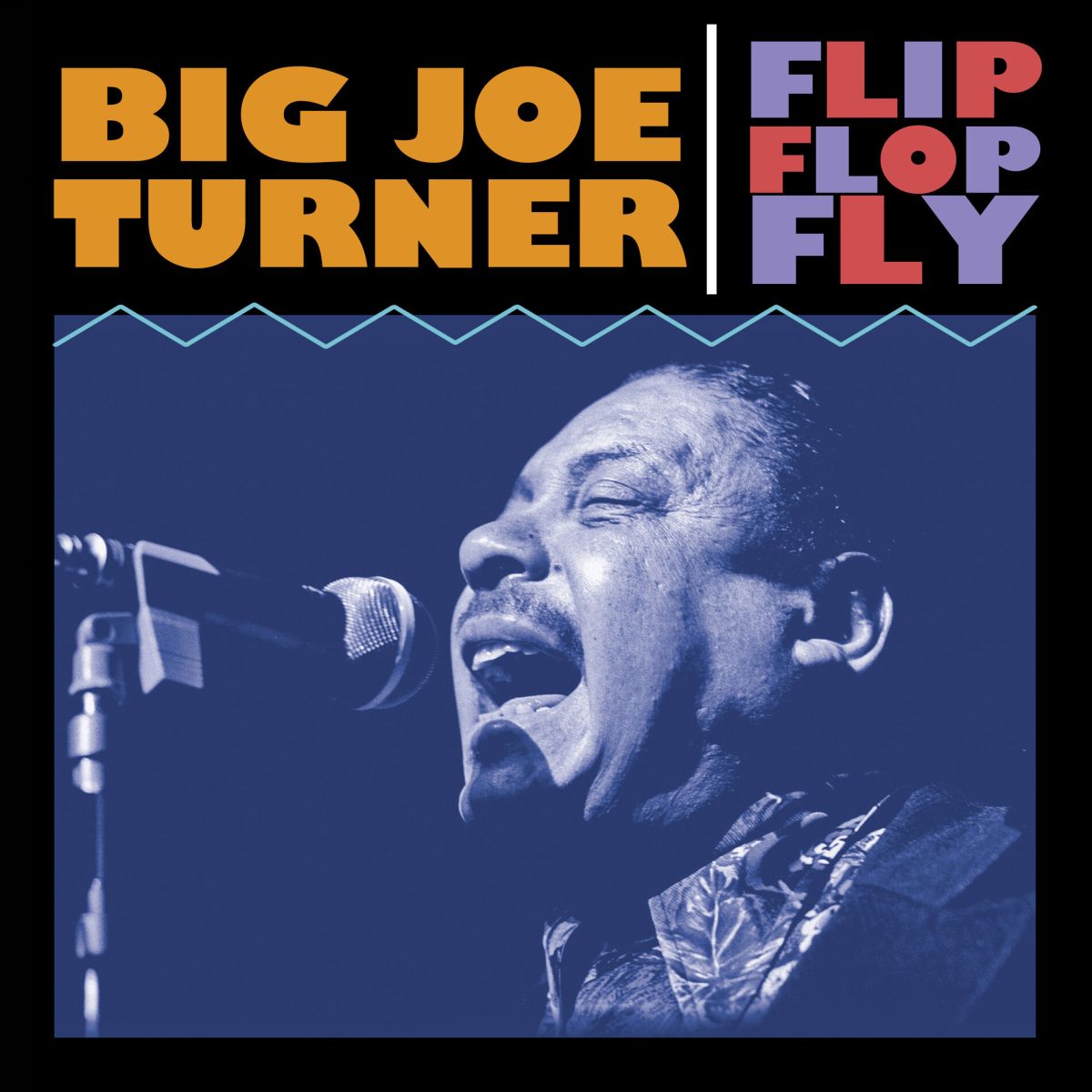
Big Joe Turner – Flip Flop and Fly

A lot of 1950s songs still get played today and we remember them but this one doesn’t get the attention although Elvis Presley, Jerry Lee Lewis, Johnnie Ray, Blues Brothers, Van Morrison, and Bill Haley covered it as well. It’s hard to beat something this simple…it just works. You don’t need a think tank… it’s just a fun song. 

Big Joe Turner (Joseph Vernon “Big Joe” Turner Jr. ) grew up in Kansas City, a major hub for jazz and blues in the early 20th century. His father passed away when he was young, leaving his mother to raise him and his siblings. Turner never formally learned to play an instrument, but he developed his booming, unmistakable voice by singing in church and later performing on street corners.

He was thriving in the Kansas City Blues Scene. He left school at age 14 (1925) to work in those Kansas Blues Clubs in the 20s and 30s. He would cook or perform as a singing waiter. In 1936 he moved to New York City. 

Signed with Atlantic Records in the 1950s and had a string of rhythm & blues hits. His upbeat jump blues style helped transition R&B into early rock & roll. He wrote and recorded songs like  Shake, Rattle and Roll (1954)… One of the first songs that bridged blues and rock & roll. It was later covered by Bill Haley & Elvis Presley. Probably one of the most important songs in Rock and Roll history. 

His success proved that older blues artists could thrive in the rock & roll era. This song was released in 1955 and has been covered 91 times. 

Flip Flop and Fly

Now when I get the blues, I get me a rockin’ chair
When I get the blues, I get me a rockin’ chair
Well, if the blues overtake me gonna rock right away from here

Now when I get lonesome, I jump on the telephone
When I get lonesome, I jump on the telephone
I call my baby, tell her I’m on my way back home

Now flip, flop and fly
I don’t care if I die
Now flip, flop and fly
I don’t care if I die
Don’t ever leave me, don’t ever say goodbye

Give me one more kiss, hold it a long long time
Now love me baby, till the feelin’ hits my head like wine

Here comes my baby, flashin’ her new gold tooth
Well she’s so small, she can mambo in a pay phone booth

Now flip, flop and fly
I don’t care if I die
Now flip, flop and fly
I don’t care if I die
Ah, don’t ever leave me, don’t ever say goodbye

I’m like a mississippi bullfrog, sittin’ on a hollow stump
I got so many women, I don’t know which way to jump

Now flip, flop and fly
I don’t care if I die
Now flip, flop and fly
I don’t care if I die
Now, don’t ever leave me, don’t ever say goodbye
Oh my!

Hey Kid, Catch Commercial

If I had to name my favorite commercials, it would be a really short list. This Mean Joe Greene and Kid commercial would top the shortlist, though. People talk about famous Super Bowl commercials. This one is probably remembered the most. I loved it as a kid…watching Mean Joe Greene, who just by name alone would scare you…but to see him as a kind person giving a kid a jersey? It made me root for the Steelers at the time…although I pulled for the Rams in the Super Bowl…that didn’t help. 

This ad debuted on October 1, 1979. It showed an injured Mean Joe headed for the locker room to encounter a star-struck kid (Tommy Okon) who offered Mean Joe a coke. Greene eventually took the coke and while limping away pitched his jersey to the kid.

The commercial spot aired repeatedly through Superbowl XIV where the Steelers beat the Rams 31-19. It took 3 days to film the commercial and Joe ended up drinking around 18 cokes to finish it.

When Greene found out Tommy Okon didn’t get to keep the jersey from the commercial, he mailed him an autographed jersey for Christmas. This says a lot about Greene’s character. Why didn’t the commercial people let the kid keep the jersey? 

Coke looked at Roger Staubach, Tony Dorsett, Ed “Too Tall” Jones, and teammate Jack Lambert but Joe Greene won out. The right man got the job. The commercial helped to soften Joe Greene’s reputation. Before it aired, Greene said people were intimidated by him. This is a quote from Greene. “I was suddenly approachable, little kids were no longer afraid of me, and older people – both women and men – would come up and offer me a Coke.”

It was directed by Roger Mosconi, and produced by McCann Erickson for Coca-Cola. Tommy Okon was a nine-year-old child actor at the time. It was later remade multiple times, including versions featuring soccer star Zico in Brazil and other athletes worldwide.

Greene was injured at the time of filming. His limping in the commercial wasn’t entirely an act…he had been dealing with real knee pain. Between that and all the soda he drank, he later joked that it was one of the toughest things he had done in his career.

It also should be said how popular the Steelers were in the 1970s. They were the first team to win 4 Super Bowls and were without a defeat. They had one of the best defenses ever, and their offense was run by Terry Bradshaw. By this time, the team was aging, and they would win their 3rd Super Bowl against the Rams a few months after the commercial was filmed. They are considered one of the greatest teams in the NFL ever. Greene was nearing the end of his career. He was drafted in 1969 and would retire in 1981. 

Reunion 36 years later. 

The Iron Eyes Cody Commercials

People start pollution. People can stop it.

Maybe the most famous tear in pop culture is Iron Eyes Cody, an actor in Native American clothing who shows us the tragedy of littering. He debuted Earth Day, April 22, 1971, at the close of a public service advertisement for the anti-litter organization Keep America Beautiful.

The ad contributed to increased environmental consciousness in the U.S., particularly during the 1970s. The commercials helped spur the passage of anti-littering laws and programs such as The Clean Water Act (1972),  The Resource Conservation and Recovery Act (1976), and the creation of recycling initiatives in cities nationwide.

At the time of the commercial’s debut, the counterculture was starting to embrace Native American Culture. Iron Eyes Cody could be seen in printed ads, television, and billboards. He was known by the press as the “Crying Indian.”

Born on April 3, 1904, as Espera Oscar de Corti, Cody’s parents were both Sicilian immigrants (Antonio de Corti and his wife, Francesca Salpietra). He grew up in Gueydan, Vermilion Parish, Louisiana, where his parents ran a grocery store.

He portrayed Indians in television shows and movies dating back to 1926. His last appearance was in the 1970s spoof movie The Spirit of 76 released in 1990. He played the role on-screen as well as off…He would deny he wasn’t Native American as late as 1996 and until he passed away in 1999 at the age of 94.

Real or not he did have an effect on me…To a young kid, this hit home. I remember this commercial rather well and there is another anti-littering commercial that I remember. Only people in Tennessee would probably remember it was called “Tennessee Trash.” I have it below the Iron Eye’s Cody video.

The ad remains one of the most memorable and emotionally impactful of all commercials to be made. 

The below commercial in 1976 was so popular that they remade it twenty-two years later. I have to say the song will stay in your head. It was filmed on an unopened stretch of I-24 at the time. The theme was sung by country singer-songwriter Ed Bruce and features Irving Kane as the ultimate litterbug.

Purina Chuckwagon Commercials

I loved these commercials when I was a kid. I wasn’t allowed to have a dog in the house (which is probably why I’ve had three Saint Bernard house dogs). Some poor dog would be bewildered by a miniature chuck wagon, then scurries through the home and into the kitchen cabinet or tv after it.

In 1967, Purina launched “Chuck Wagon” as their latest dog food innovation. Packaged as dry dog food, adding warm water would rehydrate the serving to some extent, as well as cause the meal to produce its own gravy

The commercials had a Western theme, playing into Chuck Wagon’s branding as a hearty, wholesome meal for dogs. The animated mini chuck wagon would appear from unexpected places—such as behind a cabinet door, under a table, or from inside a dog food bag…creating a playful and imaginative effect. I can’t tell you how much this worked during that time period. 

In some shots, stop-motion animation was used, where the wagon was moved frame by frame to give the illusion of self-propelled motion. In other cases, puppetry techniques such as invisible wires or rods helped guide the wagon across the floor.

Now… this was hard to believe but in 1983 Atari released a video game based on this commercial called “Chase the Chuckwagon.

Image result for atari Chase the Chuck Wagon


Magic 8 Ball

I was told as a kid that a Magic 8 Ball could predict the future. I bought it hook line and sinker…I was also told by my older sister (8 years older) that snakes bite the second person in a line while I was merrily leading the way hiking in the woods as a 5-year-old…so I caught on pretty quick after I stepped on a snake…didn’t get bit though…but I never let her forget it.

I bugged my mom till she got me the mysterious Magic 8 Ball. I was amazed at this toy…well it wasn’t a toy to me. I thought this was great. So being 5-6 years old I thought I would put it to use… Oh, Magic 8 Ball should I color in the encyclopedias with my crayons? I shook it up and waited for the triangle to give me the answer… “signs point to yes”…those signs must have pointed in a different direction than my Mom… she wasn’t a fan of the Magic 8 ball after that.

Abe Bookman invented the Magic 8 Ball, a fortune-telling toy currently manufactured by Mattel.

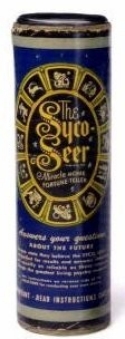
During World War II, a man named Alfred Carter in Cincinnati created a tube-like fortune-telling toy. To help him he got his brother-in-law to help…that would be Abe Bookman. they created a 7″ tube device with glass on both ends with a pair of floating dice with responses. It was sold as the “Syco-Seer: The Miracle Home Fortune Teller.” Their company was called Alabe Crafts.

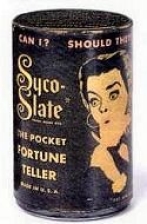
The original Magic 8 Ball was tubular and went by the name Syco-Seer. The Magic 8 Ball above. The Syco-Seer metal cylindar above. The Syco-Slate Pocekt Fortune-Teller at right.

Carter died in 1948 and Bookman revised it into a crystal ball but it still didn’t sell really well. Then the Brunswick Billiards company commissioned Bookman to make them one shaped like an 8 ball as a promotional giveaway.

After the giveaway was finished Bookman kept producing them shaped like an 8 ball.

The Magic 8 Ball that we have known since then has contained a 20-sided polygon inside a hollow plastic ball, floating in a liquid-filled, 3-inch diameter tube. The liquid largely consists of dark blue ink and alcohol. The predictions, yes, no, or non-committal, appear on each triangular face of the polygon.

Bookman marketed it as a conversation piece, a paperweight and then a toy.

Ideal Toys bought Alabe Crafts in 1971. Next, Tyco Toys bought the ball in ’87. Mattel owns it today and sells one million units a year.

Here are the magical statements of the Magic 8 Ball

  • As I see it, yes
  • Ask again later
  • Better not tell you now
  • Cannot predict now
  • Concentrate and ask again
  • Don’t count on it
  • It is certain
  • It is decidedly so
  • Most likely
  • My reply is no
  • My sources say no
  • Outlook good
  • Outlook not so good
  • Reply hazy, try again
  • Signs point to yes
  • Very doubtful
  • Without a doubt
  • Yes
  • Yes, definitely
  • You may rely on it.

Grateful Dead – Fire On The Mountain

I like a couple of Fire on the Mountain songs: The Marshall Tucker Band and this one. They’re two totally different songs, but both are really good. I want to thank Jim for this because he sent me some information about this song in an email. 

Fire on the Mountain’s music was primarily written by one of the Grateful Dead’s drummers, Mickey Hart, with lyrics by the band’s lyricist, Robert Hunter. The song’s groove reflects Hart’s rhythm sensibilities, while Hunter’s lyrics (as with most of his) are open to interpretation and rich with imagery.

The song initially existed as an instrumental titled Happiness is Drumming, which appeared on Mickey Hart’s 1976 solo album, Diga. The instrumental version already contained the core melody.  The song evolved into the version that the Grateful Dead began performing live in 1977 and eventually included on their 1978 album Shakedown Street.

The first time I heard the song was a live video of The Grateful Dead playing in Egypt in 1978. I’ve watched that concert many times, and it’s fantastic. This song was one of the songs that got me into the band. When they played it live, the song was frequently paired with Scarlet Begonias. 

The Dead didn’t always do commercially huge songs but some songs like this one…should have been at least released as a single. 

Robert Hunter: “Written at Mickey Hart’s ranch in heated inspiration as the surrounding hills blazed and the fire approached the recording studio where we were working.”

Fire On The Mountain

Long distance runner, what you standin’ there for?Get up, get out, get out of the doorYou’re playin’ cold music on the barroom floorDrowned in your laughter and dead to the coreThere’s a dragon with matches that’s loose on the townTakes a whole pail of water just to cool him down

Fire! Fire on the mountainFire! Fire on the mountainFire! Fire on the mountainFire! Fire on the mountain

Almost ablaze, still you don’t feel the heatIt takes all you got just to stay on the beatYou say it’s a livin’, we all gotta eatBut you’re here alone, there’s no one to competeIf Mercy’s a business, I wish it for youMore than just ashes when your dreams come true

Fire! Fire on the mountainFire! Fire on the mountainFire! Fire on the mountainFire! Fire on the mountain

Long distance runner, what you holdin’ out for?Caught in slow motion in a dash for the doorThe flame from your stage has now spread to the floorYou gave all you had, why you wanna give more?The more that you give, the more it will takeTo the thin line beyond, which you really can’t fake

Fire! Fire on the mountainFire! Fire on the mountainFire! Fire on the mountainFire! Fire on the mountain

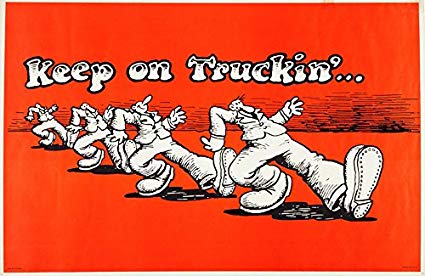
Keep On Truckin’ Poster

I have this hanging in my music room. I saw it on shirts, bumper stickers, and walls everywhere once upon a time. This phrase was used in a song from the 1930s called “Truckin’ My Blues Away” by Blind Boy Fuller and is the origin of this image.

In the seventies as a kid…I remember this phrase and picture everywhere. I saw bumper stickers, pics in magazines, and on patches for pants. In one local restaurant I went to as a kid they had this poster in the dining room. Fast forward to the 90s and the picture was still there. The place was sold in the 2000s and I tried to get the poster but they threw it away…arghhhh. It would have been cool to have that original one. 

Besides the smiley face…it’s one of the most iconic graphics of the 1970s. It was created by Robert Crumb for Zap Comics in 1968. The image was used many times without his permission for years. It was claimed that the Trademark symbol ™ was not on the original drawing.

Crumb went to court and the court ruled it Public Domain. The decision was later reversed in 1977. He sued many for using it including Amazon 2005. Crumb also came up with Fritz the Cat…

Quotes from Robert Crumb on the drawing.

For a while I was most well known for that [the Janis Joplin album cover, and for “Keep on Truckin’.” That was a drawing that came out of LSD trips, and the words came from a Blind Boy Fuller song from 1935. I drew it in my sketchbook and then for Zap. It sort of caught the popular imagination. It became a horrible popular thing.

Take Keep On Truckin’… for example. Keep on Truckin’… is the curse of my life. This stupid little cartoon caught on hugely. … I didn’t want to turn into a greeting card artist for the counter-culture! I didn’t want to do ‘shtick’—the thing Lenny Bruce warned against. That’s when I started to let out all my perverse sex fantasies. It was the only way out of being “America’s Best Loved Hippie Cartoonist.”

keep.jpg

Bigfoot

No, it’s not a new or old rock band. I have posted on many icons and events of the 1960s-1970s but never really concentrated on this big fellow. 

I know as a kid…Bigfoot was part of the culture and kids thought yea…he is real. Native American legends tell of large, hairy human-like creatures that have been part of Indigenous cultures across North America for centuries. Many tribes have their own names and variations of Bigfoot, each with distinct characteristics and significance.

The most famous film clip was the Patterson-Gimlin footage from 1967.

 Jeffery Meldrum is a professor of anatomy and anthropology at Idaho State University, and he’s known for being one of the few academics to openly study Sasquatch. “It’s all so easy to say, ‘Obviously that’s a man in a fur suit.’ Until you see it up against a man in a fur suit.” 

The National Geographic documentary Mystery 360: Bigfoot Revealed, where they went absolutely all-out to try and recreate the Patterson-Gimlin bigfoot with modern technology (suit and all…) but ultimately couldn’t. Before this documentary, everyone assumed there was someone with a gorilla suit. 

No matter how real the subject in the film appears, how much muscle movement you think you see, or how unhuman they claim the gait is, the subject has no corroborating specimen, and can therefore be no more than a question mark. The film has always been, is, and likely always will be an unsettled controversy. 

In 2003 Bob Heironimus, a retired Pepsi bottler from Yakima, Washington came out and said that he played Bigfoot in the film. “It’s time to let this thing go. I’ve been burdened with this for 36 years, seeing the film clip on TV numerous times. Somebody’s making lots of money off this, except for me. But that’s not the issue — the issue is that it’s time to finally let people know the truth.” Heironimus, 63, makes his full “confession,” as he calls it, in a published book by paranormal investigator Greg Long. He also wanted money from the film and filed a suit but it never went anywhere. 


Tom Malone, a lawyer in Minneapolis, on behalf of Bob Gimlin, an associate of the now-dead Bigfoot filmmaker. “I’m authorized to tell you that nobody wore a gorilla suit or monkey suit and that Mr. Gimlin’s position is that it’s absolutely false and untrue.” And the mystery lives on . . .

Many have broken the film down frame by frame and investigating it. It’s really interesting. 

I remember on television that some shows featured Bigfoot. The Six Million Dollar Man featured Bigfoot and don’t think we were all watching at the time. There has been many documentaries on him and movies including Harry And The Hendersons. We cannot forget the monster truck Bigfoot. 

Bigfoot is part of our popular culture and will probably always be but I would guess he peaked in the 1970s. 

The Stabilized Clip


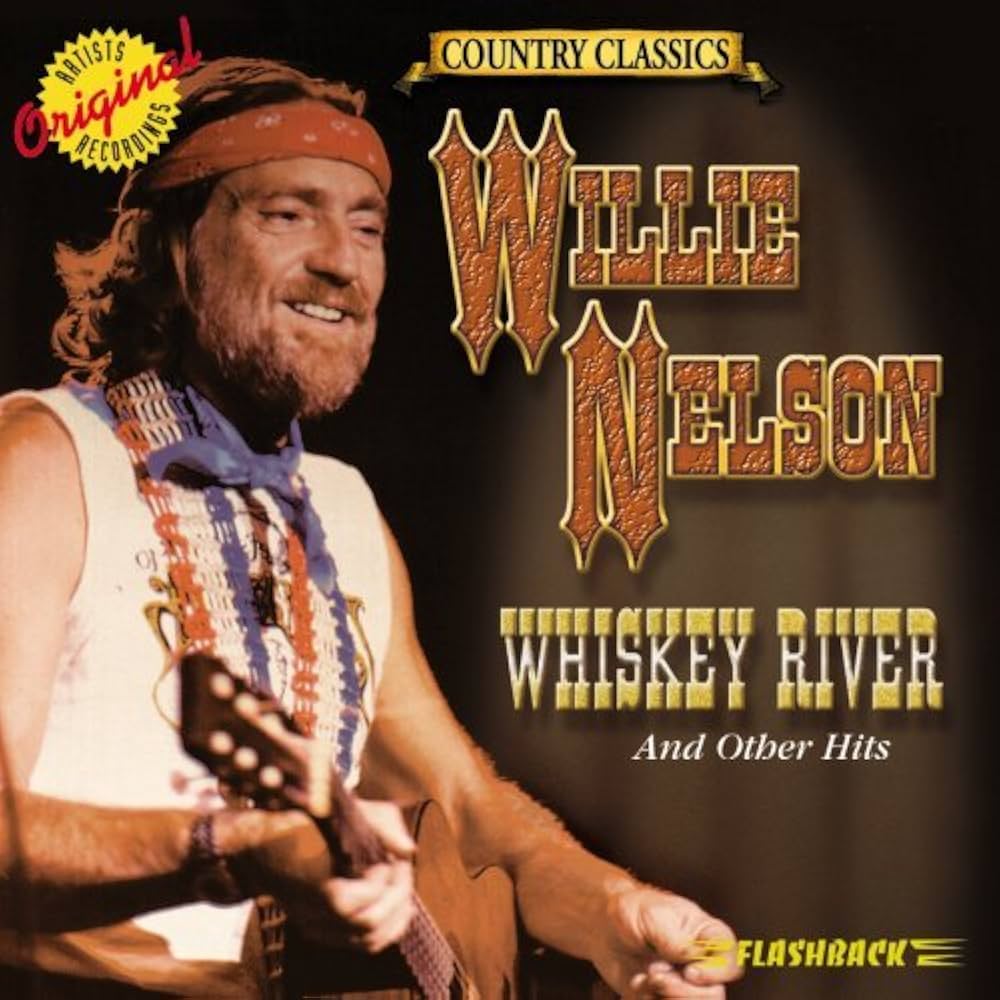
Willie Nelson – Whiskey River

After watching that Maria Muldaur video last week with Leon and Willie included…I wanted to listen to some of Nelson’s songs this past week. This one I remember as a kid. This song was on the album Shotgun Willie. It was a turning point for Willie Nelson…he left Nashville’s mainstream country for the Country Outlaw scene. 

I remember Outlaw Country back when I was a kid. Waylon Jennings, Kris Kristofferson, Charlie Daniels, Johnny Cash, and Willie Nelson are who I remember the most. It was a no-frills version of country music. This was not as polished as what you heard on country radio. It had an authentic and raw sound that people were happy to hear. 

I always thought they brought the Rock image element and feel into country music with these artists. Many of them would have songs that crossed over to the pop charts like Waylon, Willie, and Kristofferson. 

Willie is an American icon, reaching people like Johnny Cash did in country music and beyond. He crosses genres quite well with his music and laid-back image. I also love his guitar Trigger. That guitar is an N-20 Martin. He bought the guitar in 1969 when someone stepped on his Baldwin Guitar. He had the pickups on the Baldwin moved to the Martin. Willie came to love the guitar, he said: “One of the secrets to my sound is almost beyond explanation. My battered old Martin guitar, Trigger, has the greatest tone I’ve ever heard from a guitar. … If I picked up the finest guitar made this year and tried to play my solos exactly the way you heard them on the radio or even at last night’s show, I’d always be a copy of myself and we’d all end up bored. But if I play an instrument that is now a part of me, and do it according to the way that feels right for me … I’ll always be an original”

Shotgun Willie marked a huge departure from Nelson’s previous work. Out came the Willie Nelson that we now know. His look and music changed. 

The song was originally written by Johnny Bush and Paul Stroud in 1972. Willie’s version would always be the definite version of the song. If you listen to Bush’s version compared to Willies…you will quickly see the difference between mainstream country and Outlaw country. This song did well for Nelson…it peaked at #12 on the Billboard Country Charts and #3 on the Canadian RPM Country Tracks charts. Bush was happy about Willie covering it…they were friends and Willie took the song to a huge audience. Outlaw country artists sought more creative control over their music, production, and image… breaking away from the Nashville establishment.

The late Toby Keith with “I’ll Never Smoke Weed With Willie Again” and yes it was a true story. 

Whiskey River

Whiskey River take my mindDon’t let her mem’ry torture meWhiskey River don’t run dryYou’re all I’ve got, take care of me

Whiskey River take my mindDon’t let her mem’ry torture meWhiskey River don’t run dryYou’re all I’ve got, take care of me

I’m drowning in a whiskey riverBathing my mem’ried mind in the wetness of its soulFeeling the amber current flowin’ from my mindAnd warm an empty heart you left so cold

Whiskey River take my mindDon’t let her mem’ry torture meWhiskey River don’t run dryYou’re all I’ve got, take care of me

I’m drowning in a whiskey riverBathing my mem’ried mind in the wetness of its soulFeeling the amber current flowin’ from my mindAnd warm an empty heart you left so cold

Whiskey River take my mindDon’t let her mem’ry torture meWhiskey River don’t run dryYou’re all I’ve got, take care of me

Stiff Records Week – Nick Lowe – Halfway To Paradise

How cool was it that Motörhead and Nick Lowe were labelmates? That shows you the diverse talent in Stiff Records. 

I’m going to wrap it up this week with some Nick Lowe. This was his second and last single for Stiff Records. You know what? I don’t think I’ve ever heard a Nick Lowe song I didn’t like. I was going to include The Damned and Lene Lovich this week but they will be coming soon. A blogger named Warren asked about Lene Lovich and I will have a post on her in the coming weeks…thank you Warren for the suggestion. I already had today’s posts written. 

Listening to this song and I’m struck by backup vocals going on. He paints a sound picture with layers of backups with a simple musical structure. Yes…I get really excited by power pop (hence the blog’s name) done right and Lowe does it right. When you listen to this song…it fits in so well with Lowes catalog that I would have thought he wrote it. But this is some Brill Building brilliance here made better by Lowe. Simple yet so likable.

Carole King and Gerry Goffin wrote the song. Tony Orlando first recorded it in 1961, peaking at #39 on the U.S. Billboard Hot 100 and Billy Fury recorded it as well. This Lowe version was later included as a bonus track on re-releasing his 1978 album, “Jesus of Cool.” 

I hope you enjoyed this week and these posts might have introduced you to a new song. I have a new appreciation for this record label…what they were able to do and the talent they found. In the middle of disco, Led Zeppelin, reggae, Pink Floyd, and other types of music…Stiff Records made a home for these different type of artists to flourish…thank you all for reading.

And remember Stiff Records… If it ain’t stiff it ain’t worth a f***

A short bio on Nick Lowe talking about his career I thought you might like. Have a great weekend!

Halfway To Paradise

I want to be your loverBut your friend is all I’ve stayedI’m only halfway to paradiseSo near, yet so far away

I long for your lips to kiss my lipsBut just when I think they mayYou lead me halfway to paradiseSo near, yet so far away, mmm

Bein’ close to you is almost heaven (heaven)But seein’ you can do just so muchIt hurts me so to know your heart’s a treasure (treasure)And that my heart is forbidden to touch, so

Put your sweet lips close to my lipsAnd tell me that’s where they’re gonna stayDon’t lead me halfway to paradiseMmm, so near, yet so far away

Oh, uh, oh so near, yet so far awayYeah, yeah so near, yet so far away

Stiff Records Week – Elvis Costello – Watching The Detectives

 I was around 11 walking through a drug store in the late seventies and I saw this album cover…I thought what? Another person named Elvis? Who is this skinny guy?

Image result for elvis costello my aim is true cover

While at the drug store, the guy was playing this album for the entire store and I heard Alison… That was the first thing I ever heard from Elvis from his debut album My Aim Is True. Later on, I would get the album and I knew this guy was different. He would blend punk, reggae, pop, pub rock, and new wave.

This song was inspired by Costello’s experience of staying awake for 36 hours, during which he listened repeatedly to The Clash’s debut album. Initially unimpressed, he grew to appreciate it after many listens. He stayed up by consuming an entire jar of instant coffee and that led to the creation of Watching The Detectives. 

Costello has said that Watching the Detectives was a favorite of his from the early years of his career. He also experimented with different arrangements of the song, including a big band version with Allen Toussaint to capture the film qualities and swing rhythms of 1950s detective shows. 

Before recording the album, Costello worked as a computer operator while performing in pubs and writing songs. He sent demo tapes to different record labels but initially received little interest. Costello caught the attention of Jake Riviera, co-founder of Stiff Records known for his edgy approach. Riviera saw potential in Costello’s demos and signed him.

My Aim is True was released in 1977 and peaked at #14 in the UK, #32 on the Billboard Album Charts, #24 in Canada, and #32 in New Zealand. The song peaked at #15 in the UK and #60 in Canada. 

Elvis Costello: “When we did ‘Watching the Detectives,’ it was the first record that Steve Nieve played on. He was 19, straight out of the Royal College, and we’d only just met. I said, ‘This is about detectives, I want a piano thing that sounds like Bernard Hermann,’ and, of course, he didn’t know what I’m talking about, so I go [makes staccato, sharp sound], and what you hear on the record is this galloping piano thing that rushes the beat and it sounds like one of those sudden jarring gestures that Hermann would use a lot. But we didn’t have 19 clarinets or whatever he used [in] Torn Curtain; we just had a battered upright in an eight-track studio. What you imagine you have to render whether you use a fuzz-tone guitar or a symphony orchestra and everything in between.”

Elvis Costello: “I spent a lot of time with just a big jar of instant coffee and the first Clash album, listening to it over and over. By the time I got down to the last few grains, I had written ‘Watching the Detectives.’”

Watching the Detectives

Nice girls, not one with a defectCellophane shrink-wrapped, so correctRed dogs under illegal legsShe looks so good that he gets down and begs

She is watching the detectives“Ooh, it’s so cute”She’s watching the detectivesWhen they shoot, shoot, shoot, shootThey beat him up until the teardrops startBut he can’t be wounded ’cause he’s got no heart

Long shot of that jumping signInvisible shivers running down my spineCut to baby taking off her clothesClose-up of the sign that says: “We never close”

You snatch a chill and you match a cigaretteShe pulls the eyes out with a face like a magnetI don’t know how much more of this I can takeShe’s filing her nails while they’re dragging the lake

She is watching the detectives“Oh, he’s so cute”She is watching the detectivesOh, and they shoot, shoot, shoot, shootThey beat him up until the teardrops startBut he can’t be wounded ’cause he’s got no heart

You think you’re alone until you realize you’re in itNow baby’s here to stay, love is here for a visitThey call it instant justice when it’s past the legal limitSomeone’s scratching at the window, I wonder, who is it?

The detectives come to check if you belong to the parentsWho are ready to hear the worst about their daughter’s disappearanceThough it nearly took a miracle to get you to stayIt only took my little fingers to blow you away

Just like watching the detectivesDon’t get cuteJust like watching the detectivesI get so angry when the teardrops startBut he can’t be wounded ’cause he’s got no heart

Watching the detectivesIt’s just like watching the detectivesWatching the detectivesWatching the detectivesWatching the detectivesWe’re watching the detectivesThey’re watching the detectivesWatching the detectivesWatching the detectives

Stiff Records

This week I’m going to tip the proverbial cap to the pioneering Stiff Records which was an independent Record Company that helped a lot of artists in the UK. I’ll be posting a song each day off that label. This week I’ve written up 3 songs and Randy and Dave are going to contribute two songs. I really appreciate them for doing that. 

Stiff Records gave you an alternative to the Top 40. They would take chances on performers than the established record companies wouldn’t take. Who would have taken a chance on a nerdy-looking fellow named Elvis Costello? Many of the artists didn’t fit in with the major labels’ idea of what an artist should sound or look like. They had their own unique roster of talent. 

This could be a mile-long post but I’m going to keep it short. This record company was created in 1976 by Dave Robinson and Jake Riviera. The label was created to capitalize on the new punk and new wave scenes, providing an alternative to the major record companies. They used bold marketing tactics…their slogan was “If It Ain’t Stiff, It Ain’t Worth a F***. The company didn’t have a lot of money but they had plenty of ideas. 

Stiff REcords people

They signed a lot of talent and that talent is what we are going over this week. I wanted to do a week of Stiff Records and let’s see what we will find. The talent was Elvis Costello, Nick Lowe, Ian Dury and The Blockheads, The Rumour, Madness, The Damned, Motorhead, Devo and even Tracey Ullman. 

Jake Riviera left in 1978 to form Radar Records, taking Elvis Costello and Nick Lowe with him. Despite its success, the label faced financial difficulties in the early 1980s. Stiff was sold to Island Records in 1984, which marked the end of its independent era.

Stiff Records was revived in the 2000s by ZTT Records (Zang Tumb Tuum), releasing new music while managing its extensive back catalog.

Nike Lowe: The pop business was full of these dreadful groups, Genesis and Journey and REO Speedwagon and people like that. And it was all safe and run by these bean counters and know-nothings. That’s why, over here, the pub rock thing started up. When punk came along a few years later, that was the thing that it really needed, but I would say that pub rock was spawned for the same reasons — dissatisfaction that it was all rubbish and needed to be pulled down. Because it had gotten to a point where you just couldn’t have another concept album or triple bullshit thing.

Gene Vincent – I’m Goin’ Home (To See My Baby)

I love this man’s music. He is severely overlooked by many who only know Be Bob A-Lula. His voice goes with that slapback echo better than any other singer. His influence can be heard through the decades including Springsteen in Glory Days. This song has been covered 15 times including The Zombies

One thing about Vincent. You can hear people emulate Elvis and Johnny Cash but no one sounded like Vincent. Besides, no one sounding like him… no one looked like him either. No pompadour. No huge hair. Just a curly sort of quiff-ish look. 

 Union restrictions prevented his own band, the Blue Caps, from crossing the Atlantic with him, Gene Vincent had been forced to use a British backing group, and the group selected for his UK tour was Sounds Incorporated. 

The song is different in some ways. I love the sax in this song and the drumming (Tony Newman). The song has some cool dynamics built in as it starts off with just Gene and a nice guitar…it then starts with the drums and plows ahead until the end. Sounds Incorporated backed him on this song and the B-side Love Of A Man. This was their big break and after this, they also backed Little Richard, Jerry Lee Lewis, Brenda Lee, and Sam Cooke.

I’ll mention Springsteen again because the man knows dynamics in songs and artists like this inspired him. The song was written by Bob Bain and was released in 1961. It peaked at #36 in the UK Charts. It was a pure single…not off an album. 

By this time the UK was where all of the 50’s rock stars went because America was too busy listening to Paul Anka, Fabion, and Pat Boone. It was a sad state of music at that time for rock and roll. The parents probably loved the no soul no trouble singers. Then thankfully…the British invasion and Motown were coming up.


I’m Goin’ Home Home (To See My Baby)

Well, I’m going home, to see my baby
Yeah, I’m going home, to see my gal
Well, don’t you know, she really loves me
Ah, don’t you know, she really cares

Yeah, I’m going home, to see my baby
Well, I’m going home, to see my gal
Ah, don’t you know, she really loves me
Yeah, I’m going home, to see my gal

Well, I’m going home, to see my baby
Yeah, I’m going home, to see my gal
Ah, don’t you know, she really loves me
Ah, don’t you know, she really cares

She’s there to love me every night
Don’t you know she treats me right
Yeah, she’s alright, yeah…

She’s there to love me all the time
Don’t you know I’m glad she’s mine
Yeah, she’s alright, yeah…

Well, I’m going home, to see my baby
Well, I’m going home, to see my gal
Ah, don’t you know, that she’s my baby
Well, don’t you know, that she’s my gal

She’s there to love me all the time
Don’t you know I’m glad shе’s mine


Replacements – Little Mascara

Great name for a song or a band…and that guitar is what I was sorely missing around this time in the 1980s. This album was in the stretch of great albums by the band. Let It Be, Tim, and Please To Meet Me. Personally, I never knew how big this song was with fans. One search on YouTube and you can find bands covering this song everywhere.

Everyone who knows me… knows I’m not a huge fan of the Top 40 in the 1980s but alternative rock is a different story. In my opinion, the two best American alternative rock bands to come out of the 80s were The Replacements and R.E.M. The Replacements were the generation’s Big Star influencing 1990s and 2000s bands. They had a secret weapon in Westerberg as a songwriter. I would safely say they were two of my favorite bands in the 80s.

This song was on their 1985 album Tim. Why was the album called Tim? There was no reference to the name on the album. The band’s manager said that he asked Paul Westerberg what the name of the album would be. Paul told him “Tim,” and the manager asked why. Paul said, “because it’s such a nice name.”

This album was their first major label release on Sire Records in 1984. This would be the last album by the original band because Bob Stinson would be kicked out a couple of years later. Stinson did a great solo in this song…very Keith Richards-like.

Tim was placed 136th on Rolling Stone’s 2003 list of the 500 greatest albums of all time, and 137 in a 2012 revised list. The album peaked at #186 in the Billboard Album Chart in 1986.

I couldn’t find any footage of them originally doing this song live so here they are when they regrouped in the teens.

Little Mascara

You and I fall togetherYou and I sleep aloneAfter all, things might be betterAfter one, and there’s one that’s long gone

For the moon you keep shootin’Throw your rope up in the airFor the kids you stay togetherYou nap ’em and you slap ’em in a highchairAll you ever wanted was someone to take care of yaAll you’re ever losin’ is a little mascaraLittle mascaraLittle mascara

Afternoon, things are quietSettle back now if you canStations clip by like a rocketDon’t you worry if you wonder why he ran

All you ever wanted was someone to take care of yaAll you’re ever losin’ is a little mascaraLittle mascaraLittle mascaraThat you cry, cryThat you cryYour eyes outThat you cryThat you cryThat you cryYour eyes out

All you ever wanted was someone Ma’d be scared ofAll you’re ever losin’ isA little mascaraLittle mascaraLittle mascaraThat you cryThat you cryThat you cryYour eyes outThat you cryThat you cryThat you cryYour eyes outThat you cryThat you cryThat you cry…