This is a lively song by Van the Man…Van Morrison. First heard this song after I bought the Van Morrison album Saint Dominic’s Preview in the 80s without knowing any song on it…I didn’t need to…it was Van Morrison. Van is one of my favorite singers…it’s not just his voice but the way he phrases his words. If you ever get a chance to see him live…do it. I got that honor (The Pay The Devil tour) once and I have to say he sounded better live than on record and that doesn’t happen a lot.
The song peaked at #62 on the Billboard 100 in 1972. This song is an obvious tribute to the great Jackie Wison.
The opening track of Saint Dominic’s Preview, this is a tribute to Jackie Wilson, one of Morrison’s influences. Released as the first single from the album, it charted at #61 on the Hot 100.
Guitarist Doug Messenger recalled the recording of the song to Uncut: “Jackie Wilson Said was totally disorganized. He didn’t know where anything went, and no one seemed to know what to do with it. Van went away and the band worked on the basic structure. When he came back we went through it a couple of times and he was real happy because all of a sudden it seemed to be making sense. He said, ‘I think it’s coming together,’ which is what he always said when he felt it was working.”
“I remember he said to the drummer, Ricky Schlosser, ‘When I sing “boom boom boom,” hit the tom and the kick drum at the same time.’ We ran through it once or twice, and the first recorded take is what’s on the album. It was all over the place, but somehow it worked. Even when he ad-libbed at the end -‘One more time’- somehow we all kept it together. At the end, Van was smiling like a Cheshire Cat. ‘I think we got it!’ We tried a second take and – of course – it all fell apart.”
The song was used as the opening theme for the 1991 comedy movie Queens Logic.
This was covered by Dexys Midnight Runners on their 1982 album Too-Rye-Ay. Released as a single, it reached #5 on the UK singles chart.
Jackie Wilson Said (I’m in Heaven When You Smile)
Jackie Wilson said It was Reet Petite Kinda love you got Knock me off my feet Let it all hang out Oh, let it all hang out And you know I’m so wired up Don’t need no coffee in my cup Let it all hang out Let it all hang out
Ding a ling a ling Ding a ling a ling ding Ding a ling a ling Ding a ling a ling ding Do da do da I’m in heaven, I’m in heaven I’m in heaven, when you smile When you smile, when you smile When you smile And when you walk Across the room You make my heart go Boom boom boom Let it all hang out Baby, let it all hang out And every time You look that way Honey child, you make my day Let it all hang out Like the man said let it all hang out
Ding a ling a ling Ding a ling a ling ding Ding a ling a ling Ding a ling a ling ding Do da do da I’m in heaven, I’m in heaven I’m in heaven, when you smile When you smile I’m in heaven, I’m in heaven I’m in heaven, when you smile One more time I’m in heaven, I’m in heaven I’m in heaven, when you smile When you smile
I would watch this on those magical Saturday mornings when the cartoons last until around noon. Then out the door, I would go but from 7am – noon it was a kids world.
Wacky Races is about a series of car competitions where eleven racers race in different location all over North America. The story revolves around Dick Dastardly and his dog Muttley who is determined to cheat just to win the game but they always lose every time. Wacky Races was produced by Hanna-Barbera and aired from 1968 to 1970.
Inspired by the 1965 film The Great Race the cartoon features eleven teams of racers competing to win the title of “World’s Wackiest Racer.” The roster of competitors included: Dick Dastardly and Muttley, The Slag Brothers, The Gruesome Twosome, Professor Pat Pending, The Red Max, Penelope Pitstop, Sergeant Blast and Private Meekly, The Ant Hill Mob, Lazy Luke, and Blubber Bear, Peter Perfect, and Rufus Ruffcut and Sawtooth.
The song was on the album Out of the Blue which was a favorite of mine. The song peaked at #35 on the Billboard 100 and #6 in the UK in 1978.
Jeff Lynne locked himself away to write this album: “It was dark and misty for two weeks, and I didn’t come up with a thing. Suddenly the sun shone and it was, ‘Wow, look at those beautiful Alps.’ I wrote Mr. Blue Sky and 13 other songs in the next two weeks.”
The song renewed its popularity with the inclusion on the Guardians of the Galaxy Vol 2 soundtrack.
From Songfacts
This song closes the side of the Out Of The Blue album known as “Concerto For A Rainy Day.” The lyric is suitably uplifting, following the concept of a rainy day that comes to an end.
Jeff Lynne has a “blue” streak: Other songs he wrote for ELO include “Out of the Blue” and “Midnight Blue.” Lynne is from the Birmingham area in England, where the Birmingham Football Club (or as Americans call it, “soccer team”) is called the Birmingham Blues. The “blues” in these songs are in some way a tribute to his team.
The synthesized voice at the end of the song sings, “Please turn me over” because in the old days when we used to listen to our music on vinyl, we had to turn the record over to hear the other side.
In 2003, this was featured in commercials for the Volkswagen convertible Bug. The spot shows a man slogging through his workday until he stops to look out a window and sees what’s out there. The song was also used in commercials for Sears.
This is played before the start of every football (soccer) match played by Birmingham City Football Club (nickname: “The Blues”). Many fans of the club associate the song with a former player (and later manager), Trevor Francis, who, through his association with the club in the ’70s, was believed to be friends with supporter Jeff Lynne.
This was used as the theme song to the short-lived series on NBC called LAX, which starred Heather Locklear and Blair Underwood as the runway and terminal managers, respectively.
This song was used in the Jim Carrey movie Eternal Sunshine of the Spotless Mind and was also featured in the movie Martian Child with John Cusack.
Jeff Lynne and Richard Tandy of ELO performed this song with Ed Sheeran at the Grammy Awards in 2015. ELO, which never won a Grammy, had returned to action in 2014 with a concert at Hyde Park in London.
According to data provided by music discovery app Shazam, Lynne, Tandy and Sheeran’s performance provided the most Shazamed moment of the entire telecast.
This plays during the opening credits of the 2017 movie Guardians of the Galaxy Vol. 2 in what director James Gunn called “the most hugely insane shot I’ve ever done.” Like the first film, the soundtrack is made up of ’70s hits that Chris Pratt’s character plays throughout on a Walkman.
Mr. Blue Sky
Sun is shinin’ in the sky There ain’t a cloud in sight It’s stopped rainin’ everybody’s in the play And don’t you know It’s a beautiful new day, hey hey
Runnin’ down the avenue See how the sun shines brightly in the city On the streets where once was pity Mr. Blue Sky is living here today, hey hey
Mr. Blue Sky please tell us why You had to hide away for so long (so long) Where did we go wrong?
Mr. Blue Sky please tell us why You had to hide away for so long (so long) Where did we go wrong?
Hey you with the pretty face Welcome to the human race A celebration, Mr. Blue Sky’s up there waitin’ And today is the day we’ve waited for
Oh Mr. Blue Sky please tell us why You had to hide away for so long (so long) Where did we go wrong?
Hey there Mr. Blue We’re so pleased to be with you Look around see what you do Everybody smiles at you
Hey there Mr. Blue We’re so pleased to be with you Look around see what you do Everybody smiles at you
(Mr. Blue Sky, Mr. Blue Sky) (Mr. Blue Sky)
Mr. Blue, you did it right But soon comes Mr. Night creepin’ over Now his hand is on your shoulder Never mind I’ll remember you this I’ll remember you this way
Mr. Blue Sky please tell us why You had to hide away for so long (so long) Where did we go wrong?
Hey there Mr. Blue (sky) We’re so pleased to be with you (sky) Look around see what you do (blue) Everybody smiles at you
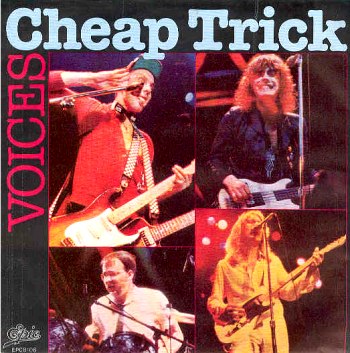
One of my top Cheap Trick songs. Robin Zanders voice sounds great in this Beatle-esque song.
This song peaked at #32 on the Billboard 100 and #12 in Canada in 1980. The song was on the Dream Police album that peaked at #6 in 1979 in the Billboard album chart. Voices was written by Rick Nielsen.
Rick Neilsen on Voices: We started off with the chorus as opposed to building up to the chorus. Because it’s like you know “Voices,” okay, and that’s the same thing with “Dream Police,” you know, you hear voices in your head or somebody’s just messing with your brain and hears voices. You hear something, it’s like you didn’t know what you were listening for until you heard the voices. Somebody, your mind’s eye, has some talking to do to you.
From Songfacts
Long before their earnest #1 hit “The Flame,” Cheap Trick released another ballad: “Voices.” It’s a love song of sorts:
I fell in love with you again
Please, can I see you every day?
Except that it’s coming from inside his own head. “You hear voices in your head or somebody’s just messing with your brain and hears voices,” the song’s writer, guitarist Rick Nielsen, told The A/V Club. “You hear something, it’s like you didn’t know what you were listening for until you heard the voices. Somebody, your mind’s eye, has some talking to do to you.”
The “title track of the album,” has a similar theme, with the singer dealing with someone else inside his head. Both songs also use a string section.
Arnold Levine directed the video for this song, which was done on the same shoot for the “Dream Police” clip.
Voices
You didn’t know what you were lookin’ for Til you heard the voices in your ear
Hey, it’s me again Plain to see again Please can I see you every day
I’m a fool again I fell in love with you again Please can I see you every day
You didn’t know what you were lookin’ for Til you heard the voices in your ear You didn’t know what you were lookin’ for Til you heard the voices in your ear
Words don’t come out right I try to say it oh so right I hope you understand my meaning
Hey, it’s me again I’m so in love with you again Please can I see you every day
You didn’t know what you were lookin’ for Til you heard the voices in your ear You didn’t know what you were lookin’ for Til you heard the voices in your ear
I remember every word you said (Word you said) I remember voices in my head (In my head) I remember ever word you said (Word you said)
I heard your voice-it Your voice is-cool voices Warm voices Just what I needed, too Words don’t seem right But its Cool voices-warm voices Your voice is Just what I needed for Love is the word-it’s Warm voices-your voice is Cool voices Just what I needed, too I heard your voice-it was Your voice is-cool voices Warm voices
Just what I needed, too Just what I needed, too Just what I needed, too
This song has been played a lot on radio and I try to stay away from posting songs like that but I still love it…and will turn it up when it comes on.
The song peaked at #7 on the Billboard 100, #5 in Canada, #2 in New Zealand, and #7 in the UK in 1974. The song was on Paul’s best-known album Band On The Run. The album was #1 in the US, Canada, and the UK.
It was a terrific single…I like the B side (Let Me Roll It) as much as the A-side. Tony Visconti, who did a lot of production work for David Bowie and Thin Lizzy, did the orchestration on this song.
From Songfacts
“Jet” was the name of a black Labrador that Paul McCartney and his wife Linda owned; the dog provided the title for the song. The McCartney’s owned a variety of animals, and at the time their brood included a Golden Lab named Poppy, a Dalmatian named Lucky, and the old Sheepdog Martha (from the Beatles song “Martha My Dear”). “Jet” was chosen not because he was Paul’s favorite, but because the name makes a very stadium-ready title, perfect for throwing your fist in the air when it’s performed in an arena. The song is really about freedom; McCartney did something similar when he used an amusement park ride as the title for a song about madness in “Helter Skelter.”
Paul’s wife Linda gave some clues to the thought process behind “Jet” when she said in 1976: “He wanted that one to be totally mad. Paul’s had a lot of practice in the studio. He’s done some very trippy things. Every now and then he remembers how much he loves it.”
Speaking with GQ in 2018, Paul McCartney told the story behind this song: “I was in a songwriting mood and I was up in Scotland. I just thought, OK, I just gotta go somewhere and try and write a song. We happened to have a little pony that was called Jet on the farm. I took my guitar and hiked up this great big hill. I found myself a place which was in the middle of nature, and just sat there and started making up a song.
I don’t know where all the words came from. Well I know where ‘Jet’ came from – I liked the name. The words are probably about me and my father-in-law. The early days of getting married and when your father-in-law is kind of a nuisance. He’s probably the ‘Major’ in it but it’s only a song so you kind of work your things out.
That one was written halfway up a mountain in Scotland, then recorded in Nigeria. I was wondering where to record and I fancied getting out of England, so I asked my record label which is EMI to supply me with a list of all the studios they had around the world – I knew they had a lot. One was in China, one was in Rio de Janeiro and one was in Lagos, Nigeria. So, I went, Yeah Lagos, come on, because I like African music a lot. I love the rhythms of African music so I chose that not realizing that it would be a really basic little studio. We kind of built half the studio. They didn’t have a vocal booth, so we had to explain to them: you take some wood, you get some glass and you put it in like that. So we built the vocal booths. But it was kind of nice, I liked the primitive aspect of it and being in Africa was a pretty interesting experience.”
It’s possible to read a deep meaning into the lyrics, “I thought the Major was a lady suffragette,” but David Bowie’s song Suffragette City was released the previous year, and it’s likely the word “suffragette,” which is a term for a woman fighting for the right to vote, was floating around in McCartney’s mind.
Linda McCartney was an official member of the band, and she was often maligned in the press as being dead weight. Her contributions on stage were rarely pronounced, which was probably the way the audio engineers mixing the shows liked it, but on live performances of this song you can kind of hear her playing the Mellotron if you listen carefully.
The Australian rock band Jet got their name from this song. McCartney and The Beatles were a big influence on them.
This was released as a single with “Mamunia” as the B-side, but three weeks later “Let Me Roll It” replaced it.
Jet
(Jet, Jet) (Jet) I can almost remember their funny faces That time you told them you were going to marrying soon And Jet I thought the only lonely place was on the moon
(Jet, Jet)
Jet was your father as bold as the sergeant major How come he told you that you were hardly old enough yet And Jet I thought the major was a lady suffragette
(Jet, Jet)
Ah mater want Jet to always love me Ah mater want Jet to always love me Ah mater, much later
(Jet)
And Jet I thought the major was a lady suffragette (Jet, Jet)
Ah mater want Jet to always love me Ah mater want Jet to always love me Ah mater, much later
Jet with the wind in your hair Of a thousand laces Climb on the back and we’ll go for a ride in the sky And Jet I thought that the major was a little lady suffragette
(Jet, Jet) And Jet you know I thought you was a little lady suffragette (Jet) A little lady My little lady, yes
This band was formed in 1971 in the Chicago suburb of Oak Park, Illinois. This song was released in 1977 and was on their self titled album…it did not chart.
The Pezband formed in the late seventies, Pezband combined Beatles type melodies with a rock ‘n roll edge. The band released three studio albums from 1977 till 1979, all of which were critically acclaimed. Rolling Stone cited their 1978 sophomore release, Laughing In The Dark as one of the best albums of the year.
However, like many bands I feature on Friday, Pezband’s great reviews didn’t translate into album sales, and the band broke up shortly after they released their third studio album in 1979, Cover to Cover.
In 1978, the group opened major stadium shows for Fleetwood Mac and Supertramp but never could move records. In 2012 they reunited and in 2013 planned a tour of Japan.
Baby It’s Cold Outside
Oh yeah I I I can’t take it no more It’s bad little girl what we’re headed for Oh and I I I can tell you right now I’m through with your lies this is my final bow
Well I know your secret I ain’t gonna keep it I’ll put it to you now Baby it’s cold outside (Baby it’s cold outside) Baby you know that you lied (Baby you know that you lied) Darlin’ you know that I love you so You should know that by now
Oh and I I I I’ll tell you again Yeah you’re a bad little girl Looks like this is the end
Well I know your secret I ain’t gonna keep it I’ll put it to you now Baby it’s cold outside (Baby it’s cold outside) Baby you know that you lied (Baby you know that you lied) Darlin’ you know that I love you so You should know that by now
Baby it’s cold outside (Baby it’s cold outside) Baby you know that you lied (Baby you know that you lied) Darlin’ you know that I love you so You should know that by now
Baby it’s cold outside (Baby it’s cold outside) Baby you know that you lied (Baby you know that you lied) Baby it’s cold outside (Baby it’s cold outside) Baby you know that you lied (Baby you know that you lied) Darlin’ you know that I love you so You should know that by now
Baby it’s cold outside (Baby it’s cold outside) Baby you know that you lied (Baby you know that you lied) Baby it’s cold outside (Baby it’s cold outside) Baby you know that you lied (Baby you know that you lied) Baby it’s cold outside (Baby it’s cold outside)
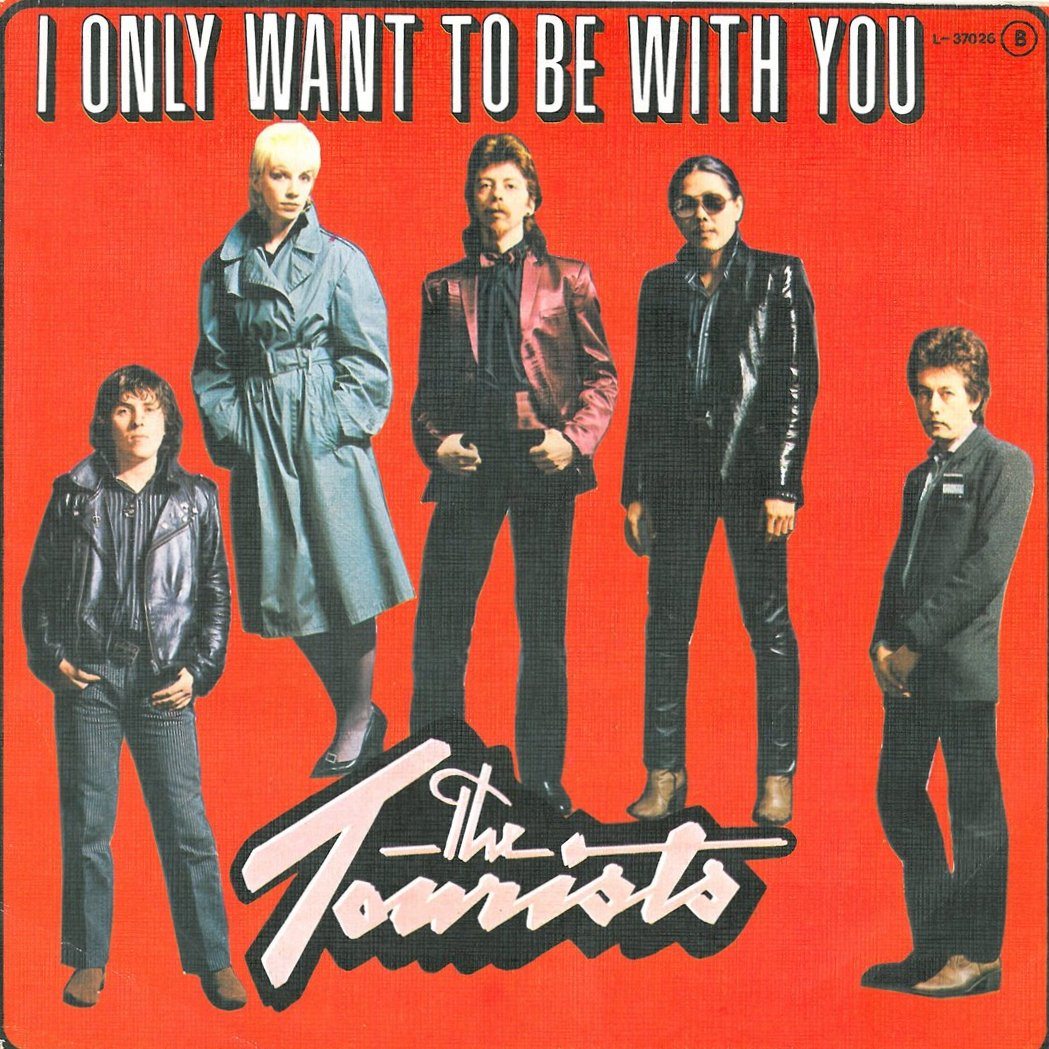
I was reading Dave’s article at A Sound Day about the Eurythmics and he mentioned the band that Annie Lennox and Dave Stewart were in before the Eurythmics. I can’t get their version of the song out of my head. The Tourist formed in 1976 and broke up in 1980. Stewart and Lennox would continue to work together and hit gold with the Eurythmics.
The song was written by Mike Hawker and Ivor Raymonde and first made famous by Dusty Springfield in 1964. After seeing Lennox and Stewart with the Eurythmics…this is fun to see and watch.
This song peaked at #83 on the Billboard 100 in 1980 and #4 in the UK in 1979.
I Only Want To Be With You
I dont know what it is that makes me love you so I only know I never want to let you go cause youve started something Oh, cant you see? That ever since we met Youve had a hold on me It happens to be true I only want to be with you
It doesnt matter where you go or what you do I want to spend each moment of the day with you Oh, look what has happened with just one kiss I never knew that I could be in love like this Its crazy but its true I only want to be with you
You stopped and smiled at me And asked if Id care to dance I fell into your open arms And I didnt stand a chance Now listen honey I just want to be beside you everywhere As long as were together, honey, I dont care cause youve started something Oh, cant you see? That ever since we met Youve had a hold on me No matter what you do I only want to be with you
Oh, oh, you stopped and you smiled at me And asked if Id care to dance I fell into your open arms And I didnt stand a chance Now hear me tell you I just want to be beside you everywhere As long as were together, honey, I dont care cause youve started something Oh, cant you see? That ever since we met Youve had a hold on me No matter what you do I only want to be with you I said no matter, no matter what you do I only want to be with you
Jeff Lynne wrote this song and it was recorded by the Move. I know the version by ELO more but I really like this version and this band. Do Ya was the B side to California Man and it was the only song by the Move to chart in the US. The band was extremely successful in the Uk. The Move had 7 top 10 hits, 10 top 40 and a number 1 in the UK Charts.
The Move formed in 1965 and was very successful until Roy Wood (lead singer and songwriter), Jeff Lynne (who joined in 1969), and Bev Bevan formed ELO in 1972. Do Ya came out at the time that ELO was forming. ELO made a studio recording of it and it appeared on the 1976 album A New World Record.
If you want to know about the Move…the below link is a good start.
In this life I’ve seen everything I can see woman I’ve seen lovers flying through the air Hand in hand I’ve seen babies dancing in the midnight sun And I’ve seen dreams that came from the heavenly skies above I’ve seen old men crying at their own grave sides And I’ve seen pigs all sitting watching Picture slides But I never seen nothin’ like you.
Do ya want my love Do ya want my face Do ya want my mind Do ya want my love
Well I heard the crowd singin’ out of tune As they sat and sang auld lang syne by the light Of the moon I heard the preacher bangin’ on the drums And I heard the police playin’ with their guns But I never heard nothing like you In the country where the sky touches down On the field she lay her down to rest In the morning sun They come a runnin’ just to get a look just to Feel to touch her long black hair they don’t Give a damn
Do ya want my love Do ya want my face Do ya want my mind Do ya want my love
Well I think you know what I’m trying to say Woman That is I’d like to save you for a rainy day I’ve seen enough of the world to know That i’ve got to get it all to get it all to grow
Do ya want my love Do ya want my face Do ya want my mind Do ya want my love
This was the opening track on the Question Of Balance album, and at one point it was going to be the title track. The song was recorded several months earlier than the other tracks on the album and its title was shortened from “Question Of Balance” to “Question.”
When I was younger I started with this album and owned everything up until Long Distance Voyager. Their early seventies output is my favorite period but I liked their entire catalog as a whole.
The song peaked at #21 in the Billboard 100 and #2 in the UK in 1970. In the UK, this became the group’s biggest hit for their classic lineup. Before John Lodge and Justin Hayward joined the group in 1966, they had a #1 UK hit with “Go Now.”
From Songfacts
Moody Blues guitarist/vocalist Justin Hayward wrote this song, which reflected the thoughts of many young people who were questioning the war in Vietnam. He told us: “We’d achieved great success in the United States and we were playing a lot of student venues and colleges, and the student audience was our audience. We were mixing with these people and seeing how different the problems were for them and the issues in being a member of the greatest nation on earth: the United States. How different they were from British people. I was just expressing my frustration around that, around the problems of anti-war and things that really concerned them, and for their own future that they may be conscripted. How that would morally be a dilemma for them and that kind of stuff. So it did really come out of that. And my own particular anger at what was happening. After a decade of peace and love, it still seemed we hadn’t made a difference in 1970. I suppose that was the theme of the song. And then the slow part of the song is really a reflection of that and not feeling defeated, but almost a quiet reflection of it, and mixing with a bit of a love song, as well.” (Here’s the full Justin Hayward interview.)
In the liner notes of the 1997 remastered CD, Justin Hayward wrote: “Sometime before we taped the album, we (documented) ‘Question,’ which was a song that I didn’t have on Friday night for a session (the next day). But, by the morning, I had it and it was recorded very quickly.” Hayward adds that it was “Recorded live, with no overdubbing or double-tracking, just a bit of echo.”
The song is a concert mainstay of The Moody Blues, which is fine with Justin Hayward, who tells us he never loses the emotion for it when he performs the tune. It’s also a song that has remained relevant. Says Hayward: “There’s no doubt that it still resonates, the lyrics reflect whichever generation you’re in. Whatever time you’re in, people are experiencing those emotions. And I find that people identify with it at any age.”
Many of the songs Justin Hayward wrote for The Moody Blues don’t have obvious titles – “The Voice,” for instance. This song is another one without a natural title where he chose a word from the lyrics to represent it.
Question
Why do we never get an answer When we’re knocking at the door With a thousand million questions About hate and death and war? ‘Cause when we stop and look around us There is nothing that we need In a world of persecution That is burning in its greed
Why do we never get an answer When we’re knocking at the door? Because the truth is hard to swallow That’s what the war of love is for
It’s not the way that you say it When you do those things to me It’s more the way that you mean it When you tell me what will be And when you stop and think about it You won’t believe it’s true That all the love you’ve been giving Has all been meant for you
I’m looking for someone to change my life I’m looking for a miracle in my life And if you could see what it’s done to me To lose the love I knew Could safely lead me through
Between the silence of the mountains And the crashing of the sea There lies a land I once lived in And she’s waiting there for me But in the grey of the morning My mind becomes confused Between the dead and the sleeping And the road that I must choose
I’m looking for someone to change my life I’m looking for a miracle in my life And if you could see what it’s done to me To lose the love I knew Could safely lead me to The land that I once knew To learn as we grow old The secrets of our soul It’s not the way that you say it when you do those things to me It’s more the way you really mean it when you tell me what will be
Why do we never get an answer When we’re knocking at the door With a thousand million questions About hate and death and war? When we stop and look around us There is nothing that we need In a world of persecution That is burning in its greed
Why do we never get an answer When we’re knocking at the door?
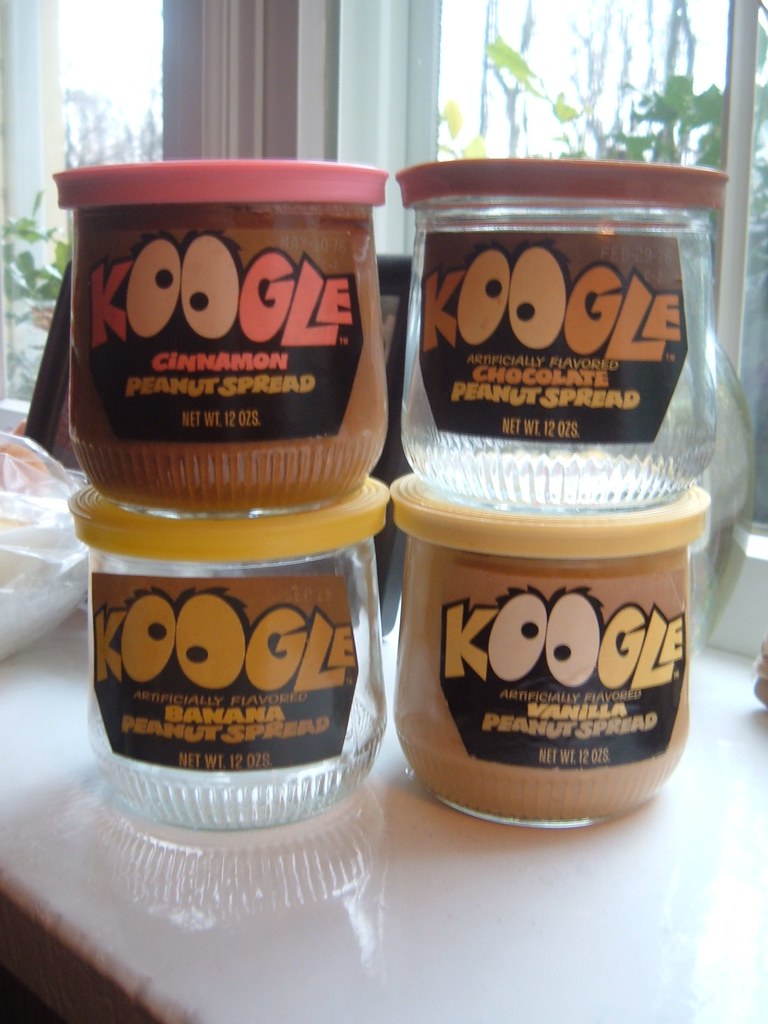
This is one thing I really miss from the seventies. I have tried other peanut butters, but nothing tastes as good as this and nothing compares. It came in different flavors… cinnamon, banana (my favorite), chocolate, and vanilla.
Kraft released this product back in 1971…I did write Kraft asking to bring it back, but alas…no no response. I remember it disappearing around 1976-77.
I’m not on Facebook, but I’m glad someone is putting it to good use…A Bring Back Koogle Page!
Koogle was an innovative, flavor-forward peanut snack that captured kid-friendly attention with its sweetness and slick texture. But its indulgent ingredients and premium price turned off parents seeking healthier, more economical options. Although it vanished by the late ’70s, its quirky charm, kooky mascot, and googly-eyed jars remain a beloved part of snack-food history.
It’s kind of amazing how a product that only lasted maybe seven years still sparks that kind of fondness decades later. That’s the power of taste and memory wrapped together, flavored peanut butter as a time machine.
If Kraft ever brought it back (with a slightly more health-conscious recipe), you just know the nostalgia shelves at Target would sell out in an afternoon.
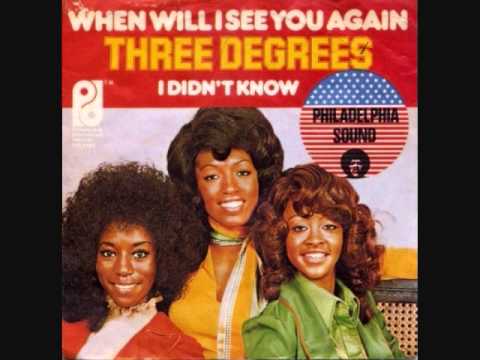
Some songs can transport me back…this is one of them. This was written by the Philadelphia songwriting and production team of Kenny Gamble and Leon Huff. It was released on their Philadelphia International Records and became the only #1 in the UK for the label.
This song peaked at #2 in the Billboard 100 in 1974.
Three Degree Sheila Ferguson: The song was played to me by Kenny Gamble at the piano in 1973 and I threw a tantrum. I screamed and yelled and said I would never sing it. I thought it was ridiculously insulting to be given such a simple song and that it took no talent to sing it. We did do it and several million copies later, I realized that he knew more than me.”
From Songfacts
A few months earlier in their first recording for Philadelphia International Records, The Three Degrees supplied the vocals for the US #1 hit “TSOP (The Sound of Philadelphia),” which was the theme song for the TV show Soul Train.
When Will I See You Again
When will I see you again?
When will we share precious moments?
Will I have to wait forever?
Or will I have to suffer and cry the whole night through?
When will I see you again?
When will our hearts beat together?
Are we in love or just friends?
Is this my beginning or is this the end?
When will I see you again?
(When will I see you again?)
When will I see you again?
Are we in love or just friends?
Is this my beginning or is this the end?
When will I see you again?
(When will I see you again?)
When will I see you again?
(When will I see you again?)
When will I see you again?
(When will I see you again?)
When will I see you again?
One of my favorite intros to any song. Billy Preston did a funky clavinet intro that sounds dark and huge. Mick Taylor’s solo on this song is perfect…without Mick Taylor they would have made those stretch of albums in the late sixties and early seventies but they would have sounded different. When Mick Taylor quit…they lost their sound from this period.
The song peaked at #15 in the Billboard 100 in 1974. It was on the great album Goats Head Soup which peaked at #1 in 1973.
From Songfacts
This tells two stories, a young man shot by police in a case of mistaken identity, and a 10-year girl who dies in an alley of a drug overdose. Neither is based on a true story, but is a commentary on urban America.
The horns were arranged by trumpet player Jim Price, who along with Bobby Keys on sax, provided the brass on records and tours for The Stones in the early ’70s. This was the last time Price recorded with The Stones. He went on to produce other artists, including Joe Cocker.
Keith Richards played bass and shared lead guitar duties with Mick Taylor.
Billy Preston played the piano.
The Stones played this on their 1973 European tour, even though it describes events in America.
Chuck Findley played trumpet on this. Other artists he worked for include George Harrison, Quincy Jones, Diana Ross, the Carpenters, Julio Iglesias, Rod Stewart, Robert Palmer and Madonna.
Doo Doo Doo Doo Doo Heartbreaker
The police in New York City They chased a boy right through the park And in a case of mistaken identity The put a bullet through his heart
Heart breakers with your forty four I want to tear your world apart You heart breaker with your forty four I want to tear your world a part
A ten year old girl on a street corner Sticking needles in her arm She died in the dirt of an alleyway Her mother said she had no chance, no chance!
Heart breaker, heart breaker She stuck the pins right in her heart Heart breaker, pain maker Stole the love right out of you heart
Oh yeah, oh yeah Want to tear your world apart Oh yeah, oh yeah Want to tear your world apart
Heart breaker, heart breaker You stole the love right out of my heart Heart breaker, heart breaker I want to tear that world I want to tear that world I want to tear that world apart
Heart breaker, heart breaker Stone love, stone love Oh yeah, oh yeah
Heartbreaker, heartbreaker Want to tear that world apart
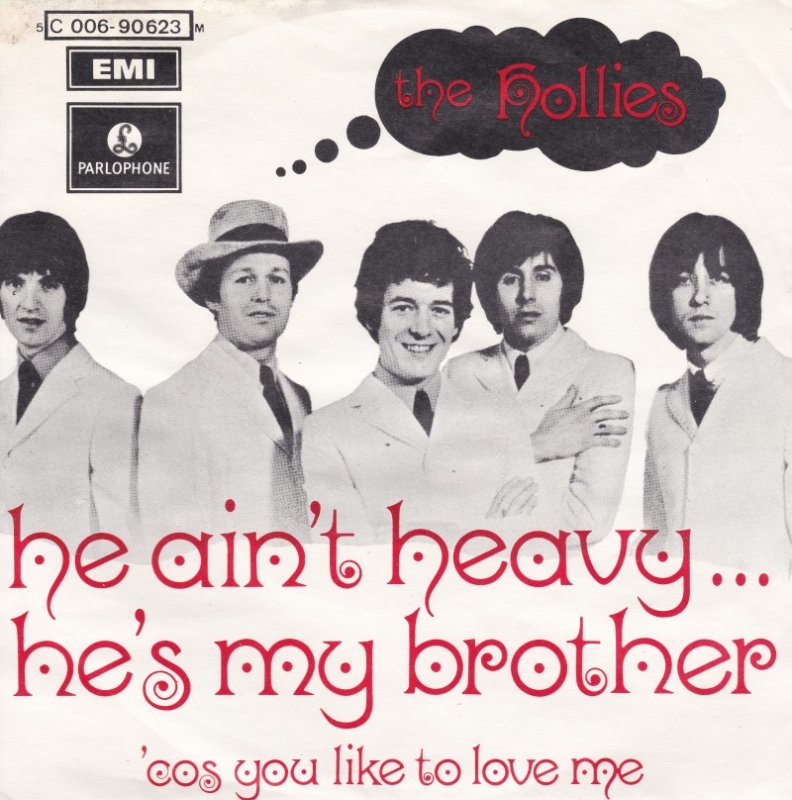
I always liked this song as it was in the second phase of the Hollies recording career. A young Elton John – who was still called Reg – played piano on it and got paid 12 pounds. The song peaked at #7 in the Billboard 100 in 1970… #3 in the UK in 1969…also #1 in the UK in 1988 after it was in a beer commercial.
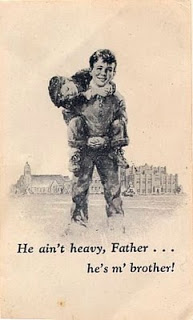
The song was written by Bobby Scott and Bob Russell, their only collaboration as songwriters. Russell was dying of cancer at the time and his lyrics for this song would be the last he ever wrote. The origin of the phrase is unknown, but it did appear as the title of an article in Kiwanismagazine in 1924 and then later became the motto for Father Flanagan’s Boy’s Town in the 1940s.
In 1941, Father Flanagan was looking at a magazine called The Messenger when he came across a drawing of a boy carrying a younger boy on his back, with the caption, “He ain’t heavy Mr., he’s my brother.” Father Flanagan thought the image and phrase captured the spirit of Boys Town, so he got permission and commissioned a statue of the drawing with the inscription, “He ain’t heavy Father, he’s my brother.” The statue and phrase became the logo for Boys Town. In 1979, girls were allowed and the name was eventually changed to Girls And Boys Town. The logo was updated with a drawing of a girl carrying a younger girl added.
Tony Hicks (The Hollies Guitarist): “In the 1960s when we were short of songs I used to root around publishers in Denmark Street. One afternoon, I’d been there ages and wanted to get going but this bloke said: ‘Well there’s one more song. It’s probably not for you.’ He played me the demo by the writers [Bobby Scott and Bob Russell]. It sounded like a 45rpm record played at 33rpm, the singer was slurring, like he was drunk. But it had something about it. There were frowns when I took it to the band but we speeded it up and added an orchestra. The only things left recognizable were the lyrics. There’d been this old film called Boys Town about a children’s home in America, and the statue outside showed a child being carried aloft and the motto He Ain’t Heavy, He’s My Brother. Bob Russell had been dying of cancer while writing. We never got, or asked for, royalties.
From Songfacts
The Two Brothers concept precedes the magazine illustration that Father Flanagan saw. In 1921, there was a resident at Boys Town who had difficulty walking. He wore leg braces and the other boys would often take turns giving him a ride on their backs. There is a famous photograph of this boy and one of the other youth giving him a ride. Now there are several statues of the Two Brothers on the Home Campus in Omaha; one is the sandstone of the two brothers from the illustration, another is a bronze version by an Italian artist that was commissioned in 1977. There is also a version done directly from the 1921 photograph in the Hall of History.
In 1938, Spencer Tracey portrayed Father Flanagan in the movie Boys Town, which also starred Mickey Rooney. In 1941, they made a sequel called Men Of Boys Town, where they used the phrase “He ain’t heavy, Father, he’s my brother” for the first time in a movie.
This was originally released by Kelly Gordon, a producer who has worked with Glen Campbell, Aretha Franklin, and David Lee Roth.
This was the only songwriting collaboration between veteran songwriters Bobby Scott (“A Taste of Honey”) and Bob Russell (“Ballerina”). Russell, who wrote the lyrics, made his mark writing for films and contributing words to songs by Duke Ellington and Carl Sigman. Scott was a piano player, singer, and producer. He did a lot of work with Mercury Records on sessions for artists like Aretha Franklin, Marvin Gaye and Bobby Darin. In 1990, he died of cancer.
Joe Cocker was offered this song before The Hollies after it had been played first to his producer Denny Cordell. The General Professional Manager for Cyril Shane Music Ltd & Pedro Music Ltd in England at the time explains: “Tony Hicks was in our office looking for songs for the Hollies (our office was not on Denmark Street, it was in Baker Street). Denny called from New York to say ‘Joe didn’t see the song.’ As Tony said in The Guardian, he liked the song and asked for an exclusive the following day. The version he heard was Kelly Gordon, who apart from being a successful producer, also wrote a little song entitled ‘That’s Life.’ His version was slow and soulful which is why I had thought of Joe Cocker to record it. Bobby Russell wrote this song while dying of cancer in Los Angeles.
We picked up the British rights to ‘He Ain’t Heavy’ from an American publisher Larry Shayne. The song was on a Kelly Gordon album called Defunked. The version was slow and soulful and had Joe Cocker written all over it. Joe turned it down, to his producer’s surprise. We had a hit with The Hollies previously called ‘I’m Alive,’ so we had a relationship with them. Also, we had a great working relationship with the Air London production team, of which their producer Ron Richards was a partner. We never considered playing the song for The Hollies when Tony Hicks was in the office. We were playing songs like ‘Sorry Suzanne.’ It was only at the end of the meeting I suggested playing Tony this wonderful song, not because it was for them, but just to share the song. We were surprised when he said ‘That’s the one.'”
This was the second single The Hollies released after Graham Nash left the group to form Crosby, Stills, and Nash; the first was “Sorry Suzanne.” Nash was replaced by Terry Sylvester. >>
In 1988, this was re-released in the UK after it was used in a Miller Beer commercial. This time, it hit #1.
This has been covered by many artists. It was a hit for Neil Diamond later in 1970, and also for Olivia Newton-John in 1976. Newton-John’s version was the B-side to the Linda Hargrove cover “Let It Shine” and went to #1 on the Adult Contemporary chart.
A version by Bill Medley (one of The Righteous Brothers) was used in the 1988 Sylvester Stallone movie Rambo 3.
The Osmonds recorded this and used it as the B-side of their first hit, “One Bad Apple.”
This was used in an anti-drug commercial in Canada during ’90s. The basis was two old friends meeting again in the hospital. There are some old home movie type flash backs, then they hug and the one in hospital garb cries. >>
A various artists charity version recorded under the name of The Justice Collective topped the UK singles charts during Christmas 2012.
Casey Affleck made reference to this song when he accepted the Oscar for Best Actor in 2017 for his role in “Manchester by the Sea.” Thanking his brother, Ben Affleck, he said, “you ain’t heavy.”
He Ain’t Heavy, He’s My Brother
The road is long With many a winding turn That leads us to who knows where Who knows where But I’m strong Strong enough to carry him He ain’t heavy, he’s my brother
So on we go His welfare is of my concern No burden is he to bear We’ll get there
For I know He would not encumber me He ain’t heavy, he’s my brother
If I’m laden at all I’m laden with sadness That everyone’s heart Isn’t filled with a gladness Of love for one another
It’s a long, long road From which there is no return While we’re on the way to there Why not share
And the load Doesn’t weigh me down at all He ain’t heavy, he’s my brother
Hold the pickles, hold the lettuce Special orders, don’t upset us All we ask is that you let us serve it your way Have it your way
Ah, a company that cares! Burger King ran this commercial around 1974. Battling McDonald’s with the “Have it your way” campaign in 1973, Burger King put their service in the spotlight with the jingle, “Hold the pickle, hold the lettuce. Special orders don’t upset us.” The campaign increased ad awareness by 50%. The Little King was retired, and “Have it your way” was adapted to target children with ad efforts tagged “All kids are different” and “Pickle-less Nicholas.”
In 1976-77, Burger King changed advertising agents and went with “America loves burgers, and we’re America’s Burger King.” In 1982, they launched a “burger wars” effort with the slogan “Battle of the burgers,” comparing the Whopper with those of McDonald’s and Wendy’s.
The jingle’s upbeat, friendly tone made it feel like Burger King employees were singing just for you. It also helped that the melody was incredibly catchy—it got stuck in your head and stayed there.
Even decades later, people who grew up in the ’70s and ’80s can instantly recall that tune. In fact, when Burger King revived “Have It Your Way” in later years, they leaned heavily on nostalgia for that original “Hold the pickles…” jingle.
Anyway…I wish they would bring back those uniforms.











 PowerPop... An Eclectic Collection of Pop Culture