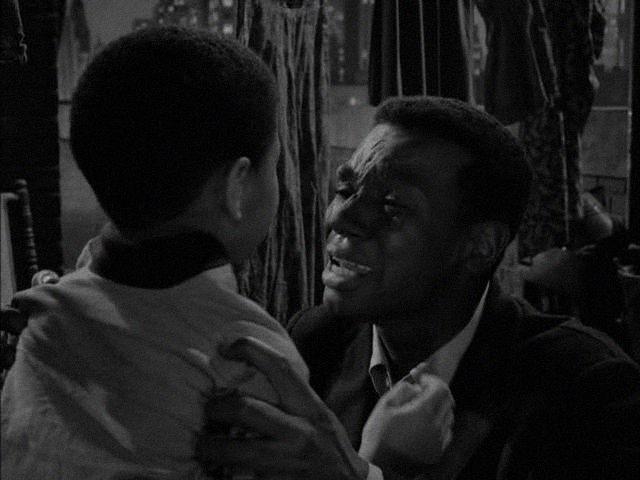
This was an important episode regardless of the story. It’s well documented that Rod Serling was against bigotry. He not only talked the talk, he put it into action with this episode with a nearly all black cast. After the airing of this episode, which was revolutionary for American television, The Twilight Zone was awarded the 1961 Unity Award for Outstanding Contributions to Better Race Relations.
It is a good episode. A child that believes in magic and a jaded boxer who long ago lost his belief. It explores the innocence in children and what little is left in adults.
The child tries to make the aging jaded boxer Bolie believe in the magic of wishing but Bolie just cannot do it. In the world Bolie lives in, wishing and hoping for the hardships to end, is never going to happen. The only real choice is to struggle through each day and fight if necessary when things block your path. The ending of this one surprised me.
This show was written by Rod Serling
Rod Serling’s Opening Narration:
In this corner of the universe, a prizefighter named Bolie Jackson, 183 pounds and an hour and a half away from a comeback at St. Nick’s Arena. Mr. Bolie Jackson, who, by the standards of his profession is an aging, over-the-hill relic of what was, and who now sees a reflection of a man who has left too many pieces of his youth in too many stadiums for too many years before too many screaming people. Mr. Bolie Jackson, who might do well to look for some gentle magic in the hard-surfaced glass that stares back at him.
Summary
Bolie Jackson is a professional boxer whose best years are behind him. He’s well-liked in his neighborhood and adored by Henry, a young lad who lives next door. He hurts his hand in an altercation with sleazy boxing manager and as a result is badly beaten in a televised boxing match. He’s apparently down and out for the count but young Henry has a special ability – something his mother calls the big wish – that changes the outcome of the match. When Bolie learns what he’s done he refuses to believe in what Henry’s done with the inevitable consequences
Rod Serling’s Closing Narration:
Mr. Bolie Jackson, 183 pounds, who left a second chance lying in a heap on a rosin-spattered canvas at St. Nick’s Arena. Mr. Bolie Jackson, who shares the most common ailment of all men, the strange and perverse disinclination to believe in a miracle, the kind of miracle to come from the mind of a little boy, perhaps only to be found in the Twilight Zone.
CAST
Rod Serling … Narrator (voice)
Ivan Dixon … Bolie Jackson
Steven Perry … Henry Temple
Kim Hamilton … Frances Temple
Walter Burke … Joe Mizell
Henry Scott … Thomas
Albert Salmi was a wonderful character actor. He would appear in two more Twilight Zones and all of them involved time travel. You could see Albert on TV shows through the 80s. This is a looked over episode that I do enjoy but it’s not without it’s faults. The way the time travel happens is unique but it’s the delivery that gets a little clumsy. I give it 4 stars because of the plot and the way they showed an 19th century primitive dropped into the loud modern world.
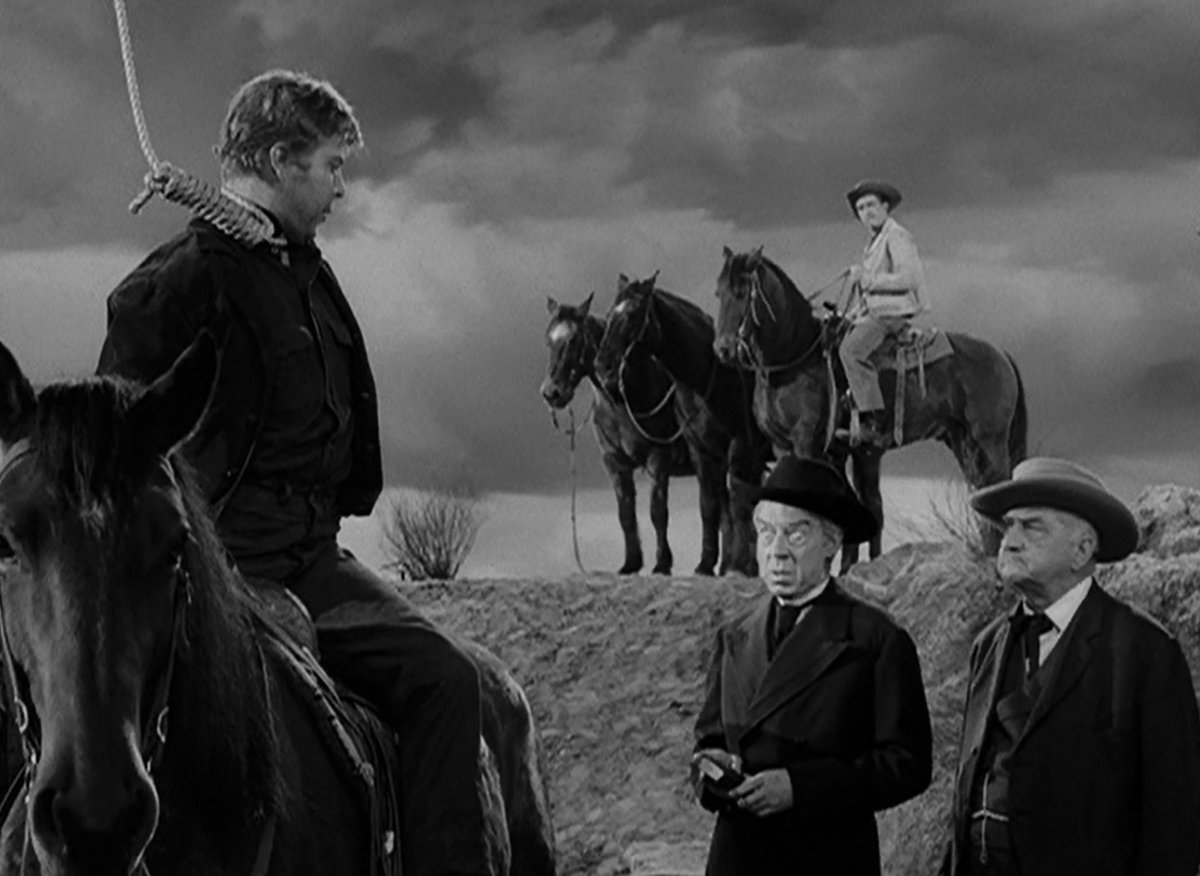
My biggest fault with this episode is the foolish way Professor Manion (Russell Johnson) handles Joe Caswell (Albert Salmi) after knowing what kind of man he was after he got there. Salmi’s acting is the standout in this. He is great at playing bad guys. Caswell is a hot-tempered sociopath who has no conscious. He makes a believable time traveler from the old west.
Watch for Russell Johnson (as Professor Manion) who will be remembered as the Professor off of Gilligan’s Island.
This show was written by Rod Serling and George Clayton Johnson
Rod Serling’s Opening Narration:
Commonplace—if somewhat grim—unsocial event known as a necktie party, the guest of dishonor a cowboy named Joe Caswell, just a moment away from a rope, a short dance several feet off the ground, and then the dark eternity of all evil men. Mr. Joe Caswell, who, when the good Lord passed out a conscience, a heart, a feeling for fellow men, must have been out for a beer and missed out. Mr. Joe Caswell, in the last, quiet moment of a violent life.
Summary
In the late 19th century, Joe Caswell is about to be hanged for murder, when he vanishes into thin air. He’s been snatched by Prof. Manion’s time machine and brought 80 years into the future. Caswell was selected at random and Manion can see the rope marks on his neck. Caswell is eager to see his new world but Manion wants to send him back. When Caswell runs off into the night, his new world proves to be too much for him. Justice is served in the end and a murderer hangs.
Rod Serling’s Closing Narration:
This is November 1880, the aftermath of a necktie party. The victim’s name—Paul Johnson, a minor-league criminal and the taker of another human life. No comment on his death save this: justice can span years. Retribution is not subject to a calendar. Tonight’s case in point in The Twilight Zone.
CAST
Rod Serling … Narrator (voice) (uncredited)
Albert Salmi … Joe Caswell
Russell Johnson … Prof. Manion
Than Wyenn … Paul Johnson
George Mitchell … Old Man
Jon Lormer … Minister
Fay Roope … Judge
Richard Karlan … Bartender
Joe Haworth … TV Cowboy (uncredited)
There have been actors and musicians that exuded cool…Steve McQueen would be one of the top ones…and he was just starting in this movie…and not the star.
This cast is just incredible… Along with McQueen, you have Charles Bronson, James Coburn, Eli Wallach, Robert Vaughn, Horst Buchholz, Brad Dexter, and the great Yul Brynner. We are not talking about cameos here…Brynner is the unquestioned leader of this band of mercenary gunfighters…but money is not the most important thing to most of them. They believe in Brynner’s character and the adventure.
I could go through talking about each actor, but I won’t…there are a few I’ll touch on. Eli Wallach… did a masterful portrayal of Calvera. He is one actor that I would have loved to have met. His personality was so big in films, but he didn’t over act…he was just that good.
The actor that caught my attention the most in this was the newcomer of the seven. Chico, played brilliantly by Horst Buchholz. His character was young, impatient, cocky, but a nice kid who you saw grow in the movie. He wanted to join the six fighters, but he wasn’t accepted until he persisted and wore Chris Larrabee Adams (Yul Brynner) down.
John Sturges directed this movie and also The Great Escape plus Gunfight at the O.K. Corral. This movie was not shot on some studio backlot somewhere. It was real locations and it showed.
A brief look at the plot. A gang of bandits terrorizes a small Mexican farming village each year. They ride in and take what they want like the village is their own personal store. Several of the village elders send three of the farmers into the United States to search for gunmen to defend them. They end up with seven, each of whom comes for a different reason. They must prepare the town to beat an army of thirty bandits who will arrive wanting food. In came the Magnificent Seven to defend the village and teach the farmers how to fight.
A little trivia about the movie. Yul Brynner had a major role in casting, and he wanted Steve McQueen in the movie. At the time McQueen was in a television western called Wanted: Dead or Alive.
They ended up not getting along because McQueen supposedly was trying to upstage Brynner. When McQueen was dying of cancer he called Brynner and made up with him for the trouble in the film. McQueen said: “I had to make it up with Yul ’cause without him I wouldn’t have been in that picture.”
It’s not only a great western, it has comedy, drama, and most of all…all the characters are real. There is a reason some of them were huge at the time and others went on to be not only popular but legends.
CAST
Yul Brynner … Chris Larabee Adams Eli Wallach … Calvera Steve McQueen … Vin Tanner Horst Buchholz … Chico Charles Bronson … Bernardo O’Reilly Robert Vaughn … Lee Brad Dexter … Harry Luck James Coburn … Britt Jorge Martínez de Hoyos … Hilario (as Jorge Martinez de Hoyas) Vladimir Sokoloff … Old Man Rosenda Monteros … Petra Rico Alaniz … Sotero Pepe Hern … Tomas Natividad Vacío … Villager (as Natividad Vacio) Mario Navarro … Boy with O’Reilly
***Special announcement Watch all you can this month on Netflix because Netflix is not streaming the Twilight after June 30th…Fellow blogger Blackwing666 posted this here. If there was ever a show you would think about purchasing… The Twilight Zone would a great one.
Roddy McDowall was one of my favorite TV actors. He normally plays caring, worried, and vulnerable characters. This episode is another story on human nature…earth bound and Martians…are they the same all over? Sam Conrad will find out. It’s a good episode but doesn’t jump in the great category.
SPOILERS Below
You can take this episode in many ways…is it a commentary on humans being a caged animal instead of its keeper? Possibly a prelude to the Planet of the Apes? Does it comment on luxuries entrapping us when they become necessitates or just human nature? Its a very good episode of the Twilight Zone .
The living room set is the same one seen in The Twilight Zone: Third from the Sun (1960). It is a redressed version of George’s living room from The Time Machine
Rod Serling changed a couple of elements from the original source story (Brothers Beyond The Void, by Paul W. Fairman) for this episode. In the original story the protagonist is Marcusson and Conrad is only in the beginning of the story as Marcusson makes the trip to Mars alone. Serling also changed the climatic utterance from the story’s mundane “People are the same everywhere,” to his more poignant version. It isn’t clear why Serling changed the story and made Conrad the protagonist.
This show was written by Rod Serling and Paul W. Fairman
Rod Serling’s Opening Narration:
You’re looking at a species of flimsy little two-legged animal with extremely small heads, whose name is Man. Warren Marcusson, age thirty-five. Samuel A. Conrad, age thirty-one. They’re taking a highway into space, Man unshackling himself and sending his tiny, groping fingers up into the unknown. Their destination is Mars, and in just a moment we’ll land there with them.
Summary
Biologist Sam Conrad is scheduled to go on a mission to Mars and is genuinely concerned about what they will find there. The mission commander, Mark Marcusson, tells him there’s nothing to worry about as he firmly believes that God made everyone in his image; no matter what they find, he is certain that people are alike all over. They crash-land on Mars and Marcusson dies from his injuries. Conrad is happy to find that the people of Mars are very human-like, friendly and intelligent. They provide him with a home and promise him much more. Too late, however, he realizes that, just as Marcusson had said, people are alike all over.
Species of animal brought back alive. Interesting similarity in physical characteristics to human beings in head, trunk, arms, legs, hands, feet. Very tiny undeveloped brain. Comes from primitive planet named Earth. Calls himself Samuel Conrad. And he will remain here in his cage with the running water and the electricity and the central heat as long as he lives. Samuel Conrad has found The Twilight Zone.
CAST
Rod Serling … Narrator (voice) (uncredited) Roddy McDowall … Sam Conrad Susan Oliver … Teenya Paul Comi … Marcusson Byron Morrow … Martian Vic Perrin … Martian Vernon Gray … Martian Herbert Winters … Martian Observer (uncredited)
How would you like to live thousands of years? Mr. Jameson was given that option that many of us would love to have…but it’s not without it’s downfalls. Like the episode “Escape Clause” this episode explores immortality except in this one the main character is sophisticated but can be just as selfish. Even with his considerable life experiences some things don’t sink in.
Compared to shows in 2021 this episode is paced slow but that is a great thing. The story has room to breathe and is laid out in front of us. Living forever looks great on paper but in real time it would be hard to lose people you love over and over again… and lose yourself in parts and pieces in the process.
This is a great episode and an interesting view on immortality.
This episode deals with immortality. The entire cast all lived exceptionally long lives. Kevin McCarthy lived to be 96, Estelle Winwood was 101 when she passed away, Edgar Stehli passed away shortly after turning 89, and Dodie Heath turned 90 in August of 2018.
McCarthy died September 11, 2010 at the age of 96, having earned an acting credit as late as the year he died, more than 50 years after this episode was produced.
This show was written by Charles Beaumont
Rod Serling’s Opening Narration:
You’re looking at Act One, Scene One, of a nightmare, one not restricted to witching hours of dark, rainswept nights. Professor Walter Jameson, popular beyond words, who talks of the past as if it were the present, who conjures up the dead as if they were alive…In the view of this man, Professor Samuel Kittridge, Walter Jameson has access to knowledge that couldn’t come out of a volume of history, but rather from a book on black magic, which is to say that this nightmare begins at noon.
Summary
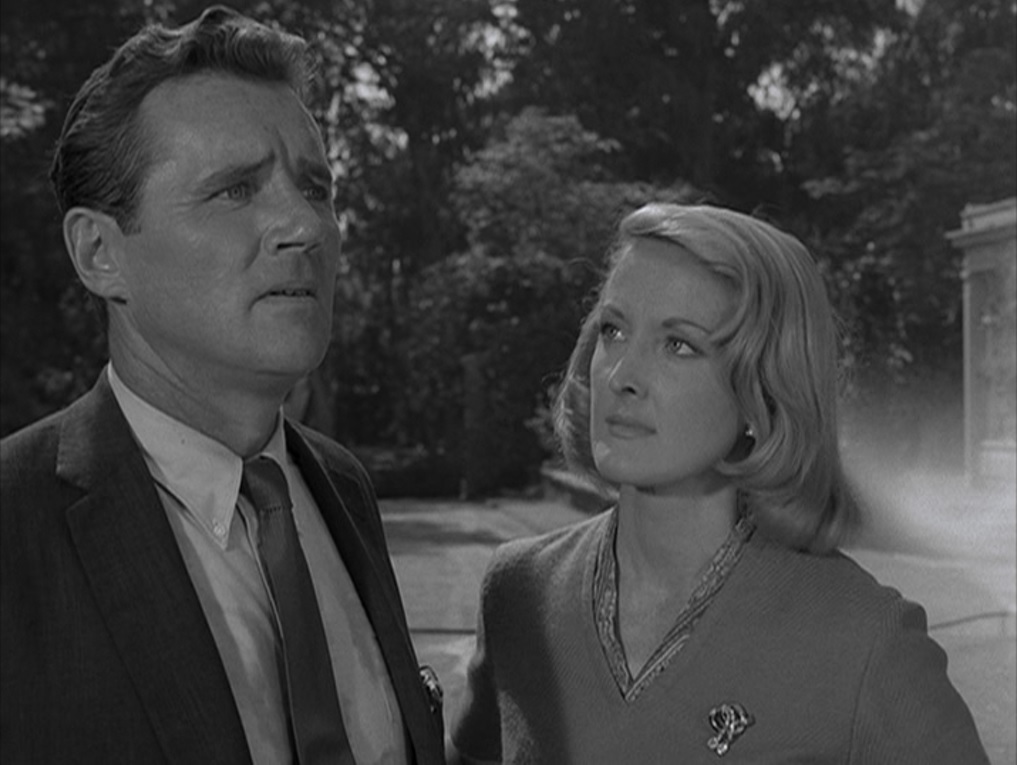
Walter Jameson is a successful history professor. He’s been teaching for 12 years and has proven to be very popular with his students for his ability to bring his subject to life. He is engaged to Susanna Kittridge, his good friend Professor Sam Kittridge’s daughter. One thing that Professor Kittridge has noticed about Walter is that he doesn’t seem to have aged one bit in the 12 years they have known each other. Walter admits that he is far older than anyone can imagine but before he and Susanna can elope, someone from his past pays him a visit.
Rod Serling’s Closing Narration:
Last stop on a long journey, as yet another human being returns to the vast nothingness that is the beginning and into the dust that is always the end.
CAST
Rod Serling … Narrator (voice) (uncredited)
Kevin McCarthy … Prof. Walter Jameson / Tom Bowen / Maj. Hugh Skelton
Edgar Stehli … Professor Sam Kittridge
Estelle Winwood … Laurette Bowen
Dodie Heath … Susanna Kittridge (as Dody Heath)
This is the kind of story that the Twilight Zone excels at. Vanishing into a fantasy world of your own design forever. They explored this plot device more than once in episodes like The Sixteen-Millimeter Shrine and A Stop at Willoughby just to name a few. Don’t worry though because the variations are so good that you would not mind more.
You think Arthur Curtis is just a white-collar worker until you hear the word “cut.” He is an actor on a set but to him…he is the character he is playing. Howard Duff plays Arthur Curtis who is really Gerry Raigan. You get the feeling you would not like Raigan at all. It seems he has a drinking problem and an ex-wife that just despises him. You start seeing the reason why Arthur Curtis was born.
Duff is very believable as Curtis…You see the worried look in his eyes yet he is hanging on to Arthur Curtis.
When Gerry’s ex-wife demands he give her a check, she spells out the last name as “Raigan”. This isn’t the expected way to spell it, which may have been deliberate, so as to not associate the character with Ronald Reagan, the then-President of the Screen Actors Guild.
Look for David White…who became famous a few years later for the character Larry Tate in Bewitched.
This show was written by Richard Matheson
Rod Serling’s Opening Narration:
You’re looking at a tableau of reality, things of substance, of physical material: a desk, a window, a light. These things exist and have dimension. Now this is Arthur Curtis, age thirty-six, who also is real. He has flesh and blood, muscle and mind. But in just a moment we will see how thin a line separates that which we assume to be real with that manufactured inside of a mind.
Summary
Arthur Curtis is sitting his office chatting with secretary about plans for his daughter’s birthday party and that he and his wife will be flying off for a couple of days of rest and relaxation. Suddenly he hears someone yell “cut” and he realizes he on a movie sound stage. He can’t understand what has happened to him. Everyone refers to him as Gerry Reagan, but he insists that he is Arthur Curtis. He runs off but can’t find any of the familiar landmarks he knows such as his house or his place of work. He is desperate to return to the world of Arthur Curtis but that window of opportunity may be closing on him.
Rod Serling’s Closing Narration:
The modus operandi for the departure from life is usually a pine box of such and such dimensions, and this is the ultimate in reality. But there are other ways for a man to exit from life. Take the case of Arthur Curtis, age thirty-six. His departure was along a highway with an exit sign that reads, “This Way To Escape”. Arthur Curtis, en route to the Twilight Zone.
CAST
Howard Duff … Arthur Curtis / Gerry Raigan David White … Brinkley Frank Maxwell … Marty Fisher Eileen Ryan … Nora Raigan Gail Kobe … Sally Peter Walker … Sam Susan Dorn … Marion Curtis Bill Idelson … Kelly (as William Idelson)
This is a great opening track to this famous album. What a way to introduce probably the most famous album ever.
The slicing guitar stands out and the drum sound that Ringo got. Paul McCartney wrote this and sang lead. After recording it, he had the idea of doing the whole album as if Sgt. Pepper was a real band. It became the title track of what was considered a “concept” album, with the songs running seamlessly together on the record.
The title is a parody of American bands who were choosing long names for their bands.
Three days after the album came out, Jimi Hendrix opened a concert with this. McCartney and Harrison were both there, and were very impressed that Hendrix learned it so quickly.
The reprise of the song is right before A Day In The Life.
This song was produced in a rush when The Beatles decided to bring back the theme song to introduce the last track on the album, “A Day In The Life.” The idea to reprise the song came from Neil Aspinall, The Beatles’ friend and road manager.
George Harrison, Paul McCartney, and Ringo Starr played this on May 19, 1979 at Eric Clapton’s wedding. Clapton married Harrison’s ex-wife, Pattie. Pattie didn’t think John Lennon would fly over from America so she never sent an invititation. John Lennon said later he would have come.
From Songfacts
The album was heavily produced and took 129 days and about 700 hours to complete. The Beatles first album, Please Please Me, was recorded in less than 10 hours.
The crowd noise was dubbed in. The Beatles had stopped touring by then.
There really is an apostrophe in this song’s title, although on the album cover, it is rendered without. Since the Lonely Hearts Club Band belongs to Sgt. Pepper, it is possessive, thus “Sgt. Pepper’s.”
This is reprised at the end of the album before the final track, “A Day In The Life.”
This was recorded as one song with “With A Little Help From My Friends.” They flow seamlessly on the album, creating a problem for radio stations that want to play just one of the songs.
Artist Peter Blake designed the album cover as if Sgt. Pepper’s band had just performed a concert. He asked The Beatles who they wanted at the concert, and put them in the cover design.
All living people depicted on the cover were asked permission. Mae West refused at first – she didn’t want to be part of a “Lonely Hearts Club Band” – but The Beatles wrote her a letter and she agreed. Other characters depicted on the album cover include comedic duos Laurel & Hardy and Abbott & Costello, Marilyn Monroe, Shirley Temple and W.C. Field.
Lennon wanted Jesus, Gandhi, and Hitler on the cover. He had recently taken a lot of heat for saying The Beatles were “Bigger than Jesus,” so they decided not to.
It was rumored that the hand that is sticking out above Paul is that of Adolph Hitler. A Hitler cut out was on the set, but if you look at some side shots of the photo session, you can clearly see that the hand belongs to comic Issy Bonn, whose face is seen in between Paul McCartney and George Harrison.
On the cover of this album McCartney is taller than the other Beatles. This added to rumors of his death, since there is also a hand above Paul’s head which is an omen of death. Also, if you take a mirror and put the edge on the center of the Lonely Hearts Club Band drum an arrow will point directly to McCartney.
Sgt. Pepper was the first pop album to come with printed lyrics on the cover.
Twelve years after “Sgt. Pepper’s Lonely Hearts Club Band” and “With a Little Help from My Friends” appeared on the Sgt. Pepper album, they were released together as a two-song medley and reached US #71 and UK #63.
In 2005, Bob Geldof helped organize Live 8, a set of concerts held in eight countries with the goal of promoting activism. The concerts coincided with the G-8 summit, and Geldof was hoping to send a message to world leaders that they should increase aid to Africa and institute fair trade practices. On the London stage, U2 played this with McCartney to kick off the concert. The opening line, “It was 20 years ago today,” was a reference to Live Aid, which Geldof organized for famine relief in 1985.
Sgt. Pepper’s Lonely Hearts Club Band was the first rock album to win a Grammy for Album of the Year.
On the album cover, Paul McCartney is wearing an Ontario Provincial Police (OPP) badge on his right sleeve. You can see this better on the inside artwork.
The hand-painted drum skin used on the cover of the Sgt Pepper album was sold at Christie’s House in London on 10th July 2008 for £541,250 ($1,071,000) – setting a record for non-lyrics Beatles memorabilia.
In 2007, the Beatles Story museum in Liverpool went on a search for real Sgt. Peppers and found seven police or army officers in the UK that were sergeants with the last name Pepper. “Being Sgt. Pepper is awesome but sometimes people think I am bogus when I call them on the phone or introduce myself,” Sgt. Sean Pepper of Highfields said.
Sgt Pepper’s Lonely Hearts Club Band
It was twenty years ago today Sergeant Pepper taught the band to play, They’ve been going in and out of style, But they’re guaranteed to raise the smile, So may I introduce to you, The act you’ve known for all these years, Sergeant Pepper’s Lonely Hearts Club Band.
We’re Sergeant Pepper’s Lonely Hearts Club Band We hope you will enjoy the show Sergeant Pepper’s Lonely Hearts Club Band Sit back and let the evening go Sergeant Pepper’s Lonely Sergeant Pepper’s Lonely Sergeant Pepper’s Lonely Hearts Club Band
It’s wonderful to be here, It’s certainly a thrill You’re such a lovely audience, We’d like to take you home with us, we’d love to take you home
I don’t really want to stop the show, But I thought you might like to know, That the singer’s going to sing a song And he wants you all to sing along, So let me introduce to you The one and only Billy Shears And Sergeant Pepper’s Lonely Hearts Club Band
Oh ha ha Yeah, dress down I feel it, I feel it, I feel it Oh baby now, I feel it, I feel it, I feel it Baby, free now Gotta be free now, gotta be free now, gotta be free Don’t like that I think it’ll probably be another day singing it Yeah so just edit that then, it’s nice Yeah, and what you can do with the bits where you can’t get it ’cause you haven’t got enough breath Just take over, yeah
A 5-Star Classic… This episode has some alien intervention but not much. This is a wonderful study of human nature at work. The outcome could have happened without aliens. A few paranoid panicky people can start a mob and a mob can become a deadly thing. This episode is so good because you can see it build and build into panic until somebody does something that cannot be undone.
Very good character actors with faces…faces that you remember. You also have Claude Akins as the voice of reason…but even he can get caught up in it. This is a must watch…forget the Twilight Zone twist…just watch suspicion and paranoia grow.
The uniforms worn by the aliens, their spaceship’s ramp, and the shot of the flying spaceship were originally used in Forbidden Planet.
This show was written by Rod Serling
Rod Serling’s Opening Narration:
Maple Street, U.S.A., late summer. A tree-lined little world of front porch gliders, barbecues, the laughter of children, and the bell of an ice cream vendor. At the sound of the roar and the flash of light, it will be precisely 6:43 P.M. on Maple Street…This is Maple Street on a late Saturday afternoon. Maple Street in the last calm and reflective moment—before the monsters came.
Summary
On a pleasant day, the residents of Maple Street feel something akin to a tremor and hear a loud noise. Steve Brand thinks it’s a meteorite though they didn’t hear a create. When young Tommy tells them the science fiction story he read about an alien invasion where they were first sent among humans to live with them in disguise, paranoia sets in. They first suspect Les Goodman and loudmouth Charlie Farnsworth then points the finger at Steve and then Tommy. Events turn on Charlie as everyone runs amok.
Rod Serling’s Closing Narration:
The tools of conquest do not necessarily come with bombs and explosions and fallout. There are weapons that are simply thoughts, attitudes, prejudices…to be found only in the minds of men. For the record, prejudices can kill…and suspicion can destroy…and a thoughtless, frightened search for a scapegoat has a fallout all of its own—for the children and the children yet unborn. And the pity of it is that these things cannot be confined to the Twilight Zone.
CAST
Rod Serling … Narrator (voice)
Claude Akins … Steve Brand
Barry Atwater … Les Goodman
Jack Weston … Charlie Farnsworth
Jan Handzlik … Tommy
Amzie Strickland… Woman
Burt Metcalfe … Don Martin
Mary Gregory … Sally
Jason Johnson … Man
Anne Barton … Myra Brand
Leah Waggner … Mrs. Goodman (as Lea Waggner)
Joan Sudlow … Old Woman
Ben Erway … Pete Van Horn
Lyn Guild … Mrs. Farnsworth
Sheldon Allman … Alien
Bill Walsh … Alien (as William Walsh)
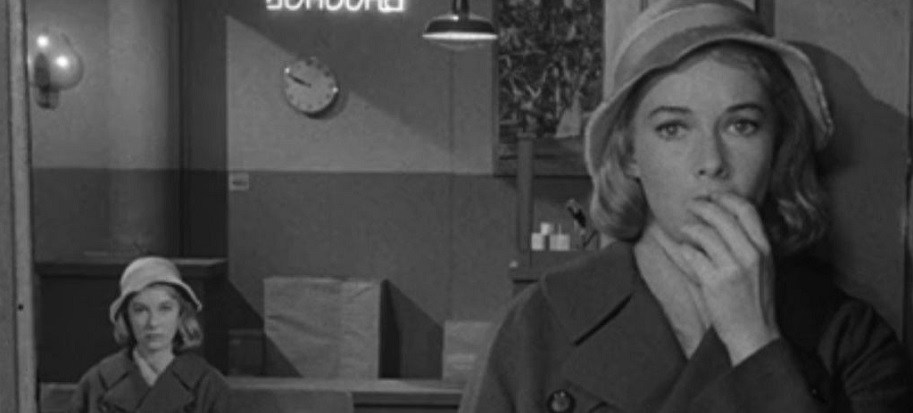
This is an odd one…but odd translates to good in the Twilight Zone. This one has no bad or good people…just an odd bus station where it all happens. What would you do if you looked across the room and saw yourself? That person not only looked just like but also carried a suitcase or bag just like you.
Vera Miles plays Millicent Barnes who swears she has seen herself. She starts to get paranoid and tells Paul Grinstead (Martin Milner) this and she starts to break down…then Grinstead, who obviously likes her and then starts to pity her does what he thinks is best…or so he thought. It could have ended a bit better. I just felt it never resolved itself. A good Twilight Zone and not a failure but not as good as some of the better ones.
A stand out character actor in this one is Joseph Hamilton playing the grumpy put upon Ticket Agent.
The reason I remember this episode so well is because of Martin Milner . He would start filming Route 66 after this and became a star…later on he would become a bigger star known to the world as Pete Malloy on Adam 12.
The cities mentioned in this episode (Cortland, Syracuse, Tully, and Binghamton) all lie along Hwy. 11 in central upstate New York. The use of these places is an homage by Rod Serling to his childhood. He was born in Syracuse and lived in Binghamton until he graduated high school. Even when he lived in Hollywood during his heyday, he maintained a home in Binghamton.
It was after filming this story that Martin Milner went to film the pilot episode of Route 66 (1960), which made him a star.
This show was written by Rod Serling
Rod Serling’s Opening Narration:
Millicent Barnes, age twenty-five, young woman waiting for a bus on a rainy November night. Not a very imaginative type is Miss Barnes: not given to undue anxiety, or fears, or for that matter even the most temporal flights of fantasy. Like most young career women, she has a generic classification as a, quote, girl with a head on her shoulders, end of quote. All of which is mentioned now because, in just a moment, the head on Miss Barnes’ shoulders will be put to a test. Circumstances will assault her sense of reality and a chain of nightmares will put her sanity on a block. Millicent Barnes, who, in one minute, will wonder if she’s going mad.
Summary
Millicent Barnes is waiting in the bus station waiting for her bus to Cortland to arrive. The weather outside is dreadful and the bus is over half an hour late already. When she inquires the station clerk chides her for constantly asking when it will arrive. The only thing is (she thinks) it’s the first time she’s asked him anything. When she goes to the ladies room the cleaning lady suggests she was just in there, she begins to worry that she’s going mad. A good Samaritan, Paul Grinstead, tries to help her out but soon realizes that there may be an explanation for what is happening after all.
Rod Serling’s Closing Narration:
Obscure and metaphysical explanation to cover a phenomenon. Reasons dredged out of the shadows to explain away that which cannot be explained. Call it ‘parallel planes’ or just ‘insanity’. Whatever it is, you’ll find it in the Twilight Zone.
CAST
Rod Serling … Narrator (voice) Vera Miles … Millicent Barnes Martin Milner … Paul Grinstead Joseph Hamilton … Ticket Agent (as Joe Hamilton) Naomi Stevens … Washroom Attendant Therese Lyon … Old Woman (as Terese Lyon) Ferris Taylor … Passenger Edwin Rand … Bus Driver
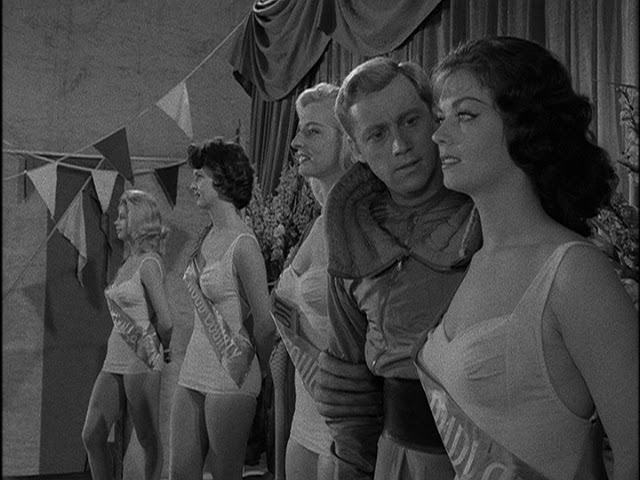
This episode gets to me when I see it. You feel the confusion of the astronauts as they land on a planet that everything is frozen in time…literally frozen in time. Everybody on this strange planet is just standing or sitting still. A beauty pageant is going on, men fishing and they are all still.
After exploring everywhere an older man finally talked to them…Jeremy Wickwire (I love that name). He explains what is going on and where they are… and then does something just terrible.
It’s an good episode and the Twilight Zone will explore this plot a little more in the future. We are certainly on a great streak of shows…only broken by The Fever.
The flashing dials in the spaceship seen right after landing are the same ones used in Forbidden Planet
Charles Beaumont wrote this years earlier under the guidance and influence of Beaumont’s literary mentor, Ray Bradbury…THAT is some mentor.
This show was written by Charles Beaumont
Rod Serling’s Opening Narration:
The time is the day after tomorrow. The place: a far corner of the universe. A cast of characters: three men lost amongst the stars. Three men sharing the common urgency of all men lost. They’re looking for home. And in a moment, they’ll find home; not a home that is a place to be seen, but a strange unexplainable experience to be felt.
Summary
In a far corner of the universe, a spaceship with three astronauts lands on a planet with gravity and air conditions virtually identical to that on Earth. Their surroundings appear as Earth did 200 years ago but the planet has two suns so they’re fairly certain they didn’t somehow end up back home. People however seem to be frozen in time. They eventually stumble upon Jeremy Wickwire, who is the caretaker for the locale. His explanation of what he is and where they are defies belief but in the end, he does grant them their wish.
This one is a good episode. I will admit the first time I watched it…I hadn’t worked out the twist.
Rod Serling’s Closing Narration:
Kirby, Webber, and Meyers, three men lost. They shared a common wish—a simple one, really. They wanted to be aboard their ship headed for home. And fate—a laughing fate—a practical jokester with a smile stretched across the stars, saw to it that they got their wish with just one reservation: the wish came true, but only in the Twilight Zone.
CAST
Cecil Kellaway … Jeremy Wickwire
Jeff Morrow … Kurt Meyers
Don Dubbins … Peter Kirby
Kevin Hagen … Captain James Webber
Walter Bacon … Beauty Contest Guest (uncredited)
Frank Baker … Hotel Guest (uncredited)
George Boyce … Minor Role (uncredited)
Barbara Chrysler Barbara Chrysler … Beauty Contestant (uncredited)
Alphonso DuBois … Minor Role (uncredited)
Joseph Glick … Rally Spectator (uncredited)
Chester Hayes … Ice Cream Man (uncredited)
Jimmie Horan … Minor Role (uncredited)
June McCall … Beauty Contestant (uncredited)
William Meader … Minor Role (uncredited)
Spec O’Donnell … Poker Player (uncredited)
Charles Perry … Spectator at Rally (uncredited)
Joe Ploski … Beauty Contest Guest (uncredited)
Paul Power … Farmer (uncredited)
Rod Serling … Narrator (voice) (uncredited)
Stephen Soldi … Minor Role (uncredited)
Jack Stoney … Finch (uncredited)
Martin Strader … Minor Role (uncredited)
Walton Walker … Minor Role (uncredited)
Sally Yarnell … Waitress (uncredited)
They were founded by singer, guitarist, and songwriter Todd Rundgren and bassist Carson Van Osten. Drummer Thom Mooney and vocalist/keyboardist Robert “Stewkey” Antoni would join last.
In celebration of Todd Rundgren getting in the Jann Wenner Rock and Roll Hall of Fame FINALLY…It makes no sense why the guy wasn’t in there 20 years ago. Not just as a performer but as a producer as well. Rundgren not getting in until now is one of the reasons it’s hard for me to take the Hall seriously…but I’m happy he is finally in.
In 2016, Rundgren told an interviewer: “It doesn’t have the same cachet as a Nobel Peace Prize or some historical foundation. If I told you about how they actually determine who gets into the Hall of Fame, you’d think that I was bullshitting you, because I’ve been told what’s involved. … It’s just as corrupt as anything else, and that’s why I don’t care.”
He was asked how he felt about finally being inducted and he said: “I’m happy for the fans. They’ve waited a long time for this.” He was probably more happy about the 2016 Honorary doctorate from Berklee College of Music, where he delivered the commencement address, and an honorary doctorate from DePauw University.
The Nazz self titled album was released in 1968. This was the A side of the single released…the B side was “Hello It’s Me”…yes the same song we know but an early version of it.
They formed in 1967 and their first concert was something to remember…opening for the Doors. Some say the band took its name from the Yardbirds’ 1966 song “The Nazz Are Blue”, other sources say the name came from a 1952 monologue, “The Nazz”, by the American Beatnik comedian Lord Buckley.
The band would release 3 albums after which Rundgren started a solo career.
Open My Eyes peaked at #112 in the Billboard Album Charts and Hello It’s Me peaked at #66 in 1968…
Todd would go on and released Hello It’s Me solo and it was a massive hit. It peaked at # 2 in the Billboard 100 and #17 in Canada in 1973.
He would also form the band Utopia in 1973.
Open My Eyes
Underneath your gaze I was found in The haze I’m wandering around in I am lost in the dark of my own room And I can’t see a thing but the fire in your eyes
Clear my eyes, make me wise Or is all I believe in lies I don’t know when or where to go And I can’t see a thing ’til you open my eyes
I’ve been told by some you’ll forget me The thought doesn’t upset me I am blind to whatever they’re saying And all I can see is the fire in your eyes
Clear my eyes, make me wise Or is all I believe in lies I really don’t know when or where to go And I can’t see a thing ’til you open my eyes Can’t see a thing ’til you open my eyes Can’t see a thing ’til you open my eyes Can’t see a thing ’til you open my eyes
Can’t believe that it’s on your mind To leave me behind
Clear my eyes, make me wise Or is all I believe in lies I really don’t know when or where to go And I can’t see a thing ’til you open my eyes Can’t see a thing ’til you open my eyes Can’t see a thing ’til you open my eyes Can’t see a thing ’til you open my eyes Can’t see a thing ’til you open my eyes
The Kinks were so different than other bands. They may have reached the popularity of the Who if they wouldn’t have been banned from touring in America in the late sixties.
The song pokes fun at the fashion scene on Carnaby Street in the Swinging Sixties London…I was written from the point of view of someone who was there living every minute of it. It was released on the Pye label in the UK on February 25 backed by “Sittin’ On My Sofa,” and on Reprise in the United States on April 27. The band’s 10th UK single, it was produced by Shel Talmy.
The song makes me want to go to Carnaby Street but…only in the sixties when it acted as the epicenter of fashion.
The song peaked at #36 in the Billboard 100, #4 in the UK, and #11 in Canada in 1966.
Shel Talmy:“Ray Davies was one of the more prolific songwriters I have ever worked with. He could literally write a dozen songs overnight if he felt the mood. We used to get together about once a month or once every week or two and go through the stuff he had. I would pick out the ones that I thought were real far along, and the ones that were not so far along, and the ones that would probably never be far along. ‘Dedicated Follower Of Fashion’ was one that stood out immediately.”
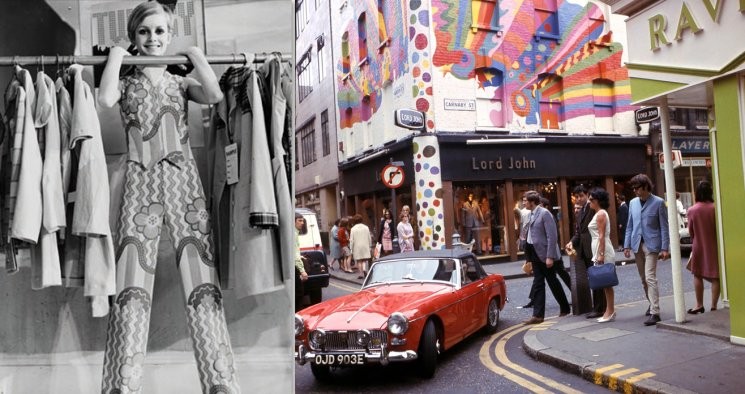
Carnaby Street…I look at sixties pictures of it and it looks really cool and different… when I see modern pictures of it…it looks like a shopping place that you could see at other places.
This looks like somewhere I would love to go
This one is modern…not as colorful!
From Songfacts
According to the online discography compiled by Kinks fan Dave Emlen, it was re-released in the US in August/September the following year, still on Reprise but backed by “Who’ll Be The Next In Line.”
“Dedicated Follower Of Fashion” is one of the band’s best-known songs, and has been included on a number of albums.
Although Carnaby Street dates to the 17th century, like the Kings Road, Chelsea, it will be linked forever to the fashion explosion that happened particularly in Britain during the so-called Swinging ’60s.
In spite of its chart success, not everyone in the Davies camp was enamored with the song. After Kinks bass player Peter Quaife died in June 2010, his obituary in the London Independent quoted him on it thus: “an incredibly boring song to play, and I had to play it night after night.”
According to a 2011 NME interview with Ray Davies, despite its fey overtones, the song is actually a scathing attack on a fop who made fun of the singer’s trousers.
Producer Shel Talmy helped frame The Kinks’ raucous guitar sound, and also had a great ear for a hit song. In a Songfacts interview with Talmy, he said:
Dedicated Follower Of Fashion
They seek him here, they seek him there His clothes are loud, but never square It will make or break him so he’s got to buy the best ‘Cause he’s a dedicated follower of fashion
And when he does his little rounds ‘Round the boutiques of London Town Eagerly pursuing all the latest fads and trends ‘Cause he’s a dedicated follower of fashion
Oh yes he is (oh yes he is), oh yes he is (oh yes he is) He thinks he is a flower to be looked at And when he pulls his frilly nylon panties right up tight He feels a dedicated follower of fashion
Oh yes he is (oh yes he is), oh yes he is (oh yes he is) There’s one thing that he loves and that is flattery One week he’s in polka-dots, the next week he is in stripes ‘Cause he’s a dedicated follower of fashion
They seek him here, they seek him there In Regent Street and Leicester Square Everywhere the Carnabetian army marches on Each one an dedicated follower of fashion
Oh yes he is (oh yes he is), oh yes he is (oh yes he is) His world is built ’round discotheques and parties This pleasure-seeking individual always looks his best ‘Cause he’s a dedicated follower of fashion
Oh yes he is (oh yes he is), oh yes he is (oh yes he is) He flits from shop to shop just like a butterfly In matters of the cloth he is as fickle as can be ‘Cause he’s a dedicated follower of fashion He’s a dedicated follower of fashion He’s a dedicated follower of fashion
A horrible “what if” power that Lt. Fitzgerald (William Reynolds) has… when he looks at his fellow soldiers… he knows which ones are about to die. A powerful episode and one that was remade in the 80s Twilight Zone reboot but it didn’t come close to this one.
One thing that struck me about actor William Reynolds…he looks like he could have walked out of 2021. Most of the time on older shows most actors and actresses look from that time period…he looks like he could be starring in a movie or TV show today.
Rod Serling served in the US Army’s 511th Parachute Infantry Regiment, 11th Airborne Division, during the liberation of the Philippines, where this episode is set.
The night of the planned air date, a plane carrying Richard L. Bare (Director) and William Reynolds crashed in the Caribbean Sea, injuring both (though not seriously). It is believed that during their swim to land, they discussed the episode that night and Bare requested Reynolds not to look at him. He later admitted that he commended Buck Houghton’s decision to reschedule rather than use the incident for publicity.
This is episode 19 of season one…we are over halfway through the first season.
This show was written by Rod Serling
Rod Serling’s Opening Narration:
Infantry platoon, U.S. Army, Philippine Islands, 1945. These are the faces of the young men who fight, as if some omniscient painter had mixed a tube of oils that were at one time earth brown, dust gray, blood red, beard black, and fear—yellow white, and these men were the models. For this is the province of combat, and these are the faces of war.
Summary
In the Philippines in 1945, Army Lt. Fitzgerald has developed the disturbing ability to look into his men’s faces and know who will be killed in the next battle. He says it’s like a light is shined on their faces. His superior, Capt. Phil Riker, consults the medical officer but he finds nothing conclusive. Fitzgerald passes out when visiting one of his wounded men in the hospital after he sees the light on his face. When he sees the light on Riker’s face, he begs him not to go out. After they return from the military operation, he sees that there will be one other casualty that day.
Rod Serling’s Closing Narration:
From William Shakespeare, Richard the Third, a small excerpt. The line reads, ‘He has come to open the purple testament of bleeding war.’ And for Lieutenant William Fitzgerald, A Company, First Platoon, the testament is closed. Lieutenant Fitzgerald has found the Twilight Zone.
CAST
Rod Serling … Narrator (voice) Dick York … Capt. Phil Riker William Reynolds … Lt. Fitzgerald William Phipps … Sergeant Barney Phillips … Capt. E.L. Gunther S. John Launer … Lieutenant Colonel Michael Vandever … Smitty Paul Mazursky … Orderly Marc Cavell … Freeman Warren Oates … Jeep Driver Ron Masak … Harmonica Man
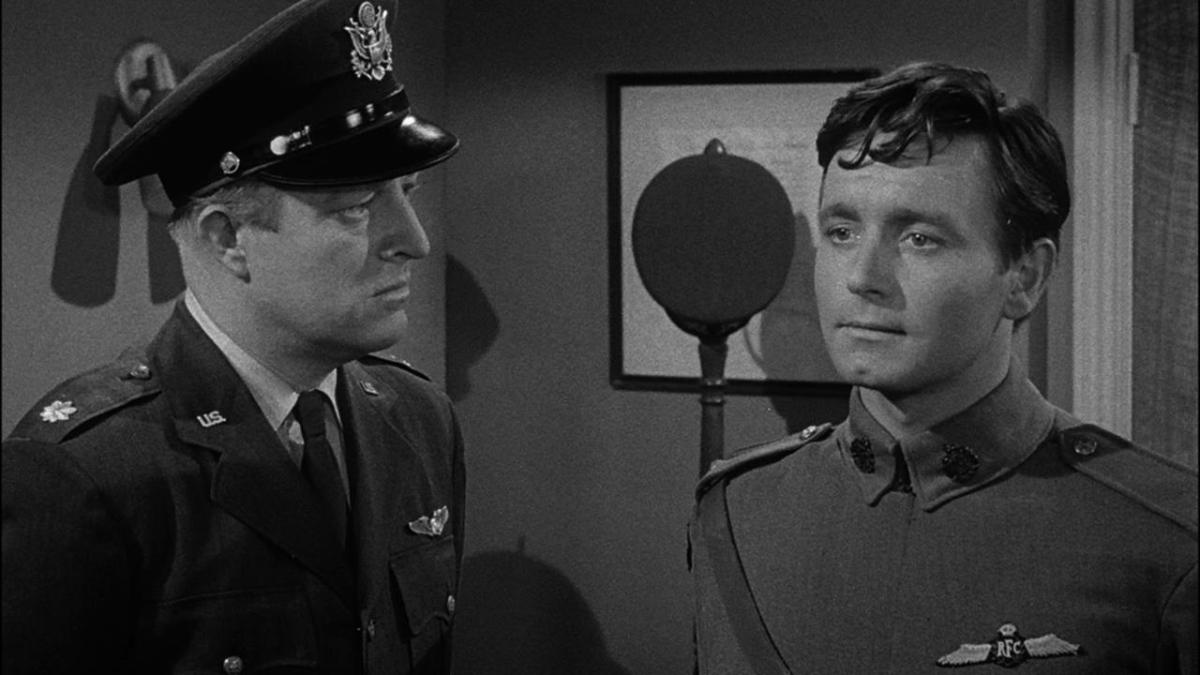
This is one of my most watched episodes of the Twilight Zone. I love time travel and this one is wonderful. Kenneth Haigh plays Lt. William Terrance Decker a British soldier who took off in his plane in 1917 and landed in 1959 at an American Air Force base. He’s held captive with the Americans believing his actions to be a prank.
I like how this one has a resolution at the end. You find out how the event affected everyone…including old “Leadbottom.”
The show like most of the other episodes is very well written, acted, and executed. This is a great episode. I could have easily given this a 5 star rating.
Richard Matheson wrote this episodes and he was one of my favorite writers of the show next to Serling. He would write 16 Twilight Episodes and among other things we would write for Star Trek the original series.
Witness Flight Lieutenant William Terrance Decker, Royal Flying Corps, returning from a patrol somewhere over France. The year is 1917. The problem is that the lieutenant is hopelessly lost. Lieutenant Decker will soon discover that a man can be lost not only in terms of maps and miles, but also in time – and time in this case can be measured in eternities.
Summary
Trying to find his way home after a dogfight in World War I, Royal Flying Corps Flt. Lt. William Terrance Decker lands at a U.S. Air Force base 42 years in the future. No one believes him when he claims to be from 1917, thinking someone is trying to put one over on them. Decker himself admits that before suddenly leaping into the future he was actually flying away from an serial encounter and leaving his friend in a lurch. He also realizes that he may have an opportunity to rectify that situation.
Rod Serling’s Closing Narration:
Dialog from a play, Hamlet to Horatio: There are more things in heaven and earth than are dreamt of in your philosophy. Dialog from a play written long before men took to the sky: There are more things in heaven and earth and in the sky than perhaps can be dreamt of. And somewhere in between heaven, the sky, and the earth, lies the Twilight Zone.
CAST
Kenneth Haigh … Lt. William Terrance Decker Alexander Scourby … Maj. Gen. George Harper Simon Scott … Maj. Wilson Robert Warwick … A.V.M. Alexander ‘Leadbottom’ Mackaye, R.A.F. Harry Raybould … Corporal Jerry Catron … Guard
This is the second time I’ve published this…it vanished from the Reader.
I watched this last week and also Thursday night again just to make sure I wasn’t marking it too low.
This is the only episode so far I’ve given a lower than 3 stars to. As always the episode has a moral lesson but…it loses something. Everett Sloane plays Franklin Gibbs who is a grouchy man who with his suffering wife Flora wins a trip to Las Vegas. Flora is just excited to be there but Everett will have none of it. He reluctantly plays a slot machine and wins…from there on it’s all down hill for Franklin. He is hooked like a bass on a line. Everett catches the gambling “fever.” I feel the episode is forced. Yes there is an important lesson but it doesn’t happen naturally at all.
Rod is preaching in this episode. Franklin goes from hating everything about gambling and fun to being a grumpy gambler in the span of a few minutes. This one needed more time to build.There is nothing wrong with Everett Sloane’s acting…the change is just too quick.
I do have sympathy with his wife… You can also tell poor Flora never gets out of the house.
The Fever was inspired by Rod Serling’s celebratory trip to Las Vegas when The Twilight Zone was first signed. His wife Carol Serling had good luck at the casino, but he himself kept losing to a slot-machine not unlike the one shown here, and battled it for a good while.
Even though the episode takes place in Las Vegas, it was filmed in California where slots were illegal at the time. The producers had to broker an arrangement with the LAPD to borrow real slot machines that had been confiscated by the police for use in the episode. Said producer Buck Houghton, “There was a policeman on the set at all times, to make damn sure that somebody didn’t take one off and set it up in his uncle’s barber shop.”
This show was written by Rod Serling
Rod Serling’s Opening Narration:
Mr. and Mrs. Franklin Gibbs, three days and two nights all expenses paid at a Las Vegas hotel, won by virtue of Mrs. Gibbs’s knack with a phrase. But unbeknownst to either Mr. and Mrs. Gibbs is the fact that there’s a prize in their package, neither expected nor bargained for. In just a moment, one of them will succumb to an illness worse than any virus can produce. A most inoperative, deadly life-shattering affliction known as the Fever.
Summary
Flora and Franklin Gibbs head off to Las Vegas for a two-night, all-expense-paid vacation won by Flora in a contest. Franklin has agreed to go with her but he is unimpressed with the place, especially the casino looking down on all of those poor fools, as he calls them, playing slot machines. He severely admonishes Flora when she puts a nickel in a slot machine, accusing her of throwing away her money. When a drunken gambler gives him a dollar and insists that he play the machine, Franklin wins and there begins his descent into madness.
Rod Serling’s Closing Narration:
Mr. Franklin Gibbs, visitor to Las Vegas, who lost his money, his reason, and finally his life to an inanimate, metal machine, variously described as a “one-armed bandit”, a “slot machine”, or, in Mr. Franklin Gibbs’ words, a “monster with a will all of its own.” For our purposes, we’ll stick with the latter definition because we’re in the Twilight Zone.
CAST
Rod Serling … Narrator (voice)
Everett Sloane … Franklin Gibbs
Vivi Janiss … Flora Gibbs
William Kendis … Hansen
Lee Millar … Joe
Lee Sands … Floor Manager
Marc Towers … Cashier
Art Lewis … Drunk
Arthur Peterson … Sheriff











 PowerPop... An Eclectic Collection of Pop Culture