Twilight Zone – The Hitch-Hiker

★★★★★  January 22, 1960 Season 1 Episode 16

If you want to see where we are…HERE is a list of the episodes.

There are episodes that are hard for me to rate but some…like this one…is really easy…it’s a 5 star classic without a second thought.

A beautiful young lady is traveling across the country and has a blow out. After she gets the tire fixed she is back on the road but keeps seeing this hitch hiker everywhere she goes. The lady (Nan Adams) is perfectly played by Inger Stevens. This has everything you would want out of a Twilight Zone. Great suspense, a little horror, and a Twilight Zone twist.

Lucille Fletcher got the idea for this story in 1940 when she and her husband Bernard Herrmann were driving cross-country from New York to California. On the first day of the trip they saw the same odd-looking man on the side of the road it two different locations. She found the occurrence rather eerie and thought it might be a good concept for a story.

In the original story, the character of Nan was a male, Ronald. Rod Serling believed that a female in the situation would be reacted to with more feeling by audiences. She was named after one of his daughters.

This show was written by Rod Serling and  Lucille Fletcher

Rod Serling’s Opening Narration: 

Her name is Nan Adams. She’s twenty-seven years old. Her occupation: buyer at a New York department store. At present on vacation, driving cross-country to Los Angeles, California from Manhattan…Minor incident on Highway 11 in Pennsylvania. Perhaps, to be filed away under “accidents you walk away from.” But from this moment on, Nan Adams’ companion on a trip to California will be terror. Her route: fear. Her destination: quite unknown.

Summary

Nan Adams is driving across country from Manhattan to Los Angeles. Apart from a blown tire, the trip has been more or less uneventful. That is until she begins to see the same man, over and over again, hitchhiking along the highway. No matter how far she goes or how far she drives, the hitchhiker always seems to be ahead of her. She also seems to be the only person who can see him. When Nan decides to call home, all is revealed.

Rod Serling’s Closing Narration:

Nan Adams, age twenty-seven. She was driving to California; to Los Angeles. She didn’t make it. There was a detour… through the Twilight Zone.

CAST

Inger Stevens … Nan Adams
Adam Williams … Sailor
Lew Gallo … Mechanic
Leonard Strong … The Hitch-Hiker
Russ Bender … Counterman
George Mitchell … Gas Station Man

Rolling Stones – 2000 Light Years From Home

Their Satanic Majesties Request…the more I listen to this album the more I like it. It wasn’t up to their normal standards but it is nice to know the St0nes stretched themselves and tried something different. They would later dip into reggae and disco but this was an album worth of change that never happened again.

This psychedelic period was coming off of one of their best stretches which I think they produced some of their best music with songs like Ruby Tuesday.

Mick Jagger got the idea for this while in jail on drug charges from the famous Redland’s bust.

On this track, their lead guitarist, Brian Jones, played a Mellotron, an early synthesizer. Jones played a number of unusual instruments in his time with the band, which lasted from their founding in 1962 until 1969, when he was fired after a number of clashes with the rest of the Stones.

Brian Jones has been over rated and underrated but his subtle touch on songs was missed.

Just weeks after leaving the band…  Jones drowned in his swimming pool.

After Brian was gone it was noticeable in the Stones. He was a great utility guy who could play about any instrument. Mick Taylor replaced him and that lead to the Stones golden period. In my opinion, Taylor was the best guitar player the Stones ever had in the band. He was a huge part of their sound. When he left there was a hole in the sound that never came back.

From Songfacts

Space exploration was big at the time, and was probably an influence on this song. Pink Floyd was making music with a similar sound.

The psychedelic sound reflected the times. It was the summer of love (1967).

The Stones played this on their Steel Wheels tour in 1989. A show in Atlantic City was broadcast with this song shot in 3D, which viewers could see using those goofy glasses.

Various echo effects and drum sounds were added in overdubbing.

The ’90s psychedelic group The Brian Jonestown Massacre recorded a tribute to the Stones’ psychedelic period (and this song) called Their Satanic Majesties’ Second Request.

2000 Light Years From Home

Sun turnin’ ’round with graceful motion
We’re setting off with soft explosion
Bound for a star with fiery oceans
It’s so very lonely
You’re a hundred light years from home

Freezing red deserts turn to dark
Energy here in every part
It’s so very lonely
You’re six hundred light years from home

It’s so very lonely
You’re a thousand light years from home
It’s so very lonely
You’re a thousand light years from home

Bell flight fourteen you now can land
See you on Aldebaran
Safe on the green desert sand
It’s so very lonely
You’re 2000 light years from home
It’s so very lonely
You’re 2000 light years from home

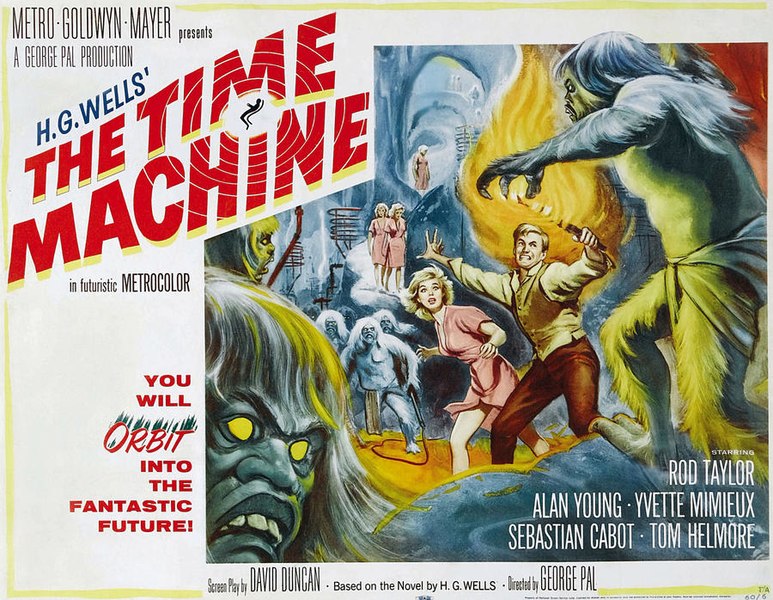
The Time Machine 1960

Hanspostcard is hosting a movie draft from 12 different genres…this is my Scifi entry.

I have always liked Time Travel movies and this one is one of the best  I’ve watched. The movie was based on the H.G. Wells book The Time Machine published in 1895. The way they present it is believable.

I somehow missed this movie until 2005. It stars Rod Taylor as George Wells, Alan Young as David Filby/James Filby , and the beautiful Yvette Mimieux as Weena and Alan Young. It also has Sebastian Cabot as Dr. Philip Hillyer.

Rod Taylor portrays George Wells, and he builds a Time Machine. Other than the Tardis (Doctor Who) it’s the coolest time machine I’ve seen. He builds a miniature one and while his friends watch, he turns the small machine on and it disappears into the future. His friends don’t really believe it. They question what good it will do if it really works? Who would buy it? George gets aggravated and takes off. I can’t say I blame him.

This time machine doesn’t physically move but just occupies the same space in the time.

He takes the machine for a test ride into the future. They had no CGI but they get across time travel fine. To show time passing they set up a mannequin across the street to show different clothing styles passing by with the time which is brilliant. Sometimes subtle ways are better than obvious ones.

George’s journey began on December 31, 1899 and he goes to October 12, 802,701 with some stops on the way. He witnesses some of the first and second World War and nuclear destruction. When he gets to 802,701 the adventure begins.

He ends up in a future society where all the people are young. They do nothing all day but play and eat…hmmm millennials? Just kidding…George shows this society there is a price they pay for playing all day. The young people there have no clue on what is going on. No laws, curiosity, and no anxiety for the future. They are sheep and they don’t even know or seem to care.

My favorite part of the movie is the creatures called the Morlocks with glowing eyes that live underground because they could not stand light. They provide the clueless land dwellers with food for obvious reasons. This is a truly classic movie. Don’t’ bother with the remake in 2002…get this version.

Alan Young does a great job as David Filby…George’s best friend and later David’s son…

My son watched this when he was 8 and feared the Morlocks but kept watching. He still watches it now. It was filmed in 1960 and the film won an Oscar for Best Effects, Special Effects. Does it measure up to today’s special effects? No,  but it gets the story across so if you like classic sci-fi you might like this one. I’ve seen it many times and never got tired of it.

CAST

  • Rod Taylor as H. George Wells
  • Alan Young as David Filby/James Filby
  • Yvette Mimieux as Weena
  • Sebastian Cabot as Dr. Philip Hillyer
  • Tom Helmore as Anthony Bridewell
  • Whit Bissell as Walter Kemp
  • Doris Lloyd as Mrs. Watchett
  • Paul Frees as voice of the Rings (uncredited)


Twilight Zone – I Shot an Arrow Into the Air

★★★★  January 15, 1960 Season 1 Episode 15

If you want to see where we are…HERE is a list of the episodes.

Serling like to show the best and worse of people and this episode has both. Edward Binns plays the honorable Col. Bob Donlin and Dewey Martin  plays the selfish Corey who folds under pressure in the worse way.  A space ship is launched and crashes on what seems an unknown asteroid…survival will be difficult for the 4 survivors of the crash. It’s hot, rocky, and no water in sight. Cory is determined to survive no matter what. It’s a very good episode…I went back between 3 1/2 and 4 but the twist pushes it over the top.

Rod Serling was at a party when he was approached by a woman named Madelon Champion who told Serling a what if story and this was it. Serling gave her $500 dollars on the spot and gave her a co-writing credit.

Rarely did this happen… here is a quote from Rod Serling: I got 15,000 manuscripts in the first five days. Of those 15,000, I and members of my staff read about 140. And 137 of those 140 were wasted paper; hand-scrawled, laboriously written, therapeutic unholy grotesqueries from sick, troubled, deeply disturbed people. Of the three remaining scripts, all of clearly poetic, professional quality, none of them fitted the show.

This is one of only four episodes that Rod Serling did a mid-episode narration

This show was written by Rod Serling and Madelon Champion

Rod Serling’s Opening Narration: 

Her name is the Arrow 1. She represents four and a half years of planning, preparation, and training, and a thousand years of science, mathematics, and the projected dreams and hopes of not only a nation, but a world. She is the first manned aircraft into space and this is the countdown. The last five seconds before man shot an arrow into the air.

Summary

This is the story of a group of spacemen who crash on what they think is an asteroid. Since they are doomed, the Captain tries to keep military protocol. Nevertheless, Cory, one of the men, becomes a survivalist. He becomes selfish and begins to take over. He kills. He steals water. He whines. The story works toward an ironic twist, bringing out the best and the worst in everyone. Patience goes out the window over water. Remember the two men fighting at the conclusion of Von Stroheim’s Greed. There is a bit of this because when our lives are on the line, we often try to hold on to every second we can. Cory can’t see honor or morality or order. It’s just to grasp for that one more drop of precious water.

Rod Serling mid-episode narration 

Now you make tracks, Mr. Corey. You move out and up like some kind of ghostly billyclub was tapping at your ankles and telling you that it was later than you’d think. You scrabble up rock hills and feel hot sand underneath your feet and every now and then, take a look over your shoulder at a giant sun suspended in a dead and motionless sky…like an unblinking eye that probes at the back of your head in a prolonged accusation.

Mr. Corey, last remaining member of a doomed crew, keep moving. Make tracks, Mr. Corey. Push up and push out because if you stop…if you stop, maybe sanity will get you by the throat. Maybe realization will pry open your mind and the horror you left down in the sand will seep in. Yeah, Mr. Corey, yeah, you better keep moving. That’s the order of the moment: keep moving.

Rod Serling’s Closing Narration:

Practical joke perpetrated by Mother Nature and a combination of improbable events. Practical joke wearing the trappings of nightmare, of terror, and desperation. Small, human drama played out in a desert 97 miles from Reno, Nevada, U.S.A., continent of North America, the Earth and, of course, the Twilight Zone.

CAST

Dewey Martin … Corey
Edward Binns … Col. Bob Donlin
Ted Otis … Pierson
Harry Bartell … Langford
Leslie Barrett … Brandt
Boyd Cabeen … Technician (uncredited)
Rod Serling … Narrator (voice) (uncredited)

Twilight Zone – Third From the Sun

★★★★★  January 8, 1960 Season 1 Episode 14

If you want to see where we are…HERE is a list of the episodes.

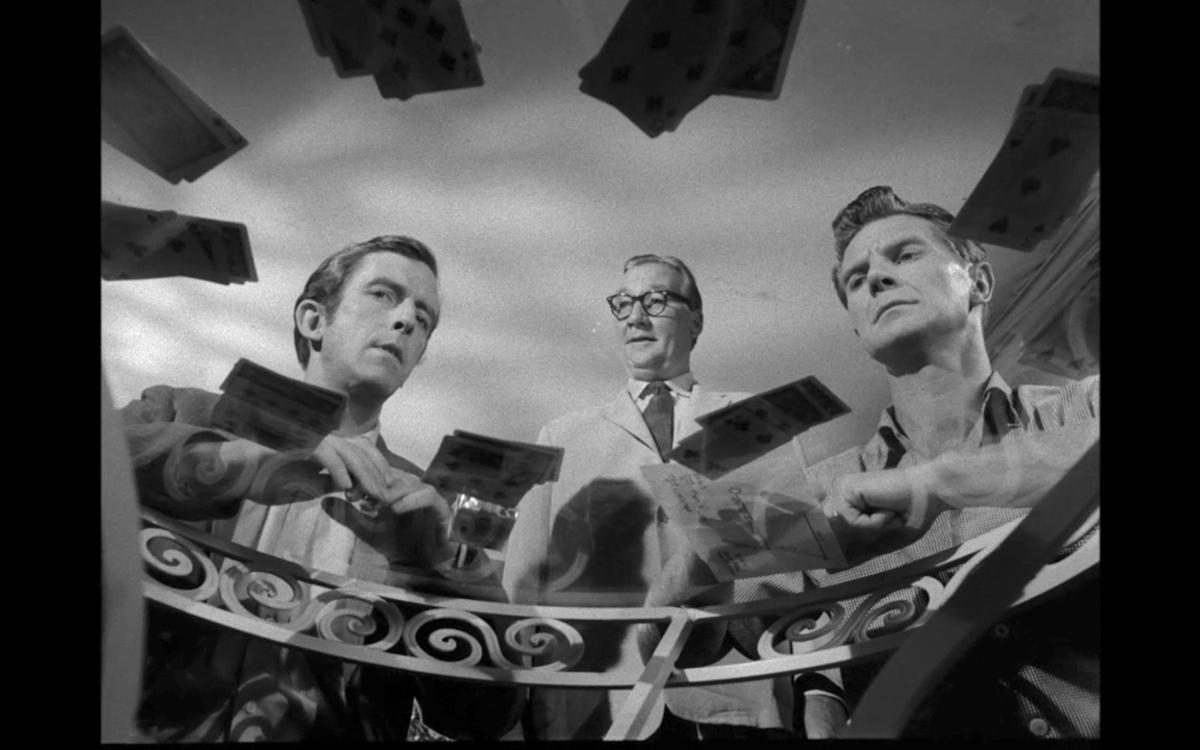
The first thing about this  episode that catches my eye is the camera work. The angles they used were really interesting and keeps this episode fresh.

I run across people who have never seen the Twilight Zone…there are a few episodes I point them to…this is one of them. This has everything a great episode has… the great casting, story, and the surprise at the end.

This one has one of my very favorite twists at the end. At the time of this episode it had to hit home for many people…The Cold War and fear of nuclear annihilation were ever-present. Fritz Weaver did an amazing job of relating the fear and paranoia of an oncoming disaster.

Edward Andrews played Carling a security officer who is unlikable at first sight. He toys with the two families determined to block their secret plans for an escape. The more I see this episode the more I really dislike this guy…he played the part very well.

Some trivia: The background noises heard aboard the ship in the final scene were later reused in Star Trek. During the closing scene, the main characters are depicted aboard a spaceship, a reuse of the ship created for Forbidden Planet

This show was written by Rod Serling and Richard Matheson

Rod Serling’s Opening Narration: 

Quitting time at the plant. Time for supper now. Time for families. Time for a cool drink on a porch. Time for the quiet rustle of leaf-laden trees that screen out the moon, and underneath it all, behind the eyes of the men, hanging invisible over the summer night, is a horror without words. For this is the stillness before storm. This is the eve of the end.

Summary

William Sturka works as a hydrogen specialist in a highly secure plant. Conditions are tense and there are constant rumors of war. The latest is that it’s going to happen in the next 48 hours. Unbeknownst to his wife Eve and daughter Jody, he and his friend Jerry Riden have been planning an escape of sorts for themselves and their families. Jerry is a test pilot and they plan to steal the government’s latest spacecraft heading off to a planet they believe may sustain life. Their biggest challenge is Carling, a security officer who seems to be onto their plan.

Rod Serling’s Closing Narration:

Behind a tiny ship heading into space is a doomed planet on the verge of suicide. Ahead lies a place called Earth, the third planet from the Sun. And for William Sturka and the men and women with him, it’s the eve of the beginning—in the Twilight Zone.

CAST

Fritz Weaver … William Sturka
Edward Andrews … Carling
Joe Maross … Jerry Riden
Denise Alexander … Jody Sturka
Lori March … Eve Sturka
Jeanne Evans … Ann Riden

Twilight Zone – The Four of Us Are Dying

★★★ 1/2  January 1, 1960 Season 1 Episode 13

If you want to see where we are…HERE is a list of the episodes.

The first episode of a brand new decade that would see the world change immeasurably.

This episode has a great what if story. What if… you could change your face just by looking at a picture or from memory? Many times in the Twilight Zone these talents are given to people who want more out of life than they have earned. Instead of using this for the good…we have a small time crook trying to take advantage people.

He had his own face and he ended up changing into 3 different faces. He would scanned the paper and changed into people who he could take advantage of their situation. They were going to cast the same actor and use makeup but they decided to cast 4 different actors with same eye color and build.

This show was written by  Rod Serling  and  George Clayton Johnson

Rod Serling’s Opening Narration: 

His name is Arch Hammer, he’s 36 years old. He’s been a salesman, a dispatcher, a truck driver, a con man, a bookie, and a part-time bartender. This is a cheap man, a nickel-and-dime man, with a cheapness that goes past the suit and the shirt; a cheapness of mind, a cheapness of taste, a tawdry little shine on the seat of his conscience, and a dark-room squint at a world whose sunlight has never gotten through to him. But Mr. Hammer has a talent, discovered at a very early age. This much he does have. He can make his face change. He can twitch a muscle, move a jaw, concentrate on the cast of his eyes, and he can change his face. He can change it into anything he wants. Mr. Archie Hammer, jack-of-all-trades, has just checked in at three-eighty a night, with two bags, some newspaper clippings, a most odd talent, and a master plan to destroy some lives.

Summary

Arch Hammer arrives in the city and checks into a seedy hotel. He looks like any other man but looks can be deceiving. Hammer has the ability to change his appearance at whim, a trick he definitely uses to his own advantage. He takes on the appearance of the recently deceased musician Johnny Foster. who died in a car accident. He goes to meet Maggie, a lounge singer who is mourning Foster’s death, and convinces her to run off with him. He then takes on the appearance of Virge Sterig, a gangster whose bullet-riddled body was recently found in the river. He then visits mob boss Penell who double-crossed him to get his share of the money their most recent job. An unplanned change of face doesn’t go over well, however.

Rod Serling’s Closing Narration:

He was Arch Hammer, a cheap little man who just checked in. He was Johnny Foster, who played a trumpet and was loved beyond words. He was Virgil Sterig, with money in his pocket. He was Andy Marshak, who got some of his agony back on a sidewalk in front of a cheap hotel. Hammer, Foster, Sterig, Marshak—and all four of them were dying.

CAST

Harry Townes … Arch Hammer
Phillip Pine … Virge Sterig
Ross Martin … Johnny Foster
Don Gordon … Andy Marshak
Harry Jackson … Trumpeter
Bernard Fein … Penell
Peter Brocco … Mr. Marshak
Milton Frome … Detective
Beverly Garland … Maggie

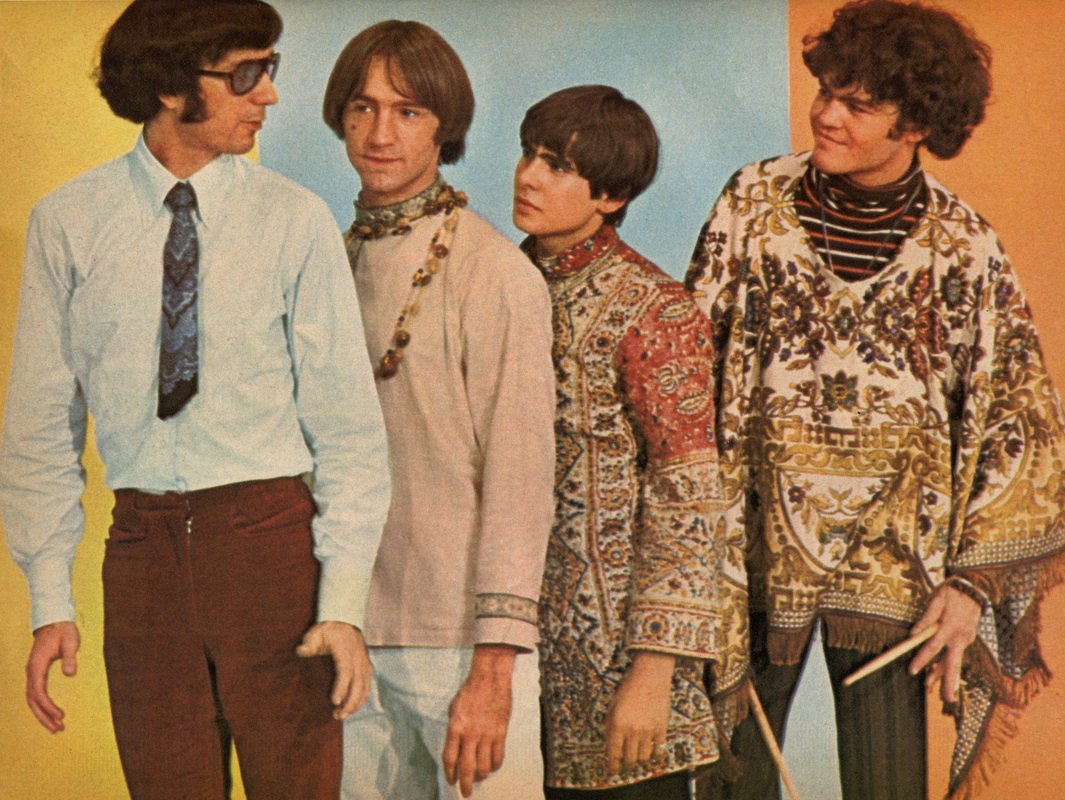
Monkees – Sweet Young Thing

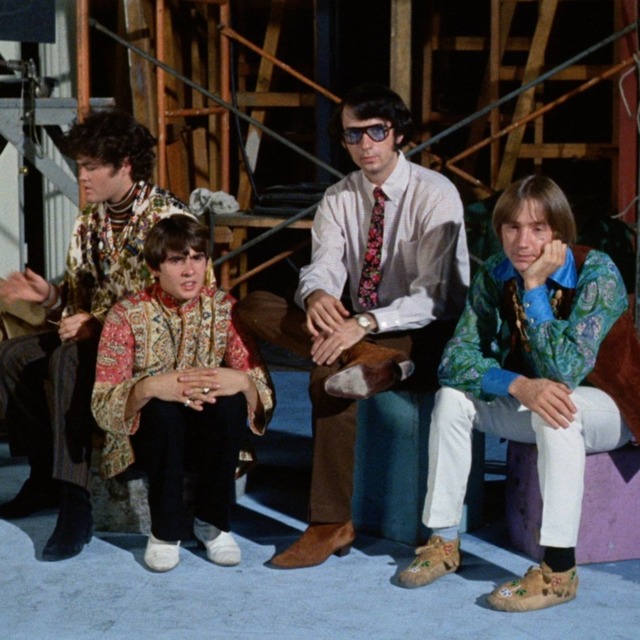
I was 7 and I had just borrowed the Monkees debut album from a cousin. I thought the band was still together and playing in the mid seventies. I had no clue they broke up years before. This is one of the songs I would wear out on the album.

The song stands out from the other songs on the album. This isn’t pop…it’s more like a country driven garage rock band song. I truly think Nesmith would have made it in the music business with or without the Monkees. He would soon write the Stone Poneys hit “Different Drum” that peaked at #13 in the Billboard 100 in 1967. This song was released on the debut album in 1966.

Mike Nesmith made it clear from the beginning he wanted to write songs. Nesmith was a talented songwriter. The shows creator Don Kirshner set him up to write with Carole King and Gerry Goffin. Michael wasn’t ungrateful and he commented that he liked both of them but he didn’t like being forced to write with someone else. Kirshner resented the rejection, feeling that a nobody like Nesmith should have flipped over the opportunity to work with two songwriting legends. In the end, though we did get this song.

Kirshner didn’t like having the band do anything but sing and act in the show. That didn’t last long with Nesmith leading them…by the third album the Monkees were playing their own instruments and writing some songs.

I just listened to it again for the first time in years and every nuance and word came back to me instantly. This was my first “favorite” Monkee song.

This was an album track not released as a single.

Sweet Young Thing

I know that something very strange
Has happened to my brain
I’m either feeling very good
Or else I am insane
The seeds of doubt you’ve planted
Have started to grow wild
And I feel that I must yield before
The wisdom of a child

And it’s love you bring
No that I can’t deny
With your wings
I can learn to fly
Sweet young thing

People try to talk to me
Their words are ugly sounds
But I resist all their attempts
To try and bring me down..
Turned on to the sunset
Like I’ve never been before
How I listen for your footsteps
As you knock upon the door

And it’s love you bring
No that I can’t deny
With your wings
I can learn to fly
Sweet young thing

And it’s love you bring
With dreams of bluer skies
And all these things
When I see it in your eyes
Sweet young thing

Sweet young thing

Beatles – I’m Down

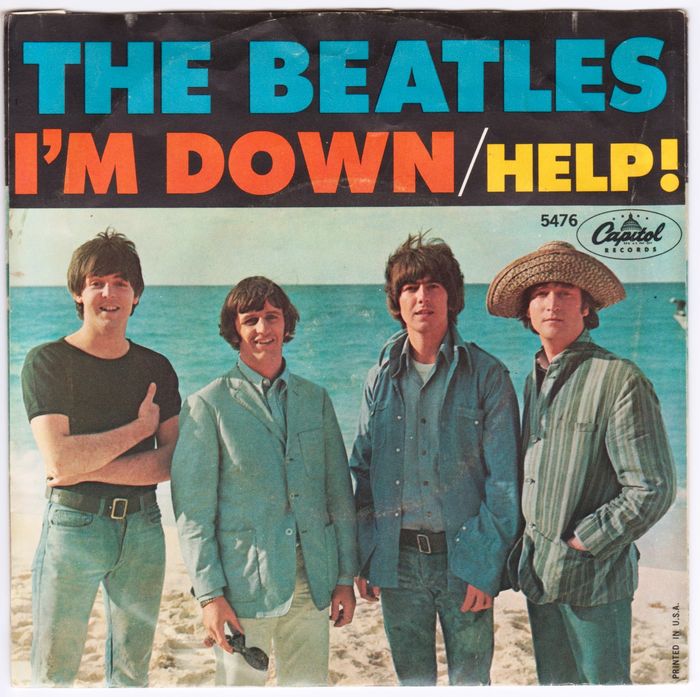
I have always liked this B side to Help! Not a bad B side at all.

It was credited to Lennon/McCartney but Paul McCartney wrote this track… in the style of Little Richard. American R&B singers like Richard were a big influence on The Beatles.

The Beatles used this as their closing number on 1965 North American and UK tours, and the 1966 World tour.

When the Beatles were recording this…Paul took a break after shredding his vocal cords and recorded the classic…Yesterday. John Lennon played the Hammond organ on this track. It was the first time Lennon played any kind of keyboard on a record. When The Beatles played this live, he often played an electric piano.

This was the first song ever recorded by Aerosmith. They used it as a demo which eventually got them a record deal. They used also recorded it in 1987 on their album Permanent Vacation.

Paul McCartney: “I’m not sure if John had any input on it, in fact I don’t think he did. But not wishing to be churlish, with most of these I’ll always credit him with 10 per cent just in case he fixed a word or offered a suggestion. But at least 90 per cent of that would be mine.”

From Songfacts

In this song, Paul McCartney plays the role of a poor sap wallowing in his misery. But the joke is on him, which the arrangement and backing vocals make clear. When he sings, “I’m down,” John Lennon and George Harrison retort in mocking fashion, with lines like “down on the ground.” It’s as if they’ve heard too much of his bellyaching and they’re sick of it.

A telling line is, “How can you laugh when you know I’m down?” You can only have so much sympathy for someone who won’t help himself. After that, you have to laugh.

The Beatles performed this on their third live Ed Sullivan Show appearance – September 12, 1965. Before The Beatles broke through in America, Sullivan was in the London airport when The Beatles returned from a tour of Sweden. When he saw the massive crowd there to greet them, he thought The Queen was arriving. When he found out the throngs were there for The Beatles, he made sure to book them on his show. He became a big fan and had them on whenever he could.

This was recorded at the same session with “Yesterday” and “I’ve Just Seen a Face.” 

The Beastie Boys recorded a version of this in 1986. Michael Jackson, who owned the publishing rights to this and many other Beatles songs, would not allow them to release it.

Paul McCartney played this at the “Concert For New York,” a benefit show he helped organize in 2001 to help victims of the World Trade Center disaster. It was the first song of his set.

I’m Down

You tell lies thinking I can’t see
You can’t cry ’cause you’re laughing at me
I’m down (I’m really down)
I’m down (Down on the ground)
I’m down (I’m really down)
How can you laugh when you know I’m down
(How can you laugh) When you know I’m down

Man buys ring woman throws it away
Same old thing happens everyday
I’m down (I’m really down)
I’m down (Down on the ground)
I’m down (I’m really down)
How can you laugh when you know I’m down
(How can you laugh) When you know I’m down

We’re all alone and there’s nobody else
You still moan, “Keep your hands to yourself!”
I’m down (I’m really down)
Oh baby, I’m down (Down on the ground)
I’m down (I’m really down)
How can you laugh when you know I’m down
(How can you laugh) When you know I’m down, wow
Baby I’m down

Oh baby, you know I’m down (I’m really down)
Oh yes, I’m down (I’m really down)
I’m down on the ground (I’m really down)
Ah, Down (I’m really down)
Oh baby, I’m upside down, a yeah, yeah, yeah, yeah, yeah
I’m down (I’m really down)
Oh baby, I’m down (I’m really down)
I’m feeling upside down (I’m really down)
Oh, I’m down (I’m really down)
Baby, I’m down, yeah
Oh baby, I’m down, yeah
Baby I’m down (I’m really down)
Well, baby I’m down (I’m really down)
Well, baby, baby, baby (I’m really down)
Oh baby, I’m down
I’m down, down, down

Twilight Zone – Walking Distance… #1

Before we get to my number 1 episode…This has been so much fun I’m going to start a huge project. I want to review every Twilight Zone…all 156 episodes…so that will be next…my top 10 is not enough. I’ll start with S01E01 and work myself through and skip the 10 I’ve covered in this section. I’ve never rated shows or movies before but I will try that as well. 

This one gets a 5 out of 5 ★★★★★

Since ratings are subjective to who ever is going it…this is my system

★★★★★ This would be an exceptional episode…to me anyway
★★★★☆ This would be above the already high standards of the show
★★★☆☆ This would be a good to very good episode
★★☆☆☆ This would be just a little below average, the 4th season might see this
★☆☆☆☆ This would be a don’t watch…I don’t think this will ever be seen but I’m watching them all over to be sure

Now for my number 1 Twilight Zone episode! This one has my favorite element…Time Travel. How cool would it be to go back and meet your 11 year old self? Episodes 2-156 could change in my rankings but this one remains my favorite.

They really did this episode right. They followed through with everything. You were not wanting for answers at the end. It wasn’t just Martin who figured out he was back in time. It resolves it self nicely…with a valuable lesson. There are spoilers past this.

If you are new to the Twilight Zone this is a great one to start with…

Rod Serling’s opening narration: 

Martin Sloan, age thirty-six. Occupation: vice-president, ad agency, in charge of media. This is not just a Sunday drive for Martin Sloan. He perhaps doesn’t know it at the time, but it’s an exodus. Somewhere up the road he’s looking for sanity. And somewhere up the road, he’ll find something else.

Gig Young plays Martin Sloan who does a great job in this episode. Many people try to go back home but it’s never the same because of progress and change…Martin Sloan DOES go home and everything is the same…he even sees himself as a boy…and meets his parents…again. Also…watch out for a 4 year old Ron Howard…soon to be forever known as Opie on the Andy Griffith Show.

13 TV shows Ron Howard was on besides Happy Days and Andy Griffith

Rod Serling wrote this episode.

Martin Sloan (Gig Young), a 36-year-old executive, stops in a fuel station off an isolated country road. Not far away, 1.5 miles, is the sight of his hometown, Homewood, he’s very curious about all the kinds of things that shaped his childhood. Martin ventures to take a closer look, first he goes to an old shop where he used to get ice cream sodas. Martin is surprised to see the prices haven’t changed still a dime for a three scoop ice cream soda. Walking around Martin meets a kid, who is his old neighbor. It is then that he realizes he’s in 1934, when he was only 11-years-old. Things get complicated when he bumps into the young Martin, follows him to his house and meets with his parents. They won’t believe him when Martin says he’s in fact their grown up son. Later, Martin insists in talking with young Martin. He finds him on a carousel, where the child gets hurt falling. Martin will learn, after talking to his father, that every man has his own time and is perhaps better off not looking to the past.

Enough of my favorite episode…what is your favorite?

Rod Serling’s closing narration:

Martin Sloan, age thirty-six, vice-president in charge of media. Successful in most things but not in the one effort that all men try at some time in their lives—trying to go home again. And also like all men, perhaps there’ll be an occasion, maybe a summer night sometime, when he’ll look up from what he’s doing and listen to the distant music of a calliope, and hear the voices and the laughter of the people and the places of his past. And perhaps across his mind there’ll flit a little errant wish, that a man might not have to become old, never outgrow the parks and the merry-go-rounds of his youth. And he’ll smile then too, because he’ll know it is just an errant wish, some wisp of memory not too important really, some laughing ghosts that cross a man’s mind, that are a part of the Twilight Zone.

  • Gig Young as Martin Sloan
  • Frank Overton as Robert Sloan
  • Irene Tedrow as Mrs. Sloan
  • Michael Montgomery as Tweenage Martin
  • Ron Howard as Wilcox Boy
  • Byron Foulger as Charlie
  • Sheridan Comerate as Gas Station Attendant
  • Joseph Corey as Soda Jerk
  • Buzz Martin as Boy with Car
  • Nan Peterson as Woman in Park
  • Pat O’Malley as Mr. Wilson

Moody Blues – Tuesday Afternoon

Tuesday Afternoon was on the classic concept album Days of Future Passed which was released in 1968. This song was released as a single and was the second single from Days of Future Passed (the first being “Nights in White Satin“). It was backed with a song called “Another Morning”.

Ever since I heard the intro on Strawberry Fields I’ve loved the mellotron. This song uses the instrument. I did read where it was hard to keep running because it used a series of tape loops and you played it by a keyboard.

Mike Pinder was the keyboard player for the Moody Blues and a founding member. He used to work for a company called Streetly Electronics, which made the instrument. He was one of the few musicians who could keep the  device operational, and The Moody Blues became the first high-profile band to use it in live performances. It wasn’t always smooth… one their first American tour, the Mellotron burst open, spewing its tape out the back. After a break Pinder repaired the machine and the show continued on.

The “London Festival Orchestra”, which was the name Decca Records gave to their collection of classical musicians, played on this track. The original idea for the album was to record a rock version of a classical piece called “New World Symphony” by Dvorak.

The song peaked at #12 in the Billboard 100 and #24 in Canada in 1968.

Justin Hayward: “I sat down in a field, smoked a funny African cigarette, and that song just came out. It was a Tuesday afternoon.”

Days of Future Passed [Expanded Version]

From Songfacts

Justin Hayward had a dog named Tuesday, but the song has nothing to do with the pooch. In his Songfacts interview, Hayward explained: “It just so happened we were sitting in the field together, that’s all. But it was a Tuesday afternoon and I did smoke a joint and it was down there where I come from in the West Country and this song just came out.”

On the album, this was listed as “Forever Afternoon (Tuesday?)” at the insistence of producer Tony Clarke.

Hayward was earning a living playing music by the time he was in his late teens, so unlike most working stiffs for whom Tuesday afternoon was a time to knuckle down and get some work done, that part of the week could be quite relaxing for him. “I did think about that and about being someone who’s been lucky enough never having to do a proper job,” he told us. “I wasn’t hampered by any of that kind of stuff.”

This song uses a Mellotron. The instrument is a keyboard which triggers taped loops of a chosen instrument recorded at different pitches. It is not synthesized sound, but actual instrument recordings. In this song the recorded loops were strings. The strange and unique quality of the sound comes from the warble in the tape loops as they play back.

Tuesday Afternoon

Tuesday afternoon
I’m just beginning to see
Now I’m on my way
It doesn’t matter to me
Chasing the clouds away

Something calls to me
The trees are drawing me near
I’ve got to find out why
Those gentle voices I hear
Explain it all with a sigh

I’m looking at myself reflections of my mind
It’s just the kind of day to leave myself behind
So gently swaying through the fairyland of love
If you’ll just come with me you’ll see the beauty of
Tuesday afternoon
Tuesday afternoon

Tuesday afternoon 
I’m just beginning to see
Now I’m on my way
It doesn’t matter to me
Chasing the clouds away

Something calls to me
The trees are drawing me near
I’ve got to find out why
Those gentle voices I hear
Explain it all with a sigh

Monkees – What Am I Doing Hanging Round?

This is a really good song by the Monkees. It was written by “Wildfire” author, Michael (Martin) Murphey and Owen Castleman and was an album track. If you watched a lot of their shows on reruns like I did…I knew their album tracks by heart. This would have been a good single. It has a great country/rock sound like most of his songs do.

It was on the album Pisces, Aquarius, Capricorn & Jones Ltd. that peaked at #1 in the Billboard 100, #2 in Canada and #5 in the UK in 1967.

Owens “Boomer” Castleman was the co-writer on this song and was a member of The Survivors, a pre-Monkees group that included Michael Nesmith, Bill Chadwick, Michael Martin Murphey, and John London.

What Am I Doing Hanging Round?

Just a loud mouth Yankee I went down to Mexico.
I didn’t have much time to spend, about a week or so.
There I lightly took advantage of a girl who loved me so.
But I found myself a-thinkin’ when the time had come to go…

[Chorus:]
What am I doin’ hangin’ round?
I should be on that train and gone.
I should be ridin’ on that train to San Antone,
What am I doin’ hangin’ round?

She took me to the garden just for a little walk.
I didn’t know much Spanish and there was no time for talk.
Then she told me that she loved me not with words but with a kiss.
And like a fool I kept on thinkin’ of a train I could not miss…

[Chorus]

Well it’s been a year or so, and I want to go back again.
And if I get the money, well I’ll ride the same old train.
But I guess your chances come but once and boy I sure missed mine.
And still I can’t stop thinkin’ when I hear some whistle cryin’….

[Chorus]

Twilight Zone – The Masks… #3

I’m going to write about my top 10 favorite TZ episodes in the next few weeks…Most of the Twilight Zones are like songs to me…to be enjoyed over and over. The Twilight Zone is not really an ordinary TV show. It’s THE TWILIGHT ZONE. This is my personal choice for #3 on my list.

Jason Foster is a wealthy person that is going to die…his daughter and her family are there to “visit” and they are truly awful people. This is one where justice gets served. Robert Keith is wonderful as Jason Foster and he has a surprise for his money hungry family waiting for him to die.

Rod Serling’s opening narration: Mr. Jason Foster, a tired ancient who on this particular Mardi Gras evening will leave the Earth. But before departing, he has some things to do, some services to perform, some debts to pay—and some justice to mete out. This is New Orleans, Mardi Gras time. It is also the Twilight Zone.

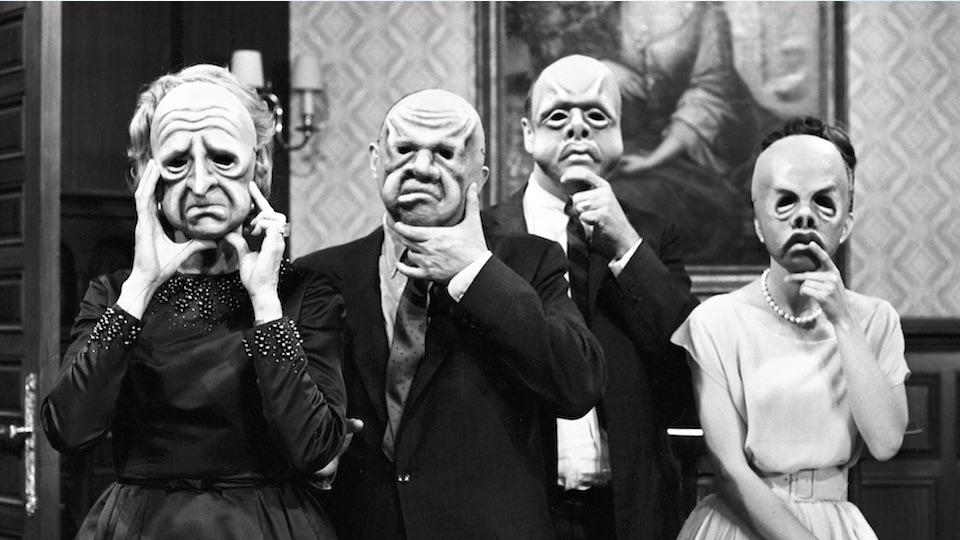
When Jason Foster’s doctor tells him that he could die at any moment, the wealthy Jason Foster gathers his heirs including his daughter Emily Harper, her husband Wilfred and their children Paula and Wilfred Jr. Jason doesn’t think much of any of them and it’s clear they can’t wait to get their hands on his fortune. It’s Mardi Gras time in New Orleans and he has one last request – for each of them to wear a carnival mask. Each of the masks is meant to reflect some aspect of their personality – and leave a lasting impression on them.

“The Masks” was the first and only episode of The Twilight Zone that was directed by a woman. Ida Lupino was known for making movies that commentated on the state of society and those who live under a specific social status.

Rod Serling wrote this great episode.

Jason Foster:  You’re cruel and miserable people! Because none of you respond to love! Emily responds only to what her petty hungers dictate! Wilfred responds only to things that have weight and bulk and value! He feels books, he doesn’t read them! He appraises paintings, he doesn’t seek out their truth or their beauty! And Paula there lives in a mirror. The world is nothing more to her than a reflection of herself. And her brother… Humanity, to him, is a small animal, caught in a trap, to be tormented! His pleasure is the giving of pain. And from this, he receives the same sense of fulfillment most human beings get from a kiss or an embrace! You’re caricatures! All of you! Without your masks, you’re caricatures!

Rod Serling Closing Narration: Mardi Gras incident, the dramatis personae being four people who came to celebrate and in a sense let themselves go. This they did with a vengeance. They now wear the faces of all that was inside them—and they’ll wear them for the rest of their lives, said lives now to be spent in the shadow. Tonight’s tale of men, the macabre and masks, on the Twilight Zone.

CAST

  • Robert Keith as Jason Foster
  • Milton Selzer as Wilfred Harper
  • Virginia Gregg as Emily Harper
  • Brooke Hayward as Paula Harper
  • Alan Sues as Wilfred Harper Jr.
  • Willis Bouchey as Dr. Samuel Thorne
  • Bill Walker as Jeffrey The Butler
  • Maidie Norman as Maid
  • Rod Serling as Host / Narrator – Himself

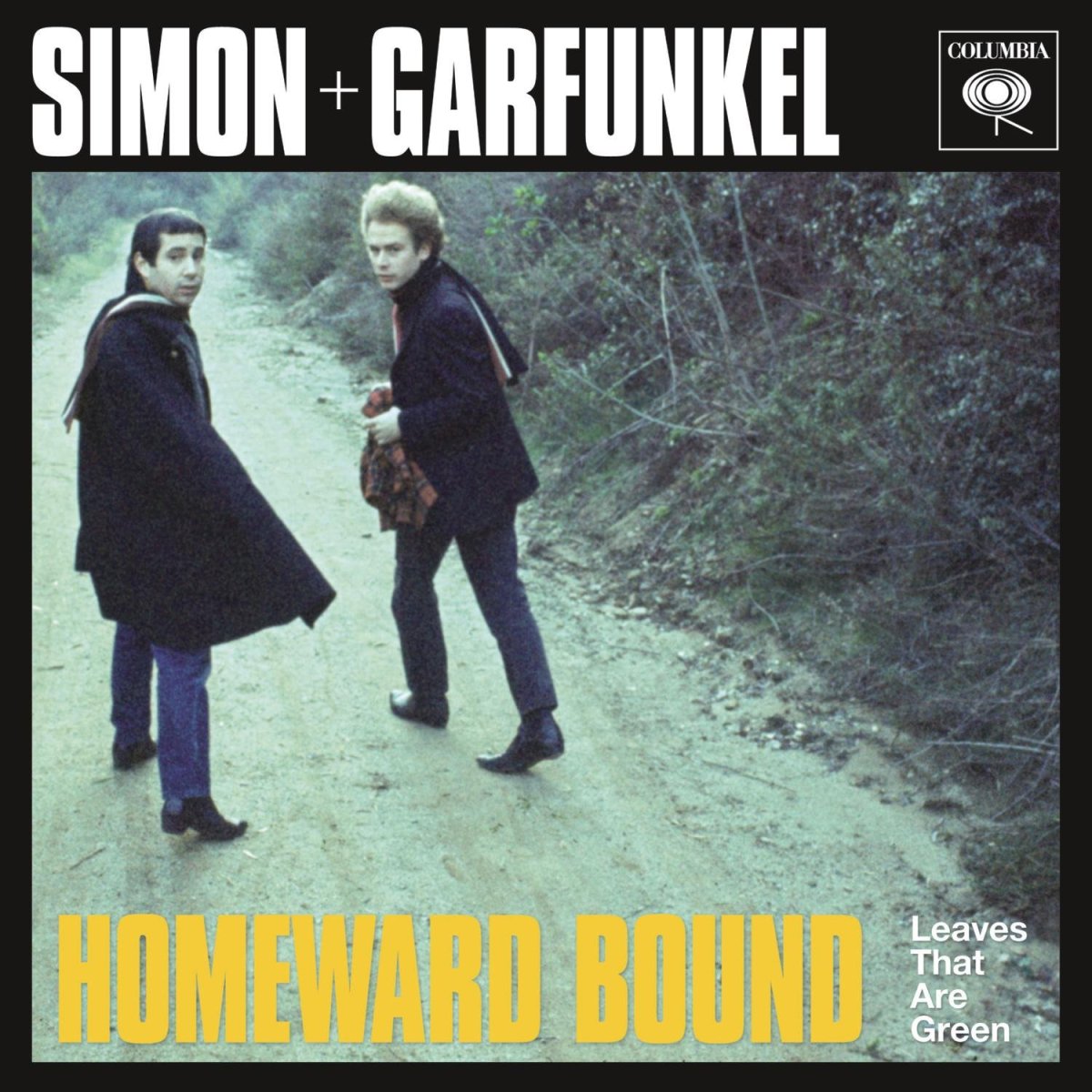
Simon and Garfunkel – Homeward Bound

It all started for me with a Simon and Garfunkel greatest hits package and I was instantly a fan.

Being a Beatle fan I always liked the version that Paul and George Harrison did on SNL in 1976 which was their highest rated episode up til that point. Paul played this and “Here Comes The Sun” with Paul Simon in 1976 on Saturday Night Live.

This was just the second Simon & Garfunkel single, following up “The Sound Of Silence,” which became a surprise hit when their record company added instrumentation and released it a year after it was first recorded. The duo had parted ways, but got back together in a hurry when “Sound of Silence” hit #1 in America.

The song peaked at #5 in the Billboard 100, #2 in Canada, #1 in New Zealand, and #9 in the UK in 1966. It appeared on the album  Parsley, Sage, Rosemary and Thyme  but they recorded it during the Sound of Silence album sessions.

Paul Simon: “That was written in Liverpool when I was traveling. What I like about that is that it has a very clear memory of Liverpool station and the streets of Liverpool and the club I played at and me at age 22. It’s like a snapshot, a photograph of a long time ago. I like that about it but I don’t like the song that much. First of all, it’s not an original title. That’s one of the main problems with it. It’s been around forever. No, the early songs I can’t say I really like them. But there’s something naive and sweet-natured and I must say I like that about it. They’re not angry. And that means that I wasn’t angry or unhappy. And that’s my memory of that time: it was just about idyllic. It was just the best time of my life, I think, up until recently, these last five years or so, six years… This has been the best time of my life. But before that, I would say that that was.”

From Songfacts

Paul Simon lived in Brentwood, Essex, England when he wrote this song. When traveling back from Wigan, where he was playing, he got stuck at the train station and wrote this. The song has a double meaning: literally, wanting for a ticket home to Brentwood, but on the other hand, yearning to go to his home in the US. 

Along with “I Am A Rock,” this was recorded at a late-night session in New York City with producer Bob Johnston. Simon played acoustic guitar, and Ralph Casale was on electric. Johnston was working on Bob Dylan’s Highway 61 album around this time, and Casale recalls that drummer Bobby Gregg and organist Al Kooper – both Dylan regulars – played on this Simon & Garfunkel session as well.

Paul Simon performed this song with Billy Joel at Joel’s concert on August 4, 2015 at Nassau Coliseum in Long Island, New York. This was the last concert at the venerable arena, and Simon was a surprise guest. It marked the first time Joel and Simon ever sung together.

Peter Carlin called his 2016 novel about Paul Simon Homeward Bound. “Given the immigrant story beneath Paul’s life and work (what are his many musical re-creations if not the assimilation process writ in music over and over again) ‘Homeward Bound’ worked too well to ignore,” he explained.

Homeward Bound

I’m sitting in the railway station.
Got a ticket to my destination.
On a tour of one-night stands my suitcase and guitar in hand.
And every stop is neatly planned for a poet and a one-man band.
Homeward bound,
I wish I was,
Homeward bound,
Home where my thought’s escaping,
Home where my music’s playing,
Home where my love lies waiting
Silently for me.

Every day’s an endless stream
Of cigarettes and magazines.
And each town looks the same to me, the movies and the factories
And every stranger’s face I see reminds me that I long to be,
Homeward bound,
I wish I was,
Homeward bound,
Home where my thought’s escaping,
Home where my music’s playing,
Home where my love lies waiting
Silently for me.

Tonight I’ll sing my songs again,
I’ll play the game and pretend.
But all my words come back to me in shades of mediocrity
Like emptiness in harmony I need someone to comfort me.
Homeward bound,
I wish I was,
Homeward bound,
Home where my thought’s escaping,
Home where my music’s playing,
Home where my love lies waiting
Silently for me.
Silently for me.

Twilight Zone – Time Enough At Last… #4

I’m going to write about my top 10 favorite TZ episodes in the next few weeks…Most of the Twilight Zones are like songs to me…to be enjoyed over and over. The Twilight Zone is not really an ordinary TV show. It’s THE TWILIGHT ZONE. This is my personal choice for #4 on my list.

This one I will be giving it all away…more than I usually do…so just a warning.

This one I love and it’s one of the most memorable episodes. If you have never seen it…stop reading now. It’s one of my favorites (and supposedly Rod Serling’s favorite of all that he wrote).

It’s so heartbreaking at the end and I feel so much for Mr. Bemis. This one more than any other Twilight Zone surprised me a bit. It is one of the best twists of any Twilight Zone.

Rod Serling Opening Narration: Witness Mr. Henry Bemis, a charter member in the fraternity of dreamers. A bookish little man whose passion is the printed page, but who is conspired against by a bank president and a wife and a world full of tongue-cluckers and the unrelenting hands of a clock. But in just a moment, Mr. Bemis will enter a world without bank presidents or wives or clocks or anything else. He’ll have a world all to himself… without anyone.

The show was written by Rod Serling and Lynn Venable.

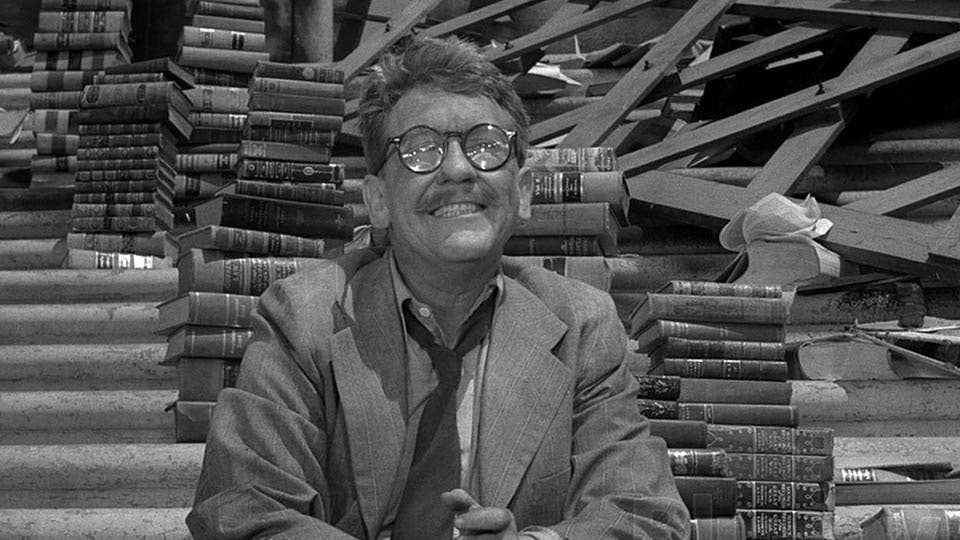
Henry Bemis (Burgess Meredith) is a bookish bank teller who has a childlike fascination for the written word…any written word be it books, periodicals, newspapers. He delights in taking any moment to read, through his incredibly thick “coke-bottle” glasses, even on his salaried time. He is consistently harassed by his wife, customers, and boss for his love of print to the point that he must sneak into the bank’s vault where he works to read on his lunch hour.

During one such visit, a nuclear bomb blast levels his city, leaving him unscathed, whereupon he exits to find that he has “time enough at last” to read all he wants when he finds the local library’s contents scattered about. At this point, (warning: spoiler!) he stacks the books into towers and rejoices in the solitude that will allow him to read everything he can…but in reaching for a particular book, his glasses slip off his face and smash….leaving him to mutter: “That’s not fair… that’s not fair at all… There was time now…. There was…all the time I needed!.. It’s not fair”. The scene then closes with the image panning away from a crying Bemis.

The Twilight Zones are mostly moral plays and justice usually is delivered to a guilty party. On this one, Mr. Bemis isn’t a bad guy. I can’t help but feel pity for Mr. Bemis. It’s not like he was anti-social. He tried to bond with people, although awkwardly, he did try.

He wasn’t the best worker but not terrible and he did read on his lunch breaks. If this episode has a bad “guy” it would be his boss and wife who took away the thing he loved the most. Maybe he was a little selfish and single-minded…but he paid an awfully big price…but the positive…he did survive!

Rod Serling Closing Narration: The best-laid plans of mice and men…and Henry Bemis, the small man in the glasses who wanted nothing but time. Henry Bemis, now just a part of a smashed landscape, just a piece of the rubble, just a fragment of what man has deeded to himself. Mr. Henry Bemis, in the Twilight Zone.

CAST

Burgess Meredith – Henry Bemis
Vaughn Taylor – Mr. Carsville
Jacqueline deWit – Helen Bemis (as Jaqueline deWit)
Lela Bliss – Mrs. Chester

Rolling Stones – Get Off Of My Cloud

I love this era of the Stones. This song was about the record company putting pressure on the Stones to follow up their biggest to date…and their biggest hit ever, Satisfaction.

The song peaked at #1 in the Billboard 100, Canada, and the UK in 1965.

It was on the US album December’s Children (And Everybody’s) released in 1965 and it peaked at #4 in the Billboard Album Charts.

Keith Richards: “‘Get Off My Cloud’ was basically a response to people knocking on our door asking us for the follow up to ‘Satisfaction,’ which was such an enormous hit worldwide. This, to us, was mind-blowing. I mean not only was it a #1 record but, boom! We thought, ‘At last. We can sit back and maybe think about events.’ Suddenly there’s the knock at the door and of course what came out of that was ‘Get Off Of My Cloud.’ Because within three weeks, in those days hey, they want another single. And we weren’t quite ready for that. So it was our response to the knock at the door: Get off of my cloud. And I’m surprised that it did so well. I mean it has a certain charm but I really remember it as a knee-jerk reaction. And it came out better than I thought.”

Mick Jagger: “That was Keith’s melody and my lyrics. It’s a stop-bugging-me, post-teenage-alienation song. The grown-up world was a very ordered society in the ’60s, and I was coming out of it. America was even more ordered than anywhere else. I found it was a very restrictive society in thought and behavior and dress.” 

From Songfacts

There was a bit of controversy over this song, as it sounded like it could be about drugs. Some radio stations shied away from the song.

Stones manager Andrew Long Oldham produced this.

Ian Stewart played piano on this track. Keith Richards explained: “That was just one of those things you could do in those days – shadow a guitar with a piano. As long as you didn’t make it obvious, it would add some different air to a track.” 

The B-side of this single was “I’m Free,” which remained obscure until it was revived by The Soup Dragons in 1990.

In 1973 The Dramatics scored an R&B hit with “Hey You! Get Off My Mountain,” which also contained the chorus lyrics, “Hey You! Get Off My Cloud.”

Get Off Of My Cloud

I live in an apartment on the ninety-ninth floor of my block
And I sit at home looking out the window
Imagining the world has stopped
Then in flies a guy who’s all dressed up just like a Union Jack
And says, “I’ve won five pounds if I have his kind of detergent pack”

I says, “hey, you, get off of my cloud
Hey, you, get off of my cloud
Don’t hang around ’cause two’s a crowd
On my cloud, baby”

The telephone is ringing
I say, “hi, it’s me, who is there on the line?”
A voice says, “hi, hello, how are you?”
“Well, I guess I’m doin’ fine”
He says, “it’s three a.m., there’s too much noise
Don’t you people ever want to go to bed?
Just ’cause you feel so good
Do you have to drive me out of my head?”

I says, “hey, you, get off of my cloud
Hey, you, get off of my cloud
Don’t hang around ’cause two’s a crowd
On my cloud, baby, yeah”

I was sick and tired, fed up with this
And decided to take a drive downtown
It was so very quiet and peaceful
There was nobody, not a soul around
I laid myself out, I was so tired
And I started to dream
In the morning the parking tickets were just
Like a flag stuck on my window screen

I says, “hey, you, get off of my cloud
Hey, you, get off of my cloud
Don’t hang around ’cause two’s a crowd
On my cloud, baby”

“Hey, you, get off of my cloud
Hey, you, get off of my cloud
Don’t hang around ’cause two’s a crowd
On my cloud, hey, you