Twilight Zone – I Am the Night – Color Me Black

★★★★★ March 27, 1964 Season 5 Episode 26

If you want to see where we are…HERE is a list of the episodes.

IMDB has this one rated with 7.4 out of 10. I think it should have been rated much higher. It is an excellent and powerful episode so I’m giving it 5 stars. A thought-provoking episode that is very original. Rod Serling wrote this and he lashed out at hatred in this episode. It was made only 4 months after JFK was assassinated. I rate this a 5 not because of the action or sci-fi…but it makes you think. The best Twilight Zones do that.  Some might not like it because it is very dark. 

Serling describes darkness covering various areas of the world simultaneously in reference to the evil happenings of the era. It’s a powerful message about a human sickness that all of us can learn and grow from. It was such a great concept to have the sunlight go away and to have total darkness brought on by hate. Maybe it is an act of God that’s being spurred on by men. 

George Lindsey (Goober off of the Andy Griffith Show) plays a backwoods redneck policeman in this one. Michael Constantine plays the sheriff who feels guilty about what is going on and realizes the mistakes that he and everyone else has made. Ivan Dixon plays the Reverend Anderson and he and Constantine are the stars of this episode. The acting, writing, and lessons are great in this one. 

IMDB Trivia: This episode takes place on May 25, 1964.

Ivan Dixon (Reverend) previously starred in The Twilight Zone: The Big Tall Wish (1960).

This show was written by Rod Serling 

Rod Serling’s Opening Narration: 

Sheriff Charlie Koch on the morning of an execution. As a matter of fact, it’s seven-thirty in the morning. Logic and natural laws dictate that at this hour there should be daylight. It is a simple rule of physical science that the sun should rise at a certain moment and supersede the darkness. But at this given moment, Sheriff Charlie Koch, a deputy named Pierce, a condemned man named Jagger, and a small, inconsequential village will shortly find out that there are causes and effects that have no precedent. Such is usually the case—in the Twilight Zone.

Summary

In a small town, a man by the name of Jagger is about to be executed after being found guilty of murder. The local newspaperman, Colbey, is convinced that Jagger is innocent. He accuses Deputy Pierce of having perjured himself to get a conviction and accuses Sheriff Charlie Koch of just plain laziness in investigating the case. As the morning of his execution arrives, the townsfolk realize that the sun hasn’t risen that day. They soon begin to understand the cause of the darkness that surrounds them.

SPOILER WARNING WITH VIDEO


Rod Serling’s Closing Narration:

A sickness known as hate. Not a virus, not a microbe, not a germ—but a sickness nonetheless, highly contagious, deadly in its effects. Don’t look for it in the Twilight Zone—look for it in a mirror. Look for it before the light goes out altogether.

CAST

Rod Serling … Host / Narrator – Himself
Michael Constantine … Sheriff Charlie Koch
Paul Fix … Colbey
George Lindsey … Deputy Pierce
Ivan Dixon … the Reverend Anderson
Terry Becker … Jagger
Eve McVeagh … Ella
Douglas Bank … Man
Russell Custer … Townsman
Elizabeth Harrower … Woman
Michael Jeffers … Deputy
Robert McCord … Townsman
Ward Wood … Man
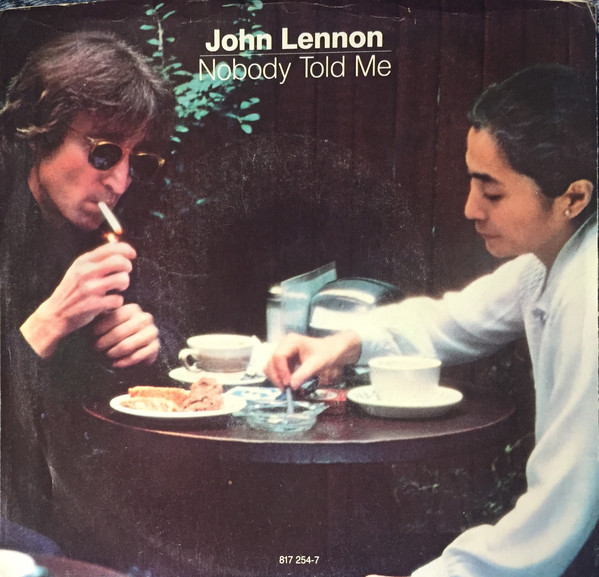
 

John Lennon – Nobody Told Me

Double Fantasy was released in 1980 and I did like the album…but it was a little too pop-leaning in some songs. That album also takes me back to that awful time right after John was murdered. Three years later another album came out and this single was released. I’ve always liked this song. It sounded so much like the old John Lennon. It was quirky and had cool wordplay. It wasn’t John’s best song by any means and no it wasn’t close to Watching The Wheels or Starting Over but it had an edge to it that the other album didn’t.

This single was released in 1983. The song was originally written by John for Ringo Starr to sing on his “Stop and Smell the Roses” album. He even gave Ringo the demo. Ringo didn’t end up recording it because of the tragedy.

There is a lyric “There’s a UFO over New York and I ain’t too surprised” and it was taken from an actual incident. In 1974, John and May Pang (his girlfriend while separated from Yoko) were living in an apartment overlooking New York’s East River, when John saw what he thought was a UFO. May Pang said he yelled out the window “come back – take me!”

The song was off the “Milk and Honey” album with tracks from John and with Yoko. It peaked at #5 in the Billboard 100, #4 in Canada, and #6 in the UK. John wrote the song in 1976 and the working title was “Everybody’s Talkin.”

I liked the song the first time I heard it. It was a fun song and I was happy to hear something new from him. I really could hear Ringo doing this one. The two songs that hit from “Milk and Honey” were Stepping Out and this one.

“Nobody Told Me”

Everybody’s talking and no one says a word
Everybody’s making love and no one really cares
There’s Nazis in the bathroom just below the stairs
Always something happening and nothing going on
There’s always something cooking and nothing in the pot
They’re starving back in China so finish what you got Nobody told me there’d be days like these
Nobody told me there’d be days like these
Strange days indeed — strange days indeed Everybody’s runnin’ and no one makes a move
Everyone’s a winner and nothing left to lose
There’s a little yellow idol to the north of Katmandu
Everybody’s flying and no one leaves the ground
Everybody’s crying and no one makes a sound
There’s a place for us in the movies you just gotta lay around

Nobody told me there’d be days like these
Strange days indeed — most peculiar, mama

Everybody’s smoking and no one’s getting high
Everybody’s flying and never touch the sky
There’s a UFO over New York and I ain’t too surprised

Nobody told me there’d be days like these
Strange days indeed — most peculiar, mama

Janis Joplin – Ball and Chain

I always thought Janis had the voice of a songbird. A cigarette smoking and Southern Comfort drinking songbird…but a songbird all the same. Janis and Aretha Franklin are my two favorite female artists of all time. They put every ounce of themselves into their songs. They cheated no one.

I first heard this song on Janis Joplin’s Greatest Hits. I bought the album for the song Me and Bobby McGee and I found out I liked every song on the album. Unlike other singers I listened to at that time…Janis left everything on the field so to speak. That is the same quality I liked about Bruce Springsteen later.

Ball and Chain was written and originally recorded by a blues singer named Willie Mae “Big Mama” Thornton, who recorded the original version of “Hound Dog.” Thornton was introduced to church music at an early age. A skilled singer, songwriter, dancer, self-taught drummer, and harmonica player.

Janis’s big break came at the Monterey Pop Festival singing this song. She would go on to sing it at Woodstock also. It was on the album by Big Brother and the Holding Company called Cheap Thrills released in 1968. With the help of their appearance at Monterey, the album peaked at #1 in the Billboard Album charts for 8 consecutive weeks.

This was their breakthrough album. The album was supposed to be called Sex, Dope and Cheap Thrills; Columbia nixed it. The album ended up being the band’s last album with Joplin, who left by the end of the year to launch a solo career.

The cover was designed by legendary artist Robert Crumb. He didn’t care for Big Brother too much but liked Janis.

Cheap Thrills [LP] VINYL - Best Buy

Robert Crumb: “She was a swell gal and a very talented singer. Ever heard any of this pre-Big Brother stuff she recorded? She was great. Then she got together with those idiots. The main problem with Big Brother was they were amateur musicians trying to play psychedelic rock and be heavy and you listen to it now and it’s bad… just embarrassing.”

“She wasn’t nationally known yet. I remember going to see her at the Avalon Ballroom and you could tell right away that she had an exceptional voice and she would go far. She started out singing old time blues like Bessie Smith. She was kind of a folknik originally.“

 “Janis had played with earlier bands just playing country blues and it was much better. Way, way better. She’s singing well, not screaming, not playing to the audience that wanted to watch her sweat blood. In the beginning she was just an authentic, genuine Texas country-girl shouter.”

Ball and Chain

Sitting down by my window
Honey, looking out at the rain
Sitting down by my window, looking out at the rain
All around that I felt it
All I can see was the rain
Something grabbed a hold of me
Feel to me, oh, like a ball and chain
Hey, you know what I mean that’s exactly what it felt like
But that’s way too heavy for you, you can’t hold them all

And I say, oh, whoa, whoa, oh, that cannot be
Just because I got oh, your love, please
Why does every
Oh, this can’t be just because I got to need you, daddy
Please don’t you knock it down now, please
Here you’ve gone today
What I wanted to love you and I wanted to hold you, yeah, till the day I die
Yes, I did, yes, I did, yeah, hey, hey, alright

Say, whoa, whoa, whoa, honey
This can’t be anything I’ve ever wanted from your daddy tell me now
Oh, tell me, baby
Oh, say, whoa, whoa, whoa, whoa, honey
This can’t be, no, no, no, no, no
Yeah, yeah
I hope there’s someone out there who could tell me
Tell me why just because I got to want your love
Honey, just because I got to need, need, need, need your love
I said I understand
Honey, what I’m wanna trying to say hi
Trying, try, try, try, try, try, try
Honey, everybody in the world, also same, baby
When everybody in the world what needs, seem lonely
What I wanted work for your love, daddy
What I wanted trust your love, daddy
I din’t understand how come you’re gone
I don’t understand why half the world is still crying, man
And the other half of the world is still crying too, man
I can’t get it together
I mean if you go to ? Oneday, man
I mean, so baby, you want ? Three and sixty five days, right
You ain’t gonna within sixty five days, you gonna for one day, man
I tell you, that one day, man, better be your life, man
Because you know, you can stay oh man, you can cry about the other three and sixty four, man I said whoa, whoa, whoa
But you gonna lose that one day, man
That’s all you got, you got to call it love, man
That’s what it is, man
If you got today, you don’t worry about tomorrow, man
Because you don’t need it
Because the matter of the fact, as we discovered tat’s rain, tomorrow never happens, man
It’s all the same fucking day, man

So you gotta when you want to hold someone
You gotta hold them like it’s the last minutes of your life
You gotta hold, hold, hold and I say, oh, whoa, whoa, now babe, tell me why
Hold, baby, ’cause some come on your shoulder, baby
It’s gonna feel too heavy, it’s gonna weigh on you why does every thing, every thing
It’s gonna feel just like a ball
Oh, daddy and a chain

The Spirit of 76… Movie

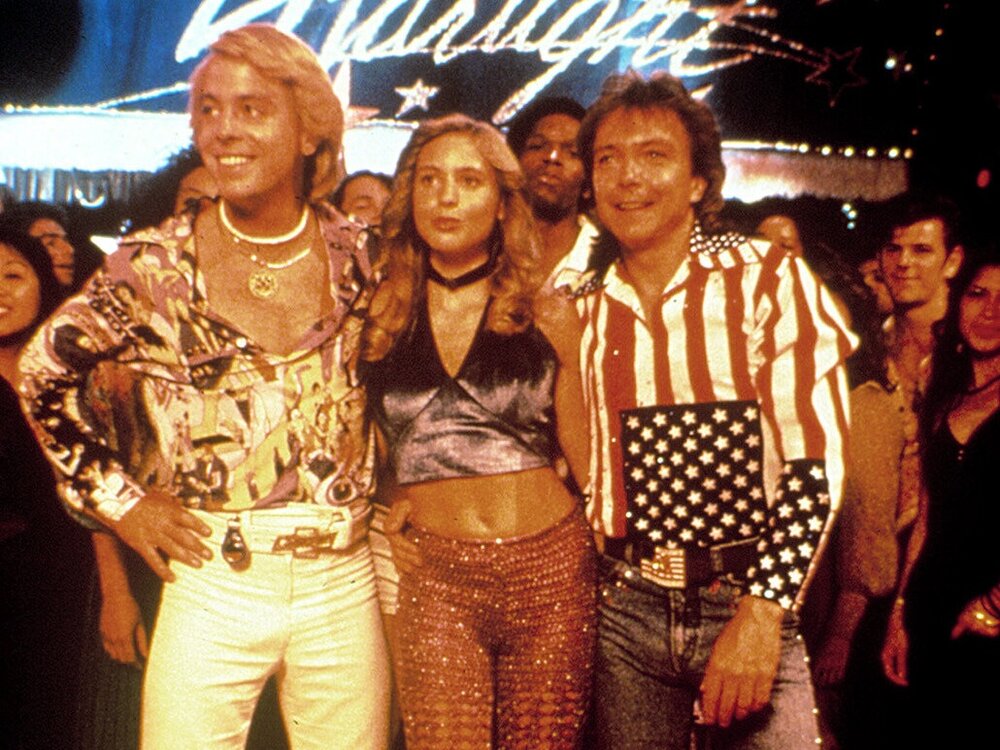
This movie is a B movie all of the way…and it plays up that fact… It was released in 1990 and if you are wanting to watch something that spoofs the 1970s… This movie is for you. You will also learn the word tetrahydrozoline.

This movie stars David Cassidy, Lief Garrett, Carl and Rob Reiner, and Olivia d’Abo… Citizen Kane, it is NOT. It’s a fun film about the future where all is gray and they lost every record because of a magnetic storm including the US Constitution.

Adam-11 (David Cassidy) has built a time machine because he wants to go to a beach…beaches don’t exist anymore in the future. The government wants him to use the time machine to go into the past to 1776 and get a copy of the US Constitution so they can rebuild their society with it. To make it work he needs a chemical that’s rare in the future… tetrahydrozoline (the main ingredient to a very popular item in the ’70s… Visine).

The government agrees to give him some tetrahydrozoline but sends two more travelers Chanel-6 (d’Abo ),  Heinz 57 (Geoff Hoyle) with Adam-11 to retrieve the document…but instead of going back to 1776 the time machine malfunctions and goes to 1976.

Devo makes an appearance as the “Ministry of Knowledge”…

It’s a corny movie but they have the 70s down in many parts of the movie. After meeting up with two teenage stoners (The group Redd Kross) they look for the constitution but lose the tetrahydrozoline. If you are looking for a second Gone with the Wind…don’t watch this but it’s funny and silly enough to entertain you.

You have to know a little about the 70s to get some of the jokes…Like David Cassidy’s character looking around a garage in 1976 asking “am I going to be stuck here forever?” while looking at a Partridge Family lunch box.

If you are bored, try this one. The trailer is below the complete movie is below that.

The complete movie

The trailer

Twilight Zone – The Masks

★★★★★ March 20, 1964 Season 5 Episode 25

If you want to see where we are…HERE is a list of the episodes.

Rod Serling wrote this episode and it is a bonafide classic. This is one of the episodes I point out to people who have never seen The Twilight Zone. I love some great Twilight Zone justice and this has it. A dying wealthy older man invites his awful family (his daughter Emily, her husband Wilfred, and children Paula & Wilfred Jr.) down to visit and for a party. He makes each of them wear a mask that reflects who they are until midnight. They do not want to wear the masks but he makes it clear, if they don’t wear the masks they will not get anything when he dies. “That is indeed the most touching thing you ever dredged up by way of conversation, Wilfred. But I must include this addendum, this small proviso: You shall wear your masks until midnight. If anyone of you should take them off, from my estate, you shall each receive train fare back to Boston, and that’s it!”

This is one of those perfect episodes. The narration, writing, and acting come together perfectly. The star of it was Robert Keith who played Jason Foster. He is dying and his lines to his family in this episode are cutting but well deserved. This was the only episode of the series to be directed by a woman, Ida Lupino. She previously played Barbara Jean Trenton in the episode The Sixteen-Millimeter Shrine. The famous actress Lupino would end up with 42 director credits to go along with her 105 acting ones. 

Here are a few of his quotes

You’ve been at death’s door so often it’s a wonder you haven’t worn a hole in the mat. 

You know, Wilfred, I think the only book you ever read was a ledger. I think if someone cut you open, they would find a cash register.

Well, that’s friendly of you to tell me that, considering that you haven’t seen me yet. All you’ve seen is your mirror image.

This show was written by Rod Serling 

Rod Serling’s Opening Narration: 

Mr. Jason Foster, a tired ancient who on this particular Mardi Gras evening will leave the Earth. But before departing, he has some things to do, some services to perform, some debts to pay—and some justice to mete out. This is New Orleans, Mardi Gras time. It is also the Twilight Zone.

Summary

When his doctor tells him that he could die at any moment, the wealthy Jason Foster gathers his heirs including his daughter Emily Harper, her husband Wilfred and their children Paula and Wilfred Jr. Jason doesn’t think much of any of them and it’s clear they can’t wait to get their hands on his fortune. It’s Mardi Gras time in New Orleans and he has one last request – for each of them to wear a carnival mask. Each of the masks is meant to reflect some aspect of their personality – and leave a lasting impression on them.

Rod Serling’s Closing Narration:

Mardi Gras incident, the dramatis personae being four people who came to celebrate and in a sense let themselves go. This they did with a vengeance. They now wear the faces of all that was inside them—and they’ll wear them for the rest of their lives, said lives now to be spent in shadow. Tonight’s tale of men, the macabre and masks, on the Twilight Zone.

CAST

Rod Serling … Narrator / Self – Host (uncredited)
Robert Keith…Jason Foster
Milton Selzer…Wilfred Harper
Virginia Gregg…Emily Harper
Brooke Hayward…Paula Harper
Alan Sues…Wilfred Harper Jr.
Willis Bouchey…Dr. Samuel Thorne
Bill Walker…Jeffrey The Butler
Maidie Norman…Maid

Lovin’ Spoonful – You Didn’t Have to Be So Nice

The Lovin’ Spoonful’s songs seem so effortlessly written and performed. They were popular for a short while in the mid-sixties. They influenced many bands including The Beatles who released Good Day Sunshine as a nod to The Lovin’ Spoonful’s song Daydream.

In the 1980s I really got into this band. I purchased one of their many greatest hits. I first heard of John Sebastian in the 70s when he wrote and sang the theme song of  TV show Welcome Back Cotter called “Welcome Back” which went to #1.

They were considered by TV producers to be in a television show but they were dropped over a conflict of song publishing rights. After an audition process, the producers figured it was more trouble than they expected. For one thing, the Spoonful were writing their own music at this point, and the show was not interested in giving up the publishing rights to the songs written for the show, so it really did not make sense for either party, and the producers instead turned to open auditions for the show. The Monkees were found soon after that. 

Brian Wilson said this song influenced one of the Beach Boys’ best songs…God Only Knows. The group was only active from 1965 to 1968, which John Sebastian described as “two glorious years and a tedious one.” John Sebastian wrote the majority of their songs. He had a #1 hit as a solo artist in 1976 with “Welcome Back,” the theme song to the TV series Welcome Back, Kotter.

This song was written by John Sebastian and bassist Steve Boone.

Lovin’ Spoonful played what they called “jug band” music and like the Rascals, they were more of a singles band than an album band. In 1967 Zal Yanovsky left the band citing musical differences. In 1968 Sebastian left for a solo career and the band carried on until 1969 without a significant hit.

The song peaked at #10 in the Billboard 100 and #4 in Canada in 1965.

John Sebastian:  “We started off in a world of 45 singles, so our only game still was three minutes of heaven every time out. That was all. We thought of it as four-man Phil Spector music. We wanted it to have that big quality, but we didn’t want to hire the Wrecking Crew.”

“Our producer Eric Jacobsen understood something about this funny hybrid that we were working on,” “Things like the chimes on ‘You Didn’t Have to Be So Nice’ were our attempts at creating that kind of vibe: harmonica, slide whistles and penny whistles. I hate calling it folk-rock. They called The Byrds folk-rock and then they were too lazy to come up with something else for our band, but we weren’t really drawing from the Pete Seeger, Bob Dylan catalog. It was a time of a lot of seriousness, and a lot of fake seriousness and people talking about Important Things. And Loving Spoonful didn’t really go for that. We were just trying to entertain.”

You Didn’t Have To Be So Nice

You didn’t have to be so nice
I would have liked you anyway
If you had just looked once or twice
And gone upon your quiet way

Today I said the time was right for me to follow you
I knew I’d find you in a day or two
And it’s true

You came upon a quiet day (ooh)
You simply seemed to take your place (ooh)
I knew that it would be that way (ooh)
The minute that I saw your face (ooh)

And when we’ve had a few more days (when we’ve had a few more days)
I wonder if I’ll get to say (wonder if I’ll get to say)
You didn’t have to be so nice (be so nice)
I would have liked you anyway (would have liked)

Today I said the time was right for me to follow you
I knew I’d find you in a day or two
And it’s true

You didn’t have to be so nice (didn’t have to be so nice)
I would have liked you anyway (would have liked you anyway)
If you had just looked once or twice (once or twice)
And gone upon your quiet way (quiet way)

Ventures – Walk Don’t Run

Walk Don’t Run is one of my favorite instrumentals right along Sleep Walk, Green Onions, and a few others. When I learned to play this on guitar, I was on cloud nine. Johnny Smith wrote this song and was the first one to record it. Chet Atkins along with many artists covered this but the song is best remembered by The Ventures.

This song got a push in The Ventures native Seattle when a local radio DJ used it to lead into every newscast. The Ventures first released this song in 1960 and it peaked at #11 in the Billboard 100. After this song, it kicked their career in high gear. The band had 14 singles in the Billboard Hot 100. With over 100 million records sold, the Ventures are the best-selling instrumental band of all time.

Numerous musicians credit the Ventures with helping them learn their instrument, including Anthrax, the B-52s, Jeff “Skunk” Baxter, Dire Straits, Dave Edmunds, Adam Ant, Mick Fleetwood, Aerosmith’s Joe Perry, Johnny Ramone, Jello Biafra, Keith Moon, Gene Simmons, Jimmy Page, Toulouse Engelhardt, Jim Diamond, Chris Spedding, Insect Surfers, Black Train, Gary Pig Gold, Al Di Meola, and Max Weinberg.

In 1964, The Ventures released an updated version called “Walk Don’t Run ’64, which also made the Top 10 in the US. In addition to their 1960 and 1964 versions. They recorded completely new versions in 1968, 1977, 1986, and 2000. “Walk-Don’t Run 77 is a disco track. The 1986 one was sort of a heavy metal version, and the one in 2000 has a sax in it.

They were founded by Bob Bogle and Don Wilson in the 1950s. John Fogerty inducted the Ventures in the Rock and Roll Hall of Fame in 2008.

Johnny Smith Version

Walk Don’t Run 77

Walk Don’t Run 64

The Original

Walk Don’t Run

Not one lyric…Just dig on the guitar riff.

Hall and Oates – You Make My Dreams

I have always liked this keyboard-driven song. The funky riff makes it irresistible. After this album, they released Private Eyes and that is when I stopped following them as much…although Private Eyes was a huge success.

You Make My Dreams peaked at #5 in the Billboard 100 and #17 in Canada in 1981. The song came off of the album Voices which peaked at #17 in the Billboard Album Charts and it went gold in Canada.

Voices was a huge success with 4 singles coming off the album making the top 40.  How Does It Feel to Be Back, You’ve Lost That Lovin’ Feelin’, Kiss on My List, and this song. Along with those songs the album also included “Everytime You Go Away” which wasn’t released as a single for some reason. Later on, Paul Young covered the song and had a #1 song in the Billboard 100.

Back in 2020, the song reached 1 billion streams worldwide. The riff in this song was played on a Yamaha CP30 Electric Piano.

Yamaha CP30 Electric Piano 1981 Brown | Yamaha CP30 Electric | Reverb

The single was not initially a hit in the UK but gathered momentum as time went on thanks to its frequent use on TV and film soundtracks. In 2018 it was the UK’s most-streamed song during the year out of all the records released in 1980.

John Oates: “It’s a great song, simple as that. Good songs are good songs. They stand on their own, they can be stripped away of the production. A song is what happens when a writer sits down on their individual instrument and creates something out of nothing. And there’s magic involved and there’s inspiration involved. ‘You Make My Dreams Come True’ represents a vibe, it represents a collaboration between myself and Daryl and the band in the studio in the ’80s. Its simplicity and directness is where the charm lies in that song.”

“It’s amazing, right? What really gets me about this is when the song ‘You Make My Dreams’ was released as a single in 1981, it wasn’t a massive Number One hit – it reached Number Five in the US. We couldn’t have predicted the impact it would have. Over the years, it’s taken on a life of its own. It’s become this anthemic feel-good thing. A lot of it started with its use in the movie 500 Days of Summer and the dance sequence they created around that song. From there on, it took on this life of its own. It’s the gift that keeps on giving. It’s an amazing feel-good groove and it has a great timeless appeal.”

Daryl Hall: “It’s funny – it’s ubiquitous, especially now. I think because it’s such a happy song, just a pure expression of joy. And it’s set to a really old-time-gospel kind of feel.”

You Make My Dreams

What I want you’ve got
But it might be hard to handle
Like the flame that burns the candle
But the candle feeds the flame, yeah yeah
What I got full stock
Of thoughts and dreams that scatter
And you pull them all together
And how I can’t explain, oh yeah

Well well you (ooh ooh ooh ooh)
You make my dreams come true
(Ooh you you ooh ooh)
Well well well you (ooh ooh ooh ooh)
Oh yeah, you make my dreams come true
(You you you you) hell yeah (you)

On a night when bad dreams become a screamer
When they’re messin’ with a dreamer
I can laugh it in the face
Twist and shout my way out
And wrap yourself around me
Cause I ain’t the way you found me
And I’ll never be the same, oh yeah

Well cause you (ooh ooh ooh ooh)
Hmmm hmm, you make my dreams come true
(Ooh you you you) oh yeah (you)
Well well well you (ooh ooh ooh ooh)
Ooh, you make my dreams come true
(You you you you) oh yeah (you)
Well, listen to this

I’m down on my daydream
All that sleepwalk should be over by now
I know

Well you, hell yeah
You make my dreams come true
(You you you you) oh yeah (you)
I’ve been waiting for, waiting for you girl
(Ooh ooh ooh ooh)
Oh yeah, you make my dreams come true
(You you you you) Me you, me you, me
I’ve been waiting for, waiting for you girl
(Ooh ooh ooh ooh) all my life

You make my dreams come true
(You you) whoa (you you)
Whoa whoa, I’ve been waiting for
Waiting for, waiting for, waiting for
(You make my dreams) ooh ooh ooh ooh

I’ve been waiting for you, girl (you you you you)
(You make my dreams, you you you you)

….

Twilight Zone – What’s in the Box

★★★1/2 March 13, 1964 Season 5 Episode 24

If you want to see where we are…HERE is a list of the episodes.

Two bickering and unlikable characters star in this episode. Do you want to see the dark side of marriage? Watch this episode. It reminds me of the episode A Most Unusual Camera. It’s almost too close to that episode. Both take place in a high-rise apartment building that features a window. This time it’s a TV, not a camera that after a “repair” shows the near feature in wonderful black and white. 

 William Demarest and Joan Blondell are effective in portraying their characters here, even if neither one is very likable. There is no need for a back story of these two, it’s clear why they fight. Sterling Holloway plays the TV repairman, and you might recognize his voice as Winnie The Pooh. Again, not in the top episodes but certainly not too bad. The next episode coming Wednesday…a classic. 

From IMDB Trivia: Joe Britt is surprised at getting Channel 10. When television began, it was broadcast over the very high frequency (VHF) band of the radio spectrum. The VHF channels were 2-13, but, to avoid interference, a city could not have channels with consecutive numbers, except for 4 and 5 or 5 and 6. Britt lives in New York, which had channels 2, 4, 5, 7, 9, 11, and 13.

While the TV repairman is fixing the television in the first scene, numerous voices can be heard. One of them is Rod Serling saying, “Next time on The Twilight Zone (1959)…”

According to The Twilight Zone Companion, Martin M. Goldsmith was brought in to write an episode of The Twilight Zone, due to his previous collaboration with William Froug on Playhouse 90. And according to William Froug, Martin Goldsmith came up with a notion of a guy looking at his own extramarital activities on TV, and trying to it off before his wife could see it. Martin Goldsmith would disown the episode, saying “I didn’t like it, it lacked all subtlety the way it was done. I think Joan Blondell and William Demarest overplayed it. It was just too broad.”

This show was written by Martin Goldsmith and Rod Serling

Rod Serling’s Opening Narration: 

Portrait of a TV fan. Name: Joe Britt. Occupation: cab driver. Tonight, Mr. Britt is going to watch “a really big show,” something special for the cabbie who’s seen everything. Joe Britt doesn’t know it, but his flag is down and his meter’s running and he’s in high gear—on his way to the Twilight Zone.

Summary

Taxi driver Joe Britt usually makes his way home to his wife Phyllis but theirs is not a happy marriage as they constantly bicker and she accuses him of having a girlfriend. The obnoxious Joe is having his TV fixed but after the repairman leaves, Joe sees himself with his girlfriend in scenes from the recent past. Soon after, he has a glimpse of what will happen in the near future.

Rod Serling’s Closing Narration:

The next time your TV set is on the blink, when you’re in the need of a first-rate repairman, may we suggest our own specialist? Factory-trained, prompt, honest, twenty-four hour service. You won’t find him in the phone book, but his office is conveniently located—in the Twilight Zone.

CAST

Rod Serling … Narrator / Self – Host (uncredited)
Joan Blondell…Phyllis Britt
William Demarest…Joe Britt
Sterling Holloway…TV Repairman
Herbert Lytton…Dr. Saltman
Sandra Gould…Woman On T.V.
Howard Wright…Judge
Douglas Bank…Prosecutor
Ted Christy…The Wild Panther
Robert McCord…Electric Chair Guard
Tony Miller…Announcer
Mitchell Rhein…Neighbour
Ron Stokes…Car Salesman
John L. Sullivan…The Russian Duke


Procol Harum – A Whiter Shade of Pale

I don’t remember the sixties, but this song makes me feel like I do. In my humble opinion, it’s one of the best songs of the sixties. It perfectly captured its time. John Lennon was a huge fan of the song and would play it repeatedly in his psychedelic Rolls Royce.

It is one of those songs like Itchycoo Park that automatically transports me to the sixties… I never get tired of listening to this. A Whiter Shade of Pale was released in 1967. It peaked at #1 in Canada, The UK, New Zealand, and #5 in the Billboard 100. It sold over 10 million copies. It was re-released in 1972 and went to #13 in the UK charts.

Gary Brooker and Keith Reid were credited with writing the song but Matthew Fisher the former keyboard player in the band sued for partial writing credit and won on July 24, 2008. Now the song’s writing credit is Reid-Brooker-Fisher. Gary Brooker and Fisher wrote the music and Reid wrote the lyrics. This was the first song Procol Harum recorded. After it became a hit, they fired their original drummer and guitarist, replacing them with Barry Wilson and Robin Trower… more experienced musicians who could handle touring.

The Illinois Crime Commission included the song in a list of ‘drug-oriented records’ along with “White Rabbit” by Jefferson Airplane and The Beatle’s “Lucy In The Sky With Diamonds.” When any ban would happen, the records would fly off the shelves.

In 2004, the UK performing rights group Phonographic Performance Limited named this the most-played record on British TV and radio of the past 70 years. In 2009 it was announced that this song is still Britain’s most played record.

Gary Brooker: “I’d been listening to a lot of classical music, and jazz. Having played rock and R&B for years, my vistas had opened up. When I met Keith, seeing his words, I thought, ‘I’d like to write something to that.’ They weren’t obvious, but that doesn’t matter. You don’t have to know what he means, as long as you communicate an atmosphere. ‘A Whiter Shade Of Pale’ seemed to be about two people, a relationship even. It’s a memory. There was a leaving, and a sadness about it. To get the soul of those lyrics across vocally, to make people feel that, was quite an accomplishment.

I remember the day it arrived: four very long stanzas, I thought, ‘Here’s something.’ I happened to be at the piano when I read them, already playing a musical idea. It fitted the lyrics within a couple of hours. Things can be gifted. If you trace the chordal element, it does a bar or two of Bach’s ‘Air on a G String’ before it veers off. That spark was all it took. I wasn’t consciously combining rock with classical, it’s just that Bach’s music was in me.”

Keith Reid: “I was trying to conjure a mood as much as tell a straightforward, girl-leaves-boy story. With the ceiling flying away and room humming harder, I wanted to paint an image of a scene. I wasn’t trying to be mysterious with those images, I was trying to be evocative. I suppose it seems like a decadent scene I’m describing. But I was too young to have experienced any decadence, then. I might have been smoking when I conceived it, but not when I wrote. It was influenced by books, not drugs.”

A Whiter Shade of Pale

We skipped the light fandango
Turned cartwheels ‘cross the floor
I was feeling kinda seasick
But the crowd called out for more
The room was humming harder
As the ceiling flew away
When we called out for another drink
And the waiter brought a tray

And so it was that later
As the miller told his tale
That her face, at first just ghostly,
Turned a whiter shade of pale

She said, “There is no reason
And the truth is plain to see. “
But I wandered through my playing cards
And they would not let her be
One of sixteen vestal virgins
Who were leaving for the coast
And although my eyes were open wide
They might have just as well been closed

And so it was that later
As the miller told his tale
That her face, at first just ghostly,
Turned a whiter shade of pale

She said, “I’m here on a shore leave,”
Though we were miles at sea.
I pointed out this detail
And forced her to agree,
Saying, “You must be the mermaid
Who took King Neptune for a ride. “
And she smiled at me so sweetly
That my anger straightway died.

And so it was that later
As the miller told his tale
That her face, at first just ghostly,
Turned a whiter shade of pale

If music be the food of love
Then laughter is it’s queen
And likewise if behind is in front
Then dirt in truth is clean
My mouth by then like cardboard
Seemed to slip straight through my head
So we crash-dived straightway quickly
And attacked the ocean bed

And so it was that later
As the miller told his tale
That her face, at first just ghostly,
Turned a whiter shade of pale

Twilight Zone – Queen of the Nile

★★★1/2  March 6, 1964  Season 5 Episode 23

If you want to see where we are…HERE is a list of the episodes.

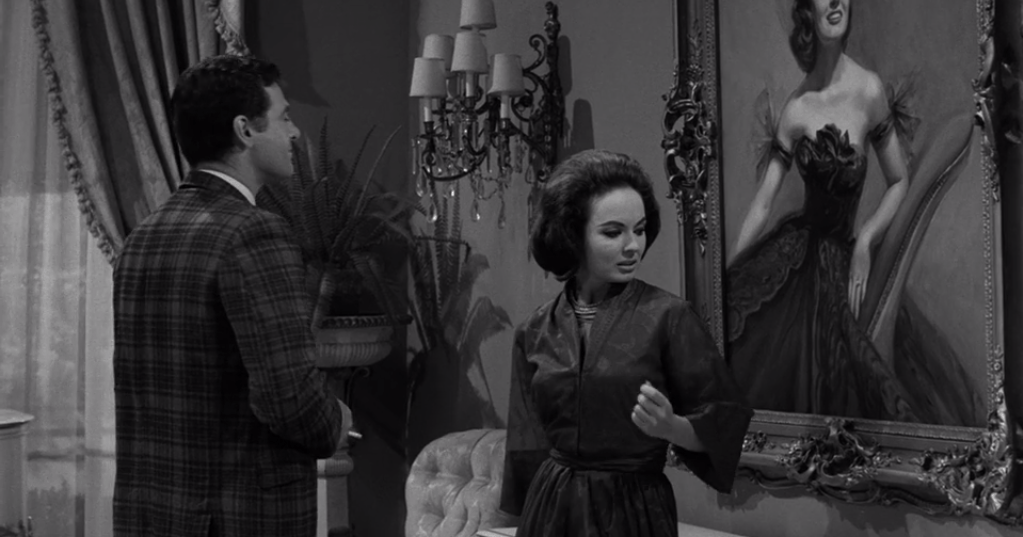
The show begins with a reporter coming to the home of a pretty film star that looks amazing for her age. At first, the show seems friendly and innocent and then starts getting dark. It’s a good episode but not spectacular and has twists and turns that will keep viewers interested.

Ann Blyth plays ageless film star Pamela Morris, who is adored and envied by her fans, she has a mysterious past that a syndicated journalist Jordan Herrick (played by Lee Philips) hopes to uncover. This episode was very reminiscent of  “Long Live Walter Jameson” from season 1 except Miss Morris will go to any length to keep her youth. Charles Beaumont wrote that one… and he was credited with Queen of the Nile but it was ghostwritten by Jerry Sohl. Beaumont’s health was in bad shape at the time.

This one is has a blend of drama, science fiction, and mystery.  How does she stay young? How old is she really? The universe has rules and Miss Morris is breaking the biggest one.

From IMDB Trivia: When Jordan is on the phone with his Chicago-based editor Krueger, Krueger states that Constance Taylor had been “reigning beauty in the days of the Florodora Girls.” This is a reference to the chorus girls of the play “Florodora,” a popular musical comedy that opened on Broadway in 1900 and ran for over 550 performances. Much of the show’s success was attributed to the beauty of its sextet of chorines, whom the public dubbed “The Florodora Girls.”

Pamela Morris claimed to have been born in 1925.

This show was written by Charles Beaumont, Rod Serling, and Jerry Sohl (uncredited)

Rod Serling’s Opening Narration: 

Jordan Herrick, syndicated columnist, whose work appears in more than a hundred newspapers. By nature a cynic, a disbeliever, caught for the moment by a lovely vision. He knows the vision he’s seen is no dream; she is Pamela Morris, renowned movie star, whose name is a household word and whose face is known to millions. What Mr. Herrick does not know is that he has also just looked into the face—of the Twilight Zone.

Summary

A syndicated columnist, Jordan Herrick, gets an interview with the famous and beautiful actress Pamela Morris. She claims to be 38 years old but according to Jordan’s information, that would have made her first film as an adult when she was only 10. He takes her word for it but her elderly mother, Viola Draper, has news for him: she’s not Pamela’s mother, she is her daughter. The more he looks into her background, the more convinced he becomes that Pamela hasn’t aged for decades. Faced with the facts, Pamela shows the lengths she will go to in order to protect her great secret.

Rod Serling’s Closing Narration:

Everyone knows Pamela Morris, the beautiful and eternally young movie star. Or does she have another name, even more famous, an Egyptian name from centuries past? It’s best not to be too curious, lest you wind up like Jordan Herrick, a pile of dust and old clothing discarded in the endless eternity of the Twilight Zone.

CAST

Rod Serling … Narrator / Self – Host (uncredited)
Ann Blyth…Pamela Morris/Constance Taylor
Lee Philips…Jordan Herrick
Celia Lovsky…Viola Draper
Ruth Phillips…Charlotte
Frank Ferguson…Krueger
James Tyler…Mr. Jackson

Cheap Trick – Southern Girls ….Power Pop Friday

I hope everyone is having a wonderful Friday!

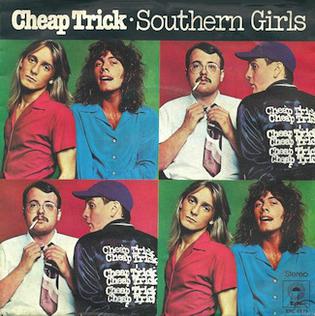
When I think of Cheap Trick, I think of a checkered pattern and the 5-neck guitar of Rick Nielson. I guess I should add power pop to that list that they carried on from bands such as Badfinger, The Raspberries, and Big Star.

I got to see Cheap Trick in 1984 at Opryland in Nashville. Opryland was a theme park that was foolishly closed in the late 90s so Nashville could have yet another mall. The concert was short…it was only an hour but they are one of the best bands I got to see. Cheap Trick has always been one of the hardest-working bands in rock. They seem to always be on tour since the 70s.

The band fits in with just about any type of band. They have shared the bill with John Mellencamp, KISS, Krokus, REO Speedwagon, The Who, Motley Crue, Kool and the Gang, Iron Maiden, The Oak Ridge Boys, and Willie Dixon. How much more variety does anyone need? When you go from the Oak Ridge Boys, Mellencamp, and Iron Maiden…you have ran the gamut.

The lyrics were inspired by women the band met in southern Canada. However, Rick Nielsen didn’t like the sound of “Southern Canadian Girls” in the hook, so he just left it as “Southern Girls.”

Rick Nielsen and Cheap Trick’s bass player Tom Petersson wrote the song.

The song was on the album In Color, you can find a review at  John’s site (2 Loud 2 Old Music) …great info. The album was released in 1977 and was produced by Tom Werman. He took their sound and produced a more power pop radio sound than their debut album.

This is the album that paved their way to stardom in Japan and later on Live at Budokan that was their breakthrough in the US. Five out of the 10 tracks on this album ended up on the live album.

Southern Girls

I’ve been north,
I’ve been east to the California beach
There’s only one place I know where to find you
And all you Southern girls got a way with your words
And you show it
You say hump and I’ll jump
You say go and I’ll know
Waste no time getting
So close to you
And you’ll never run way
When you find out why I wanted to find you

Ooh baby need some brand new shoes
Get out on the street
You got nothing to lose
You rock me and your crazy
And everyone says it, yeah yeah
Southern girls, you got nothing to lose

I’ve been up I’ve been down
I’ve been weak I’ve been strong
But I never met someone like you
And you’ll never run away
When you find why I wanted to find you
You say hump and I’ll jump
You say go and I’ll know
Waste no time getting
So close to you
All you Southern girls
Got a way with your words
And you show it

Ooh baby need some brand new shoes
Get out on the street
You got nothing to lose
You rock me and your crazy
And everyone says it, yeah yeah
Southern girls, you got nothing to lose

You think this boy, he loves you
Southern girls
You make it hard oh, so hard
I’ve been north, I’ve been east to the California beach
There’s only one place I know where to find you
And all you Southern girls got a way with your words
And you show it

Ooh baby need some brand new shoes
Get out on the street
You got nothing to lose
You rock me and your crazy
And everyone says it, yeah yeah

Southern girls, you got nothing to lose
Southern girls
Southern girls
Southern girls

Green Day – Boulevard Of Broken Dreams

The guitar tremolo effect in the intro hooked me. This one was truly a great single, arguably their best. The first song I remember from them was “When I Come Around” and I liked it immediately. I never thought of them as purely punk but more of a power pop/punk with a little sheen.

Green Day wanted to get away from their punk sound with this one with a Beatle-type vibe. The band’s first idea was an outro like The Beatles Day In The Life using circus music and other things. Producer Rob Cavallo talked them into doing it with just guitars.

The song was on the American Idiot album released in 2004. It peaked at #2 in the Billboard 100, #1 in the Canada Rock Top 30 charts, #5 in New Zealand, and #5 in the UK in 2004. The album was massive… it peaked at #1 in the Billboard 100, Canada, The UK, and #2 in New Zealand.

Noel Gallagher accused Green Day of stealing the chord progression from the song Wonderwall.  “They should have the decency to wait until I am dead [before stealing my songs]. I, at least, pay the people I steal from that courtesy”

This also won Video of the Year at the 2005 MTV Video Music Awards and also took home the prizes for Best Group Video, Best Rock Video, Best Direction, Best Editing, and Best Cinematography.

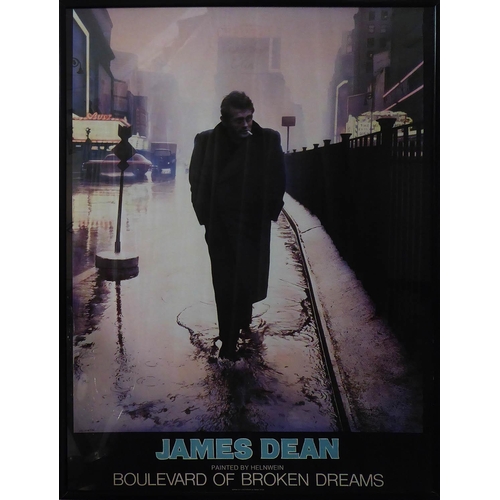
Billy Joe Armstrong said he saw a photo of James Dean with Boulevard of Broken Dreams underneath and he lifted the title from that…Gottfried Helnwein created it.

AFTER HELNWEIN, James Dean 'Boulevard of Broken Dreams', 87.5cm x 120cm,  framed and glazed.

Billy Joe Armstrong: “There’s an old James Dean photo where he’s walking in New York and underneath it says ‘Boulevard of Broken Dreams.’ It’s a great photo of him, so that’s where I sort of nicked the title from,” 

In Rolling Stone’s Decade End Readers’ Poll, this was voted the Best Single of the ’00s. This song also won the Grammy for Record Of The Year at the 2006 ceremony. The previous year, American Idiot won for Best Rock Album.

Samuel Bayer, whose first gig was directing the video for Nirvana’s “Smells Like Teen Spirit,” directed this video.

Samuel Bayer director of the video: “If you think about our country and the specter of war and the problems we’re having, then ‘Boulevard of Broken Dreams’ is the state of the union – and ‘Holiday’ is the wild trip that got us here. It was about living your life and partying as if there’s no tomorrow. But ‘Boulevard’ is the tomorrow. And it’s a really dark, gray, desolate landscape. It’s a graveyard.

“It wasn’t like it was a great linear story between the two videos, but ‘Holiday’ was brightly colored and you’re driving 100 miles an hour and you don’t care what happens, but then the car breaks down,” he explained. “And then with ‘Boulevard,’ you start walking, and that journey goes on forever.”

“A lot of people don’t understand that on ‘Boulevard of Broken Dreams,’ every image was shot on a soundstage, they’re never outside. Even when they’re walking, they’re on treadmills on a soundstage, and everything’s projected behind them from exterior footage I shot separately. A lot of videos I see now work so hard to make everything look seamless, and I wasn’t going for that. I spent a week hand-scratching the negative with razor blades and cigarettes. I threw a couple rolls of it in my shower and left it for a few days.”

Boulevard Of Broken Dreams

I walk a lonely road
The only one that I have ever known
Don’t know where it goes
But it’s only me, and I walk alone

I walk this empty street
On the boulevard of broken dreams
Where the city sleeps
And I’m the only one, and I walk alone

I walk alone, I walk alone
I walk alone and I walk a

My shadow’s the only one that walks beside me
My shallow heart’s the only thing that’s beating
Sometimes I wish someone out there will find me
Till then I walk alone

Ah ah ah ah ah
Ah ah ah ah ah

I’m walking down the line
That divides me somewhere in my mind
On the border line of the edge
And where I walk alone

Read between the lines
What’s fucked up and every thing’s all right
Check my vital signs to know I’m still alive
And I walk alone

I walk alone, I walk alone
I walk alone and I walk a

My shadow’s the only one that walks beside me
My shallow heart’s the only thing that’s beating
Sometimes I wish someone out there will find me
Till then I walk alone

Ah ah ah ah ah
Ah ah ah ah ah

I walk alone, I walk a

I walk this empty street
On the boulevard of broken dreams
Where the city sleeps
And I’m the only one, and I walk alone

My shadow’s the only one that walks beside me
My shallow heart’s the only thing that’s beating
Sometimes I wish someone out there will find me
Till then I walk alone

….

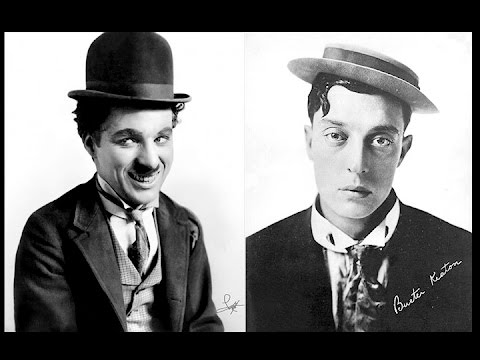
Charlie Chaplin and Buster Keaton

Back in the 90s I got into silent films. I would send off for VHS tapes of 1920s classics. The one actress I wanted to see was Clara Bow. After reading about her I started to learn more about Buster Keaton and Charlie Chaplin. I did know of Chaplin but had never seen one of his films. I still love silent cinema from that era.

Charlie and Buster were two of the best screen comedians ever to walk the earth. They both had similar upbringings. Buster and his family in American vaudeville. Charlie worked in British music halls. Charlie rose to stardom in silent movies in the 1910’s beginning with Keystone, Mutual (where he made his best short comedies) Essanay and then he confounded United Artist with Douglas Fairbanks, Mary Pickford, and W. D. Griffith. After that Charlie went into full feature films.

Buster started silent shorts in 1917 with Roscoe Arbuckle. After Roscoe broke out on his own so did Buster….he did some more short films which were brilliant. He then went into full features. Buster was just so different than anyone else. He was so still while the world moved into chaos around him. He was a brilliant actor-director and also writer which he often didn’t take credit for doing. If Buster would have just made “The General” his place in film history would be cemented. The same can be said of Charlie Chaplin and his masterpiece “The Gold Rush.”

There was no competition between the two in popularity. Charlie won hands down over Buster and probably everyone else in comedy and drama. His character “The Tramp” was internationally loved. All in all, I’ve always thought Keaton was a better filmmaker but Chaplin the better character. The most recognized character in movie history.  They were two different comedians. Chaplin would reach for pathos…sometimes a little too much. Keaton seemed much more real.

Keaton’s sight gags were incredible and sometimes dangerous to his health…like have a front of a building that weighed a ton (so it wouldn’t twist in the wind) fall on him with the upstairs opening clearing him around 2 inches on each side. He never smiled because it would have ruined his character. Both are worth watching and with Keaton’s films like Sherlock Jr…you wonder how he did some of the things he did with the primitive camera’s they used.

Both were funny men. The other big comedian was Harold Lloyd but he was more of an actor playing a comedian….he was really successful though… second to Chaplin in making money.

Charlie and Buster older both appear in Charlie’s Limelight. This is the only time they ever appeared together in a movie.

Twilight Zone – An Occurrence at Owl Creek Bridge

★★★★★ Feburary 28, 1964 Season 5 Episode 22

If you want to see where we are…HERE is a list of the episodes.

This one is a totally different animal in the Twilight Zone catalog. It was not written or adapted for the show. The producer William Froug had seen An Occurrence at Owl Creek Bridge, a French film that had won first prize for short subjects at the 1962 Cannes Film Festival. Based on the story by Ambrose Bierce, it told the story of a condemned Confederate spy who, during the instant that he’s falling before the rope breaks his neck, imagines an involved and successful escape.

The Twilight Zone was running over budget for the year so they paid 10,000 dollars for a one year viewing and it balanced their budget. The film was shortened by several minutes and an introduction by Serling was added and voilà… it was a Twilight Zone.

The first time I watched this, I didn’t like it as much because I wasn’t expecting it. Now when watching it I realize what a brilliant short film it is. It was almost entirely silent…there were maybe a half-dozen lines in film. It fits the Twilight Zone on one hand…but on another it works independently of it because it was made that way.

A good watch and I reccomend it. It has a little different look and feel but it fits.

I found a discrepancy on who saw the film at a film festival. Rod Serling or the producer William Froug. I’ve read conflicting info at different places. I stated above William Froug because of Marc Scott Zicree’s book on the Twilight Zone. Below this you will see IMDB Trivia saying Mr. Serling…Until confirmed otherwise I will stick to the book. Who knows? Maybe they went together.


IMDB Trivia: Rod Serling was getting ready to take his end-of-season break, with all but one of the shows for the fifth season already filmed or in production, when he decided to leave early and go to a French film festival. There he saw Occurrence at Owl Creek Bridge (1961) and immediately hunted down the producers with an offer to buy it for a one-time showing for American TV. Serling reportedly picked it up for $10,000 and flew straight back to Los Angeles, filming a new intro the moment he got to the studio and plugging the show into that same week’s time slot. Not only did Serling get what was considered a classic, he also saved nearly $100,000 in production costs and brought the season’s worth of shows in on budget. This prompted ABC-TV to offer to pick up The Twilight Zone (1959) for another season. Serling said no to the deal when his discussions over the content of the new season made it appear he would be “going to the graveyard” for each show, doing Gothic horror shows. (ABC did want that, and eventually would pick up Dark Shadows: The Vampire Curse (1966), which fit the bill, in daytime.) ironically, Serling would return to television in 1970 for three seasons of Night Gallery (1970) on NBC, consisting of the exact format that ABC had asked for.

The 1962 French version of Occurrence at Owl Creek Bridge (1961) won the Academy Award for Best Short Subject.

The French title of this film -“La riviere du hibou” – translates into English as “The River of the Owl.”

This show was written by Ambrose Bierce Robert Enrico

Rod Serling’s Opening Narration: 

Tonight a presentation so special and unique that, for the first time in the five years we’ve been presenting The Twilight Zone, we’re offering a film shot in France by others. Winner of the Cannes Film Festival of 1962, as well as other international awards, here is a haunting study of the incredible, from the past master of the incredible, Ambrose Bierce. Here is the French production of ‘An Occurrence at Owl Creek Bridge.

Summary

A Southern planter is about to be hanged for sabotage during the Civil War; when he is dropped off the bridge the rope breaks and he flees for his safety amid bullets and shots from a cannon. In this wonderful adaptation of Ambrose Bierce’s short story, the depths of a condemned man’s mind are probed. What does go through one’s mind moments before death?

Rod Serling’s Closing Narration:

An occurrence at Owl Creek Bridge – in two forms, as it was dreamed, and as it was lived and died. This is the stuff of fantasy, the thread of imagination… the ingredients of the Twilight Zone.

CAST

Rod Serling … Narrator (voice) (uncredited)
Roger Jacquet … Peyton Farquhar
Anne Cornaly … Mrs. Farquhar
Anker Larsen … Union Officer
Stéphane Fey … Union Officer
Jean-François Zeller … Union Sergeant
Pierre Danny … Union Soldier
Louis Adelin … Union Soldier