John Lennon – Happy Christmas (War Is Over)

Merry Christmas everyone…this is a repost from last year but I have updated it another year older…and a new one just begun.

My favorite Christmas song hands down. Yea I’m biased because I am a Beatles fan but this one is great.

I think of High School when I hear this song. Our school had a Christmas poster contest and a buddy and I made a poster as a joke and wrote “So this is Christmas and what have you done another year over, and a new one just begun” and won first prize…with an assist from John.

John’s voice goes so well with this song. The song peaked at #2 in the UK charts in 1971….the song did peak at #42 in the Billboard 100 in 2019.

John Lennon and Yoko Ono wrote this in their New York City hotel room and recorded it during the evening of October 28 and into the morning of the 29th, 1971 at the Record Plant in New York. It was released in the US for Christmas but didn’t chart. The next year, it was released in the UK, where it did much better, charting at #2. Eventually, the song became a Christmas classic in America, but it took a while.

Lennon originally wrote this as a protest song about the Vietnam War, and the idea “that we’re just as responsible as the man who pushes the button. As long as people imagine that somebody’s doing it to them and that they have no control, then they have no control.”

The children’s voices are the Harlem Community Choir, who were brought in to sing on this track. They are credited on the single along with Yoko and The Plastic Ono Band.

From Songfacts.

John and Yoko spent a lot of time in the late ’60s and early ’70s working to promote peace. In 1969, they put up billboards in major cities around the world that said, “War is over! (If you want it).” Two years later this slogan became the basis for this song when Lennon decided to make a Christmas record with an anti-war message. John also claimed another inspiration for writing the song: he said he was “sick of ‘White Christmas.'”

Lennon and Ono produced this with the help of Phil Spector. Spector had worked on some of the later Beatles songs and also produced Lennon’s “Instant Karma.” It was not Spector’s first foray into Christmas music: he and his famous session stars (including a 17-year-old Cher) spent six weeks in the summer of 1963 putting together A Christmas Gift for You from Phil Spector, featuring artists like The Ronettes and Darlene Love. Unfortunately, the album was released on November 22, 1963, which was the same day US president John F. Kennedy was assassinated. The album sold poorly as America was focused on news of the killing.

This was originally released on clear green vinyl with Yoko Ono’s “Listen, The Snow Is Falling” as the B-side.

At the beginning of the song, two whispers can be heard. Yoko whispers: “Happy Christmas, Kyoko” (Kyoko Chan Cox is Yoko’s daughter with Anthony Cox) and John whispers: “Happy Christmas, Julian” (John’s son with Cynthia). >>

This being a Phil Spector production, four guitarists were brought in to play acoustic guitars: Hugh McCracken (who had recently played on the Paul McCartney album Ram), Chris Osbourne, Stu Scharf and Teddy Irwin. According to Richard Williams, who was reporting on the session for Uncut, when Lennon taught them the song, he asked them to “pretend it’s Christmas.” When one of the guitarists said he was Jewish, John told him, “Well, pretend it’s your birthday then.”

As for the other personnel, Jim Keltner played drums and sleigh bells, Nicky Hopkins played chimes and glockenspiel. Keltner and Hopkins were part of Lennon’s Plastic Ono Band, and a third member, Klaus Voorman, was supposed to play bass on this track, but got stuck on a flight from Germany. One of the guitarists brought in for the session covered the bass – which one nobody seems to remember.

John Lennon was shot and killed less than three weeks before Christmas in 1980. The song was re-released in the UK on December 20 of that year, reaching #2 (held off the top spot by “There’s No One Quite Like Grandma” by St. Winifred’s School Choir). It made the UK Top 40 again in 1981 (#28), 2003 (#32) and 2007 (#40). Also in 2003, a version sung by the finalists of the singing competition Pop Idol reached #5.

The Fray were the first to chart with this song in America, reaching #50 in 2006; Sarah McLachlan’s version went to #107 that same year. Other artists to cover it include The Alarm, The Cranes, The December People, and Melissa Etheridge (in a medley with “Give Peace a Chance”). 

The Australian artist Delta Goodrem also covered it in 2003, taking it to #1 in her native country as a double-A-side single with “Predictable.” 

This didn’t appear on an album until 1975, when it was included on Lennon’s Shaved Fish singles compilation. Most Christmas songs are compiled with other songs of the season, but Shaved Fish listeners got to hear it year round.

Happy Xmas (War is Over)

(Happy Christmas Kyoko)
(Happy Christmas Julian)

So this is Christmas
And what have you done
Another year over
And a new one just begun
And so this is Christmas
I hope you have fun
The near and the dear one
The old and the young

A very Merry Christmas
And a happy new year
Let’s hope it’s a good one
Without any fear

And so this is Christmas
For weak and for strong
For rich and the poor ones
The world is so wrong
And so happy Christmas
For black and for white
For yellow and red ones
Let’s stop all the fight

A very Merry Christmas
And a happy new year
Let’s hope it’s a good one
Without any fear

And so this is Christmas
And what have we done
Another year over
A new one just begun
And so happy Christmas
We hope you have fun
The near and the dear one
The old and the young

A very Merry Christmas
And a happy new year
Let’s hope it’s a good one
Without any fear
War is over, if you want it
War is over now

Happy Christmas

Band – Christmas Must Be Tonight

Robbie Robertson’s Christmas gift to his new son Sebastian during the sessions for Northern Lights-Southern Cross album it never became a seasonal favorite but it should have been. It wasn’t released until the bands Islands album in 1977.

Rick Danko sings this song from a Shepherds point of view. It’s pure and down to earth like only the Band can be. No sleigh bells or other Christmas trappings…just pure music. Maybe that is the reason it never got picked up.

Robbie Robertson re-recorded this song after he left the group. And he did for the soundtrack of Bill Murray’s Scrooged. That version is very good but I still like The Bands version much more…it’s hard to beat Rick Danko.

Christmas Must Be Tonight

Come down to the manger, see the little stranger
Wrapped in swaddling clothes, the prince of peace
Wheels start turning, torches start burning
And the old wise men journey from the East

How a little baby boy bring the people so much joy
Son of a carpenter, Mary carried the light
This must be Christmas, must be tonight

A shepherd on a hillside, where over my flock I bide
Oh a cold winter night a band of angels sing
In a dream I heard a voice saying “fear not, come rejoice
It’s the end of the beginning, praise the new born king”

I saw it with my own eyes, written up in the skies
But why a simple herdsmen such as I
And then it came to pass, he was born at last
Right below the star that shines on high

Lynyrd Skynyrd – Don’t Ask Me No Questions

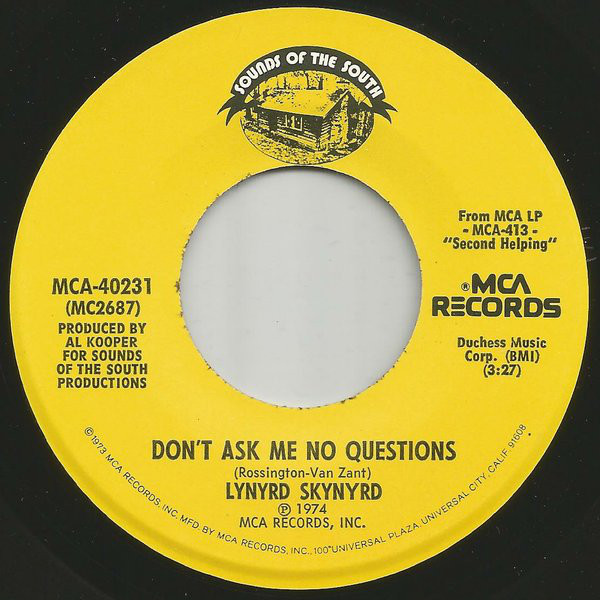
This is a very commercial sounding rock song by Lynyrd Skynyrd. The record company picked this one as the lead off single from their album Second Helping. Personally I like this song but it was the second single they should have picked first…that one was Sweet Home Alabama which ended up being their biggest hit.

This song was a message to the people who wanted a piece of the band when they became famous. They were largely ignored for about 6 years while they were struggling, but when their first album was a hit in 1973, they faced huge demands on their time.

The album did well…it peaked at #9 in the Billboard Album Chart and #12 in Canada in 1974. Pete Townshend heard the band through Al Kooper a few months before this album was released and was impressed enough to have Lynyrd Skynyrd open up for them on their Quadrophenia tour.

The one thing the band was…was extremely tight. They were always well rehearsed and built a huge reputation as a live band.

From Songfacts

The world of agents, managers, and record companies was a strange one for Lynyrd Skynyrd. They were just working-class guys who liked making music.

Lead singer Ronnie Van Zant and guitarist Gary Rossington wrote this one day while they were fishing. Gary played his guitar while Ronnie came up with the lyrics about how they wanted to be left alone.

This was released as a single before the album came out. It didn’t chart, but their next one, “Sweet Home Alabama,” was a huge hit.

Don’t Ask Me No Questions

Well, every time that I come home
Nobody wants to let me be
It seems that all the friends I’ve got
Just got to come interrogate me
I appreciate your feelings
And I don’t want to pass you by
But I don’t ask you ’bout your business
Don’t ask me about mine

Well it’s true I love the money
And I love my brand new car
I like drinkin’ the best of whiskey
And playin’ in a honk-tonk bar
But when I come off the road
I just gotta have my time
‘Cause I got to find a break in this action
Or else I’m gonna lose my mind

So don’t ask me no questions
And I won’t tell you no lies
So don’t ask me ’bout my business
And I won’t tell you goodbye

Well, what’s your favorite color
And do you dig the brothers, is drivin’ me up a wall
And every time I think I can sleep
Some fool has got to call
Well, don’t you think that when I come home
I just want a little piece of mind?
If you want to talk about the business
Buddy you’re just wasting time

So don’t ask me no questions
And I won’t tell you no lies
So don’t ask me ’bout my business
And I won’t tell you goodbye

I said don’t ask no stupid questions
And I won’t send you away
If you want to talk fishin’
Well, I guess that’ll be OK

Who – Circles (Instant Party)

This song is for Song Lyric Sunday for Jim Adams’s blog. This week’s prompt is  Circle/Polygon/Square/Triangle…

The Who are my second favorite band…right behind the Beatles. This song is early Who at the time of My Generation. The song was known as “Circles (Instant Party)”, “Instant Party (Circles)” and “Instant Party”…the song has a complicated history. It was recorded during a time they were trying to leave their producer. The song was written by Pete Townshend and released in 1966.

Circles is an early example of what would become Power Pop. Pete Townshend was trying to write a song with a different sound. Pete found out that bassist John Entwistle could play trumpet, the band’s manager, Kit Lambert, decided to allow the band to try creating a song featuring Entwistle’s horns.

John Entwistle: When we recorded our first LP and wanted a bit of a different sound, Pete told our manager, Kit Lambert, that I could play trumpet. He thought Pete was joking at first but then said he’d give it a try. I showed him I could play the trumpet and in the end we used French horn.

The song was to be the follow up to the anthem My Generation…but the band was not happy with their producer Shel Talmy and secretly broke their contract with him and re-recorded Circles as the B-side to their new UK single “Substitute”.

Talmy sued the Who and a legal battle began.

Pete Townshend: We did two versions of “Circles”, which were both identical because they were both copies of my demo. Shel [Talmy] put in a High Court injunction, saying there was copyright in the recording. In other words, if you’re a record producer and you produce a song with a group, and you make a creative contribution, then you own that sound….He took it to the high-court judge and he said things like ‘And then on bar thirty-six I suggested to the lead guitarist that he play a diminuendo, forget the adagio, and play thirty-six bars modulating to the key of E flat,’ which was all total bullshit — he used to fall asleep at the desk…

They did get away from Talmy but it cost them dearly. It was agreed that Talmy would receive a percentage of each album going forward until the early seventies. So Talmy made a huge amount of money off of their best known albums that he had nothing at all to do with…like Tommy, Live At Leeds, and  Who’s Next.

Circles (Instant Party)

Circles, my head is going round in circles
My mind is caught up in a whirlpool
Dragging me down

Time will tell if I’ll take the homeward track
Dizziness will make my feet walk back
Walk right back to you

[chorus:]
Everything I do, I think of you
No matter how I try, I can’t get by
These circles, leading me back to you

Round and around and around and around and around
and around and around and around and around

And round and round like a fool I go
Down and down in the pool I go
Dragging me down

[chorus]

There one thing could kill the pain of losing you
But it gets me so dizzy then I’m walking right back again
Back to you

Time will tell if these dreams are nearly fact
Don’t know why I left, I’m coming back
Coming on back to you

Chuck Berry – Run Rudolph Run

Nice little Christmas song by the father of Rock and Roll Chuck Berry.  The song has a “Carol” vibe to it and that is never a bad thing.  It was one of the first rock and roll Christmas songs and it was released in 1958.

Berry based this song on “Rudolph The Red-Nosed Reindeer,” giving Rudolph a bit of an attitude as he delivers the toys. The song is credited to Johnny Marks and Marvin Brodie. Johnny Marks wrote Rudolph the Red Nose Reindeer.  Chuck puts his stamp on this song. 

The song is sometimes known as “Run Run Rudolph,” which is how it appears on some other covers. Other artists to record the song include Sheryl Crow, Bryan Adams, The Grateful Dead, Jimmy Buffett, Dwight Yoakam, Bon Jovi and Keith Richards.

The song peaked at #69 in the Billboard 100 in 1958 and has re-charted many times through the years…it peaked at #36 in the Billboard 100 in January of 2020…and I’m sure it is charting now.

The song appeared in a lot of films including Home Alone, Diner, The Santa Clause 2, Cast Away and Jingle All the Way.

Run Rudolph Run

Out of all the reindeers you know you’re the mastermind
Run, run Rudolph, Randalph ain’t too far behind
Run, run Rudolph, Santa’s got to make it to town
Santa make him hurry, tell him he can take the freeway down
Run, run Rudolph ’cause I’m reelin’ like a merry-go-round

Said Santa to a boy child what have you been longing for?
All I want for Christmas is a rock and roll electric guitar
And then away went Rudolph a whizzing like a shooting star
Run, run Rudolph, Santa’s got to make it to town
Santa make him hurry, tell him he can take the freeway down
Run, run Rudolph, reeling like a merry-go-round

Run, run Rudolph, Santa’s got to make it to town
Santa make him hurry, tell him he can take the freeway down
Run, run Rudolph, reeling like a merry-go-round

Said Santa to a girl child what would please you most to get?
A little baby doll that can cry, sleep, drink and wet
And then away went Rudolph a whizzing like a Saber jet
Run, run Rudolph, Santa’s got to make it to town
Santa make him hurry, tell him he can take the freeway down
Run, run Rudolph ’cause I’m reelin’ like a merry-go-round

Led Zeppelin – Houses of the Holy

As with a lot of Zeppelin songs…it’s the riff…that riff is a beautiful thing. It’s not a complex one like Black Dog but it works.

Houses Of The Holy is the name of Led Zeppelin’s fifth album, released in 1973. This song was going to be on it, but they decided to hold it back and use it on their next album, Physical Graffiti. I never understood that…Page has said that the song didn’t fit with the Houses of the Holy album’s other songs.

The song supposedly refers to the spiritual feel of their concerts.

In order to create the layered guitar introduction and fade-out, Page used a Delta T digital delay unit.

Delta-T 102 - Lexicon Delta-T 102 - Audiofanzine

Despite being a fan favorite and about their shows, this was never performed live. For all you audiophiles out there…The squeak of John Bonham’s drum pedal can be heard about 3 minutes in.

The song was not released as a single… the album Physical Graffiti peaked at #1 in the Billboard Album Charts, Canada, and the UK in 1975. The song was written by Jimmy Page and Robert Plant. 

Houses of the Holy

Let me take you to the movies
Can I take you to the show
Let me be yours ever truly
Can I make your garden grow

From the houses of the holy, we can watch the white doves go
From the door comes satan’s daughter, and it only goes to show, you know

There’s an angel on my shoulder, in my hand a sword of gold
Let me wander in your garden and the seeds of love I’ll sow you know

So the world is spinning faster are you dizzy when you’re stoned
Let the music be your master will you heed the master’s call
Oh Satan and man

Said there ain’t no use in crying ’cause it will only, only drive you mad
Does it hurt to hear them lying?
Was this the only world you had? oh oh

So let me take you, take you to the movie
Can I take you, baby, to the show
Why don’t you let me be yours ever truly
Can I make your garden grow, you know

Rick James – Super Freak

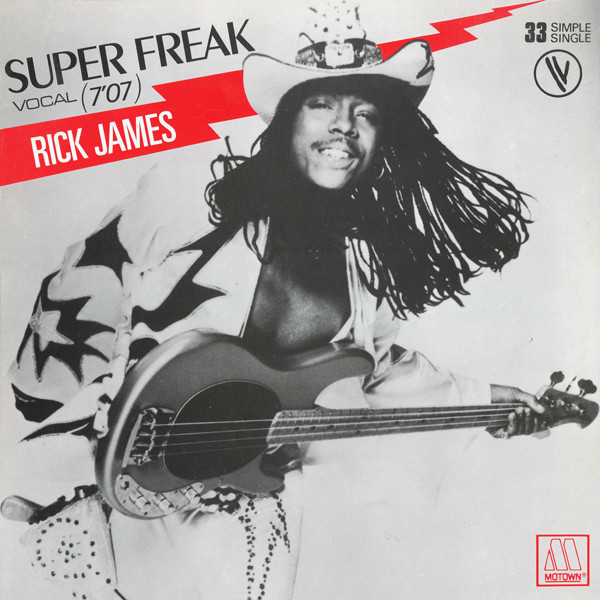
NOT to be confused with the MC Hammer song U Can’t Touch Thiswho sampled this classic intro. MC Hammer sampled the famous bass line for his biggest hit, U Can’t Touch This. James filed suit against Hammer, which ended in an out-of-court settlement giving James a songwriting credit on the track.

This resulted in Rick James only Grammy Award when “U Can’t Touch This” won in 1991 for Best R&B Song….Life just isn’t fair.

Super Freak peaked at #16 in the Billboard 100, #40 in Canada, and #4 in New Zealand in 1981.

When James exclaims, “Blow, Danny!,” he’s talking to his sax player Daniel LeMelle just before his solo.

The song featured backup vocals by The Temptations.  You will hear James point it out in the song when he says: “Tempations sing.” Temptation member Melvin Franklin was Rick James’ uncle.

One story bout Rick James… He dodged the Vietnam War draft by heading across the Canadian border from his hometown of Buffalo. But as soon as he got into Toronto, three drunk guys tried to beat him up for going AWOL. Some other guys came over to help Rick out… Two of those guys were Garth Hudson and Levon Helm, then playing backup for Ronnie Hawkins…later The Band. He also became friendly with Joni Mitchell and she introduced him to Neil Young…Rick and Neil would soon form a band called the Mynah Birds.

Rick James: “I wanted to write a silly song. I was in the studio and everything else for the album (Street Songs) was done. I just put ‘Super Freak’ together really quickly. I wanted a silly song that had a bit of new wave texture to it. So I just came up with this silly little lick and expounded on it. I came up with the bass part first. Then I put a guitar on it and keyboards, doing the ‘ehh ehh,’ silly keyboard part. Then I found a tuning on my Oberheim OB-Xa that I’d been wanting to use for a long time – it sounds like ghosts. And I put a very operatic vocal structure on it ’cause I’m really into opera and classical music. You probably hear a lot of that in my music. So I put (sings in a deep voice) ‘She’s all right’; very operatic, sort of funny, stuff.”

From Songfacts

This song is about a girl who is very adventurous sexually, especially with members of a band. A “freak” is slang for someone willing to try various fetishes, thus a “Super Freak” will try just about anything. James was famous for his penchant toward “freakish” behavior, which got him in trouble with the law when he and his girlfriend were arrested for kidnapping another girl for sex.

Explaining how he came up with this song, James he told Musician magazine in 1983:

“Super Freak” was the biggest pop hit for Rick James, reaching #16 in the US. He had just modest success on the Hot 100 but had four #1 R&B hits and secured a legend as a prolific producer and innovator of funk. The big R&B hit from the album was “Give It to Me Baby”; “Super Freak” made #3.

This was released in the summer of 1981, around the time MTV went on the air. With director Nick Saxton, James made videos for “Give It To Me Baby” and “Super Freak,” hoping to get them on the network. At the time, however, MTV refused to play videos by black artists, and they rejected them, continuing to feed America a steady stream of rock and EuroPop. This refusal to play black music was a holdover from radio station programming, where conventional wisdom was that you would lose your white listeners if you played black music. The first black artist to make MTV with a new song was Musical Youth, who despite adapting a song about smoking marijuana, was a lot less scary to network executives than the glitter-vested James singing about kinky sex. This color barrier was shattered by Michael Jackson, who brought a new sound and sophistication to the network with the videos for his Thriller album.

Even though the network didn’t play this video, Rick James eventually made peace with MTV and put their co-founder, Les Garland, in the video for Eddie Murphy’s song “Party All the Time,” which James produced. As for exactly why MTV passed on “Super Freak,” their director of acquisitions, Carolyn Baker, explained in the book I Want My MTV: “It wasn’t MTV that turned down ‘Super Freak.’ It was me. I tuned it down. You know why? Because there were half-naked women in it, and it was a piece of crap. As a black woman, I did not want that representing my people as the first black video on MTV.”

Over the years, the word “freak” became very popular in hip-hop and R&B lyrics. It’s a versatile word that can be used as both a verb (“Freak Me”) and a noun (“The Freaks Come Out At Night”). Use of the word peaked in the mid-’90s with the phrase, “Get your freak on.”

The Dutch dance duo The Beatfreakz covered this in 2006. Their version reached #7 in the UK, the first time this song charted in Britain as Rick James original version wasn’t a hit there.

In the movie Little Miss Sunshine, the little girl Olive does a wonderfully inappropriate dance to this song in the Little Miss Sunshine pageant.

It also shows up in these movies:

A Madea Family Funeral (2019)
Love, Simon (2018)
Bohemian Rhapsody (2018)
Suicide Squad (2016)
Diary of a Wimpy Kid (2010)
Transformers: Revenge of the Fallen (2009)
Welcome Home, Roscoe Jenkins (2008)
Norbit (2007)
American Dreamz (2006)
Biggie and Tupac (2002)
Batman Returns (1992)
Doctor Detroit (1983)

And in these TV shows:

Scandal (“It’s Handled” – 2013)
The Simpsons (Treehouse of Horror XXIV – 2013; Treehouse of Horror X – 1999)
Ugly Betty (“Derailed” – 2007)
Two and a Half Men (“Squab, Squab, Squab, Squab, Squab” – 2005)
Gilmore Girls (“We Got Us a Pippi Virgin” – 2004)
King of the Hill (“Returning Japanese” – 2002)
Boy Meets World (“Shallow Boy” – 1996)
In Living Color (“The Black Man’s Guide to Understanding the Black Woman” – 1990)
The A-Team (“The Heart of Rock N’ Roll” – 1985) 

A Los Angeles DJ named Alonzo Miller is credited as a writer on this track along with James. Miller worked on the lyrics with James, helping tone them down so the song had a better chance of getting airplay and crossing over to a white audience. Miller was able to get the song played at the station where he worked, KACE.

Super Freak

She’s a very kinky girl,
The kind you don’t take home to mother;
She will never let your spirits down,
Once you get her off the street.

She likes the boys in the band,
She says that I’m her all time fav’rite;
When I make my move to her room,
It’s the right time; she’s never hard to please.

That girl is pretty wild now;
The girl’s a super freak;
The kind of girl you read about
In the new wave magazines.
That girl is pretty kinky;
The girl’s a super freak;
I’d really like to taste her
Ev’ry time we meet.
She’s all right; she’s all right;
That girl’s all right with me yeah.
She’s a super freak, super freak,
She’s super freaky; super freak, super freak.

She’s a very special girl,
From her head down to her toenails;
Yet she’ll wait for me at backstage with her girlfriends,
In a limousine.

Three’s not a crowd to her, she said;
“Room 714, I’ll be waiting.”
When I get there she’s got incense, wine and candles;
It’s such a freaky scene.

That girl is pretty wild now;
The girl’s a super freak;
The kind of girl you read about
In the new wave magazines.
That girl is pretty kinky;
The girl’s a super freak;
I’d really like to taste her
Ev’ry time we meet.
She’s all right; she’s all right;
That girl’s all right with me yeah.
She’s a super freak, super freak,
She’s super freaky; super freak, super freak.
Temptations sing; oh, super freak,
Super freak, the girl’s a super freak; oh.

She’s a very kinky girl,
The kind you don’t take home to mother;
She will never let your spirits down,
Once you get her off the street.

Donnie Iris – Ah! Leah!

This song I first heard and viewed on MTV. I didn’t hear it on radio a lot but I liked it. It was in a heavy rotation on MTV and the song was undeniably catchy.

Donnie Iris (Dominic Ierace) was a member of The Jaggerz, who had a hit in 1970 with “The Rapper.” He later became a member of Wild Cherry, where he met keyboard player Mark Avsec, and the two formed a musical partnership.

Donnie Iris and Mark Avsec wrote this song. It peaked at #29 in the Billboard 100 and #6 in Canada in 1981.

One way Iris got his sound was vocal stacking. The backups was overdubbed close to 60 times. They spent days in the studio just working on the backup vocals.

Iris and Avsec released their last studio album in 2010.

Donny Iris: “Mark and I wrote that together in my basement, around the piano, and originally Mark had the idea of an anti-war song. It started out just as a chant – it’s not a chick’s name, it’s not a certain person or individual, in particular. We wanted to have a hook, or a chorus, to the tune, that sounded almost like a Gregorian chant, and somehow Mark came up with the ‘Ah, Leah’ just like a chant. I said, ‘You know what, Mark, that’s a chick’s name,’ so that’s how we named it ‘Ah, Leah.’ It just so happens that there was a girl by the name of Leah who had dated one of the guys in The Jaggerz years ago, and I always loved that name. She was a very pretty girl, and I always loved her name. So instead of a war tune, which we messed around with and messed around with and didn’t have anything in there that we liked to make it an anti-war song, it just turned out as being a love song. It was a total change in direction, and that happened with several of our songs. We were coming up with stuff and, you know, sometimes you just do something and in the end you hate it. That’s what happened. We hated that… the way it was coming out as an anti-war song, and when we finally figured it was a nice way to do a love song, then we were happy with it.”

From Songfacts

Iris: “It sounds kind of passionate, when you talk about not being able to be with a chick, and every time you see this girl, you just go nuts, but it ain’t right, you know, something’s wrong with it. We thought that it was a passionate kind of tune.”

Iris credits the songwriting of Mark Avsec as key to their success. He explains how they come up with their songs: “We’ll go into the studio and put down rhythm tracks, and sometimes we’ll get together for 3 or 4 days and put down 15-20 different tracks of musical pieces. Then the group goes home, and Mark will take the songs home, write the lyrics, and we’ll check it out. If we like it, we’ll keep it if we think it’s good. If not, we’ll maybe go for another lyric, or a different track, but he’s unbelievable that way – just a brilliant songwriter, it’s like he does it in his sleep. And he brings them into the studio, and I’ll sit down, I’ll go over it with him, and together we’ll work out the melodies and stuff.” (Thanks to Donnie Iris for speaking with us about this song. In 2006, he released Ellwood City, which is available on donnieiris.com. Check out our interview with Donnie Iris.)

Ah! Leah!

Leah
It’s been a long, long time
You’re such a sight
You’re looking better than a body has a right to
Don’t you know we’re playing with the fire
But we can stop this burning desire
Leah

Ah! Leah!
Here we go again
Ah! Leah!
Is it ever gonna end?
Ah! Leah!
Here we go again
Ah! Leah!

I see your lips
And I wonder who’s been kissing them
I never knew how badly I was missing them
We both know we’re never going to make it
But when we touch
We never have to fake it
Leah

Ah! Leah!
Here we go again
Ah! Leah!
Is it ever gonna end?
Ah! Leah!
Here we go again
Ah! Leah!
We ain’t learned our lesson yet

Baby, it’s no good
We’re just asking for trouble
I can touch you
But I don’t know how to love you

It ain’t no use
We’re headed for disaster
Our minds said no
But our hearts were talking faster
Leah

Ah! Leah!
Here we go again
Ah! Leah!
Here we go again
Ah! Leah!
Leah, Leah, Leah
Ah! Leah!
Here we go again

Ah! Leah!
Leah
We’re never, ever, ever gonna make it, yeah
Ah! Leah!
Here we go again
Ah! Leah!
We’re never gonna make it
Ah! Leah!

Band – Ophelia

I believe I could listen to Levon sing anything. He makes a song feel like that old shirt with holes that fits perfectly that your wife wants to hide or throw away. You keep going back to it to wear it triumphally.

This was inspired by the Shakespeare play Hamlet.

The most famous Ophelia is a character in Shakespeare’s play Hamlet. She is caught between her love for Hamlet and the wishes of her father, Polonius, who uses her to spy on Hamlet. She feels she has no control of her life and descends into madness, eventually drowning after falling out of a tree into a brook.

It was on the album Northern Lights – Southern Cross released in 1975. It peaked at #26 in the Billboard Album Charts and #27 in Canada in 1976.

It wasn’t a huge hit but the song peaked at #62 in the Billboard 100 in 1976…

Robbie Robertson: There was another tune I was anxious to spring on Levon because I thought it had his name written all over it. The song dealt with the mysterious disappearance of Ophelia, and I had an old-timey-type chord progression to go with a whole new spin on the story. I liked having a modern-day Shakespearean character that Hamlet couldn’t get, and neither could I. Ophelia—they don’t have names like that anymore, or maybe they do in Denmark. I loved the way the track felt after we cut it. The combination of horns and keyboards Garth overdubbed on this song was one of the very best things I’d ever heard him do. It was definitely the cherry on the cake, and completed this musical odyssey. “Ophelia” became my favorite track on the album, even if it didn’t have the depth of some of my other songs. The pure, jubilant pleasure of that tune swayed me.

Band biographer Barney Hoskyns claims the song isn’t named for Shakespeare’s heroine, but for Hee Haw comedienne Minnie Pearl, whose real name was Sarah Ophelia Colley. I don’t know why Robbie just wouldn’t say that to begin with…he doesn’t seem to be a person that puts on airs.

From Songfacts

In this song The Band drummer Levon Helm sings about a woman named Ophelia who has skipped town. We know she left in a hurry and he would love to have her come back (“The old neighborhood just ain’t the same”), but we really have no idea who she is what her relationship is with the singer.

The song was written by the group’s guitarist Robbie Robertson, and the ambiguity was intentional. “I was always fascinated by that girl’s name,” he told Melody Maker in 1976. “I always like the mystery factor. I may be writing a song and the music may imply a certain lyric, or vice versa. It’s not that deliberate, or an intellectual exercise. It just comes out naturally.”

The character in this song could certainly be an analog to Shakespeare’s Ophelia, possibly driven mad by a lover.

A modest hit for The Band, this is a number they played at many of their shows, including their famous final show in 1976 that provided footage for the concert film The Last Waltz. In the film, we see Levon Helm belting it out from behind his drum kit.

This Ophelia has three syllables: “Oh-Feel-Ya,” giving it a rootsy sound. The more mannered pronunciation is “Oh-Feel-Ee-Ah,” which is how Tori Amos sings it in her Ophelia. In 2016, The Lumineers had a hit with a five-syllable Ophelia: “Oh-Oh-Feel-Ee-Ah.”

Artists to cover this song include Animal Liberation Orchestra, Jim Byrnes and My Morning Jacket. The Dead Ships played the song at a benefit concert in 2012 after Levon Helm passed away, and the following year released it as a free download on the one-year anniversary of Helm’s death.

In our interview with their frontman Devlin McCluskey, he talked about recording the song. “It was right after I came back from the funeral. We had a show in Pomona and we played this song. It’s got this big high note in it, and I can just remember pushing that so hard and being hit with this thing of, no matter how hard I go at it, no matter how hard I push for it, absolutely nothing is going to change. Nothing is going to bring him back.”

Ophelia

Boards on the window
Mail by the door
What would anybody leave so quickly for?
Ophelia
Where have you gone?

The old neighborhood just ain’t the same
Nobody knows just what became of
Ophelia
Tell me, what went wrong

Was it something that somebody said?
Mama, I know we broke the rules
Was somebody up against the law?
Honey, you know I’d die for you

Ashes of laughter
The ghost is clear
Why do the best things always disappear
Like Ophelia
Please darken my door

Was it something that somebody said?
Mama, I know we broke the rules
Was somebody up against the law?
Honey, you know I’d die for you

They got your number
Scared and running
But I’m still waiting for the second coming
Of Ophelia
Come back home

REM – Orange Crush

This song is for Song Lyric Sunday for Jim Adams’s blog. This week’s prompt is  Apple/Banana/Cherry/Olive/Orange/Strawberry… I hope all of you have a wonderful Sunday!

I really liked REM when this came out but with this album I became a huge fan. The song was off of their album Green. Orange Crush peaked at #1 in the Billboard Alternative Charts and Mainstream Rock Hits, #28 in the UK, and #5 in New Zealand in 1989. (sorry I could not find Canada)

Orange Crush was my favorite soda growing up but this one is not about that. They got this name from Agent Orange…an awful chemical used in the Vietnam war.

Agent Orange was used to devastating effect during the Vietnam war. A toxic mix of herbicides and defoliants, nearly 20 million gallons of the it was sprayed over forested areas by the US military over a nine-year period up to 1971.

The idea was to root out guerrillas from rural communities and force people into American-controlled urban cities. It’s estimated that 400,000 were killed or maimed and it caused 500,000 children to be born with severe defects. Veterans on both sides of the conflict, meanwhile, have shown increased rates of cancer and nerve disorders. Returning US soldiers were also subject to accelerated instances of their wives having miscarriages or infants born with abnormalities.

The song was credited to all members of REM as were their other songs. The drill sergeant heard in the background during the middle is an imitation by Stipe.

Michael Stipe: “The song is a composite and fictional narrative in the first person, drawn from different stories I heard growing up around Army bases. This song is about the Vietnam War and the impact on soldiers returning to a country that wrongly blamed them for the war.”

Guitar Player Peter Buck: “I must have played this song onstage over three hundred times, and I still don’t know what the f*** it’s about. The funny thing is, every time I play it, it means something different to me, and I find myself moved emotionally. [Playwright/composer] Noel Coward made some remark about the potency of cheap music, and while I wouldn’t describe the song as cheap in any way, sometimes great songwriting isn’t the point. A couple of chords, a good melody and some words can mean more than a seven-hundred-page novel, mind you. Not a good seven-hundred-page novel mind you, but more say, a long Jacqueline Susann novel. Well alright, I really liked Valley of the Dolls.”

From Songfacts

Orange Crush was an orange flavored soft drink. In this case, though, it was meant to refer to Agent Orange, a chemical used by the US to defoliate the Vietnamese jungle during the Vietnam War. US military personnel exposed to it developed cancer years later and some of their children had birth defects. The extreme lyrical dissonance in the song meant that most people completely misinterpreted the song, including Top Of The Pops host Simon Parkin, who remarked on camera after R.E.M. performed the song on the British TV show, “Mmm, great on a summer’s day. That’s Orange Crush.”

Stipe’s father served in Vietnam in the helicopter corps.

Stipe sometimes introduced this in concert by singing the US Army jingle, “Be all that you can be, in the Army.”

This was not the first R.E.M. song to deal with the Vietnam War. That distinction goes to “Body Count,” an early unreleased song that they played live many times.

This was used in the 2007 drama Towelhead, starring Maria Bello, Chris Messina and Summer Bishil.

The song’s meaning keeps changing for Peter Buck. He wrote in the In Time liner notes:

Orange Crush

(Follow me, don’t follow me)
I’ve got my spine, I’ve got my orange crush
(Collar me, don’t collar me)
I’ve got my spine, I’ve got my orange crush
(We are agents of the free)
I’ve had my fun and now it’s time
To serve your conscience overseas (over me, not over me)
Coming in fast, over me

(Follow me, don’t follow me)
I’ve got my spine, I’ve got my orange crush
(Collar me, don’t collar me)
I’ve got my spine, I’ve got my orange crush
(We are agents of the free)
I’ve had my fun and now it’s time
To serve your conscience overseas (over me, not over me)
Coming in fast, over me

(Follow me, don’t follow me)
I’ve got my spine, I’ve got my orange crush
(Collar me, don’t collar me)
I’ve got my spine, I’ve got my orange crush
(We are agents of the free)
I’ve had my fun and now it’s time
To serve your conscience overseas (over me, not over me)
Coming in fast, over me

Beatles – Get Back

John Lennon was primarily a rhythm guitar player but George Harrison briefly left the Beatles during the recording of Let It Be.  John took the lead guitar part on this song and made a memorable solo. John was a very aggressive guitar player and on this one he was on the mark.

McCartney got the idea for the title “Get Back” from the line “Get back to where you should be” from a song George Harrison wrote called “Sour Milk Sea,” which was eventually recorded by Jackie Lomax. McCartney changed the line to, “Get back to where you once belonged”.

Early versions include the line “I dig no Pakistanis.” The song began as a commentary about immigration, telling people to “get back” to their own countries. It was meant to mock Britain’s anti-immigrant proponents. Paul McCartney, who wrote the song and sang lead, thought better of it and made the lyrics more palatable.

At the end of this album version, we hear cheering, followed by McCartney saying, “Thanks Mo” in response to Ringo’s wife, Maureen, who was clapping. Lennon then says, “I’d like to say thank you on behalf of the group and ourselves, and I hope we’ve passed the audition.” This part came from the live rooftop performance.

This song went number 1  everywhere. #1 in the  Billboard 100, Canada, UK, New Zealand, The UK, Australia, Austria, Belgium, Ireland…and so on. The B side was Don’t Let Me Down…which personally I like more.

From Songfacts

“Get Back” was going to be the title of the album and the documentary film about making it. The Beatles stopped touring in 1966 and were worn thin by 1968, but they rekindled their passion for performance after shooting the “Hey Jude” promotional film in September that year before a live audience. Energized by the effort, they agreed to the documentary; the concept was The Beatles “getting back” to their roots and playing new songs for a live audience without any studio tricks.

The song “Get Back” came closest to capturing that spirit. Produced by George Martin, it was released as the follow-up single to “Hey Jude” in April 1969 (a month later in America) and was another blockbuster for the group, going to #1 in most territories.

The album became something completely different from the live set they planned. Glyn Johns, who engineered the sessions, was asked to put it together from what were really rehearsal tapes. After he assembled the album, it sat around while the Let It Be documentary was being edited from the film footage of The Beatles rehearsing in the studio and playing on the rooftop. During this time, The Beatles made the Abbey Road album, released it, and broke up.

Phil Spector, who had worked on John Lennon’s solo song “Instant Karma” (which George Harrison played on), was brought in to produce the Get Back album, which was re-titled Let It Be. Spector took the tapes and added orchestrations using his “Wall Of Sound” technique, and the album that was supposed to be the raw sound of The Beatles returning to their roots was released as a highly produced swan song on May 8, 1970, after they had broken up.

The Beatles famously performed this song from the rooftop of Apple Records on January 30, 1969, footage of which serves as the climax to their Let It Be documentary film. Knowing it would get shut down pretty quickly, the group kept mum about the performance, which was designed to promote the single and provide an ending for their film. They got in three takes of “Get Back” before police pulled the plug. The plan worked: Not only did they get their film ending, but the audio (including their banter) was used on various edits of “Get Back” to give it a live feel and add some character.

In their early days, The Beatles were musical warriors, playing in clubs for hours most nights. The “Get Back” single harkened to those days and was advertised as “The Beatles as nature intended.”

The single version runs 3:11 and contains a false ending at 2:34, after which McCartney comes back with a spoken verse:

“Get back Loretta, your mummy’s waiting for you, wearing her high-heeled shoes and her low-neck sweater, get back home, Loretta.”

The album version is a little shorter (3:09) and omits this section. It begins with a behind-the-scenes bit from the band tuning up during a session for the song on January 27, 1969. We hear John Lennon poke fun at the first line (“Jojo was a man who thought he was a loner, but he knew it couldn’t last”) by saying:

“Sweet Loretta fat she thought she was a cleaner, but she was a frying pan.”

Preston was a salve and a spark for the group. On January 10, 1969, George Harrison quit and almost left for good. He came back to work on January 21, but the tension lingered. Preston showed up the next day and galvanized the group; he played on “Get Back” and “Don’t Let Me Down,” and participated in sessions for several other tracks.

The Beatles met Preston in 1962 when they were both playing in Germany, but they hadn’t seen each other since. It was Harrison’s idea to bring him in; after George left the Let It Be sessions, he saw Preston in concert with Ray Charles and arranged for him to join The Beatles. Having him in the studio eased the tension and made it easier for the group to put personal conflicts aside and record the album.

The press release to promote the single contains this quote from McCartney: “We were sitting in the studio and we made it up out of thin air… we started to write words there and then… when we finished it, we recorded it at Apple Studios and made it into a song to roller coast by.”

Lennon claimed this was basically a rewrite of their 1968 song “Lady Madonna.”

Beatles fans found lots of hidden meaning in their lyrics, and sometimes the band did too. In his 1980 Playboy interview, John Lennon claimed that Paul looked at Yoko in the studio when he sang the line “get back to where you once belong.” John was sure he was disrespecting her.

There was speculation that the character “JoJo” was based on Joseph Melville See Jr., Linda McCartney’s first husband, who was from Tucson, Arizona. McCartney denied this, explaining in his 1988 autobiography Many Years From Now that he and Linda were on good terms with See, who used the first name Melville, and that “JoJo” was “an imaginary character, half-man and half-woman.”

Linda attended the University of Arizona in Tucson, and in 1979 she and Paul bought a ranch there. As for Joseph Melville See, he never remarried, and in 2000 he killed himself in Tucson.

Billy Preston’s piano solo was spontaneous. he told New Jersey’s Asbury Park Press in 2000: “I was playing a Fender Rhodes on ‘Get Back.’ They just told me, ‘Take a solo!’ I wasn’t expecting to do a solo. When we were rehearsing, I wasn’t playing a solo.”

The last version of the song The Beatles played on the Apple rooftop can be heard in the widely bootlegged “rooftop sessions,” which finds McCartney mocking the police as they shut them down. You can hear him ad-lib the lines “You been out too long, Loretta! You’ve been playing on the roofs again! That’s no good! You know your mommy doesn’t like that! Oh, she’s getting angry… she’ll have you arrested! Get back!”

An edited version of the rooftop performances was released on the Anthology 3 collection in 1996.

Some of the artists to cover this song include: The Bee Gees, The Crusaders, Dizzy Gillespie, Al Green, Elton John, The London Symphony Orchestra, The Main Ingredient, Nitty Gritty Dirt Band, Billy Preston, Kenny Rogers, The Royal Philharmonic Orchestra, The Shadows, Status Quo, Rod Stewart, Ike and Tina Turner, and Sarah Vaughan.

In 2003, Paul McCartney and Ringo Starr gave permission to Apple Records to rework the album and remove Phil Spector’s production. The result is the stripped-down version called Let It Be… Naked, which McCartney claims is what the group intended.

McCartney played this at halftime of the 2005 Super Bowl. This was the year after Janet Jackson’s breast was exposed during the halftime show, so the NFL insisted on an act that wouldn’t incite controversy or push the envelope. McCartney fit the bill.

Get Back

Jojo was a man who thought he was a loner
But he knew it wouldn’t last
Jojo left his home in Tucson, Arizona
For some California grass

Get back, get back
Get back to where you once belonged
Get back, get back
Get back to where you once belonged
Get back Jojo, go home

Get back, get back
Back to where you once belonged
Get back, get back
Back to where you once belonged
Get back Jo

Sweet Loretta Martin thought she was a woman
But she was another man
All the girls around her say she’s got it coming
But she gets it while she can

Get back, get back
Get back to where you once belonged
Get back, get back
Get back to where you once belonged
Get back Loretta, go home

Get back, get back
Get back to where you once belonged
Get back, get back
Get back to where you once belonged

Get back, get back
Get back to where you once belonged
Get back, get back, get back

AC/DC – It’s A Long Way To The Top (If You Wanna Rock ‘N’ Roll)

For my posts I have no system…no master plan…I just post randomly every day. I do have the occasional series but for the most part I keep it spontaneous. That sometimes leads to late nights frantically searching for songs  but it keeps it exciting…and me sleepy during the day.

I ran across this video from a seventies Australia TV show called “Bandstand” with Bon Scott fronting ACDC with bagpipes…I’m on board!!! I just had to post it. Bon was a good musician who could play drums, recorder, and a bit of bagpipes.

Angus and Malcolm’s older brother George suggested using bagpipes in this song. Bon Scott agreed despite having never played them before…Bon did play them on the recording and live until they were destroyed by fans.

This was an autobiographical song for AC/DC describing their struggles as they toured relentlessly trying to make it. At the time, they were just getting started and playing some seedy venues with even worse business associates. The band was sometimes labeled as a punk band…a label they hated. I have never thought of ACDC as a punk band…if you look on the single cover you will see “Original Punk Music.”

The song peaked at #9 in Australia in 1975. The song was written by Bon Scott with  Angus and Malcolm Young.

Brian Johnson said he will not sing this out of respect for Bon Scott.  Bon Scott’s band was opening for future lead singer Johnson’s band Geordie in the early 1970s. Bon Scott was impressed by Johnson’s performance and told his band about him.

Brian Johnson: “Bon Scott was up on stage singing, and we met and had a couple of beers. He watched us play, and God bless his cotton socks again, when he did join AC/DC he was talking to the boys and he did say something to the effect that the only rock singer that he’d seen that was worth a damn was me, which was really nice of him, and the boys never forgot that.”

Brian Johnson: “I think he embodied everything that was fun, everything that was like ‘never say die, live life to the full.’ And he had a terrible thing happen to him when he passed on. He wasn’t a wild, wild, wild man he was just as wild as the other boys were. He was just unlucky. We’ve all done stupid, dumb things where we’re young, but we got away with it. He didn’t. It was just one of them stupid things that shouldn’t have happened, and it was accidental and it was stupid. And I just won’t have a bad word said against him. We still talk about him like he’s a member of the band in the dressing room.”

From Songfacts

“It’s A Long Way To The Top” really summed us up as a band,” Angus Young told Rolling Stone. It was the audience that really allowed us to even get near a studio.

A study in contrast is the Boston song “Rock And Roll Band,” released in 1976. That song tells the story of a similar struggle, but it was completely made up: Boston was a studio act first and foremost and had immediate success with their first album.

According to Bon Scott’s biographer Clinton Walker, this tongue-in-cheek song “has become an anthem.” Heavy metal tracks are usually dominated by ego-tripping guitar solos; this song is unusual because instead of a lengthy guitar solo it features interplay between Angus Young on lead and Bon Scott on the bagpipes. Ronald Belford (Bonnie Scotland) Scott was born in Scotland – as were the Young brothers. The somewhat older Scott arrived in Australia with his family some 11 years before the Youngs emigrated; he learned recorder and drums, and was a proficient bagpipe player.

The song runs to 5 minutes 15 seconds, which is quite long for a single.

The band made a video to promote the single and the album. This was filmed on February 23, 1976 when they rode through the center of Melbourne on an open topped truck accompanied by three members of the Rats of Tobruk Pipe Band. The most noticeable feature of the video is that the vocalist was really enjoying himself, but, Walker adds, “it’s as if Bon acknowledges he’s living on borrowed time, and luckily at that.” It would not be such a long way to the top for AC/DC, but four years later almost to the day, it would all be over for Bon. On February 19, 1980 he was found dead on the back seat of a car in London, having literally drunk himself to death. 

In 2004, one of the streets in Melbourne near where this video was filmed was renamed “ACDC Lane” in honor of the band. The street was formerly known as Corporation Lane. 

Jack Black and the School of Rock band play a version of this at the end of the movie School of Rock. The interplay is between the singer and all the members of the band. 

It’s A Long Way To The Top (If You Wanna Rock ‘N’ Roll)

Ridin’ down the highway
Goin’ to a show
Stop in all the byways
Playin’ rock ‘n’ roll
Gettin’ robbed
Gettin’ stoned
Gettin’ beat up
Broken boned
Gettin’ had
Gettin’ took
I tell you folks

It’s harder than it looks
It’s a long way to the top
If you wanna rock ‘n’ roll
It’s a long way to the top
If you wanna rock ‘n’ roll
If you think it’s easy doin’ one-night stands
Try playin’ in a rock roll band
It’s a long way to the top
If you wanna rock ‘n’ roll

Hotel
Motel
Make you wanna cry
Ladies do the hard sell
Know the reason why
Gettin’ old
Gettin’ gray
Gettin’ ripped off
Underpaid
Gettin’ sold
Second-hand
That’s how it goes
Playin’ in a band

It’s a long way to the top
If you wanna rock ‘n’ roll
It’s a long way to the top
If you wanna rock ‘n’ roll
If you wanna be a star of stage and screen
Look out it’s rough and mean
It’s a long way to the top
If you wanna rock ‘n’ roll
It’s a long way to the top
If you wanna rock ‘n’ roll
It’s a long way to the top
If you wanna rock ‘n’ roll
It’s a long way to the top
If you wanna rock ‘n’ roll

It’s a long way
It’s a long way
It’s a long way
It’s a long way

Billy Squier – Christmas Is The Time To Say I Love You

If there ever was ever a year I was looking forward to Christmas…this is the one…This Christmas song that doesn’t get played a bunch here. I’ve always liked it since is was released. It was written by Billy Squier and was the B side to the single “My Kinda Lover.”

In 1981 MTV made it’s debut and Billy Squier’s career was going strong with the 1981 release of the Don’t Say No album. MTV at the beginning had a more family atmosphere. The crowd in this sing-a-long included technicians, the secretaries, the executives, the production assistants.

The video was filmed at the Teletronics MTV studio.

 VJ Nina Blackwood: “It was taped at our original Teletronics Studio on West 33rd Street and featured our original studio crew, who we all loved and were very close to, along with all the people from the MTV offices,” “Everybody traipsed down to the studio from 44th Street & 6th Ave for the taping. Billy Squier’s career was on fire at this time, and since he lived in NYC, he was a frequent guest at the studio, so it was appropriate that he was chosen for the video.”

“Pretty much what you see on camera is an accurate representation of the celebratory and fun feeling that was happening,” Blackwood said. “It was like one big happy family, which sums up the entire vibe of the early days of MTV. One of a kind experience. When I watch all of these early MTV Christmas videos, the overwhelming sensation I come away with is that of joyous love.”

Christmas Is The Time To Say I Love You

Christmas is the time to say “I love you”
Share the joys of laughter and good cheer
Christmas is the time to say “I love you”
And a feeling that will last all through the year

On the corner carolers are singing
There’s a touch of magic in the air
From grownup to minor no one could be finer
Times are hard but no one seems to care
Christmas Eve and all the world is watching
Santa guides his reindeer through the dark
From rooftop to chimney, from Harlem to Bimini
They will find a way into your heart

Christmas is the time to say “I love you”
Share the joys of laughter and good cheer
Christmas is the time to say “I love you”
And a feeling that will last all through the year

Just outside the window snow is falling
But here beside the fire we share the glow
Of moonlight and brandy, sweet talk and candy
Sentiments that everyone should know
Memories of the year that lays behind us
Wishes for the year that’s yet to come
And it stands to reason that good friends in season
Make you feel that life has just begun

Christmas is the time to say “I love you”
Share the joys of laughter and good cheer
Christmas is the time to say “I love you”
And a feeling that will last all through the year

So when spirits grow lighter
And hopes are shinin’ brighter
Then you know that Christmas time is here

John Mellencamp – Jack and Diane

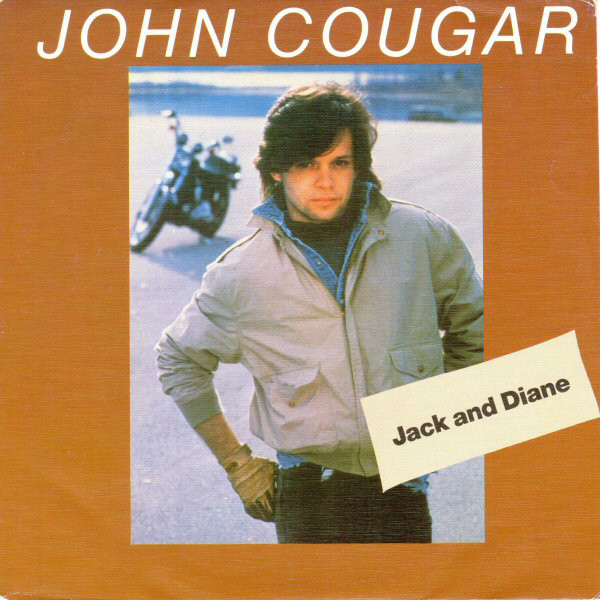
Anyone who grew up in the eighties is going to know this one. This was a big MTV and radio song in 1982. It was on the American Fool album which was his breakthrough. This song helped Mellencamp forge his identity, which was a struggle for him. John was still going by stage name John Cougar at this time. He would use Mellencamp for the follow up album Uh-Huh in 1983.

Mellencamp was inspired by the drum break in Phil Collins In The Air Tonight and asked his drummer Kenny Aronoff to come up with a drum break for this song.

The American Fool album produced two top 5 hits. It peaked at #1 in the Billboard Album Charts and Canada…and #35 in the UK. The song peaked at #1 in the Billboard 100, #1 in Canada, and #25 in the UK.

Mick Ronson played guitar, provided backup vocals, and helped arrange this song.

John Mellencamp: “The image that was given to me by the record company was so far off base of who I was and what I wanted to do,” he said in his Plain Spoken DVD. “I had no idea what I wanted to do, but I knew what I didn’t want to do. I did not want to be Johnny Cougar, I did not want to sing love songs, I did not want to be the next Neil Diamond, which is what they wanted.”

“I had to figure out what my image was, and I had a girl say to me, ‘John, just be a pair of blue jeans. That’s what you are.’ And the great thing about blue jeans is, you can dress them up, or you can dress them down.”

From Songfacts

A song about a high school couple falling in love, Mellencamp wrote “Jack & Diane” as a tribute to life in the rural working class. The inspiration was his hometown of Seymour, Indiana, which had a population of about 13,000 when it was released. The song has a very nostalgic feel, but paints a picture of a couple whose best years will soon be behind them. In a 1982 interview with The LA Herald Examiner, Mellencamp explained: “Most people don’t ever reach their goals, but that’s cool, too. Failure’s a part of what you’re all about anyway. Coming to terms with failed expectations is what counts. I try to write about the most insignificant things, really. I mean, someone who picks up a copy of Newsweek, then sits down and writes a song about the troubles in South America – who cares? What’s that song telling us that we don’t already know? Write about something that matters to people, man.”

In Campbell Devine’s authorized biography of Ian Hunter and Mott The Hoople it is revealed that this song was heavily influenced by Mick Ronson. The multi-talented Ronson (1946-1993), who was best known as a guitarist, recorded as a solo artist as well as playing lead guitar for both David Bowie and Ian Hunter (as Hunter-Ronson). In the book, Mellencamp says he’d thrown the song on the junk heap, adding: “I owe Mick Ronson the song… Mick was very instrumental in helping me arrange that.” 

Some of Mellencamp’s high school photos and home movies were used to make the video, which was pretty much an afterthought. His record company hired Jon Roseman Productions to make videos for the songs “Hurts So Good” and “Hand To Hold On To.”

Paul Flattery, who worked for that production company, explained in the book I Want My MTV that Mellencamp made a special request after those videos were completed: “He said, ‘Look, there’s a song on the album the label doesn’t believe in. But I do. Can you do me a favor and save one roll of film, shoot me singing the song, I’ll give you some old photos and stuff and then you cobble it together for me?

The song was ‘Jack & Diane.’ So we stole some editing time in LA. We projected slides on the edit room wall, and we had the tape-op wear white gloves to do the clapping. We didn’t charge John a cent.”

Mellencamp spent a long time crafting this song in an effort to make it a hit. This was part of his plan to become so successful he could ignore critics and tell his record company to stick it. But first, he had to make some concessions, like changing his name.

His manager named him “Johnny Cougar,” and he went along with it, scoring an Australian hit with “I Need A Lover” in 1978. A year later, he altered his moniker to “John Cougar,” which is how he was billed on the American Fool album. The first single, “Hurts So Good” became a huge hit and got him on MTV, and when “Jack & Diane” followed, it accomplished his mission of autonomy through hits.

When he released Uh-Huh in 1983, it was as John Cougar Mellencamp, with songs that were less crafted and more inspired, especially “Pink Houses.” He lived up to his reputation of being difficult, but it didn’t matter because he could call the shots.

Jack and Diane were a interracial couple in the first version of this song, inspired by the blended couples Mellencamp saw during his live performances (Jack was black, Diane was white). He took the race part out of it and made Jack a football star after an executive from his record company heard what he was working on and asked him to do so in an effort to make the song more relatable and therefore boost its hit potential. With race removed from the equation, a broader swath of Mellencamp’s audience identified with the song, especially in the Midwest. He says that lots of folks have told him that the characters are just like them.

Following Phil Collins’ template from the 1981 hit “In The Air Tonight,” Mellencamp ordered a drum break in the middle of this song. His drummer, Kenny Aronoff, had to come up with it on the spot, proving his mettle when he did so. In a Songfacts interview with Aronoff, he told the story:

“I walk into the studio and the co-producer has a Linn LM-1 drum machine. I’d never seen a drum machine before. I’m being told that they’re using this on the song ‘Jack & Diane’ that we were having trouble coming up with an arrangement for. I’m devastated that I’m going to be replaced by a drum machine. I grab the drum machine, I get the manual, and I program the drum part. I’m in the lounge, really bummed out and wondering, ‘What’s the future of the drummer?’ This is 1981. I’m wondering, ‘Will that machine replace us?’

Two hours later, I’m summoned into the control room, where John tells me, ‘I need you to come up with a drum solo or something after the second chorus.’ At that moment, I was absolutely terrified and excited. Excited because I’m now going to be playing on the record. Terrified because I knew that I had to save the song in order to save my career. Because if I didn’t come up with it, they’d replace me. Two people had already been fired in the band and when I joined two years prior, I was fired from playing on the record. So, this was a scary moment for me.

The long and short of it is, I come up with this part on the spot and it becomes a #1 hit – John’s biggest hit ever. That and ‘In The Air Tonight’ by Phil Collins are probably the two most air-drummed solos on pop radio, ever [even Mellencamp air drums it in the video]. It’s not technically hard, but I was forced to create that on the spot.”

Up until the big drum break, a drum machine was used on this song, but drummer Kenny Aronoff gave it a human touch not just for the break, but also the section that immediately follows. “When I got into the groove after the drum solo, the drummer that influenced me to hit the floor tom on beat four was Steve Gadd from a recording he did on a Chick Corea album, and the song was called ‘Lenore,'” Aronoff told Songfacts. “Steve Gadd would always hit the beat on beat four. I thought that was cool, so even though I don’t sound anything like Steve Gadd and nothing like he was playing on the Chick Corea record, that track influenced me to hit the floor tom, which made my hi-hats open.”

The only musical couple song that can rival this one for popularity is the standard “Frankie And Johnny. Most other hit songs of this nature were cribbed from literature or film, like “Romeo And Juliet” and Bonnie And Clyde. In 1978, Raydio had a hit with “Jack And Jill.”

Weird Al Yankovic planned to parody this song on his 1983 debut album as “Chuck And Diane,” making fun of the royal couple Prince Charles and Lady Diana. Yankovic couldn’t get Mellencamp’s permission to do the parody (which he asks as a courtesy, as anyone can parody a song as long as proper royalties are paid), so he used the lyrical content for an original song called “Buckingham Blues” instead. Yankovic did parody the song on the 2003 Simpsons episode “Three Gays Of The Condo,” where he sang it in animated form as “Homer And Marge.” 

This is the only #1 Hot 100 hit in Mellencamp’s career, and based on streams and downloads, his most popular song.

The Sun October 10, 2008 asked Mellencamp if it bothered him being best known for this little ditty. He replied: “That song is 30 or so years old and it gets played more today in the United States than it did when it came out. As much as I am a little weary of those two, I don’t know any other two people in rock and roll who are more popular than Jack and Diane. Some people probably think there’s a place in hell for me because of those two people! But it gave me the keys to do what I want. I’m 57 today. I’ve lived the way I wanted to live, sometimes recklessly and stupidly, but still been able to do that. I’ve been able to live on my whims, that’s what Jack and Diane gave me, so I can’t hate them too much.”

In 2012, a film was released called Jack & Diane, but Mellencamp had nothing to do with it, and the song is not used in the movie. In the film, Jack (played by Riley Keough) is a girl, and she and Diane have a lesbian relationship. Mellencamp said in a statement: “You don’t hear my song in the film, and I played no part in suggesting or offering this title. It’s most apparent that the lead characters were named with the hope that the familiar title might resonate in some people’s minds. I guess that’s OK to do, strictly from a legal perspective, but riding on someone else’s coattails and having a moral compass is left up to each individual.”

Mellencamp mentioned the title characters again in his 1998 song “Eden Is Burning.” The first line is, “Diane and Jack went to the movies.”

Jack and Diane

A little ditty ’bout Jack & Diane
Two American kids growing up in the heart land
Jack he’s gonna be a football star
Diane debutante in the back seat of Jacky’s car
Suckin’ on chilli dog outside the Tastee Freez
Diane sitting on Jacky’s lap
Got his hands between her knees
Jack he says:
“Hey, Diane, let’s run off behind a shady tree
Dribble off those Bobby Brooks
Let me do what I please”
Saying oh yeah
Life goes on, long after the thrill of living is gone
Sayin’ oh yeah
Life goes on, long after the thrill of living is gone
Now walk on
Jack he sits back, collects his thoughts for a moment
Scratches his head, and does his best James Dean
Well, now then, there, Diane, we ought to run off to the city
Diane says:
“Baby, you ain’t missing nothing”
But Jack he says:
“Oh yeah, life goes on, long after the thrill of living is gone”
Oh yeah
He says: “life goes on, long after the thrill of living is gone”
Oh, let it rock, let it roll
Let the bible belt come and save my soul
Holdin’ on to sixteen as long as you can
Change is coming ’round real soon
Make us woman and man
Oh yeah, life goes on
A little ditty ’bout Jack and Diane
Two American kids doin’ the best they can

Ian Hunter – Cleveland Rocks

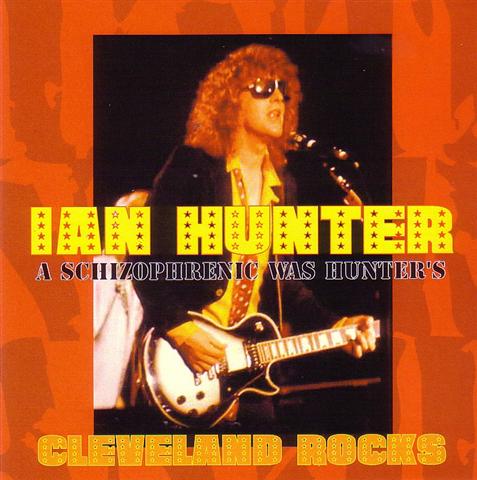
England Rocks was released in 1977 as the A Side of a single put out on the CBS label by Ian Hunter’s album Overnight Angels backed by the B side Wild N’ Free.

The same song with amended words was released in 1979 as Cleveland Rocks, and became a well known song for Hunter.

Ian Hunter had a great band behind him on this song. Mick Ronson on guitar, and the E Street Band’s Gary Tallent on bass, Roy Bittan on keyboards and Max Weinberg on drums.

The song was off of the brilliantly named album You’re Never Alone with a Schizophrenic and it peaked at #35 in the Billboard 100 and #49 in the UK in 1979.

 The song was extremely popular in Cleveland, and on June 19, 1979, Hunter was given the Key to the City by the Mayor.

Hunter’s original recording of Cleveland Rocks begins with a sample of Alan Freed introducing his show. The song was covered in 1997 by The Presidents of the United States of America as the opening theme of the television program The Drew Carey Show

Ian Hunter: “I was watching TV one night when this comedian starts making fun of Cleveland… Cleveland had the coolest rock fans in the country — I wrote ‘Cleveland Rocks’ for them, because they were always so great to me.

Cleveland was the first city in America to embrace Mott the Hoople… The East and West coasts had their heads up their [expletive], but Cleveland was hip to us and Roxy Music and David Bowie right away.”

Ian Hunter: ‘I originally wrote “Cleveland Rocks” for Cleveland. I changed it later to “England Rocks” because I thought it should be a single somewhere and Columbia wouldn’t release it as a single in the US (too regional). “Cleveland Rocks” is Cleveland’s song and that’s the truth.’

From Songfacts

From 1995 to 2004, American comedian Drew Carey starred in The Drew Carey Show, a situation comedy based in Cleveland, Ohio. Instead of an original theme song, Carey used “Cleveland Rocks,” an anthem to the City which was written in the 1970s. By an Englishman.

In a June 2007 interview on The Late Late Show, host Craig Ferguson asked that Englishman, Ian Hunter, if he’d ever lived in Cleveland. Hunter didn’t answer the question directly, but it is common knowledge that after splitting with Mott The Hoople he moved to New York, basing his second solo album around that move.

Alluding to his touring with Mott, Hunter said “They didn’t really like us on the coast much”; by us he meant not just Mott The Hoople but the whole glam rock scene referring in particular to David Bowie and Roxy Music. But “When we went to Cleveland, that was the first time we sold a club out.” He added “Cleveland was kind of like the Poland of America” but he and the rest of the glam rock crowd thought they were cool, and as Cleveland thought they were too, he in turn thought Cleveland was the coolest place.

Hunter’s original version runs to 3 minutes 48 seconds and appears on the album You’re Never Alone With A Schizophrenic; it was produced by him and Mick Ronson. The album was released on Chrysalis, March 27, 1979.

What Hunter didn’t mention on The Late Late Show is that the song was released originally – with slightly different words – as “England Rocks.”

As Hunter toured the States with Mott in the early ’70s, his claim has the ring of truth. Indeed, he has never made any secret of looking back to what he sees as the golden age of rock ‘n’ roll, and rock ‘n’ roll can in some sense be said to have originated in Cleveland. The disk jockey Alan Freed (1921-65) was born in at Johnstown, Pennsylvania less than two hundred miles from Cleveland, and moved to the City in 1949 where in 1951 he began playing rhythm and blues records on his WJW radio show The Moondog House. Freed became known as the father of rock and roll, because although he did not invent the phrase, he appears to have been the first person to use it on public radio.

In April 1983, the Rock and Roll Hall of Fame Foundation was founded in New York City, and in 1995, the Rock and Roll Hall of Fame and Museum opened its doors in downtown Cleveland. After his death, Alan Freed was cremated, and his ashes were interred at the Ferncliff Cemetery in Hartsdale, New York, but in March 2002 they were moved to the Rock and Roll Hall of Fame.

The later Drew Carey version was recorded by the Presidents Of The United States Of America.

Cleveland Rocks

All this energy callin’ me
Back where it comes from
It’s such a crude attitude
It’s back where it belongs

All the little kids goin’ up on the skits go
Cleveland rocks! Cleveland rocks!
Jumpin’ Jane Jean, and moonin’ James Dean go
Cleveland rocks! Cleveland rocks!

Momma knows, but she don’t care,she’s got her worries too
Seven kids, and a phony affair, and the rent is due

All the little chicks with the crimson lips go
Cleveland rocks! Cleveland rocks!
Livin’ in sin with a safety pin goin’
Cleveland rocks! Cleveland rocks!

I got some records from World War II
I play ’em just like me grand dad do

He was a rocker, and I am too
Now Cleveland rocks, Now Cleveland rocks
Cleveland rocks! Cleveland rocks!
Cleveland rocks!
OHIO