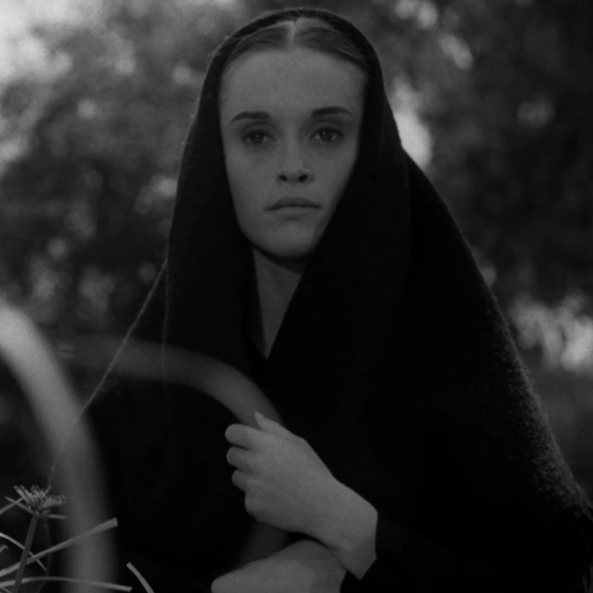
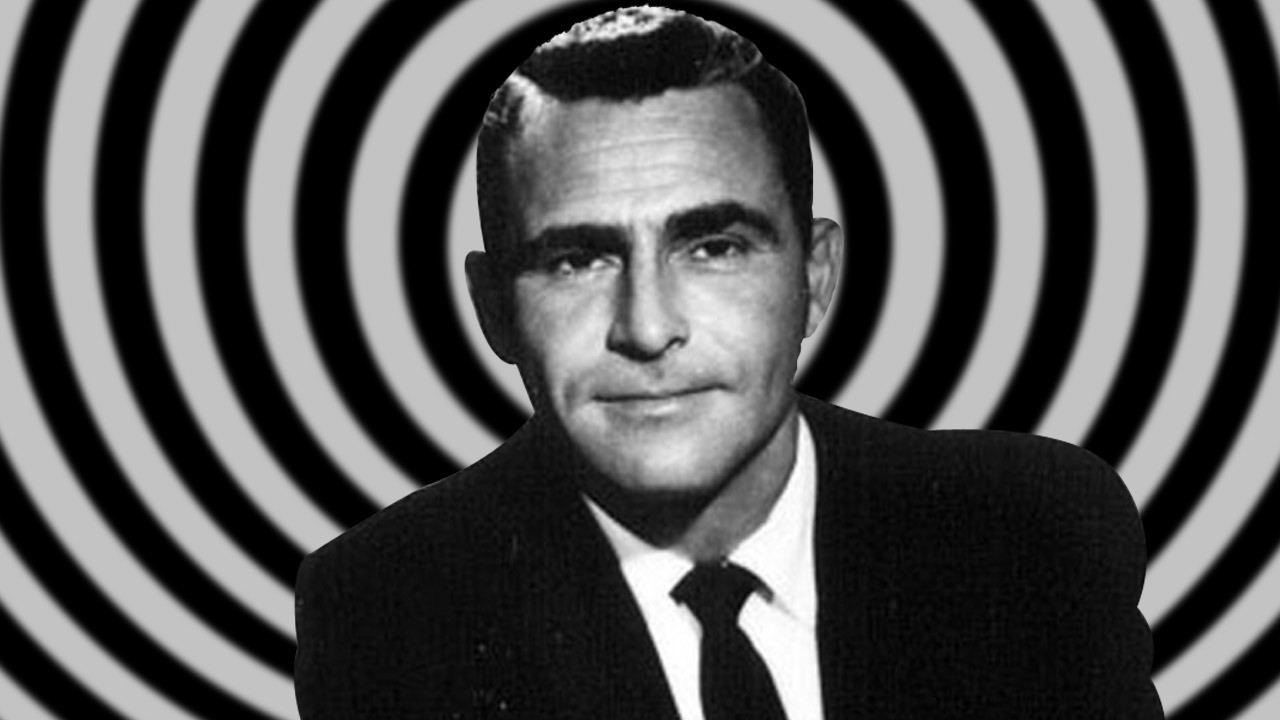
I’m going to write about my top 10 favorite TZ episodes in the next few weeks…Most of the Twilight Zones are like songs to me…to be enjoyed over and over. The Twilight Zone is not really an ordinary TV show. It’s THE TWILIGHT ZONE. This is my personal choice for #7 on my list.
I have to watch these again before I write about them…Now I wish I would have made this my top 50.
Rod Serling Opening Narration:Portrait of a frightened man: Mr. Robert Wilson, thirty-seven, husband, father, and salesman on sick leave. Mr. Wilson has just been discharged from a sanitarium where he spent the last six months recovering from a nervous breakdown, the onset of which took place on an evening not dissimilar to this one, on an airliner very much like the one in which Mr. Wilson is about to be flown home—the difference being that, on that evening half a year ago, Mr. Wilson’s flight was terminated by the onslaught of his mental breakdown. Tonight, he’s traveling all the way to his appointed destination, which, contrary to Mr. Wilson’s plan, happens to be in the darkest corner of the Twilight Zone.
In this episode he plays a husband (Bob Wilson) who just suffered a nervous breakdown on a plane 6 months before. Him and his wife Julia were taking a flight and you could tell Bob was a nervous as soon as he boarded the plane. He had just spent 6 months in an institution getting over his breakdown and now his Doctor said he was ready to fly again. He sits by the window and the fun begins… after take off he thinks sees a creature of some sort out on the wing of the aircraft.
Because of the breakdown he is not sure he saw the creature or not. Bob starts freaking out and eventually gets a gun from an officer on the plane. Hmmm gun, nervous man, and a plane. Nothing good will come from that. Everyone thinks he is crazy…is he? This one is a thriller with a creepy creature.
Richard Matheson wrote this episode. He wrote 16 Twilight Zones in all.
This is an iconic episode of the Twilight Zone. It was redone in the 1983 movie Twilight Zone with John Lithgow in the title role. I’ll take the classic version though.
Rod Serling’s Closing Narration: The flight of Mr. Robert Wilson has ended now, a flight not only from point A to point B, but also from the fear of recurring mental breakdown. Mr. Wilson has that fear no longer… though, for the moment, he is, as he has said, alone in this assurance. Happily, his conviction will not remain isolated too much longer, for happily, tangible manifestation is very often left as evidence of trespass, even from so intangible a quarter as the Twilight Zone.
Besides having one of the most unique names in the history of rock songs…this one is a really cool song off of Abbey Road. It’s always one of my favorite songs of the medley.
It’s in the medley on side 2 for those of you who have the vinyl album. I always wondered who that was coming through the bathroom window. Paul wrote the song about a fan, thought to be Diane Ashley. She said that there was a ladder in Paul’s garden and bunch of girls put it against the wall and Diane climbed up and went through the bathroom window when Paul was at the studio. I seriously doubt if she was the only one…more probable…They All Came Through Paul’s Bathroom Window. The girls that hung out waiting for the Beatles were called “Apple Scruffs” by the Beatles.
Now married with four children, Diane keeps a framed photo of herself with Paul on her kitchen shelf and looks back on her days as an Apple Scruff with affection: “I don’t regret any of it. I had a great time, a really great time.” It shows you how different of a time that was compared to now.
Margo Bird was on of the girls who Paul negotiated with to get some of his property back…he didn’t care if they got small souvenirs but when pictures went missing, Margo helped him track them down.
This was credited to Lennon/McCartney but seems to be all McCartney. The Beatles ran through it a few times earlier in the year in the Let It Be sessions. They were going to feature it in their rooftop concert but didn’t feel confident in it.
The song fit nicely between Polythene Pam and Golden Slumbers in the medley. Joe Cocker covered this song also.
Apple Scruff Margo Bird: “They rummaged around and took some clothes. People didn’t usually take anything of real value but I think this time a lot of photographs and negatives were taken. There were really two groups of ‘Apple Scruffs’ – those who would break in and those who would just wait outside with cameras and autograph books. I used to take Paul’s dog for a walk and got to know him quite well. I was eventually offered a job at Apple. I started by making the tea and ended up in the promotions department working with Tony King.”
From Songfacts
Paul McCartney wrote this about a fan who broke into his house. Diane Ashley claims it was her. “We found a ladder in his garden and stuck it up the bathroom window which he’d left slightly open,” she said. “I was the one who climbed up and got in.”
Landis Kearnon (known at the time as Susie Landis) gave us the following account:
Here, all this time I thought this song was written about me and my friend Judy. What a surprise to learn there was someone named Diane Ashley who put a ladder up to Paul’s house and climbed in through the bathroom window. This and the bit about “quit the police department” being inspired by an ex-cop taxi driver in NYC tells me something I already know about songwriting, which is that many songs are composites. This one obviously was because Diane wasn’t the only person having a profound effect on Paul McCartney by crawling in a bathroom window in 1967 (maybe ’68 in her case). Judy and I were paid $1500 by Greene & Stone, a couple of sleazy artist managers driving around the Sunset Strip in a Chinchilla-lined caddy limo, to “borrow” the quarter-inch master of “A Day In The Life” off of David Crosby’s reel-to-reel, drive it to Sunset Sound studios in Hollywood where Greene & Stone duped it, then put it back where we found it at Crosby’s Beverly Glen Canyon pad. Crosby was playing with the Byrds that day in Venice so we knew his house was empty. This was the day after a major rainstorm so the back of his house was one big mudslide. We climbed up it, leaving 8-inch deep footprints and, you guessed it, gained access via the bathroom window, leaving behind footprints and a veritable goldmine of forensic matter. We were really nervous and did not make clear mental notes of how the master reel was on the player, but did have the sense to leave Crosby’s front door unlocked while we drove across town and back. After the tape was back on the machine (badly) we changed out of our muddy shoes, drove to the Cheetah in Venice, and hung out with the Byrds into the evening, thinking we were awfully clever and cute. We did not know why Greene & Stone would pay so much money for a copy of a Beatles song, other than the fact that is was a groundbreaking and mind-blowing piece, but found out the next day when we heard “A Day In The Life” on KHJ, I think it was. Greene & Stone had used it as payola to get one of their groups, The Cake, singing “Yes We Have No Bananas,” on the air. Which they did, and it sucked, but oh well. By the following day “A Day In The Life” was no longer on the air. And just a day or two after that there was a front page blurb in the LA Times about “A Day In The Life” getting aired one month prior to the release date of the single and the Sgt. Pepper LP, which apparently cost the Beatles plenty and they were suing Capitol or Columbia, whichever the label was, for $2 million… and McCartney was flying in from London to deal with the mess. Oops. Judy and I nearly sank through the floor. Though we were active “dancers” in the various nightclubs on the Sunset Strip, we lay low for a while, not knowing what to expect. In fact, other than a song being written and a GREAT cover by Joe Cocker, nothing happened. We got our money, spent it on groovy clothes, of course (what else was there?) and never heard a word about it.
“I knew what I could not say” and “protected by a silver spoon” seemed to explain why there were no repercussions. My dad was a TV director who had already threatened to bust and ruin David Crosby for smoking pot with and deflowering his daughter; he had clout and David was afraid of him. Judy was from money and influence too. I feel that David knew exactly who had broken in and borrowed the tape but couldn’t press charges. He probably wasn’t supposed to be playing the master for all his friends and hangers-on, so there must have been hell to pay for him. I always felt bad for the cred it must have cost him with his friend Paul McCartney.
Oh, the bit about “Sunday’s on the phone to Monday, Tuesday’s on the phone to me” – that was somebody named Sunday, maybe a detective, I can’t remember now, calling the producer Billy Monday about the break-in and song leak. Billy Monday, knowing she was a friend of McCartney’s, called Tuesday Weld, and it was she who called Paul in London and told him the news. Well, I guess I didn’t make this very short after all. But you can’t tell me that this incident didn’t feed into the overall inspiration for the song. I’m just glad it turned out so cool and hope it made a heap for them in compensation for the publicity costs at the outset.
It was interesting and exciting then, that’s for sure. Even though I came of age into that scene and had nothing to compare it to, I still had a sense at the time of being at the epicenter of something big. Some of that was attributable to the hubris of youth, but some of it turned out to be real, as it happened. Now, present time, it makes my day to come across someone who still finds it interesting or even knows what or whom I’m talking about. By the way, I never did get to meet the Beatles, though I was invited to party where they were staying once, when I was 17. My mother wouldn’t let me go! I never forgave her.
I lived in LA until 1987 where I was a model, actress, (groupie, but that wasn’t professional), marching band manager, religious (Buddhist) leader, newspaper columnist, secretary, copywriter, copy editor, account executive, screenwriter, songwriter, band leader, session singer, textile designer, artist. Since then, in the Santa Fe area and now, since 1992, in Tucson, I continued my artistic and musical endeavors, ran a fabric-painting factory, was a jazz singer for several years (which has mutated to something more individual and artistic of late), have worked numerous odd jobs from pizza delivery to bookstore management, and am now close to completing my first novel, which is set in a Buddhist cult in the early ’70s.
In the ’70s I traveled halfway around the world on a square-rigged cargo ship, lived and sang in Europe for three years, and, as of 1991, am a mother of one though I never married.
Subsequent to the bathroom window event, my friend and partner in crime, as it were, Judy, went off with a Dick Clark Productions road show (can’t remember the name of it but it was something timely) as “Irma the Dancing Girl.” Her job, nightly, in each new town, was to put on a bikini, dance, and paint wild, acid abstract canvases with her extremely long blond hair. I, on the other hand, joined a Buddhist cult, which was like living on another planet entirely, and completely disappeared from view, as far as the “scene” was concerned. Judy and I didn’t hang out much after we realized the impact of our little romp. We didn’t talk about it, but we may have decided at some level that we pushed our combined wildness a bit too far on that one and moved on to “safer” friends. I saw her once in the early ’70s. She had been married and divorced, was the mother of one, and that was the last contact we had.
The Beatles recorded this as one song with “Polythene Pam.”
The Beatles gave this to Joe Cocker, who released it in 1969. The Beatles released their version first. Cocker’s version was used on the soundtrack to the movie All This and World War II, released in 1976. A strange mix of World War II documentary footage set to the music of the Beatles, the movie bombed and has barely been heard of since. Others who covered The Beatles on the soundtrack include Peter Gabriel, Elton John, Tina Turner, Leo Sayer, Frankie Laine and the Bee Gees.
This is part of a suite of songs at the end of Abbey Road. They used bits from many songs they never finished to put the suite together.
McCartney played lead guitar and Harrison played bass. It was usually the other way around.
McCartney said in a documentary shown February 6, 2002 in England that part of the lyric was inspired by sitting in the back of a New York cab. The drivers name was on display (Quitts) saying “Ex Police Department,” which inspired the line: “And so I quit the Police Department and got myself a steady job…”
She Came In Through The Bathroom Window
She came in through the bathroom window Protected by a silver spoon But now she sucks her thumb and wanders By the banks of her own lagoon
Didn’t anybody tell her? Didn’t anybody see? Sunday’s on the phone to Monday Tuesday’s on the phone to me
She said she’d always been a dancer She worked at fifteen clubs a day And though she thought I knew the answer Well, I knew what I could not say
And so I quit the police department And got myself a steady job And though she tried her best to help me She could steal but she could not rob
Didn’t anybody tell her? Didn’t anybody see? Sunday’s on the phone to Monday, Tuesday’s on the phone to me Oh yeah
I’m going to write about my top 10 favorite TZ episodes in the next few weeks…Most of the Twilight Zones are like songs to me…to be enjoyed over and over. The Twilight Zone is not really an ordinary TV show. It’s THE TWILIGHT ZONE. This is my personal choice for #8 on my list.
Probably one of the creepiest Twilight Zones. The way it ends keeps you thinking after the show is done. This was the final episode of The Twilight Zone to be filmed, although two episodes filmed earlier were aired afterwards.
Rod Serling Intro:Mr. Floyd Burney, a gentleman songster in search of song, is about to answer the age-old question of whether a man can be in two places at the same time. As far as his folk song is concerned, we can assure Mr. Burney he’ll find everything he’s looking for, although the lyrics may not be all to his liking. But that’s sometimes the case – when the words and music are recorded in the Twilight Zone.
Richard Donner wrote this episode. This one wasn’t rated as high as some of the others but it stuck with me for a long time. The desperation in Mr. Floyd Burney is something to remember.
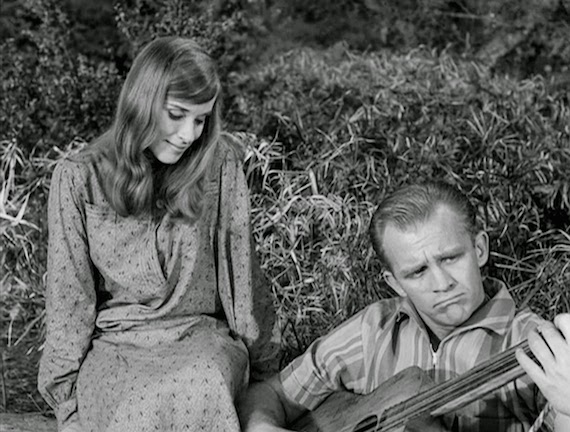
Come Wander With Me: Singer Floyd Burney, a rockabilly singer, goes deep into the back woods hoping to find a folk song to buy and release. As soon as he arrives he hears a beautiful singing voice which draws him deeper into the woods. He eventually meets Mary Rachel who tells him the song he heard belonged to someone and that she’s forbidden to tell anyone about it. When she finally reveals it to him, Floyd learns that his future might be preordained. And the outcome might make him wish he never roamed into this strange place.
Gary Crosby (Bing Crosby’s son) plays Floyd Burney and is very realistic as a fast talking rockabilly singer. Bonnie Beecher is the mystery of this show. She didn’t do much acting after this…her voice was used for the main song and it was beautiful. She ended up marrying Hugh Nanton Romney Jr. (Wavy Gravy) who was an entertainer and peace activist and was seen on the film Woodstock.
I’m asked quite a bit…Max what is your favorite Beatle song? It’s hard to tell you because it changes from day to day. I would have to say A Day In The Life if I had to give one answer… but on certain days…this one would be it. Lennon to me was one of the best all time rock singers. He could do rock and pop/rock with ease. He never liked his voice and always wanted the producer George Martin to cover it up with echo or some effect.
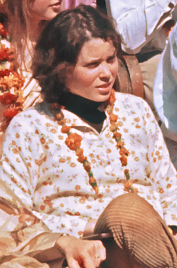
The story behind this one is known to Beatle fans. They were in India with the Maharishi and were asked to meditate all day. Mia Farrow and her sister Prudence was there. Prudence was taking this very seriously and would not come out of her quarters and John wrote this song to cheer her up.
American flautist Paul Horn, who was also with them in Rishikesh said that Prudence was a highly sensitive person, and by jumping straight into deep meditation, against the Maharishi’s advice, she had allowed herself to fall into a catatonic state.
Horn stated, “She was ashen-white and didn’t recognize anybody. She didn’t even recognize her own brother who was on the course with her. The only person she showed any slight recognition towards was Maharishi. We were all concerned about her and Maharishi assigned her a full-time nurse.”
The song was on their massive double album album “The Beatles” or better known as the White Album released in 1968. On this album you get a little bit of everything. 20’s style music, pop, folk, Avant Garde, rock, to hard rock.
Donovan was also there and taught John and Paul and guitar picking style called “clawhammer.” The clawhammer style, is played with the strumming hand formed into a claw, using the backs of the fingernails to strum down on the strings.
The song was not released as a single but remains a favorite album track.
Donovan: “He was so fascinated by fingerstyle guitar that he immediately started to write in a different color and was very inspired” “That’s what happens when you learn a new style.”
Prudence Farrow:“They were trying to be cheerful, but I wished they’d go away. I don’t think they realized what the training was all about.”
From Songfacts
While Mia Farrow inspired such men as Andre Previn, Frank Sinatra and Woody Allen, her sister Prudence left her mark on John Lennon. According to Nancy de Herrera’s book, All You Need Is Love, Prudence met The Beatles on a spiritual retreat with their guru, Maharishi Mahesh Yogi, in India, which she attended with Mia. When Prudence, suffering depression, confined herself to her room, Lennon wrote this song hoping to cheer her up. It did.
Prudence Farrow wanted to “Teach God quicker than anyone else,” according to John Lennon. She would lock herself in her room trying to meditate for hours and hours. From A Hard Day’s Write, by Steve Turner: “At the end of the demo version of Dear Prudence John continues playing guitar and says: ‘No one was to know that sooner or later she was to go completely berserk, under the care of Maharishi Mahesh Yogi. All the people around were very worried about the girl because she was going insane. So, we sang to her.'”
Ringo had left the group as the White Album sessions got very tense, so Paul McCartney played drums. When Ringo came back a short time later, there were flowers on his drum kit welcoming him back.
According to the singer-songwriter Donovan, who was on the retreat in India with The Beatles, he taught John Lennon a “clawhammer” guitar technique that he used on this track.
John Lennon’s handwritten lyrics were auctioned off for $19,500 in 1987.
Lennon considered this one of his favorites.
Siouxsie And The Banshees covered this in 1983. Their version went to #3 in the UK and became their biggest hit.
“Dear Prudence” was the second Beatles song that the Banshees had covered from their White Album. Previously, they’d recorded a version of “Helter Skelter” for their 1978 LP The Scream.
“Helter Skelter was very much part of our live show before we recorded it,” mused Siouxsie Sioux to TeamRock. “The great thing was that the two Beatles songs we chose – ‘Helter Skelter’ and ‘Dear Prudence’ – were not originally singles by The Beatles, so it wasn’t necessarily a surefire: ‘Oh, they’re doing a Beatles song.’ And it was also a bit irreverent as well, I suppose. A good test of doing a cover version is when people think that you’ve written it. Quite a lot of people thought Dear Prudence was an original.”
This song was in the movie Across the Universe, which was based on The Beatles music. In the movie, Prudence (played by T.V. Carpio) locked herself in a closet after discovering that Sadie and JoJo were together when she thought she loved Sadie. Lucy (Evan Rachel Wood), Jude (Jim Sturges), Sadie (Dana Fuges) and Max (Joe Anderson) sing this to make her feel better. It gets her out of the closet and they end the song at a anti-Vietnam War rally.
Siouxsie and the Banshees’ take on the song added to The Beatles’ simple original arrangement. “It was kind of an undeveloped song on the White Album,” Siouxsie said. “and so there was a lot of scope to put in your own stuff, really. What did I want to bring? Oh, some psychedelic transformation there [laughing].”
“No, I think that actual track’s fairly restrained, simple and understated on the White Album,” she added. “I was listening to singles like Itchycoo Park by the Small Faces, so I think it was wanting to capture the 60s, and all that kind of phasing. Also, it was where we were at the time.”
Dear Prudence
Dear Prudence, won’t you come out to play? Dear Prudence, greet the brand new day The sun is up, the sky is blue It’s beautiful and so are you Dear Prudence, won’t you come out to play?
Dear Prudence, open up your eyes Dear Prudence, see the sunny skies The wind is low, the birds will sing That you are part of everything Dear Prudence, won’t you open up your eyes?
Dear Prudence, let me see you smile Dear Prudence, like a little child The clouds will be a daisy chain So let me see you smile again Dear Prudence, won’t you let me see you smile?
Dear Prudence, won’t you come out to play Dear Prudence, greet the brand new day The sun is up, the sky is blue It’s beautiful and so are you Dear Prudence, won’t you come out to play?
I have played this song in a club with a 4 piece band and it actually very well received. You don’t have to have the full orchestra for it to sound good…it’s that good of song. Our bass player actually recited the poem to applause. Even after peeling off the layers of music, the song stood.
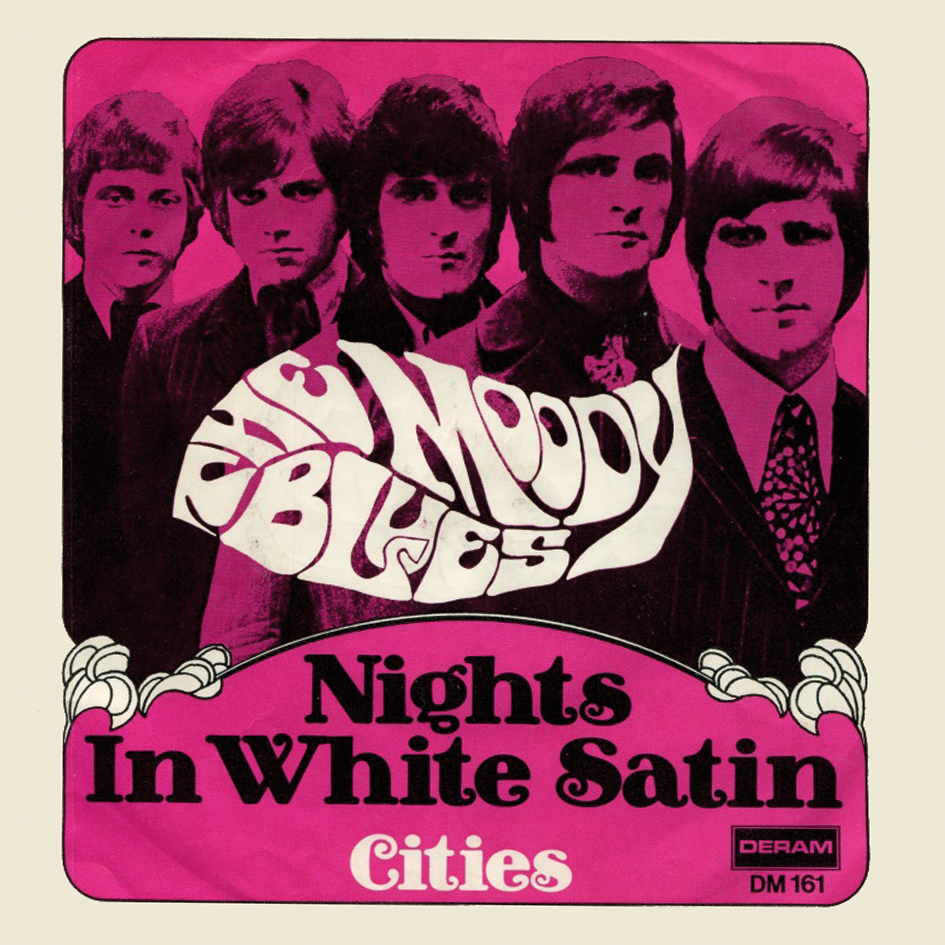
Justin Hayward wrote this song after he joined the band after Denny Laine had left. It is said that he got the idea for the song after someone gave him a set of white satin sheets, and wrote it in his bed-sit at Bayswater.
The poem at the end was recorded separately. It is called Late Lament and was written by their drummer, Graeme Edge. The poem was read by keyboard player Mike Pinder. Edge wrote another poem that appeared early on the album called Morning Glory.
This song ushered in a new sound for this band who were formally more of a blues band. “Nights in White Satin” was originally released in 1967, charting at #19 in the UK, but topping out at #103 in America, where six-minute songs were a tough sell. In 1972, after songs like “Hey Jude ” and “Layla” paved the way for long, dramatic tunes (and The Moody Blues became more popular), the song was re-released in the US and became a hit, peaking at #2 in the Billboard 100 and #1 in Canada.
Justin Hayward: “I wrote our most famous song, ‘Nights in White Satin’ when I was 19. It was a series of random thoughts and was quite autobiographical. It was a very emotional time as I was at the end of one big love affair and the start of another. A lot of that came out in the song.”
From Songfacts
The Moody Blues recorded the album with The London Festival Orchestra, which never actually existed – it was the name given to the musicians put together to make the Days of Future Passed album. The orchestral parts were performed separately and edited between and around the Moody Blues parts, so the orchestra did not actually accompany the group. The original idea was for the group and orchestra to record a rock version of Dvorak’s “New World Symphony,” which their record company would use to demonstrate enhanced stereo sound technology.
Before joining The Moody Blues, a teenaged Justin Hayward signed a deal with Lonnie Donegan’s publishing company, which ended up giving Donegan the lion’s share of the royalties for this and other songs Hayward wrote at the time. Donegan was star in the ’50s, famous for his skiffle sound that influenced The Beatles and The Who. In the ’60s, he became more involved in the business side of the industry and formed his publishing company Tyler Music.
Days of Future Passed is a concept album based around different times of day. For example, “Dawn Is A Feeling” and “Tuesday Afternoon.” This song was last on the album because it represents nighttime.
Justin Hayward was inspired by Moody Blues keyboard player Mike Pinder’s composition “Dawn Is A Feeling.” Since Pinder had done “The Morning” for the concept album, Hayward tried to do “The Night.”
Fans have come up with many interpretations of this song, which is just fine with Justin Hayward, who fells that the receiver gives life to the transmission. “It’s the listeners who bring the magic and the interpretations to these songs,” he said in his 2016 Songfacts interview.
This song introduced a new sound for the band. When they formed, they were more of a blues band, and had a hit in 1965 with a cover of Bessie Banks’ “Go Now.” With the songs on Days of Future Passed, they distinguished themselves with original songs in a more psychedelic/orchestral sound.
In the UK, the song made two more chart appearances, going to #9 in 1972 and #14 in 1979.
The Dickies 1979 Punk version reached #39; the Moody Blues used to use The Dickies version sometimes when doing a sound check.
The week of December 2, 1972, this song plunged from #17 to completely out of the Hot 100, setting a record for the biggest drop out of that chart in a single week. Drastic chart disappearances became more common in the ’10s, and the Glee Cast version of “Toxic” made the fall from the #16 spot in 2010.
Talking about the experiences that inspired the lyrics to this song, Justin Hayward said: “About an audience in Glastonbury, a flat in Bayswater and the ecstasy of an hour of love.”
Among the many artists to record this song are Procol Harum, Eric Burdon, Percy Faith, Nancy Sinatra and Il Divo. When we spoke with Justin Hayward in 2013, he told us that the best cover he heard of this song was by the soul singer Bettye LaVette. “She covered ‘Nights,’ and somebody sent it to me as an MP3, a link,” he explained. “I was sitting in bed with my laptop waking up to my emails, and I clicked on this link and I burst into tears. My wife came in and she said, ‘What the hell’s the matter with you?’ And I said, ‘You’ve got to listen to this.’ She didn’t cry. But I heard the lyric for the first time. There have been hundreds, maybe thousands of covers of ‘Nights in White Satin,’ but that was the first time I heard it for real.”
The Moody Blues enjoyed a long and illustrious career that took them well into the 2010’s, and included thousands of performances, most of which featured this song. How does Justin Hayward handle the repetition? “I never lose the emotion of songs like that,” he told us. “I’m lucky enough not to have lost the emotion or the motivation, because it’s a wonderful thing to be able to share. And the audience provides the emotion around that. Because you do it in sound check and it’s fine, but when there’s an audience there, it completely transforms the experience.”
Nights In White Satin
Nights in white satin Never reaching the end Letters I’ve written Never meaning to send
Beauty I’d always missed With these eyes before Just what the truth is I can’t say any more
‘Cause I love you Yes I love you Oh how I love you
Gazing at people, some hand in hand Just what I’m going through they can’t understand Some try to tell me, thoughts they cannot defend Just what you want to be, you will be in the end
And I love you Yes I love you Oh how I love you Oh how I love you
Nights in white satin Never reaching the end Letters I’ve written Never meaning to send
Beauty I’ve always missed With these eyes before Just what the truth is I can’t say any more
‘Cause I love you Yes I love you Oh how I love you Oh how I love you ‘Cause I love you Yes I love you Oh how I love you Oh how I love you
One of the most recognizable riffs in rock and roll. This one was also one of their most popular songs. It wasn’t ever one of my favorites by them but I did like it.
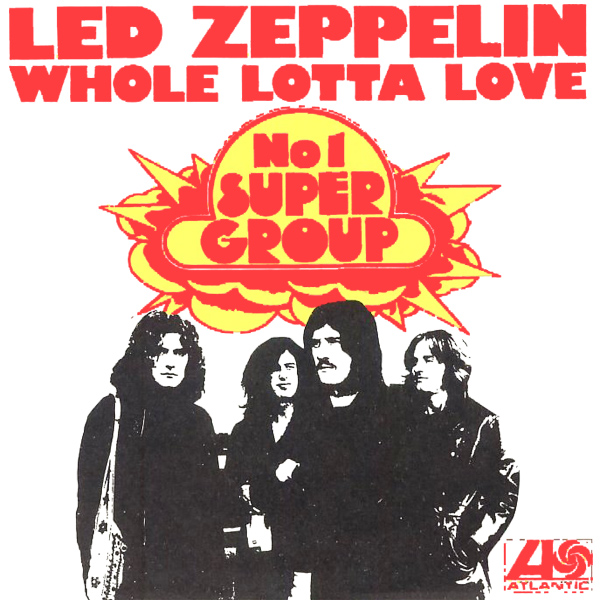
It was a rare thing for Zeppelin to release a single…but this was released as one except in the UK. This song peaked at #4 in the Billboard 100 and #2 in Canada in 1970.
The lyrics are based on a 1962 Muddy Waters song written by Willie Dixon called “You Need Love.” Led Zeppelin reached an agreement with Dixon, who used the settlement money to set up a program providing instruments for schools. All the members of Led Zeppelin get a writing credit along with Willie Dixon now.
Robert Plant has said that Steve Marriott was an influence and you can hear it really strong in the Small Faces rendition (I have it at the bottom) of You Need Love from 1966…and good 3 years before this was recorded. Marriott was one of the best singers of that or any era.
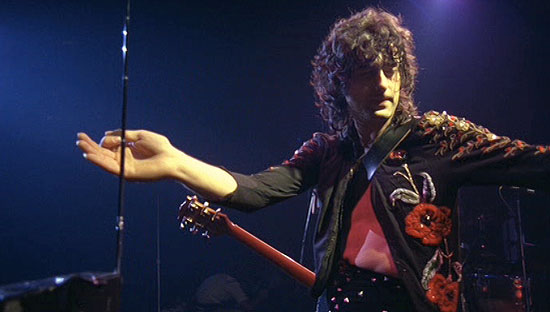
Jimmy Page played a theremin, a bizarre electronic instrument he liked to experiment with consisting of a black box and antennae, famously heard on the 1966 Beach Boys song “Good Vibrations.” The sound is altered by moving one’s hand closer to or farther from the antennae and was used to create the fuzz that alternates back and forth through the speakers.
John Paul Jones: “The backwards echo stuff. A lot of the microphone techniques were just inspired. Using distance-miking… and small amplifiers. Everybody thinks we go in the studio with huge walls of amplifiers, but he doesn’t. He uses a really small amplifier and he just mikes it up really well, so that it fits into a sonic picture.”
From Songfacts
This blistering track from Led Zeppelin’s second album contains some of Robert Plant’s most lascivious lyrics, culled from the blues. It’s not poetry, but he gets his point across quite effectively, letting the girl know that he’s yearning, and ready to give her all of his love – every inch.
The massive drum sound was the foundation of this track, so Jimmy Page recorded it in the big room at Olympic Studios in London, which had 28-foot ceilings. One of the engineers, George Chkiantz, got the sound by putting the drums on a platform and setting up microphones in unusual places: a stereo boom eight feet above the kit, two distant side microphones, and a AKG D30 placed two feet from the bass drum. “For the song to work as this panoramic audio experience, I needed Bonzo to really stand out, so that every stick stroke sounded clear and you could really feel them,” Page said in the Wall Street Journal. “If the drums were recorded just right, we could lay in everything else.”
Jimmy Page served as Led Zeppelin’s producer, and on this song, he let loose in the studio, using all kinds of innovative techniques, particularly in the freeform section about 1:20 in, which was the result of him and engineer Eddie Kramer “twiddling every knob known to man.” This part is often referred to as “the freakout.”
One of the more intriguing sections of this song comes at the 4-minute mark, where the distant voice of Robert Plant sings each line (“Way down inside… woman… you need… love”) before his full-throated vocal comes in. This is known as “backward echo,” and one of the first uses of the technique, but it happened by accident: A different take of Plant’s vocal bled over to his master vocal track, so when Page and engineer Eddie Kramer mixed the song, they couldn’t get rid of it. They did what most creative professionals do with a mistake: they accentuated it to make it sound intentional, adding reverb to it so Plant sounded like he was foreshadowing his lines from afar.
Led Zeppelin didn’t release singles in the UK, where it was considered gauche, and in America, they didn’t issue any from their first album. “Whole Lotta Love” was the first song they allowed as a US single, and it became their biggest hit, going to #4 (their only Top 10 entry) despite a 5:33 running time. Many of Zeppelin’s most popular songs, including “Stairway To Heaven,” were not released as singles.
Led Zeppelin used this as the basis for a medley they performed in their later shows. They had lots of songs by then, so they used the medley to play snippets of their popular songs they did not want to play all the way through. They incorporated various blues songs in these medleys as well, notably “Boogie Chillen” by John Lee Hooker, which was often followed by what they called “Boogie Woogie, by Unknown,” and “Let’s Have A Party” by Wanda Jackson. They would put this in when Robert Plant would yell, “Way Down INSIDE.”
When this song became a hit in America, the UK division of the band’s label, Atlantic Records, pressed copies of a shortened version of the song to release there, but Jimmy Page quashed that idea when he heard the 3:12 truncated edit (“I played it once, hated it and never listened to the short version again,” he told the Wall Street Journal). The band issued a press release stating: “Led Zeppelin have no intention of issuing ‘Whole Lotta Love’ as a single as they feel it was written as part of their concept of the album.” The American single is the same version as found on the album.
This was recorded on an 8-track tape machine at Olympic Studios, London in April 1968, but Jimmy Page waited to mix it until the band came to New York on tour in August because he wanted Eddie Kramer, who had relocated there, to work on it. To the delight of deconstructionists, Page later released the eight split tracks of Whole Lotta Love, along with the mixdowns, on the Studio Magik – Sessions 1968-1980 CD compilation. These stems reveal an entire middle vocal section that’s totally different and the “da da” vocal about two beats behind what was released. In the drum tracks, during the rolls, you can hear John Bonham groaning.
The line, “Shake for me girl, I wanna be your back door man” is a reference to the “back door man” of blues cliché (popularized in a Willie Dixon song). This guy enters and leaves through the back door to avoid detection, as the lady is using him to cheat on her boyfriend or husband. This adds an illicit edge to the storyline.
After Page started fooling around with the theremin in the studio, it was open season for experimentation on the track; he started messing around with his guitar by detuning it and pulling on the strings, and Plant did his part by going to the extreme high of his vocal range.
Page, Plant, and John Paul Jones played this at the Atlantic Records 40th anniversary concert in 1988 with Jason Bonham sitting in on drums for his late father. Jason joined the band again in 2007 at a benefit concert for the Ahmet Ertegun education fund, where they played this as the first encore.
In 1997, this became the only single Led Zeppelin released in the UK when a 4:50 edit was issued to celebrate the band’s 30th anniversary. The singles chart was dominated by acts like the Spice Girls and Puff Daddy, and this release got little attention, reaching just #21.
Guitar World noted Page’s use of the wah-wah pedal during his famous solo, securing its place at #17 on the magazine’s 2015 list of greatest wah solos of all time. Jack White has cited it as the greatest guitar solo ever recorded.
Jimmy Page played the loose blues riff for the intro on a Sunburst 1958 Les Paul Standard through a 100W Marshall “Plexi” head amp with distortion from the EL34 output valves.
Alexis Korner hit #13 UK and #58 US with his mostly instrumental cover of this song in 1970 with his studio group CCS. King Curtis also did an instrumental version that went to #64 US that year. A vocal cover by The Wonder Band reached #87 US in 1987. Tina Turner recorded it for her 1975 album Acid Queen, and the London Symphony Orchestra also covered it.
The remaining members of Led Zeppelin played this at their Live Aid reunion in 1985. Along with Tony Thompson, Phil Collins sat in on drums. Collins was the biggest presence at Live Aid. He played a set in London, flew to Philadelphia, played another set, then stayed on when Zeppelin took the stage. Jimmy Page was not happy – he thought Collins butchered it.
This song was performed by Leona Lewis and Jimmy Page at the closing ceremony of the 2008 Beijing Olympics during the hand over to the host of the 2012 games, London. Prior to the performance there was some concern about the track’s somewhat family unfriendly lyrical content, but Lewis tactfully changed the words from “every inch of my love” to “every bit of my love.”
They appeared alongside English soccer star David Beckham as symbols of British entertainment, both old and new. The performance took place in a magnificent, elaborate setting: Beijing’s “Bird’s Nest” Olympic Stadium. Lewis and Page appeared out of what had been a London double-decker bus, later transformed into a garden of green hedges.
On May 5, 2009, this became the first Led Zeppelin song performed on American Idol when Adam Lambert sang it during Rock Week, with Slash as the guest mentor. The judges loved Lambert’s version and he advanced to the next round.
In 2010, Mary J. Blige covered “Whole Lotta Love” and “Stairway To Heaven,” which were released as downloads and appeared on the UK version of her Stronger With Each Tear album. Musicians contributing to these tracks include Steve Vai, Orianthi, blink-182 drummer Travis Barker and Randy Jackson of American Idol fame, who played bass. “Whole Lotta Love” was produced by RedOne and Ron Fair, who is Chairman of Geffen Records. >>
The song’s guitar riff was voted the greatest of all time by listeners of BBC Radio 2 in a 2014 poll. “Sweet Child O’ Mine” by Guns N’ Roses came second in the listing and “Back In Black” by AC/DC third.
The songwriting credits on this track have been convoluted over the years. The four band members were listed as the writers on the original recording, and later, Willie Dixon was added as part of his settlement. But the ASCAP record shows this, which is often reprinted:
John Bonham John Paul Jones Pete Moore Jimmy Page Sharon Plant
The best we can tell, these credits come from a 1996 cover of the song by the British group Goldbug, which sampled Pete Moore’s song “Asteroid.” “Sharon Plant” is apparently a mistake (should be “Robert Plant”). This version of the song was a hit in the UK, reaching #3. At some point, Dixon’s credit was omitted in most listings.
This song got a mention in the 2014 lawsuit alleging that Jimmy Page stole the intro to “Stairway To Heaven” from a song called “Taurus” by the group Spirit.
In 1968, Spirit played some shows on the same bill with Zeppelin, and “Taurus,” an instrumental written by guitarist Randy California, was in Spirit’s set. California died in 1997, but his estate filed the wide-ranging lawsuit, which accused page of nicking an entire sound during this time. It states: “Jimmy Page’s use of the Etherwave – Theremin, and other psychedelic-type audio effects which helped give Led Zeppelin its distinctive sound – especially prominent in ‘Whole Lotta Love’ – was inspired by seeing California effectively use these types of audio-enhancing effects on tour.”
The CCS version was used as the theme song to the BBC music show Top of the Pops from 1970-1977 and again from 1998-2003. Led Zeppelin never appeared on the program, as they had no interest in lip-synching and weren’t a good fit for the TOTP audience.
Jack Johnson performed a very laid-back version of this song when he headlined the first night of the Coachella Valley Music and Arts Festival in 2008.
Robert Plant played this on his Strange Sensations tour of the UK in 2005.
In Led Zeppelin: The Oral History of the World’s Greatest Rock Band, Jack White, one of the most notable rock guitarists of the early 2000s, is quoted saying the guitar solo in “Whole Lotta Love” may be the greatest of all time. He’s talking about the part running from 2:22 to 2:39, popularly called the “freakout.”
Whole Lotta Love
You need cooling Baby I’m not fooling I’m gonna send ya Back to schooling
A-way down inside A-honey you need it I’m gonna give you my love I’m gonna give you my love
Want to whole lotta love Want to whole lotta love Want to whole lotta love Want to whole lotta love
You’ve been learning Um baby I been learning All them good times baby, baby I’ve been year-yearning
A-way, way down inside A-honey you need-ah I’m gonna give you my love, ah I’m gonna give you my love, ah oh
Whole lotta love Want to whole lotta love Want to whole lotta love Want to whole lotta love
You’ve been cooling And baby I’ve been drooling All the good times, baby I’ve been misusing
A-way, way down inside I’m gonna give ya my love I’m gonna give ya every inch of my love I’m gonna give ya my love
Hey! Alright! Let’s go!
Whole lotta love Want to whole lotta love Want to whole lotta love Want to whole lotta love
Way down inside Woman, you need, yeah Love
My, my, my, my My, my, my, my Lord Shake for me girl
I wanna be your backdoor man Hey, oh, hey, oh Hey, oh, hey, oh Ooh Oh, oh, oh, oh
Cool, my, my baby A-keep it cooling baby A-keep it cooling baby Ah-keep it cooling baby Ah-keep it cooling baby Ah-keep it cooling baby
I hope all of you have a great Valentines day…lets join the Beatles on June 25, 1967 for All You Need Is Love. There’s nothing you can do that can’t be done…
How nerve-racking this had to be even if you were a Beatle. They performed this on one of the first Satellite hookups around the world. There was an estimated 350 million people watching. This performance was a rock and roll mile stone…they were in front of the world.
The show was called “Our World”, the first worldwide TV special. Broadcast in 24 countries on June 25, 1967, the show was six hours long and featured music from 6 continents, with The Beatles representing Britain.
At the Beatles feet were members of The Rolling Stones, The Who, Cream, The Hollies, and The Small Faces helping by singing along.
The song peaked at #1 almost every where and probably even in Venus and Mars in 1967.
Musically, this song is very unusual. The chorus is only one note, and the song is in a rare 7/4 tempo. In the orchestral ending, you can hear pieces of both “Greensleeves,” a Bach two-part invention (by George Martin) and Glenn Miller’s “In The Mood.” Royalties were paid to Miller for his contribution.
Just think of all of the bits of paper all of them wrote or scribbled on and threw away. John Lennon’s hand-written lyrics for this song sold for one million pounds in the summer of 2005. Lennon left them in the BBC studios after this appearance, and they were salvaged by a very smart BBC employee.
From Songfacts
The concept of the song was born out of a request to bring a song that was going to be understood by people of all nations. The writing began in late May of 1967, with John and Paul working on separate songs. It was decided that John’s “All You Need Is Love” was the better choice because of its easy to understand message of love and peace. The song was easy to play, the words easy to remember and it encompassed the feeling of the world’s youth during that period.
“All You Need Is Love” was a popular saying in the ’60s anti-war movement. The song was released in the middle of the Summer of Love (1967). It was a big part of the vibe.
John Lennon wrote this as a continuation of the idea he was trying to express in his 1965 song “The Word.” John was fascinated by how slogans effect the masses and was trying to capture the same essence as songs like “We Shall Overcome.” He once stated, “I like slogans. I like advertising. I love the telly.” In a 1971 interview about his song “Power To The People,” he was asked if that song was propaganda. He said, “Sure. So was ‘All You Need Is Love.’ I’m a revolutionary artist. My art is dedicated to change.”
It was not until 1983 and the publication of the in the book John Lennon: In My Life by Pete Shotton and Nicholas Schaffner that it was revealed that John Lennon was the primary composer of the song. It is typical of Lennon: Three long notes (“love -love -love”) and the rise of excitement with at first speaking, then recital, then singing, then the climax and finally the redemption. This as opposed to McCartney’s conventional verse, verse, middle part, verse or A,A,B,A. Lennon felt that a good song must have a rise of excitement, climax and redeeming.
Ringo’s second son, Jason, was born the day this hit #1 in the US: August 19, 1967. Jason is also a drummer.
McCartney sang the chorus to The Beatles 1963 hit, “She Loves You” at the end: “She loves you yeah yeah yeah… She loves you yeah yeah yeah”
This begins with a clip from the French national anthem, “La Marseillaise,” written and composed by Claude Joseph Rouget de Lisle in Strasbourg on April 25, 1792. Its original name was “Chant de guerre de l’Armee du Rhin” (“Marching Song of the Rhine Army”) and it was dedicated to Marshal Nicolas Luckner, a Bavarian-born French officer from Cham. It became the rallying call of the French Revolution and got its name because it was first sung on the streets by troops from Marseille upon their arrival in Paris. Now the national anthem of France, the song was also once the anthem of the international revolutionary movement, contrasting with the theme of The Beatles song. In the late 1970s, Serge Gainsbourg recorded a reggae version “Aux Armes et cetera,” with Robbie Shakespeare, Sly Dunbar and Rita Marley in the choir in Jamaica, which resulted in him getting death threats from veterans of the Algerian War of Independence.
Al and Tipper Gore had this song played at their wedding. They married in 1970 and separated in 2010.
George Harrison mentioned this in his 1981 song “All Those Years Ago” with the line, “But you point the way to the truth when you say ‘All you need is love.'” Harrison’s song is a tribute to John Lennon, who was killed in 1980.
This was used in the climactic final episode of the UK sci-fi series The Prisoner, and was the entrance music for Queen Elizabeth II during the UK Millennial celebrations of 1999. It was also sung by choirs across the kingdom in 2002 during the Queen’s Golden Jubilee celebration.
In 2007, this was used in an advertising campaign for Luvs diapers with the lyrics changed to “All You Need Is Luvs.” While Beatles songs have been used in commercials before, notably “Revolution” in spots for Nike and “Hello Goodbye” for Target, this peace anthem shilling for diapers didn’t go over well with fans who thought it sullied The Beatles legacy. The publishing rights to “All You Need Is Love” and most other Beatles songs are controlled by the Sony corporation and Michael Jackson, which means The Beatles cannot prevent a company from re-recording the song and using it in a commercial.
When asked what his favorite lyric is during an interview with NME, John Lennon’s son Sean replied: “My list of favorite things changes from day to day. I like when my dad said: ‘There’s nothing you can know that isn’t known/ Nothing you can see that isn’t shown/ Nowhere you can go that isn’t where you’re meant to be.’ It seems to be a good representation of the sort of enlightenment that came out of the ’60s.”
All You Need Is Love
Love, love, love Love, love, love Love, love, love
There’s nothing you can do that can’t be done Nothing you can sing that can’t be sung Nothing you can say, but you can learn how to play the game It’s easy Nothing you can make that can’t be made No one you can save that can’t be saved Nothing you can do, but you can learn how to be you in time It’s easy
All you need is love All you need is love All you need is love, love Love is all you need
There’s nothing you can know that isn’t known Nothing you can see that isn’t shown There’s nowhere you can be that isn’t where you’re meant to be It’s easy
All you need is love All you need is love All you need is love, love Love is all you need
All you need is love (all together now) All you need is love (everybody) All you need is love, love Love is all you need
Love is all you need (Love is all you need) Love is all you need (Love is all you need) Love is all you need (Love is all you need) Love is all you need (Love is all you need) Love is all you need (Love is all you need) Love is all you need (Love is all you need) Love is all you need (Love is all you need) Love is all you need (Love is all you need) Love is all you need (Love is all you need) Love is all you need (Love is all you need) Love is all you need (Love is all you need) (Love is all you need) (Love is all you need) (Love is all you need) Yesterday (Love is all you need) Oh Love is all you need Love is all you need Oh yeah Love is all you need (She love you, yeah, yeah, yeah) (She love you, yeah, yeah, yeah) (Love is all you need) (Love is all you need)
I’m going to write about my top 10 favorite TZ episodes in the next few weeks…Most of the Twilight Zones are like songs to me…to be enjoyed over and over. The Twilight Zone is not really an ordinary TV show. It’s THE TWILIGHT ZONE. This is my personal choice for #10 on my list.
If I had to name a favorite show of all time…this would be it. I have all of them and I’ve watched them all at least 5 or more times. Each are like a work of art on their own. I like shows that are “Twilight Zone like” but none measure up to the original. Even the reboots in the 80’s, 2000’s, and now doesn’t live up to the original.
Ring-A-Ding Girl was written by Earl Hamner Jr….the Waltons creator. He went on to write eight Twilight Zones and one more by him will be coming up in my top ten.
The way Rod Serling handled social problems with a science fiction twist was compelling. TV has a reputation of being dumb…and it earned that reputation fair and square… Serling cannot be blamed for that…he was all about quality.
Rod Serling Intro:Introduction to Bunny Blake. Occupation: film actress. Residence: Hollywood, California, or anywhere in the world that cameras happen to be grinding. Bunny Blake is a public figure; what she wears, eats, thinks, says is news. But underneath the glamour, the makeup, the publicity, the buildup, the costuming, is a flesh-and-blood person, a beautiful girl about to take a long and bizarre journey into The Twilight Zone.
Unfortunately he died in 1975 at a young 50 years old. Now lets get to the episode…I don’t do spoilers and if I ever did I would mark it before you read it…so here it goes. Just a very short look at it.
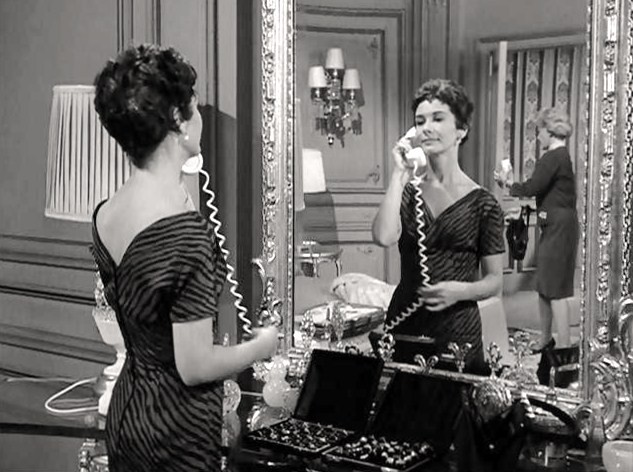
The Ring-A-Ding Girl: This one is in my top ten of Twilight Zone episodes. An actress Barbara “Bunny” Blake is in Hollywood is about to take off to Rome to make a movie. She tells her PA that they will be flying over her old hometown of Howardville. She receives a ring from her sister which is giving her warnings to come home while she flies cross country.
She then visits her sister in Howardville. The Founders Day picnic is the same day but Bunny has other ideas. You can see something is bothering her so she goes down to the TV station. She announces that she wants to do a one woman play at the High School Gym. Everyone is upset because they think she is so full of herself that she is wanting people to come see her and not to the Founders Day picnic. She has her reasons and we find out at the end.
She knows something that everyone else doesn’t know…I won’t give away the ending.
Bunny Blake is a little self centered but likable. She is what you would think some stars of the 50s and 60s would be like. Maggie McNamara does a wonderful job playing her.
It will be a little different today as this song was never a studio song. The Beatles never recorded this song for an album or single. Much later it was released in 1994 on Live At The BBC of them obviously doing it live.
They played this song regularly at the Cavern and Hamburg. The only known film footage of them playing in the Cavern is of them playing this song. It had been filmed on August 22, 1962 for Granada Television but the footage was grainy and they didn’t broadcast it until the Beatles hit big.
This is just a few days after Ringo became a Beatle. They had just got rid of Pete Best and you can hear at the very first of the Cavern footage a Pete Best fan saying “We Want Pete.” The footage is grainy but great. This was at the start of their rise. Love Me Do would be released two months later.
The Beatles loved to cover B sides and they had a knack for picking the right ones. I do wish they would have recorded this one in the studio but I don’t know if it would have captured the excitement of the live Cavern or BBC version. The song was written by Jerry Leiber, Mike Stoller, and Richie Barrett. Barrett released the song in 1962.
George Harrison: Brian (Manager Brian Epstein) had had a policy at NEMS of buying at least one copy of every record that was released. If it sold, he’d order another one, or five or whatever. Consequently he had records that weren’t hits in Britain, weren’t even hits in America. Before going to a gig we’d meet in the record store, after it had shut, and we’d search the racks like ferrets to see what new ones were there. That’s where we found artists like Arthur Alexander and Ritchie Barrett – ‘Some Other Guy’ was a great song.”
John Lennon: I’d like to make a record like ‘Some Other Guy’. I haven’t done one that satisfies me as much as that satisfies me.
The original, the BBC version, and the Cavern Version (it also shows a little of the original One after 909)…love Ringo’s drums on this.
Some Other Guy
Some other guy, now Is taking my love away from me, oh now Some other guy, now Is taking away my sweet desire, oh now Some other guy, now Just threw water, hold my hand, oh now I’m the lonely one, as lonely as I can feel, all right
Some other guy Is tippin’ up behind me like a yellow dog, oh now Some other guy, now Has taken my love just like I’m gone, oh now Some other guy, now Has taken my love away from me, oh now I’m the lonely one, as lonely as I can feel, all right
Oh oh oh oh
Some other guy Is making me very, very mad, oh now Some other guy, now Is breaking my padlock off my pad, oh now Some other guy, now Took the first girl I’ve ever had, oh now I’m the lonely one, as lonely as I can feel, all right now
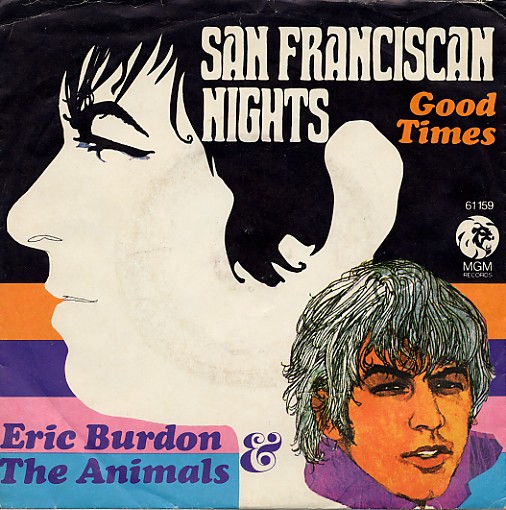
I bought this song on a single along with Sky Pilot when I was getting into the Animals as a pre-teen. This was not the same Animals of House of the Rising Sun and others…everyone but Eric Burdon and drummer Barry Jenkins had been replaced.
In this song Eric welcomes you to the Summer of Love in 1967 San Francisco. This new version of the Animals they were losing traction in Europe and at the spoken word beginning of this song Burdon welcomes the Europeans over to San Francisco. The song was popular and also an anti Vietnam song.
The song peaked at #1 in Canada, #9 in the Billboard 100, and #7 in the UK in 1967.
Many people complained that San Francisco is not that warm at night or any other time. Burdon and his group had recently played in San Francisco during a rare 10-day stretch of exceptionally warm spring weather, which left a strong impression.
At a concert Burdon has said the song was written about an evening with Janis Joplin in San Francisco.
Eric Burdon: “Britain is not as aware of what we are trying to communicate as the Americans. The whole world still needs a kick up the pants – the Americans are one move ahead. The record company was afraid I would offend England if I released ‘San Franciscan Nights’. They thought I had offered enough insults to England.”
From Songfacts
1967 was the year of the “Summer of Love,” and San Francisco was a hot spot for Hippies. Along with “San Francisco (Be Sure To Wear Flowers In Your Hair),” “San Franciscan Nights” was a popular ode to the city in those turbulent times.
The Animals were from England, but were welcomed in America along with other British Invasion groups like The Beatles and The Rolling Stones. They wrote this song themselves, which takes a stand against the Vietnam War. Looking back on the song in our 2010 interview, Animals lead singer Eric Burdon said: “The ‘Love Generation’ helped the anti-war stance in the states. It certainly turned a lot of soldiers’ heads around, making them wonder why they had to be out fighting a war when back home their girlfriends were frolicking around and it caused a lot of anguish on that level. Maybe it helped politically with the so-called enemy. I’m not sure.”
San Franciscan Nights
This following program is dedicated to the city and people of San Francisco, who may not know it but they are beautiful and so Is their city this is a very personal song, so if the viewer Cannot understand it particularly those of you who are European Residents save up all your bread and fly trans love airways to San Francisco U.S.A., then maybe you’ll understand the song, it Will be worth it, if not for the sake of this song but for the Sake of your own peace of mind.
Strobe lights beam create dreams Walls move minds do too On a warm San Franciscan night Old child young child feel alright On a warm San Franciscan night Angels sing leather wings Jeans of blue Harley Davidsons too On a warm San Franciscan night Old angels young angels feel alright On a warm San Franciscan night.
I wasn’t born there perhaps I’ll die there There’s no place left to go, San Franciscan.
Cop’s face is filled with hate Heavens above he’s on a street called love When will they even learn Old cop young cop feel alright On a warm San Franciscan night The children are cool They don’t raise fools It’s an American dream Includes indians too.
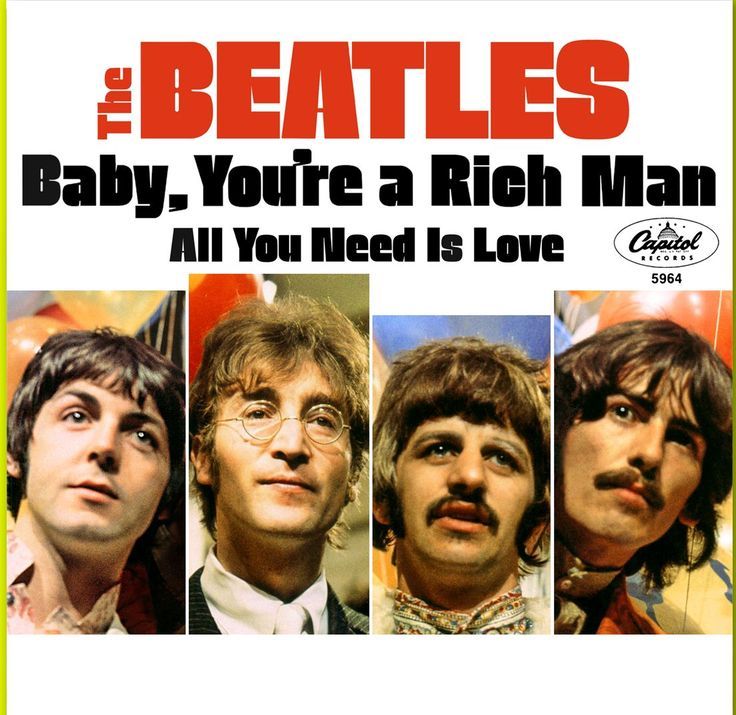
This is one Stones song that you hear John Lennon and Paul McCartney singing backup on. Mick Jagger would sing backup on the Beatles “Baby I’m A Rich Man.”
Mick Jagger and Keith Richards wrote this after they were arrested along with Brian Jones on drug charges stemming from a raid on Keith’s house, Redlands, on February 12, 1967. This song was a thank you message to the fans who supported Jagger and Richards through their arrest – note the jail door shutting at the first.
I somehow had the original single to this when I was a kid…I haven’t a clue how I got it.
This is just a personal opinion but I do believe Mick and Keith edited this video and Brian came out looking terrible in it. I have to wonder if they did it on purpose. I’m probably way off base but things were not going well for Brian Jones at this time…and yes he made a lot of his own trouble. He was being hounded by the police…with some of it not justified. Mick and Keith could have left those bad shots of Brian high out of the video…it couldn’t have help him out.
The song peaked at #8 in the UK and #50 in the Billboard 100 in 1967.
From Songfacts
This was also a “Thank You” to The Beatles, The Who and the editorial page of the London Times, who supported and spoke out in favor of the Stones after Jagger, Richards and Jones were arrested on drug charges. The Who recorded and released a double A-side of the Stones’ “The Last Time” and “Under My Thumb” to keep the Stones’ music alive while they were going through their court and prison difficulties.
The Rolling Stones lead guitarist at the time, Brian Jones, played a Mellotron, which was an early synthesizer, on this track. Jones was a founding member of the band, but the more popular they got, the more his drug habit affected him. By 1969 he was out of the band’s good graces and was fired, then found dead in his swimming pool less than a month later. “We Love You” is a testament to his influence on the band. “Despite being off his head on Mandrax by this time, Brian manages to arrange the track with that syncopated layer of psychedelic madness,” says Nick Reynolds, co-producer of the documentary Rolling Stone: Life and Death of Brian Jones. “Pure genius.”
The Stones made a promotional film for this song that was banned by the BBC but shown elsewhere. It was directed by Peter Whitehead and based on The Trials Of Oscar Wilde with Mick Jagger as Oscar, Keith Richards as the Marquis and Marianne Faithfull as Bosie.
We Love You
We don’t care if you only love we We don’t care if you only love we We love you, we love you, and we hope That you will love we too We love they, we love they, and We want you to love they too Ah
We don’t care if you hound we and Love is all around we Love can’t get our minds off We love you, we love you
You will never win we Your uniforms don’t fit we We forget the place we’re in ‘Cause we love you We love you, of course, we do
I love you, I love you And I hope that you won’t prove wrong too We love you, we do, we love you, we do
We have here a Stones- Beatles collaboration…a slight one with Mick Jagger is said to be singing backups to this song.The John and Paul returned the favor on the Stones song We Love You.
I first heard this on the Magical Mystery Tour album. I love the bass sound that Paul got on this song.
The cool sounding instrument on this song is the the Clavioline which John plays. It was a forerunner to the synthesizer.
John Lennon and Paul McCartney wrote parts of this separately and combined it to make one song… something they would repeat on “A Day In The Life.” At one point, the song was called “One Of The Beautiful People.”
On August 7th, 1967, just three weeks after the single was released in the US, George Harrison and entourage decided to make a brief visit to the Haight-Ashbury district of San Francisco, California, to visit the highly publicized “beautiful people” of the area and played the song on an acoustic after one was produced from a growing crowd. George didn’t stay too long.
Near the end of the song legend has it that John sings “Baby, you’re a rich f*g jew” as a reference to Brian Epstein toward the end of the song. Whether it is…it’s hard to tell. Whatever is in your head when you listen…it can become that. I’ve never read where John admitted it…and if he would have done that…I don’t see him shying away from admitting it.
Eddie Kramer…future producer for the Jimi Hendrix played the vibraphone.
From Songfacts
This song is about how everybody can have the things that matter, and it has nothing to do with material possessions. The Beatles were rich, but they claimed that money was not that important to them.
It was rumored that The Beatles sang “Baby you’re a rich fag Jew” as a slur to their manager, Brian Epstein. He was rich, gay and Jewish, but The Beatles never said this was about him. Epstein died later in that year when he overdosed on sleeping pills.
The Beatles started working on this song with the intention of using it on the Yellow Submarine soundtrack. It was used in the 1968 movie, but didn’t appear on the soundtrack.
Mick Jagger sang backup. McCartney and Lennon returned the favor by singing on The Stones’ “We Love You.”
Brian Jones, the guitarist from The Rolling Stones, played an oboe on this. A few years earlier, Lennon and McCartney gave The Stones a song called “I Wanna Be Your Man,” which was one of their first hits, and helped convince Mick Jagger and Keith Richards that they should write their own songs.
This was released as the B-side of “All You Need Is Love.”
Lennon played clavioline and piano on the song and George Harrison played tambourine. There is actually no guitar on this song at all. Paul played bass and piano as well.
This was released in mono, but in 1971 it was remixed in stereo along with several other tracks for a German version of Magical Mystery Tour. The stereo version is the one that is now the most common.
The comedy rap trio The Fat Boys performed this song in their 1987 movie Disorderlies.
In 2010, this song was used at the end of the movie The Social Network to punctuate the raging financial success of the guys who invented Facebook. It was one of the few Beatles songs licensed to a movie in its original form, meaning the Beatles version was used. Apple Corp. is very particular about where Beatles songs are used.
At one point in this song, The Beatles ask, “How does it feel to be one of the beautiful people?” The phrase “beautiful people” was used a lot in 1967 as a derisive way to describe the social elite. A popular book by Marilyn Bender was published that year called The Beautiful People: a Candid Examination of a Cultural Phenomenon – the Marriage of Fashion and Society in the ’60s.
Baby You’re A Rich Man
How does it feel to be One of the beautiful people Now that you know who you are What do you want to be And have you traveled very far? Far as the eye can see
How does it feel to be One of the beautiful people How often have you been there Often enough to know What did you see when you were there Nothing that doesn’t show
Baby you’re a rich man Baby you’re a rich man Baby you’re a rich man, too You keep all your money in a big brown bag Inside a zoo, what a thing to do Baby you’re a rich man Baby you’re a rich man Baby you’re a rich man, too
How does it feel to be One of the beautiful people Tuned to a natural E Happy to be that way Now that you’ve found another key What are you going to play
Baby you’re a rich man Baby you’re a rich man Baby you’re a rich man, too You keep all your money in a big brown bag Inside a zoo, what a thing to do Baby, baby, you’re a rich man Baby you’re a rich man Baby you’re a rich man, too, oh Baby you’re a rich man Baby you’re a rich man (baby) Baby you’re a rich man, too Baby you’re a rich man Baby you’re a rich man Baby you’re a rich man, too
If I ventured in the slipstream Between the viaducts of your dream Where immobile steel rims crack And the ditch in the back roads stop Could you find me? Would you kiss-a my eyes?
It’s really a crime to focus on one song off of this album. I really shouldn’t separate it from the album but this is the opening track to the great album Astral Weeks. Some have this album as the number 1 album of all time.
In 1966, Morrison visited the Belfast, Ireland, home of his friend, painter Cecil McCartney… He’d been working on some paintings themed around astral projection, and they caught Van’s attention and he tried to translate the visuals into a song.
John Payne the flautist who had been working with Morrison, said it was the first time he had ever heard it, and that although the song may sound rehearsed it was actually captured from the only take
This song acted as the hook for me for the rest of the album.
Van Morrison described the title:“like transforming energy, or going from one source to another with it being born again like a rebirth. I remember reading about you having to die to be born. It’s one of those songs where you can see the light at the end of the tunnel and that’s basically what the song says.”
Astral Weeks
If I ventured in the slipstream Between the viaducts of your dream Where immobile steel rims crack And the ditch in the back roads stop Could you find me? Would you kiss-a my eyes? To lay me down In silence easy To be born again To be born again From the far side of the ocean If I put the wheels in motion And I stand with my arms behind me And I’m pushin’ on the door Could you find me? Would you kiss-a my eyes? To lay me down In silence easy To be born again To be born again There you go Standin’ with the look of avarice Talkin’ to Huddie Ledbetter Showin’ pictures on the wall Whisperin’ in the hall And pointin’ a finger at me There you go, there you go Standin’ in the sun darlin’ With your arms behind you And your eyes before There you go Takin’ good care of your boy Seein’ that he’s got clean clothes Puttin’ on his little red shoes I see you know he’s got clean clothes A-puttin’ on his little red shoes A-pointin’ a finger at me And here I am Standing in your sad arrest Trying to do my very best Lookin’ straight at you Comin’ through, darlin’ Yeah, yeah, yeah If I ventured in the slipstream Between the viaducts of your dreams Where immobile steel rims crack And the ditch in the back roads stop Could you find me Would you kiss-a my eyes Lay me down In silence easy To be born again To be born again To be born again In another world In another world In another time Got a home on high Ain’t nothing but a stranger in this world I’m nothing but a stranger in this world I got a home on high In another land So far away So far away Way up in the heaven Way up in the heaven Way up in the heaven Way up in the heaven In another time In another place In another time In another place Way up in the heaven Way up in the heaven We are goin’ up to heaven We are goin’ to heaven In another time In another place In another time In another place In another face
This song was #1 on the Billboard 100, Canada, The UK, and New Zealand on January 15th 1967… That day since we are talking about it…the first Superbowl was played when the Packers beat the Chiefs.
I grew up with this song so it is ingrained in the back of my mind. That organ intro will stick with you. Say what you want to about the Monkees…they produced some of the great pop songs of the sixties…no matter how much Jann Wenner (Rolling Stone Magazine) snubs them for the Rock and Roll Hall of Fame.
Every Monkees post I usually say something like that…what Wenner doesn’t get, among many things, is that the Monkees influenced a couple of generations of musicians (REM, XTC included). Like other bands of that time in California…studio musicians played on their first two albums and Wenner cannot forget that. They became a band after being cast together. They started to play on the 3rd album and continued with hits.
This was The Monkees second single, after “Last Train To Clarksville.” It was released during the first season of their TV show.
Neil Diamond wrote this song. He had his first big hit earlier in 1966 with “Cherry, Cherry,” which got the attention of Don Kirshner, who was looking for material for The Monkees. Kirshner was sold on “I’m A Believer,” and as part of the deal, allowed Diamond to record the song as well. Diamond’s version was released on his 1967 album Just For You. The Monkees version benefited from exposure on their television series.
Guitarist Michael Nesmith didn’t believe this would be a hit, complaining to the producer, Jeff Barry, “I’m a songwriter, and that’s no hit.” Jeff Barry banned him from the studio while Micky Dolenz recorded his lead vocal…Mr. Nesmith was wrong about this one.
Neil Diamond: “I was thrilled, because at heart I was still a songwriter and I wanted my songs on the charts. It was one of the songs that was going to be on my first album, but Donny Kirshner, who was their music maven, hears ‘Cherry, Cherry’ on the radio and said, ‘Wow, I want one like that for The Monkees!’ He called my producers, Jeff Barry and Ellie Greenwich – ‘Hey, does this kid have any more?’ And they played him the things I had cut for the next album and he picked ‘I’m A Believer,’ ‘A Little Bit Me, A Little Bit You’ and ‘Look Out (Here Comes Tomorrow),’ and they had some huge hits. But the head of my record company freaked. He went through the roof because he felt that I had given #1 records away to another group. I couldn’t have cared less because I had to pay the rent and The Monkees were selling records and I wasn’t being paid for my records.”
From Songfacts
The Monkees sang on this, but did not play any instruments. The producers used session musicians because they were not convinced The Monkees could play like a real band. This became a huge point of contention, as the group fought to play their own songs.
Monkees drummer Micky Dolenz sang lead on this. Dolenz also handled lead vocals on “Pleasant Valley Sunday,” “Mary Mary” and “(I’m Not Your) Steppin’ Stone.”
Neil Diamond had intended the song to be recorded by the Country artist Eddy Arnold, and was surprised when record executive Don Kirshner passed it instead to The Monkees.
A cover version by Smash Mouth was featured in the 2001 movie Shrek and went to #25 in the US. Diamond wrote the song “You Are My Number One” for Smash Mouth’s next album.
The single had an advance order of 1,051,280 copies and went gold within two days of release.
British singer-songwriter and Soft Machine founding member Robert Wyatt had a #29 in the UK in 1974 with an intense cover version. His rendition featured Andy Summers (later of The Police) on guitar, and drums by Nick Mason of Pink Floyd, who also produced the recording.
Wyatt told Q Magazine that he wanted to make a point with his cover. “I was very uncomfortable with having fans who said ‘Your music is so much better than all that banal pop music,'” he said. “It sounds like a socialist thing to say but pop music is the music of the people. It’s the folk music of the industrial age. If you don’t respect popular culture. You don’t respect people, in which case your political opinion is of no great value.”
Dolenz has painful memories of performing this on tour. Literally painful. He told Entertainment Weekly in 2016. “I do remember lots of snatches of touring back then. Unbelievable. No monitors. Screaming. Screaming, screaming. [When we played ‘I’m a Believer’] I couldn’t hear myself. I just had to pound away. Even to this day, I sing with my eyes closed, because I had to close my eyes and hit myself in the leg to keep time on the drums. I had a big bruise. [Laughs]”
I’m A Believer
I thought love was only true in fairy tales Meant for someone else but not for me Love was out to get me That’s the way it seemed Disappointment haunted all of my dreams
Then I saw her face, now I’m a believer Not a trace of doubt in my mind I’m in love I’m a believer, I couldn’t leave her if I tried
I thought love was more or less a giving thing Seems the more I gave the less I got What’s the use in tryin’ All you get is pain? When I needed sunshine, I got rain
Then I saw her face, now I’m a believer Not a trace of doubt in my mind I’m in love I’m a believer, I couldn’t leave her if I tried
Oh
Oh, love was out to get me Now, that’s the way it seemed Disappointment haunted all of my dreams
Then I saw her face, now I’m a believer Not a trace of doubt in my mind I’m in love I’m a believer, I couldn’t leave her if I tried
Yes, I saw her face, now I’m a believer Not a trace of doubt in my mind Said, I’m a believer, yeah, yeah, yeah, yeah, yeah, yeah (I’m a believer) Said, I’m a believer, yeah (I’m a believer) I said, I’m a believer, yeah (I’m a believer)
This helped start the modern rock era. No British rock act had dominated in America before the Beatles. Cliff Richard had tried and failed but with this song and an appearance on the Ed Sullivan Show…The Beatles kicked down the door and started the British Invasion and the Stones, Kinks, and Who would soon follow.
Rock and Roll can be divided up into two eras… pre Beatles and post Beatles. Everything would change after this. I bought an amp from a long time country studio musician and he told me that the day after he heard this on Ed Sullivan the world changed. Not just music but everything…music, thoughts, aspirations, and hair of course. Within weeks of this song hitting number 1 there were bands forming in every neighborhood in America. Guitars were bought, hair lengths were being tested, and a huge urge to learn everything British.
I always hold this song up to why vinyl is the way to listen to some records at times. All the CD versions I’ve heard of this song sound rather flat…when I hear the 45 vinyl single the song jumps out at you. It changes the whole dynamic of the song. After hearing the single the way it was meant to be heard… you can see why this song changed a lot of things. It was maybe the most important single they ever released…it may have had the biggest impact at least in America.
It is said that John and Paul wrote this with an America’s sound in mind. They must have guessed right. This song preceded the Beatles trip here at number 1. Lennon liked the melody so much that he talked about doing something with it again til his death.
This was played on the Washington, DC radio station WWDC before it was released in America by a DJ named Carroll Baker, who got the record from a stewardess. It was a huge hit with his listeners and prompted Capitol Records to release the song ahead of schedule – they planned to issue it on January 13, 1964.
The Beatles were in Paris and celebrated madly when they found out they were #1 in America. They came to America for the first time on February 7, 1964, greeted at the airport by screaming fans. “I Want To Hold Your Hand” was the #1 song in the country at that time, and it stayed on top for seven weeks, until their next single, the re-released “She Loves You,” replaced it.
Bob Dylan thought the line “I can’t hide” was “I get high,” and a reference to marijuana. He was surprised to learn they had never tried pot, and became part of Beatles lore when he introduced them to it.
At times John Lennon realized the crowds The Beatles played to were so loud they really couldn’t hear them sing, so sometimes instead of singing the line, “I want to hold your hand,” he would say, “I want to hold your gland” as a reference to women’s breasts…and people wonder why Lennon is my favorite Beatle!
The song peaked at #1 in the Billboard 100, Canada, UK, New Zealand, and probably on Mars also in 1964.
From Songfacts
This was the first Beatles song to catch on in America. In 1963, the Beatles became stars in England, but couldn’t break through in the US. They couldn’t get a major label to distribute their singles in America, so their first three singles there, “Please Please Me,” “From Me to You” and “She Loves You,” were issued on small labels and flopped, even though they were hits in England.
Late in 1963, American news outlets started reporting on this British sensation, and interest in the group started to rise. Capitol Records took notice and released “I Want To Hold Your Hand” Stateside on December 26. The song rose up the chart, and on February 1, 1964, hit #1. It sold better in the first 10 days of release in the US than any other British single, and remains the best-selling Beatles single in the United States, moving over 12 million copies.
Conquering the US was, and still is, a big deal for British bands. Many groups that are huge in the UK (Oasis, Blur) never really catch on in America. • John Lennon and Paul McCartney wrote this in Jane Asher’s basement. Asher was an actress who became Paul’s first high-profile girlfriend. After appearing in several movies, TV shows and stage productions, Asher became an authority on baking, and has her own business selling party cakes and supplying baking and decorating equipment. She and Paul broke up in 1968.
Jane had a brother named Pete Asher who teamed up with Gordon Waller to form the duo Peter & Gordon; McCartney wrote their hit single “A World Without Love.” Pete recalled in a 2010 interview with Gibson.com the two Beatles penning this song at his home: “My mother had a practice room that she used to give private oboe lessons when she wasn’t teaching at The Royal Academy, where she was a professor. There was just a piano, and an upright chair and a sofa. Paul used that room to write in, from time to time. One afternoon John came over, while I was upstairs in my room. The two of them were in the basement for an hour or so, and Paul called me down to listen to a song they had just finished. I went downstairs and sat on the sofa, and they sat side by side, on the piano bench. That’s where they played ‘I Want to Hold Your Hand’ for the first anywhere. They asked me what I thought. I said, ‘I think it’s very good.'” [laughs] •
The Beatles performed this on their first two Ed Sullivan Show appearances, which took place February 9 and 16, 1964. There was already a media frenzy around The Beatles, which was amplified when millions saw them on Sullivan’s show. The Beatles were booked for the show before they had a hit in the US, so they actually got paid less than many other guests for their appearance. •
• This was one of John Lennon’s favorite Beatles songs. It starts with a falling melody, which is typical of Lennon’s songwriting, and ends with a cadence with a quarter-interval: “I’ll think you’ll understand.” That quarter-interval cadence you can even hear in Lennon’s first bit of “From Me to You” and in “Tomorrow Never Knows.” McCartney most often uses second-intervals. Also typically Lennon is the sudden octave-run, “Haaaaand…” The same octave-run you can hear in the end of the middle part in Lennon’s “Please Please Me”: “To reason with youuuuuu…” Also note that the beginning of the melody in the middle part is almost the same melody as the beginning of the middle part in “Don’t Let Me Down.”
Two parody groups made answer songs to this in 1964: “I’ll Let You Hold My Hand” by The Bootles and “Yes, You Can Hold My Hand” by The Beatlettes.
This was the first Beatles song recorded on 4-track equipment. Some of their first songs were in mono.
The Beatles also cut a German version called “Komm Gib Mir Deine Hand.” They picked up some German while playing The Star Club in Hamburg in 1962.
In the 1960s it wasn’t uncommon for British stars to record new versions of their hits in other languages. The idea was to increase airplay on continental stations and to get a hit before an indigenous artist recorded a version in the local tongue. On January 29, 1964, The Beatles went into the Pathé & Marconi Studios in Paris and recorded “I Want To Hold Your Hand” and “She Loves You” (“Sie Liebt Dich”) in German. The lyrics had been hurriedly translated by a Luxembourger named Camillo Felgen, who was then a program director at Radio Luxembourg. As well, apart from their recording of “My Bonnie” in the early ’60s, this was the only time The Beatles recorded in another language. In addition it was the sole occasion on which they recorded outside London.
When this hit #1 in the US, it was the first time a British group topped the chart there since 1962, when “Telstar” by The Tornados did it. Until The Beatles came along, most British groups that had hits in America came and went pretty quickly. The Beatles kicked off the British Invasion, leading to a lengthy occupation on the charts for acts like The Rolling Stones, The Kinks and The Who as well as The Beatles.
It was the youth who discovered The Beatles, and while young people can be easily manipulated through hype and image, in the case of The Beatles it was the music that drew them in. An American girl Sanda Stewart, 15 years old in spring 1964 (according to Hunter Davies in his book Beatles) said: “I was one day in a shop with my mother when I suddenly heard ‘I Want to Hold Your Hand’ on the car radio. Such a special sound! I could never stop thinking about it. No song has effected me on that way. Several other girls in school had reacted in the same way. We saw the Beatles on photos and thought they were ugly. But their music was fantastic.”
This song was used in the movie Across the Universe at a much slower tempo.
A fairly straightforward and simple Beatles song, this one still has some musical complexity that foreshadowed what was to come. “The middle eight of that does something,” Tony Banks of Genesis explained. “The way the key changes at that point is something I hadn’t heard before.”
I Want To Hold Your Hand
Oh yeah, I’ll tell you somethin’ I think you’ll understand When I say that somethin’ I want to hold your hand I want to hold your hand I want to hold your hand
Oh please, say to me You’ll let me be your man And please, say to me You’ll let me hold your hand Now, let me hold your hand I want to hold your hand
And when I touch you I feel happy inside It’s such a feelin’ that my love I can’t hide I can’t hide I can’t hide
Yeah, you got that somethin’ I think you’ll understand When I say that somethin’ I want to hold your hand I want to hold your hand I want to hold your hand
And when I touch you I feel happy inside It’s such a feelin’ that my love I can’t hide I can’t hide I can’t hide
Yeah, you got that somethin’ I think you’ll understand When I feel that somethin’ I want to hold your hand I want to hold your hand I want to hold your hand I want to hold your hand