Twilight Zone – A Kind of a Stopwatch

★★★★ October 18, 1963 Season 5 Episode 4

If you want to see where we are…HERE is a list of the episodes.

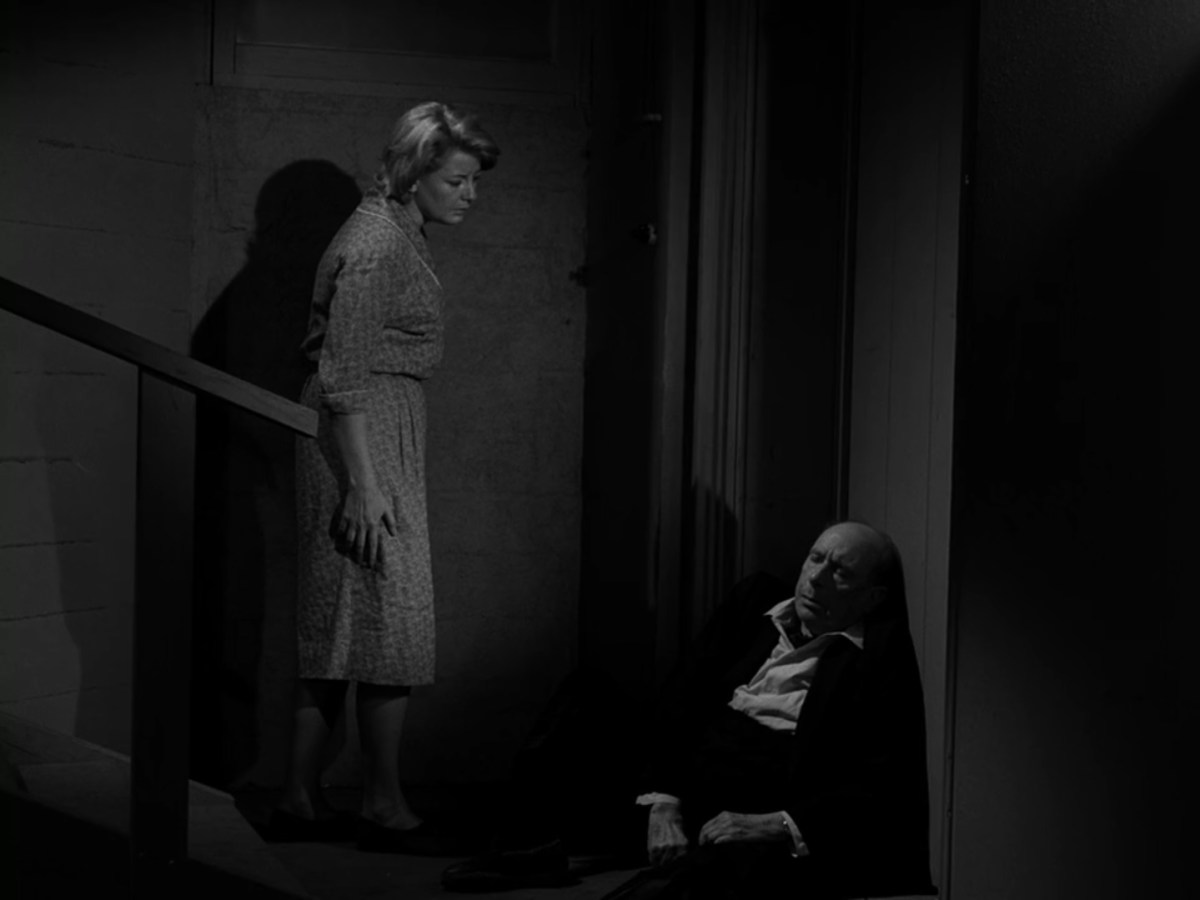
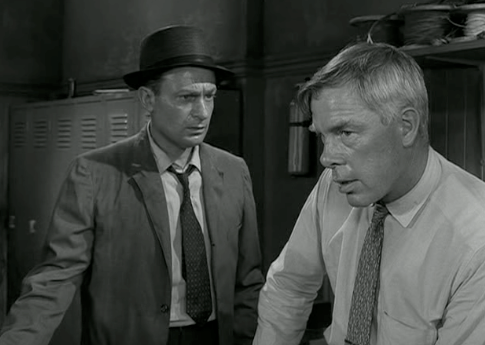
Richard Erdman plays Patrick Thomas McNulty who is an insufferable know it all bore. He is a self-proclaimed idea man…but not a good one. He is given a gift…a very special gift that he wanted to exploit. Mr. McNulty was given a stopwatch that could control time. This story is made for the Twilight Zone but it helps when you have sympathy for the main character. You don’t in this one but yet it still works. It does have a good Twilight Zone ending. 

It reminds me a little of Time Enough at Last but not as good. Erdman does a great job playing McNulty because he is a convincing pain. The inspiration for the episode came from a book written by John D. MacDonald published a year earlier called “The Girl, the Gold Watch, and Everything”. Much later the book was made into a movie called The Girl, the Gold Watch and Everything in 1980. 

The biggest disappointment is Potts, he is the fellow that gave McNulty the stopwatch. The dialogue doesn’t give us many clues…its supposed to make Potts seem the kind of eccentric character who might give a total stranger a mysterious and magical device, but it plays very flat. Potts is no more than a plot device, the intention being to get the watch into McNulty’s hands as quickly as possible. It was a wasted opportunity in not exploring that charcacter. 

The reason I bring it up is an early draft of the script featured an alternate closing shot: One of the “frozen” people, whom McNulty has just run past, turns to face the camera after McNulty vanishes around a corner. It’s Potts, who smiles and winks at us…indicating that, as with the watch he gave McNulty, there’s a lot more to him than meets the eye.

This show was written by Rod Serling and Michael D. Rosenthal

Rod Serling’s Opening Narration: 

Submitted for your approval or at least your analysis: one Patrick Thomas McNulty, who, at age forty-one, is the biggest bore on Earth. He holds a ten-year record for the most meaningless words spewed out during a coffee break. And it’s very likely that, as of this moment, he would have gone through life in precisely this manner, a dull, argumentative bigmouth who sets back the art of conversation a thousand years. I say he very likely would have except for something that will soon happen to him, something that will considerably alter his existence—and ours. Now you think about that now, because this is The Twilight Zone.

Summary

After Patrick Thomas McNulty gets fired from his job, he goes to a neighborhood bar where his non-stop chatter drives all of the customers away. One of the last patrons in the bar has a gift for him: a stopwatch. It’s a strange gift and he has no idea what he might do with it. When he presses the button however everything around him stops. He returns to work the next day and tries to market it, but to no avail. He then returns to the bar and again drives everyone out the bar with his bombast.

Rod Serling’s Closing Narration:

Mr. Patrick Thomas McNulty, who had a gift of time. He used it and he misused it, and now he’s just been handed the bill. Tonight’s tale of motion and McNulty – in the Twilight Zone.

CAST

Rod Serling … Narrator / Self – Host (uncredited)
Richard Erdman … Patrick Thomas McNulty
Herbie Faye … Joe Palucci, the bartender
Leon Belasco … Potts, the drunk who gives McNulty the stopwatch
Doris Singleton … Secretary to McNulty’s boss Mr. Cooper
Roy Roberts … Mr. Cooper, McNulty’s annoyed boss
Richard Wessel … Charlie, drinker in Palucci’s bar
Ray Kellog … Fred, who delivers coffee to McNulty’s office
Ken Drake … Daniel, last patron in Palucci’s bar who tells McNulty, “Come on fella, we’re trying to watch.”
Sam Balter: … sports announcer on TV in Polucci’s bar
Al Silvani … one of the drinkers in Polucci’s bar


Twilight Zone – Nightmare at 20,000 Feet

★★★★★ October 11, 1963 Season 5 Episode 3

If you want to see where we are…HERE is a list of the episodes.

As far as classics go…you can’t get much more classic than this one. Nightmare at 20,000 Feet goes beyond the Twilight Zone into pop culture. It’s been parodied and remade, but this is the definitive version. The Twilight Zone the movie redid this one and they did a good job but it’s not as eerie as this one. The new Twilight Zone in 2019 also did a version. 

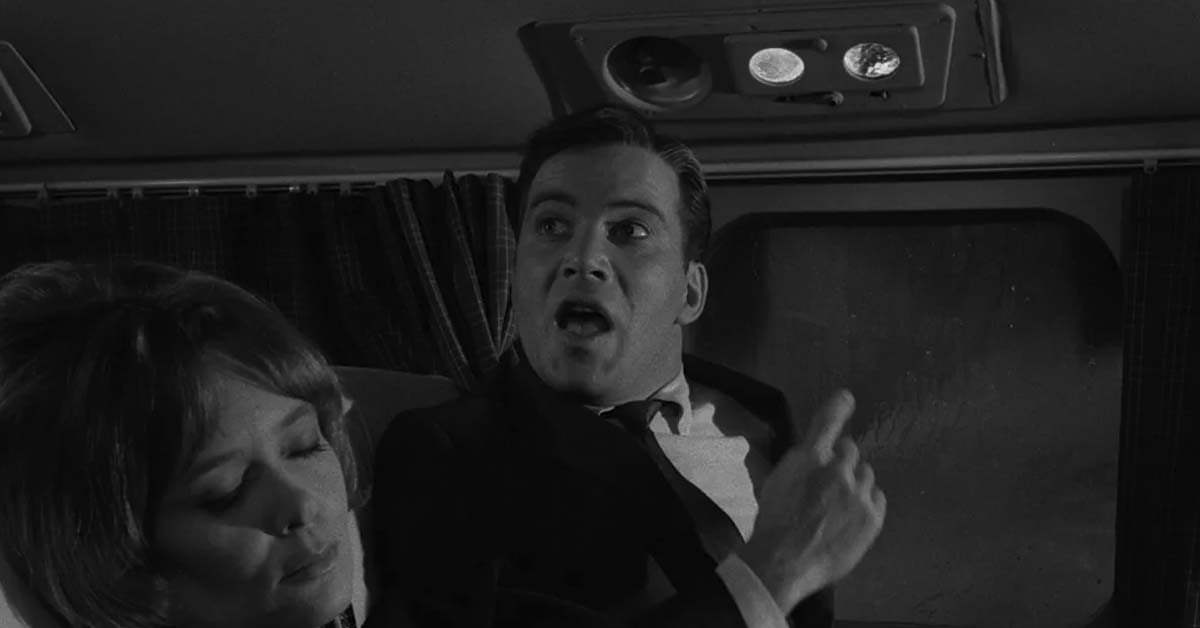
William Shatner does a great job in this episode as a man (Bob Wilson) who just recovered from a nervous breakdown. Wilson is complex, intelligent, and insecure. He is a man on the brink, trying desperately to hold on to his recently regained normalcy. Shatner’s over-the-top mannerisms work in this episode. The episode still works, partly because of the claustrophobic airplane setting with an added violent thunderstorm. I’ve heard criticism on the monster makeup but if I saw that thing on the wing of a plane I was on…I would freak out also. 

Shatner’s character reminds me of The Boy Who Cried Wolf, but this time will he be vindicated?

Richard Donner (Superman and the Omen) directed this episode. The logistics involved in filming Nightmare at 20,000 Feet were enormous. The set consisted of the interior of an airline passenger cabin with the left airplane wing attached to the outside. This was all suspended over a huge water tank, in order to contain the water from the rain effect. Donner remembers the shooting as one big headache.

Richard Matheson’s scripts were so respected that they were filmed almost exactly as written. The only change was one of title, from Flight to The Last Flight.

To show what a great sense of humor Rod Serling had…read the last quote by him down below. 

Richard Donner: Because you were suspended up, you had no stage floors. Every movement was a bitch. He lists the factors that had to be considered in virtually every shot. A man flying in on wires. Wind. Rain. Lightning. Smoke, to give the effect of clouds and travel and speed. Actors. You couldnt hear yourself think because of the noise of the machines outside. And fighting time, all the time. It was just unbearable. If any one of those things went wrong, it ruined the whole take. All of this consumed lots of time. We were supposed to take a fourth day in the tank set with the airplane

Then they found out that the studio had committed it to another company. We had to work all night to finish it up. We went overtime till early the next morning.

I love it, I do love it. Its just such an unusual thing for television, really, to see that much energy go into a little half-hour film. And the story was good, too.

From IMDB: William Shatner played an elaborate prank on set when he conspired with a friend who was visiting the filming, actor Edd Byrnes, to trick director Richard Donner into thinking Shatner died. Between takes, and when Donner was off set getting coffee, Shatner and Byrnes staged a fake fight on the set, which was suspended some 30 feet above a giant, empty tank. When Donner ran back in the studio to see what was happening the two men chased each other around the back of the airplane set and wound up atop the plane wing. Donner saw a body falling off the wing and Byrnes yelling in terror as it impacted the concrete floor. Donner said when he ran to the fallen, motionless figure, thinking it was a dead or grievously injured William Shatner, he was greeted with laughter the moment he realized it was just an articulated human dummy the two men had found in another part of the studio and threw off the wing. Donner later joked, “Honestly, my first reaction was, ‘Don’t tell me I have to shoot the whole show over again.'”

Rod Serling: The final story on Nightmare at 20,000 Feet occurred several months after the shooting. Matheson and I were going to fly to San Francisco. It was like three or four weeks after the show was on the air, and I had spent three weeks in constant daily communication with Western Airlines preparing a given seat for him, having the stewardess close the [curtains] when he sat down, and I was going to say, Dick, open it up. I had this huge, blownup poster stuck on the [outside of the window] so that when he opened it there would be this gremlin staring at him. So what happened was we get on the plane, there was the seat, he sits down, the curtains are closed, I lean over and I say, Dick at which point they start the engines and it blows the thing away. It was an old prop airplane. … He never saw it. And I had spent hours in the planning of it. I would lie in bed thinking how we could do this.

This show was written by Rod Serling and Richard Matheson

Rod Serling’s Opening Narration: 

Portrait of a frightened man: Mr. Robert Wilson, thirty-seven, husband, father and salesman on sick leave. Mr. Wilson has just been discharged from a sanitarium where he spent the last six months recovering from a nervous breakdown, the onset of which took place on an evening not dissimilar to this one, on an airliner very much like the one in which Mr. Wilson is about to be flown home—the difference being that, on that evening half a year ago, Mr. Wilson’s flight was terminated by the onslaught of his mental breakdown. Tonight, he’s traveling all the way to his appointed destination, which, contrary to Mr. Wilson’s plan, happens to be in the darkest corner of the Twilight Zone.

Summary

Bob Wilson is on a flight when he sees a creature of some sort out on the wing of the aircraft. He’s only recently recovered from a nervous breakdown and isn’t sure that what he is seeing is real. Every time someone else looks out the window, the creature hides from view. When the creature begins to tamper with one of the engines he begs his wife to tell the pilots to keep an eye on the engines. If they see nothing, he agrees to commit himself to an asylum when they arrive at their destination. His paranoia drives him to a desperate act

***WARNING…VIDEO SPOILERS***

Rod Serling’s Closing Narration:

The flight of Mr. Robert Wilson has ended now, a flight not only from point A to point B, but also from the fear of recurring mental breakdown. Mr. Wilson has that fear no longer… though, for the moment, he is, as he has said, alone in this assurance. Happily, his conviction will not remain isolated too much longer, for happily, tangible manifestation is very often left as evidence of trespass, even from so intangible a quarter as the Twilight Zone.

CAST

Rod Serling … Narrator / Self – Host (uncredited)
William Shatner…Bob Wilson
Christine White…Julia Wilson
Edward Kemmer…the flight engineer
Asa Maynor…stewardess Betty Crosby
Nick Cravat [uncredited]…the gremlin

Animals – Sky Pilot

I bought this song on a single along with San Franciscan Nights when I was getting into the Animals as a pre-teen.  This was not the same Animals of House of the Rising Sun and others…everyone but Eric Burdon and drummer Barry Jenkins had been replaced.

A Sky Pilot is a military chaplain, in the lyric he blesses the boys as they stand in line. The song finds the chaplain telling the soldiers that they are fighting for a greater cause, as they are soldiers of God. Eric Burdon tape-recorded The Royal Scot’s Dragoon Guards at a school and used the music during the middle of the song along with the war sound effects.

The song peaked at #14 in the Billboard 100, #7 in Canada, and #40 in the UK in 1968. The single was split into two parts to fit on the 45 so to hear the rest of the song… you had to flip the record over.

Eric Burdon received an angry letter from the British government for his use of pipe music. The song he used was “All The Bluebonnet’s Are Over The Border,” which is a classic Scottish war piece written as an anti-war epic during the Vietnam War.

Sky Pilot

He blesses the boys as they stand in line
The smell of gun grease and the bayonets they shine
He’s there to help them all that he can
To make them feel wanted he’s a good holy man

Sky pilot…..sky pilot
How high can you fly
You’ll never, never, never reach the sky
He smiles at the young soldiers

Tells them its all right
He knows of their fear in the forthcoming fight
Soon there’ll be blood and many will die
Mothers and fathers back home they will cry

Sky pilot…..sky pilot
How high can you fly
You’ll never, never, never reach the sky
He mumbles a prayer and it ends with a smile

The order is given
They move down the line
But he’s still behind and he’ll meditate
But it won’t stop the bleeding or ease the hate

As the young men move out into the battle zone
He feels good, with God you’re never alone
He feels tired and he lays on his bed
Hopes the men will find courage in the words that he said

Sky pilot… sky Pilot
How high can you fly
You’ll never, never, never reach the sky
You’re soldiers of God you must understand

The fate of your country is in your young hands
May God give you strength
Do your job real well
If it all was worth it

Only time it will tell
In the morning they return
With tears in their eyes
The stench of death drifts up to the skies

A soldier so ill looks at the sky pilot
Remembers the words
“Thou shalt not kill”
Sky pilot…..sky pilot

How high can you fly
You never, never, never reach the sky

Comedian Quotes II

I did this last week with the earlier comedians….this week I’ll concentrate on the 60s-70s.

George Carlin to Receive Two-Part Documentary From HBO and Judd Apatow -  Rolling Stone

George Carlin

Here’s all you have to know about men and women: women are crazy, men are stupid. And the main reason women are crazy is that men are stupid.

Most people work just hard enough not to get fired and get paid just enough money not to quit

Ever wonder about those people who spend $2 apiece on those little bottles of Evian water? Try spelling Evian backward

Think of how stupid the average person is, and realize half of them are stupider than that

Fighting for peace is like screwing for virginity

That Richard Pryor Biopic Is Back, And Headed To Netflix |  Birth.Movies.Death.

Richard Pryor

Who you gonna believe, me or your lying eyes?

I’m not addicted to cocaine. I just like the way it smells

I had to stop drinking, ‘cause I got tired of waking up in my car driving ninety

Marriage is really tough because you have to deal with feelings… and lawyers

There’s a thin line between to laugh with and to laugh at

No Respect: The Rodney Dangerfield of the Investment World | Core Compass

Rodney Dangerfield

I could tell my parents hated me. My bath toys were a toaster and a radio

My marriage is on the rocks again. Yeah. My wife just broke up with her boyfriend

My wife has to be the worst cook. In my house, we pray after we eat

When I was born, I was so ugly the doctor slapped my mother

Marriage. It’s not a word. It’s a sentence

When I was a kid my parents moved a lot, but I always found them

Remembering Lenny Bruce, 50 years after his death - Los Angeles Times

Lenny Bruce

Every day people are straying away from the church and going back to God

Alright, let’s admit it, we Jews killed Christ – but it was only for three days

I am influenced by every second of my waking hour

It’s the suppression of the word that gives it the power, the violence, the viciousness

Emmys history: One-season winners starring Bob Newhart, Julie Andrews -  GoldDerby

Bob Newhart

I don’t like country music, but I don’t mean to denigrate those who do. And for the people who like country music, denigrate means ‘put down’

Stammering is different than stuttering. Stutterers have trouble with the letters, while stammerers trip over entire parts of a sentence. We stammerers generally think of ourselves as very bright

I think you should be a child for as long as you can. I have been successful for 74 years being able to do that. Don’t rush into adulthood, it isn’t all that much fun

Phyllis Diller "Mother-In-Law" on The Ed Sullivan Show - YouTube

Phyllis Diller

The reason women don’t play football is because 11 of them would never wear the same outfit in public.

I spent seven hours in a beauty shop… and that was for the estimate.

I’ve tried Buddhism, Scientology, Numerology, Transcendental Meditation, Qabbala, t’ai chi, feng shui and Deepak Chopra but I find straight gin works best

I never made `Who’s Who,’ but I’m featured in `What’s That?’

I want my children to have all the things I couldn’t afford. Then I want to move in with them

Redd Foxx | Walk of Fame

Redd Foxx

If you can see the handwriting on the wall… you’re on the toilet

I feel sorry for people who don’t drink or do drugs. Because someday they’re going to be in a hospital bed, dying, and they won’t know why

You make me wish that birth control was retroactive

Beauty may be skin deep, but ugly goes clear to the bone.

Lily Tomlin Biography - Childhood, Life Achievements & Timeline

Lily Tomin

The best mind-altering drug is the truth.

The road to success is always under construction.

I always wondered why somebody doesn’t do something about that. Then I realized I was somebody.

I always wanted to be somebody, but now I realize I should have been more specific.

Reality is the leading cause of stress among those in touch with it.

Twilight Zone – Steel

★★★★1/2 October 4, 1963 Season 5 Episode 2

If you want to see where we are…HERE is a list of the episodes.

Steel is very good starring the movie star…Lee Marvin.

This episode has a parallel to the NFL in present day to me. With CTE (Chronic traumatic encephalopathy), football as I knew it is gone. In 20 years it probably won’t resemble the game now. Steel is set in 1974 and boxing between humans is illegal. It was deemed as too dangerous and now robots fight each other intead of humans. 

Lee Marvin plays Steel Kelly who was a former boxer until the law was passed to ban human boxing. He now owns an older model robot (an old B2) named Battling Maxo. Marvin is a determined, sad, and desparate character. He believes in his outdated fighter and will do anything to keep the broken down Maxo going…including doing the unthinkable. 

Marvin’s gritty performance brings this episode up above normal ones. Taking the place of the boxing trainer would be mechanic Pole…played by Joe Mantell. He keeps Maxo going but knows the robot is washed up and busted. He wants to scrap him but Steel won’t hear of it…they keep looking for parts that just aren’t made anymore. 

The two robot faces were crafted by William Tuttle. Lifemasks were taken of the actors, atop which the robot faces were sculpted in clay. Foam rubber and latex copies were cast of these, which were then glued onto the actors faces. As for the inhuman, expressionless eyes, those were sections of ping-pong balls, painted black, with pinpoint eye holes through the center.

This show was written by Rod Serling and Richard Matheson

Rod Serling’s Opening Narration: 

Sports item, circa 1974: Battling Maxo, B2, heavyweight, accompanied by his manager and handler, arrives in Maynard, Kansas, for a scheduled six-round bout. Battling Maxo is a robot, or, to be exact, an android, definition: ‘an automaton resembling a human being.’ Only these automatons have been permitted in the ring since prizefighting was legally abolished in 1968. This is the story of that scheduled six-round bout, more specifically the story of two men shortly to face that remorseless truth: that no law can be passed which will abolish cruelty or desperate need—nor, for that matter, blind animal courage. Location for the facing of said truth: a small, smoke-filled arena just this side of the Twilight Zone.

Summary

In the not too distant future, boxing has been banned and replaced by robot fighters in the ring. Sam “Steel” Kelly is a former boxer but now owns one of these pugilistic machines. Unfortunately his robot, which he’s named Battling Maxo, is getting old and many of its parts are no longer available. Kelly is broke and is doing everything he can to ensure Battling Maxo can enter the ring as the promoter has made it clear there’s no payment if there’s no bout. When Maxo breaks down however, Kelly decides to takes its place.

Rod Serling’s Closing Narration:

Portrait of a losing side, proof positive that you can’t outpunch machinery. Proof also of something else: that no matter what the future brings, man’s capacity to rise to the occasion will remain unaltered. His potential for tenacity and optimism continues, as always, to outfight, outpoint and outlive any and all changes made by his society, for which three cheers and a unanimous decision rendered from the Twilight Zone.

Sorry I could NOT find a video clip without a reviewer. He does give it away…just so you know. 

CAST

Rod Serling…Narrator / Self – Host (uncredited)
Lee Marvin…Steel Kelly
Joe Mantell…Pole
Chuck Hicks…Maynard Flash
Merritt Bohn…Nolan
Frank London…Maxwell
Larry Barton…Boxing Match Spectator (voice) (uncredited)
Slim Bergman…Boxing Match Spectator (uncredited)
Louis Cavalier…Boxing Match Spectator (uncredited)
Ken DuMain…Boxing Match Spectator (uncredited)
Tipp McClure…Battling Maxo (uncredited)
Edwin Rochelle…Boxing Match Spectator (uncredited)


Byrds – Mr. Spaceman

After I graduated, I purchased the Byrds Greatest Hits and this one caught my attention immediately. It continued to build my love for the Rickenbacker 12 string electric guitar.

Now, this is some cool hype. The release of the single was accompanied by a spoof press announcement from the Byrds’ co-manager, Eddie Tickner, stating that he had taken out a one-million-dollar insurance policy with Lloyd’s of London against his clients being kidnapped by extraterrestrial visitors.

This song was on their Fifth Dimension album. With this song, you could almost hear Sweetheart of the Rodeo coming around the corner. Mr. Spaceman was written by Roger McGuinn. This was their third album, and it was recorded shortly after Gene Clark left the band. When he left, it left a songwriting hole in the band. McGuinn and David Crosby tried to step up and fill the void, but they still had to have four cover songs on the album.

The album peaked at #24 in the Billboard Album Charts and #27 in the UK in 1966.  Mr. Spaceman peaked at #36 in the Billboard 100.

Despite its country-style backing with a touch of psychedelia…it was called “space rock” in the press. Some critics have said it was one of the earliest examples of country rock.

The first video below has Gram Parsons who didn’t join the band until 2 years after this song was released. It was filmed at the Roman Colosseum while the Byrds were in town to play the first International European Pop Festival in 1968.

In that video, we see original Byrds Roger McGuinn and Chris Hillman joined by new members Gram Parsons, Kevin Kelley, and Douglas Dillard.

Roger McGuinn:I was interested in astronomy and the possibility of connecting with extraterrestrial life and I thought that it might work the other way round, if we tried to contact them. I thought that the song being played on the air might be a way of getting through to them. But even if there had been anybody up there listening, they wouldn’t have heard because I found out later that AM airwaves diffuse into space too rapidly.”

The Byrds with Gram Parsons video

Mr. Spaceman

Woke up this morning with light in my eyes
And then realized it was still dark outside
It was a light coming down from the sky
I don’t know who or why

Must be those strangers that come every night
Those saucer shaped lights put people uptight
Leave blue green footprints that glow in the dark
I hope they get home alright

Hey, Mr. Spaceman
Won’t you please take me along
I won’t do anything wrong
Hey, Mr. Spaceman
Won’t you please take me along for a ride

Woke up this morning, I was feeling quite weird
Had flies in my beard, my toothpaste was smeared
Over my window, they’d written my name
Said, “So long, we’ll see you again”

Hey, Mr. Spaceman
Won’t you please take me along
I won’t do anything wrong
Hey, Mr. Spaceman
Won’t you please take me along for a ride

Hey, Mr. Spaceman
Won’t you please take me along
I won’t do anything wrong
Hey, Mr. Spaceman
Won’t you please take me along for a ride

Twilight Zone – In Praise of Pip

★★★★★ September 27, 1963 Season 5 Episode 1

If you want to see where we are…HERE is a list of the episodes.

This one is not known as a classic, but it should be. Jack Klugman plays a bookie with a drinking problem named Max Phillips. Klugman’s transformation will resonate with viewers. Max gets a telegram that his son is dying in Vietnam. He realizes he wasted a great deal of his life dreaming instead of doing and working instead of spending more time with his son. He makes a deal with God for one more hour with his son. Afterward, he makes one more deal. 

Klugman’s performances in his last scenes were some of the best of the series. How much time do we spend doing other things (even work) other than to be with our love ones? In Praise of Pip is a thought-provoking and touching drama about a man’s love for his son and a reminder to pay attention to what is really important in life. 

This is Anne Serling’s (Rod Serling’s daughter) favorite episode of the Twilight Zone. She noticed a lot of the dialog in this episode that happened between her and her father.

The script originally had Pip stationed in Laos, but the network had Rod Serling change it to Vietnam.

I was surprised about the early mention of Vietnam in this one. There were officially no combat or special forces in Laos. The implication that the U.S. had troops fighting in Laos (even in The Twilight Zone) could be an embarrassment and might cause repercussions. U.S. Special Forces were fighting (in an advisory capacity) in South Vietnam. Suggest South Vietnam. This episode was produced about two years before the massive intervention of American forces in South Vietnam.

From IMDB: Bill Mumy’s father rarely joined his son on sets, but joined him on this occasion because the two often visited the pier they filmed on. His father recalled being impressed with Jack Klugman who introduced himself to the family and explained that father and son would be extremely affectionate. Mumy joined his own son Seth Mumy on set of Dear God (1996) with Klugman 30 years later.

This show was written by Rod Serling 

Rod Serling’s Opening Narration: 

Submitted for your approval: one Max Phillips. A slightly-the-worse-for-wear maker of book, whose life has been as drab and undistinguished as a bundle of dirty clothes. And t fhough it’s very late in his day, he has an errant wish that the rest of his life might be sent out to a laundry, to come back shiny and clean. This to be a gift of love to a son named Pip. Mr. Max Phillips, homo sapiens, who is soon to discover that man is not as wise as he thinks. Said lesson to be learned in the Twilight Zone.

Summary

In the early 1960s, small-time bookie Max Phillips (Jack Klugman) hates his life. His only pride is his son, Pip, who is serving the U.S. Armed Forces in Vietnam. When a young man uses company funds to place a bet with Max, the man loses the wager. Max then returns his money, which angers Max’s bosses.


Rod Serling’s Closing Narration:

Very little comment here, save for this small aside: that the ties of flesh are deep and strong; that the capacity to love is a vital, rich, and all-consuming function of the human animal. And that you can find nobility and sacrifice and love wherever you may seek it out: down the block, in the heart or in the Twilight Zone.

CAST

Rod Serling…Narrator / Self – Host (uncredited)
Jack Klugman…Max Phillips
Connie Gilchrist…Mrs. Feeny
Robert Diamond…Pvt. Pip
Billy Mumy: Young Pip
Ross Elliott: doctor in Vietnam
Gerald Gordon: lieutenant in Vietnam
Russell Horton: George Reynold
S. John Launer: Mr. Moran
Kreg Martin: Mr. Moran’s enforcer
Stuart Nisbet…surgeon in Vietnam

Twilight Zone Season 4 Review

Again I will say…I want to thank you all who have stuck with me through this long haul. We are now finished with the 4th season! The 5th and also last season lasts 36 episodes.

I do have one to add that was on The Westinghouse Desilu Playhouse that was a precurser to the Twilight Zone called The Time Element. It was a teleplay that premiered on November 24, 1958. It was Rod Serling’s first science fiction story.

After going through 4th season …it was better than I gave it credit for earlier. The hour long episodes changed the way I graded them because they were different than the 30 minute episode. Some did suffer from too much padding but some were able to tell a more complete story. You did have a few that didn’t click well at all.

If you want… please comment on what you think I got wrong, right, or just your favorite episodes.

In the spring of 1963, CBS renewed Twilight Zone for a fifth season, shortening it back to a half hour. The networks experiment had failed: Twilight Zone’s expanded size had not made for an expanded audience. The season contained 18 long episodes.

Rod Serling: Our shows this season were too padded. The bulk of our stories lacked the excitement and punch of the shorter dramas we intended when we started five years ago and kept to for a while. If you ask me, I think we had only one really effective show this season, On Thursday We Leave for Home. … Yes, I wrote it myself, but I overwrote it. I think the story was good despite what I did to it.

Looking back, Serling’s assessment was too hard. There had been a number of really good hour-long episodes, among them On Thursday We Leave for Home, Death Ship, In His Image,  Valley Of The Shadows, Printer’s Devi and  The New Exhibit. The Twilight Zone had not embarrased itself in this season.

The 5th season was not as consistent as the first 3 but it contains some of my favorite episodes.

Season 4
Total Episode Date Episode Stars
103 1 Jan 3, 1963 In His Image 4.5
104 2 Jan 10, 1963 The Thirty-Five Fathom Grave 3.5
105 3 Jan 17, 1963 Valley Of The Shadows 5
106 4 Jan 24, 1963 He’s Alive 5
107 5 Jan 31, 1963 Mute 4
108 6 Feb 7, 1963 Death Ship 5
109 7 Feb 14, 1963 Jess-Belle 4
110 8 Feb 21, 1963 Miniature 4.5
111 9 Feb 28, 1963  Printer’s Devil 5
112 10 Mar 7, 1963  No Time Like The Past 3.5
113 11 Mar 14, 1963  The Parallel 4.5
114 12 Mar 21, 1963  I Dream Of Genie 2.5
115 13 Apr 4, 1963 The New Exhibit 5
116 14 Apr 11, 1963 Of Late I Think Of Cliffordville 4
117 15 Apr 18, 1963 The Incredible World Of Horace Ford 3.5
118 16 May 2, 1963 On Thursday We Leave For Home 5
119 17 May 9, 1963 Passage On The Lady Anne 4.5
120 18 May 23, 1963 The Bard 2

Turtles – Happy Together

When I was a kid some relative gave me The Turtles Elenore single and I became a fan. This song was their biggest hit and it is a great song.

The band was formed by Mark Volman and Howard Kaylan. They were saxophone players who did whatever was trendy in order to make a living as musicians. They were also in the choir together in high school.

They played surf-rock mostly at the time. They also played backup for The Coasters, Sonny And Cher and The Righteous Brothers when they came through. After a while, Howard and Mark gave up the sax and became singers. They signed a deal with White Whale Records as The Crosswind Singers. When British groups took over America, they tried to pass themselves off as British singers and renamed themselves The Turtles.

Like The Byrds, The Turtles recorded a Bob Dylan song for their first single It Ain’t Me Babe and it was a hit.  They recorded some more songs that that were top 40 hits but this one did the trick. They decided to record Happy Together after many other artists passed on it.  The song peaked at #1 in the Billboard 100, #2 in Canada, and #4 in the UK in 1967.

After Happy Together hit they flew to England and met The Beatles, Brian Jones,  Graham Nash, Donovan, The Rolling Stones and Jimi Hendrix. The Beatles played them the unreleased  Sgt Pepper’s album. Howard Kaylan would later write the  2003 Comedy movie “My Dinner With Jimi” with events surrounding and leading up to this trip.

Kaylan and Volman sang backing vocals on several recordings by T. Rex, including their worldwide 1971 hit “Get it On (Bang A Gong). Later they did the backup vocals on Bruce Springsteen’s Hungry Heart.

They became known as Flo (Phlorescent Leech) and Eddie. Kaylan and Volman joined Frank Zappa’s Mothers of Invention as Flo and Eddie because of contractual restrictions of their record company.

Volman and Kaylan were very smart. When White Whale’s master recordings were sold at auction in 1974, the duo won the Turtles’ masters, making them the owners of their own recorded work. They also hosted some radio shows in the 70s and 80s and recorded soundtrack music for children’s shows like the Care Bears and Strawberry Shortcake.

If you are in any way interested in watching band documentaries… watch The Turtles doc! It is hilarious. I will include the full doc above the song.

Here is the documentary…watch it if you have time. What they did to their last manager (who was also their first) is classic!

Happy Together

Imagine me and you, I do
I think about you day and night, it’s only right
To think about the girl you love and hold her tight
So happy together

If I should call you up, invest a dime
And you say you belong to me and ease my mind
Imagine how the world could be, so very fine
So happy together

I can’t see me lovin’ nobody but you
For all my life
When you’re with me, baby the skies’ll be blue
For all my life

Me and you and you and me
No matter how they toss the dice, it had to be
The only one for me is you, and you for me
So happy together

I can’t see me lovin’ nobody but you
For all my life
When you’re with me, baby the skies’ll be blue
For all my life

Me and you and you and me
No matter how they toss the dice, it had to be
The only one for me is you, and you for me
So happy together

Ba-ba-ba-ba ba-ba-ba-ba ba-ba-ba ba-ba-ba-ba

Me and you and you and me
No matter how they toss the dice, it had to be
The only one for me is you, and you for me
So happy together

So happy together
How is the weather
So happy together
We’re happy together
So happy together
Happy together
So happy together
So happy together (ba-ba-ba-ba ba-ba-ba-ba)

Twilight Zone – The Bard

★★ May 23, 1963 Season 4 Episode 18

If you want to see where we are…HERE is a list of the episodes.

This show closed out the 4th season and the one hour long experiment was over. The Bard is my least favorite episode of the entire series. I’ve seen some lists where it’s the bottom or near the bottom. On the other hand, I’ve seen some have it high. It’s a comedy episode that just doesn’t work. One thing that is interesting about this episode is the appearance of Burt Reynolds playing a Marlon Brando character. That added a star in my rating but even Burt couldn’t save this one.

Jack Weston plays Julius Moomer and the character is a no-talent writer who uses black magic to bring William Shakespeare back to write a television program. Even typing it sounds cringe-worthy. The plot had some good elements of a Twilight Zone but Weston’s character is just not likable. It might have worked in a shorter format with a different script.

Some may think this is a hilarious episode…I just never did.

From IMDB: William Shakespeare (John Williams) quotes lines from his plays nine times with a trumpet flourish sounding each time, and most of the time, him telling what play, act, and scene the quote came from. Three from ‘Romeo & Juliet,’ two from ‘Twelfth Night,’ and one each from ‘Troilus and Cressida,’ ‘As You Like It,’ and ‘A Mid-Summer’s Night Dream’, plus a partial one from ‘Hamlet’ (cut short when Shakespeare forgets the end of the “To be or not to be” line.

Cora (Judy Strangis) looks at the book , “Ye Book of Ye Black Art”, Julius (Jack Weston) is using to conjure black magic and refers to him as Faust. In a classic German legend based on Johann Georg Faust, he makes a pact with the devil, exchanging his soul for unlimited knowledge and worldly pleasures. The devil sends his representative, Mephistopheles. He makes a bargain with Faust: Mephistopheles will serve Faust with his magic powers for a set number of years, but at the end of the term, the Devil will claim Faust’s soul, and Faust will be eternally enslaved.

Burt Reynolds’s character is clearly an amalgam of Marlon Brando and Paul Newman.

Rod Serling’s Opening Narration: 

You’ve just witnessed opportunity, if not knocking, at least scratching plaintively on a closed door. Mr. Julius Moomer, a would-be writer, who if talent came 25 cents a pound, would be worth less than car fare. But, in a moment, Mr. Moomer, through the offices of some black magic, is about to embark on a brand-new career. And although he may never get a writing credit on the Twilight Zone, he’s to become an integral character in it.

Here is a clip that I could not embed becasue it’s on Dailymotion.

Summary

Julius Moomer, a talentless, but relentless, self-promoting hack who dreams of becoming a successful television writer, uses a book of magic to summon William Shakespeare to write dramatic teleplays that Moomer will pass off as his own. Shakespeare becomes irritated by Moomer’s lack of appreciation and is even more appalled when he discovers the changes wrought on his plays by cynical television executives.

Rod Serling’s Closing Narration:

Mr. Julius Moomer, a streetcar conductor with delusions of authorship, and if the tale just told seems a little tall, remember a thing called poetic license, and another thing called the Twilight Zone.

CAST

Rod Serling … Narrator / Self – Host (uncredited)
Jack Weston … Julius Moomer
John Williams … William Shakespeare
Burt Reynolds … Rocky Rhodes
Henry Lascoe … Gerald Hugo
John McGiver … Mr. Shannon
Howard McNear … Bramhoff
Judy Strangis … Cora
Marge Redmond … Secretary
Doro Merande … Sadie
William Lanteau … Dolan
Clegg Hoyt … Bus driver
John Newton … TV interviewer
John Bose … Daniel Boone (uncredited)
Rudy Bowman … Robert E. Lee (uncredited)

Cream – Born Under A Bad Sign

When I first started to listen to Cream, what stood out was not Clapton’s guitar or Baker’s drumming…no it was Jack Bruce’s bass. There are three bass players I listened to while starting out playing. John Entwistle, Jack Bruce, and Paul McCartney.  Those three covered the chaotic, the sliding, and melodic. Jack Bruce had all of these traits.

Cream recorded this and released it on their 1968 album Wheels Of Fire. It was written by Booker T Jones and William Bell for Albert King. King released it on his first Stax album Born Under A Bad Sign in 1967. Clapton stuck close to King’s guitar style on this song.

The Wheels of Fire album peaked at #1 in the Billboard Album Charts, #1 in Canada, and #3 in the UK in 1968.

Cream played this when they were inducted into the Rock and Roll Hall of Fame on January 12, 1993, in tribute to Albert King, who died the previous year. It was one of two times the band has played together since they broke up in 1968. The first time was at Clapton’s wedding in 1979…three Beatles also played together at his wedding.

Booker T Jones: “My recollection is that we wrote it in my den, late the night before the session. We had been trying to come up with something for Albert. He was coming to town and it was the last opportunity we had to write a song. But you know, now that I think of it, the fact that the song was in D flat, there is definitely an Indiana influence because, you know, a blues song in d flat? I tell you, I learned the value of flat keys and sharp keys and how to use them for emotional value so I could have more range and capacity for touching the human heart. I think that was one of the reasons that song became as huge as it did. Because it was in D flat.”

King’s song is also included in the Rock and Roll Hall of Fame’s list of the “500 Songs That Shaped Rock and Roll”

From Songfacts

When Albert King signed with Stax Records in Memphis, Booker T. Jones, who was a member of the Stax house band Booker T. & The MGs, was assigned his producer. In an interview with National Public Radio (NPR), Jones explained: “At that time, my writing partner was William Bell. He came over to my house the night before the session. William wrote the words and I wrote the music in my den that night. That was one of my greatest moments in the studio as far as being thrilled with a piece of music. The feeling of it, it’s the real blues done by the real people. It was Albert King from East St. Louis, the left-handed guitar player who was just one of a kind and so electric and so intense and so serious about his music. He just lost himself in the music. He’s such a one of a kind character. I was there in the middle of it and it was exhilarating.”

The “bad sign” is an astrology reference: if you’re “born under a bad sign,” it means the stars are aligned against you from birth. It was the song’s co-writer William Bell who came up with the title – he wanted to do a blues song about astrology.

Born Under A Bad Sign was Albert King’s first album released by Stax. It became King’s signature song, with the classic lyrics, “If it wasn’t for bad luck, I wouldn’t have no luck at all.”

The song harkens back to blues of the ’30s and ’40s which had similar lyrical content.

King was an American blues musician. Known for his size (6′ 4″, 250 pounds) and custom-made, left-handed Gibson guitar, he died in 1992.

 Their guitarist, Eric Clapton, idolized American blues artists and often performed their songs. It marked a change of guitar style for Clapton, who adopted a harder, attacking style on this song in place of the sweeter, sustaining notes he called “woman tone,” which were more apparent on Cream’s first two albums.

The Paul Butterfield Blues Band played this at Woodstock in 1969. They went on Monday morning, two sets ahead of Jimi Hendrix.

Jimi Hendrix and Buddy Miles, recorded an instrumental cover in 1969 as a tribute to King. 

This song’s lyricist William Bell performed it at the Grammy Awards in 2017 with Gary Clark Jr. “When you spend your life making music, you were born under a good sign, Bell said when they finished the song.” Bell won the award for Best Americana Album.

Janis Joplin’s guitarist Sam Andrew borrowed the riff for Big Brother & The Holding Company’s song “I Need A Man To Love.”

Christian posted this video in the comments…I thought I would add it…

Born Under A Bad Sign

Born under a bad sign
Been down since I begin to crawl
If it wasn’t for bad luck
You know I wouldn’t have no luck at all

Hard luck and trouble is my only friend
I’ve been on my own ever since I was ten
Born under a bad sign
Been down since I begin to crawl
If it wasn’t for bad luck
You know I wouldn’t have no luck at all

I can’t read, haven’t learned how to write
My whole life has been one big fight
Born under a bad sign
I been down since I begin to crawl
If it wasn’t for bad luck
I say I wouldn’t have no luck at all

I ain’t no lyin’

You know if it wasn’t for bad luck
I wouldn’t have no kinda luck
If it wasn’t for real bad luck
I wouldn’t have no luck at all

You know, wine and women is all I crave
A big-legged woman is gonna carry me to my grave
Born under a bad sign
I been down since I begin to crawl
If it wasn’t for bad luck
I tell I wouldn’t have no luck at all

Yeah, my bad luck boy
Been havin’ bad luck all of my days, yes

Twilight Zone – Passage On The Lady Anne

★★★★1/2 May 9, 1963 Season 4 Episode 17

If you want to see where we are…HERE is a list of the episodes.

The story is not really scary but the setting will remind you of a horror movie. It takes place on a ship that is surrounded by fog. Mix that with black and white and the Wolfman film comes to mind. This is the first hour-long episode I watched many years ago.  This episode benefits from the hour format. You see a couple who are teetering on breaking up decide on a cruise. Throughout the episode, you see the gradual healing and the companionship replacing turmoil. Their older fellow passengers help them both along the way. This story could not have been made as well in a half-hour-long format. 

I would strongly recommend this and there is a twist but the twist is a little ambiguous. This is not an episode where a bad person gets cosmically punished for doing bad things. It does show real-life problems that you can relate to today. The cinematographer and set designers deserve praise in this episode. 

From IMDB: Because of the large number of well-known actors in this episode, the closing theme featured a credit roll of cast names instead of the usual still frames. The remaining non-cast credits were then done with standard still frames. This was the only episode of the series to ever use a credit roll.

This was the last Charles Beaumont Twilight Zone screenplay to be actually fully written by Beaumont himself. Around the time this episode was made, Beaumont (then only 34) began suffering from the rapid onset of a degenerative neurological disorder (believed to be either Alzheimer’s and/or Pick’s Disease) which affected his speech, memory, and concentration, as well as causing him to physically age very rapidly. As the disease progressed, Beaumont was soon unable to meet his writing commitments. A number of his writer friends, including Jerry Sohl and William F. Nolan, supported Beaumont by ghostwriting stories with or for him and submitting them in his name, although Beaumont insisted on splitting the fees with his helpers. His last screen credit (also probably ghostwritten) was in 1965, by which time he was too ill to work at all, and he died on 21 February 1967, aged only 38, although his son later recounted that his father “looked ninety-five” at the time of his death.

This show was written by Rod Serling and Charles Beaumont

Rod Serling’s Opening Narration: 

Portrait of a honeymoon couple getting ready for a journey – with a difference. These newlyweds have been married for six years, and they’re not taking this honeymoon to start their life but rather to save it, or so Eileen Ransome thinks. She doesn’t know why she insisted on a ship for this voyage, except that it would give them some time and she’d never been on one before – certainly never one like the Lady Anne. The tickets read ‘New York to Southampton,’ but this old liner is going somewhere else. Its destination – the Twilight Zone.

Summary

Eileen and Alan Ransome’s marriage is going through a bad patch and they decide to go on a holiday to London. Eileen insists on traveling by ship and they book passage on the Lady Anne, an old ship that is not recommended by the travel agent but is leaving quite soon. When they arrive at the port terminal another passenger, Mr. McKenzie, insists strenuously that the young couple has made a mistake and tries to discourage them from coming along on what is a “private cruise”. Mrs. McKenzie keeps her own counsel but clearly shares her husband’s sentiments. Another passenger, Burgess, tries to warn them off as well. He and McKenzie offer them money, eventually $10,000, to leave immediately. The Ransomes take umbrage and refuse. The couple finds that all of the other passengers are quite elderly but unsurprisingly have a good deal of wisdom to dispense to the young couple. Alan and Eileen are just beginning to really enjoy the trip when the captain suddenly puts them off the ship at gunpoint with provisions and a promise to notify the authorities of their location. They are rescued but as for the Lady Anne and her other passengers — well, there’s the rub

Rod Serling’s Closing Narration:

The Lady Anne never reached port. After they were picked up by a cutter a few hours later, as Captain Protheroe had promised, the Ransomes searched the newspapers for news – but there wasn’t any news. The Lady Anne with all her crew and all her passengers vanished without a trace. But the Ransomes knew what had happened, they knew that the ship had sailed off to a better port – a place called the Twilight Zone.

CAST

Rod Serling … Narrator / Self – Host (uncredited)
Gladys Cooper … Millie McKenzie
Wilfrid Hyde-White … Toby McKenzie
Cecil Kellaway … Burgess
Lee Philips … Alan Ransome
Joyce Van Patten … Eileen Ransome
Alan Napier … Capt. Protheroe
Cyril Delevanti … Officer
Jack Raine … Officer
Colin Campbell … Addicott
Don Keefer … Spierto
Frank Baker … Otto Champion (uncredited)
Sam Harris … Mersia Jones (uncredited)
Freda Jones … Ship Passenger (uncredited)
Colin Kenny … Ship Passenger (uncredited)
Carl M. Leviness … Ship Passenger (uncredited)
Scott Seaton … Ship Passenger (uncredited)
Arthur Tovey … Ship’s Greeter (uncredited)

Ricky Nelson – Hello Mary Lou

I went through a Ricky Nelson phase when I graduated in 1985. I purchased a greatest hits package and was learning more songs by him. I wanted to go see him perform that year and I kept waiting for him to appear somewhere because I heard he was touring. This was before the internet and you had to look at the newspapers for any announcements and listen to the radio. Musicians would play at places and you would never know sometimes.

I never got a chance to see him because on December 31, 1985 his chartered jet crashed killing him and six other passengers.

Ricky was a rockabilly guy and a good one. He gets lost in the shuffle because he was a huge teenage actor at the time on his family’s show…The Adventures of Ozzie and Harriet.

This was part of a super single. In America, this was released on the B side of Travelin’ Man, which peaked at #1 in the Billboard 100. At the time, most artists put hastily produced or unwanted songs on the flip sides of singles, but Nelson took his B-sides seriously, figuring the singles would sell better if he did. The Beatles would do that later.

This song peaked at #9 in the Billboard 100, #1 in New Zealand,  and #2 in the UK despite being on the B side in 1961.

The song was written by Gene Pitney and Cayet Mangiaracina. Cavet was given credit later because his music pubishing company sued for plagrism because of the similiar titled Merry, Merry Lou.

From Songfacts

One of Ricky Nelson’s most popular songs, in “Hello Mary Lou” he gets a case of love at first sight, as she steals his heart at first glance. It’s a very simple tune but quite memorable, with 14 mentions of the melodious Mary Lou packed into a 2:17 running time. The song begins and ends with the chorus, with another between the two verses.

There are two credited writers of this song: Gene Pitney and Cayet Mangiaracina.

Pitney is a rock legend whose biggest hits as an artist – “Only Love Can Break A Heart” and “(The Man Who Shot) Liberty Valance” were written by the Burt Bacharach-Hal David team. Pitney also wrote some hits for other artists, including “He’s A Rebel” for The Crystals and “Rubber Ball” for Bobby Vee. He wrote and recorded “Hello Mary Lou,” but he had another single out so his record company didn’t release it. Meanwhile, his publisher shopped the song around to various artists, including Ricky Nelson, whose version became a huge hit.

In 1957, a New Orleans group called The Sparks released a song called “Mary, Mary Lou,” which goes:

Mary, Mary Lou
Why must you do
The things that you always do

In this song, Mary Lou runs off to marry another man, leaving our hero heartbroken.

Cayet Mangiaracina, who was a member of The Sparks, wrote it in 1954 and the band started playing it at their gigs. Mangiaracina, who said there was no Mary Lou and that the lyric just sounded good, left the band in 1956, but the following year they won a “battle of the bands” competition that earned them a deal with Decca Records to record the song and release it as a single. The Sparks version went nowhere, but Bill Haley and Sam Cooke both covered it, Haley in 1957 and Cooke the following year.

After “Hello Mary Lou” became a hit, Cayet Mangiaracina’s publisher, Champion Music, took legal action and got a share of the song, with Mangiaracina listed as a co-writer along with Pitney. Mangiaracina became priest and claimed to give royalties from the song to the Southern Dominican Province, where he served.

Pitney, who died in 2006, never spoke of Mangiaracina or the lawsuit.

This was a huge hit in Australia, where it went to #1. In the UK, it was also very popular, reaching #2.

Nelson’s father Ozzie, a popular bandleader and star (along with Ricky and the rest of his family) of the TV series The Adventures of Ozzie & Harriet, played tenor guitar on this song. The solo is by Nelson’s guitarist James Burton, who later joined up with Elvis Presley.

Gene Pitney claimed to be baffled by this song’s success. “I’ve spent a lifetime trying to analyze why it was as big as it was,” he said.

Several acts have done popular covers of this song, including Brownsville Station, New Riders of the Purple Sage and Creedence Clearwater Revival. When Ricky Nelson entered the Rock and Roll Hall of Fame in 1987, he was inducted by John Fogerty.

Nelson’s voice sounds very full and ambient thanks to overdubs in the studio. Producer Jimmie Haskell joked that he used “15 layers of overdubbing.”

Queen played this on their 1986 tour, their last with Freddie Mercury. It was part of a tribute to American rock from the ’50s that also included “Tutti Frutti.”

Hello Mary Lou

“Hello Mary Lou
Goodbye heart
Sweet Mary Lou
I’m so in love with you

I knew Mary Lou
We’d never part
So hello Mary Lou
Goodbye heart”

You passed me by one sunny day
Flashed those big brown eyes my way
And ooh I wanted you forever more
Now I’m not one that gets around
I swear my feet stuck to the ground
And though I never did meet you before

I said “hello Mary Lou
Goodbye heart
Sweet Mary Lou
I’m so in love with you

I knew Mary Lou
We’d never part
So hello Mary Lou
Goodbye heart”

I saw your lips I heard your voice
Believe me I just had no choice
Wild horses couldn’t make me stay away
I thought about a moonlit night
Arms around you, good an’ tight
All I had to see for me to say

I said “hello Mary Lou
Goodbye heart
Sweet Mary Lou
I’m so in love with you

I knew Mary Lou
We’d never part
So “hello Mary Lou
Goodbye heart
Yes, hello Mary Lou
Goodbye heart
Well, hello Mary Lou
Goodbye heart”

Twilight Zone – On Thursday We Leave For Home

★★★★★ May 2, 1963 Season 4 Episode 16

If you want to see where we are…HERE is a list of the episodes.

This is a not just a great episode…it’s a classic one. The episode takes place in 2021.  James Whitmore plays Captain William Benteen and his acting in this is top notch. The writing also is one of Rod Serling’s best scripts. Captain Benteen reminded me of a cult leader…he doesn’t make the Jim Jones jump but he is similiar. Loving, caring, power hungry, narcissistic, and dictatorial. You see all phases and you also see regret but only when it’s too late. 

The people in this episode are a remnant society who left the Earth looking for an Eden, a place without war, without jeopardy, without fear. What they found was quite different. They have been here 30 years. The planet is a nightmare place of two suns, unending day and terrible meteor storms. Despair prevails among the 187 survivors of the original colony and suicide is not uncommon. Their thirty-year survival is attributable to one source: the iron leadership of Benteen, their self-appointed Captain. 

If you only watch one hour long episode of the Twilight Zone…make it this one. Human nature is on full display in this episode…both the best and the worse. This is a science-fictional examination of the positive and negative uses of power.

From IMDB: The cave that the colonists use as their meeting hall was originally the underground lair of the Morlocks in The Time Machine (1960).

When the rescue ship from Earth arrives, several colonists ask about various places on Earth during a meeting between the ship’s crew and the colonists. One of the questions is about the Finger Lake District of New York. This area had a special significance to script writer Rod Serling. It is located close to his home town of Binghamton, he and his family vacationed there frequently, and Serling named his company that produced “The Twilight Zone,” Cayuga Productions, after one of the lakes. He later taught at Ithaca College for the last five years before his death.

The striking diorama backgrounds of the planet, the model and the large-scale prop of the rescue ship sent to bring the colonists home, and the uniforms of the rescue crew were all originally created for Forbidden Planet (1956). This was a recurring feature on “The Twilight Zone” which was frequently filmed at MGM Studios, and often prominently featured recycled props and set pieces from “Forbidden Planet”. The previous episode, “The Incredible World of Horace Ford” featured copies of the original blueprints of designs for Robby the Robot, created by MGM production designer Robert Kinoshita.

This show was written by Rod Serling

Rod Serling’s Opening Narration: 

This is William Benteen, who officiates on a disintegrating outpost in space. The people are a remnant society who left the Earth looking for a millennium, a place without war, without jeopardy, without fear, and what they found was a lonely, barren place whose only industry was survival. And this is what they’ve done for three decades: survive; until the memory of the Earth they came from has become an indistinct and shadowed recollection of another time and another place. One month ago a signal from Earth announced that a ship would be coming to pick them up and take them home. In just a moment we’ll hear more of that ship, more of that home, and what it takes out of mind and body to reach it. This is the Twilight Zone.

Summary

The colonists of Pilgrim I, Earth’s first space colony, have spent 30 years on their new home. It’s a lonely, barren place more akin to hell then Eden. Now, they’re awaiting the arrival of a ship to take them to Earth. Some colonists are at their wits’ end; another – the 9th in 6 months – commits suicide. Their leader, William Benteen, a tough drill sergeant-type, who they call Captain, does his best to keep them together. When the ship arrives, they’re given 3 days to prepare to leave. As the day of departure approaches, Benteen’s assumption that the community will stay together on Earth, is wrong; most will go their own way once on earth. Hearing this, Benteen decides they should stay. When the group decides otherwise, Benteen’s left with only one option.

Rod Serling’s Closing Narration:

William Benteen, who had prerogatives: he could lead, he could direct, dictate, judge, legislate. It became a habit, then a pattern and finally a necessity. William Benteen, once a god, now a population of one.

CAST

Rod Serling … Narrator / Self – Host (uncredited)
James Whitmore … Captain William Benteen
Tim O’Connor … Colonel Sloane
James Broderick … Al
Paul Langton … George
Jo Helton … Julie
Mercedes Shirley … Joan
Russ Bender … Hank
Danny Kulick … Jo-Jo (as Daniel Kulick)
Madge Kennedy … Colonist
John Ward … Colonist
Shirley O’Hara … Colonist
Tony Benson … Colonist (as Anthony Benson)
Lew Gallo … Lt. Engle

Twilight Zone – The Incredible World Of Horace Ford

★★★1/2 April 18, 1963 Season 4 Episode 15

If you want to see where we are…HERE is a list of the episodes.

Pat Hingle who plays Horace Ford is emotionally little more than an oversized child, lives with his wife Laura and his mother. He spends most of his time reminiscing about what he recalls as an idyllic childhood that was all play and no responsibility. This one is similar to “Walking Distance” but just not as effective…Horace isn’t as mature as the Martin Sloan characer in that episode. He fails to get the viewer’s compassion because of his imaturity. 

When looking back on childhood with rose colored glasses… Horace may get a chance to peel back the nostalgia and find out what really happened in his youth. It does have a good story but some will be put off by the exaggerated aspect of Pat Hingle’s performance. I liked it and the more times I’ve watched this episode the more I appreciated it. 

I have to ask this before I end. Pat Hingle who plays Horace Maxwell Ford…does he not look like Nick Nolte? It’s too bad when Hingle got older he didn’t play Nolte’s dad in a movie. 

The writer to this one is Reginald Rose who wrote the great 12 Angry Men. 

Reginald Rose: What I meant to do with The Incredible World of Horace Ford, was to tell a simple horror story about an everyday man with a somewhat exaggerated but everyday kind of problem and, in so doing, point out that the funny, tender childhood memories we cling to are often distorted and unreal. What happened to Horace when he finally made it back to his childhood was typical of what actually happened to so many of us again and again when we were children. He was ridiculed, rejected, beaten up. These are all familiar experiences to us, yet somehow we tend only to remember, as Horace did, the joys of swiping pomegranates from Ippolitos.

From IMDB:

This was not an original screenplay for The Twilight Zone (1959). It’s a remake of Studio One: The Incredible World of Horace Ford (1955), which was a live TV version starring Art Carney and Jason Robards.

This episode revisits themes used in The Twilight Zone: Walking Distance (1959) and The Twilight Zone: The Trouble with Templeton (1960) – namely, a person’s propensity to romanticize and try to relive a past that may not have been at all as good as they like to remember it.

The blueprints of Harold’s new robot toy are copies of the actual blueprints Bob Kinoshita made for the design of Robbie the Robot in Forbidden Planet.

This show was written by Rod Serling and Reginald Rose

Rod Serling’s Opening Narration: 

Mr. Horace Ford, who has a preoccupation with another time, a time of childhood, a time of growing up, a time of street games, stickball and hide-‘n-go-seek. He has a reluctance to check out a mirror and see the nature of his image: proof positive that the time he dwells in has already passed him by. But in a moment or two he’ll discover that mechanical toys and memories and daydreaming and wishful thinking and all manner of odd and special events can lead one into a special province, uncharted and unmapped, a country of both shadow and substance known as the Twilight Zone.

Summary

Toy designer, Horace Ford’s very enthusiastic about what he does, and his memories of childhood are beginning to become an obsession. But, those childhood moments which brought him great joy aren’t remembered by anytime else – even his mother. She doesn’t recall their time living on Randolph Street as such a great time. Horace goes to visit the old neighborhood, but when he gets there, he seems to have stepped back in time, and the past starts to spill over into the present. He returns to the street several times, and the scene repeats itself. He begins to realise -his childhood wasn’t the wonderful one he remembered

The COMPLETE episode

Rod Serling’s Closing Narration:

Exit Mr. and Mrs. Horace Ford, who have lived through a bizarre moment not to be calibrated on normal clocks or watches. Time has passed, to be sure, but it’s the special time in the special place known as the Twilight Zone.

CAST

Rod Serling…Narrator / Self – Host (uncredited)
Pat Hingle…Horace Maxwell Ford
Nan Martin…Laura Ford
Ruth White…Mrs. Ford
Phillip Pine…Leonard O’Brien
Vaughn Taylor…Mr. Judson
Jerry Davis…Hermie Brandt
Billy Hughes…Kid
Mary Carver…Betty O’Brien
Jim E. Titus…Horace…a boy