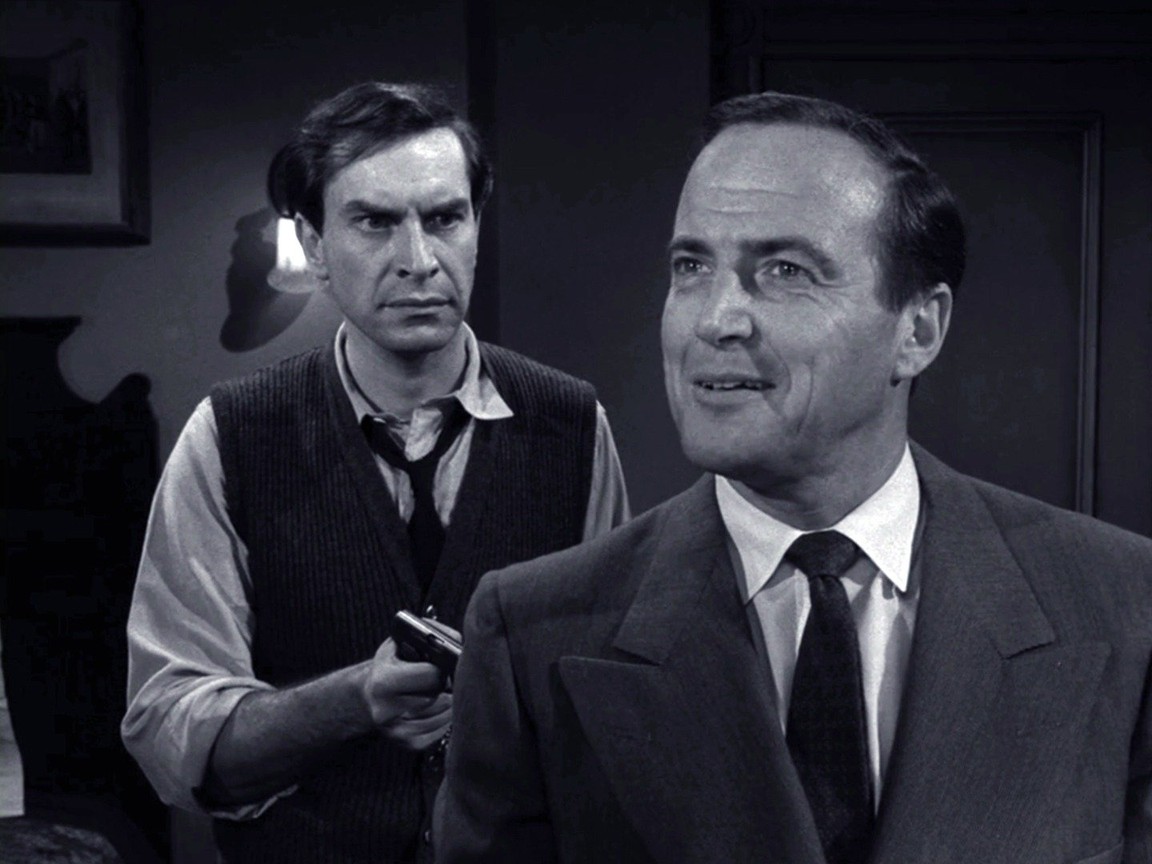
Twilight Zone – Number Twelve Looks Just Like You

★★★★★ January 24, 1964 Season 5 Episode 17

If you want to see where we are…HERE is a list of the episodes.

“Whoso would be a man, must be a nonconformist.”― Ralph Waldo Emerson

Personally, I think this is one of the most important Twilight Zone episodes ever made. It could have been made now. 

This one is deeply disturbing and not in a monster or twist sense…it tackles an issue that still is going strong. Did Rod Serling have a crystal ball or did he see where everything was going?  This episode takes place in the 21st century and yes, it is very relatable now. In a time now where our cars, houses, and clothes look the same you could see this coming and with plastic sugery it is essentially here. On our phones, computers, tv’s, and magazines we are hit with a barrage of advertising aimed at beautifying ourselves. We are obssessed with celebrities looking perfect and mimicking them. We can lose our identity if we are not careful as a whole. 

There is a line in the episode where the lead character says “Is that good being like everybody? Isn’t that the same as being nobody?” and that line speaks volumes. The episode is about when a person turns 19, he or she must choose which body and face they want to go through life with. All the choices are basically models and they are forced to go through with this operation. However, it’s not only the body and face that is changed, it’s their outlook and personality. They are always shallow and happy because no deep thoughts are allowed. The lead character Marilyn Cuberle is billiantly played by Collin Wilcox and you feel like she is alone in the world.

The episode is not about beauty. It’s not about if you are beautiful you are automatically shallow. I think people have misread it through the years. It’s about conforming to the social norm. There is the social price that we pay for not conforming, but I would rather pay it with intrest than go along with the crowd. In a world where everything is beautiful, nothing is. 

*** I apologize for interupting here but this is a personal reflection on what this episode means to me. The quote at the top “Whoso would be a man, must be a nonconformist.” by Ralph Waldo Emerson is the most important quote I’ve ever read. I found it in high school and later on I was wrote up at work (I don’t work at that place now) because I had it on my computer desktop. I was not “part of the team” with thoughts like that. ***

IMDB Trivia: All the characters are named after conventionally beautiful film stars of the day: Lana for Lana Turner, Marilyn for Marilyn Monroe, Grace for Grace Kelly, Rex for Rex Harrison, Eva for Eva Marie Saint, Valerie for Valerie Allen.

Three separate characters – Uncle Rick, Dr. Rex, and Dr. Sigmund Friend – were identical in appearance, but were distinctly different as portrayed by Richard Long. Uncle Rick was kindly and down-to-earth; Dr. Rex was eerily good-natured, with some peculiar mannerisms; and “Sigmund Friend” was a Freud-like, ominous and shadowy character with a thick German accent.

This episode is reported to be the inspiration for “Uglies”, a 21st Century series of young adult science fiction novels by Scott Westerfeld.

When Marilyn shows her mother Lana a picture of herself (Lana) before her own “Transformation,” the picture is of Collin Wilcox with a different hairstyle. Wilcox was herself twenty-eight years old when she made this episode (and just two years younger than Suzy Parker), but the premise made it possible for her to be credible as a nineteen-year-old.

This episode is based on Charles Beaumont’s short story, “The Beautiful People”, which first appeared in the September 1952 issue of the science fiction magazine “If”.

This show was written by Charles Beaumont, John Tomerlin, and Rod Serling

Rod Serling’s Opening Narration: 

Given the chance, what young girl wouldn’t happily exchange a plain face for a lovely one? What girl could refuse the opportunity to be beautiful? For want of a better estimate, let’s call it the year 2000. At any rate, imagine a time in the future where science has developed the means of giving everyone the face and body he dreams of. It may not happen tomorrow, but it happens now, in The Twilight Zone.

Summary

As Marilyn Cuberle approaches her 19th birthday she faces a momentous decision. Like everyone else in this futuristic society, she must choose which look she will adopt in the transformation process. Here, all men and women look like one of a series of approved faces, all are beautiful or handsome. Marilyn doesn’t want to change her appearance and is happy to look different from anyone else. Everyone assures her that she is under no obligation to undergo the transformation – but they go out of their way to make it difficult for her to say no.

Rod Serling’s Closing Narration:

Portrait of a young lady in love – with herself. Improbable? Perhaps. But in an age of plastic surgery, body building and an infinity of cosmetics, let us hesitate to say impossible. These, and other strange blessings, may be waiting in the future, which, after all, is The Twilight Zone.

CAST

Rod Serling … Narrator / Self – Host (uncredited)
Collin Wilcox…Marilyn Cuberle
Suzy Parker…Lana Cuberle / Eva / Doe / Grace / Jane / Patient / Number 12
Richard Long…Uncle Rick / Dr. Rex / Sigmund Friend / Dr. Tom / Tad / Jack / Attendant
Pam Austin…Valerie / Marilyn (after transformation) / Number…


Jackson 5 – I Want You Back …1970’s AM Radio Gold Week

The Jackson Five had some great pop songs in the seventies. Most of the early songs were full of energy and infectious. They called their music bubblegum soul. This was the first Jackson 5 single released by Motown Records (they released a single on a local label in Gary, Indiana, in 1968). It launched their career and went to #1 in the US, as did the next three releases: “ABC,” “The Love You Save” and “I’ll Be There.”

The song peaked at #1 in the Billboard 100, #2 in Canada, #2 in the UK, and  #12 in New Zealand 1969-1970.

Motown had set up offices in Los Angeles, which is where the Jackson 5 relocated and where this song was written and recorded. The top songwriting/production team at Motown, Holland-Dozier-Holland, had left the label to get better terms, so there was a huge void that many Motown writers were trying to fill.

Their first three songs were written and produced by a Motown collective known as “The Corporation”: Freddie Perren, Deke Richards, Fonce Mizell, and Berry Gordy Jr. Gordy was head of the label and assigned them that name, which kept the focus on the team instead of the individuals within it – if one member deigned to leave, he could replace him.

The Jackson 5 found a winning formula early. Michael Jackson sang the lead and his brothers added vocals in the song. It also opened the door for family groups with young lead singers, notably the Osmonds and the DeFranco Family.

It has gained popularity because of being included on the 2014 soundtrack Guardians Of The Galaxy, which was a #1 hit in America for two weeks.

From Songfacts

The Jackson 5 were a family group from Gary, Indiana, that were auditioned to exhaustion by their father, Joe, before signing with Motown Records in 1968. Joe made sure the youngest brother, Michael, was out front – his voice, dance moves and stage presence were the star of the show. When “I Want You Back” was released in October 1969, Michael was just 11 years old, but by that point he had so much training he could handle the promotional appearances and rigorous schedule. The entire group was media trained by Motown, and for a while they were ordered to tell a story about how Diana Ross discovered the group. For the most part, they came off as a regular family, with Michael citing basketball and catching lizards as hobbies. They described their sound as “bubblegum soul,” a term that explains their appeal to both black and white audiences.

This song tells a tried-and-true story about a guy who took his girl for granted and now desperately wants her back now that she’s left him. Making it work from the perspective of an 11-year-old boy took some doing, but the upbeat track takes the weight off, so it sounds more like a schoolyard crush. There are also lots of answer lines in the lyric (“Let you go, baby…”) that give the other members of the group a chance to chime in.

“I Want You Back” started as a song Freddie Perren, Fonce Mizell, and Deke Richards wrote for Gladys Knight & The Pips called “I Want To Be Free.” Perren and Mizell were childhood friends from New Jersey who moved to Los Angeles and teamed up with Deke Richards, a producer at Motown. When Berry Gordy heard the song, he decided it could be a good fit for the Jackson 5 if it got a rewrite. Michael Jackson reminded Gordy of Frankie Lymon, another teenage star, Gordy suggested they write it as if it were for Lymon. They reworked the song, changing the storyline so it’s about a young kid trying to get his girl back, and they fashioned a lively track to underline it.

When the song took off, Perren, Mizell, Richards and Gordy became the songwriting/production team that powered the Jackson 5. Stung by the loss of his marquee team of Holland-Dozier-Holland, Gordy branded this new team “The Corporation,” which is how the songwriting credit was listed. This kept the writers’ names off the record, ensuring they would remain anonymous. They became the first West Coast songwriting team to make a big impact at Motown.

The musicians who played on most of the ’60s Motown hits were members of their Detroit house band, the Funk Brothers. The Jackson 5 recorded in Los Angeles with a new group of session players. On “I Want You Back,” they included Louis Shelton and David Walker on guitars, Wilton Felder on bass, and Gene Pello on drums.

This song opens with an ear-catching piano glissando that was played by two of the song’s writers, Freddie Perren and Fonce Mizell.

Berry Gordy went out of his way to make this a hit, using all his resources at Motown to do so. With the ’60s coming to a close and Motown moving west, Gordy wanted to mint new stars at the label, and he knew he had a winner in the Jackson 5. One of his ploys was to claim the group was discovered by Diana Ross, and have her showcase the group for industry bigwigs. Ross was also in transition, having recently left The Supremes and launched her solo career. This bit about Ross finding the group proved a solid talking point and was propagated for decades. Nobody seemed to care that it was a ruse – there was a lot more to talk about concerning the Jackson 5 and their precocious lead singer.

Two popular songs sampled this in 2001: Jay Z used it on “Izzo (H.O.V.A.)” and it was also used on Lil’ Romeo’s “My Baby.” In 1992, it was sampled on the Kris Kross hit “Jump.”

The sci-fi soul singer-songwriter Janelle Monáe covered this as a bonus track on the deluxe edition of her The Electric Lady album. She explained to A.V.Club that she chose this particular tune as it resonated with her. “There are so many amazing Michael Jackson songs from different stages of his career,” she said, “and that happened to be one of my favorite stages. It makes people happy, and I love the tone, and musically, it has a lot of places to go for our orchestra. It has a lot of odd instrumentation.”

“The version I did does not sound like the Jackson 5 original recording,” Monáe continued. “I wanted to interpret it my way and record it differently, while continuing to pay homage to him, but I saw it in a different light. I’m really excited to let you guys hear it because you’ll get a chance to hear that song from my perspective. I had a dream about it and how I wanted it to be recorded.”

This song appears in the films Now and Then (1995), Drumline (2002), Daddy Day Care (2003) and Friends with Benefits (2011).

I Want You Back

When I had you to myself, I didn’t want you around
Those pretty faces always make you stand out in a crowd
But someone picked you from the bunch, one glance is all it took
Now it’s much too late for me to take a second look

Oh baby, give me one more chance
(To show you that I love you)
Won’t you please let me back in your heart
Oh darlin’, I was blind to let you go
(Let you go, baby)
But now since I’ve seen you it is on
(I want you back)
Oh I do now
(I want you back)
Ooh ooh baby
(I want you back)
Yeah yeah yeah yeah
(I want you back)
Na na na na

Trying to live without your love is one long sleepless night
Let me show you, girl, that I know wrong from right
Every street you walk on, I leave tear stains on the ground
Following the girl I didn’t even want around

Let me tell ya now
Oh baby, all I need is one more chance
(To show you that I love you)
Won’t you please let me back in your heart
Oh darlin’, I was blind to let you go
(Let you go, baby)
But now since I’ve seen you it is on

All I want
All I need
All I want!
All I need!

Oh, just one more chance
To show you that I love you
Baby baby baby baby baby baby!
(I want you back)
Forget what happened then
(I want you back)
And let me live again!

Oh baby, I was blind to let you go
But now since I’ve seen you it is on
(I want you back)
Spare me of this cost
(I want you back)
Give me back what I lost!

Oh baby, I need one more chance, hah
I’d show you that I love you
Baby, oh! Baby, oh! Baby, oh!
I want you back!
I want you back!

Bread – If …1970’s AM Radio Gold Week

Bread was one of the first bands I found out about. My sister loved them because every time she started to date someone or broke up with someone…out came the Bread albums. She is 8 years older than me so I was just 6 when she was 14 but I knew the dating cycle of a teenage girl rather well at that time.

My sister now…(she will kill me if she finds out I posted this)

May be an image of 1 person, eyeglasses and indoor

Bread was a soft rock band that later on I probably would have never claimed that I liked…but I did…and still do. I called them a guilty pleasure (the guilt-o-meter peaks) for a while but hell…I like them. When I hear the opening guitar in this song, it’s the early seventies again.

The song peaked at #4 in the Billboard 100 and #6 in Canada in 1971. It also peaked at #1 in the  Easy Listening chart in America and Canada. The song was on the album Mana that peaked at #21 in the Billboard Album charts and #16 in Canada.

David Gates was the writer who wrote most of the hits. Gates is a very good singer songwriter who knows how to write a good pop melody. In this song there is no chorus to speak of but it works well.

David Gates:  “I wrote that one night at the dining room table, after my kids and my wife had gone to bed. It took me about an hour and a half, with an extra verse left over. If you look at it, there’s a few bizarre lines in there, like ‘you and I would simply fly away’ – that’s kind of an unusual thought. When I was done, I said, ‘That’s the best song I’ve ever written and probably will be the best song I’ll ever write.’ For me it’s really held up over time, more than any of the others.”

One odd fact about this song… Kojak actor Telly Savalas recorded a spoken-word version that went to #1 in the UK in 1975.

If

If a picture paints a thousand words,
Then why can’t I paint you?
The words will never show the you I’ve come to know.
If a face could launch a thousand ships,
Then where am I to go?
There’s no one home but you,
You’re all that’s left me too.
And when my love for life is running dry,
You come and pour yourself on me.

If a man could be two places at one time,
I’d be with you.
Tomorrow and today, beside you all the way.
If the world should stop revolving spinning slowly down to die,
I’d spend the end with you.
And when the world was through,
Then one by one the stars would all go out,
Then you and I would simply fly away

Bachman-Turner Overdrive – Takin’ Care Of Business …1970’s AM Radio Gold Week

There were times when I could not hear this song anymore because it’s been played so much but…now I enjoy hearing it again. It is a great song but a song that radio has played endlessly. When I think of this phrase, I think of Elvis. Elvis loved the saying…he wore a “TCB” necklace and called his backing group “The TCB Band.”

Essential Elvis - Museum - Genuine TCB necklace

Canadian Randy Bachman wrote this song and the music was inspired by The Beatles Paperback Writer. He came up with the idea for the song in the late-’60s while he was still a member of The Guess Who. After hearing Paperback Writer and he used that music to create a song about going to work called “White Collar Worker,” which needed a new hook to complete.

For the lyric, Bachman was listening to C-Fox radio on the way to the club and heard the DJ say they were “Takin’ Care of Business,” which gave him the idea for the hook. Singing his lyrics to “White Collar Worker,” Bachman sang “Takin’ Care of Business” in the breakdown, and he had his song.

The song lay dormant until Bachman formed Bachman-Turner Overdrive and was playing a show when lead singer Fred Turner’s voice gave out. Forced to sing for a set, Bachman told the band to “Play these three chords over and over – C, B flat, and F – endlessly and when I get to the hook, help me out.”

Randy Bachman: “Ralph (Murphy) and I wrote a song in ’67 called ‘A Little Bit Of Rain.’ That riff is used in the middle of ‘Takin’ Care Of Business,’ just to break the monotony because ‘Takin’ Care Of Business’ was three chords over and over and over. It had no bridge. No hook. No song format, other than that it was ‘Louie Louie.’ Endless, mind-bashing of three chords. And the original version, as I explained at the Ryman, had twelve chords. That’s why nobody liked it. It had an incredible number of chords.”

From Songfacts

The band captured the feel of jamming in the club by having Bachman sing it, which Turner appreciated since it would give his voice a rest at their shows. Bachman had a sore throat and a head cold when he recorded his vocals.

The song propelled the phrase “Takin’ care of business” into the popular lexicon, forever to be used by athletes, performers and the common man to indicate they are on the job.

While the song title implies an industrious responsibility, a closer listen reveals that this song is more of a slacker anthem. The singer is presumably unemployed, and he “loves to work at nothing all day.”

Norman Durkee played the piano on this track. So who is this Norman fellow? John Presho, who knew Bachman and worked security at their concerts, gives this account:
“Randy Bachman told me that when BTO was in the recording studio the record producer wasn’t happy with the raw version of that song. BTO took a time out, ordered a pizza and went back to work on the song. A while later there was a knock on the studio door and it was the pizza delivery man. After giving the band their pizza he commented that ‘Takin’ Care of Business’ was a great song but it needed some piano playing. The pizza man introduced himself as Norman and said that he was a piano player. BTO thanked and tipped him and sent him on his way. Hours later with no improvement in the song they decided to call Norman, but no one got his phone number or could remember the name of the pizza place. BTO called a half dozen pizza houses before they were able to track him down. The band paid Herman’s $75 to join the musicians union so he could play the piano in the recording studio.”

BTO being introduced by the great Keith Moon.

Takin’ Care Of Business

You get up every morning from your alarm clock’s warning
Take the 8:15 into the city
There’s a whistle up above and people pushin’, people shovin’
And the girls who try to look pretty
And if your train’s on time, you can get to work by nine
And start your slaving job to get your pay
If you ever get annoyed, look at me I’m self-employed
I love to work at nothing all day

And I’ll be taking care of business (every day)
Taking care of business (every way)
I’ve been taking care of business (it’s all mine)
Taking care of business and working overtime, work out

If it were easy as fishin’ you could be a musician
If you could make sounds loud or mellow
Get a second-hand guitar, chances are you’ll go far
If you get in with the right bunch of fellows
People see you having fun just a-lying in the sun
Tell them that you like it this way
It’s the work that we avoid, and we’re all self-employed
We love to work at nothing all day

And we be taking care of business (every day)
Taking care of business (every way)
We be been taking care of business (it’s all mine)
Taking care of business and working overtime

Mercy
Whoo
All right

Take good care of my business
When I’m away, every day
Whoo

You get up every morning from your alarm clock’s warning
Take the 8:15 into the city
There’s a whistle up above and people pushin’, people shovin’
And the girls who try to look pretty
And if your train’s on time, you can get to work by nine
And start your slaving job to get your pay
If you ever get annoyed, look at me I’m self-employed
I love to work at nothing all day

And I be taking care of business (every day)
Taking care of business (every way)
I’ve been taking care of business (it’s all mine)
Taking care of business and working overtime, take care

Takin’ care of business, whoo
Takin’ care of business
Takin’ care of business (every day)
Takin’ care of business (every way)
Takin’ care of business (it’s all mine)
Takin’ care of business and working overtime, whoo

Takin’ care of business
We be takin’ care of business
Takin’ care of business

Twilight Zone – The Self-Improvement of Salvadore Ross

★★★★ January 17, 1964 Season 5 Episode 16

If you want to see where we are…HERE is a list of the episodes.

Don Gordon who plays Salvadore Ross a troubled young man who has fits of rages. He soon finds out that human characteristics can be bought, sold, and exchanged like stock. There is one thing though…it’s a price steeper than money. Salvadore starts out as another Serling low life. A small-time man looking for shortcuts who only want things without giving back. His newfound power has no explanation, but I didn’t mind.

This is an episode about getting what you want and how essential it is to be true to yourself in attaining it. Sometimes it’s not about having it but how you get it. The acting is top-notch. Don Gordon went on to have 134 acting credits in 6 different decades. He also appeared in the Twilight Zone appearance since The Four of Us Are Dying. The character here is similar…cocky, slightly cruel, and short-tempered.

From IMDB Trivia: Based upon a short story of the same name, written by Henry Slesar and first published in the May 1961 issue of The Magazine of Fantasy & Science Fiction by Mercury Press, Inc.

Kathleen O’Malley plays the nurse and J. Pat O’Malley played the older patient in the hospital. They were not related, however, when he began his career, he was known as Pat O’Malley, but when he arrived in Hollywood, he became known professionally as J. Pat O’Malley to avoid confusion with the actor Pat O’Malley who was, in real life, the father of Kathleen O’Malley.

The character of Salvadore Ross is 26, but the actor playing him, Don Gordon, was 38.

The $100,000.00 offer in 1964 would be the equivalent of about $896,000.00 in the year 2022.

This show was written by Jerry McNeely, Henry Slesar, and Rod Serling

Rod Serling’s Opening Narration: 

Confidential personnel file on Salvadore Ross. Personality: a volatile mixture of fury and frustration. Distinguishing physical characteristic: a badly broken hand, which will require emergency treatment at the nearest hospital. Ambition: shows great determination towards self-improvement. Estimate of potential success: a sure bet for a listing in Who’s Who in the Twilight Zone.

Summary

Salvadore Ross is a volatile mix of violence and frustration. He’s not very bright and hasn’t made much of himself so far. He is very much in love with Leah Maitland though she has told him she doesn’t want to see him anymore. He thinks she won’t see him because her father doesn’t approve and that they both think she can do better. When he realizes he can actually exchange parts of himself, like his age, with others he sets out on a path to make himself more acceptable to both of them.

Rod Serling’s Closing Narration:

The Salvadore Ross program for self-improvement. The all-in-one, sure-fire success course that lets you lick the bully, learn the language, dance the tango and anything else you want to do. Or think you want to do. Money-back guarantee. Offer limited to…the Twilight Zone.

CAST

Rod Serling … Narrator / Self – Host (uncredited)
Don Gordon…Salvadore Ross
Gail Kobe…Leah Maitland
Vaughn Taylor…Mr. Maitland
J. Pat O’Malley…Old Man
Douglass Dumbrille…Mr. Halpert
Douglas Lambert…Albert Rowe
Seymour Cassel…Jerry (uncredited)
Ted Jacques…Bartender (uncredited)
Kathleen O’Malley…Nurse (uncredited)


Guess Who – Undun…1970’s AM Radio Gold Week

I had a greatest hits package by the Guess who given to me by a relative. At the time I thought the Guess Who and The Who were the same.

The title of this song was inspired by Bob Dylan. Randy Bachman said he got the idea after hearing the Dylan song “Ballad In Plain D” on the radio. It was a very long song, and just as Bachman was about to turn off the radio, Dylan sang the line “She came undone.” Bachman said the lyrics were about a girl he saw at a party who went into a coma after dropping acid.

Canadian Jazz guitarist Lenny Breau taught Bachman some chords and you can hear the jazzy feel of the song. Bachman also was influenced by an obscure Kenny Rankin song called “Soft Guitar.”

Burton Cummings learned to play the flute for this song. In his old band The Deverons he played saxophone. While playing at a music store Cummings saw a flute in a case. Burton learned from the dealer that the fingering for the flute was the same as a sax (except for C).

Their name came about when their label Quality Records released their first hit single (“Shakin’ All Over”) credited only to “Guess Who?” in an attempt to build a mystique around the band. They wanted the public to believe that this was a possible British band. The real name of the band was “Chad Allan & The Expressions,” but radio station DJs continued to refer to them as “The Guess Who.” when playing subsequent singles.

This was released as the B-side of Laughing. It got radio play when some disc jockeys flipped the single and played it. That in turn prompted the record company to release it as an A-side 4 months later.

The song peaked at #21 in Canada and #22 in the Billboard 100 in 1969. The song was on the album Canned Wheat.

Undun

She’s come undun
She didn’t know what she was headed for
And when I found what she was headed for
It was too late

She’s come undun
She found a mountain that was far too high
And when she found out she couldn’t fly
It was too late

It’s too late
She’s gone too far
She’s lost the sun

She’s come undun
She wanted truth but all she got was lies
Came the time to realize
And it was too late

She’s come undun
She didn’t know what she was headed for
And when I found what she was headed for
Mama, it was too late

It’s too late
She’s gone too far
She’s lost the sun
She’s come undun

Too many mountains, and not enough stairs to climb
Too many churches and not enough truth
Too many people and not enough eyes to see
Too many lives to lead and not enough time

It’s too late
She’s gone too far
She’s lost the sun

She’s come undun

It’s too late
She’s gone too far
She’s lost the sun

She’s come undun
She didn’t know what she was headed for
And when I found what she was headed for
It was too late

She’s come undun
She found a mountain that was far too high
And when she found out she couldn’t fly
Mama, it was too late

It’s too late
She’s gone too far
She’s lost the sun

She’s come undun
No, no, no, no, no, no, no

Ozark Mountain Daredevils – Jackie Blue…1970’s AM Radio Gold Week

I haven’t had a theme week in a while. This week will be 1970’s songs that you would have heard on AM Radio back then that were big pop hits…as you were cruising in your parent’s LTD or some other vehicle.

This is one of those AM Gold radio singles from the seventies. It’s made to be heard through an AM station while you are riding in your…insert your 1970s car of choice (mine would be an Opel GT).

Opel GT - Wikipedia

Ricks Radio Conversions - Radio Conversions, Car Radio Conversion

The Ozark Mountain Daredevils were, in one word, eclectic. They have been called southern rock, country, country rock, and pop. This song is one of those great pop hits during the mid-seventies. It is part of my childhood DNA.

The band started out with the name “Family Tree” but they found out that another band was using that name, so they stopped using it. They soon had a “naming party” and came up with “Cosmic Corn Cob & His Amazing Ozark Mountain Daredevils” but decided to shorten the name…and none of the band wanted to be called Cosmic Corn Cob.

The song was written by bandmates Steve Cash and Larry Lee. The song was inspired by someone they had met in L. A. that was strung out on drugs. It was a guy who partied way too much…when they recorded the song, they changed Jackie to a girl.

This song was off of their It’ll Shine When It Shines album released in 1974. The song peaked at #3 in the Billboard 100, #2 in Canada, and #9 in New Zealand. It was the biggest hit of their career…they are known most for this song and If You Want To Get To Heaven. After their first two albums, they didn’t have a lot of big hits but retained a good following. They have released 8 studio albums and 6 charting singles…the latest album was released in 2018 called Off The Beaten Path.

Dave from A Sound Day has more info on this song.

Bassist Mike ‘Supe’ Granda: “[Ozarks drummer] Larry Lee brought the song to us. He said he wrote it about a guy we knew. Every night, this guy would go out to the nightclub with a wad of money and a pocket full of blow and he’d be out there chasing women. “So we played this song for about a year. After we recorded the song we went to LA to mix it, and A&M said: ‘You’ve recorded a number one song, but Jackie needs to be a girl.’ So Larry took Steve Cash, our lyricist, into the other room, and three or four hours later they came out and Jackie was a girl. Larry laid his vocals down, and it flipped all of us out. “We’d been hearing this song about a guy for a year-and-a-half, and all of a sudden it was about a girl. But it sounded great.” 

Jackie Blue

Ooh, Jackie Blue
Lives her life from inside of her room
Hides a smile when she’s wearin’ a frown
Ooh, Jackie you’re not so down

You like your life in a free-form style
You’ll take an inch but you’d love a mile
There never seems to be quite enough
Floating around to fill your lovin’ cup

Ooh, Jackie Blue
What’s a game girl, if you never lose?
Ask a winner and you’ll probably find
Ooh, Jackie they’ve lost at sometime

Don’t try to tell me that you’re not aware
Of what you’re doing and that you don’t care
You say it’s easy, just a natural thing
Like playing music, but you never sing

Ooh, Jackie Blue
Making wishes that never come true
Going places that you’ve never been
Ooh, Jackie Blue, you’re going again

Ooh, Jackie Blue
Lives a dream that can never come true
Making love is like sifting through sand
Ooh, Jackie, it slips through your hand

Every day, in your indigo eyes
I watch the sunset but I don’t see it rise
Moonlight and stars in your strawberry wine
You’d take the world but you won’t take the time

Ooh-hoo-hoo, Jackie Blue
Lives her life from inside of a room
Makes you think that her life is a drag
Ooh Jackie, what fun you have had

Ooh, Jackie
Ooh, Jackie
Ooh, Jackie
Ooh, Jackie
Hey, hey, hey, hey

Buffalo Springfield – Nowadays Clancy Can’t Even Sing

My friend and I discovered his father’s Buffalo Springfield’s greatest hits album in the early eighties. I grew to be a fan then and there, before I knew about Stills, Young, and the rest. Broken Arrow was my favorite song but Mr. Soul, For What It’s Worth, and this one we could not get enough of.

This song was Buffalo Springfield’s first single and the breakout for both Stephen Stills and Neil Young – although it wasn’t supposed to be. Originally the song Go and Say Goodbye by Stephen Stills on the A-side and Young’s Nowadays Clancy Can’t Even Sing on the B-side, before their producers caved to pressure from distributors and flipped the sides.

Richie Furay sings the lead on this song after hearing Young play it earlier. Furay had songs he wanted to include on the album. His songs got lost in the shuffle with the Stills and Young and the developing rivalry between the two.

It wasn’t a smash by any means, but it charted at #110 in the Billboard 100 and #75 in Canada in 1966… so it got some airplay and was a regional success in California. Their album Buffalo Springfield peaked at #80 in the Billboard Album charts in 1967.

In Los Angeles, California’s WKHJ was the first radio station to play the song. Buffalo Springfield’s management arranged this feat by giving the station advanced tapes of “A Day In The Life” by the Beatles, which gave them the chance to break the song ahead of anyone else.

Neil Young wrote this song, which is partially based on one of his real-life schoolmates. Ross “Clancy” Smith attended Kelvin High School in Winnipeg, Canada, with Young.

Neil Young: “He was a kind of persecuted member of the community. He used to be able to do something, sing or something, and then he wasn’t able to do it anymore. The fact was that all the other problems or things that were seemingly important didn’t mean anything anymore because he couldn’t do what he wanted to do.”

The Carpenters did a version on their album Ticket To Ride in 1969.

From Songfacts

Further stress on the band’s debut was brought about by frustration with their producers. Though the legendary Ahmet Ertegun was their mentor, they’d been hooked up through the management team of Charlie Greene and Brian Stone, who were clearly out of their depth. Greene and Stone named themselves Buffalo Springfield’s producers and had them signed not to Atlantic proper or even their subsidiary Atco, but to their own York/Pala Records label, giving them a bigger slice of the profit pie than they otherwise would have been entitled to. As drummer Bruce Palmer is quoted in Neil Young: Long May You Run: The Illustrated History, “They were the sleaziest, most underhanded, backstabbing motherf–kers in the business! They were the best!”

Also from that book: “What hurt the album more than anything, though, was Greene and Stone’s production. Despite the Springfield’s strength as a live act, the managers forced each musician to record separately, piecing the parts together. Worse, after the band participated in the mono mix, Greene and Stone quickly converted the album to stereo, resulting in a tinny mix that outrages the group to this day. Young commented that Greene and Stone made them sound like the All-Insect Orchestra.”

In the same book, classmate Diana Halter says Clancy had multiple sclerosis, and was “so intelligent and so bright that he masked the sweet soul beneath it all.”

All accounts taken together, it’s hard to put an exact picture together of what made Clancy such a standout figure, but all agree he was exactly that.

Though Clancy was an inspiring figure in the song, “Nowadays Clancy Can’t Even Sing” is about Young as much as it about Clancy. He wrote it in 1965 after having a terrible time in Toronto, where his attempts to get things going as a professional musician totally flopped. The rejection he experienced there was so complete (“humbling,” as he called it) that it sent him into a fit of introspective, frustrated songwriting. Out of this pain began to emerge the songwriting style on which Young would build his legend. The pinnacle of those songs, many of which were only recorded on demos or not recorded at all, was “Nowadays Clancy Can’t Even Sing.”

Released on Buffalo Springfield’s eponymous debut album, the song peaked at #110, which wasn’t very good at that time. Unlike the modern era when there are so many bands and expectations are a bit more muted, back then a major-label act, even a new one, was expected to at least break into the top 100 to be considered commercially viable. The song was popular in the Los Angeles area, however, which was the nexus of hippie counterculture.

Young first recorded this song on a January 1966 demo for Elektra Records (Elektra rejected the demos). It can be heard on the 2009 release of The Archives Vol. 1 1963–1972.

There’s a live solo recording of the song on Sugar Mountain – Live at Canterbury House 1968.

The psychedelic band Fever Tree recorded the song in 1968 on their self-titled debut album. 

Furay got an early preview of this song from Young himself when the Canadian visited Furay’s New York City apartment. He was auditioning to be house performer at a nightclub called the The Bitter End and played it there. Some of the auditions were recorded but haven’t been released anywhere.

The Clancy Brothers inspired the musical form in this song, with its Irish-styled 2/4 rhythm verses and 3/4 rhythm choruses.

Many journalists and historians have noted this song as Young’s artistic breakthrough, the one that helped him find the niche that would give him the kind of appeal that endured over 50 years later.

Who’s coming home on old 95?

Einarson in Don’t Be Denied posits that this line might refer to a trip that Young took home to Winnipeg in the fall of ’65, suggesting that the train was numbered 95.

Nowadays Clancy Can’t Even Sing

Hey who’s that stomping all over my face?
Where’s that silhouette I’m trying to trace?
Who’s putting sponge in the bells I once rung?
And taking my gypsy before she’s begun?
To singing the meaning of what’s in my mind
Before I can take home what’s rightfully mine
Joinin’ and listenin’ and talkin’ in rhymes
Stoppin’ the feeling to wait for the times
Who’s saying baby that don’t mean a thing
‘Cause nowadays Clancy can’t even sing

And who’s all hung-up on that happiness thing?
Who’s trying to tune all the bells that he rings?
And who’s in the corner and down on the floor?
With pencil and paper just counting the score?
And who’s trying to act like he just in between?
The night isn’t black, it can only be screened
Don’t bother looking you’re too blind to see
Who’s coming on like he wanted to be
Who’s saying baby, that don’t mean a thing
‘Cause nowadays Clancy can’t even sing

And who’s coming home on the old ninety five?
Who’s got the feeling to keep him alive
Though havin’ it, sharin’ it ain’t quite the same
It ain’t no gold nugget you can’t lay a claim
Who’s seeing eyes through the crack in the floor
There it is baby don’t you worry no more
Who should be sleepin’ but is writing this song
Wishin’ and a-hopin’ he weren’t so damned wrong
Who’s saying baby, that don’t mean a thing
‘Cause nowadays Clancy can’t even sing
Who’s saying baby that don’t mean a thing
‘Cause nowadays Clancy can’t even sing

Twilight Zone – The Long Morrow

★★★★ January 10, 1964 Season 5 Episode 15

If you want to see where we are…HERE is a list of the episodes.

The Long Morrow is a simple but complicated love story in the Twilight Zone. Robert Lansing and Mariette Hartley play Commander Douglas Stansfield and Sandra Horn respectively. They make the characers real and inject an emotional depth to their  story. The Twilight Zone had some of the best casting of any show on television. 

I would say it’s The Twilight Zone’s most romantic episode. This one is unbelievably poignant with the ironic ending.  It makes you think about human spirit and the lenghs to which Man (and Woman) will go to realize an ultimate ambition. We are clever when we want to be but sometimes it doesn’t turn out the way we think it will. 

To talk anymore about it would give the ending away. This is one you will have to watch. 

Robert Lansing: I was a little reluctant to do the semi-nude thing in the ice block, but it was such a good idea, so visual, that I bypassed my own feelings and did it. I was wearing a pair of mini-trunks which today id wear on a beach.

From IMDB Trivia: 

Both Robert Lansing (Commander Stansfield) and Mariette Hartley (Sandra Horn) later both guest star on Star Trek (1966), but not together. Robert Lansing played Gary Seven in S2E26 (“Assignment: Earth”), for a spin-off series that was not picked up. Mariette Hartley played Zarabeth in S3E23 (“All Our Yesterdays”) as a love interest for Mr. Spock.

This episode takes place in June 1987, in November 1987, from December 31, 1987 to January 1, 1988, on April 19, 1988, on May 1, 1988 and in 2027.

This show was written by Rod Serling 

Rod Serling’s Opening Narration: 

It may be said with a degree of assurance that not everything that meets the eye is as it appears. Case in point, the scene you’re watching. This is not a hospital, not a morgue, not a mausoleum, not an undertaker’s parlor of the future. What it is is the belly of a spaceship. It is en route to another planetary system, an incredible distance from the Earth. This is the crux of our story – a flight into space. It is also the story of the things that might happen to human beings who take a step beyond, unable to anticipate everything that might await them out there.

The narration continues after Stansfield is informed that his journey into space will take forty years:

Commander Douglas Stansfield, astronaut, a man about to embark on one of history’s longest journeys: forty years out into endless space and hopefully back again. This is the beginning, the first step towards man’s longest leap into the unknown. Science has solved the mechanical details and now it’s up to one human being to breathe life into blueprints and computers, to prove once and for all that man can live half a lifetime in the total void of outer space, forty years alone in the unknown. This is Earth. Ahead lies a planetary system. The vast region in between is the Twilight Zone.

Summary

Commander Douglas Stansfield is selected to be the first astronaut to go on a deep-space mission. He will be away for 40 years but for much of that, he will be in stasis, and on his return he will hardly have aged. Stansfield is a seemingly ideal candidate as he is single and has no close family. Prior to his departure however, he meets the beautiful Sandra Horn and they fall very much in love. Forty years later, Stansfield returns but it seems he and Sandra had their own way of dealing with the 40 years since they last saw each other.


Rod Serling’s Closing Narration:

Commander Douglas Stansfield, one of the forgotten pioneers of the space age. He’s been pushed aside by the flow of progress and the passage of years, and the ferocious travesty of fate. Tonight’s tale of the ionosphere and irony, delivered from the Twilight Zone.


CAST

Rod Serling … Narrator / Self – Host (uncredited)
Robert Lansing…Commander Douglas Stansfield
Mariette Hartley…Sandra Horn
George Macready…Dr. Bixler
Ed Binns…General Walters
William Swan…Technician


Velvet Underground – There She Goes Again

Being a fan of bands like this is like being in a secret club. When you do find a person who knows Big Star, The Velvet Underground, or any other band like that…you usually have found a friend.

In the 80s a buddy of mine had some Velvet Underground albums (same one with Big Star albums) and I loved what I heard. After I started to know some of their songs, I wanted to talk to other people about them…most people I talked to never knew who I was talking about. Lou Reed they knew but not this band. That is when I learned what a cult band was…after being introduced to Big Star and Velvet Underground by the same person…I’ll never be able to thank him enough.

This song was on their debut album The Velvet Underground & Nico it was released in 1967. Lou Reed wrote There She Goes Again. The lyrics to this song must have sounded outrageous to the listeners in 1967. The album only charted at #129 in the Billboard 100 and that would be the best charting LP of all of their 5 original albums.

Their compilation album VU did peak at #85 in 1985.

The band got its name from the 1963 paperback book of the same title. Cover quote on the book: “Here is an incredible book. It will shock and amaze you. But as a documentary on the sexual corruption of our age, it is a must for every thinking adult.”

It came with an introduction by Louis Berg, M.D. Cover price: sixty cents. Lou Reed called it “the funniest dirty book he’d ever read.

The Velvet Underground – “Velvet Underground” by Michael Leigh / 1963 Book  The Band Took Their Name From

From Songfacts

“There She Goes Again” is the 8th track from the Velvet Underground’s debut album, reaching up the Billboard Hot 100 charts at… oh, wait, the Velvet Underground never charted. However as Velvet Underground songs go, this one is perhaps the most mainstream-sounding.

The lyrics more than make up for the ear-friendly notes, however, when you realize that this song is about a woman falling into prostitution. And in fact it does so with gritty references to being on her knees and walking the streets – maybe not so shocking today, but monocle-popping in 1967.

On December 11, 1965, the Velvets appeared at the Summit High School Auditorium for one of their first paid gigs, alongside two other bands since long forgotten. Their set began with this song, then went to “Venus In Furs,” and finished with “Heroin.” At a high school. Sterling Morrison later recounted in a 1983 interview that a “murmur of surprise” changed to “a roar of disbelief” and then to “a mighty howl of outrage and bewilderment” over the course of their three-song set.

Musically, this song does borrow from Marvin Gaye’s “Hitch Hike” – give it a listen. It’s even more obvious of an influence if you listen to the Rolling Stones cover on the Out of Our Heads album – there’s the guitar riff and the pronounced stops.

That album cover for The Velvet Underground & Nico – have you ever thought about how, if you peel off the sticker, the revealed banana is pink? Isn’t that an… interesting color choice for a… peeled banana? It’s almost like Andy Warhol was trying to convey some subtle Freudian signal to us. Pink banana.

There She Goes Again

There she goes again (There she goes again)
She’s out on the streets again (There she goes again)
She’s down on her knees, my friend (There she goes again)
But you know she’ll never ask you please again (There she goes again)

Now take a look, there’s no tears in her eyes
She won’t take it from just any guy, what can you do (There she goes again)
You see her walkin’ on down the street (There she goes again)
Look at all your friends she’s gonna meet (There she goes again)
You better hit her

There she goes again (There she goes)
She’s knocked out on her feet again (There she goes)
She’s down on her knees, my friend (There she goes)
But you know she’ll never ask you please again (There she goes)

Now take a look, there’s no tears in her eyes
Like a bird, you know she would fly, what can you do (There she goes)
You see her walkin’ on down the street (There she goes)
Look at all your friends that she’s gonna meet (There she goes)
You better hit her

Now take a look, there’s no tears in her eyes
Like a bird, you know she will fly, fly, fly away (Fly, fly, fly)
See her walking on down the street
Look at all your friends that she’s gonna meet

She’s gonna bawl and shout, she’s gonna work it
She’s gonna work it out, bye bye
Bye by by by by by bye baby
She’s all right

Twilight Zone – You Drive

★★★★ January 3, 1964 Season 5 Episode 14

If you want to see where we are…HERE is a list of the episodes.

The first episode that was shown in 1964. America was going through a big change. JFK had been assassinated two months before and The Beatles were on their way the following month. This episode predates the movie Christine and The Car by decades. Edward Andrews plays Oliver Pope who is driving distractedly on a rainy day and runs down a boy on a bike.

The boy is badly injured, and Andrews runs when he sees no one around. He goes home, filled with guilt and paranoia. He is worried about a man who he thinks is after his job. At this point, his car begins to act out. At first, it flashes headlights. Then it’s the horn. Then the radio. No matter what Andrews does, the car continues to act out.

They could have played this one like a horror movie but instead, they built up suspense based on a guilty conscience.

Another good episode that was written by Earl Hamner Jr….the creator of The Waltons.

Earl Hamner Jr: All mechanical things frustrate me. Im like my friend, John McGreevey, the writer, who once cut himself with a sponge. I am afraid of and inept with all mechanical devices. Its kind of a love-hate relationship. I drive a Corvette which I love because it is so at odds with the image of John-Boy Walton as an old man. And of course it is a stunning machine. But at the same time, I do not trust it. It seems to have a life of its own, and sometimes when it will not start I suspect it is because it has some personal grudge against me.

This show was written by Rod Serling  and Earl Hamner Jr.

Rod Serling’s Opening Narration: 

Portrait of a nervous man: Oliver Pope by name, office manager by profession. A man beset by life’s problems: his job, his salary, the competition to get ahead. Obviously, Mr. Pope’s mind is not on his driving.

Oliver Pope, businessman-turned-killer, on a rain-soaked street in the early evening of just another day during just another drive home from the office. The victim, a kid on a bicycle, lying injured, near death. But Mr. Pope hasn’t time for the victim, his only concern is for himself. Oliver Pope, hit-and-run driver, just arrived at a crossroad in his life, and he’s chosen the wrong turn. The hit occurred in the world he knows, but the run will lead him straight into—the Twilight Zone.

Summary

On a rainy day, office manager Oliver Pope is driving home when he hits a newspaper boy with his car and promptly flees the scene. He puts the car in his garage but when his wife sees the lights flashing, she thinks they have an intruder. In fact, its just the car acting up. In the middle of the night, his car horn honks and when his wife takes it out the next day, it stops at the exact corner where the accident occurred. When his competitor at the office, Pete Radcliff, is arrested he thinks he’s home free. It’s apparent however that the car is going to continue acting up until Pope makes things right.

WARNING VIDEO CONTAINS SPOILERS

Rod Serling’s Closing Narration:

All persons attempting to conceal criminal acts involving their cars are hereby warned: check first to see that underneath that chrome there does not lie a conscience, especially if you’re driving along a rain-soaked highway in the Twilight Zone.

CAST

Rod Serling … Narrator / Self – Host (uncredited)
Edward Andrews…Oliver Pope
Helen Westcott…Lillian Pope
Kevin Hagen…Pete Radcliff
Totty Ames…Muriel Hastings
Michael Gorfain…Timmy Danbers, newspaper boy
John Hanek…Policeman
Robert McCord…Passerby


Badfinger – Love Is Gonna Come At Last

This wasn’t released in the prime years of Badfinger. Pete Ham was gone by  this point but this is one new Badfinger song that I heard on radio at the time. I liked it so much that I bought the album Airwaves.

I posted another Airwaves song not long with a song called Lost Inside Your Love that came off of the Airwaves album. This song was a minor hit and peaked at #69 in 1979. It’s a nice power pop song that Joey Molland wrote.

Following the “hold placed (by the record company) on the last Badfinger album, Head First, and the suicide of group co-founder Pete Ham in 1975, Badfinger disbanded, and the remaining members joined various other groups or dropped out of music for the next two years.

This was a comeback album for the band trying to make it back without their main songwriter Pete Ham.

Rick Springfield just covered the song with Joey Molland that was released on an album which Joey worked with different artists such as Todd Rundgren, Springfield, Rick Wakeman, Ian Anderson (Jethro Tull), Sonny Landreth, Vanilla Fudge and more for a Badfinger cover album called Badfinger No Matter What: Recovering the Hits.

Love is Gonna Come at Last - song by Badfinger, Rick Springfield | Spotify

Love Is Gonna Come At Last

There are times when it feels so hard just to carry on
There are times when the days all seem to be so long
Then this feeling inside of me sets me free from the past

And I know that when I’m ready, love is gonna come at last
Yes, I know that when I’m ready, love is gonna come at last

Been alone in a crowded room, watched it all go on
I’ve had so many sleepless nights when I dreamed alone
Then a break in the clouds above feels like love shining down

And I know that when I’m ready, love is gonna come around
Yes, I know that when I’m ready, love is gonna come around

I live for tomorrow, what it may bring
I live through the sorrow
Live in my dreams, in my dreams

This feeling inside of me sets me free from the past
And someday I’ll find a way to make my dreams come true

‘Cause I know that when I’m ready, love is gonna come at last
Yes, I know that when I’m ready, love is gonna come at last

Rolling Stones – (I Can’t Get No) Satisfaction

I’ve seen the Stones twice…once in 1997 and another time in 2006. If they would not have played Satisfaction it would not have bothered me in the least. Don’t get me wrong….it’s a great song…an iconic song but they could have subbed Happy or All Down The Line and I would have been happy. That is the way I felt at the time…but looking at it now…yea they are identified with this song. You probably could call it their signature song. This song made them international stars.

On May 6, 1965, The Rolling Stones played to about 3,000 people at Jack Russell Stadium in Clearwater, Florida while on their first US tour. That night, Keith Richards woke up in his hotel room with the guitar riff and lyric “Can’t get no satisfaction” in his head. He recorded it on a portable tape deck, went back to sleep, and brought it to the studio that week. The tape contained his guitar riff followed by the sounds of him snoring…no he doesn’t still have the tape.

The guitar riff is similar to Martha & the Vandellas “Dancing in the Street.” Richards thought that is where he got the idea, and was worried that it was too similar.

Mick Jagger wrote all the lyrics except the line “Can’t get no satisfaction.” The lyrics deal with what Jagger saw as the two sides of America, the real and phony. He sang about a man looking for authenticity but not being able to find it. Jagger experienced the vast commercialism of America in a big way on their tours, and later learned to exploit it, as The Rolling Stones made truckloads of money through sponsorships and merchandising in the US.

The song peaked at #1 in the Billboard 100, The Uk…but…Canada was the rebel of the bunch…it peaked at #3 there.

Keith Richards about the Fuzzbox: “It was the first one Gibson made. I was screaming for more distortion: This riff’s really gotta hang hard and long, and we burnt the amps up and turned the s–t up, and it still wasn’t right. And then Ian Stewart went around the corner to Eli Wallach’s Music City or something and came around with a distortion box. Try this. It was as off-hand as that. It was just from nowhere. I never got into the thing after that, either. It had a very limited use, but it was just the right time for that song.” 

Mick Jagger: “It sounded like a folk song when we first started working on it and Keith didn’t like it much, he didn’t want it to be a single, he didn’t think it would do very well. I think Keith thought it was a bit basic. I don’t think he really listened to it properly. He was too close to it and just felt it was a silly kind of riff.” 

Mick Jagger: “People get very blasé about their big hit. It was the song that really made The Rolling Stones, changed us from just another band into a huge, monster band. You always need one song. We weren’t American, and America was a big thing and we always wanted to make it here. It was very impressive the way that song and the popularity of the band became a worldwide thing. It’s a signature tune, really, rather than a great, classic painting, ’cause it’s only like one thing – a kind of signature that everyone knows. It has a very catchy title. It has a very catchy guitar riff. It has a great guitar sound, which was original at that time. And it captures a spirit of the times, which is very important in those kinds of songs… Which was alienation. Or it’s a bit more than that, maybe, but a kind of sexual alienation. Alienation’s not quite the right word, but it’s one word that would do.” 

From Songfacts

Richards was staying at the Fort Harrison Hotel (known at the time as the Jack Tar Harrison Hotel) when he rolled out of bed with the idea for this song. The hotel still exists. In 1975, it was bought by the Church of Scientology and frequently hosts religious retreats.

This was released in the United States on June 6, 1965, just a month after Keith Richards woke up with the guitar riff in his head. In the UK, it wasn’t issued until August 20, since The Stones did not want to release it in England until they were there to support it. While they were touring in America, they became very popular in England, so they kept recording singles in the States to keep their momentum until they could return for a tour.

Richards ran his guitar through a Gibson Fuzz Box to create the distortion effect. He had no intention of using the sound on the record, but Gibson had just sent him the device, and he thought the Fuzz Box would create sustained notes to help sketch out the horn section. The band thought it sounded great and wanted to use the sound because it would be very unusual for a rock record. Richards thought it sounded gimmicky and did not like the result, but the rest of the band convinced him to ditch the horn section and use the distorted guitar sound.

There is some debate as to whether this is the first use of fuzz guitar in a rock song. Shiloh Noone sheds some light on the subject in his book Seekers Guide To The Rhythm Of Yesteryear: “Anne Margaret does have one claim to fame that embarrassingly whitewashes the rock generation, namely her studio recording of ‘I Just Don’t Understand’ which boasts the first fuzz guitar applied to wax, courtesy of Billy Strange, a one time member of Phil Spector’s session crew who later hit the charts with an instrumental version of Monty Norman’s ‘James Bond theme.’ ‘I Just Don’t Understand’ was later launched as a single by Freddie & The Dreamers and also played live by the Beatles at the Cavern. Billy Strange repeated his fuzz on ‘Zip-A-Dee-Doo-Dah’ (Bob B Soxx & The Blue Jeans). So what’s the buzz about fuzz? Well it did launch the early stages of psychedelia and boost its prime exponents The Ventures, specifically their 1962 single ‘2.000lb Bee.’ Sure-fisted Keith Richards claims he revolutionized the fuzz on the ripping ‘Satisfaction’ while utilizing his new fuzz box, yet Big Jim Sullivan used it previously on P.J. Proby’s ‘Hold Me.’ Billy Strange exalted the riff that Link Wray had already laid claim to three year previous, so what’s the fuzz?”

The Stones performed this on their third Ed Sullivan Show appearance, which took place February 13, 1966. The line, “Trying to make some girl,” was bleeped out by Sullivan’s censors, as it was a family show. Sullivan was perhaps the only host that could get away with this, as he helped launch the band in America. On their fifth appearance, Jagger agreed to sing “Let’s Spend The Night Together” as “Let’s Spend Some Time Together.”

This was included on the US version of the Out Of Our Heads album, but not the British. Putting singles on albums was considered ripping people off in England.

The stereo mix has electric instruments on one channel and acoustics on the other.

Jack Nitzsche worked with The Stones on this, playing piano and helping produce it. He also played the tambourine part because he thought Jagger’s attempt lacked soul. Nitzsche was a successful producer who worked on many early hits for the Stones, including “Get Off My Cloud” and “Paint It, Black.” He died in 2000 at age 63.

Otis Redding recorded this in 1966 at the behest of Steve Cropper and Booker T. Jones, who were part of his backing band at Stax Records. Otis hadn’t heard the song, and he didn’t like it, so he did a radically different version of the song, using horns and changing many of the words. Using horns was what Keith Richards originally had in mind for the song, and he lauded Redding’s take. His version was one of the first British songs covered by a black artist; usually it was the other way around.

The final take was recorded just five days after Richards first came up with the idea. Three weeks later, it was released as a single in the US. An instant hit, it made The Stones stars in America; it helped that they were already touring the US to support it.

There is a song by Chuck Berry called “Thirty Days” with the line “I can’t get no satisfaction from the judge.” Richards is a huge Chuck Berry fan and it is possible that this is where he got the idea for the title.

This was featured in the 1984 film Starman, starring Jeff Bridges. The movie is set on a deep space probe in the ’70s. >>

Sesame Street did a version called “(I Can’t Get No) Cooperation,” which is about a kid at school having trouble to finding someone to play jump rope or ride the seesaw.

Some of the artists who have covered this include Britney Spears and Devo. Another unusual cover was by The Residents, whose version is much more intense, with distorted, raging vocals, and a heavy guitar solo courteously of Phil “Snakefinger” Lithman. 

The Stones don’t own the publishing rights to this song. In 1965, they signed a deal with an American lawyer named Allen Klein and let him make some creative accounting maneuvers to avoid steep British taxes. He ended up controlling most of their money, and in order to get out of their contract, The Stones signed over the publishing rights to all the songs they wrote up to 1969. Klein, who died in 2009, still had to pay royalties to the songwriters, but controlled how the songs were used.

Richards says he never plays this on stage the same way twice. 

In 2006, The Rolling Stones played this at halftime of Superbowl XL. 

The phrase, “I Can’t Get No Satisfaction,” is grammatically incorrect. It’s a double negative and really means, “I Can Get Satisfaction.” 

Keith Richards used his fuzzbox, but he also played clean guitar during the song, with Brian Jones strumming an acoustic throughout. This meant Keith had to switch between his two tones during the song, as multiple tracks were sparse back then and overdubs rare. If you listen to the song at :36 you will hear Keith switching on his fuzz with an audible click, just between Jagger’s “get” and “no.” At about 1:35, Keith is stomping his fuzz too late, slightly missing his cue, ending up playing the riff a little behind. At his next cue (2:33) he probably wants to be sure that his fuzz is on, so you can hear a short but audible fuzz note (accidentally?) played before the actual riff and slightly before Jagger’s “I can’t get.”

Despite the dig at TV advertising in this song (“When I’m watchin’ my TV, and that man comes on to tell me how white my shirts can be…”), Snickers wanted it badly for their “Snickers Satisfies” campaign, and got it for a price of $4 million, according to Allen Klein of the song’s publishing company, ABKCO. Klein said $2.8 million of that went to Jagger and Richards as writers of the song.

Further, Snickers didn’t even get the original song for their money. The commercial, which aired in 1991 used a version performed by studio musicians.

The song spent four weeks at #1 in America before getting knocked off by Herman’s Hermits “I’m Henry The VIII, I Am.” In the UK, it spent two weeks at #1, knocked off by The Walker Brothers “Make It Easy on Yourself.”

The Stones debuted “Satisfaction” on the ABC variety show Shindig! May 20, 1965, a few weeks before it was released in America. Months earlier, they had a UK #1 with “Little Red Rooster,” a song originally recorded by Howlin’ Wolf, an American bluesman who wasn’t well known in his home country. The Stones insisted that Wolf appear on the show, and they helped introduce his performance of How Many More Years.

(I Can’t Get No) Satisfaction

I can’t get no satisfaction, I can’t get no satisfaction
‘Cause I try and I try and I try and I try
I can’t get no, I can’t get no

When I’m drivin’ in my car, and the man come on the radio
He’s tellin’ me more and more about some useless information
Supposed to fire my imagination

I can’t get no, oh, no, no, no, hey, hey, hey
That’s what I say
I can’t get no satisfaction, I can’t get no satisfaction
‘Cause I try and I try and I try and I try
I can’t get no, I can’t get no

When I’m watchin’ my TV and a man comes on and tells me
How white my shirts can be
But, he can’t be a man ’cause he doesn’t smoke
The same cigarettes as me

I can’t get no, oh, no, no, no, hey, hey, hey
That’s what I say
I can’t get no satisfaction, I can’t get no girl reaction
‘Cause I try and I try and I try and I try
I can’t get no, I can’t get no

When I’m ridin’ ’round the world
And I’m doin’ this and I’m signin’ that
And I’m tryin’ to make some girl, who tells me
Baby, better come back maybe next week
Can’t you see I’m on a losing streak?
I can’t get no, oh, no, no, no, hey, hey, hey
That’s what I say, I can’t get no, I can’t get no
I can’t get no satisfaction, no satisfaction
No satisfaction, no satisfaction
I can’t get no

The Tale Of Two Keiths and the NO.64 Bus…(A Guest Post By Colin and Paul from Once Upon A Time In The 70’s )

I’m very happy to have Colin Jackson and Paul Fitzpatrick from Once Upon A Time In The 70’s guest host my blog today and reproduce a great post. As many of you know two of my favorite rock stars are Keith Moon and Keith Richards. What an experience this had to be! Without further ado…

Once Upon a Time in The '70s

Colin Jackson and Paul Fitzpatrick grew up in Bearsden, a northern suburb of Glasgow, Scotland. They were school friends from the age of five until in 1974, aged sixteen, Paul left school to start a career working with fashion and sportswear brands.Their paths would not cross again for forty-four years, during which time Colin pursued a career in Banking.

With Paul in London and Colin in Glasgow they re-connected in 2020 when they both became active on their old secondary school’s Facebook page, instigating discussion and memories of their time at Bearsden Academy in the early to mid ’70s.

It became apparent pretty quickly that they enjoyed revisiting those halcyon days and after a quick catch up, they agreed that most people of a certain age, would have stories to share of growing up and living through the late 1960s and ’70s.

And so … ‘Once Upon a Time in The ’70s‘ was born in February 2021. 

The blog focuses on all aspects of the ’70s (& late ’60s) generally, though not exclusively, from a light-hearted, personal perspective. 

Music; school; sport; fashion; social life; family-life; television; comics; books; toys; holidays ….. memory makers, them all.

Colin and Paul encourage all their readers to share memories of that era – you can contact them at: submissions70s@gmail.com . The Group Facebook page is here.

Go on – they’d love to hear from you. And recalling your youth is quite cathartic, you know!   

*************************************************************

Mark Arbuckle: Glasgow, May 2021

Inspired by the recent Apollo posts I’ve decided to share some of my own gig memories.

On 12th of May 1976, myself and my friend Peter attended The Rolling Stones concert at The Glasgow Apollo. 

I don’t remember too much about the gig but apparently, it wasn’t their best as it was beset by sound problems all night.

It’s what happened after the gig that is etched on my mind, however.

As we were leaving there was an altercation on the street right outside the main doors.
Peter and I decided to cut along Renfield Lane to avoid whatever was happening. Just as we got to the side door it burst open and a figure hurtled out, slipped on the cobbles and crashed to the ground. I reached down to help him to his feet.

‘Scrag-dab Groog Slubdabahoo!’ spluttered the man and I suddenly realized that the skinny figure I was propping up was a totally wasted Keith Richards!
Almost immediately a black limo screeched to a halt in front of us and a very large man jumped out, removed KR from my arms, opened the back door and threw him onto the back seat!
He grunted ‘Thanks man’ jumped into the car and sped off! The entire incident lasted about 40 seconds!

Peter and I just stared open-mouthed at each other and then burst out laughing!

A few weeks later, on 5th June 1976, I was very fortunate to be asked to be part of the security team at ‘The Who Put The Boot In’ all-day gig at Celtic Park.

My brother was friendly with a guy (MR) who booked all the bands for Glasgow Tech and he was asked to provide some bodies for the day.
MR was very well known in the UK music industry and even had Pans People at his 22nd birthday party at the old Albany Hotel, where I danced with my long-time crush, the gorgeous Cherry Gillespie……but I digress.

My brother and I and 4 other friends duly turned up at Celtic Park at 8.00am and along with 60 other ‘security’ guards were given a briefing on our duties for the day.
We were issued with our yellow ‘Harvey Goldsmith’ security jackets and split up into teams of six.
We were then taken on a tour of the ground’s fire exits, toilets, catering, and first aid points.
We were also shown the No Access areas and told that in no uncertain terms that the large, bulky figures sporting the blue ‘Rock Steady’ jackets were the REAL security and we were to assist them whenever asked to!

Our team of six was then told to report to the front of the stadium where the crowds had been gathering for the last few hours. We were to assist the Police confiscating the fans’ alcohol before they entered the stadium! ‘Either drink it where you stand or give it to us!’
We had to open and empty the beer cans and smash the glass bottles into large brick bins. The smell of alcohol was eye-watering! People were attempting to consume their entire kerryoot there and then! Especially the ones at the back of the huge queues as the word quickly spread.

I watched a skinny wee guy down a bottle of vodka in the five minutes it took him to get to the turnstile!
I doubt if he saw much of the day’s entertainment!

Though I imagine quite a lot (hunners) of half and quarter bottles of alcohol were missed by our untrained searches and smuggled into the stadium.
(I’m also sure quite a few made it into Yella Jaikets’ zipped pokits!)
After about 2 hours of confiscating booze, I was partnered with an older guy and sent to guard the pylon on the right side of the stage. 

We were there to prevent anybody trying to climb up it, but as you couldn’t see the stage from there, nobody did! After a boring half-hour, my partner announced that he was ‘Offski’ ‘F#€K This’ were his exact words.
I later found out that he was ejected for drinking. I lasted another 15 minutes then abandoned my post and decided to have a wander backstage. Little Feat were on stage and I was enjoying Lowell George’s superb slide guitar work.

Little Feat’s Lowell George

I was talking to a long haired denim clad guy next to me who turned out to be the bass player (Frank O’Keefe… I had to google him) of The Outlaws who had already played their set. 

The Outlaws, Frank O’Keefe second from right

A man approached us and said to Frank ‘Excuse me, this is Alan Longmuir of The Bay City Rollers….’Alan also plays bass’ Frank stared right through him, shrugged a ‘So what?’ and returned to talking to me! I felt really sorry for Alan Longmuir.

A Rock Steady Security Guy shouted ‘Right you! Follow me!’ So I did.

I followed him down a back staircase and emerged outside in a courtyard.

A few weeks before the gig a Sunday newspaper ran a competition to win a gig ticket and the chance to meet Keith Moon and help him smash up a replica of the organ used in Rock Opera, Tommy!

There stood Keith Moon dressed in a leather bikers jacket with tasseled sleeves and brandishing a sledgehammer!

Keith Moon

After posing for press photographs, cackling Keith dealt the first mighty blow to the poor keyboard sending black and white keys flying in all directions! Then he handed his sledgehammer to me and said ‘Your turn’ The competition winner and I then set about the helpless instrument with glee! After 15 minutes our ‘Appetite for Destruction’ waned and we put down our weapons. Keith reappeared and invited us onto The Who’s tour bus for a drink. We were greeted by a stunning 6′ 2″ woman dressed in a black leather basque, fishnet stockings and thigh length leather boots with 4″ stiletto heels! Oh and she was carrying a whip!
The bus had been converted into a fully functioning bar with beer pumps, spirit optics and high stools! We took our seats and Miss Whiplash served our drinks. I had an ice cold beer (very welcome after our exertions) and a Jack & Coke. I did feel a pang of guilt for all the poor sods that had had their carry outs destroyed earlier…but not for long.

Keith was laughing and talking nonstop and it was obvious that he was already quite drunk and had probably partaken of other various substances. It was around 4pm and The Who weren’t due on stage for at least another 5 hours!

Keith offered us a second round but I declined and said I’d better, very reluctantly, get back to work. The competition winner (we never did introduce ourselves) left the bus with me. We were both still on a high after this amazing encounter with one of the legends of rock!

I returned backstage and watched SAHB’s amazing set.
Nobody questioned why I was there and I had a brilliant view!
The crowd went wild at Alex Harvey’s mad antics and Zal and the rest of the band pounded out song after song!

SAHB’s elaborate Vambo set then had to be dismantled and The Who’s much-heralded outdoor laser light show (the first in Scotland) was set up.

The crowd was getting a bit restless by the time The Who took the stage about 9.30pm but they played a magnificent set.

However the laser show didn’t really work as intended as it was still pretty light until around 10.30pm.
Then the show was over and I met up again with my brother and his pals as we queued up to be paid.
The deal was ‘Hand in your Yellow Jacket and get paid £1 per hour cash or keep the jacket and get zero. Now if I’d known then that eBay would exist in the future then I would’ve kept the jacket and sold it now for £500!

However I took my  £14.00  handed out by Harvey Goldsmith himself sitting in a little wooden booth. 

HG was beaming as he handed over the little bundles of cash obviously calculating the tens of thousands that he’d personally made from the tour!

I can’t even remember how we all got home from that exhausting but exhilarating day!

Now this last story may not be true…..It was told to me by an older guy who regularly attended gigs throughout 70’s

Fun and substance-loving band Dr. Hook were partying hard with their crew and local security at The Central Hotel after their gig at The Apollo.

Dr Hook

One of the band overheard a local guy mentioning ‘Hocken-Shoe-Gal! 
and in their spaced out, inebriated state the sound of this, strange, mystical place must’ve appealed to them and they decided they must visit, so they enquired how to get there.
The local guy suggested a taxi but the band insisted on traveling ‘like the other pilgrims do’ 
‘Then get the No. 64 bus from under the bridge’ They were told, so off they went to Argyle St. and got on the No. 64 bus…. 

Unfortunately, they boarded it on the wrong side of the road so instead of traveling east to the magical, mystical Auchenshuggle, they headed west through Finnieston, Partick, Whiteinch, Yoker, Clydebank and arrived at the large concrete terminus of Dalmuir West! 

The band was very confused and didn’t appreciate these surroundings at all! They clambered back on the bus for the return journey back to the city centre to continue their par-tay! Hahaha

True or Not… It’s a great story!! 

Visit their blog at Once Upon A Time In The 70’s

Fawlty Towers…TV Draft

This is my second selection in the first round of the SlicetheLife TV Draft. And my choice is Fawlty Towers.

A great BBC sitcom…some have rated it as the best BBC sitcom ever.
The series is quick, well written and well-acted. The show was made in the mid and late seventies after John Cleese left the Monty Python TV series. I watched it when our PBS station carried it in the 80s.

There is not a bad episode of Fawlty Towers. John Cleese and his wife Connie Booth wrote all of the episodes. The scripts are solid and there is some physical comedy blended in with Sachs and Cleese. Cleese and Booth spent two-and-a-half weeks working out each plot before they wrote a single line of dialogue, generally spending the time most sitcom writers used for a whole series on a single episode.

There was a four-year gap between season one and two. That was because Cleese and Booth had divorced. They still wrote the second season together. The first season aired in 1975 and the second season in 1979.

Fawlty Towers centered around Basil… a rude, class-conscious hotel owner with a domineering wife Sybil a commonsense maid Polly, a Spanish waiter Manuel who could not understand English and took Basil’s abuse, and a retired senile military officer Major Gowen.

Cleese and Booth were inspired by the manager of a real Torquay hotel, Gleneagles, where they had stayed while filming Monty Python. They found the manager, Donald Sinclair, to be entertainingly rude. There were only 12 episodes made…two seasons with six episodes each. Instead of milking it dry they stopped at 12 because Cleese and Booth didn’t think they could write anymore up to the standards they set.

My favorite episode is the 6th episode of the 1st season called The Germans. The episode is a classic.

The Characters:

Basil

Basil Fawlty (John Cleese) – Basil seems to spend most of his life alternating between fawning over any guest who he perceives as being worthy of his attention, and then trying to berate them when they didn’t quite have the social standing, he first thought they had. Basil’s trouble is that he thinks his hotel is a higher-class establishment than it really is. The real thorn in his life is his wife Sybil. For all of his bluster, Basil can quickly be brought into line with a curt “Basil!” or two from Sybil. Basil never could stand up to his evidently better half.

Sybil

Sybil Fawlty (Prunella Scales) – She spends her time keeping a tight rein on her husband Basil. She never misses an opportunity to close off an avenue of pleasure for Basil, such as betting on the horses.  She can be domineering and controlling but with Basil you can’t blame her.

Polly

Polly Sherman (Connie Booth) – She probably has more common sense than anyone in the hotel. She struggles to calm down Basil, placate Sybil, and to instruct Manuel.

Manuel

Manuel (Andrew Sachs) – Poor Manuel takes Basil’s abuse constantly. He was the waiter, bell-boy, porter, and all around do anything guy. Basil hired him with the intention of teaching him English because he’s cheap, but due to Basil’s only rudimentary grasp of Spanish it goes wrong.

Major Gowen

Major Gowen (Ballard Berkeley)- A very forgetful retired Major who is a constant guest at the hotel.

Miss Gatsby and Miss Tibbs

Miss Gatsby and Miss Tibbs (Gilly Flower and Renee Roberts,) – They are two sweet natured spinsters who have taken a fancy to Basil, feeling that they need to take care of him.

….