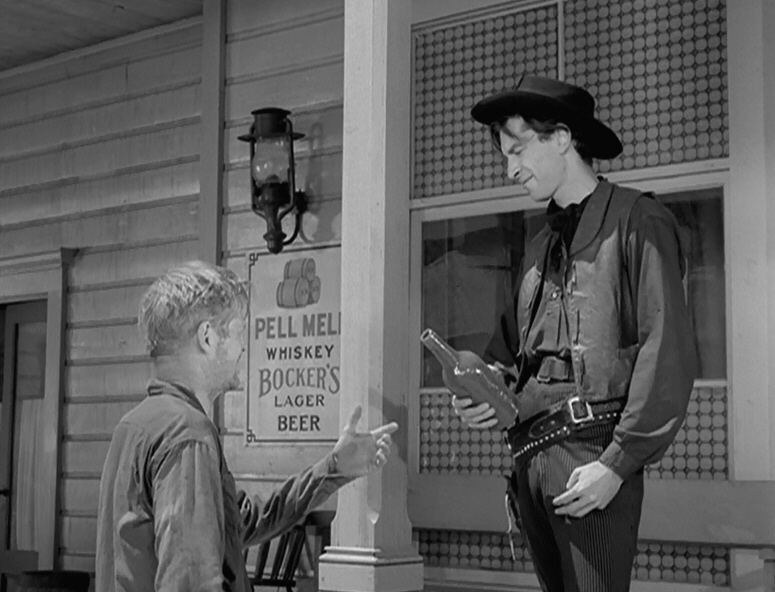
I think very highly of this episode. The more I watch it the more I enjoy it. We travel to the old West for this episode. We meet the town drunk Al Denton who was brilliantly played by Dan Duryea. A gunfighter named Dan Hotaling played by a young Martin Landau is making a fool of Denton by making him sing “How Dry I Am” for whiskey. He picks on Denton one too many times.
The show also has a mystical character (but of course…it’s the Twilight Zone) named Henry J. Fate and he tries to help Denton to redeem himself. I can’t say enough about Dan Duryea’s acting in this episode. The transformation of Denton and the nice twist at the end makes this a great episode.
You get to know Al Denton and feel for him as he was an old gunfighter and it drove him to drinking…will he be forced into that line of work again?
This episode was written by Rod Serling
Rod Serling’s Opening Narration:
Portrait of a town drunk named Al Denton. This is a man who’s begun his dying early—a long, agonizing route through a maze of bottles. Al Denton, who would probably give an arm or a leg or a part of his soul to have another chance, to be able to rise up and shake the dirt from his body and the bad dreams that infest his consciousness. In the parlance of the times, this is a peddler, a rather fanciful-looking little man in a black frock coat. [A revolver mysteriously appears on the ground next to Denton] And this is the third principal character of our story. Its function: perhaps to give Mr. Al Denton his second chance.
Summary
In the Old West, the drunkard Al Denton is bullied by the gunman Dan Hotaling to get some booze. The mysterious Henry J. Fate observes the humiliation and Al Denton finds a revolver on the street. When Dan sees Al Denton with a revolver in his hand, he challenges the drunk to a gunfight. Fate observes again and makes a movement with his hand that will change the life of Al Denton.
Rod Serling’s Closing Narration:
Mr. Henry Fate, dealer in utensils and pots and pans, liniments and potions. A fanciful little man in a black frock coat who can help a man climbing out of a pit—or another man from falling into one. Because, you see, fate can work that way, in the Twilight Zone.
CAST
Rod Serling … Narrator (voice)
Dan Duryea … Al Denton
Martin Landau … Dan Hotaling
Jeanne Cooper … Liz
Malcolm Atterbury … Henry J. Fate
Ken Lynch … Charlie
Arthur Batanide … Leader
Bill Erwin … Man
Robert Burton … Doctor
Doug McClure … Pete Grant
This song has a very garage band sound. It was a minor hit in 1986. The Del Fuegos were an alternative band that was eventually signed to RCA later in their career. They were touring the same circuit as REM and The Replacements.
The Zanes brothers Dan and Warren formed the band in Boston in the early eighties. The brothers had a hard time getting a long and supposedly still do. Tom Petty became a fan of them and appeared on one of their songs. They also opened up for Tom Petty and the Heartbreakers on a tour.
Warren quit the band after the 3rd album. He went to college and received a Ph.D in Visual and Cultural Studies. Zanes is the former vice president of education and public programs for the Rock and Roll Hall of Fame and Museum. He ended up writing Tom Petty’s biography shortly before Petty’s death.
This song was written by lead singer Dan Zanes and bass player Tom Lloyd, it was one of the first hits for the band. The Del Fuegos got some attention when Miller beer featured them in a national beer commercial as part of their “Made the American Way” campaign, which got them a lot of exposure and also some critical scorn, as commercials were seen as selling out at the time.
After that commercial their creditability suffered. In the current time having your song in a commercial helps you tremendously and no one things anything about it…but in the 20th century it didn’t go over well. The band would hear “sell out” on tour.
After the commercial though… they did get better tours and more money. This song peaked at #87 in the Billboard 100 in 1986.
I Still Want You
Seasons change and lessons get learned It’s been awhile, but my heart burns It said, I still want you
And that’s all I’ll do Spend my time just thinking about you Said, I still want you
The car we bought together just started to rust The world we made came between the two of us I still want you
When the day was through We drive through town my arm around you Said, I still want you
I tried so hard just to fill your cup I tried so hard just to fill it up But you only drift away, you drift away Now you only drift away, you drift away
I hear the rain coming down The leaves start to fall I hear your voice I remember it all Said, I still want you
And that’s all I’ll do Spend my life just thinking about you Said, I still want you
I tried so hard, tried to fill your cup I tried so hard just to fill it up But you only drift away, you drift away
And baby, I still want you I still want you I said, I still want you
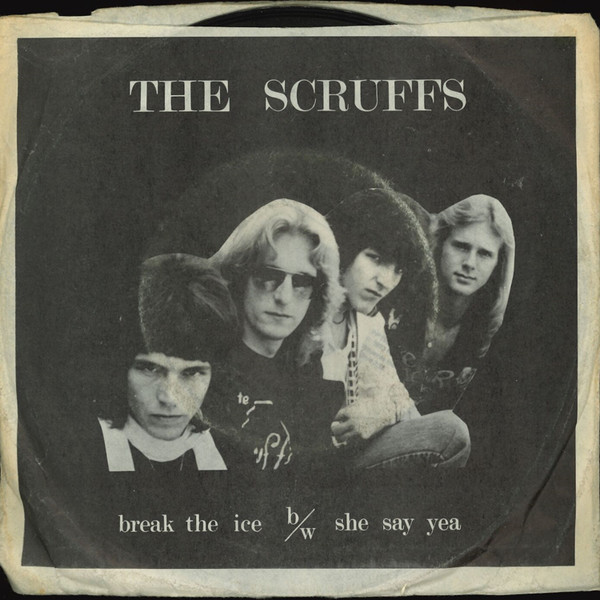
Memphis in the early 1970s was more than Big Star. Many power pop bands and artists were coming out of there at that time. Not many made it huge but many were recognized later. They formed in 1974 and released their first album Wanna Meet The Scruffs? in 1977. Like the others around this period. Many of the power pop musicians worked with each other. The Scruffs worked with Alex Chilton, Tommy Hoehn, and Jim Dickinson. Break the Ice was the first single off of the album. It reminds me of the Raspberries.
To show what some rock critics thought of the band…here is Robert Christgau (rock critic):
Only a sucker for rock and roll could love this record, and I am that sucker. A middle-period Beatles extrapolation in the manner of Big Star (another out-of-step Memphis power-pop group on a small, out-of-step Memphis label), it bursts with off harmonies, left hooks, and jolts of random energy. The trouble is, these serve a shamelessly and perhaps permanently post-adolescent vision of life’s pain, most of which would appear to involve gurls. To which objection the rockin’ formalist in me responds, “I wanna hear ‘Revenge’ again.”
Pretty good endorsement right? That is just one of many but again they just couldn’t break through. They did not have the influence like Big Star did but they were a great power pop band. I listened to all of this album and that jangle of the guitar is infectious. The song was a regional hit but was not played outside of Memphis too much. They did move to New York in 1978 had some high profile gigs at CBGB and Max’s Kansas City.
The Band broke up in 1981 but Stephen Burns the singer, guitar player, and songwriter would continue recording albums under the Scruffs name into the 2010’s…with Peter Buck from REM guesting on the 2011 Kill! Kill! album .
This is a great opening song and the band used it as an opener for many of their concerts. The song is autobiographical in many ways. It was an open letter to their new record company at the time…”But I’ll sign my contract baby, and I want you people to know That every penny that I make, I’m gonna see where my money goes”
I wrote this post a while back…A Sound Day just told me that today is the 47th anniversary of this album…Second Helping was released on April 15th 1974.
MCA was Lynyrd Skynyrd’s record company. This song is based on how they were signed. The “Yankee Slicker” that is mentioned in the song is no other than Al Kooper. They actually were signed for $9,000.
The “seven years of hard luck” in the opening line is the time from 1966 to 1973. 1966 was when the group changed their name to Lynyrd Skynyrd, and 1973 was when their first album was released.
This song was on their second album called Second Helping. While Skynyrd were in Los Angeles in The Record Plant in a studio, the Eagles were recording in another. One day they were shocked when John Lennon came to see Kooper to talk music and see what he was working on. Lennon’s presence overwhelmed the band so much that they began to fumble over notes they had played thousands of times, Rossington admitted. Lennon introduced himself and shared small talk with the musicians.
After recording “Sweet Home Alabama,” Lynyrd Skynyrd performed at the “Sounds of the South” press party. According to the booklet included with their box set, “When Skynyrd hit the stage with a roaring version of ‘Workin’ For MCA,’ written especially for the event, the party stopped while 500 hardened industry vets stood on chairs to get a glimpse of the unknown band.” A few months later, Lynyrd Skynyrd opened for The Who on their “Fallout Shelter” tour.
The song was written by Ed King and Ronnie Van Zant.
From Songfacts
In spite of the suspicious tone to this song, “Workin’ For MCA” had its perks. Al Kooper, in his memoir Backstage Passes and Backstabbing Bastards, goes to great lengths to describe the studio where Second Helping, Skynyrd’s second album, was recorded. The Record Plant in Los Angeles was a Hollywood crib of decadence and hedonism, with all the hallmarks of 1970s sleaze. Jacuzzis and bedrooms in the building, squealing groupies bounding naked down the halls, and a staff which had standing orders to cater to every whim of the guests. And as for the decor, if it wasn’t wood paneled, it was tie-died.
Workin’ For MCA
Seven years of hard luck, comin’ down on me From the Florida border, yeah up to Nashville, Tennessee I worked in every joint you can name, mister every honky tonk Along come Mr. Yankee Slicker, sayin’ maybe you’re what I want
[Chorus:] Want you to sign your contract Want you to sign today Gonna give you lots of money Workin’ For MCA
Nine thousand dollars, that’s all we could win But we smiled at the Yankee Slicker with a big ol’ Southern grin They’re gonna take me out to California, gonna make me a superstar Just pay me all of my money and mister maybe you won’t get a scar
[Chorus:]
Suckers took my money since I was seventeen If it ain’t no pencil pusher, it got to be a honky tonk queen But I’ll sign my contract baby, and I want you people to know That every penny that I make, I’m gonna see where my money goes
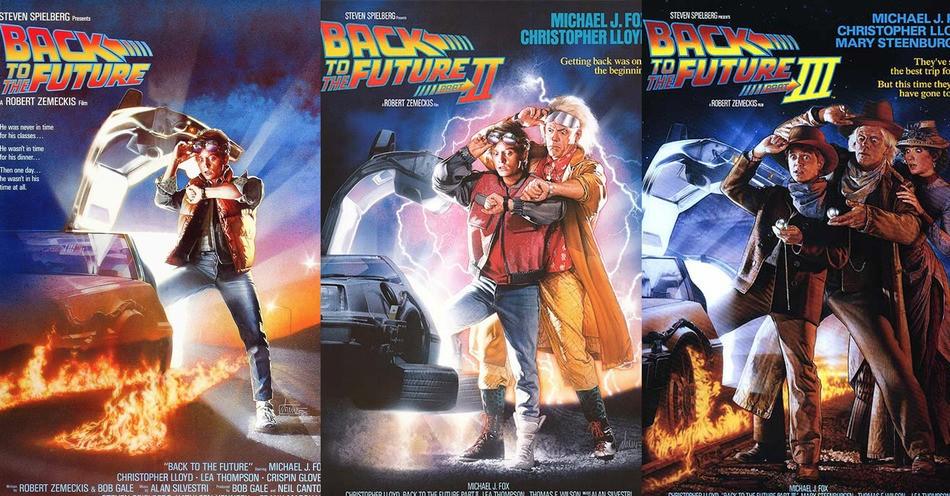
I was telling someone the other day…if you wanted a movie to define a decade…except for John Hughes movies…Back to the Future would be the one for the 1980s.
This movie trilogy has been copied, parodied, praised, and analyzed. The original movie came out in 1985…the year I graduated, and it fit the times so well.
Bob Gale, the writer, is said to have taken inspiration from a look at his father’s yearbook and dreaming about meeting him when he was younger. The basic idea, later formed along with Zemeckis, was having the characters travel inside a refrigerator using the energy of a nuclear blast. After rewrites
At the time we saw these future products that seemed unreal. Now many of them have become real…fingerprint activated payment devices, video-calling, augmented-reality glasses, wearable tech, intelligent home appliances, personal drones, hands-free gaming devices, and even hoverboards have made an appearance.
The movies left their imprint in a huge way.
The first movie to me is the best. As far as liking them…my order from best to worse is the order they came in. The first one introduced us to the 2 main characters…Marty and Doc Brown. Marty’s parents and Biff were also important to the story.
The second movie really crosses itself out! After undoing a mistake by Marty…and I can’t blame him one bit for buying the sports book. The movie ends up where we left off…and then Doc ended up in the west and setup the 3rd movie. Plus, the movie predicted the Cubs winning the World Series and they were only off by one year. They predicted in 2015 and they won it in 2016.
The last movie was good but not as good as the other two. You have Marty and Doc in the old west plus a descendant of Biff to be the bad guy. You also get an appearance from one of the hottest rock bands of the 80s…ZZ Top. The series concludes when Marty is back in 1985 with Jennifer and they get a visit by Doc and family to finish things out.
It’s a movie (any of the three) that I can pick up on in the middle or near the end and watch. Watch these movies and you are back in the 80s…so go find a DeLorean and let’s go back and watch the premier.
I list the plots below…like we need any of them, but they are there just in case and yes there are spoilers.
Summaries by IMDB
Back To The Future 1985
It is the year 1985. Marty McFly, a mild-mannered high school student, stopped by Dr. Emmett L. Brown’s laboratory to play around with an amplifier. Then he receives a message from Doc that he needs help from him for Doc’s latest invention, the time machine made out of a DeLorean sports car that can travel through time instantaneously when it reaches a speed velocity of 88 MPH. Then, Doc was gunned down by Libyan Nationalists, Marty makes an effort to escape from the Libyans by using the time machine. Then Marty accidentally warps himself into 1955. Where he meets both of his parents when they were teenagers, then Marty unintentionally interrupts his parent’s first meeting together, he then finds a younger version of Doc and together they try to find a way to get Marty’s parents-to-be back together, and to get Marty back to 1985.
Back To The Future II 1989
This movie begins where Back to the Future ended; with Marty, Doc and Jennifer going into the future to help Marty and Jennifer’s children. After doing that they return to 1985. But when they arrive they discover that things are not as they remember it. There’s a casino which is owned by, of all people, Biff. Marty learns that his father was killed a few years ago and his mother is now married to Biff. Marty meets with Doc who thinks he knows what happened. Somehow Biff got his hands on a book from the future which has in it all sports results and he used it to bet on sports and amass his fortune. Marty said he considered doing that but Doc nixed it. Somehow the Biff from the future discovered about the time machine and Marty’s plan and used the time machine to give his younger self the book. So they have to find out when Biff got the book so they can take it away from him. So Marty goes to see him and confronts him about it and Biff also tells him that he was the one who killed George. Marty and Doc then go back to, of all places, 1955 on the day of the school dance. So Marty tries to get the book while trying to avoid being seen by Doc’s younger self and himself who’s getting ready to go back to 1985. Marty at times gets the book but when Biff calls him a coward, Marty gets incensed which leads to him losing the book so he has to try and get it again.
Back To The Future III 1990
With the Almanac destroyed by Marty McFly and the timeline back on its original course, things are not all well. Dr. Emmett L. Brown and the time machine were somehow struck by lightning, and Marty somehow received a letter from Doc that he is okay, and in the year 1885. Marty and the 1955 Doc fix up the time machine after digging it up from a mine, then Marty discovers a gravestone with Doc’s name on it, indicating that he will be killed by a man named Buford Tannen (Biff’s great-grandfather). Marty makes an effort to travel to 1885 to save Doc from his bleak future. But Marty damages the time machine causing Marty and Doc to have to figure out how to get back to 1985. Unfortunately, this will not be easy with Doc madly in love with schoolteacher Clara Clayton, and with Tannen causing constant trouble for Marty and Doc.
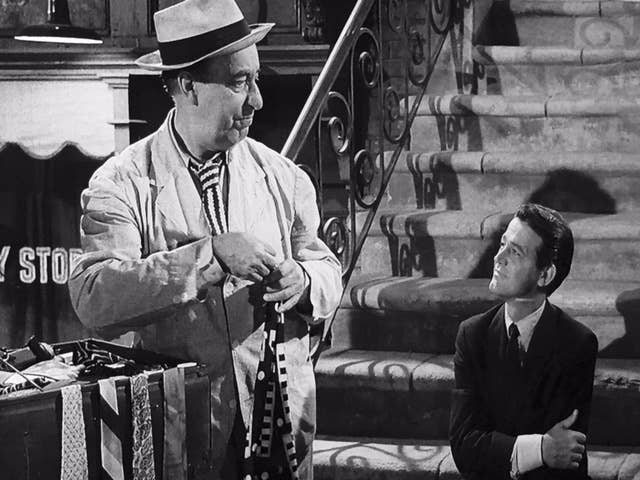
This is a good episode of The Twilight Zone. It’s the first time we meet Death. He comes in different forms in the Twilight Zone. 73 year old Ed Wynn does a superb job as a salesman and a Santa Claus figure in the neighborhood. He is beloved by people but especially kids.
Murray Hamilton also is great as Mr. Death. He is very business like and he treats the job like any other job with deadlines and commitments. I must wonder what people thought in 1959 watching a show with Death stalking someone so businesslike.
Murray Hamilton is probably better remembered for his role playing Mr. Robinson in the 1967 film The Graduate.
Dana Dillaway who played Maggie: The scene where I was hit by the car was kind of morbid… I remember they kept spritzing the actor who was driving the car with a water spray bottle, who came around to see if I was okay while laying in the street… there is a publicity shot of me laying there and it’s kind of morbid!”
This show was written by Rod Serling
Rod Serling’s Opening Narration:
Street scene: Summer. The present. Man on a sidewalk named Lew Bookman, age sixtyish. Occupation: pitchman. Lew Bookman, a fixture of the summer, a rather minor component to a hot July, a nondescript, commonplace little man whose life is a treadmill built out of sidewalks. And in just a moment, Lew Bookman will have to concern himself with survival – because as of three o’clock this hot July afternoon, he’ll be stalked by Mr. Death.
Lou Bookman is a street vendor; a pitchman, making a living selling what he can from his valise – radios, toys, ties and the like. After a long day, he returns to his shabby apartment to find someone waiting for him, someone he saw near where he had been selling that day. That person turns out to be Mr. Death who is there to tell Lou that his time on Earth has come to an end and that his “departure” will be at midnight. Lou tries to forestall his death by asking for a delay until he’s able to make a big sales pitch. It’s all a ruse however and Mr. Death shows him that his actions have consequences. As a result, Lou makes the pitch of his life.
Rod Serling’s Closing Narration:
Lewis J. Bookman, age sixtyish. Occupation: pitchman. Formerly a fixture of the summer, formerly a rather minor component to a hot July. But, throughout his life, a man beloved by the children, and therefore, a most important man. Couldn’t happen, you say? Probably not in most places – but it did happen in the Twilight Zone.
CAST
Rod Serling … Narrator (voice) Ed Wynn … Lou Bookman Murray Hamilton … Mr. Death Dana Dillaway … Maggie Polanski Jay Overholts … Doctor Merritt Bohn … Truck Driver
The early Who singles were first heard in the UK much more than America. They were really exciting and raw and different from anyone else. I first heard this song on the great compilation album Meaty Beaty Big and Bouncy. The album was made up of singles and many of them were not heard in America much at all when they were originally released.
It was released both as the B-side to “The Kids Are Alright” in the U.S., and as the A-side of a single that peaked at #32 in the UK in 1965. Both singles were released by Shel Talmy without the permission of the Who and were a result of a legal dispute between Talmy and the band at the time and an attempt to sabotage the release of the band’s chosen single “Substitute”.
This was the first song that Pete Townshend took the lead vocal on.
Pete Townshend on the song: “is about a guy on the run from a chick about to pin him down for breach of contract. What this song was screaming from behind lines like ‘It’s a legal matter, baby, marrying’s no fun/It’s a legal matter, baby, you got me on the run’ was, “I’m lonely, I’m hungry, the bed needs making.’ I wanted a maid, I suppose.”
A Legal Matter
I told you why I changed my mind
I got bored by playing with time
I know you thought you had me nailed
But I’ve freed my head from your garden rails
Now it’s a legal matter, baby
You got me on the run
It’s a legal matter, baby
A legal matter from now on
My mind’s lost in a household fog
Wedding gowns and catalogs
Kitchen furnishings and houses
Maternity clothes and baby’s trousers
Now it’s a legal matter, baby
Marryin’s no fun
It’s a legal matter, baby
A legal matter from now on
I told you why I changed my mind
I got bored by playing with time
I know you thought you had me nailed
Well, I’ve freed my head from your garden rails
Now it’s a legal matter, baby
You got me on the run
It’s a legal matter, baby
A legal matter from now on
You ain’t the first and you ain’t the last
I gain and lose my women fast
I never want to make them cry
I just get bored, don’t ask me why
Just wanna keep doing all the dirty little things I do
And not work all day in an office just to bring my money back to you
Sorry, baby
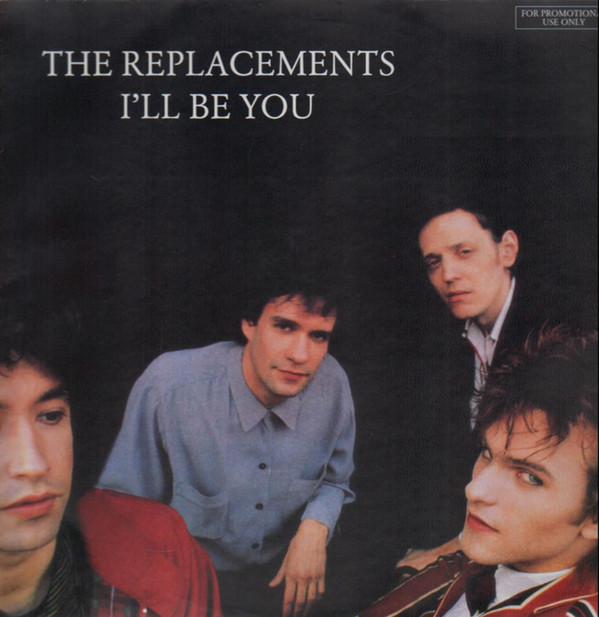
This song was on their Don’t Tell A Soul album. The sound of this album turned a lot of the older fans off. In order to get more radio play the record company brought in Chris Lord-Alge to mix the album. The album had a lot of those eighties effects used to enhance the music. The result was pop sounding Replacements album.
This was the closest the Replacements came to having a “hit.” It peaked at #51 in the Billboard 100 and #1 on the Modern Rock Charts in 1989. The song did expand their audience with younger kids coming to see them without knowing their back catalog. This was an annoyance to some of the band members who some nights didn’t play I’ll Be You.
The line, “Left a rebel without a clue” was later borrowed by Tom Petty into his hit, “Into the Great Wide Open,” in 1991. The Replacements opened up for Petty in his 1989 tour with the Heartbreakers.
Below are two mixes. The one above the lyrics was the original one with the pop album mix. The top one came off a box set without the pop sheen of the original album.
I’ll Be You
If it’s a temporary lull
Why’m I bored right outta my skull?
Man, I’m dressin’ sharp an’ feelin’ dull
Lonely, I guess that’s where I’m from
If I was from Canada
Then I’d best be called lonesome
And if it’s just a game
Then I’ll break down just in case
Oh yeah, we’re runnin’ in our last race
Well, I laughed half the way to Tokyo
I dreamt I was Surfer Joe
An’ what that means, I don’t know
A dream too tired to come true
Left a rebel without a clue
And I’m searching for somethin’ to do
And if it’s just a game
Then we’ll hold hands just the same
So what, we’re bleeding but we ain’t cut
And I could purge my soul perhaps
For the imminent collapse
Oh yeah, I’ll tell you what we could do
You be me for a while
I’ll be you
A dream too tired to get to
Left a rebel without a clue
Won’t you tell me what I should do?
Oh if it’s just a lull
Why’m I bored right outta my skull?
Oh yeah, keep me from feeling so dull
And if it’s just a game
Then we’ll break down just in case
Then again, I’ll tell you what we could do
You be me for a while
You be me for a while
And I’ll be you
A good episode to start the series. They would explore this topic of being alone in more episodes to greater affect but a good debut. How new this must have been on the tv landscape at the time. On the DVD set Rod Serling is shown in a short clip trying to sell the series to the network with previews of coming episodes. My guess is the first episode they didn’t want to air a really strange one.
This one has the Twilight Zone twist ending and the moral. Rod Serling wrote this episode. The episode originally featured Westbrook Van Voorhis as narrator. When Voorhis was unavailable for later episodes, Serling re-recorded the narration himself for consistency.
Opening narration:
“The place is here, the time is now, and the journey into the shadows that we’re about to watch could be our journey.”
Summary
A man finds himself walking down a country road, not knowing where nor who he is. He comes across a diner with a jukebox blaring and hot coffee on the stove – only there’s no one there. A little further down the road, he comes to the picturesque town of Oakwood, and finds, it too, seems deserted. The only sounds he hears are a clock tower, and a pay phone ringing. At the local movie theater, an ad for Battle Hymn (1957) leads him to believe he’s in the Air Force. In spite of no people to be found, he can’t shake off the feeling, he’s being watched.
Closing narration:
“Up there, up there in the vastness of space, in the void that is sky, up there is an enemy known as isolation. It sits there in the stars waiting, waiting with the patience of eons, forever waiting…in the Twilight Zone.”
Earl Holliman Earl Holliman … Mike Ferris
James Gregory James Gregory … Air Force General
Paul Langton Paul Langton … Doctor
James McCallion James McCallion … Reporter #1
John Conwell John Conwell … Air Force Colonel
Jay Overholts Jay Overholts … Reporter #2 (as Jay Overholt)
Carter Mullally Jr. Carter Mullally Jr. … Air Force Captain (as Carter Mullaly)
Garry Walberg Garry Walberg … Reporter #3 (as Gary Walberg)
Jim Johnson Jim Johnson … Air Force Staff Sergeant
To kick off reviewing the Twilight Zone episodes… I thought this was appropriate.
This song was a great example of MTV’s clout. It was in heavy rotation and it paid off for the band. It peaked at #10 in the Billboard 100 and #13 in Canada in 1983.
I have to wonder how the landscape of music would have changed without MTV in the 80s. Some bands hated videos because it could change the songs perception. Many wanted people to make up their own mind about songs and not think of “guitarists in leather pants.”
TheTwilight Zone was written by Golden Earring’s lead guitarist George Kooymans. He was inspired not by the famous TV series of the same name, but by the Robert Ludlum novel The Bourne Identity, which would later be turned into a popular movie.
The song’s intro will stick in your head for days…kind of like the intro to the Twilight Zone TV series a repeating riff. I was happy to hear this song at the time. I knew them for Radar Love and any seventies rock group in the 80s was nice to hear.
Golden Earring was a Dutch band and they were formed in Hauge in 1961. They were a long lasting band. George Kooymans sadly announced this year that he is suffering from ALS and the band officially dissolved.
From Songfacts
Right out front, note that this song has nothing to do with Manhattan Transfer’s “Twilight Zone.” One is not a cover of the other.
The song and especially the video tell the story of an espionage agent, on the run from enemy spies before being cornered. The cover of the album Cut (from which this was the only single) shows a scene repeated in the video, of a bullet slicing through the Jack of Diamonds playing card. The card is supposed to represent the rogue agent.
Interestingly, there was at least one episode of the original Twilight Zone TV series which was also a spy drama. Namely, episode #149 from season five, “The Jeopardy Room,” is about a Soviet KGB agent who wants to defect, but he ends up pinned in a hotel room under surveillance from a hit man and his accomplice, who sadistically make him play a game for his life. And it’s one of the few episodes where a gun is fired – “When the bullet hits the bone,” indeed!
Get ready for a nostalgia blast: This song was also used as the theme to the Twilight Zone pinball machine. This was part of Bally Midway’s series of “Superpin” arcade pinball games that were based on TV shows – other pinball games in the series were based on Star Trek and The Addams Family.
Fittingly, this song is also sometimes used as bumper music for the radio show Coast to Coast AM, the all-night paranormal talk show which also more frequently uses “A Hazy Shade of Winter.”
The video is yet another whose early airplay on MTV paid off. In MTV Ruled the World – The Early Years of Music Video, Rick Springfield talks about the MTV Effect: “The difference that I saw was, before MTV, you’d have to be on like your third successful album before people started recognizing you at the airport. But once MTV hit, you had that one hit single, and you were as recognizable as if you were around for three or four years. It was so instant. That was the power of television.
Twilight Zone
Somewhere in a lonely hotel room there’s a guy Starting to realize that eternal fate has turned its back on him It’s two A.M.
It’s two A.M. (It’s two A.M.) Fear is gone (fear is gone) I’m sitting here waiting The Gun still warm (the gun still warm) Maybe my connection is tired of taking chances
Yeah, there’s a storm on the loose Sirens in my head Wrapped up in silence, all circuits are dead Cannot decode, my whole life spins into a frenzy
Help, I’m steppin’ into the twilight zone Place is a madhouse, feels like being cold My beacon’s been moved under moon and star Where am I to go now that I’ve gone too far? (Oh oh oh)
Help, I’m steppin’ into the twilight zone Place is a madhouse, feels like being alone My beacon’s been moved under moon and star Where am I to go now that I’ve gone too far?
So you will come to know When the bullet hits the bone So you will come to know When the bullet hits the bone
I’m fallin’ down a spiral, destination unknown Double crossed messenger, all alone Can’t get no connection, can’t get through Where are you?
Well the night weighs heavy on his guilty mind This far from the borderline When the hitman comes He knows damn well he has been cheated
And he says Help, I’m steppin’ into the twilight zone Place is a madhouse, feels like being cold My beacon’s been moved under moon and star Where am I to go now that I’ve gone too far? (Oh oh oh)
Help, I’m steppin’ into the twilight zone Place is a madhouse, feels like being alone My beacon’s been moved under moon and star Where am I to go now that I’ve gone too far?
So you will come to know When the bullet hits the bone So you will come to know When the bullet hits the bone When the bullet hits the bone
Help, I’m steppin’ into the twilight zone Place is a madhouse, feels like being cold My beacon’s been moved under moon and star Where am I to go now that I’ve gone too far? (Oh oh oh)
Help, I’m steppin’ into the twilight zone Place is a madhouse, feels like being alone My beacon’s been moved under moon and star Where am I to go now that I’ve gone too far?
So you will come to know When the bullet hits the bone So you will come to know When the bullet hits the bone So you will come to know When the bullet hits the bone So you will come to know When the bullet hits the bone When the bullet hits the bone When the bullet hits the bone When the bullet hits the bone When the bullet hits the bone When the bullet hits the bone When the bullet hits the bone When the bullet hits the bone When the bullet hits the bone
Before we get to my number 1 episode…This has been so much fun I’m going to start a huge project. I want to review every Twilight Zone…all 156 episodes…so that will be next…my top 10 is not enough. I’ll start with S01E01 and work myself through and skip the 10 I’ve covered in this section. I’ve never rated shows or movies before but I will try that as well.
This one gets a 5 out of 5 ★★★★★
Since ratings are subjective to who ever is going it…this is my system
★★★★★ This would be an exceptional episode…to me anyway
★★★★☆ This would be above the already high standards of the show
★★★☆☆ This would be a good to very good episode
★★☆☆☆ This would be just a little below average, the 4th season might see this
★☆☆☆☆ This would be a don’t watch…I don’t think this will ever be seen but I’m watching them all over to be sure
Now for my number 1 Twilight Zone episode! This one has my favorite element…Time Travel. How cool would it be to go back and meet your 11 year old self? Episodes 2-156 could change in my rankings but this one remains my favorite.
They really did this episode right. They followed through with everything. You were not wanting for answers at the end. It wasn’t just Martin who figured out he was back in time. It resolves it self nicely…with a valuable lesson. There are spoilers past this.
If you are new to the Twilight Zone this is a great one to start with…
Rod Serling’s opening narration:
Martin Sloan, age thirty-six. Occupation: vice-president, ad agency, in charge of media. This is not just a Sunday drive for Martin Sloan. He perhaps doesn’t know it at the time, but it’s an exodus. Somewhere up the road he’s looking for sanity. And somewhere up the road, he’ll find something else.
Gig Young plays Martin Sloan who does a great job in this episode. Many people try to go back home but it’s never the same because of progress and change…Martin Sloan DOES go home and everything is the same…he even sees himself as a boy…and meets his parents…again. Also…watch out for a 4 year old Ron Howard…soon to be forever known as Opie on the Andy Griffith Show.
Rod Serling wrote this episode.
Martin Sloan (Gig Young), a 36-year-old executive, stops in a fuel station off an isolated country road. Not far away, 1.5 miles, is the sight of his hometown, Homewood, he’s very curious about all the kinds of things that shaped his childhood. Martin ventures to take a closer look, first he goes to an old shop where he used to get ice cream sodas. Martin is surprised to see the prices haven’t changed still a dime for a three scoop ice cream soda. Walking around Martin meets a kid, who is his old neighbor. It is then that he realizes he’s in 1934, when he was only 11-years-old. Things get complicated when he bumps into the young Martin, follows him to his house and meets with his parents. They won’t believe him when Martin says he’s in fact their grown up son. Later, Martin insists in talking with young Martin. He finds him on a carousel, where the child gets hurt falling. Martin will learn, after talking to his father, that every man has his own time and is perhaps better off not looking to the past.
Enough of my favorite episode…what is your favorite?
Rod Serling’s closing narration:
Martin Sloan, age thirty-six, vice-president in charge of media. Successful in most things but not in the one effort that all men try at some time in their lives—trying to go home again. And also like all men, perhaps there’ll be an occasion, maybe a summer night sometime, when he’ll look up from what he’s doing and listen to the distant music of a calliope, and hear the voices and the laughter of the people and the places of his past. And perhaps across his mind there’ll flit a little errant wish, that a man might not have to become old, never outgrow the parks and the merry-go-rounds of his youth. And he’ll smile then too, because he’ll know it is just an errant wish, some wisp of memory not too important really, some laughing ghosts that cross a man’s mind, that are a part of the Twilight Zone.
The Georgia Satellites came out swinging with a number 2 hit in 1986 called Keep Your Hands To Yourself. At the time of Madonna and synth driven songs it was great to hear this band out of Georgia that played raw roots rock and roll.
I almost always post the original songs but I do like the Satellites versions of these two. Both of these songs could have fit in nice with CCR’s catalog.
These two songs they tacked together worked perfect with each other. They are both John Fogerty songs that he released in the mid seventies. The Satellites were on the same touring circuit as the Replacements, REM, and The Fresh Young Fellows. What separated them at the time with those bands was that hit. They also had a minor hit with a song called Battleship Chains.
The two songs were on John Fogerty’s self titled album released in 1975. The Satellites released their version on their greatest hits released in 1993. The lead singer Dan Baird had quit by this time. The band is still together but with only one original member…lead guitarist Rick Richards.
Almost Saturday Night/Rockin’ All Over the World
Oh-ho-ho
Outside my window I can hear a radio And I know that motor wagon’s gettin’ ready to fly And it’s almost Saturday night
Bye-bye, tomorrow Jody’s gone to a rodeo And I know some good ol’ boys are gettin’ ready to ride And it’s almost Saturday night
Gonna push the clouds away Let the music have its way Let it steal your heart away And I know, I know it
Outside me ringin’ The night train is bringing me home When you hear that locomotion gettin’ ready to ride And it’s almost Saturday night
Gonna push the clouds away Let the music have its way Let it steal my heart away And I know, I know it
Outside me ringin’ The night train is bringing me home When you hear that locomotion gettin’ ready to ride And it’s almost Saturday night
Outside my window Outside, it’s almost Saturday night Outside me ringin’ Outside, it’s almost Saturday night
Well, I like it, I like it, I like it, I like it I li-li-like it, li-li-like it Here we go, rockin’ all over the world Well, I like it, I like it, I like it, I like it I li-li-like it, li-li-like it Here we go, rockin’ all over the world Well, I like it, I like it, I like it, I like it I li-li-like it, li-li-like it Here we go, rockin’ all over the world Well, I like it, I like it, I like it, I like it I li-li-like it, li-li-like it Here we go, rockin’ all over the world
Van Duren is a power pop musician in Memphis and was managed by Andrew Loog Oldham. He made his first album called Are You Serious in 1978. He is another power pop rocker from the early seventies in Memphis. He was in a band with Big Star’s Chris Bell and drummer Jody Stephens called The Baker Street Regulars. He auditioned as the 2nd guitar player for Big Star just before the band’s demise.
Chemical Fire is an excellent power pop song. It could have very well been played on late seventies radio. It still sounds fresh today.
His style has been compared to Paul McCartney and Todd Rundgren. Personally I hear Marshall Crenshaw also. Big Star wasn’t noticed until over a decade after they recorded their last album. Van Duren waited 30 years before he was properly found.
His second album Idiot Optimism was recorded in 1979 and because of record company problems its wasn’t released until twenty years later. Memphis power artists could not catch a break. There is a documentary about Van Duren that was released in 2019 and his two first albums were re-released also.
According to a documentary, the record label had Scientology connections, which meant they attempted to convert all the acts on their roster. Duren, already in debt, just wanted to finish his record, which he correctly thought was his one shot at stardom. It flopped, and by the mid-80s, after another near-miss with another band, Good Question, his musical career was as good as over.
No this is not a review of the new movie…just memories from a Godzilla fan. I will say though that I did enjoy the movie…The fight scenes are the best I’ve scene through this monster universe reboot…I felt like I was 10 again.
When I was a kid I loved monster movies. Huge monsters stomping through cities. My monster was and still is Godzilla. I watched all of those Japanese movies of the sixties and seventies and loved them. I will still watch one every once in a while. When I was around 11 I bought a monster book while on vacation in Florida. I took it to school and some jerk stole it. I would love to have that book back…so if you are out there…come on…give me the book back!
My best friend growing up was named Ronald…he was and still is a huge Elvis fan and I am a huge Beatles fan (we both liked older music) and we would have good natured arguments over who was better. I still think I’m right!
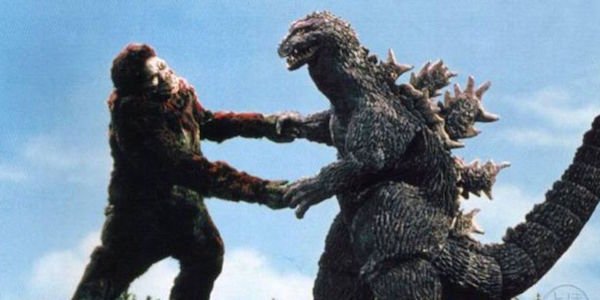
Ok back to Monsters he was a Kong fan and Godzilla was my guy…another argument we would gladly have. After he sees the new movie we will probably have it again.
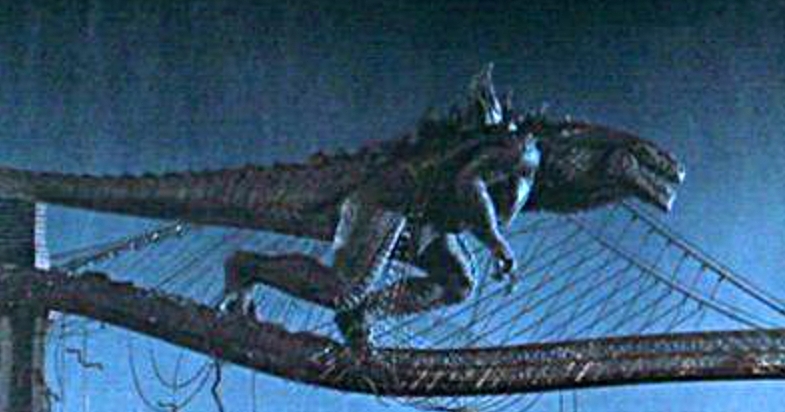
In 1998 a new Godzilla was in the theaters. I was so excited… normally I’m not a big fan of CGI BUT… with monster movies…oh yes! I could not believe what they did to my Godzilla…they made him a large sidewalk lizard. They changed his looks and sound. I didn’t think they would ever come out with anything again. At the time I did get some of the recent Japanese Godzilla movies and they were good.
1998
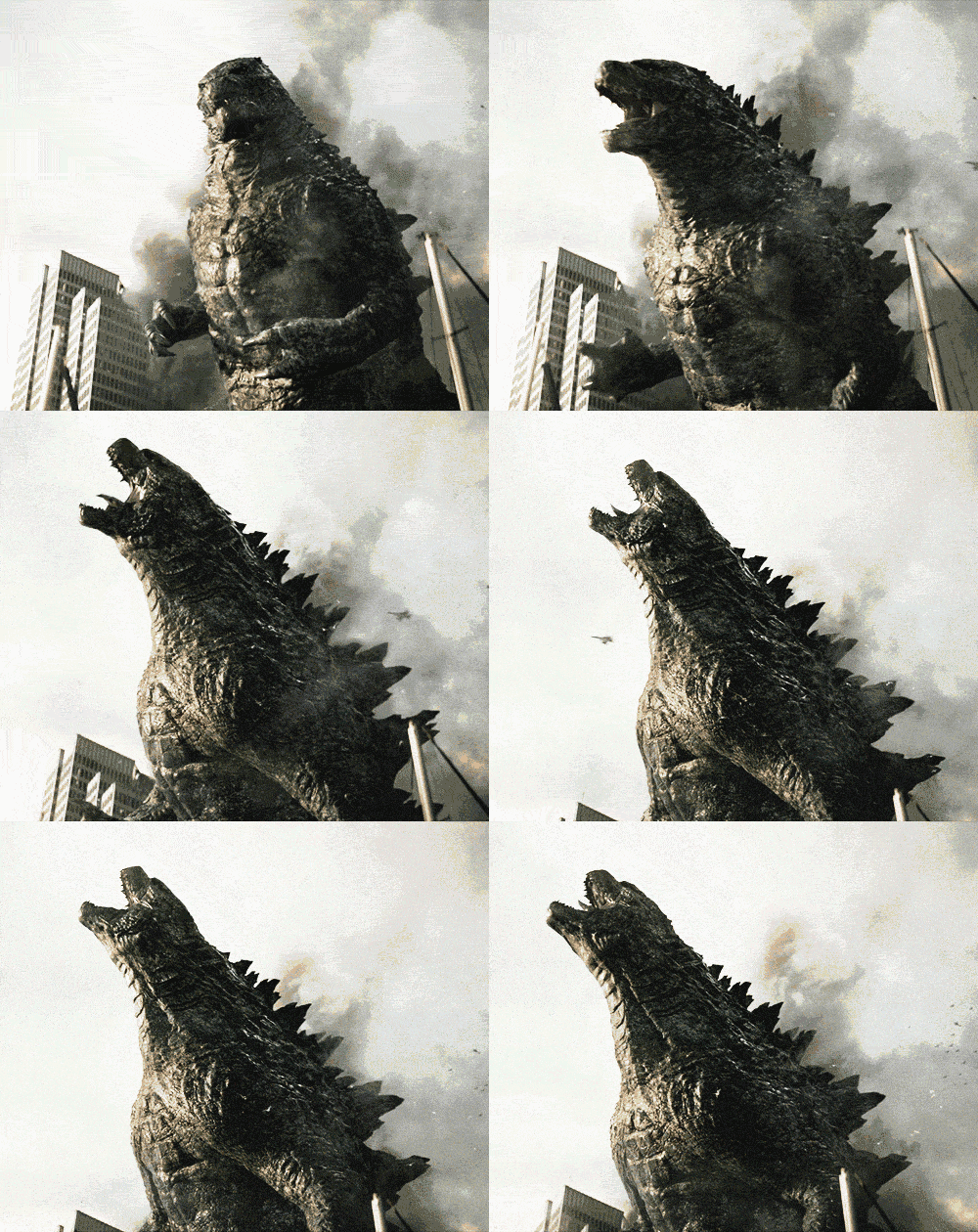
In 2014 the movie Godzilla came out and I felt like a kid again. This was the Godzilla (minus the man in the suit) that I loved as a child…
We all know Kong connects with people and that is a great thing but Godzilla is just so cool with his atomic breath and dorsal plates. Godzilla looks at people like ants but as long as we don’t attack him…he is cool with us…except if you own tall buildings on the coast! If you do you better get a lot of insurance.
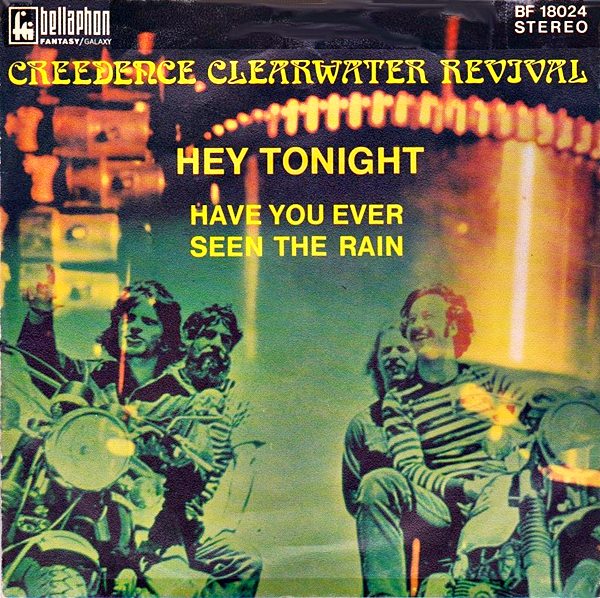
Hey Tonight is the B-side of “Have You Ever Seen the Rain,” the first single Creedence Clearwater Revival released in 1971 and the last the band launched as a quartet. Both single cuts also appear on the Pendulum album. What terrific singles this great band produced like clockwork.
This is yet another song that has the character “Jody” in it. Songs like It Came Out Of The Sky, Hey Tonight, and a solo Fogerty song called Almost Saturday Night. He has never said one way or another if it was based on someone or just sounded good in the song…probably the latter.
John Fogerty wrote “Hey Tonight” and the band rehearsed it before the group hit the studio in 1970. Fogerty thought the song was one of the better ones on the album despite the fact it was written in while the band was in turmoil at that time. Creedence Clearwater played “Hey Tonight” live for a first time at the private party the band held to music writers at Cosmo’s Factory on December 12th, 1970.
John not only wrote, sings and plays guitar on every track, he also overdubbed organ and saxophone (which he played himself) on some of the songs.
Have You Ever Seen The Rain?/Hey Tonight peaked at #9 in the Billboard 100 and #1 in Canada in 1971.
This video below is not a real video to the song but it shows some footage I haven’t seen before of the band as a trio after Tom quit. The song is right below this one.
Hey Tonight
Hey, Tonight, Gonna be tonight, Don’t you know I’m flyin’ Tonight, tonight. Hey, c’mon, Gonna chase tomorrow Tonight, tonight.
Gonna get it to the rafters, Watch me now. Jody’s gonna get religion All night long.
Hey, c’mon, Gonna hear the sun Tonight, tonight.
Gonna get it to the rafters, Watch me now. Jody’s gonna get religion All night long.
Aaaah! Hey, Tonight, Gonna be tonight, Don’t you know I’m flyin’ Tonight, tonight. Tonight, tonight.












 PowerPop... An Eclectic Collection of Pop Culture