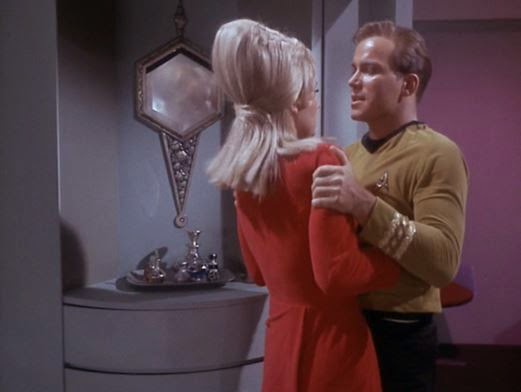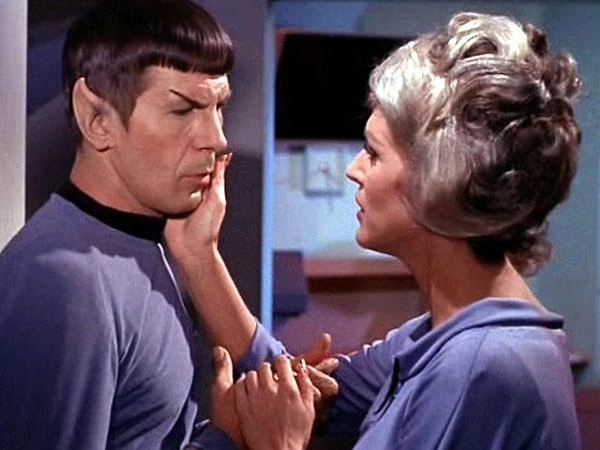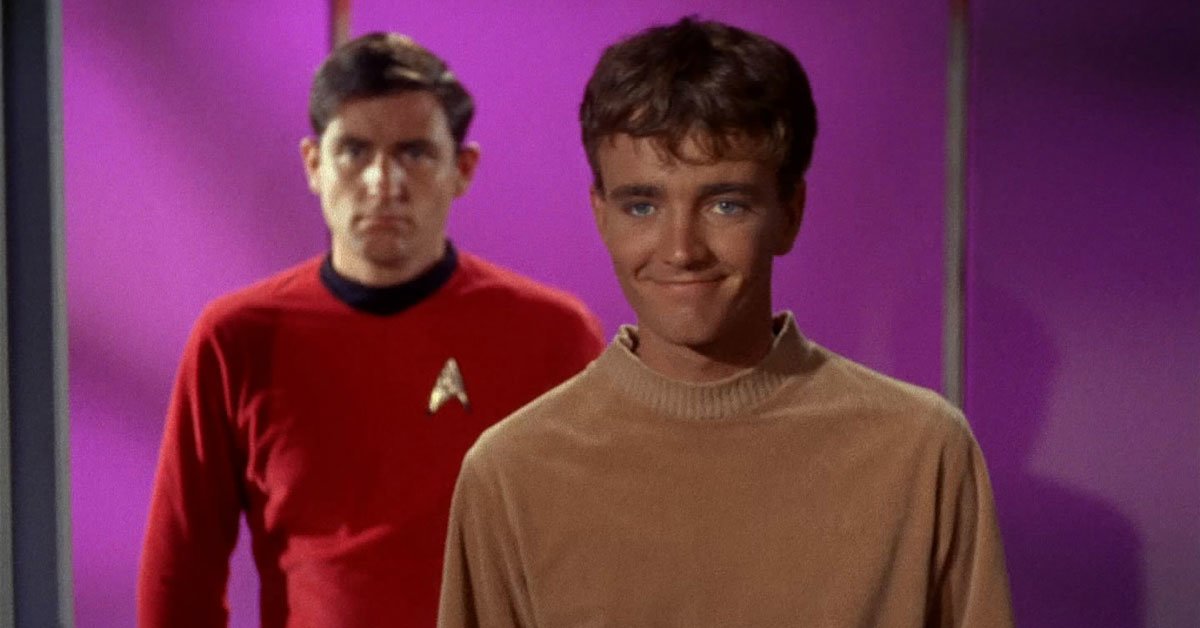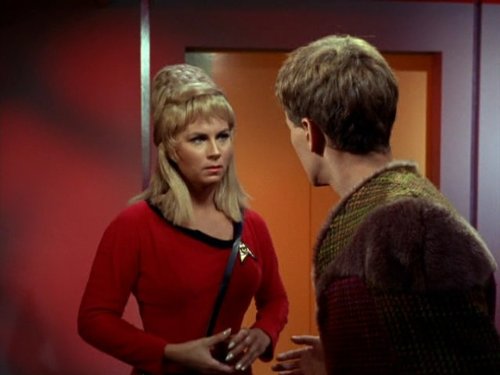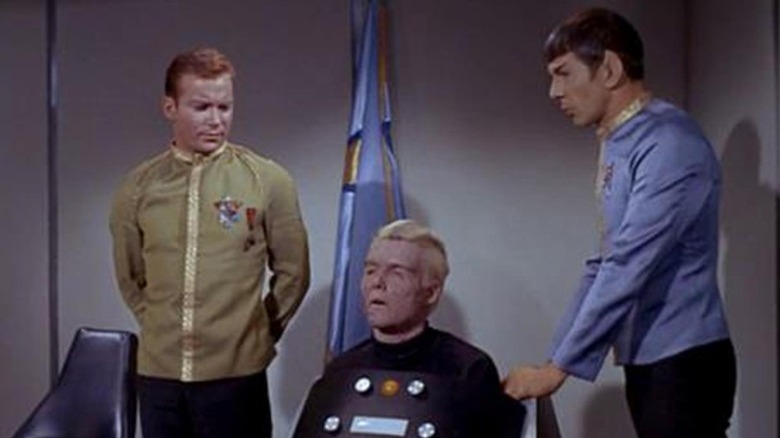
Star Trek – The Menagerie Part 1

★★★★★ October 27, 1966 Season 1 Episode 11

If you want to see where we are…and you missed a few…HERE is a list of the episodes in my index located at the top of my blog.

This show was written by Gene Roddenberry

My star rating system goes to 5…but this one…I would give a 12 if I could…that includes Part 1 and Part 2. I point this episode out to people who have never seen the original series before. This two-parter would be a great place to start. It gives you some history of the crew, especially Spock and Captain Pike from the unseen pilot at the time.

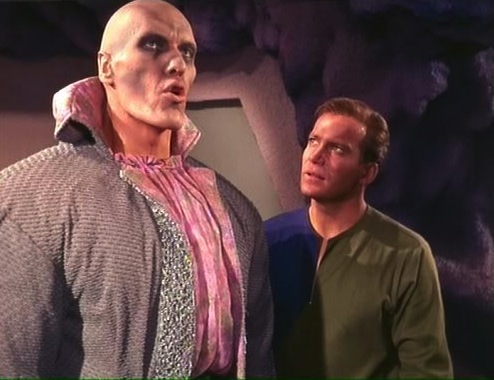
Spock charged with mutiny and court marshal? Has the world gone mad? This is part one of a two-parter. They used the unseen pilot (The Cage) to make this one. It takes place 13 years after the episode The Cage that had Captain Pike.

You don’t know how Spock will not be in trouble for all the chaos he has caused. When Spock turns himself into Bones to be arrested…the shock of all the crew around them is priceless. When Kirk tries to pry the Enterprise from Spock’s control he fails. Spock has thought this out down to every single detail.

I have to give Roddenberry a lot of credit for writing this one. He took the pilot and developed this fantastic story around it and got to use the pilot’s footage that the network rejected. It could have been easily a patch job all the way around but it’s a great episode. Even some of the plot holes were explained. While watching the video screen of detailed past events, Kirk remarked that the Enterprise didn’t keep that good of video records but it was explained.
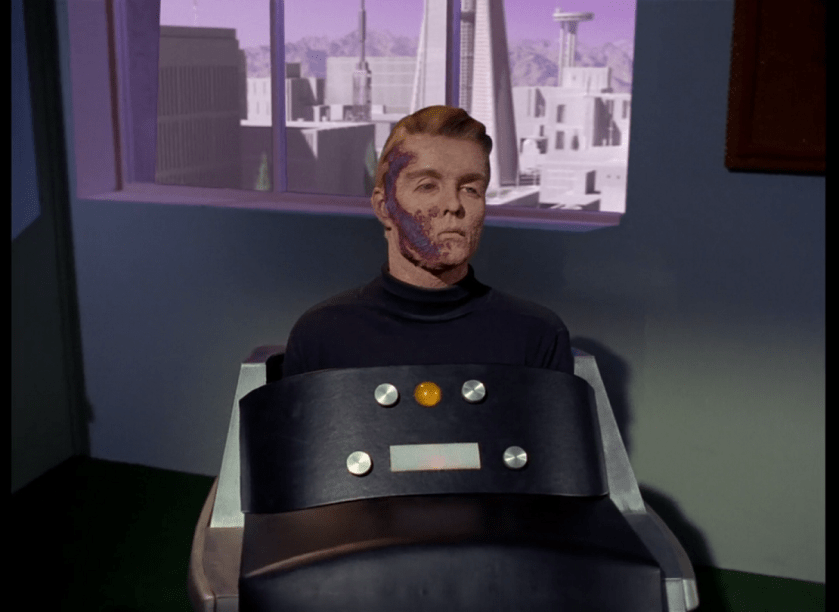
Captain Pike

We learn that Vulcans are fiercely loyal, and seeing that Spock served under Captain Pike for over 11 years it would make sense that he still feels a sense of loyalty to his old Captain. Even though Pike rejects Spock’s plan with a series of beeps (Pike cannot talk) Spock still takes Pike against his will with good intentions. We also learn that Vulcans cannot lie, but it certainly appears that Spock did indeed lie in this episode, which seems impossible until Bones acknowledges that Spock is only half-human.

I remember first watching this episode in the 1980s. I totally bought the plot and still do. You are thinking, why is Spock risking everything, his career, and life, against his old Captain’s wishes? Kirk trusts Spock and is shocked when he finds out Spock has taken over the ship. You can see the hurt and confusion in the character. Good acting all the way around. Part II is just as good and has the payoff.

From IMDB

Although scenes from Star Trek: The Cage (1966) feature Jeffrey Hunter as Captain Christopher Pike, he was unavailable and unaffordable for the framing story into which the scenes were to be inserted. Sean Kenney, an actor who resembled Hunter, was used instead. He plays the mute, crippled Captain Pike, now wheelchair-bound after an accident.

According to James Doohan, Gene Roddenberry originally wanted to sell the failed pilot as a theatrical film. However, it needed to be expanded with additional material to reach the feature length. Roddenberry planned to film the crash of the Columbia on Talos IV, because it didn’t require Jeffrey Hunter, who was neither available nor affordable to reprise his role as Captain Pike. However, plans for the feature release were soon abandoned.

The “frame” story of Captain Pike’s injury and abduction to Talos IV was necessitated because the producers’ inability to use the original pilot Star Trek: The Cage (1966) in its unedited form. Normally, series producers count on being able to use the pilot as an episode of the season, despite possible minor changes from the regular series, such as differences in uniform styles, terminology, and props; the second pilot, Star Trek: Where No Man Has Gone Before (1966), was used despite such discrepancies. But the differences between the series and the original pilot were too stark to be used unaltered – without the elaborate “frame” placing it 13 years in the past.

This episode was the first Star Trek material to be officially released by Paramount on any home video format in the United States, first in 1980 on VHS and Betamax, followed by a RCA SelectaVision CED videodisc release in 1981, and a US Laserdisc release in 1984.

The novel “Burning Dreams” establishes that the subspace message summoning Enterprise to Starbase 11 was not a fabrication by Spock, but instead an illusion by the Talosians making Spock think he actually did receive a message. The Talosians then spoke telepathically to Spock, making him aware of Pike’s condition and asking him to bring Pike to Talos IV. The novel also establishes that at the end of the teaser, when Spock tells Pike, “I have no choice,” their conversation continued with Spock telling Pike that the Talosians were aware of his condition and wanted to give him a chance for a better life than what he had and that Spock actually asked Pike for permission to try to help him.

Jeffrey Hunter accepted the lead role of Captain Christopher Pike in “The Cage”, the first pilot episode of Star Trek, but declined to film a second Star Trek pilot, requested by NBC in 1965, deciding to concentrate on films. Footage from the original pilot was subsequently adapted into a two-part episode called “The Menagerie” and screened in 1966. It wasn’t until 1988 that it was screened intact as a filler episode in Star Trek: The Next Generation (1987) due to a writers’ strike.

There have been many reasons given for Jeffrey Hunter not continuing as the captain. The one that rings most true is from Shatner’s book, where he relates that Hunter’s wife was a constant irritant to the production staff, with never-ending demands for how Hunter was to be handled and treated. Other books say that his wife came to a screening pitch for the pilot and declared that he wasn’t interested because he “was a movie star”. It seems likely the second story is a cover for the first and the first is the closest to the truth. Roddenberry decided that he wanted to be rid of Hunter, his wife, and their demands, and so never actually offered him a contract to continue.

It seems the nation of Cuba still exists in the 23rd century. During the court-martial scene, if you look carefully (to the right of where Captain Kirk is seated), you can see a flag stand in the back of the room. The flag hanging on it has the blue stripes and red triangle, which are part of the Cuban flag.

Summary

The Enterprise is summoned to Starbase 11 only to learn that no one there sent a message to them. The base is home to Fleet captain Christopher Pike, Kirk’s predecessor as Captain of the Enterprise. Unfortunately, Pike has recently had a serious accident, rendering him unable to speak and confining him to an automated chair. The base Commander, Commodore Mendez, begins to suspect Mr. Spock but Kirk defends his friend. That is until Spock takes command of the Enterprise and heads to Talos IV, a planet for which all Federation personnel are forbidden to visit under the sentence of death. Kirk and Mendez catch up with the Enterprise in a space shuttle at which time Mr. Spock is arrested. At his trial, he pleads guilty and offers mitigating circumstances in the form of detailed video logs recounting the time the Enterprise visited Talos IV 13 years before with Pike in command and Spock as its science officer.

CAST

William Shatner … Captain James Tiberius ‘Jim’ Kirk
Leonard Nimoy … Mister Spock
Jeffrey Hunter … Captain Christopher Pike (archive footage)
Susan Oliver … Vina (archive footage)
Malachi Throne … Commodore José Mendez
Majel Barrett … Number One / Enterprise Computer (archive footage) (as M. Leigh Hudec)
Peter Duryea … Lt. José Tyler (archive footage)
John Hoyt … Dr. Phil Boyce (archive footage)
Adam Roarke … C.P.O. Garrison (archive footage)
DeForest Kelley … Doctor Leonard ‘Bones’ McCoy
James Doohan … Lieutenant Commander Montgomery ‘Scotty’ Scott
Nichelle Nichols Nichelle Nichols … Lieutenant Nyota Uhura
Sean Kenney … Christopher Pike
Hagan Beggs … Lt. Hansen
Julie Parrish … Miss Piper
Bill Blackburn … Lieutenant Hadley (uncredited)
Tom Curtis … Jon Daily (uncredited)
Frank da Vinci … Guard (uncredited)
Brett Dunham … Guard (uncredited)
Sandra Lee Gimpel … Third Talosian (archive footage) (uncredited)
James Holt … Starfleet Officer (uncredited)
Clegg Hoyt … Transporter Chief Pitcairn (archive footage) (uncredited)
Anthony Jochim … Third Survivor (archive footage) (uncredited)
Bob Johnson … First Talosian / Transporter Chief Pitcairn (voice) (uncredited)
Jon Lormer … Dr. Theodore Haskins (archive footage) (uncredited)
Tom Lupo … Security Guard (uncredited)
Ed Madden … Enterprise Geologist (archive footage) (uncredited)
Leonard Mudie … Second Survivor (archive footage) (uncredited)
Eddie Paskey … Lieutenant Leslie (uncredited)
Jan Reddin … Enterprise Court Recorder (uncredited)
Serena Sande … Second Talosian (archive footage) (uncredited)
George Sawaya … Chief Humboldt (uncredited)
Georgia Schmidt … First Talosian (archive footage) (uncredited)
Meg Wyllie … The Keeper (archive footage) (uncredited)

Joan Jett – I Love Rock And Roll ….Under The Covers Week

Our small town got a record store in 1982. We had one in the seventies but it went out of business. In the new one…this is the first single I bought there. The store only lasted a year at the most but we enjoyed it while we had it. In 1982 you could not go to school, a store, or anywhere without hearing this song. If you didn’t hear it you heard someone hum it. Much like Another One Bites The Dust from two years earlier…you just couldn’t escape it.

In 2016 I saw The Who in Nashville and I didn’t know who was opening up. I was pleasantly surprised when Joan Jett was announced. She and her band were tight and very loud. The Who had ties with Jett back in 1979 as they helped finance Jett’s debut album Bad Reputation.

This was originally recorded by a British group called The Arrows in 1975, and it was written by their lead singer Alan Merrill and guitarist Jake Hooker. The song was released as a B-side with The Arrows’ “Broken Down Heart.” Co-writer Alan Merrill said  “That was a knee-jerk response to the Rolling Stones’ ‘It’s Only Rock ‘N’ Roll.’ I remember watching it on Top of the Pops. I’d met Mick Jagger socially a few times, and I knew he was hanging around with Prince Rupert Lowenstein and people like that – jet setters. I almost felt like ‘It’s Only Rock and Roll’ was an apology to those jet-set princes and princesses that he was hanging around with – the aristocracy, you know. That was my interpretation as a young man: Okay, I love rock and roll. And then, where do you go with that?”

The Arrows did get their own TV show called The Arrows Show. It ran from 1976-1977 in the UK for two full 14-week seasons on the ITV network. It was this show that Joan Jett saw in 1976. A fun fact about the song. The Arrows were based in England, where they don’t use dimes. At that time they would put a sixpenny in the jukebox to buy a song. That would have had a different ring to it, but the original producer Mickie Most liked dime because it sounded American,  and that’s the way The Arrows recorded it. Joan Jett didn’t really differ much from the Arrows version…just a little louder.

When the Runaways broke up in 1979, Joan Jett and her producer Kenny Laguna put her first solo album together with studio time and travel arrangements fronted by The Who. They struggled to get a record deal and had to form their own label, Blackheart Records, to release the album in America. Joan remembered The Arrows singing I Love Rock N Roll in 1976 while touring the UK and knew it sounded like a hit. She wanted the Runaways to cover the song but they turned it down. The reason they turned it down was that they had already covered a song called Rock and Roll by Lou Reed on their debut album and didn’t want another song with “rock” in the title at that time.

Jett recorded it with Paul Cook and Steve Jones of The Sex Pistols and released it as a B-side in 1979. Polygram Records owned that version of the song but they were not excited about the song or Joan Jett. They basically let her go and signed some of the other Runaways. Boy was that a mistake! Joan would end up being the best-known Runaway. Lita Ford was successful also along with Michael Steele with the Bangles but neither became as popular as Joan Jett…and this song was a big reason.

I like the original and both Jett covers. The hit version peaked at #1 on the Billboard 100, #1 in Canada, #1 in New Zealand, and #4 in the UK in 1982.

The album was called I Love Rock And Roll released in 1981. The album peaked at #2 on the Billboard Album Charts, #1 in Canada, #1 in New Zealand, and #25 in the UK in 1982.

The producers were Ritchie Cordell, Kenny Laguna, and Glen Kolotkin.

The song’s co-writer, Alan Merrill, died at 69 on March 29, 2020. Joan Jett offered condolences on Twitter, posting: “I can still remember watching the Arrows on TV in London and being blown away by the song that screamed hit to me.”

Joan Jett: “I think most people who love some kind of rock ‘n’ roll can relate to it. Everyone knows a song that just makes them feel amazing and want to jump up and down. I quickly realized, this song is gonna follow you, so you’re either gonna let it bother you, or you gotta make peace with it, and feel blessed that you were involved with something that touched so many people.”

Producer Kenny Laguna on Polygram Records: “They could care less about Joan Jett, they were busy signing every other Runaway. They thought Joan was the loser and they signed the other girls, who we’re all friends with, but I looked at the band and thought she was the Mick Jagger and Keith Richards of the band. The company decided that if I would pay the studio cost of $2,300, I could have all the rights, and I got three songs. I got ‘I Love Rock and Roll’ with The Sex Pistols, I got ‘You Don’t Own Me’ – they did a great version of the Lesley Gore hit, and they did a song Joan wrote called ‘Don’t Abuse Me.’ So I buy these songs back. In the meantime, Joan has a couple of fans. Rodney Bingenheimer of K-ROCK, KMAC in Long Beach, BCN in Boston, LIR in Long Island, they were playing The Sex Pistols’ kind of cruddy version of the song, and it was #1 on the alternative stations. It was really alternative music, they were way-out stations that would play some pretty adventurous stuff, that’s why they would play Joan, because Joan was not getting a record deal, Joan was way on the outside, like a Fugazi of her day. We saw some kind of potential there. I remember these guys from the big record distributors in Long Island kept calling and saying, ‘This is a hit record, we’re getting so many requests for it.’ So we cut it over and did a really good version of it.”

THE 1979 VERSION

I Love Rock and Roll

I saw him dancin’ there by the record machine
I knew he must a been about seventeen
The beat was goin’ strong
Playin’ my favorite song
An’ I could tell it wouldn’t be long
Till he was with me, yeah me, singin’

I love rock n’ roll
So put another dime in the jukebox, baby
I love rock n’ roll
So come an’ take your time an’ dance with me

He smiled so I got up and’ asked for his name
That don’t matter, he said,
‘Cause it’s all the same

Said can I take you home where we can be alone

An’ next we were movin’ on
He was with me, yeah me

Next we were movin’ on
He was with me, yeah me, singin’

I love rock n’ roll
So put another dime in the jukebox, baby
I love rock n’ roll
So come an’ take your time an’ dance with me

Said can I take you home where we can be alone

An we’ll be movin’ on
An’ singin’ that same old song
Yeah with me, singin’

I love rock n’ roll
So put another dime in the jukebox, baby
I love rock n’ roll
So come an’ take your time an’ dance with me

Creedence Clearwater Revival – I Heard It Through The Grapevine ….Under The Covers Week

Creedence cut through his song and stripped it bare with their version. I love Marvin Gaye’s version of this song but Creedence spun it into a garage band’s dream. I really like the steady drums that keep it tethered to earth. CCR’s drummer Doug Clifford played off of John Fogerty’s rhythm and it created the atmosphere of the song.

California Rasins - Heard It Through The Grapevine

This is embarrassing but this song really hit my radar through constant commercials in 1987. It was used in California Raisin commercials that played, and played, and played more. When I would go to Hardees for lunch…they would give me a plastic figure of one of the raisins. Yea…I collected them. Former drummer of the Jimi Hendrix Band of Gypsies, Buddy Miles, sang lead in those commercials.

Creedence’s album version was a whopping (I love using that word) 11-minute song. This was a change from their other compact songs. This of course was not an original. It was written by Norman Whitfield and Barrett Strong. Strong came up with the idea and asked Motown writers Holland-Dozier-Holland to work on it with him. They refused to credit another writer, so Strong took it to Whitfield, who helped put it together…so it was credited to Norman Whitfield and Barrett Strong.

In December 1975, CCR’s label Fantasy Records re-released the song as a single, which peaked at #43 on the Billboard 100 and #76 in Canada. This release came in the middle of some heated legal battles between the band and the label, which resulted in John Fogerty taking a 10-year break from making music. The song was edited down to a more reasonable length for radio.

The song was originally on their Cosmo’s Factory album released in 1970 which is possibly their best album.

Below….the first is one of the many commercials, the second was the single version, and the third is the album’s 11-minute version. 

I Heard It Through The Grapevine

Ooh-ooh, bet you’re wondering how I knew
‘Bout your plan to make me blue
With some other guy that you knew before?
Between the two of us guys, you know I love you more
Took me by surprise, I must say, when I found out yesterday

Ooh-ooh, I heard it through the grapevine
Not much longer would you be mine
Ooh-ooh, I heard it through the grapevine
And I’m just about to lose my mind
Honey, honey yeah

You know that a man ain’t supposed to cry
But these tears I can’t hold inside
Losing you would end my life, you see
‘Cause you mean that much to me
You could’ve told me yourself that you found someone else
Instead

I heard it through the grapevine
Not much longer would you be mine
Ooh-ooh, I heard it through the grapevine
And I’m just about to lose my mind
Honey, honey yeah

People say “You hear from what you see
Not, not, not from what you hear.”
I can’t help but being confused
If it’s true, won’t you tell me dear?
Do you plan to let me go
For the other guy that you knew before?

Ooh-ooh, I heard it through the grapevine
Not much longer would you be mine
Ooh-ooh, I heard it through the grapevine
And I’m just about to lose my mind
Honey, honey yeah

Ooh-ooh, I heard it through the grapevine
Not much longer would you be mine
Ooh-ooh, I heard it through the grapevine
And I’m just about to lose my mind
Ooh-ooh, I heard it through the grapevine
Not much longer would you be mine
Aah-aah, I heard it through the grapevine
And I’m just about to lose my mind
Honey, honey yeah

Star Trek –  The Corbomite Maneuver

★★★★1/2 November 10, 1966 Season 1 Episode 10

If you want to see where we are…and you missed a few…HERE is a list of the episodes in my index located at the top of my blog. 

This episode was written by Jerry Sohl and Gene Roddenberry

This was a really good episode. It’s a very dramatic and suspenseful episode. Kirk is seen as a commander worthy of the title as this episode shows his skills quite well. The Enterprise wanders into a part of space where they are warned to turn back and proceed no further…but that is not part of the 5-year mission.

Blalok

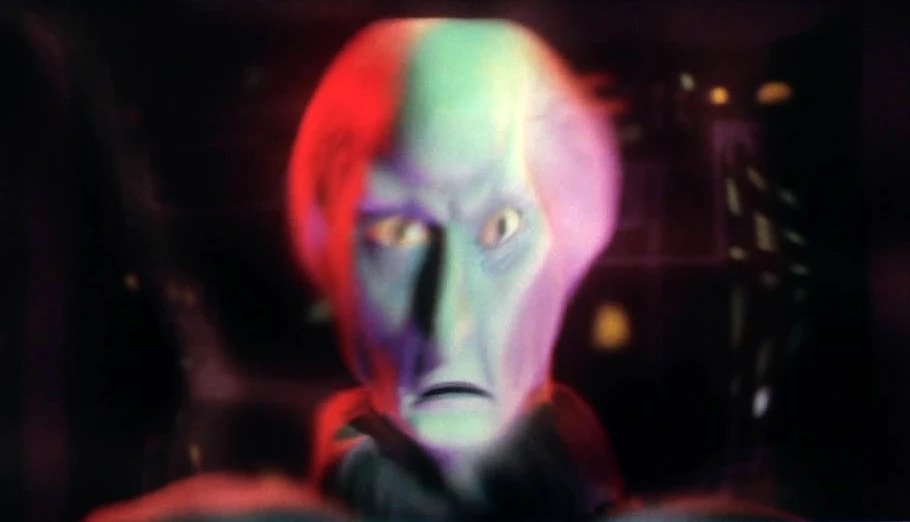
A mysterious alien attacker claims to be able to destroy the ship with no risk of anything stopping him, and therefore grants the crew ten minutes…but they didn’t count on Captain Kirk pulling victory out of defeat. I love the look of the alien as his image gets transmitted to the Enterprise… a very handsome young man. 

Kirk has a lot of boldness in this episode. He is risking the ship on a bluff but he didn’t have many options at that point.  I have to say, the most disturbing thing to me was the episode’s final reveal of Balok. His appearance and the ship’s interior design, mixed with the incongruous voice really had an uncomforting effect. The episode offers a good look at the political climate of the Cold War.

The ending of this episode will throw you. You will not see it coming. I watched this one for the first time in years a few weeks ago…and yes I completely forgot about the ending. Great episode. 

From IMDB

Although the script instructed Leonard Nimoy to emote a fearful reaction upon his first sight of Big Balok, director Joseph Sargent suggested to Nimoy that he ignore what the script called for and instead simply react with the single word “Fascinating.” The suggestion of this response helped refine the Spock character and provide him with a now-legendary catchphrase.

McCoy says “What am I, a doctor or a moon shuttle conductor?” which can be considered the first of the “doctor not a” quotes. In later days, the quote would have been phrased “I’m a doctor, not a moon shuttle conductor!”

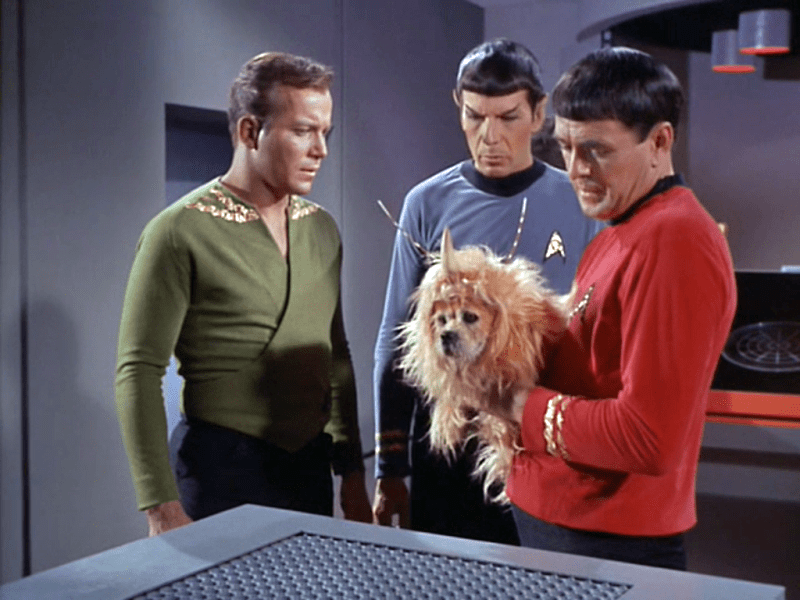
James Doohan’s wartime injury to his right hand (incurred at Normandy on D-Day) is briefly visible in the conference room scene when he passes a coffee thermos. Generally this was carefully hidden off-camera, but it can also be seen when he’s holding a phaser in Star Trek: Catspaw (1967), as he carries a large bundle of tribbles in Star Trek: The Trouble with Tribbles (1967), as he reverses the probe polarity in Star Trek: That Which Survives (1969) and very briefly in freeze-frame when he’s reaching into the box to restrain the evil dog in Star Trek: The Enemy Within (1966).

This episode was originally scheduled to air much earlier than it did, but the large amount of visual effects took several months to complete. The producers had to delay the planned airdate twice, before eventually broadcasting it as the tenth episode of the season.

Both in terms of its order on the production schedule, and its order of televised broadcast, this episode marks the very first time that the Enterprise fires its phasers. The actual burst that the ship fires at the warning buoy is unique to this episode.

Summary

In a section of unexplored space, the Enterprise comes across a marker of sorts that will not let it pass. They destroy the marker and move on but soon find themselves in conflict with an unknown alien who accuses them of trespassing and tells them they have only 10 minutes to live. Kirk decides it’s time to play a little poker and literally bluff his way out of the situation by telling the alien that the Enterprise has a device on board that will destroy the alien as well as the Enterprise. The bluff works but the alien turns out to be something quite unexpected.

CAST

William Shatner … Captain James Tiberius ‘Jim’ Kirk
Leonard Nimoy … Mister Spock
Anthony D. Call … Dave Bailey (as Anthony Call)
Clint Howard … Balok
DeForest Kelley … Doctor Leonard ‘Bones’ McCoy
Grace Lee Whitney … Yeoman Janice Rand
George Takei … Lieutenant Hikaru Sulu
James Doohan … Lieutenant Commander Montgomery ‘Scotty’ Scott
Nichelle Nichols … Lieutenant Nyota Uhura
Majel Barrett … Nurse Christine Chapel (voice) (uncredited)
Bill Blackburn … Lieutenant Hadley (uncredited)
Ted Cassidy … Balok’s Puppet (voice) (uncredited)
Frank da Vinci … Crewman (uncredited)
Walker Edmiston … Balok (voice) (uncredited)
Jeannie Malone … Yeoman (uncredited)
Sean Morgan … Crewman (uncredited)
Eddie Paskey … Lieutenant Leslie (uncredited)
Eddie Smith … Crewman (uncredited)
Ron Veto … Crewman (uncredited)

Star Trek – Dagger Of The Mind

★★★★1/2 November 3, 1966 Season 1 Episode 9

If you want to see where we are…and you missed a few…HERE is a list of the episodes in my index located at the top of my blog. 

This show was written by Shimon Wincelberg and Gene Roddenberry


This episode is excellent. Morgan Woodward played Dr. Simon van Gelder and did a superb job. He stated that the part of Van Gelder was perhaps the most physically and emotionally exhausting role he played…and it affected him for weeks. James Gregory as Dr. Tristan Adams turned in a nice performance as the sadistic doctor that has been corrupted by his power over the patients. James Gregory had a long successful career. He played on Barney Miller and many other shows.

Star Trek - Marianna Hill

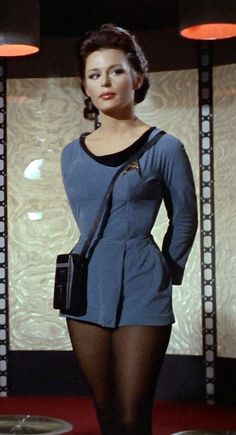
Marianna Hill as Helen Noel did a great job as well but I felt she was underutilized in the row. She played a psychologist who knew Kirk in the past and helps save him in this episode. Her character is independent, strong, and viral. She holds her own throughout the episode and displays a strong female, not usually common, for 1960s television.

This episode also shows Spock doing the first mind meld in the series with a distraught Dr. Simon van Gelder. Provocative, intriguing, and intelligent, with some good tension with some great acting, makes this one a must. This episode is a pure human drama that explores the consequences of not only experimentation on humans but also of the need for past experiences to define us.

From IMDB

In several interviews, Morgan Woodward noted that his work on the episode greatly affected him on both a personal and professional level. Woodward felt the part of Van Gelder was perhaps the most physically and emotionally exhausting role he played. He also stated his experience in playing the part resulted in his being in a largely anti-social state of mind for a few weeks following. However, Woodward, who would later play Captain Tracey in Star Trek: The Omega Glory (1968), credits his work on Star Trek in helping him to finally break away from his being typecast in Western roles.

James Doohan and George Takei do not appear in this episode. Scotty appeared in the original script, operating the transporter in the first scene, when Van Gelder is beamed aboard. His appearance was nixed by Robert H. Justman, who saw this as a way of saving costs by eliminating Doohan, who would have been paid $890 for the episode, and replacing him with a random performer (Anthony Larry Paul, playing Lieutenant Berkeley), hired for a much lower salary.

A shipping label produced for Star Trek: Deep Space Nine (1993) shows that a (now elderly) Dr. Van Gelder is still in charge of the Tantalus Penal Colony in the 2370s. TBF More likely to be the son or even grandson of the original Dr. Van Gelder given he would have to be at least 153 years old by the time of DS9.

This episode marks the first appearance of the Vulcan mind meld. The final shooting draft of this script had Spock placing his hands on Van Gelder’s abdomen while performing the mind meld. According to The Making of Star Trek, the mind meld was developed as an alternative to the scripts use of hypnosis to stabilize Van Gelder. They did not want to inaccurately depict hypnosis as a medical technique. Nor did they want to shoehorn into the script a pretext that Spock was qualified to act as a hypnotist in a medical capacity. Lastly, they did not want to risk accidentally hypnotizing viewers at home.

During filming of this episode, William Shatner was pulled away from the sound stage and rushed to a recording studio where, in 2 takes, he recorded the famous “Where No Man Has Gone Before” monologue, which had been re-written several times by different writers (mostly John D.F. Black). He read the first take flawlessly, but associate producer Robert H. Justman felt it should have a subtle echo, so he had the sound engineer create it for the second take. Since most of the effects sequences of the Enterprise were late and not yet been completed for the series debut, the opening credits were hurriedly assembled from existing shots from Star Trek: The Cage (1966) and Star Trek: Where No Man Has Gone Before (1966).

Summary

After a psychologically disturbed patient from the Tantalus penal colony, Dr. Simon Van Gelder manages to escape to the Enterprise, Dr. McCoy begins to suspect that something is amiss on the colony. Captain Kirk and Dr. Helen Noel beam down to the planet to investigate.

CAST

William Shatner … Captain James Tiberius ‘Jim’ Kirk
Leonard Nimoy … Mister Spock
James Gregory … Dr. Tristan Adams
DeForest Kelley … Doctor Leonard ‘Bones’ McCoy
Morgan Woodward … Dr. Simon van Gelder
Marianna Hill … Helen Noel
Nichelle Nichols … Lieutenant Nyota Uhura
Susanne Wasson … Lethe
John Arndt … First Crewman
Ed McCready … Inmate
Eli Behar … Therapist
Frank da Vinci … Lt. Brent (uncredited)
Walt Davis … Tantalus (uncredited)
Louie Elias … Inmate Guard (uncredited)
Ron Kinwald … Tantalus Inmate (uncredited)
John Hugh McKnight John Hugh McKnight … Inmate Guard (uncredited)
Eddie Paskey … Lieutenant Leslie (uncredited)
Anthony Larry Paul … Crewman (uncredited)


Star Trek – Miri

★★★★★ October 27, 1966 Season 1 Episode 8

If you want to see where we are…and you missed a few…HERE is a list of the episodes in my index located at the top of my blog. 

***Dave at A Sound Day has given me the honor to host his site today…check it out if you can***

This show was written by Adrian Spies and Gene Roddenberry

miri

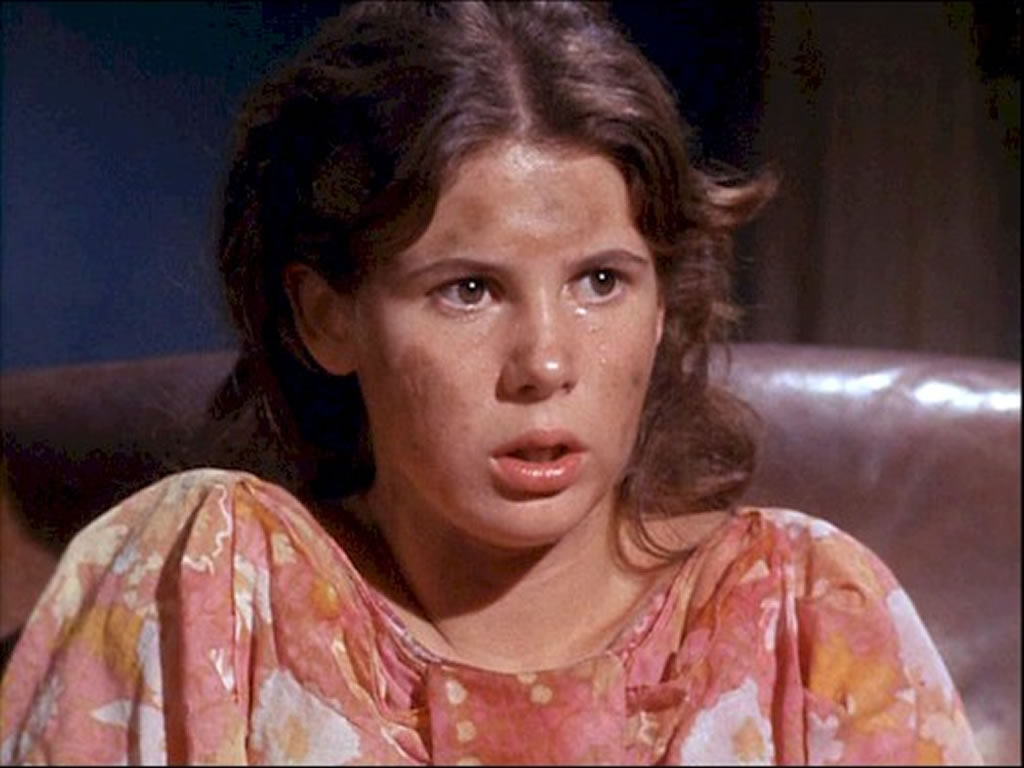
This is a wonderful episode of Star Trek. Miri is a name of a girl played by Kim Darby and she is brilliant in that role. I’m reminded of Lord of the Flies with a dash of a dark Peter Pan while watching this episode. A planet that is a replica of earth that has a disease that affects kids as soon as they start puberty. They start the symptoms with sores and then go berserk and die shortly thereafter. 

The problem started with the earlier people on the planet experimenting with trying to prolong life. They ended up creating a serious virus (hmmm been there done that). The catch is the kids do have prolonged lives and are hundreds of years old before they reach puberty but they still have the maturity of children. The crew get there and because of their age start contracting the disease. 

Bones and Spock are trying to come up with the vaccine while the children steal the communicators of the crew. Miri is a young woman about to hit puberty and is showing signs of the disease. She is not trusting of the Enterprise crew at first but then warms up to Captain Kirk and develops a crush on him. She is also jealous of Yeoman Janis Rand because of her close relationship with Kirk. She wants to help the captain and crew, to find a cure but she is scared and jealous. Can Kirk find the rest of the kids to get their help along with Miri?

This is one of my favorite episodes

From IMDB

Leonard Nimoy was asked to allow his children to appear as extras but Nimoy refused to let his children be involved in show business. His son, Adam Nimoy, did grow up to become a television director, including a few episodes of Star Trek: The Next Generation (1987).

The first of several “parallel Earth” plots in the series, contrived to save money by avoiding the necessity for “alien” sets, costumes, and makeup.

The outdoor scenes of this episode were filmed on the same back lot streets that also were used to create Mayberry on The Andy Griffith Show (1960), except that the streets were piled with debris and dirt to create the appearance that the town was in ruins. Several building exteriors familiar from Mayberry can be seen in those exterior shots, including the courthouse, Walker’s Drugstore, the Grand movie theater, Floyd’s barber shop, and the Mayberry Hotel.

John Decker and Scott Dweck are Grace Lee Whitney’s sons. As an adult, Scott would return in a feature film appearance as a Vulcan members of the Enterprise crew in Star Trek: The Motion Picture (1979).

Leonard Nimoy and Grace Lee Whitney both named this as one of their favorite episodes of the show. William Shatner was more critical, however, feeling that the story dragged and that the initial hook of “another Earth” was interesting, but didn’t amount to anything.

This episode has a number of connections to The Andy Griffith Show (1960). The outdoor scenes are shot on the streets of the set that stood in for the town of Mayberry. Visible are the old courthouse, barber shop, feed and grain store, Walker’s Drugs, bank, grocery store, the Grand movie theater; and the building with the small porch into which the crew runs is the old Hotel Mayberry. Michael J. Pollard, who plays Jahn, the leader of the Onlies, played Barney Fife’s bumbling cousin in The Andy Griffith Show: Cousin Virgil (1962). And, when Kirk asks Spock to estimate in what time period the town seems to be, Spock responds with “1960,” the year that series debuted.

Summary

The Enterprise receives an old-style SOS signal and finds on arrival a planet that is virtually identical to Earth. Kirk, Spock, McCoy, and Yeoman Rand beam down to the planet only to find that it is inhabited solely by children. Kirk befriends one of the older children, Miri, but they soon learn that experiments to prolong life killed all of the adults and that the children will also die when they reach puberty. They also learn that the children are in fact, very old. Soon, the landing party contracts the virus and has seven days to find a cure.

CAST

William Shatner … Captain James Tiberius ‘Jim’ Kirk
Leonard Nimoy … Mister Spock
Kim Darby … Miri
Michael J. Pollard … Jahn
DeForest Kelley … Doctor Leonard ‘Bones’ McCoy
Grace Lee Whitney … Yeoman Janice Rand
Keith Taylor … Jahn’s Friend
Ed McCready … Boy Creature
Kellie Flanagan … Blonde Girl
Stephen McEveety … Redheaded Boy (as Steven McEveety)
David L. Ross … Security Guard #1 (as David Ross)
Jim Goodwin … Farrell
John Megna … Little Boy
Tom Anfinsen … Crewman (uncredited)
John Arndt … Ingenieur Fields (uncredited)
Iona Morris … Little African American Girl (uncredited)
Phil Morris … Boy – Army Helmet (uncredited)
Eddie Paskey … Lieutenant Leslie (uncredited)
Darleen Anita Roddenberry … Flowered Dress Girl (uncredited)
Dawn Roddenberry … Little Blonde Girl (uncredited)
Irene Sale … Louise (uncredited)
Leslie Carol Shatner … Brunette Girl (uncredited)
Elisabeth Shatner … Girl in Red-Striped Dress (uncredited)
Scott Whitney … Small Boy (uncredited)


Jimmy Buffet – Come Monday

Buffet has always lived on the pop/country side of music…and soon after this, it was pop/country/tropical music. I bought his greatest hits in the 80s and I became a fan. I saw him live twice and if you ever want a concert that is more like a giant party or a Hawaiian Lūʻau…go see Buffet live. Also If you like tailgating before the concert… this is the man to see. His truly devoted fans are called “parrotheads.”

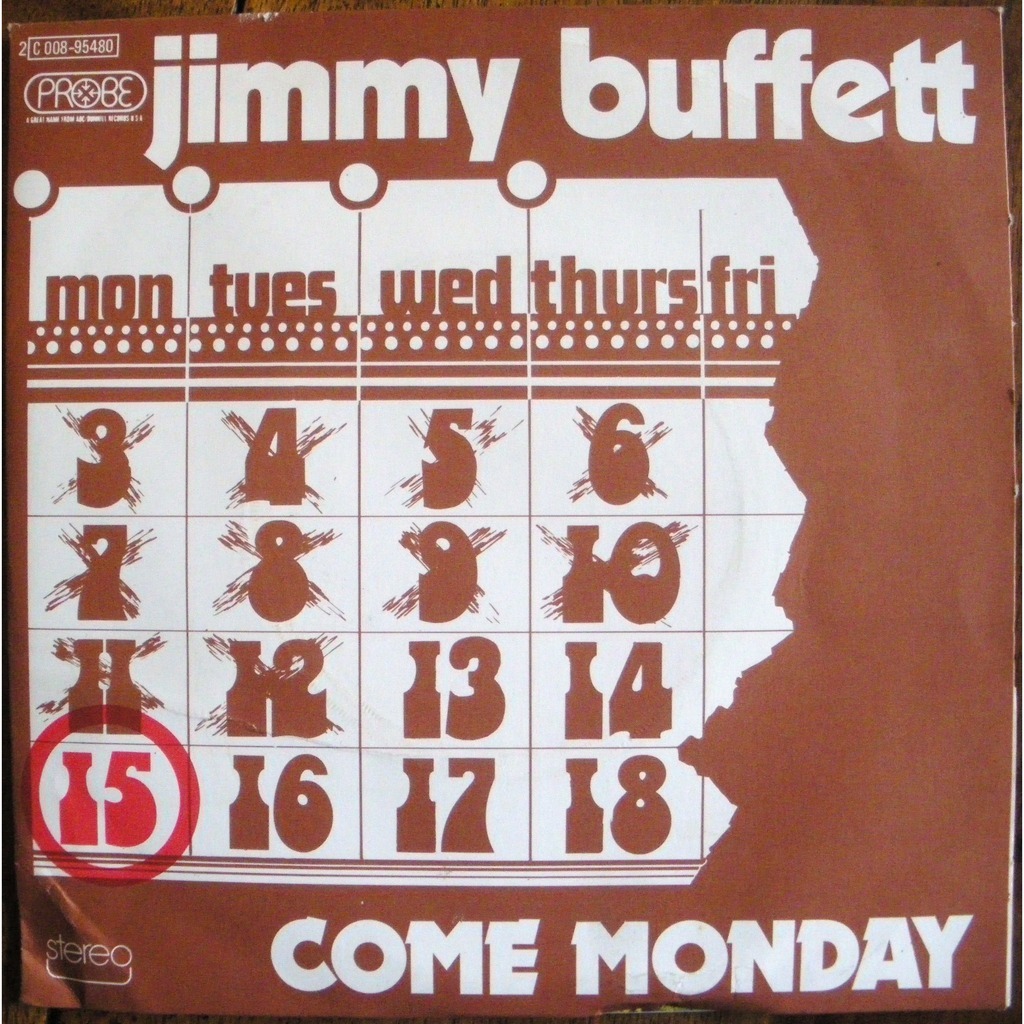
This song was written by Buffet and released in 1973 and peaked at #30 on the Billboard 100, #23 in Canada, and #58 on the Country Charts. The song was off of Living & Dying in ¾ Time and the album was Buffet’s first album to reach the top 200 at #176. Come Monday was his first top-40 hit. He would have some minor hits after this like Pencil Thin Mustache, A Pirate Looks at Forty, and others but it was Margaritaville in 1977 that broke it open for him.

The single version of the song replaces the third line, “I’ve got my Hush Puppies on,” with “I’ve got my hiking shoes on.” Some broadcast outlets, including the BBC, would not play songs with brand names in the lyrics, something that forced an edit on the Kinks song “Lola.”

Jimmy Buffet was quite the partier in the 70s. I’ve talked to a music producer who knew him back then and it’s a wonder he survived. He did have a run-in with a famous Tennessee sheriff…6’6″ Bufford Pusser. If you have a few minutes…it’s worth the story! 

He wrote this song for his girlfriend, who he was missing and she ended up in the video. When he sings the first line, “Headed out to San Francisco for the Labor Day weekend show,” he’s talking about a specific concert in 1973.

Buffet explains quickly how the video was made and then the video. 

Come Monday

Headin’ up to San Francisco
For the Labor Day weekend show,
I’ve got my hush-puppies on,
I guess I never was meant for
Glitter rock and roll.
And honey I didn’t know
That I’d be missin’ you so.

Come Monday It’ll be all right,
Come Monday I’ll be holding you tight.
I spent four lonely days in a brown L.A. haze
And I just want you back by my side.

Yes it’s been quite a summer,
Rent-a-cars and west bound trains.
And now you’re off on vacation,
Somethin’ you tried to explain.
And darlin’ I love you so that’s
The reason I just let you go.

Come Monday It’ll be all right,
Come Monday I’ll be holding you tight.
I spent four lonely days in a brown L.A. haze
And I just want you back by my side.

I can’t help it honey,
You’re that much a part of me now.
Remember the night in Montana when
We said there’d be no room for doubt.

I hope you’re enjoyin’ the scenery,
I know that it’s pretty up there.
We can go hikin on Tuesday,
With you I’d walk anywhere.
California has worn me quite thin,
I just can’t wait to see you again.

Come Monday It’ll be all right,
Come Monday I’ll be holding you tight.
I spent four lonely days in a brown L.A. haze
And I just want you back by my side.

Star Trek – What Are Little Girls Made Of?

★★★★1/2 October 20, 1966 Season 1 Episode 7

If you want to see where we are…and you missed a few…HERE is a list of the episodes in my index located at the top of my blog. 

This episode was written by Robert Bloch and Gene Roddenberry

This episode highlights Majel Barrett as Nurse Christine Chapel. Nurse Chapel and Kirk beam down to a planet to meet with Chapel’s old fiancee Dr. Roger Korby. What they find is extraordinary. Making copies of humans into Androids who gain their consciousness and live practically forever. 

Star Trek Ted Cassidy

This episode has Ted Cassidy as Ruk. If that name doesn’t ring a bell, he was Lurch in the Addams family as well as the voice or growl of The Incredible Hulk over a decade later. He plays a survivor still running the machinery of the old civilization that died out long ago. He’s also quite protective of that and those that are on the planet.

Sherry Jackson

Another guest star in this episode is Sherry Jackson who plays Andrea… who is an android. She was in many television shows from the 50s through the 90s. In this episode, she has an interesting relationship with Kirk. 

Dr. Korby was so overcome with his obsession with eliminating the bad aspects of human nature, he didn’t consider the consequences of the good. He was trying to build the perfect human but stripping away everything that makes us humans. This is an excellent episode. 

From IMDB

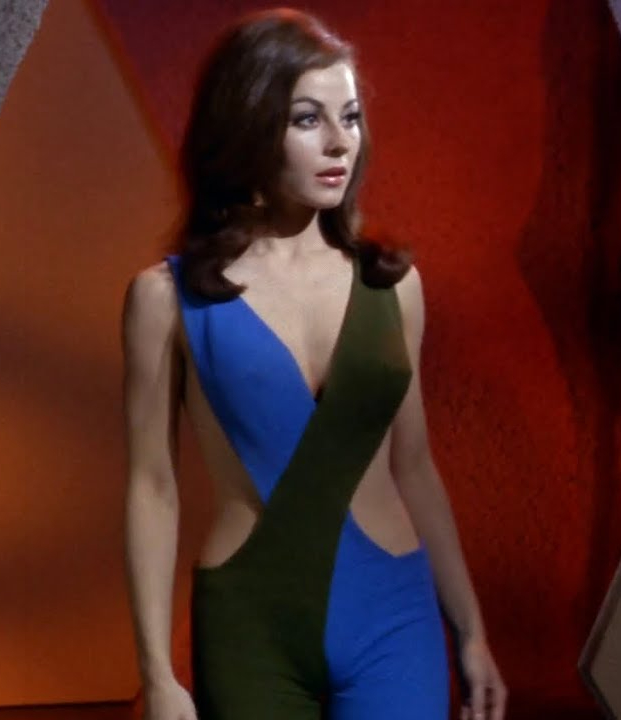
Sherry Jackson’s revealing costume never failed to get an enthusiastically appreciative response, whether it be stunning a noisy commissary into silence, when the actress showed it off there, or when it was displayed at a SF convention and the model for it found herself being approached by a large number of men, including Harlan Ellison, trying to secure a date from her.

The only TOS episode to prominently feature Nurse Christine Chapel, who was played by Majel Barrett. Also featured is Ted Cassidy, best known for playing Lurch on The Addams Family (1964) TV series. Barrett would later play Star Trek: The Next Generation (1987)’s gag character Lwaxana Troi, whose valet Mr. Homm was played by Carel Struycken, who played Lurch in The Addams Family (1991) and Addams Family Values (1993).

To test the effectiveness of Ted Cassidy’s Ruk costume and makeup, the producers arranged for Cassidy to receive a visiting clothes dealer while costumed as Ruk. Sure enough, the salesman, who thought he was calling on Gene Roddenberry, was so frightened at Cassidy’s intimidating character, he was barely coherent even as he attempted to do his pitch. However, the salesman eventually recovered, and Roddenberry ended up purchasing some pants from him.

William Shatner kisses Sherry Jackson so hard that when they pull apart you can see that her lips are swollen a little, and that most of her lipstick is gone and all over his lips. Also, when he holds her in his arms and pulls her in close to kiss her, he squeezes her arms so tight when kissing, that he leaves his fingerprints there. In 1998, the Sci-Fi Channel aired all the original episodes in their complete, non-syndicated format, with added interviews from some of the series stars, guest stars and production people. It was called “Star Trek Insights”. Jackson said in her interview, “I must say when he kissed me on screen, he really kissed me!”

Ruk is Ted Cassidy’s only appearing role in Star Trek. He provided voice overs in Star Trek: The Corbomite Maneuver (1966) and Star Trek: Arena (1967). Ironically, in a few scenes of this one, his own voice is dubbed over by other actors to show Ruk’s mimicking abilities.

Summary

The crew of the Enterprise arrives at the planet EXO-III with some trepidation and great anticipation. They are there to see if they can locate the renowned scientist Dr. Roger Korby. The man hasn’t been heard from for 5 years and the general belief is that he is dead. For Nurse Christine Chapel, however, a reunion with Corby will be a reunion with her fiancé. They find Korby alive but when Kirk and Chapel beam down to the planet, they find a man obsessed who is using alien technology to reproduce the humans around him in the form of androids.

CAST

William Shatner … Captain James Tiberius ‘Jim’ Kirk
Leonard Nimoy … Mister Spock
Michael Strong … Dr. Roger Korby
Sherry Jackson … Andrea
Ted Cassidy … Ruk
Majel Barrett … Nurse Christine Chapel
Nichelle Nichols … Lieutenant Nyota Uhura
Harry Basch … Brown
Vince Deadrick Sr. … Mathews (as Vince Deadrick)
Budd Albright … Rayburn
Eddie Paskey … Lieutenant Leslie (uncredited)

Bessie Smith – Down Hearted Blues

Let’s go back…way back. Music did exist before the 50s and sometimes I like to explore it. These are the talented artists who inspired later generations that we listen to. We cannot forget the pioneers of any genre. Artists like Mahalia Jackson, Janis Joplin, and Norah Jones have all given Bessie Smith credit as their inspiration.

Whenever I hear Bessie Smith I hear pain and greatness all at once. I’ve written about her song No One Loves You When You’re Down And Out and I’ve been revisiting her lately. This song was her debut single in 1923.

I got into Bessie Smith from listening to Janis Joplin and reading about her. Bessie’s voice sends chills up my spine…that is my litmus test. This particular song grabs me because of Smith’s voice and the recording vibe. She sings it, means it, and she damn well lived it. The sound of the record and her voice is just unbeatable. Yes, we have digital now but digital could not give you this sound.

She was born in Chattanooga, Tennessee, on April 15, 1894. She lost her dad while she was an infant and her mom when she was 7-8 years old. She was raised by her tough older sister. To help support her orphaned siblings, Bessie began her career as a Chattanooga street musician, singing in a duo with her brother Andrew to earn money to support their poor family.

She is credited with recording more than 160 songs between 1923 and 1933. Smith performed on stage throughout the southern United States and recorded with such jazz greats as Benny Goodman, Louis Armstrong, and Coleman Hawkins.

Before the Great Depression, Bessie was the highest-paid black entertainer in the world, collecting as much as two thousand dollars a week to perform. She was accompanied by great musicians such as Louis Armstrong, Lonnie Johnson, and Benny Goodman.

This song was written by  Alberta Hunter and Lovie Austin. The song is about a mistreated woman and had been recorded by fellow blues singer Alberta Hunter in 1922. A year later Bessie Smith sang it with pain, passion, and power as if it was her own song. The record sold more copies than any blues or jazz record had before…780,000 in the first six months after the release, #1 in the Billboard charts for 4 weeks, it helped to save Columbia from imminent bankruptcy and made Bessie a star.

They called Bessie Smith the “Empress of the Blues,” and for good reason.

Down Hearted Blues

Gee, but it’s hard to love someone
when that someone don’t love you!
I’m so disgusted, heart-broken, too;
I’ve got those down-hearted blues.

Once I was crazy ‘bout a man;
he mistreated me all the time,
The next man I get has got to promise me
to be mine, all mine!

Trouble, trouble, I’ve had it all my days,
It seems like trouble
going to follow me to my grave.

I ain’t never loved but three men in my life,
My father, my brother,
the man that wrecked my life.

It may be a week, it may be a month or two,
But the day you quit me, honey,
it’s comin’ home to you.

I got the world in a jug, the stopper’s in my hand,
I’m gonna hold it until
you meet some of my demands.

Star Trek – Mudd’s Women

★★★1/2  October 13, 1966 Season 1 Episode 6

If you want to see where we are…and you missed a few…HERE is a list of the episodes in my index located at the top of my blog. 

This show was written by Stephen Kandel and Gene Roddenberry

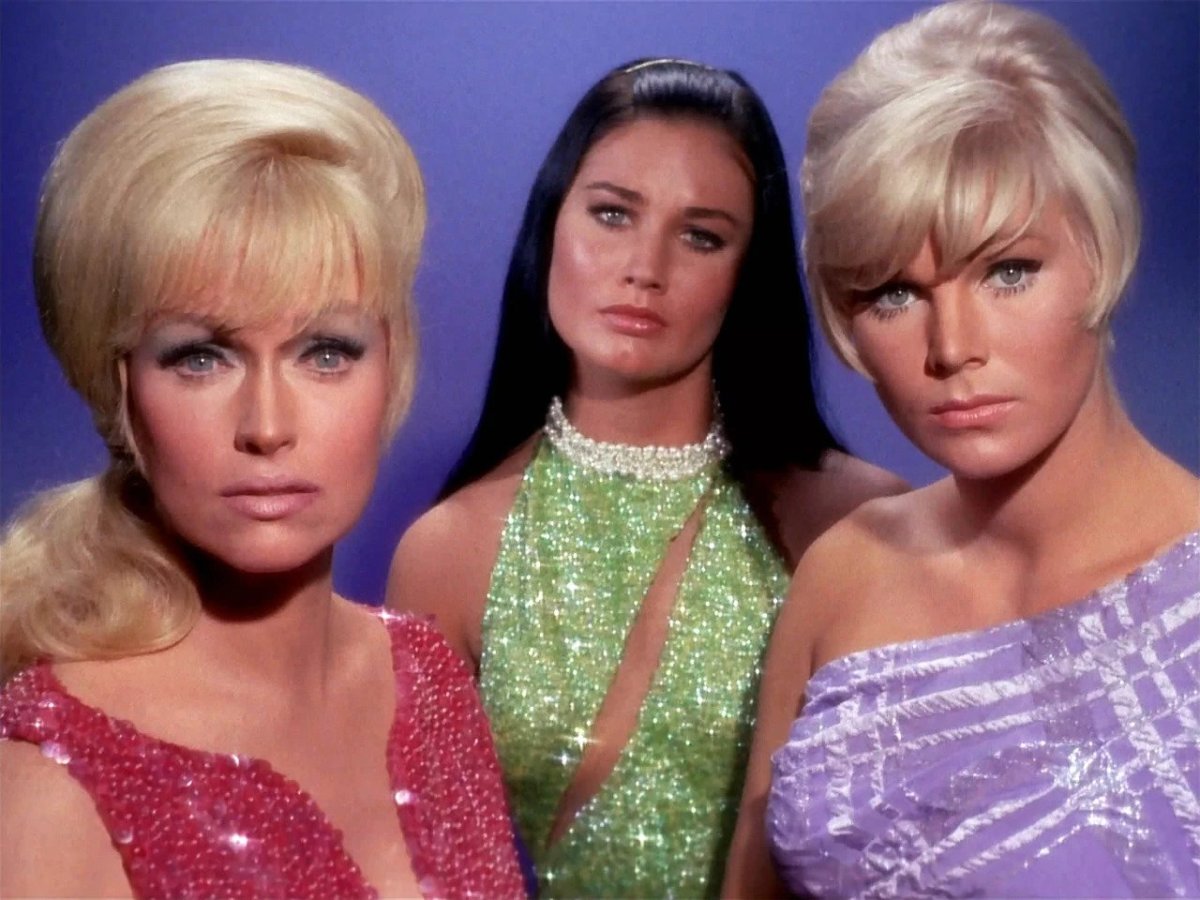
Harry Mudd in today’s time would be a crooked car salesman and a good old con man. This is the first appearance of Harry Mudd, a con artist whose cargo is three lovely ladies. He would reappear on another episode called I, Mudd. Roger Carmel played this role over the top and it worked for this character. Harry Mudd attempted to evade the Enterprise, driving his inferior ship into a dangerous asteroid belt, narrowly escaping death thanks to Kirk’s persistence in transporting him on board instead of the alternative, sacrificing his own ship’s Lithium crystals which keep the power operative at effective levels. 

Now the Enterprise needs more crystals to go on and they will go down to the last minute trying to get them or the Enterprise will crash out of orbit. The three ladies are looking for husbands and have the males in the Enterprise all in a flutter. There is something different about them that attracts the attention of the crew…more than just a beautiful female would do. There is a humorous conversation between Kirk and Bones about why they are so attracted to them with an amused Spock listening to them. 

It is revealed why later on in the episode. It’s a good episode but not one of the great ones to me. There is a message from one of the ladies named Eve in the end. Asking a would-be husband if he just basically wanted a trophy wife or someone who would work with him. If you like Harry Mudd…no worries…he will return in another episode. 

Good episode

From IMDB

The velour uniforms used in this episode had shrunk since they were first used in Star Trek: The Corbomite Maneuver (1966). According to Robert H. Justman and Herbert F. Solow’s book “Inside Star Trek: The Real Story”, the velour uniforms shrank every time they were cleaned. The actors’ union requirements specified that the costumes had to be cleaned daily.

NBC program manager Jerry Stanley recalled that “One of the problems we had was in trying to talk Gene Roddenberry out of some of his sexual fantasies that would come to life in the scripts. Some of the scenes he would describe were totally unacceptable”. William Shatner noted “that NBC allowed ‘Mudd’s Women’ to be produced at all is still a minor miracle”.

During the very early pre-production days of “Star Trek – The Next Generation” (1987-1994), Gene Roddenberry proposed to have Roger C. Carmel return and make a guest appearance, possibly as Harry Mudd, in order to provide an extra link with the original series. However, nothing came of this as Carmel died unexpectedly at the relatively young age of 54, several months before the pilot show was filmed.

Production went a day over schedule due to the intricate camera setups used by director Harvey Hart, which had good results but were too time-consuming. Hart also made things difficult for the editors by “camera cutting” the show, leaving few choices of shot available. Due to these factors, Hart was not invited back to the show.

One of the more memorable bloopers in the series occurred while filming the scene where the women take the “Venus drug.” As Maggie Thrett’s (Ruth) reaction shot was being filmed, her right breast popped out of her scanty green costume. A shot of her stuffing it back in with an embarrassed smile appeared in the first season’s blooper reel.

Summary

After stopping a vessel in space, Kirk and the crew find a very odd captain with a very strange cargo. The captain of the vessel is Harcourt Fenton Mudd – known as Harry to his friends – and the cargo are three lovely women he is transporting as brides for lonely men on distant planets. Kirk has a major problem: while trying to rescue Mudd and his women from his disintegrating ship, the Enterprise’s lithium crystals used to power the engines were destroyed. They travel to a nearby mining colony where Mudd sets about to arrange marriages for the women, interfering with Kirk’s plan to buy the crystals. All the time, the ship’s orbit is deteriorating and risks burning up in the atmosphere.

CAST

William Shatner … Captain James Tiberius ‘Jim’ Kirk
Leonard Nimoy … Mister Spock
Roger C. Carmel … Harry Mudd
Karen Steele … Eve McHuron
DeForest Kelley … Doctor Leonard ‘Bones’ McCoy
Maggie Thrett … Ruth
Susan Denberg … Magda
James Doohan … Lieutenant Commander Montgomery ‘Scotty’ Scott
George Takei … Lieutenant Hikaru Sulu
Jim Goodwin … Farrell
Nichelle Nichols … Lieutenant Nyota Uhura
Gene Dynarski … Ben
Jon Kowal … Herm
Seamon Glass … Benton
Jerry Foxworth … Guard
Majel Barrett … Enterprise Computer (voice) (uncredited)
Frank da Vinci … Vinci (uncredited)
Eddie Paskey … Connors (uncredited)
Ron Veto … Starfleet Officer (uncredited)

Star Trek – The Enemy Within

★★★★ October 6, 1966 Season 1 Episode 5

If you want to see where we are…and you missed a few… HERE is a list of the episodes in my index located at the top of my blog. 

This episode was written by Richard Matheson and Gene Roddenberry

A problem with the transporters causes Captain Kirk to re-energize as two versions of himself.

Kirk is split in half. He is the Jekyll/Hyde character, except he becomes two actual people. One exhibited animalistic behavior and the other a compassionate indecisive person. The problem is that the two look exactly alike. It allows William Shatner to go over the top…he is good at that but in this case, it really fits. He sneers as the evil side while he wonders indecisively as the other half. 

yeoman rand

The evil Kirk attacked Yeoman Rand and it’s brutally realistic. Shatner and Whitney do an excellent job in this scene. The episode examines the good and bad in everyone. It makes us who we are…both the ugly and compassionate sides make the whole.

Compassionate Kirk is too easily swayed by arguments and is paralyzed by the weight of decisions on his shoulders. Animal Kirk is too blinded by his desires to make decisions and is terrorized by fear.

Spock had to tell Kirk that he won’t be able to continue to be Captain if he kept losing his decision-making abilities. While this was going on, Sulu and crew are stuck on a very cold planet and cannot come up until the transporter is repaired. Dividing Kirk into two emotional halves to examine man’s duality is ingenious because it reveals not only Kirk but a broader look into our own human nature. 

Spock: If I seem insensitive to what you are going through Captain…understand…It’s the way I am. 

From IMDB

The original script called for Spock to karate chop Kirk to subdue him. Leonard Nimoy felt that this would be an uncharacteristically violent act for a peace-loving species like the Vulcans so he came up with a pincer-like grasp on the neck that has since become known as the Vulcan Nerve Pinch and become one of the character’s most famous gimmicks…it was used in The Naked Time but although this was filmed first…The Naked Time was aired first. 

This is one of the few times in Star Trek where it can be seen that the middle finger on actor James Doohan’s (Scotty’s) right hand is missing. Doohan lost the finger when it was struck by a bullet or shrapnel during the D-Day invasion in 1944. He took great pains to conceal its absence during the series, but his full right hand can be glimpsed briefly when he reaches into the box holding the snarling alien dog.

According to Grace Lee Whitney, while shooting the scene when a distraught, tearful Janice Rand accuses Captain Kirk of trying to rape her, William Shatner slapped her across the face to get her to register the proper emotion. As they shot the attempted rape scene days earlier, Whitney couldn’t get into the same emotion successfully, and it was Shatner’s “solution” to the problem.

The only Star Trek program written by Richard Matheson, a fantasy-horror legend who wrote two previous William Shatner vehicles: The Twilight Zone: Nick of Time (1960) and The Twilight Zone: Nightmare at 20,000 Feet (1963).

Summary

While beaming back aboard the Enterprise, a transporter malfunction results in two vastly different Captain Kirks being beamed aboard. His personality has in effect been split into two. One Captain Kirk is weak and indecisive, fearful of making any kind of decision; the other is a mean-spirited and violent man who likes to swill brandy and force himself on female crew members. Meanwhile, as Scotty struggles to repair the transporter, the landing party is stuck on the planet below with temperatures falling rapidly.

CAST

William Shatner … Captain James Tiberius ‘Jim’ Kirk
Leonard Nimoy … Mister Spock
DeForest Kelley … Doctor Leonard ‘Bones’ McCoy
Grace Lee Whitney … Yeoman Janice Rand
George Takei … Lieutenant Hikaru Sulu
James Doohan … Lieutenant Commander Montgomery ‘Scotty’ Scott
Ed Madden … Fisher (as Edward Madden)
Garland Thompson … Wilson
Jim Goodwin … Farrell
Nichelle Nichols … Lieutenant Nyota Uhura (voice) (uncredited)
Eddie Paskey … Connors (uncredited)

Star Trek – The Naked Time

★★★★ September 29, 1966 Season 1 Episode 4

If you want to see where we are…and you missed a few…HERE is a list of the episodes in my index located at the top of my blog. 

This show was written by John D.F. Black and Gene Roddenberry

This episode is probably best known as the one with Sulu, stripped to the waist, running around the ship’s corridors with a sword. But, it’s this episode where we learn a lot of interesting things about the main characters. After visiting the surface of a planet where many people had died in odd ways, one by one the Enterprise Crew starts acting with no inhibitions. You learn some of the inner secrets of the crewman as they get sick which is much like them getting drunk. 

Spockchapel

Majel Barrett as Nurse Christine Chapel makes her first appearance in Star Trek since the pilot when she played Number One. She starts professing her love for Spock who is shaken because the disease is affecting him as well and he is losing control of his emotions. We also learn in this episode that Spock is half-human… his mom is human and his dad is Vulcan. 

Bruce Hyde who plays Riley is the comic relief in this one. He catches the disease and locks himself up and shuts the engines down while drunkenly serenading the Enterprise for a good part of the episode. They are in orbit and are about to crash unless they find a way to start the engines long before the 30 minutes required to do so. 

This is also the first episode Spock did the famous Vulcan Nerve Pinch. The main reason for the 4 stars is because of the way we get to know these characters. 

From IMDB

After the scene where Spock is weeping, Leonard Nimoy’s fan mail increased exponentially. Viewers were enthralled with the idea that Spock was secretly a reservoir of love and passion instead of an empty emotional void. This reaction inspired further scripts which explored Spock’s inner makeup.

The budget-strapped show often made good use of the creativity of its prop staff in coming up with low-cost solutions to otherwise pricey items. Here, the “thermal suits” worn by Spock and Tormolen on the planet’s surface were fashioned from 1960s art deco-style shower curtains.

This is the only TOS episode in which the three primary female crew members – Uhura, Chapel, and Rand – appeared together. The characters did not appear together again until Star Trek: The Motion Picture (1979).

While under the influence of the virus, Nurse Chapel attempts to seduce Spock. This would be the first depiction of what many fans perceived as underlying romantic tensions between the characters, or at least Chapel’s unrequited romantic attraction to Spock.

Summary

When Lieutenant Junior Grade Tormolen brings aboard an infection that killed the science team on Psi 2000, the crew of the Enterprise soon find themselves unable to control their most predominant emotions. Soon the entire starship is in shambles and plummeting toward the self-destructing planet.

CAST

William Shatner … Captain James Tiberius ‘Jim’ Kirk
Leonard Nimoy … Mister Spock
Stewart Moss … Tormolen
Majel Barrett … Nurse Christine Chapel
Bruce Hyde … Riley
DeForest Kelley … Doctor Leonard ‘Bones’ McCoy
Grace Lee Whitney … Yeoman Janice Rand
George Takei … Lieutenant Hikaru Sulu
James Doohan … Lieutenant Commander Montgomery ‘Scotty’ Scott
Nichelle Nichols … Lieutenant Nyota Uhura
William Frederick Knight … Amorous Crewman (as William Knight)
John Bellah … Laughing Crewman
Tom Anfinsen … Crewman (uncredited)
Bill Blackburn … Lieutenant Hadley (uncredited)
Frank da Vinci … Lt. Brent (uncredited)
Andrea Dromm … Yeoman Smith (uncredited)
Eddie Paskey … Lieutenant Ryan (uncredited)
Woody Talbert … Crewman #2 (uncredited)
Ron Veto Ron Veto … Crewman (uncredited)

Star Trek – Where No Man Has Gone Before

★★★★ September 22, 1966 Season 1 Episode 3

If you want to see where we are…and you missed a few…HERE is a list of the episodes in my index located at the top of my blog. 

This episode was written by Samuel A. Peeples and Gene Roddenberry

Absolute power corrupts. In an energy field Kirk’s friend Gary Mitchell is endowed with astonishing powers of ESP and telekinesis, Kirk and Spock grow alarmed as he starts to test his ability to take over the Enterprise. Spock urges Kirk to maroon Mitchell on Delta Vega, an uninhabited planet, or kill him. At first, Kirk is outraged at even the suggestion, but eventually accepts the cold logic of this solution as Spock warns him, “we’ll never reach another earth base with him on board.”

This episode probably should have been the debut of Star Trek…it was the second pilot filmed but this one was aired 3rd. It truly is bizarre that this story wasn’t used for the first broadcast episode on September 8, 1966, instead of The Man Trap. It worked out in the end but this would have been a stronger episode. 

It was the first one filmed with Captain Kirk. Spock looks close to what he looked like on the pilot which no one saw at the time. In the other episodes, he looks like the Spock we have come to know. This episode has a different doctor (Paul Fix) than DeForrest Kelley.

It’s a strong episode with a very good storyline and acting. My favorite interaction was this between Kirk and Spock about what to do with Gary Mitchell. After telling Kirk his friend needs to be marooned on a planet before he destroys them all…this short snippet took place.

Kirk: Doctor Dehner feels he isn’t that dangerous. What makes you right and a trained psychiatrist wrong?
Spock: Because she feels. I don’t. All I know is logic. In my opinion, we’ll be lucky if we can repair this ship and get away in time.

That sums up Spock rather nicely. 

Sally Kellerman Star Trek

Sally Kellerman was in this episode as Dr. Elizabeth Dehner. Kellerman would go on to star in M*A*S*H the movie. Also, Gary Lockwood who played Lt. Cmdr. Gary Mitchell would be in 2001: A Space Odyssey a few years later. 

From IMDB

The change in Gary and Elizabeth’s eyes was accomplished by Gary Lockwood and Sally Kellerman wearing sparkly contact lenses. They consisted of tinfoil sandwiched between two lenses that covered the entire eye. Wearing the lenses was difficult for Lockwood. He could only see through the lenses by looking down while pointing his head up. Lockwood was able to use this look to convey Mitchell’s arrogant attitude.

The phaser rifle that Kirk uses appears for the first and only time in the series. However, it can be seen on many pre-season 1 promotional photos.

Leonard Nimoy is the only actor to appear in both this, the second pilot, and the original pilot episode Star Trek: The Cage (1966). That being so, and the fact that he is in all the rest of the episodes, makes him the only actor to appear in all 79 episodes of the series (80 for those who count “The Cage”).

The gap in time between filming this and the rest of the series explains some of the apparent inconsistencies, notably some changes in the Enterprise architecture, the fact that most of the female crew members wear trousers and Mr Spock’s distinctive yellowish skin tone.

The reason this episode wasn’t broadcast first, despite being a pilot, is that the network felt it was “too expository”, and would not have made a good premiere episode for the series.

This was filmed more than one year before it was aired on TV.

Summary

When the Enterprise attempts to penetrate a space barrier, it is damaged and creates a potentially worse problem. Two crew members, including Kirk’s best friend, gain psionic powers that are growing exponentially. This leaves Captain Kirk with the difficult choice; either maroon them or killing before they get so powerful they lose their humanity and become truly dangerous.

CAST

William Shatner … Captain James Tiberius ‘Jim’ Kirk
Leonard Nimoy … Mister Spock
Sally Kellerman … Dr. Elizabeth Dehner
Gary Lockwood … Lt. Cmdr. Gary Mitchell
George Takei … Lieutenant Hikaru Sulu
James Doohan … Lieutenant Commander Montgomery ‘Scotty’ Scott
Lloyd Haynes … Alden
Andrea Dromm … Yeoman Smith
Paul Carr Paul Carr … Lt. Lee Kelso
Paul Fix  … Doctor Piper
Bill Blackburn … Lieutenant Hadley (uncredited)
Eddie Paskey … Lieutenant Leslie (uncredited)

Star Trek – Charlie X

★★★★ September 15, 1966 Season 1 Episode 2

If you want to see where we are…and you missed a few…HERE is a list of the episodes in my index located at the top of my blog. 

***Sorry to interrupt Star Trek but I guest hosted UK #1’s Blog today…he has an incredible blog of all the number 1 hits in the UK from the beginning. Check his blog out today if you can!***

This show was written by D.C. FontanaGene Roddenberry

There are parallels between Charlie X and the iconic Twilight Zone episode It’s a Good Life that aired 5 years before…when Billy Mumy’s character would wish people in the cornfield. 

Charles Evans had very little contact with human life before coming on board the Enterprise and has to live amongst a community of 428 people. He is 17 years old, a time when teenagers have to find their way in the world and somehow fit into adult communities. This episode does a good job of portraying how awkward and difficult life can be in these situations. What complicates it further is the infatuation he develops for Yeoman Janice Rand, not to mention the uncontrolled psychic power he possesses.

Star Trek charlie x and Yeoman

Charlie is a 17-year-old with the emotional maturity of a 5-year-old…but with massive powers that no one knows about. You feel bad for Charlie as he has never had the opportunity to develop and learn around real people. He asked Kirk if Yeoman Janice Rand is a girl. Kirk tries to be a father figure to Charlie throughout the episode which included explaining why he shouldn’t slap Rand in the butt. Charlie comes off as obnoxious and whiny…so yes…a teenager but they find out quickly he is very dangerous. 

The episode starts off humourous until Charlie is angered by the rejection of Rand and that is when the crew discovers his powers. Charlie is a character whom one could easily fear or hate, but in the end, one realizes that what he really needs is guidance. Imagine being 17 and having unlimited powers. Robert Walker Jr. who plays Charlie Evans did a great job of portraying Charlie. 

From IMDB

True to his training as a Method actor, Robert Walker Jr. chose to remain in his dressing room and not interact with any members of the cast as this would help his characterization of a strange, aloof person.

In the original outline, Gene Roddenberry’s working titles were “The Day Charlie Became God” or “Charlie Is God”. These would almost certainly have been problematic to the network censors, so the title was changed to Charlie’s Law, then settled on Charlie X, as X denotes the unknown. However, the title “Charlie’s Law” was retained in the book-form tie-in, novelized by James Blish.

During the lounge scene, where Uhura sings a song about Charlie, Spock is seen smiling as he accompanies her on a harp-like instrument. This is one of the few times in the series that Spock smiles, while not under the influence of a substance or someone’s mind-control powers.

This episode was originally scheduled to air further into the season, as all action took place aboard the Enterprise and it was basically a teenage melodrama set in the space age, both of which NBC disliked. However, as it required no new outer space special effects shots (actually all Enterprise shots are recycled from the two pilots), its post-production took less time than other episodes, and it was chosen to be the second episode to air out of necessity, as other episodes were not ready for the deadline. The Antares was originally to be shown on screen, however, when the early airdate was commissioned, this was eliminated.

Summary

Charlie Evans was the sole survivor of a crash and he has been alone on a deserted planet for fourteen years. Making Charlie’s return to society more difficult is his mysterious godlike abilities. The space vessel Antares rescues Charlie from the forbidding surface of the planet Thasus, and then hurriedly hands him off to the Enterprise. Soon, mysterious happenings dog the boy, who cannot seem to learn certain vital lessons of adulthood. Finally, the humiliated teen reveals prodigious psionic powers that could even threaten the survival of the Federation. Who is Charlie, really, and where did he get these abilities?

CAST

William Shatner … Captain James Tiberius ‘Jim’ Kirk
Leonard Nimoy … Mister Spock
Robert Walker Jr. … Charlie Evans (as Robert Walker)
DeForest Kelley … Doctor Leonard ‘Bones’ McCoy
Grace Lee Whitney … Yeoman Janice Rand
Nichelle Nichols … Lieutenant Nyota Uhura
Charles Stewart … Captain Ramart (as Charles J. Stewart)
Dallas Mitchell … Tom Nellis
Don Eitner … Navigator
Pat McNulty … Tina Lawton (as Patricia McNulty)
John Bellah … Crewman I
Garland Thompson … Crewman II
Abraham Sofaer … The Thasian
Bill Blackburn … Lieutenant Hadley (uncredited)
Frank da Vinci … Brent / Security Guard (uncredited)
Bob Herron … Sam (uncredited)
John Lindesmith … Helmsman (uncredited)
Eddie Paskey … Lieutenant Leslie (uncredited)
Gene Roddenberry … Enterprise Chef (voice) (uncredited)
George Takei … Lieutenant Hikaru Sulu (voice) (uncredited)
Ron Veto … Security Guard (uncredited)
Laura Wood … Prematurely Aged Woman (uncredited)

Beatles – Here, There, And Everywhere

I was looking for a Beatles song to post about and I came across Hobo Moon Cartoons a while back and this new video was featured. Check the site out when you can.

What a beautiful song this is..I think it’s one of Paul’s and The Beatle’s best ballads. Paul has said before that the song was inspired by the Beach Boys’ “God Only Knows” off of their album Pet Sounds.

beachboyslegacy.com on Twitter: "Today in 1966, Bruce ...

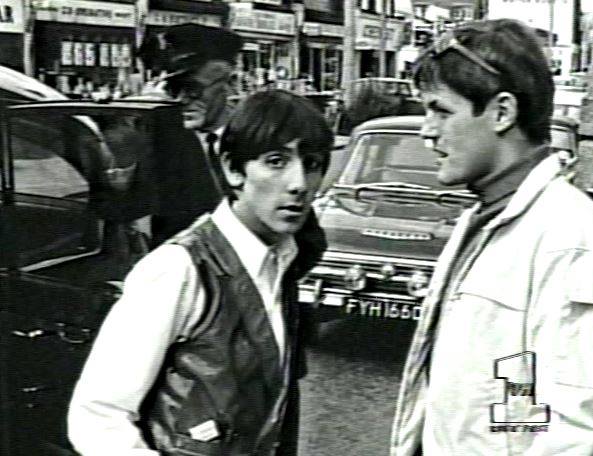
The way that John and Paul heard Pet Sounds for the first time is interesting. Beach Boy Bruce Johnston was in England in 1966 and he met a huge Beach Boy fan Keith Moon. Moon dragged him to every hip spot in London. To Johnston’s surprise and amazement…he took him to a hotel and invited John and Paul to come over and meet Johnston and listen to the Beach Boy’s new album that was about to be released. Bruce had no idea how connected the Who’s drummer was at the time. He had come to England to sightsee and maybe hype the album a little but did not expect to have an audience of John and Paul.

Keith at the time acted like he liked the album but at heart, he wanted the same old surf songs…he wasn’t expecting an art-pop album from the Beach Boys. John and Paul were knocked out by Pet Sounds and after hearing God Only Knows Paul came up with this melody and he and John finished it off. Paul said this song was around 80-20 his song. It was a full circle because Brian Wilson was inspired by Rubber Soul when writing Pet Sounds.

Paul said that John praised his songwriting only once. He said “John says just as it finishes, ‘That’s a really good song, lad. I love that song.’ And I’m like, ‘Yes! He likes it!'”

The song was on arguably the Beatle’s best album Revolver. This song was somehow not released as a single. The album peaked at #1 in the Billboard Album Charts, in Canada, and in The UK in 1966. During the 1987 CD releases, it peaked at #3 on the US Billboard Top Compact Disks Charts…seriously? I never heard of the US Billboard Top Compact Disks but that is also a chart.

Paul McCartney: “I wrote that by John’s pool one day, I sat out by the pool on one of the sun chairs with my guitar and started strumming in E, and soon had a few chords, and I think by the time he’d woken up, I had pretty much written the song, so we took it indoors and finished it up…John might have helped with a few last words…But it’s very me, it’s one of my favorite songs that I’ve written…So I would credit me pretty much 80-20 on that one.”

John Lennon:  “Here, There And Everywhere’ was Paul’s song completely, I believe – and one of my favorite songs of The Beatles.”

John Lennon: “There was a period when I thought I didn’t write melodies, that Paul wrote those and I just wrote straight, shouting rock’n’roll. But of course, when I think or some of my own songs – ‘In My Life,’ or some of the early stuff, ‘This Boy’ – I was writing melody with the best of them.”

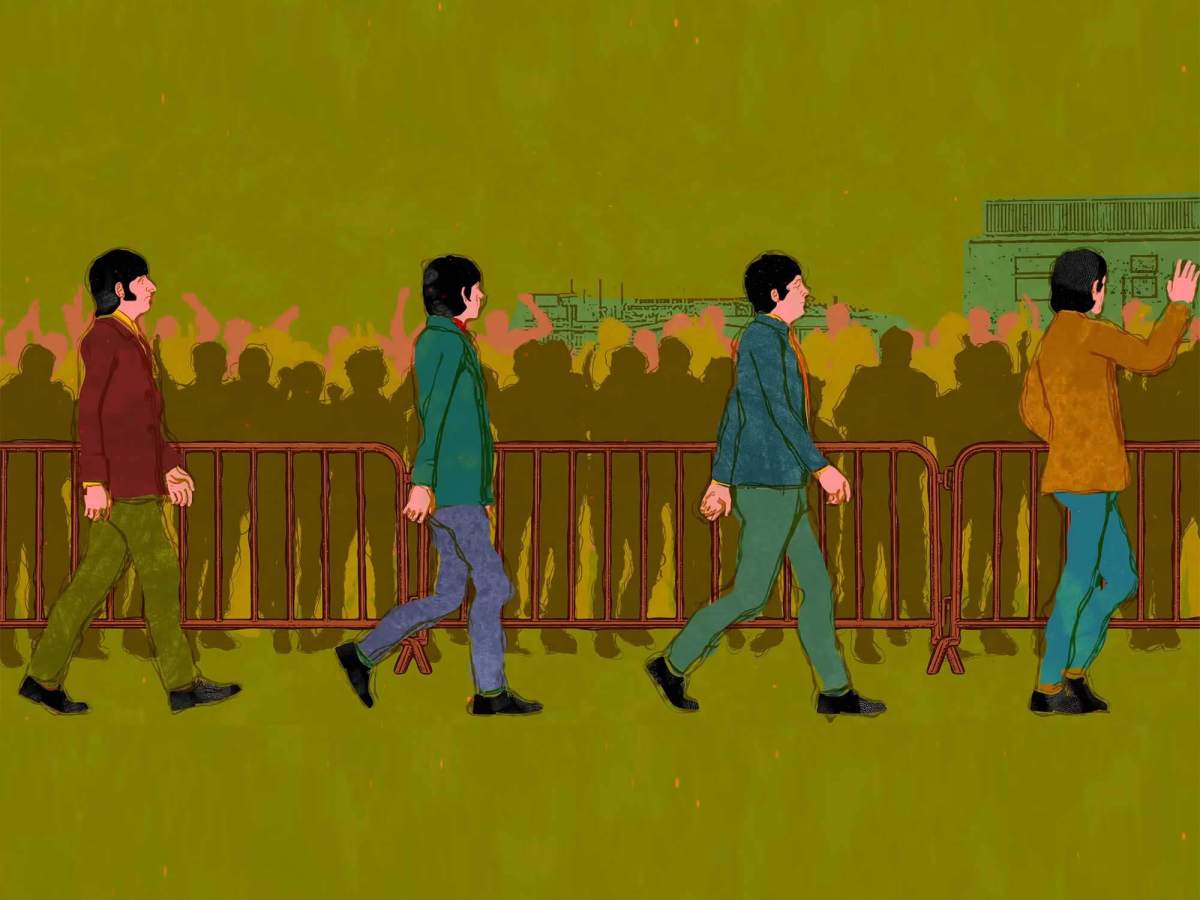
The Beatles released an animated video for this song in 2022. It was directed by Rok Predin.

Here, There, And Everywhere

To lead a better life
I need my love to be here

Here, making each day of the year
Changing my life with a wave of her hand
Nobody can deny that there’s something there
There, running my hands through her hair
Both of us thinking how good it can be
Someone is speaking
But she doesn’t know he’s there

I want her everywhere
And if she’s beside me I know I need never care
But to love her is to need her everywhere

Knowing that love is to share
Each one believing that love never dies
Watching their eyes and hoping I’m always there

I want her everywhere
And if she’s beside me I know I need never care
But to love her is to need her everywhere

Knowing that love is to share
Each one believing that love never dies
Watching their eyes and hoping I’m always there

I will be there
And everywhere
Here, there and everywhere