Star Trek – The Deadly Years

★★★★1/2 December 8, 1967 Season 2 Episode 12

If you want to see where we are…and you missed a few…HERE is a list of the episodes in my index located at the top of my blog. 

This show was written by Gene Roddenberry and David P. Harmon

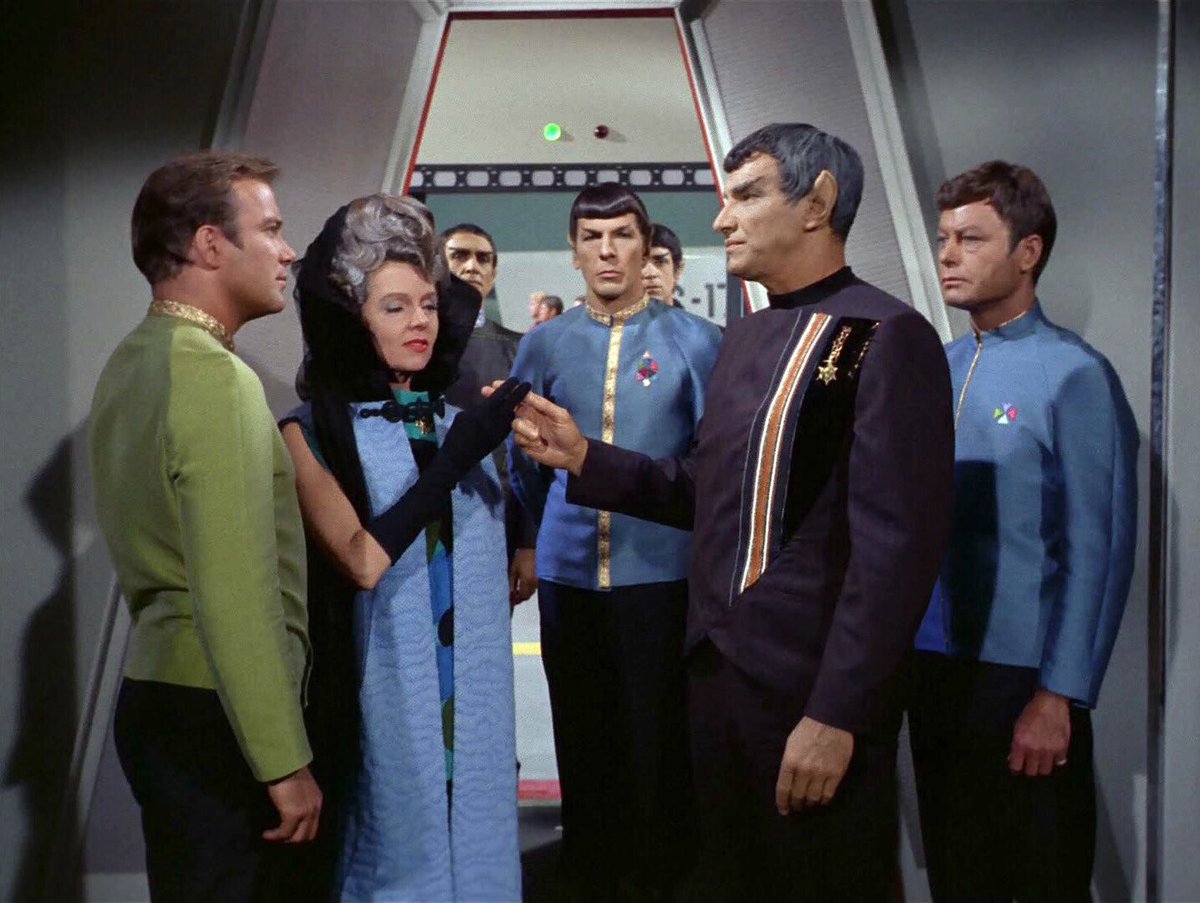
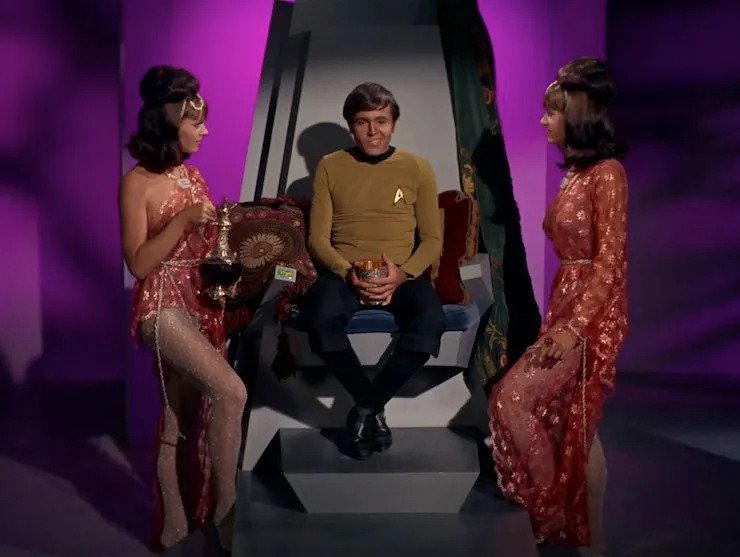
Another favorite of mine in the 2nd season. Some of the crew starts growing old…really quick. 

When an away team goes for a routine visit to a scientific outpost they are shocked to discover the personnel are dead or dying, apparently of old age, despite none of them being old.

Star Trek – The Deadly Years B

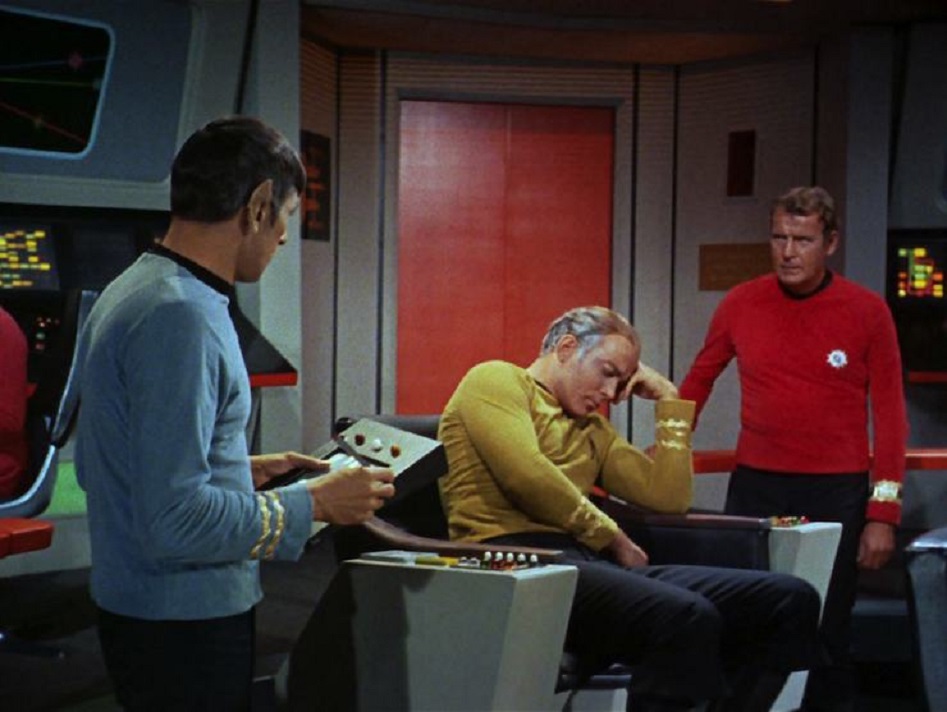
Back on the Enterprise, it isn’t long before members of the away team, with the exception of Chekov, start aging. At first, the signs are subtle; Kirk gives the same order twice and instructs Uhura to contact Star Fleet using a code that has already been cracked by the Romulans. It isn’t long before more obvious signs of aging show and if they don’t discover the cause and a remedy quickly most of the senior staff will be dead within days.

As time progresses Kirk’s ability to command comes into question and Commodore Stocker, who was being transported to a nearby star base, assumes command despite never serving on a starship before. This almost leads to disaster when he orders the Enterprise to head directly to the star base even though that course takes them through the Romulan neutral zone.

After that, the Romulans of course are after The Enterprise. With Kirk and Spock old…it doesn’t look like they will get out of this trouble with the Romulans. 

Here is a comparison of William Shatner…a Hollywood 80-year-old or so…and the real Shatner around 80-85 years old at the time of the picture. 

William Shatner old and old

From IMDB:

The cast wore oversized versions of their costumes as their characters aged in order to give the impression that they were shrinking.

William Shatner resisted looking too old as Captain Kirk aged. This is why at first the aging Kirk’s hairline is receding but later his hair is more full.

Having been born on July 16, 1882, Felix Locher (Robert Johnson) is the earliest born actor to appear in any “Star Trek” episode or film, at 85 years of age.

Kirk’s age (34) is established in this episode. William Shatner was 36.

Around this mid-season shoot, rumors started to circulate that Star Trek was going to be canceled. One of the show’s most ardent fans, Bjo Trimble, created a mailing list, urging everyone on it to write to the network pleading for the show’s survival. The ploy worked.

In “The World of Star Trek”, William Shatner relates that he endured an excruciating make-up session for this episode – all for nothing, because the shooting day was just about to end. The producers caught his exasperation in an infamous blooper, wherein he declares, “Robert H. Justman, I’m going home now, after spending three hours putting this [expletive deleted] make-up back on – and it’s your fault!”

Kirk reuses the scam involving the “corbomite” device, which he first described in Star Trek: The Corbomite Maneuver (1966). Although Chekov was not on the bridge on that occasion, he obviously heard the story from someone, as he and Sulu exchange knowing looks when Kirk mentions the word.

According to Walter Koenig, a close-up shot of his eyes was filmed as Chekov sees the dead body. Unfortunately, Koenig kept blinking during the shot and it took fifteen takes to get it right. However, the shot was deleted from the episode.

Lieutenant Uhura was originally supposed to be one of the landing party that starts to age but Gene Roddenberry refused to allow this on the grounds that it would make her unattractive. In Star Trek: And the Children Shall Lead (1968), Uhura had a rapid-aging scene.

This is the first time McCoy is aged using makeup in order to look much older than he is. The second time is in Star Trek: The Next Generation: Encounter at Farpoint (1987). Both versions look very similar.

Each crew member displays different symptoms of aging: Captain Kirk suffers from short-term memory loss and arthritis, Spock becomes hypersensitive to temperature changes, McCoy becomes more moody and irritable, Galway suffers from hearing loss, and Scotty finds that he is always tired.

Normally, make-up artist Fred B. Phillips would have been given a month to come up with the latex prosthetics to age his cast. Instead, he was given 10 days. Philips was able to get round the problem by drafting a whole troupe of make-up artists to assist him.

William Shatner reportedly threatened producer Robert H. Justman with bodily harm after enduring the three hour old-age makeup process for no reason. “Who’s afraid of such a wrinkled, feeble old coot!” scoffed Justman. Nevertheless, Justman kept his office door locked until shooting was finished.

When Spock questions Uhura during the competency hearing, he twice clearly refers to Uhura’s having signed her initials (note the plural) on a document. Lt. Uhura was never given a first name during the entire run of the series, which at the time lead some to believe she may have only had the single name “Uhura”. However, this episode established that, due to having more than one initial, she must also have had a name other than “Uhura”.

Dr. Wallace’s costume was made from drapes.

In the first scene, the landing party beams down to the planet surface in front of two buildings. The first one has a curved exterior with alternating raised light blue panels and sunken white panels with no “ribs”, but the second one has a similar curved exterior with “ribs” clearly protruding from the roof. This second building is a repurposing of the structure used as the home for Zefram Cochran in Star Trek: Metamorphosis (1967).

McCoy’s Southern dialect grows noticeably thicker as he ages.

The last shot of the episode is reused from Star Trek: Amok Time (1967). Note the wig there on Chekov, which he didn’t have on for the entire episode.

The proximity of the Gamma Hydra sector to the Romulan Neutral Zone is repeated in the opening scene of Star Trek II: The Wrath of Khan (1982), when the Enterprise supposedly violates the zone while patrolling near the sector. However, in the movie it’s the Klingons who attack.

If one goes by production order, this is the first episode in which Vulcans are mentioned to have a longer lifespan than humans. If one goes by airdate order, that title goes to Star Trek: Journey to Babel (1967).

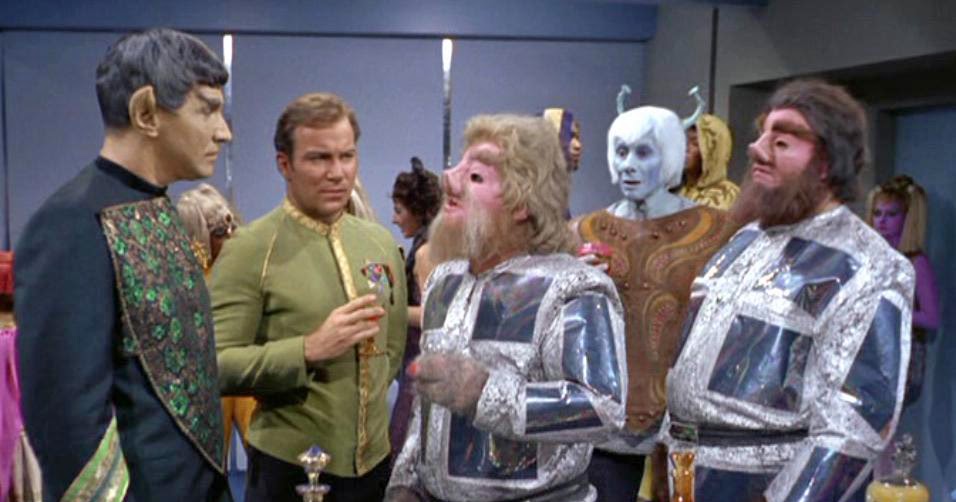
The end credits include a make-up test shot of Bill Blackburn as a Tellarite.

Except for Checkov, the pronounced aging effects of each of the landing party are as follows: McCoy – Crankiness, somewhat difficulty enunciating words. Kirk – Memory loss, arthritis, stiffness. Scotty – Fatigue. (Duaring the competency hearing he just sits quietly and withdrawn.) Galway – Hearing loss, fast metabolism caused rapid aging and death. Spock – Sensitivity to cold, easily fatigued, failing eyesight, difficulty concentrating.

Areel Shaw’s line from Star Trek: Court Martial (1967) about how long it has been since she’s seen Kirk is recycled by Janet Wallace in this segment.

Kirk’s return to normal age was filmed differently from the version seen in the aired show. It was originally planned to have him take the antidote and, accompanied by a still-aged Spock, return to normal slowly on his way to the bridge. For unknown reasons, this scene was eliminated and just his lower body was filmed showing him writhing after the antidote was administered.

Summary

Rapid aging afflicts all six colonists on Gamma Hydra IV and five members of Kirk’s six-man landing party – all but Chekov. With the Neutral Zone so close, suspicion falls on the Romulans testing a new weapon, but is it? With time running out, answers are elusive. As Kirk’s memory progressively deteriorates, regulations necessitate a competency hearing no one wants – the outcome of which may eventually lead the Enterprise to its destruction with all aboard.

CAST

William Shatner … Captain James Tiberius ‘Jim’ Kirk
Leonard Nimoy … Mister Spock
DeForest Kelley … Doctor Leonard ‘Bones’ McCoy
James Doohan … Lieutenant Commander Montgomery ‘Scotty’ Scott
Nichelle Nichols … Lieutenant Nyota Uhura
George Takei … Lieutenant Hikaru Sulu
Majel Barrett … Nurse Christine Chapel
Charles Drake – Commodore Stocker
Carolyn Nelson – Yeoman Atkins
Sarah Marshall – Dr. Janet Wallace
Laura Wood – Elaine Johnson
Felix Maurice Locher – Robert Johnson
Beverly Washburn – Lt. Arlene Galway
Roger Holloway – Lt. Lemli
Eddie Paskey – Lt. Leslie
Frank Da Vinci – Lt. Brent

Band – King Harvest  (Has Surely Come) ….Canadian Week

Power Pop Friday will be back next week. Thank you for tuning in this week as we talked about these great Canadian artists…I’ve had a blast with them. There is one band that I didn’t get to cover because I ran out of days…well actually more…but Blue Rodeo will be coming up soon on a Friday. 

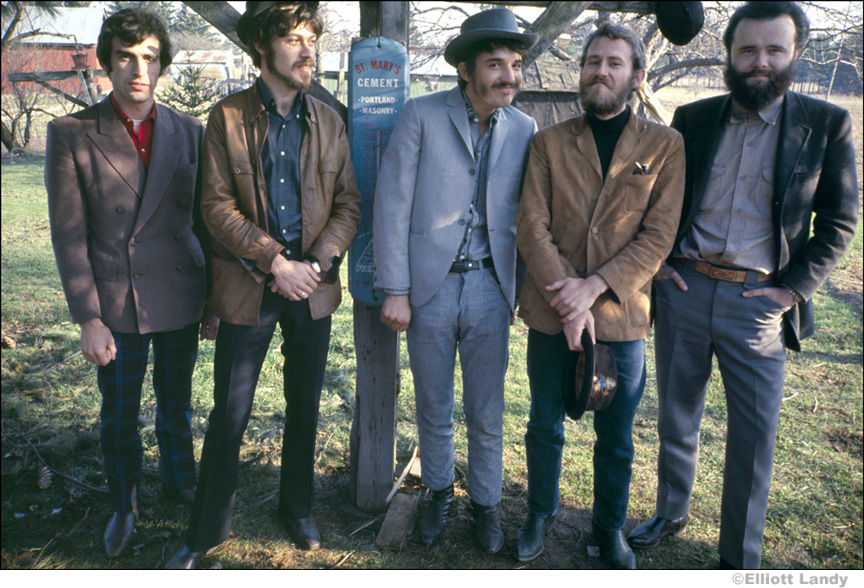
The Band is my favorite Canadian export. Well, I will say Canadian although one member…Levon Helm was from Arkansas but the rest are Canadians. CB mentioned this song not long ago so I used it after listening to it again. It is quite a complex song. I can’t believe I’ve never posted it but better late than never.

The Band was so rootsy… They had it all – rawness, competence, sublimity, experience, originality, and roots. The five different instruments were not five different instruments…they were one. In the liner notes to one of their greatest hits it states… the music is unusually complex, making use of odd verse patterns and tricky rhythmic suspensions and modifying the natural sounds of instruments for various calculated effects. But because of the way the record sounds, none of this calls attention to itself…it sounds effortless.

Robertson said he’d been immersed in the novels of John Steinbeck at this time. I’ve read where The Grapes of Wrath is a big influence on this song. Rock critic Greil Marcus has written that King Harvest might be the finest song that Robertson has ever written. The song is told from the point of view of a poverty-stricken farmer- detailing everything that has happened to his farm- then a union organizer appears and makes promises that things will soon improve.

Richard Manuel is the singer of King Harvest. King Harvest is a great finishing track to one of the greatest albums ever made. The album was their second album called The Band (The Brown Album). The album peaked at #2 in Canada, #9 on the Billboard 100 in 1970. This is their highest-charting album in their home country.

The song is credited solely to guitarist Robbie Robertson, although drummer-singer Levon Helm claimed that “King Harvest” was a group effort. It’s been covered by Blue Rodeo, Bruce Hornsby, and many more.

Robbie Robertson: “It’s just a kind of character study in a time period. At the beginning, when the unions came in, they were a saving grace, a way of fighting the big money people, and they affected everybody from the people that worked in the big cities all the way around to the farm people. It’s ironic now, because now so much of it is like gangsters, assassinations, power, greed, insanity. I just thought it was incredible how it started and how it ended up.”

Robbie Robertson: In the story to me, it’s another piece I remember from my youth, that people looking forward, people out there in the country somewhere, in a place … we all know it, may have been there, may have not … but there’s a lot of people that the idea of come Autumn, come Fall, that’s when life begins. It is not the Springtime where we kinda think it begins. It is the Fall, because the harvests come in.

Levon Helm: Some of the lyrics came out of a discussion we had one night about the times we’d seen and all had in common. It was an expression of feeling that came from five people. The group wanted to do one song that took in everything we could muster about life at that moment in time. It was the last thing we cut in California, and it was that magical feeling of ‘King Harvest’ that pulled us through. It was like, there, that’s The Band.

King Harvest (Has Surely Come)

Corn in the fields
Listen to the rice when the wind blows ‘cross the water
King Harvest has surely come

I work for the union ’cause she’s so good to me
And I’m bound to come out on top
That’s where she said I should be
I will hear every word the boss may say
For he’s the one who hands me down my pay
Looks like this time I’m gonna get to stay
I’m a union man, now, all the way

The smell of the leaves
From the magnolia trees in the meadow
King Harvest has surely come

Dry summer, then comes fall
Which I depend on most of all
Hey, rainmaker, can’t you hear the call?
Please let these crops grow tall

Long enough I’ve been up on Skid Row
And it’s plain to see, I’ve nothing to show
I’m glad to pay those union dues
Just don’t judge me by my shoes

Scarecrow and a yellow moon
And pretty soon a carnival on the edge of town
King Harvest has surely come

Last year, this time, wasn’t no joke
My whole barn went up in smoke
Our horse Jethro, well he went mad
And I can’t remember things bein’ that bad

Then there comes a man with a paper and a pen
Tellin’ us our hard times are about to end
And then, if they don’t give us what we like
He said, “men, that’s when you gotta go on strike”

Corn in the fields
Listen to the rice when the wind blows ‘cross the water
King Harvest has surely come

Star Trek – Friday’s Child

★★★ December 1, 1967 Season 2 Episode 11

If you want to see where we are…and you missed a few…HERE is a list of the episodes in my index located at the top of my blog. 

This show was written by Gene Roddenberry and D.C. Fontana

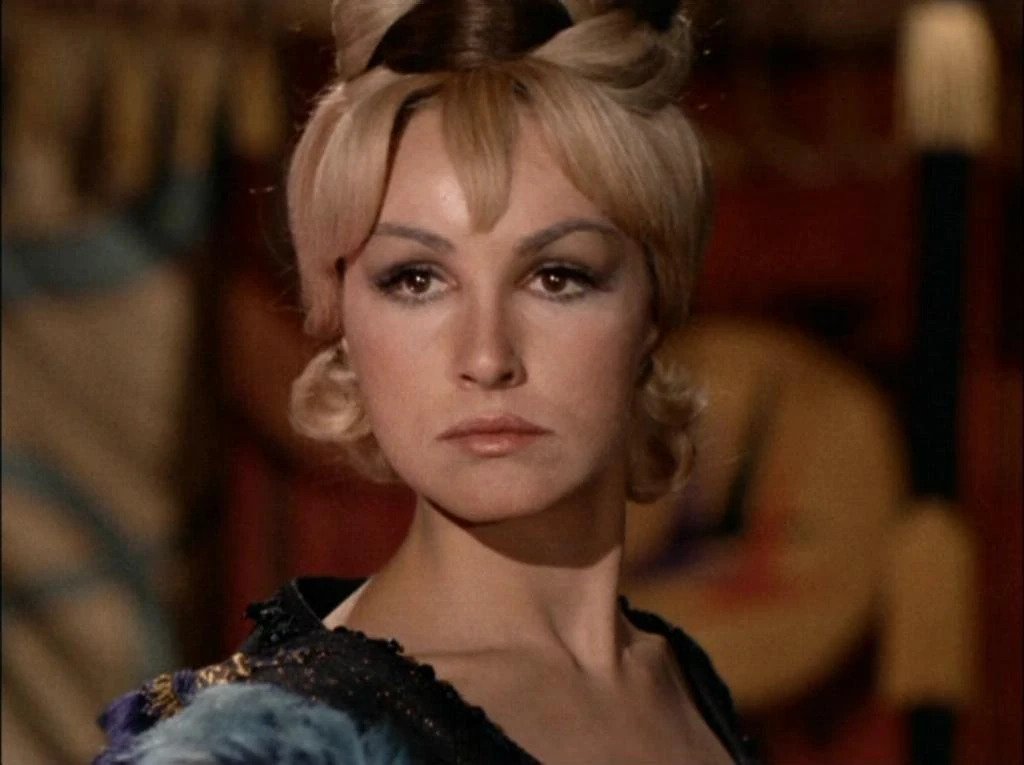
The main thing I noticed when I watched this episode is Julie Newmar as Eleen. I never missed her on Batman. 

Julie Newmar

Once again the crew of the Enterprise are in negotiations for an alien planet’s mineral rights… McCoy has been there before and cautions the captain about the importance of not breaching local etiquette; infringements can mean death. These aliens, the Capellans are intelligent but not advanced; fighting with swords and throwing weapons. The landing party, consisting of Kirk, Spock, McCoy and security are shocked to discover a Klingon is already there; leading to the red-shirt drawing his weapon and being killed.

The leader of the Capellans is keen to negotiate but his underling thinks they should deal with the Klingons as they offer military items and fights for the leadership. With the old leader dead his pregnant wife is expected to die but McCoy attempts to save her and the away team flees to the hills with her. Here Kirk and Spock must prepare to fight without use of their phasers while McCoy helps deliver the baby. Meanwhile, the Enterprise, commanded by Scotty, has been called away by a distress call, apparently from a freighter under attack from Klingons.

It was a strong episode for Scotty.  Faced with the decision to rescue the crew that was on the planet from Capella or answer a distress call from an unarmed freighter, Scotty stays consistent with Federation duty and leaves orbit to help the ship under attack. Turns out it was a Klingon ruse, but no harm was done. Doctor McCoy also has some good scenes with Eleen and her new born baby. 

Not one of my favorites but a decent episode. 

From IMDB:

This is the only episode in which Uhura and Sulu call Scotty by his nickname. Otherwise, they call him “Mr. Scott”.

For his first four appearances in the series, including this episode, Walter Koenig wore a The Monkees (1965)-style wig, which he absolutely detested. In one interview, he made joking and uncomplimentary references to that wig.

The actors playing Capellan warriors were given elevated shoes to make them appear like giants. Maab’s high headgear served the same purpose.

Third time Bones uses the saying “I’m a doctor, not a …” (In this case, escalator)

Lots of dialogue looping was used in this episode because of the outdoor setting. Some of the dubbing was crammed together, nearly on top of other lines.

When Chekhov is scanning the Klingons, he uses the term vessel as opposed to his normal “wessel.”

Temperatures reached 110 degrees in the Vazquez Rocks filming location, making it quite uncomfortable for the actors in the Capellan costumes. This location was also a setting for Star Trek: Arena (1967), Star Trek: Shore Leave (1966) and Star Trek: The Alternative Factor (1967).

This is the first episode where all seven “classic” crew members (Kirk, Spock, McCoy, Scotty, Uhura, Sulu, and Chekov) appear in the same scene, in the teaser, discussing the background for the Capellans, although Sulu is seen only on a view screen reporting from the bridge. The other six are all in the same briefing room together. The six also appear in the same scene together at the very end on the bridge, and Sulu is still absent, although the right arm of a helmsman that should be him is seen at the right edge of the screen.

In D.C. Fontana’s original script, Eleen sacrificed her child for her own life. But Gene Roddenberry objected to this and changed the ending. Eleen was originally written to be a stronger character who rebels against the male-dominated Capellan society but this was also changed.

In the footage seen in the briefing room of Dr. McCoy’s previous visit to Capella IV, he is seen wearing his present day Enterprise tunic, rather than a Star Trek: Where No Man Has Gone Before (1966) era tunic, which would have been appropriate for that time period. However, it can also be seen that the tunic’s sleeves show a lieutenant’s stripes, whereas McCoy’s present rank is lieutenant commander, as often indicated by his sleeves. This is consistent with his visit to Capella having taken place in a previous time period.

Eleen’s baby, Leonard James Akaar, would make numerous appearances decades later as a high-ranking Starfleet officer in many Star Trek novels from the Original Series, Star Trek: Deep Space Nine (1993) relaunch novels, and the Star Trek Titan series. In the latter, he holds the rank of Admiral.

The remastered version of this episode included new shots of the Enterprise herself. Several new, more realistic views of Capella IV from space were inserted into the episode. Other changes include cleaned-up mattes of the viewscreen during the briefing room scene, a more realistic sensor readout on the bridge, a corrected insert shot while Chekov is working the controls at the science station, updated phaser effects, and the establishment of the Klingon ship on screen as a D7-class.

Contained in Dr. McCoy’s emergency medical field kit, Magnesite-nitron tablets when crushed provide emergency illumination and heat through a bright flame. The tablets also could be used for ignition of a larger fire, heating of food, or sterilization of water.

The name of Tige Andrews’s character Kras is never spoken. He is only called “Klingon”.

This is the first episode that inn which makes the dubious claim of something being invented in Russia. In this case, he claims that the old Earth saying, “Fool me once, shame on you. Fool me twice, shame on me”, was invented in Russia. In fact, the earliest occurrence of the phrase, as listed in the OED, dates back over 300 years and comes from Italy.

When Scotty is in command of the ship, they receive a distress call from a Federation freighter, the S.S. Deirdre. Deirdre is the name of James Doohan’s second daughter.

A sequence in the blooper reel shows William Shatner entering the tent too quickly when Tige Andrews is looking for his weapon and exclaiming, “Oh, shit!”

Phaser One almost has enough power to explode rocks, as seen when the Klingon hits the one Spock is sheltered behind.

(at around 40 mins) This episode marks the first time Sulu’s attack scanner is shown deploying from underneath the helm console when Scotty orders “Battle Stations”.

In production order, this is only the second episode to feature Klingons; interestingly, the Klingon make-up design is different from their first appearance in “Errand of Mercy”; in the latter, their complexions were dark and swarthy, with stereotypical “Asian” facial hair. Kras, the Klingon in this episode, is bearded, but without the dark makeup and “Ming the Merciless” facial hair.

Capella, the planet where the action occurs, has the same name after a form of singing. Upon receiving the script, associate and supervising producer Robert H. Justman shouted, “Ah Capella!” (as in ‘acapella’) and burst into song, to much laughter. Although the pun story is probably true, it is more likely that the planet, Capella IV, is the fourth planet of one of the four stars in the Capella system. In reality, Capella is the name given to the brightest star in the constellation Auriga, and is also known as Alpha Aurigae. Its name is the diminutive of the Latin noun “capra” (“she-goat” or “nanny-goat”), hence “little she-goat”. The system’s four stars are in two binary pairs, and none of them have shown any evidence of containing exoplanets.

This is the second and final episode where Spock is knocked out in a fight (the first being Star Trek: Mirror, Mirror (1967), though in that case it was the mirror Spock who was incapacitated). In this one, a Capellan hits him with a sword while he and Kirk protect Eleen.

Summary

The Federation is in competition with the Klingons for an alliance with the inhabitants of Capella IV. The Capellans are a warrior tribe and there is dissension among them as to who to sign the mining rights treaty with. McCoy is familiar with their customs having once spent several months there. When a Capellan, who clearly favors the Klingons, stages a coup, Kirk, Spock and McCoy flee with the now dead leader’s wife, who is about to give birth. Meanwhile, the Enterprise receives a distress call from a Federation vessel under attack and, with Scotty in command, leaves orbit.

CAST

William Shatner … Captain James Tiberius ‘Jim’ Kirk
Leonard Nimoy … Mister Spock
DeForest Kelley … Dr. McCoy
Julie Newmar … Eleen
Tige Andrews … Kras
Michael Dante … Maab
James Doohan … Scott
George Takei … Sulu
Nichelle Nichols … Uhura
Cal Bolder … Keel
Ben Gage … Akaar
Walter Koenig … Chekov
Kirk Raymond … Duur (as Kirk Raymone)
Bob Bralver … Grant (as Robert Bralver)
Bill Blackburn … Lieutenant Hadley (uncredited)
Vic Christy … Capellan (uncredited)
Frank da Vinci … Capellan Warrior (uncredited)
Walker Edmiston … SS Dierdre (voice) (uncredited)
Eddie Paskey … Lieutenant Leslie (uncredited)

Gordon Lightfoot – Early Morning Rain …. Canadian Week

Robbie Robertson“a cultural treasure of the Canadian nation.”

From now until Friday it’s going to be Canadian Week…with all Canadian artists. Two of which I’ve never posted on before and one at the very end…were all Canadian except a certain southern drummer. I hope you will join me this week whether you are Canadian or not…there will be some great artists.

I grew up with Lightfoot’s songs. He was one of the very few respected artists my sister liked so I was hearing his songs when I was around 5 or 6. The Wreck of the Edmund Fitzgerald is still a go-to song for me. From Sundown to If You Could Read My Mind and all the ones in between. This particular song is such a perfectly written number. I first heard this by Elvis Presley when I was a kid.

Gordon Lightfoot - Early Morning Rain

Bob Dylan covered this song on his Self Portrait album and it helped Gordon’s career. So many have covered this song. Here is a link to the second-hand songs website if you want to see them all.  Elvis Presley, Dylan, Jerry Reed, Steve Forbert, Jerry Lee Lewis, Peter Paul and Mary, and a TON more. You know you have written a great song when you have those quality artists covering it.

It didn’t chart for Lightfoot but other artists took the song to the charts. According to Wiki… Ian and Sylvia #1 on the Canada AC Charts in 1965, Peter, Paul, and Mary #39 in Canada and #91 on the Billboard 100, George Hamilton IV #9 on the Billboard Country Charts in 1971, Oliver #28 in the Billboard AC Charts in 1971, Paul Weller #40 in the UK in 2005… even the Grateful Dead covered this song.

Gordon died on May 1, 2023. The music world lost a huge legend with Gordon Lightfoot. It’s hard to put into words how great of a songwriter the man was.

Gordon Lightfoot on Bob Dylan recording this song:  “I was totally blown away that he would record one of my songs in the first place. It helped my career – I’d not had a hit single myself at that point. His cover was a linchpin in that whole process because it made people in the industry aware that I was producing good songs.”

Robbie Robertson“a cultural treasure of the Canadian nation.”

Bob Dylan: “I can’t think of any Gordon Lightfoot song I don’t like. Every time I hear a song of his, it’s like I wish it would last forever. “

Bob Dylan: Lightfoot died “without ever having made a bad song”

Early Morning Rain

In the early mornin’ rain
With a dollar in my hand
With an aching in my heart
And my pockets full of sand
I’m a long ways from home
And I missed my loved one so
In the early mornin’ rain
With no place to go

Out on runway number nine
Big seven o seven set to go
Well I’m stuck here on the grass
With a pain that ever grows
Where the liquor tasted good
And all the women all were fast
There, there she goes my friend
She’s rolling down at last

Hear the mighty engines roar
See the silver wing on high
She’s away and westward bound
For above the clouds she’ll fly
Where the mornin’ rain don’t fall
And the sun always shines
She’ll be flying over my home
In about three hours time

This ol’ airport’s got me down
It’s no damn good to me
And I’m stuck here on the ground
As cold and drunk as I can be
Can’t jump a jet plane
Like you can a freight train
So I best be on my way
In the early mornin’ rain
Can’t jump a jet plane
Like you can a freight train
So I best be on my way
In the early mornin’ rain

Star Trek –  Journey To Babel

★★★★ 1/2  November 17, 1967 Season 2 Episode 10

If you want to see where we are…and you missed a few…HERE is a list of the episodes in my index located at the top of my blog. 

This show was written by Gene Roddenberry and D.C. Fontana

An episode I’ve always liked a lot. We meet Spock’s parents in this one. The actress that played his mom was Jayne Wyatt. To show you how bizarre this show was in the 1960s…Wyatt never watched the show before and after she read the script…she thought it was a comedy. That is until she got on set and saw how everyone took the show so seriously. 

I think it’s this episode, more than any other, in which Spock’s lonely place in the Trek universe is spelled out. We, as the audience, had already gathered as much during the past forty or so episodes, but here, Spock’s mother, the ideal choice to voice such concerns out loud, makes apparent the pain Spock has endured during his life – in terms we had only guessed at earlier.

Star Trek -  Journey To Babel

She had known since he was a little boy that he belongs in neither the human nor the Vulcan worlds and, as a mother, she had no choice but to feel his pain, that ultimate form of alienation – but, as a human, her feelings are much more obvious to us. Nimoy gives another subtly excellent performance; his demeanor is slightly different when speaking with his mother about ‘the situation’ between himself and his father. Despite the Vulcan reserve, you sense his discomfort and sadness.

The personal story is played out as part of a larger plot element involving diplomatic negotiations among ambassadors on board the Enterprise headed toward the planetoid Babel. Competing interests among the representatives threaten (and eventually lead to) hostilities, as the impending conference will decide whether planets of the Coridan System will become part of the Federation. If that wasn’t enough going on, a third party is presented as a foil in order to profit from the dissension…but the story centers around the Vulcans and their relationship. 

While describing this episode I realized what a deep episode this is. There’s a lot of plot to it and a lot of new alien species and characters. The introduction of Spock’s parents was interesting and I really enjoy the dynamic that Spock has with his mother especially. While the politics of the Federation is the focal point of this episode, it really focuses more on Spock’s relationship with his parents.

From IMDB:

For two weeks after the airing of this episode, Mark Lenard received more fan mail than Leonard Nimoy.

In the first episode to feature Spock’s parents, actors Mark Lenard and Jane Wyatt asked Leonard Nimoy for advice on how the two of them could display their affection for one another in a subtle way since the Vulcans supress their emotion. Since it was Nimoy who had devised the Vulcan neck pinch and the Vulcan salute, Nimoy suggested they touch and stroke each others hand by the index and middle finger.

Gene Roddenberry wrote the scene in which Amanda tells Kirk of the rift between Spock and Sarek. Writer D.C. Fontana felt that it would be inappropriate for her to discuss this with someone she had just met. But Roddenberry wanted Kirk to be more involved with the story.

This episode introduces the Andorians and the Tellarites. Later episodes established that, along with Humans and Vulcans, they are two of the four founding members of the United Federation of Planets.

Actor John Wheeler, in character as Gav, had so much trouble seeing through the prosthetics over his eyes that he was forced to raise his head to see his castmates. This added to the early mythos that all Tellarites were arrogant as well as belligerent and aggressive.

Jane Wyatt would only play Spock’s mother one more time, in the film Star Trek IV: The Voyage Home (1986). In Star Trek: The Animated Series: Yesteryear (1973), to save costs, Majel Barrett voiced the role. Mark Lenard, however, reprised his role of Sarek in the animated series and again in the films Star Trek III: The Search for Spock (1984), Star Trek IV: The Voyage Home and Star Trek VI: The Undiscovered Country (1991), as well as the Star Trek: The Next Generation episodes Star Trek: The Next Generation: Sarek (1990) and Star Trek: The Next Generation: Unification I (1991).

Writer D.C. Fontana chose the name “Amanda” for Spock’s mother because it means “worthy of love” in Latin.

Mark Lenard had also been a potential candidate for the recasting of Spock if Leonard Nimoy were to quit the series.

Though they play father and son, Mark Lenard was 42 years old at the time and Leonard Nimoy was 36.

Jane Wyatt has said that some years after “Journey to Babel” first aired, while waiting in an airport she heard someone cry out the name Amanda. Wyatt said that at first she had no idea it was a fan trying to get her attention, as she had completely forgotten the name of the character she had played.

The original script called for an establishment shot of the city Sarek and his party travelled from. However, painting a matte to depict the city became budget prohibitive. Likewise, Sarek was initially to be beamed aboard the Enterprise, but use of existing shuttle craft stock footage was cheaper than employing Transporter effects.

Amanda’s description of Spock being bullied by other children for his human heritage was later shown in animated form in Star Trek: The Animated Series: Yesteryear (1973), and in live action form in the movie Star Trek (2009).

In the original draft script, there was a banquet scene featuring the three main diplomats: Sarek (the Vulcan), Shras (the Andorian), and Gav (the old Tellarite). When this scene was scrapped, the dialog was inserted into the final version of the buffet scene. Other dialog was scrapped that would have indicated that Sarek was an engineer before he became a diplomat, and that he was the son of the famous Vulcan diplomat Shaleris.

As a tribute to her long and distinguished career, Jane Wyatt is called “Miss Jane Wyatt” in the closing credits.

In the remastered version, the Enterprise shuttlebay and landing sequence was completely redone digitally, featuring a number of background actors visible within the viewing galleries. Also revamped were shots of Vulcan (now more closely resembling its appearance in Star Trek: Enterprise) and the battle between the Enterprise and the Orion ship, now featuring a more identifiable design.

The Andorians cock their heads for better visual acuity. According to Star Trek lore, the Andorian antennae are sensitive light beyond the normal human spectrum. Thus, Andorian vision is literally quadroscopic.

Before he was cast as Sarek, Mark Lenard played the first major Romulan character seen on Star Trek, the Romulan Commander in Star Trek: Balance of Terror (1966).

Scotty does not appear in this episode. Other characters refer to him as being nearby, but he never has to appear on-camera.

D.C. Fontana had become curious about past references to Spock’s background, and was inspired to more fully flesh them out. In particular, Fontana was inspired by information Spock had revealed about his parents in Star Trek: This Side of Paradise (1967). Fontana also felt such an episode would be an interesting way to reflect issues relating to the Generation Gap.

Many of the costumes worn by extras in the hallway and reception room scenes were recycled from several first season episodes, including the outfits worn by Galactic High Commissioner Ferris in Star Trek: The Galileo Seven (1967) and by Lazarus in Star Trek: The Alternative Factor (1967).

This is listed as one of the “Ten Essential Episodes” of TOS in the 2008 reference book “Star Trek 101” by Paula M. Block and Terry J. Erdmann.

Russ Peek, who plays one of Sarek’s aides, also appeared as mirror Spock’s Vulcan bodyguard in Star Trek: Mirror, Mirror (1967).

The Orion ship was recycled as the missile in Star Trek: Patterns of Force (1968), although this has been changed in the remastered version of the latter.

If one goes by airing order, this is the first episode in which Vulcans are mentioned to have a longer lifespan than humans. If one goes by production order, that title goes to Star Trek: The Deadly Years (1967).

The matte shot of Uhura appearing on the screen in engineering is one of the smallest mattes ever used in the series, until the view discs in Star Trek: All Our Yesterdays (1969).

Star Trek: Metamorphosis (1967) starring Elinor Donahue and Journey to Babel starring Jane Wyatt aired back-to-back. Both actresses had been regular cast members on Father Knows Best (1954), where Donahue played Wyatt’s daughter.

The Tantalus field controls used in Star Trek: Mirror, Mirror (1967) can be seen behind McCoy while Amanda is inquiring about Sarek’s condition.

The noise of the coded message sent by Thelev is also used in Star Trek: Miri (1966).

Bill Blackburn, in an unused make-up scheme for the Tellarites from a make-up test, can be seen in the end credits of Star Trek: The Deadly Years (1967) and Star Trek: A Private Little War (1968).

Mark Lenard, who played the 102-year-old Sarek, was 42 at the time of filming.

Summary

The Enterprise is transporting several diplomatic delegations to a conference on Babel regarding the future of the mineral-rich planet Coridan. Among the passengers are Spock’s parents, Ambassador Sarek and Amanda. There is obviously a chill between father and son owing to Spock’s choice of pursuing a career in Starfleet. Unknown to Spock or his mother is the fact that Sarek is seriously ill. There is also much tension among the delegations and a spy on board is transmitting coded messages to a ship that attacks the Enterprise. With Captain Kirk wounded in an earlier knife attack, Spock is in temporary command just as his father needs a transfusion that only he can provide.


CAST

William Shatner … Captain James Tiberius ‘Jim’ Kirk
Leonard Nimoy … Mister Spock
DeForest Kelley … Dr. McCoy
Jane Wyatt … Amanda (as Miss Jane Wyatt)
Mark Lenard … Sarek
Nichelle Nichols … Uhura
William O’Connell … Thelev
Majel Barrett … Nurse Chapel
Walter Koenig … Chekov
John Wheeler … Gav
James X. Mitchell … Josephs
Reggie Nalder … Shras
Bill Blackburn … Lieutenant Hadley (uncredited)
John Blower … Babel Conference Attendee (uncredited)
Jerry Catron … Montgomery (uncredited)
Billy Curtis … Small Copper-Skinned Ambassador (uncredited)
Frank da Vinci … Vulcan Aide (uncredited)
Jeannie Malone … Purple-Skinned Delegate (uncredited)
Jerry Maren … Small Copper-Skinned Ambassador (uncredited)
Eddie Paskey … Lieutenant Leslie (uncredited)
Russ Peek … Sarek’s 2nd Vulcan Aide (uncredited)
Kai J. Wong … Doctor (uncredited)

Allman Brothers – It’s Not My Cross To Bear

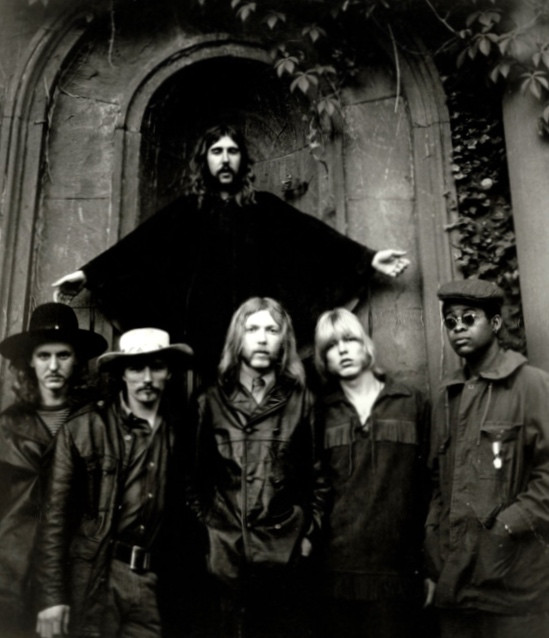
In 1969 Duane Allman hand-picked the members he wanted in his band. The first member he picked was drummer Johnny Lee Johnson…better known as Jaimoe or Jai Johanny Johanson. He then looked at a band called “The 2nd Coming” and he got members guitarist Dickey Betts and bassist Berry Oakley out of that band and continued. He also picked another drummer named Butch Trucks out of the band The 31st of February.

Duane wanted the best band possible. People were confused that he wanted two drummers and a guitar player who could play almost better than him. He didn’t care about that as much at all…as long as it sounded good. Dickey Betts was not the easiest person to get along with but he respected Duane so much that they never had any problems. They spurred each other live to go further.

They needed a singer and Duane automatically thought of this brother Gregg. Gregg was living in LA at this point with Jackson Browne sharing an apartment. He told Gregg to come to Macon Georgia with this band. Gregg came armed with songs and walked into the door. He heard the band and didn’t know if he was good enough to do it. The big brother Duane jumped on Gregg and told him not to embarrass him and get behind the keyboards and do his thing. Gregg as always listened to Duane and of course, he fit perfectly. Duane knew exactly what he was doing.

On a side note…the band had a keyboard player named Reese Wynans. Reese knew his stint with the band was done with Gregg joining. They already had two guitarists and two drummers…they didn’t need another keyboard player with Gregg joining. Duane helped him get some studio work and hooked him up with other musicians. Reese’s career was only starting. Later on, Reese joined Stevie Ray Vaughan and Double Trouble in 1985, playing keyboards on Soul to Soul and In Step. He performed live with the group until Stevie’s death in 1990.

Allman Brothers - It's Not My Cross To Bear B

He moved to Nashville, Tennessee in 1992, Reese has played keyboards for a number of country artists including Brooks & Dunn, Trisha Yearwood, Martina McBride, and Hank Williams Jr. He has also played for blues artists Buddy Guy, John Mayall, Kenny Wayne Shepard, Colin James, Ana Popovic, Dudley Taft, Eli Cook, and Los Lonely Boys. I personally met Reese at my guitar tech’s business… a great guy. 

The Allman Brothers toured relentlessly through 1969-1971 playing at clubs and also doing free shows in the park in what town they were at…the same thing that The Grateful Dead did also. Money wasn’t the thing…they built a grass roots following and they were probably more popular in New York than anywhere else.

This song was on their debut album The Allman Brothers Band released in 1969. The album was hailed by critics but it didn’t sell but 35,000 copies at the time. When you look at the album now…it’s full of songs that would be their bedrock for years. Whipping Post, Dreams, and Trouble No More to name but a few.

Gregg Allman was the main songwriter in the band at first. Dicky Betts would soon start writing more around the second album. Allman wrote this about a girlfriend and wrote a song called Blackhearted Woman about that same girlfriend. They recorded the album in two weeks total…played it and mixed it.

They would release their second album the following year. That album did a little better but it still didn’t take off despite having many songs (Midnight Rider, In Memory of Elizabeth Reed, and more) that would make them famous later. It was in 1971 when they released At Fillmore East that all the years of touring paid off. It was a massive hit peaking at #13 and they were set up for a great career. Up until then, the record company had been advancing them money since 1969 and that album paid everything off. They finally had money coming in and the ability to get what they wanted.

Then on October 29, 1971, Duane Allman was killed on a motorcycle in Macon Georgia. They thought about breaking up but they stayed together and had a huge career with albums Eat A Peach (which Duane is on a few tracks) and the massive Brothers and Sisters. Around a year later…their bassist Berry Oakley died on a motorcycle within a few blocks of where Duane crashed.

When punk came in the late seventies they struggled because no one wanted blues jams anymore even if the musicianship was top notch and it was. That is something about the punk and New Wave movement I didn’t like. Some bands like this who were musically superior got swept away for a while.

Classic radio started to get popular and all of these bands that were ignored during punk and new wave were sought after again. In the late eighties, Gregg had a huge hit with I’m No Angel and the band reformed and played until Oct. 28, 2014 when they officially retired as a band.

I truly think they had more talent in that band than most of their peers. I have to add that I think Gregg could be the best white blues singer of his era.

It’s Not My Cross To Bear

Yeah, yeah, yeah

I have not come, yeah
To testify
About our bad, bad misfortune
And I ain’t here a wond’rin’ why
But I’ll live on and I’ll be strong
‘Cause it just ain’t my cross to bear

I sat down and wrote you a long letter
It was just the other day
Said, sure as the sunrise, baby
Tomorrow I’ll be up and on my way
But I’ll live on
And I’ll be strong
‘Cause it just ain’t my cross to bear
Oh no

Oh, but I’ll live on and I’ll be strong
‘Cause it just ain’t my cross to bear
Yes now baby

But in the end, baby
Long towards the end of your road
Don’t reach out for me, babe
‘Cause I’m not gonna carry your load
But I’ll live on and I’ll be strong
‘Cause it just ain’t my cross to bear
Yeah, yeah
Yeah yeah, yeah yeah, yeah yeah, yeah yeah, yeah yeah, yeah yeah

Star Trek – Metamorphosis

★★★★★ November 10, 1967 Season 2 Episode 9

If you want to see where we are…and you missed a few…HERE is a list of the episodes in my index located at the top of my blog. 

This show was written by Gene Roddenberry and Gene L. Coon

One of my top episodes of Star Trek. This one was directed by Ralph Senensky. I’ve mentioned Ralph before… he will be 100 years old on May 1st of this year. He has a website and still posts about his adventures in directing many episodes of Star Trek and so many other shows including The Twilight Zone, The Waltons, Mission Impossible, and too many to mention. Please visit his site…he has a lot of fun stories about each episode he directed. 

This one has everything you could want from a Star Trek episode. Great acting, writing, and even romance. 

Kirk, Spock, and Dr. McCoy are traveling with Commissioner Hedford, trying to get her back to the Enterprise so that they can hopefully cure her of a rare and deadly disease that she has. They are pulled down to a planet. They meet Zefram Cochrane, who supposedly died 150 years ago.

Star Trek - Metamorphosis B

He tells them that he had been out in space because he had gotten old and his wish was to die in space. However, he and his ship had been brought down to the planet just as they were. An alien entity he calls the companion was responsible for this as well as for rejuvenating him and making him back to around the age of 35. This companion has been able to keep him healthy, well, and at the same age for all these years.

They find a way to have a direct conversation with the companion. Spock is wanting to spend time asking the companion questions so that they can learn more about it. It is a very different species and part of their mission is to find new species and learn about them. I concur with Spock on this. Of course, because they made an error when writing this and made it so that the companion cannot heal the commissioner, Kirk stops Spock from asking the questions, pointing out that they need to hurry and try to get the companion to let them go so that they can get to the Enterprise, hopefully in time, to heal the commissioner.

Strong performances from Glenn Corbett and Elinor Donahue help raise this episode to classic status. A touching love story between a man isolated on a planet by himself, and a caring, alien life form he refers to as ” the Companion” is a thoughtful and moving story.

From IMDB:

A few scenes featuring Elinor Donahue had to be re-shot, because the original film negatives were damaged and couldn’t be used. Portions of the planet set had to be rebuilt, since other episodes were shot there by that time, using different sets. Meanwhile, Donahue got pneumonia and lost ten pounds. To hide this, they put Hedford’s scarf around her neck and upper body. However, her weight loss is still visible on her face. The re-shots were not directed by Ralph Senensky.

This is the first story to feature Zefram Cochrane, inventor of warp drive technology and an important figure in Federation history. He would later re-appear in Star Trek: First Contact (1996) and Star Trek: Enterprise: Broken Bow, Part 1 (2001), played by James Cromwell.

A view of the starship from dead center in front of the saucer section is used only in this episode.

This is the only episode in the first two seasons in which Captain Kirk is not on the Enterprise at any time during the plot. Likewise, the Enterprise does not appear until twenty-seven minutes into the episode. In four third season shows, Kirk also spends the entire episode off-ship: Star Trek: The Paradise Syndrome (1968), Star Trek: Plato’s Stepchildren (1968), Star Trek: Whom Gods Destroy (1969), and Star Trek: All Our Yesterdays (1969).

The scenes of Cochrane communicating with the Companion were all shot at one time. The set was then completely redone with his house added for all of the sequences with Kirk and company. The inconsistencies between the two versions of the same set can be seen in alien trees that are near Cochrane in one view and absent in the next.

To give an illusion of open space to a confined stage set, wide angle lenses were used. Although Glenn Corbett appears to be hundreds of yards away when he first runs toward the shuttle, he is much closer. Strategically placed rocks also allowed the camera to be very far away without seeing the edges of the set.

In the first draft, the Enterprise is temporarily commanded by Sulu, and the helmsman is an officer with an African background, named Lieutenant Ackrumba. The character later appeared in the novel “Mission to Horatius” by Mack Reynolds.

In the first draft script, Scotty is also on board the shuttlecraft (here called the Edison) with Kirk, Spock, McCoy, and Hedford. It was originally he who was to encounter the Companion while attempting to repair the shuttlecraft.

In a rare effect, slowly moving “clouds” were blown in from hidden vents, adding a touch of reality to the usually static planet set. This was also used in Star Trek: Obsession (1967).

George Takei disappears from the cast for the next 9 episodes after this one as he was off filming The Green Berets (1968) at the time.

Elinor Donahue recalled about this episode, “I remember watching it at home. And I am quite often nervous about watching something I’m in because there is nothing you can do about it once it’s out there. But I was very pleased with it; very happy.”

This was George Duning’s first Star Trek score, the strength of which got him rehired for many more assignments, including Star Trek: Patterns of Force (1968), Star Trek: Return to Tomorrow (1968), Star Trek: And the Children Shall Lead (1968), Star Trek: Is There in Truth No Beauty? (1968), and Star Trek: The Empath (1968). Portions of the score were reheard throughout the season, but the love themes were reused only once more, in Star Trek: The Gamesters of Triskelion (1968).

Ralph Senensky named this episode as his favorite among those he directed. Senensky recalled, praising the work of Gene L. Coon, “I just thought the script was absolutely wonderful. As I remember Gene, he was the least author-y type of person. He just didn’t seem like an author. He didn’t present that kind of sensitivity that his writing had expressed. It was just a deep, deep script and scene after scene had so many angles to come at it from. It was a complex script.”

The sparkling effects of the Companion would be reused in Star Trek: The Apple (1967) when the Enterprise fires phasers at Vaal, and again in Star Trek: Obsession (1967) inside of the deadly vampire cloud.

All the footage of the shuttlecraft in outer space was reused from Star Trek: The Galileo Seven (1967), some with the Companion animation added in post-production.

Technically, Zefram Cochran is 237 years old (87 plus the 150 years the Companion kept him young.)

When Kirk asks Cochrane for his first name, he replies, “Zefram”. Kirk then asks him if he is from Alpha Centauri and the inventor of the “space warp”. Cochrane then confirms he is. Yet in the movie Star Trek: First Contact (1996), Zefram Cochrane is from Earth. However, having invented the warp drive, it is conceivable that he went there and took up residence. It is possible he left to “die in space” from there. Therefore, he could be described as “from Alpha Centauri.”

A Gold Key Comics comic book was released as a sequel to this episode, #49: “A Warp in Space”.

The original voice of the Companion was too emotionless and robotic, and all of her dialog had to be re-recorded by another actress (apparently Elizabeth Rogers).

The Companion was designed by Richard Edlund at Westheimer photographic effects company.

Summary

While transporting ailing Assistant Federation Commissioner Nancy Hedford to the Enterprise aboard a shuttlecraft, Captain Kirk, Spock and Dr. McCoy encounter a gaseous creature that forcibly takes them to a planet with only one human inhabitant. The man turns out to be Zephram Cochrane, the inventor of the warp drive who supposedly died 150 years ago at the ripe old age of 87. The creature, whom he calls the Companion, found and brought him to the planet where it rejuvenated him and kept him alive. They can communicate but only on a non-verbal, empathic level, (which unintentionally lead to the shuttlecraft’s abduction when the man conveyed to it his loneliness). As Commissioner Hedford’s condition rapidly deteriorates, they need to free themselves to get her back to the Enterprise before it’s too late.

CAST

William Shatner … Captain James Tiberius ‘Jim’ Kirk
Leonard Nimoy … Mister Spock
DeForest Kelley … Dr. McCoy
Glenn Corbett … Zefram Cochrane
Elinor Donahue … Nancy Hedford
James Doohan … Scott
George Takei … Sulu
Nichelle Nichols … Uhura
Bill Blackburn … Lieutenant Hadley (uncredited)
Lisabeth Hush … The Companion (voice) (uncredited)
Eddie Paskey … Lieutenant Leslie (uncredited)

Beatles – Good Morning Good Morning

Somebody needs to know the time, glad that I’m here
Watching the skirts you start to flirt now you’re in gear

I was 10 when I bought Sgt Peppers Lonely Hearts Club Band…10 years after it was released. It came with the same cutouts as it did in 1967. I remember taking hours and looking over the album cover. You would find faces you didn’t see before and I remember spotting Stuart Sutcliffe, the former Beatles bassist and the man who was most responsible for coming up with the band’s name.

Here is Stuart (left) on the cover and the picture they took it from. 

Stuart Sutcliffe on Sgt Pepper

The Cutout page that came with Sgt Pepper. 

Sgt Pepper Cutouts

The song started out with a rooster crowing and ends with a chicken clucking. Good Morning Good Morning was inspired by a Corn Flake commercial. Lennon would always leave the TV on and sometimes with the volume turned down. He saw an ad for Corn Flakes and the song came to him. “Good Morning Good Morning…the best to you each morning.” I’ll have the video at the bottom of the post.

As a youngster, I enjoyed this song and Lovely Rita. The only song that was hard for me to grasp on the album was Within You Without You…because it was so different. In time, it became one of my favorites on the album.

I love the horns in this song and McCartneys stinging guitar solo in this one. Ringo’s drumming also stands out on this track…the sound and the playing are outstanding. His cymbols sound like a steam engine with the compression they ran on them.

This song is one of the most technically challenging songs they wrote. It was highly aggressive and complex, with a loud french horn, animal noises, pounding drums, strong vocals, and a large amount of intricate strumming guitars. The time signature to this song is all over the place…3/4, 5/4, 4/4, 12/8… but the song doesn’t sound forced or disjointed. This track is an example of how great Ringo is as a drummer. This and his work on A Day In The Life. He had to play in many different styles because John, Paul, and George wrote so many different styles of songs.

One of the most interesting things about the song is the end of it. Various animal sounds are put together but they had a purpose. The animal sounds were dubbed in from a sound effects disc. They were arranged in order of creatures capable of eating or chasing the one before, at Lennon’s request. And at the very end…was a very cool effect. A clucking chicken suddenly turns into a guitar lick when it melts into Sgt Pepper’s Reprise.

Six brass players were involved in this session, three saxophonists, two trombonists, and one French horn player. George Martin was excellent at mixing horns with Beatle songs. Got To Get You Into My Life is another example of that. They are not regulated to the background like other songs. They are upfront and have a fat sound to them.

This song was also the first song The Beatles ever licensed, while they were together, to be used in a show. It was in the last Monkees episode (“The Frodis Caper”) which was totally surreal…not like the formula driven episodes of the first season. It was kinda like The Simpsons meet Green Acres.

John Lennon: “I often sit at the piano, working at songs, with the telly on low in the background, if I’m a bit low and not getting much done, then the words on the telly come through. That’s when I heard ‘Good morning, good morning.’ It was a corn flakes advertisement. I was never proud of it. I just knocked it off to do a song.”

Paul McCartney: “John was feeling trapped in suburbia and was going through some problems with Cynthia, it was about his boring life at the time. There’s a reference in the lyrics to ‘nothing to do’ and ‘meet the wife’; there was an afternoon TV soap called ‘Meet The Wife’ that John watched, he was that bored, but I think he was also starting to get alarm bells and so ‘Good morning, good morning.’”

Micky Dolenz (drummer for the Monkees): “And I’ll never forget it.  John Lennon looks up at me and says, ‘Hey Monkee Man!…You want to hear what we’re working on?’…And he points up to George Martin and I remember this so clearly…He’s wearing a three-piece suit…and he pushes a button on a four-track tape recorder and I hear the tracks to ‘Good Morning Good Morning.’…And then we sit around and then I remember some guy with a white coat and tie came in with tea…’Tea time, eh!’ And we sat around a little table and had really God-awful tea. And then everybody sat around and then we were chatting – ‘What’s it like, The Monkees?,’ me again trying to be so cool. And then I think it was John that went, ‘Right lads, down in the mines.’ And they went back to work.” .

Sgt Pepper

Just in case you wanted to know who was who on the cover. 

Sgt Pepper Cover who is who

This is the commercial that inspired John Lennon

I couldn’t find a version of Good Morning Good Morning going into the Sgt Pepper Reprise. You have to listen to the end of Good Morning and the beginning of the Reprise to hear it. The album of course plays them together…there is no space between the songs. 

Good Morning Good Morning

Nothing to do to save his life call his wife in
Nothing to say but what a day how’s your boy been
Nothing to do it’s up to you
I’ve got nothing to say but it’s okay
Good morning, good morning

Going to work don’t want to go feeling low down
Heading for home you start to roam then you’re in town
Everybody knows there’s nothing doing
Everything is closed it’s like a ruin
Everyone you see is half asleep
And you’re on your own you’re in the street
Good morning, good morning

After a while you start to smile now you feel cool
Then you decide to take a walk by the old school
Nothing has changed it’s still the same
I’ve got nothing to say but it’s okay
Good morning, good morning

People running round it’s five o’clock
Everywhere in town is getting dark
Everyone you see is full of life
It’s time for tea and meet the wife
Somebody needs to know the time, glad that I’m here
Watching the skirts you start to flirt now you’re in gear
Go to a show you hope she goes
I’ve got nothing to say but it’s okay
Good morning, good morning

cat, dogs barking, horses, sheep, lions, elephants, a fox being chased by dogs with hunters’ horns being blown, then a cow and finally a hen.

Star Trek – I, Mudd

★★★1/2 November 3, 1967 Season 2 Episode 8

If you want to see where we are…and you missed a few…HERE is a list of the episodes in my index located at the top of my blog. 

This show was written by Gene Roddenberry, Stephen Kandel, and David Gerrold

It’s a comic turn for guest star Roger C. Carmel. This was Carmel’s second appearance as Harry Mudd, a futuristic enterprising con man and he thinks he’s found heaven. I think this sequel was better than the one that Carmel did originally, Mudd’s Women. 

Star Trek - I Mudd B

 In an attempt to get revenge on the Enterprise, he plans on having a planet of robots take the entire crew prisoner in order to serve them–whether they want it or not. The robots feel that the human race is very chaotic and must have the robots run their lives for their own good (they might just be on to something here). So, thousands of robots are ready, willing, and able to cater to humans’ every need. That reminds me of computers and cell phones. 

Star Trek - I Mudd C

My favorite scene was with Chekov. Chekov contemplates being with two such androids as he realizes they were programmed by a man as depraved as Mudd. The look on his face is priceless. 

The resolution here is a bit corny (plus it was used before) but the concepts brought up are undeniably fascinating and really do the Mudd character justice. The entire crew has to act illogically and even Spock joins in on the fun. 

It’s not a great episode but is a humorous one. Like I said before…I do think it’s much better than the first one with the Mudd character. The ending is poetic justice also with Mudd. 

Gene Roddenberry really liked the character. Carmel was slated to reprise his role as Harry Mudd in a first-season episode of Star Trek: The Next Generation, but died before filming started. He was in the 1973 Star Trek: The Animated Series in the episode of Mudd’s Passion. The animated series of Star Trek with the original cast is worth tracking down! 

The character Harry Mudd returned to Star Trek Discovery played by Rainn Wilson from The Office. He was in two episodes in the first season…the 1st Choose Your Pain (2017) and Magic To Make The Sanest Man Go Mad (2017). He also appeared as Mudd again in “The Escape Artist” in Star Trek Short Treks released in 2019. 

Rainn Wilson: I read about it in the paper that they were going to reboot Star Trek at CBS/Paramount. Bryan Fuller was the original creator [of Star Trek: Discovery] and I met with Bryan and some other folks. I said, “Hey, just so you know, I want to throw my hat in the ring.” I love Star Trek. I’d love to be a part of this somehow. I don’t know what that looks like. I’m not sure I want to move to Toronto for years. I’m not sure I want to sit in a chair and get makeup put on for two hours every morning. Because that’s brutal, what Doug [Jones] does, but it’s amazing. And then I didn’t hear anything and things came and went, and up and down. And and then, fortunately, they gave a call, “What about Harry Mudd?” It was fantasic!

From IMDB:

During the filming, casting director Joseph D’Agosta was in a panic because he needed at least two female identical twins and couldn’t find any suitable for the show. Then one night while driving home he saw Alyce Andrece and Rhae Andrece walking down a street. D’Agosta literally pulled up beside them, jumped out of his car and told them that they were going to be on television! (In some tellings of the story Gene Rodenberry is substituted for D’Agosta, but Steven Whitfield’s “The Making Of Star Trek” confirms it was D’Agosta.)

A third-season appearance of Harry Mudd was planned but axed due to the producers’ desire to move away from comedy episodes. However, Roger C. Carmel would reprise the role of Mudd as a cartoon voice in Star Trek: The Animated Series: Mudd’s Passion (1973). Mudd was considered for a return during the Star Trek movies in the 1980s, but Carmel’s failing health nixed that.

This was Roger C. Carmel’s favorite Star Trek episode.

With the exception of those actors who played members of the Enterprise crew, Roger C. Carmel was the only actor to play the same character in more than one episode of Star Trek the Original Series.

According to Walter Koenig, NBC considered making a Harry Mudd spin-off show after the success of “I, Mudd.” They assigned Gene Roddenberry to develop the idea, but being busy with Star Trek and other projects, he didn’t have time for it, and the series was never conceived.

David Gerrold did an uncredited rewrite on this episode. One of the significant changes he made, at Gene L. Coon’s request, was to get the crew on to the planet by the end of the first act. Other notable contributions were the gag of the five hundred identical female robots, and more material relating to Stella. Coon offered to submit the script for arbitration so that Gerrold would receive credit and residuals. However, Gerrold declined as he felt it would be stealing from Stephen Kandel, who had created Harry Mudd.

Using identical twins for each android “series” aided the photographic-effects budget for the episode. With imaginative use of twins and split screens, as many as six of one model were shown at once, while two of the same model required nothing but an additional costume. This ultimately gave the illusion of a planet of thousands of androids.

This episode marks George Takei’s last appearance in the series until Star Trek: Return to Tomorrow (1968). During his nine episode absence, Takei was on the East Coast filming The Green Berets (1968).

The first draft of the script devoted more attention to Norman’s act of diverting the Enterprise to Mudd, with the crew only arriving at the end of the second act. After an examination revealed Norman as an android, Scotty expressed an urge to take Norman apart – quickly adding that it was “nothing personal.” Norman understood.

While searching for identical twins to play androids, casting director Joseph D’Agosta found two young girls (apparently prostitutes) walking on Hollywood Boulevard with their pet wild cat, Marlon. He brought the two girls to meet producer Gene L. Coon and associate producer Robert H. Justman. While they inspected the girls (who were ultimately deemed unsuitable for the role), Coon had to hold Marlon, which consequently scratched him with its claws and tore his entire shirt.

At approximately 5 minutes and 35 seconds, this episode’s teaser is the longest in the original series.

As a result of its unusual use of several pairs of twins, this episode was featured in an article in TV Guide for the week it aired.

The piece of equipment found in Norman’s lab and workshop would be recycled for future episodes, appearing in the corridors of the Enterprise. Parts of the device that contained the nanopulse laser were later seen in Dr. McCoy’s lab.

The body suits worn by the male androids were later reused on Bele and Lokai in Star Trek: Let That Be Your Last Battlefield (1969).

The Maisie series and the Barbara series androids are wearing costumes left over from Star Trek: Mudd’s Women (1966), worn by Karen Steele and Maggie Thrett respectively.

Although ‘I, Claudius’ may be an inspiration for the title, a more likely source is Isaac Asimov’s ‘I, Robot’.

The title, referring to the absurd “king” of the robots, spoofs the 1934 Robert Graves historical novel “I, Claudius,” about the fourth emperor of the Roman Empire, who ruled between Caligula and Nero.

The Trudy series android is wearing a costume worn by an Argelian woman in Star Trek: Wolf in the Fold (1967).

Stella Mudd is wearing a dress (with slight modifications), which was seen on Martha Leighton in Star Trek: The Conscience of the King (1966).

Near the end, Dr. McCoy says, “It’s worked so far, but we’re not out yet.” This line was sampled on the song “What’s on Your Mind (Pure Energy)” on Information Society’s titular 1988 album.

Although there are 500 Alice models, we only see fifteen or sixteen. In order of appearance, they are: 1, 2, 66, 99, 19, 263, 118, 322, 471, 210, 27, 11, 3, 73 and 500. The number of the Alice that throws Scott into Kirk’s group is too far away to read (although it does seem to be a double-digit figure.)

The Annabelle series android is wearing the costume originally worn by Marlys Burdette in Star Trek: Wolf in the Fold (1967).

This takes place in 2268.

In his review of this episode in ‘The Star Trek Compendium’, author Allen Asherman states that many of the actors had great difficulty keeping their composure while filming. However, actor Richard Tatro (Norman) had successfully performed his scenes without ever breaking character.

Roger C. Carmel would later voice the G1 Decepticon Stunticon leader Motormaster in the animated series ‘The Transformers’ (1984.)

Summary

When an android takes control of the Enterprise, Kirk and his crew spend four days traveling at warp speed to an uncharted planet. When they beam down they find none other that Harry Mudd, the apparent ruler of the planet made up entirely of androids. It turns out there is one major problem with Harry’s idyllic existence: the androids who serve him hand and foot simply won’t allow him to leave. Kirk and Spock devise a way to disable the androids but have their own special plans for Harry.

CAST

William Shatner … Captain James Tiberius ‘Jim’ Kirk
Leonard Nimoy … Mister Spock
DeForest Kelley … Doctor Leonard ‘Bones’ McCoy
Roger C. Carmel … Harry Mudd
Richard Tatro … Norman
Alyce Andrece … Alice #1 through 250
Rhae Andrece … Alice #251 through 500
James Doohan … Lieutenant Commander Montgomery ‘Scotty’ Scott
Nichelle Nichols … Lieutenant Nyota Uhura
George Takei … Lieutenant Hikaru Sulu
Walter Koenig … Ensign Pavel Chekov
Kay Elliot … Stella Mudd
Mike Howden … Lt. Rowe
Michael Zaslow … Jordan
Bobby Bass … Android (uncredited)
Bill Blackburn … Android (uncredited)
Marlys Burdette … Female Android (uncredited)
Roger Holloway … Lt. Lemli (uncredited)
Ted LeGarde … Herman Series (uncredited)
Tom LeGarde … Herman Series (uncredited)
Jeannie Malone … Yeoman (uncredited)
Bob Orrison … 1st Engineer (uncredited)
Eddie Paskey … Lieutenant Leslie (uncredited)
Colleen Thornton … Barbara Series (uncredited)
Maureen Thornton … Barbara Series (uncredited)
Starr Wilson … Maisie Series (uncredited)
Tamara Wilson … Maisie Series (uncredited)

Star Trek – Catspaw

★★★ November 3, 1967 Season 2 Episode 7

If you want to see where we are…and you missed a few…HERE is a list of the episodes in my index located at the top of my blog. 

This show was written by Gene Roddenberry, Robert Bloch, and D.C. Fontana

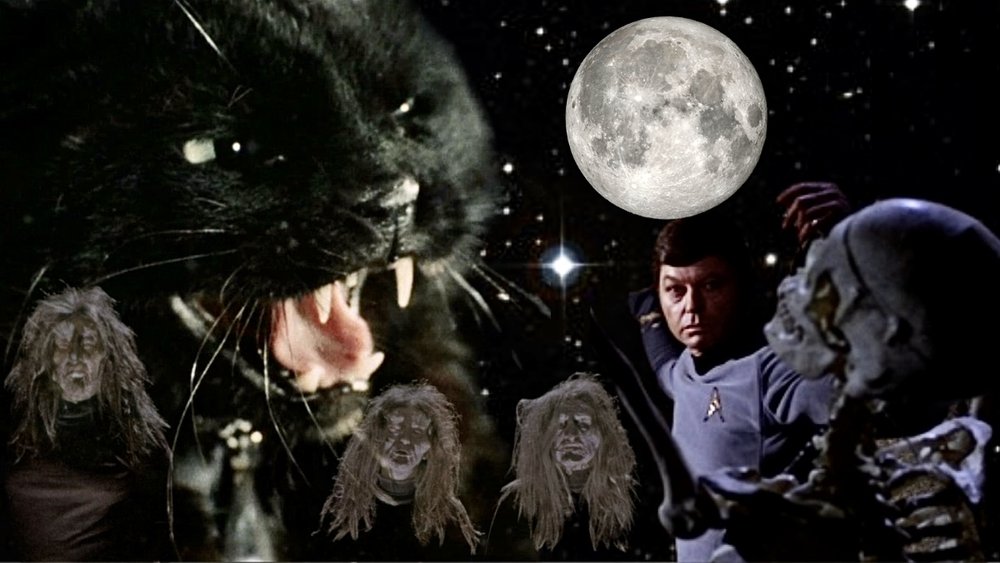
A black cat, witches, fog, and a spooky castle.

I saw this in a comment elsewhere and it’s true. If you understand the premise of this episode, that the black cat, witches, zombies skeletons, magic, etc. were derived from the aliens’ mistaken interpretation of human nightmares, rather than human reality, then, this episode does make sense.

This 1967 Halloween episode is not just about Trick or Treat – It’s about the clash of two cultures that meet in passing.  It’s about how badly things can go wrong when communication is set aside to make room for personal wants and desires that can become greed.

Star Trek - Catspaw

There is truly a great line in this episode. When the crew faces the 3 witches from Macbeth. When the witches are done reciting their lines, Kirk says to Spock, “Spock . . . comment.”
Very bad poetry, Captain,” Spock replies to Kirk’s obvious annoyance. I loved that. 

20 Most Cringeworthy Classic Star Trek Moments – Page 8

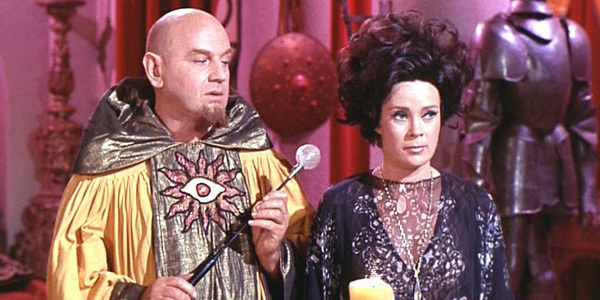
When they beam down, they see thick fog, 3 witches, an eerie castle, and a black cat entering the castle. They meet Korob and Sylvia, end up in a dungeon, and find that Scotty and Sulu are in a trance of sorts and obeying the will of the two sorcerers.

The sorcerers use their magic against the Enterprise, Bones ends up in a trance-like state while Kirk and Spock try to figure out a way to beat the sorcerers and save their ship and crew. Sylvia becomes very cruel and disputes with Korob. Korob decides to help Kirk and his crew because he feels that Sylvia is going way too far.

This episode is Star Trek Halloween special basically… The crew land on a weird foggy world complete with monsters…

From IMDB:

The voices of the little creatures in the final scene are the sounds made by newly-hatched alligators calling for their mother.

A detailed metal prop miniature of the Enterprise was created for this episode, then laminated in lucite as one of Korob’s tricks. The miniature was donated to the Smithsonian National Air and Space Museum by Gene Roddenberry.

First appearance of Pavel Chekov, though not the first one broadcast. That honor goes to Star Trek: Amok Time (1967). Notice that Walter Koenig was still growing his hair out and therefore had to wear a rather unconvincing wig.

The title of this episode, “Catspaw”, is a term that describes a person used by another as a dupe. As McCoy points out, Scott and Sulu are used as catspaws to lure more crewmen down.

Fittingly, the episode was first aired during the week of Halloween.

James Doohan (Scotty) lost his right middle finger during World War II. Most of his scenes are shot to hide it; however, it is very noticeable here. When Scotty is holding a phaser pistol on Kirk and Spock, only two fingers are holding the butt of the phaser.

Scotty’s only dialogue is the statement, “Everything’s vanished”. Sulu doesn’t speak at all; he simply nods “yes” and “no” when queried by Kirk, and later cries “aha!” before engaging Kirk in hand-to-hand combat.

This is the first episode to feature all 7 of the “classic” cast members who would be brought back for future big screen adventures: Kirk, Spock, McCoy, Scotty, Uhura, Sulu, and Chekov, although they do not all appear in the same scene together.

 The three witches seen towards the start of the episode were intended to be shown as floating severed heads. Hence the reaction from the landing party at their appearance. The characters wore black turtlenecks against a black backdrop, with light shining directly up into the face. Unfortunately, the effect did not work and the turtlenecks worn by the actors can clearly be seen. Even in the remastered version of the episode, this oversight is still present.

Theodore Marcuse (Korob) died in a car accident one month after “Catspaw” aired.

Korob and Sylvia refer to their leaders as the Old Ones, and imply that they are close by. Horror writer H.P. Lovecraft referred to the inhuman gods in his short stories as Old Ones; their being “nearby” was standard fare in his writings. Episode author Robert Bloch was a friend and disciple of Lovecraft. A similar reference occurs in Bloch’s Star Trek: What Are Little Girls Made Of? (1966).

The ornithoid lifeforms were marionettes composed of blue fluff, pipe cleaners, crab pincers, and other materials. The marionettes were operated with thick, black threads that were clearly visible; most of this was corrected in the remastered version of the episode.

When Gene Roddenberry originally outlined the chain of command, Lt Uhura was fourth in command. One of the reasons Dr Martin Luther King Jr convinced her to continue in the role (which she was considering quitting) was that he thought it was progress for a black woman to have such a prominent role for that time, although he was probably unaware that she was to be fourth in command. In the original script, Lt Uhura was to be in command when Kirk, Spock and Scott were all on any planet, but NBC was against having a female in charge of the Enterprise.

The Three Witches are iconic characters from William Shakespeare’s Macbeth, a play which inspired frequent allusions throughout this series.

The role of Crewman Jackson was played by regular Trek stuntman Jay Jones. Jones is credited as “Jimmy Jones”, whom some sources believed was Jones’ brother. However, in a 1996 retrospective interview, Jay claimed he played Jackson, as his first assignment on Star Trek, and makes no mention of a brother named Jimmy being involved on the show.

First time Assistant Chief Engineer, Lt. DeSalle was in command of Enterprise. Captain Kirk and second-in-command Mr. Spock beamed down on the planet Pyrus VII to rescue third-in-command Chief Engineer Scotty and fourth-in-command helmsman Sulu, leaving the command to Lt. DeSalle. Lt. DeSalle became fifth officer in charge of Enterprise command. Also, this was the third and last appearance of Lt. DeSalle in the show. He had appeared previously in Star Trek: The Squire of Gothos (1967) and Star Trek: This Side of Paradise (1967).

 First episode produced for the second season.

This is the first episode in which a scope can be seen at the engineering station on the bridge. The science station scope was slightly altered for this episode; it is of a lighter color than the science scope used in episodes of the first season and has a circular control added to its left side. This dial control, as first seen in this episode, would remain throughout Seasons 2 and 3.

Robert Bloch based this episode very loosely on his own short story “Broomstick Ride”. Bloch also wrote Star Trek: What Are Little Girls Made Of? (1966) In both episodes, the “Old Ones” figure into the guest characters’ backstories.

One of the cat’s roars was recycled as the trademark growl for Bowser in various games such as Mario Party (1998) and Mario Golf (1999).

The short scene of crewmen in turtleneck uniforms walking in a corridor during red alert is stock footage from Star Trek: Where No Man Has Gone Before (1966). This marks the last time that these uniforms are worn by Enterprise crewmembers.

This is Sulu’s only non-speaking appearance in the entire series.

This episode marks several changes to the episode credits. From this point on, the episode titles and end credits are in the same typeface as the main title of the series. Directors and writers are credited at the beginning of Act One instead of the end of the last act. DeForest Kelley’s name is added to the opening credits. Also, Gene Roddenberry is credited as series creator in the opening credits.

Several bloopers from this episode can be found in the second season blooper reel.

The robe worn by Theodore Marcuse as “Korob” was previously worn by Bob Denver as “Fairy Godfather” in a dream sequence in Gilligan’s Island: Lovey’s Secret Admirer (1967) ten months before. So either the Trek Wardrobe Department borrowed it, even though the shows were produced by different studios, or they loved the design so much they copied it.

In this episode, DeSalle wears a red engineering tunic, unlike the gold command tunic he wore in Star Trek: The Squire of Gothos (1967) and Star Trek: This Side of Paradise (1967). The character started out as a navigator in the former, then served as a science officer in the latter, ending up as an engineer here.

The blue planet used in this episode as Pyris VII (albeit a darker blue, to illustrate the spookiness of the planet) was reused in subsequent episodes, representing Argelius II in Star Trek: Wolf in the Fold (1967), Sigma Iotia II in Star Trek: A Piece of the Action (1968), Troyius in Star Trek: Elaan of Troyius (1968) and Scalos in Star Trek: Wink of an Eye (1968) which were all lighter blue.

‘Catspaw’ introduces two plot elements that were revisited in stories later in season 2. First, Star Trek: By Any Other Name (1968) explored the theme of extra-galactic aliens taking human form and then becoming inundated with human sensations. Second, Star Trek: Assignment: Earth (1968) revolved around an eccentric man with uncommon powers, who is accompanied by an apparently intelligent black cat which later turns into a black-haired woman.

Body Count: 3, and he isn’t wearing a red shirt, it’s yellow. Given that Scotty, Sulu, and Jackson all beamed down to the planet and that only Jackson was killed, it is unusual that Jackson wasn’t a red shirt, as a red shirt’s life expectancy is typically shorter than a crewman’s who is a gold or blue shirt. The other 2 casualties were not Enterprise crew members at all.

This was the first of two times that Captain Kirk and Spock were cornered by a giant cat. The second was in Star Trek: The Animated Series: Once Upon a Planet (1973).

Spock’s reference to the witches’ “very bad poetry” echoes his earlier remarks about the Air Force’s “poor photography” in Star Trek: Tomorrow Is Yesterday (1967).

 Summary

When Captain Kirk and his landing party arrive on Pyrus VII, they are met by eerie mists, a dark castle, wailing witches, zombies and a black cat. They soon learn that they are under the influence of a wizard, Korob, who tries to bend them to his will. They also soon learn that the black cat they saw is more than she appears and is in fact a powerful witch in her right. This beautiful witch, Sylvia, who wears a diamond pendant on her black dress, explains that they are explorers from another galaxy; however, Kirk and Spock must find a means to escape their grasp before they return to the Enterprise.

CAST

William Shatner … Captain James Tiberius ‘Jim’ Kirk
Leonard Nimoy … Mister Spock
DeForest Kelley … Doctor Leonard ‘Bones’ McCoy
Antoinette Bower … Sylvia
Theodore Marcuse … Korob (as Theo Marcuse)
James Doohan … Lieutenant Commander Montgomery ‘Scotty’ Scott
George Takei … Lieutenant Hikaru Sulu
Nichelle Nichols … Lieutenant Nyota Uhura
Walter Koenig … Ensign Pavel Chekov
Michael Barrier … DeSalle (as Mike Barrier)
John Winston … Lieutenant Kyle
Rhodie Cogan … First Witch
Gail Bonney … Second Witch
Maryesther Denver … Third Witch
Jay D. Jones … Crewman Jackson (as Jimmy Jones)
Bill Blackburn … Lieutenant Hadley (uncredited)
Jeannie Malone … Yeoman (uncredited)
Eddie Paskey … Lieutenant Leslie (uncredited)

Star Trek – The Doomsday Machine

★★★★★ October 20, 1967 Season 2 Episode 6

If you want to see where we are…and you missed a few…HERE is a list of the episodes in my index located at the top of my blog. 

This show was written by Gene Roddenberry and Norman Spinrad

A true 5-star episode. This would be in my top 5 Star Trek episodes of all time. The story is about obsession…if you get too caught up in it…it can hurt you or worse. This could be the most well-written episode. 

The crew of the Enterprise comes across the wrecked hull of the Constellation with only its commander, Commodore William Windom aboard. His crew was sent down to a planet that no longer exists because it was destroyed by a Doomsday device, a miles-long machine that looks like a hollowed-out log floating through space. It’s not floating and it isn’t hollow. It is self-fueling feeding on the planets and other objects in its path and its hull is impervious to starship phaser fire. It doesn’t look like it but it’s one of the best weapons I’ve ever seen. When it comes to your galaxy…you would have no galaxy left. 

Commodore William Windom is in shock, for good reason, and he is beamed to the Enterprise so the doctor can take a look at him.  

Star Trek - The Doomsday Device - Uss Constellation

While Kirk is away trying to repair the other ship, communications are circumvented, allowing Dekker, crazy as he is, to take over the Enterprise. He decides to wage war with this gaint eater of planets, endangering another crew. The episode draws on some wonderful twists and turns as Kirk has to deal with Dekker and then with the force that is now a danger to everyone. 

The cosmic threat of this huge alien weapon, while exciting in itself, takes on a much more darker tone thanks to the presence of Decker on the bridge of the Enterprise. The whole plot seems to take a back seat, for a while at least, to the strange, awful relationship between Dekker and this unfeeling machine. Everyone else becomes an incidental side player to the conflict between these two, but, of course, it’s Decker who sees this thing as his personal devil who killed his crew. 

Spock didn’t give up power easily but he had to when faced with Starfleet rules. Dekker wants to kill a machine with phasers that he knows won’t hurt it. On the communicator, Kirk gives Spock the command to relieve Dekker of power…against regulations but Spock complies and the following exchange takes place…video below of this. 

Capt. Kirk: Mr. Spock, relieve Commodore Decker immediately. That’s a direct order.

Matt Decker: You can’t relieve me and you know it, according to regulations…

Capt. Kirk: BLAST REGULATIONS! Mr. Spock, I order you to assume command on my personal authority as Captain of the Enterprise.

Mr. Spock: Commodore Decker, you are relieved of command.

Matt Decker: I don’t recognize your authority to relieve me.

Mr. Spock: You may file a formal protest with Starfleet Command, assuming we survive to reach a Starbase, but you are relieved. Commodore, I do not wish to place you under arrest.

Matt Decker: You wouldn’t dare.

[Mr. Spock signals two security guards who immediately step forward at his command]

Matt Decker: You’re bluffing.

Mr. Spock: Vulcans never bluff.

Matt Decker: [sadly] No. No, I don’t suppose that they do. Very well, Mr. Spock, the bridge is yours.

It’s a well-written episode and the acting by William Windom as Dekker is flawless. If I say too much more it will give it away…watch this episode. 

From IMDB:

James Doohan’s favorite episode for its highlighting of the engineering aspects of the Star Trek world.

According to William Windom, he did not enjoy working on the show. He said that William Shatner and Leonard Nimoy were not getting along at the time, which made the set’s atmosphere tense. He also said that he felt that the episode was silly so he purposely overacted. It was not until many years later that he realized that his character was a reference to Captain Ahab from Herman Melville’s “Moby Dick”.

This episode marks the first time Scotty is heard cursing in Gaelic. He later utters the same expletive in Star Trek: I, Mudd (1967) and Star Trek V: The Final Frontier (1989).

This is the most effects-heavy episode of the second season. When the series was digitally remastered for its 2007 DVD release, the upgrade required nearly 200 new effects shots.

According to William Windom, he had Decker compulsively twiddle with “cassette cartridges” (sic; data tapes) as an homage to Humphrey Bogart, who did the same thing with ball-bearings as Captain Queeg in The Caine Mutiny (1954).

Norman Spinrad was displeased with the model used for the planet killer. As he told Allen Asherman in The Star Trek Interview Book, he envisioned a doomsday machine bristling with all sorts of evil-looking weapons. For budgetary reasons, the actual Doomsday Machine model was made by dipping a windsock in cement.

Director Marc Daniels finished this episode in five days instead of the usual schedule of six. Daniels made a bet with the producers that he could finish the episode in five days. When he succeeded, he got a $500 bonus.

Nichelle Nichols does not appear in this episode. Uhura’s duties were assumed by Lt. Palmer, played by Elizabeth Rogers. Walter Koenig is also absent.

This episode was nominated for a Hugo Award for Best Dramatic Presentation, at the 1968 World Science Fiction Convention.

When Spock describes the two innermost planets of the solar system that was destroyed, he says “The surface temperature of the inner planet is that of molten lead. The other has an atmosphere poisonous to human life”. Commodore Decker says he beamed his crew down to the third planet. This accurately describes the first three planets in our solar system.

The first of two appearances of Elizabeth Rogers as communications officer Lt. Palmer, the other being season three’s Star Trek: The Way to Eden (1969).

This episode marks the debut of the re-designed engineering set. The dilithium crystal storage units now occupy the center of the floor (complete with recycled Horta eggs), a ladder and upper level have been added into what was just a high bank of lighted panels in the first season. The set also is entered through a short spur hallway now, rather than as a side door off a main corridor. The console across from the forced-perspective end of the set has been replaced by a doorway and moved to the main wall to the left of the red grid. The huge structures among which Kirk’s evil self and Ben Finney once hid are not seen in detail again, but the emergency manual monitor set was built on stilts on that spot, making its debut in Star Trek: Mirror, Mirror (1967).

Besides the Constellation and the Enterprise, the other Constitution class ships seen in the original series are Hood, Potemkin, Excalibur, Lexington, Defiant, and the Exeter.

Re-used stock footage of Scott being tossed around engineering is from Star Trek: Tomorrow Is Yesterday (1967). A console that appears only in that episode can be seen. Scott wears a tricorder throughout this episode. But, when the old footage of him being thrown against the grating in “Tomorrow is Yesterday” is spliced in, the tricorder vanishes.

Captain Willard Decker from Star Trek: The Motion Picture (1979), played by Stephen Collins, is the son of Commodore Decker from this episode. In the William Shatner vehicle T.J. Hooker: Second Chance (1982) there was a character named Decker.

Commodore Decker’s first name was originally to be Curt, but it was felt that it sounded too much like “Kirk”, so it was changed to Matt.

This is the first appearance in the series of another vessel identical to the Enterprise. The Constellation is a Constitution class vessel which is virtually the same as the Enterprise. Its registry number is NCC-1017, which implies that it was produced earlier than the Enterprise. Kirk said in an earlier show that there were only 12 Constitution class ships in service.

Writer Norman Spinrad recycled a short story of his called “The Planet Eater” which had been roundly rejected by publishing houses, despite being heavily influenced by “Moby Dick”. He was able to convince Gene Roddenberry that it would make a viable subject for an episode.

Although considered to be a classic episode by fans and critics alike, story editor D.C. Fontana named this as her least favourite episode.

This was one of very few episodes to have its entire score composed specifically for it. Sol Kaplan’s outstanding music was subsequently used in several of the other best episodes of the 2nd season, including Star Trek: The Immunity Syndrome (1968), Star Trek: Obsession (1967) and Star Trek: The Ultimate Computer (1968). Many listeners have noted similarities between its “planet killer” theme and the “shark” theme of John Williams’ score for Jaws (1975).

Strangely, there are two armed red-shirt guards posted on the bridge throughout much of this episode, even though there is no apparent reason requiring their presence. This doesn’t happen on any other episode of the series, unless there is an apparent security threat.

Norman Spinrad has expressed disappointment that the actor whom he envisioned playing Decker, Robert Ryan, was not cast. Ryan was a fan of the series and wanted to do the episode. Scheduling conflicts prevented this, so William Windom was cast.

The auxiliary control room is first seen in this episode aboard the Constellation. Its large viewing screen was previously used in the briefing room in Star Trek: The Menagerie: Part I (1966), Star Trek: The Menagerie: Part II (1966), and Star Trek: Space Seed (1967), and on the bridge set used in Star Trek: Where No Man Has Gone Before (1966).

The character of Lt. Washburn (played by Richard Compton) was named after the show’s longtime assistant director, Charles Washburn.

In the original script, Enterprise actually fires several phaser shots into the machine’s mouth, but the beams just ricochet around harmlessly, if energy beams can be said to ricochet. (‘Reflect’ is probably a better word.)

In Norman Spinrad’s original version, Spock makes an unusual comment after the machine has been destroyed. He calls the weapon “not very efficient”, pointing out that a fusion bomb disguised as space rubble could be easily fed to another version of the machine, should one appear.

The picture of the star field on the bulkhead of the transporter room makes its last appearance in this episode.

Kirk’s second season green wraparound tunic debuts in this episode and will appear intermittently throughout the season. In contrast with the first season version, the collar is now edged with gold piping, although it lacks the black trim that it will gain for later (shooting order) second-season episodes such as Star Trek: The Apple (1967) and Star Trek: The Immunity Syndrome (1968). The other key difference is the location of the rank braids: these were seen on the shoulders in the first season, whereas this version of the tunic sports the standard braids on the sleeves. Kirk never wore the green tunic in the third season.

In many of its profile shots, the planet killer is semi-transparent and stars show through it. This was an overlay of film footage of the doomsday machine model over an existing star field. This money-saving technique also was used in Star Trek: The Squire of Gothos (1967) when Trelane’s planet blocks the Enterprise’s path.

The modified Nuclear-Chicago Model 2586 Radiation Survey Meter is again used by a member of the landing party as a sensor device.

In the Star Trek novel “Vendetta”, author Peter David related that the planet-killer was actually a prototype for a much larger version. The weapon had been built by a race called The Preservers, who were fighting (and losing) a war with the Borg.

The three crewmen who beam over to the Constellation with Kirk, McCoy, and Scott were named after three of the series’ assistant directors. Washburn’s namesake was Charles Washburn; Russ’ was Rusty Meek, and Elliott’s was Elliot Schick.

The digitally remastered episode shows a much better idea of the doomsday machine’s ominous design. There is also a believable view of the disabled and heavily damaged Constellation.

This episode has six alumni from The Twilight Zone (1959): William Shatner, Leonard Nimoy, James Doohan, George Takei, William Windom, and Jerry Catron.

The trident scanner Scott pulls out of the new storage area near the doorway to engineering is the same prop Spock uses in Star Trek: Metamorphosis (1967) as he works on the shuttlecraft, and which Ensign Harper uses to plug in the M-5 multitronic unit in Star Trek: The Ultimate Computer (1968). It is identified in The Making of Star Trek as a “Ray Generator and Energy Neutralizer (Spock-Built).”

Here we see a Federation style of martial art in the fight scene between Mr. Montgomery and Commodore Decker. In most episodes, the fighting is not as structured. Two of Kirk’s default moves are to use a knife-hand strike to the neck (strike with the side of the hand, commonly known as a ‘karate chop’) and a flying side kick.

One of the legendary “bloopers” occurred during the filming of this episode: Spock says to Decker, “If you don’t veer off, I shall relieve you on that basis!” In the blooper, Leonard Nimoy forgets part of his line and says, “If you don’t veer off, I shall…blow my brains out!”

Summary

While on patrol, the Enterprise approaches a recently mapped solar system only to find that all but two of its planets have been destroyed. They also find another starship, the USS Constellation, floating in space and apparently abandoned. Beaming aboard the Constellation, they find only one occupant, Kirk’s friend and the ship’s commander, Commodore Matt Decker, who tells them of his encounter with a huge planet-killing machine. With Kirk attempting to re-start the Constellation’s engines, Decker takes command of the Enterprise and, in his irrational state, announces he is going to try and destroy the doomsday machine.

CAST

William Shatner … Captain James Tiberius ‘Jim’ Kirk
Leonard Nimoy … Mister Spock
DeForest Kelley … Doctor Leonard ‘Bones’ McCoy
William Windom … Commodore Decker
James Doohan … Lieutenant Commander Montgomery ‘Scotty’ Scott
George Takei … Lieutenant Hikaru Sulu
Elizabeth Rogers … Lt. Palmer
John Winston … Lieutenant Kyle
Richard Compton … Washburn
John Copage … Elliott
Tim Burns … Russ
Jerry Catron … Montgomery
Bill Blackburn … Lieutenant Hadley (uncredited)
Roger Holloway … Roger Lemli (uncredited)
Jeannie Malone … Yeoman (uncredited)
Eddie Paskey … Lieutenant Leslie (uncredited)

Star Trek – The Apple

★★★ October 13, 1967 Season 2 Episode 5

If you want to see where we are…and you missed a few…HERE is a list of the episodes in my index located at the top of my blog. 

This show was written by Gene Roddenberry, Max Ehrlich, and Gene L. Coon

This is not the greatest episode of Star Trek, but I like it because it really has most of the classic Star Trek themes and situations. There’s a landing party that gets mixed up with natives, and to save his crew Kirk has to take drastic steps to alter the course of their civilization. There’s a lot of romance in the air, (though interestingly, no romance for Kirk.)

There is something about Star Trek that I haven’t mentioned. The Red Shirt Syndrome. It seems that any security personnel with a red shirt…has a high mortality rate in the Enterprise. The ones that get it…usually are just stock performers we never saw before and certainly won’t again. Scotty is somehow safe from this occurrence… well he rarely beams down to planets. 

In this episode, there is plenty of time for Spock and McCoy to debate concepts like free will, change, and material comfort versus freedom. Of course, several red-shirt crew members are killed along the way here also. There’s a big fight and plenty of storms and lightning.

***Spoilers***

The Enterprise crew are exploring a planet that seems idyllic, but turns out to have deadly plants and explosive rocks, as well as a simple native race that worships a sophisticated machine they don’t understand and deify as an entity called “Valla”. Valla’s story is never really explained… it provides for the natives’ needs while needing periodic ‘feeding’ for some strange reason.

Valla basically serves as a plot device to temporarily disable the Enterprise and place the ship and crew in mortal danger. Valla also has the ability to control the weather and direct deadly lightning bolts at ground targets. Kirk’s dilemma is to take out Valla and free both his ship and the natives from their seemingly benevolent dictator.

The episode is alright but the storyline has been done before on Star Trek and Twilight Zone. 

From IMDB:

Spock’s lightning-burned shirt was auctioned off at a science-fiction convention in 1967, the same year filming wrapped.

 Chekov’s first name, Pavel, is established in this episode, when his love interest, Yeoman Landon, calls him “Pav”.

 Originally, the script for this installment called for Vaal’s stone dinosaur head to be destroyed by Enterprise’s phasers. The props department had put in a lot of work creating it with paper mache’ and refused to allow its destruction.

 Walter Koenig seems to have discarded the wig he used in his earlier episodes. Since his own hair was now long enough, it was not necessary for him to wear it anymore.

 Spock’s appearance is jokingly compared to Satan in the final scene. This resemblance caused discomfort to would-be advertisers when Star Trek was first being marketed (see series trivia).

 This episode contains confirmation of a much-speculated upon topic: whether the Enterprise could separate the Engineering section and warp nacelles from the primary vessel. Mentioned in Kirk and Scotty’s conversation by communicator, half-way into the show, after Kirk beams down to the planet with an away team, and Scotty takes a seat in the captain’s chair on the bridge.

 This is the only time we see a landing party that comprises more than 6 members.

 Actress Celeste Yarnall, who played Yeoman Martha London, said it took a while to film the scene where she asks how the planet’s inhabitants would “do it” after Vaal is destroyed because William Shatner, Leonard Nimoy, and Deforest Kelly kept making up hilarious methods for procreating. Network censors we’re on set and Yarnall said they were getting upset, which made everyone laugh more.

 Security Guard/Red-Shirt Casualties: 4.

 Leonard Nimoy kept playing practical jokes on Celeste Yarnall while filming the episode. In an interview, she said that she was terrified every time she saw him coming because she had no idea what he might do.

 After the first crewman is killed by the poisonous flower darts, the captain is trying to understand it all and foolishly plucks a flower and smells it, not realizing that this could be a fatal mistake.

 Censors made producers cut out footage of Yeoman London during the cave scene because they didn’t want the audience to make the assumption that she slept in the same cave with the male characters.

 It is debated whether or not Kirk is in violation of the Prime Directive by interfering. The Prime Directive states “Don’t interfere with the natural evolution of the planet.” In Kirk’s opinion, the planet’s inhabitants are living in servitude of a machine that is impeding their natural growth and development. Mr. Spock’s point is that the natives are healthy, happy, and content with their lives. This means that life on the planet is exactly as it should be, and doesn’t need to advance.

 In addition to Lt. Hadley, Bill Blackburn also appears as one of the natives.

 The deity called “Vaal” is curiously similar to “Baal”, the Semitic deity.

 According to Celeste Yarnall, she and William Shatner were very attracted to each other. He wanted to act on that attraction but understood when she said no, because she was married at the time. They did end up dating for a while, a few years later, after she got divorced.

 “The Apple” refers the forbidden fruit (of the “tree of knowledge”) eaten by Adam and Eve in Genesis, Chapter 3, which caused them to be cast out of Paradise by God. The fruit was never specifically identified in the text, but popular culture regards it as an apple. The fruit was first called an apple in John Milton’s epic poem “Paradise Lost,” which also inspired a famous line in Star Trek: Space Seed (1967).

 The villager’s greeting to the Enterprise crew, wrists together with hands apart and fingers slightly curled inward, is similar to the Ferengi greeting. The gesture used here places the left hand below the right, unlike the Ferengi gesture.

 George Takei and Nichelle Nichols do not appear in this episode.

 David Soul (Makora) would go on to play Detective Kenneth Hutchinson in Starsky and Hutch (1975) as well as author Ben Mears in Salem’s Lot (1979).

 When the landing party meets with the villagers, Kirk asks Akuta where the children are, but he fails to comprehend. But, after Kirk makes a gesture simulating the height of a child, Akuta interprets it as “replacements”. Since an accidental death of a villager would cause an imbalance, there is no explanation by Akuta as to how Vaal replaces a villager, since Vaal has prohibited “holding” and “touching”. But, during the final scene, it is implied that the villagers will be able to procreate naturally.

 This takes place in 2267.

54 years after this episode aired, William Shatner made a space flight on October 13, 2021 aboard Blue Origin’s New Shepard 4 capsule. On this flight he officially became the oldest human to fly to space.

 Not unique to this episode, but worth noting. Using the failed beam-up sequence as a reference, when several people beam up, they’ll arrange themselves to stand approximately where the transporter pad that’ll receive them will be. Exception for the unconscious Mr. Spock, notice how Kirk, Checkov, Yeoman Landon, and Kaplan stand in a somewhat circular formation.

 Three years earlier, James Doohan and Keith Andes had appeared together in The Outer Limits: Expanding Human (1964) along with Skip Homeier. Skip Homeier would go on to play Melakon in Star Trek: Patterns of Force (1968) and Sevrin Star Trek: The Way to Eden (1969). The latter also has a Genesis-themed story-line as leader a group of space hippies in search of Eden.

At the end when Kirk advises the villagers that they are free of Vaal and now have the right of autonomy, there is no mention of retribution for the crewman killed during the villagers attack. Likely because they are a gentle, childlike people who were simply beguiled by Vaal and obeying a command.

Summary

Kirk and a landing party beam down to what seems to be an ideal, Eden-like planet. They soon find however that the planet is ruled by a powerful computer that keeps its local inhabitants – primitive and simple tribesmen – happy and healthy. With the Enterprise locked in a tractor beam and slowly being dragged into the planet’s atmosphere, Kirk and Spock must find a way to disable the computer. Realizing the threat to its existence, the computer orders the tribesmen to kill the visitors.

CAST

William Shatner … Captain James Tiberius ‘Jim’ Kirk
Leonard Nimoy … Mister Spock
DeForest Kelley … Doctor Leonard ‘Bones’ McCoy
Keith Andes … Akuta
Celeste Yarnall … Yeoman Martha Landon
James Doohan … Lieutenant Commander Montgomery ‘Scotty’ Scott
David Soul … Makora
Walter Koenig … Ensign Pavel Chekov
Jay D. Jones … Ensign Mallory (as Jay Jones)
Jerry Daniels … Marple
John Winston … Lieutenant Kyle
Mal Friedman … Hendorff
Shari Nims … Sayana
Paul Baxley … Native (uncredited)
Bill Blackburn … Lieutenant Hadley / Native (uncredited)
Ron Burke … Native (uncredited)
Bobby Clark … Native (uncredited)
Vince Deadrick Sr. … Native (uncredited)
Dick Dial … Kaplan (uncredited)
Eddie Paskey … Lieutenant Leslie (uncredited)


Tragically Hip – Ahead By A Century

I learned about this band from my Canadian friends Dave and Deke. What a wonderful band they were and I’m still shocked they didn’t make a bigger impact in America. The Tragically Hip remains a national treasure in Canada. This song is not only beautiful but it weaves together past, present, and future. It is about time, memory, loss, disappointment, and desire.

The song was released in 1996 on the album Trouble In The Henhouse. The album peaked at #1 in Canada, #7 on the Billboard Heatseeker Album Charts, and #134 on the Billboard Album Charts.

They got their name from Elephant Parts. That was a video by Michael Nesmith (Monkee guitarist) and they heard it in an Elvis Costello song (Town Cryer) also. Gordon Downie said: “There’s one skit in there that is sort [of] like a TV plea: ‘Send some money to the Foundation for the Tragically Hip.’ And that phrase has also appeared in an Elvis Costello song. It crops up every now and again, and it’s just a name that we like.”

They formed in 1984 in Kingston, Ontario. They were together until 2017. They have released 13 studio albums, one live album, one compilation album, two video albums, two extended plays, and a boxed set. In December 2015, their lead singer Gordon Downie was diagnosed with terminal brain cancer.

gord-downie

Following Downie’s terminal diagnosis, he soldiered on for one final tour with the group that had  over a thirty-plus-year career  and become known as “Canada’s Band.” Night after night, the group’s set closed with a lengthy ovation for a man that had…in his impressive body of work…seemingly captured everything that made Canada…well Canada.

On the last night of the tour – in the band’s hometown of Kingston, Ontario – Downie said his final goodbye with this song. The credited songwriters are Rob Baker, Gordon Downie, Johnny Fay, Paul Langlois, and Gord Sinclair.

Gordon Downie died on October 17, 2017, and the country mourned his passing.

Gordon Downie: “Originally, that song was entirely different,” he revealed. “The lyrics were almost totally overhauled, which is not usually my style, but whatever—it seemed like the way to go. Originally, what was it: ‘First thing we’d climb a tree, and maybe then we’d talk; I will touch your cunt, you will touch my cock; then we’ll be married, then we won’t have to hide.’ Those were sort of working lyrics, but they stuck there, they said to me ‘innocence’, and that’s what I wanted, because I thought, ‘It’s two little kids, and they don’t know what a cunt is and they don’t know what a cock is—they just heard them called that.’

“People picked up on that within the band, but then it became apparent that I was going to have to defend one’s right to use words that possibly offend other people, and I didn’t really care to have a Lenny Bruce situation on my hands. But the biggest concern—which was pointed out to me by our guitar tech, Billy—was that no one’s gonna get to hear this song because no one’s gonna play it, and ultimately the real reason no one’s gonna hear it is because they’re only gonna hear those lines and not the rest of the song. People’s ears are gonna race to those words and start having a little debate about what those words mean.

The last concert and last song…Ahead By A Century

Ahead By A Century

First thing we’d climb a tree
And maybe then we’d talk
Or sit silently
And listen to our thoughts
With illusions of someday
Cast in a golden light
No dress rehearsal
This is our life

And that’s where the hornet stung me
And I had a feverish dream
With revenge and doubt
Tonight, we smoke them out

You are ahead by a century

Stare in the morning shroud
And then the day began
I tilted your cloud
You tilted my hand
Rain falls in real time
And rain fell through the night
No dress rehearsal, this is our life

But that’s when the hornet stung me
And I had a serious dream
With revenge and doubt
Tonight, we smoked them out

You are ahead by a century

You are ahead by a century
And disappointing you is gettin’ me down

Star Trek – Mirror, Mirror

★★★★★ October 6, 1967 Season 2 Episode 4

If you want to see where we are…and you missed a few…HERE is a list of the episodes in my index located at the top of my blog. 

This show was written by Gene Roddenberry and Jerome Bixby

I do love time travel stories and I also love parallel universe stories which this one is a good one. An evil Star Trek crew… it also reminds me of the later Star Wars where the government is evil. 

In the opening scene, a landing party which consists of Kirk, McCoy, Scotty, and Uhura are unsuccessfully negotiating with a race of pacifists; they refuse to allow dilithium crystals to be mined in case they are used violently. They state that the Enterprise could take them by force but Kirk states that they won’t do that. As they beam up there is an ion storm that affects the transporter… instead of finding themselves on the Enterprise they know they materialize on a ship that is almost exactly the same yet somehow totally different

An excellent episode! It is another 5-star in the 2nd season. Kirk, McCoy, Scott, and Uhura get thrust into an alternate reality where the Federation is an evil empire and their shipmates and friends are now malicious, dangerous adversaries. Now the four have to find a way to get back to their own reality without being discovered and killed.

Star Trek" Mirror, Mirror (TV Episode 1967) - IMDb

This is a classic episode that serves to introduce us to the parallel universe… a universe that will be visited more than once in the later ‘Star Trek series. It is immediately apparent that the Star Fleet in the parallel universe is an organization with fascist tendencies which immediately raises the tension. The fact that the villains have familiar faces serves to make it even more interesting.

it is also interesting that this goateed Spock is just as logical as his ‘good’ counterpart. This is one of those can’t-miss episodes…if you haven’t seen it…give it a shot. 

From IMDB:

It took about a month to complete this particular episode. After filming had begun, BarBara Luna was diagnosed with strep throat. Since the script called for Capt. Kirk to kiss her, they had to postpone the kissing scene for three weeks until she was medically cleared, since they couldn’t risk William Shatner getting infected.

To further denote the inverted nature of the parallel universe, phasers are worn upside-down on the left hip.

This proved to be one of the more popular Star Trek segments in terms of follow-ups. The Mirror Universe would be depicted on Star Trek: Deep Space Nine (1993) and Star Trek: Enterprise (2001), while several non-canonical Star Trek novels and comic book series featured sequel stories to the episode.

In Jerome Bixby’s original outline, the Mirror Universe Federation was not evil, but simply backwards in terms of some technology, notably phaser weapons. Initially, Mirror Kirk was to be married to a nurse on board the parallel Enterprise, and Mirror Spock was more Vulcan in temperament. In addition, McCoy’s counterpart, and not that of Spock, was to be bearded.

Star Trek was usually not allowed to show women’s navels, but Uhura’s navel is visible in the mirror universe. Reportedly, this was accomplished by filming while a PA took the Standards representative to lunch. This is a popular myth in Star Trek but it is untrue. By the fall of 1966, the networks had removed this prohibition from their standards. In fact, Star Trek had already done this, as seen at the end of season one’s “Shore Leave”, when McCoy shows up with two women by his side, both of whom had exposed navels. Besides, Uhura is seen several times with her bare midriff, and they would have never risked the problem of doing this if it meant re-shooting all of the scenes she appeared in.

As Mirror Sulu is the security chief as well as the helmsman, George Takei wears a red uniform in this episode. Since he normally wore gold, and had worn Science blue as an astrophysicist in Star Trek: Where No Man Has Gone Before (1966), this makes Takei the first Trek actor to wear all three uniform colours.

In the wake of this episode, a group of child fans started a neighborhood-wide letter campaign suggesting that the concept of a “Captain’s Woman” be carried over into the series as a whole, and requesting that Stefanie Powers be cast in that role. Eventually Gene Roddenberry’s assistant had to write to the group’s two “ringleaders”, telling them to ask their parents exactly what a “Captain’s Woman” was.

Actor Vic Perrin, who portrays Tharn, made his second appearance on Star Trek in as many weeks, having supplied the voice of Nomad in the previous episode Star Trek: The Changeling (1967).

First appearance of the emergency manual monitor set.

Jerome Bixby based this episode very loosely on his own short story “One Way Street”. In the original draft script, Kirk traveled to the parallel universe alone and the parallel universe Federation was battling a race called the Tharn. This name was later given to the leader of the Halkan Council, although it is not spoken on screen.

A modified brig makes its debut here. Its location on the set was in the short hallway leading to the Engineering set.

In the opening scene (prologue), the universe-switch shows the I.S.S. Enterprise orbits Planet Halkan right to left, in contrast to the U.S.S. Enterprise, which always orbits left to right (except in Star Trek: Shore Leave (1966)). By the beginning of Act I, however, it changes to orbiting from left to right. Note that in the re-mastered version, this error has been corrected, and the I.S.S. Enterprise orbits right-to-left.

In the original story outline, Captain Kirk was trapped in the Mirror Universe alone, and it was gradually rejecting him, treating him like he was an invading germ by poisoning his systems. Both ideas were dropped.

There is a second Vulcan serving on the ship. During the walk with Kirk, passing Chekov being tortured, you can see Spock’s security guard is Vulcan.

Inspired the name of the progressive/alternative rock band Spock’s Beard.

This is listed as one of the “Ten Essential Episodes” of TOS in the 2008 reference book “Star Trek 101” by Paula M. Block and Terry J. Erdmann.

The only time in the series when someone replies to Doctor McCoy’s “I’m a doctor…” line. McCoy says “I’m a doctor, not an engineer.” Scotty answers, “Now, you’re an engineer.”

The Star Trek books ‘Spectre’, ‘Dark Victory’, and ‘Preserver’, all written by William Shatner, are about the mirror universe. They take place in the 24th Century at around the same time as the Next Generation movies, and give a 100-year history of events in the mirror universe starting after this episode.

In the late 1980s, the pop band Information Society sampled Kirk’s line “It is useless to resist us”, at the very beginning of their song “Walking Away”, as well as “In every revolution, there’s one man with a vision”, in “Over the Sea”.

This is also the only episode in which Uhura is seen in a moving turbolift.

The Mirror Universe was the subject of a Star Trek graphic novel in 1991, written by Mike W. Barr, and published by DC Comics.

This episode was a primary inspiration for Blake’s 7 (1978).

The mirror universe Sulu wears a rank badge of a real-life ARVN (Army Republic Viet Nam) Captain. George Takei plays the role of an ARVN Captain in The Green Berets (1968) and in fact was unable to appear in Star Trek: The Gamesters of Triskelion (1968) due to his commitment to that film.

In the mirror universe, the male computer explains that James Kirk became Captain by murdering his predecessor Christopher Pike, a character played in previous installments by Jeffrey Hunter and Sean Kenney. This is possibly the only time in TOS where Pike is mentioned but does not appear.

This is the only time in TOS where Scotty addresses Captain Kirk as “Jim”. He did it twice in the movies: in Star Trek: The Motion Picture (1979), while en route to the refitted Enterprise, and in Star Trek Into Darkness (2013), when he tries to convince Kirk not to take the 72 torpedoes on board the Enterprise. In fact, he does NOT address Kirk as “Jim” in Star Trek: The Motion Picture (1979).

Ronald D. Moore (a prime writer and producer of the later Trek series) once cited this episode as one of his favourite installments of the original Star Trek series.

This title of this episode is said to be influenced by Disney’s Snow White where the wicked queen invokes the power of her mirror by saying ‘Mirror, mirror on the wall, who is fairest of them all’. However, the wicked queen actually says: ‘Magic Mirror on the wall, who is fairest of them all’. The line is often misquoted as ‘Mirror, mirror…’.

This show was nominated for science fiction’s Hugo Award.

There are physical changes in the “Enterprise” sets, to emphasize the difference between the parallel universes, one of which is the Empire’s symbol of a planet bisected with a sword, which accents its barbaric principles. Another difference is that Kirk’s command chair is given a higher back, to make it look more like a throne, in line with the idea that the alternate Federation is an empire. (This chair would be seen later in the season as Commodore Wesley’s in “The Ultimate Computer”.)

The voice of the computer on the alternate Enterprise was James Doohan’s.

This takes place in 2267.

The line from McCoy, “What kind of people are we?” was sampled in the song “Still Here” on Information Society’s 1992 album “Peace and Love Inc.”

Nurse Chapel (Majel Barrett) is the only major cast member not accounted for either in the beamed up landing party or among the crew of the Mirror Enterprise.

George Takei and BarBara Luna had previously appeared together in Hawaiian Eye: Sword of the Samurai (1960).

South Park: Spookyfish (1998) is a parody of this episode, where a portal is opened to the mirror universe, and the mirror version of Cartman has a goatee.

Summary

While beaming back to the Enterprise during an ion storm, Kirk, McCoy, Scotty and Uhura materialize aboard an Enterprise in a parallel universe. Here, the Federation has been replaced by the Empire and its inhabitants are violent and cruel. Members of the crew advance in rank by killing their superiors and Kirk is constantly a target. Their only hope is to artificially reproduce the effects of the storm to facilitate a return to their own universe. Spock also realizes that all is not as it should be and uses the Vulcan mind meld on Dr. McCoy to learn the truth.

CAST

William Shatner … Captain James Tiberius ‘Jim’ Kirk
Leonard Nimoy … Mister Spock
DeForest Kelley … Doctor Leonard ‘Bones’ McCoy
BarBara Luna … Marlena (as Barbara Luna)
James Doohan … Lieutenant Commander Montgomery ‘Scotty’ Scott
George Takei … Lieutenant Hikaru Sulu
Nichelle Nichols … Lieutenant Nyota Uhura
Vic Perrin … Tharn
Walter Koenig … Ensign Pavel Chekov
John Winston … Lieutenant Kyle
Garth Pillsbury … Wilson
Pete Kellett … Kirk’s Henchman
Bobby Bass … Chekov’s Helper in Mirror Universe (uncredited)
Bill Blackburn … Lieutenant Hadley (uncredited)
Bobby Clark … Chekov’s Guard #2 (uncredited)
Roger Holloway … Lt. Lemli (uncredited)
Johnny Mandell … Sulu’s Guard (uncredited)
Eddie Paskey … Lieutenant Leslie (uncredited)
Russ Peek … Spock’s Vulcan Guard (uncredited)
Paul Prokop … Phaser Control Guard (uncredited)


Star Trek – The Changeling

★★★★1/2 September 29, 1967 Season 2 Episode 3

If you want to see where we are…and you missed a few…HERE is a list of the episodes in my index located at the top of my blog. 

This show was written by Gene Roddenberry and John Meredyth Lucas

The Enterprise investigates why a star system, where billions of lives once inhabited, is no longer showing life signs, with the ship encountering a lifeform with immense power, using a type of beam that exhausts the shields with only a few bursts, leaving them vulnerable until Kirk is able to communicate with it. Through mathematical communication, the Enterprise establishes contact.

After that, they beam the machine aboard. It believes Capt. Kirk is its creator. Apparently, it has mistaken Kirk for the long-dead Dr. Jackson Roykirk. They find out the name of the machine…Nomad. Nomad was an interstellar space probe designed by Jackson Roykirk and launched from Earth in the year 2002 with a mission of seeking out new life. It was a prototype and the only one of its type built. There is a problem though with Nomad. It was damaged by a meteoroid in 2005 and thought lost. It combined with an alien probe to be deadly. 

Star Trek Episode 32: The Changeling - Midnite Reviews

Kirk plays along with Nomad’s belief that he is its creator. Nomad’s original program was to search out new life forms but now has changed; it is now searching for perfect life forms and is ‘sterilizing’ anything it finds imperfect. As it learns more it states its intention to return to its launch point, Earth, and sterilize any imperfections there… Kirk will have to use a logical approach if he is to destroy Nomad before it kills everybody aboard his ship.

I really liked this episode…this machine is capable of anything and it takes some fast thinking by Kirk and Spock to save the crew. 

From IMDB:

In conventions, Nichelle Nichols frequently tells a story of getting into a dispute with director Marc Daniels over the filming of this episode. As it had already been established that Uhura’s first language was Swahili, Nichols believed that, after her mind was erased, Uhura would revert to her first language. However, as Nichols herself did not speak Swahili, Daniels wanted Uhura to just speak English. Nichols refused to, telling Daniels, “Nichelle Nichols doesn’t speak Swahili, but Uhura does!” Gene Roddenberry was eventually brought in to settle the dispute, and he sided with Nichols. A linguist specializing in Swahili was then brought in to write the few lines of Swahili that are spoken in the episode.

The biographical photo of scientist Jackson Roykirk is of the director Marc Daniels wearing Scotty’s dress uniform.

Although never credited, this episode – which depicted an Earth-launched space probe that acquires almost unimaginable powers in the course of the search for its “Creator” – became the inspiration behind Star Trek: The Motion Picture (1979). (It also inspired The Questor Tapes (1974), a rejected series pilot written by Gene Roddenberry and Gene L. Coon which also featured a robot with a damaged memory who searched for its creator.) For this reason, some fans have appended to the 1979 movie the punning subtitle “Where Nomad Has Gone Before.”

Nomad was launched from Earth in 2002.

Lt. Leslie has two unusual aspects in this episode; he is at the helm and he is wearing a gold uniform as opposed to the red uniform that he is normally seen in.

The song Uhura sings is the same song she sings to entertain Lt. Riley in Star Trek: The Conscience of the King (1966), after he is transferred back to lonely duty in Engineering. The lyrics were written by Gene Roddenberry himself.

First time Scotty uses the famous “giving them all we got” phrase.

Spock mentions that Nomad’s first attack on the Enterprise was the equivalent of ninety photon torpedoes. Surprisingly, this attack only reduced the shields by 20%. This seems even stranger a few moments later, when Nomad absorbs the energy of a single photon torpedo and Kirk wonders how anything could “absorb so much energy and survive”. However, the implication is that “absorbing” the energy from a photon torpedo is different than merely “shielding” against it (or against ninety).

The alien probe that Nomad collided with was called Tan Ru.

First appearance of the new, redesigned engineering section.

Bill Blackburn appears in three different uniform colors in this episode: his usual gold (as Hadley), a blue uniform in a corridor scene, and in a red technician’s jumpsuit in main engineering.

Bears a striking resemblance to The Outer Limits: The Probe (1965), aired just two years earlier.

Per Irish mythology, a “changeling” is a demon child substituted by the spirits for a human child they have stolen. That is the context used here. However, the word can also mean a shape-shifter, as in several other contexts within the Trek Universe. The most famous shape-shifter changeling in Trek was the regular character Odo from Star Trek: Deep Space Nine (1993).

Actor Joe Paz who portrays one of the security guards killed by Nomad (the guard on the left outside Nomad’s cell) would appear again in Star Trek: Patterns of Force (1968) as an SA Brigadier. (He can be seen among those saying “Hail To The Fuhrer!”)

Footage of Nomad exiting the turbolift is recycled to show him leaving sickbay.

Vic Perrin, who provided the voice of Nomad, had previously performed the Control Voice that narrated the opening and closing segments of the “Outer Limits”. His delivery of Nomad’s dialogue, with just enough inflection to remain automated without being monotonous, greatly enhances the show.

Lemli’s first name, Roger, is given in this episode. His last name wasn’t revealed until the following season, in Star Trek: The Lights of Zetar (1969).

Summary

The Enterprise encounters a powerful energy force that has apparently killed all human life in a solar system with over one billion inhabitants. They identify the culprit as a small space probe that had its origins on Earth. Called Nomad, it merged with another and, as a result, took on a new mission to destroy all biological beings as being imperfect. It believes Captain Kirk to be its creator and, as such, has spared the Enterprise and its crew, at least temporarily.

CAST

William Shatner … Captain James Tiberius ‘Jim’ Kirk
Leonard Nimoy … Mister Spock
DeForest Kelley … Doctor Leonard ‘Bones’ McCoy
James Doohan … Lieutenant Commander Montgomery ‘Scotty’ Scott
Nichelle Nichols … Lieutenant Nyota Uhura
George Takei … Lieutenant Hikaru Sulu
Majel Barrett … Nurse Christine Chapel
Makee K. Blaisdell … Singh (as Blaisdel Makee)
Barbara Gates … Crewwoman
Meade Martin … Crewman
Arnold Lessing … Security Guard
Vic Perrin … Nomad (voice)
Bill Blackburn … Lieutenant Hadley (uncredited)
Frank da Vinci … Lt. Brent / Security Guard (uncredited)
Marc Daniels … Prof. Jackson Roykirk (uncredited)
Roger Holloway … Lt. Lemli (uncredited)
Jeannie Malone … Yeoman (uncredited)
Eddie Paskey … Lieutenant Leslie (uncredited)