Educated fools, From uneducated schools, Pimping people is the rule, Polluted water in the pool, And Nixon talking about don’t worry, worry, worry, worry
I’m saying goodbye to Richard Milhous Nixon with this one. I hope you have enjoyed the songs that referenced the former President. The comments were great so I thank all of you.
(Don’t Worry) If There’s a Hell Below, We’re All Going to Go” was released in November 1970 as the first, and only charting single off of Curtis’ debut album Curtis, it being his first solo charting single. The song peaked at #29 in 1971 in the Billboard 100. It also peaked at #3 in the Billboard Hot Soul Singles chart.
The song was about racial relations and the situation in America’s inner cities. He’d already steered The Impressions toward funkier, more conscious material. As a solo artist, he wanted to make a fresh impression beyond The Impressions. This song certainly did that. Much like John Lennon, he didn’t hold back.
On August 13, 1990, a lighting rig fell on him while he was onstage in New York, crushing three vertebrae and rendering him a quadriplegic for the remainder of his life. He managed to make one last album, two years before his death on December 26, 1999; titled New World Order
(Don’t Worry) If There Is A Hell Below, We Are All Going To Go
Sisters, brothers and the whities
Blacks and the crackers
Police and their backers
They’re all political actors
Hurry
People running from their worries
While the judge and the juries
Dictate the law that’s partly flaw
Cat calling, love balling, fussing and cussing
Top billing now is killing
For peace no-one is willing
Kind of make you get that feeling
Everybody smoke, smoke, smoke, smoke, smoke
Use the pill and the dope, dope, dope, dope, dope
Educated fools
From uneducated schools
Pimping people is the rule
Polluted water in the pool
And Nixon talking about don’t worry, worry, worry, worry
He says don’t worry, worry, worry, worry
He says don’t worry, worry, worry, worry
He says don’t worry, worry, worry, worry
But they don’t know
There can be no show
And if there’s a hell below
We’re all gonna go, go, go, go, go
Everybody’s praying
And everybody’s saying
But when come time to do
Everybody’s laying
Just talking about don’t worry, worry, worry, worry
They say don’t worry, worry, worry, worry
They say don’t worry, worry, worry, worry
They say don’t worry, worry, worry, worry
I hardly slept the night you wept, Our secret’s safe and still well kept, Where even Richard Nixon has got soul., Even Richard Nixon has got Soul.
Campaigner has a more sympathetic take on the former president. This song was inspired by Richard Nixon’s wife Pat when she had a stroke in 1976. Cameron Crowe, then a Rolling Stone magazine writer remembered: Neil Young is on tour. Young and his son, Zeke, are sitting on a hotel bed watching television. A news bulletin interrupts the broadcast. Pat Nixon, the wife of the disgraced former president, had suffered a stroke. The report has an announcer talking over a film clip of a distraught Richard Nixon moving through the hospital’s revolving doors. Young took it all in and after some time passed, headed for his bus in the hotel’s parking lot. There he wrote a song, “Campaigner,” and played it in concert a few hours later.
The song was on the Decade, a triple album set that was released in 1977. It’s also on Songs For Judy, a live album recorded in November 1976 that was released in 2018.
Campaigner
I am a lonely visitor.
I came to late to cause a stir,
Though I campaigned all my life
towards that goal.
I hardly slept the night you wept
Our secret’s safe and still well kept
Where even Richard Nixon has got soul.
Even Richard Nixon has got
Soul.
Traffic cops are all color blind.
People steal from their own kind.
Evening comes to early for a stroll.
Down neon streets the streaker streaks. The speaker speaks,
but the truth still leaks,
Where even Richard Nixon has got soul.
Even Richard Nixon has got it,
Soul.
The podium rocks in the crowded waves.
The speaker talks of the beautiful saves
That went down long before
he played this role
For the hotel queens and the magazines,
Test tube genes and slot machines
Where even Richard Nixon got soul.
Even Richard Nixon has got it,
Soul.
Hospitals have made him cry,
But there’s always a freeway in his eye,
Though his beach just got
too crowded for his stroll.
Roads stretch out like healthy veins,
And wild gift horses strain the reins,
Where even Richard Nixon has got soul.
Even Richard Nixon has got
Soul.
I am a lonely visitor.
I came to late to cause a stir,
Though I campaigned all my life
towards that goal.
I don’t want to be a candidate for, Vietnam or Watergate, ‘Cause all I wanna do is Bicycle (yeah) bicycle (eh) bicycle, I want to ride my bicycle bicycle (c’mon) bicycle
Watergate will do for this one to count. I thought we would have a fun one today…
This song is off the wall and I’ve always liked it. Queen does what they do best…go over the top.
I remember when I first heard this song. I was around 11 and I got a giggle out of it. Somewhere (probably Rolling Stone Magazine…when they were still good) I read about the promo video of this song and as an eleven-year-old boy…I thought it was the coolest promo idea ever.
Queen staged a bicycle race around Wimbledon stadium in England to promote the single. Sixty-five professional models were hired to race nude, with special effects hiding the nudity in the original video… a photo from the race was used on the cover of the single and images from the race were used for the video…ahhh the 1970s.
The song peaked at #24 in the Billboard 100 and #11 in the UK in 1979… The song was on the Jazz album and released in 1978. The song was paired with Fat Bottom Girls on a double “A” sided single. The song is listed in Billboard as Bicycle Race/Fat Bottom Girls.
Freddie wrote this song and although he sang “I don’t like Star Wars” Brian May said he was a big Star Wars fan.
From Songfacts
Freddie Mercury wrote this in France after watching the Tour de France bicycle race ride by his hotel. The band was recording Jazz in the French countryside mainly as a tax break – Roger Taylor claimed in the Days of our Lives documentary that they were being taxed as much as 98% on royalties on previous albums, hence why they defected to France and later Montreux in Switzerland to record future albums.
This was released as a double A-side single with “Fat Bottomed Girls.” They ran back to back on the album, and many radio stations played them together. The “Fat Bottomed Girls” are mentioned in this song’s lyrics.
Wherever Queen played, bicycle shops sold out of bells bought by fans who brought them to the show to ring them during this song.
Queen rented 65 bicycles for the race. In a possibly apocryphal but often-repeated story, when the rental company found out what they were used for, they refused to take the bikes back unless the band paid for new seats.
The album contained a poster of the women in the bicycle race. It was left out of some copies for stores that did not want to carry it, but fans could mail order the poster if they desired. A bikini bottom was digitally added to the cover of the single, and on some US releases a bra was also added.
At a 1978 concert in Madison Square Garden, Queen re-created the video by having women with very little clothing ride bicycles around the stage.
Queen had a lot of success the year before with another double A-side, “We Will Rock You” and “We Are The Champions.”
Be Your Own Pet covered this for the 2005 Queen tribute album Killer Queen.
The song features surprisingly complex instrumentation, and the Jazz album as a whole perhaps represents the apex of Queen’s experimentation. It features an imaginative solo played exclusively on bicycle bells, unusual chord progressions, shifts in time signature (from 4/4 to 6/8) and a whole host of pop culture references in the lyrics, including mentions of religion, the Watergate scandal, drugs, Jaws, Star Wars and Frankenstein.
Bicycle Race
Bicycle bicycle bicycle I want to ride my bicycle bicycle bicycle I want to ride my bicycle I want to ride my bike I want to ride my bicycle I want to ride it where I like
You say black I say white You say bark I say bite You say shark I say hey man Jaws was never my scene And I don’t like Star Wars You say Rolls I say Royce You say God give me a choice You say Lord I say Christ I don’t believe in Peter Pan Frankenstein or Superman All I wanna do is
Bicycle bicycle bicycle I want to ride my bicycle bicycle bicycle I want to ride my bicycle I want to ride my bike I want to ride my bicycle I want to ride my Bicycle races are coming your way So forget all your duties oh yeah Fat bottomed girls They’ll be riding today So look out for those beauties oh yeah On your marks, get set, go! Bicycle race bicycle race bicycle race Bicycle bicycle bicycle I want to ride my bicycle Bicycle bicycle bicycle bicycle I want a bicycle race
Hey You say coke I say caine You say John I say Wayne Hot dog I say cool it man I don’t wanna be the President of America You say smile I say cheese Cartier I say please Income tax I say Jesus I don’t want to be a candidate for Vietnam or Watergate ‘Cause all I wanna do is
Bicycle (yeah) bicycle (eh) bicycle I want to ride my bicycle bicycle (c’mon) bicycle I want to ride my bicycle I want to ride my bike I want to ride my bicycle I want to ride it where I like
Tin soldiers and Nixon’s coming, We’re finally on our own, This summer I hear the drumming, Four dead in Ohio
One of the most famous songs to mention Nixon by name…or at least the one I think of the most. It was inspired by a tragic real event that took place onMay 4, 1970, when the US National Guard shot four unarmed students at Kent State University in Ohio. Neil Young wrote it shortly after seeing a news report on the tragedy. It was released 10 days after the shootings.
This song is extremely powerful…In that time some rock songs were like newspaper articles for the young. The guitar riff is pure Neil Young at his raw best. The song peaked at #14 in the Billboard 100 in 1970. This was released as a single, but the song did not appear on an album until Crosby, Stills, Nash, and Young included it on their live album Four Way Street a year later.
Neil Young considers this the best song he wrote with CSN&Y. He included this on his 1977 Greatest Hits album Decade. After the single’s release, it was banned from some AM radio stations because of the challenge to the Nixon Administration in the lyrics.
The most famous song to mention Nixon or Watergate is probably Sweet Home Alabama… This is a write up from Dave from A Sound Day.
From Songfacts
The Kent State shootings had a profound effect on some of the students who later became prominent musicians. Chrissie Hynde was a student at the time and eventually formed The Pretenders. Mark Mothersbaugh and Jerry Casale were also on campus, and after the shootings, they developed the band Devo based on the concept of “De-Evolution,” meaning the human race was regressing. Said Casale, “It refocused me entirely. I don’t think I would have done Devo without it. It was the deciding factor that made me live and breathe this idea and make it happen. In Chrissie Hynde’s case, I’m sure it was a very powerful single event that was traumatic enough to form her sensibility and account for a lot of her anger.” Mothersbaugh added, “It was the first time I’d heard a song about something I’d been a participant in. It affected us. It was part of our life.”
A tin soldier is a toy soldier, mindlessly controlled by its owner. In this song, Young likens the National Guard troops to tin soldiers controlled by Nixon.
It’s likely he got the metaphor from a 1969 song by The Original Caste called “One Tin Soldier,” which went to #1 in Young’s native Canada (it was an American hit two years later for the band Coven). Other songs with the phrase in the title include “The Little Tin Soldier” by Donovan (1965) and “Tin Soldier” by the Small Faces (1967).
Jerry Casale gave Songfacts this account of the shootings:
“I was a student, I was a member of SDS – an antiwar group called Students for a Democratic Society, trying to restore Democracy at a time when LBJ and Nixon were running roughshod over it. There were several antiwar groups. That protest that day where everybody got shot was a protest against the expansion of the Vietnam War into Cambodia. It was a secret expansion, Nixon had done it the night before and we found out about it the next day – the whole nation did. They did it without an act of Congress, without passing any new law or having any meetings. It was completely unconstitutional.
So we’re out there at noon, about 3,500 students at Kent State were out there. The governor, who certainly was a pro-war kind of guy, Governor Rhodes, he had placed the National Guard inside the heating plant of the school the night before anticipating what would happen when the students found out about Cambodia. Not only did he do that, but he waited until about 9 a.m. on May 4th to declare Martial Law, which suspends all first amendment rights of The Constitution, meaning that any assembly is automatically illegal, you’re automatically committing a crime.
These National Guardsmen poured out of the heating plant, surrounded the protesters, and with a bullhorn announced that Martial Law had been declared and that we were all going to jail. Everybody starts chanting and screaming and they start shooting tear gas and some of the more ballsy protesters, while they’re coughing and choking and puking are trying to throw it back, but most of the kids were anywhere from 50 to 100 yards away from these lines of National Guardsmen with guns.
Nobody believed that the guns were actually loaded with live ammo. They just suddenly formed a row. The first one knelt and the second one stood, and they just shot right into the crowd, shot at all of us, down the hill at all of us. The worst thing about it is that two of the four students killed weren’t part of the demonstration, weren’t part of an antiwar group. They’d just come out of class from the journalism building at that time and come out on their way to their next class and we’re looking at the protest, just seeing what the hell’s going on, and they got killed. The bullets just went everywhere, it was like a scatter-gun approach, like shooting geese. A lot of the bullets went over the heads of the protesters and kept going straight down the hill. One of the kids that’s paralyzed for life was getting into his car to leave campus after his class, and they shot him in the back. He was at least 200 yards away and wanted nothing to do with what was going on. It was shocking. It pretty much knocked any hippie that I had left in me right out of me that day.
I had been a member of the honors college and the only way I went to school was with a scholarship. My family was poor and I got a scholarship to go to school. What I had to do every year to earn my scholarship was work three months in the summer for the university admitting new students to the honors college, the incoming freshman, and helping them arrange their curriculum, taking them through the registration process. The summer before May 4th, I had befriended Jeffery Miller and Allison Krause, two honor students, and they turn out to be two of the four killed on May 4th. So I’d known both of them nine months before this happened, and so when I realized that this girl on her stomach with a huge exit wound in her back with blood running down the sidewalk was Allison, I nearly passed out. I sat down on the grass and kind of swooned around and lied down. I was in shock, I couldn’t move.
The government and the press tried to lie about what happened as well as they could. The fact that anybody knows what happened is amazing because they did such a good job of muddying it up and lying, it was amazing. The final chapter there was that the parents of the students who were shot and killed banded together and went on a class action suit against Governor Rhodes and the state of Ohio and the National Guard, and summarily lost across the board. These kids that were shot were 18 and 19 years old. Two of them were 18 and two of them were 19. They lost because by law, no one was allowed to be having a protest once Martial Law was declared, and they threw it out of the court system. I don’t think anyone wants to know the truth. It ruins the myth of freedom in America to find out how easy it can be gone.” (check out our Devo interview)
This became a protest anthem as Americans became fed up with the war in Vietnam. Providing a firsthand account of the shootings and the effect of this song, Alan Canfora told us: “On May 4, 1970, I was waving a black protest flag as a symbol of my anger and despair 10 days after I attended the funeral of my 19-year-old friend killed in Vietnam. I was about 250 feet away from the kneeling, aiming guardsmen from Troop G – the death squad – minutes before they marched away up a hillside. They fired 67 shots from the hilltop during 13 seconds of deadly gunfire, mostly from powerful M1 rifles. I was shot through my right wrist. I survived because I jumped behind the only tree in the direct line of gunfire. About a week later, I was riding in the Ohio countryside with other Kent State massacre survivors when WMMS radio played the song ‘Ohio’ for the first time. We were deeply moved and inspired by that great anti-war anthem.”
Young was a vocal critic of American foreign policy throughout the Vietnam War and became a voice of dissent during the George W. Bush administration when songs like “Let’s Impeach The President” spoke out against the president and his war in Iraq.
Devo recorded this for the 2002 album When Pigs Fly, Songs You Never Thought You’d Hear. The album was a collection of unlikely covers by various artists. Cevin Soling, who put the album together, met Mark Mothersbaugh’s girlfriend at a film festival, who told Mark about the project and got Devo involved. Says Soling: “I knew about the history, I was nervous about them thinking I was being exploitative of their tie to the tragedy. So I really tried to do that gingerly. That took a little while to get off the ground. They did “Itsy Bitsy Teeny Weeny Yellow Polka Dot Bikini,” which I guess they had started working on at one point. And I guess it was just sort of difficult getting everyone together and recording. But then they called me back and they said they listened to it and they didn’t think it was good. So at some point in time, they finally all got motivated and got together. I guess Mark was very nervous about putting out something that might not up to Devo quality, and I think he’s finally let the seer of his legacy kind of loom over doing new stuff.”
Ohio
Tin soldiers and Nixon’s coming We’re finally on our own This summer I hear the drumming Four dead in Ohio
Gotta get down to it Soldiers are gunning us down Should have been done long ago What if you knew her and Found her dead on the ground How can you run when you know
Ah, la la la la…
Gotta get down to it Soldiers are gunning us down Should have been done long ago What if you knew her and Found her dead on the ground How can you run when you know
Tin soldiers and Nixon’s coming We’re finally on our own This summer I hear the drumming Four dead in Ohio Four dead in Ohio
Do you remember, your President Nixon? Do you remember, the bills you have to pay For even yesterday?
This song and album had to be a shock at the time. Bowie went from Glam Rock to more of a soul sound within a year. Young Americans peaked at #28 in the Billboard 100, #33 in Canada, #18 in the UK, and #7 in New Zealand. The album peaked at #5 in the Billboard Album Chart in 1975.
Young Americans was the first Bowie album that guitarist Carlos Alomar played on. Bowie first saw Alomar playing in the house band at the Apollo Theatre in Harlem, and convinced him to play on this album and join the tour. Alomar became a major contributor, playing on several of Bowie’s albums and coming up with guitar riffs for songs like “Fame” and “Golden Years.”
John Lennon appeared on the album on songs Across The Universe and Fame.
From Songfacts
Bowie never was a young American – he was born and raised in England. Bowie said that this was the result of cramming his “whole American experience” into one song.
This was recorded between tour dates at Philadelphia’s Sigma Sound Studios, which was the capital of black music in the area. The soul influence had a very obvious effect on Bowie’s style. He even completely redesigned the stage for the rest of his Diamond Dogs tour.
Over the course of about eight very creative days, Bowie recorded most of the songs for Young Americans at Sigma Studios. He usually recorded his vocals after midnight because he heard that’s when Frank Sinatra recorded most of his vocals, and because there weren’t so many people around.
Sigma had a staff of very talented producers and musicians (known as MFSB – the same folks who had a #1 hit with “TSOP (The Sound of Philadelphia)”), but Bowie used his own people – Tony Visconti produced this track.
The line near the end, “I heard the news today, oh boy,” is a reference to the Beatles song “A Day In The Life.” John Lennon worked with Bowie on “Fame” and also Bowie’s cover of “Across The Universe.” Both songs are on this album.
The lead instrument in this song the saxophone, which was played by the American jazz player David Sanborn. He was just starting to get noticed when Bowie brought him in to play on this.
Bowie hired Luther Vandross, who had yet to establish himself as a solo artist, to sing backup and create the vocal arrangements on the Young Americans album.
Near the end of the song, Bowie sings, “Black’s got respect and white’s got his soul train.” Soul Train is an American TV show targeted to a black audience that started in 1970. The show featured lots of very expressive dancing as well as a musical guest, and in November 1975, Bowie became one of the first white singers to perform on the show, something he was very proud of. The “Young Americans” single was released in February 1975, so Bowie performed “Fame” and “Golden Years,” which was his current single.
The album was going to be called “Dancin'” before Bowie decided to name it after this track.
At a performance at Giants Stadium, Bowie stopped after singing the line, “Ain’t there one damn song that can make me…”, and dropped to the stage, where he stayed for 10 minutes. The crowd went nuts, but got concerned after a while. Bowie did it to see what kind of reaction he would get.
The Cure did a version of this in appreciation of Bowie, their longtime friend. The lyrics “Do you remember President Nixon?” were changed to “…President Clinton?” The Cure’s version was originally released on a British radio demo CD only, but can now be found on various bootlegs.
Young Americans
They pulled in just behind the bridge He lays her down, he frowns Gee my life’s a funny thing, am I still too young? He kissed her then and there She took his ring, took his babies It took him minutes, took her nowhere Heaven knows, she’d have taken anything, but
All night She wants the young American Young American, young American, she wants the young American All right She wants the young American
Scanning life through the picture window She finds the slinky vagabond He coughs as he passes her Ford Mustang, but Heaven forbid, she’ll take anything But the freak, and his type, all for nothing Misses a step and cuts his hand, but Showing nothing, he swoops like a song She cries where have all Papa’s heroes gone?
All night She wants a young American Young American, young American, she wants the young American All right She wants the young American
All the way from Washington Her bread-winner begs off the bathroom floor “We live for just these twenty years Do we have to die for the fifty more?”
All night He wants the young American Young American, young American, he wants the young American All right He wants the young American
Do you remember, your President Nixon? Do you remember, the bills you have to pay For even yesterday?
Have you have been an un-American? Just you and your idol singing falsetto ’bout Leather, leather everywhere, and Not a myth left from the ghetto Well, well, well, would you carry a razor In case, just in case of depression? Sit on your hands on a bus of survivors Blushing at all the afro-Sheilas Ain’t that close to love? Well, ain’t that poster love? Well, it ain’t that Barbie doll Her heart’s been broken just like you have
All night All night was a young American Young American, young American, you want the young American All right All right you want the young American
You ain’t a pimp and you ain’t a hustler A pimp’s got a Cadi and a lady got a Chrysler Black’s got respect, and white’s got his Soul Train Mama’s got cramps, and look at your hands ache (I heard the news today, oh boy) I got a suite and you got defeat Ain’t there a man you can say no more? And, ain’t there a woman I can sock on the jaw? And, ain’t there a child I can hold without judging? Ain’t there a pen that will write before they die? Ain’t you proud that you’ve still got faces? Ain’t there one damn song that can make me Break down and cry?
All night I want the young American Young American, young American, I want the young American All right I want the young American, young American whoa whoa
Young American, young American I want what you want I want what you want You want more I want you You want I I want you I want what you want But you want what you want You want I I want you And all I want is a young American Young American
Since I blog about the seventies a bunch I thought this reference in songs would fit the loose format I have here…songs that reference Mr. Richard Milhous Nixon. This should be fun. We will start with this John Lennon song “Gimme Some Truth.” In this case “tricky dicky” will work as a reference.
No short-haired, yellow-bellied, Son of tricky dicky’s, Gonna mother hubbard soft soap me, With just a pocket full of hopes, Money for dope, money for rope
Don’t hold back John…tell us how you really feel. John was working on this song during the Let It Be sessions. He would record it two years later and it would be on the Imagine album. Lennon’s contempt for politicians came through rather well on this song.
George Harrison played guitar on this song. Their old friend from Germany Klaus Voormann (Bass player and Graphic Artist) played bass and the great Nicky Hopkins, who was on practically everyone’s records played the piano. Alan White who later joined Yes played drums. It was recorded at Ascot Sound Studios, Lennon’s recording studio at his Tittenhurst Park home, in May 1971.
John Lennon 1968
“I think our society is run by insane people for insane objectives, and I think that’s what I sussed when I was 16 and 12, way down the line. But, I expressed it differently all through my life. It’s the same thing I’m expressing all the time, but now I can put it into that sentence that I think we’re being run by maniacs for maniacal ends. If anybody can put on paper what our government, and the American government and the Russian, Chinese, what they are actually trying to do and what they think they’re doing… I’d be very pleased to know what they think they’re doing, I think they’re all insane!”
From Songfacts
There is a book written by Jon Wiener of the same title revealing a compilation of FBI files on Lennon, who was investigated as a drug user and radical. The FBI feared Lennon would disrupt the Republican National Convention in 1972.
Lennon referred to President Richard Nixon in this song as “trick-dicky,” a nickname that became popular during the Watergate hearings. There are many lyrical references to politicians as deceiving, slick, and cowardly characters.
Cover-ups such as the My Lai massacre in Vietnam frustrated Lennon into writing this song, demanding simple truth.
Mother Hubbard in the lyrics refer to the poem, which is itself, a cover-up: “Old Mother Hubbard Went to the cupboard To get her poor doggie a bone, When she got there The cupboard was bare So the poor little doggie had none” The Old Mother Hubbard referred to in this rhyme’s words allude to the famous Cardinal Wolsey. Cardinal Thomas Wolsey was the most important statesman and churchman of the Tudor history period in 16th century England. Cardinal Wolsey proved to be a faithful servant but displeased the King, Henry VIII, by failing to facilitate the King’s divorce from Queen Katherine of Aragon who had been his queen of many years. The reason for seeking the divorce and hence the creation of the Old Mother Hubbard poem was to enable him to marry Anne Boleyn with whom he was passionately in love. In the Old Mother Hubbard song King Henry was the “doggie” and the “bone” refers to the divorce (and not money as many believe) The cupboard relates to the Catholic Church although the subsequent divorce arranged by Thomas Cramner resulted in the break with Rome and the formation of the English Protestant church and the demise of Old Mother Hubbard – Cardinal Wolsey. Another rhyme reputedly relates to Cardinal Wolsey.
“Softsoap” is slang – It alludes to liquid soap, likening its slippery quality to insincere flattery. Its figurative use was first recorded in 1830. “Yellow-bellied” is slang for cowardly.
George Harrison played guitar on this.
Gimme Some Truth
I’m sick and tired of hearing things from Uptight short sided narrow minded hypocritics All I want is the truth, just give me some truth I’ve had enough of reading things By neurotic psychotic pigheaded politicians All I want is the truth, just give me some truth
No short-haired, yellow-bellied Son of tricky dicky’s Gonna mother hubbard soft soap me With just a pocket full of hopes Money for dope, money for rope
No short-haired, yellow-bellied, Son of tricky dicky’s Gonna mother hubbard soft soap me With just a pocket full of hopes Money for dope, money for rope
I’m sick to death of seeing things from Tight-lipped condescending mama’s little chauvinists All I want is the truth, just give me some truth I’ve had enough of watching scenes from Schizophrenic egocentric paranoiac primadonnas All I want is the truth just give me some truth
No short-haired, yellow-bellied, Son of tricky dicky’s Gonna mother hubbard soft soap me With just a pocket full of hopes It’s money for dope, money for rope
I’m sick to death of hearing things from Uptight short sided narrow minded hypocritics All I want is the truth, just give me some truth I’ve had enough of reading things By neurotic psychotic pigheaded politicians All I want is the truth, just give me some truth All I want is the truth, just give me some truth All I want is the truth, just give me some truth
Frank didn’t get played on commercial radio often. This is one of the few tracks that did get some airplay. The album peaked at #27 in the Billboard 100 in 1979.
I’m not familiar with a lot of Zappa’s catalog. The first song I remember liking by him was Catholic Girls off of this album. A friend of mine heavily into Zappa played me this concept album. The triple album came out as a double album and then a single album.
It’s pretty easy to see why it didn’t get radio play as the lyrics were full of profanity. The music is great… Zappa was one of the best guitarists around as well as a great all-around musician and songwriter.
From Songfacts about the album.
Running to 6 minutes 10 seconds, the title track of this triple concept album was obviously written from the heart, even though it is one of the few such songs which does not resort to out and out profanity. The song itself is fairly straightforward, but the uptempo music is both entertaining and witty. At the end, Joe is arrested for the crime of playing music. Zappa never got much airplay, but the few stations that played him often had this song in rotation.
Joe’s Garage is a popular name for real garages, though it remains to be seen if this is out of homage to Zappa or due to a lot of mechanics being Christened Joe!
In the liner notes to the album, Zappa makes a barely-passing reference to music being censored in Iran, which led some folks to believe the song was inspired by the Iran Hostage Crisis, but the American hostages weren’t taken until months after the album was released.
Zappa was an extremely outspoken enemy of religion, government, commercialism, and just about anything else, so this song and album are right in character. Joe’s Garage has parodies of a broad range of subjects – there’s “L. Ron Hoover” and the “First Church of Appliantology,” the Roman Catholic and Christian churches, lots of references to kinky sex (he also mocked that a lot), the “Central Scrutinizer” is kind of like Orwell’s Big Brother – referencing government censorship, making fun of “dope and LSD” and snorting lines of detergent, the music industry in general… you get the picture.
The ban-on-music thing in the story stems from the government’s “Total Criminalization” policy, where this new philosophy passes the legislation that states that “all humans are inherently criminals” and it’s the government’s job to keep making up laws to give them an excuse to throw everybody in jail.
Bottom line: You can’t narrow the theme of the album down to one thing. If anything, it was more Zappa’s general mockery of the whole capitalist-industrial military-religion complex, and mentioning Iran was just his way of saying “Look what could happen here! It happened there, after all.” Seeing as how this came out before the PMRC targeted Zappa for obscenity in lyrics which led to parental advisory stickers on the album, that kind of makes him a prophet.
Joe’s Garage
A boring old garage in a residential area with a teen-age band rehearsing in it. JOE (the main character in the CENTRAL SCRUTINIZER’S Special Presentation) sings to us of the trials and tribulations of garage-band husbandry.
Central Scrutinizer: We take you now, to a garage, in Canoga Park.
Frank Zappa: (It makes it’s own sauce…)
Joe: It wasn’t very large There was just enough room to cram the drums In the corner over by the Dodge It was a fifty-four With a mashed up door And a cheesy little amp With a sign on the front said “Fender Champ” And a second hand guitar It was a Stratocaster with a whammy bar
At this point, LARRY (a guy who will eventually give up music and earn a respectable living as a roadie for a group called Toad-O) joins in the song…
Larry: We could jam in Joe’s Garage His mama was screamin’ His dad was mad We was playin’ the same old song In the afternoon ‘n’ sometimes we would Play it all night long It was all we knew, ‘n’ easy too So we wouldn’t get it wrong All we did was bend the string like… Hey! Down in Joe’s Garage We didn’t have no dope or LSD But a coupla quartsa beer Would fix it so the intonation Would not offend yer ear And the same old chords goin’ over ‘n’ over Became a symphony We would play it again ‘n’ again ‘n’ again ‘Cause it sounded good to me ONE MORE TIME! We could jam in Joe’s Garage His mama was screamin’, “TURN IT DOWN!” We was playing’ the same old song In the afternoon ‘n’ sometimes we would Play it all night long It was all we knew, and easy too So we wouldn’t get it wrong Even if you played it on a saxophone We thought we was pretty good We talked about keepin’ the band together ‘N’ we figured that we should ‘Cause about this time we was gettin’ the eye From the girls in the neighborhood They’d all come over ‘n’ dance around like…
Twenty teen-age girls dash in and go STOMP-CLAP, STOMP-CLAP-CLAP…
So we picked out a stupid name Had some cards printed up for a coupla bucks ‘N’ we was on our way to fame Got matching suits ‘N’ Beatle Boots ‘N’ a sign on the back of the car ‘N’ we was ready to work in a GO-GO Bar
ONE TWO THREE FOUR LET’S SEE IF YOU GOT SOME MORE!
People seemed to like our song They got up ‘n’ danced ‘n’ made a lotta noise An’ it wasn’t ‘fore very long A guy from a company we can’t name Said we oughta take his pen ‘N’ sign on the line for a real good time But he didn’t tell us when These “good times” would be somethin’ That was really happenin’ So the band broke up An’ it looks like We will never play again…
Joe: Guess you only get one chance in life To play a song that goes like…
(And, as the band plays their little song, MRS. BORG (who keeps her son SY, in the closet with the vacuum cleaner) screams out the window…
Mrs. Borg: Turn it down! Turn it DOWN! I have children sleeping here… Don’t you boys know any nice songs?
Joe: (Speculating on the future) Well the years was rollin’ by, yeah Heavy Metal ‘n’ Glitter Rock Had caught the public eye, yeah Snotty boys with lipstick on Was really flyin’ high, yeah ‘N’ then they got that Disco thing ‘N’ New Wave came along ‘N’ all of a sudden I thought the time Had come for that old song We used to play in “Joe’s Garage” And if I am not wrong You will soon be dancin’ to…
Central Scrutinizer: The WHITE ZONE is for loading and unloading only. If you gotta load or unload, go to the WHITE ZONE. You’ll love it…
Joe: Well the years was rollin’ by (etc.)…
Mrs. Borg: I’m calling THE POLICE! I did it! They’ll be here… shortly!
Officer Butzis: This is the Police…
Mrs. Borg: I’m not joking around anymore
Officer Butzis: We have the garage surrounded If you give yourself up We will not harm you Or hurt you neither
Mrs. Borg: You’ll see them
Officer Butzis: This is the Police
Mrs. Borg: There they are, they’re coming!
Officer Butzis: Give yourself up We will not harm you
Mrs. Borg: Listen to that mess, would you?
Officer Butzis: This is the Police Give yourself up We have the garage surrounded
Mrs. Borg: Everday this goes on around here!
Officer Butzis: We will not harm you, or maim you (SWAT Team 4, move in!)
Mrs. Borg: He used cut my grass… He was very nice boy… That’s DISGUSTING!
Central Scrutinizer: This is the CENTRAL SCRUTINIZER… That was Joe’s first confrontation with The Law. Naturally, we were easy on him. One of our friendly counselors gave him A do-nut… and told him to Stick closer to church-oriented social activities.
I don’t believe in Elvis, I don’t believe in Zimmerman, I don’t believe in Beatles
Before recording this album, John and Yoko began “Primal Scream therapy,” which was a very emotional time for them. Lennon was dealing with the breakup of The Beatles and focusing on the death of his mother a decade earlier. His interviews at the time had a “scorched earth” feel about them. He basically was breaking ties with his past completely and starting anew.
John could be a walking contradiction.
In a 1969 interview John gave that was broadcast on the BBC recently he was asked about the “The Beatles bigger than Christ” he gave in 1966.
“It’s just an expression meaning the Beatles seem to me to have more influence over youth than Christ. Now I wasn’t saying that was a good idea, ‘cos I’m one of Christ’s biggest fans. And if I can turn the focus on the Beatles on to Christ’s message, then that’s what we’re here to do.” 1969.
This song is as strong as any of his Beatles songs. The word I would use would be Powerful to describe it. God was released on his debut album John Lennon/Plastic Ono Band album in 1970. The song is so personal that sometimes I feel uncomfortable listening to it.
When Lennon was recording this at Abbey Road studios, George Harrison was next door completing work on All Things Must Pass. George Harrison said “I was in one room singing ‘My Sweet Lord’, “and John was in another room singing ‘I don’t believe in Jesus, I don’t believe in nothing’.”
John Lennon: “I was going to leave a gap, and just fill in your own words: whoever you don’t believe in. It had just got out of hand, and Beatles was the final thing because I no longer believe in the myth, and Beatles is another myth. I don’t believe in it. The dream is over. I’m not just talking about the Beatles, I’m talking about the generation thing. It’s over, and we gotta – I have to personally – get down to so-called reality.”
From Songfacts
Lennon wrote this about the worship of false idols. He felt organized religion did more harm than good. In “Imagine,” he sang about a better world where there was “no religion.”
Lennon was not an atheist but believed that God was something different to everyone. He also believed that people focus too much on the teacher (God) rather than what is supposed to be taught. In songs like this one and “Imagine,” Lennon was trying to send the message that we should not let religion and other things get in the way of how we think life should be lived. In “Imagine,” “Living for today,” means to live as if there is no afterlife or god and to do the best you can. In this song, “I just believe in me,” states his belief in his life regardless of anything else.
At the time, Lennon had some hard feelings toward The Beatles, especially Paul McCartney. He made a statement that he was moving on with the line, “I don’t believe in Beatles.”
Billy Preston played the piano on this track. He also played on some of The Beatles’ songs, including “Get Back.” Preston, who came from a gospel background, was troubled by the song’s atheistic vibe but kept his feelings to himself. He had similar issues when performing “Sympathy For The Devil” on tour with the Rolling Stones.
Ringo Starr played drums. He and Lennon had a good relationship even after The Beatles broke up.
This contains the classic line, “The Dream Is Over.” This summed up the feelings of many who felt their idealistic goals of the ’60s were not going to come true.
In the January 1971 edition of Rolling Stone, Lennon said that this, “was put together from three songs almost.” He went on to the explain that the words for this “just came out of me mouth.” The former Beatle continued: “I had the idea that ‘God is the concept by which we measure pain,’ so that when you have a word like that, you just sit down and sing the first tune that comes into your head and the tune is simple, because I like that kind of music and then I just rolled into it. It was just going on in my head and I got by the first three or four, the rest just came out. Whatever came out.”
Among the list of idols in this song, which Lennon said he didn’t believe in was The Beatles. Lennon explained why to Rolling Stone:
Lennon starts this song with the line, “God is a concept by which we measure our pain.” He explained to Rolling Stone that, “pain is the pain we go through all the time,” Then added: “You’re born in pain. Pain is what we are in most of the time, and I think that the bigger the pain, the more God you look for.”
God
God is a concept By which we measure Our pain I’ll say it again God is a concept By which we measure Our pain
I don’t believe in magic I don’t believe in I-Ching I don’t believe in Bible I don’t believe in tarot I don’t believe in Hitler I don’t believe in Jesus I don’t believe in Kennedy I don’t believe in Buddha I don’t believe in mantra I don’t believe in Gita I don’t believe in yoga I don’t believe in kings I don’t believe in Elvis I don’t believe in Zimmerman I don’t believe in Beatles I just believe in me Yoko and me And that’s reality
The dream is over What can I say? The dream is over Yesterday I was the dream weaver But now I’m reborn I was the Walrus But now I’m John And so dear friends You just have to carry on The dream is over
Fear in the air, tension everywhere, Unemployment rising fast, the Beatles new record’s a gas
This song has an edge to it that Motown songs lack at times. This was one of the many psychedelic soul records that Norman Whitfield wrote and produced for the Temptations between the late ’60 and early ’70s. The song tries to make sense of the chaos and disorder pervading the times and still relevant today. Norman Whitfield and Barrett Strong wrote the song.
Motown wasn’t known to make a lot of protest records but this one contained lyrics about Nixon’s influence, Vietnam, and drug addiction.
This song peaked at #3 in the Billboard 100 in 1970. The Temptations had 53 songs in the top 100, 15 top ten hits and 4 number 1’s. This song was on their Greatest Hits II album.
From Songfacts
Bob Babbitt of the Motown house band The Funk Brothers recalled to Mojo magazine February 2009 the recording of this track: “Norman Whitfield gave the call to me the night before (the session). So I got to the studio the next day, there was a whole load of guys in there – Uriel Jones, Pistol Allen, Jack Ashford, Eddie Bongo, Earl Van Dyke on clavinet, Johnny Griffith on organ, Joe Messina, Dennis Coffey.
There was no song, just some musical ideas, some chord patterns, and part of a bassline he played us. Norman knew what he wanted though, that it was going to be funky. He’d been listening to a lot of Hendrix, Sly & the Family Stone, that’s the sound he wanted to make the Motown sound.
Putting it together was simple, we just did that one song in the three-hour session and we had enough time left over to eat some BLT sandwiches. We didn’t know it was going to be political, because the lyrics weren’t written when the rhythm track was recorded.
I heard the song four days later. It was a Saturday morning, I was running errands and it came on the automobile radio. They got the songs out quick in those days, especially in Detroit.”
Dennis Coffey used a Vox Tone Bender pedal and an Echoplex effect unit on his guitar to get psychedelic delay. Coffey also used the Echoplex on “In The Rain” by The Dramatics, where it is more pronounced.
This was one of the number of classic R&B and gospel songs performed by Whoopi Goldberg and her choir in the 1993 movie, Sister Act 2 Back in the Habit.
A number of artists have covered this tune, including The Neville Brothers, Tina Turner, Duran Duran and Anthrax. Tina Turner’s version was included on the 1982 LP Music of Quality And Distinction Volume One, a tribute album by the B.E.F, a production team formed by former Human League members Martyn Ware and Ian Craig Marsh who later became Heaven 17 (with lead singer Glenn Gregory). The album involved other artists covering classic songs, mainly done in their electro-pop style with synthesizers and LinnDrums. Martyn Ware recalled to us the moment where Tina and her manager Rodger Davis first walked into the studio. “She said, ‘Martyn, nice to meet you. Where is the band?’ And I pointed at the Fairlight and I said, ‘It’s there.’ Of course, this was the early days of that stuff. They were blown away, really.”
Tina Turner’s recording of the track opened the album and was also issued as a single reaching the Top 5 in Norway. It proved to be an important song in Turner’s career as it led to Capitol Records signing her and her next single, a Martyn Ware produced cover of Al Green’s “Let’s Stay Together,” became a surprise hit on both sides of the Atlantic.
Ball Of Confusion (That’s What the World Is Today)
One, two, one, two, three, four, ow
People moving out, people moving in Why, because of the color of their skin Run, run, run but you sure can’t hide
An eye for an eye, a tooth for a tooth Vote for me and I’ll set you free Rap on, brother, rap on
Well, the only person talking about love thy brother is the preacher And it seems nobody’s interested in learning but the teacher Segregation, determination, demonstration, integration Aggravation, humiliation, obligation to our nation
Ball of confusion Oh yeah, that’s what the world is today Woo, hey, hey
The sale of pills are at an all time high Young folks walking round with their heads in the sky The cities ablaze in the summer time
And oh, the beat goes on
Evolution, revolution, gun control, sound of soul Shooting rockets to the moon, kids growing up too soon Politicians say more taxes will solve everything
And the band played on
So, round and around and around we go Where the world’s headed, nobody knows
Oh, great googa-looga, can’t you hear me talking to you Just a ball of confusion Oh yeah, that’s what the world is today Woo, hey
Fear in the air, tension everywhere Unemployment rising fast, the Beatles new record’s a gas
And the only safe place to live is on an Indian reservation
And the band played on
Eve of destruction, tax deduction, city inspectors, bill collectors Mod clothes in demand, population out of hand, suicide, too many bills Hippies moving to the hills, people all over the world are shouting, end the war
And the band played on
Great googa-looga, can’t you hear me talking to you Sayin’ ball of confusion That’s what the world is today, hey, hey
Let me hear ya, let me hear ya, let me hear ya Sayin’, ball of confusion That’s what the world is today, hey, hey Let me hear ya, let me hear ya, let me hear ya, let me hear ya, let me hear ya Ball of confusion
In the next few days, I will be featuring some songs that make references to The Beatles. either separately or as a band. Today will be Life On Mars?. They will be in no order…
Now the workers have struck for fame ‘Cause Lennon’s on sale again
Life On Mars is my absolute favorite song by David Bowie. Not only favorite by Bowie but one of my favorites ever. Both the abstract lyrics and music are perfect. This song was on the Hunky Dory album released in 1971. The song peaked at #3 in the UK charts in 1972.
The piano on the recording was played by Rick Wakeman of Yes.
Bowie came up with this after he was asked to put English lyrics to a French song called “Comme d’habitude.” Paul Anka bought the rights to the original French song and rewrote it in English as “My Way,” later made famous by Frank Sinatra. “Life On Mars?” uses practically the same chords as “My Way” and the Hunky Dory liner notes state that the song is “Inspired by Frankie.”
David Bowie about the song: A sensitive young girl’s reaction to the media” “I think she finds herself disappointed with reality… that although she’s living in the doldrums of reality, she’s being told that there’s a far greater life somewhere, and she’s bitterly disappointed that she doesn’t have access to it.”
From Songfacts
The song is about a girl who goes to watch a movie after an argument with her parents. The film ends with the line “Is there life on Mars?”
The lyrics also contain imagery suggesting the futility of man’s existence, a topic Bowie used frequently on his early albums.
In 2008, Bowie recalled writing this song to the Mail on Sunday: “This song was so easy. Being young was easy. A really beautiful day in the park, sitting on the steps of the bandstand. ‘Sailors bap-bap-bap-bap-baaa-bap.’ An anomic (not a ‘gnomic’) heroine. Middle-class ecstasy. I took a walk to Beckenham High Street to catch a bus to Lewisham to buy shoes and shirts but couldn’t get the riff out of my head. Jumped off two stops into the ride and more or less loped back to the house upon Southend Road. The workspace was a big empty room with a chaise lounge; a bargain-price art nouveau screen (‘William Morris,’ so I told anyone who asked); a huge overflowing freestanding ashtray and a grand piano. Little else. I started working it out on the piano and had the whole lyric and melody finished by late afternoon. Nice. Rick Wakeman [of prog band, Yes] came over a couple of weeks later and embellished the piano part and guitarist Mick Ronson created one of his first and best string parts for this song which now has become something of a fixture in my live shows.”
The band Bush used the line, “Mickey Mouse has grown up a cow” as a tribute to Bowie in their song “Everything Zen.”
This was released as a single in 1973, two years after it appeared on Hunky Dory.
The song was recorded in Portuguese by Seu Jorge for the soundtrack of the 2004 film The Life Aquatic With Steve Zissou. Anni-Frid Lyngstad, formerly of ABBA, recorded a Swedish version titled “Liv pa Mars?”
If you listen closely to the end of the original recording of this song, you can hear a telephone ringing.
The Ukulele Orchestra of Great Britain often performs this song at live shows. They claim it is a “song about plagiarism” and that it “wasn’t our idea.” The first verse is played straight as Jonty Bankes sings. As Bankes sings the second verse, George Hinchcliffe sings “My Way” until the bridge (“But the film is a sadd’ning bore”) when Peter Brooke-Turner sings lines from “For Once in My Life.” Then through the chorus, Hester Goodman sings from “Born Free” while Dave Suich sings The Who’s “Substitute.” Watch it here. >>
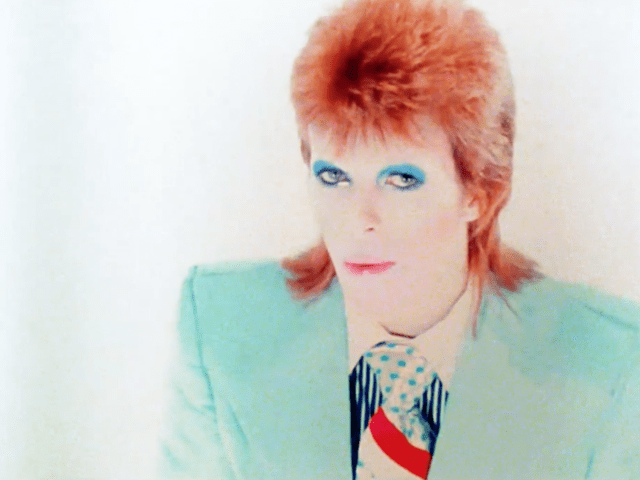
Mick Rock directed the song’s official video. It was filmed backstage at Earls Court in London in 1973. It features Bowie in a turquoise suit and makeup, performing the song against a white backdrop.
The BBC television series, Life On Mars, was named after this, while its sequel, Ashes to Ashes, was also named after the Bowie song of the same name.
Green Day frontman Billie Joe Armstrong has stated he would like this song to be played at his funeral.
This was featured on the first episode of the TV series American Horror Story: Freak Show, where it was sung by Jessica Lange’s character. The series is set in 1952 but used music recorded much later, similarly to how Baz Luhrmann incorporated contemporary tunes into the films Moulin Rouge and The Great Gatsby.
Ryan Murphy, who created the show, says that he looked for music by artists who were oddities themselves, and proud of it. Bowie fit the bill and approved the use of the song, as did Fiona Apple, who allowed her song “Criminal” to be used in the next episode.
Life On Mars
It’s a God-awful small affair To the girl with the mousy hair But her mummy is yelling no And her daddy has told her to go
But her friend is nowhere to be seen Now she walks through her sunken dream To the seat with the clearest view And she’s hooked to the silver screen
But the film is a saddening bore For she’s lived it ten times or more She could spit in the eyes of fools As they ask her to focus on
Sailors fighting in the dance hall Oh man look at those cavemen go It’s the freakiest show Take a look at the lawman Beating up the wrong guy Oh man wonder if he’ll ever know He’s in the best selling show Is there life on Mars?
It’s on America’s tortured brow That Mickey Mouse has grown up a cow Now the workers have struck for fame ‘Cause Lennon’s on sale again See the mice in their million hordes From Ibiza to the Norfolk Broads Rule Britannia is out of bounds To my mother, my dog, and clowns But the film is a saddening bore ‘Cause I wrote it ten times or more It’s about to be writ again As I ask you to focus on
Sailors fighting in the dance hall Oh man look at those cavemen go It’s the freakiest show Take a look at the lawman Beating up the wrong guy Oh man wonder if he’ll ever know He’s in the best selling show Is there life on Mars?
The main thing I like about the song is the guitar. It has a slight Chuck Berry feel to it and I like the fills the guitar player throws in. The band signed with Warner Brothers and the label wanted a soft country sound like the Eagles but the band refused to change it’s raw style.
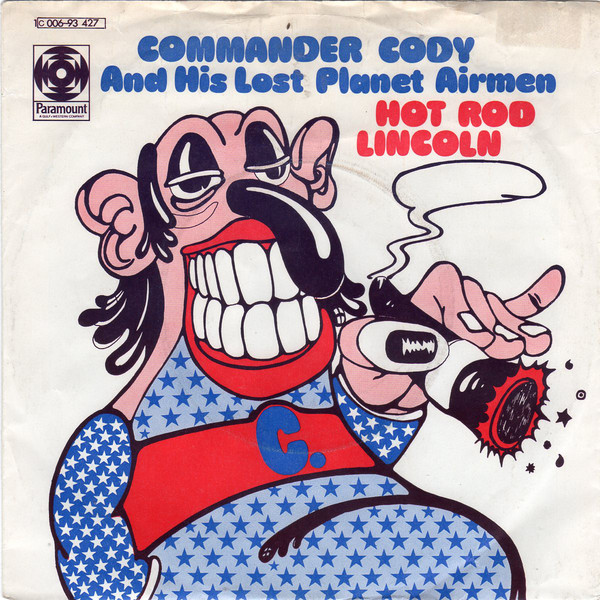
Hot Rod Lincoln was originally written by Charlie Ryan. It was first recorded and released by Charlie Ryan and The Livingston Brothers in 1955. This was the only hit for Commander Cody and His Lost Planet Airmen, who were a County-Rock group formed at the University of Michigan. Commander Cody is the lead singer and piano player George Frayne.
Commander Cody and His Lost Planet Airmen are still out there touring now.
The song peaked at #9 in the Billboard 100 and #7 in Canada in 1972.
From Songfacts
It tells the second half of the story started by the song “Hot Rod Race,” recorded in 1951 by Arkie Shibley and his Mountain Dew Boys, as referenced by the opening: “Have you heard this story of the Hot Rod Race, when Fords and Lincolns was settin’ the pace? That story is true, I’m here to say; I was drivin’ that Model A.” While the song tells of a race between a Lincoln and a Cadillac on the Grapevine grade in California, the actual location was on the Lewiston grade in Idaho.
The most iconic line from the song is: “Son, you’re gonna drive me to drinkin’ if you don’t stop drivin’ that Hot Rod Lincoln!”
Was there really a “hot-rod Lincoln?” Yes and no. Actually, it was a rebuilt car with the body of a Model “A” coupe set into the frame of a 1941 Lincoln, along with a “hopped-up” Lincoln engine block. However, at the time of this song’s writing, Ryan built a second car, this time with a chop-shop melding of a 1930 Model “A” Ford coupe and a wrecked 1948 Lincoln. It is this second restored car with which has Ryan toured.
Both the songs “Hot Rod Lincoln” and “Hot Rod Race” are defining anthems of the hot rod community and 1950s car song culture. “Hot Rod Lincoln” has appeared in the soundtracks to The Beverley Hillbillies and MTV’s Beavis and Butthead.
Hot Rod Lincoln
My pappy said, “Son, you’re gonna’ drive me to drinkin’
If you don’t stop drivin’ that Hot Rod Lincoln.”
Have you heard this story of the Hot Rod Race
When Fords and Lincolns was settin’ the pace.
That story is true, I’m here to say
I was drivin’ that Model A.
It’s got a Lincoln motor and it’s really souped up.
That Model A Vitimix makes it look like a pup.
It’s got eight cylinders; uses them all.
It’s got overdrive, just won’t stall.
With a 4-barrel carb and a dual exhaust,
With 4.11 gears you can really get lost.
It’s got safety tubes, but I ain’t scared.
The brakes are good, tires fair.
Pulled out of San Pedro late one night
The moon and the stars was shinin’ bright.
We was drivin’ up Grapevine Hill
Passing cars like they was standing still.
All of a sudden in a wink of an eye
A Cadillac sedan passed us by.
I said, “Boys, that’s a mark for me!”
By then the taillight was all you could see.
Now the fellas was ribbin’ me for bein’ behind,
So I thought I’d make the Lincoln unwind.
Took my foot off the gas and man alive,
I shoved it on down into overdrive.
Wound it up to a hundred-and-ten
My speedometer said that I hit top end.
My foot was blue, like lead to the floor.
That’s all there is and there ain’t no more.
Now the boys all thought I’d lost my sense
And telephone poles looked like a picket fence.
They said, “Slow down! I see spots!
The lines on the road just look like dots.”
Took a corner; sideswiped a truck,
Crossed my fingers just for luck.
My fenders was clickin’ the guardrail posts.
The guy beside me was white as a ghost.
Smoke was comin’ from out of the back
When I started to gain on that Cadillac.
Knew I could catch him, I thought I could pass.
Don’t you know by then we’d be low on gas?
We had flames comin’ from out of the side.
Feel the tension. Man! What a ride!
I said, “Look out, boys, I’ve got a license to fly!”
And that Caddy pulled over and let us by.
Now all of a sudden she started to knockin’,
And down in the dips she started to rockin’.
I looked in my mirror; a red light was blinkin’
The cops was after my Hot Rod Lincoln!
They arrested me and they put me in jail.
And called my pappy to throw my bail.
And he said, “Son, you’re gonna’ drive me to drinkin’
If you don’t stop drivin’ that hot rod Lincoln!”
A few days ago I had a Movie Quotes post and received suggestions from people and have included some. Thanks to you all including msjadeli, hanspostcard, and The Hinoeuma.
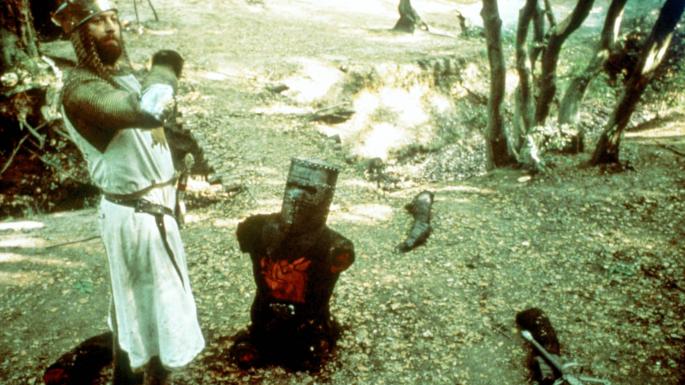
Monty Python and the Holy Grail – Just a flesh wound.
at 1:10
Cool Hand Luke – “What we’ve got here is a failure to communicate.”
Tombstone – I’m your Huckleberry, why Johnny Ringo looks like somebody just walked over your grave.
Pulp Fiction (deleted scene) “There are only two kinds of people in the world, Beatles people and Elvis people. Now Beatles people can like Elvis and Elvis people can like the Beatles, but nobody likes them both equally. Somewhere you have to make a choice. And that choice, tells you who you are.”
at 1:21
Dirty Harry – You’ve got to ask yourself a question: ‘do I feel lucky?’ Well, do ya, punk?
at :49
Spinal Tap – “But these go to 11”
A League of Their Own – “There’s no crying in baseball!”
at :35
Ferris Bueller’s Day Off – ‘Life moves pretty fast. If you don’t stop and look around once in a while, you could miss it’
Planet of the Apes – “Get your stinking paws off me, you damned dirty ape!”
at 1:58
Good Morning Vietnam – No, Phil, he’s not all right. A man does not refer to Pat Boone as a beautiful genius if things are all right.
Some songs make you think about social issues, some make you feel good, some make you sad, some make you think of certain people…and some take you back to a place in time when you first remember it. This one does the later for me. It’s not Elton’s best single whatsoever but I heard it a lot later on when I was 13 and I’m 13 again when I hear it and it’s 1980. I must have heard it before many times but it took hold for some reason then.
This came along in the fifties revival that happened in the 1970s. This is not a type of song I would normally like but it transports me back and I like it.
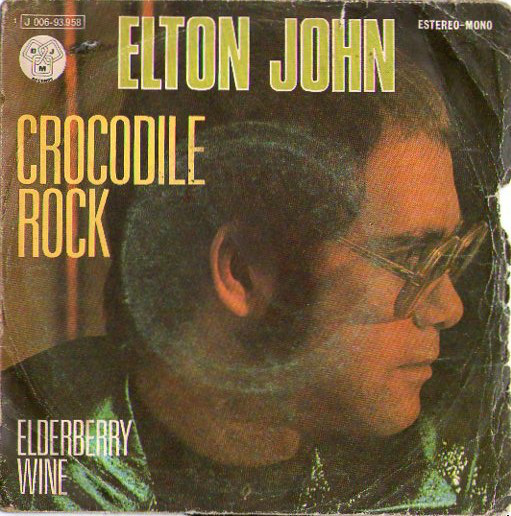
Crocodile Rock was a fifties sounding single that was a massive hit. It peaked in 1972 at #1 in the Billboard 100, #5 in the UK, #1 in Canada, #1 in New Zealand.
Elton and Bernie Taupin wrote the song.
Bernie Taupin “a strange dichotomy because I don’t mind having created it, but it’s not something I would listen to.”
From Songfacts
This tells the story of a guy in the ’50s and ’60s who frequented a restaurant where the patrons loved an obscure dance called the Crocodile Rock. Because of all the events that happened in the ’60s, however, this unknown little dance forever vanished into history and no one cared anymore. Even his girlfriend, who also enjoyed “burning up to the Crocodile Rock,” left him. It’s a catchy little song with really sad lyrics.
There is a distinct ’50s musical theme in this song. Elton said that it contains flavors of a lot of his favorite early rock songs, including “Little Darlin’,” “At The Hop” and “Oh Carol,” as well as songs by The Beach Boys and Eddie Cochran. The title is a play on the Bill Haley song “See You Later Alligator” – Haley’s “Rock Around The Clock” even gets a mention, as that’s what the other kids were listening to while our hero was doing the Crocodile Rock.
This was the first of many #1 singles by Elton John in the US. His first in the UK came in 1976 with Kiki Dee (“Don’t Go Breaking My Heart”). His first solo #1 in the UK was “Sacrifice” in 1990.
The falsetto hook from Pat Boone’s 1962 hit, “Speedy Gonzales” has some similar “La La”s, and that song’s writers spoke out, accusing Elton of plagiarism. There was no legal action taken, and Elton has copped to the influence, saying “Crocodile Rock” was “a really blatant homage to ‘Speedy Gonzales’ and all the great ’50s and ’60s records that we used to love.”
A precursor to this song is Elton’s 1970 single “Rock And Roll Madonna,” which pays tribute to the musical form. “This time I wanted to do something that was a send-up of the early ’60s rather than an out-and-out rocker,” he told Beat Instrumental. I wanted it to be a tribute to all those people I used to go and see as a kid. That’s why I used the Del Shannon-type vocals and that bit from Pat Boone’s ‘Speedy Gonzales.'”
Elton added: “We also tried to get the worst organ sound possible… something like Johnny and The Hurricanes used to manage to produce. This type of song is actually a very hard thing to write because the temptation is to try too hard and go berserk.”
Don McLean has mentioned that this is similar to his hit “American Pie,” which came out the previous year. Both songs are about young people in the ’50s obsessed with rock n’ roll, but disappointed when the music “dies.” Both songs also feature a Chevy. Elton admits the song is highly derivative because it’s about the things he grew up with. In Elton John: The Definitive Biography, Elton is quoted as saying: “I wanted it to be a record about all the things I grew up with. Of course, it’s a rip-off.”
Elton performed this on The Muppet Show when he appeared on a Season Two episode in 1977. A very popular song with kids, it made for a great opening number, with Elton performing in a swamp with a crocodile chorus.
This song helped send the Don’t Shoot Me I’m Only the Piano Player album to #1 on both sides of the Atlantic. It was Elton’s first #1 in the UK, but Honky Chateau went to #1 in the US earlier that year.
A few “firsts” are attributed to both the song and album. It was the first song released as a single on the MCA label (catalog #40000) after MCA dissolved its Uni (Elton John’s previous label), Decca, Kapp and Coral labels. It was also MCA’s first #1 song as well as Elton John’s first #1. >>
There is a Crocodile Rock in The Philippines, which from the right angle, looks like an enormous croc.
Partial inspiration for this song is the Australian band Daddy Cool and their hit single “Eagle Rock,” which Elton discovered on his 1972 tour to Australia. In the artwork for the Don’t Shoot Me I’m Only the Piano Player packaging, there is a shot of Bernie Taupin wearing a badge that says “Daddy Who?”
The sheer popularity of this song caused a backlash against it in some circles – notably disc jockeys who had to play it over and over. Stations used to determine what songs they would play by using “auditorium testing,” where listeners were gathered into a big room and played hooks from different songs, which they would then rate. This song always got very high marks, which embedded it onto playlists and drove some DJs to hate it.
The odd thing is that Elton has a very deep catalog filled not just with meaningful hits, but with more obscure songs that many listeners enjoy. “It was just a one-off thing,” Elton said of “Crocodile Rock,” adding, “It became a huge hit record, and in the long run, it became a negative for me.”
Elton has described this song as “disposable pop.” Bernie Taupin gave his thoughts in a 1989 interview with Music Connection. Said Taupin: “I don’t want people to remember me for ‘Crocodile Rock.’ I’d much rather they remember me for songs like ‘Candle In The Wind’ and ‘Empty Garden,’ songs that convey a message. Well, they don’t really need to convey a message, as long as they can convey a feeling. But there are things like ‘Crocodile Rock,’ which was fun at the time, but it was pop fluff. It was like, ‘Okay, that was fun for now, throw it away, and here’s the next one. So there’s a certain element of our music that is disposable, but I think you’ll find that in anybody’s catalog.”
One of Elton’s more memorable performances of this song took place on September 7, 1973 at the Hollywood Bowl. As Elton played from his piano, a few feet behind him, sound engineer Clive Franks played the electric piano while wearing an enormous crocodile head.
The Baha Men recorded a new version of this for the film The Crocodile Hunter: Collision Course with new lyrics that described the life of Steve Irwin. Ironically, “Suzie” (the girl described in this song) is the name of Steve Irwin’s dog, who appears frequently on the series.
Elton John – Crocodile Rock
I remember when rock was young Me and Suzie had so much fun Holding hands and skimming stones Had an old gold Chevy and a place of my own But the biggest kick I ever got Was doing a thing called the Crocodile Rock While the other kids were Rocking Round the Clock We were hopping and bopping to the Crocodile Rock
Well Crocodile Rocking is something shocking When your feet just can’t keep still I never knew me a better time and I guess I never will Oh Lawdy mama those Friday nights When Suzie wore her dresses tight And the Crocodile Rocking was out of sight
But the years went by and the rock just died Suzie went and left us for some foreign guy Long nights crying by the record machine Dreaming of my Chevy and my old blue jeans But they’ll never kill the thrills we’ve got Burning up to the Crocodile Rock Learning fast as the weeks went past We really thought the Crocodile Rock would last
Well Crocodile Rocking is something shocking When your feet just can’t keep still I never knew me a better time and I guess I never will Oh Lawdy mama those Friday nights When Suzie wore her dresses tight And the Crocodile Rocking was out of sight
I had this post started since last year but never posted. I saw another blog yesterday mentioning Leon’s passing at 69 years old on Thursday. I never bought a record by him but I loved his songs and his appearances on Saturday Night Live in the 70s. This was back when Lorne Michaels would actually take a chance and let someone play that wasn’t on the charts or “hot.”
I have a friend…Chris who would play his songs on guitar and sometimes goof around on popular songs in Leon’s style. Redbone was one of a kind and a part of my childhood growing up.
He was a hell of a guitar player that played in a twenties – forties jazz and blues style along with his deep voice.
This was on Leon’s website…
“It is with heavy hearts we announce that early this morning, May 30th 2019, Leon Redbone crossed the delta for that beautiful shore at the age of 127. He departed our world with his guitar, his trusty companion Rover, and a simple tip of his hat. He’s interested to see what Blind Blake, Emmett, and Jelly Roll have been up to in his absence, and has plans for a rousing sing along number with Sári Barabás. An eternity of pouring through texts in the Library of Ashurbanipal will be a welcome repose, perhaps followed by a shot or two of whiskey with Lee Morse, and some long overdue discussions with his favorite Uncle, Suppiluliuma I of the Hittites. To his fans, friends, and loving family who have already been missing him so in this realm he says, ” Oh behave yourselves. Thank you…. and good evening everybody.”
Please Don’t Talk About Me When I’m Gone
Please don’t talk about me when I’m gone, oh honey
Though our friendship ceases from now on
If you can’t say anything real nice, it’s better
Not to talk at all, is my advice
You go your way I’ll go mine, best we do
Here’s a kiss, I hope that this brings lots of luck to you
Makes no difference, how I carry on
Please don’t talk about me when I’m gone
You go your way I’ll go mine, best we do
Here’s a kiss, I hope that this brings lots of luck to you
Makes no difference, how I carry on
Please don’t talk about me when I’m gone
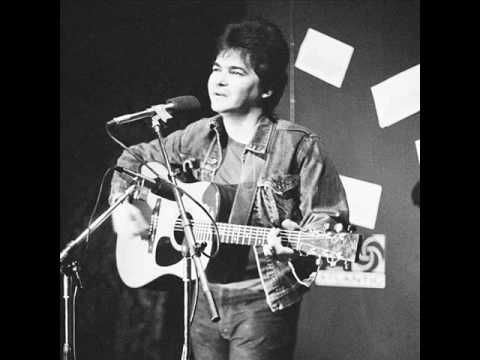
It’s hard not to like John Prine. This is a brilliant song…for him to think of this and write about it shows he thinks outside of the box. The song is included on the album “Sweet Revenge” released in 1973… it peaked at #135.
I have a one John Prine story. A friend of mine named Chris went to see John Prine and Arlo Guthrie in the ’90s and met John in the parking lot after the concert. Prine was really talkative and asked Chris if he could boost his car off…which, of course, he did. Chris told me he was really down to earth and a genuinely nice guy.
Dear Abby for those of you who may be too young to remember was an American Advice Columnist. Her real name was Pauline Phillips who went under the pen name “Abigail Van Buren”. people would write in and tell her their troubles and she would answer back in the newspaper. Her daughter, Jeanne Phillips, now owns the legal rights to the pen name.
From Songfacts
Prine’s song about an assortment of miserable people who write letters to the renowned advice columnist was recorded during a live gig at New York’s State University after a studio session didn’t pan out. Prine explained in an interview with Performing Songwriter: “The studio version of that was cut with a band, and it was real stiff and humorless. We cut it once, live, and that was it. That was the power of the song, in the way people would turn their heads the minute I’d get to the first verse, the first chords. That was the reason we used the live version.”
Prine found inspiration when he happened upon a “Dear Abby” column while on a trip to Rome, Italy. He said:
“I was in Europe and my first wife and I stopped in Rome for the day. I wanted a newspaper and all they had was the International Herald Tribune which is all the tragic news in the world crammed into six pages with no sports results and no comics. And yet here’s ‘Dear Abby.’ She was the only relief in the whole paper. and that’s where I wrote most of the song – in Rome, Italy that is.”
“Years later somebody took the verse about the guy whose stomach makes noises, wrote it just out of kilter enough so it didn’t rhyme, and send it to ‘Dear Abby.’ And she answered it in her column. She suggested that he seek professional help. She got loads of letters from people who knew the song and told her she’d been had.”
Dear Abby
Dear Abby, dear Abby My feet are too long My hair’s falling out and my rights are all wrong My friends they all tell me that I’ve no friends at all Won’t you write me a letter, won’t you give me a call Signed bewildered
Bewildered, bewildered
You have no complaint You are what your are and you ain’t what you ain’t So listen up buster, and listen up good Stop wishing for bad luck and knocking on wood
Dear Abby, dear Abby My fountain pen leaks My wife hollers at me and my kids are all freaks Every side I get up on is the wrong side of bed If it weren’t so expensive I’d wish I were dead Signed unhappy
Unhappy, unhappy
Dear Abby, dear Abby You won’t believe this But my stomach makes noises whenever I kiss My girlfriend tells me it’s all in my head But my stomach tells me to write you instead Signed noise-maker
Noise-maker, noise-maker
Dear Abby, dear Abby Well I never thought That me and my girlfriend would ever get caught We were sitting in the back seat just shooting the breeze With her hair up in curlers and her pants to her knees Signed just married





 PowerPop... An Eclectic Collection of Pop Culture