I graduated in 1985…and when I hear anything by The Rascals or Cream…I think of that spring and riding around in my car with friends. That is when I bought two cassettes…The Rascal’s greatest hits and a best of Cream. This band was so talented and you can tell they influenced Springsteen, Steven Van Zandt, and others.
What a great band! I could almost leave it at that and post the song. They were technically the Young Rascals when this song came out of AM radio in the sixties. They were never really an album band but more of a super singles band. Another band like that was The Lovin’ Spoonful. They dropped the “young” in 1968 and continued having hits.
The Rascals made it by playing rhythm and blues and soul music. Their 1966 cover of the Rudy Clark and Artie Resnick song…Good Lovin went to the top of the Billboard Pop Singles chart. They had the majority of their hits between 1966-1968.
You Better Run peaked at #20 on the Billboard 100 and #22 in Canada in 1966.
They had nine top 20 hits and thirteen top 40 hits…they also had three number 1 hits and a total of 18 songs in the Billboard 100 before they disbanded in 1972. This song was written by Felix Cavaliere and Eddie Brigati.
You Better Run
What you tryin’ do to my heart?
What you tryin’ do to my heart?
You go around tellin’ lies
You foolin’ round with the other guy’s
What you tryin’ do to my heart?
You better run
You better hide
You better leave from my side
What you tryin’ do to my soul?
What you tryin’ do to my soul?
Everythin’ I had was yours
And no I’m closing all the doors
What you tryin’ do to my soul?
You better run
You better hide
You better leave from my side
I love you girl, I love you so
Can’t you see it, don’t you know
I can’t stand you alibi
You’re tellin’ lies, and tell me why
What you tryin’ do to my head?
What you tryin’ do to my head?
Now I go my jaw out of line
You’re not gonna take my mind?
What you tryin’ do to my head?
You better run
You better hide
You better leave from my side
When I bought the album “Backtracking” in the mid-1980s…I was in Van Morrison heaven. This was the only Van Morrison era I knew at the time. The first time I heard Brown Eyed Girl was in 1985. I fell in love with that song so just like I do now…I wanted to find out everything about this man. The first thing I did was to go to Tower Records. I looked it up with a magazine there and they ordered it…Tower did not have a huge stock of Them albums, to say the least.
I wore this album out and I still have it. It was the best $10 I ever spent. This was the intro song to the album. I noticed that Paul Simon wrote this one. After devouring this and another Them album I made the jump to Van’s solo career. I’m happy I did it in order. The album had songs that caught my attention. Baby Please Don’t Go, Richard Cory, Don’t Start Crying Now, and most of all…Mighty Like a Rose which was never released but on this 1974 compilation album. That song would not have passed by the censors…if you haven’t heard it give it a listen. A song about a nympha and her sugar cubes.
Richard Cory is a folk-based song but Morrison supercharges it with his voice. Simon wrote some standards but he could have never done this like Them did. The song was based on a poem called Richard Cory by Edwin Arlington Robinson. It’s about a lonely rich man who everyone thought was happy because of his money but they were too intimidated to come around him.
Them released this as a stand-alone single in 1966. It didn’t chart but the band was pretty much over… at least Van’s participation. The following year Van would release Brown Eyed Girl and begin his solo career with Bert Berns and Bang Records.
Them’s influence on garage, punk, and rock bands was immense.
Richard Cory
They say that Richard Cory
Owns one-half of this here town
With political connections
Spread his wealth around
Born into society, a banker’s only child
He had everything a man could want
Power, grace and style
But I, work in his factory
And I curse the life I’m livin’
And I curse my poverty
That I wish that I could be
Yeah, I wish that I could be
Lord, I wish that I could be, Richard Cory
Paper’s print his pictures
Almost everywhere he go
Richard Cory at the opera
Richard Cory at the show
And the rumours of his a-parties
And the orgies on his yacht
Well, he surely must be happy
With everythang that he has got
But I, work in his factory
And I curse the life I’m livin’
And I curse my poverty
And I wish that I could be
I wish that I could be, yea-ah
I wish that I could be, Richard Cory
He freely gave to charity
And had that common touch
They were grateful for his patronage
And thanked him very much
So my mind was filled with wonder
When the evenin’ headlines read
That Richard Cory went home last night
And put a bullet through his head, hu
But I, I, I, work in his factory
And I, I don’t don’t dig the life I’m livin’
And I don’t dig my poverty
And I wish that I could be
Yeah, an’ I wish that I could be
Well, wish that I could be, Richard Cory
Ay-hey, I wish that I could be
I wish that I could be
Sometime, I wish that I could be
A-just like a-Richard Cory
Just li-iiiiiiike, a-Richard Cory
A-Richard Cory
Again…a big thank you again to Phil Strawn who gave me the necessary information so the story could be told and much of it from a personal view.
One of the performers in The Big D Jamboree was Ronnie Dawson. He was from Dallas Texas and was nicknamed “The Blonde Bomber.” His father Pinkie showed him how to play the mandolin, drums, and bass guitar. Dawson attended Southwestern Bible Institute in Waxahachie but was expelled. After that, he appeared regularly on the Big D Jamboree Radio Show in Dallas in 1958 as Ronnie Dee and the D Men. Dawson was known to be highly energetic on stage. Many thought he got it from Elvis but he said no, he learned it from the dynamic Pentecostal revivals he attended.
The Jack Rhodes song “Action Packed” was Dawson’s first release in 1958 on the Backbeat label. After that came the 1959 Rockin’ Bones and this time it was on the Rockin’ Records label. It was issued under Ronnie’s own name with “The Blond Bomber” added. Though Ronnie toured nationally with Gene Vincent and appeared on TV, his records gained no more than regional airplay.
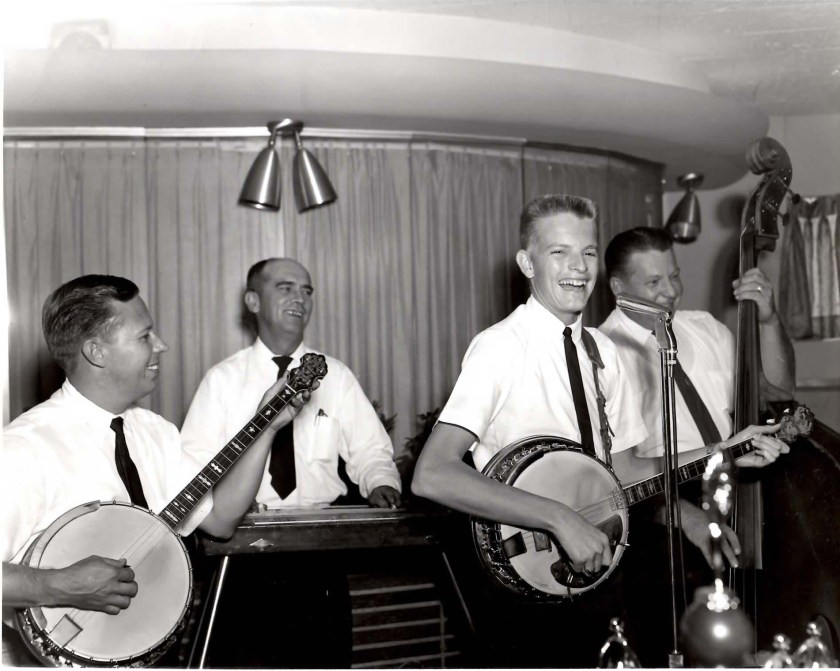
The next 3 paragraphs are from Phil. Back in the early ’60s, there was a club on Mockingbird Lane in Dallas called The Levee. It was a sing-along Dixieland place that was popular at the time. The band was banjos, a doghouse bass and a clarinet and sax. Burgers and pitchers of beer made up the menu. Southern Methodist University was two blocks away, across Highway 75, so most of the clientele were students and couples in their twenties. The famous Egyptian Lounge was next door. It served the best Italian food in Dallas and was a known hangout for the Dallas Mafia and other wise guys.
At a Levee Singers gig at the Adolphus Hotel in Dallas, around 1961 or 62. Phil’s dad is also playing a tenor banjo, as is Ronnie.
Smokey Montgomery, the banjo player for the Light Crust Doughboys, started the Levee with Ed Burnett, who was also his partner in Summit Sounds, a well-known recording studio on Greenville Ave. Ronnie was playing with the Doughboys, so Smokey asked him to play with the banjo band in order to add some youth to the mix. He was a huge hit, and the business tripled. The coeds loved him; their boyfriends hated him. The Levee bounced along all through the 60s until the fad went flat. In the mid-70s, Ronnie was into the progressive country music scene and started a band called The Steel Rail. I don’t remember the drummer, lead, or bass players’ names, but the legendary Tommy Morrell played the pedal steel while Ronnie sang and tore up his Strat.
The old Levee club was empty, so Ronnie leased the space and opened a club called “Aunt Emma’s,” a nod to his favorite aunt. On opening night, Ronnie asked my dad to come down and add some fiddle to the band, which he did. I took my guitar, just in case he needed another player. The place was full up, with a line down past the Egyptian. Around 11 pm, Johnny Paycheck strolled in the door. He had finished a gig in Dallas and heard about Ronnie’s new club, so he stopped by to sit in. Of course, he did all of his hits and played for at least an hour. After that, word got around that Aunt Emma’s was the place to go for the new outlaw country; it out-drew Willie Nelson’s Whiskey River which was a few blocks away on Greenville Ave.
He made several singles in the early sixties with Dick Clark’s Swan Records. He also did some session work. He played on Paul & Paula’s “Hey Paula. After Elvis died rockabilly started to make a comeback.
Dawson’s career experienced periods of obscurity. However, he continued to perform and record music throughout his life, earning a cult following among rockabilly enthusiasts. In the 1980s and 1990s, he experienced a resurgence of interest in his music, performing at festivals and recording new albums.
In the 1980s Ronnie was just beginning. A fifties revival was happening in the UK and he became popular there. This led Dawson to tour Britain for the first time in 1986. He was blown away by the audience’s reception. Dawson sounded purer than most of his peers from the 1950s and he put on a more energetic show.
He recorded new material for No Hit Records, the label of British rockabilly fan Barry Koumis, which was leased in the USA to Crystal Clear Records. No Hit Records also reissued his recordings from the 1950s and early 1960s on a 16-track LP called “Rockin’ Bones” and an extended 2-CD version of which was released by Crystal Clear in 1996.
Ronnie was still performing until the early 2000s when health problems started. He passed away in Dallas on September 30, 2003, at the age of 64.
Phil Strawn:He was a great guy and close friend. After his death from lung cancer, which shocked us all because he never smoked cigarettes but did partake of other smokable plants, his wife, Chris, held a wake at the Sons of Herman Hall in Deep Ellum. You couldn’t stir the musicians and rock stars with a stick; the ballroom on the second floor was packed. I remember Billy Joe Shaver, Ray Wylie Hubbard, Michael Martin Murphy, Robert Earl Keen, and Robert Duvall being there. George Gimarc, a noted Texas music historian, has a treasure trove of photos and reel-to-reel recording tapes of Ronnie dating back to the Big D Jamboree and American Bandstand. He refuses to share or part with any of his collections. I told him, that’s okay, leave a few to me when you bite the dust. There is no need for me to approve of your article; you write great music history, and Ima sure this one will also be stellar.
Ronnie Dawson:“At that point in my life, I was so ready to get out of Dallas. I was really ready to go, and I just blew up when I got over there. … I couldn’t believe it. All these people started embracing me. I was in heaven. I didn’t want to go home.”
He was inducted into the Rockabilly Hall of Fame, in 1998.
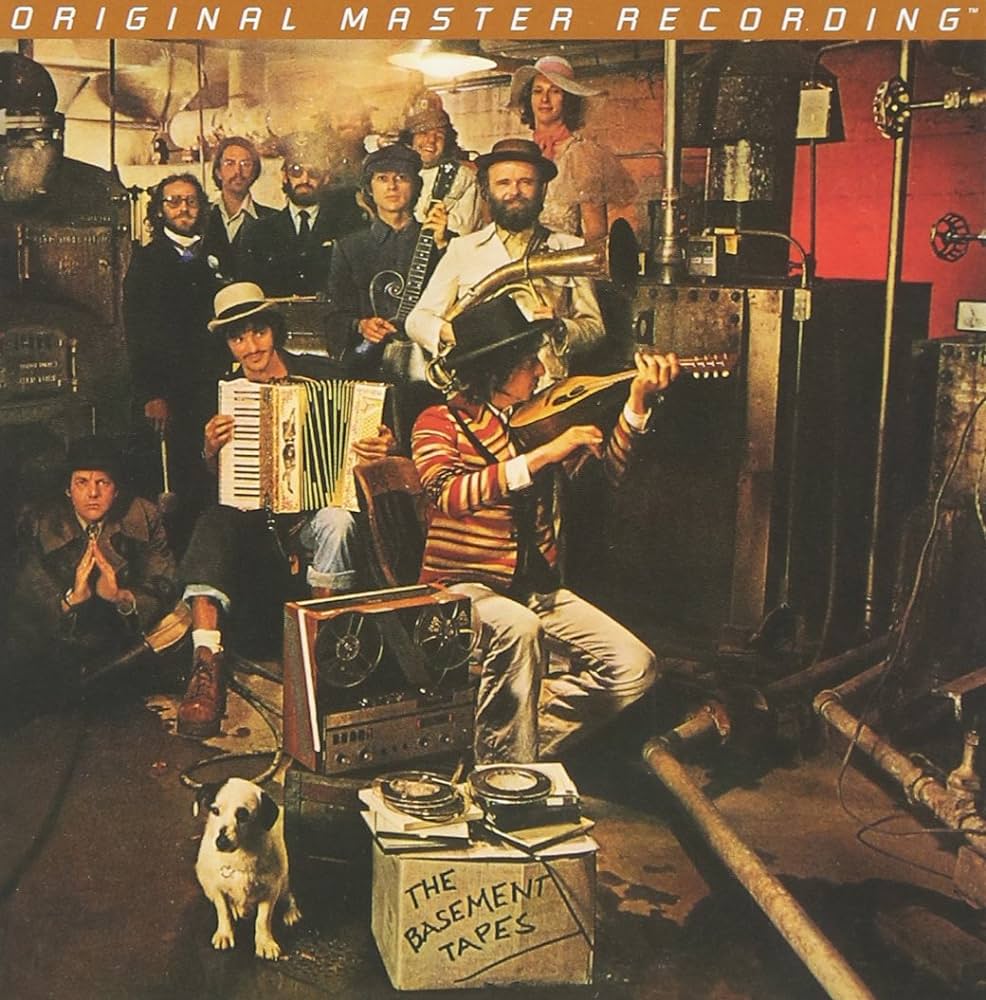
This song was on the Basement Tapes and one of my favorites on that album. When I wrote the Bessie Smith article for Lisa…I forgot all about it. CB brought it up on my Bessie Smith post the other day. I completely forgot about it.
The Basement Tapes was a collection of recordings made by Bob Dylan and The Band in 1967. These recordings took place in the basement of a house known as “Big Pink,” located in West Saugerties, New York, where members of The Band lived at the time. It was released in 1975.
The story behind The Basement Tapes is quite interesting. In 1966, Bob Dylan had been involved in a motorcycle accident and retreated from the public eye to recover. During this period, he began recording informal sessions with members of The Band, then known as The Hawks. These sessions were largely acoustic, featuring Dylan and The Band members playing a mix of original songs and cover tunes in a relaxed, informal setting. It was mostly recorded by Garth Hudson the keyboard player for The Band.
Many of these songs were bootlegged through the years and received a lot of attention. This release included songs like “The Mighty Quinn,” “I Shall Be Released,” “This Wheel’s on Fire,” and “Tears of Rage,” among others.
Robbie Robertson and Rick Danko wrote this song and it wasn’t about Bessie Smith’s life but he used her to symbolize the blues and their respect for her. It incorporates her name into a broader narrative while celebrating her.
The album peaked at #7 on the Billboard Album Charts, #15 in Canada, and #18 in New Zealand in 1975.
Bessie Smith
Bessie was more than just a friend of mine We shared the good times with the bad Now many a year has passed me by I still recall the best thing I ever had
I’m just goin’ down the road t’ see Bessie Oh, see her soon I’m just goin’ down the road t’ see Bessie Smith When I get there I wonder what she’ll do
All the crazy things I had to try Well I tried them all and then some But if you’re lucky one day you find out Where it is you’re really comin’ from
I’m just goin’ down the road t’ see Bessie Oh, see her soon I’m just goin’ down the road t’ see Bessie Smith When I get there I wonder what she’ll do
Now in my day I’ve made some foolish moves But back then, I didn’t worry ’bout a thing And now again I still wonder to myself Was it her sweet love or the way that she could sing
I’m just goin’ down the road t’ see Bessie Oh, see her soon I’m just goin’ down the road t’ see Bessie Smith When I get there I wonder what she’ll do
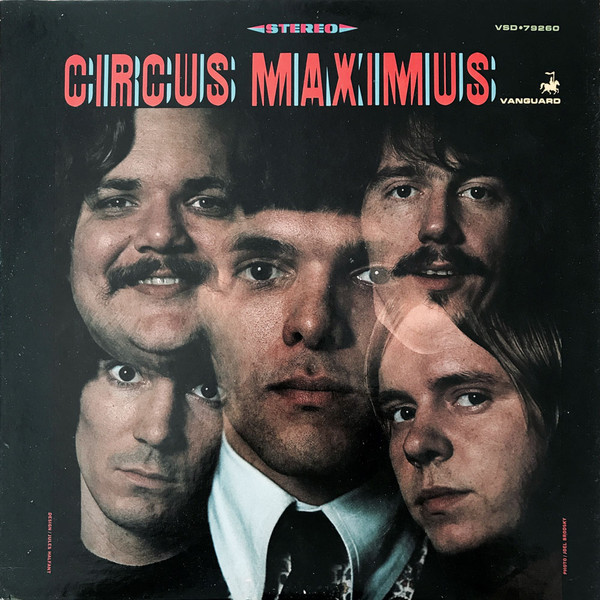
I blog because I like to talk to everyone about the artists I and they featured that day. Sometimes, the conversations go elsewhere and not long ago I happened to catch a conversation between CB and Phil from the Cactus Patch. They mentioned Circus Maximus which featured Jerry Jeff Walker. I pay attention to all the conversations, even if they don’t involve me, and pick up some good songs that way.
I started to listen to their music. I liked their debut album which has intricate musical arrangements that border a free-form type of music. It flows like jazz and dips into psychedelic. It also has a little of The Guess Who in it. It’s a piece of music from the psychedelic rock era that fits into the landscape of the 1960s. Their members included Jerry Jeff Walker, Bob Bruno, David Scherstrom, Gary White, and Peter Troutner.
Jerry Jeff Walker was probably the most famous to come out of the band. In the early 1970s, Walker relocated to Austin, Texas, where he became part of the burgeoning outlaw country music scene. He helped define that genre. He was part of the Texas songwriters such as Willie Nelson, Guy Clark, and Townes Van Zandt. You know his most famous song very well, Mr Bojangles. That song was made popular by the Nitty Gritty Dirt Band.
While Circus Maximus did not achieve mainstream commercial success, they gained a cult following within the psychedelic rock scene of the late 1960s. The song is called Wind, which was on their debut album released in 1967. The album was played on the progressive FM radio stations.
Wind
You say that once knew for sure
But now you’re walkin’ into shore to wonder*
The more you learn the less you know
The more you move the more you go to nowhere*
You ask a bird as she flies by
Just where she’s at she says, where the wind blows*
Ask her by that what she means
She says she doesn’t know
But as she flew away she seemed to say
Chorus:
The wind is love is the wind
Wind is my love
Who knows the wind
Who knows my love
Where blows the wind
The wind is my love
You say you staggered to your room
Sleep by day and plot by noon
Your conscious plight
Pack your dreams, you move away
Decide to eat and live by day
And leave the night
City sun blinks in your eyes
You shade your face and realize
a lonely crowd
Then at once you feel the smile
And then the ice warm air moves by
She says the breeze provokes her sigh
Chorus
You say you found another spring
Another joy or human thing
Called lovers
You play your role as a comedy
Refreshing well the tradgedy
Your living
Lovers shore, or so you say
Like the wind love blew away
But as she left she seemed to say
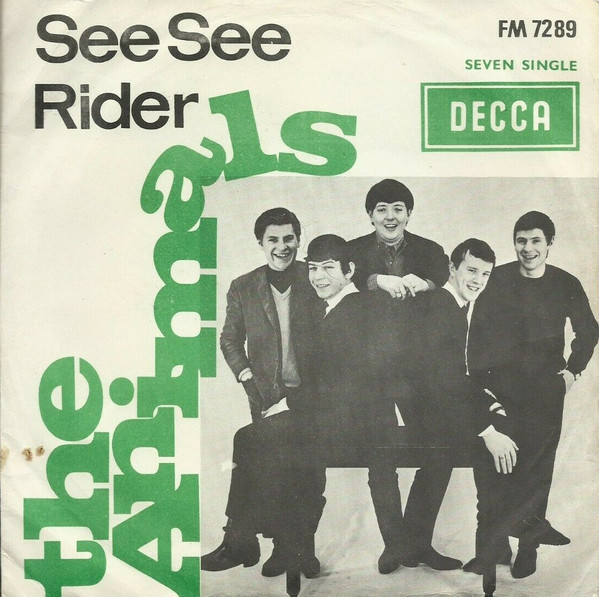
Many have covered this song and I’ve known many versions. It’s been covered over 100 times. I first knew this song by Elvis but I love the Animals version.
The biggest difference between the Animals and The Beatles, Stones, Kinks, and The Who was that the Animals didn’t write many of their early songs. They kept looking at the Brill Building for songs. In this instance, they took an old blues song and breathed new life into it, creating a powerful recording that would become emblematic of their sound.
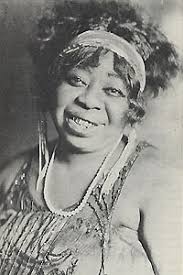
One of the earliest recorded versions of “See See Rider” was by Ma Rainey, one of the pioneering figures of blues music. Rainey’s recording, released in 1925, helped popularize the song and establish it as a blues standard. The writing credit on this song is Lena Arent and Ma Rainey.
Ma Rainey’s influence extended beyond her music… she was also a trailblazer for African American artists in the music industry. As one of the first African American women to record blues music. she was a vaudeville star in the early 1900s. In 1923, she started recording for Paramount Records. Earlier he took Bessie Smith under her wing and helped her. She was one of the first female blues artists to find a wide audience.
The C.C. Rider, also known as See See Rider or Easy Rider, is a blues cliché for the sexual partner, although originally it referred to the guitar hung on the back of the traveling bluesman. An easy rider was also known as an unfaithful boyfriend.
The song peaked at #1 in Canada and #10 on the Billboard 100 in 1966.
Over the years, “See See Rider” has been covered by many artists from various genres, including Elvis Presley, Chuck Berry, and Janis Joplin. Per Secondhandsongs… it has been covered 450 times.
See See Rider
Oh see, see see rider girl see what you’ve done Oh oh, see see rider see what you’ve done now You’ve gone away and left me and now And now the blues they come oh yes they do
Oh well I’m goin’ goin’ away baby and I won’t be back till fall Oh yes I am goin’ away baby and I won’t be back till fall If I get me a good lookin’ woman no no no I won’t be back at all oh right Now see see rider I love you yes I do and there isn’t one thing darling I would not do for you you know I want you see see I need you by my side see see rider oh keep me satisfied
Oh he had see see rider see see rider See see rider see see rider see rider See see rider you keep on a ridin’, keep on a ridin’ Here it comes baby look out Beat it all right don’t lose it now come on, come on, yeah
Here she comes she’s oh right She’s so fine she’s all mine See see come on Jenny dig a ride now, hey
Well I’m goin’, goin’ away baby and I won’t be back till fall Yes, I’m goin’, goin’ away baby and I won’t be back till fall If I find me a good lookin’ woman no no no I won’t be back at all And that’s the truth baby listen I’m goin’ all right Somebody told me somebody told me I jump catch on I leave it oh right oh right ah
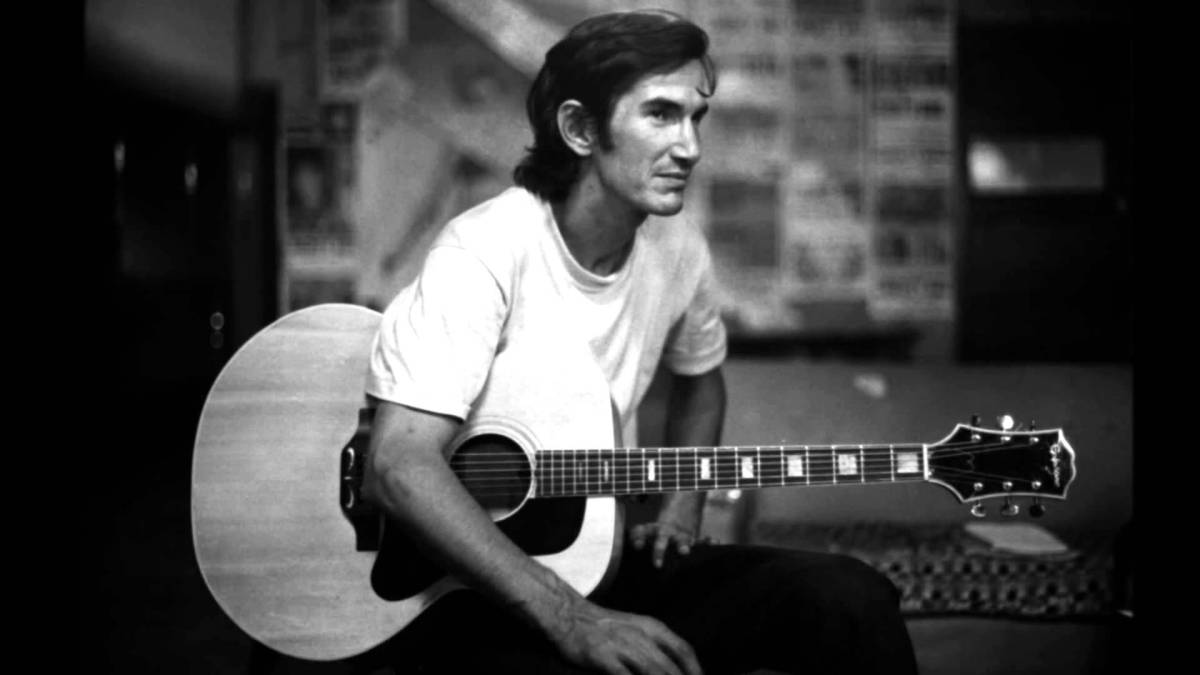
I’m learning more about Townes Van Zandt and you don’t have to search for great songwriting in his catalog. Just pull up any song and it’s usually a winner. This is another song that makes songwriters sigh. Sunset diamonds roll across my memory and Cloudsroll by and hide the tears I’m crying It’s so original and it’s like a great artist painting a masterpiece.
This song was on his self-titled 3rd album released in 1969. It was recorded at Bradley’s Barn in Nashville in July of 1969.
Bradley’s Barn deserves its own post. It was owned by Owen Bradley and he recorded so many well-known artists such as Buddy Holly, Gene Vincent, Kitty Wells, Patsy Cline, Brenda Lee, Loretta Lynn, Lenny Dee, and Conway Twitty to name a few.
Steve Earle points out in a quote that Townes had walking pneumonia in New York and wrote this song based on that. Some sources say he got part of it when he was younger and he went through insulin shock therapy for manic depression. In that “treatment,” you would be shocked and have injections of insulin to put you in a coma daily. He lost much of his long-term memory from this treatment.
He came out of that far from cured. He had a fatalistic view of the world and holes in his memory. It very well could have caused some of his substance abuse and depression problems afterward.
It’s also said to be about coal miners, specifically about pneumoconiosis commonly known as Black Lung Disease.
Secondhandsongs has 22 versions of the song including the original.
Steve Earle: I’ve done it for a very, very long time and it’s one of my favorite Townes songs. The story I heard was that he was in New York and he had pneumonia, literally, just got walkin’ pneumonia. He was literally sick with a respiratory ailment. It’s literal past the poetic decimal point. He was a bad-ass. The difference between Townes and Bob Dylan is, and this makes Townes a lot more radical to me in some ways, is Dylan was really heavily influenced by the same kinds of music, but lyrically he was influenced more by modern French poets and the Beats. Whereas Townes was much more influenced by old-school, conventional lyric poets like Robert Frost and Walt Whitman. And it’s cool, it’s where a lot of the uniqueness of his voice comes from. ‘Cause it is Lightnin’ Hopkins against Robert Frost, and it’s pretty startling.
Lungs
Well, won’t you lend your lungs to me?
Mine are collapsing
Plant my feet and bitterly breathe
Up the time that’s passing.
Breath I’ll take and breath I’ll give
Pray the day ain’t poison
Stand among the ones that live
In lonely indecision.
Fingers walk the darkness down
Mind is on the midnight
Gather up the gold you’ve found
You fool, it’s only moonlight.
If you try to take it home
Your hands will turn to butter
You better leave this dream alone
Try to find another.
Salvation sat and crossed herself
Called the devil partner
Wisdom burned upon a shelf
Who’ll kill the raging cancer
Seal the river at it’s mouth
Take the water prisoner
Fill the sky with screams and cries
Bathe in fiery answers
Jesus was an only son
And love his only concept
Strangers cry in foreign tongues
And dirty up the doorstep
And I for one, and you for two
Ain’t got the time for outside
Just keep your injured looks to you
We’ll tell the world we tried
This is the Yardbirds… Jeff Beck edition. Great song that peaked at #11 in the Billboard 100, #3 in the UK, and #7 in Canada in 1966. Beck’s guitar solo in this song is fantastic as he uses distortion, sustain, feedback, and some Eastern influence. This was shortly before Jimmy Page joined the group.
The band recorded this song at Chess Studio in Chicago, their first time there. Chris Dreja said it’s one of the best songs they ever made. Shapes of Things was about the state of the UK during the Vietnam War, so it was an anti-war song according to the band. The song was written by Jim McCarty, Keith Relf, and Paul Samwell-Smith.
The band is best known now because of the great guitarists that were in the band. Eric Clapton joined the band in 1963, but soon quit to concentrate on the blues with Cream.
Jeff Beck replaced him in 1965, and then Jimmy Page joined in 1966 on bass. He soon switched to guitar, and the band had Page and Beck together.
Later, Beck walked out of the band, leaving only Page. The Yardbirds broke up, but Jimmy Page kept the name and played under “The New Yardbirds” with his new bandmates Robert Plant, John Paul Jones, and drummer John Bonham, who would change their name to Led Zeppelin.
Jeff Beck liked the song so much that he used it on arguably his best album Truth. He was able to control feedback and use it to enhance the song. The song is often considered a precursor to the heavier, more experimental rock sound that would emerge in the late 1960s and early 1970s.
Jeff Beck: “The way they worked was completely off the cuff: We’d jam, Keith would rush off and write some lyrics in the toilet, it was exactly like that. After four verses, let’s go into this raga thing. I kept changing guitar sounds all the way through. So we did two or three takes of my guitars and blended them all together. But the solo on “Shapes Of Things” was pretty honest until that feedback note that comes in over it. If nothing else, that was the best single.”
Bassist Paul Samwell-Smith: I wrote it in a bar in Chicago. I just lifted part of a Dave Brubeck fugue to a marching beat. It’s a sort of protest song.
Jim McCarty: “With ‘The Shapes of Things’ I came up with a marching type of rhythm that I tried to make interesting. And at the end of each line we’d build up like we used to do with some of our stage stuff – the rave ups. And then the bass riff came on top of that. And the bass riff was loosely based on a Dave Brubeck song, sort of a jazz song, around a doo doo doo doo doo doo, and then the chords came over that. The chords were very basic, came between the two tones, I think G and F, and then resolving it in D, each verse. And then the tune came on top of that. In fact, I remember putting the backing track down, which sounded great. I wasn’t at the session where Keith made up the tune, and when I heard the tune, I thought, Oh, that’s great. It’s a real surprise. He made up the tune, and then we had this sort of ‘Come tomorrow,’ but that was part of the song, anyway, at the beginning. So it was an exciting song to be involved in.”
Jim McCarty:“That’s probably the hardest thing to try and do. Every time we tried to do that it never really succeeded. I suppose we were lucky in that when we did ‘Shapes of Things’ it was like a hit song, but we were really coming from not trying to create a sort of a 3-minute piece of music, it was just something that seemed natural to us. We started with the rhythm, we used a bass riff that came from a jazz record, got a groove going with that and then added a few other bits from elsewhere, other ideas that we’d had. And I think it was a great success for us, it was a good hit record that wasn’t really selling out. And it was original.”
Shapes of Things
Shapes of things before my eyes,
Just teach me to despise.
Will time make men more wise?
Here within my lonely frame,
my eyes just heard my brain.
But will it seem the same?
(Come Tomorrow) Will I be older?
(Come Tomorrow) May be a soldier.
(Come Tomorrow) May I be bolder than today?
Now the trees are almost green.
But will they still be seen?
When time and tide have been.
Fall into your passing hands.
Please don’t destroy these lands.
Don’t make them desert sands.
Chorus, Lead.
Soon I hope that I will find,
Thoughts deep within my mind.
That won’t displace my kind.
This is probably one of the most studied songs by the Beatles in their entire catalog. Why is it studied? That opening chord or chords. It baffled musicians for years on how to duplicate it. It took around 40 years to figure it out to be exact. It’s probably one of the most recognizable intros in rock. A musician didn’t figure it out…that took a Dalhousie mathematician. None of the Beatles could remember exactly how they did it.
Here is a PDF you can download. A Hard Days Night Chord . It’s called Mathematics, Physics and A Hard Day’s Night. Here is what Wiki said: George Harrison: Fadd9 in 1st position on Rickenbacker 360/12 12-string electric guitar. John Lennon: Fadd9 in 1st position on a Gibson J-160E 6-string acoustic guitar. Paul McCartney: high D3 played on the D-string, 12th fret on Hofner 500/1 electric bass. George Martin: D2-G2-D3 played on a Steinway Grand Piano.
I just don’t see how they thought it up…it was most likely helped by George Martin. Anyway, it’s a great song and a hugely popular one from their early years. The title came from something Ringo said and John remembered it. They all called Ringo’s odd phrases Ringoisms. Ringo said “We went to do a job, and we’d worked all day and we happened to work all night. I came up still thinking it was day I suppose, and I said, ‘It’s been a hard day…’ and I looked around and saw it was dark so I said, ‘Night!’ So we came to ‘A Hard Day’s Night.”
A Hard Day’s Night was written and recorded in less than 24 hours. It only took them 3 hours to finish the song. It was another song that was written under pressure. The movie production had begun and this was the last song to be recorded. On the way to the studio, John Lennon was talking to a journalist Maureen Cleave who was sharing a cab with him.
He showed her the lyrics to A Hard Day’s Night. They were scrawled down on a birthday card sent from a fan to his son Julian. What the lyrics were was “When I get home to you / I find my tiredness is through …” and Cleave didn’t like the word tiredness and told John…so he grabbed her pen and wrote, “When I get home to you / I find the things that you do / Will make me feel all right.” Today Julian’s birthday card is in the British Library.
The song peaked at #1 on the Billboard 100, #1 in Canada, #1 in New Zealand, and #1 in the UK in 1964.
The album peaked at #1 on the Billboard Album Charts, #1 in Canada, and #1 in the UK.
A fun fact about the movie. Phil Collins was one of the school kids brought in as extras for a scene in the movie where The Beatles perform. He didn’t make the cut, but years later, the film’s producer gave Collins the outtake footage with him in it and had Collins add commentary to the DVD release.
They won their first Grammy with this song.
A Hard Day’s Night
It’s been a hard day’s night
And I’ve been workin’ like a dog
It’s been a hard day’s night
I should be sleepin’ like a log
But when I get home to you
I find the things that you do
Will make me feel alright
You know I work all day
To get you money to buy you things
And it’s worth it just to hear you say
You’re gonna give me everything
So why on Earth should I moan?
‘Cause when I get you alone
You know I feel okay
When I’m home
Everything seems to be right
When I’m home
Feeling you holding me tight, tight, yeah
It’s been a hard day’s night
And I’ve been workin’ like a dog
It’s been a hard day’s night
I should be sleepin’ like a log
But when I get home to you
I find the things that you do
Will make me feel alright, ow
So why on Earth should I moan?
‘Cause when I get you alone
You know I feel okay
When I’m home
Everything seems to be right
When I’m home
Feeling you holding me tight, tight, yeah
Oh, it’s been a hard day’s night
And I’ve been workin’ like a dog
It’s been a hard day’s night
I should be sleepin’ like a log
But when I get home to you
I find the things that you do
Will make me feel alright
You know I feel alright
You know I feel alright
I haven’t had a Kinks post in quite a while so I thought I would have one today. It’s always a good day to have a Kinks song. I’ve said this before but one of my favorite concerts was The Kinks in 1983 at the Grand Ole Opry House.
Ray Davies and nostalgia go together. He often writes about his past, the past, or preserving the past as in The Village Green Preservation Society. That is one of the many reasons I always liked his writing. I think of him…or should I say I think of Bruce Springsteen as the British Ray Davies. They write about the every day way of life in their respective countries.
The band was going through a rough time in 1965. Guitarist Dave Davies and drummer Mick Avory had an on-stage fight which resulted in Avory nearly decapitating Davies with a cymbal, Dave was left unconscious in a pool of blood. Avory ran away, terrified that he had killed him.
This was thought to have led to them getting banned from touring America. The other theory was The American Federation of Musicians delisted the Kinks not because of any rowdy behavior… It was simply because the band wanted to use non-union help during a concert tour. I tend to believe the latter.
This song was the B side to Till The End of the Day. The single peaked at #8 in the UK, #36 in Canada, and #50 on the Billboard 100 in 1965. The song was also released in 1973 with the flip side of Lola. The single didn’t chart. It was originally on the album The Kink Kontroversy.
Van Halen covered this song on their 1982 album Diver Down. David Bowie also covered it on his album Pin Ups.
Ray Davies: “We’d been rehearsing ‘Where Have All the Good Times Gone’ and our tour manager at the time, who was a lot older than us, said, ‘That’s a song a 40-year-old would write. I don’t know where you get that from.’ But I was taking inspiration from older people around me. I’d been watching them in the pubs, talking about taxes and job opportunities.”
Ray Davies: “I wanted to write a song my dad or relatives could sing, they always talked about how great it was before or during the war – I think every generation thinks that way.” “It’s got that hard edge The Kinks had, but at the same time, it’s got a reflective, poignant lyric.”
Where Have All The Good Times Gone
Well, lived my life and never stopped to worry ’bout a thing
Opened up and shouted out and never tried to sing
Wondering if I’d done wrong
Will this depression last for long?
Won’t you tell me
Where have all the good times gone?
Where have all the good times gone?
Well, once we had an easy ride and always felt the same
Time was on our side and I had everything to gain
Let it be like yesterday
Please let me have happy days
Won’t you tell me
Where have all the good times gone?
Where have all the good times gone?
Ma and Pa look back at all the things they used to do
Didn’t have no money and they always told the truth
Daddy didn’t have no toys
And mummy didn’t need no boys
Won’t you tell me
Where have all the good times gone?
Where have all the good times gone?
Well, yesterday was such an easy game for you to play
But let’s face it things are so much easier today
Guess you need some bringing down
And get your feet back on the ground
Won’t you tell me
Where have all the good times gone?
Where have all the good times gone?
Where have all the good times gone?
In my Fred Eaglesmith post on Saturday, two comments caught my attention. One was Keith telling me when he was a DJ they would play car songs at certain times. Then Obbverse mentioned… that would be a good post for someone…and indeed he was right.
When I was a teenager…a car wasn’t just a car…it was freedom. It was a key to an adult world we wanted eagerly to jump into. Ok…I’ll have songs with either the word “car” in them or with a model of a car in the title only. If not I would have 80 percent of Springsteen songs…not a bad thing at all but I will play by those rules.
Janis Joplin – Mercedes Benz
Let’s start with Janis Joplin. This is based on a song called C’mon, God, and buy me a Mercedes Benz by the Los Angeles beat poet Michael McClure. Joplin saw McClure perform it, and on August 8, 1970, she reworked it into her own song, which she performed about an hour later.
There are three credited songwriters on this track: Joplin, Michael McClure, and Bob Neuwirth. McClure says he never earned a cent from his poetry, but “Mercedes Benz” paid for his house in the Butters Canyon section of Oakland, California.
Janis Joplin never got a Mercedes Benz, but she did have a 1965 Porsche that was painted to become a piece of hippie art.
Wilco – Bull Black Nova
Many thanks to Obbverse for recommending this one. This song is a dark one…very dark. It’s somewhat cryptic and open to interpretation but one thing it does show… guilt, betrayal, and the consequences of one’s actions…and the narrator possibly killing his girlfriend. This song was released in 2009 on the album Wilco (The Album). The song was written by Wilco… Glenn Kotchie, Jeff Tweedy, John Stirratt, Mikael Jorgensen, Nels Cline, and Pat Sansone.
If I am the one, blood on the sofa Blood in the sink, blood in the trunk High at the wheel of a bull black Nova And I’m sorry as a setting sun This can’t be undone, can’t be outrun
Bruce Springsteen – Cadillac Ranch
I could probably do a post just on Cadillac songs.
This song is a great little rocker off of The River. This is one of many early Springsteen songs featuring cars. Some others were “Thunder Road,” “Backstreets,” and “Racing In The Street.” Bruce used the Cadillac image again in 1984 on “Pink Cadillac.”
Springsteen used Cadillac Ranch as a metaphor for the coming of death.
There is a real Cadillac Ranch.
In 1974 along Route 66 west of Amarillo, Texas, Cadillac Ranch was invented and built by a group of art-hippies from San Francisco. They called themselves The Ant Farm, and their silent partner was Amarillo billionaire Stanley Marsh 3. He wanted a piece of public art that would baffle the locals, and the hippies came up with a tribute to the evolution of the Cadillac tail fin. Ten Caddies were driven into one of Stanley Marsh 3’s fields, then half-buried, nose-down, in the dirt
T Rex – Jeepster
This song was on the 1972 album Electric Warrior. The music was supposedly based off of the Willie Dixon song You’ll Be Mine.
Jeepster was recorded live in the studio. The recording happened entirely organically and was not overdubbed. Marc Bolan, amid a performance, jumped up and down as he played his guitar, shaking the microphone stands. The sound of those stands was kept in the song. Producer Tony Visconti saw them as important features of the overall mood of the track and chose to include them.
K.C. Douglas-Mercury Blues
Mercury Blues was written by the Blues musicians K.C. Douglas and Robert Geddins in 1949. It was originally titled “Mercury Boogie.” The song was made famous 44 years later by Alan Jackson, whose 1993 cover peaked at #2 on the Billboard Country charts. The song has also been covered by Steve Miller, David Lindley, and Meat Loaf.
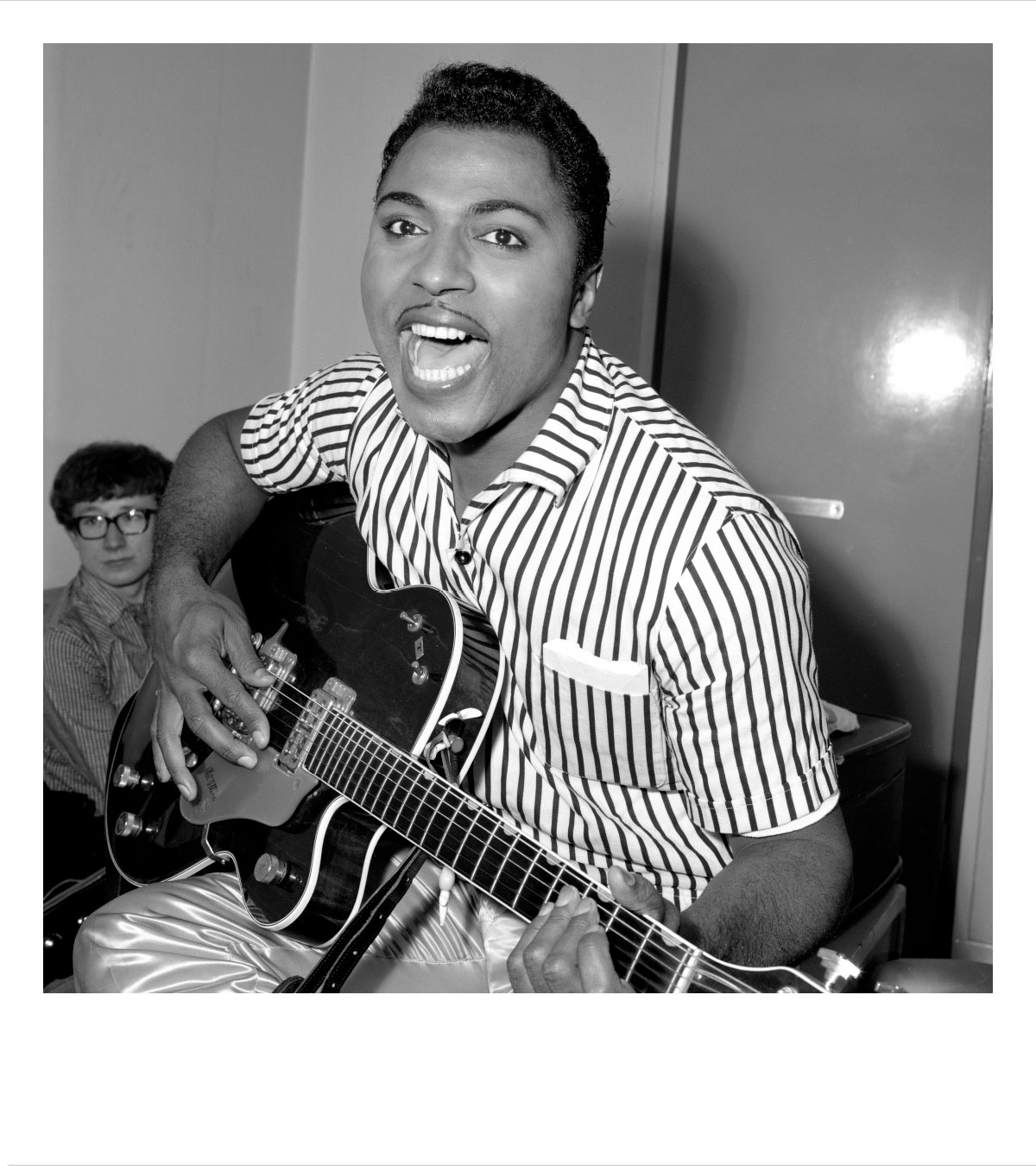
I posted this song to show the other side of Little Richard. Some people just know him as the screamer and rocker. This is a ballad that he released in 1962. nobody beats Little Richard (Richard Penniman) for a hard-raving song but it’s nice to see this side also.
Little Richard isn’t just a singer he is a force of nature. I think he would have been successful now or in any decade. He is one of the best singers I’ve heard in rock and roll. His voice is brash, intense, rough, soulful, and magical. He takes you to the edge of the cliff and when you think he will go over he pulls it back.
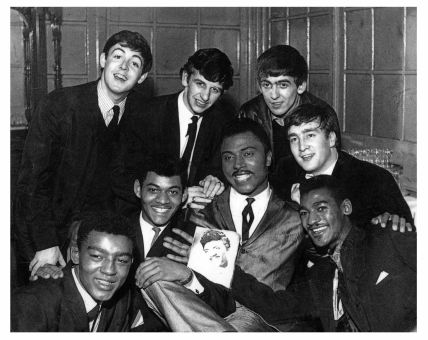
This song was the B side to “He Got What He Wanted (But Lost What He Had)” released in 1962 as Little Richard returned to Rock and Roll after his retirement. He was touring the UK and Germany at this time. The Beatles opened a few shows for him while he was on tour.
Joe Lutcher wrote this song and had a hand in Little Richard retiring earlier. In 1957, he discussed religious matters with Little Richard, following which, during a tour of Australia, Little Richard resolved also to give up playing what was described as “the devil’s music”. Lutcher joined Penniman in Bible studies, and they toured the country together as The Little Richard Evangelistic Team, preaching the word of God to reportedly enthusiastic crowds.
Little Richard would come back to Rock and Roll of course but Joe Lutcher would not. In later years he refused all requests to discuss his earlier secular music career. He died in 2006.
Here is the A-Side of the single….He Got What He Wanted (But Lost What He Had)… great title by the way.
Why Don’t You Change Your Ways?
Why don’t you change your ways of living
why don’t you do it now
Why don’t you do it my friend this very day
Because there is no other way
Why don’t you change your ways of talking?
Why don’t you do it now
Why don’t you do it my friend this very day
Because there is no other way
Yes, this is the way
This is the way oh well
This is the way
This is the way oh yes
Why Don’t you change your ways of walking
why don’t you do it now
Why don’t you do it my friend this very day
Because there is no other way
It’s so straight and there could be no other way
It’s so narrow many would never look that way
It’s so they don’t won’t to even find the way
It’s the light that leads me the right way
I never knew that Buddy Holly covered this song…somehow I missed or forgot that he covered it.
This was recorded back in 1956 as one of his first recordings. It wasn’t released until 4 years after he died. The original version is just Buddy on guitar and vocals and Jerry Allison on drums. Producer Norman Petty then overdubbed the other instruments with help from a band called The Fireballs.
I consider him the beginning of power pop. His Fender playing a clean jangling melody. Songs like Maybe Baby, Peggy Sue, and Words of Love influenced future artists like The Beatles, Hollies, Bob Dylan, and the list is endless. He wrote his own songs and is still influencing artists today with a recording career that only lasted less than three years.
Buddy Holly’s music is still relevant almost sixty years after he passed away in 1959. He didn’t have a big voice like Elvis, Little Richard, or some of his peers but he wrote and crafted beautiful melodies for his voice to weave through.
This song peaked at #4 on the UK Charts and #116 on the Billboard 100 in 1963. The song was on an album called Reminiscing. The album peaked at #2 on the UK Album Charts and #40 on the Billboard Album Charts.
Not only was he a great songwriter but also a great producer and he would have only got better. Unlike many of his fifties counterparts, I believe that Buddy Holly would have fit in the music scene post-Beatles. I always thought his best songs were in front of him. Most of his music transcends the fifties and would have fit nicely in the sixties.
Here are two versions…the bottom WITH the overdubs and the other the original raw recording.
Bo Diddley
Bo Diddley buy baby a diamond ring If that diamond ring don’t shine He gonna take it to a private eye If that private eye can’t see
He better not take that ring from me Won’t you come to my house back at home Take a-my baby on away from home Love a-that photo, where ya been Up to your house and gone again Bo Diddley caught a fat cat
To make a-pretty baby a Sunday hat Bo Diddley caught him a nanny goat To make a pretty baby a Sunday coat Bo Diddley, Bo Diddley have you heard My pretty baby says she wants a bird
Starting with The Who’s Tommy album…everything after that gets noticed. Their brilliant early singles sometimes get criminally overlooked. Personally, and I know I am in the minority, I think many of their early singles trump both the Beatles’ and Stones’s early singles. The Who and Kinks didn’t have the quality of the sound of those bigger bands…but that was the point. Those singles were exciting and raw…a few experimental. Paul McCartney was influenced heavily by The Who when he wrote Paperback Writer and Helter Skelter.
On July 8, 1989, I traveled to Atlanta Georgia to see The Who for the first time. Nashville at that time had no place really big enough for them to play. Vanderbilt wasn’t allowing rock concerts at their stadium at that time. I’ll never forget when The Who played this song that night. Roger forgot the words to it and said “I don’t know the bloody words to this song.” I found the clip and I’ll have it below.
The only part of that concert that bothered me was the volume or the lack of really. Entwistle had to turn down his volume and they carried a brass section with them because of Pete’s tinnitus. It sounded great of course but not as in your face as when I saw them in Nashville in 2016. My only guess is now the PA equipment is better because The Who were much louder in 2016 than when I heard them in 1989.
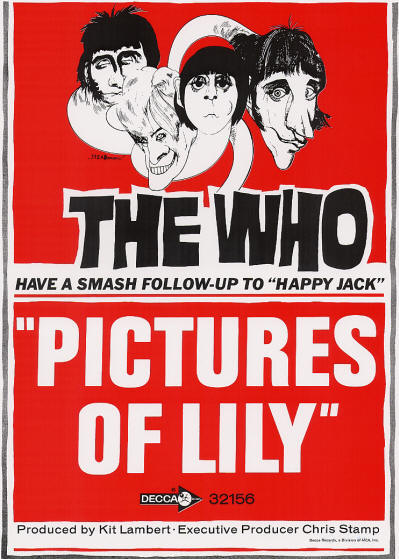
Describing The Who’s next new single (Pictures of Lily)…Pete Townshend coined the term “Power Pop” to describe this song before it was released. It made it to #4 in the UK Charts, #60 on the Billboard 100, and #36 in Canada in 1967. The song tells the story of a father giving his son risque pictures of a woman taken in the 1920s…and after a while, the son finds out that she had died many years ago.
It is a song about the lust of a teenage boy…we will keep it at that. John Entwistle played the French Horn on this that he later didn’t like.
Pete Townshend: On Karen’s (his future wife) bedroom wall were three Victorian black-and-white postcard photographs of scantily dressed actresses. One was the infamous Lily Langtry, mistress of Prince Edward, later King Edward VII, and one sunny afternoon while Karen was at work I scribbled out a lyric inspired by the images and made a demo of ‘Pictures of Lily’. My song was intended to be an ironic comment on the sexual shallows of show business, especially pop, a world of postcard images for boys and girls to fantasise over. ‘Pictures of Lily’ ended up, famously, being about a boy saved from burgeoning adolescent sexual frustration when his father presented him with dirty postcards over which he could masturbate.
John Entwistle: “The thing I hate about ‘Pictures Of Lily’ is that bloody elephant call on the French horn. I also hated the backing vocals, the mermaid voices, where we’d sing all the ‘oooooohs.’ I hated ‘oooooohs.'”
Below is the concert I was at when Roger forgot the words. It’s around the 1:36 mark.
Pictures Of Lily
I used to wake up in the morning I always feel so glad I got so sick of having sleepless nights I went and told my dad
He said, “Son, now here’s some little somethings” And stuck them on my wall And now my nights ain’t quite so lonely In fact I don’t feel bad at all (I don’t feel bad at all)
Pictures of Lily that make my life so wonderful Pictures of Lily that let me sleep at night Pictures of Lily that solved my childhood problem Pictures of Lily, they make me feel alright
Pictures of Lily (pictures of Lily) Pictures of Lily (Lily, oh Lily) Pictures of Lily (Lily, oh Lily) Pictures of Lily (pictures of Lily) Pictures of Lily, pictures of Lily Pictures of Lily, pictures of Lily
And then one day things weren’t so fine I fell in love with Lily I asked my dad where Lily I could find He said, “Don’t be silly”
“She’s been dead since 1929” Oh, how I cried that night If only I’d been born in Lily’s time It would have been alright There were always pictures of Lily to help me sleep at night Pictures of Lily to help me feel alright
‘Cause me and Lily are together in my dreams (my mind) And I was wonderin’, mister, have you ever seen?
Pictures of Lily to help you sleep at night Pictures of Lily to help you feel alright
‘Cause me and Lily are together in my dreams And I was wonderin’, mister, have you ever seen Pictures of Lily?
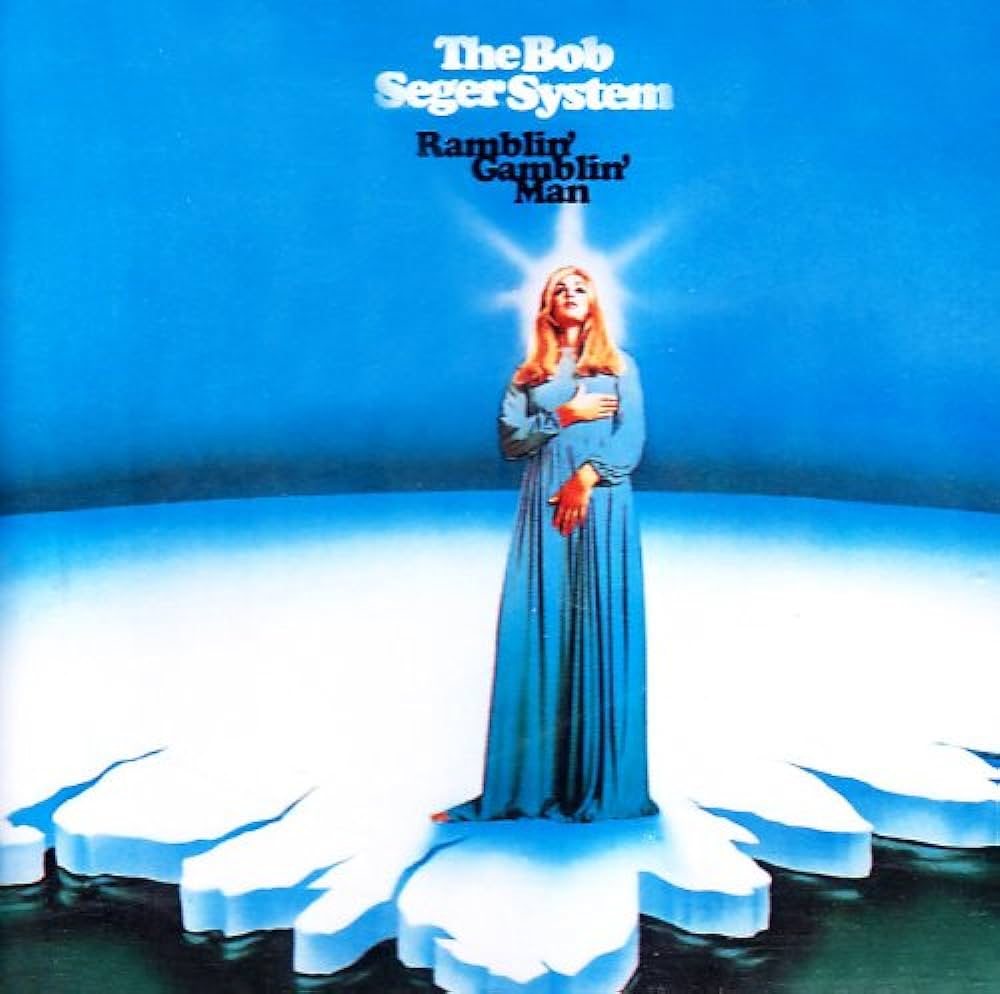
Something about Bob Seger…the man paid his dues. Bob started in 1961 in the Detroit music scene in the Decibels. He kicked around in different bands through the years. His break-out song is this one. His friend, 19-year-old Glen Frey, plays acoustic guitar and sings backup on this song.
The song was a big hit in Michigan and eventually started to climb the charts. The song peaked at #17 on the Billboard 100 in 1969. It would be 1975 before Seger broke nationally. After hearing Gimme Some Loving by the Spencer Davis Group, Seger wanted that organ in a song. Bob Schultz, a Seger’s band member, played it on this track. From then on it became a part of the live sound.
Seger has had an interesting career. Before Against The Wind, before Night Moves, before the Silver Bullet Band even existed, Bob Seger made gritty, experimental garage rock. It was far from the radio hits that made him famous, and much closer to the punk of fellow Michigan musicians like Iggy Pop. At this time he would hang out with The Stooges and The MC5. They would eventually fade away but Seger matured as a songwriter and became a hit machine.
I’ve always liked Bob Seger. He gets heavy play here in the south and many of his songs have been played to death…but not this one. I like the rawness of this single.
Bob Seger: “We’d had a few records that were popular around town and you’d hear on the radio a lot, but, yeah, that was a little different. That was a hit.”
“I wasn’t necessarily a great songwriter at that time, I think I focused more on playing the guitar and singing… even though Dylan and Van Morrison were important to me and influences on me. That craft was something that developed slowly.”
A live version
Here is a very early look at Bob Seger
Ramblin’ Gamblin’ Man
Yeah, I’m gonna
Tell my tale, come on
Come on, ha, give a listen
Cause I was born lonely
Down by the riverside
Learned to spin fortune wheels
And throw dice
I was just thirteen
When I had to leave home
Knew I couldn’t stick around
I had to roam
Ain’t good looking
But you know I ain’t shy
Ain’t afraid to look
A girl in the eye
So if you need some loving
And you need it right away
Take a little time out
And maybe I’ll stay
[CHORUS]
But I got to ramble (rambling man)
I got to gamble (gambling man)
Got to, got to ramble (rambling man)
I was born a rambling, gambling man
Yeah, yeah, yeah….
Ha ha, bring it on
Come on down, yeah
All right, here we go
Now, now
I’m out of money
Cause you know I need some
Ain’t gone run out of loving
And I must run
Gotta keep moving
Never gonna slow down
You can have your funky world
See you round
Cause I got to ramble (rambling man)
I got to gamble (gambling man)
I got to ramble (rambling man)
Lord, I’m a rambling, gambling man
Oh, I’m just a rambler
Yeah, I’m just a gambler
Come on and sing along
Cause I’m just a rambler (rambling man)
Lord, I’m a gambler (gambling man)
I’m a rambler (rambling man)
Yeah, I’m a rambler…








 PowerPop... An Eclectic Collection of Pop Culture