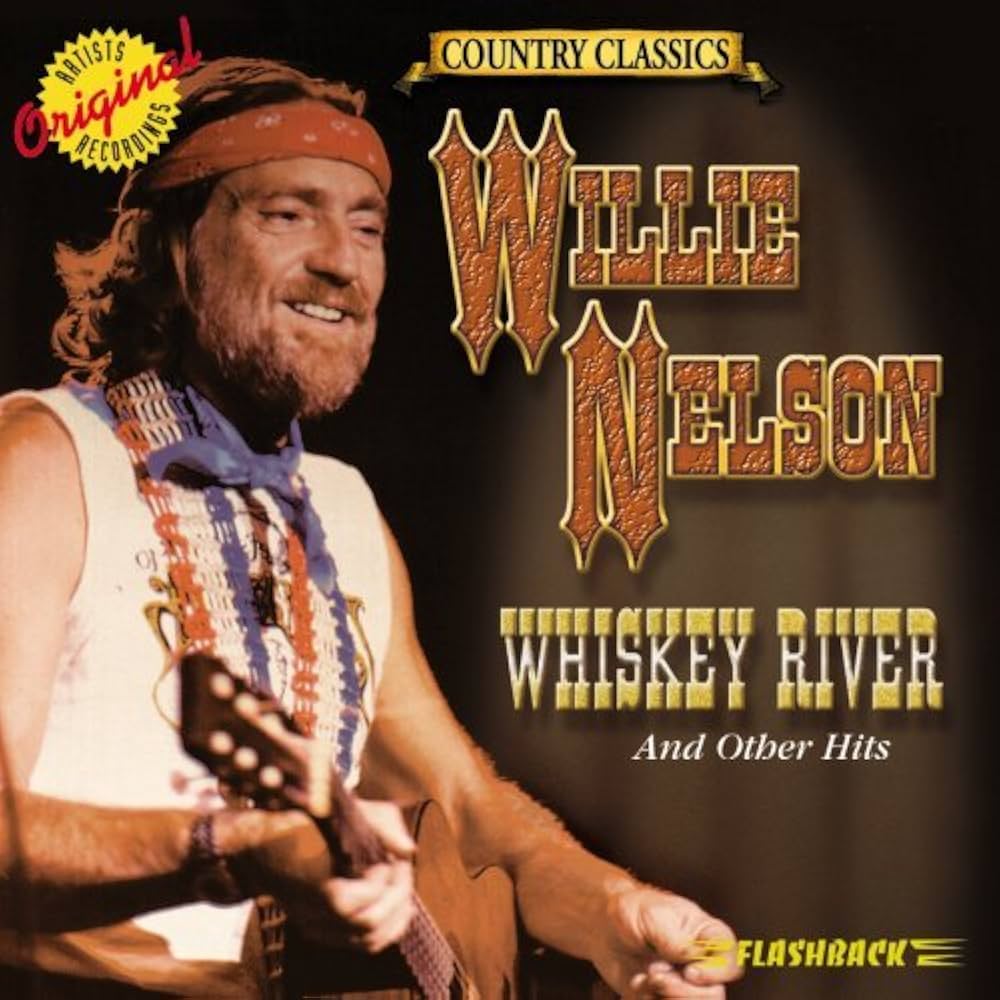
Willie Nelson – Roll Me Up and Smoke Me When I Die

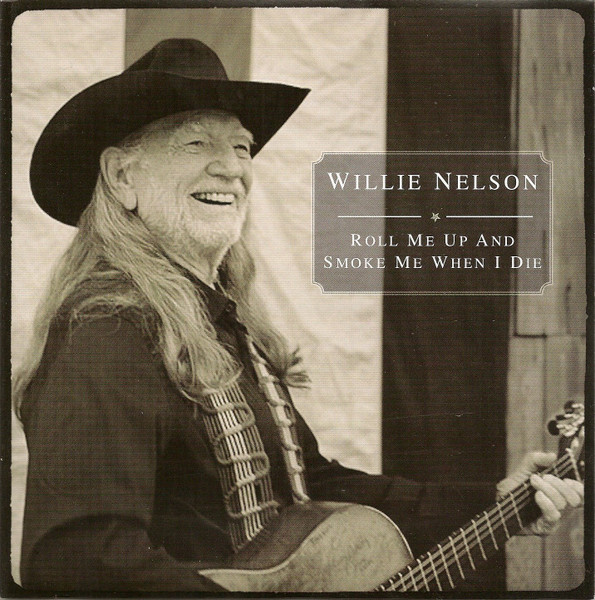
Wanted to have a little fun today. What better way to celebrate July 4th than with Willie Nelson and my next American Artist? The Willie Nelson set I watched on June 25th was probably the first real country act I’ve seen in concert, other than in street fairs in Nashville. Willie has done what few others have: appealed to a vast array of genres like Johnny Cash and Dolly Parton. The man is 92 and still going out there every night. 

The couple in front of us took this picture. 

If there were a Mount Rushmore for country outlaws, Willie Nelson wouldn’t just be on it, he’d be carving the damn thing with a joint in one hand and Trigger (his guitar) slung over his back. And with this song, Willie laughs at his legend and turns it into a porch-sing-along for the afterlife.

Released in 2012 on his Heroes album, this track arrived with a puff of smoke, wrapped in that unmistakable red-headed goodness. It’s a song about death that somehow feels like a party. Leave it to Willie to make his own funeral plans sound like a tailgate party. Beneath the title and chorus is something far more poignant: a man looking mortality in the eye and saying, You’re not killing my vibe.

The lineup of guests: Snoop Dogg, Kris Kristofferson, and Jamey Johnson all pile in for the chorus like it’s some high-end dive bar jam session. The vibe is half gospel, half roadhouse. The songwriters are Willie Nelson, Buddy Cannon, Rich Alves, John Colgin, and Mike McQuerry.

Roll Me Up and Smoke Me When I Die

Roll me up and smoke me when I dieAnd if anyone don’t like it, just look ’em in the eyeI didn’t come here and I ain’t leaving, so don’t sit around and cryJust roll me up and smoke me when I die

Now you won’t see no sad and teary eyesWhen I get my wings and it’s my time to flyCall my friends and tell ’em there’s a party, come on byAnd just roll me up and smoke me when I die

Roll me up and smoke me when I dieAnd if anyone don’t like it, just look them in the eyeI didn’t come here and I ain’t leaving, so don’t sit around and cryBut just roll me up and smoke me when I die

And I’d go, I’ve been here long enoughSo sing and tell more jokes and dance stuffJust keep the music playing, that will be a good goodbyeRoll me up and smoke me when I die

Roll me up and smoke me when I dieAnd if anyone don’t like it, just look ’em in the eyeI didn’t come here and I ain’t leaving, so don’t sit around and cryJust roll me up and smoke me when I die

Hey, take me out and build a roaring fireRoll me in the flames for about an hourAnd take me out and twist me up and point me towards the skyAnd roll me up and smoke me when I die

Roll me up and smoke me when I dieAnd if anyone don’t like it, just look ’em in the eyeI didn’t come here and I ain’t leaving, so don’t sit around and cryJust roll me up and smoke me when I die

Just roll me up and smoke me when I die

Willie Nelson – Whiskey River

After watching that Maria Muldaur video last week with Leon and Willie included…I wanted to listen to some of Nelson’s songs this past week. This one I remember as a kid. This song was on the album Shotgun Willie. It was a turning point for Willie Nelson…he left Nashville’s mainstream country for the Country Outlaw scene. 

I remember Outlaw Country back when I was a kid. Waylon Jennings, Kris Kristofferson, Charlie Daniels, Johnny Cash, and Willie Nelson are who I remember the most. It was a no-frills version of country music. This was not as polished as what you heard on country radio. It had an authentic and raw sound that people were happy to hear. 

I always thought they brought the Rock image element and feel into country music with these artists. Many of them would have songs that crossed over to the pop charts like Waylon, Willie, and Kristofferson. 

Willie is an American icon, reaching people like Johnny Cash did in country music and beyond. He crosses genres quite well with his music and laid-back image. I also love his guitar Trigger. That guitar is an N-20 Martin. He bought the guitar in 1969 when someone stepped on his Baldwin Guitar. He had the pickups on the Baldwin moved to the Martin. Willie came to love the guitar, he said: “One of the secrets to my sound is almost beyond explanation. My battered old Martin guitar, Trigger, has the greatest tone I’ve ever heard from a guitar. … If I picked up the finest guitar made this year and tried to play my solos exactly the way you heard them on the radio or even at last night’s show, I’d always be a copy of myself and we’d all end up bored. But if I play an instrument that is now a part of me, and do it according to the way that feels right for me … I’ll always be an original”

Shotgun Willie marked a huge departure from Nelson’s previous work. Out came the Willie Nelson that we now know. His look and music changed. 

The song was originally written by Johnny Bush and Paul Stroud in 1972. Willie’s version would always be the definite version of the song. If you listen to Bush’s version compared to Willies…you will quickly see the difference between mainstream country and Outlaw country. This song did well for Nelson…it peaked at #12 on the Billboard Country Charts and #3 on the Canadian RPM Country Tracks charts. Bush was happy about Willie covering it…they were friends and Willie took the song to a huge audience. Outlaw country artists sought more creative control over their music, production, and image… breaking away from the Nashville establishment.

The late Toby Keith with “I’ll Never Smoke Weed With Willie Again” and yes it was a true story. 

Whiskey River

Whiskey River take my mindDon’t let her mem’ry torture meWhiskey River don’t run dryYou’re all I’ve got, take care of me

Whiskey River take my mindDon’t let her mem’ry torture meWhiskey River don’t run dryYou’re all I’ve got, take care of me

I’m drowning in a whiskey riverBathing my mem’ried mind in the wetness of its soulFeeling the amber current flowin’ from my mindAnd warm an empty heart you left so cold

Whiskey River take my mindDon’t let her mem’ry torture meWhiskey River don’t run dryYou’re all I’ve got, take care of me

I’m drowning in a whiskey riverBathing my mem’ried mind in the wetness of its soulFeeling the amber current flowin’ from my mindAnd warm an empty heart you left so cold

Whiskey River take my mindDon’t let her mem’ry torture meWhiskey River don’t run dryYou’re all I’ve got, take care of me

Maria Muldaur – Trouble In Mind

I was listening to Maria Muldaur and this song popped up in the recommended songs. I usually only do studio cuts but this one was just too good.  I had to post this because what a band and what a groove these musicians have. I love the way she sounds here and she lets it go. The backing band is tremendous. You have Leon Russell, Maria Muldaur, Bonnie Raitt, and Willie Nelson. How better of a band could you ask for? You will also get a two-for-one today…I’m including a song by her called I’m A Woman.

Maria Muldaur…all I knew from her was the pop song Midnight At The Oasis…it is a brilliant pop song but the more I listened…the more I was surprised. I saw her sing with Dan Hicks and other artists and when I dug into her history the more I was impressed.

She became a part of the Greenwich Village folk music scene in the early 1960s. She was part of The Even Dozen Jug Band and later with the Jim Kweskin Jug Band. She got into so many different types of music like blues, gospel, R&B, jazz, and big band music. Her influences were the best… Bessie Smith and Memphis Minnie are two of them.

Jimmy Page and Robert Plant were huge fans and she has worked with the best. Jerry Garcia, Paul Butterfield, Linda Ronstadt, Elvin Bishop, The Doobie Brothers, Wendy Waldman, and more. She has released over 40 solo albums starting in 1973 and that is not counting her earlier band albums with The Even Dozen Jug Band, Jim Kweskin and The Jug Band, and with her then-husband Geoff Muldaur. When you add those…the number gets into the 50s.

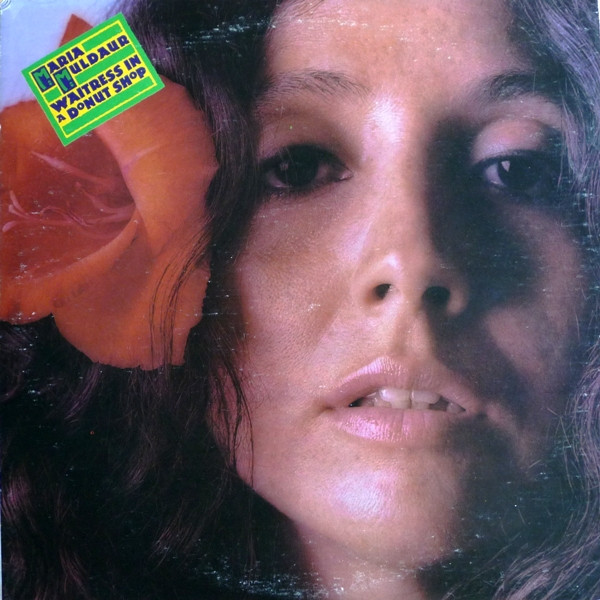
The song I’m A Woman appeared on her 1974 album Waitress in a Donut Shop. I’ve been listening to that album and it’s one that I would recommend everyone checking out. The album did well…it peaked at #23 on the Billboard Album Charts in 1974.

I’m going to close with this. Many times an artist is defined by their major hit…that does an injustice on Muldaur. That is not a putdown on “Midnight at the Oasis”…I think it’s brilliant… but she is so much more than that. I’ve never been into awards but she has been nominated for 5 Grammy Awards.

Townes Van Zandt – Pancho and Lefty

After the country post on Saturday…I looked through a lot of lists you all made. I listened…I want to thank Lisa for bringing this one up. It’s high time I did a post on Townes Van Zant. He was one of the best songwriters of the 20th Century.

What a songwriter Towns Van Zandt was…this song is probably best known for the Merle Haggard and Willie Nelson cover in 1983. The song peaked at #1 on the Country Billboard Charts and #1 on the Canadian Country Charts in 1983.

Willie Nelson has said that his and Merles duet album was almost complete but it lacked THAT song to put it over the top. Nelson said his daughter Lana suggested to him to listen to Pancho and Lefty by Townes Van Zandt. Willie then asked Townes what the song was about…and Townes said he didn’t know. Nelson then cut the track with his band. Willie and Merle had never heard that song before.

Nelson recorded it that night with his band and had to go and drag a sleepy Haggard (who was sleeping on his bus) to do the vocal part. The vocals were recorded in one take that night. They made a video of it and invited Townes to be in it. He was in the video as one of the Mexican  Federales.

The royalties from this song helped Van Zandt through the years. He told a story of getting pulled over by a couple of policemen. His car sticker was out of date so he got into the police car and they asked him what he does for a living. He said he was a songwriter and the policemen shook their heads. He then told them that he wrote “Pancho and Lefty” and their eyes lit up and they started to grin. Pancho and Lefty were the policemen’s police radio code names. They let Townes go after that.

Van Zandt did not like fame or what came attached to it. It’s been reported that he turned down opportunities to write with Bob Dylan. He respected Dylan a great deal but it was the celebrity part he didn’t want. He never ended up on a major label through his career…by choice. Steve Earle counted Townes Van Zandt as his mentor, and the two formed a close bond in the years since their initial encounter in 1978.

Unfortunately, Earle also adopted Van Zandt’s drug and alcohol habits. So bad, in fact, that Van Zandt actually visited Earle during a rare moment in which Townes was sober. Earle told him “I must be in trouble if they’re sending you.” Earle eventually named his son after Townes Justin Townes Earle.

The original song was on Van Zandt’s 1972 album The Late Great Townes Van Zandt. 

For Willie’s Big 60 show, Bob Dylan and Willie Nelson sang Pancho and Lefty. Bob covered the song sporadically in concert during the 90’s. In 2004, Rolling Stone ranked “Pancho and Lefty” 41st on its list of the “100 Greatest Country Songs of All Time.

Townes Van Zandt on being invited to be in the video: “It was real nice they invited me,”they didn’t have to invite me and I made I think $100 dollars a day. I was the captain of the federales. And plus I got to ride a horse. I always like that. It took four and a half days and that video was four and a half minutes long…The money goes by a strange life, or elsewhere. I mean it doesn’t come to me. But money’s not the question. I would like if I could write a song that would somehow turn one five-year-old girl around to do right. Then I’ve done good. That’s what I care about.”

Townes Van Zandt:  “I realize that I wrote it, but it’s hard to take credit for the writing, because it came from out of the blue. It came through me and it’s a real nice song, and I think, I’ve finally found out what it’s about. I’ve always wondered what it’s about. I kinda always knew it wasn’t about Pancho Villa, and then somebody told me that Pancho Villa had a buddy whose name in Spanish meant ‘Lefty.’ But in the song, my song, Pancho gets hung. ‘They only let him hang around out of kindness I suppose’ and the real Pancho Villa was assassinated.”

Pancho and Lefty

Living on the road my friend,
Is gonna keep you free and clean
Now you wear your skin like iron,
Your breath as hard as kerosene.
You weren’t your mama’s only boy,
But her favorite one it seems
She began to cry when you said goodbye,
And sank into your dreams.

Pancho was a bandit boy,
His horse was fast as polished steel
He wore his gun outside his pants
For all the honest world to feel.
Pancho met his match you know
On the deserts down in Mexico
Nobody heard his dying words,
Ah but that’s the way it goes.

All the Federales say
They could have had him any day
They only let him slip away
Out of kindness, I suppose.

Lefty, he can’t sing the blues
All night long like he used to.
The dust that Pancho bit down south
Ended up in Lefty’s mouth
The day they laid poor Pancho low,
Lefty split for Ohio
Where he got the bread to go,
There ain’t nobody knows

The poets tell how Pancho fell,
And Lefty’s living in cheap hotels
The desert’s quiet, Cleveland’s cold,
And so the story ends we’re told
Pancho needs your prayers it’s true,
But save a few for Lefty too
He only did what he had to do,
And now he’s growing old

Stanley Brothers – Mountain Dew

Ok…we are veering WAY OFF the power-pop/rock path today! I was reading a biography of Pittsburgh Steelers coach Chuck Noll, and it mentioned he would sing this song occasionally. So reading a bio of an American football coach led to this post…you just never know! To paraphrase Bugs Bunny…we are taking that proverbial left turn at Albuquerque.

I got really curious and looked the song up. It’s great…I’ve always liked these old folk songs and bluegrass music because I respect them so much. I’ve played bluegrass with a professional before, and it is some of the hardest music I’ve tried to play. The time signatures are all over the place, and if you haven’t played the music a lot… it can be tricky. It made me a better musician.

I like the music because it’s so rootsy and earthy. I don’t listen to it a lot, but sometimes I will enjoy an hour or so of it. It reminds me of when my dad would go to work in the morning, and sometimes he would have this music on.

Good Ole’Mountain Dew!

This song is an  Appalachian folk song that Bascom Lamar Lunsford first wrote in 1928. Lunsford was an attorney; however, he is very fond of folk songs. He once represented a man in court because he was illegally making whiskey called Moonshine. This experience led him to write the song.  He ended up selling the song to Scotty Wiseman, and Wiseman changed a few lyrics but remembered Lunsford…he kept the songwriting credit Wiseman-Lunsford.

These songs are special. They were not trying to write hits…they just wanted to tell stories through songs. Instead of newspapers in the backwoods of the Appalachians, you had these songs.

Many artists have covered the song through the years, like Willie Nelson, Glen Campbell, Mother Maybelle Carter, Grandpa Jones, and more.

Willie Nelson released a version in 1981 that peaked at #23 in the Billboard Country Charts and #39 in Canada.

The lyrics never stay completely the same through the versions, but it still works. We will return to our normal programming in the next post!

Mountain Dew

Down the road here from me there’s an old holler tree
Where you lay down a dollar or two
Go on round the bend come back again
There’s a jug full of that good ole mountain dew

Oh they call it that good ole mountain dew
And them that refuse it are few
I’ll hush up my mug if you’ll fill up my jug
With that good ole mountain dew

Now Mr. Roosevelt told ’em just how he felt
When he heard that the dry law ‘d gone through
If your liquors too red it’ll swell up your head
You better stick to that good ole mountain dew

Oh they call it that good ole mountain dew
And them that refuse it are few
I’ll hush up my mug if you’ll fill up my jug
With that good ole mountain dew

The preacher rode by with his head hasted high
Said his wife had been down with the flu
He thought that I o’rt to sell him a quart
Of my good ole mountain dew

Oh they call it that good ole mountain dew
And them that refuse it are few
I’ll hush up my mug if you’ll fill up my jug
With that good ole mountain dew

Well my uncle Snort he’s sawed off and short
He measures four feet two
But feels like a giant when you give him a pint
Of that good old mountain dew

Oh they call it that good ole mountain dew
And them that refuse it are few
I’ll hush up my mug if you’ll fill up my jug
With that good ole mountain dew

Famous Rock Guitars Part 1

I love guitars…I own 12 of them. It’s something about them that draws me in. Each one has its own sound and vibe. My family made guitars in the 60’s and 70’s so I do remember as a small kid walking into the guitar shop smelling the wood and glue. Some guitars are just as famous as their former or current owners.

I will include 2 guitars per post…this week we have two famous guitars from two completely different artists.

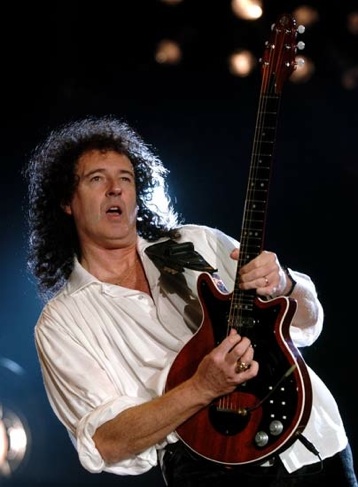
Brian May’s “Red Special”

Brian May’s sound was as a big part of Queen as Mercury’s voice. Brian May designed and built the Red Special with his father, in 1963, using any parts they could find.  The neck of the guitar was fashioned from an 18th-century fireplace mantel, the inlays on the neck from a mother-of-pearl button. For the body, they used wood from an old oak table. Then the bricoleurs combined a bike saddlebag holder, a plastic knitting needle tip, and motorbike valve springs to create a tremolo arm.

Brian May: I remembered that at the time we finished the topcoat of varnish, my Dad had wanted to christen her as the Brian May Special, and I had poo-pooed the idea; now I realized that it wasn’t so uncool to give her a proper name. So one day in a radio interview, when someone asked me what I called the guitar, the words Red Special just tumbled out before I’d had time to think. 

Legendary Guitar: Brian May's Red SpecialBrian May of Queen, playing Red Special, the guitar he built himself as a  teenager. | Queen guitarist, Brian may, Queen band

The Red Special is not in a museum it’s with Brian and it’s still his number 1 guitar.

I have a couple of guitars that has some cracking in the finish but nothing I’ve had or seen compares with this one.

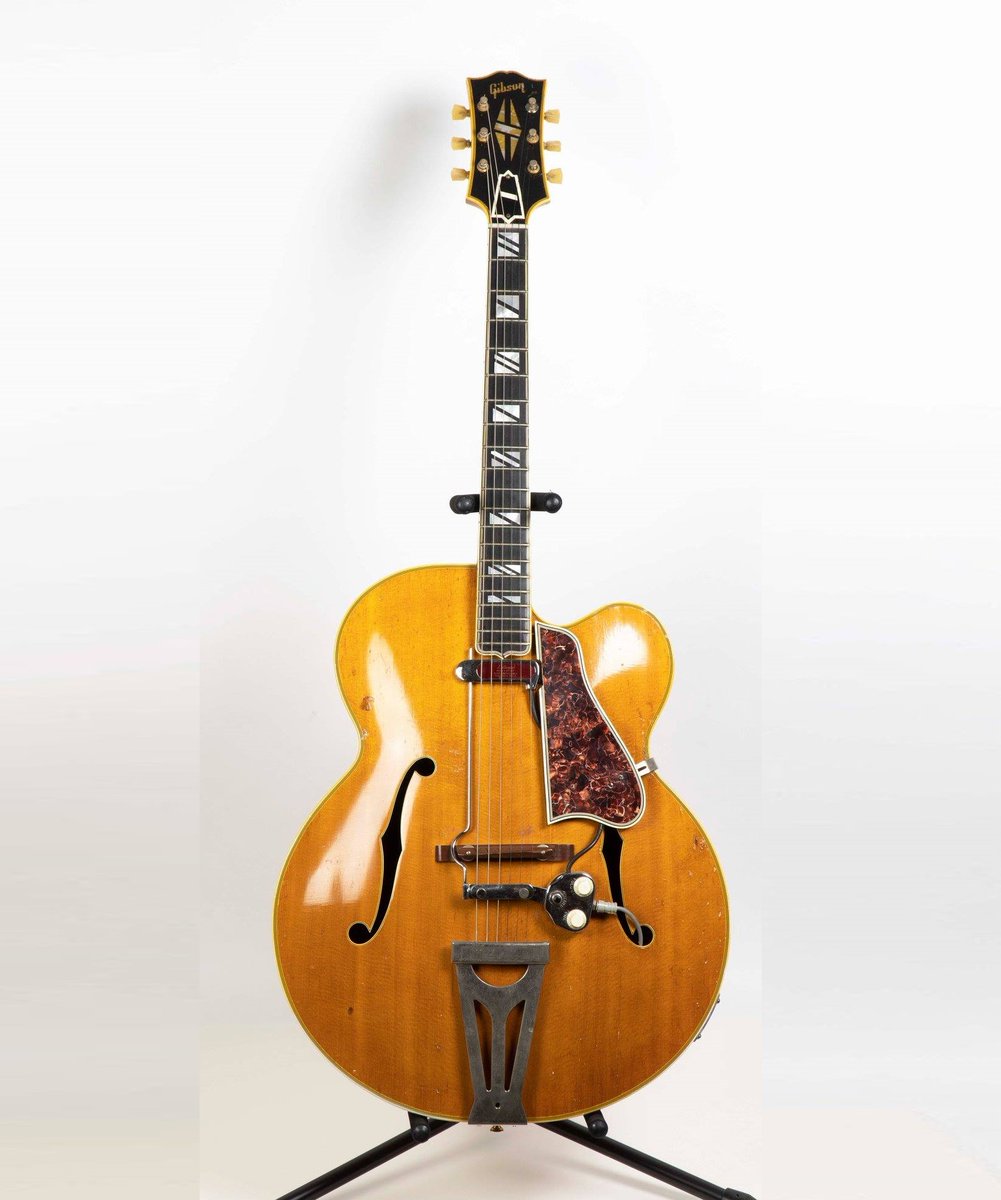
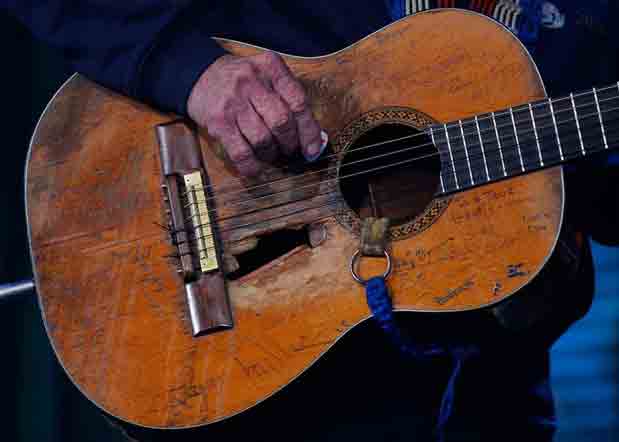
For more than 40 years Willie Nelson has been playing a Martin N-20 nylon-string acoustic guitar he named “Trigger,” after Roy Rogers’ horse. A classical guitar designed with no pick-guard, the famous relic has developed a gaping hole in the body.

Willie got this guitar in 1969 after a drunk stepped on his Baldwin guitar. The same year he bought Trigger his house caught fire and Willie braved the blaze to pull it out.

Willie Nelson has said….“When Trigger goes, I’ll quit.” 

Willie still plays this guitar…and yes it has a distinctive sound all its own.

Waylon Jennings – Luckenbach, Texas (Back To The Basics Of Love)

I love the Outlaws…

The song was written by Chips Moman and Bobby Emmons. Waylon Jennings was in Moman’s American Studios in Nashville recording Luckenbach, Texas when Willie Nelson happened to drop by for no particular reason.

Jennings saw him and asked him to sing with him on this. So Willie ended up adding his voice to the final verse, providing a couple of lyrical changes in the process.

Chips Moman used reverse psychology on Waylon to get him to record this song. Chips told him “here’s a song that you can’t cut because I’ve got it promised to someone else, but can I get your opinion on it?” It worked, Waylon took the bait and told Moman “I’m gonna cut that song.”|

Suddenly the tiny town of Luckenbach was besieged by network reporters and camera crews. Over one hundred city-limit signs have been stolen from the town since Jennings’ famous record was first released in 1977, and ironically neither Waylon nor the song’s writers Chips Moman and Bobby Emmons ever made their way to Luckenbach, Texas.

The song peaked at #1 in the Billboard Country Charts, #25 in the Billboard 100, and #1 in the Canadian Country Charts, and #46 in the Canadian RPM Charts in 1977.

Luckenbach Texas

Let’s go to Luckenbach, Texas
With Waylon and Willie and the boys
This successful life we’re livin’
Got us feuding like the Hatfields and McCoys
Between Hank Williams’ pain songs and
Newbury’s train songs and “Blue Eyes Cryin’ in the Rain”
Out in Luckenbach, Texas, ain’t nobody feelin’ no pain

So baby, let’s sell your diamond ring
Buy some boots and faded jeans and go away
This coat and tie is choking me
In your high society, you cry all day
We’ve been so busy keepin’ up with the Jones
Four car garage and we’re still building on
Maybe it’s time we got back to the basics of love

Let’s go to Luckenbach, Texas
With Waylon and Willie and the boys
This successful life we’re livin’ got us feudin’
Like the Hatfield and McCoys
Between Hank Williams’ pain songs and
Newbury’s train songs and “Blue Eyes Cryin’ in the Rain”
Out in Luckenbach, Texas, ain’t nobody feelin’ no pain

Let’s go to Luckenbach, Texas
Willie and Waylon and the boys
This successful life we’re livin’s got us feudin’
Like the Hatfield and McCoys
Between Hank Williams’ pain songs
And Jerry Jeff’s train songs and “Blue Eyes Cryin’ in the Rain”
Out in Luckenbach, Texas, there ain’t nobody feelin’ no pain


The Equals – Baby Come Back

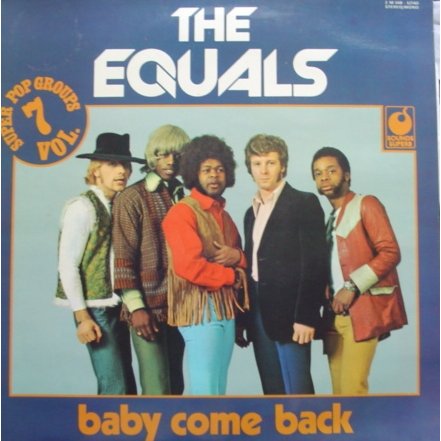
If you were wondering what Eddy Grant did before Electric Avenue…wonder no more. He was writing this song for the band he was in called The Equals.

The Equals were a pop/reggae/rock group that formed in North London, England in 1965. Eddy Grant, founded the group. Also in the original line-up were the twin brothers Derv and Lincoln Gordon, as well as John Hall and Pat Lloyd. They were noted as being the first major interracial rock group in the UK and one of the few racially mixed bands of the era.

This song was originally released in 1966 as a B side. Throughout Europe DJ’s started to play this song and it charted in Germany. It was re-released in 1968 in the UK and it peaked at #1 and in the US it made it to #32.

In 1980, The Clash recorded a cover version of the Equals’ song “Police on My Back”. Willie Nelson also covered the song in 2006.

Baby Come Back would be their only charting song in America but in the UK they found success.

  • “I Get So Excited” / “The Skies Above” – (1968) (UK #44)
  • “Baby Come Back” / “Hold Me Closer” – (1968) (UK #1, IRL #2, NOR #4, U.S. #32)
  • “Laurel And Hardy” / “The Guy Who Made Her a Star” – (1968) (UK #35)
  • “Softly Softly” / “Lonely Rita” – (1968) (UK #48)
  • “Michael and The Slipper Tree” / “Honey Gum” – (1969) (UK #24)
  • “Viva Bobby Joe” / “I Can’t Let You Go” – (1969) (UK #6, IRL #3)
  • “Rub A Dub Dub” / “After the Lights Go Down Low” – (1969) (UK #34)
  • “Black Skin Blue Eyed Boys” / “Ain’t Got Nothing to Give You” – (1970) (UK #9)


From Songfacts

Originally, this was the B-side of The Equals’ “Hold Me Closer” single. That record did not capture much attention, but in early 1968 this was released as a single in Germany, where it rose to #1. After it subsequently topped the charts in Belgium and Holland the song was finally reissued in the UK, where it soared to #1.

The Equals were a pop group formed in England in 1965 by Derv Gordan (vocals), his twin brother Lincoln (guitar), Grant (guitar), John Hall (drums) and Pat Lloyd (guitar). They went on to have 12 more hits in Germany and two other UK Top 10 hits (“Viva Bobby Joe” and “Black Skin Blue Eyed Boys”) before legal problems with the record company made it impossible to release any more records.

https://www.youtube.com/watch?v=5q3ALvb16EE

Baby Come Back

Come back 
Baby, come back 
Baby, come back 
Baby, come back 

This is the first time [unintelligible] today 
That you have run away 
I’m asking you for the first time 
Love me [unintelligible] stay (all right) 

Hey (all right) 
Hey (all right!) 
Hey, yeah 
Come back 

Baby, come back 
Baby, come back 
Baby, come back 

There ain’t no use in you crying 
‘Cause I’m more hurt than you 
I shoulda not been out flirting 
But now my love is true 

Ooh (all right) 
Ooh (OK!) 
Ooh, yeah 
Come back 

Baby, come back 
Baby, come back 
Baby, come back 
Come back, baby, don’t you leave me 

Baby, baby, please don’t go 
Oh, won’t you give me a second chance 
Baby, I love you so (all right) 
Oh (oh, yeah) 

Oh (unintelligible) 
Oh, yeah 
Come back 
I said baby, come back 

I said baby, come back 
Oh won’t you please come back 
Oh won’t you please come back [Repeat until fade]

https://en.wikipedia.org/wiki/The_Equals