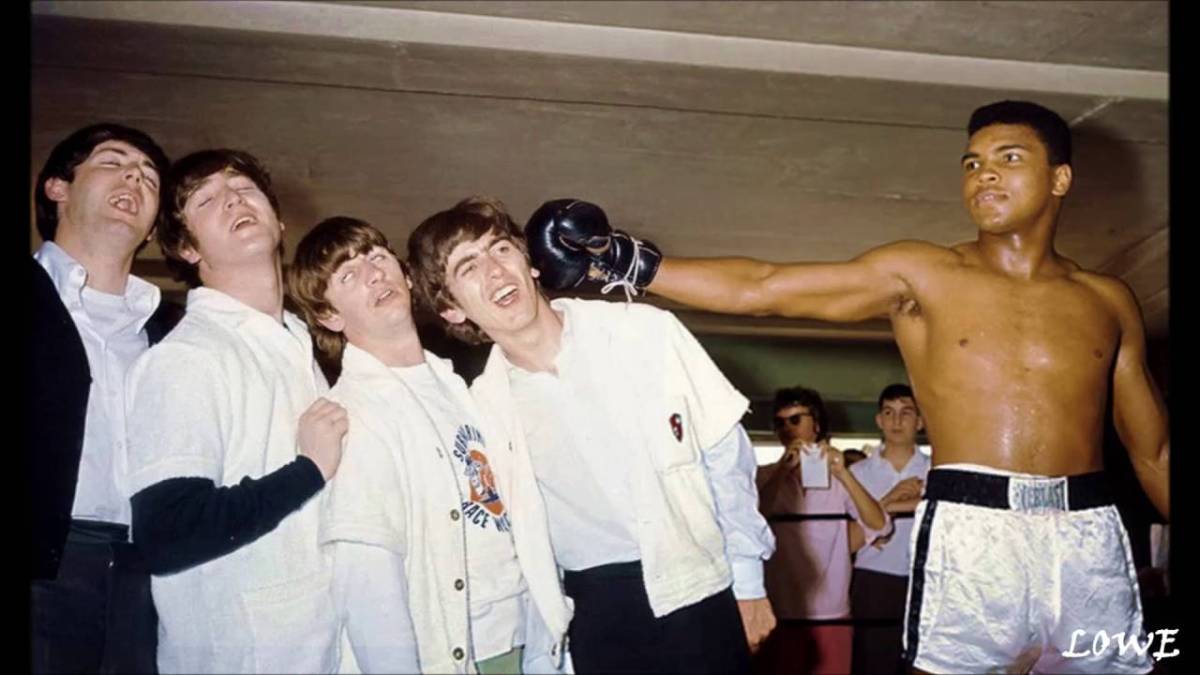
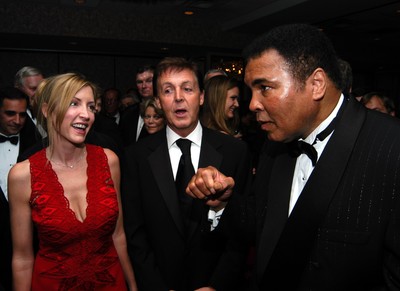
Just think of the photographs snapped of Muhammad Ali and the Beatles. Put together they would reach the moon and back. Muhammad Ali was probably the most famous person in the world in the 20th century. Kids on remote islands in the middle of nowhere knew about Ali. The two were truly the greatest in their fields.
Muhammad Ali played with the idea of reuniting the Beatles in the 1970s.
The two culture icons would meet on February 18, 1964 right after the Beatles broke through America. The Beatles wanted to meet Sonny Liston because he was favored 7-1 to win the match between him and Ali but Sonny declined to meet them.
By all accounts, Ali had no idea who The Beatles were. But he welcomed the opportunity for some extra publicity with them. Although The Beatles fumed because the soon-to-be-new champ was late and kept them waiting, when he arrived he quickly broke the ice with his opening line, which has since been reported as either: “Hey, Beatles, let’s go make some money!”; or the equally memorable: “Hello there, Beatles! We oughta do some roadshows together. We’ll get rich!”
At one point, Ali used one of his favorite lines at the time, telling the Beatles: “You ain’t as dumb as you look!”
Lennon… but of course… shot back: “No. But you are!”
After a nervous silence…everyone started to laugh. Ali made up one of his rhymes. “When Liston reads about The Beatles visiting me / He’ll get so mad, I’ll knock him out in three!” It actually took 6 rounds for Ali to win on February 25, 1964…Sonny wouldn’t return for the 7th.
Joel Sacher was attending the inauguration gala for President Jimmy Carter. He was there as a personal guest of Muhammad Ali, maybe the most recognizable man on the planet at the time. Ali and Sacher were meeting with one of the few men who was almost as recognizable Ali. They were talking to John Lennon and his wife Yoko Ono, and while the conversation included plenty of nostalgia about meeting the Beatles in Miami long ago.
Ali was armed with a proposal, one that was the brainchild of Sacher and a business associate that had the potential to stun the world. They wanted to reunite The Beatles.
In 1976 inventor Alan Amron and businessman Joel Sacher partnered with Ali to promote The International Committee to Reunite the Beatles. They asked fans worldwide to contribute a dollar each. Ali said the idea was to use the proceeds to establish an international agency to help poor children. “This is money to help people all over the world”, he said. He added, “I love the music. I used to train to their music.” He said a reunion of the Beatles “would make a lot of people happy.” The Beatles were indifferent to the plan. No reunion happened.
Here is a PDF of a newspaper article describing Ali’s plan. It was a nice gesture. Ali and the Beatles.pdf
The International Committee to Reunite the Beatles released a single called “Get Back Beatles” and it was released by singer-songwriter Gerald Kenny.
The Beatles turned down big-time money in the seventies and didn’t reunite. Personally, I’m happy they didn’t…no way could they have lived up to people’s expectations.
After Muhammad Ali died
Paul McCartney:
“I loved that man. He was great from the first day we met him in Miami, and on the numerous occasions when I ran into him over the years. Besides being the greatest boxer, he was a beautiful, gentle man with a great sense of humor who would often pull a pack of cards out of his pocket, no matter how posh the occasion, and do a card trick for you.
Ringo Starr:
“I taught (Ali) everything he knew!” Starr said, before growing more – and less – serious. “That was a thrill, of course, and I was putting my money on Liston, so I really knew what was happening!”
This was released as a double A-side single with “Come Together.” It was the only song written by George Harrison released as a single by The Beatles. They had used some of his songs as B-sides, including “The Inner Light” and “Old Brown Shoe.”
The song was written about his then-wife Pattie Boyd. This song moved his songwriting abilities up… in the eyes of his bandmates Lennon and McCartney. George had written some very good songs before like Taxman, If I Needed Someone, and While My Guitar Gently Weeps but this one…this one placed him in another league. George had two of the highlights on the album wth Something and Here Comes The Sun.
Harrison wrote this during a break while they were working on The White Album. It was not recorded in time for the album, so Harrison gave this to Joe Cocker, but Cocker didn’t release it until after The Beatles did.
When I saw Paul McCartney in 2014 he played this as a tribute to George Harrison. He played a version of this using a ukulele George had given him…and it made it really special.
Frank Sinatra called this “”the greatest love song of the past 50 years”.” He often performed it in the ’70s, at one point wrongly attributing it to Lennon and McCartney rather than Harrison.
With at least 200 cover versions on record, this is the second-most-covered Beatles song; only “Yesterday” has been covered more.
Harrison chastised McCartney for being too active with his bass lines in this song. In the past, Paul had sometimes been critical of George’s guitar playing on his songs. I have to say though…Paul did a great job on this song…his bass playing compliments the song.
From Songfacts
Pattie did inspire “Layla” when Eric Clapton realized he loved her a few years later. She and Clapton were married from 1979-1988 (he also wrote “Wonderful Tonight” for her).
In her 2007 book Wonderful Tonight: George Harrison, Eric Clapton, and Me, Pattie Boyd wrote: “George wrote a song called ‘Something.’ He told me in a matter-of-fact way that he had written it for me. I thought it was beautiful and it turned out to be the most successful song he ever wrote, with more than 150 cover versions. George’s favorite version was the one by James Brown. Mine was the one by George Harrison, which he played to me in our kitchen. But, in fact, by then our relationship was in trouble. Since a trip to the Maharishi Mahesh Yogi’s ashram in India in 1968, George had become obsessive about meditation. He was also sometimes withdrawn and depressed.”
Harrison came up with the title and the first line after listening to a James Taylor song called “Something In The Way She Moves.” Taylor was signed to Apple Records (The Beatles’ label) at the time.
This is the only song on the Beatles 1 album that was not a #1 hit on its own in the US or UK. “Something” and “Come Together” spent one week at #1 on Billboard’s Hot 100 chart when the compilers of the chart changed its ranking method and stopped giving separate rankings for the two sides of a single. It was also gave Harrison representation among the 27 tracks.
Harrison had the first line, “Something in the way she moves,” but had trouble coming up with the second. He considered “attracts me like a pomegranate,” before coming up with “attracts me like no other lover.”
This was used in a commercial for Chrysler cars in 1987.
John Lennon said that this was his favorite song on Abbey Road.
Harrison wrote this on a piano. The Beatles often composed and recorded separately at this time.
Harrison pictured Ray Charles on vocals when he wrote this. Charles did eventually cover it.
With 21 string players used in overdubs, this ended up being one of the most orchestral Beatles songs. This sound made it a staple of light rock radio and, in bowdlerized instrumental form, Muzak.
Before this was edited down, it contained a long instrumental tag at the end.
Dave Grohl, a former member of Nirvana and leader of The Foo Fighters, recorded a tribute song to Harrison on the Foo’s first album called “Oh, George” based on the guitar lead to this. Harrison was Grohl’s favorite Beatle, and this was one of the first leads he learned to play on guitar.
Jeff Lynne, Joe Walsh and Dhani Harrison performed this song on the CBS special The Beatles: The Night That Changed America. The show featured Grammy-winning performers covering Beatles songs; it aired on February 9, 2014 – the 50th anniversary of the group’s first Ed Sullivan Show appearance.
Something
Something in the way she moves Attracts me like no other lover Something in the way she woos me I don’t want to leave her now You know I believe and how
Somewhere in her smile she knows That I don’t need no other lover Something in her style that shows me I don’t want to leave her now You know I believe and how
You’re asking me will my love grow I don’t know, I don’t know You stick around and it may show I don’t know, I don’t know
Something in the way she knows And all I have to do is think of her Something in the things she shows me I don’t want to leave her now You know I believe and how
The opening track to The Beatle’s last album Abbey Road.
This song was part of one of their best double A-sided singles…Come Together was sided with Something and the single peaked at #1 in 1969.
In 1969, Timothy Leary decided to run for Governor of California and asked John Lennon to write a song for him. “Come Together, Join The Party” was Leary’s campaign slogan a reference to the drug culture he supported and was the original title of the song. Leary never had much of a campaign, but the slogan gave Lennon the idea for this song.
Leary wasn’t happy with it when he heard it and said: “I was a bit miffed that Lennon had passed me over this way…When I sent a mild protest to John, he replied with typical Lennon charm and wit that he was a tailor and I was a customer who had ordered a suit and never returned. So he sold it to someone else.”
In the song, Lennonwrot the opening line o “Here come old flat-top / he come grooving up slowly,” which is very similar lyrically and in meter to a line in Chuck Berry’s “You Can’t Catch Me,” “Here come a flat-top / he was moving up with me.”
This similarity caught the notice of the song’s publisher Morris Levy who, shortly after the Beatles song was released, filed a lawsuit against John for plagiarism. Timothy Leary may have walked away quietly, but Morris Levy was to do nothing of the sort.
A settlement was reached in 1973 which stipulated that Lennon would record three songs owned by Big Seven Music Corp., which was owned by Levy. Lennon picked Ya Ya, You Can’t Catch Me, and Angel Baby. He recorded the first two but the last one, Angel Baby he never did. Levy sued Lennon again and was eventually awarded a total of $6,795 in damages.
Aerosmith covered this song and did a good job…
John Lennon: “Though it’s nothing like the Chuck Berry song,” “they took me to court because I admitted this once years ago. I left in one line, which is not just Berry’s: ‘Here come old flat top.’ I could have changed it to ‘Here comes old iron face.’
Paul McCartney: “here come old flat-top, “That was a lyric John could NOT let go of. And he couldn’t better it, so he just used it. And I said, ‘Well, it’s a bit of a nick, isn’t it?’ He said, ‘No, it’s a quote.’ I said, ‘OK, fair enough.”
From Songfacts
Timothy Leary was a psychologist who became famous for experimenting with LSD as a way to promote social interaction and raise consciousness. Leary did many experiments on volunteers and himself and felt the drug had many positive qualities if taken correctly. When the government cracked down on LSD, Leary’s experiments were stopped and he was arrested on drug charges.
After Timothy Leary decided against using this song for his political campaign Lennon added some nonsense lyrics and brought it to the Abbey Road sessions. Paul McCartney recalled in Rolling Stone magazine’s 500 Greatest Songs: “I said, ‘Let’s slow it down with a swampy bass-and-drums vibe.’ I came up with a bass line, and it all flowed from there.”
John Lennon was sued for stealing the guitar riff and the line “Here comes old flat-top” from Chuck Berry’s “You Can’t Catch Me.” The lawsuit did not come from Berry, but from Morris Levy, one of the music industry’s most infamous characters (see our interview with Tommy James for more on Levy). He owned the song along with thousands of other early rock songs that he obtained from many poor, black, and unrepresented artists. Levy sued the Beatles, or more accurately, John Lennon, over the song around the time the Beatles broke up.
For years, Lennon delayed the trial while he and the Beatles tried to sort out all the legal and business problems that plagued Apple Records. Finally, in an attempt to avoid the court room as much as he could (Lennon felt like he was appearing in court more often than not), he settled with Levy. Lennon agreed to record his Rock N Roll album, which was just a series of cover songs, including three songs Levy owned (including “You Can’t Catch Me”) on the tracklist.
The deal made sense: Lennon always wanted to make a covers album, and Levy wanted the value of his songs to increase (when a Beatle re-records a song, that is just what happens). To make a long long long story short, Lennon recorded the album over the Lost Weekend, a year-or-two period when he was separated from Yoko Ono and lived in Los Angeles. During that time he was often drunk or high, and was rather sloppy and useless. Levy was getting frustrated with the lack of progress. Phil Spector was the producer, but in a fit of madness (which was not too unusual for Spector) he ran away and stole the recording session tapes. Levy invited Lennon to his upstate New York recording studio, and that is where he finally recorded the album, which ended up with only two Levy songs: “You Can’t Catch Me” and “Ya Ya.” >>
The whispered lyric that sounds like “shoot” is actually Lennon saying “shoot me” followed by a handclap. The bass line drowns out the “me.”
The Beatles recorded this on July 21, 1969 and it was the first session John Lennon actively participated in following his and Yoko’s car accident 3 weeks earlier. John was so insistent on Yoko being in the studio with him that he had a hospital bed set up in the studio for her right after the accident, since she was more seriously injured than he was. >>
The line “Ono sideboard” refers to Yoko.
The British Broadcasting Company (The BBC) banned this because of the reference to Coca Cola, which they considered advertising.
This has one of the most commonly misheard lyrics in the history of popular music: “Hold you in his -armchair- you can feel his disease.” It’s actually “Hold you in his arms, yeah, you can feel his disease.” All published sheet music had the “armchair” lyric, including the inner sleeve of the 1967-1970 compilation, which contained lots of other errors too, notably on “Strawberry Fields Forever.” After John heard that his lyric was incorrect in the sheet music and other folios, he decided he liked “armchair” better and kept it. >>
The Beatles released this as a “double A side” single with “Something.”
In 1969, this won a Grammy for best engineered recording.
When rumors were spreading that Paul McCartney was dead, some fans thought the line “One and one and one is three” meant that only George, John and Ringo were left. The line “Got to be good lookin’ cuz he’s so hard to see” was supposed to be Paul’s spirit. >>
A rotary phone was used to make the sound heard before each verse and after the chorus. The sound was accompanied by the bass Paul played. Kids, ask your parents or grandparents what a rotary phone was. >>
Aerosmith recorded this song with Beatles producer George Martin for the 1978 movie Sgt. Pepper’s Lonely Hearts Club Band, which turned out to be one of the worst films ever made. Aerosmith appeared in the film performing this song (as the Future Villain Band), agreeing to the role only because they couldn’t resist the chance to record a Beatles song with George Martin. They weren’t the only big names in the film – Peter Frampton and The Bee Gees were also in it.
The Aerosmith version of “Come Together” made #23 in the US when it was released as a single. When we asked their guitarist Brad Whitford why some folks prefer the Aerosmith version, he replied, “I’ve actually never heard anybody say that.” Whitford added, “But you know, it’s funny, I hear our version more on the radio than I do The Beatles’ version.”
In 2001, Beck, Moby, Marc Anthony, and Nelly Furtado were scheduled to put on a tribute concert in Radio City Music Hall called “Come Together: A Night For John Lennon.” Due to the terrorist attacks on America, it was postponed and dedicated to the people of New York City, with proceeds benefiting victims of the attacks.
Nortel used this in commercials, as did Macy’s.
On an early demo version of “My Monkey” by Marilyn Manson (whose vocals were sped up to sound like “a demonic toddler”), Manson sang the second verse as an opener. It appeared on Demos in Lunchbox by Manson’s former band, The Spooky Kids.
This has been covered by Michael Jackson, Tina Turner, Meat Loaf, Guns N’ Roses, Soundgarden, Marilyn Manson, Nazareth, and Oasis.
Though Ringo is best known for playing on Oyster Black Pearl Ludwig drum kit, he used for this his Ludwig “Hollywood” maple-finish equipment, with a 22″ kick. Starr produced his distinctive late ’60s drum muffling sound on tracks like this by wrapping tea towels (dishtowels) around his snares and toms.
On October 7, 2016, The Rolling Stones covered this song during their headline set at the Desert Trip festival in Indio, California. Before launching into the tune, Mick Jagger told the crowd: “We’re gonna do a cover song of a sort of unknown beat group. I think you might remember [them], we’re gonna try a cover of one of their tunes.”
Come Together
Here come old flat top He come groovin’ up slowly He got joo joo eyeballs He one holy roller He got hair down to his knee Got to be a joker He just do what he please
He wear no shoeshine He got toe jam football He got monkey finger He shoot Coca-Cola He say I know you, you know me One thing I can tell you is You got to be free Come together, right now Over me
He bad production He got walrus gumboot He got Ono sideboard He one spinal cracker He got feet down below his knee Hold you in his armchair You can feel his disease Come together, right now Over me
He roller coaster He got early warning He got muddy water He one Mojo filter He say one and one and one is three Got to be good looking ‘Cause he’s so hard to see Come together right now Over me
Come together, yeah Come together, yeah Come together, yeah Come together, yeah Come together, yeah Come together, yeah Come together, yeah Come together, yeah Come together, yeah
Not the most pleasant song available from John but it does get your attention. I do like the guitar sound that John and Eric Clapton get in this song.
This song is about drug withdrawal. Quitting “Cold Turkey” means abruptly stopping drug use and the effect it has on your body and mind. John Lennon quit cold turkey because he wanted to get off drugs and start a family with Yoko.
John wanted to record this with the Beatles but they rejected it so he went off and recorded it on his own.
Eric Clapton and John played guitar on this, Ringo drummed, and Klaus Voormann played the bass, It was released as a single in 1969 as The Plastic Ono Band. The song peaked at #30 in the Billboard 100, #14 in the UK, and #30 in Canada.
This was Lennon’s second single away from The Beatles. “Give Peace A Chance” was released a few months earlier. This was also the first song John took complete credit for as he dropped the McCartney from Lennon and McCartney.
Its first public performance on September 13, 1969, was recorded and released on the Live Peace in Toronto 1969 album by the Plastic Ono Band.
John Lennon:“Cold Turkey was banned. They thought it was a pro-drugs song. But I’ve always expressed what I’ve been feeling or thinking at the time. So I was just writing the experience I’d had of withdrawing from heroin. To some it was a rock ‘n’ roll version of The Man With The Golden Arm because it showed Frank Sinatra suffering from drug withdrawal.”
From Songfacts
Lennon performed this on September 13, 1969 at The Toronto Rock and Revival Show, where he introduced his Plastic Ono Band (at least the configuration of it for this show). Eric Clapton was on guitar, Klaus Voorman on bass, and Alan White on drums. Yoko Ono was also part of the act, and she made an impact during “Cold Turkey.” As the song played, she emerged from a bag on stage, stepped up to a microphone, and made turkey-sounding noises (not out of character). The set was released as a live album called Live Peace In Toronto 1969.
Eric Clapton played some of the guitar on this. Lennon asked Clapton to join The Plastic Ono Band, but Eric declined.
Lennon wrote and recorded this song before attending Arthur Janov’s Primal Scream therapy workshop, which played a part in his song “Mother.” The screams he used in “Cold Turkey,” he was actually emulating Yoko singing.
When John Lennon decided to return his MBE (Member of the British Empire) award on November 25, 1969, he sent it to Queen Elizabeth II with a note explaining, “I am returning this MBE in protest against Britain’s involvement in the Nigeria-Biafra thing, against our support of America in Vietnam and against ‘Cold Turkey’ slipping down the charts.”
Cold Turkey
Temperature’s rising Fever is high Can’t see no future Can’t see no sky
My feet are so heavy So is my head I wish I was a baby I wish I was dead
Cold turkey has got me on the run My body is aching Goose-pimple bone Can’t see no body Leave me alone
My eyes are wide open Can’t get to sleep One thing I’m sure of I’m at the deep freeze
Cold turkey has got me on the run Cold turkey has got me on the run
Thirty-six hours Rolling in pain Praying to someone Free me again
Oh I’ll be a good boy Please make me well I promise you anything Get me out of this hell
Like “A Hard Day’s Night,” the title came from an expression Ringo Starr used. Ringo’s turn of the phrase took the edge off the heavy philosophical lyrics. Working titles for the song before Ringo gave them inspiration were “Mark I” and “The Void.”
It was on what perhaps is the greatest Beatle album…Revolver.
The inspiration for the song came from a book entitled “The Psychedelic Experience: A Manual Based On The Tibetan Book Of The Dead.” This book was published in August of 1964 by Timothy Leary, Ralph Metzner, and Richard Alpert
The Beatles made “tape loops”…short tapes of grandfather clocks, sitars, seagulls, laughter, and other things. They brought them to the studio and put them together at different speeds, played forward, and backward. That is what you hear at the beginning.
John wanted his voice to…sound like the Dalai Lama chanting from a mountaintop, miles away or like a group of Tibetan monks chanting on a mountain top. Well, that was impractical so John suggested they suspend him from a rope in the middle of the studio ceiling, put a mike in the middle of the floor, give him a push and he’d sing as he went around and around. They didn’t do that either but they ended up putting Lennon’s voice through a Leslie Speaker Cabinet (a rotating speaker cabinet) and that made John happy.
Tomorrow Never Knows was a great innovation. It opened the door to Sgt Pepper and was one of the great psychedelic rock songs.
John Lennon on LSD: “Leary was the one going round saying, ‘take it, take it, take it,’” Lennon remembered in 1980, “and we followed his instructions in his ‘how to take a trip’ book. I did it just like he said in the book, and then I wrote ‘Tomorrow Never Knows,’ which was almost the first acid song: ‘Lay down all thought, surrender to the void,’ and all that sh*t which Leary had pinched from ‘The Book Of The Dead.’”
From Songfacts
John Lennon wrote this, and described it as “my first psychedelic song.”
The book is a reinterpretation of the Tibetan Book of the Dead and a guide to understanding it through psychedelic drugs. Lennon would read it while tripping on LSD, and according to his biographer Albert Goldman, he recorded himself reading from the book, played it back while tripping on LSD, and wrote the song.
The most overt reference to the book is the line:
Turn off your mind
Relax and float downstream
It is not dying
The book states: “Whenever in doubt, turn off your mind, relax, float downstream.”
To accompany the psychedelic imagery in Lennon’s lyric, each Beatle created strange sounds which were mixed in throughout the recording, often backward and in different speeds. Their producer, George Martin, was older and more experienced, but he allowed the group to experiment in the studio as much as they pleased.
The night before they recorded this song, Paul McCartney created 16 tape loops of guitar sounds and odd vocals that he brought in to the studio to create some of the effects. Several people remember standing around the room holding pencils for the tape to loop around and back into the recording machine as the various sound effects and instrumentation were faded in and out.
John Lennon used only one chord in this whole song, which creates a hypnotic feeling. For his vocals, he asked producer George Martin to make him sound like the Dali Lama.
Drugs influenced the creation of this song, but the Beatles recorded sober. “We would have the experiences and then bring that into the music later,” Ringo Starr explained.
George Harrison played a droning Indian instrument called a tambura on this track, which added an ethereal feel to the soundscape.
The musical break that comes in about a minute into this song consists mostly of guitars that were heavily processed. This wild passage makes use of just about every studio trick at their disposal, including passing from one channel to the other. Those listening in mono (often in cars) didn’t get the full experience.
This was the first track recorded for the Revolver album, but the last one on the tracklist.
On May 6, 2012, this song was featured in an episode of the popular American TV series Mad Men. The episode was set in 1966, and part of the plot was the ad agency in the show helping a client capitalize on Beatlemania. This was a big deal, since Beatles songs are very rarely licensed for TV shows – at least in their original versions. Cover versions and performances (think American Idol) show up from time to time, since those just have to be approved by Sony/ATV, which owns the publishing rights. Getting permission to use an actual Beatles recording requires permission from Apple Corp, which is controlled by The Beatles and their heirs.
The Wall Street Journal reported the payment for the song at $250,000, and that Mad Men creator Matthew Weiner had to reveal to Apple exactly how the song would be used, which was a big deal since he is very secretive about scripts. In the episode, the main character Don Draper has trouble adapting to changing musical times. He plays this song to see what all the fuss is about, and after a character-developing montage while the song is playing, he switches it off. The song then comes back to play over the closing credits.
Phil Collins covered this on his debut solo album, Face Value, in 1981, using synthesizers to create many of the unusual sounds. Like The Beatles did on Revolver, Collins used it to close the album.
Our Lady Peace remade this song for the soundtrack to the movie The Craft. It’s played during the opening credits.
Oasis pays tribute to this song in “Morning Glory” with the line:
Walking to the sound of my favorite tune
Tomorrow never knows what it doesn’t know too soon
The Beatles were a huge influence on Oasis.
This song is featured on the 2006 Beatles album Love (a soundtrack to the Cirque du Soleil show based on their music) remixed with “Within You Without You.”
Tomorrow Never Knows
Turn off your mind relax and float down stream It is not dying, it is not dying
Lay down all thoughts, surrender to the void It is shining, it is shining
Yet you may see the meaning of within It is being, it is being
Love is all and love is everyone It is knowing, it is knowing
And ignorance and hate mourn the dead It is believing, it is believing
But listen to the colour of your dreams It is not leaving, it is not leaving
So play the game “Existence” to the end Of the beginning, of the beginning
As Van Morrison would say…Into The Mystic… this song off of Sgt Pepper was a George Harrison song…and he was the only Beatle on it… This is about as sixties as you can get with the sitar and philosophical lyrics.
This was a brilliant addition to Sgt Pepper to show yet another side to the Beatles.
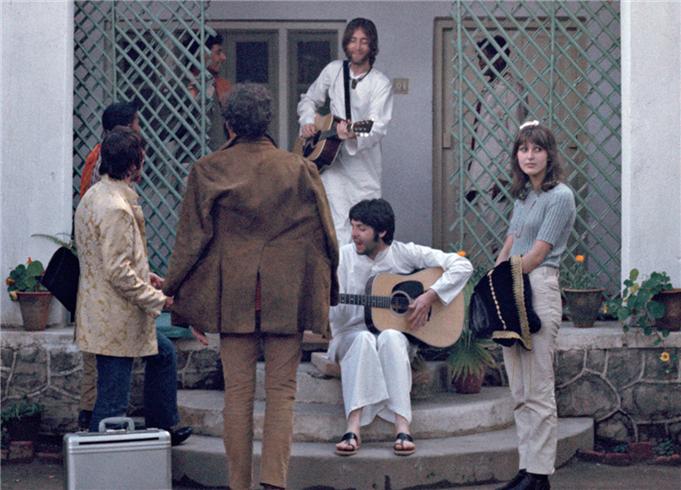
It’s hard to overestimate how profound of an effect that the introduction to Eastern religion had on George Harrison. Under the name of Sam Wells, George, along with his wife Pattie, vacationed in Bombay, India for six weeks, beginning on September 20th, 1966. At the suggestion of Ravi Shankar, from whom he was going to take sitar lessons while there, he grew a mustache as a subtle disguise so as to ward off any Indian “Beatlemaniacs” that may have been around in the area.
The book Autobiography Of A Yogi really changed his life and mind. It influenced his writing of songs like Within You Without You’ and many others. George started to write this song on a pedal harmonium at friend Klaus Voormann’s home.
During the recording, George was there with Indian musicians and they had a carpet on the floor and there was incense burning.
At George Harrison’s request, they added a small bit of laughter at the end of the song as it faded out to lighten the mood a bit.
John Lennon: “I think that is one of George’s best songs, one of my favorites of his. I like the arrangement, the sound and the words. He is clear on that song. You can hear his mind is clear and his music is clear. It’s his innate talent that comes through on that song, that brought that song together. George is responsible for Indian music getting over here. That song is a good example.”
From Songfacts
Although this song is billed as being recorded by the Beatles, George Harrison was the only Beatle to play on the track. There is no guitar or bass, but there are some hand-drums.
Harrison spent weeks looking for musicians to play the Indian instruments used on this. It was especially difficult because Indian musicians could not read Western music.
This is based on a piece by Indian musician Ravi Shankar, who helped teach Harrison the sitar. Harrison wrote his own lyrics and shortened it considerably.
Harrison wrote this as a 30-minute piece. He trimmed it down into a mini-version for the album.
This was the only song Harrison wrote that made it onto the album. He also contributed “Only A Northern Song” (recorded in February of 1967 as verified by the Anthology 2 album), but it was left off the album at the last minute. It was initially intended to go on the first side of Sgt. Pepper between “She’s Leaving Home” and “Being for the Benefit of Mr. Kite.” >>
This was one of Harrison’s first songs to explore Eastern religion, which would become a lifelong quest. He believed in reincarnation, which helped him accept death in 2001, when he lost his life to cancer.
Oasis covered this for the BBC to celebrate the 40th anniversary of Sgt. Pepper’s Lonely Hearts Club Band.
This is the second Indian classical-influenced song that George Harrison wrote for the Beatles, the first being “Love You To.”
“Now “Within You/Without You” was not a commercial song by any means. But it was very interesting. [George Harrison] had a way of communicating music by the Indian system of kind of a separate language… the rhythms decided by the tabla player.” –Sir George Martin, from the documentary The Material World.
Within You Without You
We were talking About the space between us all And the people Who hide themselves behind a wall of illusion Never glimpse the truth Then it’s far too late when they pass away
We were talking About the love we all could share When we find it To try our best to hold it there, with our love, with our love We could save the world, if they only knew
Try to realize it’s all within yourself, no-one else can make you change And to see you’re really only very small And life flows on within you and without you
We were talking About the love that’s gone so cold And the people Who gain the world and lose their soul They don’t know, they can’t see Are you one of them?
When you’ve seen beyond yourself then you may find peace of mind is waiting there And the time will come when you see we’re all one And life flows on within you and without you
In 1975 my friends and cousin had a clubhouse that was an old horse barn. We had a record player, a lantern, and a one-armed bandit. My cousin played the Meet The Beatles album and me… being a Monkee fan soaked it up and it started a lifelong love for The Beatles.
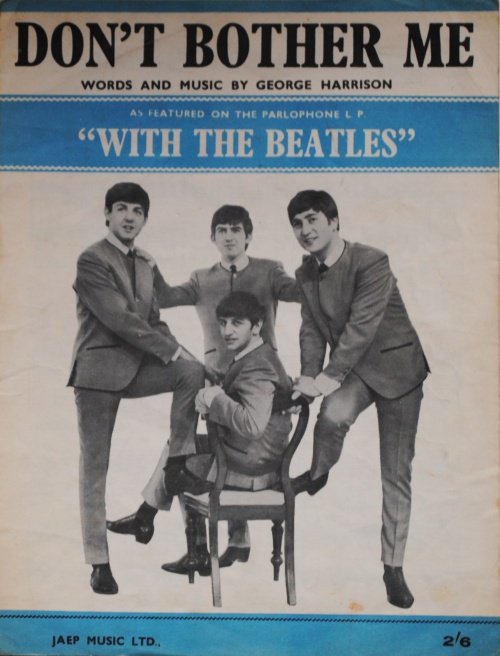
My first favorite Beatle song was It Won’t Be Long…then this one came in second at the time. George wrote this when he was down with the flu in a hotel room in the Northeast of England. It was the first song he wrote……technically he did have partial credit on the instrumental Cry For A Shadow.
Is it George’s best song? Of course not but it fits in well with the early Beatles and it gets overlooked. If you think about it…”Don’t Bother me” is so George and his attitude at times. I always really liked it…the overall feel of it is cool. It was a very good attempt at his first song.
George Harrison:“I don’t think it’s a particularly good song… It mightn’t even be a song at all, but at least it showed me that all I needed to do was keep on writing, and then maybe eventually I would write something good.”
Tom Petty:“I thought it was just the coolest song, like nothing I’d heard in rock,” Petty said in 2014 “I’d say, ‘Well, I like it. A lot. If you did that today, I’d say it was really good.’ And he’d go, ‘Well, you’d be wrong.'”
The Smithereens did a great job covering this song.
From Songfacts
This was George Harrison’s first recorded song. It was his response to critics who claimed he was not an important member of the group because he did not write songs.
A Harrison-penned song would not appear again until the 1965 album Help!. That would be “You Know What To Do.”
This song has a darker, more pessimistic mood that was uncommon of The Beatles main sound, but would come to be Harrison’s trademark stamp. This is actually part of what made the Beatles’ formula work: McCartney was the chirpy, positive one, and Harrison was the melancholic counterpart.
Years later these were sold off at one of the London auction houses. This song in it’s very earliest stages is available on bootleg and features George working the music and lyrics out as he goes along. George stated, “I wrote the song as an exercise to see if I could write a song. I was sick in bed. Maybe that’s why it turned out to be ‘Don’t Bother Me.'”
For your information, the photography technique for the cover of With The Beatles, in which the Fab Four’s headshots hover in a half-moon, light-and-shadow effect, is called “chiaroscuro.” It’s an Italian word to describe the Renaissance technique of dramatically contrasted lighting effects in oil paintings.
This was the first song on Side 2 of Meet The Beatles, their first album released in the US. With The Beatles was their second UK release.
Don’t Bother Me
Since she’s been gone I want no one to talk to me It’s not the same but I’m to blame, it’s plain to see
So go away, leave me alone, don’t bother me I can’t believe that she would leave me on my own It’s just not right when every night I’m all alone
I’ve got no time for you right now, don’t bother me I know I’ll never be the same if I don’t get her back again Because I know she’ll always be the only girl for me
But ’til she’s here please don’t come near, just stay away I’ll let you know when she’s come home Until that day Don’t come around, leave me alone, don’t bother me
I’ve got no time for you right now, don’t bother me I know I’ll never be the same if I don’t get her back again Because I know she’ll always be the only girl for me
But ’til she’s here please don’t come near, just stay away I’ll let you know when she’s come home Until that day
Don’t come around, leave me alone, don’t bother me Don’t bother me Don’t bother me Don’t bother me Don’t bother me
One thing that strikes me about this song is the constant guitar. The song was on perhaps the most famous rock album…or album ever released. Sgt Peppers Lonely Hearts Club Band was released on May 26, 1967. No singles were pull off of this album when it was released.
Paul McCartney: “It’s an optimistic song,” “I often try and get on to optimistic subjects in an effort to cheer myself up and also, realizing that other people are going to hear this, to cheer them up too. And this was one of those. The ‘angry young man’ and all that was John and I filling in the verses about schoolteachers. We shared a lot of feelings against teachers who had punished you too much or who hadn’t understood you or who had just been bastards generally. So there are references to them.”
John Lennon had a bad acid trip during the recording. While doing the overdubs, John began to get very sick. He said, “I suddenly got so scared on the mike. I thought I felt ill and I thought I was going to crack. I said I must get some air.” George Martin took him up on the roof of the studios for air and John started walking towards the edge. Martin panicked, thinking that John would fall or leap off and that would be it. On the roof, when John saw Martin looking at him “funny,” he realized he was on acid. John decided he couldn’t do anymore that night, so he sat in the booth and watched the others record. Paul eventually took him home and stayed to keep him company, and he decided to drop some acid with John. It was Paul’s first LSD experience.
John Lennon: “I thought I was taking some uppers and I was not in the state of handling it. I took it and I suddenly got so scared on the mike. I said, ‘What is it? I feel ill.’ I thought I felt ill and I thought I was going cracked. I said I must go and get some air. They all took me upstairs on the roof, and George Martin was looking at me funny, and then it dawned on me that I must have taken some acid. I said, ‘Well, I can’t go on. You’ll have to do it and I’ll just stay and watch.’ I got very nervous just watching them all, and I kept saying, ‘Is this all right?’ They had all been very kind and they said, ‘Yes, it’s all right.’ I said, ‘Are you sure it’s all right?’ They carried on making the record.”
The idea of “Getting Better” came to Paul McCartney while he was walking his dog, Martha. The sun started to rise on the walk and he thought “it’s getting better.” It also reminded him of something that Jimmy Nichol used to say quite often during the short period when he was The Beatles drummer. This song was a true collaborative effort for Lennon and McCartney, with Lennon adding that legendary part about being bad to his woman. He later admitted to being a “hitter” when it came to women. He said “I was a hitter. I couldn’t express myself, and I hit.”
George Harrison played the tamboura, a large Indian string instrument. It is the droning noise about 2/3rds of the way through.
The string sound at the end was Beatles producer George Martin hitting the strings inside a piano.
Lennon contributed the pessimistic viewpoint, coming up with the line, “It can’t get no worse.” McCartney usually wrote much happier lyrics than Lennon. Lennon revisited this song when he used the lyrics, “Every day, in every way, it’s getting better and better” for his 1980 track “Beautiful Boy (Darling Boy).” This time, instead of taking the cynical side, he was affirming that life does just get keep getting better and better.
This was used in commercials for Phillips television sets in 1999. The living Beatles resent the use of their songs in advertisements, but cannot prevent it because they do not own the publishing rights; Michael Jackson does.
The Beatles had stopped touring by the time this was released. The first time McCartney played it live was on his 2002 “Back In The US” tour. That tour was made into a CD and a 2-hour concert film that aired on ABC and was released on DVD.
This was used in the 2003 movie The Cat in the Hat starring Mike Myers.
Getting Better
It’s getting better all the time I used to get mad at my school The teacher’s that taught me weren’t cool You’re holding me down Filling me up with your rules
I’ve got to admit it’s getting better A little better all the time I have to admit it’s getting better It’s getting better since you’ve been mine
Me used to be angry young man Me hiding me head in the sand You gave me the word I finally heard I’m doing the best that I can I’ve got to admit it’s getting better
I used to be cruel to my woman I beat her and kept apart from the things that she loved Man I was mean but I’m changing my scene And I’m doing the best that I can
I admit it’s getting better A little better all the time Yes I admit it’s getting better It’s getting better since you’ve been mine…
Rarely if ever do I say a song is a piece of art. This one would qualify in my opinion. I can’t imagine being a peer at the time and having to compete with this.
Paul McCartney wrote most of this song. It is said he got the name “Eleanor” from actress Eleanor Bron, who appeared in the 1965 Beatles film Help!. “Rigby” came to him when he was in Bristol, England and spotted a store: Rigby and Evens Ltd Wine and Spirit Shippers. He liked the name “Eleanor Rigby” because it sounded natural and matched the rhythm he wrote.
There is also a gravestone for an Eleanor Rigby in St. Peter’s Churchyard in Woolton, England. Woolton is a suburb of Liverpool and Lennon first met McCartney at a fete at St. Peter’s Church. The gravestone bearing the name Eleanor Rigby shows that she died in October 1939, aged 44. McCartney has denied that that is the source of the names, though he has agreed that they may have registered subconsciously.
This song was on the great Revolver album that peaked at #1 in the Billboard Album Charts in 1966. Eleanor Rigby peaked at #11 in 1966. This was on a double A-sided single paired with Yellow Submarine.
The Beatles didn’t play any of the instruments on this track. All the music came from the string players, who were hired as session musicians. A string section scored by Beatles producer George Martin consisting of four violins, two violas, and two cellos were used in the recording.
Paul McCartney:“When I was really little I lived on what was called a housing estate, which is like the projects – there were a lot of old ladies and I enjoyed sitting around with these older ladies because they had these great stories, in this case about World War II. One in particular I used to visit and I’d go shopping for her – you know, she couldn’t get out. So I had that figure in my mind of a sort of lonely old lady.
Over the years, I’ve met a couple of others, and maybe their loneliness made me empathize with them. But I thought it was a great character, so I started this song about the lonely old lady who picks up the rice in the church, who never really gets the dreams in her life. Then I added in the priest, the vicar, Father McKenzie. And so, there was just the two characters. It was like writing a short story, and it was basically on these old ladies that I had known as a kid.”
From Songfacts
McCartney explained at the time that his songs came mostly from his imagination. Regarding this song, he said, “It just came. When I started doing the melody I developed the lyric. It all came from the first line. I wonder if there are girls called Eleanor Rigby?”
McCartney wasn’t sure what the song was going to be about until he came up with the line, “Picks up the rice in a church where a wedding has been.” That’s when he came up with the story of an old, lonely woman. The lyrics, “Wearing the face that she keeps in a jar by the door” are a reference to the cold-cream she wears in an effort to look younger.
The song tells the story of two lonely people. First, we meet a churchgoing woman named Eleanor Rigby, who is seen cleaning up rice after a wedding. The second verse introduces the pastor, Father McKenzie, whose sermons “no one will hear.” This could indicate that nobody in coming to his church, or that his sermons aren’t getting through to the congregation on a spiritual level. In the third verse, Eleanor dies in the church and Father McKenzie buries her.
“Father Mackenzie” was originally “Father McCartney.” Paul decided he didn’t want to freak out his dad and picked a name out of the phone book instead.
After Eleanor Rigby is buried, we learn that “no one was saved,” indicating that her soul did not elevate to heaven as promised by the church. This could be seen as a swipe at Christianity and the concept of being saved by Jesus. The song was released in August 1966 just weeks after the furor over John Lennon’s remarks, “Christianity will go. It will vanish and shrink. I needn’t argue about that; I’m right and I will be proved right. We’re more popular than Jesus now.”
For the most part, the song eluded controversy, possibly because the lilting string section made it easier to handle.
In Observer Music Monthly, November 2008, McCartney said: “These lonely old ladies were something I knew about growing up, and that was what ‘Eleanor Rigby’ was about – the fact that she died and nobody really noticed. I knew this went on.”
This was originally written as “Miss Daisy Hawkins.” According to Rolling Stone magazine, when McCartney first played the song for his neighbor Donovan Leitch, the words were “Ola Na Tungee, blowing his mind in the dark with a pipe full of clay.”
The lyrics were brainstormed among The Beatles. In later years, Lennon and McCartney gave different accounts of who contributed more of the words to the song.
Microphones were placed very close to the instruments to create and unusual sound.
Ray Charles reached #35 US and #36 UK with his version in 1968; Aretha Franklin took it to #17 US in 1969. A year later, an instrumental by the group El Chicano went to #115. The song reached the chart again in 2008 when David Cook of American Idol fame took it to #92.
Because of the string section, this was difficult to play live, which The Beatles never did. On his 2002 Back In The US tour, Paul McCartney played this without the strings. Keyboards were used to compensate.
This song was not written in a normal chord, it is in the dorian mode – the scale you get when you play one octave up from the second note of a major scale. This is usually found in old songs such as “Scarborough Fair.”
Vanilla Fudge covered this in a slowed-down, emotional style, something they did with many songs, including hits by ‘N Sync and The Backstreet Boys. Their version of “You Keep Me Hangin’ On” was a #6 US hit in 1968. Fudge drummer Carmine Appice told Songfacts: “Most of the songs we did, we tried to take out of the realm they were in and try to put them where they were supposed to be in our eyes. ‘Eleanor Rigby’ was always a great song by The Beatles. It was done with the orchestra, but the way we did it, we put it into an eerie graveyard setting and made it spooky, the way the lyrics read. Songs like ‘Ticket To Ride,’ that’s a hurtin’ song, so we slowed it down so it wouldn’t be so happy. We would look at lyrics and the lyrics would dictate if it was feasible to do something with it or not.”
In 1966, this song took home the Grammy Award for Best Contemporary Pop Vocal Performance, Male. It was awarded to Paul McCartney.
In August 1966, the long-defunct British music magazine Disc And Music Echo asked Kinks frontman Ray Davies to review the then newly released Revolver album. This is how he reacted to this song: “I bought a Haydn LP the other day and this sounds just like it. It’s all sort of quartet stuff and it sounds like they’re out to please music teachers in primary schools. I can imagine John saying: ‘I’m going to write this for my old schoolmistress’. Still it’s very commercial.”
The chorus of this song was sampled as part of Sinead O’Connor’s 1994 song “Famine,” which is based on the story of the potato famine in Ireland. >>
In 2008 a document came to light that showed that McCartney may have had an alternative source for the Eleanor Rigby name. In the early 1990s a lady named Annie Mawson had a job teaching music to children with learning difficulties. Annie managed to teach a severely autistic boy to play “Yellow Submarine” on the piano, which won him a Duke of Edinburgh Silver Award. She wrote to the former Beatle telling him what joy he’d brought. Months later, Annie received a brown envelope bearing a “Paul McCartney World Tour” stamp. Inside was enclosed a page from an accounts log kept by the Corporation of Liverpool, which records the wages paid in 1911 to a scullery maid working for the Liverpool City Hospital, who signed her name “E. Rigby.” There was no accompanying letter of explanation. Annie said in an interview that when she saw the name Rigby, “I realized why I’d been sent it. I feel that when you’re holding it you’re holding a bit of history.”
When the slip went up for auction later that year, McCartney told the Associated Press: “Eleanor Rigby is a totally fictitious character that I made up. If someone wants to spend money buying a document to prove a fictitious character exists, that’s fine with me.”
This was released simultaneously on August 5, 1966 on both the album Revolver and as a double A-side with “Yellow Submarine.”
The thrash band Realm covered this song on their 1988 album Endless War. It is a speed metal version of the song that got them signed to Roadrunner Records.
McCartney told Q magazine June 2010 that after recording the song, he felt he could have done better. He recalled: “I remember not liking the vocal on Eleanor Rigby, thinking, I hadn’t nailed. I listen to it now and it’s… very good. It’s a bit annoying when you do Eleanor Rigby and you’re not happy with it.”
Former US President Bill Clinton has stated that this is his favorite Beatles song. >>
Richie Havens covered this on his 1966 debut album, Mixed Bag, and again on his 1987 Sings Beatles and Dylan album.
Eleanor Rigby
Ah look at all the lonely people Ah look at all the lonely people
Eleanor Rigby, picks up the rice In the church where a wedding has been Lives in a dream Waits at the window, wearing the face That she keeps in a jar by the door Who is it for
All the lonely people Where do they all come from? All the lonely people Where do they all belong?
Father McKenzie, writing the words Of a sermon that no one will hear No one comes near Look at him working, darning his socks In the night when there’s nobody there What does he care
All the lonely people Where do they all come from? All the lonely people Where do they all belong?
Ah look at all the lonely people Ah look at all the lonely people
Eleanor Rigby, died in the church And was buried along with her name Nobody came Father McKenzie, wiping the dirt From his hands as he walks from the grave No one was saved
All the lonely people Where do they all come from? All the lonely people Where do they all belong?
McCartney wrote this song. John Lennon had said it was a Paul song and it is thought to be mostly if not all his song. The song was not a single but just added another great song to the album.
The song was on the Beatles arguably best album Revolver…and perhaps one of the best albums of all time.
George Martin called in Alan Civil to play the French horn in the solo.
Paul McCartney and George Martin about the French Horn : ‘Well, it goes from here to this top E,’ and I said, ‘What if we ask him to play an F?’ George saw the joke and joined in the conspiracy. We came to the session and Alan looked up from his bit of paper: ‘Eh, George? I think there’s a mistake here – you’ve got a high F written down.’ Then George and I said, ‘Yeah,’ and smiled back at him, and he knew what we were up to and played it. These great players will do it. Even though it’s officially off the end of their instrument, they can do it, and they’re quite into it occasionally. It’s a nice little solo.”
Most people would have never written that part for a French horn player because it was too high to play, but that was the note Paul wanted to hear.
Paul McCartney: “I was in Switzerland on my first skiing holiday. I’d done a bit of skiing in ‘Help!’ and quite liked it, so I went back and ended up in a little bathroom in a Swiss chalet writing ‘For No One.’ I remember the descending bass-line trick that it’s based on, and I remember the character in the song – the girl putting on her make-up.”
From Songfacts
Paul McCartney wrote this song sitting in a chalet while on holiday with his girlfriend Jane Asher in Klosters, Switzerland, March of 1966. The working title was “Why Did It Die,” and there is speculation that McCartney wrote the song about Asher, who was a successful London actress.
The theory is that Paul wanted her to cater to his schedule, tour with him, and be the “perfect Beatle wife,” but Jane had a life and career of her own, hence the “She doesn’t need you” lyrics. Paul has never said it was about Jane specifically, however he did say, “I guess there had been an argument. I never have easy relationships with women.” He knew what he was getting into when he got involved with Jane, and being that the song was written in 1966 and they didn’t break up until 1968, it’s likely that if the song was about Jane, it wasn’t a serious argument.
This was recorded on May 9, 16 and 19, 1966 by only two Beatles – Paul singing and playing the keyboard and bass, and Ringo on percussion.
Maureen McGovern recorded this and “Things We Said Today” as a 2-song medley for her 1992 album Baby I’m Yours.
McCartney used this in his 1984 movie Give My Regards to Broad Street.
Revolver was the last Beatles album to have different US and UK versions. In 2002, Rolling Stone readers voted it the greatest album of all time. The album cover was created by artist Klaus Voormann, who became friends with the band when they were playing clubs in Hamburg, Germany in the early ’60s.
For No One
Your day breaks, your mind aches You find that all the words of kindness linger on When she no longer needs you
She wakes up, she makes up She takes her time and doesn’t feel she has to hurry She no longer needs you
And in her eyes you see nothing No sign of love behind the tears Cried for no one A love that should have lasted years!
You want her, you need her And yet you don’t believe her when she says her love is dead You think she needs you
And in her eyes you see nothing No sign of love behind the tears Cried for no one A love that should have lasted years!
You stay home, she goes out She says that long ago she knew someone but now he’s gone She doesn’t need him
Your day breaks, your mind aches There will be times when all the things she said will fill your head You won’t forget her
And in her eyes you see nothing No sign of love behind the tears Cried for no one A love that should have lasted years!
This song was the B side to Get Back. This song was credited to John and Paul but it’s a clear John song that he wrote directly to Yoko. Don’t Let Me Down should have been on the Let It Be album in my opinion. It would have made it a stronger album but Phil Spector decided to took it out.
This one is one of my favorite late Lennon Beatle songs. I liked the time signature change in this song. All measures are in 4/4 time except for the eighth measure, which is in 5/4, the extra beat needed in order to fit in John’s first verse lyric “Nobody ever loved my like she…”
The song peaked at #35 in the Billboard 100 in 1969. It’s a powerful and sincere love song by John.
Billy Preston, who The Beatles met when he was on tour with Little Richard in 1962, played keyboards on this track. Preston was one of the few outside musicians (excluding members of orchestras) to play on any Beatles song.
George Harrison brought Preston in to play on the sessions. It was a smart move by George. Not only did Preston bring his talents in the mix but his presence helped smooth the tensions the band had at the time. He did the same thing on the White Album sessions by bringing Eric Clapton in to play on While My Guitar Gently Weeps.
From Songfacts
John Lennon dedicated this song to Yoko Ono. It was the first song he wrote for Yoko, whom he married on March 20, 1969.
This was one of the songs The Beatles played at their impromptu rooftop concert in 1969. The concept of the album was The Beatles performing new songs for a live audience, with film footage of their rehearsals used to make a documentary TV special. George Harrison didn’t like the idea, and when things got tense during recording, he left the sessions and returned only after they agreed to cancel the live performance. The Beatles were still under contract to make another movie, so they decided to use the rehearsal footage as their last movie, Let It Be. In order to end the movie, they needed a big scene, so they went to the roof of Apple Records and started playing. John Lennon forgot some of the words to this song while the Beatles were playing their rooftop concert.
When Apple Records remixed the album Let It Be and released it in 2003 as Let It Be… Naked, this was included. An alternate take was used. It was the only song on the new album that did not appear on the original.
Lennon asked Ringo to crash his cymbals loudly to “give me the courage to come in screaming.”
Billy Corgan’s band Zwan covered this. They rearranged the entire song so only the melody was the same. They added a guitar solo at the end. Others artists to cover the song include Randy Crawford, Crown of Thorns, Dylan & Clark, Garbage, Gene, Marcia Griffiths, Taylor Hicks, Julian Lennon, Annie Lennox, Maroon 5, Matchbox Twenty, The Persuasions, Phoebe Snow, Stereophonics and Paul Weller. >>
Garbage lead singer Shirley Manson is from Edinburgh, and in 1999 they played this song at the opening of the newly-elected Scottish Parliament, which was celebrating autonomy after 300 years of British rule.
Don’t Let Me Down
Don’t let me down, don’t let me down Don’t let me down, don’t let me down
Nobody ever loved me like she does Oh, she does, yeah, she does And if somebody loved me like she do me Oh, she do me, yes, she does
Don’t let me down, don’t let me down Don’t let me down, don’t let me down
I’m in love for the first time Don’t you know it’s gonna last It’s a love that lasts forever It’s a love that had no past
Don’t let me down, don’t let me down Don’t let me down, don’t let me down
And from the first time that she really done me Oh, she done me, she done me good I guess nobody ever really done me Oh, she done me, she done me good
Don’t let me down, don’t let me down Don’t let me down
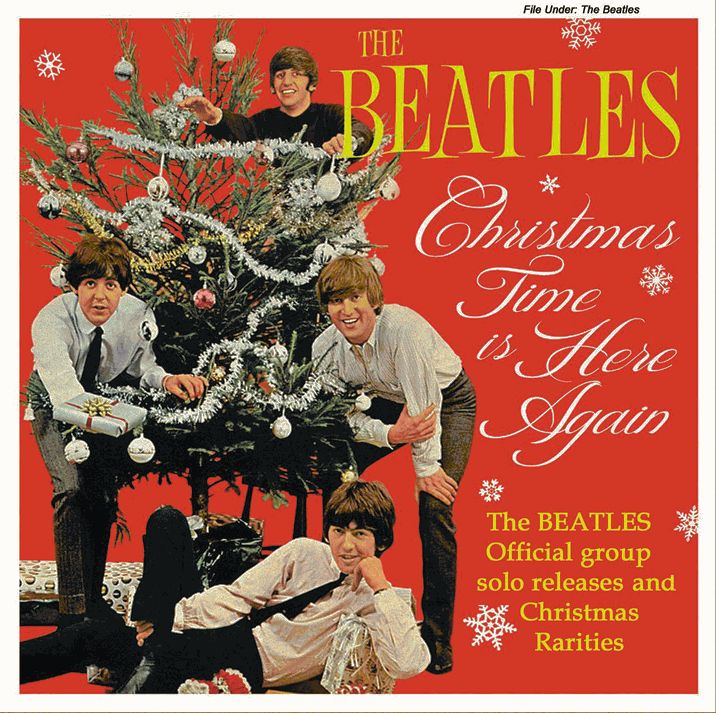
The Beatles recorded this in 1967 and wasn’t released until 1994 paired with “Free As A Bird”. It is a fun Christmas song that will stick in your head. The Beatles did not release a Christmas song commercially… only to their fan club when they were active.
Recorded December 6, 1966, and November 28, 1967, in London, England, this song was never officially released until it appeared as the B-side to “Free As A Bird” in 1994. The original version was distributed to The Beatles fan club in 1967. It’s the only song ever written specifically for the Beatles Fan Club members.
Many upbeat Pop groups of this era like The Beach Boys and The Four Seasons released Christmas songs, but The Beatles never had an official Christmas release.
Christmas Time Is Here Again
Christmas time is here again Christmas time is here again Christmas time is here again Christmas time is here again
Ain’t been round since you know when Christmas time is here again O-U-T spells “out”
Christmas time is here again Christmas time is here again Christmas time is here again Christmas time is here again
Ain’t been round since you know when Christmas time is here again O-U-T spells “out”
Christmas time is here again Christmas time is here again Christmas time is here again Christmas time is here again
Ain’t been round since you know when Christmas time…[music continues and fades to background]
[spoken]
This is Paul McCartney here, I’d just like to wish you everything you wish yourself for Christmas.
This is John Lennon saying on behalf of the Beatles, have a very Happy Christmas and a good New Year.
George Harrison speaking. I’d like to take this opportunity to wish you a very Merry Christmas, listeners everywhere.
This is Ringo Starr and I’d just like to say Merry Christmas and a really Happy New Year to all listeners
[a John Lennon pastiche at this point, very hard to understand]
A beautiful song that was written by Paul McCartney that was on the White Album. Paul wrote it in India with a little help from Donovan to shape the song. It took 67 takes to get this song. McCartney played acoustic guitar and vocalized the bass (you can hear him going “bom, bom” in parts). John Lennon and Ringo Starr both added percussion using various instruments… George Harrison didn’t play on it at all.
The song would have fit comfortably on earlier Beatle albums. The melody is memorable and I always really liked the short guitar break after the choruses.
Paul McCartney: “I was doing a song, ‘I Will,’ that I had as a melody for quite a long time but I didn’t have lyrics to it. I remember sitting around with Donovan, and maybe a couple of other people. We were just sitting around one evening after our day of meditation and I played him this one and he liked it and we were trying to write some words. We kicked around a few lyrics, something about the moon, but they weren’t very satisfactory and I thought the melody was better than the words so I didn’t use them. I kept searching for better words and I wrote my own set in the end; very simple words, straight love-song words really. I think they’re quite effective. It’s still one of my favorite melodies that I’ve written. You just occasionally get lucky with a melody and it becomes rather complete and I think this is one of them; quite a complete tune.”
I Will
Who knows how long I’ve loved you You know I love you still Will I wait a lonely lifetime If you want me to, I will
For if I ever saw you I didn’t catch your name But it never really mattered I will always feel the same
Love you forever and forever Love you with all my heart Love you whenever we’re together Love you when we’re apart
And when at last I find you Your song will fill the air Sing it loud so I can hear you Make it easy to be near you For the things you do endear you to me You know I will I will
My son walked into his first college Music Appreciation class in August. The Professor was waiting for everyone and played this piece by The Beatles. He turned around and asked the class…Is this considered music or not?
Bailey wasn’t the only one who knew this strange piece and in the end…the Professor said yes it was music…like art, music can come in different forms.
I went to youtube to see some of the comments…I’m going to list a few.
“This is what it feels like to have anxiety.” “I use this song to test my sanity” “Terrifying for sure, but it’s kind of beautiful in an abstract way” “I listened to She Loves You right before this. I can’t believe it’s the same band” “Still better than Justin Bieber”
And last but not least: “Listened to this blind drunk and by the end, I swear I saw John wearing Ringo’s skin as an overcoat”
I remember listening to this at 2 in the morning alone in the dark in around 1981…scared me to death. The memory has stayed with me to this day. I have grown to appreciate this sound collage. They were trying something new…and it is interesting.
John Lennon wrote this with contributions from Yoko and George Harrison. It’s a highly experimental piece, which Lennon once called “The music of the future.” It is the most controversial and bizarre track on the album.
John Lennon: “an unconscious picture of what I actually think will happen when it happens; that was just like a drawing of revolution.” “All the thing was made with loops, I had about thirty loops going, fed them onto one basic track. I was getting classical tapes, going upstairs and chopping them up, making it backward and things like that, to get the sound effects. One thing was an engineer’s testing tape and it would come on with a voice saying ‘This is EMI Test Series #9.’ I just cut up whatever he said and I’d number nine it. Nine turned out to be my birthday and my lucky number and everything. I didn’t realize it; it was just so funny the voice saying ‘Number nine’; it was like a joke, bringing number nine into it all the time, that’s all it was.”
From Songfacts
This was made by layering tape loops over the basic rhythm of “Revolution.” Lennon was trying to create an atmosphere of a revolution in progress. The tape loops came from EMI archives, and the “Number 9” voice heard over and over is an engineer testing equipment.
Paul McCartney and Beatles producer George Martin hated this and tried to keep it off the album.
This is the longest Beatles song – it runs 8:15. It also took longer to complete than any other track on album.
This helped fuel the “Paul is dead” rumors. If played backwards, you were supposed to hear the car crash where Paul died, and a voice saying “Turn me on, dead man.” Also, playing the line, “I’m not in the mood for wearing clothing” in reverse eventually becomes a rather odd but clear reversal, “There were two, there are none now.”
This is referencing the rumor that Paul McCartney died in a car with “Lovely Rita” and that the two were burned away after the wreck.
The rumor took off in October 1969 when a listener called the radio station WKNR in Detroit and told the DJ Russ Gibb about the backward message. When Gibb played it backwards on his show, listeners went wild and spent the next week calling in and offering their own rumors. The story quickly spread, and McCartney helped it along by laying low and letting it play out.
Lennon felt the number 9 was quite significant. He was happy that, after he changed his name to John Ono Lennon, his and Yoko’s names collectively contained 9 O’s. >>
According to the book The Beatles, Lennon And Me, by John Lennon’s childhood friend Pete Shotton, One evening, Lennon was with Shotton in the attic of his Kenwood home, tripping on LSD and smoking a few joints. They messed about with John’s Brunnel recorders, fiddling with feedback, running recordings backwards and creating tape loops. Opening the windows for some fresh air, John and Pete began to shout whatever was on their minds at the trees outside, the recorder running. This night’s lark was to later captured on “Revolution 9.” >>
Marilyn Manson released their own version of this on the B-side of the single for “Get Your Gunn.” It was called “Revelation 9” and ran 12:57. >>
This was parodied on an episode of The Simpsons. When the guys for a group called The B-Sharps, Barney meets a girl during recording. He exclaims at the studio that he’s making the music of all time. The song is Barney’s girl friend (with striking resemblance to Yoko Ono) saying “Number 8” and Barney burping. >>
Charles Manson thought that when they screamed the words “Right!” it was actually “Rise!” meaning the black community rising over the white people. Charles Manson was of course crazy, and thought The Beatles were warning about a race war.
Revolution 9
lyrics?… Oh, yea…Number 9, Number 9…then the madness starts.
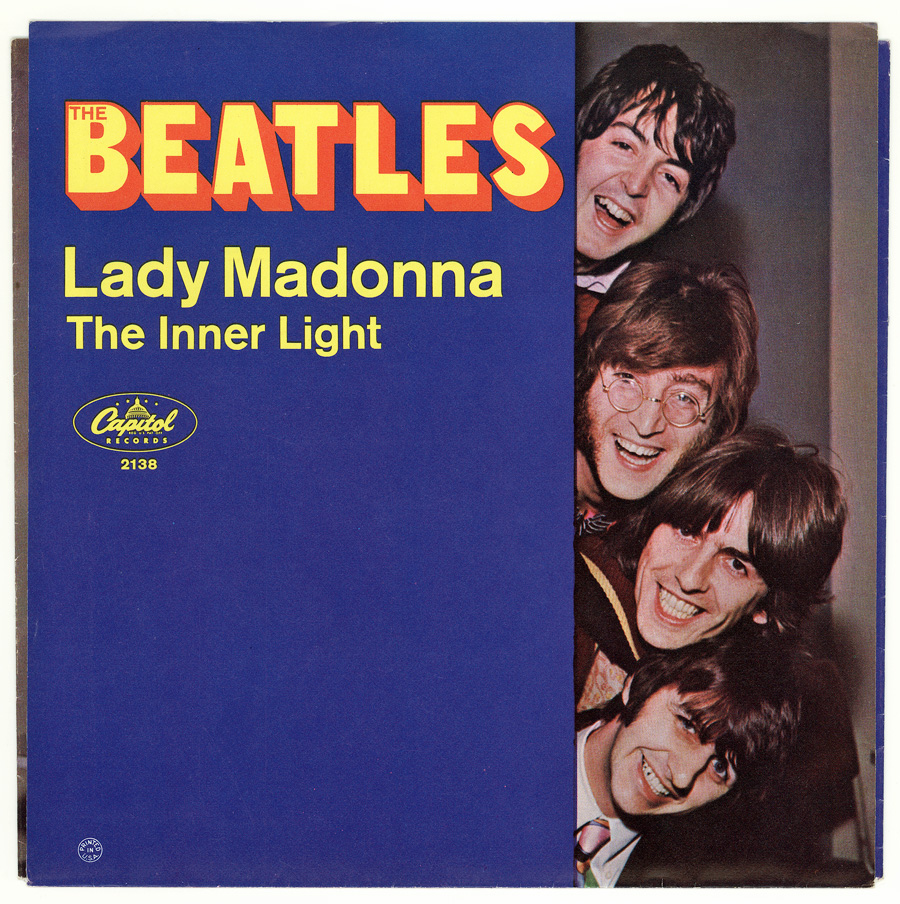
This song was the B side to Lady Madonna and a terrific song and melody. This is a George Harrison song and has gone largely unnoticed. It was George’s first song to appear on a single.
Harrison recorded the instrumental track for The Inner Light in India in January 1968, during the sessions for his Wonderwall Music soundtrack album. The only Beatles studio recording to be made outside Europe, the song introduced instruments such as sarod, shehnai, and pakhavaj.
George was reluctant to sing it because he was afraid he would not do it justice. Paul told him ‘You must have a go, don’t worry about it, it’s good.” McCartney and Lennon coaxed George into singing it. Two days later, McCartney and Lennon overdubbed backing vocals at the very end of the song, over the words “Do all without doing“.
George said about the song: : “Following John and I’s appearance on ‘The Frost Programme,’ the Sanskrit scholar Juan Mascaro, who was present in the audience, wrote a complimentary letter to me praising ‘Within You Without You.'” Juan’s letter stated: “It is a moving song. May it move the souls of millions.” George continues: “He also sent me a book called ‘Lamps Of Fire,’ suggesting that I wrote a song with the words of “Tao Te Ching.’ The words of ‘The Inner Light’ came from that book, page 66, 48a.”
“The Inner Light” finally appeared on an album called Rarities (released in the UK in 1978 and the US in 1980, and then the Past Masters CDs released in 1987.
Paul McCartney’s quote on the song… Forget the Indian music and listen to the melody. Don’t you think it’s a beautiful melody? It’s really lovely.
From Songfacts
George Harrison wrote this song. It was released as the B-side of “Lady Madonna” and was Harrison’s first song to appear on a single.
All the music was recorded by Indian session musicians at the EMI studios in Bombay, India, while George was working on the soundtrack to the movie Wonderwall.
George Harrison had originally recorded this for the Wonderwall soundtrack in January 1968. When The Beatles got together for recording sessions shortly before their trip to India, John and Paul added harmonies to the final line, “Do all without doing.”
The lyrics are a translation of a section of the Tao Te Ching. Juan Mascaro, a Sanskrit teacher at Cambridge University, sent the book to George.
This was Harrison’s last Indian-themed Beatles song.
The original release was in mono; a stereo version was mixed in 1970 and used on the Past Masters compilation. The mono mix features an extra Indian instrument in the intro that did not make it to the stereo version.
Jeff Lynne from Electric Light Orchestra performed this at George Harrison’s 2002 memorial show The Concert For George. Lynne was good friends with Harrison and played with him in The Traveling Wilburys.
The Inner Light
Without going out of my door
I can know all things of earth
Without looking out of my window
I could know the ways of heaven
The farther one travels
The less one knows
The less one really knows
Without going out of your door
You can know all things on earth
Without looking out of your window
You could know the ways of heaven
The farther one travels
The less one knows
The less one really knows
Arrive without traveling
See all without looking
Do all without doing








 PowerPop... An Eclectic Collection of Pop Culture