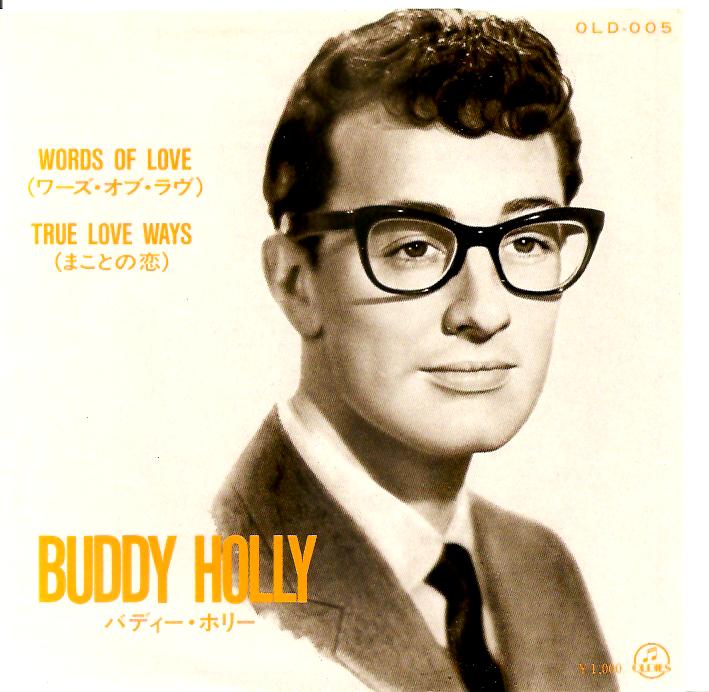
Buddy recorded and released this song in 1957. This was not one of Buddy’s biggest hits but a good song all the same. It was recorded on April 8th, 1957 and included a revolutionary gimmick for its time. He recorded his vocals twice and combined the results, thereby harmonizing with himself in the fashion of The Everly Brothers. This was one of the first released pop record to feature vocal overdubbing.
Canadian quartet The Diamonds as a successful follow-up to their #2 hit “Little Darlin’.” Their version of “Words Of Love” peaked at #13 in July of 1957.
I first heard this song by The Beatles. They had covered the song live between 1958-1962 and decided to record it for the Beatles for Sale album in 1964.
Paul McCartney about writing their own songs. “People these days take it for granted that you do, but nobody used to then. John and I started to write because of Buddy Holly. It was like, ‘Wow! He writes and is a musician.'” Paul McCartney purchased the publishing rights to Buddy Holly’s catalog in 1976.
John Lennon on Buddy Holly: “Buddy Holly was great and he wore glasses, which I liked,” “Buddy Holly was the first one that we were really aware of in England who could play and sing at the same time – not just strum, but actually play the licks.”
Words of Love
Hold me close and tell me how you feel Tell me love is real Words of love you whisper soft and true Darling I love you
Let me hear you say the words I long to hear Darling when you’re near Words of love you whisper soft and true Darling I love you
This song peaked at #51 on the Billboard 100 in 1986.
The two Davids were David Baerwald and David Ricketts. They broke up after their only studio album which really disappointed me because I was really looking forward to their next album. As I’ve said before there is hope…in 2016 it was reported that they are working on their second album…I have checked since then and have found nothing.
Ain’t So Easy
We can stay Or we can move along Either way don’t leave me all alone I’m sorry about your eye
I’ll find a way to make amends It’s only that sometimes I’ve got to break Before I bend
Come on, darling There’s a show downtown tonight Let’s go out dancing We can drink until the light
I know I’ve haven’t been everything A man should be But I promise I will change You just leave that up to me
And I’ll kiss your face, attend to your aches I swear that I can make you happy And you’ll rub my back, forget the past And baby, I know that that ain’t so easy
It ain’t too late To salvage all of this It ain’t too late we could Fix it with a kiss
All I want this one more chance So that we could have a home ‘Cause I would not stand a change If I had to make it on my own
Oh, let me kiss your face, attend to your aches I swear that I could make you happy And you’ll rub my back, forget the past And baby I know that that ain’t so easy
Maybe someday You will remember what I said to you today Maybe someday And where would you go anyway
Put that suitcase down Leave it for another day Stop this fooling around I could never let you get away
Let me kiss your face, attend to your aches I swear that I can make you happy And you’ll rub my back, forget the past And baby, I know that that ain’t so easy, please
The song was written by David Bowie and Brian Eno and was on the Heroes album released in 1977. The song peaked at #24 in the UK Charts, #35 in New Zealand, and #11 in Australia in 1978. The song recharted again in 2016. The album peaked at #35 in the Billboard Album Charts, #3 in the UK, #15 in New Zealand, #6 in Australia, and #44 in Canada.
After burn out because of touring Bowie moved to Berlin and rented a cheap apartment above an auto-repair shop, which is where he wrote this album.
Bowie made a video for this song which aired on the Bing Crosby Christmas special. In 1977 Crosby recorded a Christmas special in London called Merrie Olde Christmas, playing the England theme to the hilt. Bowie agreed to sing a duet with Crosby, which became the famous “The Little Drummer Boy/Peace On Earth” mashup. Bowie’s “Heroes” video also aired on the show with an introduction by Crosby. The show aired in November 1977, about a month after Crosby died.
Bowie talked about the song:
“It’s a bitch to sing, ‘cos I really have to give it some towards the end. I pace myself throughout the show and often place it near to a point where I can take a vocal break afterward. As long as I’m touring I don’t see a time when I won’t be singing ‘Heroes.’ It’s a good one to belt out and I get a kick out of it every time.”
From Songfacts
This song tells the story of a German couple who are so determined to be together that they meet every day under a gun turret on The Berlin Wall. Bowie, who was living in Berlin at the time, was inspired by an affair between his producer Tony Visconti and backup singer Antonia Maass, who would kiss “by the wall” in front of Bowie as he looked out of the Hansa Studio window. Bowie didn’t mention Visconti’s role in inspiring this song until 2003, when he told Performing Songwriter magazine: “I’m allowed to talk about it now. I wasn’t at the time. I always said it was a couple of lovers by the Berlin Wall that prompted the idea. Actually, it was Tony Visconti and his girlfriend. Tony was married at the time. And I could never say who it was (laughs). But I can now say that the lovers were Tony and a German girl that he’d met whilst we were in Berlin. I did ask his permission if I could say that. I think possibly the marriage was in the last few months, and it was very touching because I could see that Tony was very much in love with this girl, and it was that relationship which sort of motivated the song.”
Robert Fripp, formerly of King Crimson, played guitar on this track. His band, King Crimson, performed the song at the Admiralspalast in Berlin on September 11, 2016 in celebration of Bowie. This version was released on an EP called Heroes in 2017.
Brian Eno, formerly of Roxy Music, helped Bowie write and produce this. Eno moved to Berlin with Bowie and worked on his albums Low, Heroes, and Lodger. These albums were much more experimental and less commercial than Bowie’s previous work, but they still sold well in England.
Co-writer Eno said of this in the April 2007 Q Magazine: “It’s a beautiful song. But incredibly melancholy at the same time. We can be heroes, but actually, we know that something’s missing, something’s lost.”
Bowie released versions of this song in English, German, and French. The German version is called “Helden”; the French is “Héros.”
Featured in this song are not only Brian Eno’s synthesizer and Robert Fripp’s guitar, but also producer Tony Visconti banging on a metal ashtray that was lying around the studio.
This song is featured in the films Christiane F (1981) and The Parole Officer (2001). It also ended up as a Microsoft commercial theme.
Bowie played this at Live Aid from Wembley Stadium, England in 1985, and also at the Berlin Wall in 1987. Regarding the later performance, Bowie said in his Performing Songwriter interview: “I’ll never forget that. It was one of the most emotional performances I’ve ever done. I was in tears. They’d backed up the stage to the wall itself so that the wall was acting as our backdrop. We kind of heard that a few of the East Berliners might actually get the chance to hear the thing, but we didn’t realize in what numbers they would. And there were thousands on the other side that had come close to the wall. So it was like a double concert where the wall was the division. And we would hear them cheering and singing along from the other side. God, even now I get choked up. It was breaking my heart. I’d never done anything like that in my life, and I guess I never will again. When we did ‘Heroes’ it really felt anthemic, almost like a prayer. However well we do it these days, it’s almost like walking through it compared to that night, because it meant so much more. That’s the town where it was written, and that’s the particular situation that it was written about. It was just extraordinary. We did it in Berlin last year as well – ‘Heroes’ – and there’s no other city I can do that song in now that comes close to how it’s received. This time, what was so fantastic is that the audience – it was the Max Schmeling Hall, which holds about 10-15,000 – half the audience had been in East Berlin that time way before. So now I was face-to-face with the people I had been singing it to all those years ago. And we were all singing it together. Again, it was powerful. Things like that really give you a sense of what performance can do. They happen so rarely at that kind of magnitude. Most nights I find very enjoyable. These days, I really enjoy performing. But something like that doesn’t come along very often, and when it does, you kind of think, ‘Well, if I never do anything again, it won’t matter.'”
The Wallflowers covered this in 1998. Their version was used on the soundtrack to the movie Godzilla.
The single version, which appears on the ChangesBowie album, is shortened, leaving out a good chunk of the first verse.
Bowie first performed this on a television show hosted by his friend Marc Bolan, who was the lead singer for T-Rex. A week later, Bolan died when his girlfriend crashed their car into a tree.
Bowie played this at the “Concert For New York.” Organized by Paul McCartney, it was a tribute to the police, firemen, and rescue workers involved in the 2001 World Trade Center attacks.
Blondie recorded a live cover on January 12, 1980 at The Hammersmith Odeon. It can be found on the disc Blondie and Beyond.
This was originally an instrumental composition, whose title was a reference to the 1975 track “Hero” by the German Krautrock band Neu!.
The finalists from the seventh series of The X Factor released a cover version in November 2010 in aid of armed forces charity Help For Heroes, which topped both the UK and Irish Singles Charts. The choice of song follows a trend as in 2008, the fifth series of X Factor finalists reached #1 with a cover of Mariah Carey’s “Hero.” Despite a plethora of cover versions from other acts over the years, the X Factor 2010 Finalists are the first act aside from Bowie ever to have a hit single with the song.
What became the “official” video for the song was shot later in September 1977 and directed by Nick Ferguson, a painter who also did set design and directed various film and TV projects.
Janelle Monae recorded a cover for a 2014 Pepsi football-based advertising campaign “Now Is What You Make It.” Asked by The Guardian if she needed Bowie’s permission to use his song, the R&B songstress replied: “Oh, he’s a fan. He’s aware of me. His wife Iman is a huge supporter and she has told me countless times what a big fan he is. So he had to clear me doing the song and I’m so grateful.”
This song is central in the 2012 film The Perks of Being a Wallflower, starring Logan Lerman and Emma Watson. You hear it more than once throughout the movie.
Something of an underachiever when originally released, “Heroes” peaked at a lowly #24 back in 1977 in the UK and failed to make the Hot 100. In the week after David Bowie’s death, the song finally made the Top 20 in the country of his birth, leaping into the chart at #12.
Album Version
Single Version
Heroes
I, I wish you could swim Like the dolphins Like dolphins can swim
Though nothing, nothing will keep us together We can beat them, forever and ever Oh, we can be heroes just for one day
I, I will be King And you, you will be Queen Though nothing will drive them away We can be heroes just for one day We can be us just for one day
I, I can remember (I remember) Standing by the wall (By the wall) And the guns, shot above our heads (Over our heads) And we kissed, as though nothing could fall (Nothing could fall)
And the shame, was on the other side Oh, we can beat them, forever and ever Then we could be heroes just for one day
We can be heroes We can be heroes We can be heroes just for one day We can be heroes
I can hear Needles and Pins by The Searchers slightly in this song and that just makes it better. Gene Clark of the Byrds wrote this song and also sang it. The song was the B side to All I Really Want to Do and it was released in 1965 and as a B side managed to peak at #103 on the Billboard charts.
Tom Petty did a great cover of this song on his Full Moon Fever album released in 1989. Tom was heavily influenced by the Byrds.
Gene Clark talked about the song:
“There was a girlfriend I had known at the time, when we were playing at Ciro’s. It was a weird time in my life because everything was changing so fast and I knew we were becoming popular. This girl was a funny girl, she was kind of a strange little girl and she started bothering me a lot. And I just wrote the song, ‘I’m gonna feel a whole lot better when you’re gone,’ and that’s all it was, but I wrote the whole song within a few minutes.”
I’ll Feel a Whole Lot Better
The reason why oh, I can’t say I have to let you go, baby and right away
After what you did I can’t stay now
And I’ll probably feel a whole lot better when you’re gone
Baby for a long time (baby for a long time) you had me believe (you had me believe)
That your love was all mine (that your love was all mine) and that’s the way it would be
But I didn’t know (but I didn’t know) that you were putting me on
And I’ll probably feel a whole lot better when you’re gone, when you’re gone
Now I gotta say (I gotta say) that it’s not like before (that it’s not like before)
And I’m not gonna play your games any more (and I’m not gonna play)
After what you did (after what you did)I can’t stay on
And I’ll probably feel a whole lot better when you’re gone
Oh, when you’re gone, oh when you gone,oh when you gone
This song wasn’t as popular with the masses as it was with me. From the 90s on this is in my top Tom Petty songs. Something about it resonated with me and I also saw Tom on this tour. The song was written by Tom Petty and his Traveling Wilburys bandmate Jeff Lynne.
The song peaked at #28 in the Billboard 100, #46 in Canada and #28 in New Zealand in 1991. The song was on the album “Into the Great Wide Open” that peaked at #13 in the Billboard album charts.
Petty got the idea for it when he saw a pilot being interviewed on TV during the Gulf War. The pilot said how it wasn’t hard learning to fly… the hardest part was coming down.
On October 21, 2017, Bob Dylan played “Learning to Fly” at First Bank Center in tribute to Tom who had just passed away a few weeks before. Bob told Rolling Stone Magazine: “It’s shocking, crushing news. I thought the world of Tom. He was a great performer, full of the light, a friend, and I ll never forget him.”
From Songfacts
The song was informed by the political events of the time, specifically the Gulf War, as well as the band dynamics – Into The Great Wide Open was a Tom Petty & the Heartbreakers album, whereas Petty’s previous album, Full Moon Fever, was a solo album (although guitarist Mike Campbell played on every song and helped produce it). “I wanted that song to be a kind of redemptive song, only in the vaguest way, certainly not literally,” he told Billboard.
It is based on only four simple chords: F, C, A minor, and G.
Julien Temple, who also did Petty’s “Free Fallin’,” directed the video, which shows a young boy in various key moments of adolescence, as he gets his wings.
Pink Floyd beat Petty to the title, releasing their “Learning To Fly” in 1987. Their song was also sparked by aviation argot – lead singer Dave Gilmour was taking flying lessons. Pink Floyd was moving forward after shedding their founding member, Roger Waters, so the song is a metaphor for finding their wings without him.
The country trio Lady Antebellum covered this on their seven-song acoustic EP iTunes Session.
Learning To Fly
Well I started out down a dirty road Started out all alone And the sun went down as I crossed the hill And the town lit up, the world got still
I’m learning to fly, but I ain’t got wings Coming down is the hardest thing
Well, the good ol’ days may not return And the rocks might melt and the sea may burn
I’m learning to fly (learning to fly) but I ain’t got wings (learning to fly) Coming down (learning to fly) is the hardest thing (learning to fly)
Well, some say life will beat you down Break your heart, steal your crown So I’ve started out for God-knows-where I guess I’ll know when I get there
I’m learning to fly, around the clouds But what goes up (learning to fly) must come down
I’m learning to fly (learning to fly), but I ain’t got wings Coming down is the hardest thing
I’m learning to fly (learning to fly), around the clouds But what goes up (learning to fly) must come down
I’m learning to fly (learning to fly) (Learning to fly) learning to fly (learning to fly) (learning to fly) (learning to fly) (learning to fly)
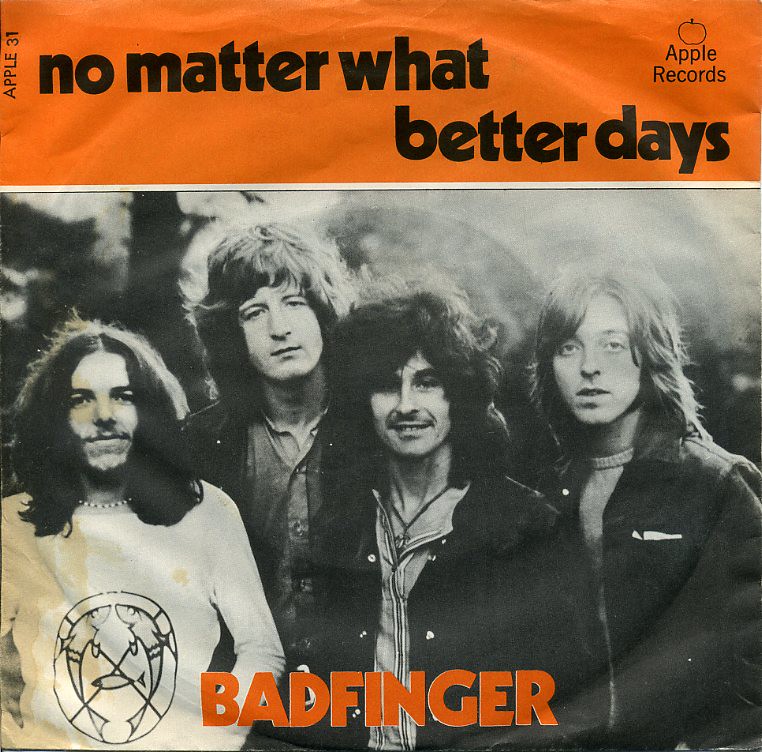
I like this band a little. This was Badfinger’s second big hit after Come and Get It. This one was written by Pete Ham. The song was released in 1970 just a few months after the Beatles had officially broken up. Some people thought that perhaps the Beatles had gotten together again and issued a new song after hearing this. It has a fantastic crunchy guitar opening the song up.
The producer of the song was Mal Evan…Beatles roadie and overall helper. The song peaked at #8 in the Billboard 100 and #5 in the UK in 1971. The song was on the album No Dice which peaked at #28 on the Billboard Album charts. Reviews of the album were mostly positive but they could not shake the Beatle comparisons. They tried to break it live by stretching songs out and playing long solos…becoming more of a jam band.
From Songfacts
Badfinger was signed to The Beatles label, Apple Records. Peter Ham used one of George Harrison’s Gibson guitars on this.
Many people thought this was The Beatles when they heard it. Badfinger was one of the first groups signed to The Beatles record label, Apple Records.
In 2001, The Gap wanted to use this in a commercial. Apple Records, which owns the rights to it, asked for an enormous sum of money and were turned down.
No Matter What
No matter what you are I will always be with you Doesn’t matter what you do girl, oh girl with you No matter what you do I will always be around
Won’t you tell me what you found girl, oh girl won’t you Knock down the old grey wall, and be a part of it all Nothing to say, nothing to see, nothing to do If you would give me all, as I would give it to you Nothing would be, nothing would be, nothing would be
No matter where you go There will always be a place Can’t you see in my face girl, oh girl don’t you
Knock down the old grey wall, and be a part of it all Nothing to say, nothing to see, nothing to do If you would give me all, as I would give it to you Nothing would be, nothing would be, nothing would be
No matter what you are I will always be with you Doesn’t matter what you do girl, oh girl want you Oh girl, you girl, want you Oh girl, you girl, want you
Emitt Rhoads is not a household name but he did have some very good powerpop songs and albums in his off and on career. The goal on every Friday is to shine some light on the less well-known songs and artists…at least one.
In 1969 Rhodes bought all of the equipment he needed when A&M Records refused to release his recordings and built a recording studio in his parents’ garage. Rhodes recorded his first album (Emitt Rhodes) in that studio. ABC/Dunhill Records signed him and they released his album as well as the next two albums he recorded
His first album was a critical success – Billboard called Rhodes “one of the finest artists on the music scene today” and later called his first album one of the “best albums of the decade“.
Fresh as a Daisy peaked at #54 in the Billboard 100 while his album Emitt Rhodes peaked at #29 in 1970.
Well, if you come from heaven You know that that’s ok. Just as long as you’re here to help me, It doesn’t matter how long you stay. Talkin’ ’bout you baby. Don’t you know you’re Fresh as a Daisy, as Fresh as a Daisy
Well tell me can you feel it, I’m feeling all right myself. I’m changing my old habits, And I found a new bit of health. Talkin’ ’bout you baby. Don’t you know you’re Fresh as a Daisy, as Fresh as a Daisy, As Fresh as a Daisy.
You do the things you do very well You make me feel the way I’ve never felt, You make me feel the way I’ve never felt.
Don’t know how I’ll feel tomorrow, Tomorrow’s another day. I like everything about you, What more is there to say.
Talkin’ ’bout you baby. Don’t you know you’re Fresh as a Daisy, as Fresh as a Daisy. Talkin’ ’bout you baby. Don’t you know you’re Fresh as a Daisy, as Fresh as a Daisy.
I remember this song as a teenager and have never grown tired of it. It’s a salute to the unheralded songwriters. This song means a lot me because I have talked to a few songwriters that this song was about. Back in the 1980s, Nashville wasn’t the clean tourist spot that it has turned into now. I saw many songwriters trying to hawk their songs to anyone that would listen. Many did live out of their car (and still do) or with anyone who would take them. Many gambled their lives to achieve their dreams. Some made it but most had to find their way back home.
A songwriter by the name of Thom Schuyler wrote the song the same year he moved to Nashville. He knew a lot of the songwriters that were around and the song rang true to many of them.
Lacy J. Dalton was born in Bloomsburg, Pennsylvania and had several country hits in the 1980s. She’s one of the most instantly recognizable voices in country…People Magazine called Lacy “Country’s Bonnie Raitt.” In 1979 when she was awarded the Academy of Country Music’s Top New Female Vocalist of the Year. 16th Avenue became the Anthem for Nashville songwriters and was voted one of Country’s Top 100 Songs ever by Billboard Magazine. Lacy also appeared on shows with the likes of Neil Young, The Grateful Dead, Grace Slick, and the Jefferson Airplane.
The song peaked at #7 in the U.S. Billboard Hot Country Singles & Tracks and #13 in the Canadian RPM Country Tracks in 1983.
When asked about her influences…these impressed me… Bob Dylan, Joan Baez, Kris Kristofferson, Guy Clark, Waylon Jennings, Willie Nelson, Dolly Parton, Janis Joplin, Robert Johnson, Karen Dalton, Fred Koller, Big Mama Thornton, Billie Holiday, Hank Williams, Tammy Wynette and J.J. Cale.
Thom talking about what lead up to the song:
I was hired as a carpenter to remodel an old house on 16th Avenue that was purchased to house a music publishing owned by Eddie Rabbitt, Even Stevens and Jim and David Malloy. I was also to construct a recording studio within the remains of an old garage behind the property. Several weeks into the job I had made an appointment over my lunch hour to visit another publisher to play some of my songs. My reel-to-reel tape was laying on the kitchen table next to my lunch and the secretary/office manager–a young woman named Keni Wehrman–took it upon herself to listen to it. Unbeknownst to me she was impressed to the point of sharing it with Even and Jim that same day. Later that afternoon, while putting some shingles on the studio, Jim came out and said, “Thom, when you finish up there come and see me in my office.” He offered me a deal that afternoon. I stayed there for 5 years and it was my most fruitful deal.
As a songwriter, Thom Schuyler composed tunes recorded by over 200 different artists.
16th Avenue
From the corners of the country From the cities and the farms With years and years of living Tucked up underneath their arms
They walk away from everything Just to see a dream come true So God bless the boys who make the noise On 16th Avenue
With a million dollar spirit And an old flattop guitar They drive to town with all they own In a hundred dollar car
‘Cause one time someone told them About a friend of a friend they knew Who owns, you know, a studio On 16th Avenue
Now some were born to money They’ve never had to say “Survive” And others swing a 9 pound hammer Just to stay alive
There’s cowboys drunks and Christians Mostly white and black and blue They’ve all dialed the phone collect to home From 16th Avenue
Ah, but then one night in some empty room Where no curtains ever hung Like a miracle some golden words Rolled off of someone’s tongue
And after years of being nothing They’re all looking right at you And for a while they’ll go in style On 16th Avenue
It looked so uneventful So quiet and discreet But a lot of lives where changed Down on that little one way street
‘Cause they walk away from everything Just to see a dream come true So God bless the boys who make the noise On 16th Avenue
David John Harman (Dave Dee), Trevor Leonard Ward-Davies (Dozy), John Dymond (Beaky), Michael Wilson (Mick) and Ian Frederick Stephen Amey (Tich), who were childhood friends from Wiltshire formed a group in 1961. They were originally called Dave Dee and the Bostons. A few years later they changed their names to Dave Dee, Dozy, Beaky, Mick and Tich.
They never made it big in America but they were huge in the UK. They had 13 UK Top forty hits, 8 UK Top 10’s, and 13 UK top 75, and 1 Number 1…the number 1 was LEGEND OF XANADU.
Hold Tight peaked at #4 in the UK Charts, #27 in the Australian Charts, and #8 in the New Zealand Charts in 1966.
I heard them a bit through the 80s and 90s but not much. Quentin Tarantino must have liked them because he featured this song in his movie Death Proof during the infamous crash scene.
Hold Tight
Hold tight, count to three Gotta stay close by me And hold tight, sing and shout Just ride my round-about And hold tight, shut your eyes, girl You suit me for size Forget the other guys You’ll never fall, each time you call Hold tight, hold tight, hold tight
Hold tight, make me feel What you say is for real And hold tight, Carousel Girl you’ll soon ring my bell And hold tight, we will fly swinging low, swinging high We’re gonna make the sky You’ll never fall, each time you call Hold tight, hold tight, hold tight
Hold tight, count to three Gotta stay close by me And hold tight, sing and shout Just ride my round-about And hold tight, shut your eyes, girl You suit me for size Forget the other guys You’ll never fall, each time you call Hold tight, hold tight, hold tight
This song was released in 1966 and it appears on The Who’s debut album My Generation. The song peaked at #41 in the UK but didn’t make it into the top 100 in the US. This song, along with My Generation, became anthems for The Who, as well as for the Mod movement in England.
Pete Townshend said this about it in 2000: When I wrote this song I was nothing but a kid, trying to work out right and wrong through all the things I did. I was kind of practicing with my life. I was kind of taking chances in a marriage with my wife. I took some stuff and I drank some booze. There was almost nothing that I didn’t try to use. And somehow I’m alright
I first heard this on Meaty Beaty Big and Bouncy a compilation album of the band’s singles… In the UK it was more of a greatest hits LP…in America, while a few were known…most never charted.
One of my favorite albums by the Who.
From Songfacts
The song was written by Pete Townshend as a tribute to the Mods, who were trendy and often rebellious British youth.
Check out Keith Moon’s drumming on this song – he used his cymbals and toms to emphasize the vocal lines, crashing down at the end of lyrical lines. This was one of his innovations with The Who.
A 1979 rockumentary concerning the Who shares the same title.
This song has been covered by both Goldfinger and Green Day.
The Offspring song The Kids Aren’t Alright is a reference to this
The Kids Are Alright
I don’t mind other guys dancing with my girl That’s fine, I know them all pretty well But I know sometimes I must get out in the light Better leave her behind with the kids, they’re alright The kids are alright
Sometimes, I feel I gotta get away Bells chime, I know I gotta get away And I know if I don’t, I’ll go out of my mind Better leave her behind with the kids, they’re alright The kids are alright
I know if I go, things would be a lot better for her I had things planned, but her folks wouldn’t let her
I don’t mind other guys dancing with my girl That’s fine, I know them all pretty well But I know sometimes I must get out in the light Better leave her behind with the kids, they’re alright The kids are alright
Sometimes, I feel I gotta get away Bells chime, I know I gotta get away And I know if I don’t, I’ll go out of my mind Better leave her behind with the kids, they’re alright The kids are alright, the kids are alright, the kids are alright
Jim…https://wordpress.com/read/feeds/64726988 asked me to contribute a song to a song lyric Sunday. This weekend I had some time so I told Jim I would be happy to contribute a song. The theme is Wedding/Marry/Diamond/Ring/Cake so I thought of this Elvis song.
The song peaked at #2 in the Billboard 100 in 1958. The song was written by Bert Carroll and Russell Moody and released April. 1, 1958. This was at the period where everything Elvis touched turned to gold. I remember going to my cousin’s home and listening to an Elvis compilation of his 50s songs in the mid-70s when I was around 8-9. This song and All Shook Up, Hound Dog, Don’t Be Cruel and many more.
Elvis recorded this song on February 1, 1958, at Radio Recorders, Hollywood, California. The musicians were Guitar: Scotty Moore, Tiny Timbrell, Elvis Presley. Bass: Bill Black. Drums: D.J. Fontana. Piano: Dudley Brooks. Vocals: The Jordanaires.
In this song, Presley wants his girlfriend to wear his ring around her neck. Of course, the ring would be on a chain…as was the custom in the 1950s to signify they are going steady. Hope you enjoyed the song and have a great Sunday.
Wear My Ring Around Your Neck
Won’t you wear my ring around your neck To tell the world I’m yours, by heck Let them see your love for me And let them see by the ring around your neck
Won’t you wear my ring around your neck To tell the world I’m yours, by heck Let them know I love you so And let them no by the ring around your neck
They say that goin’ steady is not the proper thing They say that we’re too young to know the meaning of a ring I only know that I love you and that you love me too So, darling, please do what I ask of you
Won’t you wear my ring around your neck To tell the world I’m yours, by heck Let them see your love for me And let them see by the ring around your neck
Let them know I love you so And let them know by the ring around your neck
When asked what my favorite Beatle song is…It usually depends on what Beatle mood I’m in…early, middle or late…but this one is always near the top.
The beginning of this song was based on two stories John Lennon read about in the Daily Mail newspaper. Guinness heir Tara Browne dying when he smashed his Lotus into a parked van, and an article in the UK Daily Express in early 1967 which told of how the Blackburn Roads Surveyor had counted 4000 holes in the roads of Blackburn and commented that the volume of material needed to fill them in was enough to fill the Albert Hall.
McCartney contributed the line “I’d love to turn you on.” This was a drug reference, but the BBC banned it because of another section, which they assumed was about marijuana…that guaranteed it would be huge.
George Martin once said he got chills listening to John’s voice in this song. I can relate to that.
A 41-piece orchestra played on this song. The musicians were told to attend the session dressed formally. When they got there, they were presented with party novelties (false noses, party hats, gorilla-paw glove) to wear, which made it clear this was not going to be a typical session. The orchestra was conducted by Paul McCartney, who told them to start with the lowest note of their instruments and gradually play to the highest. >>
This was recorded in three sessions: First the basic track, then the orchestra, then the last note was dubbed in.
Regarding the article about Tara Browne, John Lennon stated: “I didn’t copy the accident. Tara didn’t blow his mind out. But it was in my mind when I was writing that verse.” At the time, Paul didn’t realize the reference was to Tara. He thought it was about a “stoned politician.” The article regarding the “4000 holes in Blackburn, Lancashire” was taken from the UK Daily Express, January 17, 1967 in a column called “Far And Near.”
John’s friend Terry Doran was the one who completed John’s line, “Now they know how many holes it takes to fill…” Terry told him “fill the Albert Hall, John.”
The ban was finally lifted when author David Storey picked it as one of his Desert Island Discs.
Speaking with GQ in 2018, Paul McCartney explained this song’s origin story: “‘A Day In The Life’ was a song that John had started. He had the first verse, and this often happened: one of us would have a little bit of an idea and instead of sitting down and sweating it, we’d just bring it to the other one and kind of finish it together, because you could ping-pong – you’d get an idea. So he had the first verse: ‘I read the news today oh boy,’ and we sat in my music room in London and just started playing around with it, got a second verse, and then we got to what was going to lead into the middle. We kind of looked at each other and knew we were being a little bit edgy where we ‘I’d love to turn you on.’ We knew that would have an effect.
It worked. And then we put on another section I had: ‘Woke up, fell out of bed, dragged a comb across my head.’ Then we finished the song up and did a big sort of epic recording of it with a big full orchestra and everything. And then did that crescendo thing in the middle of it with the orchestra, which was an idea I’d had because I’d been talking to people and reading about avant-garde music, tonal stuff and crazy ideas. I came up with this idea. I said to the orchestra, ‘You should start, all of you.’ And they sat all looking at me puzzled. We’ve got a real symphony orchestra in London who are used to playing Beethoven, and here’s me, this crazy guy out of a group and I’m saying, ‘Everyone start on the lowest note your instrument can play and work your way up to the highest at your own pace.’ That was too puzzling for them, and orchestras don’t like that kind of thing. They like it written down and they like to know exactly what they’re supposed to do. So George Martin, the producer, said to the people, ‘You should leave this note and this point in the song, and then you should go to this note and this note,’ and he left the random thing, so that’s why it sounds like a chaotic sort of swirl. That was an idea based on the avant-garde stuff I was into at the time.”
The final chord was produced by all four Beatles and George Martin banging on three pianos simultaneously. As the sound diminished, the engineer boosted to faders. The resulting note lasts 42 seconds; the studio air conditioners can be heard toward the end as the faders were pushed to the limit to record it.
The rising orchestra-glissando and the thundering sound are reminiscent of “Entry of the Gods into Valhalla” from Richard Wagner’s opera “Das Rheingold,” where after the rising glissando, Thor beats with his hammer. George Martin said in his 1979 book All You Need is Ears that the glissando was Lennon’s idea. After Lennon’s death, Martin seems to have changed his mind. In his 1995 book Summer of Love: The Making of Sgt. Pepper, he states that the rising orchestra-glissando was McCartney’s idea. >>
This being the last song on the album, The Beatles found an interesting way to close it out. After the final note, Lennon had producer George Martin dub in a high pitched tone, which most humans can’t hear, but drives dogs crazy. This was followed by a loop of incomprehensible studio noise, along with Paul McCartney saying, “Never could see any other way,” all spliced together. It was put there so vinyl copies would play this continuously in the run-out groove, sounding like something went horribly wrong with the record. Another good reason to own vinyl.
In 2004, McCartney did an interview with the Daily Mirror newspaper where he said he was doing cocaine around this time along with marijuana. “I’d been introduced to it, and at first it seemed OK, like anything that’s new and stimulating,” he said. “When you start working your way through it, you start thinking, ‘This is not so cool and idea,’ especially when you start getting those terrible comedowns.”
The movie reference in the lyrics (“I saw a film today, oh boy. The English Army had just won the war”) is to a film John Lennon acted in called How I Won The War.
McCartney’s middle section (woke up, got out of bed…) was intended for another song.
The Beatles started this with the working title “In The Life of…”
This is a rare Beatles song with a title that is not part of the lyrics. Another one is “Yer Blues.”
That’s Mal Evans doing the counting during the first transition from John to Paul. He set the alarm clock (heard on the recording) to go off at the end of his 24-bar count. Evans also helped with the composition of a couple of songs on the Sgt. Pepper album. Although he never received composer’s credit, the Beatles did pay his estate a lump sum in the 1990s for his contributions. Evans died January 5, 1976 after a misunderstanding with the police.
George Martin (from Q Magazine, July 2007): “John’s voice – which he hated – was the kind of thing that would send shivers down your spine. If you hear those opening chords with the guitar and piano, and then his voice comes in, ‘I heard the news today, oh boy’ It’s just so evocative of that time. He always played his songs to me on the guitar and I would sit on a stool as he strummed. The orchestral section was Paul’s idea. We put two pieces of songs together that weren’t connected in any way. Then we had that 24-bars-of-nothing in between. I had to write a score, but in the climax, I gave each instrument different little waypoints at each bar, so they would know roughly where they should be when they were sliding up. Just so they didn’t reach the climax too quickly. With ‘A Day In The Life,’ I wondered whether we were losing our audience and I was scared. But I stopped being scared when I played it to the head of Capitol Records in America and he was gob smacked. He said, That’s fantastic. And of course, it was.”
In the original take, the 41-piece orchestra was not used. Instead, Lennon had roadie Mal Evans count to 21 in a very trippy manner and set off an alarm clock after the 21 counts. This version is on the second Anthology CD, and is very different than the one on Sgt. Pepper.
David Crosby was at Abbey Road studios when The Beatles were recording this. In an interview with Filter magazine, he said: “I was, as near as I know, the first human being besides them and George Martin and the engineers to hear ‘A Day In The Life.’ I was high as a kite – so high I was hunting geese with a rake. They sat me down; they had huge speakers like coffins with wheels on that they rolled up on either side of the stool. By the time it got the end of that piano chord, man my brains were on the floor.”
The orchestral bit was used in the Yellow Submarine movie. Photos of different geographical areas were shown as The Beatles were apparently traveling in the submarine to try and find Pepperland.
When asked by Rolling Stone magazine what songs of his dad’s constantly surprise him, Sean Lennon said: “I’ve listened so much to that stuff that there are very few surprises. But I do think ‘A Day In The Life’ is always inspiring.”
The American rock band Hawthorne Heights originally named themselves A Day in the Life after this song. In 2003, lead vocalist/rhythm guitarist JT Woodruff changed it to their current name.
On June 18, 2010 John Lennon’s handwritten lyric sheet for this song featuring corrections and alternate crossed-out lines was auctioned at New York Sotheby’s. It was sold for $1.2 million to an anonymous American buyer.
This was rated the greatest ever Beatles song in a special collector’s edition issue by The Beatles: 100 Greatest Songs. The list was compiled to coincide with the 40th anniversary of the Fab Four’s final studio album, Let It Be.
There is term for the techniques The Beatles used in arranging the final chords of this song: Deceptive Cadence. Glen Burtnik, who was a member of Styx and was also in a popular Beatles tribute band, told us: “It’s an instance where the listener assumes the next chord, or melody note, will go somewhere it doesn’t. Even though all the indications lead you to expecting a certain outcome, the writer/arranger intentionally surprises you by going someplace else musically. Not sure it’s simple to understand, as you’re conditioned to being used to the outcome.”
Peter Asher, who worked for The Beatles at Apple Records and produced the biggest hits of James Taylor and Linda Ronstadt, considers this the greatest Beatles song from a production standpoint. “‘A Day In The Life’ certainly combined Beatle ideas and George Martin ideas very effectively,” he told Songfacts.
Keith Richards named his second son Tara after Tara Brown, the Guinness heir who smashes his car in Lennon’s first verse. Richard’s son was premature and died soon after birth.
A Day In The Life
I read the news today oh boy About a lucky man who made the grade And though the news was rather sad Well I just had to laugh
I saw the photograph He blew his mind out in a car He didn’t notice that the lights had changed A crowd of people stood and stared They’d seen his face before Nobody was really sure If he was from the House of Lords
I saw a film today oh boy The English army had just won the war A crowd of people turned away But I just had to look Having read the book I’d love to turn you on
Woke up, fell out of bed Dragged a comb across my head Found my way downstairs and drank a cup And looking up I noticed I was late Found my coat and grabbed my hat Made the bus in seconds flat Found my way upstairs and had a smoke Somebody spoke and I went into a dream
I read the news today oh boy Four thousand holes in Blackburn, Lancashire And though the holes were rather small They had to count them all Now they know how many holes it takes to fill the Albert Hall I’d love to turn you on
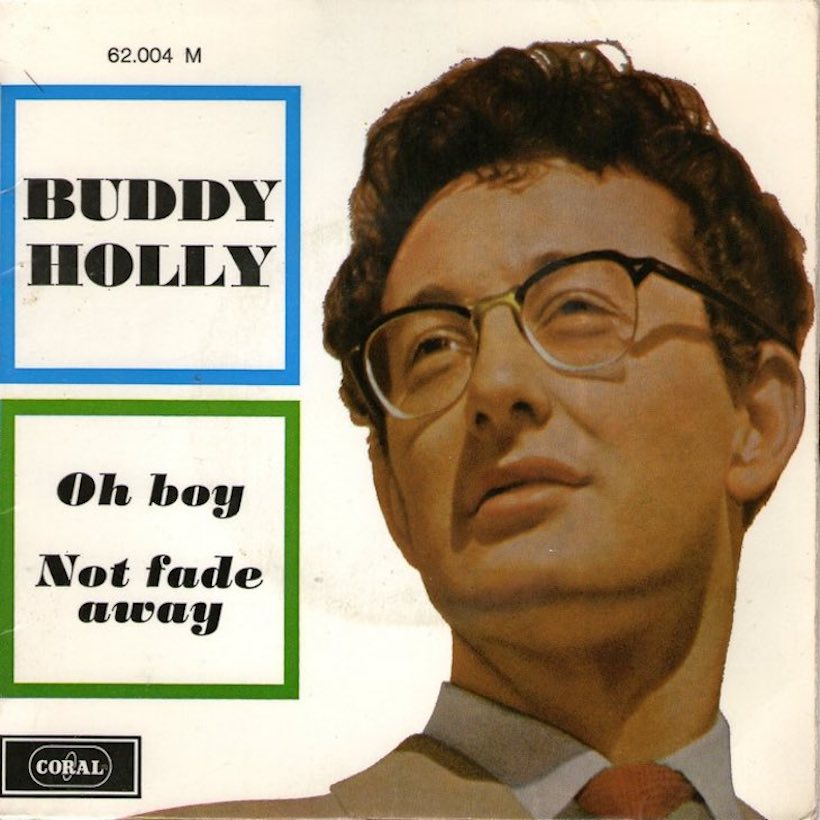
This was recorded June 29-July 1, 1957 at Petty Studios in Clovis, New Mexico. Oh Boy was written by Sunny West, Bill Tilghman, and Norman Petty. Norman was Holly’s producer and owned the studio where this was recorded.
This song played live is very powerful along with Buddy’s other songs. In the 90s I saw a musical play called Buddy that was touring the country. In the musical, there was just “Buddy”, a bass player and a drummer and the songs exploded off the stage. Buddy arranged these songs to sound so big with just a few instruments.
This rocker is a simple song but there is so much going on in the background. From the Crickets backups to the pounding drums of Jerry Allison. Buddy’s Strat comes through clear as he plays against the drums.
The song peaked at #19 in the US Hot 100 and #3 in the UK. This song was paired with the “b” side Not Fade Away…which later became very popular when the Rolling Stones covered it in 1964.
From Songfacts
Background vocals were added later by The Picks (Bill & John Pickering, Bob Lapham).
This was released as a single with “Not Fade Away” as the B-side. While this song did fade away, the B-side has become one of Holly’s well-known songs. It got a boost when it was covered by The Rolling Stones in 1964.
This was credited to The Crickets, who were Holly’s band.
Holly and The Crickets performed this on their second and final Ed Sullivan Show appearance on January 26, 1958. Sullivan was not happy with the song selection, as he considered it too raunchy, but Holly insisted on performing it. Possibly in retaliation, Sullivan introduced him as “Buddy Hollet,” and Holly can be seen trying to turn up his guitar, which had been set too low. While most musical guests were given 2 songs, Holly got just the one.
Buick spun this into the jingle “Oh, Buick!” for a 1987 commercial.
Oh Boy
All of my love All of my kissin’ You don’t know what you’ve been a-missin’ Oh boy, when you’re with me Oh boy, the world can see That you, were meant, for me
All of my life I’ve been a-waitin’ Tonight there’ll be no, hesitatin’ Oh boy, when you’re with me Oh boy, the world can see That you, were meant, for me
Stars appear and shadows a-falling You can hear my heart a-calling A little bit a-lovin’ makes everything right And I’m gonna see my baby tonight
All of my love All of my kissin’ You don’t know what you’ve been a-missin’ Oh boy, when you’re with me Oh boy, the world can see That you, were meant, for me
All of my love All of my kissin’ You don’t know what you’ve been a-missin’ Oh boy, when you’re with me Oh boy, the world can see That you, were meant, for me
All of my life I’ve been a-waitin’ Tonight there’ll be no, hesitatin’ Oh boy, when you’re with me Oh boy, the world can see That you, were meant, for me
Stars appear and shadows a-falling You can hear my heart a-calling A little bit a-lovin’ makes everything right I’m gonna see my baby tonight
All of my love All of my kissin’ You don’t know what you’ve been a-missin’ Oh boy, when you’re with me Oh boy, the world can see That you, were meant, for me
Most people today know this song as the theme to That 70s Show. They never used Big Star’s version for some reason. Todd Griffin covered it the first season and by the second season, Cheap Trick’s version was used. Big Star’s drummer Jody Stephens said, “I don’t know if the general population even knows that Big Star had anything to do with it.” …that is unfortunately true. The general population doesn’t know Big Star which is a crime.
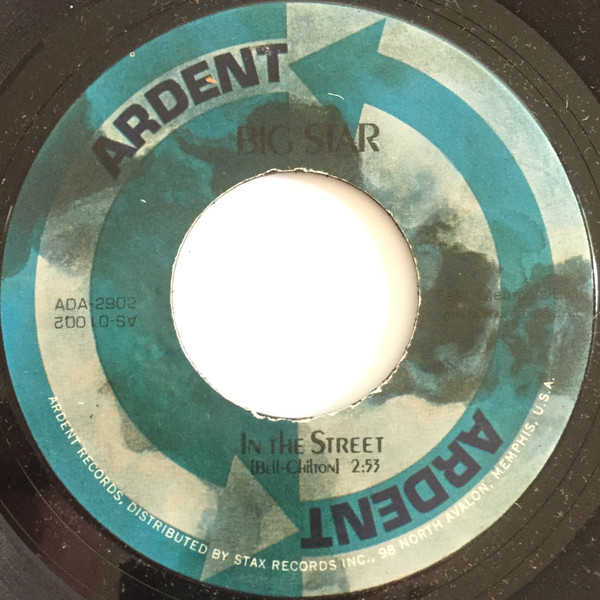
The song was on their great debut album named #1 Record which was released in August of 1972. Billboard went as far as to say, “Every cut could be a single”…On the picture above it says “Distributed by Stax Records”…unfortunately it WASN’T… They did a tour and no one could find the album because many record stores didn’t have it. Stax was not equipped to distribute rock records.
By the second album, this was going to be resolved. Columbia was gonna distribute Stax, and then they would have got Big Star into big-box retail outlets. But what happened was Clive Davis, who’s huge in the music world, was the one who brokered that deal… and then he was fired. So the whole thing fell apart after that. America lost out on one of the best bands it ever produced. I would recommend to anyone the documentary on Big Star called…Big Star: Nothing Can Hurt Me
The song has a great riff and wonderful teenage seventies lyrics.
From Songfacts
Stephens played in a band called Golden Smog with Jeff Tweedy, and when Tweedy’s band Wilco came to Memphis, Jody sat in with the group. “We played ‘In The Street’ together – I sat in on drums and Glenn Kotche played the cowbell part and John Stirratt sang lead,” he recounts. “My wife was in the audience and she said when we started playing ‘In The Street,’ somebody sitting in back of her said, ‘Why are they playing That ’70s Show song?'”
In what he described as “ironic” in a 2000 Rolling Stone interview, Alex Chilton received $70 in royalty payments every time That ’70s Show was broadcast.
Cheap Trick’s cover features the lyrics “We’re all all right,” an allusion to their 1978 hit “Surrender” from the album Heaven Tonight. Perhaps a chirpy re-interpretation to suit a primetime network sitcom, the inclusion undermines the ambiguity of the original, which evokes adolescent boredom without either romanticizing or condemning it.
This ambiguity is perfectly encapsulated in the lyric, “wish we had a joint so bad” (also absent from the theme tune, although pot smoking was a recurring theme on the show), the double meaning of which can be read as meaning the protagonist’s craving to get high or for a place to go with his friends. There is certainly a theme of being disposed that runs throughout the deceptively simple lyrics, which is juxtaposed with the major key Power-Pop music.
Chilton has said that along with “When My Baby’s Beside Me,” “In The Street” is the best song he ever wrote
In The Street
Hanging out, down the street The same old thing we did last week Not a thing to do But talk to you
Steal your car, and bring it down Pick me up, we’ll drive around Wish we had A joint so bad
Pass the street light Out past midnight
Hanging out, down the street The same old thing we did last week Not a thing to do But talk to you
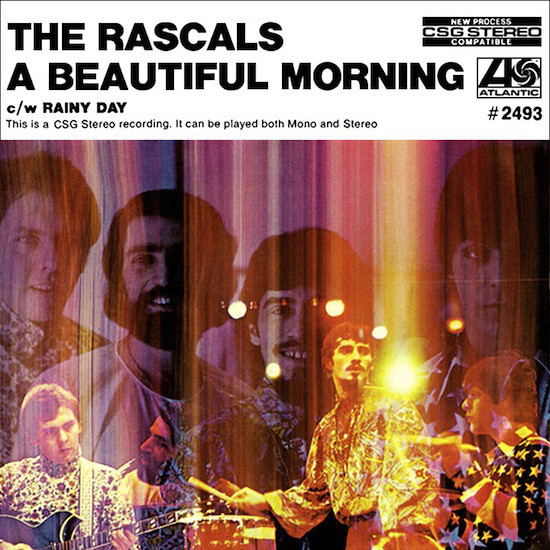
This was the first of the group’s singles to be credited to “The Rascals,” the original name of the group, rather than “The Young Rascals” which their producer had them take in order to avoid confusion from listeners with another group “The Harmonica Rascals.”
This song peaked at #3 in the Billboard 100 in 1968. Beautiful Morning was written by Felix Cavaliere and Eddie Brigati. The Rascals don’t get talked about as much as some of their peers… which is a shame…they were a great singles band. The band had 18 songs in the Billboard 100, 3 number 1 hits and 6 top ten hits. The Rascals were inducted into the Rock and Roll Hall of Fame on May 6, 1997.
From Songfacts
Written by band members Felix Cavaliere and Eddie Brigati, this is an upbeat, optimistic song similar in theme to their 1967 hit “Groovin’.” While the late ’60s were a tumultuous time in America and a lot of the music dealt with social and political issues of the time, The Rascals provided hopeful songs that were a welcome relief for many listeners.
Beautiful Morning
It’s a beautiful mornin’, ah I think I’ll go outside a while And just smile Just take in some clean fresh air, boy! Ain’t no sense in stayin’ inside If the weather’s fine, and you got the time It’s your chance to wake up and plan another brand new day Either way It’s a beautiful mornin’, ah Each bird keeps singin’ his own song So long! I’ve got to be on my way now Ain’t no fun just hangin’ around I’ve got to cover ground; you couldn’t keep me down It just ain’t no good if the sun shines When you’re still inside Shouldn’t hide, still inside, shouldn’t hide Ah, oh! (Shouldn’t hide) Ah, ah, oh
(Doo, doo-wa) (Doo, doo-wa)
There will be children with robins and flowers Sunshine caresses each new waking hour Seems to me that the people keep seeing More and more each day; gotta say, lead the way It’s okay, Wednesday, Thursday, it’s okay (Ah) Monday, Wednesday, Friday, weekday, ah, ah, oh






 PowerPop... An Eclectic Collection of Pop Culture