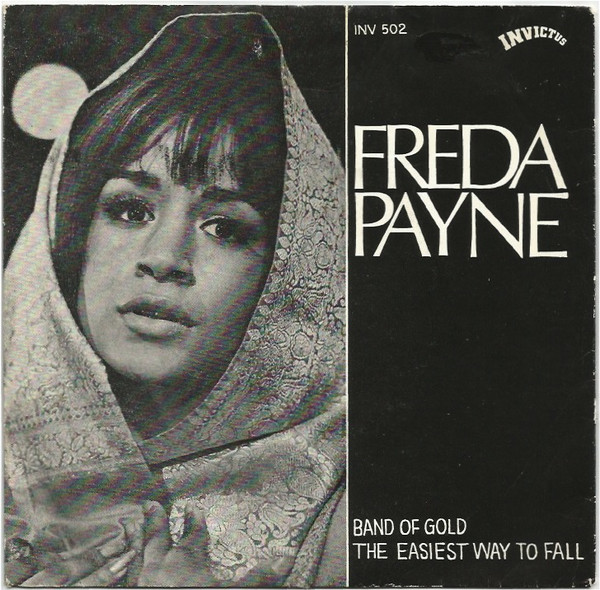
Freda Payne – Band of Gold

I’ve always liked this song. It’s a bit of a soap opera but it’s a really good soul song. The song peaked at #3 in the Billboard 100 in 1970. The guitar had a rubberband type effect that was used on this song.

Because of the subject matter, Freda Payne did not want to record this at first. She thought the song was about a woman who was a virgin or sexually naïve and felt it was more suitable for a teenager. When Payne objected to this song, Ron Dunbar (co-writer of the song) said to her, “Don’t worry. You don’t have to like them! Just sing it,” and she did. Little did she know that this song would become her biggest hit and would give her her first record of gold.

The lead guitarist on this track was Ray Parker Jr., who later found success with the theme song for the comedy movie Ghostbusters.


From Songfacts.

There is some mystery to this song. Some people think it is about an impotent man, while others think it is about a frigid woman. In a Songfacts interview with Lamont Dozier, who co-wrote the song, he explained: “The story was, the girl found out this guy was not all there. He had his own feelings about giving his all. He wanted to love this girl, he married the girl, but he couldn’t perform on his wedding night because he had other issues about his sexuality. I’ll put it that way.

It was about this guy that was basically gay, and he couldn’t perform. He loved her, but he couldn’t do what he was supposed to do as a groom, as her new husband.”

This was released on Invictus Records, which Brian Holland, Lamont Dozier and Eddie Holland formed after they left Motown in 1968. Holland-Dozier-Holland produced the track and wrote it with their collaborator Ron Dunbar, but because of their dispute with Motown, the H-D-H trio couldn’t put their names on the label and credited themselves as “Edythe Wayne.” Members of the Motown house band The Funk Brothers played on the track.

Freda Payne is the older sister of Scherrie Payne, the final lead singer of The Supremes. Holland-Dozier-Holland wrote many of The Supremes’ hits.

According to 1000 UK #1 Hits by Jon Kutner and Spencer Leigh, Freda Payne said of this song: “It is about a wedding night that didn’t work out. I wondered why a girl would have a problem on her wedding night and why they would be in separate rooms, but they said, ‘Just learn it.’ I had no idea that it would be such a big hit.”

Band of Gold

Now that you’re gone,
All that’s left is a band of gold
All that’s left of the dreams I hold
Is a band of gold
And the memories of what love could be
If you were still here with me

You took me from the shelter of my mother
I had never known or loved any other
We kissed after taking vows
But that night on our honeymoon,
We stayed in separate rooms

I wait in the darkness of my lonely room
Filled with sadness, filled with gloom
Hoping soon
That you’ll walk back through that door
And love me like you tried before

Since you’ve been gone,
All that’s left is a band of gold
All that’s left of the dreams I hold
Is a band of gold
And the dream of what love could be
If you were still here with me
Ohhh

Don’t you know that I wait
In the darkness of my lonely room
Filled with sadness, filled with gloom
Hoping soon
That you’ll walk back through that door
And love me like you tried before

Since you’ve been gone,
All that’s left is a band of gold
All that’s left of the dreams I hold
Is a band of gold
And the dream of what love could be
If you were still here with me
Since you’ve been gone,
All that’s left is a band of gold
All that’s left of the dreams I hold
Is a band of gold
And the dream of what love could be
If you were still here with me

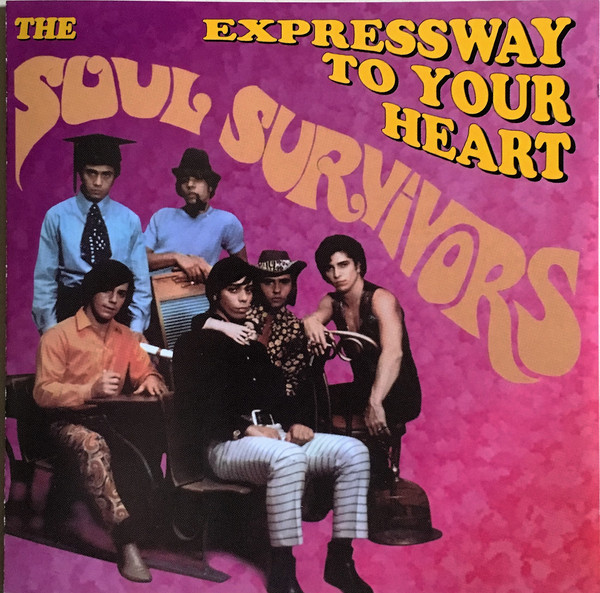
Soul Survivors – Expressway To Your Heart

When I was 18 I would listen to 96.3 in Nashville that would only play oldies. This one I heard quite a bit but never knew who performed this song…until now. It’s a nice 60s soul song that you don’t hear every day.

The song was written by Kenny Gamble and Leon Huff. The song peaked at #4 in the Billboard 100 in 1967. It was on the Soul Survivors album When the Whistle Blows Anything Goes.

From Songfacts.

This was the first hit record written and produced by Kenny Gamble and Leon Huff, who helped create the Philadelphia Soul sound with songs like “If You Don’t Know Me By Now” and “TSOP (The Sound of Philadelphia),” which were released on their Philadelphia International label. Gamble and Huff are from Camden, New Jersey, which is just east of Philadelphia, and often took the Schuylkill Expressway, which is the “Expressway To Your Heart.” Gamble wrote the lyrics, and he explained to National Public Radio: “I was on my way over to see a young lady, and the expressway was backed up. This is when they just started the expressway in 1967 – I was sitting there for what seemed like hours, so I started beating on the dashboard and singing, ‘Expressway to your heart, trying to get to you.’ Songs come from your imagination. You have to be quick to capture the moment.”

This song starts with the sound of car horns, which came from records containing sound effects. The horns were inspired by the Lovin’ Spoonful song “Summer In The City,” which also used the effect.

Gamble and Huff reused the lyrics “Shower you with love and affection, now you won’t look in my direction” on the song I’m Gonna Make You Love Me, which contains the line, “I’m gonna shower you with love and affection, look out, it’s comin’ in your direction.”

The Soul Survivors were a white group from New York City. They had one more Top 40 hit: “Explosion (In My Soul).”


Expressway To Your Heart

I’ve been tryin’ to get to you for a long time
Because constantly you been on my mind
I was thinkin’ ’bout a shortcut I could take
But it seems like I made a mistake

I was wrong, mmm, I took too long
I got caught in the rush hour
A fellow started to shower
You with love and affection
Now you won’t look in my direction

On the expressway to your heart
The expressway is not the best way
At five o’clock it’s much too crowded
Much too crowded, so crowded
No room for me (too crowded)
Oh, too crowded

Now there’s too many ahead of me
They’re all the time gettin’ in front of me
I thought I could find a clear road ahead
But I found stoplights instead

I was wrong, baby, I took too long
I got caught in the rush hour
A fellow started to shower
You with love and affection
Come on, look in my direction

On the expressway to your heart
The expressway is not the best way
At five o’clock it’s much too crowded
Much too crowded, so crowded
No room for me (too crowded)
Oh, too crowded

Oh, much too crowded
Oh, so crowded

Jimi Hendrix – The Wind Cries Mary

This is the softer side of Jimi. I had the American version of Are You Experienced and came across this song and it has always stuck with me. It was written about his girlfriend Kathy Mary Etchingham.

The song peaked at #6 in the UK charts and was the B side to Purple Haze in America. Bob Dylan was one of Hendrix’s biggest influences and it shows…this song has some great imagery.

From Songfacts.

Jimi wrote this in 1967 for Are You Experienced?; it was inspired by his girlfriend at the time, Kathy Mary Etchingham. He’d gotten into an argument with her about her cooking. She got very angry and started throwing pots and pans and finally stormed out to stay at a friend’s home for a day or so. When she came back, Jimi had written “The Wind Cries Mary” for her.

Kathy Mary recalled, “We’d had a row over food. Jimi didn’t like lumpy mashed potato. There were thrown plates and I ran off. When I came back the next day, he’d written that song about me. It’s incredibly flattering.” (Source Q magazine February 2013)

Jimi wrote the song quietly in his apartment and didn’t show it to anybody. After recording “Fire” (which was about his sexual relationship with Kathy), he had 20 minutes to spare in the recording studio, so he showed it to the band. They managed to record it in the 20 minute period they had. The band later recorded several more takes of the song, but they all seemed very sterile and they decided to go with the original recording.

This was the third single from Are You Experienced?. 

A lot of people assumed this was about marijuana, which is also known as “Mary Jane.”

This song begins with a distinctive and recognizable introduction, in which three chromatically ascending ‘five’ chords are played in second inversion. A ‘five’ chord consists of two notes (first or “root,” and fifth) instead of three (root, third and fifth). The missing middle note gives the chord a more ‘open’ or ‘bare’ sound. A second inversion “flips” the notes in the chord, so that the fifth, not the root, is the lowest sounding note. This makes it more difficult for the listener to immediately identify what key the song is being played in. In addition, a syncopated rhythm makes it difficult for the listener to identify the “downbeats” of the song. This combination of musical elements creates a unique and disorienting experience when the song is heard for the first time.

Jamie Cullum covered this song, replacing the guitar part with a jazzy piano. Other artists to record the song include John Mayer, Popa Chubby and Robyn Hitchcock.>>

According to the book Jimi Hendrix: Electric Gypsy, Hendrix wrote this as a very long song, but broke it down to fit the short-song convention and make it radio friendly. Hendrix was concerned that listeners wouldn’t understand the song in its shortened form.

The Wind Cries Mary

After all the jacks are in their boxes
And the clowns have all gone to bed
You can hear happiness staggering on down the street
Footprints dressed in red
And the wind whispers “Mary”

A broom is drearily sweeping
Up the broken pieces of yesterdays life
Somewhere a queen is weeping
And somewhere a king has no wife
And the wind cries “Mary”

The traffic lights they turn blue tomorrow
And shine the emptiness down on my bed
The tiny island sags downstream
Cause the life that lived is dead
And the wind screams “Mary”

Will the wind ever remember
The names it has blown in the past
And with its crutch, its old age, and its wisdom
It whispers no this will be the last
And the wind cries “Mary”

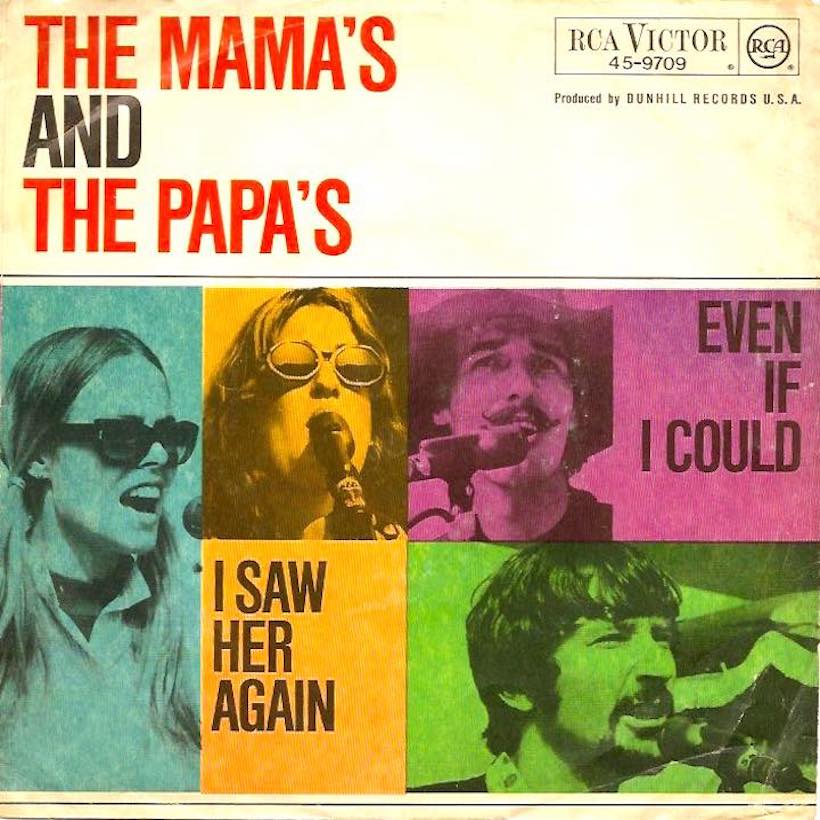
The Mamas & The Papas – I Saw Her Again

I never was a huge fan of The Mamas and Papas but I did like some of their songs like this one. This song was written by  John Phillips, the leader of the Mamas And The Papas, about the affair between his wife, Michelle Phillips (a Mamas And Papas member), and Denny Doherty (a Mamas And Papas member).

After that Michelle had an affair with Gene Clark of the Byrds which ultimately led to Michelle Phillips’  dismissal from the band temporarily.

Ironically enough, Doherty received a songwriting credit. The sessions for this album must have been as uncomfortable.

I found this researching the song. The two women of the group were Michelle Phillips and Cass Elliott were opposite…one had model looks and insecure and Cass Elliott was heavy and outgoing making friends with everyone. This is a quote from Michelle Phillips…the lone survivor of the band.

“People assume that there must have been tension between us, but the truth is I wanted to be just like Cass,” says Phillips. “Cass liberated me; she stopped John trying to have too much control over me. She taught me a lot about feminism, and she always encouraged me, although I was obviously inferior to her as a singer.”

Elliot died of a heart attack in 1974, aged 32. Phillips died of heart failure in 2001, and Doherty died of an abdominal aneurysm in 2007.

This song peaked at #5 in the Billboard 100 in 1966 and #11 in the UK. This was their second album called The Mamas and Papas.

Jill Gibson took Michelle’s place in the band for a few weeks when this album was being recorded and then Michelle was asked back to finish out the album. Some songs have both of their voices on them.

From Songfacts.

Lou Adler produced this song, and Bones Howe was the engineer for the session. According to Bones, the part around the 2:45 mark where “I saw her” is repeated twice was a happy accident. Said Bones: “We were punching vocals in, and when we came to that part where the rhythm stops and the group goes, ‘I saw her again last night,’ I just punched in early. They came in early, and so we stopped. And then we went back and started again, and I punched in at the beginning of the vocal, they started two bars later or whatever it was. And when I played it back, the vocal went, ‘I saw her – I saw her again.’ It was a mistaken punch. And Lou said, ‘I love it! Leave it in.’ It was an error, it was a mistake. But Lou was wise enough, it caught his ear and he left it. And I learned something from that. You go with your gut. If something catches – they could be – there are wonderful mistakes that happen in the studio and you have to learn to catch those when they happen and use them.”

I Saw Her Again

I saw her again last night
And you know that I shouldn’t
To string her along’s just not right
If I couldn’t I wouldn’t

But what can I do, I’m lonely too
And it makes me feel so good to know
You’ll never leave me
I’m in way over my head

Now she thinks that I love her
Because that’s what I said
Though I never think of her
But what can I do, I’m lonely too

And it makes me feel so good to know
You’ll never leave me
Every time I see that girl
You know I want to lay down and die

But I really need that girl
Don’t know why I’m livin’ a lie
It makes me want to cry
I saw her again last night

And you know that I shouldn’t
To string her along’s just not right
If I couldn’t I wouldn’t
But what can I do, I’m lonely too

And it makes me feel so good to know
You’ll never leave me

But what can I do, I’m lonely too
And it makes me feel so good to know
You’ll never leave me
Every time I see that girl

You know I want to lay down and die
But I really need that girl
Don’t know why I’m livin’ a lie
It makes me want to cry

I saw her again last night
And you know that I shouldn’t
To string her along’s just not right
If I couldn’t I wouldn’t

I’m in way over my head
Now she thinks that I love her
Because that’s what I said
Though I never think of her

Beatles – I Am the Walrus

I first heard this when I was a kid and I tried wrapping my brain around it. It starts with a siren-like sound and dives into chaos…my favorite place. John famously said he wrote the first line on an acid trip on one weekend and the second line on another acid trip the next weekend and filled in the rest after he met Yoko.

This was the first song recorded after Beatle’s manager Brian Epstein’s death in 1967. After John first sang the song to Beatle’s producer George Martin…the did this before they worked on their songs so George could get a feel for it. George  said: “Well, John, to be honest, I have only one question:  What the hell do you expect me to do with that?” John was not happy about it but after being played a song with two notes… and singing about a Walrus and Eggman…you can’t really blame him.

The song was the B side to the Hello, Goodbye. I think…as well as John the A side should have been I Am the Walrus.

I Am the Walrus

I am he as you are he as you are me
And we are all together
See how they run like pigs from a gun
See how they fly
I’m crying 

Sitting on a cornflake
Waiting for the van to come
Corporation T-shirt, stupid bloody Tuesday
Man you’ve been a naughty boy
You let your face grow long

I am the eggman
They are the eggmen
I am the walrus
Goo goo g’ joob

Mr. City policeman sitting
Pretty little policemen in a row
See how they fly like Lucy in the sky
See how they run
I’m crying
I’m crying, I’m crying, I’m crying

Yellow matter custard
Dripping from a dead dog’s eye
Crabalocker fishwife
Pornographic priestess
Boy, you’ve been a naughty girl
You let your knickers down

I am the eggman
They are the eggmen
I am the walrus
Goo goo g’ joob

Sitting in an English garden
Waiting for the sun
If the sun don’t come you get a tan
From standing in the English rain

I am the eggman 
(“How do you do sir”)
They are the eggmen 
(“The man maintains a fortune”)
I am the walrus
Goo goo g’ joob Goo Goo Goo g’ joob

Expert, texpert choking smokers
Don’t you think the joker laughs at you
(Ho ho ho hee hee hee hah hah hah)
See how they smile like pigs in a sty
See how they snide
I’m crying

Semolina Pilchard
Climbing up the Eiffel tower
Elementary penguin singing Hare Krishna
Man, you should have seen them kicking
Edgar Allen Poe

I am the eggman
They are the eggmen
I am the walrus
Goo goo g’ joob
Goo goo goo g’ joob
Goo goo g’ joob
Goo goo goo g’ joob 
Goo goo
Juba juba juba
Juba juba juba
Juba juba juba
Juba juba

(Oh I’m tired, servicible villain
Set you down father, rest you)

Paul Simon – Kodachrome

As a kid, I learned what Kodachrome meant by this song. Paul Simon was working on a song with the title “Coming Home” when the word “Kodachrome” came to him. He had no idea what it meant, but knew it would make for a much more interesting song than “Coming Home.” The song became an appreciation of the things in life that color our world.

Kodachrome is a registered trademark of the Kodak company. It is a method of color transparency, but more commonly known as a type of color film the company started marketing in 1935. The song peaked at #2 in the Billboard 100 and Canada.

From Songfacts.

This was not a hit in England, partly because UK radio stations rarely played it. The BBC had very strict rules about commercial endorsements, and they would not allow stations to play songs that seemed to push products. It’s the same reason The Kinks had to re-record part of “Lola.” The lyrics were, “We drink champagne and it tastes just like Coca-Cola,” But Ray Davies had to redo them as “…Just like cherry cola” so the song could get airplay in Great Britain.

Paul Simon recorded this at Muscle Shoals Sound Studios in Alabama with the famous Muscle Shoals Rhythm Section. He sought out the musicians when he found out they played on “I’ll Take You There” by the Staple Singers, and was surprised to learn that they were not Jamaican musicians, but four white guys from the South. Simon went to Muscle Shoals to record just one song: “Take Me To The Mardi Gras,” but when they finished that one much sooner than he expected, he also recorded “Kodachrome” and “Loves Me Like A Rock.” Simon was the first big rock artist to record at the studios – Bob Seger and The Rolling Stones were some of the others who recorded there in the ’70s.

David Hood, the bass player in the Muscle Shoals Rhythm Section, told us this story: “When Paul Simon walked into our studio, he thought, God, what a funky place. Because it was. He was used to working at A&R and Columbia Studios in New York, and studios in England and different places. And when he came and saw our little place, he probably thought, man, this is a rat trap.

It just so happened that the roof leaked in our studio right over the recording console, and as a short term fix, we taped sanitary pads across the ceiling just to absorb the water so it wouldn’t drop down on the recording console. So we had Paul Simon, who’s got hit record after hit record walking in and seeing this place with Kotex on the ceiling. He must have thought, what in the world have I gotten myself into? But we cut this track for him in two takes, and I think he thought, wow, well these guys know what they’re doing. It doesn’t really matter.” (Here’s more on the history of the Muscle Shoals sound.)

Simon sometimes sings the line “Everything looks worse in black and white” as “Everything looks better in black and white.” He changes it a lot, and claims he can’t remember which way he wrote it.

On June 22, 2009, Kodak officially retired Kodachrome color film after 74 years. Photographers had turned to more recent Kodak products and digital technologies, which led to Kodachrome’s decline.

Kodachrome

When I think back
On all the crap I learned in high school
It’s a wonder
I can think at all
And though my lack of education
Hasn’t hurt me none
I can read the writing on the wall

Kodachrome
They give us those nice bright colors
They give us the greens of summers
Makes you think all the world’s a sunny day
I got a Nikon camera
I love to take a photograph
So mama don’t take my Kodachrome away

If you took all the girls I knew
When I was single
And brought them all together for one night
I know they’d never match
My sweet imagination
Everything looks worse in black and white

Kodachrome
They give us those nice bright colors
They give us the greens of summers
Makes you think all the world’s a sunny day
I got a Nikon camera
I love to take a photograph
So mama don’t take my Kodachrome away

Mama don’t take my Kodachrome away

Mama don’t take my Kodachrome
Mama don’t take my Kodachrome away
Mama don’t take my Kodachrome
Leave your boy so far from home
Mama don’t take my Kodachrome away
Mama don’t take my Kodachrome
Mama don’t take my Kodachrome away

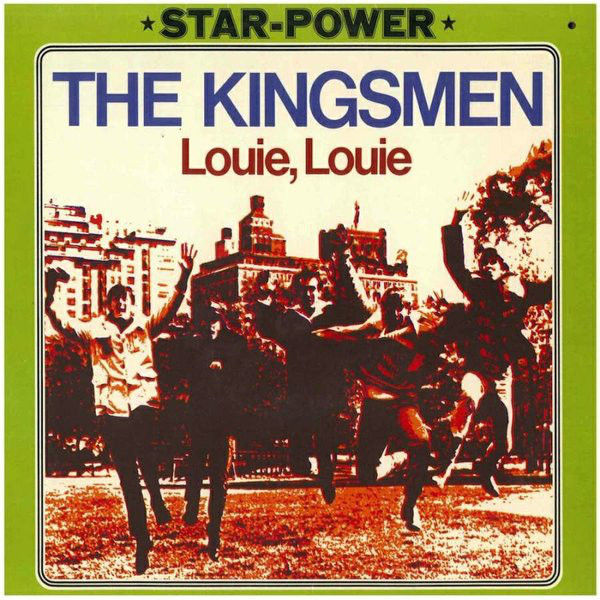
Kingsmen – Louie Louie

This song has been played in thousands of bars, clubs,  and garages. It’s an important milestone in Rock and Roll’s history.  Louie Louie caused a scandal when it was released. Many people thought the mumbled words were obscene. John Ely was the lead singer for the Kingsmen at the time. He had to sing from a distance or rather shout at a distant microphone.

The FBI got involved and started an investigation…even Robert Kennedy and J. Edgar Hoover received letters about it. The governor of Indiana, Matthew Welsh wanted it banned. Some technicians play it backward and forwards, they played it at different speeds, they spent a lot of time on it but it was indecipherable at any speed. The one person they didn’t ask about it was John Ely.

You have to wonder if the band or most likely the record company started the rumor about the lyrics. It was said some college student caused it but my money would be on the record company. The song peaked at #2 in the Billboard 100 and #27 in the UK in 1963.

The song was written by Richard Berry in 1955.

Here is the official FBI file on the Kingsmen’s Louie Louie.

Also, Eric Predoehl is supposedly making a documentary on the song.

The drummer did shout out something at 0.57 below that could have been the f-bomb after dropping a stick.

From Songfacts.

This was written by an R&B singer named Richard Berry in 1955. With his group The Pharaohs, he was also the first to record it, and it got some airplay in some cities in the Western US when it was released in 1957. Various garage bands heard it and started covering the song, until it became a phenomena with the Kingsmen’s 1964 version. While much of the song’s notoriety comes from the indecipherable lyrics, in Berry’s original version words are quite clear: the song is about a sailor who spends three days traveling to Jamaica to see his girl.

Dwight Rounds, author of The Year The Music Died, 1964-1972, writes: “The words to ‘Louie Louie’ are almost impossible to understand, and are rumored to be obscene. No question that this added significantly to the sales of the single. There was probably a leak somewhere that the lyrics were obscene; otherwise no one would have realized it. This was the most ingenious marketing scheme ever. The FBI tried to track down Richard Berry, The Kingsmen, and various record company executives. They were never able to determine the actual lyrics used. The Kingsmen insisted they said nothing lewd, despite the obvious mistake at the end of the instrumental, where Jack Ely started to sing the last verse one bar too soon, and can be heard yelling something in the background. Ely also said that he sung far away from the microphone, which caused the fuzzy sound, and that the notoriety was initiated by the record company. The words sound much more like the official version seen below, especially the word “rose” instead of “bone.” The lyrics rumor was a sham. The official lyrics are listed below in plain print, with one of the many alternative versions in italics.

Chorus: “Louie, Louie, oh no. Me gotta go. Aye-yi-yi, I said. Louie Louie, oh baby. Me gotta go.”

“Fine little girl waits for me. Catch a ship across the sea. Sail that ship about, all alone. Never know if I make it home.”

“Three nights and days, I sail the sea.” Every night and day, I play with my thing.
“Think of girl, constantly.” I f–k you girl, oh, all the way.
“Oh that ship, I dream she’s there. On my bed, I’ll lay her there. 
“I smell the rose in her hair.” I feel my bone, ah, in her hair.

“See Jamaica, the moon above.” Hey lovemaker, now hold my thing.
“It won’t be long, me see my love.” It won’t take long, so leave it alone.
“Take her in my arms again.” Hey, senorita, I’m hot as hell.
“Tell her I’ll never leave again.” I told her I’d never lay her again.

The FBI launched an extensive investigation into this song after Indiana governor Matthew Welsh declared it “Pornographic” in early 1964 and asked the Indiana Broadcasters Association to ban it. The investigation spanned offices in several states, with technicians listening to the song at different speeds trying to discern any obscene lyrics. None were found; the FBI eventually figured out what happened when they contacted the FCC. The report details this correspondence:

“She explained that for approximately two years her company has been receiving unfounded complaints concerning the recording of ‘Louie Louie.’ She advised that to the best of her knowledge, the trouble was started by an unidentified college student, who made up a series of obscene verses for ‘Louie Louie’ and then sold them to fellow students. It is her opinion that a person can take any 45 r.p.m recording and reduce its speed to 33 r.p.m. and imagine obscene words, depending upon the imagination of the listener.”

This song was prominently featured in the film Animal House, starring John Belushi, despite the fact that it wasn’t actually recorded until almost two years after the period of time in which the movie is set (1962). 

Louie Louie

Louie Louie, oh no
Me gotta go
Aye-yi-yi-yi, I said
Louie Louie, oh baby
Me gotta go

Fine little girl waits for me
Catch a ship across the sea
Sail that ship about, all alone
Never know if I make it home

Louie Louie, oh oh no
Me gotta go, oh no
Louie Louie, oh baby
I said we gotta go

Three nights and days I sail the sea
Think of girl, constantly
On that ship, I dream she’s there
I smell the rose in her hair.

Louie Louie, oh no
Me gotta go
Aye-yi-yi-yi, I said
Louie Louie, oh baby
Me gotta go
Okay, let’s give it to ’em, right now!

See Jamaica, the moon above
It won’t be long, me see me love
Take her in my arms again
I tell her I’ll never leave again

Louie Louie, oh no
Me gotta go
Aye-yi-yi-yi, I said
Louie Louie, oh baby
Me gotta go

I said we gotta go now
Let’s take it on outta here now
Let’s go!!

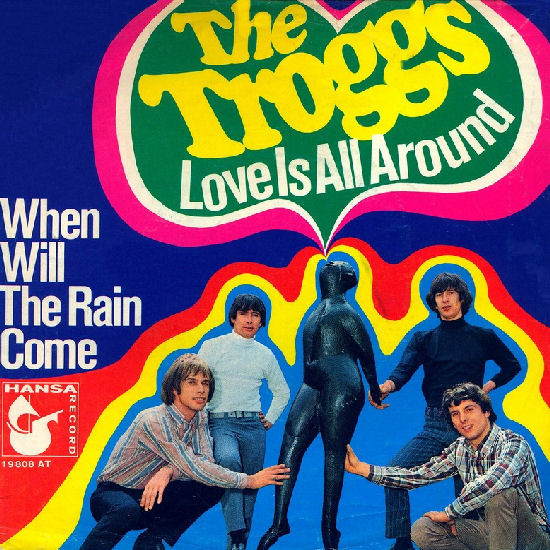
The Troggs – Love Is All Around

We will start off the new year with a little love from 1968. The Troggs are my favorite 60’s garage rock/punk band. Their big claim to fame was “Wild Thing” in 1966. The song peaked at #7 in the Billboard 100, #6 in Canada, and #5 in the UK.

Troggs lead singer Reg Presley wrote this in about 10 minutes. He was inspired by the Joy Strings Salvation Army band he’d seen on TV

The Troggs are not the only band to have success with this song. Wet, Wet, Wet recorded this song and it peaked at #41 and #1 in the UK in 1994.

REM and the Troggs made an album together called Athens Andover… REM later released a live version of this song.

From Songfacts.

Reg Presley’s real name is Reginald Ball, he adopted the name of Presley in 1966 as a publicity stunt.

In 1994 this became a huge hit when Wet Wet Wet covered it for the movie Four Weddings And A Funeral. The band chose it over Gloria Gaynor’s “I Will Survive” and Barry Manilow’s “Can’t Smile Without You” even though some of their members hadn’t heard it before. Their version was UK #1 for 15 weeks and became the best selling single in the UK in 1994.

The UK record for longest stay at #1 is held by Bryan Adams’ “(Everything I Do) I Do It For You).” Wet Wet Wet’s record company tried to tie this record by announcing they were pulling the single after 16 weeks, hoping people would rush out to buy it. The plan failed and Whigfield knocked them out of #1 with “Saturday Night.” Wet Wet Wet claimed they asked their record company to pull the song because they were sick of it. Their version does hold the record for most weeks at #1 for a UK based act. In the US it reached #41.

When this was revived by Wet Wet Wet, Reg Presley got massive royalties as the songwriter. He denoted the proceeds to crop circle research.

R.E.M. did a cover of this as well, which they played on an episode of MTV Unplugged. The video for this can be found on their VHS/DVD This Film Is On, featuring all the videos for the songs off their 1991 album Out Of Time

Presley recalled the inspiration for the song in the July 2011 edition of Mojo magazine: “I got back from America, I smelt the Sunday lunch cooking (inhales deeply), phaaaaw – after about 25 years on burgers – I kissed my wife, my little daughter, four years old. We went into the lounge and those Salvation Girls, The Joystrings, were on television, banging their tambourines and singing something, ‘Love, love,’ love.’ I went over to turn it off, knelt down and hearing that ‘Love, love’ I got a bass line, (sings) ‘doom, doom doom, doom doom, doom doom, doom,’ and I got: ‘I feel it in my fingers, I feel it in my toes. My wife, my kid… And so the feeling grows.'”

 Love Is All Around

I feel it in my fingers, I feel it in my toes
Love is all around me and so the feeling grows
It’s written on the wind, it’s everywhere I go
So if you really love me, come on and let it show

You know I love you, I always will
My mind’s made up by the way that I feel
There’s no beginning, there’ll be no end
‘Cause on my love you can depend

I see your face before me, as I lay on my bed
I kinda get to thinking of all the things you said
You gave a promise to me, and I gave mine to you
I need someone beside me in everything I do

You know I love you, I always will
My mind’s made up by the way that I feel
There’s no beginning, there’ll be no end
‘Cause on my love you can depend

It’s written on the wind, it’s everywhere I go
So if you really love me, come on and let it show
Come on and let it show

Sly and the Family Stone – Thank You (Falettinme Be Mice Elf Agin)

I hope all of you have a great New Year…

Sly and the Family Stone were huge during their heyday but have been neglected since. This song peaked at #1 in the Billboard 100 in 1970. Sly to me, was somewhat of a musical genius until drugs started to affect him. The lyrics include references to some of Sly & the Family Stone’s earlier hits, including “Dance To The Music” and “Everyday People.

From Songfacts.

Sly Stone wrote this because he was upset that people were not listening to the messages in his songs even though the band was more popular then ever. They were an integrated band and tried to spread the message of racial harmony, but Stone thought that message was getting lost. The lyrics are scathing and mostly directed at Sly himself, but once again, many people lost the message in the powerful groove.

Larry Graham played the innovative bass line using a technique where thumped the strings. He learned this technique when he was playing in a duo with his mother, who played the organ. He thumped the strings to make up for a lack of drummer. This bass style became very popular on funk records for years to come, and was a big influence on artists like Prince and The Red Hot Chili Peppers.

The title is a funky way of spelling “Thank you for letting me be myself again.”

Janet Jackson sampled the bass riff from this on her 1990 hit “Rhythm Nation.” >>

In 2008, Brooke Hogan, who is the daughter of wrestling star Hulk Hogan, released a version of this song called “Thnku4lettinmebmahself,” where she sings about the trappings of fame. Her cover, which strips all Funk from the original, was released ahead of her second album.

Thank You (Falettinme Be Mice Elf Agin)

Lookin’ at the devil, grinnin’ at his gun
Fingers start shakin’, I begin to run
Bullets start chasin’, I begin to stop
We begin to wrestle I was on the top

I want to thank you falettinme be mice elf agin
Thank you falettinme be mice elf agin

Stiff all in the collar, fluffy in the face
Chit chat chatter tryin’, stuffy in the place
Thank you for the party but I could never stay
Many things is on my mind, words in the way

I want to thank you falettinme be mice elf agin
Thank you falettinme be mice elf agin

Dance to the music
All night long
Everyday people
Sing a simple song
Mama’s so happy
Mama start to cry
Papa still singin’
We can make it if we try

I want to thank you falettinme be mice elf agin
Thank you falettinme be mice elf agin

Flamin’ eyes of people fear, burnin’ into you
Many men are missin’ much, hatin’ what they do
Youth and truth are makin’ love
Dig it for a starter
Dyin’ young is hard to take
Sellin’ out is harder

Thank you falettinme be mice elf agin
I want to thank you falettinme be mice elf agin
Thank you falettinme be mice elf agin
I want thank you falettinme be mice elf agin
I want to thank you falettinme be mice elf agin


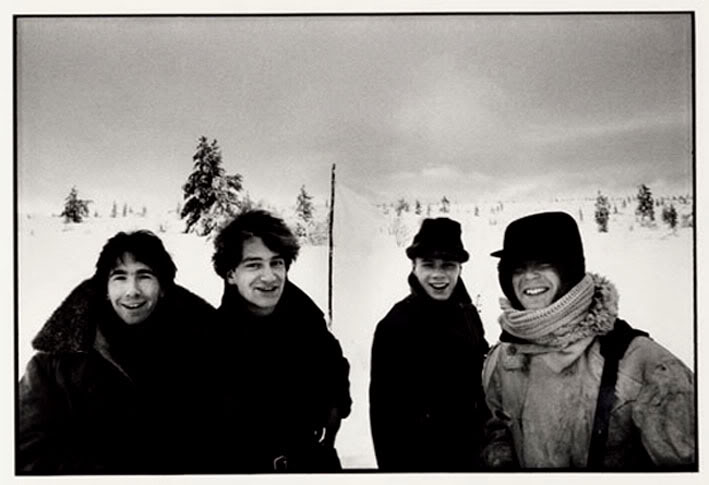
U2 – New Year’s Day

I’d heard guitar delay before but U2 took it to a new level. New Year’s Day peaked at #53 in the Billboard 100, #10 in the UK and #41 in Canada in 1983. This song was on their third album War. This is about the time I started to notice them.

from Songfacts.

The lyrics refer to the movement for solidarity lead by Lech Walesa in Poland. After this was recorded, Poland announced they would abolish martial law, coincidentally, on New Year’s Day, 1983.

This was U2’s first UK Top 10 and their first single to chart in America.

This almost didn’t make the album because Bono was having fits writing the lyrics.

The Edge played piano on this as well as guitar. In concert, he played the song on the piano with his guitar in his lap. For his guitar solo, he would get up and go to the front of the stage as the crowd cheered wildly.

This was the first U2 video to get heavy airplay on MTV, and it was by far their most ambitious video to that point. It was directed by Meiert Avis, who worked on U2’s previous videos, including “Gloria” and “I Will Follow.” They planned to shoot the video in Sweden, but when the mountains and snow they hoped for didn’t materialize, they tried Norway. They got the majestic mountains and tight shots of the band performing the song, which was more than adequate for MTV in 1983.

We also see what is supposed to be the band riding horses, which were actually four teenaged girls covered in winter clothes. The guys in U2 weren’t experienced riders, and since they were in the middle of a tour during the shoot, it wasn’t worth the risk.

The themes of understanding in a time of global unrest were a focal point for the album War, whose title was inspired by the various worldwide conflicts of 1982.

The line “Under a blood red sky” was used as the title for a video and live album U2 released in 1983. The video was recorded at Red Rocks, Colorado, June 5, 1982. The album contains performances from that show as well as two others.

Bono considers this a love song. While it is about war, it deals with “The struggle for love.”

Bono wrote this shortly after he married his childhood sweetheart, Ali.

This song was recorded at Windmill Lane Studios in Dublin, which is where U2 recorded their first three albums. The studio had a stone stairway where Larry Mullen played his drums for this track.

This is commonly played at bars every New Year’s Day for lack of something more appropriate.

This is a popular song for other artists to sample or cover. With It Guys used the piano line as a sample in the song “Let The Music Take Control,” Manchester rappers Kiss AMC sampled the intro for their song “A Bit Of U2,” the group Dynamic Base used the sample on their “Africa” single and Bacon Popper did the same on “Free.” Hyper Logic also used a sample in “Only Me.” >>

Producer Steve Lillywhite remembers mixing this song in ten minutes while Bono cranked out “40” at the last minute while another band was waiting outside of the studio for their turn.

New Year’s Day

Yeah!

All is quiet on New Year’s Day
A world in white gets underway
I want to be with you, be with you night and day
Nothing changes on New Year’s Day
On New Year’s Day

I will be with you again

Under a blood red sky
A crowd has gathered, black and white
Arms entwined, the chosen few
The newspapers says, says

Say it’s true, it’s true
We can break through
Though torn in two
We can be one

I, I will begin again

Oh, maybe the time is right
Oh, maybe tonight

I will be with you again

And so we are told this is the Golden Age
And gold is the reason for the wars we wage
Though I want to be with you, be with you night and day
Nothing changes on New Year’s Day
On New Year’s Day
On New Year’s Day


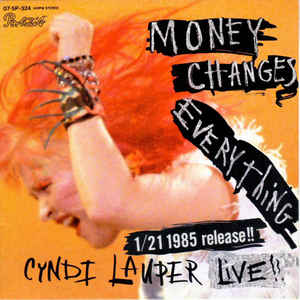
Cyndi Lauper – Money Changes Everything

The song peaked at #27 in the Billboard 100 and #30 in Canada in 1985. This song was the fifth single released off of the She’s So Unusual album. It was written by Tom Gray who released it with the Brains in 1980.

Most Cyndi Lauper fans owned the album by the time this song was released as a single, so it was issued with a different version, labeled “recorded live” as the A-side, and the album version on the B-side. The “live” version was recorded live but in a studio. Most radio stations played the album version.

From Songfacts.

A track from Cyndi Lauper’s debut album She’s So Unusual, “Money Changes Everything” was written by Tom Gray, who first recorded it with his Atlanta Rock band The Brains. The song got a great audience reaction when The Brains performed it at live shows in 1979, and when they earned some cash opening shows for The B-52s, they recorded the song and pressed 1,000 copies on their own label. Progressive FM stations in Boston, San Francisco and a few places in between started playing the song, which earned the band a record deal with Mercury Records.

But then money changed everything: Mercury cleaned house and the executives that were behind the band were replaced with folks who knew nothing about them. The song was released on The Brains 1980 self-titled debut album, but without record company support, it got little attention despite being produced by Steve Lillywhite, who would later have enormous success working with U2.

Soon after, Tom Gray got a publishing deal with ATV, which pitched “Money Changes Everything” to the producer Rick Chertoff, hoping he would record it with a teenage singer he worked with named Rachel Sweet. Chertoff declined, but a few months later he included the song on a demo reel for a new artist he was working with: a brash young singer named Cyndi Lauper. Cyndi loved the song and recorded it for her album, turning it into a hit and improving Gray’s financial fortunes considerably.

The song is about a girl who leaves her man for someone with a more robust bank account. Many songs have been written about how money can’t buy love, but this one takes the opposite tack, explaining that sometimes money trumps love.

Lauper didn’t change the gender of the song – the original version sung by a man places him in the lead role, but with Lauper singing, she is recounting a story.

Tom Gray wasn’t going for social commentary when he wrote this song; he got the idea after having a conversation with his landlady. In our interview with Gray, he explained:

“We were just sort of gossiping about this couple we knew, and she said, ‘She’s going to leave him as soon as she finds somebody with money.’ And I said, ‘Wait a minute, excuse me.’ The idea of the song just appeared in my head right there. The keyboard part was something I’d been banging on the piano for a week or so. But I wrote the chorus very quickly and then the verses followed. The song was finished within a day or two.”

A lot happened between this song’s conception and its appearance on the chart. Written in 1979 and first recorded by The Brains in 1980, Lauper put it on her She’s So Unusual album, which came out in October 1983. The first single was “Girls Just Want To Have Fun,” which peaked in March 1984. The album was a runaway hit, and three more singles were issued before “Money Changes Everything” finally got its turn, peaking at #27 in February 1985.

The song provided a welcome infusion of cash to its writer Tom Gray. It didn’t change everything, but he did go from hand-to-mouth, mowing lawns for extra funds, to buying a house and enjoying a higher status in the songwriter community, which led to a collaboration with Carlene Carter. He also became friends with Lauper, who met him when she came to Atlanta on her first tour. They wrote a song together for her next album called “The Faraway Nearby.” They collaborated again on Lauper’s song “A Part Hate,” which appeared on her 1993 album Hat Full of Stars.

Lauper released an acoustic version of this song with Adam Lazzara of Taking Back Sunday on her 2005 album The Body Acoustic. This was a moment of serendipity for the song’s writer Tom Gray, who had formed a band called Delta Moon and was working on a similar arrangement. Gray told us: “I’d always wanted to do it with a fiddle, so I played Appalachian dulcimer on it. And then after we already had it in the can, Cyndi came out with her all-acoustic CD – and what instrument did she play on it but Appalachian dulcimer! We hadn’t talked or communicated about this at all. But she came out doing it with a fiddle and an Appalachian dulcimer and I was just like, ‘Whoa.'”

Money Changes Everything

I said I’m sorry baby I’m leaving you tonight
I found someone new, he’s waitin’ in the car outside
Ah honey how could you do it
We swore each other everlasting love
I said well yeah I know but when we did;
There was one thing we weren’t
Thinking of and that’s money

Money changes everything
I said money, money changes everything
We think we know what we’re doin’
That don’t mean a thing
It’s all in the past now
Money changes everything

They shake your hand and they smile
And they buy you a drink
They say we’ll be your friends
We’ll stick with you till the end
Ah but everybody’s only
Looking out for themselves
And you say well who can you trust
I’ll tell you it’s just
Nobody else’s money

Money changes everything
I said money, money changes everything
You think you know what you’re doin’
We don’t pull the strings
It’s all in the past now
Money changes everything

Money, money changes everything
I said money, money changes everything
We think we know what we’re doing
We don’t know a thing
It’s all in the past now

Money changes everything
Money changes everything, money changes everything, money changes everything, money changes

The Shangri-Las – Remember (Walking in the Sand)

I really liked the way this song is produced and the sound of it. The song peaked at #5 in the Billboard 100 and #14 in the UK Charts in 1964. This was the Shangri-Las’ first national hit single. Like their other hits “Leader Of The Pack” and “I Can Never Go Home Anymore,” the song is about young love gone wrong, as the singer remembers all the good times with the guy who left her.

Aerosmith covered this song in 1979 with Shangri-Las lead singer Mary Weiss on uncredited backup vocals.

From Songfacts.

This was the Shangri-Las’ first national hit single. Like their other hits “Leader Of The Pack” and “I Can Never Go Home Anymore,” the song is about young love gone wrong, as the singer remembers all the good times with the guy who inexplicably left her.

George “Shadow” Morton wrote this song. Morton was an aspiring songwriter who was recommended by Ellie Greenwich to her husband Jeff Barry. Barry wanted to find out if Morton could give him a song, so Morton arranged meetings with musicians and the Shangri-Las for a future demo session. However while driving to Barry’s studio for the session, Morton remembered that he forgot to write a song! So, he pulled over to the side of the road and began writing. Thus, the song was born.

This song contains the sound effects of seagull cries. Shadow Morton was once asked how these sound effects were included, as many people assumed that they were taped from a beach. His response to the question was: “sound effects record.”

A young Billy Joel played the piano on the sessions for this and The Shangri-Las’ followup (and biggest) hit “Leader of the Pack.” In a 1987 interview with Q magazine, Joel explained: “I met a guy at an Echoes gig – was about 15 and he asked me if I wanted to play piano on a recording. So I go down to this little studio in a guy’s basement in Levittown, Dynamic Studios, and they’ve got this sheet music down there. There’s two songs, one’s called ‘Leader Of The Pack’ and the other is called ‘Remember (Walking In The Sand)’ and this is pretty easy stuff to play and then Shadow comes in. He’s a pretty strange guy, Shadow. He’s wearing this big cape and dark glasses and he played the producer role to the hilt. I think he had a thing about Phil Spector. He wanted to be the Phil Spector of the East Coast. And he talked in these wild, dramatic, theatrical terms – he wanted more ‘thunder’ and he wanted more ‘purple’ in the record. He’s waving his arms in the air saying ‘give me more PURPLE’. And I’m sitting there kind a nervous – this is my first time ever in a recording studio – and I’m hissing to the other musicians, What does that mean? How do I play “purple”? And the guitar player leans over and say, Oh, just play louder, kid.

So we did these songs in a couple of hours and the singers didn’t actually sing with us, we just did the backing tracks and I was never really sure who it was for and then I heard ‘Remember (Walking In The Sand)’ by the Shangri-Las on the radio and I went Wait a minute, that’s me, and the guys in the band said, Oh, what did you get paid? I didn’t get paid anything. What did I know. I guess Shadow pulled in guys like me so he could save some money.”

Remember (Walking in the Sand)

Seems like the other day
My baby went away
He went away cross the sea
It’s been two years or so
Since I saw my baby go
And then this letter came for me

He said that we were through
He’s found somebody new (who?)
Let me think, let me think
What can I do?

Oh no
Oh no
Oh no no no no no

(Remember) Walking in the sand
(Remember) Walking hand in hand
(Remember) The night was so exciting
(Remember) Smile was so inviting
(Remember) Then he touched my cheek
(Remember) With his finger tips
(Remember) Softly, softly we’d meet with our lips

What ever happened to
The boy that I once knew?
The boy who said he’d be true
Oh, what happened to
The light I gave to you
What will I do with it now?

(Remember) Walking in the sand
(Remember) Walking hand in hand
(Remember) The night was so exciting
(Remember) Smile was so inviting
(Remember) Then he touched my cheek
(Remember) With his finger tips
(Remember) Softly, softly we’d meet with our lips

Led Zeppelin – Over the Hills and Far Away

When I learned this riff on guitar I felt like I won the lottery. It’s easy but sounds impressive. This is a great song from Led Zeppelin with their light-heavy approach. It starts off with an acoustic and works itself up to hard electric guitar.

The song peaked at #51 in the Billboard 100 in 1973. It was on the Houses of the Holy album.

From Songfacts.

This evolved from the Yardbirds song “White Summer,” an acoustic solo by Jimmy Page. Many of the same riffs and chords are in it. After The Yardbirds broke up, Led Zeppelin continued to play “White Summer” live. >>

This was one of the few Led Zeppelin songs released as a single in the US. It made it only to #51.

The music was inspired by Jimmy Page’s Celtic ancestry.

This began as an instrumental. Robert Plant came up with backing tracks and then lyrics.

Plant’s lyrics were inspired by the J.R.R. Tolkien book The Hobbit, and to Tolkein’s 1915 poem of the same name. “Over The Hills And Far Away” describes the adventure the Hobbits embark on.

Over the Hills and Far Away

Hey lady, you got the love I need
Maybe more than enough
Oh darling, darling, darling 
Walk a while with me
Ohh, you’ve got so much, so much, so much

Many have I loved, and many times been bitten
Many times I’ve gazed along the open road

Many times I’ve lied, and many times I’ve listened
Many times I’ve wondered how much there is to know

Many dreams come true, and some have silver linings
I live for my dream, and a pocket full of gold

Mellow is the man who knows what he’s been missing
Many, many men can’t see the open road

Many is a word that only leaves you guessing
Guessing ’bout a thing you really ought to know, oh, oh, oh, oh
Really ought to know
I really ought to know
Oh
You know I should, you know I should, you know I should, you know I should

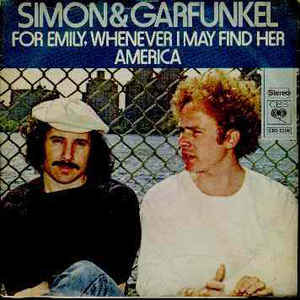
Simon & Garfunkel – America

I could listen to this song on a tape loop for eons and eons and be happy. Paul Simon is on a different level than other songwriters. This song peaked at #95 in the Billboard 100 and #25 in the UK in 1972. The song was originally on the album Bookends released in 1968 but this record was released as single in 1972 to promote their Greatest Hits.

The first Simon and Garfunkel album I bought was the Greatest Hits in the 80s. None of the songs ever get old to me.

From Songfacts.

In this song, Paul Simon and his longtime girlfriend Kathy Chitty (from “Kathy’s Song”) are coming to America (moving from England). Paul is deeply confused and unsatisfied, but he doesn’t know why. He just knows that something is missing. It is also about the “American Dream” – the guarantee that you will make it if you stumble upon this country. That is why they are coming to America.

The song is a great example of Paul Simon and Art Garfunkel singing in unison, which was a hallmark of their sound. Garfunkel is especially fond of the section where they sing, “And walked off to look for America.” To told Paul Zollo in 1993: “That has a real upright, earnest quality because we both have the identical soul at that moment. We come from the identical place in our attitude, and the spine that’s holding us up, we are the same person. Same college kid, striking out.”

There are no rhymes in this song, which is quite a feat of songwriting. In his Songfacts interview, Gerry Beckley of America (no relation) broke it down: “The entire song is prose. There’s not one line that rhymes and I will tell some of the best songwriters you’ve ever met that particular element and you can see them stop and go through it in their head. We’re oblivious to that being an ingredient because we’re so involved in the story. You’re not sitting there going, ‘That didn’t rhyme, wait a second.’ It’s not an issue.”

The prolific session drummer Hal Blaine played on this, and considers it one of his favorites. Blaine also played on Simon & Garfunkel’s “Mrs. Robinson.”

Other musicians on the track include Joe Osborn on bass and Larry Knechtel on organ.

At their live show in Central Park, Simon & Garfunkel repeated the line “Counting the cars on the New Jersey Turnpike” because the home crowd could relate to the image of massive traffic on New Jersey highways. 

This was used by James Leo Herlihy in his all-but-forgotten classic novel, The Season of the Witch. The story begins with a pair of teenage runaways traveling by bus to New York, riffing off the lyrics all the way. When they actually see the moon rising over an open field, they feel their journey was meant to happen.

In the movie Almost Famous, the teenaged character Anita (Zooey Deschanel) plays this song to explain why she is leaving home to explore the country. The song is included on the soundtrack to the film.

The progressive rock band Yes recorded a vastly different version which they released as a single in 1972. Their rendition, with layered vocals and musical breakdowns, made #46 in the US. The single version ran 4:06, but a full 10:28 version was also released on a sampler album called The New Age of Atlantic later that year, and included on their 1996 Keys To Ascension album.

In our interview with Yes bass player Chris Squire, he explained: “When Yes first formed, Simon & Garfunkel were very prevalent hit makers at the time and both myself and Jon Anderson were big fans of them. That’s why we covered the song ‘America.’ But we did it differently than their way. We wanted to expand things, which is basically what we did. When Pop tunes were expected to be three minutes long, our mantra was, ‘Let’s make them 10 minutes long.’ So that was really what we did.”

Paul Simon gave Bernie Sanders permission to use this song in a campaign ad when Sanders was campaigning for the Democratic nomination against Hillary Clinton in 2016. Simon told Billboard magazine: “Look, here’s a guy, he comes from Brooklyn, he’s my age. He voted against the Iraq War. He’s totally against Citizens United, thinks it should be overturned. He thinks climate change is an imminent threat and should be dealt with. And I felt: Hats off to you! You can use my song.”

America

Let us be lovers, we’ll marry our fortunes together
I’ve got some real estate here in my bag
So we bought a pack of cigarettes and Mrs. Wagner’s pies
And we walked off to look for America
Cathy, I said as we boarded a Greyhound in Pittsburgh
Michigan seems like a dream to me now
It took me four days to hitchhike from Saginaw
I’ve gone to look for America

Laughing on the bus, playing games with the faces
She said the man in the gabardine suit was a spy
I said, be careful, his bowtie is really a camera
Toss me a cigarette, I think there’s one in my raincoat
We smoked the last one an hour ago
So I looked at the scenery
She read her magazine
And the moon rose over an open field

Cathy, I’m lost, I said though I knew she was sleeping
And I’m empty and aching and I don’t know why
Counting the cars on the New Jersey Turnpike
They’ve all come to look for America
All come to look for America

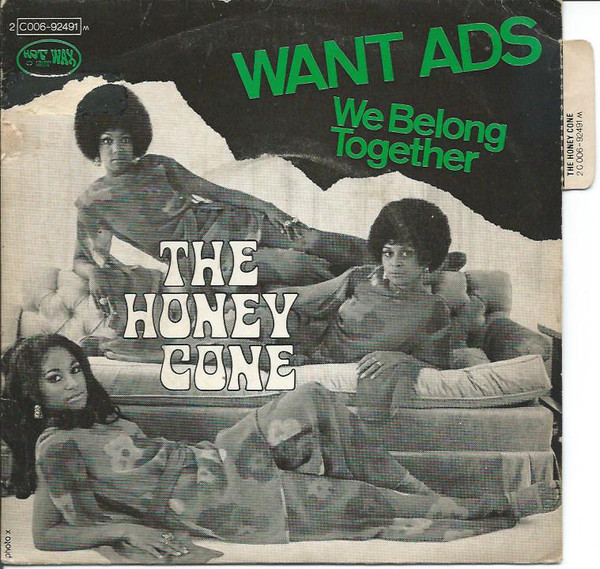
The Honey Cone – Want Ads

The song peaked at #1 in 1971 in the Billboard 100 and #11 in Canada. They were an R&B soul trio. These early seventies soul records have some great grooves on them.  Martha & the Vandellas and the Marvelettes two of the female vocal groups that epitomized Motown Records’ sound in the ’60s were among Honey Cone’s main influences

From Songfacts.

Honey Cone was the first act signed to the Hot Wax label, which Eddie Holland, Lamont Dozier and Brian Holland (Holland-Dozier-Holland) formed after leaving Motown in 1969. The group was the trio of Shelly Clark, Carolyn Willis, and Edna Wright. Wright was an accomplished singer, having done background work on various TV shows as well as tours with Bill Medley and Billy Preston, and singing backup for Motown, which is where she met Eddie Holland. Hot Wax wanted to sign Wright’s sister, Darlene Love (Phil Spector is the one who suggested she change her name from Darlene Wright to Darlene Love), but she was busy with her group the Blossoms and passed on the offer. When Darlene got an offer to do an Andy Williams TV special, she turned it down but suggested Edna, who called her friend Carolyn Willis, who called her friend Shelly Clark, and they sang together for the first time at the gig.

They continued to perform together, and when Hot Wax signed them, they took a page from Motown’s book and crafted an image for them. The attractive trio was christened Honey Cone and sent to charm school and to dance classes where they choreographed some routines. The girls returned to Detroit and released the singles “Girls It Ain’t Easy” and “While You’re Out Looking For Sugar” (both written by H-D-H, “Girls hit #68 and “Sugar went to #62, both in 1969) before hitting it big with “Want Ads,” a song about a girl who is fed up with her lying, cheating man and is ready to advertise for a new one (and even willing to train). The song topped both the Hot 100 and the R&B charts.

This was written by the Hot Wax songwriting team of General Johnson (the Showmen, The Chairmen of the Board) and Greg Perry (Chairmen of the Board), who produced versions by Glass House, Scherrie Payne (who later joined the Supremes), and Frieda Payne (Scherrie’s sister, who hit #1 with “Band of Gold”) before deciding to try the song with Honey Cone. An engineer at the studio named Barney Perkins also got a songwriting credit.

It was Perkins who suggested a song about want ads, which were the way goods and services were solicited before the internet. A week later, Perry was sitting at the piano when the chorus line came to him: “Gonna put it in the want ads, I need some love for sale.” Johnson suggested they tweak the lyric so the girl didn’t sound like a prostitute, and they came up with the idea of looking for a new man to replace the defective one.

Johnson and Perry teamed up to write a follow-up hit for Honey Cone (this time with Angelo Bond as co-writer) called “Stick-Up,” which made #11 on the Hot 100 and gave the group their second #1 R&B hit. Subsequent hits for the group were “One Monkey Don’t Stop No Show (Part I)” (#15) and “The Day I Found Myself” (#23).

Sixteen years later in 1987, Taylor Dayne, who was nearly unknown at the time, recorded a cover version of this song for her debut album Tell It To My Heart. Dayne’s cover wasn’t released as a single, but the album was a big hit, selling over 2 million copies.

Want Ads

Wanted, young man single and free
Experience in love preferred, but will accept a young trainee
Oh I’m gonna put it in the want ads, I need a love that’s true
Gonna put it in the want ads, my man and I are through

At home I find myself, lost and all alone
My man is playing the field, the thrill is gone
He stays out all night, says he’s with the boys
But lipstick on his collar, perfume on it too
Tells me he’s been lying, tell ya what I’m gonna do
I’m gonna put it in the want ads, this girl’s in misery
Gonna put it in the want ads, somebody rescue me

I spend my nights alone, cryin’ bitter tears
Although I cry aloud, nobody really hears
And when I need him most, he’s never by my side
He’s either playing cards or drinking at the bar
He thinks that I’m a fool, I’m going to the evening news
Gonna put it in the want ads, I need somebody new
Gonna put it in the want ads, my man and I are through

Extra extra, read all about it, wanted, young man single and free
Experience in love preferred but will accept a young trainee

Extra extra, read all about it, wanted, young man single and free
Experience in love preferred but will accept a young trainee

Oh I’m gonna put it in the want ads, I need somebody new
Gonna put it in the want ads, my man and I are through
Gonna put it in the want ads, this girl’s in misery
Gonna put it in the want ads, please somebody rescue me

Lipstick on his collar, perfume on it too
Tells me he’s been lying, I’m going to the evening new
Gonna put it in the want ads, I need somebody new
Gonna put it in the want ads, my man and I are through
Gonna put it in the want ads, this girl’s in misery
Gonna put it in the want ads, please som