I remember hearing about this Canadian band but I didn’t start listening to them until recently. Deke and Dave my Canadian friends have mentioned them while following their blogs. Teenage Head was sometimes known as Canada’s answer to the Ramones.
They are from Hamilton, Ontario and met in Hamilton Weston High school… friends Frank “Venom” Kerr and Gord Lewis formed the group in 1975 with bassist Steve Mahon (later changed his last name to Marshall) and Nick Stipinitz on drums. They took their name from a Flaming Groovies song title and quickly gained a loyal following on the Ontario club circuit for their raw energy, highlighted by Lewis’guitar work and front man Venom’s antics and natural charisma on stage.
Signing with Attic Records, Teenage Head issued their sophomore effort, Frantic City, in early 1980.
They played a show at the Ontario Place Forum, a prominent outdoor venue situated in a Toronto park. Over 15,000 people showed up but they venue wasn’t large enough to hold them. A drunken crowd tried to storm the entrances, sparking a battle with the police officers on hand…multiple injuries and arrests followed. The band woke up the next morning with their name in the papers. They lost some gigs but the publicity pushed “Frantic” up the charts and to gold status.
Teenage Head released Let’s Shake in 1980 and it made it to #88 in Canada.
Let’s Shake
OOH
Give me that opener, pass me that beer C’mon move your ass on out of here Well I guess you know I need some money But you are just too fat and ugly
Well you can’t dance, can’t keep up the beat Well that’s because you got size twelve feet Well don’t make me run, well don’t make me blush You’re just that girl I hate to touch
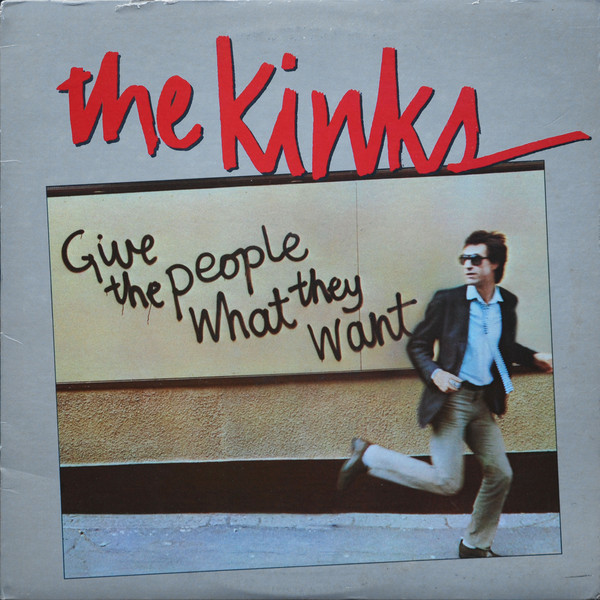
In 1981 I remember hearing Destroyer on the radio and was confused..Wait…is this a new version of All Day and All of the Night? I wanted that song so I bought the album. Give The People What They Want combines different styles. Punk, Rock, and a little New Wave was thrown in on a few of the songs. I had bought singles and a greatest hits by the Kinks but this was the first new Kinks album I purchased. It’s not considered among their best but I think it’s been underrated and the album still stands up today.
It didn’t get the recognition that their next album “State of Confusion” received because it didn’t have a huge hit single like Come Dancing. Songs like Better Things, Around The Dial, and Destroyer did get radio play though.
Two years after I bought the album I saw the Kinks live at the Grand Ole Opry in Nashville. They opened with “Around The Dial,” the opener off of this album.. Ray started to write songs that played well in arenas during this time. The concert was right up there with The Stones concerts to me. I was lucky to see the Kinks while they still were still releasing new albums.
Their energy was off the charts. They were approaching middle age but they had more energy than their opening band (The White Animals) who were in their early 20s.
The album opener… Around The Dial is a song that I totally can relate to today because of pre-programmed radio shows. It’s about corporations taking over radio and getting rid of the free form local DJ’s who played songs that their audience actually wanted to hear. This was starting to get popular in the late seventies…now it’s standard.
The song Give The People What They Want is my favorite song off the album. While writing Low Budget, their previous album, Ray was watching American TV including “That’s Incredible” where people did dangerous and insane stunts. He writes a fair statement about the viewing public…now and then. Parts of it are crude but is true to life. When Oswald shot Kennedy, he was insane, But still we watch the re-runs again and again, We all sit glued while the killer takes aim…
Ray borrowed his own riff from All Day And All Of The Night and repurposed it for Destroyer. He also revisits Lola in the song. Destroyer reached #3 on the Billboard Rock Top Tracks chart and #85 on the Billboard 100.
Better Things has a new wave feel to it and one of the few optimistic songs on the record. It’s the closing song on the album and changes the dark cynical tone of the album to a little more hopeful.
I finally brought an album to the island that wasn’t released in the 60s or 70s. This 1981 album rocks. It’s probably the hardest rock album that the Kinks ever produced…but it’s still unmistakably Ray Davies.
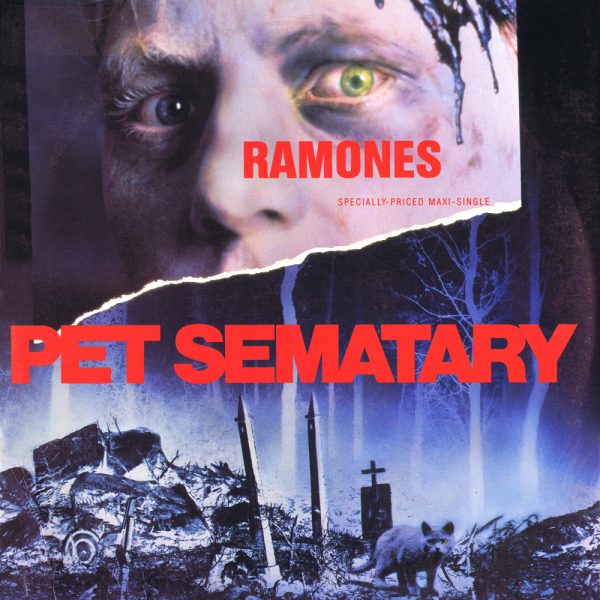
The Ramones always seem to brighten my day. No pretentious songs or long drawn out solos. They get to the point and fast. This song is a little different their previous songs and it was one of their biggest hits.
Dee Dee Ramone and producer Daniel Rey wrote this song for the 1989 Stephen King movie Pet Sematary. Another Ramones song, Sheena Is A Punk Rocker, also appears in the film.
Stephen King was a big Ramones fan and even mentioned them in the book.
The music video for Pet Sematary was filmed at the Sleepy Hollow Cemetery in New York village…it was filmed in 1989. The video features cameos by Debbie Harry and Chris Stein of Blondie.
The song peaked at #4 in the Billboard Modern Rock Charts in 1989. The song was on the album Brain Drain.
Marky Ramone:“Stephen King is a big Ramones fan. … He’s a great guy, very tall, very intense-looking. His eyes are very intense, you can see he read a lot … and we hit it off. He asked us to do a song for the movie soundtrack. … He gave Dee Dee the book to read; he read the book and wrote the song in 40 minutes. I’m forever grateful I met the guy. He wrote a nice quote in the book about me. So thank you, Stephen.”
This is a link for more info on the song and video.
Under the arc of a weather stain boards Ancient goblins, and warlords Come out the ground, not making a sound The smell of death is all around And the night when the cold wind blows No one cares, nobody knows
I don’t want to be buried in a pet cemetery I don’t want to live my life again I don’t want to be buried in a pet cemetery I don’t want to live my life again
Follow Victor to the sacred place This ain’t a dream, I can’t escape Molars and fangs, the clicking of bones Spirits moaning among the tombstones And the night, when the moon is bright Someone cries, something ain’t right
I don’t want to be buried in a pet cemetery I don’t want to live my life again I don’t want to be buried in a pet cemetery I don’t want to live my life again
The moon is full, the air is still All of the sudden I feel a chain Victor is grinning, flesh is rotting away Skeletons dance, I curse this day And the night when the wolves cry out Listen close and you can hear me shout
I don’t want to be buried in a pet cemetery I don’t want to live my life again I don’t want to be buried in a pet cemetery I don’t want to live my life again, oh, no, oh, no I don’t want to live my life, not again, oh, no, oh, oh I don’t want to live my life, not again, oh, no, no, no I don’t want to live my life, not again, oh, no, no, no
God have mercy on the man Who doubts what he’s sure of
I was 20 years old when I heard that lyric for the first time and a chill went through me. Brilliant Disguise I would play over and over again.
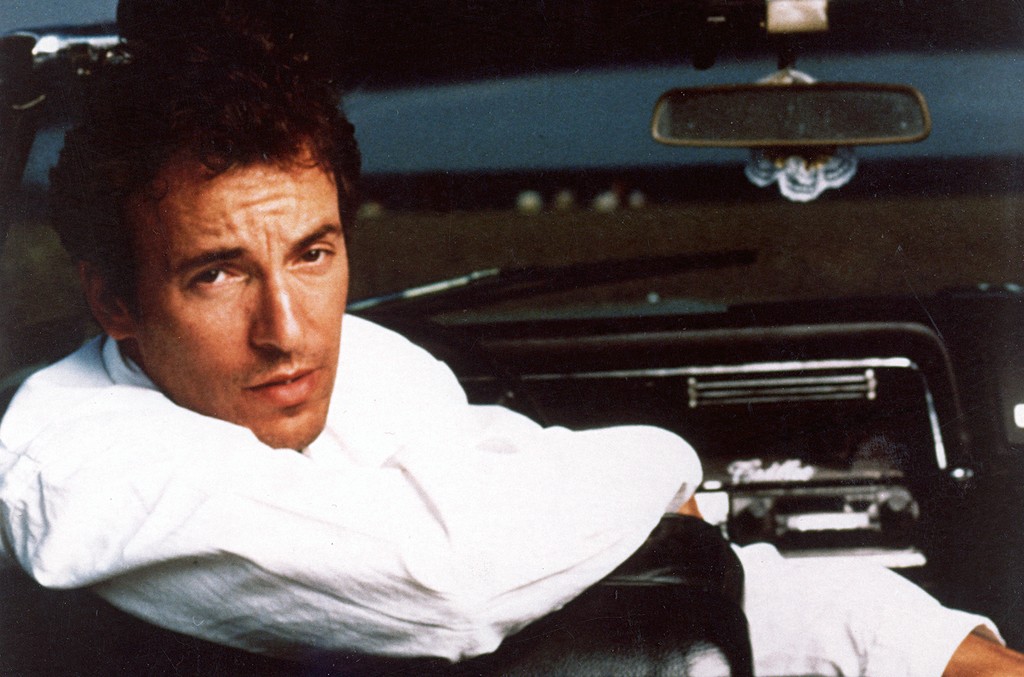
Springsteen sings this from the viewpoint of a man who is conflicted over a romantic relationship. Although he claims the song is not directly about him, Springsteen was having problems in his marriage to his first wife, Julianne Phillips, and they divorced soon after.
This was the first single off Tunnel Of Love, an album Springsteen recorded in his home studio in New Jersey. Tunnel of Love is one of my favorite albums by Springsteen. The album peaked at #1 in the Billboard Album Charts, Canada, and the UK.
The song peaked at #5 in the Billboard 100, #9 in Canada, and #20 in the UK in 1987.
Bruce Springsteen: “I guess it sounds like a song of betrayal – who’s that person sleeping next to me, who am I? Do I know enough about myself to be honest with that person? But a funny thing happens: songs shift their meanings when you sing them, they shift their meanings in time, they shift their meanings with who you sing them with. When you sing this song with someone you love, it turns into something else.”
Brilliant Disguise
I hold you in my arms As the band plays What are those words whispered baby Just as you turn away I saw you last night Out on the edge of town I wanna read your mind To know just what I’ve got in this new thing I’ve found So tell me what I see When I look in your eyes Is that you baby Or just a brilliant disguise
I heard somebody call your name From underneath our willow I saw something tucked in shame Underneath your pillow Well I’ve tried so hard baby But I just can’t see What a woman like you Is doing with me So tell me who I see When I look in your eyes Is that you baby Or just a brilliant disguise
Now look at me baby Struggling to do everything right And then it all falls apart When out go the lights I’m just a lonely pilgrim I walk this world in wealth I want to know if it’s you I don’t trust ‘Cause I damn sure don’t trust myself
Now you play the loving woman I’ll play the faithful man But just don’t look too close Into the palm of my hand We stood at the alter The gypsy swore our future was right But come the wee wee hours Well maybe baby the gypsy lied So when you look at me You better look hard and look twice Is that me baby Or just a brilliant disguise
Tonight our bed is cold I’m lost in the darkness of our love God have mercy on the man Who doubts what he’s sure of
This 1980 song is from a Vancouver punk band called The Modernettes.
I ran across this song searching for power pop songs. This one is VERY Ramones like. It’s a fun song. They did play more than punk… they ventured into power-pop recordings.
There is a documentary about the Vancouver punk rock scene in the late 70s and early 80s with Henry Rollins and Duff Mckagan that includes the Modernettes called Bloodied and Unbowed…this is the trailer but the documentary is on there also.
The Modernettes were formed in 1979, with John Armstrong, aka Buck Cherry, and Mary Armstrong, aka Mary-Jo Kopechne (yea tasteless). John formed the Modernettes soon after drafting drummer John McAdams and Mary to form the three-piece lineup.
In 1980, the Modernettes recorded the debut EP Strictly Confidential. It was released under the Quintessence Records label. A second EP, Teen City, followed quickly. It included the band’s strongest and probably most popular song, “Barbara.” Though the group pulled together a strong following, true success eluded them.
The Modernettes only completed one full album, Get It Straight.
Barbra
there’s a new little girl in my home class you know i’m talking about barbra and everybodys thinks that she’s such a gas b-a-r-b-r-a barbra
shes the girl i love forever we’ll spend our lives together barbra
well the dogs are gonna slide so she can pass you know i’m talking about barbra and everybodys looking and thats such a gas b-a-r-b-r-a barbra i envy the guy she kiss last i just wanna skip class with barbra
there’s a new little girl in my home class you know i’m talking about barbra and everybodys thinks she’s such a gas b-a-r-b-r-a barbra
shes the girl i love forever you know im talking about barbra talking about barbra talking about barbra talking about barbra
Bruce Springsteen wrote this and gave it to filmmaker Paul Schrader for his 1987 movie starring Michael J. Fox and Joan Jett as a brother and sister who lead a garage band.
Michael J. Fox and Joan Jett performed this in the movie. The song was released as a single credited to “The Barbusters” the name of the group in the film. The song is a duet with Fox and Jett, but the single was just Jett accompanied by her band, The Blackhearts.
Benmont Tench of Tom Petty and the Heartbreakers played Hammond organ on this song. Light Of Day peaked at #33 in the Billboard 100 in 1987. From Songfacts
This is one of Springsteen’s live favorites. He often performs an inspirational extended version, preaching lines like “I can not offer you eternal life, but I can offer you life right now.”
Bruce performed this at a 1992 concert for MTV. Part of their “Unplugged” series, Springsteen insisted on playing electric and calling it “Plugged.” The set was released as an album in England.
The title was used as the name of a benefit concert Springsteen played at The Stone Pony, a small club in New Jersey, in 2000. Proceeds went to The Parkinson’s Disease Foundation. Michael J. Fox, who starred in the movie Light Of Day, has Parkinson’s.
Springsteen performed this with Joan Jett at two benefit concerts in New Jersey in 2001. Proceeds from the shows went to victims of the September 11 attacks.
In 2000, the Light of Day foundation was formed, taking its name from this song. Music impresario Bob Benjamin started the foundation after he was diagnosed with Parkinson’s disease, with proceeds going toward the search for a cure. Benjamin organized a series of concerts to raise money, which proved very successful. Springsteen has performed at many of these events to lend his support.
Light Of Day
Well I’ve been out of the woods for six days and nights now Well I’m a little hot wired, but I’m feeling alright I got some money in my pocket and a long lean ride I got to make it down to Galveston by Saturday night, now
Well I’m a little down under, but I’m feeling O.K. Got a little lost along the way
I’m just around the corner to the light of day Well, I’m just around the corner to the light of day
Been driving five hundred miles, got five hundred to go, yeah I got rock and roll music on the radio I got a brother on a rig just off the gulf coast He says the girls down there, well they’re really the most, man
Well I’m a little down under, but I’m feeling O.K. I got a little lost along the way
Just around the corner to the light of day Just around the corner to the light of day I’m just around the corner to the light of day I’m just around the corner to the light of day
Well I got thrown out of work on the Kokomo Don’t ask me what I’m doing, I don’t know I hope he wasn’t joking when he wrote me that letter Things can’t get any worse, they got to get better
Well I’m a little down under, but I’m feeling O.K. I got a little lost along the way
I’m just around the corner to the light of day Just around the corner to the light of day Just around the corner to the light of day Just around the corner to the light of day
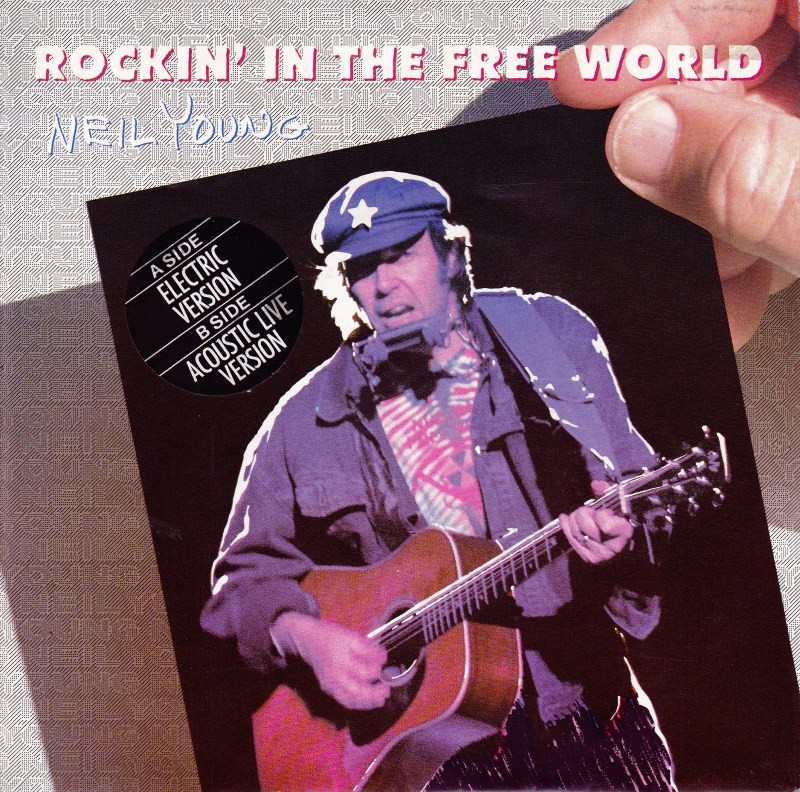
This is from our favorite Canadian Neil Young. It surprised me that this was released in 1989. I remember it the most in the 90s.
This was inspired by the political changes going on at the time, and was highly critical of the George Bush Sr. Some of the lyrics mock Bush’s campaign speeches: “We got 1,000 points of light, for the homeless man,” “We got a kinder, gentler machine gun hand.”
Rocking In A Free World was written in February 1989, as Neil Young toured the Pacific Northwest. Iran’s Ayatollah Khomeni had just issued a fatwa ordering Muslims to kill Salman Rushdie because of his controversial novel The Satanic Verses and Russia had recently withdrawn its forces from Afghanistan.
Pearl Jam have performed this song from time to time with Young, who they said that Neil is their musical mentor. The first time they performed it together was at the 1993 MTV Video Music Awards, where the “Jermey” video won four awards. Young came on as a surprise guest.
Pearl Jam has used this as the closing song in many of their concerts. The band played several times at Young’s Bridge School concerts.
The song peaked at #2 in the Mainstream Rock Chart and #39 in Canada. The song is rated number 216 on Rolling Stone’s 500 Greatest Songs of All Time.
From Songfacts
This was released a few months before the fall of the Berlin Wall. It became kind of an anthem for the event as freedom spread through Eastern Europe.
Meanwhile Young and his guitarist Frank “Poncho” Sampedro, were musing on global events as they traveled to Portland.
“There was supposed to have been a cultural exchange between Russia and United States,” Sampedro recalled to Mojo in a 2018 interview. “Russia was getting Neil Young and Crazy Horse and we were getting the Russian ballet! All of a sudden, whoever was promoting the deal, a guy in Russia, took the money and split. We were all bummed, and I looked at him and said, ‘Man I guess we’re just gonna have to keep on rockin in the free world. He said, ‘Well, Poncho, that’s a good line. I’m gonna use that, if you don’t mind.'”
“So we checked into the hotel in Portland,” the guitarist continued. “And we needed a song. We needed a rocker. We’d written some songs and they were good but we didn’t have a real rocker. I said, ‘Look man, tonight, get in your room, think about all this stuff that’s going down – the Ayatollah, all the stuff in Afghanistan, all these wars breaking out, all the problems in America… “Keep On rockin in the free world,” you got that: put something together man, let’s have a song!’ And the next morning, we got on the bus to leave and he says, ‘OK, I did it!'”
Young used members of his former backing group The Bluenotes to record this.
Young and Pearl Jam proved a great fit, as both eschew convention when it comes to music and promotion, catering instead to their ardent fan bases. The MTV appearance was an anomaly – Pearl Jam didn’t make another video for five years. In 1995, they collaborated on Young’s 1995 album Mirror Ball.
You deserve service as unique as you are. At State Farm, we offer personalized solutions. Like a good neighbor, State Farm is there.
Young performed this at the 7th annual Bridge School benefit in 1993 with all the artists involved joining Young on stage to close the show. Young put on the concert for the school, which serves children with special needs, every year until 2017.
.Neil Young played with Pearl Jam on 1995’s Merkinball, a 2-song EP that featured the songs “I Got ID” on one side and “The Long Road” on the other. Merkinball was a case of Young returning the favor to Pearl Jam. They had served as his “backing band” on his 1995 album Mirrorball. Contractual stipulations prevented Mirrorball from being credited to both artists and recognized as the collaborative effort it actually was (The name “Pearl Jam” was not legally allowed to appear on either the album’s cover or within its liner notes). “I Got ID” and “Long Road” were actually recorded during the Mirrorball sessions.
The song is on occasion used as a pro-America anthem, which ignores many of the ironic overtones of the lyrics. While the chorus does seem to celebrate the United States, it’s juxtaposed with grim verses which paint a haunting portrait of life in modern America – the song is sometimes interpreted as a critique of the “keep on rocking in the free world” sentiment that US citizens use to ignore global problems that don’t concern them.
Much like his seminal “My My, Hey Hey”/”Hey Hey, My My” counterparts, the widely known version of “Rockin’ In The Free World” is a loud, electric reprise of a stripped-down acoustic version that opens the Freedom album.
Rolling Stone rated this #216 on their 500 Greatest Songs of All Time list.
Young is very particular about where his songs are used. He authorized this one for the 2004 Michael Moore documentary Fahrenheit 9/11, and also for the 2015 film The Big Short, which tells the story of the rapacious financial workers who caused the 2008 recession. It also appears in the video game Guitar Hero: Warriors of Rock.
The track was used in Donald Trump’s announcement that he will run as a Republican candidate for the 2016 presidency. Young, a longtime supporter of Bernie Sanders, said that the mogul was not authorized to use the song.
Trump’s campaign responded by saying it did pay to use Neil Young’s tune at the presidential announcement, but won’t use Young’s music at any future events. “Through a licensing agreement with ASCAP, Mr. Trump’s campaign paid for and obtained the legal right to use Neil Young’s recording of ‘Rockin’ In The Free World,'” the statement read. “Nevertheless, there are plenty of other songs to choose from. Despite Neil’s differing political views, Mr. Trump likes him very much.”
Trump later hit back, posting a photo of him and Young shaking hands, and explaining that Young asked him for financing on an audio deal and invited Trump to a concert. In a Tweet, Trump called Young a “total hypocrite,” adding, “‘Rockin’ In The Free World’ was just one of 10 songs used as background music. Didn’t love it anyway.”
Rocking In A Free World
There’s colors on the street Red, white and blue People shufflin’ their feet People sleepin’ in their shoes But there’s a warnin’ sign on the road ahead There’s a lot of people sayin’ we’d be better off dead Don’t feel like Satan, but I am to them So I try to forget it, any way I can.
Keep on rockin’ in the free world, Keep on rockin’ in the free world Keep on rockin’ in the free world, Keep on rockin’ in the free world.
I see a woman in the night With a baby in her hand Under an old street light Near a garbage can Now she puts the kid away, and she’s gone to get a hit She hates her life, and what she’s done to it There’s one more kid that will never go to school Never get to fall in love, never get to be cool.
Keep on rockin’ in the free world, Keep on rockin’ in the free world Keep on rockin’ in the free world, Keep on rockin’ in the free world.
We got a thousand points of light For the homeless man We got a kinder, gentler, Machine gun hand We got department stores and toilet paper Got styrofoam boxes for the ozone layer Got a man of the people, says keep hope alive Got fuel to burn, got roads to drive.
Keep on rockin’ in the free world, Keep on rockin’ in the free world Keep on rockin’ in the free world, Keep on rockin’ in the free world.
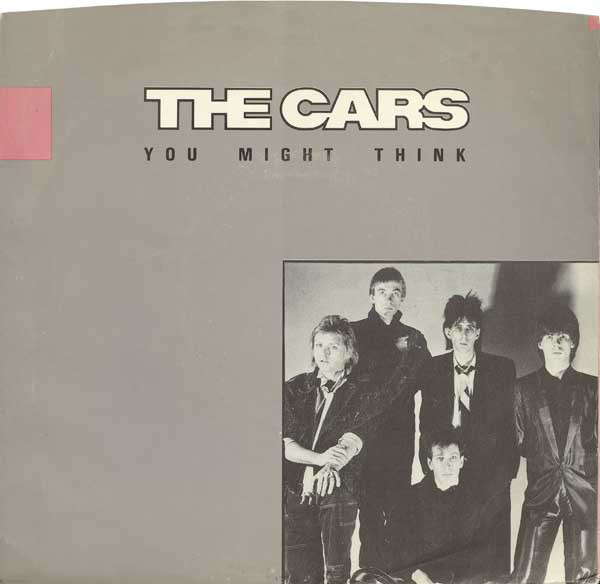
Another Cars release and another catchy song. This song was released in 1984 on the album Heartbeat City. The song was written by Ric Ocasek. The album was produced by Mutt Lange who was an in-demand producer in the 1980s.
You Might Think peaked at #7 in the Billboard100, #8 in Canada, #88 in the UK, and #27 in New Zealand in 1984.
The album Heartbeat City peaked at #3 in the Billboard Album Charts, #5 in Canada, #25 in the UK, and #1 in New Zealand in 1985.
The video won the first-ever Video of the Year award at MTV’s Video Music Awards. It beat out “Thriller” by Michael Jackson and Herbie Hancock’s “Rockit,” among others.
The video took months to make. The effects seen in the video can be created with a basic program these days, but in 1984 creating and rendering this stuff was extremely tedious and time-consuming.
Jeff Stein directed the video. in 1979 he had directed The Who’s documentary The Kids Are Alright.
From Songfacts
The video was very advanced for the time and was one of the first to use computerized effects. Singer/guitarist Ric Ocasek’s image appeared in various animated scenes – he would show up as a fly, climbing the Empire State Building, just about anywhere to get the attention of the girl. The object of his affection was played by model Susan Gallagher.
Weezer recorded this for the 2011 movie Cars 2 – their version was used in a scene where Lightning McQueen and Mater go to Japan. The actual Cars had reunited by 2011, but apparently weren’t contemporary enough for the kids’ movie.
The antecedent for the video were commercials for the American gossip magazine National Enquirer, which featured goofy cutout animations of the celebrities the magazine would feature. These spots were produced at Charlex studios, so Jeff Stein, who directed the “You Might Think” video, commissioned them to work on it after pitching The Cars on the idea, which was putting the band in pop culture scenarios and having an animated Ric Ocasek stalk the girl. Getting the band on board wasn’t easy. Stein explained in the book I Want My MTV: “I met The Cars and told them, ‘The band’s in the medicine chest, and then on a bar of soap, and Ric’s a fly,’ and one of them said, ‘Why don’t we all just play on a turd in the toilet bowl?’ That was the prevailing attitude.”
Stein was famous for his live videos like what he did with Billy Idol on “Rebel Yell,” but he thought The Cars were a boring live band so he used digital trickery to get around that.
This song was used throughout the CBS TV series BrainDead, which ran for one season in 2016. The show was about ants that take over the brains of politicians. The song played to indicate a character who has been infected.
This was used on the series finale of The Office in 2013. It plays while Erin dances with her biological father at Angela and Dwight’s wedding reception.
You Might Think
You might think I’m crazy To hang around with you Maybe you think I’m lucky To have something to do
But I think that you’re wild Inside me is some child
You might think I’m foolish Or maybe it’s untrue (You might think) you might think I’m crazy (All I want) but all I want is you
You might think it’s hysterical But I know when you’re weak You think you’re in the movies And everything’s so deep
But I think that you’re wild When you flash that fragile smile
You might think it’s foolish What you put me through (You might think) you might think I’m crazy (All I want) but all I want is you
And it was hard, so hard to take There’s no escape without a scrape
You kept it going ’till the sun fell down You kept it going
Well you might think I’m delirious The way I run you down But somewhere sometimes, when you’re curious I’ll be back around
Oh I think that you’re wild And so uniquely styled
You might think it’s foolish This chancy rendezvous (You might think) you might think I’m crazy (All I want) but all I want is you All I want is you All I want is you
It’s just nobody knows baby where love goes But when it goes it’s gone gone
I was reading posts a while back and Vinyl Burn reviewed the album Tunnel Of Love. That brought back a lot of memories of that album…and this song. This was the studio follow up to the huge Born in the USA album. Bruce had married actress Julianne Phillips in 1985 and she filed for divorce in 1988…a year after the release of Tunnel of Love. The album reflects some of the turmoil that was going on.
He later toured after the album was released and the E-Street Band backed him up as usual. After the tour, Bruce told the band that he would not need them for the foreseeable future. It wouldn’t be until 10 years later in 1999 that they would regroup and tour again.
I saw Bruce in 1996 on a solo acoustic tour and he played this song and it was the only song he played off of Tunnel of Love.
The album was released in 1987. Tunnel of Love peaked at #1 in the Billboard Album Chart, #1 in Canada, #1 in the UK. It peaked at #6 in New Zealand.
The song was not released as a single.
When You’re Alone
Times were tough love was not enough So you said sorry Johnny I’m gone gone gone You said my act was funny But we both knew what was missing honey So you let out on your own Now that pretty form that you’ve got baby Will make sure you get along But you’re gonna find out someday honey
When you’re alone you’re alone When you’re alone you’re alone When you’re alone you’re alone When you’re alone you ain’t nothing but alone
Now I was young and pretty on the mean streets of the city And I fought to make ’em my home With just the shirt on my back I left and swore I’d never look back And man I was gone gone gone But there’s things that’ll knock you down you don’t even see coming And send you crawling like a baby back home You’re gonna find out that day sugar
When you’re alone you’re alone When you’re alone you’re alone When you’re alone you’re alone When you’re alone you ain’t nothing but alone
I knew someday your runnin’ would be through And you’d think back on me and you And your love would be strong You’d forget all the bad and think only of all the laughs that we had And you’d want to come home Now it ain’t hard feelings or nothin’ sugar That ain’t what’s got me singing this song It’s just nobody knows baby where love goes But when it goes it’s gone gone
When you’re alone you’re alone When you’re alone you’re alone When you’re alone you’re alone When you’re alone you ain’t nothing but alone
This is probably the first song I remember by Iggy Pop back in the 80s.
This song was originally recorded by Australian rocker Johnny O’Keefe with The Deejays in 1958 as “Wild One.” Deejays saxophonists Johnny Greenan and Dave Owens drafted the song over drinks after a particularly wild concert and Johnny O’Keefe later chipped in.
The song was an immediate hit and made Johnny O’Keefe the first Australian rocker to reach the national charts. Iggy Pop covered it for his Blah Blah Blah album. Released as a single, it became his only UK Top 10 hit.
The song peaked at #1 in New Zealand, #10 in the UK, #65 in Canada, and #27 in the Mainstream Rock Billboard Charts.
The album Blah Blah Blah peaked at #75 in the Billboard Album Charts, #61 in Canada, #43 in the UK, and #19 in New Zealand in 1986.
From Songfacts
Johnny O’Keefe (1935-1978) was a pioneering Australian Rock singer whose career began in the 1950s and ended with his early death in the late 1970s of barbiturate poisoning. Often referred to by his nickname, “The Wild One,” O’Keefe was the first Australian Rock star.
The lyrics are about youngsters wanting to be cool and wild.
In Australia this has been used as the theme music for the ABC’s all-night music video show Rage for over 20 years.
Iggy Pop’s version has featured in the movies Adventures in Babysitting (1987) and Problem Child 2 (1991).
A cover by Christopher Otcasek featured in Pretty Woman (1989). Other cover versions include “Real Wild Child” by Joan Jett and The Blackhearts (1993), “Wild One” by Status Quo (2003) and Christian pop band Everlife’s “Real Wild Child,” which appears as the theme song in Disney’s The Wild (2006). >>
This is Kesha’s favorite song. She told Spinmagazine: “It’s the last song I play before I walk onstage and the first song I play when I get off stage. It always gets me going.”
Real Wild Child (Wild One)
Well I’m just outta school Like I’m real real cool Gotta dance like a fool Got the message that I gotta be A wild one Ooh yeah I’m a wild one
Gotta break it loose Gonna keep ’em movin’ wild Gonna keep a swingin’ baby I’m a real wild child
Gonna met all muh friends Gonna have our self a ball Gonna tell my friends Gonna tell them all That I’m a wild one Ooh yeah I’m a wild one
Gotta break it loose Gonna keep ’em movin’ wild Gonna keep a swingin’ baby I’m a real wild child
I’m a real wild one An’ I like a wild fun In a world gone crazy Everything seems hazy I’m a wild one Ooh yeah I’m a wild one
Gotta break it loose Gonna keep ’em movin’ wild Gonna keep a swingin’ baby I’m a real wild child
I’m a wild one I’m a wild one I’m a wild one Oh baby I’m a wild one
Gotta break it loose Gonna keep ’em movin’ wild Gonna keep a swingin’ baby I’m a real wild child
This song was the title track of Georges 1987’s superb album. Song starts off with Harrison and Clapton trading licks and George matches him with his slide guitar. George was not a virtuoso type of guitar player but he was one of the best slide guitarists in the business. Guitar players are still trying to get his tone.
George wasn’t a self-indulgent guitar player…he always played for the song and always gave the song what it needed.
I love the blues-tone that Jeff Lynne got out of this production. He emphasized the bass drum and the bass to make it sound grounded.
Although the album was titled Cloud Nine, Harrison decided to use the numeric “9” in the song’s title to avoid confusion with the Temptations’ 1968 hit song “Cloud Nine.”
The song wasn’t released as a single but it’s a great-sounding song. This album marked a huge comeback for George. This album peaked at #8 in the Billboard 100, #5 in Canada, and #10 in the UK in 1988.
After this album, George formed the Travelin Wilburys.
Cloud 9
Have my love It fits you like a glove Join my dream, tell me yes Bail out should there be a mess The pieces you don’t need are mine
Take my time I’ll show you cloud nine Take my smile and my heart They were yours from the start The pieces to omit are mine
Have my love Use it while it does you good Share my highs but the times That it hurts pay no mind The pieces you don’t need are mine
I’ll see you there on cloud nine
Take my hope Maybe even share a joke If there’s good to be shown You may make it all your own And if you want to quit that’s fine While you’re out looking for cloud nine
John Mellencamp took a three-chord pattern that is used many times in rock and roll (Cherry, Cherry is one) and turned it into Rock in the USA. The song worked well…in the middle of the eighties, he turned this very 60’s sounding song into a big hit. The song peaked at #2 in the Billboard 100 and #7 in Canada in 1986.
Mellencamp name-drops several artists, particularly Frankie Lyman, Bobby Fuller, Mitch Ryder, Jackie Wilson, Shangra La’s, Young Rascals, Martha Reeves and James Brown. These artists were Mellencamp’s influences while growing up.
This song was on the Scarecrow album. To prepare for this album Mellencamp had a great idea. He had his band run through 60’s rock songs for a month. They learned them inside and out and applied the feel on the new songs they were working on the album.
Larry Crane the guitarist: “We got a bunch of those tapes you see advertised on TV with all the old songs on them, and God, we learned everything.”
Rolling Stone Magazine’s “100 Best Albums of the Eighties,” ranked Scarecrow at #95… that surprises me that it’s that low on the list. In my opinion, this album was the peak of his career.
From Songfacts
“R.O.C.K. in the U.S.A.” is subtitled “A Salute to ’60s Rock,” and despite Mellencamp’s feeling that “I don’t think people are getting the idea of what the song’s about, so I must’ve not done a very good job,” the song became a big hit. It tells the story of how rock and roll emerged in America, and how those (now infamous) musicians that were not afraid to take personal risks for the sake of their music became a strong influence on the next generation, including Mellencamp, who sings: “[They] Filled our head full of dreams, turned the world upside down.”
Growing up, Mellencamp listened to AM radio at a time when the same station would play a mix of styles, exposing him to rock, folk, soul and R&B at an early age.
John Mellencamp released “R.O.C.K. in the U.S.A.” in 1985 on his eighth album Scarecrow. The album peaked at #2 in the US, with three Top 10 hit singles, this being the biggest. The overall theme of the album is the decay of societal foundations in rural America, but this song is a departure from that theme. Far from satirical, Mellencamp intends to portray a mournful U.S.A. that has been slowly eaten out from inside by the industries that substitute greed for the American Dream, but “R.O.C.K. in the U.S.A” was so against the grain of this album’s emotional profile that Mellencamp almost excluded it from the album.
Mellencamp’s interest in recreating the sounds of the heyday of rock & roll has spanned his entire career; in 2009 he recorded songs for the 2010 album No Better than This at Sun Studios (in the footsteps of Elvis) and other historical locations. The recording techniques used for this album are purposefully raw in an attempt to reconnect with his roots, a reflection of Mellencamp’s ideology of “Real music, for real people!”
In this way, Mellencamp was paying homage, but he was also paying his dues. For example, the late Bobby Fuller’s mention on a Top 10 song, and a platinum album, was enough to revive flagging interest in the artist (as well as get Mellencamp a credit on a Bobby Fuller Four Best-Of album). Said Mellencamp: “When I played in Albuquerque, I think it was, his [Fuller’s] mom and some of his family came down to see me play. They acted like I gave them 60 million dollars just for mentioning his name. They gave me his belt that he died in.”
The instrumental break in this song is very clever. When we first hear it, it’s played on an ocarina, which is a small wind instrument of ancient Eastern origins, thought to be 12,000 years old, and often made in the shape of a bird and used to imitate its fluting song. This is a nod to the song “Wild Thing” by The Troggs, which featured an ocarina solo. In Mellencamp’s song, the riff is then played on guitar and later on keyboards, going through various musical forms popular in ’60s rock. In concert, Mellencamp would often bring a fan onstage to dance with him during this section.
In the months prior to recording Scarecrow, Mellencamp’s band worked their way through nearly a hundred cover songs. Mellencamp hoped that through these covers, they would absorb the stylistic essence of the era through osmosis. Mellencamp’s bassist Toby Myers admitted that, “I thought he was giving us busywork, but he wanted us to understand what made those songs tick so we could put some of that grit into his songs.” The band was surprised by the sheer quantity of different styles that characterized the era. “Take an old Rascals song for example,” Mellencamp said. “There’s everything from marching band beats to soul music to country sounds in one song.”
For the Scarecrow album, Mellencamp moved away from the stage-name, John Cougar, which had been given to him by Tony DeFries, his first manager, and became “John Cougar Mellencamp” (he would drop the “cougar” completely by 1989). This was a fortunate move, because 2009 saw the release of the hit sitcom Cougar Town starring Courteney Cox (as the main “cougar”). The ensuing taunts that would have come with the transition of cultural interpretation from a cougar being an imposing catamount to a sexy middle-aged woman might have been enough to revive Mellencamp’s reputation as a hothead prone to bursts of anger in his old age. As if continually being compared to Bruce Springsteen wasn’t enough…
This song forms part of a greater genre of songs that spell out words in the lyrics, like Otis Redding’s song “Respect” (made famous by Aretha Franklin) or “Lola” by the Kinks.
Mellencamp’s title wasn’t too far from Bruce Springsteen’s “Born In The U.S.A.,” released a year earlier. That song was often misinterpreted as a celebration of America, when it was really about the plight of a Vietnam War veteran.
In keeping with ’60s hit single tradition, Mellencamp kept this song under three minutes long – it clocks in at 2:54.
R.O.C.K. in the U.S.A.
They come from the cities And they come from the smaller towns Beat up cars with guitars and drummers Goin crack boom bam
R.O.C.K. in the U.S.A. R.O.C.K. in the U.S.A. R.O.C.K. in the U.S.A., Yeah, Yeah! Rockin’ in the U.S.A.
Said goodbye to their families Said goodbye to their friends With pipe dreams in their heads And very little money in their hands Some are black and some are white Ain’t to proud to sleep on the floor tonight With the blind faith of Jesus you know that they just might, be Rockin’ in the U.S.A. Hey!
Voices from nowhere And voices from the larger towns Filled our head full of dreams Turned the world upside down
There was Frankie Lyman-Bobby Fuller-Mitch Ryder (They were Rockin’) Jackie Wilson-Shangra-las-Young Rascals (They were Rockin’) Spotlight on Martha Reeves Let’s don’t forget James Brown Rockin’ in the U.S.A. Rockin’ in the U.S.A. Hey!
R.O.C.K. in the U.S.A. R.O.C.K. in the U.S.A. R.O.C.K. in the U.S.A., Yeah, Yeah! Rockin’ in the U.S.A.
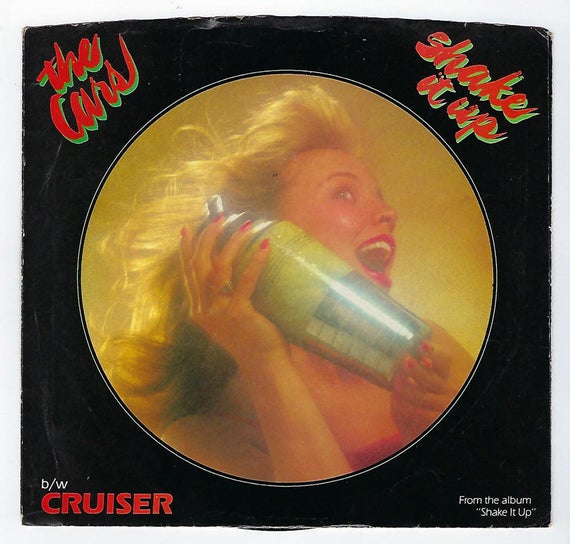
Shake It Up was the title track to The Cars’ fourth album. This was their first top 10 hit which is surprising with all of the well-known songs they had released to this point.
They had been playing around with this song for a few years but they didn’t like the sound of it. They basically started all over and changed the song completely and then worked it out.
The Shake It Up album came out in 1981, just a few months after the first MTV broadcast. The release became a big hit for the Cars, a top 10 album that would eventually go multi-platinum… aided by this song.
The song peaked at #4 in the Billboard 100, #7 in Canada, and #26 in New Zealand in 1982.
The album peaked at #9 in the Billboard Album Chart.
The song is typical Cars…catchy chorus and full of hooks. Ric Ocasek wrote the song but did say he was never too thrilled about the lyrics.
Drummer David Robinson: “We recorded [‘Shake It Up’] a couple of times in the studio and dumped it, and we were going to try it one more time, and I was fighting everybody,” “So we thought, let’s start all over again, like we’ve never even heard it – completely change every part – and we did. Then, when it was through and all put back together, it was like a brand-new song.”
From Songfacts
Written by frontman Ric Ocasek, it’s an outlier in that it’s very straightforward, simply encouraging us all to get on the dance floor and boogie like nobody’s watching. Ocasek’s songs were generally far more enigmatic.
This song has some throwback elements, like the “ooo ooo ooo” backing vocals and references to a “quirky jerk” and “night cats” – lingo that was hep in the ’60s when songs about dancing were in vogue. At the same time, “Shake It Up” as a futuristic sound, with synthesizers and drum machines that were part of the new wave.
Released as the lead single from the album, “Shake It Up” was a big American hit for The Cars, getting them into the Top 10 for the first time. Some fans accused them of “selling out,” but the band insisted they were simply progressing (one point in their defense: they continued to live in Boston instead of relocating to New York or Los Angeles). The jabs came mostly from the UK, where the band got lots of positive press early on but faced the wrath of a finicky press when they released this song about dancing. In the UK, “Shake It Up” wasn’t released as a single.
The Cars are one of the groups who can be credited with opening the New Wave sound up to the mainstream. As noted in Seventies Rock: The Decade of Creative Chaos, “The fact that new music was getting airplay at all – New Wave or not – was somewhat remarkable.” When The Cars came on the scene in 1978, the Bee Gees and all the disco craze they brought with them dominated the charts. While mainstream radio was reluctant to put a punk record on the air, it found New Wave less intimidating.
Meanwhile, Ken Tucker muses about the New Wave movement in The Rolling Stone Illustrated History of Rock and Roll: “Kids all over the country decided to play Record Promotion: if the big boys wouldn’t sign up their local bands, the fans would, with a vengeance. Mimeographed manifestos and homemade rock magazines multiplied as ways to push burgeoning local scenes; they plugged cherished unknowns and finessed an ad hoc network for distributing their records.” Notice any similarities with 1978 music culture and the Internet-fostered music scene now?
Shake It Up Demo
Shake It Up Studio Version
Shake It Up
Uh well, dance all night, play all day Don’t let nothin’ get in the way Dance all night, keep the beat Don’t you worry ’bout two left feet
Shake it up Shake it up, oo yeah Shake it up Shake it up
Dance all night and get real loose You don’t need no bad excuse Dance all night with anyone Don’t let nobody pick your fun
Shake it up, oo, oo Shake it up, yeah yeah Shake it up, oo, oo Shake it up
That’s right, I said Dance all night Go go go Dance all night Get real low Go all night Get real hot Well, shake it up now, all you’ve got, woo
Dance Oo dance
Uh well, dance all night and whirl your hair Make the night cats stop and stare Dance all night, go to work Do the move with a quirky jerk
Just shake it up, oo oo Shake it up, oo yeah Shake it up Shake it up
Uh well, dance all night Go go go Get so light Get real low Dance all night Get real hot Shake it up, with all you’ve got, woo
Shake it up, make a scene Let them know what you really mean And dance all night, keep the beat And don’t you worry ’bout two left feet
Just shake it up, oo, oo Shake it up, oo oo, yeah Shake it up, oo, oo Shake it up, oh, yeah
Shake it up, shake it up babe Shake it up, oo, oo Shake it up, shake it up babe Shake it up, oo, oo
Shake it up, shake it up, yeah yeah, shake it up Oo oo, shake it up Shake it up, shake it up babe Shake it up, oo, oo
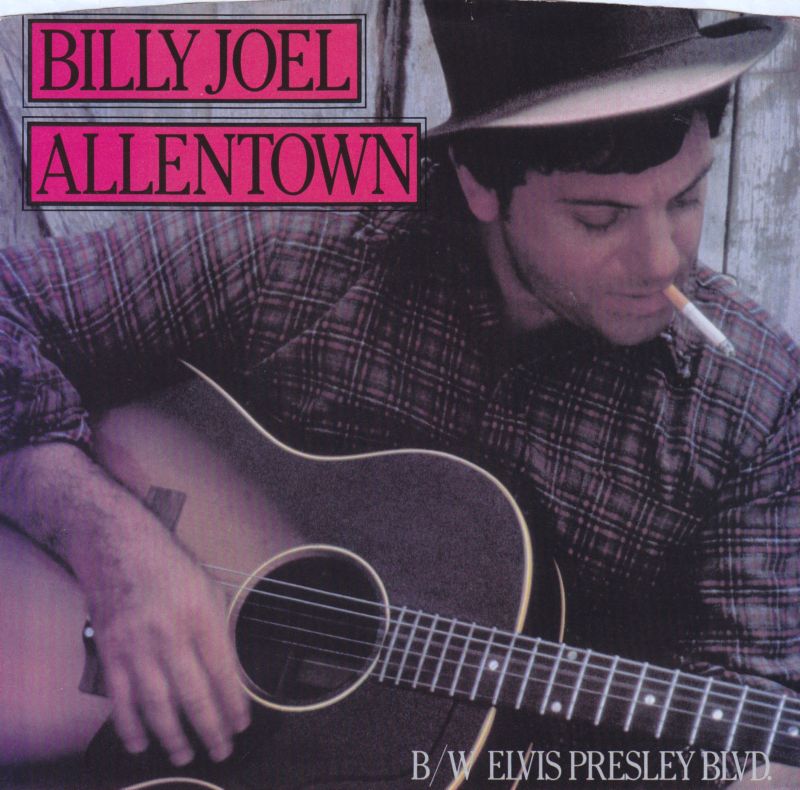
A great single by Billy Joel with a song off of the Nylon Curtain album.
Allentown is a town in Northeast Pennsylvania about 45 minutes away from the Pocono mountains. An industrial town, many of the once-thriving factories and mills had fallen on hard times when Joel wrote the song, and unemployment in the area was at an all-time high of 12%.
Also mentioned in the song is nearby Bethlehem, Pennsylvania, whose main employer, Bethlehem Steel, had been closing operations. Joel sings about the unemployed workers in the line, “Out in Bethlehem they’re killing time, filling out forms, standing in line.”
When the album and single were released in 1982, the Mayor of Allentown PA was Joe Dadonna, who had the difficult job of promoting the image of his city during the worst economic crisis of its history. While many locals viewed “Allentown” as a put-down of their declining city, Mayor Dadonna saw it as an opportunity for some publicity and promotion.
The song was on the Nylon Curtin released in 1982.
The song peaked at #17 in the Billboard 100 and #21 in Canada, and #1 in New Zealand in 1982.
The steel mill this song is written about is now a casino.
From Songfacts
Billy Joel did not grow up in Allentown – he grew up in Levittown, on Long Island. In an interview with James Lipton on Inside the Actors Studio, he compared Allentown with his hometown while he was growing up, noting the similarities. Joel stated that the original title was “Levittown,” and the original lyrics seemed kind of bland, and he felt that they would possibly be considered boring to the listeners.
Some of the original lyrics included lines like, “Well we’re living here in Levittown. And there’s really not much going down. I don’t see much when I look around. The grass is green, the trees are brown. And we’re living here in Levittown.” So, during the time of the upcoming studio sessions for The Nylon Curtain, Billy took a trip to Pennsylvania. It was here that he came up with the idea for new lyrics. At that time, he had Bethlehem in mind, but was worried people would suddenly get the impression that the song was religious (the birth of Christ was said to have happened was Bethlehem, Israel). It is worth noting that Bethlehem and Allentown are right next to each other. So, he started writing down some lyrics for what later became the song “Allentown.”
The distinctive chord at the beginning was originally a mistake, but Joel decided he liked the way it sounded and left it in.
The song starts with the blowing of a steam whistle in a factory. This was common in the days of steel mills and lumber companies. Usually, whistles were blown at the beginning of a work day, to summon workers to their duties, to announce shift changes, to call them to their lunch hour at noon, and at the end of a work day, to let them know that it was 5:00 and it was time to go home. Also, when listened to carefully, in the background with the music, one can hear the rhythmic pounding of a pile driver, a machine for delivering repeated blows to the top of a pile for driving it into the ground. The machine consists of a frame which supports and guides a hammer weight, together with a mechanism for raising and dropping the hammer or for driving the hammer by air or steam.
Joel played a benefit concert in Allentown, Pennsylvania on December 27, 1982 as this song was climbing the charts.
The video was directed by Russell Mulcahy, whose work was all over MTV in their early years, with many videos to his credit by Fleetwood Mac, Elton John and Duran Duran. Billy Joel had little interest in music videos, so he let the directors control them. The “Allentown” video stays true to the song in the sense that we see young men coming back from the war and struggling to find work, but these men are far more shirtless and muscular than you would expect. In I Want My MTV by Craig Marks, Joel said: “It’s really gay. There’s a shower scene with all these good-looking, muscular young steel workers who are completely bare assed. And then they’re all oiled up and twisting valves and knobs. I’d missed this completely when I was doing the video. I just thought it was like The Deer Hunter.”
This is the biggest hit to mention the state of Pennsylvania in the lyric (“for the Pennsylvania we never found”). Darryl Worley’s “Have You Forgotten?,” a 2003 song about the September 11 attacks, was the next hit to mention the state.
Allentown
Well we’re living here in Allentown And they’re closing all the factories down Out in Bethlehem they’re killing time Filling out forms Standing in line Well our fathers fought the Second World War Spent their weekends on the Jersey Shore Met our mothers in the USO Asked them to dance Danced with them slow And we’re living here in Allentown
But the restlessness was handed down And it’s getting very hard to stay
Well we’re waiting here in Allentown For the Pennsylvania we never found For the promises our teachers gave If we worked hard If we behaved So the graduations hang on the wall But they never really helped us at all No they never taught us what was real Iron and coke And chromium steel And we’re waiting here in Allentown
But they’ve taken all the coal from the ground And the union people crawled away
Every child had a pretty good shot To get at least as far as their old man got But something happened on the way to that place They threw an American flag in our face
Well I’m living here in Allentown And it’s hard to keep a good man down But I won’t be getting up today
And it’s getting very hard to stay And we’re living here in Allentown
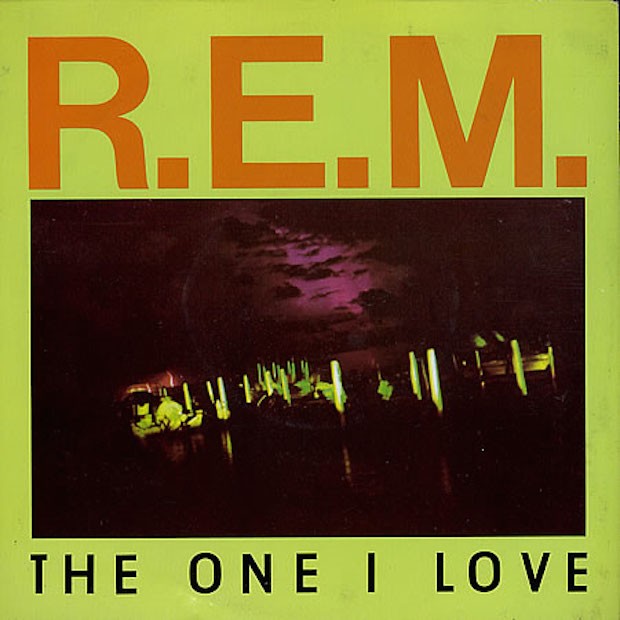
I remember this song well…it was a breakthrough song for REM. I knew some very intense REM fans and they were not happy that they were in the top 10. The cat was out of the bag and the band was not their secret anymore.
The moment that guitarist Peter Buck played that riff on his Rickenbacker 325 I knew I liked this song. It had the jangly sound that previous REM songs had but this one had a larger commercial appeal. This song broke them through to the masses.
The song peaked at #9 in the Billboard 100, #11 in Canada, #16 in the UK, and #6 in New Zealand in 1987.
It was on the album Document and it peaked at #10 in the Billboard Album Charts, #13 in Canada, #28 in the UK, and #17 in New Zealand.
Michael Stipe describes this song as about using people over and over. It sounds like a love song until the line, “A simple prop to occupy my time.”
Mike Mills (Bass Player): “Peter Buck came up with the riff on his porch. I remember Peter, showing me that riff and thinking it was pretty cool, and then the rest of the song flowed from there. We played the whole song as an instrumental until Michael (Stipe) came up with some vocals for it.”
From Songfacts
The lead vocal on the chorus contains just one word: “Fire,” which Michael Stipe draws out into a long wail. In the background, you can hear bass player Mike Mills singing, “She’s comin’ down on her own, now.”
This is not based on any real person or event. The band made up the lyrics while they were on a tour.
For a while, Stipe thought this was too brutal a song to record. He told Q magazine in 1992: “It’s probably better that they think it’s a love song at this point. That song just came up from somewhere and I recognized it as being really violent and awful. But it wasn’t directed at any one person. I would never write a song like that. Even if there was one person in the world thinking, This song is about me, I could never sing it or put it out… I didn’t want to record that, I thought it was too much. Too brutal. I think there’s enough of that ugliness around.”
This was R.E.M.’s first hit song. They had been recording since 1981 and growing a following.
Bush played this at Woodstock ’99 with a much harder sound.
Robert Longo directed the music video for this song, which has images of tenement buildings, dancers and lonely couples, mixed with sweeping clouds, lighting bolts and bursts of flame. The director of photography was Alton Brown, who would go on to be a Food Network star with shows like Good Eats, Iron Chef America and Cutthroat Kitchen.
Speaking to Mojo in 2016, Stipe said that he wasn’t at all dismayed that so many people misinterpreted the sarcastic and spiteful lyrics as a straightforward love song. “I didn’t like the song to begin with,” he explained. “I felt it was too brutal. I thought the sentiment was too difficult to put out into the world. But people misunderstood it, so it was fine. Now it’s a love song, so that’s fine.”
The One I Love
This one goes out to the one I love This one goes out to the one I’ve left behind A simple prop to occupy my time This one goes out to the one I love
Fire (she’s comin’ down on her own, now) Fire (she’s comin’ down on her own, now)
This one goes out to the one I love This one goes out to the one I’ve left behind A simple prop to occupy my time This one goes out to the one I love
Fire (she’s comin’ down on her own, now) Fire (she’s comin’ down on her own, now)
This one goes out to the one I love This one goes out to the one I’ve left behind Another prop has occupied my time This one goes out to the one I love
Fire (she’s comin’ down on her own, now) Fire (she’s comin’ down on her own, now) Fire (she’s comin’ down on her own, now) Fire (she’s comin’ down on her own, now)






 PowerPop... An Eclectic Collection of Pop Culture