Love the guitar tone in this song but you cannot get it out of your head after one listen.
This is a traditional song that folk singer Leadbelly popularized before his death in 1949. He recorded a lot of songs that otherwise might have been lost, including “Goodnight Irene” and “Midnight Special.” Leadbelly’s version is a cappella and commonly sung by laborers to pass the time while working.
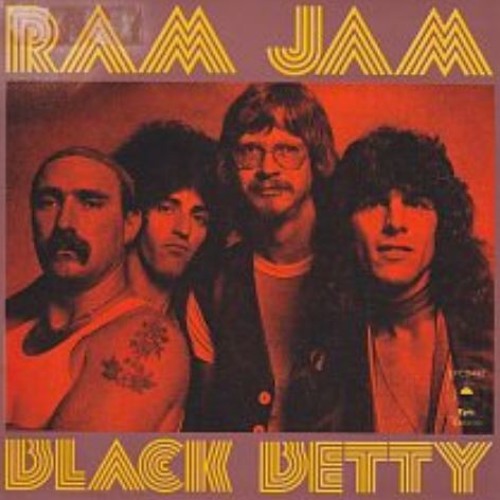
Ram Jam took some heat because some civil rights groups felt the lyrics were disrespectful.
This was Ram Jam’s only hit. The song peaked at #18 in the Billboard 100, #46 in Canada, #7 in the UK, and #8 in New Zealand in 1977.
A remix of “Black Betty” by Ben Liebrand reached number 13 in the UK Singles Chart in 1990. Cover versions of the song also appear on the 2002 album Mr. Jones by Tom Jones and on the 2004 album Tonight Alright by Australian rock band Spiderbait.
From Songfacts
Ram Jam was a short-lived band from New York City, and this was their only hit. While the lyrics can be deconstructed, Ram Jam’s version is driven by the powerful beat and aggressive tempo, making it one of those songs that gets your heart beating faster. The song is commonly played at sporting events to pump up the crowd.
This was produced by Jerry Kasenetz and Jeff Katz, who were architects of the Bubblegum Sound, producing groups like The Ohio Express and the 1910 Fruitgum Company.
The Australian band Spiderbait recorded this in 2004. It was their first single to reach #1 on the Australian charts.
A remixed version of this song is used in the 2002 movie Kung Pow: Enter The Fist when the main character fights the villain.
Black Betty
Whoa, Black Betty (Bam-ba-Lam) Whoa, Black Betty (Bam-ba-Lam)
Black Betty had a child (Bam-ba-Lam) The damn thing gone wild (Bam-ba-Lam) She said, “I’m worryin’ outta mind” (Bam-ba-Lam) The damn thing gone blind (Bam-ba-Lam) I said “Oh, Black Betty” (Bam-ba-Lam) Whoa, Black Betty (Bam-ba-Lam)
Oh, Black Betty (Bam-ba-Lam) Whoa, Black Betty (Bam-ba-Lam)
She really gets me high (Bam-ba-Lam) You know that’s no lie (Bam-ba-Lam) She’s so rock steady (Bam-ba-Lam) And she’s always ready (Bam-ba-Lam) Whoa, Black Betty (Bam-ba-Lam) Whoa, Black Betty (Bam-ba-Lam)
Whoa, Black Betty (Bam-ba-Lam) Whoa, Black Betty (Bam-ba-Lam)
She’s from Birmingham (Bam-ba-Lam) Way down in Alabam’ (Bam-ba-Lam) Well, she’s shakin’ that thing (Bam-ba-Lam) Boy, she makes me sing (Bam-ba-Lam) Whoa, Black Betty (Bam-ba-Lam) Whoa, Black Betty Bam-ba-lam
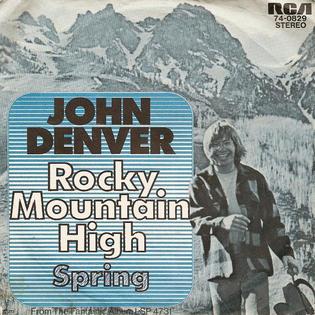
If you asked who the hippest person was in the seventies…John Denver probably would not make the shortlist. He did, however, release some interesting songs and this is one is great. This song peaked at #9 in the Billboard 100 and #8 in Canada in 1973.
Denver started writing this song during the Perseid Meteor Shower which happens every August. He was camping with friends at the tree line at Williams Lake near Windstar (his foundation in Colorado) and all of a sudden there were many shooting stars and he noticed “The shadow from the starlight”… thus the line from the song. He says that while the inspiration struck quickly, it took him about nine months to complete the song. The song was written by John Denver and Mike Taylor.
The song peaked at #9 in the Billboard 100 and #8 in Canada in 1974.
In 2007 “Rocky Mountain High” was named one of the two state songs of Colorado. The other song is “Where the Columbines Grow.”
From Songfacts
In Denver’s autobiography, he wrote: “I remember, almost to the moment, when that song started to take shape in my head. We were working on the next album and it was to be called Mother Nature’s Son, after the the Beatles song, which I’d included. It was set for release in September. In mid August, Annie and I and some friends went up to Williams Lake to watch the first Perseid meteor showers. Imagine a moonless night in the Rockies in the dead of summer and you have it. I had insisted to everybody that it was going to be a glorious display. Spectacular, in fact.
The air was kind of hazy when we started out, but by 10 p.m. it had grown clear. I had my guitar with me and a fishing rod. At some point, I went off in a raft to the middle of the lake, singing my heart out. It wasn’t so much that I was singing to entertain anyone back on shore, but rather I was singing for the mountains and for the sky. Either my voice gave out or I got cold, but at any rate, I came in and found that everybody had kind of drifted off to their individual campsites to catnap. We were right below the tree line, just about ten thousand feet, and we hadn’t seen too much activity in the sky yet. There was a stand of trees over by the lake, and about a dozen aspens scattered around. Around midnight, I had to get up to pee and stepped out into this open spot. It was dark over by those trees, darker than in the clearing. I looked over there and could see the shadow from the starlight. There was so much light from the stars in the sky that there was a noticeable difference between the clearing and everywhere else. The shadow of the starlight blew me away. Maybe it was the state I was in. I went back and lay down next to Annie in front of our tent, thinking everybody had gone to sleep, and thinking about how in nature all things, large and small, were interwoven, when swoosh, a meteor went smoking by. And from all over the campground came the awed responses “Do you see that?” It got bigger and bigger until the tail stretched out all the way across the sky and burned itself out. Everybody was awake, and it was raining fire in the sky.
I worked on the song – and the song worked on me – for a good couple of weeks. I was working one day with Mike Taylor, an acoustic guitarist who had performed with me at the Cellar Door and had moved out to Aspen. Mike sat down and showed me this guitar lick and suddenly the whole thing came together. It was just what the piece needed. When I realized what I had – another anthem, maybe; a true expression of one’s self, maybe – we changed the sequencing of the album we’d just completed, and then we changed the album title.”
Some of the references in the lyrics:
“He was born in the summer of his 27th year” – John was 27 that summer.
“Coming home to a place he’d never been before” – He and Annie had just made Aspen home.
“And he lost a friend but kept his memory” – A good friend from Minnesota had come to visit and was killed riding John’s motorcycle.
“Why they try to tear the mountains down to bring in a couple more” – This referred to the debate at that time about bringing the Olympics to Colorado.
On his BBC radio program The John Denver Show, he set the stage for this song by introducing it with this story: “You and I have just broken out of a huge stand of Douglas fir. The trees tower hundreds of feet above us. We’ve come out of the solemn, cathedral-like darkness of the trees, into the bright, early morning sunshine of a grassy slope. The grass is wet and soft with morning dew beneath our feet. The air is crisp, so crisp it sends little needles of joyful pain through the membranes of your nose. The air is so clear, it seems to purify your lungs. On both sides, above and beyond, stretch the awesome Rockies, their great, snow-capped peaks jutting out of the early morning mist. This is living. This is what man was created for: to live and work and continue what these mountains represent. This is true freedom. Being part of nature and drawing from it, and returning back to it.”
Denver invoked this song when he testified at a Senate hearing in 1985 where he opposed the labeling of albums proposed by the Parents Music Resource Center (PMRC). “As an artist, I am opposed to any kind of a rating system, voluntarily or otherwise,” he said. “My song “Rocky Mountain High” was banned from many radio stations as a drug-related song. This was obviously done by people who had never seen or been to the Rocky Mountains and also had never experienced the elation, celebration of life, or the joy in living that one feels when he observes something as wondrous as the Perseides meteor shower on a moonless, cloudless night, when there are so many stars that you have a shadow from the starlight, and you are out camping with your friends, your best friends, and introducing them to one of nature’s most spectacular light shows for the very first time. Obviously, a clear case of misinterpretation. Mr. Chairman, what assurance have I that any national panel to review my music would make any better judgment?”
Rocky Mountain High
He was born in the summer of his 27th year Coming home to a place he’d never been before He left yesterday behind him, you might say he was born again You might say he found a key for every door
When he first came to the mountains his life was far away On the road and hanging by a song But the string’s already broken and he doesn’t really care It keeps changing fast and it don’t last for long
But the Colorado rocky mountain high I’ve seen it rainin’ fire in the sky The shadow from the starlight is softer than a lullabye Rocky mountain high (Colorado)
He climbed cathedral mountains, he saw silver clouds below He saw everything as far as you can see And they say that he got crazy once and he tried to touch the sun And he lost a friend but kept his memory
Now he walks in quiet solitude the forest and the streams Seeking grace in every step he takes His sight has turned inside himself to try and understand The serenity of a clear blue mountain lake
And the Colorado rocky mountain high I’ve seen it raining fire in the sky You can talk to God and listen to the casual reply Rocky mountain high
Now his life is full of wonder but his heart still knows some fear Of a simple thing he cannot comprehend Why they try to tear the mountains down to bring in a couple more More people, more scars upon the land
And the Colorado rocky mountain high I’ve seen it rainin’ fire in the sky I know he’d be a poorer man if he never saw an eagle fly Rocky mountain high
It’s Colorado rocky mountain high I’ve seen it rainin’ fire in the sky Friends around the campfire and everybody’s high Rocky mountain high Rocky mountain high Rocky mountain high Rocky mountain high Rocky mountain high Rocky mountain high
The two songs today will involve the Rocky Mountains…by song title anyway. This song just flat out rocks. Joe Walsh includes a talk box on the guitar in the solo.
Joe Walsh left the James Gang just as they were building momentum, having scored hits with “Walk Away” and “Funk #49.” Splintering the band as they were on the verge of stardom didn’t go over well with Walsh’s bandmates or their record company, but Joe felt creatively limited in the 3-piece band and wanted out. Colorado put him near James Gang producer Bill Szymczyk, who continued to work with Walsh and produced this album.
When Joe Walsh moved to Colorado, he formed a band called Barnstorm, whose first, self-titled album came out in 1972. Their next album was The Smoker You Drink, The Player You Get, contained this track. The song was co-written by the group: Rocke Grace (keyboards), Kenny Passarelli (bass), Joe Vitale (drums), and Walsh. The music was written before Walsh added the lyrics.
Joe Walsh: “I’m living in Colorado and I’m mowing the lawn. I look up and there’s the Front Range of the Rocky Mountains and there’s snow on them in the summer. And it knocked me back because it was just beautiful. And I thought, ‘Well I have committed. I’m already in Colorado and it’s too late to regret the James Gang. The Rocky Mountain way is better than the way I had, because the music was better.’ I got the words. Bam!”
The song peaked at #23 in the Billboard 100 and #31 Canada in 1973.
This was one of the first songs to feature a talkbox, which allows a guitarist to make distorted vocalizations with his mouth. Peter Frampton is probably the most famous talkbox practitioner, and his use of the device is prominent on his famous 1976 album Frampton Comes Alive.
From Songfacts
After leaving his group the James Gang at the end of 1971, Joe Walsh moved from Cleveland to Boulder, Colorado, where he wrote this song, which celebrates the scenery and lifestyle of Colorado. In some ways, the song is a rocked-up version of John Denver’s “Rocky Mountain High,” which was released the previous year. Both songs use the famous Rocky Mountains as a focal point for the virtues of Colorado.
“Rocky Mountain Way” reflects Walsh’s range of emotions after making the big move. He explained in the book The Guitar Greats: “I got kind of fed up with feeling sorry for myself, and I wanted to justify and feel good about leaving the James Gang, relocating, going for it on a survival basis. I wanted to say ‘Hey, whatever this is, I’m positive and I’m proud’, and the words just kind of came out of feeling that way, rather than writing a song out of remorse. It was special then, and the words were special to me, because the words were like, ‘I’m goin’ for it, the heck with feeling sorry for this and that’, and it did turn out to be a special song for a lot of people. I think the attitude and the statement of that have a lot to do with it – it’s a positive song, and it’s basic rock’n’roll, which is what I really do.”
As for Barnstorm, they played up to their name and did over 300 gigs in 1973. The band broke up after the two albums, which have since been more commonly credited as Joe Walsh solo works.
Walsh is a big baseball fan, and this song has become associated with the game because of the lyrics “Casey’s at bat,” which is a reference to a famous baseball poem. When the Colorado Rockies baseball team formed in 1993, “Rocky Mountain Way” became a popular song at their stadium, Coors Field, where the song is played after a Rockies win.
Joe Walsh described writing the lyrics to this song during an interview with Howard Stern. Walsh explained he had the track recorded but had no ideas for lyrics. He had been living in Colorado after leaving the James Gang over creative differences with the direction of the music. He was mowing his lawn and looking at the Rocky Mountains and the lyrics came to him. He ran inside to write the lyrics but forgot to shut off the lawn mower. The mower ran into his neighbor’s yard and ruined the neighbor’s garden.
“It was a very expensive song to write,” Walsh said, implying he had to pay to repair the damage to the neighbor’s yard. He said the lyrics describe his anxiety about leaving the James Gang and his excitement about a solo career.
Rocky Mountain Way
Spent the last year Rocky Mountain Way Couldn’t get much higher Out to pasture Think it’s safe to say Time to open fire
And we don’t need the ladies Crying ’cause the story’s sad ’cause the Rocky Mountain Way Is better than the way we had
Well he’s tellin’ us this And he’s tellin’ us that Changes it every day Say’s it doesn’t matter Bases are loaded and Casey’s at bat Playin’ it play by play Time to change the batter
And we don’t need the ladies Crying ’cause the storie’s sad, uh huh Rocky Moutain Way Is better than the way we had Hey, hey, hey, hey
Pete Townshend took a chance with this song and the album. Back in1971 when you used any new synthesizer or electronic sounds you ran the risk of sounding dated very quickly as new devices were coming out regularly.
Townshend played a Lowrey TBO-1 organ at his home studio. He tried to run it through an ARP synthesizer/sequencer, but couldn’t get the sound he was looking for. Instead, he used the “marimba repeat” setting on his Lowrey to create an arpeggiated, complex repeating pattern. The album sounds fresh today.
The song was on Who’s Next…arguably the most successful album of the Who’s career. There is not a weak song on the album. The difference in the sound of the album compared to Tommy is phenomenal. This album has a sonic quality that not many albums have.
The album was released on August 14, 1971.
From Songfacts
The first part of the title comes from Meher Baba, who was Pete Townshend’s spiritual guru. The second part comes from Terry Riley, an experimental, minimalist composer Townshend admired – many of the keyboard riffs and sound effects on Who’s Next were a result of Riley’s influence. According to the Who’s Next liner notes, Townshend wrote it as his vision of what would happen if the spirit of Meher Baba was fed into a computer and transformed into music. The result would be Baba in the style of Terry Riley, or “Baba O’Riley.”
The title is not mentioned in the lyrics, so the song is often referred to as “Teenage Wasteland.” The “Teenage Wasteland” section was a completely different song Townshend combined with his “Baba O’Riley” idea to form the song.
Pete Townshend spent a few weeks in his home studio putting together the part that sounds like a synthesizer on a Lowry organ. His goal: to create “a replication of the electronic music of the future.”
When he took the tape of his recording to engineer Glyn Johns, he expected Johns to alter it, but Johns left it as is, insisting it was perfect.
This is the first song on Who’s Next, the most successful album of The Who’s career. Although this is one of the most popular Who songs, it was never released as a single in America or the UK. It was, however, the perfect song for the up-and-coming Album Oriented Rock (AOR) format that was picking up steam on FM radio. Always played in moderation, “Baba” became a Classic Rock staple and remains on many playlists.
When The Who perform this live, the processed organ is played from a recording, since it would be nearly impossible to replicate on an instrument. The guitar doesn’t come in until 1:40, giving Pete Townshend some time to reflect on his work. “There is this moment of standing there just listening to this music and looking out to the audience and just thinking, ‘I f–king did that. I wrote that,” he told Rolling Stone. “I just hope that on my deathbed I don’t embarrass myself by asking someone, ‘Can you pass me my guitar? And will you run the backing tape of ‘Baba O’Riley’? I just want to do it one more time.”
This marked one of the first times a keyboard/synthesizer was used to form the rhythm of a rock song, rather than employing it as a lead instrument.
Regarding the phrase “Teenage Wasteland”:
Lifehouse is set in a time where most of England is a polluted wasteland. Townshend described it as: “A self-sufficient drop-out family group farming in a remote part of Scotland decide to return South to investigate rumors of a subversive concert event that promises to shake and wake up apathetic, fearful British society. Ray is married to Sally, they hope to link up with their daughter Mary who has run away from home to attend the concert. They travel through the scarred wasteland of middle England in a motor caravan, running an air conditioner they hope will protect them from pollution.”
As for the “teenage” bit, Townshend said: “There are regular people, but they’re the scum off the surface; there’s a few farmers there, that’s where the thing from ‘Baba O’Riley’ comes in. It’s mainly young people who are either farmer’s kids whose parents can’t afford to buy them experience suits; then there’s just scum, like these two geezers who ride around in a battered-up old Cadillac limousine and they play old Who records on the tape deck… I call them Track fans.” So basically, teenagers traveling across the wasteland to attend this concert.
The famous violin part was performed by Dave Arbus of the group East of Eden, who created what many consider the first Celtic Rock song with Jig a Jig.
According to Rolling Stone magazine’s 500 Greatest Songs Of All Time, this violin jig at the end was drummer Keith Moon’s idea. In concert, Roger Daltrey would play the jig on harmonica.
This began as part of Townshend’s “Lifehouse” project, which is a film script he wrote. The playscript was published in 1999 by Pocket Books, Great Britain. In the screenplay of “Lifehouse,” Townshend wrote about the composer (Bobby) setting up the concert: “An experiment Bobby conducts in which each participant [in the concert] is both blueprint and inspiration for a unique piece of music or song which will feature largely in the first event to be hacked onto the grid.”
Townshend subsequently decided to actually pursue this, which he did through lifehouse-method.com.
Townshend was never able to convince anyone to do the Lifehouse film, and he more or less gave up on that – but he never gave up on having it produced. He revised the script to be more relevant to the world of the Internet (which had caught up with his 1971 concept of a global grid), and to incorporate thoughts and insights he’d had in the ensuing 25+ years, and it was performed on BBC3 on December 5, 1999.
The final version of the song runs 5:01, but Townshend’s instrumental synthesizer demo of the song was a healthy 9:48. This demo was released in 1972 on a Meher Baba tribute album called I Am.
In an interview with Billboard magazine carried out in February 2010, Townshend discussed how he feels now that 40 years on this and other Who songs take on a deeper meaning. He explained that when he wrote the band’s classic tunes, “The music there was about living in the present and losing yourself in the moment. Now that has changed. Boomers kind of hang on to that as a memory.When I go back and listen to those songs, the Who songs in particular of the late ’60s and early 70s, there was an aspiration in my writing to attune to the fact that what I could feel in he audience was – I won’t say religious – but there was certainly a spiritual component to what people wanted their music to contain. There’s definitely a higher call for the music now which is almost religious. U2, for example, are hugely successful with songs about inner longing for freedom, ideas.
A song like ‘Baba O’Riley,’ with ‘we’re all wasted,’ it just meant ‘we’re all wasted’ – it didn’t have the significance that it now has. What we fear is that in actual fact we have wasted an opportunity. I think I speak for my audience when I say that, I hope I do.”
This is the theme song for the TV show CSI: NY, which launched in 2004, the third in the CSI franchise. Every CSI uses a theme song by The Who: for the original CSI: Crime Scene Investigation it’s “Who Are You,” CSI: Miami uses “Won’t Get Fooled Again,” and for CSI: Cyber it’s “I Can See For Miles.”
This was used in commercials for the 2000 Nissan Pathfinder, and also appeared in ads for Cisco. The Who lost a lot of money on bad business deals in their early years and decided to cash in when they were offered big bucks for commercials.
This quickly became a concert favorite for The Who. Live versions of this song can be found on the albums The Kids Are Alright (1978), Concerts for the People of Kampuchea (1979), Who’s Last (1982), The Blues To The Bush (1999) and The Who & Special Guests Live at the Royal Albert Hall video (2000).
Black Francis of the Pixies finds this song rather intriguing. He broke it down in an interview with Songfacts. “It’s not just straight up verse/chorus/verse/chorus,” Francis said. “I was always impressed by that song, the way that it changes, the way the end of the song sort of becomes the chorus by eliminating one of the chords. It removes the minor chord, and it’s an outro, I guess, but it feels like, Oh, here we are in the chorus again, even though it’s not again – it’s totally different than anything that came before it. So I really like that song. Songs like that I tend to deconstruct a little bit and try to understand what it is that I’m hearing.”
In 2007, the song was covered by The Blue Man Group for the TV show America’s Got Talent. Since then, it has become a staple at Blue Man Group shows.
While Townsend’s keyboard playing is legendary and brilliant, it’s not quite what it seems. When the song was recorded, the band’s newly purchased Lowry organ came with a very special feature: a pedal that, when pressed, would repeat each note played three times in succession. (Source: interstitial on 97.1FM The Mountain, Denver, Colorado – thanks, S.D. – Denver, CO)
Spike Lee used this in his 1999 movie Summer of Sam, and a fully orchestrated version was used at the beginning of the 2002 movie Slackers. Other movies to use the song include:
Far Out (2015) Slash 3 (2015) Premium Rush (2012) The Girl Next Door (2004) Fever Pitch (1997) Prefontaine (1997) Love in Maid (1975)
It has been used in these TV series:
Stranger Things (“Chapter One: Suzie, Do You Copy?” – 2019) Family Guy (“Quagmire’s Mom” – 2015) The Good Guys (“Vacation” – 2010) My Name Is Earl (“The Trial” – 2007) One Tree Hill (“Pictures of You” – 2007) House (“Control” – 2005) King of the Hill (“Tankin’ It to the Streets” – 2002) Miami Vice (“Out Where the Buses Don’t Run” – 1985)
This song was used for Part 3 of the VH1 special The Drug Years about drug use in the 1970s. It showed how drugs went from a religious experience in the ’60s to just getting “Wasted” in the ’70s.
This was used at the end of the trailer for the film The Girl Next Door. The movie encompasses some of the dramas of teenage life.
Baba O’Riley
Out here in the fields I fight for my meals I get my back into my living I don’t need to fight To prove I’m right I don’t need to be forgiven
Don’t cry Don’t raise your eye It’s only teenage wasteland
Sally take my hand We’ll travel south cross land Put out the fire And don’t look past my shoulder The exodus is here The happy ones are near Let’s get together, before we get much older
Teenage wasteland It’s only teenage wasteland Teenage wasteland Oh yeah, teenage wasteland They’re all wasted!
This band had quite a few hits in the seventies. Each of their singles sounded a little different than the previous one. They had songs that included Little Willy, Fox On The Run, Ballroom Blitz, and this one Love Is Like Oxygen. This song marks a change in their sound. You can hear a little Queen and 10cc in their sound.
Sweet guitarist Andy Scott wrote this song and was nominated for an Ivor Novello Award for the composition. It lost to “Baker Street” by Gerry Rafferty.
Life Is Like Oxygen peaked at #8 in the Billboard 100, #8 in Canada, #9 in the UK, and #6 in New Zealand in 1978. This song was the last hit for Sweet as punk coming in.
From Songfacts
Many songs make liberal use of metaphor in the lyrics, but rarely is a song title a direct metaphor, which is the case here. Sweet eschews subtlety as they make the case that love, much like oxygen, must be constantly regulated.
One of Sweet’s more serene song titles, this was Sweet’s last US, UK and German Top 10 hit, as the group left the glam rock scene for the more plush atmosphere of pop-driven music.
Level Headed was Sweet’s first album for their new label Polydor, in which like ELO they found themselves experimenting with mixing rock and classical sounds.
In 2002, Andy Scott told the Slovakian Box Network: “We had finished with our first record company and had begun on a project for another. At that time the era of the Sex Pistols had started, and how people thought of music reached new dimensions. No one knew what was coming next. We were already a part rock, part metal band. Therefore in the area which was most touched by the changes. That is when I wrote the song ‘Love is Like Oxygen,’ and then the idea came along to compose it in a style which at that time was totally new, yet one that suited us. I think it worked out well. Of course the people didn’t accept it so easily. I consider Level Headed to be a good album, it sold around the world.”
The 1975 Hall & Oates’ song “Grounds for Separation” contains similar lyrics: “But isn’t it a bit like oxygen, ’cause too much will make you high, but not enough will make you die.”
Love Is Like Oxygen
Love is Like Oxygen, You get too much, you get too high, Not enough and you’re gonna die. Love gets you high.
Love is Like Oxygen, You get too much, you get too high, Not enough and you’re gonna die. Love gets you high.
Time on my side. I got it all. I heard that pride Always comes before a fall.
There’s a rumor goin’ around the town. That you don’t want me around. I can’t shake off my city blues. Everywhere I turn, I lose.
Love is Like Oxygen, You get too much, you get too high, Not enough and you’re gonna die. Love gets you high.
Love is Like Oxygen, You get too much, you get too high, Not enough and you’re gonna die. Love gets you high.
Time is no healer. If you’re not there. Holy fever. Set words in the air.
Some things are better left unsaid. I’m gonna spend my days in bed. I walk the streets at night, To be hidden by the city light. City light.
Love is Like Oxygen, You get too much, you get too high, Not enough and you’re gonna die. Love gets you high.
Love is Like Oxygen, You get too much, you get too high, Not enough and you’re gonna die. Love gets you high.
A masterpiece. I was 12 when this was released and it sounded timeless even then. It was a great song in 1979 and will be great in 2079. Not only are the words inventive but this was most people’s introduction to Mark Knopfler. I wasn’t a guitar player when I was 12 but I knew he was something special.
I’ve heard this one at what seems like a thousand times but I’ll always turn it up when it comes on the radio.
Sultans of Swing peaked at #4 in the Billboard 100, #4 in Canada, #8 in the UK, and #12 in New Zealand in 1979.
Mark Knopfler was inspired by watching a lousy club band perform. Knopfler was in England on a rainy night. He ducked into a bar where a mediocre band was closing out the night to an audience that was maybe four or five drunks unaware of their surroundings. The hapless jazz combo ended their set with the lead singer announcing, “Goodnight, and thank you. We are the sultans of swing.”
Mark Knopfler:“When the guys said ‘Thank you very much, We are the Sultans of Swing,’ there was something really funny about it to me because Sultans, they absolutely weren’t. You know they were rather tired little blokes in pullovers.”
From Songfacts
This song is about guys who go to a club after work, listen to music and have a good time. They are there for the music, and not for the image presented by the band. The song was a marked change from the waning disco style and the nascent punk movement.
Knopfler got a lot of songwriting ideas from observing everyday people, something that got harder to do when he became famous.
This was Dire Straits’ first single. It was one of five songs on a demo tape they used to get their record deal. The tape got played on London radio and started a bidding war for the band.
Despite the title, the song is not played with a swing rhythm.
A singer-songwriter from Indiana named Bill Wilson, who died in 1993, claimed that he wrote the lyrics to this song. He would often tell the story in concert, which was recorded for a 24-track CD that was released by a production company which recorded various artists between 1989-1995. One of the tracks is Wilson (identified only as “B. Wilson”) performing “Sultans Of Swing.”
There is an asterisk after his name and on the CD it says that this was from a live show performed at The Warehouse in Indianapolis, Indiana. Before Wilson plays the song he says the following: “I do this thing I co-wrote about, I guess, it’s been about 12 years ago I wrote the lyrics and a friend of mine used to work a lot of sessions for my old producer, Bob Johnston, and worked a session with this fellow from England by the name of Mark Knopfler. Has his own group over there called Dire Straits. He had this little melody. It sounded like ‘Walk, Don’t Run.’ And he had this little story concerning a band that nobody wanted to listen to. Only a few people show up to hear. So we got together one night after the session and tossed these lyrics around on a napkin and I guess I wound up writing most of the lyrics to the tune. Made enough money to buy a new Blazer that year I remember, so… didn’t do too bad. It goes like this…”
Then he starts playing an acoustic guitar, strumming Spanish style and singing “Sultans.” The lyrics are pretty close to what Mark Knopfler recorded but are slightly different. In 2009, this was posted to YouTube.
It is unlikely that Wilson’s account is true. Knopfler has never made mention of him, and Wilson is not credited for any contribution to the song. Also, the timeline doesn’t sync: Mark Knopfler didn’t come to America until after the album was released. The session work he did in Memphis was in the late ’80s and early ’90s when he was on a break from Dire Straits.
Sultans of Swing
You get a shiver in the dark It’s a raining in the park but meantime- South of the river you stop and you hold everything A band is blowing Dixie, double four time You feel alright when you hear the music ring
Well now you step inside but you don’t see too many faces Coming in out of the rain they hear the jazz go down Competition in other places Uh but the horns they blowin’ that sound Way on down south Way on down south London town
You check out guitar George, he knows-all the chords Mind, it’s strictly rhythm he doesn’t want to make it cry or sing They said an old guitar is all, he can afford When he gets up under the lights to play his thing
And Harry doesn’t mind, if he doesn’t, make the scene He’s got a daytime job, he’s doing alright He can play the Honky Tonk like anything Savin’ it up, for Friday night With the Sultans We’re the Sultans of Swing
Then a crowd a young boys they’re a foolin’ around in the corner Drunk and dressed in their best brown baggies and their platform soles They don’t give a damn about any trumpet playin’ band It ain’t what they call Rock and Roll And the Sultans Yeah, the Sultans, they play Creole Creole
And then the man he steps right up to the microphone And says at last just as the time bell rings “Goodnight, now it’s time to go home” Then he makes it fast with one more thing
I always liked the rhythm of this song and the stuttering vocal.
Bachman wasn’t planning to release the song with the stuttering vocal. He sang it with the stutter to poke fun at his brother Gary, who had a speech impediment. During microphone checks, he would sing it with the stutter and recorded a version that was intended just for Gary. His record company liked it a lot better than the non-stuttering version, so that’s the one they released. Eventually, Gary stopped stuttering.
The song peaked at #1 in the Billboard 100, #1 in Canada, #1 in New Zealand, and #2 in the UK in 1974.
Randy Bachman: “I was rehearsing and producing BTO’s third album. We needed an FM Top 40 hit, something light with a heavy bit in it. At that time, I was inspired by Traffic’s Dave Mason and his song Only You Know And I Know, which had a dang-a-lang rhythm, and the Doobie Brothers’ Listen To The Music. So I copped those jangling rhythms, changed the chords and then added some power chords of my own. I had a work in progress, in two parts: a great rhythm and a heavy riff.”
“I thought it was embarrassing, but it went to No.1 in the States and 2. other countries. I was dumbfounded. Particularly because as soon it became a hit my brother stopped stammering.”
From Songfacts
This is one of the most famous songs with prominent stutter, as Randy Bachman sings, “B-b-b-baby, you just ain’t seen n-n-nothin’ yet.”
The lyrics, especially “She took me to her doctor and he told me of a cure,” led to rumors that the song was about herpes or some other social disease. According to Bachman, the lyrics are just words he improvised, as he didn’t thing the song was going to be released and was just using it to test levels in the studio.
Randy Bachman produced the Not Fragile album and used this song to test dynamics in the studio, since the guitars would go from quiet to loud.
When the band recorded it, they didn’t think it would be released, so they didn’t bother perfecting it – or even tuning their instruments. Bachman’s vocal was considered a scratch track. This became Bachman’s “work song” for testing.
The band only played it for their label after the boss at Mercury, Charlie Fach, heard the eight songs they completed and didn’t hear a hit. The engineer suggested playing him the “work song,” and Bachman reluctantly agreed.
When Fach heard the song, he loved it, warts and all. In a Songfacts interview with Bachman, he explained: “Charlie said, ‘I want to put this on the album.’ And I said, ‘I need to remix it.’ And he said, ‘Don’t touch it. Put it on the way it is. When you play this with the other songs, it just jumps off the turntable.'”
The title is grammatically incorrect. It is a double-negative, although “You Haven’t Seen Anything Yet” wouldn’t have the same ring to it.
This song came about when the band was playing a jam session in the key of “A.” “Takin’ Care Of Business” also came out of a jam session, but that one was in the key of “C.”
Randy Bachman wrote this song and sang lead. He and his bandmate Fred Turner split vocal duties in the band.
Bachman’s inspiration for the intro/verse melody was Dave Mason’s “Only You Know and I Know.”
Stephen King referenced “You Ain’t Seen Nothing Yet” in the short story “Big Driver” from his 2010 collection, Full Dark, No Stars, when the protagonist hears the tune blasting from a car. King has another connection to the band. Early in his career, his publisher only allowed him to release one book a year, so he bypassed the rule by coming up with a pen name: Richard Bachman, inspired by the Richard Stark novel on his desk and the Bachman-Turner Overdrive album in his record player.
This was used in these TV shows:
My Name Is Earl (“Darnell Outed: Part 1” – 2009) Supernatural (“The Magnificent Seven” – 2007) Cold Case (“Yo, Adrian” – 2005) The Sopranos (“Watching Too Much Television” – 2002) The Simpsons (“Saddlesore Galactica” – 2000)
And in these movies:
The Watch (2012) It’s A Boy Girl Thing (2006) The Ex (2006) Joe Dirt (2001) Pushing Tin (1999)
You Ain’t Seen Nothing Yet
I met a devil woman She took my heart away She said, I’ve had it comin’ to me But I wanted it that way I think that any love is good lovin’ So I took what I could get, mmh Oooh, oooh she looked at me with big brown eyes
And said, You ain’t seen nothin’ yet B-b-b-baby, you just ain’t seen n-n-nothin’ yet Here’s something that you never gonna forget B-b-b-baby, you just ain’t seen n-n-nothin’ yet
Nothin’ yet, you ain’t been around That’s what they told me
And now I’m feelin’ better ‘Cause I found out for sure She took me to her doctor And he told me of a cure He said that any love is good love So I took what I could get Yes, I took what I could get And then she looked at me with them big brown eyes
And said, You ain’t seen nothin’ yet B-b-b-baby, you just ain’t seen n-n-nothin’ yet Here’s something, here’s something your never gonna forget, baby You know, you know, you know you just ain’t seen nothin’ yet
You need educatin’ You got to got to school
Any love is good lovin’ So I took what I could get Yes, I took what I could get And then, and then, and then She looked at me with them big brown eyes
And said, You ain’t seen nothin’ yet Baby, you just ain’t seen n-n-nothin’ yet Here’s something, here’s something Here’s something that your never gonna forget, baby Baby, baby, baby you ain’t seen n-n-nothin’ yet You ain’t been around You ain’t seen nothin’ yet That’s what she told me She said, I needed educatin’, go to school I know I ain’t seen nothin’ yet I know I ain’t seen nothin’ yet Got something for you right now Feels good, alright, how do you do that? But I ain’t seen nothin’ yet I deserve it one of these days Woohoo, but I ain’t seen nothin’ yet Yeahyeahyeahyeahyeahyeah I ain’t seen nothin’ yet I’ll wait, I’ll wait, I’ll wait If you want to show me what I ain’t seen, where I ain’t been Lalalalalala
My wife asked me if I have ever posted this song before. So for her… here it is…September by Earth, Wind, and Fire. It was her…”Jr High Song.” One warning…when you hear it you cannot get it out of your head.
Maurice White, Al McKay, Allee Willis wrote this song. Maurice White said he got the idea for this song in an unlikely place… a hotel room in Washington DC while there was some kind of protest going on below. Said White, “There’s all these cats screaming and throwing things and going crazy and this tune just evolved.”
September peaked at #1 in the Billboard 100, #3 in the UK, #10 in Canada, and #12 in New Zealand in 1979.
Earth, Wind, and Fire had 33 songs in the top 100, 7 top ten hits, and one number 1.
Verdine White (Bass Player): “People now are getting married on September 21st,” he said. “The stock market goes up on September 21st. Every kid I know now that is in their 20s, they always thank me because they were born on September 21st.”
From Songfacts
This song has a tendency to make people happy when they hear it. Allee Willis, who wrote the song with Maurice White and Al McKay from Earth, Wind & Fire, describes it as “Joyful Music.”
It was the first song Willis wrote with the band, and quite a learning experience. She told us: “Their stuff was very much based on Eastern philosophies, an incredibly positive outlook on life; the lyrical content of their songs was not typical of what would have been in soul music at that time. So when I left the studio that first day, Maurice gave me the name of a book, it was called The Greatest Salesman In The World, and he sent me to the Bodhi Tree, which is a very spiritual bookstore here in LA. I got that and a bunch of other books that the saleswoman said was the philosophy. And what went from being a very simple experience turned into, for me, an incredibly complex experience. Because I dove into these books.
And even the way they were written, the language they were written in, I kind of didn’t understand anything. But Maurice told me right from the jump he thought I was a very spiritual person, and I was put here to communicate. And I thought, if Maurice was saying that to me, I need to hang with this.
I was pouring through these books for a couple of months. Lyrics started being 25-30 pages long as I’m trying to figure all this stuff out. Reading all that stuff changed me forever. He lead me to a path I’ve stayed on.
“So ‘September’ was fantastic and thrilling, and they had started the intro of it by the time I had walked into the studio to meet everyone. Just as I opened the door and I heard that little guitar intro, I thought, Oh God, please let this be what they want to work with me on. Because it was so obviously a hit.” (Here’s our full Allee Willis interview. Her website is alleewillis.com.)
While there are many theories as to the “21st night of September” in the opening lyrics, the truth is they just felt right. Willis told us: “Maurice had that very first line, and I said to him, ‘Why the 21st?’ Because I’m someone who likes to tie up all the ends very neatly, so if I’m saying the 21st, I want to know during the song what’s the significance. But he always told me there was no real significance. So whether that’s true or not I can’t say. But as far as I know, it’s just something that sang really well. And I would say the main lesson I learned from Earth, Wind & Fire, especially Maurice White, was never let a lyric get in the way of a groove. Ultimately it’s the feel that is the most important, and someone will feel what you’re saying if those words fit in there right. I do remember us experimenting with other dates, but 21st just sang phonetically fantastic.”
Willis co-wrote most of the songs on Earth, Wind & Fire’s next album I Am, including the hit “Boogie Wonderland.”
Although many people hear the first words in the chorus as “Party On,” it’s really “Bada-Ya.” Allee Willis explained in her Songfacts interview: “I absolutely could not deal with lyrics that were nonsensical, or lines that weren’t complete sentences. And I’m exceedingly happy that I lost that attitude. I went, ‘You cannot leave bada-ya in the chorus, that has to mean something.’ Maurice said, ‘No, that feels great. That’s what people are going to remember. We’re leaving it.’ We did try other stuff, and it always sounded clunky – thank God.”
This was written specifically for Earth, Wind & Fire’s greatest hits album The Best of Earth, Wind & Fire, Vol. 1. Along with their cover of “Got To Get You Into My Life,” it was one of two new songs included on the set, which became their best-selling album and helped the band cross over to a broader audience.
Movies that used this song include Night at the Museum, The Ringer, Soul Food, Dan In Real Life and Babel.
This was featured on the NBC spy comedy Chuck in the 2010 episode “Chuck Versus the Living Dead.” On the show, Buy More manager Big Mike claims he was once a member of the band back when they were called Earth, Wind, Fire & Rain (he was Rain).
Taylor Swift released an airy, banjo-and-acoustic-guitar version of this song on April 13, 2018 that provoked ire on social media. Her recording was part of a Spotify promotion; she explained that she covered it for “sentimental reasons” and because the month of September is when one of her memorable breakups occurred.
Philip Bailey of EW&F came to her defense, tweeting,”Music is free like that… Ain’t Got Nothing But Love for Ya.”
September
Do you remember the 21st night of September? Love was changing the minds of pretenders While chasing the clouds away
Our hearts were ringing In the key that our souls were singing As we danced in the night Remember how the stars stole the night away
Hey hey hey Ba de ya, say do you remember Ba de ya, dancing in September Ba de ya, never was a cloudy day
Ba duda, ba duda, ba duda, badu Ba duda, badu, ba duda, badu Ba duda, badu, ba duda
My thoughts are with you Holding hands with your heart to see you Only blue talk and love Remember how we knew love was here to stay Now December found the love that we shared in September Only blue talk and love Remember the true love we share today
Hey hey hey Ba de ya, say do you remember Ba de ya, dancing in September Ba de ya, never was a cloudy day
There was a Ba de ya, say do you remember Ba de ya, dancing in September Ba de ya, golden dreams were shinny days
The bell was ringing Our souls were singing Do you remember, never a cloudy day
There was a Ba de ya, say do you remember Ba de ya, dancing in September Ba de ya, never was a cloudy day
There was a Ba de ya, say do you remember Ba de ya, dancing in September Ba de ya, golden dreams were shinny days
Ba de ya de ya de ya Ba de ya de ya de ya Ba de ya de ya de ya de ya
Ba de ya de ya de ya Ba de ya de ya de ya Ba de ya de ya de ya de ya
Since we have had plenty of time in this lockdown we are living in…I’ve revisited a lot of characters that I remembered from some great shows. Many times my favorite characters are not the stars of the shows…but a supporting character with a few exceptions…anyway…here they are and I hope you enjoy them. They are in no order.
Hank Kimball (Alvy Moore) – Green Acres – If I met Hank Kimball in real life… I would want to choke him but he is funny. I have never seen a character like him…he is the definition of short term memory loss.
Reverend Jim Ignatowski (Christopher Lloyd) – Taxi – His scenes are the scenes I look forward to in every episode of Taxi. A heart of gold but a history of being stoned and using his own unique logic.
Arthur Dietrich (Steve Landesberg) – Barney Miller – Arthur Dietrich was like a walking encyclopedia. He knew something it seemed about every subject…and a very dry sense of humor. He might be the least known on my list but again…a truly original character.
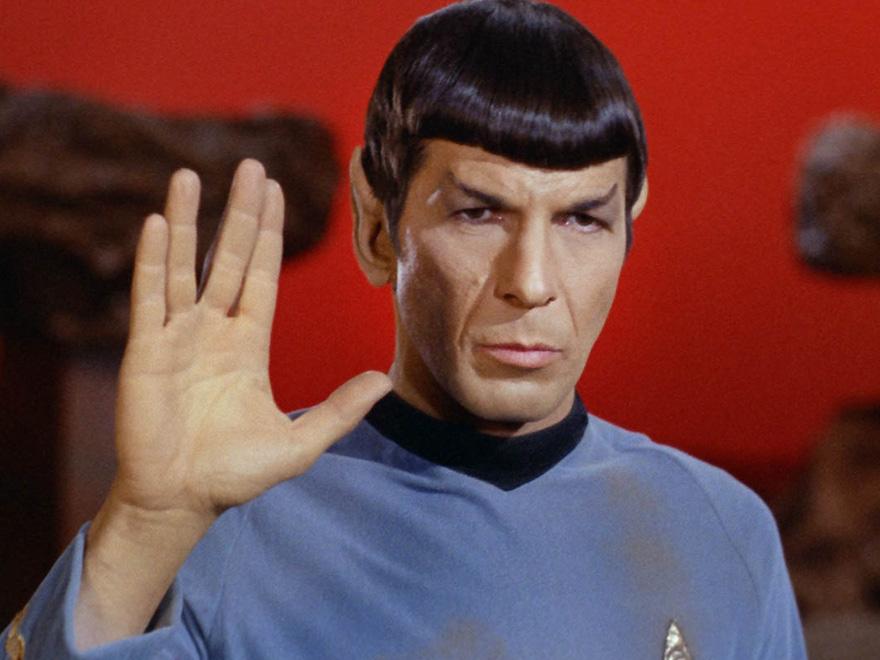
Spock (Leonard Nimoy) – Star Trek – What a character Spock was…like a few others on this list…totally original. He is the reason I started to like Star Trek in the first place.
Columbo (Peter Falk) – Columbo – I went over Colombo yesterday. An untidy guy who appears to be a bumbling detective but will find the killer every time.
Gene Hunt (Philip Glenister) – Life On Mars – American readers may not know this character but he is the most politically incorrect character that you could possibly have on a show. A 1973 Detective Chief Inspector that loves his city and don’t get in his way of trying to defend it. He is much like a movie sheriff in the old west.
Tony Soprano (James Gandolfini) – The Sopranos – Modern mobster… He is a murderer and a thief who preys on society and exploits the system…while having a family that he loves. You could teach a college class by studying his character traits. One of the truly great characters.
Gomez Addams (John Astin) – Addams Family – John Astin played him so well. Very irrelevant to whatever was going on around him…and he LOVED train crashes.
Homer Simpson – Simpsons – Role model? NO Smart? NO NO Father of the Year? NO NO NO but funny and he does love his family…and doughnuts.
Doctor Who – (Tom Baker, David Tennant, and Matt Smith) – Doctor Who is really a superhero in a lot of ways. Unlike Superman or other heros…he uses his brains more than anything to save someone or to save earth from destruction.
I remember Columbo well when I was a kid but I never watched it much…until the lockdown that we all are going through. Now I know why this show was popular. A detective show that shows you “who done it” before you are into it for 10 minutes. You get enjoyment out of seeing how Columbo can find the killer. Back in the early seventies…Columbo was one of the most popular characters on television.
Peter Falk played Columbo for 35 years and in five different decades (1968-2003) counting the pilots. He looked like a walking unmade bed but was brilliant at solving cases. He would pester his suspect to death…very polite with “I’m sorry” and the main phrase as he was walking away…”There’s just one more thing.” that is followed by “There’s something that bothers me” and so on.
The killer would end up confessing or probably wanting to beg for jail simply to escape him.
The show lasted for 69 episodes. Each episode was over an hour long. It was part of The NBC Mystery Movie program that worked on a rotating basis – one per month from each of its shows. The shows were McMillian and Wife, McCloud, Hec Ramsey, and Columbo. Columbo was taken off the air in the late seventies but came back on the air in the eighties.
Falk had to wear a glass eye because his eye was taken out because of a tumor when he was 3 years old. That made Columbo’s trademark squint. He wore his raincoat and later on had a basset hound. Stories of his wife were always at hand all the while studying his suspect to see if they would slip.
Falk really made that role. If you get a chance to see it…try it. The stories are interesting and you will see some stars you might have forgotten about.
This is my favorite song on In Through The Out Door. The beginning sounds like the end of the world is coming. There is a build-up of sound and then Jimmy blasts the main riff of this song.
The intro was apparently taken from a soundtrack Jimmy Page was working on for fellow Aleister Crowley admirer Kenneth Anger’s film Lucifer Rising.
The song was not released as a single as usual for Led Zeppelin but the album peaked at #1 in the Billboard Album Charts in 1979. This album and The Wall by Pink Floyd were said to help save a Record industry that was slumping at the time.
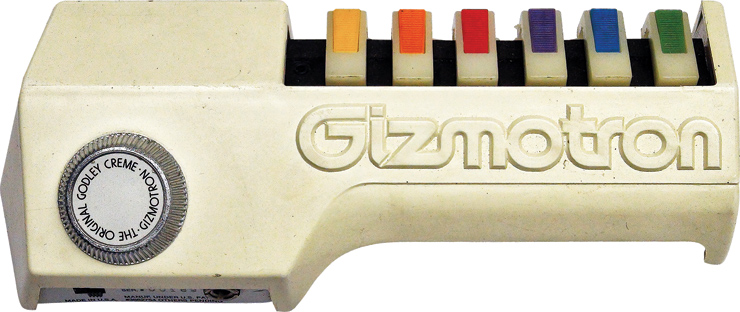
Jimmy Page used a drone effect on his guitar similar to create a sound similar to what he did on the song “In The Light,” but instead of using a cello bow on his guitar, he used a Gizmotron to create the effect. The Gizmotron is a guitar processing device invented by Lol Creme and Kevin Godley from the band 10cc to get a strange distorted sound.
After reading about the Gizmotron…I want one!
Gizmotron
From Songfacts
Robert Plant’s lyrics are about how the rich and famous are still exposed to pain and suffering, just in different ways.
When they were recording this album, Jimmy Page and John Bonham were spending a lot of time together and would usually show up at the studio very late and work through the night. This started out with just drums and keyboards created by John Paul Jones, who had a new drum machine to work with.
Robert Plant called this song, “A great one, a real stomper.”
In The Evening
In the evening When the day is done I’m looking for a woman But the girl don’t come So don’t let her Play you for a fool She don’t show no pity, baby She don’t make no rules
Oh, I need your love I need your love Oh, I need your love I just got to have
So don’t you let her Oh, get under your skin It’s only bad luck and trouble From the day that you begin I hear you crying in the darkness, Don’t ask nobody’s help Ain’t no pockets full of mercy, baby ‘Cause you can only blame yourself
Oh, I need your love Oh, oh, I need your love Yeah, I need your love I just got to have
Oh, it’s simple All the pain that you go through You can turn away from fortune, fortune, fortune ‘Cause that’s all that’s left to you Oh, it’s lonely at the bottom Man, it’s dizzy at the top But if you’re standing in the middle Ain’t no way you’re gonna stop, oh
Oh, I need your love Oh, oh, I need your love Oh, oh, I need your love I just got to have
Ooh, whatever that your days may bring No use hiding in a corner ‘Cause that won’t change a thing If you’re dancing in the doldrums One day soon, it’s got to stop, it’s got to stop When you’re the master of the off-chance When you don’t expect a lot
Oh, I need your love Oh, oh, I need your love Oh yeah, I need your love I just got to have, I just got to have
I never checked the statistics…but I have to think there had to be a baby explosion nine months after “Let’s Get It On” was released in 1973. Anyone born in 1974 may owe their very existence to this song.
This song’s co-writer Ed Townsend also produced the album with Marvin and co-wrote the three other songs on the first side of the disc, including “Keep Gettin’ It On.” He wrote with Marvin again on songs for Marvin’s 1978 album Here, My Dear.
This song peaked at #1 in the Billboard 100, The guitar and voice are excellent in this song. There is no guessing what this song is about.
Marvin Gaye: “I can’t see anything wrong with sex between consenting anybodies. I think we make far too much of it. After all, one’s genitals are just one important part of the magnificent human body … I contend that SEX IS SEX and LOVE IS LOVE. When combined, they work well together, if two people are of about the same mind. But they are really two discrete needs and should be treated as such. Time and space will not permit me to expound further, especially in the area of the psyche. I don’t believe in overly moralistic philosophies. Have your sex, it can be exciting if you’re lucky. I hope the music that I present here makes you lucky.”
Jon Landau (former rock critic and current manager of Bruce Springsteen) “Let’s Get It On” is a classic Motown single, endlessly repeatable and always enjoyable. It begins with three great wah-wah notes that herald the arrival of a vintage Fifties melody. But while the song centers around classically simple chord changes, the arrangement centers around a slightly eccentric rhythm pattern that deepens the song’s power while covering it with a contemporary veneer. Above all, it has Marvin Gaye’s best singing at its center, fine background voices on the side, and a long, moody fade-out that challenges you not to play the cut again.
From Songfacts
Originally written by 1950s one-hit-wonder Ed Townsend (“For Your Love” in 1958), the song originally addressed the author’s desire to get on with life after beating alcoholism. Marvin Gaye completely changed the lyrics (and meaning) to the song after meeting Janis Hunter, the woman who would become his second wife. The song helped cement Gaye’s reputation as one of the greatest singers of baby-making music. Songwriting credits on the song went to both Gaye and Townsend.
“Let’s Get It On” was the title track of Gaye’s 1973 album. It topped the Billboard Pop Singles chart for two weeks and the Billboard Soul Singles chart for eight weeks. It also made history as Motown’s most successful release in the United States to that date and the second most successful song of 1973 (behind Tony Orlando & Dawn’s “Tie A Yellow Ribbon Round The Ole Oak Tree”).
This song has appeared in a variety of TV shows, movies, and commercials, often for comic effect to imply an imminent romantic encounter. Some of the media uses include the TV shows The Simpsons, The Sopranos, Scrubs, House, Ugly Betty, Charmed, Spin City and The King of Queens.
Movie uses include Into the Night (1985), Queens Logic (1991), The Inkwell (1994), Austin Powers: The Spy Who Shagged Me (1999), High Fidelity (2000), Crossroads (2002), Something’s Gotta Give (2003), Mr. 3000 (2004), Bridget Jones: The Edge of Reason (2004), The Change-Up (2011), and The Dictator (2012).
Let’s Get It On
I’ve been really tryin’, baby Tryin’ to hold back this feeling for so long And if you feel like I feel, baby Then, c’mon, oh, c’mon
Let’s get it on Ah, baby, let’s get it on Let’s love, baby Let’s get it on, sugar Let’s get it on
We’re all sensitive people With so much to give Understand me, sugar Since we’ve got to be here Let’s live I love you
There’s nothing wrong with me Loving you, baby no no And giving yourself to me can never be wrong If the love is true, oh baby
Ooh don’t you know how sweet and wonderful life can be ooh I’m asking you baby to get it on with me ooh ooh I ain’t gonna worry I ain’t gonna push, won’t push you baby So c’mon, c’mon, c’mon, c’mon, c’mon, baby Stop beatin’ ’round the bush, hey
Let’s get it on Let’s get it on You know what I’m talkin’ ’bout C’mon, baby Let your love come out If you believe in love Let’s get it on Let’s get it on, baby This minute, oh yeah Let’s get it on Please, please get it on
I know and you know what I’ve been dreaming of, don’t you baby? My whole body makes that feelin’ of love, I’m happy I ain’t gonna worry, no I ain’t gonna push I won’t push you baby, woo
C’mon, c’mon, c’mon, c’mon, c’mon, darlin’ Stop beatin’ ’round the bush Oh, gonna get it on Threatenin’ you, baby I wanna get it on You don’t have to worry that it’s wrong If the spirit moves ya Let me groove ya good Let your love come down Oh, get it on
C’mon, baby Do you know the meaning? I’ve been sanctified Girl, you give me good feeling I’ve been sanctified
Oh dear I, baby Nothing wrong with love If you want to love me just let your self go Oh baby, let’s get it on
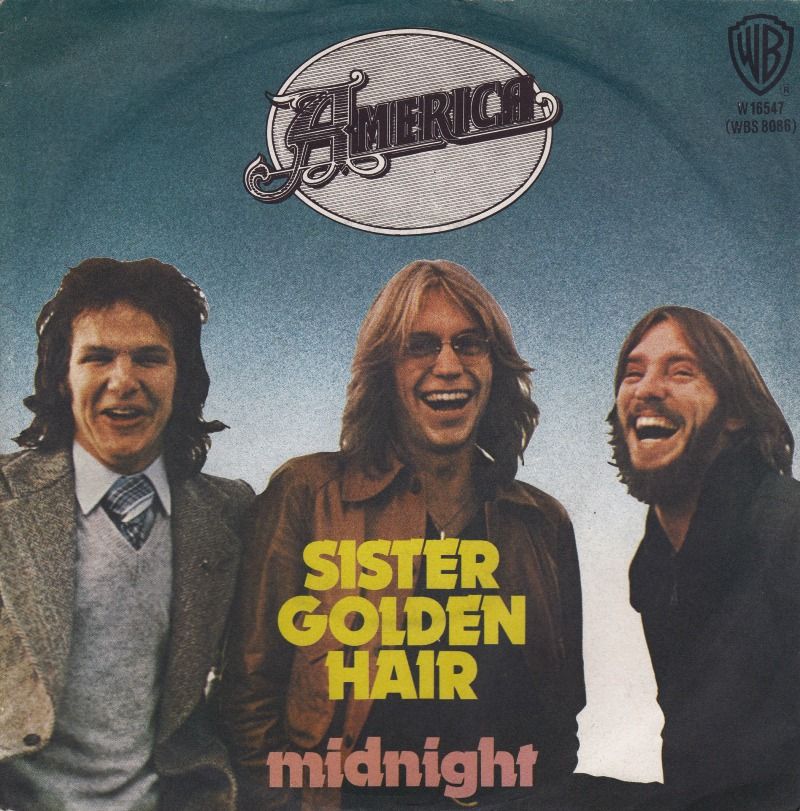
I’ve always liked the slide guitar in this song. It has a George Harrison sound to it. The song was on America’s album Hearts. The former Beatle producer George Martin produced this album.
Gerry Beckley wrote “Sister Golden Hair,” America’s second and final number one hit. Beckley has said that Jackson Brown and George Harrison inspired this song.
The song peaked at #1 in the Billboard 100, #11 in Canada, and #26 in New Zealand.
Gerry Beckley: “I very openly tip my hat there to ‘My Sweet Lord,'” “I was such a fan of all the Beatles, but we knew George [Harrison] quite well and I just thought that was such a wonderful intro.”
One interesting thing about the album… Phil Hartman, who was a graphic designer before his star turn in Saturday Night Live, designed the cover to the Hearts album.
From Songfacts
America’s first single, “A Horse With No Name,” went to #1 in 1972. That song was written by Dewey Bunnell, who formed the band in 1970 with Gerry Beckley and Dan Peek (the group became a duo when Peek left in 1977).
In 1975, they scored another #1 with “Sister Golden Hair,” another enigmatic track with lots of harmony. It was written and sung by Beckley, who says that it was based on a composite of different girls. When asked if it was written to anyone, Beckley said: “No, this is all poetic license. With ‘Sister Golden Hair,’ as far as my folks were concerned, I was writing a song about my sister, and I couldn’t quite fathom it; they must not have listened to the lyrics.”
“I’d like to point out that you can have a #1 record with a line that enters that darkly,” he said. “That’s kind of my thing: I try to mix these emotions and I think ‘Sister’ was a great example. Pretty good message in there. John Lennon famously said, ‘We don’t know what these songs are about till people tell us.’ So all of our songs, including ‘Horse,’ are open to interpretation. But ‘Sister’ was a relationship song and there is a variety of elements. We always combine them as songwriters so that they’re not verbatim, word for word, for a particular circumstance. Poetic license we call it.”
In our interview with Gerry Beckley, he explained that he made a demo of this song before America recorded their fourth album, Holiday, but he was happy with the songs they chose for that album so “Sister Golden Hair” sat on the shelf for a year, making the cut for their next album, Hearts.
“I can’t really tell you if it was a lack of faith in the song or not, but it was interesting to see,” he said. “It shows you that songs can have a life of their own – they might just need the right time and circumstances to surface.”
This song was used in a bloody scene in the 2001 episode of the TV series The Sopranos, “Another Toothpick.” After a mobster kills two people, the song plays on his car radio as he drives off. When he has trouble breathing and can’t reach his inhaler, he crashes the car and dies, but the song keeps playing.
“Sister Golden Hair” also appears in the movies Cherish (2002), Radio (2003) and All the Boys Love Mandy Lane (2006).
George Martin, who was The Beatles producer, produced this track and the rest of the Hearts album (he started working with America on their previous album, Holiday). It was Martin’s 20th US #1 as a producer, and his first away from The Beatles (by this point, each former Beatle had reached #1 outside of the group). Martin would have three chart-toppers: “Ebony and Ivory,” “Say Say Say” and “Candle In The Wind ’97.”
This was recorded at the Record Plant in Sausalito, California. The engineer on the session was Geoff Emerick, who worked with George Martin on much of The Beatles output.
Beckley played lap steel guitar on this track. He told Songfacts that the musical influence came from George Harrison. “I very openly tip my hat there to ‘My Sweet Lord,'” he said. “I was such a fan of all The Beatles but we knew George quite well and I just thought that was such a wonderful intro.”
The group recorded a version in Spanish called “Hermana de Cabellos Dorados.” Gerry Beckley doesn’t speak Spanish, so he did it phonetically.
Sister Golden Hair
Well I tried to make it Sunday, but I got so damn depressed That I set my sights on Monday and I got myself undressed I ain’t ready for the altar but I do agree there’s times When a woman sure can be a friend of mine
Well, I keep on thinkin’ ’bout you, Sister Golden Hair surprise And I just can’t live without you; can’t you see it in my eyes? I been one poor correspondent, and I been too, too hard to find But it doesn’t mean you ain’t been on my mind
Will you meet me in the middle, will you meet me in the air? Will you love me just a little, just enough to show you care? Well I tried to fake it, I don’t mind sayin’, I just can’t make it
Well, I keep on thinkin’ ’bout you, Sister Golden Hair surprise And I just can’t live without you; can’t you see it in my eyes? Now I been one poor correspondent, and I been too, too hard to find But it doesn’t mean you ain’t been on my mind
Will you meet me in the middle, will you meet me in the air? Will you love me just a little, just enough to show you care? Well I tried to fake it, I don’t mind sayin’, I just can’t make it
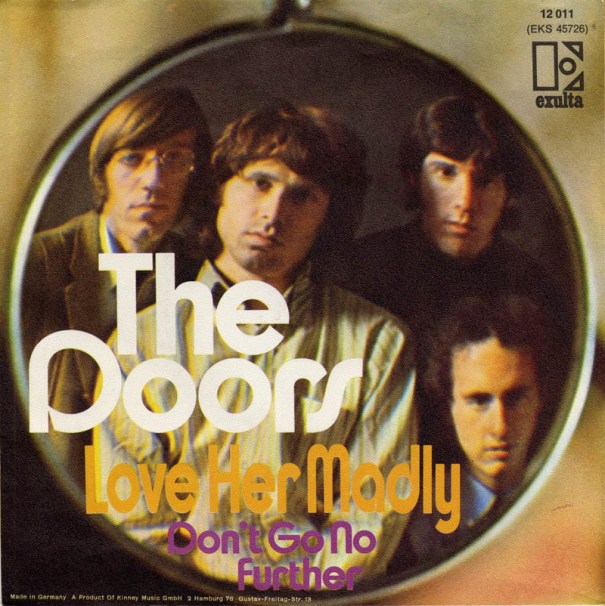
This is one of the Door’s radio hits that I like. I bought the album LA Woman at relative’s yardsale for 10 cents when I was around 12. I went through a Doors phase and even bought the An American Prayer album with a lot of spoken word poetry by Jim Morrison. That ended my fascination with Jim and the Doors. I do like some of their radio hits…my phase lasted around 6 months.
LA Woman is a good album and was the last album they recorded with Jim Morrison, who died shortly after it was released. The album peaked at #9 in 1971.
Doors guitarist Robby Krieger wrote this song on a 12-string guitar. It is about the numerous times his girlfriend…later his wife Lynn, threatened to leave him. Krieger said: “Every time we had an argument, she used to get pissed off and go out the door, and she’d slam the door so loud the house would shake,”
The song peaked at #11 in the Billboard 100 and #3 in Canada in 1971.
From Songfacts
Krieger, John Densmore, and Ray Manzarek recorded a new version with Bo Diddley for the 2000 Doors tribute album Stoned Immaculate.
This was recorded in a very casual atmosphere. The musicians all played together, with no overdubs. They produced it themselves, which meant they could relax and make their own rules. The whole album was recorded in just two weeks.
The group’s longtime producer Paul Rothchild had this to say in an interview with BAM magazine: “That’s exactly the song I was talking about that I said sounded like cocktail music. That’s the song that drove me out of the studio. That it sold a million copies means nothing to me. It’s still bad music.”
Along with “Hello, I Love You,” “People Are Strange” and “Soul Kitchen,” this was used in the movie Forrest Gump. It plays in a scene where Jenny (Robin Wright) runs out of a motel with a black eye.
The title is a twist on a phrase Duke Ellington popularized. At his concerts, he would say, “we love you madly.”
The Doors didn’t have a bass player, but sometimes used one in the studio to beef up the low end. On “Love Her Madly,” Jerry Scheff, famous for his work with Elvis Presley, played.
Love Her Madly
Don’t ya love her madly Don’t ya need her badly Don’t ya love her ways Tell me what you say
Don’t ya love her madly Wanna be her daddy Don’t ya love her face Don’t ya love her as she’s walkin’ out the door Like she did one thousand times before
Don’t ya love her ways Tell me what you say Don’t ya love her as she’s walkin’ out the door
All your love All your love All your love All your love
All your love is gone So sing a lonely song Of a deep blue dream Seven horses seem to be on the mark
Yeah, don’t you love her Don’t you love her as she’s walkin’ out the door
All your love All your love All your love
Yeah, all your love is gone So sing a lonely song Of a deep blue dream Seven horses seem to be on the mark
Well, don’t ya love her madly Don’t ya love her madly Don’t ya love her madly
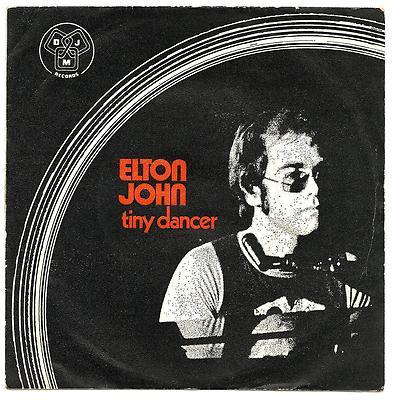
Tiny Dancer is a nice way to start your Sunday morning. Cameron Crowe did a great job of using this song in the movie Almost Famous…which I recommend highly.
The lyrics were written by Bernie Taupin, Elton’s writing partner, and were inspired by Taupin’s first trip to America. John and Taupin are from England, and Madman Across The Water was the first album they wrote after spending time in the US. Taupin and John spent a lot of time together in the ’70s; Bernie traveled with the band and would usually stand by the soundboard during shows.
The “blue jean baby, LA Lady, seamstress for the band” could have been Maxine Feibelmann, who was Bernie Taupin’s girlfriend when he wrote the song and who became his first wife in 1971. She traveled with the band on their early tours, often sewing together the costumes and fixing their clothes. Plus, on the Madman Across The Water album, it says, “With love to Maxine” under the credits for this song. Elton John even said at one point that Bernie wrote it about his girlfriend.
The song peaked at #41 in the Billboard 100, #19 in Canada, and #70 in the UK in 1972. I’m surprised it didn’t reach higher in the charts.
From Songfact
This song ripened into one of Elton John’s classics, but it didn’t even crack the Top 40 when it was released, peaking at #41 in America in 1972. In the UK and most other territories, it wasn’t released as a single.
Its chart failure has a lot to do with its 6:12 running time, making it too long for many radio stations. Also, Elton was only on the precipice of stardom at the time, his biggest hit being “Your Song” at #8. Part of the song’s enduring popularity owes to how it was never overplayed – when it comes on the radio, it seems special.
The Madman Across The Water album was much more heavily produced than Elton’s first three. It was one of his first songs with a lush string section arranged by Paul Buckmaster, who arranged the stings on many of Elton’s albums as well as songs by The Rolling Stones, Train, and Leonard Cohen. Ron Cornelius, who played guitar on Cohen’s album Songs Of Love And Hate, told us: “Buckmaster is a wonderful string arranger, he’s just one of these guys who can make an orchestra talk. In other words, if the strings aren’t saying something, it ain’t on the record.”
This is featured in the 2000 movie Almost Famous in a scene where a rock band is on tour, at each other’s throats. When “Tiny Dancer” come on in the tour bus, they all start singing along and remember how they’re connected through their love of music.
In 2011, Budweiser used the same “Tiny Dancer changes the mood” theme in a commercial that debuted on the Super Bowl. In the spot, a gruff cowboy starts a sing-a-long to the song when he gets his beer. Peter Stormare, whose film credits include Fargo and The Big Lebowski, played the cowboy.
Elton was pleasantly surprised to learn about this song’s use in Almost Famous, as it didn’t always get a great reaction when he performed it live. Speaking to Rolling Stone in 2011, Elton recalled: “Jeffrey Katzenberg called me and said, ‘There’s a scene in this film which is going to make ‘Tiny Dancer’ a hit all over again.’ When I saw it, I said, ‘Oh my God!’ I used to play ‘Tiny Dancer’ in England and it would go down like a lead zeppelin. Cameron resurrected that song.”
After it was used in Almost Famous in 2000, Elton made this a regular part of his setlists. Over the next few years, digital downloading became possible and “Tiny Dancer” was a top seller. In 2005, it earned its first Gold certification for selling 500,000 copies; in 2018, it was certified at 3 million.
Ten different backup vocalists are credited on this track, including bass player Dee Murray and drummer Nigel Olsson, both of whom became played on many of Elton’s later recordings, but not on this one: session man David Glover played bass and Roger Pope was on drums. Other backup vocalists include songwriter Roger Cook (“Long Cool Woman (In A Black Dress)” by The Hollies) and the duo Sue & Sunny (Sue Glover and Sunny Leslie).
Additional personnel are:
Davey Johnstone – acoustic guitar Caleb Quaye – electric guitar B. J. Cole – steel guitar
Madman Across The Water contains another late bloomer in Elton’s catalog: “Levon,” which with a 5:08 running time, didn’t get much airplay when it was first released, but went on to become one of his standards. Released as a US single ahead of “Tiny Dancer,” it stalled at #24.
Elton performed this as a duet with Tim McGraw to open the 2002 American Music Awards. McGraw was named Favorite Male Country Artist, but left before he could accept the award.
In 2008, DJ Ironik interpolated this for his album No Point In Wasting Tears, in a version featuring the rapper Chipmunk. This reworking, which was titled “Tiny Dancer (Hold Me Closer),” hit #3 in the UK. Elton John is featured in the video. >>
On October 28, 2010, Elton played the BBC Radio show Electric Proms, where during his performance of “Tiny Dancer,” a guy in the audience asked his girlfriend to marry him. The following evening, Elton appeared on the BBC magazine program The One Show, and the now-engaged couple were in the audience. When Elton learned of this, he insisted on them coming up to meet him. >>
When Tony Danza hosted the ESPY Awards on ESPN, Chris Berman gave him the nickname Tony “Tiny” Danza. He hated it. On the show, he claimed he wanted the nickname Tony “Extrava” Danza.
Elton John performed this with Miley Cyrus at the Grammy Awards in 2018. Four days earlier, Elton announced his farewell tour.
In February 2019, this featured in a trailer for the movie Rocketman, starring Taron Egerton as Elton John. Egerton did his own singing in the film, and the trailer proved that he could pull it off. A few days after the trailer was released, Egerton sang it with the real Elton John at Elton’s annual Oscars party. The film was released on May 31, 2019.
Tiny Dancer
Blue jean baby, L.A. Lady, seamstress for the band Pretty eyed, pirate smile, you’ll marry a music man Ballerina, you must have seen her dancing in the sand And now she’s in me, always with me, tiny dancer in my hand
Jesus freaks out in the street Handing tickets out for God Turning back she just laughs The boulevard is not that bad Piano man he makes his stand In the auditorium Looking on she sings the songs The words she knows, the tune she hums
But oh how it feels so real Lying here with no one near Only you and you can hear me When I say softly, slowly
Hold me closer, tiny dancer Count the headlights on the highway Lay me down in sheets of linen You had a busy day today Hold me closer, tiny dancer Count the headlights on the highway Lay me down in sheets of linen You had a busy day today
Blue jean baby, L.A. Lady, seamstress for the band Pretty eyed, pirate smile, you’ll marry a music man Ballerina, you must have seen her dancing in the sand And now she’s in me, always with me, tiny dancer in my hand
Oh how it feels so real Lying here with no one near Only you and you can hear me When I say softly, slowly
Hold me closer, tiny dancer Count the headlights on the highway Lay me down in sheets of linen You had a busy day today Hold me closer, tiny dancer Count the headlights on the highway Lay me down in sheets of linen You had a busy day today








 PowerPop... An Eclectic Collection of Pop Culture