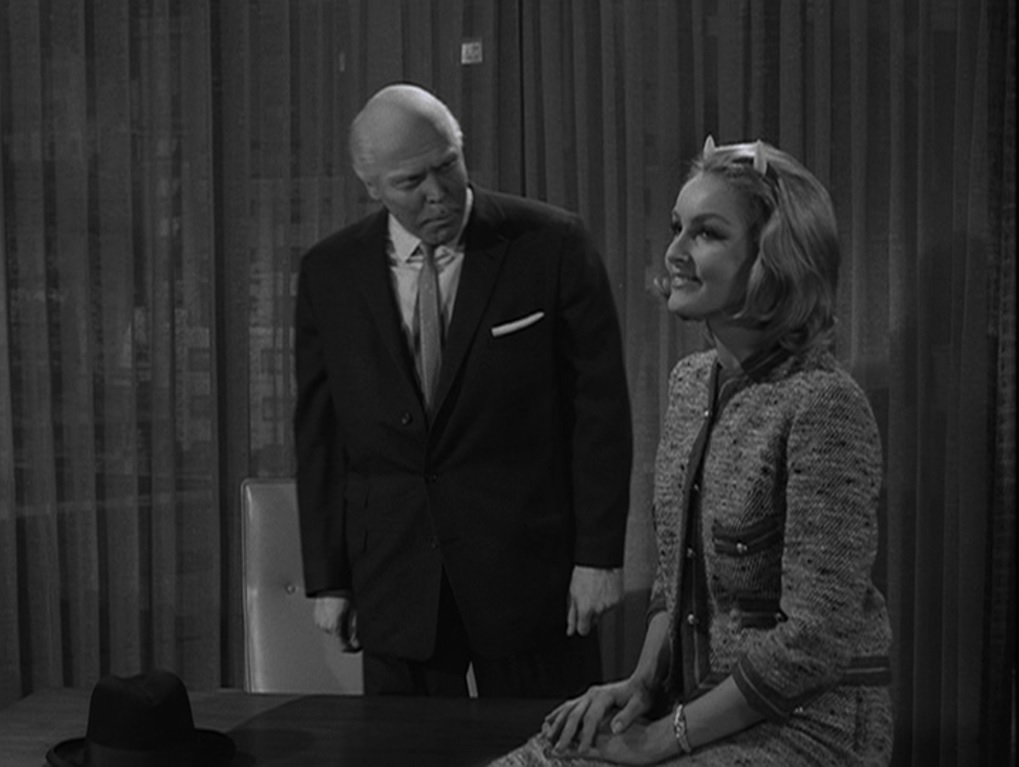
Twilight Zone – Passage On The Lady Anne

★★★★1/2 May 9, 1963 Season 4 Episode 17

If you want to see where we are…HERE is a list of the episodes.

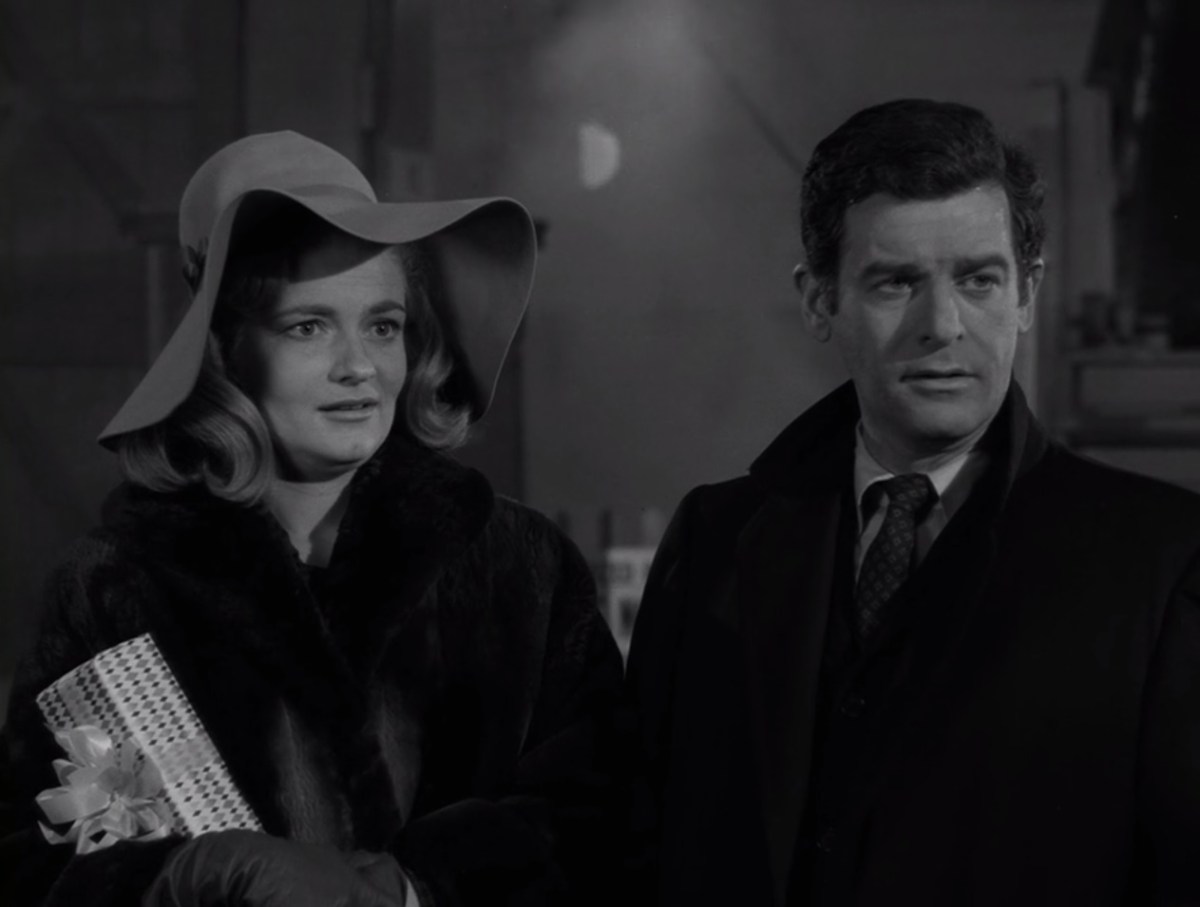
The story is not really scary but the setting will remind you of a horror movie. It takes place on a ship that is surrounded by fog. Mix that with black and white and the Wolfman film comes to mind. This is the first hour-long episode I watched many years ago.  This episode benefits from the hour format. You see a couple who are teetering on breaking up decide on a cruise. Throughout the episode, you see the gradual healing and the companionship replacing turmoil. Their older fellow passengers help them both along the way. This story could not have been made as well in a half-hour-long format. 

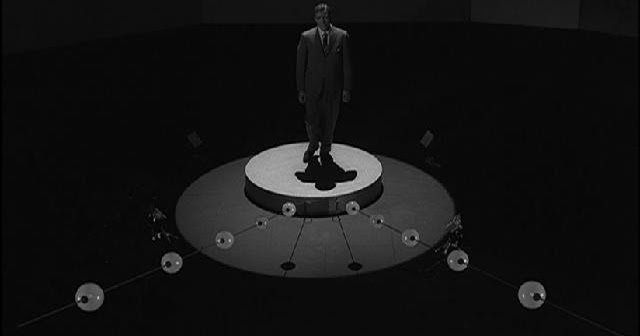
I would strongly recommend this and there is a twist but the twist is a little ambiguous. This is not an episode where a bad person gets cosmically punished for doing bad things. It does show real-life problems that you can relate to today. The cinematographer and set designers deserve praise in this episode. 

From IMDB: Because of the large number of well-known actors in this episode, the closing theme featured a credit roll of cast names instead of the usual still frames. The remaining non-cast credits were then done with standard still frames. This was the only episode of the series to ever use a credit roll.

This was the last Charles Beaumont Twilight Zone screenplay to be actually fully written by Beaumont himself. Around the time this episode was made, Beaumont (then only 34) began suffering from the rapid onset of a degenerative neurological disorder (believed to be either Alzheimer’s and/or Pick’s Disease) which affected his speech, memory, and concentration, as well as causing him to physically age very rapidly. As the disease progressed, Beaumont was soon unable to meet his writing commitments. A number of his writer friends, including Jerry Sohl and William F. Nolan, supported Beaumont by ghostwriting stories with or for him and submitting them in his name, although Beaumont insisted on splitting the fees with his helpers. His last screen credit (also probably ghostwritten) was in 1965, by which time he was too ill to work at all, and he died on 21 February 1967, aged only 38, although his son later recounted that his father “looked ninety-five” at the time of his death.

This show was written by Rod Serling and Charles Beaumont

Rod Serling’s Opening Narration: 

Portrait of a honeymoon couple getting ready for a journey – with a difference. These newlyweds have been married for six years, and they’re not taking this honeymoon to start their life but rather to save it, or so Eileen Ransome thinks. She doesn’t know why she insisted on a ship for this voyage, except that it would give them some time and she’d never been on one before – certainly never one like the Lady Anne. The tickets read ‘New York to Southampton,’ but this old liner is going somewhere else. Its destination – the Twilight Zone.

Summary

Eileen and Alan Ransome’s marriage is going through a bad patch and they decide to go on a holiday to London. Eileen insists on traveling by ship and they book passage on the Lady Anne, an old ship that is not recommended by the travel agent but is leaving quite soon. When they arrive at the port terminal another passenger, Mr. McKenzie, insists strenuously that the young couple has made a mistake and tries to discourage them from coming along on what is a “private cruise”. Mrs. McKenzie keeps her own counsel but clearly shares her husband’s sentiments. Another passenger, Burgess, tries to warn them off as well. He and McKenzie offer them money, eventually $10,000, to leave immediately. The Ransomes take umbrage and refuse. The couple finds that all of the other passengers are quite elderly but unsurprisingly have a good deal of wisdom to dispense to the young couple. Alan and Eileen are just beginning to really enjoy the trip when the captain suddenly puts them off the ship at gunpoint with provisions and a promise to notify the authorities of their location. They are rescued but as for the Lady Anne and her other passengers — well, there’s the rub

Rod Serling’s Closing Narration:

The Lady Anne never reached port. After they were picked up by a cutter a few hours later, as Captain Protheroe had promised, the Ransomes searched the newspapers for news – but there wasn’t any news. The Lady Anne with all her crew and all her passengers vanished without a trace. But the Ransomes knew what had happened, they knew that the ship had sailed off to a better port – a place called the Twilight Zone.

CAST

Rod Serling … Narrator / Self – Host (uncredited)
Gladys Cooper … Millie McKenzie
Wilfrid Hyde-White … Toby McKenzie
Cecil Kellaway … Burgess
Lee Philips … Alan Ransome
Joyce Van Patten … Eileen Ransome
Alan Napier … Capt. Protheroe
Cyril Delevanti … Officer
Jack Raine … Officer
Colin Campbell … Addicott
Don Keefer … Spierto
Frank Baker … Otto Champion (uncredited)
Sam Harris … Mersia Jones (uncredited)
Freda Jones … Ship Passenger (uncredited)
Colin Kenny … Ship Passenger (uncredited)
Carl M. Leviness … Ship Passenger (uncredited)
Scott Seaton … Ship Passenger (uncredited)
Arthur Tovey … Ship’s Greeter (uncredited)
Ricky Nelson – Hello Mary Lou

I went through a Ricky Nelson phase when I graduated in 1985. I purchased a greatest hits package and was learning more songs by him. I wanted to go see him perform that year and I kept waiting for him to appear somewhere because I heard he was touring. This was before the internet and you had to look at the newspapers for any announcements and listen to the radio. Musicians would play at places and you would never know sometimes.

I never got a chance to see him because on December 31, 1985 his chartered jet crashed killing him and six other passengers.

Ricky was a rockabilly guy and a good one. He gets lost in the shuffle because he was a huge teenage actor at the time on his family’s show…The Adventures of Ozzie and Harriet.

This was part of a super single. In America, this was released on the B side of Travelin’ Man, which peaked at #1 in the Billboard 100. At the time, most artists put hastily produced or unwanted songs on the flip sides of singles, but Nelson took his B-sides seriously, figuring the singles would sell better if he did. The Beatles would do that later.

This song peaked at #9 in the Billboard 100, #1 in New Zealand,  and #2 in the UK despite being on the B side in 1961.

The song was written by Gene Pitney and Cayet Mangiaracina. Cavet was given credit later because his music pubishing company sued for plagrism because of the similiar titled Merry, Merry Lou.

From Songfacts

One of Ricky Nelson’s most popular songs, in “Hello Mary Lou” he gets a case of love at first sight, as she steals his heart at first glance. It’s a very simple tune but quite memorable, with 14 mentions of the melodious Mary Lou packed into a 2:17 running time. The song begins and ends with the chorus, with another between the two verses.

There are two credited writers of this song: Gene Pitney and Cayet Mangiaracina.

Pitney is a rock legend whose biggest hits as an artist – “Only Love Can Break A Heart” and “(The Man Who Shot) Liberty Valance” were written by the Burt Bacharach-Hal David team. Pitney also wrote some hits for other artists, including “He’s A Rebel” for The Crystals and “Rubber Ball” for Bobby Vee. He wrote and recorded “Hello Mary Lou,” but he had another single out so his record company didn’t release it. Meanwhile, his publisher shopped the song around to various artists, including Ricky Nelson, whose version became a huge hit.

In 1957, a New Orleans group called The Sparks released a song called “Mary, Mary Lou,” which goes:

Mary, Mary Lou
Why must you do
The things that you always do

In this song, Mary Lou runs off to marry another man, leaving our hero heartbroken.

Cayet Mangiaracina, who was a member of The Sparks, wrote it in 1954 and the band started playing it at their gigs. Mangiaracina, who said there was no Mary Lou and that the lyric just sounded good, left the band in 1956, but the following year they won a “battle of the bands” competition that earned them a deal with Decca Records to record the song and release it as a single. The Sparks version went nowhere, but Bill Haley and Sam Cooke both covered it, Haley in 1957 and Cooke the following year.

After “Hello Mary Lou” became a hit, Cayet Mangiaracina’s publisher, Champion Music, took legal action and got a share of the song, with Mangiaracina listed as a co-writer along with Pitney. Mangiaracina became priest and claimed to give royalties from the song to the Southern Dominican Province, where he served.

Pitney, who died in 2006, never spoke of Mangiaracina or the lawsuit.

This was a huge hit in Australia, where it went to #1. In the UK, it was also very popular, reaching #2.

Nelson’s father Ozzie, a popular bandleader and star (along with Ricky and the rest of his family) of the TV series The Adventures of Ozzie & Harriet, played tenor guitar on this song. The solo is by Nelson’s guitarist James Burton, who later joined up with Elvis Presley.

Gene Pitney claimed to be baffled by this song’s success. “I’ve spent a lifetime trying to analyze why it was as big as it was,” he said.

Several acts have done popular covers of this song, including Brownsville Station, New Riders of the Purple Sage and Creedence Clearwater Revival. When Ricky Nelson entered the Rock and Roll Hall of Fame in 1987, he was inducted by John Fogerty.

Nelson’s voice sounds very full and ambient thanks to overdubs in the studio. Producer Jimmie Haskell joked that he used “15 layers of overdubbing.”

Queen played this on their 1986 tour, their last with Freddie Mercury. It was part of a tribute to American rock from the ’50s that also included “Tutti Frutti.”

Hello Mary Lou

“Hello Mary Lou
Goodbye heart
Sweet Mary Lou
I’m so in love with you

I knew Mary Lou
We’d never part
So hello Mary Lou
Goodbye heart”

You passed me by one sunny day
Flashed those big brown eyes my way
And ooh I wanted you forever more
Now I’m not one that gets around
I swear my feet stuck to the ground
And though I never did meet you before

I said “hello Mary Lou
Goodbye heart
Sweet Mary Lou
I’m so in love with you

I knew Mary Lou
We’d never part
So hello Mary Lou
Goodbye heart”

I saw your lips I heard your voice
Believe me I just had no choice
Wild horses couldn’t make me stay away
I thought about a moonlit night
Arms around you, good an’ tight
All I had to see for me to say

I said “hello Mary Lou
Goodbye heart
Sweet Mary Lou
I’m so in love with you

I knew Mary Lou
We’d never part
So “hello Mary Lou
Goodbye heart
Yes, hello Mary Lou
Goodbye heart
Well, hello Mary Lou
Goodbye heart”

Twilight Zone – On Thursday We Leave For Home

★★★★★ May 2, 1963 Season 4 Episode 16

If you want to see where we are…HERE is a list of the episodes.

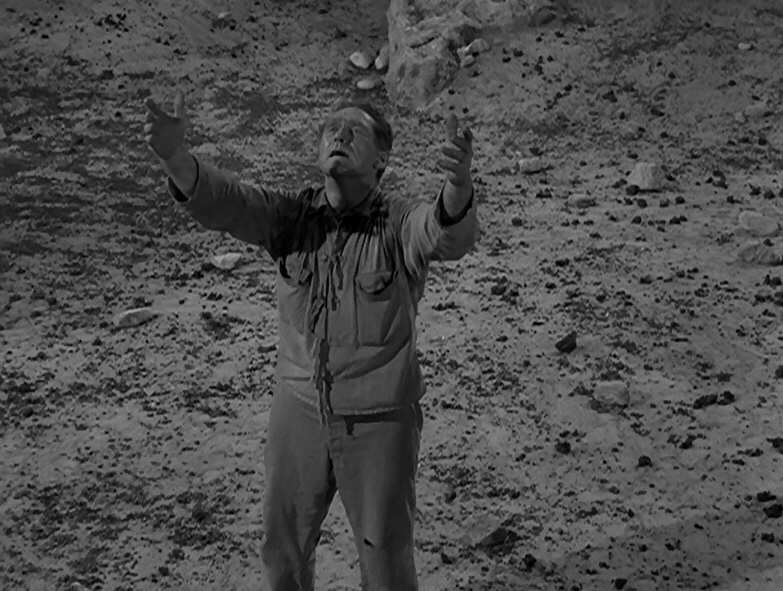
This is a not just a great episode…it’s a classic one. The episode takes place in 2021.  James Whitmore plays Captain William Benteen and his acting in this is top notch. The writing also is one of Rod Serling’s best scripts. Captain Benteen reminded me of a cult leader…he doesn’t make the Jim Jones jump but he is similiar. Loving, caring, power hungry, narcissistic, and dictatorial. You see all phases and you also see regret but only when it’s too late. 

The people in this episode are a remnant society who left the Earth looking for an Eden, a place without war, without jeopardy, without fear. What they found was quite different. They have been here 30 years. The planet is a nightmare place of two suns, unending day and terrible meteor storms. Despair prevails among the 187 survivors of the original colony and suicide is not uncommon. Their thirty-year survival is attributable to one source: the iron leadership of Benteen, their self-appointed Captain. 

If you only watch one hour long episode of the Twilight Zone…make it this one. Human nature is on full display in this episode…both the best and the worse. This is a science-fictional examination of the positive and negative uses of power.

From IMDB: The cave that the colonists use as their meeting hall was originally the underground lair of the Morlocks in The Time Machine (1960).

When the rescue ship from Earth arrives, several colonists ask about various places on Earth during a meeting between the ship’s crew and the colonists. One of the questions is about the Finger Lake District of New York. This area had a special significance to script writer Rod Serling. It is located close to his home town of Binghamton, he and his family vacationed there frequently, and Serling named his company that produced “The Twilight Zone,” Cayuga Productions, after one of the lakes. He later taught at Ithaca College for the last five years before his death.

The striking diorama backgrounds of the planet, the model and the large-scale prop of the rescue ship sent to bring the colonists home, and the uniforms of the rescue crew were all originally created for Forbidden Planet (1956). This was a recurring feature on “The Twilight Zone” which was frequently filmed at MGM Studios, and often prominently featured recycled props and set pieces from “Forbidden Planet”. The previous episode, “The Incredible World of Horace Ford” featured copies of the original blueprints of designs for Robby the Robot, created by MGM production designer Robert Kinoshita.

This show was written by Rod Serling

Rod Serling’s Opening Narration: 

This is William Benteen, who officiates on a disintegrating outpost in space. The people are a remnant society who left the Earth looking for a millennium, a place without war, without jeopardy, without fear, and what they found was a lonely, barren place whose only industry was survival. And this is what they’ve done for three decades: survive; until the memory of the Earth they came from has become an indistinct and shadowed recollection of another time and another place. One month ago a signal from Earth announced that a ship would be coming to pick them up and take them home. In just a moment we’ll hear more of that ship, more of that home, and what it takes out of mind and body to reach it. This is the Twilight Zone.

Summary

The colonists of Pilgrim I, Earth’s first space colony, have spent 30 years on their new home. It’s a lonely, barren place more akin to hell then Eden. Now, they’re awaiting the arrival of a ship to take them to Earth. Some colonists are at their wits’ end; another – the 9th in 6 months – commits suicide. Their leader, William Benteen, a tough drill sergeant-type, who they call Captain, does his best to keep them together. When the ship arrives, they’re given 3 days to prepare to leave. As the day of departure approaches, Benteen’s assumption that the community will stay together on Earth, is wrong; most will go their own way once on earth. Hearing this, Benteen decides they should stay. When the group decides otherwise, Benteen’s left with only one option.

Rod Serling’s Closing Narration:

William Benteen, who had prerogatives: he could lead, he could direct, dictate, judge, legislate. It became a habit, then a pattern and finally a necessity. William Benteen, once a god, now a population of one.

CAST

Rod Serling … Narrator / Self – Host (uncredited)
James Whitmore … Captain William Benteen
Tim O’Connor … Colonel Sloane
James Broderick … Al
Paul Langton … George
Jo Helton … Julie
Mercedes Shirley … Joan
Russ Bender … Hank
Danny Kulick … Jo-Jo (as Daniel Kulick)
Madge Kennedy … Colonist
John Ward … Colonist
Shirley O’Hara … Colonist
Tony Benson … Colonist (as Anthony Benson)
Lew Gallo … Lt. Engle

Twilight Zone – The Incredible World Of Horace Ford

★★★1/2 April 18, 1963 Season 4 Episode 15

If you want to see where we are…HERE is a list of the episodes.

Pat Hingle who plays Horace Ford is emotionally little more than an oversized child, lives with his wife Laura and his mother. He spends most of his time reminiscing about what he recalls as an idyllic childhood that was all play and no responsibility. This one is similar to “Walking Distance” but just not as effective…Horace isn’t as mature as the Martin Sloan characer in that episode. He fails to get the viewer’s compassion because of his imaturity. 

When looking back on childhood with rose colored glasses… Horace may get a chance to peel back the nostalgia and find out what really happened in his youth. It does have a good story but some will be put off by the exaggerated aspect of Pat Hingle’s performance. I liked it and the more times I’ve watched this episode the more I appreciated it. 

I have to ask this before I end. Pat Hingle who plays Horace Maxwell Ford…does he not look like Nick Nolte? It’s too bad when Hingle got older he didn’t play Nolte’s dad in a movie. 

The writer to this one is Reginald Rose who wrote the great 12 Angry Men. 

Reginald Rose: What I meant to do with The Incredible World of Horace Ford, was to tell a simple horror story about an everyday man with a somewhat exaggerated but everyday kind of problem and, in so doing, point out that the funny, tender childhood memories we cling to are often distorted and unreal. What happened to Horace when he finally made it back to his childhood was typical of what actually happened to so many of us again and again when we were children. He was ridiculed, rejected, beaten up. These are all familiar experiences to us, yet somehow we tend only to remember, as Horace did, the joys of swiping pomegranates from Ippolitos.

From IMDB:

This was not an original screenplay for The Twilight Zone (1959). It’s a remake of Studio One: The Incredible World of Horace Ford (1955), which was a live TV version starring Art Carney and Jason Robards.

This episode revisits themes used in The Twilight Zone: Walking Distance (1959) and The Twilight Zone: The Trouble with Templeton (1960) – namely, a person’s propensity to romanticize and try to relive a past that may not have been at all as good as they like to remember it.

The blueprints of Harold’s new robot toy are copies of the actual blueprints Bob Kinoshita made for the design of Robbie the Robot in Forbidden Planet.

This show was written by Rod Serling and Reginald Rose

Rod Serling’s Opening Narration: 

Mr. Horace Ford, who has a preoccupation with another time, a time of childhood, a time of growing up, a time of street games, stickball and hide-‘n-go-seek. He has a reluctance to check out a mirror and see the nature of his image: proof positive that the time he dwells in has already passed him by. But in a moment or two he’ll discover that mechanical toys and memories and daydreaming and wishful thinking and all manner of odd and special events can lead one into a special province, uncharted and unmapped, a country of both shadow and substance known as the Twilight Zone.

Summary

Toy designer, Horace Ford’s very enthusiastic about what he does, and his memories of childhood are beginning to become an obsession. But, those childhood moments which brought him great joy aren’t remembered by anytime else – even his mother. She doesn’t recall their time living on Randolph Street as such a great time. Horace goes to visit the old neighborhood, but when he gets there, he seems to have stepped back in time, and the past starts to spill over into the present. He returns to the street several times, and the scene repeats itself. He begins to realise -his childhood wasn’t the wonderful one he remembered

The COMPLETE episode

Rod Serling’s Closing Narration:

Exit Mr. and Mrs. Horace Ford, who have lived through a bizarre moment not to be calibrated on normal clocks or watches. Time has passed, to be sure, but it’s the special time in the special place known as the Twilight Zone.

CAST

Rod Serling…Narrator / Self – Host (uncredited)
Pat Hingle…Horace Maxwell Ford
Nan Martin…Laura Ford
Ruth White…Mrs. Ford
Phillip Pine…Leonard O’Brien
Vaughn Taylor…Mr. Judson
Jerry Davis…Hermie Brandt
Billy Hughes…Kid
Mary Carver…Betty O’Brien
Jim E. Titus…Horace…a boy

Twilight Zone – Of Late I Think Of Cliffordville

★★★★ April 11, 1963 Season 4 Episode 14

If you want to see where we are…HERE is a list of the episodes.

This is a good episode. It has two plot lines that I love…time travel and deals with the Devil. If the devil looked like  Julie Newmar…there would be a lot of deals signed. Albert Salmi as the greedy Feathersmith is fantastic. He is one of my favorite chacter actors of that time. You may recognize John Anderson as Deidrich…he was a character actor until his death in 1992. He had 246 acting credits on various tv shows. 

If you could go back knowing what you know now. Would it be something small or  large you would miss because you were so excited? Chances are yes…and that little something could start a chain reaction…and you might just regret it. 

The special effects in the Twilight Zone are usually great. The only bad thing I can say about them in this one is Salmi’s “old” makeup. I believe though it’s a product of our times. With high definition tv now…you can see it clear but back then on 60’s tv…it was probably fine. This one is marked low in IMDB which I totally disagree with. It does have it’s faults but is an enjoyable episode. 

From IMDB: Ms. Devlin’s Travel Offices are on the 13th floor. This is unusual in the US (and suitable to her nature) as most buildings before the 1980’s skip the 13th floor when numbering floors in their buildings. The number 13 has long been considered unlucky.

Albert Salmi previously appeared in The Twilight Zone: Execution (1960) and The Twilight Zone: A Quality of Mercy (1961), all of which involve time travel. In “Execution” and “Cliffordville” his characters are very unlikable, although that is not the case in “Quality.”

This show was written by Rod Serling and Malcolm Jameson

Rod Serling’s Opening Narration: 

Witness a murder. The killer is Mr. William Feathersmith, a robber baron whose body composition is made up of a refrigeration plant covered by thick skin. In a moment, Mr. Feathersmith will proceed on his daily course of conquest and calumny with yet another business dealing. But this one will be one of those bizarre transactions that take place in an odd marketplace known as the Twilight Zone.

Summary

Rod Serling’s Closing Narration:

Mr. William J. Feathersmith, tycoon, who tried the track one more time and found it muddier than he remembered, proving with at least a degree of conclusiveness that nice guys don’t always finish last, and some people should quit when they’re ahead. Tonight’s tale of iron men and irony, delivered F.O.B. from the Twilight Zone.

CAST

Rod Serling…Narrator / Self – Host (uncredited)
Albert Salmi … Feathersmith
John Anderson … Deidrich
Wright King … Hecate
Guy Raymond … Gibbons
Christine Burke … Joanna
John Harmon … Clark
Hugh Sanders … Cronk
Julie Newmar … Miss Devlin
Mary Jackson … Miss Pepper (uncredited)

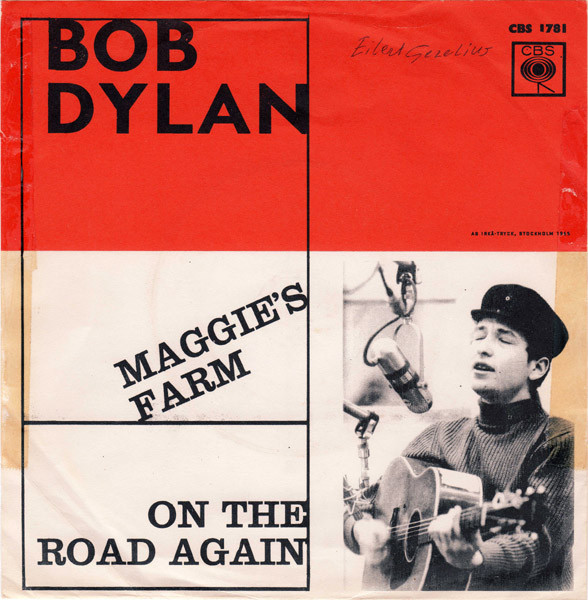
Bob Dylan – Maggie’s Farm

One of the first songs that caught my attention by Bob Dylan. I’ve seen the man live 8 times and this one…he would always play, at least in the first 5 concerts. After that I only heard it once again.

I don’t post many Dylan songs…not because I’m not a huge fan…like I said I’ve seen the man 8 times. If I get a chance, I’ll see him 8 more times.  When you post a Dylan song you almost feel the urge to do an interpretation of the song…I have no interest in doing that.

Some think he was inspired by The Bentley Brothers’ “Penny’s Farm,” a 1920s song about a rural landlord. In “Maggie’s Farm,” Dylan included descriptions of Maggie, her brother, her father, and her mother in successive verses.

The song was famous for the reaction it got at the Newport Jazz Festival when Dylan “went electric” to his die-hard folk fans. This appearance by Dylan is portrayed as one of the most important and controversial events in the history of American rock and roll. When the band came out to play his new songs from Bringing It Back Home album…much of the crowd were not amused. They wanted Bob to only play the acoustic and sing protest songs…but Bob had already started opening the folk-rock door earlier with bands such as The Byrds covering his songs.

Some say that most of the booing was not because of the songs but with different things like the short set, the volume level (you couldn’t hear Dylan sing), and other things.

Bob didn’t really care…or he didn’t show it much. He was going to do what he wanted to do. He continued with a different backing band later…and that band heard boo’s around the world…the backing band turned out to be The Band…then known as The Hawks.

Al Kooper organist: The reason they booed is because he only played for 15 minutes and everybody else played for 45 minutes to an hour, and he was the headliner of the festival. […] The fact that he was playing electric…I don’t know. The Paul Butterfield Blues Band (who had played earlier) had played electric and the crowd didn’t seem too incensed.

Maggies Farm peaked at #22 in the UK in 1965.

From Songfacts

Dylan recorded this at one of his first rock sessions on January 15, 1965. He was backed by two electric guitarists, piano, bass, and drums.

Dylan’s famous (some say infamous) set at the Newport Folk Festival on July 25, 1965 marks the split of Bob Dylan with the folk movement when he decided to play a set with a backing band of electric instruments. The set included three songs: “Maggie’s Farm,” “Like A Rolling Stone,” and “Phantom Engineer.”

 The audience at the festival was clearly angry with Dylan and they expressed their anger with a growing chorus of boos during the 16-minute set.

The band for this set was hastily thrown together. This would indicate that doing an “electric” set wasn’t necessarily part of Dylan’s plans for this festival.

Several members of this band played with the Paul Butterfiled Blues Band, who played for about 45 minutes just before Dylan took the stage. Guitarist Michael Bloomfield, bassist Jerome Arnold and drummer Sam Lay all played with Dylan that evening. Al Kooper, who didn’t play with the Butterfield band but played the instantly recognizable organ line on “Like A rolling Stone” in the studio recording, rounded out the band. Legend has it that Dylan rehearsed all night with this band the day before the performance, but even with that preparation, the performances were weak. That too could have accounted for the boos.

Al Kooper said later in an interview that he thought the booing was caused by a bad sound system, but recordings don’t bear that out.

But the day before during a blues workshop, Alan Lomax, one of the organizers of the festival, was very condescending in introducing the Butterfield Blues Band. Lomax was a blues purist and felt that white boys had no business playing the blues. That led to a physical fight between Lomax and Albert Grossman who managed both Dylan and the Butterfield Blues Band.

Also, in introducing the evening show, Pete Seeger (another organizer of the festival, and another folk music purist,) played the audience a recording of a newborn baby, and said that the final night’s program was a message from everyone to this baby that the world it was being born into was full of hate, hunger, bombs, and injustice, but that the people – the folk – would overcome, and make it a better world.

Overwrought displays like this also may have set Dylan’s teeth on edge. If he was on the fence about doing an electric set, these two events might have convinced him just to get under the skin of these two pompous organizers.

Or maybe the audience was angry with the short set of only three songs. A rain delay pushed some of the afternoon bands into the evening show. So people had been sitting and waiting for Dylan for a while. Peter Yarrow (of Peter Paul and Mary, and another of the Festival’s organizers) persuaded Dylan to return to the stage to sing a few more songs. Dylan borrowed an acoustic guitar (allegedly from Johnny Cash) and opened with “It’s All Over Now, Baby Blue” while he appeared to be regaining his wits after being blindsided by the boos from the audience.

The acoustic set seemed to placate everyone. Dylan then started to strum the chords to “Tambourine Man” but realized he didn’t have a harmonica. He asked for anyone with an E harmonic to throw it up to him. There followed a barrage of incoming harmonicas hitting the stage. Dylan picked one up, thanked the crowd and played on. (This can be seen on the Songfacts.com video of the song.)

The two recordings of Maggie’s Farm presented here – the acoustic studio version, and the video from the Newport Folk Festival – are good examples of how Dylan’s music changed. In 1963, when Dylan released his first successful recordings, he was hailed as one of the most powerful musical voices in America. By 1965, with the growing influence of the Beatles, and the continued musical conservatism of the folk movement as personified by Pete Seeger, the relationship between the folk movement and Dylan became increasingly strained. The final separation came with “Maggie’s Farm” at the Newport Folk Festival of 1965. (Thanks, David Sherman, who teaches the History of Rock and Roll at Excelsior College.) >>

Making his fifth appearance performing on the Grammys, Dylan played this at the 2011 ceremonies backed by The Avett Brothers and Mumford & Sons.

Festival! was a 1967 documentary film about Dylan’s three mid-’60s appearances at the Newport Folk Festival, including his controversial electric set from 1965. Uncut magazine asked the movie’s director, Murray Lerner, what he could hear on stage, after Dylan came on and played “Maggie’s Farm.”

“I heard a combination of boos and applause,” he replied. “And some catcalls. And then when he came back and did the acoustic songs, they got with it again. He was nervous when he came back, there’s no question about it. That was sweat you can see rolling down his face. And on ‘Mr. Tambourine Man,’ asking for a harmonica from the crowd – the fact that he forgot his harmonica.”

Maggie’s Farm

I ain’t gonna work on Maggie’s farm no more
No, I ain’t gonna work on Maggie’s farm no more
Well, I wake in the morning
Fold my hands and pray for rain
I got a head full of ideas
That are drivin’ me insane
It’s a shame the way she makes me scrub the floor
I ain’t gonna work on Maggie’s farm no more

I ain’t gonna work for Maggie’s brother no more
No, I ain’t gonna work for Maggie’s brother no more
Well, he hands you a nickel
He hands you a dime
He asks you with a grin
If you’re havin’ a good time
Then he fines you every time you slam the door
I ain’t gonna work for Maggie’s brother no more

I ain’t gonna work for Maggie’s pa no more
No, I ain’t gonna work for Maggie’s pa no more
Well, he puts his cigar
Out in your face just for kicks
His bedroom window
It is made out of bricks
The National Guard stands around his door
Ah, I ain’t gonna work for Maggie’s pa no more

I ain’t gonna work for Maggie’s ma no more
No, I ain’t gonna work for Maggie’s ma no more
Well, she talks to all the servants
About man and God and law
Everybody says
She’s the brains behind Pa
She’s sixty eight, but she says she’s fifty four
I ain’t gonna work for Maggie’s ma no more

I ain’t gonna work on Maggie’s farm no more
No, I ain’t gonna work on Maggie’s farm no more
Well, I try my best
To be just like I am
But everybody wants you
To be just like them
They sing while you slave and I just get bored
I ain’t gonna work on Maggie’s farm no more

Twilight Zone – The New Exhibit

★★★★★ April 4, 1963 Season 4 Episode 13

If you want to see where we are…HERE is a list of the episodes.

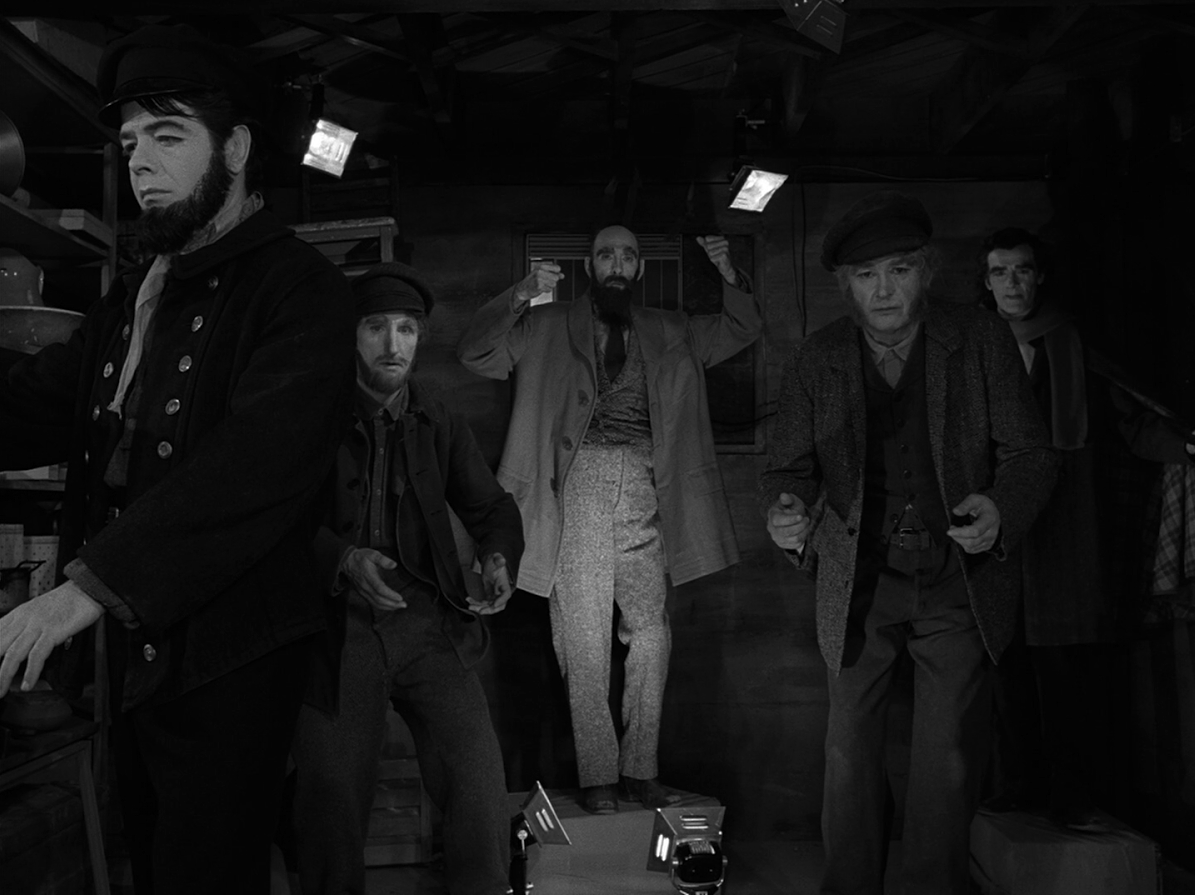
This episode of the Twilight Zone is really good. It has everything…some horror, mystery, and a great twist at the end. It could have been a 50’s type horror movie. You expect Vincent Price to come on at any time. Martin Balsam plays Martin Lombard Senescu and he is fantastic. He is a sympathetic character that loves his job at the wax museum…maybe a little too much. Will Kuluva as Ernest Ferguson plays the owner of the museum who sees the writing on the wall, the museum is not as popular as it was and will have to close. He is a kindly older gentlemen who cares… and gently lets Martin go…but not without granting Martin a favor. 

The pacing in this one is good. They use the hour to breathe life to the characters.  The story builds nicely and there is a good payoff in the end.  

There was a sad story behind the scenes. Charles Beaumont (his real name was Charles Leroy Nutt) was credited as writing this but Jerry Sohl had started ghostwriting for him by this time. Beaumont was only 35 and had been the top writer for Playboy and he wrote some of the very best Twilight Zones. He was probably the best writer the Twilight Zone had besides Rod Serling.

He was starting to forget things and could not concentrate. He was diagnosed with Alzheimers Disease or Picks Disease…they could not know which one until he passed. He passed away at 38 years old in 1967 and his son said he had the body and mind of a 95 year old. 

Jerry Sohl helped him out and split everything 50/50 and did all the writing in his name. He wrote for Hitchcock, Route 66 and Playboy under Beamont’s name. Sohl would write more Twilight Zones but not be credited. They had to keep this a secret because it was against Writers Guild rules.

Sohl’s script went before the cameras virtually unchanged, with no rewrites at all. This was the case with most of the scripts he ghosted. They went right in, and the reason is that Chuck Beaumont scripts were always so great that they didnt have to do anything.

Jerry Sohl on visiting the set:

Here I am standing with Chuck Beaumont, he recalls, and John Brahm, the director, comes up, puts his arm around him with the script that / did and says, Chuck, youve done it again! And here I am, standing right next to Chuck, unable to say a word!

This show was written by Rod Serling, Charles Beaumont, and Jerry Sohl (uncredited)

Rod Serling’s Opening Narration: 

Martin Lombard Senescu, a gentle man, the dedicated curator of murderers’ row in Ferguson’s Wax Museum. He ponders the reasons why ordinary men are driven to commit mass murder. What Mr. Senescu does not know is that the groundwork has already been laid for his own special kind of madness and torment found only in the Twilight Zone.

Summary

Martin Lombard Senescu is a gentle man and the curator of Murderer’s Row in Ferguson’s wax museum. He loves his work and is fascinated by what drives men to commit the crimes that they do. He’s informed by his boss Mr. Ferguson that the property is being sold to developers who will raze the building and erect a supermarket. Martin brings 5 of of wax figures home but after a year his wife is at her wits end. Martin spends all of his time in the basement with his beloved friends and the cost of keeping them is eating into their already limited income. When Martin finds Emma dead in the basement he buries her there. When her brother Dave shows up, he too is apparently killed. After Mr. Ferguson finally finds a buyer for the wax figures, Martin reluctantly agrees to let them go. There is a new addition to the exhibit however.

Rod Serling’s Closing Narration:

The new exhibit became very popular at Marchand’s, but of all the figures none was ever regarded with more dread than that of Martin Lombard Senescu. It was something about the eyes, people said. It’s the look that one often gets after taking a quick walk through the Twilight Zone.

CAST

Rod Serling…Narrator / Self – Host (uncredited)
Martin Balsam …Martin Lombard Senescu
Will Kuluva…Ernest Ferguson
Margaret Field…Emma Senescu (as Maggie Mahoney)
William Mims…Dave
Phil Chambers…Gas Man
Leonard Bremen…Van Man (as Lennie Bremen)
Eddie Barth…Sailor (as Ed Barth)
Craig Curtis…Sailor
Milton Parsons…Henri Desire Landru
David Bond…Jack the Ripper
Bob Mitchell…Albert W. Hicks
Robert McCord…Burke (as Robert L. McCord)
Billy Beck…Hare
Marcel Hillaire…The Guide

Albert King – As The Years Go Passing By

As you probably have seen…I’ve beening listening to some blues lately…this one is great. King’s clean piercing guitar hits the spot.

When Duane Allman was helping Eric Clapton on the Derek and the Dominos album they had Layla’s main track laid out. Duane suggest a new intro…he got that intro from this song that King did and expanded on it. It’s very faint…but Duane saw something in there and made it work. That shows you how some songs influence other artists. Just a riff here or there that they build on.

This is a great song all by itself. It was written by “Deadric Malone”, a pseudonym for Don Robey. It was first recorded by Fention Fenton Robinson and released as a single in 1959.

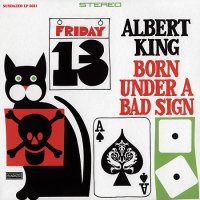
Albert started to record in the 50s and would eventually go to Memphis to join Stax Records in the 60s. In 1967 we would relased the album Born Under A Bad Sign which contained this song. Love that cover design!

The album cover for Born Under a Bad Sign. The cover features a drawing of various objects related to superstition, including: a black cat, snake eyes, an ace of spades, and a calendar displaying the date Friday the 13th.

As The Years Go Passing By

Ah the blues
The ball and chain that is ’round every English musician’s leg
In fact every musician’s leg
Tryin’ to kick it off baby?
No no.
You’ll just never do it
And these are the blues of time
And the blues of a woman
And a man thinkin’ of her
As time goes by

There is nothin’ I can do
If you leave me here to cry
There is nothin’ I can do
If you leave me here to cry
You know my love will follow you baby
Mmm until the day I die

I’ve given you all I own;
That is one thing you cannot deny
Oh I’ve given you all I own;
Baby that is one thing you cannot deny
And my love will follow you baby
Yeah
Till the day this man dies.

I’ve got failure all around me
No matter how hard I try.
I’ve got failure
It’s all around me
No matter how hard I
Try try
You know my ghost will haunt you baby
Until the day you stop down and die
Well you better get up
Right now right now

Well
You think that you have left me behind
And that with your other man you’re safe
And you’re away from me baby but uh
One o’ these days you’re gonna break down and cry
Because there is no escape from this man
Because this man’s love is so strong
He’s gonna haunt you
You know my love will follow you
Mmm until the day I die

There is just one thing I want to tell you before I go
I’m gonna leave it
I’m gonna leave it
Leave it up to you
So long
baby bye-bye
Hey I’m gonna leave it up to you baby
So long
baby bye-bye

Well you know my love will follow you
Mmm ’til the day I die
Till the day I die
Till the day I die
Till the day I die
Till the day I die
Till the day I am dead
Till the day that they rest my head
Till the day I die
Till the day I I I I die
Till the day I die
Till the day I die
Till the day I die
Till the day that you die and I die
Till the day I die
Till the day I die
Till the day I die
Till the day I die
Till the day I die
Till the day I die
Till the day I die
Till the day I die
Till the day I die
Till the day I die

Die
Die
Die
Die

Twilight Zone –  I Dream Of Genie

★★1/2 March 21, 1963 Season 4 Episode 12

If you want to see where we are…HERE is a list of the episodes.

This episode is one of the light ones. You will notice the star of this episode right off the bat if you are a fan of the Andy Griffith Show. It’s Howard Morris…who is better known as Earnest T Bass. He does what he can do with the script. It’s slow paced and dull in spots. It does have a good moral to the story and a good twist at the very end…getting there is the challenge in this one. I feel like a broken record in a few of these longer episodes…but the hour works against itself in this one. One thing I will say…Howard Morris and Jack Albertson as the Genie are good in their parts. 

The best moments in I Dream of Genie is when Howard Morris is in the fantasy roles imagining how a wish would turn out if he made it. There are some funny moments but the journey is too long to get there. A thirty minute version of this still wouldn’t save much. 


This show was written by Rod Serling and John Furia

Rod Serling’s Opening Narration: 

Meet Mr. George P. Hanley, a man life treats without deference, honor or success. Waiters serve his soup cold. Elevator operators close doors in his face. Mothers never bother to wait up for the daughters he dates. George is a creature of humble habits and tame dreams. He’s an ordinary man, Mr. Hanley, but at this moment the accidental possessor of a very special gift, the kind of gift that measures men against their dreams, the kind of gift most of us might ask for first and possibly regret to the last, if we, like Mr. George P. Hanley, were about to plunge head-first and unaware into our own personal Twilight Zone.

Summary

A smart aleck genie appears from a lamp to a meek man, George P. Hanley. Hanley is so used to bad luck, he imagines how each of three possible wishes could go very wrong – but the genie will grant him only one wish.


Rod Serling’s Closing Narration:

Mr. George P. Hanley, former vocation; jerk. Present vocation; genie. George P. Hanley, a most ordinary man whom life treated without deference, honor, or success, but a man wise enough to decide on a most extraordinary wish, that makes him the contented, permanent master of his own altruistic Twilight Zone.

CAST

Rod Serling … Narrator / Self – Host (uncredited)
George P. Hanley…Howard Morris
Ann…Patricia Barry
Watson…Loring Smith
Starlet…Joyce Jameson
Genie…Jack Albertson
Roger…Mark Miller[1]
May…Molly Dodd
The P.R. Man/Scientist were played Milton Parsons
Masters…James Millhollin
Sam…Bob Hastings

Lovin’ Spoonful – Summer In The City

This is one of those transport songs. It takes me to a time when I wasn’t around…the mid sixties…at least my interpretation of it.

They were a great singles band but had a short window. From 1965 to 1967 they had 7 top 10 hits. This single peaked at #1 in the Billboard 100, #1 in Canada, #11 in the UK, and #3 in New Zealand in 1966.

The song was a collaboration between John Sebastian, Steve Boone (bass player), and John Sebastian’s brother Mark. Mark was 15 years old when he wrote a poem that John used as the basis for the song – John especially liked the line that went, But at night there’s a different world.

Steve Boone came up with the middle eight, which John thought sounded like the Gershwin composition “An American in Paris,” where the orchestra implies the sound of traffic and city noises. This gave him the idea of incorporating car horns and other city ambiance into the track

Things started to fall apart due to repercussions from guitarist Zal Yanovsky and bassist Steve Boone’s 1966 pot bust in San Francisco. They were pressured into a deal where they agreed to introduce an undercover cop to partygoers in the city, one of whom got busted. A backlash ensued that damaged their reputation in the counterculture.

In 1967 Zal Yanovsky left the band citing musical differences with John Sebastian. Yanovsky would later become a  Chef in Kingston, Ontario, Canada in his restaruarnt Chez Piggy. His daughter Zoe Yanovsky took over the restaurant after Zal’s death in 2002 and still runs it.

In 1968 Sebastian left for a solo career and the band carried on until 1969 without a significant hit.

The original group (John Sebastian,  Zal Yanovsky, Joe Butler and Steve Boone) reunited briefly in the fall of 1979 for a show at the Concord Hotel in the Catskills for an appearance in the Paul Simon film One Trick Pony.

John Sebastian: “That song that came from an idea my brother Mark had, he had this great chorus, and the release was so big. I had to create some kind of tension at the front end to make it even bigger. That’s where that jagged piano part comes from.”

From Songfacts

This song contrasts what it’s like to live in a large city during the day and during the night. According to the song, it’s difficult to walk around a crowded and hot city during the day, but it’s great at night because you have plenty of opportunities to chase women. This particular city is New York, where the band formed. 

.The band was rather particular about the traffic sounds. Instead of just using what was available on the sound effects records in the studio, they found an old-school radio engineer – a guy who used to create the soundscapes for shows, so if a guy was riding a horse, you’d hear the hooves hitting the ground and the wind whistling by. This guy, whom John Sebastian referred to as a “hilarious old Jewish sound man,” came in with a huge library of street sounds, which the band went through for hours. They wanted the scene to build, so it starts softly (the horn at the beginning comes from a Volkswagen Beetle), and grows to a gridlock nightmare. To close the scene, they used a pneumatic hammer pounding away at the pavement.

This was recorded over two days: At the first session, they put down the instruments: guitar, bass, autoharp, drums, organ, electric piano and percussion. The second session was for vocals and sound effects.

The sound of car horns and traffic was the first time these sounds appeared on a hit song. A year later, Kenny Gamble and Leon Huff used the idea when they produced the Soul Survivors track “Expressway (To Your Heart).”

Appropriately, this song was released in the summer of 1966 – July 4, to be exact. It quickly climbed the chart, reaching #1 on the chart dated August 13, where it stayed for three weeks.

This is used during the looting sequence on The Simpsons episode “Poppa’s Got a Brand New Badge.”

The song served as the theme song for German art-director Wim Wenders’ first film, 1970’s Summer in the City. It plays during an incongruous scene in which the protagonist Hans is seen walking on a brutally cold day, surrounded by snow.

This was used at the beginning of the movie Die Hard: With A Vengeance. The song plays throughout the opening credits, showing different scenes of New York City until a building blows up. 

From 2006-2007, the piano portion was used in various Gatorade ads depicting the history of the sports drink, which was created in 1965.

Summer In The City

Hot town, summer in the city
Back of my neck getting dirty and gritty
Been down, isn’t it a pity?
Doesn’t seem to be a shadow in the city
All around, people looking half dead
Walking on the sidewalk, hotter than a match head

But at night it’s a different world
Go out and find a girl
Come on, come on and dance all night
Despite the heat it’ll be alright

And babe, don’t you know it’s a pity
That the days can’t be like the nights
In the summer, in the city

Cool town, evening in the city
Dressing so fine and looking so pretty
Cool cat, looking for a kitty
Gonna look in every corner of the city
Till I’m wheezing like a bus stop
Running up the stairs, gonna meet you on the rooftop

But at night, it’s a different world
Go out and find a girl
Come on, come on and dance all night
Despite the heat, it’ll be alright

And babe, don’t you know it’s a pity
That the days can’t be like the nights
In the summer, in the city

Hot town, summer in the city
Back of my neck getting dirty and gritty
Been down, isn’t it a pity?
Doesn’t seem to be a shadow in the city
All around, people looking half dead
Walking on the sidewalk, hotter than a match head

But at night, it’s a different world
Go out and find a girl
Come on, come on and dance all night
Despite the heat, it’ll be alright

And babe, don’t you know it’s a pity
That the days can’t be like the nights
In the summer, in the city

Monkees – The Porpoise Song

This was not one of their well-known TV songs.

This was on the soundtrack to their 1968 trippy movie Head. Where else would you find Annette Funicello, The Monkees, and Frank Zappa in the same movie?

They may have been seeking some countercultural acceptance after their show ended. The movie blew the image of the Monkees up…some say deconstruction of the Monkees completely. It was a stream of consciousness black comedy that mocks war, America, Hollywood, television, the music business, and the Monkees themselves.

If kids went into the theater expecting the Monkees TV show…they were in for a big surprise. On the other hand, kids couldn’t watch the movie because of its R rating.

Carole King and Gerry Goffin wrote this song and Goffin produced it…even recording a porpoise for good measure.

I’ve watched the movie and it’s interesting but you have to remember what kind of movie it is. Jack Nicolson help write it with the band along with Bob Rafelson. Nicholson hung out with The Monkees for several weeks, even going with them on tour. Once this movie was made, Rafelson abandoned The Monkees and went off to bigger projects, starting with Easy Rider.

Mickey Dolenz – “It wasn’t so much about the deconstruction of the Monkees, but it was using the deconstruction of the Monkees as a metaphor for the deconstruction of the Hollywood film industry”

The Porpoise Song

My, my, the clock in the sky
Is pounding away
And there’s so much to say

A face, a voice
An overdub has no choice
An image cannot rejoice

Wanting to be
To hear and to see
Crying to the sky

But the porpoise is laughing
Goodbye, goodbye
Goodbye, goodbye, goodbye

Clicks, clacks, riding the backs of giraffes for laughs
S’alright for a while

sings of castles
And kings and things that go
With a life of style

Wanting to feel
To know what is real
Living is a, is a lie

The porpoise is waiting
Goodbye, goodbye
Goodbye, goodbye, goodbye

Twilight Zone – The Parallel

★★★★1/2 March  14, 1963, Season 4 Episode 11

If you want to see where we are…HERE is a list of the episodes.

I kept saying that the 4th season was not a great season of the Twilight Zone. As someone (Paul) pointed out…there are some really good to great episodes. He was right…there are some great episodes in the season. This is one of them. After watching this season over…it’s much better than I gave it credit for. Is it as good as 1, 2, 3, or 5? No, it’s just different with the hour format. Not apples to oranges, just different.

This could be a 5 star…I went back and forth with the rating. The small details in this episode keep it interesting. 

This one is about a Parallel world. Steve Forrest who plays Major Robert Gaines is an astronaut that returns home from a troubled mission. He notices things wrong when he gets back…a different president, a gate around his yard that wasn’t there before, and small things that are wrong. His family also starts noticing little things…little things that only a loved one can see. 

From IMDB: Steve Forrest played the protagonist, Major Robert Gaines, in this episode while his elder brother Dana Andrews played the protagonist, Paul Driscoll, in the preceding episode The Twilight Zone: No Time Like the Past 

There is a moment after Maj. Gaines has spent the night with Mrs. Gaines where they attempt to embrace and she gives him a hard, questioning stare. According to producer Bert Granet, the intent of this interchange was to imply that sexual relations on the parallel world were slightly different from those of Maj. Gaines’ world, and that this had told Mrs. Gaines that he was no longer her husband. Unfortunately, in 1963 no direct mention of sexual behavior, even between spouses, was permissible, so that the scene is really too subtle to communicate this implication.

In the parallel universe, no one has ever heard of John F. Kennedy. The identity of the President of the United States in that universe is not revealed.

This show was written by Rod Serling and Richard Matheson

Rod Serling’s Opening Narration: 

In the vernacular of space, this is T minus one hour. Sixty minutes before a human being named Major Robert Gaines is lifted off from the Mother Earth and rocketed into the sky, farther and longer than any man ahead of him. Call this one of the first faltering steps of man to sever the umbilical cord of gravity and stretch out a fingertip toward an unknown. Shortly, we’ll join this astronaut named Gaines and embark on an adventure, because the environs overhead—the stars, the sky, the infinite space—are all part of a vast question mark known as the Twilight Zone.

Summary

Astronaut Major Robert Gaines is the latest to orbit the Earth but something happens while there. Ground control loses all contact with him and although he returns safely, he apparently blacked out and has no recollection of what may have happened. Nor can he explain how the craft landed on land – completely undamaged – when it was meant to splash down in the ocean. When Gaines returns home he finds that little things are different: he’s now a full colonel and has been for some time; his house now has a picket fence; he no longer seems to take sugar in his coffee; and even his wife senses he is different after she kisses him. It is soon apparent that Gaines has returned to an Earth in an alternate universe

Rod Serling’s Closing Narration:

Major Robert Gaines, a latter-day voyager just returned from an adventure. Submitted to you without any recommendations as to belief or disbelief. You can accept or reject; you pay your money and you take your choice. But credulous or incredulous, don’t bother to ask anyone for proof that it could happen. The obligation is a reverse challenge: prove that it couldn’t. This happens to be the Twilight Zone.


CAST

Rod Serling … Narrator / Self – Host (uncredited)
Steve Forrest … Major Robert Gaines
Jacqueline Scott … Helen Gaines
Frank Aletter … Colonel William Connacher
Paul Comi … Psychiatrist
Shari Lee Bernat … Maggie Gaines
Morgan Jones … Captain
William Sargent … The Project Manager
Philip Abbott … General Stanley Eaton
Fred Crane … News Anchorman (uncredited)

Twilight Zone – No Time Like The Past

★★★1/2 March 7, 1963 Season 4 Episode 10

If you want to see where we are…HERE is a list of the episodes.

I love time travel episodes. I wanted so much to love this one. No Time Like The Past has it’s charms but the hour long format works against it. It’s 4 time travel stories in this one. It could have been split up into two 30 minute episodes with the first three time jumps and the second episode the final jump. I think it would have been better for the hour long format to flesh out the first three time jumps. 

It was an interesting concept…to go back to the atom bomb dropping in Japan, the Lusitania sinking, and to try to kill Hitler. One of the flaws in this episode is he only gives himself a small amount of time to accomplish his tasks. In this case too much wasn’t a good thing. To sum it up…I wish they would have focused either on Hitler, Japan, and The Lusitania or the 1881 small town of Homeville, Indiana. The most interesting part of the episode is the 1881 Indiana story. 

Dana Andrews who played Paul Driscoll was a star in the 1940s in movies with Henry Fonda, Tyrone Powers, and more. 

From IMDB: Dana Andrews played the protagonist, Paul Driscoll, in this episode while his younger brother Steve Forrest played the protagonist, Major Robert Gaines, in the succeeding episode The Twilight Zone: The Parallel .

This episode takes place in 1963, in Hiroshima, Japan on August 6, 1945, in Berlin, Germany in August 1939, aboard the RMS Lusitania off the Old Head of Kinsale, Ireland on May 7, 1915 and in Homeville, Indiana from July 1 to July 3, 1881.

This show was written by Rod Serling

Rod Serling’s Opening Narration: 

Exit one Paul Driscoll, a creature of the twentieth century. He puts to a test a complicated theorem of space-time continuum, but he goes a step further, or tries to. Shortly, he will seek out three moments of the past in a desperate attempt to alter the present, one of the odd and fanciful functions in a shadowland known as the Twilight Zone.

Summary

Paul Driscoll does not much like the way the 20th century has developed thus far and decides to go back in time to change mankind’s future. He first travels to Hiroshima and tries to warn an English-speaking policeman of what is to come, but to no avail. He then travels to Nazi Germany and attempts to assassinate Adolf Hitler but is thwarted when his rifle misfires. He then finds himself aboard the Lusitania but again is unable to convince the ship’s captain to alter course before it is torpedoed. When he returns to the present, he agrees with his colleague Harvey that the past cannot be changed. He still does not like the present, so decides to go back to July 1881 to live his life in the small town of Homeville, Indiana. Unfortunately he learns yet again that past events cannot be changed

Rod Serling’s Closing Narration:

Incident on a July afternoon, 1881. A man named Driscoll who came and went and, in the process, learned a simple lesson, perhaps best said by a poet named Lathbury, who wrote, ‘Children of yesterday, heirs of tomorrow, what are you weaving? Labor and sorrow? Look to your looms again, faster and faster fly the great shuttles prepared by the master. Life’s in the loom, room for it. Room.’[1] Tonight’s tale of clocks and calendars in the Twilight Zone.


CAST

Rod Serling … Narrator / Self – Host (uncredited)
Dana Andrews … Paul Driscoll
Patricia Breslin … Abigail Sloan
Malcolm Atterbury … Prof. Eliot
Robert Cornthwaite … Hanford
John Zaremba … Horn Player
C. Lindsay Workman … Bartender (as Lindsay Workman)
Marjorie Bennett … Mrs. Chamberlain
Tudor Owen … Captain of Lusitania
James Yagi … Japanese Police Captain
Robert F. Simon … Harvey
Adolf Hitler … Self (archive footage)
Gene Coogan … Fire Spectator Restraining Driscoll (uncredited)
Peter Humphreys … Steward on Lusitania (uncredited)
Robert McCord … Man Hearing About Garfield (uncredited)
Bobs Watson … Man at Dining Room Table (uncredited)

Beatles – Penny Lane

I love the visuals in this song. I’ve never had the pleasure of being there but it feels like I’m standing in the middle of Penny Lane in 1967.

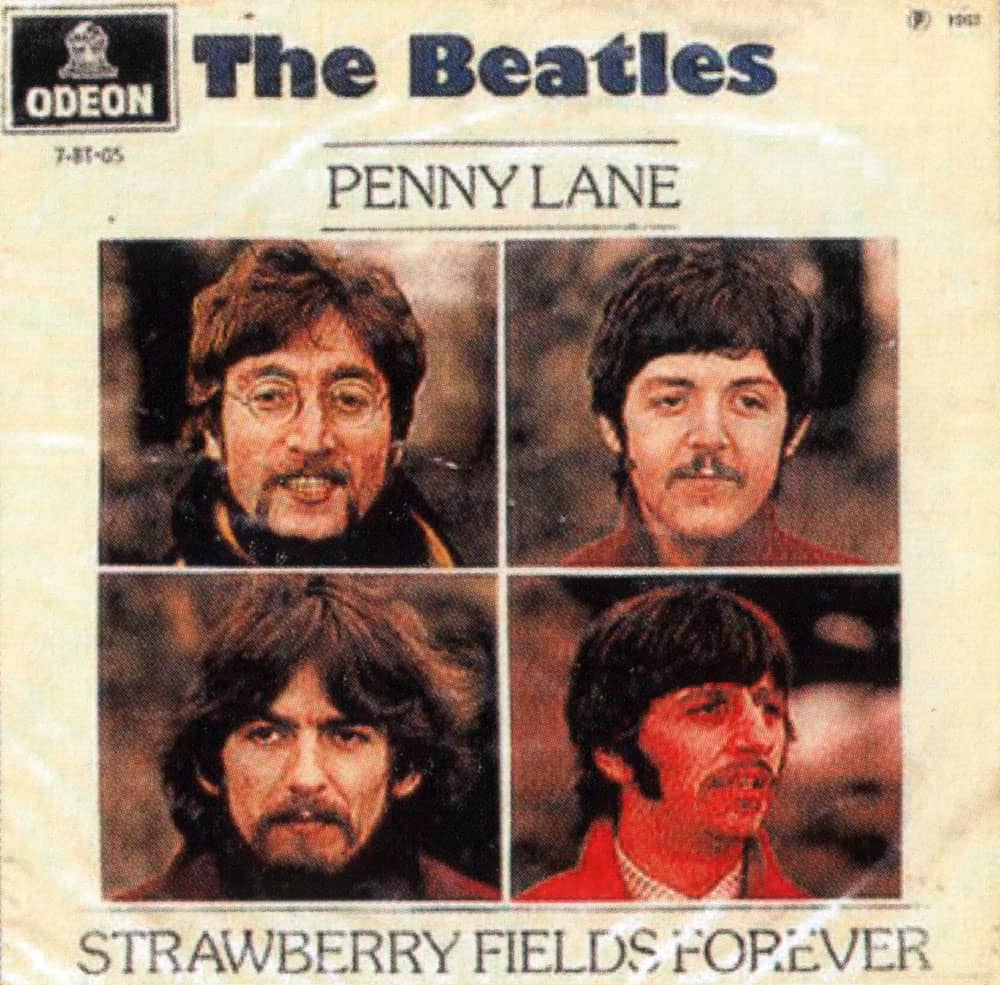
This song was part of what I think was the best single ever released. Penny Lane/Strawberry Fields. Both of the songs are connected with Liverpool. Both John and Paul wrote about places where they grew up.  Paul explained that Penny Lane was a suburban district where, until age four, he lived with his mother and father.

The Beatles did not include these two songs on Sgt Pepper. They recorded singles and albums separately for the most part. They ended up on the Magical Mystery Tour album in America.

Lennon and McCartney were competitive and for the most part it was a good competitiveness that resulted in timeless songs that will be still remembered 100 years from now.

They made promotional films for both songs. This must have been a shock to some people. They had not seen the Beatles since the year before…they had ditched the mop tops and gone weird…that must have been in some people’s minds. The music had a sophistication that earlier songs didn’t have.

The single only made #2 in the UK…it was locked out of the #1 position by no other than Elbert Humperdinck with Release Me. It did peak at #1 in the Billboard 100, #1 in Canada, and #1 in New Zealand in 1967.

In 1967, Capitol released Beatles music on a new but short-lived format called “Playtapes.” These tape cartridges did not have the capabilities to include entire albums, so a truncated four-song version of “Magical Mytery Tour” was released in early 1968 in this portable format, some rare copies having a picture from the “Help!” soundtrack album on the front of the tape. “Penny Lane” was one of the four songs on this release. These Playtapes are highly collectable today.

Paul McCartney: “When I came to write it, John came over and helped me with the third verse, as often was the case. We were writing childhood memories: recently faded memories from eight or ten years before, so it was a recent nostalgia, pleasant memories for both of us. All the places were still there, and because we remembered it so clearly we could have gone on.” John himself relates: “We really got into the groove of imagining Penny Lane, you know – the bank was there, and that was where the tram sheds were and people waiting and the inspector stood there, the fire engines were down there. It was just reliving childhood.” In John’s Playboy interview of 1980, he concurs about his input in writing the song: “I wrote some of the lyrics. I can’t remember which. It was all Paul’s melody.”

“There was a barber shop called Bioletti’s with head shots of the haircuts you can have in the window and I just took it all and arted it up a little bit to make it sound like he was having a picture exhibition in his window. It was all based on real things; there was a bank on the corner so I imagined the banker, it was not a real person, and his slightly dubious habits and the little children laughing at him, and the pouring rain. The fire station was a bit of poetic license; there’s a fire station about half a mile down the road, not actually in Penny Lane, but we needed a third verse so we took that and I was very pleased with the line ‘It’s a clean machine.’ I still like that as a phrase, you occasionally hit a lucky little phrase and it becomes more than a phrase. So the banker and the barber shop and the fire station were all real locations.”

Here are the two videos…Strawberry Fields and Penny Lane… See those glasses that John Lennon slips on in the Penny Lane Video? The square ones…I have some identical from that time period…they are really cool.

Penny Lane

In Penny Lane, there is a barber showing photographs
Of every head he’s had the pleasure to know
And all the people that come and go
Stop and say, “Hello”

On the corner is a banker with a motorcar
And little children laugh at him behind his back
And the banker never wears a mac
In the pouring rain, very strange

Penny Lane is in my ears and in my eyes
There beneath the blue suburban skies
I sit, and meanwhile back
In Penny Lane there is a fireman with an hourglass
And in his pocket is a portrait of the Queen
He likes to keep his fire engine clean
It’s a clean machine

Penny Lane is in my ears and in my eyes
A four of fish and finger pies
In summer, meanwhile back
Behind the shelter in the middle of the roundabout
The pretty nurse is selling poppies from a tray
And though she feels as if she’s in a play
She is anyway

In Penny Lane, the barber shaves another customer
We see the banker sitting waiting for a trim
And then the fireman rushes in
From the pouring rain, very strange

Penny Lane is in my ears and in my eyes
There beneath the blue suburban skies
I sit, and meanwhile back
Penny Lane is in my ears and in my eyes
There beneath the blue suburban skies
Penny Lane!

Twilight Zone – Printer’s Devil

★★★★★ Febraury 28, 1963 Season 4 Episode 9

If you want to see where we are…HERE is a list of the episodes.

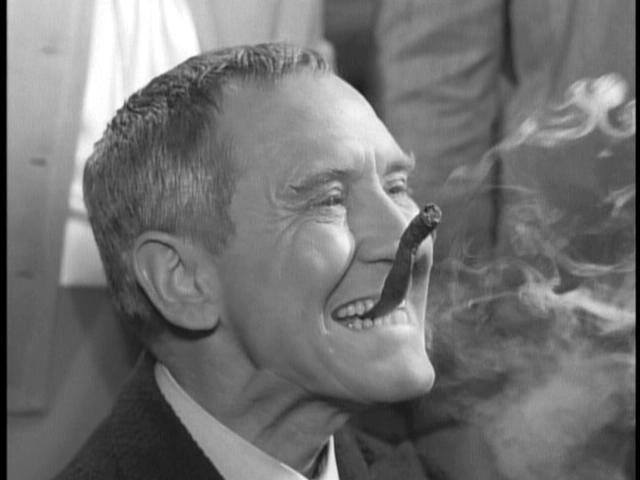
I’ve always liked sell your soul to the devil stories. This one has Burgess Meredith and that means chances are it’s a great one. Three out of four Twilight Zones he is in are classics. Time Enough At Last, The Obsolete Man, and this one are remembered episodes of the Twilight Zone. His eyebrows were pointing slightly upward, a twisted cigar in his mouth, he certainly looks the part. He is a grinning, leering Devil, full of subtleties. His interpretation goes well beyond the lines. Meredith is also listed as one of the writers. 

Robert Sterling plays Douglas Winter, a down on his luck newspaper owner who is about to get pushed out by a larger paper. Pat Crowley plays Jackie Benson who is Douglas’s much more acute girlfriend. The hour format doesn’t hurt this one at all…in fact it helps a bit. The fourth season is not full of classic episodes but I have always considered this one…one of the best. 

Ralph Senensky directed this episode. I want to use this opportunity to tell everyone who is interested that he has a blog and talks about all the shows he directed. The Waltons, Night Gallery, Twilight Zone, and much more. His memories are insightful about those old shows. He still posts and he is around 98 years old. 

Ralph Senensky: Actors like Burgess Meredith fascinated me with the preparation they brought to their roles. They didn’t just memorize their lines. As Beulah Bondi once said to me, “After the lines are learned, that’s when the work begins.”  I’m sure Burgess took his cue for how to work at the linotype machine from one of Jackie’s lines: “If he doesn’t play Chopin’s Polonaise, I’m going to be disappointed.”

This show was written by Robert Sterling, Pat Crowley, and Burgess Meredith

Rod Serling’s Opening Narration: 

Take away a man’s dream, fill him with whiskey and despair, send him to a lonely bridge, let him stand there all by himself looking down at the black water, and try to imagine the thoughts that are in his mind. You can’t, I can’t. But there’s someone who can—and that someone is seated next to Douglas Winter right now. The car is headed back toward town, but its real destination is the Twilight Zone.

Summary

Douglas Winter, the editor of The Courier, a failing newspaper, feels there is nothing to live for after a number of employees quit, including the Linotype operator. On a bridge while drunk, he looks down into the inviting water below. When he is going to commit suicide, he is approached by one “Mr. Smith”, who comments that it’s a short fall and probably wouldn’t do a very good job. He then asks Doug for a light, and, if he wasn’t quite ready, a ride into town. Amused and forgetting about suicide, Winter gives him a lift to a café, where Mr. Smith agrees to provide the editor with money to pay off debts and continue the operation of the newspaper. Mr. Smith also signs up to replace the linotype operator and be the sole reporter. With nothing to lose, Doug agrees to the proposition.

Rod Serling’s Closing Narration:

Exit the infernal machine, and with it his satanic majesty, Lucifer, prince of darkness—otherwise known as Mr. Smith. He’s gone, but not for good; that wouldn’t be like him—he’s gone for bad. And he might be back, with another ticket….to The Twilight Zone.

CAST

Rod Serling…Narrator / Self – Host (uncredited)
Burgess Meredith…Mr. Smith
Robert Sterling…Douglas Winter
Pat Crowley…Jackie Benson
Ray Teal…Mr. Franklin
Charles P. Thompson…Andy Praskins
Doris Kemper…Landlady
Camille Franklin…Molly