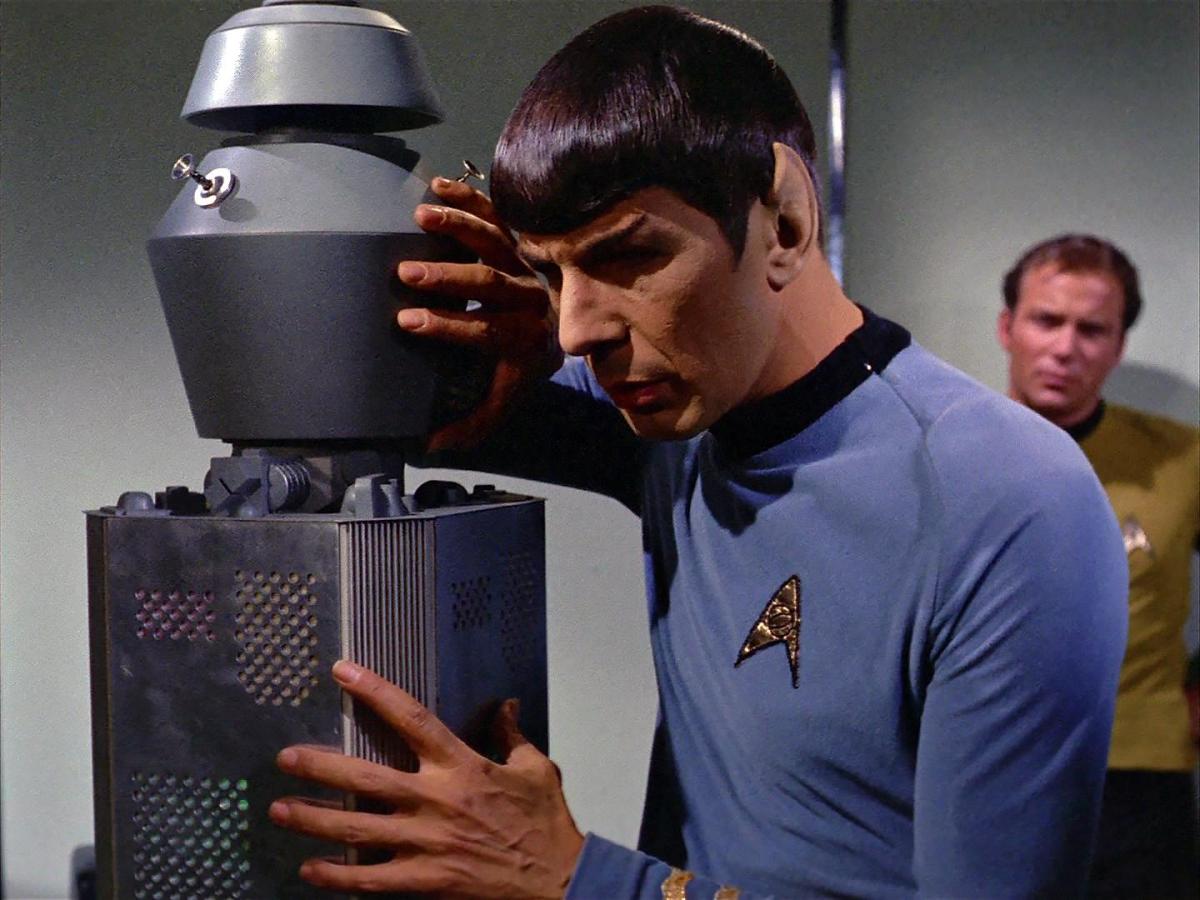
Star Trek – The Doomsday Machine

★★★★★ October 20, 1967 Season 2 Episode 6

If you want to see where we are…and you missed a few…HERE is a list of the episodes in my index located at the top of my blog. 

This show was written by Gene Roddenberry and Norman Spinrad

A true 5-star episode. This would be in my top 5 Star Trek episodes of all time. The story is about obsession…if you get too caught up in it…it can hurt you or worse. This could be the most well-written episode. 

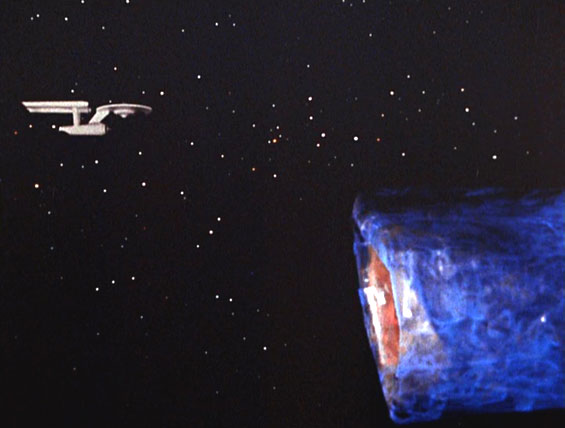
The crew of the Enterprise comes across the wrecked hull of the Constellation with only its commander, Commodore William Windom aboard. His crew was sent down to a planet that no longer exists because it was destroyed by a Doomsday device, a miles-long machine that looks like a hollowed-out log floating through space. It’s not floating and it isn’t hollow. It is self-fueling feeding on the planets and other objects in its path and its hull is impervious to starship phaser fire. It doesn’t look like it but it’s one of the best weapons I’ve ever seen. When it comes to your galaxy…you would have no galaxy left. 

Commodore William Windom is in shock, for good reason, and he is beamed to the Enterprise so the doctor can take a look at him.  

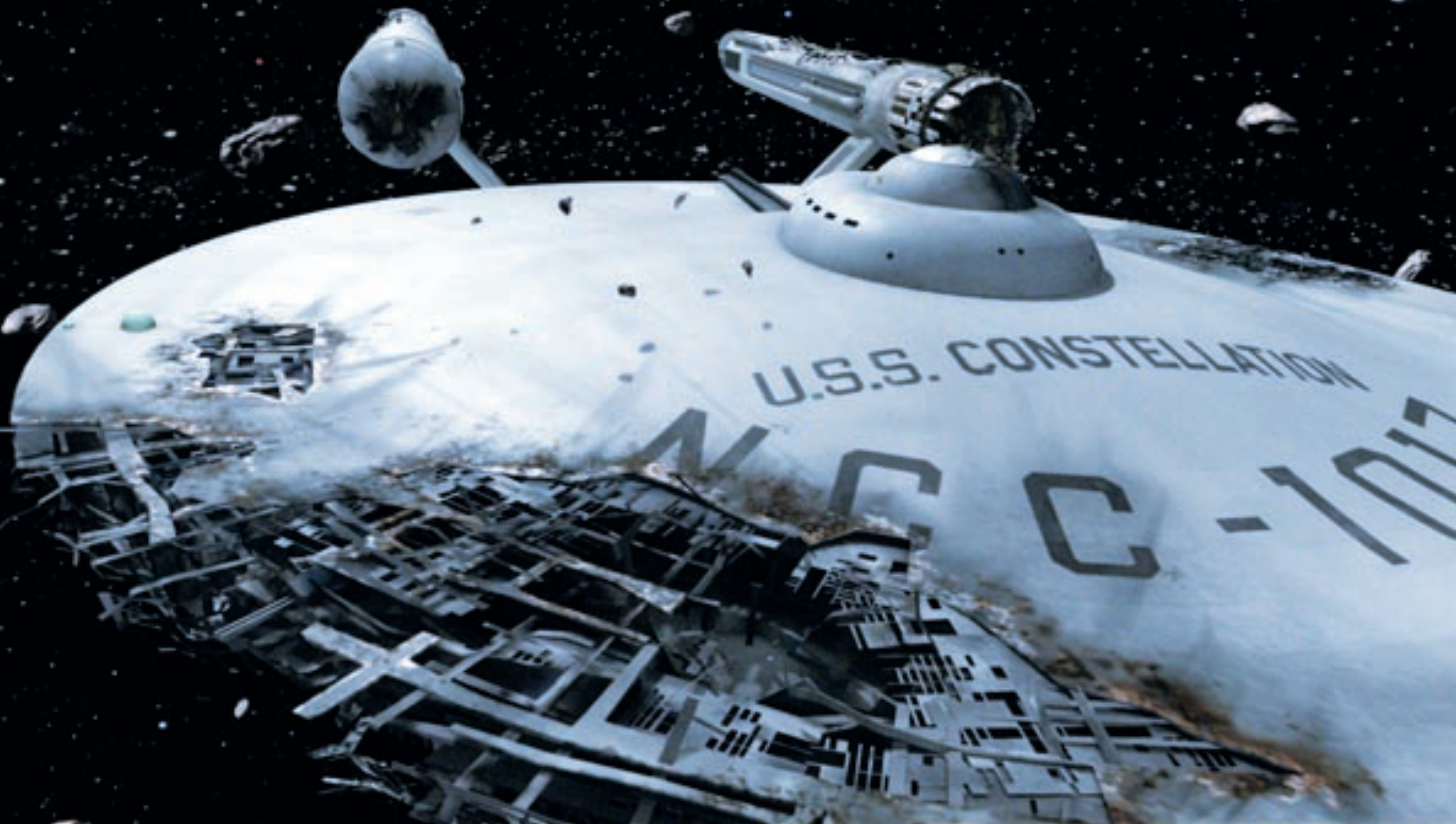
Star Trek - The Doomsday Device - Uss Constellation

While Kirk is away trying to repair the other ship, communications are circumvented, allowing Dekker, crazy as he is, to take over the Enterprise. He decides to wage war with this gaint eater of planets, endangering another crew. The episode draws on some wonderful twists and turns as Kirk has to deal with Dekker and then with the force that is now a danger to everyone. 

The cosmic threat of this huge alien weapon, while exciting in itself, takes on a much more darker tone thanks to the presence of Decker on the bridge of the Enterprise. The whole plot seems to take a back seat, for a while at least, to the strange, awful relationship between Dekker and this unfeeling machine. Everyone else becomes an incidental side player to the conflict between these two, but, of course, it’s Decker who sees this thing as his personal devil who killed his crew. 

Spock didn’t give up power easily but he had to when faced with Starfleet rules. Dekker wants to kill a machine with phasers that he knows won’t hurt it. On the communicator, Kirk gives Spock the command to relieve Dekker of power…against regulations but Spock complies and the following exchange takes place…video below of this. 

Capt. Kirk: Mr. Spock, relieve Commodore Decker immediately. That’s a direct order.

Matt Decker: You can’t relieve me and you know it, according to regulations…

Capt. Kirk: BLAST REGULATIONS! Mr. Spock, I order you to assume command on my personal authority as Captain of the Enterprise.

Mr. Spock: Commodore Decker, you are relieved of command.

Matt Decker: I don’t recognize your authority to relieve me.

Mr. Spock: You may file a formal protest with Starfleet Command, assuming we survive to reach a Starbase, but you are relieved. Commodore, I do not wish to place you under arrest.

Matt Decker: You wouldn’t dare.

[Mr. Spock signals two security guards who immediately step forward at his command]

Matt Decker: You’re bluffing.

Mr. Spock: Vulcans never bluff.

Matt Decker: [sadly] No. No, I don’t suppose that they do. Very well, Mr. Spock, the bridge is yours.

It’s a well-written episode and the acting by William Windom as Dekker is flawless. If I say too much more it will give it away…watch this episode. 

From IMDB:

James Doohan’s favorite episode for its highlighting of the engineering aspects of the Star Trek world.

According to William Windom, he did not enjoy working on the show. He said that William Shatner and Leonard Nimoy were not getting along at the time, which made the set’s atmosphere tense. He also said that he felt that the episode was silly so he purposely overacted. It was not until many years later that he realized that his character was a reference to Captain Ahab from Herman Melville’s “Moby Dick”.

This episode marks the first time Scotty is heard cursing in Gaelic. He later utters the same expletive in Star Trek: I, Mudd (1967) and Star Trek V: The Final Frontier (1989).

This is the most effects-heavy episode of the second season. When the series was digitally remastered for its 2007 DVD release, the upgrade required nearly 200 new effects shots.

According to William Windom, he had Decker compulsively twiddle with “cassette cartridges” (sic; data tapes) as an homage to Humphrey Bogart, who did the same thing with ball-bearings as Captain Queeg in The Caine Mutiny (1954).

Norman Spinrad was displeased with the model used for the planet killer. As he told Allen Asherman in The Star Trek Interview Book, he envisioned a doomsday machine bristling with all sorts of evil-looking weapons. For budgetary reasons, the actual Doomsday Machine model was made by dipping a windsock in cement.

Director Marc Daniels finished this episode in five days instead of the usual schedule of six. Daniels made a bet with the producers that he could finish the episode in five days. When he succeeded, he got a $500 bonus.

Nichelle Nichols does not appear in this episode. Uhura’s duties were assumed by Lt. Palmer, played by Elizabeth Rogers. Walter Koenig is also absent.

This episode was nominated for a Hugo Award for Best Dramatic Presentation, at the 1968 World Science Fiction Convention.

When Spock describes the two innermost planets of the solar system that was destroyed, he says “The surface temperature of the inner planet is that of molten lead. The other has an atmosphere poisonous to human life”. Commodore Decker says he beamed his crew down to the third planet. This accurately describes the first three planets in our solar system.

The first of two appearances of Elizabeth Rogers as communications officer Lt. Palmer, the other being season three’s Star Trek: The Way to Eden (1969).

This episode marks the debut of the re-designed engineering set. The dilithium crystal storage units now occupy the center of the floor (complete with recycled Horta eggs), a ladder and upper level have been added into what was just a high bank of lighted panels in the first season. The set also is entered through a short spur hallway now, rather than as a side door off a main corridor. The console across from the forced-perspective end of the set has been replaced by a doorway and moved to the main wall to the left of the red grid. The huge structures among which Kirk’s evil self and Ben Finney once hid are not seen in detail again, but the emergency manual monitor set was built on stilts on that spot, making its debut in Star Trek: Mirror, Mirror (1967).

Besides the Constellation and the Enterprise, the other Constitution class ships seen in the original series are Hood, Potemkin, Excalibur, Lexington, Defiant, and the Exeter.

Re-used stock footage of Scott being tossed around engineering is from Star Trek: Tomorrow Is Yesterday (1967). A console that appears only in that episode can be seen. Scott wears a tricorder throughout this episode. But, when the old footage of him being thrown against the grating in “Tomorrow is Yesterday” is spliced in, the tricorder vanishes.

Captain Willard Decker from Star Trek: The Motion Picture (1979), played by Stephen Collins, is the son of Commodore Decker from this episode. In the William Shatner vehicle T.J. Hooker: Second Chance (1982) there was a character named Decker.

Commodore Decker’s first name was originally to be Curt, but it was felt that it sounded too much like “Kirk”, so it was changed to Matt.

This is the first appearance in the series of another vessel identical to the Enterprise. The Constellation is a Constitution class vessel which is virtually the same as the Enterprise. Its registry number is NCC-1017, which implies that it was produced earlier than the Enterprise. Kirk said in an earlier show that there were only 12 Constitution class ships in service.

Writer Norman Spinrad recycled a short story of his called “The Planet Eater” which had been roundly rejected by publishing houses, despite being heavily influenced by “Moby Dick”. He was able to convince Gene Roddenberry that it would make a viable subject for an episode.

Although considered to be a classic episode by fans and critics alike, story editor D.C. Fontana named this as her least favourite episode.

This was one of very few episodes to have its entire score composed specifically for it. Sol Kaplan’s outstanding music was subsequently used in several of the other best episodes of the 2nd season, including Star Trek: The Immunity Syndrome (1968), Star Trek: Obsession (1967) and Star Trek: The Ultimate Computer (1968). Many listeners have noted similarities between its “planet killer” theme and the “shark” theme of John Williams’ score for Jaws (1975).

Strangely, there are two armed red-shirt guards posted on the bridge throughout much of this episode, even though there is no apparent reason requiring their presence. This doesn’t happen on any other episode of the series, unless there is an apparent security threat.

Norman Spinrad has expressed disappointment that the actor whom he envisioned playing Decker, Robert Ryan, was not cast. Ryan was a fan of the series and wanted to do the episode. Scheduling conflicts prevented this, so William Windom was cast.

The auxiliary control room is first seen in this episode aboard the Constellation. Its large viewing screen was previously used in the briefing room in Star Trek: The Menagerie: Part I (1966), Star Trek: The Menagerie: Part II (1966), and Star Trek: Space Seed (1967), and on the bridge set used in Star Trek: Where No Man Has Gone Before (1966).

The character of Lt. Washburn (played by Richard Compton) was named after the show’s longtime assistant director, Charles Washburn.

In the original script, Enterprise actually fires several phaser shots into the machine’s mouth, but the beams just ricochet around harmlessly, if energy beams can be said to ricochet. (‘Reflect’ is probably a better word.)

In Norman Spinrad’s original version, Spock makes an unusual comment after the machine has been destroyed. He calls the weapon “not very efficient”, pointing out that a fusion bomb disguised as space rubble could be easily fed to another version of the machine, should one appear.

The picture of the star field on the bulkhead of the transporter room makes its last appearance in this episode.

Kirk’s second season green wraparound tunic debuts in this episode and will appear intermittently throughout the season. In contrast with the first season version, the collar is now edged with gold piping, although it lacks the black trim that it will gain for later (shooting order) second-season episodes such as Star Trek: The Apple (1967) and Star Trek: The Immunity Syndrome (1968). The other key difference is the location of the rank braids: these were seen on the shoulders in the first season, whereas this version of the tunic sports the standard braids on the sleeves. Kirk never wore the green tunic in the third season.

In many of its profile shots, the planet killer is semi-transparent and stars show through it. This was an overlay of film footage of the doomsday machine model over an existing star field. This money-saving technique also was used in Star Trek: The Squire of Gothos (1967) when Trelane’s planet blocks the Enterprise’s path.

The modified Nuclear-Chicago Model 2586 Radiation Survey Meter is again used by a member of the landing party as a sensor device.

In the Star Trek novel “Vendetta”, author Peter David related that the planet-killer was actually a prototype for a much larger version. The weapon had been built by a race called The Preservers, who were fighting (and losing) a war with the Borg.

The three crewmen who beam over to the Constellation with Kirk, McCoy, and Scott were named after three of the series’ assistant directors. Washburn’s namesake was Charles Washburn; Russ’ was Rusty Meek, and Elliott’s was Elliot Schick.

The digitally remastered episode shows a much better idea of the doomsday machine’s ominous design. There is also a believable view of the disabled and heavily damaged Constellation.

This episode has six alumni from The Twilight Zone (1959): William Shatner, Leonard Nimoy, James Doohan, George Takei, William Windom, and Jerry Catron.

The trident scanner Scott pulls out of the new storage area near the doorway to engineering is the same prop Spock uses in Star Trek: Metamorphosis (1967) as he works on the shuttlecraft, and which Ensign Harper uses to plug in the M-5 multitronic unit in Star Trek: The Ultimate Computer (1968). It is identified in The Making of Star Trek as a “Ray Generator and Energy Neutralizer (Spock-Built).”

Here we see a Federation style of martial art in the fight scene between Mr. Montgomery and Commodore Decker. In most episodes, the fighting is not as structured. Two of Kirk’s default moves are to use a knife-hand strike to the neck (strike with the side of the hand, commonly known as a ‘karate chop’) and a flying side kick.

One of the legendary “bloopers” occurred during the filming of this episode: Spock says to Decker, “If you don’t veer off, I shall relieve you on that basis!” In the blooper, Leonard Nimoy forgets part of his line and says, “If you don’t veer off, I shall…blow my brains out!”

Summary

While on patrol, the Enterprise approaches a recently mapped solar system only to find that all but two of its planets have been destroyed. They also find another starship, the USS Constellation, floating in space and apparently abandoned. Beaming aboard the Constellation, they find only one occupant, Kirk’s friend and the ship’s commander, Commodore Matt Decker, who tells them of his encounter with a huge planet-killing machine. With Kirk attempting to re-start the Constellation’s engines, Decker takes command of the Enterprise and, in his irrational state, announces he is going to try and destroy the doomsday machine.

CAST

William Shatner … Captain James Tiberius ‘Jim’ Kirk
Leonard Nimoy … Mister Spock
DeForest Kelley … Doctor Leonard ‘Bones’ McCoy
William Windom … Commodore Decker
James Doohan … Lieutenant Commander Montgomery ‘Scotty’ Scott
George Takei … Lieutenant Hikaru Sulu
Elizabeth Rogers … Lt. Palmer
John Winston … Lieutenant Kyle
Richard Compton … Washburn
John Copage … Elliott
Tim Burns … Russ
Jerry Catron … Montgomery
Bill Blackburn … Lieutenant Hadley (uncredited)
Roger Holloway … Roger Lemli (uncredited)
Jeannie Malone … Yeoman (uncredited)
Eddie Paskey … Lieutenant Leslie (uncredited)

Star Trek – The Apple

★★★ October 13, 1967 Season 2 Episode 5

If you want to see where we are…and you missed a few…HERE is a list of the episodes in my index located at the top of my blog. 

This show was written by Gene Roddenberry, Max Ehrlich, and Gene L. Coon

This is not the greatest episode of Star Trek, but I like it because it really has most of the classic Star Trek themes and situations. There’s a landing party that gets mixed up with natives, and to save his crew Kirk has to take drastic steps to alter the course of their civilization. There’s a lot of romance in the air, (though interestingly, no romance for Kirk.)

There is something about Star Trek that I haven’t mentioned. The Red Shirt Syndrome. It seems that any security personnel with a red shirt…has a high mortality rate in the Enterprise. The ones that get it…usually are just stock performers we never saw before and certainly won’t again. Scotty is somehow safe from this occurrence… well he rarely beams down to planets. 

In this episode, there is plenty of time for Spock and McCoy to debate concepts like free will, change, and material comfort versus freedom. Of course, several red-shirt crew members are killed along the way here also. There’s a big fight and plenty of storms and lightning.

***Spoilers***

The Enterprise crew are exploring a planet that seems idyllic, but turns out to have deadly plants and explosive rocks, as well as a simple native race that worships a sophisticated machine they don’t understand and deify as an entity called “Valla”. Valla’s story is never really explained… it provides for the natives’ needs while needing periodic ‘feeding’ for some strange reason.

Valla basically serves as a plot device to temporarily disable the Enterprise and place the ship and crew in mortal danger. Valla also has the ability to control the weather and direct deadly lightning bolts at ground targets. Kirk’s dilemma is to take out Valla and free both his ship and the natives from their seemingly benevolent dictator.

The episode is alright but the storyline has been done before on Star Trek and Twilight Zone. 

From IMDB:

Spock’s lightning-burned shirt was auctioned off at a science-fiction convention in 1967, the same year filming wrapped.

 Chekov’s first name, Pavel, is established in this episode, when his love interest, Yeoman Landon, calls him “Pav”.

 Originally, the script for this installment called for Vaal’s stone dinosaur head to be destroyed by Enterprise’s phasers. The props department had put in a lot of work creating it with paper mache’ and refused to allow its destruction.

 Walter Koenig seems to have discarded the wig he used in his earlier episodes. Since his own hair was now long enough, it was not necessary for him to wear it anymore.

 Spock’s appearance is jokingly compared to Satan in the final scene. This resemblance caused discomfort to would-be advertisers when Star Trek was first being marketed (see series trivia).

 This episode contains confirmation of a much-speculated upon topic: whether the Enterprise could separate the Engineering section and warp nacelles from the primary vessel. Mentioned in Kirk and Scotty’s conversation by communicator, half-way into the show, after Kirk beams down to the planet with an away team, and Scotty takes a seat in the captain’s chair on the bridge.

 This is the only time we see a landing party that comprises more than 6 members.

 Actress Celeste Yarnall, who played Yeoman Martha London, said it took a while to film the scene where she asks how the planet’s inhabitants would “do it” after Vaal is destroyed because William Shatner, Leonard Nimoy, and Deforest Kelly kept making up hilarious methods for procreating. Network censors we’re on set and Yarnall said they were getting upset, which made everyone laugh more.

 Security Guard/Red-Shirt Casualties: 4.

 Leonard Nimoy kept playing practical jokes on Celeste Yarnall while filming the episode. In an interview, she said that she was terrified every time she saw him coming because she had no idea what he might do.

 After the first crewman is killed by the poisonous flower darts, the captain is trying to understand it all and foolishly plucks a flower and smells it, not realizing that this could be a fatal mistake.

 Censors made producers cut out footage of Yeoman London during the cave scene because they didn’t want the audience to make the assumption that she slept in the same cave with the male characters.

 It is debated whether or not Kirk is in violation of the Prime Directive by interfering. The Prime Directive states “Don’t interfere with the natural evolution of the planet.” In Kirk’s opinion, the planet’s inhabitants are living in servitude of a machine that is impeding their natural growth and development. Mr. Spock’s point is that the natives are healthy, happy, and content with their lives. This means that life on the planet is exactly as it should be, and doesn’t need to advance.

 In addition to Lt. Hadley, Bill Blackburn also appears as one of the natives.

 The deity called “Vaal” is curiously similar to “Baal”, the Semitic deity.

 According to Celeste Yarnall, she and William Shatner were very attracted to each other. He wanted to act on that attraction but understood when she said no, because she was married at the time. They did end up dating for a while, a few years later, after she got divorced.

 “The Apple” refers the forbidden fruit (of the “tree of knowledge”) eaten by Adam and Eve in Genesis, Chapter 3, which caused them to be cast out of Paradise by God. The fruit was never specifically identified in the text, but popular culture regards it as an apple. The fruit was first called an apple in John Milton’s epic poem “Paradise Lost,” which also inspired a famous line in Star Trek: Space Seed (1967).

 The villager’s greeting to the Enterprise crew, wrists together with hands apart and fingers slightly curled inward, is similar to the Ferengi greeting. The gesture used here places the left hand below the right, unlike the Ferengi gesture.

 George Takei and Nichelle Nichols do not appear in this episode.

 David Soul (Makora) would go on to play Detective Kenneth Hutchinson in Starsky and Hutch (1975) as well as author Ben Mears in Salem’s Lot (1979).

 When the landing party meets with the villagers, Kirk asks Akuta where the children are, but he fails to comprehend. But, after Kirk makes a gesture simulating the height of a child, Akuta interprets it as “replacements”. Since an accidental death of a villager would cause an imbalance, there is no explanation by Akuta as to how Vaal replaces a villager, since Vaal has prohibited “holding” and “touching”. But, during the final scene, it is implied that the villagers will be able to procreate naturally.

 This takes place in 2267.

54 years after this episode aired, William Shatner made a space flight on October 13, 2021 aboard Blue Origin’s New Shepard 4 capsule. On this flight he officially became the oldest human to fly to space.

 Not unique to this episode, but worth noting. Using the failed beam-up sequence as a reference, when several people beam up, they’ll arrange themselves to stand approximately where the transporter pad that’ll receive them will be. Exception for the unconscious Mr. Spock, notice how Kirk, Checkov, Yeoman Landon, and Kaplan stand in a somewhat circular formation.

 Three years earlier, James Doohan and Keith Andes had appeared together in The Outer Limits: Expanding Human (1964) along with Skip Homeier. Skip Homeier would go on to play Melakon in Star Trek: Patterns of Force (1968) and Sevrin Star Trek: The Way to Eden (1969). The latter also has a Genesis-themed story-line as leader a group of space hippies in search of Eden.

At the end when Kirk advises the villagers that they are free of Vaal and now have the right of autonomy, there is no mention of retribution for the crewman killed during the villagers attack. Likely because they are a gentle, childlike people who were simply beguiled by Vaal and obeying a command.

Summary

Kirk and a landing party beam down to what seems to be an ideal, Eden-like planet. They soon find however that the planet is ruled by a powerful computer that keeps its local inhabitants – primitive and simple tribesmen – happy and healthy. With the Enterprise locked in a tractor beam and slowly being dragged into the planet’s atmosphere, Kirk and Spock must find a way to disable the computer. Realizing the threat to its existence, the computer orders the tribesmen to kill the visitors.

CAST

William Shatner … Captain James Tiberius ‘Jim’ Kirk
Leonard Nimoy … Mister Spock
DeForest Kelley … Doctor Leonard ‘Bones’ McCoy
Keith Andes … Akuta
Celeste Yarnall … Yeoman Martha Landon
James Doohan … Lieutenant Commander Montgomery ‘Scotty’ Scott
David Soul … Makora
Walter Koenig … Ensign Pavel Chekov
Jay D. Jones … Ensign Mallory (as Jay Jones)
Jerry Daniels … Marple
John Winston … Lieutenant Kyle
Mal Friedman … Hendorff
Shari Nims … Sayana
Paul Baxley … Native (uncredited)
Bill Blackburn … Lieutenant Hadley / Native (uncredited)
Ron Burke … Native (uncredited)
Bobby Clark … Native (uncredited)
Vince Deadrick Sr. … Native (uncredited)
Dick Dial … Kaplan (uncredited)
Eddie Paskey … Lieutenant Leslie (uncredited)


Janis Joplin – Piece Of My Heart ….Under The Covers Tuesday

Erma Franklin, Aretha’s sister, was the first to record this song. She did a fantastic job and Janis Joplin came later and did what is probably the definitive version of it.

Jerry Ragovoy and Bert Berns wrote this song. Aretha Franklin’s younger sister Erma sang the original version and put it on the R&B charts in 1967. It peaked at #63 on the Billboard 100, #10 on the Billboard R&B Charts, #3 on the Canada Adult Contemporary Charts, and #9 in the UK in 1967.

Big Brother and the Holding Company covered it and it peaked at #12 on the Billboard 100 and #9 in Canada a year later in 1968. For Erma Franklin, it was her biggest hit. She went on to sing backup on some of Aretha’s songs and ran a childcare agency called Boysville. Erma died of cancer in 2002 at age 64.

I like Erma’s version of it. It’s a very soulful version of the song. I’m surprised it didn’t do better on the charts. I have to wonder if Aretha would have covered it first…would it have been more of a hit since she was so popular and had more of a presence on the charts?

A great song by one of my favorite artists…Janis Joplin. I could listen to her sing the phone book and be happy….but some songs I really like are…Down On Me, Summertime, Piece of My Heart, Ball and Chain, Try (Just a little bit Harder), Maybe, Little Girl Blue, Cry Baby, Me and Bobby McGee, Mercedes Benz, and anything live she did with either band…She could sing the blues and she lived them…

I covered this song back around 5 years ago but I wanted to get this in for a Tuesday cover.

Piece Of My Heart

Didn’t I make you feel
Like you were the only man?
Didn’t I give you everything that a woman possibly can?
(Ohhhh ohhh ohhhhh)

But with all the love I give you
It’s never enough
But I’m gonna show you, baby
That a woman can be tough
So come on
Come on
Come on
Come on
And
Take another little piece of my heart now, baby
(Break it!)
Break another little bit of my heart now, honey
(Have a)
Have another little piece of my heart now, baby
(You know you got it if it makes you feel good)

You’re out on the streets (looking good)
And you know deep down in your heart that it ain’t right
And ohhhhh you never never hear me when I cry at night
Ohhhhhhhh

I tell myself
That I can’t stand the pain
But when you hold me in your arms
I’ll say it again
So come on
Come on
Come on
Come on

And take it
Take another little piece of my heart now, baby
Heyyyy!
(Break it!)
Break another little bit of my heart now, baby
You can
(Have a)
Have another little piece of my heart now, baby
(You know you got it if it makes you feel good)

Hey heyyyyy!
Take another little piece of my heart now, baby
Ohhhh
(Break it!)
Break another little bit of my heart now, honey
Heyyyyyy!
(Have a)
Have another little piece of my heart now, baby
Come on
(Take it!)
Take another little piece of my heart now, baby

Star Trek – Mirror, Mirror

★★★★★ October 6, 1967 Season 2 Episode 4

If you want to see where we are…and you missed a few…HERE is a list of the episodes in my index located at the top of my blog. 

This show was written by Gene Roddenberry and Jerome Bixby

I do love time travel stories and I also love parallel universe stories which this one is a good one. An evil Star Trek crew… it also reminds me of the later Star Wars where the government is evil. 

In the opening scene, a landing party which consists of Kirk, McCoy, Scotty, and Uhura are unsuccessfully negotiating with a race of pacifists; they refuse to allow dilithium crystals to be mined in case they are used violently. They state that the Enterprise could take them by force but Kirk states that they won’t do that. As they beam up there is an ion storm that affects the transporter… instead of finding themselves on the Enterprise they know they materialize on a ship that is almost exactly the same yet somehow totally different

An excellent episode! It is another 5-star in the 2nd season. Kirk, McCoy, Scott, and Uhura get thrust into an alternate reality where the Federation is an evil empire and their shipmates and friends are now malicious, dangerous adversaries. Now the four have to find a way to get back to their own reality without being discovered and killed.

Star Trek" Mirror, Mirror (TV Episode 1967) - IMDb

This is a classic episode that serves to introduce us to the parallel universe… a universe that will be visited more than once in the later ‘Star Trek series. It is immediately apparent that the Star Fleet in the parallel universe is an organization with fascist tendencies which immediately raises the tension. The fact that the villains have familiar faces serves to make it even more interesting.

it is also interesting that this goateed Spock is just as logical as his ‘good’ counterpart. This is one of those can’t-miss episodes…if you haven’t seen it…give it a shot. 

From IMDB:

It took about a month to complete this particular episode. After filming had begun, BarBara Luna was diagnosed with strep throat. Since the script called for Capt. Kirk to kiss her, they had to postpone the kissing scene for three weeks until she was medically cleared, since they couldn’t risk William Shatner getting infected.

To further denote the inverted nature of the parallel universe, phasers are worn upside-down on the left hip.

This proved to be one of the more popular Star Trek segments in terms of follow-ups. The Mirror Universe would be depicted on Star Trek: Deep Space Nine (1993) and Star Trek: Enterprise (2001), while several non-canonical Star Trek novels and comic book series featured sequel stories to the episode.

In Jerome Bixby’s original outline, the Mirror Universe Federation was not evil, but simply backwards in terms of some technology, notably phaser weapons. Initially, Mirror Kirk was to be married to a nurse on board the parallel Enterprise, and Mirror Spock was more Vulcan in temperament. In addition, McCoy’s counterpart, and not that of Spock, was to be bearded.

Star Trek was usually not allowed to show women’s navels, but Uhura’s navel is visible in the mirror universe. Reportedly, this was accomplished by filming while a PA took the Standards representative to lunch. This is a popular myth in Star Trek but it is untrue. By the fall of 1966, the networks had removed this prohibition from their standards. In fact, Star Trek had already done this, as seen at the end of season one’s “Shore Leave”, when McCoy shows up with two women by his side, both of whom had exposed navels. Besides, Uhura is seen several times with her bare midriff, and they would have never risked the problem of doing this if it meant re-shooting all of the scenes she appeared in.

As Mirror Sulu is the security chief as well as the helmsman, George Takei wears a red uniform in this episode. Since he normally wore gold, and had worn Science blue as an astrophysicist in Star Trek: Where No Man Has Gone Before (1966), this makes Takei the first Trek actor to wear all three uniform colours.

In the wake of this episode, a group of child fans started a neighborhood-wide letter campaign suggesting that the concept of a “Captain’s Woman” be carried over into the series as a whole, and requesting that Stefanie Powers be cast in that role. Eventually Gene Roddenberry’s assistant had to write to the group’s two “ringleaders”, telling them to ask their parents exactly what a “Captain’s Woman” was.

Actor Vic Perrin, who portrays Tharn, made his second appearance on Star Trek in as many weeks, having supplied the voice of Nomad in the previous episode Star Trek: The Changeling (1967).

First appearance of the emergency manual monitor set.

Jerome Bixby based this episode very loosely on his own short story “One Way Street”. In the original draft script, Kirk traveled to the parallel universe alone and the parallel universe Federation was battling a race called the Tharn. This name was later given to the leader of the Halkan Council, although it is not spoken on screen.

A modified brig makes its debut here. Its location on the set was in the short hallway leading to the Engineering set.

In the opening scene (prologue), the universe-switch shows the I.S.S. Enterprise orbits Planet Halkan right to left, in contrast to the U.S.S. Enterprise, which always orbits left to right (except in Star Trek: Shore Leave (1966)). By the beginning of Act I, however, it changes to orbiting from left to right. Note that in the re-mastered version, this error has been corrected, and the I.S.S. Enterprise orbits right-to-left.

In the original story outline, Captain Kirk was trapped in the Mirror Universe alone, and it was gradually rejecting him, treating him like he was an invading germ by poisoning his systems. Both ideas were dropped.

There is a second Vulcan serving on the ship. During the walk with Kirk, passing Chekov being tortured, you can see Spock’s security guard is Vulcan.

Inspired the name of the progressive/alternative rock band Spock’s Beard.

This is listed as one of the “Ten Essential Episodes” of TOS in the 2008 reference book “Star Trek 101” by Paula M. Block and Terry J. Erdmann.

The only time in the series when someone replies to Doctor McCoy’s “I’m a doctor…” line. McCoy says “I’m a doctor, not an engineer.” Scotty answers, “Now, you’re an engineer.”

The Star Trek books ‘Spectre’, ‘Dark Victory’, and ‘Preserver’, all written by William Shatner, are about the mirror universe. They take place in the 24th Century at around the same time as the Next Generation movies, and give a 100-year history of events in the mirror universe starting after this episode.

In the late 1980s, the pop band Information Society sampled Kirk’s line “It is useless to resist us”, at the very beginning of their song “Walking Away”, as well as “In every revolution, there’s one man with a vision”, in “Over the Sea”.

This is also the only episode in which Uhura is seen in a moving turbolift.

The Mirror Universe was the subject of a Star Trek graphic novel in 1991, written by Mike W. Barr, and published by DC Comics.

This episode was a primary inspiration for Blake’s 7 (1978).

The mirror universe Sulu wears a rank badge of a real-life ARVN (Army Republic Viet Nam) Captain. George Takei plays the role of an ARVN Captain in The Green Berets (1968) and in fact was unable to appear in Star Trek: The Gamesters of Triskelion (1968) due to his commitment to that film.

In the mirror universe, the male computer explains that James Kirk became Captain by murdering his predecessor Christopher Pike, a character played in previous installments by Jeffrey Hunter and Sean Kenney. This is possibly the only time in TOS where Pike is mentioned but does not appear.

This is the only time in TOS where Scotty addresses Captain Kirk as “Jim”. He did it twice in the movies: in Star Trek: The Motion Picture (1979), while en route to the refitted Enterprise, and in Star Trek Into Darkness (2013), when he tries to convince Kirk not to take the 72 torpedoes on board the Enterprise. In fact, he does NOT address Kirk as “Jim” in Star Trek: The Motion Picture (1979).

Ronald D. Moore (a prime writer and producer of the later Trek series) once cited this episode as one of his favourite installments of the original Star Trek series.

This title of this episode is said to be influenced by Disney’s Snow White where the wicked queen invokes the power of her mirror by saying ‘Mirror, mirror on the wall, who is fairest of them all’. However, the wicked queen actually says: ‘Magic Mirror on the wall, who is fairest of them all’. The line is often misquoted as ‘Mirror, mirror…’.

This show was nominated for science fiction’s Hugo Award.

There are physical changes in the “Enterprise” sets, to emphasize the difference between the parallel universes, one of which is the Empire’s symbol of a planet bisected with a sword, which accents its barbaric principles. Another difference is that Kirk’s command chair is given a higher back, to make it look more like a throne, in line with the idea that the alternate Federation is an empire. (This chair would be seen later in the season as Commodore Wesley’s in “The Ultimate Computer”.)

The voice of the computer on the alternate Enterprise was James Doohan’s.

This takes place in 2267.

The line from McCoy, “What kind of people are we?” was sampled in the song “Still Here” on Information Society’s 1992 album “Peace and Love Inc.”

Nurse Chapel (Majel Barrett) is the only major cast member not accounted for either in the beamed up landing party or among the crew of the Mirror Enterprise.

George Takei and BarBara Luna had previously appeared together in Hawaiian Eye: Sword of the Samurai (1960).

South Park: Spookyfish (1998) is a parody of this episode, where a portal is opened to the mirror universe, and the mirror version of Cartman has a goatee.

Summary

While beaming back to the Enterprise during an ion storm, Kirk, McCoy, Scotty and Uhura materialize aboard an Enterprise in a parallel universe. Here, the Federation has been replaced by the Empire and its inhabitants are violent and cruel. Members of the crew advance in rank by killing their superiors and Kirk is constantly a target. Their only hope is to artificially reproduce the effects of the storm to facilitate a return to their own universe. Spock also realizes that all is not as it should be and uses the Vulcan mind meld on Dr. McCoy to learn the truth.

CAST

William Shatner … Captain James Tiberius ‘Jim’ Kirk
Leonard Nimoy … Mister Spock
DeForest Kelley … Doctor Leonard ‘Bones’ McCoy
BarBara Luna … Marlena (as Barbara Luna)
James Doohan … Lieutenant Commander Montgomery ‘Scotty’ Scott
George Takei … Lieutenant Hikaru Sulu
Nichelle Nichols … Lieutenant Nyota Uhura
Vic Perrin … Tharn
Walter Koenig … Ensign Pavel Chekov
John Winston … Lieutenant Kyle
Garth Pillsbury … Wilson
Pete Kellett … Kirk’s Henchman
Bobby Bass … Chekov’s Helper in Mirror Universe (uncredited)
Bill Blackburn … Lieutenant Hadley (uncredited)
Bobby Clark … Chekov’s Guard #2 (uncredited)
Roger Holloway … Lt. Lemli (uncredited)
Johnny Mandell … Sulu’s Guard (uncredited)
Eddie Paskey … Lieutenant Leslie (uncredited)

Russ Peek … Spock’s Vulcan Guard (uncredited)
Paul Prokop … Phaser Control Guard (uncredited)


Star Trek – The Changeling

★★★★1/2 September 29, 1967 Season 2 Episode 3

If you want to see where we are…and you missed a few…HERE is a list of the episodes in my index located at the top of my blog. 

This show was written by Gene Roddenberry and John Meredyth Lucas

The Enterprise investigates why a star system, where billions of lives once inhabited, is no longer showing life signs, with the ship encountering a lifeform with immense power, using a type of beam that exhausts the shields with only a few bursts, leaving them vulnerable until Kirk is able to communicate with it. Through mathematical communication, the Enterprise establishes contact.

After that, they beam the machine aboard. It believes Capt. Kirk is its creator. Apparently, it has mistaken Kirk for the long-dead Dr. Jackson Roykirk. They find out the name of the machine…Nomad. Nomad was an interstellar space probe designed by Jackson Roykirk and launched from Earth in the year 2002 with a mission of seeking out new life. It was a prototype and the only one of its type built. There is a problem though with Nomad. It was damaged by a meteoroid in 2005 and thought lost. It combined with an alien probe to be deadly. 

Star Trek Episode 32: The Changeling - Midnite Reviews

Kirk plays along with Nomad’s belief that he is its creator. Nomad’s original program was to search out new life forms but now has changed; it is now searching for perfect life forms and is ‘sterilizing’ anything it finds imperfect. As it learns more it states its intention to return to its launch point, Earth, and sterilize any imperfections there… Kirk will have to use a logical approach if he is to destroy Nomad before it kills everybody aboard his ship.

I really liked this episode…this machine is capable of anything and it takes some fast thinking by Kirk and Spock to save the crew. 

From IMDB:

In conventions, Nichelle Nichols frequently tells a story of getting into a dispute with director Marc Daniels over the filming of this episode. As it had already been established that Uhura’s first language was Swahili, Nichols believed that, after her mind was erased, Uhura would revert to her first language. However, as Nichols herself did not speak Swahili, Daniels wanted Uhura to just speak English. Nichols refused to, telling Daniels, “Nichelle Nichols doesn’t speak Swahili, but Uhura does!” Gene Roddenberry was eventually brought in to settle the dispute, and he sided with Nichols. A linguist specializing in Swahili was then brought in to write the few lines of Swahili that are spoken in the episode.

The biographical photo of scientist Jackson Roykirk is of the director Marc Daniels wearing Scotty’s dress uniform.

Although never credited, this episode – which depicted an Earth-launched space probe that acquires almost unimaginable powers in the course of the search for its “Creator” – became the inspiration behind Star Trek: The Motion Picture (1979). (It also inspired The Questor Tapes (1974), a rejected series pilot written by Gene Roddenberry and Gene L. Coon which also featured a robot with a damaged memory who searched for its creator.) For this reason, some fans have appended to the 1979 movie the punning subtitle “Where Nomad Has Gone Before.”

Nomad was launched from Earth in 2002.

Lt. Leslie has two unusual aspects in this episode; he is at the helm and he is wearing a gold uniform as opposed to the red uniform that he is normally seen in.

The song Uhura sings is the same song she sings to entertain Lt. Riley in Star Trek: The Conscience of the King (1966), after he is transferred back to lonely duty in Engineering. The lyrics were written by Gene Roddenberry himself.

First time Scotty uses the famous “giving them all we got” phrase.

Spock mentions that Nomad’s first attack on the Enterprise was the equivalent of ninety photon torpedoes. Surprisingly, this attack only reduced the shields by 20%. This seems even stranger a few moments later, when Nomad absorbs the energy of a single photon torpedo and Kirk wonders how anything could “absorb so much energy and survive”. However, the implication is that “absorbing” the energy from a photon torpedo is different than merely “shielding” against it (or against ninety).

The alien probe that Nomad collided with was called Tan Ru.

First appearance of the new, redesigned engineering section.

Bill Blackburn appears in three different uniform colors in this episode: his usual gold (as Hadley), a blue uniform in a corridor scene, and in a red technician’s jumpsuit in main engineering.

Bears a striking resemblance to The Outer Limits: The Probe (1965), aired just two years earlier.

Per Irish mythology, a “changeling” is a demon child substituted by the spirits for a human child they have stolen. That is the context used here. However, the word can also mean a shape-shifter, as in several other contexts within the Trek Universe. The most famous shape-shifter changeling in Trek was the regular character Odo from Star Trek: Deep Space Nine (1993).

Actor Joe Paz who portrays one of the security guards killed by Nomad (the guard on the left outside Nomad’s cell) would appear again in Star Trek: Patterns of Force (1968) as an SA Brigadier. (He can be seen among those saying “Hail To The Fuhrer!”)

Footage of Nomad exiting the turbolift is recycled to show him leaving sickbay.

Vic Perrin, who provided the voice of Nomad, had previously performed the Control Voice that narrated the opening and closing segments of the “Outer Limits”. His delivery of Nomad’s dialogue, with just enough inflection to remain automated without being monotonous, greatly enhances the show.

Lemli’s first name, Roger, is given in this episode. His last name wasn’t revealed until the following season, in Star Trek: The Lights of Zetar (1969).

Summary

The Enterprise encounters a powerful energy force that has apparently killed all human life in a solar system with over one billion inhabitants. They identify the culprit as a small space probe that had its origins on Earth. Called Nomad, it merged with another and, as a result, took on a new mission to destroy all biological beings as being imperfect. It believes Captain Kirk to be its creator and, as such, has spared the Enterprise and its crew, at least temporarily.

CAST

William Shatner … Captain James Tiberius ‘Jim’ Kirk
Leonard Nimoy … Mister Spock
DeForest Kelley … Doctor Leonard ‘Bones’ McCoy
James Doohan … Lieutenant Commander Montgomery ‘Scotty’ Scott
Nichelle Nichols … Lieutenant Nyota Uhura
George Takei … Lieutenant Hikaru Sulu
Majel Barrett … Nurse Christine Chapel
Makee K. Blaisdell … Singh (as Blaisdel Makee)
Barbara Gates … Crewwoman
Meade Martin … Crewman
Arnold Lessing … Security Guard
Vic Perrin … Nomad (voice)
Bill Blackburn … Lieutenant Hadley (uncredited)
Frank da Vinci … Lt. Brent / Security Guard (uncredited)
Marc Daniels … Prof. Jackson Roykirk (uncredited)
Roger Holloway … Lt. Lemli (uncredited)
Jeannie Malone … Yeoman (uncredited)
Eddie Paskey … Lieutenant Leslie (uncredited)
Star Trek – Who Mourns For Adonais

★★★1/2 September 22, 1967 Season 2 Episode 2

If you want to see where we are…and you missed a few…HERE is a list of the episodes in my index located at the top of my blog. 

This show was written by Gene Roddenberry and Gilbert Ralston

I thought this was a good episode of the series. Thought-provoking, very well-written, and well-paced, with a nice balance of attention paid to the various performers.

Kirk and his crew are waylaid by a powerful alien who claims to be the ancient Greek god Apollo. Apollo demands they abandon their ship and become his worshipers like the Greeks of old Earth had been, and Apollo is not taking no for an answer. The crew has to figure out how to escape his clutches without falling victim to his extraordinary powers and his violent temper.

The idea that the ancient gods were, in fact, visiting aliens is interesting and has been used many times since however here it seems like a way to make an apparently all-powerful being a bit more interesting.  Lt. Palamas, we can guess that she will somehow be important in this episode and indeed she is as she appears to fall for Apollo.

Star Trek" Who Mourns for Adonais? (TV Episode 1967) - IMDb

The speech that Kirk gives to Palamas was brilliant, I thought. A great piece of rhetoric that is strongly moving, and is potent enough to induce her to betray her heart and act for the good of her fellow humans. 

In the end, the combined efforts of Kirk and the landing party on the planet and Spock back on the Enterprise work independently to sort out the challenge. This episode is a great one for Chekov…a very good introduction to him.

From IMDB:

.The title is taken from Adonais: An Elegy on the Death of John Keats by Percy Bysshe Shelley. Line 415 reads “Who mourns for Adonais?”. Shelley’s Adonais is derived from Adonis, a male figure of Greek mythology associated with fertility. Also, “Adonais” would be the English plural of the Hebrew Spoken Name of God (the Hebrew word ‘adonai’ simply means ‘lord’), so it would mean “Who Mourns for the Gods?”

In the original script, the gods and other mythological figures were mentioned in their Latin names, but, in the revised final draft (and the finished episode), they are called by their Greek equivalents (possibly at the suggestion of series researcher Kellam de Forest).

The producers were looking for someone with an English dialect and Shakespearean theatrics to pull off the Apollo role. First, they wanted to find someone in England, but rather decided to look for an actor at the San Diego Shakespeare festival. The head of the theatre recommended Michael Forest, who was already in Hollywood, making films at the time. Forest was called in for an audition, where he first had to take off his shirt, to let them see if he had the muscles needed for the part. Next, they asked him to read some lines in a British accent. Forest refused, claiming he couldn’t do it, but is able to speak in a Mid-Atlantic accent, probably more suitable for the character. He did it, and they gave him the role.

Michael Forest recalled working with his co-stars, “Leslie Parrish was a delightful person to work with; no problems; never any difficulties; we would just discuss what we were going to do and we would do it. She was excellent and very personable. William Shatner was a bit of a problem, however. You never saw me standing with him; we were always in different shots. We would be talking to one another, but we wouldn’t be on camera at the same time. I’m sure that’s what he stipulated – because I was so much taller.”

William Shatner was so concerned with the height disparity that he disallowed any shots which would show him and the much taller Michael Forest side-by-side in the same frame. According to Forest, whenever Shatner would speak to him, Forest would notice Shatner inadvertently standing on his tip toes.

This is the very first episode of Star Trek (1966) (in broadcast order) to feature all seven members of the original cast – including Walter Koenig who was the last to join the cast at the very beginning of Season 2.

Apollo’s temple was constructed on an indoor studio set. Swaying trees (courtesy of hidden stagehands) and dubbed-in bird sounds were combined with stock footage of an outdoor lake and adequately conveyed the illusion of being outdoors.

The fused, charred phaser Kirk holds up as he is speculating about Apollo visiting Earth is the one crushed by Khan Noonian Singh in Star Trek: Space Seed (1967).

This is the first time Kyle is shown in an officer’s uniform (colored shirt, black pants) instead of the noncommissioned officer’s and enlisted man’s jumpsuit. He must have been exceptional since he has jumped past Ensign and Lieutenant Junior Grade to full Lieutenant.

The gown Leslie Parrish wore was glued to her skin to keep it in place, which was painful for her because it tore her skin when it was removed.

In the trailer, the phasers fired by the Enterprise at the temple are blue. In the episode itself, they are red. They would once again be blue in the remastered version of this episode.

This is the only time in TOS that a star is both referred to as its Bayer designation and ancient name, specifically Beta Geminorum aka Pollux.

This was released in 1967. Erich von Däniken published theories concerning ancient aliens coming to earth and being taken for gods due to their advanced technology being witnessed by early humanity only in 1968.

Michael Forest reprised his role as Apollo in the fan-made sequel Star Trek Continues: Pilgrim of Eternity (2013) 46 years later.

This is the first episode, in broadcast order, to feature Chekov’s Russian pride. When Apollo identifies himself, Chekov says “I am the Czar of all the Russias!” Later, after Chekov notices Apollo is fatigued and disappears, Chekov says “He disappeared like that cat in the Russian story…”

The producers originally wanted Jon Voight for Apollo, but he was hired for another project.

A traveling matte was used to allow a giant Apollo to appear with the landing party in the foreground at the end of act one.

Marc Daniels cited this episode as his favorite among those he directed, claiming “it all came together so well”.

Michael Forest and Leonard Nimoy had played brothers on Laramie: The Runt (1962). They also worked together on the play and television adaptation of Deathwatch (1965).

The scene in which Apollo flips Scott to the side was actually executed by stunt double, Jay D. Jones, who was wearing a special harness with which he was pulled backward on cue. Jones nearly slammed into a step prop which could have caused serious injury.

Jason Alexander cites this episode as his favourite of the original series, describing it as “thought-provoking, beautiful, and very sad.”

Summary

The Enterprise is stopped dead in its tracks by a powerful energy force that appears in the form of a human hand. Soon, a being claiming to be Apollo orders Kirk (William Shatner) and several others down to the planet below. Apollo (Michael Forest) claims to have visited Earth 5,000 years ago and Kirk theorizes that he may be telling the truth. Apollo’s demand for unquestioned servitude, however, doesn’t give the crew much choice and it becomes imperative that they locate and destroy his power supply.

CAST

William Shatner … Captain James Tiberius ‘Jim’ Kirk
Leonard Nimoy … Mister Spock
DeForest Kelley … Doctor Leonard ‘Bones’ McCoy
Michael Forest … Apollo
Leslie Parrish … Lt. Carolyn Palamas
James Doohan … Lieutenant Commander Montgomery ‘Scotty’ Scott
George Takei … Lieutenant Hikaru Sulu
Nichelle Nichols Nichelle Nichols … Lieutenant Nyota Uhura
Walter Koenig … Ensign Pavel Chekov
John Winston … Lieutenant Kyle
Bill Blackburn … Lieutenant Hadley (uncredited)
Roger Holloway … Lt. Lemli (uncredited)
Eddie Paskey … Lieutenant Leslie (uncredited)
Star Trek – Amok Time

★★★★★ September 15, 1967 Season 2 Episode 1

If you want to see where we are…and you missed a few…HERE is a list of the episodes in my index located at the top of my blog. 

This show was written by Theodore Sturgeon and Gene Roddenberry

A 5-Star Classic episode of Star Trek. They don’t get much better than this one. This is a good episode. The series was renewed for another year and began with a very original story. Spock’s physiology demands that every seven years he must mate. Mr. Spock is overcome with desire, and his emotions are raging on fire, must return to Vulcan, the flames he must fan, if he can’t the prognosis is dire.

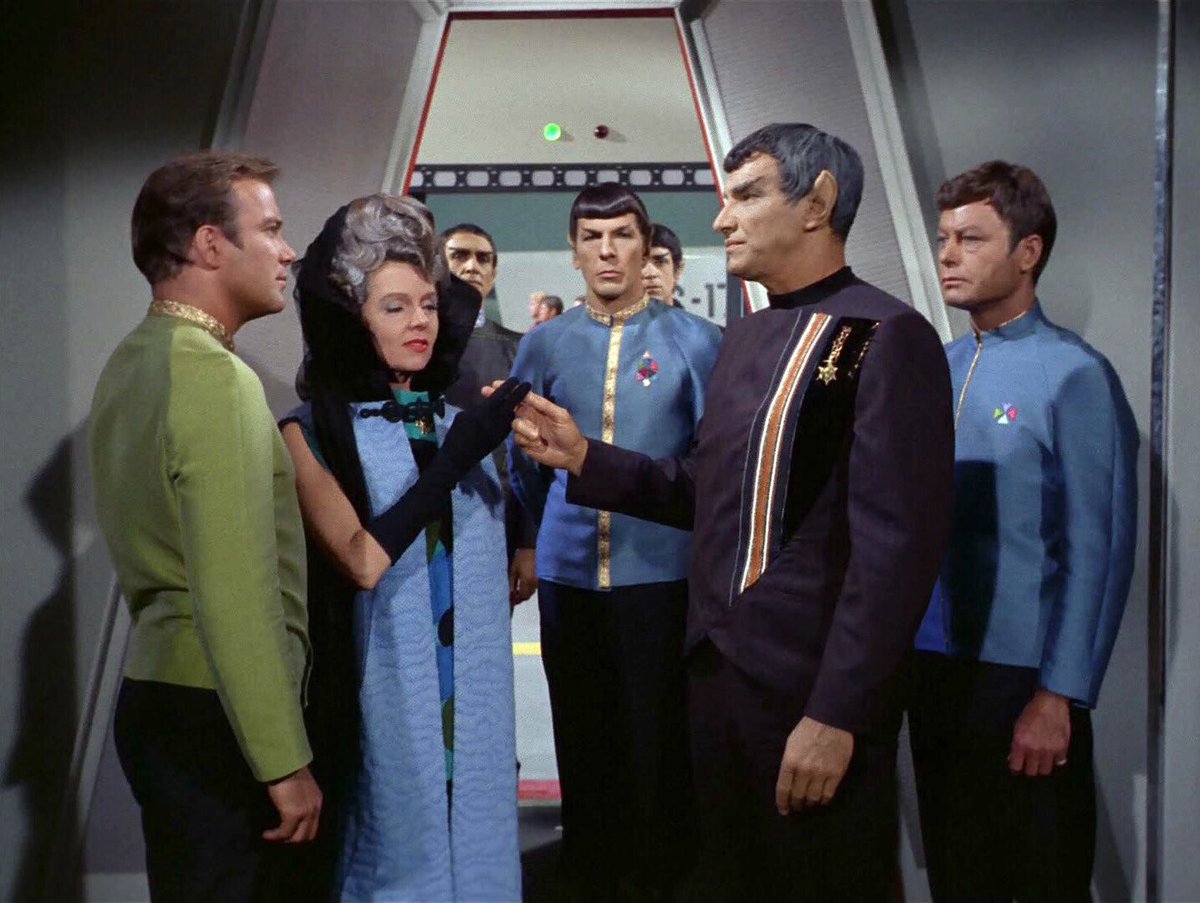
This requires a trip to Vulcan. When Spock and his crew mates arrive, it becomes obvious that Spock must be a very important figure because he is in the presence of the matriarch ruler, T’Pau. Unfortunately, his trip proves a difficult one in that his soon-to-be bride has decided, according to Vulcan law, to choose a different mate. She also has the privilege of choosing someone to fight for her. Instead of choosing a Vulcan hero, she picks Kirk.

Classic TV Themes: Star Trek — Contains Moderate Peril

 This is one of the most memorable shows concerning Spock and his home planet of Vulcan. You get to see Spock in a different light completely. The scene between Nurse Chapel and Spock is very good and shocking in some ways. 

I can’t really pick on this episode. It has the chemistry between Kirk, Spock, and Bones and is an excellent episode. This was the first episode in that Walter Koenig appears as Pavel Chekov.

From IMDB:

First appearance of the Vulcan phrases “Peace and long life” and “Live long and prosper”. Also the first ever Star Trek episode to feature any Vulcan characters other than Spock.It’s also the first episode to air since filming began for 2001: A Space Odyssey (1968).

First appearance of the Vulcan hand salute. Leonard Nimoy improvised this symbol during the production of “Amok Time,” modified from a traditional Jewish religious hand gesture.

Season 2 introduced new opening credits. DeForest Kelley’s name was added to the “starring” cast and the theme music was extended and had the female soprano voice Loulie Jean Norman and percussion added to it.

The prequel series Star Trek: Enterprise (2001) considered having its regular Vulcan character (played by Jolene Blalock) be a younger version of T’Pau. Since that would have required paying a fee to the estate of Theodore Sturgeon the author of Amok Time, this plan was abandoned and the new character was rechristened T’Pol.

Romulan helmets are reused from Star Trek: Balance of Terror (1966), this time worn by Vulcans during the pon farr ritual. In both productions, the helmets were a de facto economy measure as they precluded the need for the actors to wear ear prostheses.

Another innovation of the second season was the further-expanded sickbay that now includes McCoy’s new office.

First time we hear the now-famous “Star Trek fight music” (in 5/4 time), when Kirk and Spock battle. The theme is also played, albeit differently and more slowly, when Spock first informs Kirk of the details of his condition in Spock’s quarters and during the entrance of T’Pau.

When child model Mary Elizabeth Rice posed as seven year-old T’pring (fitted with only one ear prosthetic, since a single still photograph taken from the side was all the script called for), she was ill with chicken pox, replete with fever. She later commented that her sickness had been a plus, as it made her appear more serious.

One of only two times in Star Trek (1966) where Spock shows an emotional reaction without being influenced by something – if only for a few seconds. The other example is the first pilot Star Trek: The Cage (1966), filmed when the rules hadn’t been established for this character.

Summary

Lately, Spock’s behavior has been increasingly and unprecedentedly erratic. When McCoy finds it to be a growing medical risk, Kirk drags the truth out of him: it is the ‘blood fever’, the one time in a Vulcan’s life he regresses to a primitive, hormonal state of mind, setting out to mate for life. He is granted the first request for shore-leave in his entire career to go to Vulcan, asking Kirk and McCoy to join him in his equivalent of a marriage ceremony with his since-age-seven arranged fiancée, T’Pring. But, once on Vulcan, T’Pring halts the matrimony by calling the ancient challenge, whereby a champion of her choice will fight Spock for her. Surprising all, she selects Jim Kirk. He accepts after due consideration only to find, when the first of two dueling weapons are handed out, that the fight is to the death – too late to decline in front of T’Pau, the presiding top official for Spock’s family and the most powerful of all Vulcan dignitaries.

CAST

William Shatner … Captain James Tiberius ‘Jim’ Kirk
Leonard Nimoy … Mister Spock
DeForest Kelley … Doctor Leonard ‘Bones’ McCoy
Celia Lovsky … T’Pau
Arlene Martel … T’Pring
Lawrence Montaigne … Stonn
Majel Barrett … Nurse Christine Chapel
George Takei … Lieutenant Hikaru Sulu
Nichelle Nichols … Lieutenant Nyota Uhura
Walter Koenig … Ensign Pavel Chekov
Byron Morrow … Admiral Komack
Bill Blackburn … Lieutenant Hadley (uncredited)
Frank da Vinci … Vulcan Ceremonial Aide (uncredited)
Walker Edmiston … Space Central (voice) (uncredited)
Charles Palmer … Vulcan Litter Bearer (uncredited)
Eddie Paskey … Lieutenant Leslie (uncredited)
Joseph Paz … Vulcan Ceremonial Aide (uncredited)
Russ Peek … Vulcan Executioner (uncredited)
Mary Rice … T’Pring as Child (uncredited)
Mauri Russell … Vulcan Litter Bearer (uncredited)
Gary Wright … Vulcan Litter Bearer (uncredited)


Star Trek Season 1 Review

I’m going to hit upon some key points here.

The first season was a tremendous opening season. Out of 29 episodes I had 11 with 5 stars. Only one episode was under 3 and that one was at least interesting. Some of the most classic episodes are in Season 1 but we have more in Season 2. We will also see a new crew member Pavel Chekov, a Russian who joins the crew in the 2nd season. The Monkees were huge at the time so the producers wanted to have their own “Davy Jones” for the girls watching.

Chekov Replacement? | The Trek BBS

Lucille Ball... without her, it might not have happened. She wasn’t in on the creative side of the show but she and her studio Desilu did help finance Star Trek. A studio accountant named Edwin “Ed” Holly is on the record saying “If it were not for Lucy, there would be no Star Trek today.

Grace Lee Whitney as Yeoman Janice Rand… only after 8 total episodes Yeoman Rand just vanished from the series. Janice Rand was supposed to be a major character on Star Trek but was written off the show after season 1. Gene Roddenberry once stated that Whitney’s firing was purely financial. Whitney tells a different story. Only a few days before her firing, she was sexually assaulted by a studio executive on the Star Trek set. Whitney discussed the incident in her autobiography years later and, although she deliberately did not mention the executive by name, stated that she had a hard time believing the assault wasn’t at least in some way related to her exit from The Original Series.

Gene Roddenberry later apologized for giving in to pressure from the network to let Whitney go, even going so far as to say that writing Janice Rand off “was the dumbest mistake” he had ever made. To show how much she was loved by the fans and cast…she returned when the movies started in 1979.

William Shatner once said that their budget was lower than what it takes to cater a cast and crew in today’s time. What they had were great writers and good actors who had extremely good chemistry. The leading three men will always be known for their roles in this series. William Shatner as Kirk, Leonard Nimoy as Spock, and DeForest Kelley as “Bones” or Doctor McCoy. The supporting cast was great also…with  Majel Barrett as Nurse Chapel, Nichelle Nicols as Nyota Uhura, George Takei as Hikaru Sulu, Walter Koenig as Pavel Chekov, and James Doohan as Scotty. I can’t forget Grace Lee Whitney who should have been in the entire series.

Thank you all for reading each Wednesday, Saturday, and Sunday. We have some more in front of us and I’m looking forward to it.

Thanks

Max

Star Trek – Operation – Annihilate!

★★★1/2 April 13, 1967 Season 1 Episode 29

If you want to see where we are…and you missed a few…HERE is a list of the episodes in my index located at the top of my blog. 

This show was written by Steven W. Carabatsos and Gene Roddenberry

We have hit the last episode of the first season. This weekend I’ll have a First Season review. 

The Enterprise is tracking a strange straight line pattern where all of the inhabitants of the planets in line are going crazy and dying – some are killing themselves. The next planet in line is Deneva, a Federation Outpost where Kirk’s brother Sam is stationed. Kirk, Spock & McCoy beam down to the planet to investigate and to visit Sam and his family. What they find are strange flat flying creatures attacking people and everyone on the planet are either going crazy, dying or already dead.

Doux Reviews: Star Trek: Operation - Annihilate!

When they get to Sam’s place they find Sam is dead, Sam’s wife starting to go mad then suddenly dies and Sam’s son in a comatose state and dying. Spock is attacked by one of the creatures. The 3 beam back aboard the ship with Kirk’s comatose nephew. Kirk, Spock and McCoy race to find the answers.

Spock is infected with one of the aliens, who cause such great pain as to drive their hosts mad. Spock uses his Vulcan half to control his emotions, even under extreme pain, and this provides Nimoy something to really sink his teeth into.

Unless a method of destroying the creatures can be found, Kirk is faced with the possibility of having to kill millions of people to prevent the creatures from spreading further throughout the galaxy, Spock and Peter, Kirk’s nephew included.

This time there are no mind melds or any kind of communication with the flat-looking creatures. They want them exterminated immediately and for good reason. 

From IMDB: 

This is the first time McCoy’s lab is seen. Inside the lab, the prop used previously as Balok’s lamp device in Star Trek: The Corbomite Maneuver (1966) can be seen sitting on a shelf. Different components of sickbay were added over the first season, such as the decompression chamber seen in Star Trek: Space Seed (1967). McCoy’s lab contains one of the life support canisters used on the Botany Bay.

The Deneva outdoor scenes were shot at the headquarters of TRW Space and Defense Park in Redondo Beach, California (currently [2021] the Northrop Grumman Space Technology headquarters). The establishing shot of Kirk’s brother – Sam’s lab was a building on the campus of UCLA, and the entrance of the building was the cafeteria at TRW. See Google Earth for location. The actual location where Spock is attacked by the parasite is the lobby of TRW Building E1 next door to the cafeteria where the outdoor scenes were shot. It is now (2021) Northrop Grumman Aerospace Building E1.

The parasites bear a strong resemblance to the titular enemies from the 1951 Robert A. Heinlein novel The Puppet Masters, sometimes considered to have started the “body snatchers” sub genre of science fiction. The same story was the unofficial basis for The Brain Eaters (1958) which also starred Leonard Nimoy. See also Star Trek: Charlie X (1966) and Star Trek: The Trouble with Tribbles (1967), additional Star Trek The Original Series episodes with Heinlein resemblances.

William Shatner portrays Kirk’s brother Sam in the scene where McCoy rolls his body over to identify him. The shot is brief, but freezing the frame reveals Shatner in light character makeup and a mustache.

Craig Huxley (Kirk’s nephew Peter) reappears in Star Trek: And the Children Shall Lead (1968) as Tommy Starnes, and composed some music for Star Trek III: The Search for Spock (1984). Also invented the “Blaster Beam”, the musical instrument used for the distinctive “V’Ger” sound from Star Trek:The Motion Picture.

Steven W. Carabatsos had an obligation in his contract, that he must deliver at least one script of his own while serving as story editor. Carabatsos left the series in late-1966, but still had to fulfill this task before departing. Having no idea of his own, Gene Roddenberry suggested him one, entitled Operation: Destroy!, which was the basis for this episode.

The fly-by of the Enterprise that opens this episode was only seen one other time. It is re-used in Star Trek: The Tholian Web (1968) as the ship is thrown clear of the Tholian force field.

Stock footage of Leslie’s hands from Star Trek: The Alternative Factor (1967) is used to represent the personnel in the satellite control room. This shot was removed from the remastered version of the episode.

The voice of the Denevan who cries out, “I did it. it’s finally gone! I’m free!” is clearly that of Leonard Nimoy’s.

Some non canonical Star Trek novels have given the explanation that Sam Kirk’s two other sons (spoken of in Star Trek: What Are Little Girls Made Of? (1966)) were away from Deneva during the events of the episode. It has also been suggested that Sam Kirk having three sons was part of the misinformation Kirk planted in his robot double in that episode.

The clubs used by the Denevans during their attack on the landing party appear to be thick Lucite rods. Curiously, the gray, grooved clubs used by Spock during his fight with Kirk in Star Trek: This Side of Paradise (1967) and some of the miners on Janus VI in Star Trek: The Devil in the Dark (1967) were not recycled for this use.


Summary

The Enterprise traces a virus-like outbreak that seems to be traveling in a direct line across a planetary system. The next planet is home to Kirk’s brother Sam, his sister-in-law and their young son. The Enterprise arrives too late however for Sam. They find flying jellyfish-like creatures that attach themselves to humans. They take over the victims nervous system forcing them to bend to their will. Spock finds a weapon to use against the creatures but it leaves him hopelessly blind.

CAST

William Shatner … Captain James Tiberius ‘Jim’ Kirk / Samuel ‘Sam’ Kirk
Leonard Nimoy … Mister Spock
DeForest Kelley … Doctor Leonard ‘Bones’ McCoy
James Doohan … Lieutenant Commander Montgomery ‘Scotty’ Scott
Joan Swift … Aurelan Kirk
Maurishka … Yeoman Ellen Zahra
Majel Barrett … Nurse Christine Chapel
George Takei … Lieutenant Hikaru Sulu
Nichelle Nichols Nichelle Nichols … Lieutenant Nyota Uhura
Craig Huxley … Peter Kirk (as Craig Hundley)
Fred Carson … First Denevan
Jerry Catron … Second Denevan
David Armstrong … Kartan (uncredited)
Bill Blackburn … Lieutenant Hadley (uncredited)
Frank da Vinci … Guard (uncredited)
Jeannie Malone … Yeoman (uncredited)
Eddie Paskey … Lieutenant Leslie (uncredited)
Ron Veto … Harrison (uncredited)

Gene Vincent – She She Little Sheila

A true rock and roll pioneer. I don’t have to be coaxed to listen to Gene Vincent but I watched the 1969 bio of him doing a UK tour in 1969 (at the bottom of the post). He radiated star but you could tell he was in pain probably from all directions. I always liked him because of his attitude while singing but I noticed…very late…but I saw what a great unusual voice he had. He could go from ballad to rocker in a split second.

Vincent was injured in a car accident on April 16, 1960…with Eddie Cochran in a taxi which killed Cochran. Vincent whose leg was weak due to a wound incurred in a motorcycle accident in Virginia during the Korean War. He walked with a noticeable limp for the rest of his life. In 1962 he was in Hamburg and played on the same bill as the Beatles.

The 50s revival had started in the UK and Vincent did around 24 shows altogether on that tour. The bio is a fascinating look into the UK in 1969. The music is there of course but it gives a lesson on how touring is not always glamorous and 5-star hotels.

Vincent’s energetic performance and dynamic vocals make this song a standout track. It was written by Whitey Pullen and Jerry Merritt. The song was released in 1960 and it peaked at #22 in the UK charts. By this time the UK is where all of the 50’s rock stars went because America was too busy listening to Paul Anka, Fabion,  and Pat Boone. It was a sad state of music at that time for rock and roll. The parents probably loved the no soul no trouble singers. Then thankfully…the British invasion and Motown were coming up.

The Beatles, Stones, Who, and other bands made America wake up to the blues and rock artists they had been ignoring.

Gene Vincent would die only two years after this tour in 1971 after recording an album called The Day the World Turned Blue at 36 years old. He was the first inductee into the Rockabilly Hall of Fame upon its formation in 1997. The following year he was inducted into the Rock and Roll Hall of Fame. He would die of a ruptured ulcer, internal hemorrhage and heart failure.

She She Little Sheila

Well, she, she, she little Sheila
Best lookin’ gal in town
Well now, she, she, she little Sheila
With your hair so long and brown
Well, you never-never know what my Sheila’s puttin’ down

Well now, Dick Clark said you’re the best lookin’ girl
On his big bandstand
I know it too and I love you true
And honey, I’m your man
Well, you never-never know what my Sheila’s puttin’ down

Yeah, she, she, she little Sheila
She, she, she little Sheila
Well, you never-never know what my Sheila’s gonna put down

Well, she, she, she little Sheila
Best lookin’ gal around
Well, she, she, she little Sheila
With your hair so long and brown
Well, you never-never know what my Sheila’s puttin’ down (aw)

Yeah, she, she, she little Sheila
She, she, she little Sheila
Well, you never-never know what my Sheila’s puttin’ down

Star Trek – The City On The Edge Of Forever

★★★★★ April 6, 1967 Season 1 Episode 28

If you want to see where we are…and you missed a few…HERE is a list of the episodes in my index located at the top of my blog. 

This show was written by Harlan Ellison and Gene Roddenberry

If someone asked me the best episode of Star Trek…this would be the one. This one has drama, comedy, romance, and most importantly…Time Travel!

McCoy is accidentally injected with a stimulant that makes him paranoid and aggressive. He attacks crewmen and beams himself down on a planet the ship is orbiting. There, he jumps into a time travel device that resembles a giant donut called the Guardian. The Guardian has time running through and you can watch history. He manages to totally disrupt time…so much so that the Enterprise no longer exists.

Kirk and Spock ask the Guardian to start again and Kirk and Spock jump through into a period a few weeks before McCoy lands in depression-era New York. They take refuge in a homeless shelter run by Edith Keeler and prepare for McCoy’s arrival. Spock works to create a method of viewing the history he had recorded and Kirk grows close to Edith. When Spock finally finishes his work he sees that he has recorded two contradictory histories… one where Edith dies in the near future and one where she does on to work for peace

The question is which history is the ‘correct’ one, which led to the future being changed and how will McCoy interfere with what is meant to happen? I cannot say enough great things about this episode. 

Star Trek" The City on the Edge of Forever (TV Episode 1967) - IMDb

This episode is considered to be one of the best episodes of the series and rightly so. It uses the time travel device to set up a moral conundrum and surprisingly doing the right thing might mean allowing a good woman to die. Guest star Joan Collins does a fine job in the role of Edith and DeForest Kelley’s portrayal of the drug-affected McCoy is one of his best performances in the series.

We have one more episode to wrap up the first season!

From IMDB:

To emphasize on the extremely high age of the Guardian in the upper millions, or well into the billions, the starfield of its planet is surrounded by red dwarfs and red giants.

When William Shatner and Joan Collins are walking together on the street, they pass in front of a shop with the name Floyd’s Barber Shop clearly painted on the window. This is the same Floyd’s Barber Shop which is often seen on The Andy Griffith Show (1960), adjacent to the sheriff’s office, in the town of Mayberry.

Gene Roddenberry apparently denied Harlan Ellison’s pseudonym request because he knew everyone in the science fiction community was aware that the “Cordwainer Bird” credit was Ellison’s way of signaling his dissatisfaction with the way production people treated what he wrote. It would have meant that Star Trek was no different than all the other “science fiction” shows in mistreating quality writers, and could have resulted in prose science fiction writers avoiding contributing to the program.

In Harlan Ellison’s original story, Beckwith’s change of the past is revealed by members of the Enterprise team who are beamed back to the ship, only to find it is now a pirate vessel named the Condor. This idea was later used in Star Trek: Mirror, Mirror (1967).

Widely considered by both fans and critics to be the best episode of the series.

At the 50th anniversary “Star Trek” convention in Las Vegas in August 2016, fans voted this the best episode of the “Star Trek” franchise.

Gene L. Coon is mainly responsible for the small comical elements of the story, including the famous “rice picker” scene, which Harlan Ellison reportedly hated.

The footage seen through the time portal is, for the most part, lifted from old Paramount films.

This was the most expensive episode produced during the first season, with a budget of $245,316 ($2,163,601.87 in 2022 adjusted for inflation), and also the most expensive episode of the entire series, except the two pilots. The average cost of a first season episode was around $190,000 ($1,675,733.97). Also, production went one and a half days over schedule, resulting in eight shooting days instead of the usual six.

When asked in February 26, 1992 interview whether the makers of this episode consciously intended it to have the contemporaneous anti-Vietnam-war movement as subtext, associate producer Robert H. Justman replied, “Of course we did.”

The Guardian of Forever was designed by Art Director Rolland M. Brooks. Normally, set design was the purview of his colleague Matthew Jeffreys, but due to illness, Brooks took over his chores for the Guardian. When Jefferies returned to his duties and saw the donut-shaped set piece for the first time, he reportedly exclaimed, “What the hell is this?!”, according to D.C. Fontana. Special effects artist Jim Rugg was responsible for the light effects for the Guardian.

Clark Gable, who was by no means a leading man in 1930, was not the original choice of reference. The final shooting draft of this script has Edith reference “a Richard Dix movie”, but the crew on the set felt Dix’s name wouldn’t be familiar to viewers in the 1960s.

Originally, then-story editor Steven W. Carabatsos got the job to rewrite Harlan Ellison’s script, but his draft was not used. Instead, Ellison agreed to make a rewrite himself, which was again deemed unsuitable. Producer Gene L. Coon also got himself into the rewriting. Finally, the new story editor, D.C. Fontana got the assignment to rewrite Ellison’s script and make it suitable for the series. Fontana’s draft was then slightly rewritten by Roddenberry to become the final shooting draft. Much of the finished episode is the product of Fontana, who went uncredited (as did all the other writers) for her contribution. Only two lines from Ellison’s original teleplay survive in the final episode, both spoken by the Guardian: “Since before your sun burned hot in space, since before your race was born,” and “Time has resumed its shape.”

The title of this episode refers to both the dead city on the time planet and New York itself, where the timeline will either be restored or disrupted. In Harlan Ellison’s original script, Kirk, upon first seeing the city sparkling like a jewel on a high mountaintop, reverently says it looks like “a city on the edge of forever”. In Ellison’s first treatment for this episode, the city they travelled back in time to was Chicago.

The alley in which Kirk steals the clothing from the fire-escape is the same alley seen in Star Trek: Miri (1966), in which Spock and the guards have debris dumped on them by the children and the same alley seen in Star Trek: The Return of the Archons (1967) where the townspeople are stunned.

Leonard Nimoy characterizes the episode as a high-water mark in the series, calling it “good tragedy”.

Harlan Ellison’s original story had the time portal manned by people who were the real guardians of time, rather than a machine entity.

In Harlan Ellison’s original story, Kirk and Spock are aided in the 1930s by a vagrant called Trooper who reveals himself to be a veteran of the Battle of the Somme. This character was renamed Rodent, and has a smaller role as the bum who incinerates himself with McCoy’s phaser.

In one scene in this episode, a poster can be seen advertising a boxing event at Madison Square Garden featuring “Kid McCook” vs. “Mike Mason”. For Star Trek: Deep Space Nine: Past Tense, Part II (1995), scenic artists Doug Drexler and Michael Okuda created a near replica of this boxing poster for a scene set in 1930 San Francisco; the DS9 poster features the same boxers, and says that it is “their first rematch since Madison Square Garden”.

The network heavily objected to Kirk’s last line, “Let’s get the hell out of here” and wanted it to be removed from the episode. The word “Hell” was used five times in The Original Series, the other four being:
Star Trek: Space Seed (1967)(#1.22), when Kirk quotes Milton, “It is better to rule in Hell than serve in Heaven”,
Star Trek: The Alternative Factor (1967)(#1.27), when Lazarus tells his counterpart, “I’ll chase you into the very fires of hell!”, and
Star Trek: The Doomsday Machine (1967)(#2.6), when Decker describes the berserker as “right out of hell.” Kirk also says “What the hell is going on?” when he activates the Constellation viewscreen and sees the Enterprise being pulled into the maw of the Planet Killer. These are the only two times that the word was used as an expletive, rather than a reference to the domicile of the damned.

Harlan Ellison’s script was unusable for the series for many different reasons. Gene Roddenberry objected to the idea that drug usage would still be a problem in the 23rd century, and even present among starship crews. Also, the production staff was heavily against Kirk’s final inactivity. It seemed that being unable to decide and act, viewers could never be able to accept him as the strong leader figure in later episodes. Elements, such as the Guardians and the Condor and its crew were simply impossible to create on the series’ budget.

One of William Shatner’s favorite episodes.

William Shatner recalled that he attempted to talk to Harlan Ellison during the writing dispute to try and calm things down. According to Shatner, Ellison responded by yelling at him.

After Kirk and Spock talk about the “flop”, the scene changes to a street view, where a kosher meat store, with a conspicuously large Star of David on its front, is displayed in the center of the scene. This is one of the very few times a human (Earth) religious symbol is displayed in this series.

Desilu Stage 11, usually not a Star Trek stage, was used for filming the mission interiors. The stage was occupied by My Three Sons (1960) previously, but as that series was moved to another location, it became available for the crew to film.

Harlan Ellison’s original script later won the Writers’ Guild of America Award.To emphasize on the extremely high age of the Guardian in the upper millions, or well into the billions, the starfield of its planet is surrounded by red dwarfs and red giants.

When William Shatner and Joan Collins are walking together on the street, they pass in front of a shop with the name Floyd’s Barber Shop clearly painted on the window. This is the same Floyd’s Barber Shop which is often seen on The Andy Griffith Show (1960), adjacent to the sheriff’s office, in the town of Mayberry.

Gene Roddenberry apparently denied Harlan Ellison’s pseudonym request because he knew everyone in the science fiction community was aware that the “Cordwainer Bird” credit was Ellison’s way of signaling his dissatisfaction with the way production people treated what he wrote. It would have meant that Star Trek was no different than all the other “science fiction” shows in mistreating quality writers, and could have resulted in prose science fiction writers avoiding contributing to the program.

In Harlan Ellison’s original story, Beckwith’s change of the past is revealed by members of the Enterprise team who are beamed back to the ship, only to find it is now a pirate vessel named the Condor. This idea was later used in Star Trek: Mirror, Mirror (1967).

Widely considered by both fans and critics to be the best episode of the series.

At the 50th anniversary “Star Trek” convention in Las Vegas in August 2016, fans voted this the best episode of the “Star Trek” franchise.

Gene L. Coon is mainly responsible for the small comical elements of the story, including the famous “rice picker” scene, which Harlan Ellison reportedly hated.

The footage seen through the time portal is, for the most part, lifted from old Paramount films.

This was the most expensive episode produced during the first season, with a budget of $245,316 ($2,163,601.87 in 2022 adjusted for inflation), and also the most expensive episode of the entire series, except the two pilots. The average cost of a first season episode was around $190,000 ($1,675,733.97). Also, production went one and a half days over schedule, resulting in eight shooting days instead of the usual six.

When asked in February 26, 1992 interview whether the makers of this episode consciously intended it to have the contemporaneous anti-Vietnam-war movement as subtext, associate producer Robert H. Justman replied, “Of course we did.”

The Guardian of Forever was designed by Art Director Rolland M. Brooks. Normally, set design was the purview of his colleague Matthew Jeffreys, but due to illness, Brooks took over his chores for the Guardian. When Jefferies returned to his duties and saw the donut-shaped set piece for the first time, he reportedly exclaimed, “What the hell is this?!”, according to D.C. Fontana. Special effects artist Jim Rugg was responsible for the light effects for the Guardian.

Clark Gable, who was by no means a leading man in 1930, was not the original choice of reference. The final shooting draft of this script has Edith reference “a Richard Dix movie”, but the crew on the set felt Dix’s name wouldn’t be familiar to viewers in the 1960s.

Originally, then-story editor Steven W. Carabatsos got the job to rewrite Harlan Ellison’s script, but his draft was not used. Instead, Ellison agreed to make a rewrite himself, which was again deemed unsuitable. Producer Gene L. Coon also got himself into the rewriting. Finally, the new story editor, D.C. Fontana got the assignment to rewrite Ellison’s script and make it suitable for the series. Fontana’s draft was then slightly rewritten by Roddenberry to become the final shooting draft. Much of the finished episode is the product of Fontana, who went uncredited (as did all the other writers) for her contribution. Only two lines from Ellison’s original teleplay survive in the final episode, both spoken by the Guardian: “Since before your sun burned hot in space, since before your race was born,” and “Time has resumed its shape.”

The title of this episode refers to both the dead city on the time planet and New York itself, where the timeline will either be restored or disrupted. In Harlan Ellison’s original script, Kirk, upon first seeing the city sparkling like a jewel on a high mountaintop, reverently says it looks like “a city on the edge of forever”. In Ellison’s first treatment for this episode, the city they travelled back in time to was Chicago.

The alley in which Kirk steals the clothing from the fire-escape is the same alley seen in Star Trek: Miri (1966), in which Spock and the guards have debris dumped on them by the children and the same alley seen in Star Trek: The Return of the Archons (1967) where the townspeople are stunned.

Leonard Nimoy characterizes the episode as a high-water mark in the series, calling it “good tragedy”.

Harlan Ellison’s original story had the time portal manned by people who were the real guardians of time, rather than a machine entity.

In Harlan Ellison’s original story, Kirk and Spock are aided in the 1930s by a vagrant called Trooper who reveals himself to be a veteran of the Battle of the Somme. This character was renamed Rodent, and has a smaller role as the bum who incinerates himself with McCoy’s phaser.

In one scene in this episode, a poster can be seen advertising a boxing event at Madison Square Garden featuring “Kid McCook” vs. “Mike Mason”. For Star Trek: Deep Space Nine: Past Tense, Part II (1995), scenic artists Doug Drexler and Michael Okuda created a near replica of this boxing poster for a scene set in 1930 San Francisco; the DS9 poster features the same boxers, and says that it is “their first rematch since Madison Square Garden”.

Harlan Ellison’s script was unusable for the series for many different reasons. Gene Roddenberry objected to the idea that drug usage would still be a problem in the 23rd century, and even present among starship crews. Also, the production staff was heavily against Kirk’s final inactivity. It seemed that being unable to decide and act, viewers could never be able to accept him as the strong leader figure in later episodes. Elements, such as the Guardians and the Condor and its crew were simply impossible to create on the series’ budget.

One of William Shatner’s favorite episodes.

William Shatner recalled that he attempted to talk to Harlan Ellison during the writing dispute to try and calm things down. According to Shatner, Ellison responded by yelling at him.

After Kirk and Spock talk about the “flop”, the scene changes to a street view, where a kosher meat store, with a conspicuously large Star of David on its front, is displayed in the center of the scene. This is one of the very few times a human (Earth) religious symbol is displayed in this series.

Desilu Stage 11, usually not a Star Trek stage, was used for filming the mission interiors. The stage was occupied by My Three Sons (1960) previously, but as that series was moved to another location, it became available for the crew to film.

Harlan Ellison’s original script later won the Writers’ Guild of America Award.

Summary

When a drug-crazed Dr. McCoy leaps through a time portal to 1930 Earth, he does something to change history resulting in the disappearance of the Enterprise. Kirk and Spock soon follow hoping to arrive just before McCoy. They soon find themselves working at the 21st Street Mission for the beautiful Edith Keeler. Spock builds a crude computer and finds two newspaper articles about Edith: one dated 1936 about a meeting she had with President Roosevelt and the other her obituary dated 1930. The question then becomes which of the two are correct. Is Edith Keeler, with whom Kirk has fallen in love, supposed to live or to die?

CAST

William Shatner … Captain James Tiberius ‘Jim’ Kirk
Leonard Nimoy … Mister Spock
Joan Collins … Edith Keeler
DeForest Kelley … Doctor Leonard ‘Bones’ McCoy
James Doohan … Lieutenant Commander Montgomery ‘Scotty’ Scott
George Takei … Lieutenant Hikaru Sulu
Nichelle Nichols … Lieutenant Nyota Uhura
John Harmon … Rodent
Hal Baylor … Policeman
David L. Ross … Galloway
John Winston … Lieutenant Kyle
Bart La Rue … Guardian (voice) (as Bartell La Rue)
Walter Bacon … Onlooker on Street (uncredited)
Bill Blackburn … Lieutenant Hadley (uncredited)
Bill Borzage … Drunk (uncredited)
Dick Cherney … Passerby on Sidewalk (uncredited)
Noble ‘Kid’ Chissell … Server (uncredited)
Jane Crowley … Onlooker on Street (uncredited)
Joe Garcio … Man in Mission (uncredited)
Joseph Glick … Man in Mission (uncredited)
Carey Loftin … Truck Driver (uncredited)
Eddie Paskey … Lieutenant Leslie (uncredited)
Eleanore Vogel … Onlooker on Street (uncredited)
Max Wagner … Man in Mission (uncredited)

Star Trek – The Alternative Factor

★★1/2 March 30, 1967 Season 1 Episode 27

If you want to see where we are…and you missed a few…HERE is a list of the episodes in my index located at the top of my blog. 

This show was written by Don Ingalls and Gene Roddenberry

Only two more episodes after this and we are done with the first season! I’ll write up a Season 1 review for next weekend and we will tackle the 2nd season after that.

Ok…this is one of the unpopular episodes of Star Trek. It’s not one of the better ones but I find it interesting…but saying that…it’s hard to get a handle on exactly what is going on. This is the first episode where even Spock has more questions in his answers than answers. The funny thing is…the next episode coming up is maybe the best in the entire series. 

Star Trek – The Alternative Factor | Archive Television Musings

Robert Brown does a good job of performing the rather maniacal Lazarus…an interesting biblical allusion, but a bit difficult to interpret the meaning given the character. The cinematography and the script impose limitations that inhibit dramatic development.

The known universe is, apparently, about to be destroyed by a malevolent humanoid from a parallel universe of antimatter. If antimatter meets matter…the results will be catastrophic. Lazarus has been chasing this being for years to exact revenge for the destruction of his world. The Enterprise crew is stymied and confused (as well as us the viewers), until the identity of the would-be destroyer is revealed.

In closing… this is some hard-core science fiction with a wonderful mystery setup. The script hints at the possibility of an invasion from the antimatter universe and/or the destruction of all existence due to the collision of both. The execution, however, leaves much to be desired. It could have been so much better…maybe in a movie format or with a much better script. 

In other words…you will do better seeing this episode than reading about it. That doesn’t mean everything will make sense…at the end of the episode I saw what was going on but it’s like describing a train wreck getting to that point. 

From IMDB

This is the first time that live two-way communication with Starfleet Command is depicted. In previous episodes, communication with Starfleet Command was through delayed radio messages.

John Drew Barrymore (Drew’s dad) was originally cast as Lazarus, but failed to show up for shooting and had to be replaced by Robert Brown, causing the episode to go two days over schedule. Star Trek’s producers subsequently filed and won a grievance with the Screen Actors Guild, which suspended Barrymore’s SAG membership for 6 months.

Along with Star Trek: Friday’s Child (1967), this is one of the only two episodes where outdoor planet scenes were filmed both on Desilu Stage 10 and on location (both times at Vasquez Rocks). Originally, all planet-side scenes were scheduled to be filmed on location, but due to the turmoil during production, director Gerd Oswald couldn’t finish shooting at Vasquez. Matt Jefferies and the art department prepared a spot on Stage 10 which could accomodate the missing “alternate universe” sequence.


At the 50th anniversary “Star Trek” convention in Las Vegas in August 2016, fans voted this the ninth worst episode of the “Star Trek” franchise.

Depending on which version of this episode you watch, the closing stills change. The original syndicated version and the VHS version show the still as the Enterprise leaving the Earth-like planet from Star Trek: Miri (1966). However, the Sci-fi Channel and DVD version show the still as just a blue planet, possibly Rigel 12 from Star Trek: Mudd’s Women (1966) or Starbase 11 from Star Trek: Court Martial (1967).


Actor Eddie Paskey appeared in 59 episodes of the original Star Trek series, 50 of them playing Lt. Leslie – a character name that came from William Shatner himself inserting the first name of his eldest daughter Leslie Carol Shatner into the show – but only in ‘The Alternative Factor’ does Eddie’s role as Lt. Leslie ever appear in closing credits, and when it does – in contrast to the spelling by which it has become widely known and accepted – it is spelled ‘Lesley’. Also, this was the second episode in which Leslie was seen in the command chair.


James Doohan and George Takei do not appear in this episode. For unknown reasons, Scotty and Sulu were substituted in the roles of engineer and helmsman by Charlene Masters and Mr. Leslie, respectively.


The visual of the iron-silica planet from orbit is reused footage previously representing Alfa 177 in Star Trek: The Enemy Within (1966) and M-113 in Star Trek: The Man Trap (1966). This planet effect was reused again as Argus X in Star Trek: Obsession (1967) and Ardana in Star Trek: The Cloud Minders (1969).


When Lazarus sabotages the Engineering Panel to create an overload, and eventually steal several dilithium crystals, the electrical plugs he switches around are actually Dual Binding Post Plugs (banana plugs), very common when this show was made in the 1960s and still in use in 2021.


A still image in the closing credits of Star Trek: The Squire of Gothos (1967) shows the corridor between universes set unaltered by the effects and double exposure. Titled at a 45 degree angle, William Shatner stands ankle deep in smoke in a near pose of the crucifixion, falling back into a purple corridor, where an orange line draws the horizon to a vanishing point.


Although this episode isn’t the best of the series, it does serve as the springboard for other plot lines concerning parallel or alternative universes as well as time travel. These subjects would be expanded upon through the original series seasons as well as in sequel television and film productions.


Summary

While mapping the uninhabited planet below, the Enterprise – indeed the entire galaxy – is affected by a powerful force after which a single human, Lazarus, is found on the planet. He claims to be after an evil creature who destroyed his entire civilization, but Spock can identify no other creature on the planet. Lazarus is in fact a time traveler who has been battling an alternate version of himself from an alternate universe. When Lazarus’ opponent steals the ship’s dilithium crystals, solving the mystery becomes a matter of life and death for Kirk and the crew.

CAST

William Shatner … Captain James Tiberius ‘Jim’ Kirk
Leonard Nimoy … Mister Spock
Robert Brown … Lazarus
DeForest Kelley … Doctor Leonard ‘Bones’ McCoy
Janet MacLachlan … Lt. Charlene Masters
Nichelle Nichols … Lieutenant Nyota Uhura
Richard Derr … Barstow
Arch Whiting … Assistant Engineer
Christian Patrick … Transporter Chief
Eddie Paskey … Lieutenant Leslie
Bill Blackburn … Lieutenant Hadley (uncredited)
Vince Cadiente … Security Guard (uncredited)
Bill Catching … Anti-Matter Lazarus Being #2 (uncredited)
Frank da Vinci … Crewman (uncredited)
Carey Foster … Enterprise crewmember (uncredited)
Tom Lupo … Security Guard (uncredited)
Ron Veto … Security Guard (uncredited)
Al Wyatt Sr. … Anti-Matter Lazarus Being #1 (uncredited)

Turtles – It Ain’t Me Babe

I first heard the Turtles with the single that I got from a cousin. The single was Eleanor… I fell for them at that moment. After I got to know them better…I found out they didn’t take themselves seriously and had some good pop songs.

This was written and originally recorded by Bob Dylan, who released the song on his 1964 album Another Side Of Bob Dylan. Smart performers started to pick up that this Bob guy could write accessible songs for the public. Add a Rickenbacker or a jangly guitar and whala you have folk rock.

The band was formed by Mark Volman and Howard Kaylan. They were saxophone players who did whatever was trendy in order to make a living as musicians. They were also in the choir together in high school.

They were in an instrumental band but with the Beatles and the British invasion, they soon switched to a rock and roll band with Howard Kaylan as lead singer.

This was their debut single and what a single it was for them. It peaked at #8 on the Billboard 100 and #3 in Canada in 1965. It was on their debut album with the same name. The album didn’t do as well…it peaked at #98 on the Billboard Album Charts.

Turtlesbattlebands.jpg

The Turtles were more of a singles band but did release some interesting ones at the end of their career. One of them was called The Turtles Present The Battle of the Bands. It was a concept album where they pretended to be different bands for each song. I’ve always liked that idea.

After they broke up Mark Volman and Howard Kaylan became Flo and Eddie.

Howard Kaylan: “When the Turtles first signed our original recording agreements with the tiny label that would become White Whale, we were all under the legal age of 18. Needless to say, the contracts required our parents’ approval. This was all done before a judge in the county of Los Angeles who reviewed the paperwork about to be executed and told our parents that, “If you let your sons sign these papers, the court won’t be responsible for the outcome. These are the worst contracts that I have ever seen.” We didn’t care. We wanted to make records and damn the consequences. So we signed. And our parents co-signed. And the judge had been right. It took many years and many thousands of dollars to win back our money and our self-respect. But, in the meantime, we had a record deal.

We had originally intended to break up our band, the Crossfires, on one particular evening in 1965, while playing our usual Friday night gig at the a teen club in Redondo Beach, California called the Revelaire. On my way upstairs with our resignation, two shady-looking entrepreneurs stopped me and asked if we were interested in making a record. They loved the way we sounded doing a cover of the new Byrds single (our guitarist had gone out and bought a 12-string guitar earlier that week) and thought that doing folk-rock was the key to our future.

It fell upon me to find the tunes to record. The Crossfires had been a surf band in high school, but together with a friend of ours, Betty McCarty, we had also done some folk singing as The Crosswind Singers. In fact, we opened a concert at Westchester High that starred the folk duo Joe and Eddie (a foreshadowing of things to come, many years before the names Flo and Eddie were to become our nom de plumes). I found Dylan’s ‘It Ain’t Me Babe’ on an album and, being blissfully unaware that anyone else had ever recorded it, thought that it would make a great rock song. So I literally ‘lifted’ the Zombies’ approach to pop – a soft Colin Blunstone-like minor verse bursting into a four-four major chorus a-la ‘She’s Not There.’

It Ain’t Me Babe

Go away from my window
Leave at your own chosen speed
I’m not the one you want, babe
I’m not the one you need
You say you’re lookin’ for someone
Who’s never weak but always strong
To protect you and defend you
Whether you are right or wrong
Someone to open each and every door

But it ain’t me, babe
A-no, no, no it ain’t me, babe
Well, it ain’t me you’re lookin’ for, babe

Go lightly from the ledge, babe
Go lightly on the ground
I’m not the one you want, babe
I’ll only lead you down
You say you’re lookin’ for someone
Who’ll promise never to part
Someone to close his eyes to you
Someone to close his heart
Someone who will die for you and more

But it ain’t me, babe
A-no, no, no it ain’t me, babe
Well, it ain’t me you’re lookin’ for, babe
No it ain’t me you’re lookin’ for, babe
I said a-no, no, no, it ain’t me, babe

Star Trek – Errand Of Mercy

★★★★ March 23, 1967 Season 1 Episode 26

If you want to see where we are…and you missed a few…HERE is a list of the episodes in my index located at the top of my blog. 

This show was written by Gene L. Coon and Gene Roddenberry

This episode introduces one of the most famous enemies of anyone in TV or movies. The Klingons are up there with the Daleks and Storm Troopers. 

The Enterprise must beat the Klingons to a planet that is of significant strategic importance between the Klingon Empire and the Federation’s realm of control. This planet is known as Organia and appears to be technologically inferior to humans and Klingons alike. Kirk pleads with its council to side with the Federation in an imminent war with the Klingons in order to avoid occupation but the Organians seem unperturbed by any of this.

The Organians can be super annoying at times. We all want peace but they refused to put up any defense at all against the coming Klingons. They gave a vibe of “everything will be alright” and didn’t seem concerned about anything really. At first, I thought they were way too naive. It’s great being peaceful but not defending yourself did not make sense. There is a surprise at the end and we find out that the Organians are not what they seem. 

Kirk never even tries to understand the Organians… he assumes he’s so far above them that they can’t even understand the trouble they find themselves in.

Klingon

This episode serves as a very good introduction to the Klingons. We get to know what they are all about…we also see the similarities between them and Starfleet. At the end of the episode, Kirk looks back and realizes he’s not the biggest fish in the pond like he originally presumed. A fun episode made all the more memorable by John Calicos as the merciless Klingon Kor, the actor makes a truly great villain.

SPOILERS

The Organians then reveal themselves to be highly-evolved incorporeal beings composed of pure energy. They put a stop to the coming war by making their weapons useless. They left Kirk and Kor to ponder what might have been (a disappointed Kor says that war between them ‘would have been glorious’).

From IMDB:

Introduces the Klingon Empire. Klingons were named after Gene Roddenberry’s friend, Bob Clingan.

John Colicos intended to reprise the role of Captain Kor in a later episode Star Trek: Day of the Dove (1968), but scheduling conflicts with Anne of the Thousand Days (1969) prevented this. The role of Captain Kang (Michael Ansara) was written to take the place of Kor, and the performances of both actors were so excellent that they became equally legendary.

The Klingon Lieutenant played by Victor Lundin walks into the room ahead of John Colicos (Kor), making him the first Klingon to appear on screen in any Trek production, although, in a prior scene, several Klingons are seen walking through the village.

The baldric that Kor wore was reused for Worf during the first season of Star Trek: The Next Generation (1987). When it was exhibited at the Smithsonian Institution as part of a Star Trek retrospective in the 1990s, the material could clearly be seen to be burlap sacking, painted gold. The same exhibit showed that the buckles of the Klingon belts were pieces of bubble pack, with the bubbles painted silver to resemble metal studs.

In the original broadcast, we never saw visuals of the Klingon vessels either on the view screen or on exterior shots, just explosions on the view screen where the Klingon vessels were supposed to be. In the “Remastered” release (2006), new shots of the D7 Klingon Battle Cruisers, designed and built by art director Walter M. Jefferies, were digitally inserted into various shots, providing new visuals of the Klingon ships that were not present before. Due to this addition, this would now officially make this the first episode of the series to feature the D7s. Originally, the D7s did not appear until the Third Season of the series and the original first episodes to feature them were Star Trek: The Enterprise Incident (1968) and Star Trek: Elaan of Troyius (1968), which were aired in reverse order from when they were filmed.

The entrance of the Klingon headquarters is the same building as the main gate to the Organian village, filmed from a longer distance and different angles.

This is the first episode in which Sulu is shown sitting in the command chair, although he had previously commanded the bridge from the helm position in Star Trek: Arena (1967). Scott, who doesn’t appear in this episode, had commanded the Enterprise in the absence of Kirk and Spock in Star Trek: A Taste of Armageddon (1967), in which Sulu didn’t appear. The second season would establish Scott as senior to Sulu in the command structure.

This is the last episode in which the term “Vulcanian” is used to refer to Vulcans. Both “Vulcanian” and “Vulcan” are used at different points in the episode: Kor uses “Vulcanian” and the Klingon lieutenant uses “Vulcan”, both in reference to Spock.

An audio clip of Spock’s line about “pure energy” was used by the band Information Society in their song Information Society: What’s on Your Mind? (Pure Energy) (1988). The song reached #3 on the Billboard Hot 100 chart, and Leonard Nimoy was given a “Special Thanks” in the song’s credits.

Popularly known as “The Vietnam Story”, for its obvious allusions to Vietnam and its abuse by the colonial powers.

The set where Kirk and Spock shoot the two Klingons is the same set used in Star Trek: The Cage (1966) where Captain Pike kills the giant warrior with a spear.

One of only a few episodes where a blue-shirted crewman is seen at helm.

D.C. Fontana thought the Klingons were made the regular adversaries of the series because they didn’t need any special (and expensive) make-up like the Romulans, whom she thought to be much more interesting.

In the script, the Klingons were described simply as “Oriental, hard-faced.”

The scene where Kirk and Spock stun the guards and break into the Klingon headquarters was filmed at sunlight using a “day-for-night” filter.

Kor was also set to appear in Star Trek: Day of the Dove (1968) and Star Trek: The Trouble with Tribbles (1967), but John Colicos was unavailable and other Klingon characters were written in. A script was written for Kor for the fourth season, but the show was cancelled after the third season, and he never got his chance to appear again. (Kor did appear in Star Trek: The Animated Series: The Time Trap (1973), but was voiced by James Doohan.) Colicos was also the person who gave the Klingons their dark-skinned, mustached look. He said he was going for the “Genghis Khan” look. Makeup artist Fred B. Phillips agreed on it, and conceived the Klingons in this fashion. He did eventually reprise his role in Star Trek: Deep Space Nine: Blood Oath (1994), Star Trek: Deep Space Nine: The Sword of Kahless (1995), and Star Trek: Deep Space Nine: Once More Unto the Breach (1998).

Kor makes appearances in quite a number of Star Trek novels including “The Tears of the Singers”, in which he allies with Kirk first against human criminals and then against a mutiny aboard his own ship. John Colicos reprised the role of a now-elderly Kor in a few episodes of Star Trek: Deep Space Nine (1993).

John Colicos (Kor) would go on to play another iconic villain in a space opera television show: Lord Baltar in the original Battlestar Galactica (1978).

The shot of Enterprise hit by magnetic pulses was a stock shot of energy bolts hitting the ship, the corresponding live-action sequences used a buzzing electric effect that would be reused for the Klingon Bird-of-Prey firing effect in Star Trek III: The Search for Spock (1984). The shot of Enterprise firing was also a re-use. This time the white bolts shot out of the ship are said to be phasers, even though in other appearances the same effect represents photon torpedoes. The script specified that the battle should be depicted using stock footage from Star Trek: Balance of Terror (1966) and Star Trek: Arena (1967).

John Colicos was director John Newland’s first and immediate choice for the role of Kor. He got the script only two hours before flying to Los Angeles from Toronto, and read it on the plane.

A comic book published by IDW Comics in April 2007, “Against Their Nature”, told this story from the Klingon point of view.

The episode title comes from “The Life and Adventures of Nicholas Nickleby” by Charles Dickens: “It is an errand of mercy which brings me here. Pray, let me discharge it.” Nearly 40 years later, a passage from Nicholas Nickleby was discussed in a subplot of Star Trek: Enterprise: Cold Station 12 (2004).

The Organian ‘fortress’ that is observed in the distance and remarked on by Spock (and later established as the Klingon occupation force base of operations) is the Citadelle Laferrière, a famous Haitian landmark on Bonnet à l’Evêque mountain near Nord, Haiti.

Summary

With the breakdown of peace negotiations, the Federation finds itself at war with the Klingon Empire. The Enterprise is ordered to the planet Organia in order to ensure that the Klingons are prevented from using the planet as a base. They arrive to find a peace-loving population who seem to know little of war or violence and don’t see a threat, even after the Klingons arrive in force on the planet. While Kirk and the Klingon commander Kor jockey for position, the Organians refuse to support either side and both commanders soon learn that the Organians have a good reason not to fear or support either of them.

CAST

William Shatner … Captain James Tiberius ‘Jim’ Kirk
Leonard Nimoy … Mister Spock
John Abbott … Ayelborne
John Colicos … Kor
George Takei … Lieutenant Hikaru Sulu
Nichelle Nichols … Lieutenant Nyota Uhura
Peter Brocco … Claymare
Victor Lundin … Lieutenant
David Hillary Hughes … Trefayne
Walt Davis … Klingon Soldier
George Sawaya … Second Soldier
Bobby Bass … Klingon Guard (uncredited)
Bill Blackburn … Organian villager (uncredited)
John Blower … Organian Villager (uncredited)
Gary Combs … Klingon Guard (uncredited)
Frank da Vinci … Brent / Organian villager (uncredited)
Eddie Paskey … Lieutenant Leslie (uncredited)
Basil Poledouris … Klingon (uncredited)
Paul Power … Elder (uncredited)
Ron Veto … Harrison / Organian villager (uncredited)

Star Trek – The Devil In The Dark

★★★★★ March 9, 1967 Season 1 Episode 25

If you want to see where we are…and you missed a few…HERE is a list of the episodes in my index located at the top of my blog. 

This show was written by Gene L. Coon and Gene Roddenberry

William Shatner’s father died during the making of this episode. Please check the IMDB notes below about that. 

This is the fourth excellent episode in a row. I’ve seen a video of a 1990s Star Trek convention of Leonard Nimoy saying this episode’s closing banter between Spock and Kirk was one of his favorite scenes to perform. He noted, “It was a wonderful moment which defined the relationship and defined the whole Spock character’s existence and his attitude about himself.”

 I like the fact that the episode is not about one specific character but evolves around the trio handling an alien problem. Also, it’s nice to see an episode that doesn’t only happen on the Enterprise.

The Enterprise arrives at a mining colony on Janus VI in order to kill a beast called the Horta, which has been killing miners, jeopardizing the exportation of the ever-important pergium (an element for energy). As the miners continue drilling deeper, it seems to be upsetting the monster more and more. Spock soon discerns that the monster is silicon-based, not the type of life form that the crew is familiar with.

The Devil In The Dark" (S1:E25) Star Trek: The Original Series Episode  Summary

In the beginning, everyone hates the Horta… they fear it and loathe it. But Spock’s mind meld and Kirk’s understanding soon changes this tune for everyone. People are often afraid of what they don’t understand. This episode reveals to us that, if we hope to find peace with what we don’t understand or take issue with, the first step is communication.

There is not much action in this one but a compelling episode and is a very good first-season episode. During the episode, Kirk wanted the creature killed but Spock wanted it alive. Spock augured to no avail but things started to change once he met the Horta. 

Just a quick note on a director. Ralph Senensky was told he was going to direct this episode and was sent the script but then told it would be another episode…yesterday’s This Side of Paradise. 

The reason I mention this is that Ralph has a great site where he talks about all of the different Star Trek and other TV shows (including the Twilight Zone and Waltons) he directed. If you have time check it out…he is 99 years old but still posts on his site

From IMDB:

In his book “Star Trek Memories”, William Shatner identified this as his favourite episode, because his father died during filming and Leonard Nimoy’s delivery of the mind meld lines made him laugh. He thought it was “exciting, thought-provoking and intelligent, it contained all of the ingredients that made up our very best Star Treks.”

Janos Prohaska, the creator of the Horta costume, actually wore it into Gene L. Coon’s office, as if to say “Look what I designed”. Coon said “That’s great! What is it?”, and Prohaska said “I don’t know. It can be whatever you want.” Coon replied “I’ll write a script around it”, and he wrote this episode in four days so the costume could be used.

Arthur C. Clarke once remarked, in 1995, that of the Original Series, the only episode he could recall was this one, stating that “It impressed me because it presented the idea, unusual in science fiction then and now, that something weird, and even dangerous, need not be malevolent. That is a lesson that many of today’s politicians have yet to learn.”

When William Shatner, on the set, got the call from his mother informing him about his father’s death, the crew was ready to shut down production, but he insisted on continuing. During the rest of the day, Shatner took comfort in Leonard Nimoy, and cinematographer Gerald Perry Finnerman, whose father had died on a movie set less than seven years before.

William Shatner was in Florida for his father’s funeral while nearly all of Spock’s “mind meld” scene with the Horta was shot. His screen double is shown from behind in several of the shots and all of Kirk’s “reaction” shots were made after he returned.

This episode was the first time McCoy used the phrase, “I’m a doctor, not a (blank)” when Kirk asks him to help the Horta, finishing the line as, “I’m a doctor, not a brick layer!” An earlier version of this phrase is used in “The Corbomite Maneuver,” when McCoy says, “What am I, a doctor or a moon-shuttle conductor?”

Gene Roddenberry was impressed with the way this episode explains the behaviour of a Star Trek “monster,” citing the instalment as “a classic example of doing this right” as well as “one of our most popular episodes.” He went on to say, “The Horta suddenly became understandable [….] It wasn’t just a monster-it was someone. And the audience could put themselves in the place of the Horta… identify… feel! That’s what drama is all about. And that’s it’s importance, too… if you can learn to feel for a Horta, you may also be learning to understand and feel for other Humans of different colours, ways, and beliefs.”

In a book about Star Trek, it was reported that after William Shatner returned from the funeral, to put everyone at ease, as he was trying to do his lines following Mr. Spock’s mind meld with the Horta and his cry of “AHH! PAIN! PAIN! PAIN!”, Leonard Nimoy just spoke the words, so Shatner told him to do it again with feeling. When “Spock” again said “AHH! PAIN! PAIN! PAIN! ” Shatner yelled out, “WILL SOMEBODY PLEASE GET THIS VULCAN AN ASPIRIN!”

“No Kill I” was the name of a Star Trek-themed punk rock band.

This episode includes only one actress, who appears for a few seconds and has no lines. This is the only episode with no female speaking parts.

The unbroken Horta eggs were toy bouncing balls painted gold.

NBC announced that Star Trek would be renewed for a second season next fall, during the closing credits of this episode on 9 March 1967.

This is the only episode in the original series in which the distinction is drawn between “phaser one” and “phaser two.”

This episode marks the first and only time an episode begins without the Enterprise or its crew being involved in the teaser scenes before the main credits.

Gene L. Coon’s original script featured a different material as the base of the Horta, but researcher Kellam de Forest changed it to silicon, as the original choice seemed to be even theoretically impossible.

Actor Barry Russo, appearing as Lt. Commander Giotto, also appears in Star Trek: The Ultimate Computer (1968) as the character Commodore Robert Wesley.

The Star Trek: Deep Space Nine (1993) novel “Devil in the Sky” is a sequel of sorts to this episode.

This episode was originally scheduled to be filmed before Star Trek: This Side of Paradise (1967), with Ralph Senensky assigned to direct it, but during pre-production the two episodes and the directors were switched because Gene L. Coon thought “Devil” would be a tough assignment to first-time Trek director Senensky.

The clubs used by some of the Janus VI colonists during their hunt for the Horta appear to be of the same design used by Kirk during his fight with Spock in the transporter room in Star Trek: This Side of Paradise (1967).

Summary

The Enterprise travels to the planet Janus 6 to assist the mining colony there. Kirk, Spock and McCoy beam down to the planet where Chief Engineer Vanderberg tells of a creature loose in the mine tunnels killing some of his men. The monster seems to appear out nowhere then disappears just as quickly. Finding that the creature, known as a Horta, lives in a newly opened part of the underground mining complex, Spock uses the Vulcan mind meld to determine why it is killing the miners.


Here are some CGI effects they have made into this episode

CAST

William Shatner … Captain James Tiberius ‘Jim’ Kirk
Leonard Nimoy … Mister Spock
DeForest Kelley … Doctor Leonard ‘Bones’ McCoy
Ken Lynch … Vanderberg
James Doohan … Lieutenant Commander Montgomery ‘Scotty’ Scott
Brad Weston … Appel
Biff Elliot … Schmitter
George Allen … Engineer #1 (as George E. Allen)
Jon Cavett … Guard
Barry Russo … Giotto
Lee Allen … Janus IV Miner (uncredited)
Tom Anfinsen … Civilian Engineer (uncredited)
Bill Blackburn … Lieutenant Hadley (uncredited)
Frank da Vinci … Lt. Osborne (uncredited)
Dick Dial … Sam (uncredited)
Robert Hitchcock … Miner (uncredited)
Bob Hoy … Horta (uncredited)
Monty O’Grady … Miner (uncredited)
Eddie Paskey … Lieutenant Leslie (uncredited)
Janos Prohaska … Horta (uncredited)
Al Roberts … Roberts (uncredited)
Ron Veto … Security Guard (uncredited)