I’ve always liked Jimi’s mellow songs. The song moves so well because of his guitar playing and the futility of life lyrics. The song originally appeared on the Axis: Bold as Love album released in December of 1967.
Jimi Hendrix and his mother Lucille Hendrix
He never liked talking much about his past, but he reveals some in this song. Sarita Cannon has written a book that explores Hendrix’s identity as a Black Cherokee. Hendrix’s Indigenous ancestry has never been documented by blood. His grandmother, a vaudeville performer from Vancouver, British Columbia, passed along Cherokee traditions to him. incorporated Indigenous themes in his music, including this song, the instrumental “Cherokee Mist” and the 1967 anthem “I Don’t Live Today.” His mother had stated that she was part Cherokee.
Many believed that this song is an instance of Hendrix reflecting on painful memories from his childhood, including his parents’ tumultuous separation and his mother’s illness, Hendrix himself never confirmed the inspiration behind the song. Leon Hendrix, Jimi’s brother, has said the lyrics were about their father’s alcoholism and their family. He said the soldier in the song is Leon himself. At one time Leon was taken away by Child Protective Services.
Castles Made Of Sand was not released as a single and did not chart although the album peaked at #3 on the Billboard 200 Album Charts in 1968.
This album was his second studio album to be released. His third and last album Electric Ladyland was released in October of 1968. Since Hendrix died in 1970…a glut of albums have been released. The man must have recorded in his sleep.
Castles Made Of Sand
Down the street you can hear her scream you’re a disgrace
As she slams the door in his drunken face
And now he stands outside
And all the neighbours start to gossip and drool
He cries oh, girl you must be mad,
What happened to the sweet love you and me had?
Against the door he leans and starts a scene,
And his tears fall and burn the garden green
And so castles made of sand fall in the sea, eventually
A little Indian brave who before he was ten,
Played war games in the woods with his Indian friends
And he built up a dream that when he grew up
He would be a fearless warrior Indian chief
Many moons passed and more the dream grew strong until
Tomorrow he would sing his first war song and fight his first battle
But something went wrong, surprise attack killed him in his sleep that night
And so castles made of sand melts into the sea, eventually
There was a young girl, whose heart was a frown
‘Cause she was crippled for life,
And she couldn’t speak a sound
And she wished and prayed she could stop living,
So she decided to die
She drew her wheelchair to the edge of the shore
And to her legs she smiled you won’t hurt me no more
But then a sight she’d never seen made her jump and say
Look a golden winged ship is passing my way
And it really didn’t have to stop, it just kept on going…
And so castles made of sand slips into the sea, eventually
If you want to see where we are…and you missed a few…HERE is a list of the episodes in my index located at the top of my blog.
This show was written by Gene Roddenberry, Joyce Muskat, and Arthur H. Singer
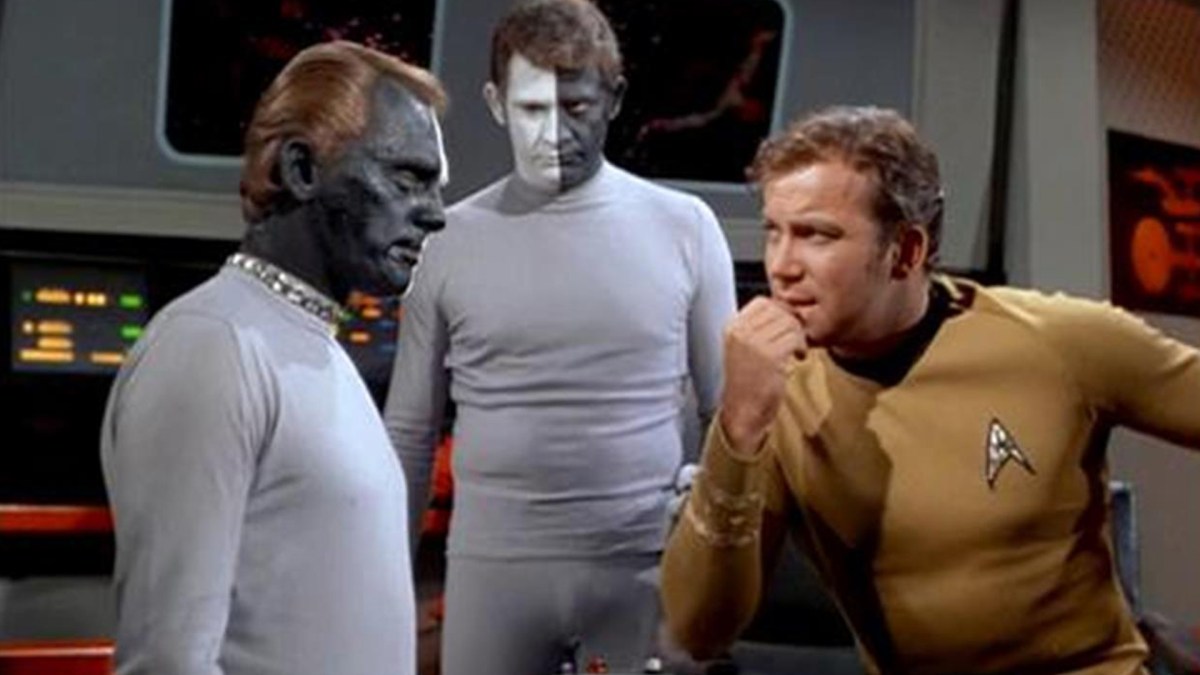
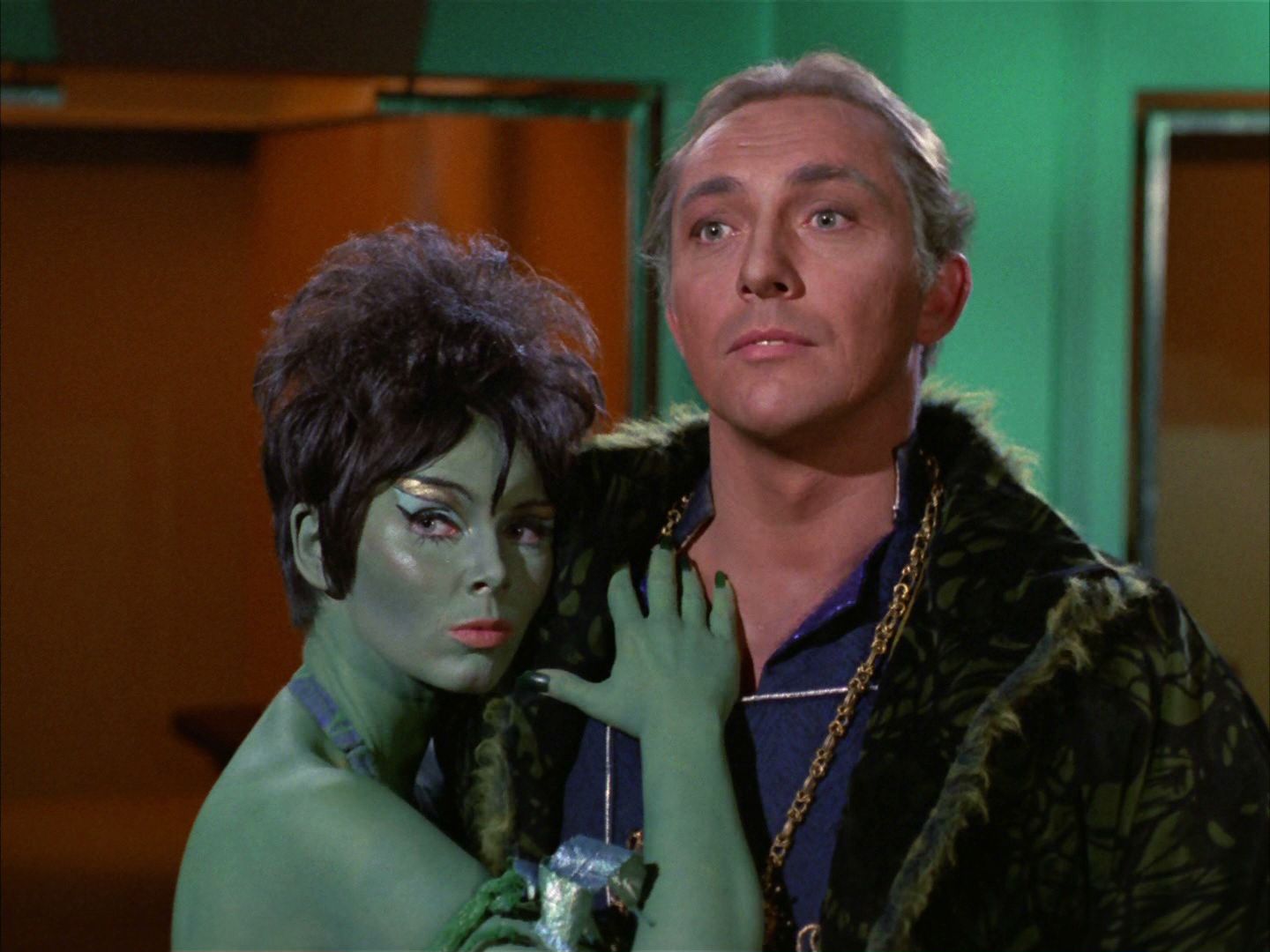
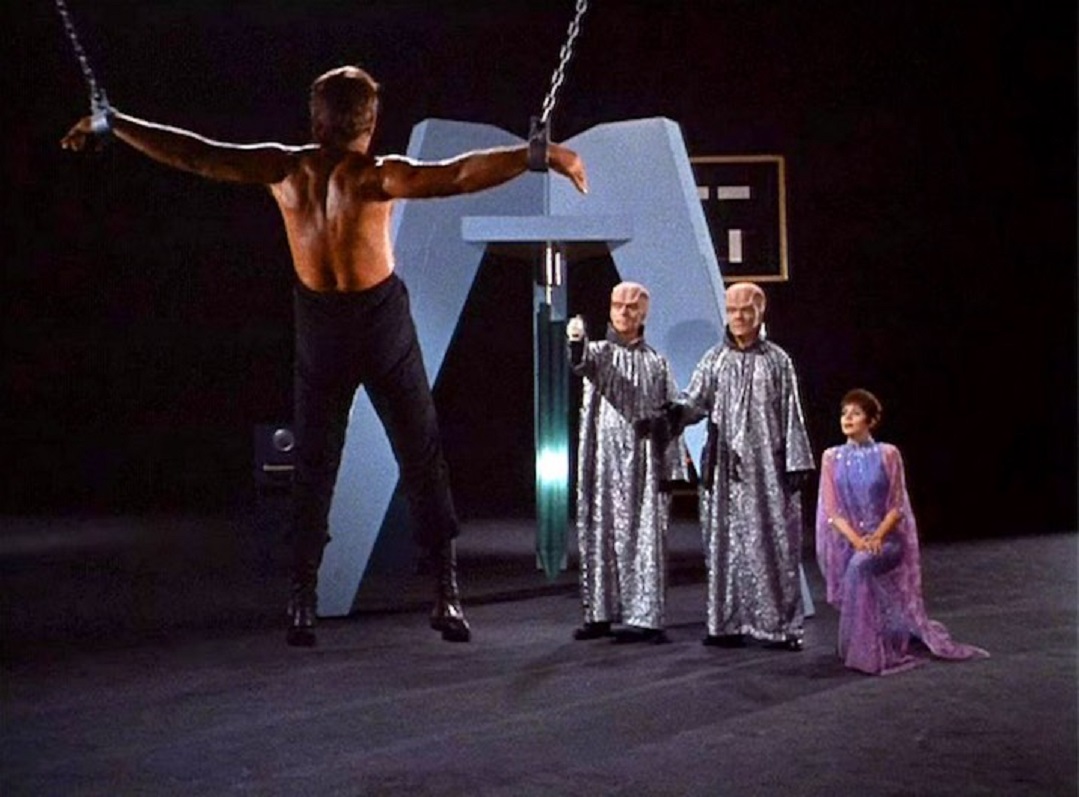
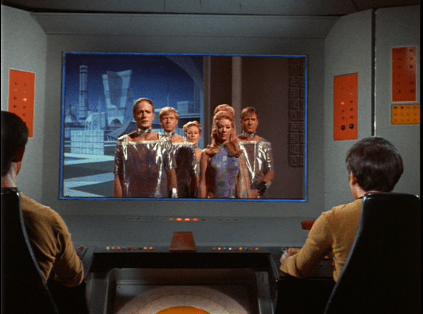
the Enterprise comes upon a superior alien race that selects the landing party of Kirk, Spock, McCoy, and a pair of unnamed crewmen as guinea pigs in a psychological experiment. The aliens look like second cousins to the Talosians and we know what intellects they had. You also know what happens to unnamed crewmen in any Star Trek episode.
This crowd is almost as good or bad depending on your point of view. The three regulars are put into a room together with a deaf-mute named Gem played by Kathryn Hays. She cannot speak, but her facial expressions tell much because Hays is a total empath with healing powers.
As all the series regulars are tortured, Gem heals them. But like that other healer from the big screen, John Coffey in The Green Mile it takes a lot out of Gem every time she heals. It’s soon clear she’s the object of the alien experiment.
This is an interesting and emotional episode dealing with the idea of self-sacrifice. Having Gem mute makes her more mysterious as she can’t tell people about herself… the members of the Enterprise must determine for themselves what she is and decide whether she is a fellow prisoner or working with those holding them captive. Kathryn Hays does a great job in the role… expressing Gem’s emotions entirely through facial expressions.
From IMDB:
This was DeForest Kelley’s favourite episode.
In the sequence of Gem absorbing the boils, Kathryn Hays was strapped to a board and kept absolutely still while make-up was applied. Stop-motion photography filmed the progression. The few moments of the scene took eight hours to film.
This episode contains another one of McCoy’s famous, “I’m a doctor, not a…” quotes. In this episode, it is “coal miner”.
The Empath was written by Joyce Muskat, one of only four fans who were able to sell scripts to the original series, the others being David Gerrold, Judy Burns, and Jean Lisette Aroeste.
After McCoy is tortured, his tattered uniform shirt is an older velour shirt, rather than the new polyester double knits that were used in the 3rd season.
The helical staircase in the station was also used in For the World Is Hollow and I Have Touched the Sky (1968).
The orange-red flickers that accompany the Vian transporter effect are frames of the same effect created to represent the Medusan ambassador Kollos.
Though identified as Thann and Lal in the closing credits, the two Vians are never called by their proper names on-screen.
The third season of Star Trek was famously only greenlighted after viewer pressure made the NBC network change their mind after they originally planned to cancel the series after the second season. One of the conditions that NBC insisted on when they finally commissioned a third season was for the production company to implement cuts to the production budget by 25%, and this resulted in production design shortcuts (such as reusing footage, props and sets from previous episodes) as well as a purported drop in the quality of some of the scripts. The budget cuts are particularly noticeable in this episode, one of the last of the third season. With the production budget for the entire series already thinly stretched and close to running out as the production schedule for season three drew to a close, the producers were forced to creatively save money by implementing minimal set design in the laboratory scenes where much of this story takes place (hence why these scenes were filmed against a black backdrop) and re-use the slightly redressed alien desert planet surface set previously seen in The City on the Edge of Forever (1967) among others.
In Turnabout Intruder (1969), Kirk (in Janice Lester’s body) mentions the events of The Empath to try to convince Spock of the mind switch.
The research station shown at the beginning is the same set used in The Naked Time (1966). While it’s not unusual to re-use sets, this also confirms that Starfleet used the same design of research station on various planets.
In the United Kingdom, the BBC skipped this episode in all runs of the series through to the early 1990s. Three other episodes were also skipped, Whom Gods Destroy (1969), Plato’s Stepchildren (1968), and Miri (1966). The reason given was because they dealt with the unpleasant subjects of madness, torture, sadism and disease.
In the final scene, Scotty refers to the story of ‘the pearl of great price’. This refers to a parable told by Jesus in Matthew 13:45-46.
This is the only episode whose first-act credits open on a completely black background.
This was one of the few episodes to quote the Bible.
The Empath bears many striking similarities to Nightmare (1963), where Earth men are subjected to various tortures and torments by bizarre aliens on a mostly barren set with just a few props and backdrops. Both “The Empath” and “Nightmare” were directed by John Erman.
The footage of the Minaran sun is re-used from Operation — Annihilate! (1967).
The preview of the episode shows Gem’s healing of wounds done by jump-cuts, rather than as fades.
Sound effects of the Vians’ laboratory were previously used in Norman’s lab in I, Mudd (1967).
The tripodal device in the center of the Vian laboratory appeared first in Spock’s Brain (1968) as the framework connected to the black box (by “light rays”) that housed Spock’s brain. It is inverted here from its earlier position.
Uhura and Chekov do not appear in this episode.
The couch seen in the underground lab is a gigantic version of the agonizers seen in Mirror, Mirror (1967) and Day of the Dove (1968). It was first seen as the Eymorg’s table in Spock’s Brain (1968).
This takes place in 2268.
Leonard Nimoy and Kathryn Hays were also cast together in Night Gallery’s “She’ll Be Coming For You” (S3:E10, 1972).
Summary
Kirk, Spock, and McCoy suddenly find themselves in an underground laboratory where they meet an attractive young woman who is not only mute but also an empath who can absorb someone else’s pain. When their captors make themselves known, they refuse to explain why the three men have been taken prisoner or why they and the young woman, whom McCoy has named Gem, are there. Inexplicably, they set about torturing them for no apparent reason. Fortunately, Gem’s empathic powers allow her to take away their pain, but only at great sacrifice to herself. When their captors tell Kirk that he must choose which of his men to die, their selflessness comes to the fore, leaving Dr. McCoy to volunteer himself. They all soon learn that the object of the experiment is Gem herself.
CAST
William Shatner … Captain James Tiberius ‘Jim’ Kirk Leonard Nimoy … Mister Spock DeForest Kelley … Dr. McCoy Kathryn Hays … Gem Alan Bergmann … Lal James Doohan … Scott George Takei … Sulu Davis Roberts … Dr. Ozaba Jason Wingreen … Dr. Linke Willard Sage … Thann Bill Blackburn … Lieutenant Hadley (uncredited) Dick Geary … Security Guard (uncredited) Roger Holloway … Lt. Lemli (uncredited)
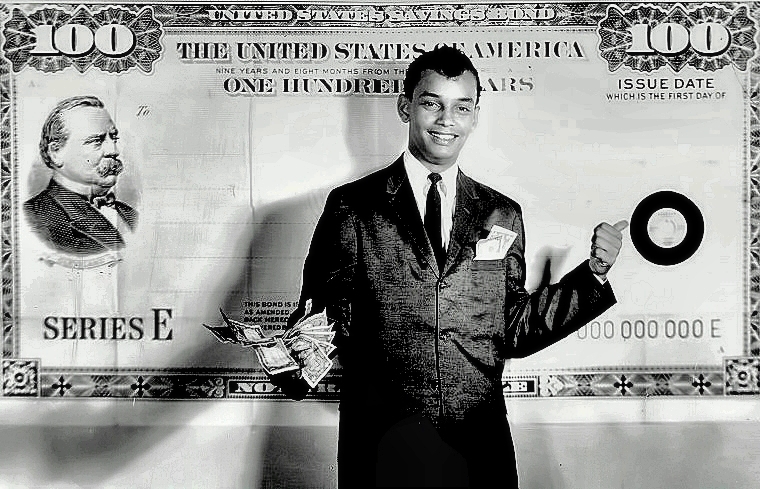
Gary US Bonds song Quarter To Three was a huge hit this year. Bonds’ real name is Gary Anderson. His label boss, Frank Guida, changed it to “U.S. Bonds” for his first single, New Orleans, as a play on the posters asking Americans to “buy U.S. savings bonds.” Pretty clever, but too many people, including many DJs, got it wrong and thought it was the name of a group. His next single, “Quarter To Three,” was initially issued as U.S. Bonds but soon changed to Gary U.S. Bonds, along with his subsequent releases.
Now let’s check in with Del Shannon. He released what is now an iconic song named Runaway. This song was written by Del Shannon and Max Crook.
I want to throw some country in this also with a song that has been remembered along with the artist who did the vocals. Patsy Cline sings I Fall To Pieces. The song was written by Hank Cochran and Harlan Howard.
The Big E makes a wonderful appearance in this post. This was a pure rock and roll song and that was a seldom occurence for Elvis Presley at this point.
Now for the Big O to close this year out. Roy Orbison does Running Scared with his operatic voice. Hearing Orbison’s voice still gives me the chills. was recorded in RCA Studio B in Nashville with the session pros known as “The A-team.” This was the last song that he sang live before his death in 1988.
If you want to see where we are…and you missed a few…HERE is a list of the episodes in my index located at the top of my blog.
This show was written by Gene Roddenberry, Arthur Heinemann, and Gene L. Coon
I always liked this episode…maybe more than some other Star Trek fans. The ending bothered me but other than that I loved it. I do have a question or two for you serious Star Trek fans coming up.
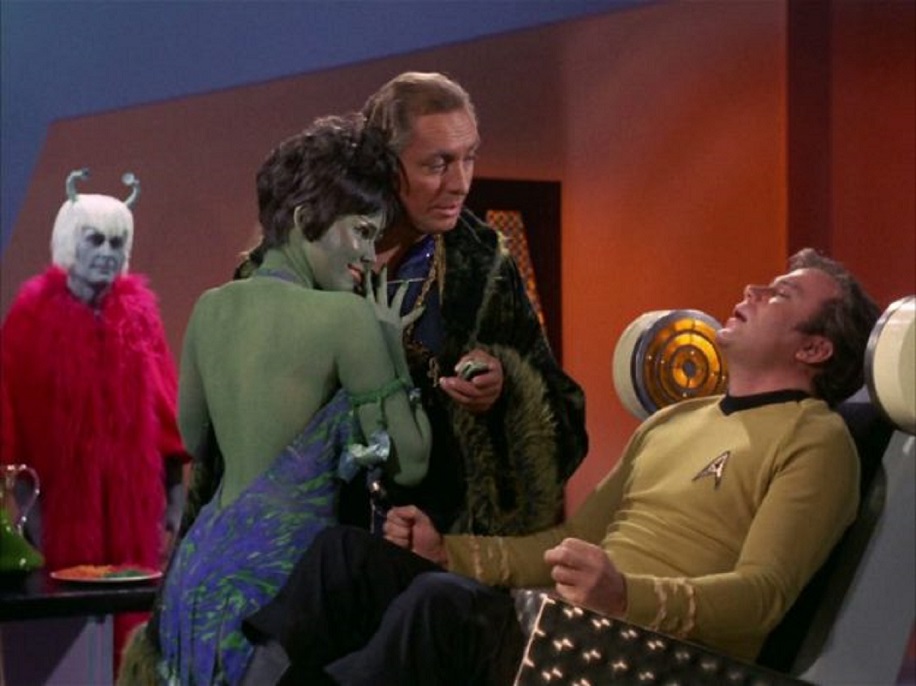
The Enterprise receives a distress signal, but when they arrived on the planet, they see it was once inhabited but is now totally depopulated. When they transport back to the ship, something is slipped in Kirk’s coffee by an unseen force. Suddenly, everyone but him appears to be moving slower and slower, though it’s actually Kirk that is accelerating in speed to such a degree that he seems to disappear…moving too fast for the human eye to detect.
Once this occurs, he discovers that there were survivors on the planet and they beamed aboard undetected because they, too, were moving at this hugely accelerated speed. The Scalosians plan on putting the ship’s crew in suspended animation and using the crew as breeding stock to be thawed out as needed, as the same thing that makes these beings accelerate also makes their men sterile.
So they have to mate outside of their race or their race will die.
I just noticed when Deela and Kirk are left alone in a room…it goes to another shot and when it comes back to the pair…Kirk is putting his boots on and Deela is combing her hair. It’s clear in a subtle way they had sex. I’m curious about how the censors allowed this. Nothing stops Kirk…even being held against his will.
SPOILERS
Kirk leaves a message to the others about what is happening. Spock, McCoy, and Nurse Chapel see it and McCoy comes up with an antidote so Spock drinks the Scalosian water and he speeds up to help Kirk. They get together and disable the freezing device that the Scalosians have put in place. Spock does have the antidote with him.
Why didn’t Kirk offer the Scalosians the antidote that he and Spock took? Would it have not worked with their body chemistry?
From IMDB:
The remastered version of this episode premiered in syndication the weekend of 13 January 2007. New shots of Scalos from space, as well as an enhanced matte painting of the surface were inserted into the episode, alongside more realistic phaser effects. This was the first remastered episode from third season to air and thus featured a “new” opening titles sequence.
Walter Koenig did not film any new footage for this. Chekov appears briefly in the opening scenes but it’s stock footage from earlier productions. He takes no part in the plot.
This contains the second time in The Original Series where Kirk is seen in what can be presumed to be a post-coital situation. He is seen zipping up his boots while sitting on the edge of his bed, with Deela standing nearby arranging her hair.
The hyper-accelerated movement plot was also used in The Night of the Burning Diamond (1966), produced by Gene L. Coon/Lee Cronin.
Written by Lee Cronin, the pseudonym of Gene L. Coon. The pseudonym was used because he had left Paramount and was under contract with Universal, so he was not supposed to be working for Paramount as well.
Loosely based on an H.G. Wells short story called “The New Accelerator”. A cartoon episode of The Lone Ranger (1966) also used this plot.
The Scalosian weapon was made from lathe-turned aluminum and was approximately 170 mm (6¾”) long. A sketch of the design appeared in the “Star Trek: The Original Series Sketchbook” (p. 91). The weapon made a sound identical to Klingon disruptors and the Ardana torture device in The Cloud Minders (1969).
The “Star Trek Customizable Card Game” features a wild card called “Boot Scene” (named after the famous suggestive scene with Deela) which can neutralize the opposing player’s Captain Kirk with a beautiful alien.
In the first scene, Scotty is shown on the bridge recording a log while other dialogue is played over this scene. The footage is reused from The Empath (1968). This is evident because Scotty wears a very different hairstyle, and another woman takes the place of Uhura. A piece of Scotty’s dialogue with Kirk on the planet below from “The Empath” can also be heard, very faintly. In fact, what he is saying originally played over Kirk’s communicator in “The Empath”.
This episode was, in essence, a bottle show with the need for only one set, a fountain, which was designed by Walter M. Jefferies.
As part of the condition of commissioning a third series of Star Trek, the network insisted on a cut in the budget of 25%. This meant that some episodes suffered notable cost cutting measures. This particular episode was considered one of the more lavish and expensive ones of series three due to the number of special effects that had to be created for the story.
Rael is also the name taken by Claude Vorilhon, the founder and actual leader of the UFO religion known as Raëlism. It started in 1973.
In a note from Gene Roddenberry to Fred Freiberger dated May 29th, 1968, he calls the water “Scalian water”, which may be a mistake on his part or a indication that the name was changed to “Scalosian” later.
This, along with ‘The Tholian Web’ and ‘The Cloud Minders’, was one of the most expensive stories to make from series 3 due to the number of effects shots needed. As the series budget had already been significantly cut back from the budget NBC had assigned to Seasons 1 & 2, some of the other stories filmed for the rest of Season 3 had to make noticeable cutbacks in their sets and effects to accommodate the high production cost of this episode. However, as other posters have noted, even here the budget was sparingly used with limited film sets.
This takes place in 2268.
Kathie Browne and Jason Evers also appeared together in Deathtown (1968).
In the accelerated world of the Scalosians and then Kirk and later Spock, touching anything (buttons, switches, machines, countertops, doors, etc), at the accelerated speed, would have the same (if not more) energy as a bullet from a gun. So, everything they touched in the unaccelerated world could blow apart as if it had been struck by a bullet. However, bullets are harder than hands/fingers so the latter might not have had an immediate effect. Over time, they might wear out through over-use.
Actress Kathie Browne (Deela), first worked with Gene Roddenberry in 1962 on an episode he wrote for Have Gun – Will Travel (1957), titled Taylor’s Woman (1962).
Captain James T. Kirk takes his coffee without milk.
When Kirk entered the accelerated world of the Scalosians, given everything they did within the ship, compared to the slower Enterprise crew, the crew’s movement could have equated to weeks or even months in the Scalosian world, not merely days. During that time, Kirk and the Scalosians would have needed to eat, sleep, use the bathroom, bath/shower and shave. Any appliances (e.g., shower, faucet or flushing toilet) would have operated far too slowly to be useable by Kirk and the Scalosians.
Summary
The Enterprise responds to a distress call from the planet Scalos, but when Kirk and a landing party beam down to the planet they find no living beings. It turns out that the Scalosians live at a much higher rate of acceleration, rendering them invisible to the human eye. One of the Scalosians, the beautiful and seductive Deela, accelerates Kirk so they can interact, where she tells him he cannot return to his normal life. For the crew, Kirk has virtually disappeared before their eyes. The Scalosians want to turn the Enterprise into a cryogenic storage facility for the crew. Kirk learns that at his current state of acceleration, they are subject to cellular degeneration and rapid aging should they suffer the slightest cut. He leaves a message for the crew but it is left to Mr. Spock to find a way to decipher it.
On this one…at least as far as the City…CGI brings the city to life…it’s one of the very few CGI effects that I liked.
CAST
William Shatner … Captain James Tiberius ‘Jim’ Kirk Leonard Nimoy … Mister Spock DeForest Kelley … Dr. McCoy Kathie Browne … Deela Jason Evers … Rael James Doohan … Scott George Takei … Sulu Nichelle Nichols … Uhura Majel Barrett … Nurse Chapel Erik Holland … Ekor Geoffrey Binney … Compton Bill Blackburn … Lieutenant Hadley (uncredited) Dick Geary … Scalosian / Security Guard #1 (uncredited) Eddie Hice Eddie Hice … Security Guard #2 (uncredited) Roger Holloway … Lt. Lemli (uncredited) Jay D. Jones … Engineer (uncredited) Jeannie Malone … Yeoman (uncredited)
My sister had most of Tommy James’ hits back in the day on singles. Crimson and Clover was cracked so I taped it up on the other side…and it played great…minus the scratches. I would probably never buy an album by him unless it was a greatest hits because he had some good ones.
Most people thought this song was about drugs and I can see that. At the time there was a popular blue color LSD tablet in circulation so people automatically thought it was about that. The line “It’s a new vibration” was about James becoming a Christian. James realized afterward that the title fit with his budding interest in religion, with the words sourced from the Biblical Book of Revelation.
Tommy James and The Shondells regretted a decision they made. They turned down Woodstock which would have made their hip meter go up a bit. At the time he was writing this song he was working with another band. The band was Alive and Kicking and James wanted them to record Crystal Blue Persuasion but Tommy James’ label boss would not let him give them this song. He ended up writing another song for that band…Tighter, Tighter. That song became a huge hit for them. What’s strange about that…is Alive and Kicking were on the same label as Tommy James…Roulette who was rumored to have mafia ties.
There have been numerous cover versions of the song, including those by Tito Puente, Joe Bataan, The Heptones, Morcheeba, Concrete Blond, and John Wesley Harding. The song has also appeared in films, TV, and commercials. It was used in an episode of Breaking Bad titled “Gliding Over All,” where Walter White expands his crystal meth business overseas.
The song peaked at #2 on the Billboard 100 and #1 in Canada in 1969. The credited writers are Eddie Gray, Tommy James, and Mike Vale.
Tommy James on recording it: “When we got it into the studio, we just overproduced it, plain and simple, We got it done and listened to it and we said, ‘That’s not the song we wrote.’ I spent the next month or so going in the studio every week pulling stuff out and putting stuff in, trying to make it work. Finally, in about four weeks, we had pulled out the drums completely. We took out all the guitars except for my rhythm guitar on tremolo, and Eddie had a little flamenco guitar part that he played. One keyboard, just kind of a trickling Hammond organ. And a bongo drum. And that was it. About 80 percent of the instruments on there, we had to pull out. We let it breathe.”
Tommy James: “‘Crystal Blue’ was interesting. First of all, I was becoming a Christian at that time, and we never thought a thing about it. We never thought that doing something semi-religious was any big deal. We didn’t think of it as being politically incorrect or anything like that. We just did what felt right. I wrote ‘Crystal Blue Persuasion’ with Eddie Gray and Mike Vale. Eddie came up with the little guitar riff, and Mike and I did the lyrics. And it just felt very right as a sort of semi-religious poetic song, but it turned out to be one of the hardest records I’ve ever made.
We went in and had a set of drums, we had guitars, we had keyboards, and by the end, we just realized we had totally overproduced the record. It just was not ‘Crystal Blue Persuasion’ anymore. It was a nice track, but wasn’t right. So we had to produce the record, and then we had to un-produce the record. And one by one we just started pulling the instruments out, until we ended up with a conga drum, a bongo, a tambourine, a flamenco guitar, and a very light-sounding bass. We took out the drums completely. We took out all the keyboards except one, which was a Hammond. And basically ended up with about four instruments on it. And suddenly it became ‘Crystal Blue Persuasion,’ the song that we had written. It has kind of an effervescent sound about it, a lot of atmospherics that just weren’t there when it had all those instruments on it. Suddenly when you emptied out the record it sounded like ‘Crystal Blue’ again. It had that light airy sound, which it needed to be right. And it took us about six weeks to do all that. It really was a very intricate un-production, pulling all the things out. Actually, it was tougher than putting them in because you didn’t want to mess up the record, but you wanted to empty it out. So it came out and went #1 for us. It was the follow-up to ‘Sweet Cherry Wine.’ We were in Hawaii when it went #1, and I often think of Hawaii as I think of ‘Crystal Blue Persuasion.'”
Crystal Blue Persuasion
Look over yonder
What do you see?
The sun is a-rising
Most definitely
A new day is coming (ooh, ooh)
People are changing
Ain’t it beautiful? (Ooh, ooh)
Crystal blue persuasion
Better get ready to see the light
Love, love is the answer (ooh, ooh)
And that’s all right
So don’t you give up now (ooh, ooh)
So easy to find
Just look to your soul (your soul)
And open your mind
Crystal blue persuasion, hmm, hmm
It’s a new vibration
Crystal blue persuasion
Crystal
Blue persuasion
Maybe tomorrow
When he looks down
On every green field (ooh, ooh)
And every town
All of his children
And every nation
There’ll be peace and good brotherhood
Crystal blue persuasion, yeah
Crystal blue persuasion, aah-aah
(Crystal blue persuasion, aah-aah)
If you want to see where we are…and you missed a few…HERE is a list of the episodes in my index located at the top of my blog.
This show was written by Gene Roddenberry, Meyer Dolinsky, and Arthur H. Singer
This is one of the more famous episodes of Star Trek but certainly not one of the great ones. It’s famous for the “first” interracial kiss on television. Whether it was the first is debatable but this was in prime time and remembered. The kiss happened between Captain Kirk and Uhura and within the storyline was forced by the enemy so to speak. It’s sad that it was such a big deal…and it shouldn’t have been.
What’s funny is Kirk…he had kissed green aliens and all kinds…the Captain loved women…so, in theory, this shouldn’t have been a big deal. I have to give Shatner a lot of credit here. The network wanted two shots…one of them kissing and one that they don’t. Time was running out while shooting and they could NOT go in overtime so Shatner messed the one up that they didn’t kiss on purpose so they would have to use the other. After hugging Uhura he crossed his eyes knowing they would not use that one.
For me…the kiss between Spock and Nurse Chapel was more compelling in the story but not history of course. Kirk and Uhura were just work colleagues who respected each other. Nurse Chapel had feelings for the unemotional Spock. Nurse Chapel said: “For so long I’ve wanted to be close to you. Now all I want to do is crawl away and die.” In other words, she wanted it to happen naturally and not forced which was a violation of both of them.
Kirk, Spock, and McCoy beam down to a culture patterned after ancient Greece, to treat an infection suffered by the group’s leader. However, the resemblance to the old-time Greek philosophers and intellectual is mostly superficial… the jerks here possess vast telekinetic powers and enjoy using them on ‘lesser’ beings for purposes of humiliation, to satisfy their sadistic need for vicarious entertainment. In other words, they’re bored as hell after an existence of over two millennia and the Enterprise crew offer a brief respite from the doldrums.
A cautionary take on the ‘power corrupts’ principle, the episode shows how these Platonians are unable or unwilling to hold back from using their power for even the briefest of periods. Kirk gets the first sampling when Parmen, the leader, forces him to slap himself repeatedly. It gets worse, much worse.
Their powers have allowed them to live here for centuries undetected. After saving the leader’s life, they ask McCoy to stay and be their doctor. He quickly declines but they won’t take no for an answer, even if that means torturing his friends in the process. We see Kirk continuously punching himself in the face, Spock almost crushing Kirk’s skull with his foot, and all sorts of bizarre interactions and movements. McCoy is able to isolate why this planet gave the people these powers. He creates a concoction in Kirk’s blood that allows him to battle the leader telekinetically. Kirk wins and warns the people to be better behaved or the Federation will come down and give them a shiner in the future.
SPOILERS BELOW
Michael Dunn who plays Alexander stole the show to me. His dialog was excellent as was his acting. My only criticism with the ending…is they didn’t show Alexander’s reaction to the Starship when he was beamed aboard.
From IMDB:
Network executives ordered director David Alexander to shoot a take where Kirk and Uhura did not kiss, just so it would be available. However, William Shatner crossed his eyes at the camera, making the take useless.
Nichelle Nichols said this was her favorite episode, due to Uhura’s being allowed to do something plot-crucial as opposed to her usual role as a glorified receptionist.
Leonard Nimoy composed the “Maiden Wine” song himself.
Nichelle Nichols has said that the Star Trek production offices received more mail on this episode than any other episode in the history of the series and, surprisingly, none of it was negative.
There is some dispute about whether the kiss actually occurred. According to the on-screen footage, it appears that the actors’ lips touched. However, both William Shatner and Nichelle Nichols claimed in ‘Star Trek Memories’ that NBC exerted pressure to forbid lip contact and to use a clever camera technique to conceal the “separation”. Looking closely, it appears that the actors’ lips are not touching; the angle only makes it look like they might be slightly touching.
In the UK, where interracial romance had already been depicted on television, the BBC dropped this episode and subsequent repeats purely on the violence factor, on the grounds that the sadistic treatment of the Enterprise Crew was not suitable for its early evening time slot. It was first shown in the UK on satellite television some 25 years later and on the BBC in December 1993.
This episode features the first and only time both Uhura and Chapel were beamed down to a planet together, and both are a part of the central storyline.
The musical number that Kirk and Spock are forced to perform consists of lines from different parts of ‘Through the Looking Glass’ (sequel to ‘Alice’s Adventures in Wonderland’) by Lewis Carroll.
Contrary to popular belief, this was not the first interracial kiss on American network television. This occurred previously in Movin’ with Nancy (1967) when Nancy Sinatra kissed Sammy Davis Jr., and it was also voluntary. When Captain Kirk (William Shatner) kissed Lieutenant Uhura (Nichelle Nichols), he kissed her involuntarily. The studio expressed some concern, and it was suggested instead that Spock should kiss Uhura ‘to make it less of a problem for the southern [US] audience’. Some stations in the South originally refused to air it.
Michael Dunn died of natural causes, just five years after this episode was shown, at age 38.
This is Alexander Courage’s last score for Star Trek. This episode was also the last episode to have an original score, although new songs for The Way to Eden (1969) and a Johannes Brahms paraphrase for Requiem for Methuselah (1969) were composed.
Michael Dunn (Alexander) was best known for playing villains such as Dr. Loveless on The Wild Wild West (1965). Dunn had previously been considered for the role of Little Balok in The Corbomite Maneuver (1966).
As Kirk and Spock are forced to perform at Parmen’s will, their faces are momentarily contorted into a manically happy face (Spock, ironically) and an overtly pouting one (Kirk). A re-occuring image of theatre masks doing these faces is very common in symbolizing the world of theatre.
Liam Sullivan, who plays Parmen, was cast because the producers thought (incorrectly) that he strongly resembled British actor Sir Laurence Olivier. (He looks nothing like Olivier.)
As with other episodes from this season, George Takei was unavailable due to his working on The Green Berets (1968).
Philana says she stopped aging at 30. Barbara Babcock was 31 at time of filming.
This takes place in 2268.
The fictional compound ‘kironide’ could be a reference to Cyranides/Kyranides, a Greek text on alchemy and magic from nearly 2000 years ago.
This is an illustration of how immune system may become less effective if not challenged (e.g., by pathogens or antigens). In this case, the Platonians had weakened their bodies from lack of use, greatly diminishing their resistance to infections and the ability to repair the most minor injury. The body’s internal “safeguards” always have to be working in order to be totally effective. In the next, Wink of an Eye (1968)(#3.11), the Scalosians have the same weakness but the reason is not explained.
Summary
Paste HerThe Enterprise responds to an urgent distress call from the planet Platonius. There, they find Platonius’ leader, Parmen, delirious after a small cut on his leg that has become massively infected. The residents of planet are an ancient civilization and, since relocating to Platonius after their original planet was destroyed, have developed telekinetic powers. Having cured Parmen, McCoy finds that they will not let him leave. Working with Alexander, the only Platonian not to have telekinetic power, Kirk, Spock and McCoy try to find a way to gain an advantage.
CAST
William Shatner … Captain James Tiberius ‘Jim’ Kirk Leonard Nimoy … Mister Spock DeForest Kelley … Dr. McCoy Michael Dunn … Alexander Liam Sullivan … Parmen Barbara Babcock … Philana James Doohan … Scott Nichelle Nichols … Uhura Majel Barrett … Nurse Chapel Ted Scott Ted Scott … Eraclitus Derek Partridge … Dionyd Bill Blackburn … Lieutenant Hadley (uncredited) Jeannie Malone … Yeoman (uncredited)
This song has always sounded really good…especially in headphones. Los Bravos were a Spanish beat group quintet with a German lead singer named Mike Kogel. They were one of the few rock groups from a non-English speaking country to have an international hit, in part because they were one of the few Spanish acts to sing in English. They formed in 1965 and were based in Madrid.
The song peaked at #1 in Canada, #4 on the Billboard 100, and #2 in the UK in 1966. This song was written by the British team of Michelle Grainger, Tony Hayes, and Steve Wadey.
In America, the group followed this up with the unfortunately titled “Going Nowhere,” which reached #91 later in 1966. “Bring A Little Lovin” did a little better, going to #51 in 1968. In the UK, their only other chart entry was “I Don’t Care,” which went to #16 in 1966.
The organ you hear is a Vox Continental that Manuel Fernández played on this track. This instrument was used on many classic tracks from the ’60s, including “96 Tears” and “The House Of The Rising Sun.”
Kogel was not a native English speaker (he had to have the lyrics written out phonetically), and his vocals had unusual intonations. When this song was released…some thought Gene Pitney was singing it because Mike Kogel sounded so much like him.
The British producer Ivor Raymonde took a trip to that country and signed the group, who at the time were using the name Mike & The Runaways. He brought them to London and had them record “Black Is Black,” which was their first release as Los Bravos.
Black is Black
Black is black, I want my baby back
It’s grey, it’s grey, since she went away, oh oh
What can I do, ’cause I, I’m feelin’ blue
If I had my way, she’d be here today
But she’d go in time, and leave me to cry again, oh no
What can I do, ’cause I, I’m feelin’ blue
I can’t choose, it’s too much to lose when our love’s too strong
Maybe if she would come back to me, then I can’t go wrong
Bad is bad, that I feel so sad
It’s time, it’s time, that I felt peace of mind, oh oh
What can I do, ’cause I, I’m feelin’ blue
I can’t choose, it’s too much to lose when our love’s too strong
Maybe if she would come back to me, then I can’t go wrong
Black is black, I want my baby back
It’s grey, it’s grey, since she went away, oh oh
What can I do, ’cause I, I’m feelin’ blue
‘Cause I, I’m feelin’ blue, ’cause I, I’m feelin’ blue
If you want to see where we are…and you missed a few…HERE is a list of the episodes in my index located at the top of my blog.
This show was written by Gene Roddenberry, Judy Burns, and Chet Richards
I’ve said that the third season was much better than I remembered…well this is one of the reasons. A 5-star episode. We get to see the relationship between Spock and Doctor McCoy up close in this one.
An excellent episode that provides all the elements necessary for the feud between Spock and McCoy to come to a climax. Without Kirk to referee and the situation growing more intolerable, Spock and McCoy find themselves alone to hear the “Final Orders” as part of their obligation to Kirk.
The reason Kirk is not there is because when Checkov, McCoy, Kirk, and Spock beam on the disabled Starship USS Defiant adrift in space… everyone is dead on the ship. By the looks of it they all killed each other. While this is going on the Defiant is going in and out of view like it’s slowly disappearing. After investigating and showing no one but them alive on the ship…all beam back except Kirk. The ship then disappears into subspace and it’s gone.
All the while… the ship is trapped by the Tholians in an obvious Tholian Web.
Kirk vanishes with the ship…and on top of the Captain missing…now whatever caused the other crew to kill each other is now on the Enterprise. They think Kirk is dead until Uhura sees a ghostly image of Kirk…was it Kirk or was it the illness that the Enterprise has now?
A classic Star Trek episode. My favorite part is when McCoy and Spock have to watch a video left to them by Kirk if he dies. After arguments between them up to this point…the video does help them get through it.
From IMDB:
Star Trek was nominated for an Emmy Award for the special effects in this episode.
This episode is the only time that Spock refers to McCoy by his nickname, Bones.
This was the only appearance of the Tholians in the “Star Trek” franchise until Future Tense (2003) 35 years later.
This is one of the few episodes in which all of the regular second and third-season characters, Kirk, Spock, McCoy, Scott, Sulu, Uhura, Chekov, and Chapel, appear.
This is the third time that the Enterprise has encountered another Constitution-class star ship with the entire crew dead. The others were in The Doomsday Machine (1967) and The Omega Glory (1968). By the end of The Ultimate Computer (1968) a fourth Constitution class, the Excalibur, is also lifeless.
This episode introduced the environmental suit. These suits were created by costume designer William Ware Theiss and consisted of silver lamé with a fabric helmet with screen mesh visor. Since these outfits were meant to be seen only in NTSC resolution, someone came up with the ingenious solution of making the “window” out of mesh. Mesh would provide the diffusion to make it seem there was something clear and solid in front of the actor’s face and reflections and recording dialog would be no problem. The way the shows were broadcast back then it would provide successful illusion of a solid face plate for the most part. It was not until DVD, which achieved the highest quality of NTSC resolution that the use of mesh became much more noticeable. And now, with high definition resolution, you can see the texture and wrinkling of the mesh quite easily.
According to James Doohan, NBC executives told him to comb his hair back for the third season. Doohan hated wearing his hair this way and stopped doing so during the filming of ‘The Tholian Web’.
Ralph Senensky began the direction of this episode but was fired and replaced by Herb Wallerstein. Senensky used the fisheye lens camera effect to show the viewpoint of a person affected by interspace. This technique had previously been used by Senensky in Is There in Truth No Beauty? (1968). (The Trek 25th Anniversary Celebration)
The antique Napoleon III ebony cabinet pedestal found in Spock’s quarters had previously appeared in the films It’s a Wonderful Life (1946) and Citizen Kane (1941).
The Defiant is not among the names of the fourteen Constitution-class starships that were established in “The Making of Star Trek”.
One of only two TOS episodes without a single guest star; the other was The Immunity Syndrome (1968).
When Chekov asks if there’s ever before been a mutiny aboard a starship, Spock responds by saying that there are absolutely no records of any such occurrence. This cleverly avoids answering the question directly. While there may be no mutiny “on record,” Spock well knows that there have been at least two, one of which he himself took part in, during The Menagerie: Part I (1966)/The Menagerie: Part II (1966). Another mutiny is mentioned years after the fact in Whom Gods Destroy (1969).
This is the first time, in the broadcast order, that Lt. Uhura’s quarters are shown. The first time via production order is in Elaan of Troyius (1968).
Herb Wallerstein is the credited director of this episode. Ralph Senensky was the original director, but was fired midway through filming and replaced by Wallerstein. Senensky refused any screen credit for this episode. However, he admitted, just to set the record straight, that half of the episode was his footage.
The space suits were later reused in Whom Gods Destroy (1969).
The ship’s chapel, which had previously appeared in Balance of Terror (1966), was a redress of the briefing room.
The lab apparatus and tubing that McCoy uses in attempting to synthesize the theragen derivative appears to have been recycled from The Devil in the Dark (1967), where it was used as part of Scotty’s makeshift replacement for the main circulating pump of the PXK pergium reactor.
Summary
The Enterprise finds the U.S.S. Defiant, which had disappeared three weeks earlier, in uncharted space. While they can see it on the view screen, their instruments can’t detect it as the space around them is in a state of flux. Captain Kirk and others beam aboard to find that the crew have all killed themselves. When all but Kirk returned to the Enterprise, the Defiant suddenly disappears. Spock believes Kirk may still be alive and is determined to bring him back, but the instability in space is affecting the crew, who are going mad (and starting to see the captain floating about the ship). Meanwhile, a pair of Tholian ships, thinking the Federation is intruding upon their space, is slowly weaving a web around the Enterprise to entrap them.
***I want to vent here for a second…or two or three. I don’t know if youtube has changed its policy but lately, every time I try to post a video for Star Trek…it’s age-restricted and will show blocked if you click on it. You can watch real people die on youtube but a 30-second clip from a 60s TV show? NO can’t have that.***
CAST
William Shatner … Captain James Tiberius ‘Jim’ Kirk Leonard Nimoy … Mister Spock DeForest Kelley … Dr. McCoy James Doohan … Scott George Takei … Sulu Walter Koenig … Chekov Nichelle Nichols … Uhura Majel Barrett … Nurse Chapel Sean Morgan … Lt. O’Neil Barbara Babcock … Cmdr. Loskene (voice) (uncredited) Paul Baxley … Defiant Captain (uncredited) Bill Blackburn … Lieutenant Hadley (uncredited) Bob Bralver … Berserk Engineer (uncredited) Frank da Vinci … Lt. Brent (uncredited) Louie Elias … Crazed Crewman (uncredited) Jimmy Fields … Security Crewman (uncredited) Roger Holloway … Lt. Lemli (uncredited) Jay D. Jones … Engineer (uncredited) Jeannie Malone … Yeoman (uncredited) Gary Wright … Enterprise Sciences Crewman (uncredited)
Here we are in a new decade that will make a huge dent in 20th-century culture. This decade will change the world from the black and white 1950s into technicolor with tragedy, freedom, generation gaps, and thoughts of change that are still felt…both good and bad. Music is filled with safe artists…not many edgy artists like Jerry Lee Lewis and Little Richard. Even Elvis was safe now and he became Cliff Richard a movie star. Rock and Roll had temporarily lost its bite. There was still some great music as we see below.
Let’s start off with those sweet harmonies by the Everly Brothers. Cathy’s Clown which was huge this year. It was written by Don Everly.
Ok, let’s get a driving voice in this look at 1960. Here is the one and only WandaJackson with Let’s Have A Party. It was written by Jessie Mae Robinson.
Instrumentals were huge through the 1950s and 60s. They gradually wound down through the decades. I’ve always liked instrumentals because it’s not as easy as writing songs with lyrics. It’s almost like a silent movie…you try to get the point across without words… just painting with music. Here is one of the best-known instrumental bands ever…The Ventures with Walk Don’t Run. They also released a version four years later but we will go with the 1960 version. It was written by Johnny Smith. He was a jazz guitarist who wrote this back in 1954. This guitar sound lent itself to beach music that was just around the corner in becoming popular.
Roy Orbison and Joe Melson wrote Only the Lonely, which they tried to sell to Elvis Presley and the Everly Brothers. Both of them turned him down so Orbison did the song himself thank goodness. His voice was truly unique and one of a kind. Here is Roy singing Only The Lonely.
The Shirelles released this song in November of 1960. The song is beautiful and it was written by the husband and wife duo of Gerry Goffin and Carole King.
If you want to see where we are…and you missed a few…HERE is a list of the episodes in my index located at the top of my blog.
This show was written by Gene Roddenberry, Hendrik Vollaerts, and Arthur H. Singer
I like this one a lot. It’s one of the episodes I go to when I want to watch a Star Trek episode.
Doctor McCoy finds out he has a fatal disease and only has around one year to live. The Enterprise in attacked by a missile, launched from an asteroid on an independent collision course with highly populated planet, Darren 5, in 396 days, which has simple atomic power and an internal atmosphere, but no inhabitants.
Kirk, Spock and McCoy beam onto the ‘asteroid’ and soon discover that it is a generational ship and its crew, which is very much alive, have no idea that they are on a ship. In fact, the fact is deliberately hidden from the people aboard and actions that may lead to the truth coming out are punished by the ‘Oracle’.
The most senior person there is Natira, the High Priestess of the society, and she is clearly attracted to McCoy and he feels the same way. This makes it easy for him to keep her occupied while Kirk and Spock investigate the Oracle. Unfortunately, they are caught and forced to return to the Enterprise. McCoy however decides to spend his final year with Natira. Shortly afterward he learns that there may be a way to save the people of Yonada but it would mean reading their sacred book; something nobody may do until they reach their destination.
McCoy is in love with Natira and is ready to run off with her since he only has a year to live. It was nice seeing McCoy getting the female this time. The biggest criticism of this episode is too many coincidences in this one to make it believable but still a very enjoyable episode.
From IMDB:
Polycythemia is a real disease in which the body produces too many red blood cells and is not, by itself fatal. Xenopolycythemia would be an alien (xeno- = foreign, alien) variation of the disease. It is revealed Dr. McCoy is suffering from xenopolycythmia.
The voice of the Oracle was played by James Doohan.
Jon Lormer, who plays the Old Man, was also in The Return of the Archons (1967), and the original pilot, The Cage (1966).
The metal helical staircase is recycled from The Empath (1968).
The ancient Yonada text is based on Korean (Han-Gul-ma) alphabet.
The entrance set used for the entrance portal to the “underground” section of the Yonada world-ship was used again in The Cloud Minders (1969).
The ‘Book of the People’ is the same as ‘Chicago Mobs of the Twenties’ in A Piece of the Action (1968).
Byron Morrow, who portrayed Admiral Westervliet, also portrayed Admiral Komack in Amok Time (1967).
This has the longest title of any episode in the “Star Trek” franchise.
The field reader tube, normally used to take a medical patient’s vital signs, is used in this episode by McCoy to extract the instrument of obedience from Natira. This marks the only apparent close-up use of this prop in the series.
The music that accompanies the appearance of the old man played by Jon Lormer is the same music by Alexander Courage that played during some of his lines as Dr. Theodore Haskins in The Cage (1966).
When McCoy is being punished by the Oracle while talking to the Enterprise, Kirk says, “Bones what is it? Bones what is it?” This is a recorded line of dialogue reused from The Tholian Web (1968).
The bridge scene that runs under Kirk’s voiceover at the start of Act One (where Kirk enters the bridge from the turboshaft) is the same footage from the very beginning of the episode.
Summary
Dr. McCoy is diagnosed with a fatal disease and has only one year to live. When the Enterprise is fired upon, they trace the weapons to what appears to be a giant asteroid, some 200 miles wide, that is in fact a ship on a collision course with a heavily populated planet, Darren V. What they find when they beam over is that the local population that don’t realize they are on a ship. For McCoy the trip is liberating in many ways. He finds purpose with them but also love with their High Priestess, Natira. Kirk agrees to let him stay behind but when McCoy discovers a possible solution to the impending collision with Darren V, he returns to the alien vessel with Spock intent on re-directing the errant craft.
CAST
William Shatner … Captain James Tiberius ‘Jim’ Kirk Leonard Nimoy … Mister Spock DeForest Kelley … Dr. McCoy Katherine Woodville … Natira (as Kate Woodville) James Doohan … Scott George Takei … Sulu Walter Koenig … Chekov Nichelle Nichols … Uhura Majel Barrett … Nurse Chapel Byron Morrow … Admiral Westervliet Jon Lormer … Old Man Frank da Vinci … Transporter Operator (uncredited) Tony Dante … Fabrini Oracle Guard (uncredited) Jeannie Malone … Fabrini Servant (uncredited)
It’s a fun song that never gets old….they produced it themselves. They had been recording for Motown but left the label in 1968 to take more control of their music. This was their first release after leaving Motown, and it was a huge success, hitting #1 on the R&B charts and selling over two million copies.
The group never had a bigger chart hit in America, but became one of the top acts of the ’70s, enjoying the creative control that came with recording on their own label. The song peaked at #1 on the Billboard R&B Charts, #2 on the Billboard 100, and #3 in Canada in 1969.
Ernie Isley, just 16 years old, played bass on this song…the first time playing that instrument on a recording. Isley had played the bass when they were rehearsing the song, but a studio musician was supposed to handle it on the recording. When this hired hand couldn’t match what Ernie did at rehearsal, Ronald Isley made the call to have his younger brother play it instead. Ernie later said he was in “complete fear” during the recording.
Barry Gordy evidently wasn’t a fan of the Isley Brothers after they left him. When this song took off, Motown head Berry Gordy filed a lawsuit claiming The Isleys were still under contract when they recorded it. The court case went on for 18 years before a federal judge ruled that The Isley Brothers had recorded it after the Motown contract had lapsed.
They use the phrase “sock it to me” which Aretha Franklin had made popular with the song Respect. It also started to be used on the 60s show Laugh-In. This song also won a Grammy for best R&B vocal by group or duo in 1970.The song was written by Ronald Isley, O’Kelly Isley, and Jr.Rudolph Isley.
Ronald Isley said that he wrote the song while dropping his daughter off at her school one day. He hummed it over and over so he wouldn’t forget the lyrics. After he reached his mom’s house…he sang it to his older brother O’Kelly Isley…his brother told him right away…that is a hit!
The guitar player in this session was Charles Pitts Jr. who later played the famous wah-wah on “Theme From Shaft” by Isaac Hayes.
It’s Your Thing
It’s your thing
Do what you wanna do
I can’t tell you
Who to sock it to
It’s your thing
Do what you wanna do now
I can’t tell you
Who to sock it to
If you want me to love you, maybe I will
I need you woman, it ain’t no big deal
You need love now, just as bad as I do
Make’s me no difference now, who you give your thing to
It’s your thing (It’s your thing)
Do what you wanna do
I can’t tell you
Who to sock it to
It’s your thing (It’s your thing)
Do what you wanna do now
I can’t tell you
Who to sock it to
It’s your thing (It’s your thing)
Do what you wanna do
I can’t tell you
Who to sock it to
I’m not trying to run your life,
I know you wanna do what’s right,
Ah, give your love girl, do whatever you choose,
How can you lose, with the stuff you use?
It’s your thing (It’s your thing)
Do what you wanna do
I can’t tell you
Who to sock it to
It’s your thing (It’s your thing)
Do what you wanna do
Don’t let me tell you
Who to sock it to
Let me hear you say it’s my thing (It’s your thing),
I do what I wanna do…
If you want to see where we are…and you missed a few…HERE is a list of the episodes in my index located at the top of my blog.
This show was written by Gene Roddenberry, Jerome Bixby, and Arthur H. Singer
I think this one ranks up there with the best of the 3rd season. Klingons and the Enterprise crew are controlled by an alien. Things are still tense between the Federation and the Klingon Empire. Anything can set it off and in this episode something nearly does.
The Enterprise responds to a distress call from a colony but finds no sign of them; it is as if there were no colony. Shortly afterwards a Klingon vessel arrives and suffers damage without the Enterprise firing a shot. A Klingon landing party, led by Kang, confronts Kirk on the planet and blames him for the attack on his ship while Kirk accuses him of wiping out the colony. Kang intends to take the Enterprise by forcing Kirk to beam them up… his plans fail and he is the one captured.
Things don’t stay that way for long though, a strange entity appears to be playing one side against the other. It turns the crew’s phasers into swords and similarly arms the Klingons. Fights ensue but injuries soon heal no matter how serious and the hatred is magnified as each side’s distrust grows. If they are to avoid an eternity of fighting they will have to come to an understanding; something that won’t be easy.
I thought the concept excellent… a being that feeds on violent, negative emotions and with the wounds healed…could go on forever. This nicely brings the crew of the Enterprise back into conflict with their most famous enemy… the Klingons.
The fact that to win they must persuade the Klingons that they can be trusted serves to make it more interesting and the conflict before that involves some enjoyable sword-fighting action. We also get Chekov ranting about wanting revenge for the death of an imagined brother and even the doctor is demanding revenge.
The regular cast do a solid job but it is Michael Ansara’s strong performance as Kang that stands out… this performance enables us to believe Kang would torture Chekov to death in an early scene and also believe he would agree to a truce when he saw their fighting had no purpose. Susan Howard also puts in a likable performance as Kang’s wife, Mara, without whom the peace couldn’t have been established.
From IMDB:
Although intra-ship beaming is routine in later incarnations of ‘Star Trek’ (where it is called “site-to-site transport”), this is the first and only time it is done in the original series, although it is also referenced in Shore Leave (1966) when Sulu notes that Spock is beaming down “from the bridge”.
Near the end of the episode, Scotty tells Kirk that the ship’s dilithium crystals are deteriorating. Kirk asks “Time factor?” Scotty replies “In 12 minutes we’ll be totally without engine power.”
This happens with exactly 12:00 minutes left in the episode.
Mara is the only female Klingon with a speaking role on TOS. Another female is beamed on board the Enterprise at the same time, but only seen briefly.
This episode was originally written with Kor from Errand of Mercy (1967) as Kirk’s Klingon adversary. Although John Colicos wanted to reprise his role, he was in Europe making Anne of the Thousand Days (1969) and was unavailable. The part was recast with Michael Ansara as “Kang”.
The spinning alien entity effect was created with a child’s spinning windmill bought from a stand at Santa Monica beach. Visual effects supervisor James Rugg was told to be creative as the production budget for season three had been drastically cut. He bought it after noticing how it glistened in the sunlight and filmed it against a black velvet cloth from several different angles, deliberately out of focus, turning with the help of a desk fan and with different gels on the spotlights. To help make it feel unearthly and disguise what it was, he also under-cranked the film in the camera to make it appear to spin faster and ran the film backwards.
This episode affords a second and final glimpse of the “working” communicator’s central spinning moiré disc, which was controlled by an inner stopwatch mechanism. Its first appearance was in Friday’s Child (1967).
As in the Imperial Starfleet of the Mirror Universe (first seen in Mirror, Mirror (1967)), the regular universe’s Klingon Empire uses agonizers on Ensign Chekov. These were developed further as the “painsticks” often seen on Star Trek: The Next Generation (1987).
Kang wears the same golden sash worn by Kor in Errand of Mercy (1967). The same sash would be worn (albeit on the opposite shoulder) by Lieutenant Worf in the first season of Star Trek: The Next Generation (1987).
The Klingon who says, “Stand and fight, you cowards!” is Pete Kellett, who previously appeared in Mirror, Mirror (1967) as Farrell, Kirk’s henchman.
Mark Tobin, who plays a Klingon in this episode, would return more than 30 years later to play a Klingon in Barge of the Dead (1999). He previously played Khan’s right-hand man, Joaquin, in Space Seed (1967).
Footage of the Klingon ship is reused from Elaan of Troyius (1968) which was filmed earlier, but aired later.
For most of the fighting, Kirk has a US Model 1860 cavalry saber.
Scottie is delighted to find a claymore (Scottish longsword). The kind he had was a basket-hilt claymore, a good battlefield weapon. The earliest claymores were 15th century but the basket-hilt designs (as Scotty has) appeared in the 18th century. Claymores weighed about 2.2-2.8 kg and were 1.2-1.4 m long. They were two-handed weapons that could take the legs off of a cavalry horse.
This is the only time Sulu is seen in engineering or working in a Jefferies tube.
Kang gives his name to one of the two cyclopic alien squids who repeatedly plague The Simpsons (1989) in their Halloween fantasies. The other is Kodos who takes his name from The Conscience of the King (1966).
David L. Ross plays a character called Lt. Johnson. This appears to be the same crewman who is otherwise known as Galloway.
The footage of engineering, with the hovering entity, was recycled from The Tholian Web (1968), which featured a floating Kirk in place of the entity.
Multiple spellings exist for Chekov’s imaginary brother. It’s a foreign variant of “Peter” that has been spelled as Piotr and Piotre. “Piotre” is an unusual spelling that can’t readily be found anywhere (leastwise, not outside the 23rd century). “Piotr” does exist in European spellings, but it is Polish rather than Russian. The standard transliteration of the Russian name (from the original Cyrillic) is “Pyotr”, although “Piotr” is phonetically equally valid.
The transporter can beam up more than six at a time. Mr. Scott had isolated and beamed through Enterprise party first, and held the additional Klingons in status somewhere within the transporter buffer.
Michael Ansara later reprises his role as Kang in Blood Oath (1994) and Flashback (1996). In Buck Rogers in the 25th Century (1979) he appeared as a character with a difference of only one letter: Kane.
Klingon battle cruisers can hold up 440 people. (Kang said four hundred of his crew were killed, and forty survivors were beamed aboard the Enterprise.)
This takes place in 2268.
Michael Ansara and Leonard Nimoy appeared together previously in Showdown (1965), as brothers that were also lawmen. The episode was written by TOS producer/writer Gene L. Coon.
James Doohan and Michael Ansara previously both appeared in Hot Line (1964), but did not share any scenes.
Summary
Having found a Federation colony of 100 people completely destroyed, Kirk and the Enterprise have to deal with a nearby Klingon vessel which they believe must be responsible for the colony’s destruction. When the Klingon ship is disabled, they, in turn, assume they were attacked by the Enterprise. There is obvious tension between the Enterprise crew and its Klingon enemies. Unbeknown to Kirk and his Klingon counterpart, Kang, this is the work of an alien being that gets its energy from the friction and emotions between sentient beings. The natural animosities between the two parties feed its appetites. When the creature is beamed aboard the Enterprise, it purposely creates tension among the crew, to its benefit. The situation eventually forces Kirk and Kang to work together to defeat it.
CAST
William Shatner … Captain James Tiberius ‘Jim’ Kirk Leonard Nimoy … Mister Spock DeForest Kelley … Dr. McCoy Michael Ansara … Kang Susan Howard … Mara James Doohan … Scott Walter Koenig … Chekov George Takei … Sulu Nichelle Nichols Nichelle Nichols … Uhura David L. Ross … Lt. Johnson (as David Ross) Mark Tobin … Klingon Phil Adams … Klingon Soldier (uncredited) Albert Cavens … Klingon Crewman (uncredited) Dick Geary … Security Guard (uncredited) Eddie Hice … Security Guard (uncredited) Roger Holloway … Lt. Lemli (uncredited) Jay D. Jones … Klingon (uncredited) Pete Kellett … Klingon (uncredited) Hubie Kerns … Klingon Crewman (uncredited) Victor Paul … Klingon Crewman (uncredited) Charlie Picerni … Klingon (uncredited) George Sawaya … Klingon Crewman (uncredited) David Sharpe … Security Officer (uncredited)
If you want to see where we are…and you missed a few…HERE is a list of the episodes in my index located at the top of my blog.
This show was written by Gene Roddenberry, Gene L. Coon, and Arthur H. Singer
This one really caught my attention. It’s one of my favorite episodes. It’s a bit surreal and I like the sparse half-done sets. We have a few of the crew of the Enterprise visiting the OK Corral. Doc Holliday, Morgan, Virgil, and Wyatt Earp all are here.
Westerns were all the rage in the 50s and 60s, and I suppose Star Trek had to pay homage to the genre in some form or fashion. “Spectre of the Gun” offers that, just as other episodes touched on medical and courtroom drama formulas.
The Enterprise arrives in Melkotian space, Kirk’s goal is to set up relations with the secretive race. The Melkotians don’t take kindly to visitors, however, and, as a form of punishment, seemingly send Kirk, Spock, McCoy, Scotty, and Chekov to a warped version of Tombstone, circa 1881, based on information they plucked from Kirk’s mind. To Spock’s credit…he thought they should have turned around and left but Kirk was determined.
The buildings are there but only halfway done. You only see fronts of buildings and nothing is quite right about this version of the old west. A powerful Melkotian tells Kirk, Spock, Bones, Checkov, and Scotty they are to be punished for their “disobedience”, recreating a frontier town with only a few buildings on some fake ground representing Tombstone, Arizona.
The Melkotian tells them they have been sentenced to death and the means of the death will be based on Kirk’s cultural memories of the Wild West town of Tombstone. The town they find themselves in is rather strange and their phasers have become revolvers and the locals believe that the landing party, Kirk, Spock, McCoy, Scotty and Chekov, are actually the Clanton Gang. To make matters worse it is the day of the famous Gunfight at the OK Corral where the real Clantons were gunned down.
Chekov, who is playing the part of Billy Claiborne is gunned down in a fight over a woman but the real Billy Claiborne was the sole survivor from the Clanton Gang. It becomes apparent that normal rules don’t apply here; if they believe they won’t die then maybe they won’t. As the allotted time approaches, they will find out.
A very different type of episode for Star Trek. When you watch the video below…remember…everyone sees them as the Clanton game with normal western clothes.
From IMDB:
The original script called for filming on an outdoor location but, due to budget constraints, filming took place in the studio. These constraints also prevented the set designers from building a complete Western town and the concept of pieces of a town drawn from Kirk’s mind was developed.
DeForest Kelley appeared in other dramatizations of the same historical events, playing Ike Clanton in The Gunfight at the O.K. Corral (October 26, 1881) (1955) and Morgan Earp in Gunfight at the O.K. Corral (1957). He was also offered a role in Hour of the Gun (1967) (the movie this episode is named after) but had to decline due to his Star Trek commitment.
For the third season, the velour tunics from the first two seasons have been replaced by polyester ones, which are better-fitting but lack the luster of the original velour. The new fabric was a heavy diamond-weave nylon double-knit material akin to that used in professional baseball uniforms. The switch was made because the original velour shrank every time it was dry-cleaned. This was a problem because union rules required that costumes be cleaned before each use.
The writing of this episode was influenced by NBC executives who wanted Chekov to be featured more in the third season than he had been in the second season.
This is the only episode to end with the Enterprise heading toward a planet.
Written by Lee Cronin, the pseudonym of Gene L. Coon. Some have assumed that it was used because he was unhappy with the results. Actually, it was because he had left Paramount and was under contract with Universal, so he was not supposed to be working for Paramount as well.
Gene Roddenberry originally wanted to film ‘Spectre of the Gun’, about the Gunfight at the O.K. Corral, in Arizona, either at Old Tucson Studios in Tucson, Arizona, or at Apacheland Studios in Apache Junction, Arizona. He found out that there was no budget to do it and had to rely on camera angles, bright colorful lights, and dreamlike sets, which added to the episode’s strange alien quality.
This was the first episode produced for the third season but it aired as the sixth episode of the season.
Kirk, Spock, and Scotty are all in the landing party and Sulu doesn’t appear. The storyline never states who is in command of the Enterprise while the senior ranking officers are away, although Uhura is the next in line.
According to James Doohan, NBC executives told him to comb his hair back for the third season. Doohan hated wearing his hair this way and stopped doing so during The Tholian Web (1968).
After Season 2, Star Trek was very nearly cancelled. After a fan-led campaign, a third season was finally commissioned by the network, providing a budget cut of 25% was instigated. This is why the third season has little location filming, re-used and re-purposed props, and recycled special effects. Seasons 1 and 2 already had tight budgets, so a reduced budget was always going to be noticeable This episode is one example where the budget cutbacks started to become apparent as the producers tried to keep expenditures down.
A very subtle change in the third season was the use of new sound effects for the pushing of buttons on the bridge.
The episode was first broadcast on October 25, 1968, only one day before the 87th anniversary of the actual Gunfight at the O.K. Corral.
A scene that was never filmed included McCoy/McLowery (DeForest Kelley) offering to share his medical expertise with Doc Holliday (Sam Gilman) to treat his progressing tuberculosis.
Another difference this episode brings is the “singing plant” background noise from The Cage (1966), used for nearly every planet in seasons one and two, is replaced here by a warbling sound used before in The Gamesters of Triskelion (1968). This will again be used intermittently throughout season three for example, in For the World Is Hollow and I Have Touched the Sky (1968) and The Cloud Minders (1969).
In this episode, Kirk refers to the ships phasers as ‘phaser guns’.
Clocking in at approximately five minutes and 25 seconds, this episode’s teaser is the second longest in the original series, lasting 10 seconds shorter than the teaser for I, Mudd (1967).
The original title for this episode was “The Last Gunfight”.
This is The Original Series’ only foray into surrealism, with unique set designs by Walter M. Jefferies.
Some errors regarding the historical gunfight: Morgan Earp is referred to by Kirk as “the man who kills on sight” when the real-life Morgan, by most reliable accounts, was an even-tempered lawman who used his gun only when he was forced to. The gunfight in the Melkotian scenario is treated as a prearranged event when, actually, it was a more or less spontaneous affair. The gunfight took place near the hour of three o’clock, rather than the five o’clock in the episode. Finally, although it may have seemed that Chekov’s Billy Claiborne was the youngest (he turned twenty-one, the day before the gunfight), Billy Clanton, the role Scotty played, was nineteen.
Jerry Fielding’s unique score adds atmosphere. When the villains are first seen in the saloon, Fielding has the piano play stereotypical “menace” notes and a bizarre rendition of “Buffalo Gals”. Fielding’s other Star Trek contribution was his score for The Trouble with Tribbles (1967).
For the incomplete mock-up of the Sheriff’s office, the sign with the word “Sheriff” on it is written in the same font as the opening credits to the series (the Fs have the same slant in the center).
This is the second time that McCoy believes he cannot be harmed by a weapon (this time due to Spock’s convincing in a meld); the first time, when he stands his ground as the Black Knight charges him in Shore Leave (1966), this strategy was unsuccessful, as the weapon (a lance) was physically real, not merely an illusion.
Chekov is the only member of the landing party who wears a two-holstered gun belt.
Rex Holman (Morgan Earp) later played the settler J’onn in Star Trek V: The Final Frontier (1989).
When Spock and McCoy are in the bar, discussing the tranquilizer, the table with the supplies that are used to make it also has a double-barreled shotgun on it, whose presence goes unexplained.
Although Sam Gilman (Doc Holliday) was 53 years old when this episode was made, Holliday was only 30 at the time of the Gunfight at the O.K. Corral on October 26, 1881 and 36 at the time of his death on November 8, 1887.
Gregg Palmer (Rancher) previously played Tom McLowery in Gunfight at the O.K. Corral (1961).
Charles Seel plays the saloon bartender. He also played a Western bartender in the series Tombstone Territory (1957), Bat Masterson (1958), Wanted: Dead or Alive (1958), and The Guns of Will Sonnett (1967) as well as the feature films The Texas Rangers (1951) and The Horse Soldiers (1959).
Abraham Sofaer, the voice of the Melkotian, also provided the voice used for the Thasian in Charlie X (1966).
Other USS Enterprise crews visited the Old West in A Fistful of Datas (1992) and North Star (2003).
The “sparkling” sound effect heard in the background while the crew is in Tombstone is also heard in the “Orson reports” at the end of most episodes of Mork & Mindy (1978).
Sulu does not appear in this episode.
Charles Maxwell, who plays Virgil Earp, was a veteran character actor on TV westerns of the era, including Bat Masterson (1958), Bonanza (1959), Rawhide (1959), The High Chaparral (1967), and others.
This takes place in 2268.
This was Bonnie Beecher’s penultimate role before retiring from acting. Now known as “Jahanara Romney”, she works with her husband Wavy Gravy (born Hugh Romney) running a performing arts camp. Beecher grew up in Minnesota where she knew the young Robert Zimmerman, now known as Bob Dylan. Beecher even sang on some of Dylan’s earliest homemade recordings, and is one of the possible inspirations for the song “Girl From The North Country.”
James Doohan voiced the Melkotian warning buoy.
When Kirk (Ike Clanton) attempts to appeal to Wyatt and Virgil Earp in their office, he is taunted by Virgil, who punches him. Kirk reacts and places Virgil in an arm lock. After Kirk releases him, Wyatt wants to kill Kirk and tells him to draw, but Virgil intercedes and tells Wyatt that, when the time comes, he will make him pay for what he did, but,during the gunfight at the end, it is Wyatt who move forward to confront Kirk.
Summary
When the Enterprise trespasses into uncharted territory, Kirk, Spock, McCoy, Scott and Chekov are transported to a location that has all the trappings of the American Old West. It’s October 26, 1881, and Kirk soon realizes they are in Tombstone, Arizona, on the day of the famed gunfight at the OK Corral between the Clanton gang and the Earps – with Kirk and company representing the ill-fated Clantons. If history is to be repeated, they will fairly all be killed so must use whatever resources availed to them to defeat the threat and survive. The solution, however – and the only way of escape – lies within them.
CAST
William Shatner … Captain James Tiberius ‘Jim’ Kirk Leonard Nimoy … Mister Spock DeForest Kelley … Dr. McCoy Ron Soble … Wyatt Earp Bonnie Beecher … Sylvia James Doohan … Scott Walter Koenig … Chekov Nichelle Nichols … Uhura Charles Maxwell … Virgil Earp Rex Holman … Morgan Earp Sam Gilman … Doc Holliday Charles Seel … Ed Bill Zuckert … Johnny Behan Ed McCready … Barber Abraham Sofaer … Melkotian (voice) Richard Anthony … Rider (uncredited) Paul Baxley … 1st Cowboy (uncredited) Bill Blackburn … Lieutenant Hadley (uncredited) Charles Cirillo … Barfly (uncredited) Roger Holloway … Lt. Lemli (uncredited) Jeannie Malone … Yeoman (uncredited) Bob Orrison … 2nd Cowboy (uncredited) Gregg Palmer … Rancher (uncredited) Eddie Paskey … Lieutenant Leslie (uncredited)
I was born with a plastic spoon in my mouth The north side of my town faced east, and the east was facing south
America missed out on The Who’s great early singles. Some didn’t hear their 60’s singles until after they hit with Tommy and released Meaty Beaty Big and Bouncy in 1971. It’s one of my favorite compilation albums. This one has a raw power to it and it’s pushed by John Entwistle and Keith Moon driving the song along.
Great song by The Who. The song peaked at #5 in the UK charts in 1966. The twelve-string guitar opening riff kicks into one of The Who’s best singles. This was a flop in the US, partly because it wasn’t promoted well. It was the only Who song released on Atco Records.
Townshend’s favorite song at the time was “Tracks of My Tears” by Smokey Robinson & The Miracles. Townshend loved the way Smokey sang the word “substitute” so perfectly “Although she may be cute she’s just a substitute ‘Cause you’re the permanent one” that he decided to celebrate the word with a song all its own. The song was also influenced by 19th Nervous Breakdown by the Rolling Stones. Townshend admitted to getting the riff from that song. Townshend also got his trademark windmill from watching Keith Richards warm up with his arms going above his head.
This was the first single The Who released after breaking their contract with their manager and producer, Shel Talmy. As part of the deal, Talmy got royalties from this and the other Who records over the next 5 years, which turned out to be albums that old-time producer Shel Talmy would never have produced. The albums were Tommy, Who’s Next, and Quadrophenia.
After listening to a recording of the song, Keith Moon began to become paranoid, insisting that it wasn’t him drumming and that the band had gone behind his back and gotten another drummer. John Entwistle refuted this paranoia as ridiculous – he could hear Keith screaming on the recording as he did a difficult fill.
Substitute
You think we look pretty good together
You think my shoes are made of leather
But I’m a substitute for another guy
I look pretty tall but my heels are high
The simple things you see are all complicated
I look pretty young, but I’m just back-dated, yeah
(Substitute) your lies for fact
(Substitute) I can see right through your plastic mac
(Substitute) I look all white, but my dad was black
(Substitute) my fine linen suit is really made out of sack
I was born with a plastic spoon in my mouth
The north side of my town faced east, and the east was facing south
And now you dare to look me in the eye
Those crocodile tears are what you cry
It’s a genuine problem, you won’t try
To work it out at all you just pass it by, pass it by
(Substitute) me for him
(Substitute) my coke for gin
(Substitute) you for my mum
(Substitute) at least I’ll get my washing done
I’m a substitute for another guy
I look pretty tall but my heels are high
The simple things you see are all complicated
I look pretty young, but I’m just back-dated, yeah
I was born with a plastic spoon in my mouth
The north side of my town faced east, and the east was facing south
And now you dare to look me in the eye
Those crocodile tears are what you cry
It’s a genuine problem, you won’t try
To work it out at all you just pass it by, pass it by
(Substitute) me for him
(Substitute) my coke for gin
(Substitute) you for my mum
(Substitute) at least I’ll get my washing done
(Substitute) your lies for fact
(Substitute) I can see right through your plastic mac
(Substitute) I look all white, but my dad was black
(Substitute) My fine-looking suit is really made out of sack
Maybe the first “”Supergroup”…In 1968 John Lennon, Keith Richards, Eric Clapton, and Mitch Mitchell got together and played the Beatle’s Yer Blues. The Rolling Stones were taping a Television special featuring The Who, Jethro Tull, Taj Mahal, and Marianne Faithfull, called “The Rolling Stones Rock and Roll Circus” but was shelved for 28 years.
Yer Blues was on the White Album and had only been released 3 weeks before this December 11th recording. John Lennon came up with the band name “Dirty Mac” from a play on words of the hot new group at the time…Fleetwood Mac. I always wondered what a band would have sounded like headed by John Lennon and Keith Richards…this is as close as we will ever know.
I would have loved to hear John Lennon sing in close quarters more than about anyone else. John was an interesting lead guitarist. He never played much lead with The Beatles but he would work a chord and get a solo out of it. He also came up with some great rock and roll riffs. Day Tripper, I Feel Fine, And Your Bird Can Sing, and many more. He did play lead a year later on the song Get Back.
The show did not see the light of day until 1996. The Stones were not happy with their performance which would be the last with Brian Jones. They had been up for days and were worn out. The Who had just returned from a tour and were really tight and some thought upstaged the Rolling Stones. I’ve read that Keith, Mitch, and Clapton wanted to stay as close as possible to the Beatles recording…and they did.
The best thing to come out of the film to me is this performance…and The Who performing “A Quick One, While He’s Away.”
The Dirty Mac performed two songs…Yer Blues and “Whole Lotta Yoko” with Yoko…uh…”singing” so we will stick with this one.
A DVD of this event was released in 2004…It’s worth buying.
Yer Blues
Yes, I’m lonely, wanna die
If I ain’t dead already
Woo! Girl you know the reason why
In the morning, wanna die
In the evening, wanna die
If I ain’t dead already
Woo! Girl you know the reason why
My mother was of the sky
My father was of the earth
But I am of the universe
And you know what it’s worth
I’m lonely, wanna die
If I ain’t dead already
Woo! Girl you know the reason why
The eagle picks my eyes
The worm he licks my bone
I feel so suicidal
Just like Dylan’s Mr. Jones
Lonely, wanna die
If I ain’t dead already
Woo! Girl you know the reason why
[Instrumental Break]
The black cloud crossed my mind
Blue mist round my soul
Feel so suicidal
Even hate my rock and roll
I’m lonely, wanna die
If I ain’t dead already
Woo! Girl you know the reason why
[Instrumental Break]
Wanna die, yeah, wanna die
[Instrumental Break]