What a soulful song this is coming out of the Hollies. After Graham Nash left the group, they started to change into more of a 70s rock band.
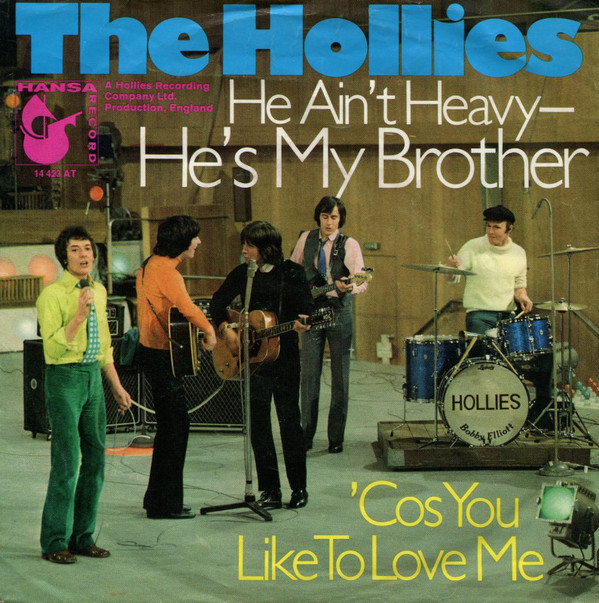
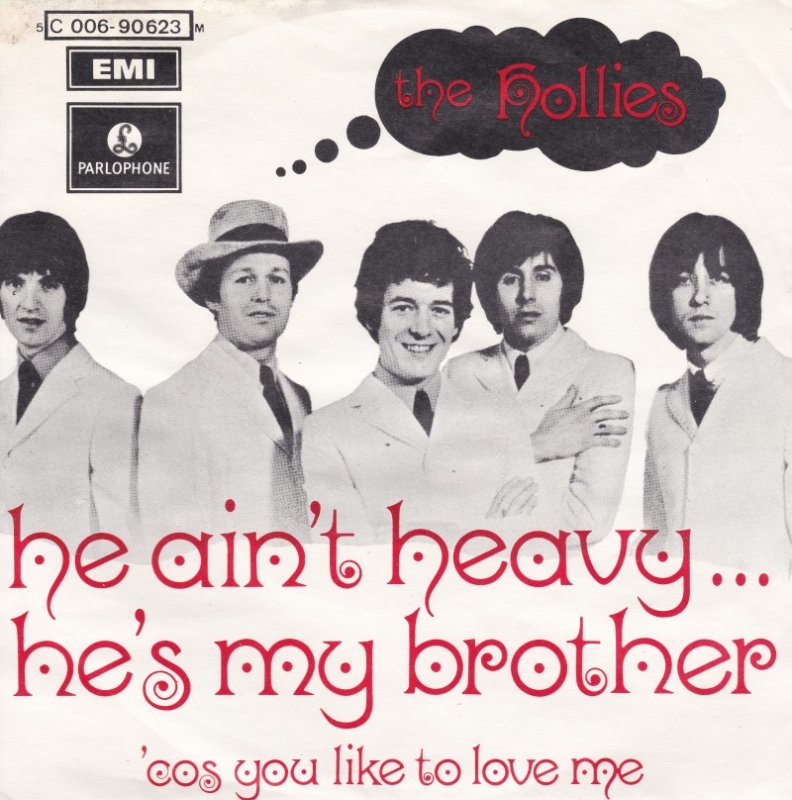
The Hollies may be best known for their chiming guitars, close harmonies, and pop feel on songs like Bus Stop or Carrie Anne, but in 1969, they took a hard turn straight into emotional overdrive with this song. This wasn’t your typical British Invasion earworm. This was a slow-burning ballad with a title that sounded like scripture. The star of this song is Alan Clarke’s lead vocal. A gut-wrenching vocal that makes Clarke sound like he lived the song.
It was released in 1969 and was written by Bobby Scott and Bob Russell. A young Elton John played piano on the song. It peaked at #7 on the Billboard 100, #11 in Canada, #3 in the UK, and #7 in New Zealand. It was used in a commercial in 1988 and in that year went to number 1 in the UK charts. I always thought the song had a spiritual sound to it.
Speaking of the songwriters, Bobby Scott was a jazz pianist, and Bob Russell was writing these lyrics while battling terminal cancer. The phrase “He ain’t heavy, he’s my brother” came from a story involving a Scottish orphanage and a child being carried on another’s back. Back in 1918, a boy named Howard Loomis was abandoned by his mother at Father Flanagan’s Home for Boys, which had opened just a year earlier. Howard had polio and wore heavy leg braces. Walking was difficult for him, especially when he had to go up or down steps. Soon, several of the Home’s older boys carried Howard up and down the stairs. One day, Father Flanagan asked Reuben Granger, one of those older boys, if carrying Howard was hard. Reuben replied, “He ain’t heavy, Father… he’s my brother.”
Tony Hicks: “In the 1960s when we were short of songs I used to root around publishers in Denmark Street. One afternoon, I’d been there ages and wanted to get going but this bloke said: ‘Well there’s one more song. It’s probably not for you.’ He played me the demo by the writers [Bobby Scott and Bob Russell]. It sounded like a 45rpm record played at 33rpm, the singer was slurring, like he was drunk. But it had something about it. There were frowns when I took it to the band but we speeded it up and added an orchestra. The only things left recognizable were the lyrics. There’d been this old film called Boys Town about a children’s home in America, and the statue outside showed a child being carried aloft and the motto He Ain’t Heavy, He’s My Brother. Bob Russell had been dying of cancer while writing. We never got, or asked for, royalties. Elton John – who was still called Reg – played piano on it and got paid 12 pounds. It was a worldwide hit twice.”
He Ain’t Heavy(He’s My Brother)
The road is long With many a winding turn That leads us to who knows where Who knows where But I’m strong Strong enough to carry him He ain’t heavy, he’s my brother
So on we go His welfare is of my concern No burden is he to bear We’ll get there
For I know He would not encumber me He ain’t heavy, he’s my brother
If I’m laden at all I’m laden with sadness That everyone’s heart Isn’t filled with the gladness Of love for one another
It’s a long, long road From which there is no return While we’re on the way to there Why not share
And the load Doesn’t weigh me down at all He ain’t heavy he’s my brother
He’s my brother He ain’t heavy, he’s my brother, he ain’t heavy
A good pop song by the Hollies. They were known mostly for their harmonies but they were a good band…they had a great guitar player and drummer. Tony Hicks is never mentioned much with the guitar players with the other British Invasion bands but he could hold his own with the others. Bobby Elliot was/is a drummer’s drummer.
The Hollies had great harmonies and also a secret weapon in Tony Hicks as a guitar player. He was and still is outstanding but was never as well known as his later neighbor George Harrison and his other peers.
Tony’s son Paul Hicks was in Dhani Harrison’s band and has worked with Giles Martin on Beatle remastering projects. I have a soft spot for the Hollies. They started in the early sixties and continued through the seventies without Graham Nash who quit the Hollies for what he thought was a hipper band…Crosby, Stills, and Nash. Soon to include the elusive Neil Young.
The song peaked at #11 on the Billboard 100, #7 in Canada, and #4 in the UK in 1967. I included a short video of The Hollies recording the song. While they were recording this The Beatles were in the next studio recording as they both recorded at EMI Studios.
Just a little trivia… The earliest known record of a carousel is a Byzantine etching from 500 AD which shows riders swinging in baskets tied to a central pole.
Graham Nash: We really hit the mark when it came to our next record. Tony, Allan, and I wanted desperately to write a monster A-side. So far, our biggest hits were Graham Gouldman songs, and, hey, you take ’em where you can get ’em. But we thought we were good enough writers to land the big fish. We knew the combination, how to come up with a universal theme, the right type of hook. So we went through a shitload of ideas until inspiration struck. I’m not sure which of the three of us came up with fun fairs. We had all been to them as kids: pulling ducks out of the water, a ring around a bottleneck, winning goldfish. We thought a love affair was pretty much like going round and round and round on a carousel. And before we knew it, the song just took shape. It was all there—the words, the tune, there was no stopping it. And Tony and Bobby wrapped it in an exceptional arrangement.
You ask me, “On a Carousel” was one of the Hollies’ best songs. It’s a pop song with an infectious chorus but flirts with gorgeous shifts in rhythmic texture. The transition to “Horses chasing ’cause they’re racing / So near yet so far-r-r-r-r” features a hook that keeps the melody from becoming predictable. Tony’s barb-like accents that echo the phrase “on a carousel” demonstrate his subtle virtuosity. And the lyric captures the essence of young love without the usual moon-and-June clichés. We knew it was a hit from the get-go.
On A Carousel
Riding along on a carousel, trying to catch up to you
Riding along on a carousel, will I catch up to you?
Horses chasing ’cause they’re racing
So they ain’t so far
On a carousel
On a carousel
Nearer and nearer by changing horses,
Still so far away
People fighting for their places just get in my way
Soon you’ll leave and then I’ll lose you
Still we’re going ’round
On a carousel
On a carousel
‘Round and round and round and round
round and round and round and round with you
Up, down, up, down, up, down, too
As she leaves, she drops the presents that she won before
Pulling ducks out of the water, got the highest score
Now’s my chance and I must take it, a case of do-or-die
On a carousel
On a carousel
‘Round and ’round and ’round and ’round
‘Round and ’round and ’round and ’round with you
Up, down, up, down, up, down, too
Riding along on a carousel, trying to catch up to you
Riding along on a carousel, will I catch up to you?
Now we take our ride together
No more chasing her
On a carousel
On a carousel
On a carousel
On a carousel
On a carousel
After appearing on the covers of Time and Newsweek in October 1975, Springsteen sometimes changed the words to “Tell your papa I ain’t no freak, ’cause I got my picture on the cover of Time and Newsweek” when he performed it live. This wasn’t a “hit” at the time but it still lives on in classic radio and is a key song in Bruce’s catalog.
I’ve seen Bruce do this song live and it is special. It’s one of the best live songs I’ve ever heard along with The Who’s Won’t Get Fooled Again. The song is exciting as he pleads with Rosie and calls out the nicknames of their friends.
I was around 7 years old when this was released. I remember being in a tire swing in my Aunt’s front yard when I heard this Hollies on a radio that was playing from a car that someone was working on. I still remember smelling the grass and the green surroundings of that day.
This song would be way up in my favorite songs ever. Graham Nash had left by this time and the band turned a corner when he had gone. They went from a pop sixties band to more of a rock/pop band with hits like Long Cool Woman in a Black Dress, He Ain’t Heavy (He’s My Brother), and finally this song which was their last top ten hit in the US and Canada. It was written by Albert Hammond and Mike Hazlewood.
Great song great music great voice. This song was performed by Rufus with Chaka Khan and written by Stevie Wonder. The Talk-Box which Frampton later used sounds great in this song.
Rufus evolved from a group called The American Breed, who had a hit with “Bend Me, Shape Me.” They took their name from a column in Popular Mechanics magazine called “Ask Rufus,” later shortened to Rufus when Chaka Khan joined the band in 1972.
Paul McCartney‘s Band on the Run was one of his best songs since the Beatles. This song fell in a grey area. The album was released in December of 1973 but the single was released in April of 1974 so it could have gone in either year.
The song was recorded in two parts, in different sessions. The first two were taped in Lagos while the third section was recorded in October 1973 at AIR Studios in London. Paul was robbed at knifepoint in Lagos, Nigeria and they took the tapes that he had at the time. They were never recovered and Paul figured they recorded over them.
The song was off the album Band On The Run which was I think Paul’s best solo album. It was written by Paul and Linda McCartney.
Trying to figure out Elton’s lyrics has always been interesting…not what they mean…I won’t even try that. No, it’s… what is he singing? “He’s got electric boots a mohair suit You know I read it in a magazine, oh” I wasn’t even close. I thought “masseuse” was in there. I don’t think I can even spell what I’ve been singing along with for years. Mick Jagger does this well also.
Regardless of the hard-to-decipher words…I love the song.
Elton wrote the music to this song as an homage to glam rock, a style that was popular in the early ’70s, especially in the UK…and of course, Bernie Taupin co-wrote it with Elton.
I was around 7 years old when this was released. I remember being in a tire swing in my Aunt’s front yard when I heard this song on a radio that was playing from a car that someone was working on. I still remember the grass and smell from the day I heard this song.
This song would be way up in my favorite songs ever. Graham Nash had left by this time and the band turned a corner when he had gone. They went from a pop sixties band to more of a rock/pop band with hits like Long Cool Woman in a Black Dress, He Ain’t Heavy (He’s My Brother), and finally this song which was their last top ten hit in the US and Canada. In the UK they would have one more hit…a rerelease of He Ain’t Heavy He’s My Brother.
This Hollies song was released in 1974 and it made it to #6 in the US Billboard Charts and #2 in the UK. The band did not write the song. It was written by Albert Hammond and Mike Hazlewood. Hammond was the first to record this – it appeared on his 1972 album It Never Rains In Southern California. Phil Everly recorded it in 1973 on his album Star Spangled Banner.
I was seven when the song came out and it was one song I remember because of that dream-like guitar intro by the underrated lead guitar player for the Hollies…Tony Hicks.
Thom Yorke of Radiohead based the song “Creep” on this song. After “Creep” was released, Radiohead agreed to share the songwriting royalties, so this is credited to Yorke, Hammond, and Hazlewood.
Allan Clarke lead singer of the Hollies: ‘The Air That I Breathe’, another song just like ‘He Ain’t Heavy’. A classic song and again that’s where Phil Everly came back into my life. I went to that same office where I wrote ‘Long Cool Woman’ in one day. The secretary of Ron Richards said that she’d just listened to a Phil Everly album and there was one song on it which was beautiful. She thought that I should do that song, obviously, she meant with The Hollies. I listened to it and obviously felt that I wasn’t going to be able to do it as well as Phil. So they said ‘You gotta try. Do it the way Phil would sing it’. And that’s what I did when we recorded it.’ It’s a beautiful song to sing, ‘Harmony-wise, Terry did a great job on that. To me, that’s again a classic that will go on, and on again.’
The Air That I Breathe
If I could make a wish I think I’d pass Can’t think of anythin’ I need No cigarettes, no sleep, no light, no sound Nothing to eat, no books to read
Making love with you Has left me peaceful, warm, and tired What more could I ask There’s nothing left to be desired Peace came upon me and it leaves me weak So sleep, silent angel Go to sleep
Sometimes, all I need is the air that I breathe And to love you All I need is the air that I breathe Yes, to love you All I need is the air that I breathe
Peace came upon me And it leaves me weak So sleep, silent angel Go to sleep
Sometimes, all I need is the air that I breathe And to love you All I need is the air that I breathe Yes, to love you All I need is the air that I breathe
Sometimes, all I need is the air that I breathe And to love you All I need is the air that I breathe Yes, to love you All I need is the air that I breathe And to love you
I have a soft spot for the Hollies. They started in the early sixties and continued through the seventies without Graham Nash who quit the Hollies for what he thought was a hipper band…Crosby, Stills, and Nash. Soon to include the elusive Neil Young.
Hollies members Allan Clarke, Tony Hicks, and Graham Nash wrote this song and shared the lead vocals, with each taking a verse (Clarke, then Hicks, then Nash). The Hollies had great harmonies and also a secret weapon in Tony Hicks as a guitar player. He was and still is outstanding but was never as known as his later neighbor George Harrison and his other peers.
Tony’s son Paul Hicks was in Dhani Harrison’s band and has worked with Giles Martin on Beatle remastering projects.
This song is about the British singer and actress Marianne Faithfull, who is well known for her relationship with Mick Jagger. She also had a brief fling with lead singer Alan Clarke. For a short time. “Marianne” was changed to “Carrie-Anne” so it wouldn’t be so obvious.
The song peaked at #9 in the Billboard 100, #9 in Canada, #3 in the UK, and #2 in New Zealand in 1967. This song was a straight-ahead pop hit, but changes were coming. Sgt Peppers was released so The Hollies, with the urging of Nash, tried going the more psychedelic route. The next single was King Midas In Reverse which only peaked at #18 in the UK and was considered a failure. Personally…it’s my favorite early Hollies song.
A side note…The Canadian actress Carrie-Anne Moss, best known for playing Trinity in The Matrix, was named after this Hollies hit. The song was on the charts at the time of her birth in August 1967.
From Songfacts
The group didn’t let on that the song was about Faithfull until 1995, when Graham Nash spilled the beans in a documentary.
In the song, the singer recalls the schoolyard days when he and Carrie Anne were friends, but she went for the older boys. Now their older and he tells her that although she’s lost her charm, he’s willing to “be her teacher” and take her on. By the end of the lesson, he’s sure she’ll be his girl.
According to the book Forty Years of Steel by Jeffrey Thomas, this song marks the first use of steel drums in a commercial pop record. Steel drums evoke an island vibe, but there’s nothing tropical about this song and none of The Hollies played the instrument (it’s not clear who played it on the record, but their producer, Ron Richards, apparently arranged it). Still, inserting a steel drum solo where a guitar solo would be certainly made the song stand out. Stephen Stills, Nash’s bandmate in Crosby, Stills & Nash, incorporated steel drums into his 1970 hit “Love The One You’re With.”
The Hollies had a very impressive run of hits starting in 1963, but Graham Nash wanted to put hit-making aside so they could create songs with more weight behind them. He ended up leaving the group in 1968 and forming Crosby, Stills & Nash. In an interview with Bruce Pollock, Nash said listeners “want to hear songs that mean more to them than ‘Hey Carrie Ann, what’s your game.'”
Carrie Anne
Hey, Carrie Anne Hey, Carrie Anne When we were at school, our games were simple I played a janitor, you played a monitor Then you played with older boys and prefects What’s the attraction in what they’re doing
Hey, Carrie Anne, what’s your game now Can anybody play Hey, Carrie Anne, what’s your game now Can anybody play
You were always something special to me quite independent, never caring You lost your charm as you were aging Where is your magic disappearing
Hey, Carrie Anne, what’s your game now Can anybody play Hey, Carrie Anne, what’s your game now Can anybody play
You’re so, so like a woman to me (So like a woman to me) So, so like a woman to me (Like a woman to me)
Hey, Carrie Anne, what’s your game now Can anybody play Hey, Carrie Anne, what’s your game now Can anybody play
People live and learn but you’re still learning You use my mind and I’ll be your teacher When the lesson’s over, you’ll be with me Then I’ll hear the other people saying
Hey, Carrie Anne, what’s your game now Can anybody play Hey, Carrie Anne, what’s your game now Can anybody play
This song has the sixties stamped all over it. The video that I found is a good example of that. The song peaked at #32 in the Billboard 100 and #4 in the UK in 1966. This song was The Hollies’ first American Billboard Top 40 hit.
It has a distinctive 12 string that started to appear on Byrds and Beatle songs at the time.
Graham Gouldman wrote this song:
“Yes, I was on a train coming back from London up from Manchester where I used to live, with a friend of mine, and he was looking out the window. He said, ‘Look through any window,’ because we were looking as the train crept out of the station and started going through the suburbs quite slowly. We were trying to look into the houses to see what was going on.”
From Songfacts
Proving that not every song has to involve love, heartbreak or espionage, The Hollies released this song about the quotidian delights that happen every day. Just look through any window and you’ll see them.
Graham Gouldman, who wrote the Hollies hit “Bus Stop,” wrote “Look Through Any Window” with Charles Silverman, about whom little is known.
As he did with “Bus Stop,” Graham Gouldman, who was still a teenager, got help with the lyrics from his father, Hymie, a writer known affectionately as “Hyme the Rhyme.”
Look Through Any Window
Look through any window yeah What do you see Smiling faces all around rushing through the busy town
Where do they go Moving on their way walking down highways and the by-ways Where do they go Moving on their way people with their shy ways and their sly ways
Oh you can see the little children all around Oh you can see the little ladies in their gowns when you
Look through any window yeah any time of day See the drivers on the roads pulling down their heavy loads
Where do they go Moving on their way driving down highways and the byways Where do they go Moving on their way drivers with their shy ways and their sly ways
Oh you can see the little children all around Oh you can see the little ladies in their gowns when you
Look through any window yeah what do you see Smiling faces all around rushing through the busy town
Where do they go Moving on their way Moving on their way Moving on their way
I always liked this song as it was in the second phase of the Hollies recording career. A young Elton John – who was still called Reg – played piano on it and got paid 12 pounds. The song peaked at #7 in the Billboard 100 in 1970… #3 in the UK in 1969…also #1 in the UK in 1988 after it was in a beer commercial.
The song was written by Bobby Scott and Bob Russell, their only collaboration as songwriters. Russell was dying of cancer at the time and his lyrics for this song would be the last he ever wrote. The origin of the phrase is unknown, but it did appear as the title of an article in Kiwanismagazine in 1924 and then later became the motto for Father Flanagan’s Boy’s Town in the 1940s.
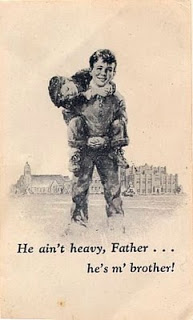
In 1941, Father Flanagan was looking at a magazine called The Messenger when he came across a drawing of a boy carrying a younger boy on his back, with the caption, “He ain’t heavy Mr., he’s my brother.” Father Flanagan thought the image and phrase captured the spirit of Boys Town, so he got permission and commissioned a statue of the drawing with the inscription, “He ain’t heavy Father, he’s my brother.” The statue and phrase became the logo for Boys Town. In 1979, girls were allowed and the name was eventually changed to Girls And Boys Town. The logo was updated with a drawing of a girl carrying a younger girl added.
Tony Hicks (The Hollies Guitarist): “In the 1960s when we were short of songs I used to root around publishers in Denmark Street. One afternoon, I’d been there ages and wanted to get going but this bloke said: ‘Well there’s one more song. It’s probably not for you.’ He played me the demo by the writers [Bobby Scott and Bob Russell]. It sounded like a 45rpm record played at 33rpm, the singer was slurring, like he was drunk. But it had something about it. There were frowns when I took it to the band but we speeded it up and added an orchestra. The only things left recognizable were the lyrics. There’d been this old film called Boys Town about a children’s home in America, and the statue outside showed a child being carried aloft and the motto He Ain’t Heavy, He’s My Brother. Bob Russell had been dying of cancer while writing. We never got, or asked for, royalties.
From Songfacts
The Two Brothers concept precedes the magazine illustration that Father Flanagan saw. In 1921, there was a resident at Boys Town who had difficulty walking. He wore leg braces and the other boys would often take turns giving him a ride on their backs. There is a famous photograph of this boy and one of the other youth giving him a ride. Now there are several statues of the Two Brothers on the Home Campus in Omaha; one is the sandstone of the two brothers from the illustration, another is a bronze version by an Italian artist that was commissioned in 1977. There is also a version done directly from the 1921 photograph in the Hall of History.
In 1938, Spencer Tracey portrayed Father Flanagan in the movie Boys Town, which also starred Mickey Rooney. In 1941, they made a sequel called Men Of Boys Town, where they used the phrase “He ain’t heavy, Father, he’s my brother” for the first time in a movie.
This was originally released by Kelly Gordon, a producer who has worked with Glen Campbell, Aretha Franklin, and David Lee Roth.
This was the only songwriting collaboration between veteran songwriters Bobby Scott (“A Taste of Honey”) and Bob Russell (“Ballerina”). Russell, who wrote the lyrics, made his mark writing for films and contributing words to songs by Duke Ellington and Carl Sigman. Scott was a piano player, singer, and producer. He did a lot of work with Mercury Records on sessions for artists like Aretha Franklin, Marvin Gaye and Bobby Darin. In 1990, he died of cancer.
Joe Cocker was offered this song before The Hollies after it had been played first to his producer Denny Cordell. The General Professional Manager for Cyril Shane Music Ltd & Pedro Music Ltd in England at the time explains: “Tony Hicks was in our office looking for songs for the Hollies (our office was not on Denmark Street, it was in Baker Street). Denny called from New York to say ‘Joe didn’t see the song.’ As Tony said in The Guardian, he liked the song and asked for an exclusive the following day. The version he heard was Kelly Gordon, who apart from being a successful producer, also wrote a little song entitled ‘That’s Life.’ His version was slow and soulful which is why I had thought of Joe Cocker to record it. Bobby Russell wrote this song while dying of cancer in Los Angeles.
We picked up the British rights to ‘He Ain’t Heavy’ from an American publisher Larry Shayne. The song was on a Kelly Gordon album called Defunked. The version was slow and soulful and had Joe Cocker written all over it. Joe turned it down, to his producer’s surprise. We had a hit with The Hollies previously called ‘I’m Alive,’ so we had a relationship with them. Also, we had a great working relationship with the Air London production team, of which their producer Ron Richards was a partner. We never considered playing the song for The Hollies when Tony Hicks was in the office. We were playing songs like ‘Sorry Suzanne.’ It was only at the end of the meeting I suggested playing Tony this wonderful song, not because it was for them, but just to share the song. We were surprised when he said ‘That’s the one.'”
This was the second single The Hollies released after Graham Nash left the group to form Crosby, Stills, and Nash; the first was “Sorry Suzanne.” Nash was replaced by Terry Sylvester. >>
In 1988, this was re-released in the UK after it was used in a Miller Beer commercial. This time, it hit #1.
This has been covered by many artists. It was a hit for Neil Diamond later in 1970, and also for Olivia Newton-John in 1976. Newton-John’s version was the B-side to the Linda Hargrove cover “Let It Shine” and went to #1 on the Adult Contemporary chart.
A version by Bill Medley (one of The Righteous Brothers) was used in the 1988 Sylvester Stallone movie Rambo 3.
The Osmonds recorded this and used it as the B-side of their first hit, “One Bad Apple.”
This was used in an anti-drug commercial in Canada during ’90s. The basis was two old friends meeting again in the hospital. There are some old home movie type flash backs, then they hug and the one in hospital garb cries. >>
A various artists charity version recorded under the name of The Justice Collective topped the UK singles charts during Christmas 2012.
Casey Affleck made reference to this song when he accepted the Oscar for Best Actor in 2017 for his role in “Manchester by the Sea.” Thanking his brother, Ben Affleck, he said, “you ain’t heavy.”
He Ain’t Heavy, He’s My Brother
The road is long With many a winding turn That leads us to who knows where Who knows where But I’m strong Strong enough to carry him He ain’t heavy, he’s my brother
So on we go His welfare is of my concern No burden is he to bear We’ll get there
For I know He would not encumber me He ain’t heavy, he’s my brother
If I’m laden at all I’m laden with sadness That everyone’s heart Isn’t filled with a gladness Of love for one another
It’s a long, long road From which there is no return While we’re on the way to there Why not share
And the load Doesn’t weigh me down at all He ain’t heavy, he’s my brother
Mid-Sixties pop classic. If I Needed Someone is a George Harrison song that was on the album Rubber Soul. In America this was one of the four songs left off of Capital’s version of Rubber Soul…it was included on Yesterday and Today…an album that Capital put together for the American market. It was originally issued only in the United States and Canada
George Harrison said the song was influenced by the Byrds: “It was based on the twelve-string figure from ‘The Bells Of Rhymney’ by The Byrds.”
McCartney called the song the first “landmark” song written by George for the Beatles.
George Harrison: “It was like a million other songs written around one chord, a D chord actually.” “If you move your fingers about you get various little melodies. That guitar line, or variations on it, is found in many a song, and it amazes me that people still find new permutations of the same notes.”
As a guitarist, there are many songs that have been written around the D chord by moving your fingers in different positions. Here Comes The Sun, Woman by Lennon, Free Falling, Sweet Home Alabama, and like George said…a million others.
On January 24th, 1996, “If I Needed Someone” got its first and only release on a single. The Capitol series of “For Jukebox Only” singles paired the song as the b-side to “Norwegian Wood” and was printed on both black and green vinyl.
The Hollies received an early version of the song and then quickly recorded their own version of the song and released it as their next single at the end of 1965. It reached #20 in the UK, making it the first George Harrison composition to make the charts.
George made it known he didn’t like their version…but to me, the Hollies did a good job.
From Songfacts
This was written by George Harrison, who got the idea from a few of The Byrds’ songs including “The Bells of Rhymney” and “She Don’t Care About Time.” It was not Ravi Shankar that introduced George to the wonderment of sitar, but Byrd traveler David Crosby shortly after Shawn Phillips had shown him the basic steps. In 1965 The Beatles toured the US and visited Ravi at World Pacific Studios where The Byrds had permanent residency. It was also here that Roger McGuinn’s Rickenbacker jingle jangle influenced Harrison’s “If I Needed Someone.” In turn, The Byrds were influenced by Harrison’s 12-string guitar work. >>
Former Byrds guitarist Roger McGuinn recalled to Christianity Today magazine: “George Harrison wrote that song after hearing the Byrds’ recording of “Bells of Rhymney.” He gave a copy of his new recording to Derek Taylor, the Beatles’ former press officer, who flew to Los Angeles and brought it to my house. He said George wanted me to know that he had written the song based on the rising and falling notes of my electric Rickenbacker 12-string guitar introduction. It was a great honor to have in some small way influenced our heroes the Beatles.”
If I Needed Someone
If I needed someone to love You’re the one that I’d be thinking of If I needed someone
If I had some more time to spend Then I guess I’d be with you my friend If I needed someone Had you come some other day Then it might not have been like this But you see now I’m too much in love
Carve your number on my wall And maybe you will get a call from me If I needed someone Ah, ah, ah, ah
If I had some more time to spend Then I guess I’d be with you my friend If I needed someone Had you come some other day Then it might not have been like this But you see now I’m too much in love
Carve your number on my wall And maybe you will get a call from me If I needed someone Ah, ah
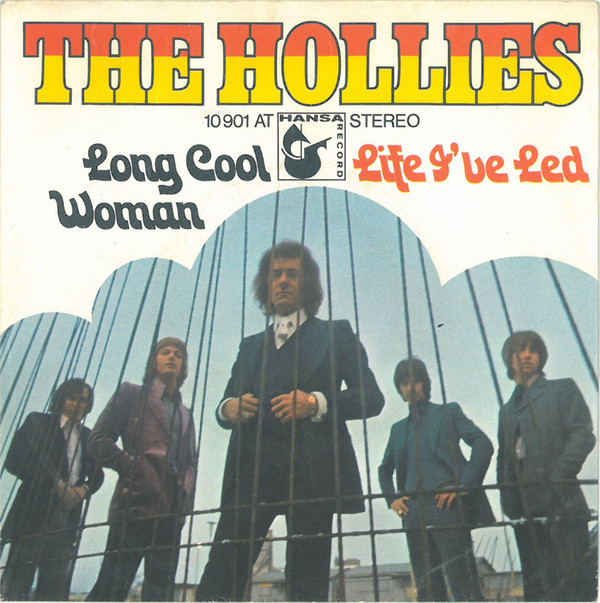
Great song by CCR Uh no the Hollies. This song peaked in 1972 at #2 in the Billboard 100 and #32 in the UK. The Hollies had most of their success in the UK but surprisingly it missed there but was a huge hit in America. Lead singer Alan Clarke wrote this song with the Brittish songwriters Roger Cook and Roger Greenaway.
Love the intro and I especially like the slapback echo on the vocals. I never really thought of CCR when I heard it though many people do… Alan Clarke’s voice will never be confused with John Fogerty’s but the style here is the same. Here is a quote from Alan Clarke… On the vocal, my intention wasn’t to sound like John Fogerty of Creedence Clearwater Revival. I was thinking of Elvis on his early songs, like “Mystery Train.”
This is the only Hollies single without any backing vocals. The reason why Clarke is the only singer on this record is that he didn’t intend the song to be released on a Hollies album but as a record of his own. When the band learned that he intended to do a solo recording, Clarke was issued an ultimatum – he could either remain with The Hollies or pursue a solo career, but not both. Clarke told Rolling Stone in 1973: “I think with me the band feared that if I got a hit I’d leave. How can you stop destiny? Now, if they originally agreed, I might not even have left. ‘Long Cool Woman’ would have been released a year earlier, and we’d have done a few tours of the States and maybe would have been really big.”
Note to readers outside the UK: A “skinful” is a British term, essentially meaning an amount of alcohol that is enough to make a person drunk.
Great article with Roger Cook (one of the songwriters) from the Tennessean.
Saturday night I was down town Working for the F.B.I. Sitting in a nest of bad men Whiskey bottles piling high Boot legging boozer on the west side Full of people who are doing wrong Just about to call up the D.A. man When I heard this woman singing a song.
A pair of forty fives made me open my eyes My temperature started to rise She was a long cool woman in a black dress Just a five nine Beautiful Tall With just one look I was a bad mess Cause that long cool woman had it all.
Saw her heading to the table Well a tall walking big black cat When Charlie said “I hope that you’re able boy” Well I’m telling you she knows where it’s at Well suddenly we heard a siren And every body started to run A jumping out of doors and tables Well I heard somebody shooting a gun.
Well the D.A. was pumping my left hand And a she a holding my right And I told her don’t get scared Cause you’re gonna be spared I gotta be forgiven If I want to spend my living with A long cool woman in a black dress Just a five nine Beautiful Tall With just one look I was a bad mess ‘Cause that long cool woman had it all Had it all Had it all Had it all
Graham narrates the audible version and does a good job weaving through his personal history. He starts with his blue-collar family and how Alan Clarke and he knew each other since school and formed The Hollies. The most interesting part to me was the mid-sixties era living in swinging London.
He wrote about his friendship with the Beatles and him getting an advance tape of Sgt Pepper from Brian Epstein. He had a great hi-fi system at his flat and he would show it off to anyone that came over. When the Turtles came over from America they were blown away by Sgt Peppers at top volume. He went on about how Sgt Peppers changed everything and it would eventually lead him to leave the Hollies.
Graham describes being a pop star in the mid-sixties in London. Shouldn’t we all live that life? Paul McCartney calls him up and invites him over to the All You Need Is Love session for the “Our World” program to be broadcast to millions.
He talks about how his friendship with Mama Cass led to meeting David Crosby and eventually CSN being born. Graham covers the CSNY period and his romantic relationships including Joni Mitchell. He does cover the drama associated with CSNY and the troubled David Crosby. What kind of Rockstar bio would it be without drugs… Graham did his share and Crosby did our share. Graham handled them better than some.
Graham would write simple songs compared to Crosby, Stills, and Young but many times his songs would be the hits that drove some of the later albums…songs like “Just a Song Before I Go” and “Wasted on the Way.”
One thing I can say is he didn’t hold back or pull punches…but he still comes off as a really nice guy but it is his book.
This book helped sever his relationship with Crosby…for now anyway but Nash stressed through the book how much he cared for Crosby.
I would recommend this book to not only Hollies and CSNY fans but fans of 60’s and 70’s music and culture. After reading this I listened to more Hollies songs and I really began to appreciate their psychedelic period with songs like King Midas in Reverse.






 PowerPop... An Eclectic Collection of Pop Culture