This is the album’s opening track, and it doesn’t so much kick down the door as quietly invite you in. If you only know the Layla album for the title track, you might miss how the whole journey begins with this two-and-a-half-minute sigh of regret.
Unlike Clapton’s past work in Cream or Blind Faith, this wasn’t about ripping incredible riffs. The melody flows with a natural grace, closer to something from The Band than the psychedelic guitar Clapton had been known for.
Derek and the Dominos was a band formed in the spring of 1970 by guitarist and singer Eric Clapton, along with keyboardist Bobby Whitlock, bassist Carl Radle, and drummer Jim Gordon. All four musicians also worked with George Harrison on his All Things Must Pass album. Clapton didn’t want his name in the title and had hoped to keep his involvement as low-key as possible.
The album peaked at #16 in 1970 on the Billboard 100. Although Derek and the Dominos were poised to record a follow-up album in 1971, because of tensions and drug abuse among the band members, along with the tragic death of Duane Allman later that year, this remained their sole album.
This song and Bell Bottom Blues are my two favorites off the album. Everyone knows Layla, but these other songs are great as well. Eric Clapton and Bobby Whitlock wrote this song. As with most of the songs on this album, Patti Harrison was the main inspiration.
I Looked Away
She took my hand And tried to make me understand That she would always be there, But I looked away And she ran away from me today; I’m such a lonely man. It came as no surprise to me That she’d leave me in misery. It seemed like only yesterday She made a vow that she’d never walk away. First Verse And if it seemed a sin To love another man’s woman, baby, I guess I’ll keep on sinning Loving her, Lord, till my very last day. But I looked away And she ran away from me today; I’m such a lonely man.
I like this song just as much as Layla. It was written by Eric Clapton and Bobby Whitlock. This song and “I Looked Away” are two of my favorites on the album. Bell Bottom Blues peaked at only #91 on the Billboard 100 in 1971. Recently, Eric did a great thing for someone with this album.
Derek and The Dominos formed after working on George Harrison’s album All Things Must Pass. After that, they played a lot of different small clubs all over Europe. They made the album, Layla and Other Assorted Love Songs in Criteria Studios in Miami, Florida. It’s there where Clapton met Duane Allman and a little later invited him to join them. Duane ended up turning Eric down because he believed in the Allman Brothers and he built them from the ground up. Eric was one of his guitar guys so it had to be a hard choice for him.
Clapton first heard about Allman when listening to Wilson Pickett’s version of Hey Jude for the first time and heard his guitar playing at the end of the song. He called up either Ahmet Ertegun or Tom Dowd and asked who was that guitar player? Eric has said that he has never heard better rock guitar playing on an R&B record.
In 1970, Eric Clapton was experiencing emotional anguish over George Harrison’s wife Pattie Boyd. He recounts writing the song for Boyd after she asked him to get her a pair of bell-bottom jeans while he visited the US.
Clapton repackaged this album and the first thing he did was to ask his attorneys…what is Bobby Whitlock going to get out of this? Bobby played keyboards and wrote a lot of the songs with Eric. The attorneys told Eric he would get nothing because he sold all of his rights. He was down at one time and had to sell everything. Eric and his attorneys went to the publishing company and bought back all of Bobby’s rights and handed it over to him without Whitlock even knowing.
Bobby Whitlock:Well, unbeknownst to me, Eric and Michael took their attorneys in to the respective Warner/Chappel and Universal and all the other companies and bought back my rights to my income and restored them and gave them back to me. Out of the blue.
So all of my royalties have come back. And now it’s even more so, because it hasn’t been a month-and-a-half ago that I wrote him to explain how ‘Bell Bottom Blues’ came about, and I sent it to Eric and to Michael. Someone had come online and says something about, ‘Is this true that ‘Bell Bottom Blues’ was written about a pair of trousers?’
And I said, Yeah, well, it was that and this girl in France that Eric was seeing for a little while while we were there. I’d forgotten about Pattie [Boyd – subject of ‘Layla’] asking him about those pants. But anyway, before I would answer this and put it out publicly online, I decided, Well, I probably ought to write Eric.
Bobby Whitlock: “Eric met this girl, she was like a Persian princess or something, and she wore bell bottoms. She was all hung up on him – he gave her a slide that Duane (Allman) had given him and he wrapped it in leather and she wore it around her neck. She didn’t speak a word of English and they had to date through an interpreter. That relationship did not last but a week. He started the song over there, then when we got back to England, we finished it up in his TV room in Hurtwood Edge.”
Bell Bottom Blues Indeed!
Bell Bottom Blues
Bell bottom blues, you made me cry
I don’t want to lose this feeling
And if I could choose a place to die
It would be in your arms
Do you want to see me crawl across the floor to you?
Do you want to hear me beg you to take me back?
I’d gladly do it because
I don’t want to fade away
Give me one more day, please
I don’t want to fade away
In your heart I want to stay
It’s all wrong, but it’s all right
The way that you treat me baby
Once I was strong but I lost the fight
You won’t find a better loser
Do you want to see me crawl across the floor to you?
Do you want to hear me beg you to take me back?
I’d gladly do it because
I don’t want to fade away
Give me one more day, please
I don’t want to fade away
In your heart I want to stay
Do you want to see me crawl across the floor to you?
Do you want to hear me beg you to take me back?
I’d gladly do it ’cause
I don’t want to fade away
Give me one more day, please
I don’t want to fade away
In your heart I want to stay
Bell bottom blues, don’t say goodbye
I’m sure we’re gonna meet again
And if we do, don’t you be surprised
If you find me with another lover
Do you want to see me crawl across the floor to you?
Do you want to hear me beg you to take me back?
I’d gladly do it ’cause
I don’t want to fade away
Give me one more day, please
I don’t want to fade away
In your heart I want to stay
I don’t want to fade away
Give me one more day please
I don’t want to fade away
In your heart I want to stay
I don’t want to fade away
Give me one more day please
I don’t want to fade away
In your heart I want to stay
I’ve been listening to All Things Must Pass recently and the songs are really consistent on that album.
Harrison wrote these lyrics while he was still a Beatle. He found it hard to get many of them on Beatles albums because there was only so much room. The good side is when The Beatles broke up, he had a backlog full of songs.
Phil Collins was brought in to play the congos on this song. He played for 90 minutes and got blisters on his fingers from playing them for so long. Unfortunately for Collins…his version didn’t make the cut. George Harrison had a great sense of humor and pranked Collins in later years.
Collins met Harrison several more times over the years, and the pair became friendly… friendly enough for Harrison to prank Collins. In 2001, shortly before Harrison’s death, he put out a remastered version of All Things Must Pass and around the same time sent Collins what he claimed was a version of the track on which he had played featuring the drummer’s missing Congas handiwork.
George had the percussionist Ray Cooper play out of time on the tape and that is what he sent to Collins. Phil later said: “I got a tape from George of the song that I played with the congas quite loud, I thought, Oh my god, this sounds terrible. In fact, it was a Harrison joke. He’d recorded [percussionist] Ray Cooper. [He said] said, ‘Play bad, I’m going to record it and send it to Phil.’ I couldn’t believe that a Beatle had actually spent that much time on a practical joke for me.” He did have a connection to the Beatles… As a kid, he was an extra in the Beatles movie A Hard Day’s Night but was edited out. Harrison did credit Collins on the 2001 remastered version of All Things Must Pass.
All the members of Derek and the Dominos played on this track and it was produced by Phil Spector.
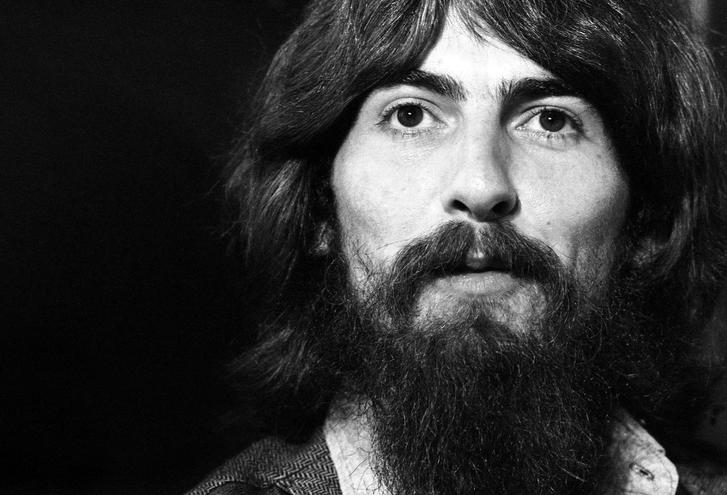
George Harrison credits his first experience with LSD as being the doorway to his spiritual awakening and introduction to Hinduism. Harrison said that during the LSD trip, he thought of Yogis of the Himalayas running through his mind. He began to think about death and that is how this song came about.
George Harrison passed away on November 29, 2001 after a long battle with cancer. He was not afraid of death, as he believed it would take him to a better place. Before he passed, Paul and Ringo visited him and spent the day telling jokes and talking about times in Liverpool. He did tell Paul McCartney one to stop fighting with Yoko…that life was too short. Paul honored that wish and started to communicate with Yoko.
George Harrison: In the scriptures and in the Bhagavad Gita it says there’s never a time when you didn’t exist and will never be a time you cease to exist. The only thing that changes is our bodily conditioned soul comes in the body and we go from birth to death and it’s death how I look at it. It is like taking your suit off, you know the soul is in these three bodies and one body falls off.
Acoustic Demo
Art Of Dying
There’ll come a time when all of us must leave here
Then nothing sister Mary can do
Will keep me here with you
As nothing in this life that I’ve been trying
Could equal or surpass the art of dying
Do you believe me?
There’ll come a time when all your hopes are fading
When things that seemed so very plain
Become an awful pain
Searching for the truth among the lying
And answered when you’ve learned the art of dying
But you’re still with me
But if you want it
Then you must find it
But when you have it
There’ll be no need for it
There’ll come a time when most of us return here
Brought back by our desire to be
A perfect entity
Living through a million years of crying
Until you’ve realized the Art of Dying
Do you believe me?
But I shot a man in Reno, Just to watch him die… Johnny Cash
It doesn’t get much better than that.
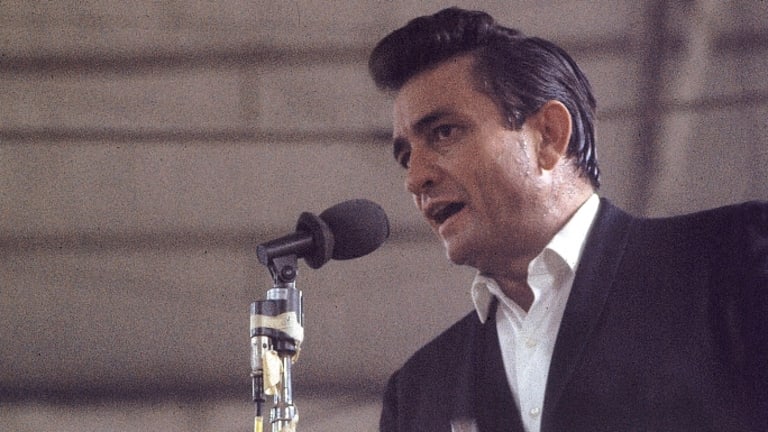
The man in black was The Man. Not many performers can cross genres like Johnny Cash did and still does. He first recorded this song in 1955 at Sun Records as the B side to “S3o Doggone Lonesome” but it was the live 1969 version that hit.
The At Folsom Prison album helped revitalize Cash’s career. Up to this point, his last Country top 40 entry was in 1964. This was recorded live at Folsom Prison in California on January 13, 1968, and that album came to define his outlaw image. The record company told him it wouldn’t work but Johnny recorded at the prison anyway.
Folsom Prison Blues peaked at #1 on the Billboard Country Charts, #1 on the Canadian Country Charts, #32 on the Billboard 100, and #17 on the Canadian Pop Charts. The song and album generated a lot of interest in the rebellious Johnny Cash, who made prison reform his political cause of choice. He started regularly performing in jails, doing about 12 shows a year for free mostly in Folsom and San Quentin.
The album peaked at #1 in the Billboard Country Charts, #13 in the Billboard Album Charts, and #27 in Canada.
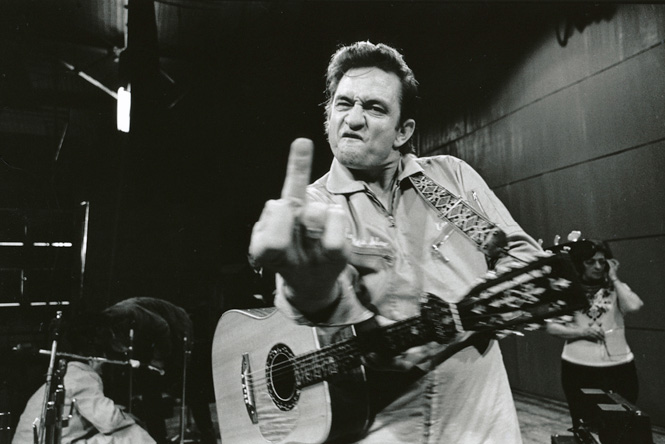
This iconic picture came from Folsom Prison. According to photographer Jim Marshall…he asked Cash to express what he thought of the prison authorities when he played the show. Marshall told Cash “let’s do a shot for the warden” and the picture was born.
Cash saw Crane Wilbur’s 90-minute film Inside the Walls of Folsom Prison while stationed in Germany. It left an impression on Cash, who emphasized the tale of the imprisoned men, and inspired him to write a song. Johnny Cash:“It was a violent movie, I just wanted to write a song that would tell what I thought it would be like in prison.”
Cash’s first prison performance occurred in 1957 when he performed for inmates at Huntsville State Prison. The favorable response inspired Cash to perform at more prisons through the years. His next hit, recorded in San Quentin Prison, was the humorous “A Boy Named Sue,” which proved that he could be clever and funny.
Cash came off as a champion for the oppressed. He got his own national TV show in 1969 and became one of the most popular entertainers of his era. His guests included Derek and the Dominos, Joni Mitchell, Bob Dylan, Linda Ronstadt, Kris Kristofferson, Mickey Newbury, Neil Young, Gordon Lightfoot, Merle Haggard, James Taylor, Tammy Wynette, and Roy Orbison.
Isn’t that list incredible? Cash was considered a Country-Folk artist but look at the range of performers. The late sixties and seventies were like this ….and it’s the reason I like them so much…all the generations intersected at that point in time. I mean you have Eric Clapton and then you have Tammy Wynette on the guest list.
The lyrics to this song were based on a 1953 recording called Crescent City Blues by a bandleader named Gordon Jenkins with Beverly Maher on vocals. After filing a lawsuit, Gordon Jenkins received an out-of-court settlement from Cash in 1969. I have to say it does sound really close.
Johnny Cash:“I don’t see anything good come out of prison. You put them in like animals and tear out the souls and guts of them, and let them out worse than they went in.”
Rosanne Cash:“He was a real man with great faults, and great genius and beauty in him, but he wasn’t this guy who could save you or anyone else.”
Folsom Prison Blues
(Hello, I’m Johnny Cash)
I hear the train a-comin’
It’s rollin’ ’round the bend
And I ain’t seen the sunshine
Since I don’t know when
I’m stuck in Folsom Prison
And time keeps draggin’ on
But that train keeps a-rollin’
On down to San Antone
When I was just a baby
My Mama told me, “son
Always be a good boy
Don’t ever play with guns”
But I shot a man in Reno
Just to watch him die
When I hear that whistle blowin’
I hang my head and cry (play it to the verse, yeah)
(Sue it)
I bet there’s rich folks eatin’
From a fancy dining car
They’re probably drinkin’ coffee
And smokin’ big cigars
Well, I know I had it comin’
I know I can’t be free
But those people keep a-movin’
And that’s what tortures me (hit it)
(Howdy-ho)
Well, if they freed me from this prison
If that railroad train was mine
I bet I’d move it on, a little
Farther down the line
Far from Folsom Prison
That’s where I want to stay
And I’d let that lonesome whistle
Blow my blues away
Damn…this is such a great song. Duane Allman came into the Derek and the Dominos sessions and made a suggestion to record a Jimi Hendrix song, Little Wing. This is what he did in the Wilson Pickett sessions with the song Hey Jude.
After the Layla sessions were completed, Clapton returned to England with a rare left-handed Fender Stratocaster, a gift for Jimi Hendrix. He wanted him to hear the Dominos’ recording of Hendrix’s Little Wing, a tribute he and Duane had recorded for him. They both greatly admired Hendrix and Duane planned to meet him when Jimi came back from Europe. On the morning of September 18, 1970, Jimi Hendrix was found unconscious in a Notting Hill apartment in London. He died that afternoon at the hospital, having apparently suffocated while under the heavy sedation of sleeping pills.
The album peaked at #16 in 1970 on the Billboard 100. Although Derek and the Dominos were poised to record a follow-up album in 1971… tensions and drug abuse among the band members, along with the tragic death of Duane Allman ended that idea.
Jimi wrote this song and it was inspired by the 1967 Monterey Pop Festival, a concert held for 3 days in 1967. It was attended by around 200,000 music fans, it happened 2 years before Woodstock. Jimi wrote about the atmosphere at the festival as if it was a girl. He described the feeling as “Everybody really flying and in a nice mood.” He named it “Little Wing” because he thought it could just fly away.
The song was on Axis: Bold as Love released in 1967. The album peaked at #3 on the Billboard 100 in 1968.
Bobby Whitlock keyboard player: We had two leaders then. We had Eric and Duane. Eric backed up and gave Duane a lot of latitude, a lot of room, so he could contribute up to his full potentiality, and Duane was full of fire and ideas. He’d just go, “Hey, how about we try ‘Little Wing’?”—that was completely his idea and he came up with the intro by himself. He just started playing it.
Duane was very, very good in the studio. Working with the finest musicians and engineers on the planet really paid off for him. When he had the opportunity to be thrust into that environment, he absorbed what was right and righteous and then used it to killer advantage.
Little Wing
Well, she’s walking through the clouds
With a circus mind that’s running around
Butterflies and zebras and fairy tales
That’s all she ever thinks about
And when I’m sad, she comes to me
A thousand smiles she gives to me free
Said it’s all right, take anything you want from me
(Anything you want, babe) (Anything)
Well, she’s walking through the clouds
With a circus mind that’s running around
Butterflies and zebras and fairy tales
That’s all she ever thinks about
And when I’m sad, she comes to me
With a thousand smiles she gives to me free
Said it’s all right, take anything you want from me, baby
(Anything you want) (Anything)
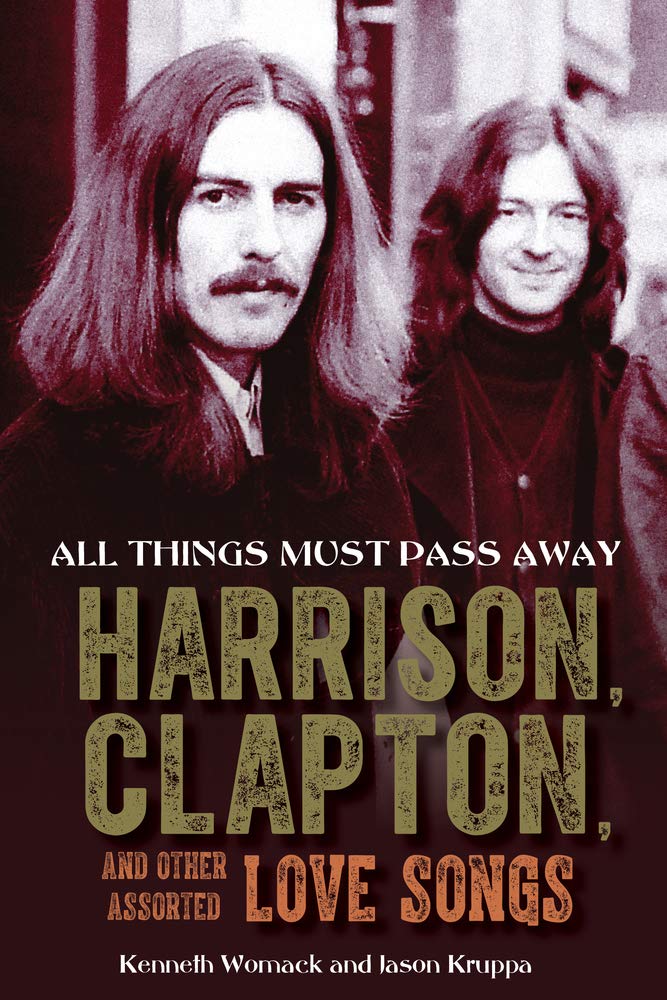
As a huge Beatles and Clapton fan, I was hoping to find out things I didn’t know…I certainly did. No revelation about The Beatles but many about George who just started his life without them.
I’m more familiar with Harrison than Clapton but I did know some about him. They go through each artist’s history up until around 1972 and then do highlights after that. The book centers around the making of Harrison’s album All Things Must Pass and Clapton’s Derek and the Dominos Layla and Assorted Love Songs and their friendship.
The authors picked a point in time to concentrate on (70-72) …and they did in detail. From Phil Spector to the “Apple Scruffs” outside the studio’s door. They also cover Duane Allman, Tom Dowd, and more helping out Clapton on the Layla album.
Harrison and Clapton had a genuine and later complicated friendship that started in earnest in 1966 when they met while Clapton was in Cream and George in the Beatles. Out of the two, George had a better childhood with a caring family and later his family with the Beatles. The Beatles were tight like brothers and although they fought…it was a love and closeness there.
Clapton had a rocky childhood where he was raised by his grandparents and his sister, he found out later, was really his mom. He felt abandoned and that partly explains the reason Clapton never stayed in a band more than a few years. He never wavered in his friendship with Harrison though.
The book would not be complete without getting into the Patti Boyd-George Harrison-Eric Clapton triangle. Clapton wanted Patti for years, but she resisted him, and he turned into a heroin addict. They didn’t get together until Harrison and Boyd split up and Clapton got off heroin. The cause of the Harrison Boyd separation was said not to have anything to do with Clapton. Drugs and a certain affair that they could not get past was part of it.
They remained friends for the rest of their lives and while they always got along…George would occasionally throw a verbal jab about Boyd and Clapton…which was his sense of humor but uncomfortable sometimes for Clapton and those around, but he never said anything publicly about it.
George and Eric helped each other musically throughout their careers. Clapton formed a backing band for a tour of Japan in the early 90s for Harrison.
After George’s death…George’s wife Oliva called on Clapton to put together a show… Concert for George…with musicians from Harrison’s past. That show was Concert for George. There were many special moments in that show. The one for me personally would be Paul McCartney singing All Things Must Pass.
This song is a masterpiece from the intro rock guitar riff to the beautiful piano coda. The piano section would have made a great song itself.
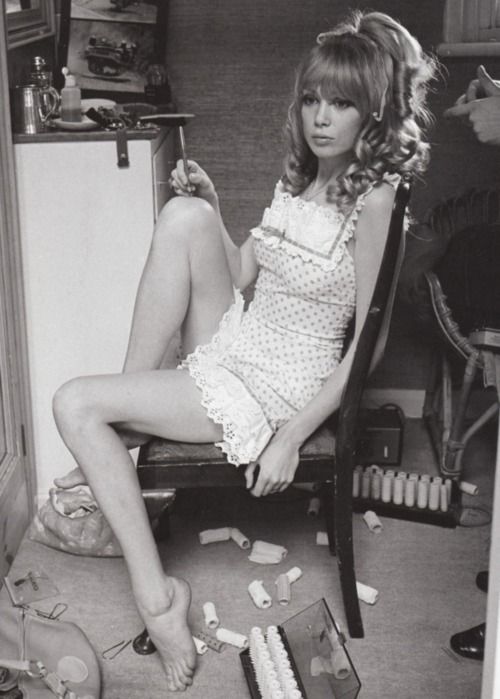
This song was inspired by one of the most famous muses in rock and roll. Her name is Pattie Boyd and she was George Harrison’s wife at the time…but that didn’t stop Clapton who was and remained friends with George.
The lyrics are based on the book by Persian poet Nizami, Layla and Majnun, about a man in love with a woman who cannot have her because her parents object.
Pattie divorced Harrison in 1977 and married Clapton in 1979 during a concert stop in Tucson, Arizona. Harrison was not bitter about the divorce and attended Clapton’s wedding party months later with fellow Beatles Ringo Starr and Paul McCartney.
At the end of the song, Duane Allman produced the “crying bird” sound with his guitar while Clapton played acoustic. It was a tribute to Charlie Parker, a jazz legend known as “bird.” Duane also came up with the famous guitar riff and played lead with Clapton. The riff was based on one Albert King played on his song “As The Years Go Passing By,” but sped up.
An edited version was released as a single in 1971. it ran 2:43 and flopped on the charts. The full version was released a year later and became one of the most famous songs in rock history. Allman’s death in a motorcycle accident in October 1971 helped renew interest in the song.
Pattie Boyd:“We met secretly at a flat in South Kensington. Eric Clapton had asked me to come because he wanted me to listen to a new number he had written. He switched on the tape machine, turned up the volume and played me the most powerful, moving song I had ever heard. It was Layla, about a man who falls hopelessly in love with a woman who loves him but is unavailable. He played it to me two or three times, all the while watching my face intently for my reaction. My first thought was: ‘Oh God, everyone’s going to know this is about me.’
Bobby Whitlock: “I was there when they were supposedly sneaking around. You don’t sneak very well when you’re a world figure. He was all hot on Pattie and I was dating her sister. They had this thing going on that supposedly was behind George’s back. Well, George didn’t really care. He said, ‘You can have her.’ That kind of defuses it when Eric says, ‘I’m taking your wife’ and he says, ‘Take her.’ They got married and evidently, she wasn’t what he wanted after all. The hunt was better than the kill. That happens, but apparently Pattie is real happy now with some guy who’s not a guitar player. Good for her and good for Eric for moving on with his life. George got on with his life, that’s for sure.”
The song had an interesting chart history. It was released in 1970 and it peaked at #51 in the Billboard 100 in 1971… then in 1972 it peaked at #10 in the Billboard 100, #9 in Canada and #7 in the UK.
Clapton performed a slow, acoustic version for an MTV Unplugged concert in 1992. It was released as a single and made #12 in the US, getting lots of airplay radio stations. This version also won a Grammy for Best Rock Song.
From Songfacts
This song is about George Harrison’s wife, Pattie. She and Clapton began living together in 1974 and married in 1979. Clapton and Harrison remained good friends, with George playing at their wedding along with Paul McCartney and Ringo Starr. Clapton left her for actress Lory Del Santo (with whom he had his son, Conor) in 1985. In an article published in The Guardian December 13, 2008, Pattie said: “I wasn’t so happy when Eric wrote ‘Layla,’ while I was still married to George. I felt I was being exposed. I was amazed and thrilled at the song – it was so passionate and devastatingly dramatic – but I wanted to hang on to my marriage. Eric made this public declaration of love. I resisted his attentions for a long time – I didn’t want to leave my husband. But obviously when things got so excruciatingly bad for George and me it was the end of our relationship. We both had to move on. Layla was based on a book by a 12th-century Persian poet called Nizami about a man who is in love with an unobtainable woman. The song was fantastically painful and beautiful. After I married Eric we were invited out for an evening and he was sitting round playing his guitar while I was trying on dresses upstairs. I was taking so long and I was panicking about my hair, my clothes, everything, and I came downstairs expecting him to really berate me but he said, ‘Listen to this!’ In the time I had taken to get ready he had written “Wonderful Tonight.”
I was a bit more hurt when Eric wrote Old Love (1989). The end of a relationship is a sad enough thing, but to then have Eric writing about it as well. It makes me more sad, I think, because I can’t answer back.”
Allman ended up playing on the album through good timing and a mutual admiration between he and Clapton. Tom Dowd was producing the Allman Brothers’ album Idlewild South at Criteria Studios in Miami when he got the call that Clapton would like to book time with his new band. Duane was a huge fan of Clapton, and when the Allman Brothers played a show in Miami on August 26, 1970, it was when Derek and the Dominos were recording with Dowd at Criteria. Duane called to see if he could stop by after the gig, and Clapton decided to bring his band to the show. At the show, Duane froze up when he saw Clapton near the stage, but the admiration was mutual, and Clapton arranged for Duane to keep coming by and help with the album. Duane would fly in between Allman Brothers shows, and after recording a few songs with Derek and the Dominos, he worked with them on “Layla” the final day of the recording sessions: September 9th.
Clapton went into a drug-filled depression when the single tanked in 1971. He couldn’t understand why it wasn’t a hit. The record company did very little to advertise the album, figuring any project with Clapton would get plenty of publicity. It eventually did, and the record company made out very well.
Derek and the Dominos formed after Eric Clapton, Bobby Whitlock, Carl Radle and Jim Gordon worked on George Harrison’s first post-Beatles album, All Things Must Pass. They got together at Clapton’s house in England and started writing songs and playing small clubs. Bobby Whitlock explained in his Songfacts interview: “We toured all over England. We did a club tour, and no ticket was over a pound. It was all word of mouth. We played the Speakeasy in London and The Marquee Club, then we played some really funky places up in Nottingham and Plymouth and Bornmouth – we went all over Great Britain. Here we were, these so called “big rock stars,” and we were playing these funky places that would hold like 200 people. Of course, people were jam packed and spilling out on the streets and stuff. It was pretty wild, it was a great time. We did this one tour, we rode around in Eric’s Mercedes. We were all crammed in one car. The second time we went out in Great Britain, we upscaled it. We played small concert venues – Royal Albert Hall and places like that. We went down to Miami, recorded the Layla album and went on tour in the United States. We preceded the record for the most part. All Things Must Pass Came Out, it was a big record, “My Sweet Lord” was #1. We were on the road in the United States, George was playing all over. We were all over the radio with our playing with George, and the album Layla – nobody could get it.”
The group did a lot of drugs while they were recording the album – there’s even a picture as part of the album art of Duane making a phone call, which Whitlock says was to score drugs from Georgia. While drugs led to a lot of problems down the line for the band and most of their members, it didn’t hurt their performance on the album – Clapton even said that the drugs may have helped the recording process.
I was married to Eric’s close friend, George Harrison, but Eric had been making his desire for me clear for months. I felt uncomfortable that he was pushing me in a direction in which I wasn’t certain I wanted to go. But with the realization that I had inspired such passion and creativity, the song got the better of me. I could resist no longer.”
Clapton’s affair with Patti Harrison wasn’t a big concern with the band. Says Whitlock, “It was nobody’s business. They were adults making adult, life-altering decisions.”
The piano piece at the end was edited on a few weeks later. Drummer Jim Gordon came up with it as a solo project and had to be convinced to use it on “Layla.” Gordon was one of the most successful session drummers of the late 1960s and early 1970s, playing on many classic albums of the time. Sadly, in the mid 1970s, severe psychological problems began to manifest in Gordon’s behavior. He complained of hearing voices, especially the voice of his mother. By the late ’70s, Gordon’s mental difficulties – later diagnosed as acute paranoid schizophrenia – had ruined his musical career. In 1983, Gordon brutally murdered his own mother using a claw hammer. The insanity defense having been narrowed in California, Gordon was convicted of second-degree murder in 1984 and sentenced to 16 years to life. If he ever gets out of jail, Gordon will have lots of money waiting for him as a result of his songwriting credit on this track.
The piano at the end has become a cultural touchstone. It was used to great effect at the end of the movie Goodfellas, and radio stations almost always play the version with the piano. At the time, not everyone liked it. Whitlock told us, “I hated it. The original ‘Layla’ didn’t have a piano part. When we did the song, we didn’t have a piano part in mind. Jim was playing it, and Eric said, ‘What about that – that’s good.’ Jim’s not a piano player. He plays so straight – everything is right on the money. They wanted me to give it some feel, so Jim recorded it, I recorded it, Tom Dowd mixed them together. It’s two different takes.”
In 1985, Eric Clapton played this at Live Aid, a benefit concert for famine relief. Phil Collins played drums during his set.
Andy Summers from The Police named his daughter Layla.
Two years after Duane Allman died, Lynyrd Skynyrd released their debut album containing “Free Bird,” a song they often dedicated to Allman in concert. Like “Layla,” “Free Bird” is powered by a lengthy instrumental passage that evokes the bird flying free. That one was also truncated for single release in an edit that sucks the marrow from its bones.
The band broke up when they tried to record a second album. Clapton and Gordon had a falling out in the studio, which ended the sessions and marked the end of the band. Says Whitlock, “Eric says it was drugs and paranoia. It was just a lot of everything. We were road weary. We did 50-something dates in as many days in the United States. I would wake up and not even know where I was. They didn’t expect us to live very long anyway. We surprised them, at least a couple of us did – Eric and myself. That was it.” Carl Radle died of heroin-related kidney failure in 1980. (For more on Derek and the Dominos, check out our full Bobby Whitlock interview)
As a tribute to Jimi Hendrix, Derek and the Dominos recorded a version of his “Little Wing” the same day. Hendrix died nine days later.
Jim Gordon’s then-girlfriend Rita Coolidge claimed in her memoir Delta Lady, that she wrote the song’s piano coda. The singer-songwriter maintained that it came from a track called “Time (Don’t Get In Our Way)” written by her and Gordon. “We played the song for Eric Clapton in England. I remember sitting at the piano in Olympic Studios while Eric listened to me play it,” she recalled. “Jim and I left a cassette of the demo, hoping of course that he might cover it.”
A year later, having split up with Gordon, Coolidge heard “Layla” for the first time. “I was infuriated,” she remembered. “What they had clearly done was take the song Jim and I had written, jettisoned the lyrics and tacked it to the end of Eric’s song. It was almost the same.”
Layla
What’ll you do when you get lonely And nobody’s waiting by your side? You’ve been running and hiding much too long. You know it’s just your foolish pride.
Layla, you’ve got me on my knees. Layla, I’m begging, darling please. Layla, darling won’t you ease my worried mind.
I tried to give you consolation When your old man had let you down. Like a fool, I fell in love with you, Turned my whole world upside down.
Layla, you’ve got me on my knees. Layla, I’m begging, darling please. Layla, darling won’t you ease my worried mind.
Let’s make the best of the situation Before I finally go insane. Please don’t say I’ll never find a way And tell me all my love’s in vain.
Layla, you’ve got me on my knees. Layla, I’m begging, darling please. Layla, darling won’t you ease my worried mind.
Layla, you’ve got me on my knees. Layla, I’m begging, darling please. Layla, darling won’t you ease my worried mind.






 PowerPop... An Eclectic Collection of Pop Culture