I ran across this song a few weeks ago. It was the first time I heard this song in many years. I would hear it on local radio stations growing up.
Danny O’Keefe was from Spokane, Washington and he wrote the song during a period when he was struggling with his own demons. He had just gotten out of a bad relationship and was dealing with alcohol and drug addiction.
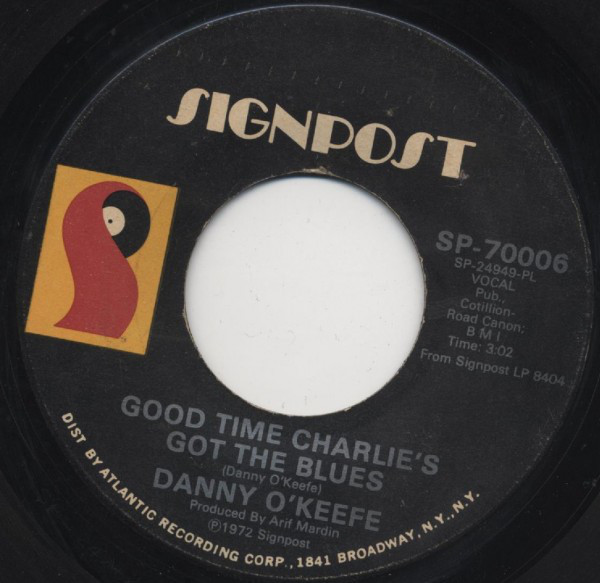
It was also recorded by Elvis using the same musicians as O’Keefe did on this recording. He also wrote the song “The Road” on Jackson Browne’s Running on Empty Album. It peaked at #9 in the Billboard 100 and #19 in Canada in 1972. It was recorded at American Studios in Memphis with Arif Marden producing. Danny O’Keefe was a one-hit wonder with Good Time Charlie’s Got the Blues his only Billboard hit.
The song has been featured in numerous films and television shows, including The Sopranos and Forrest Gump. It has also been recognized by the Rock and Roll Hall of Fame, which included it in its list of “500 Songs That Shaped Rock and Roll.”
Danny O’Keefe:“The success of one’s dreams is always exhilarating. Elvis cut the song with the same group of musicians I had, so there was a pride in continuity, but I didn’t think he brought anything new to it. Over the years I’ve come to appreciate it more as part of the song’s great legacy.”
Danny O’Keefe: “Maybe it was about hipsters drawn to the high life. I lived in interesting times and there was a lot of experimentation with every kind of drug. There were a lot of damages and strange intersections of lives that provided much grist for a young songwriter’s mill.”
Good Time Charlie’s Got the Blues
Everybody’s goin’ away Said they’re movin’ to LA There’s not a soul I know around Everybody’s leavin’ town Some caught a freight, some caught a plane Find the sunshine, leave the rain They said this town’s a waste of time I guess they’re right, it’s wastin’ mine Some gotta win, some gotta lose Good time Charlie’s got the blues Good time Charlie’s got the blues Ya know my heart keeps tellin’ me “You’re not a kid at thirty-three” “Ya play around, ya lose your wife” “Ya play too long, you lose your life” I got my pills to ease the pain Can’t find a thing to ease the rain I’d love to try and settle down But everybody’s leavin’ town Some gotta win, some gotta lose Good time Charlie’s got the blues Good time Charlie’s got the blues Good time Charlie’s got the blues (whistling to end)
I listened to the radio in 1987 a little more than in the previous 3 years or so. The albums that really got my attention were George Harrison’s Cloud Nine and the Replacements album that’s one of my favorites of the 1980s…Please To Meet Me… it was recorded in the Memphis studio where Big Star recorded. It was also the year of the Grateful Dead…a huge top-ten album and single.
Grateful Dead – Touch Of Grey
I knew of the Grateful Dead from an older brother of a friend I had. I had heard of them as a kid in the seventies before I actually heard them. I knew some of their songs and the Garcia song Sugaree. I always pictured this heavy tough metal band with a name like that. Whenever they toured they would draw a massive amount of fans despite having no top ten hits…until this song. After this song, they drew a larger amount of attention and fans.
When this came out in the 80s, it was like Deadmania. With MTV suddenly everyone was talking about them. While big success is great it did cause some trouble at some of their concerts. Chilled-out Deadheads followed them around the country for decades. Some financed their travels by hawking food, T-shirts, and handicrafts…not to mention pot and LSD usually peacefully. Through the years more would add to the fold…some described it as a giant community more than a regular concert. In 1987 they suddenly had an influx of new young fans (Touchheads) and some didn’t know what the band was about. Along with them came some gate crashers and riots.
With the backing of the band, older Deadheads handed out flyers on how to act, trying to mellow out the newer crowd.
Robert Hunter started writing the lyrics to this song in 1980, and the Grateful Dead first performed it in 1982. They played it sporadically over the next few years and finally recorded it for their 1987 album In The Dark.
George Harrison – We We Was Fab
I loved this song when I heard it. To hear George sing about his time with The Beatles surprised me. Of all the Beatles George seemed to have the most resentment and some of it was understandable. A few years after this he would join the remaining Beatles and start on The Beatles Anthology. George wanted Paul to be in this video but Paul was tied up at the time. He asked George to put a left-handed bass player in the video with a walrus mask and tell everyone it was him.
George co-wrote the song with Jeff Lynne, who also co-produced the album that shortly pre-dates the two of them forming The Traveling Wilburys. ‘When We Was Fab’ is a musical nod to the psychedelic sound that the Beatles had made their own. George used a sitar, string quartet, and backward tape effects.
He also got some help from Ringo. Starr played drums on this track and a few others on the album. Harrison says that when he started writing the song, he had Ringo’s drumming in mind for the intro and the overall tempo
Replacements – Alex Chilton
The Replacement’s tribute song about Big Star and Box Tops lead singer, Alex Chilton. The song was off the album Please To Meet Me. One of my favorite bands of all time singing about a singer in one of my favorite bands. This would be my number 1 song of 1987.
The Replacements recorded Pleased To Meet Me in Memphis at Ardent Studios, the same studio as Big Star. The man behind the board was Jim Dickinson, who produced the storied third Big Star album. Alex came into the studio a few times while the Replacements were working on the record (and laid down a guitar fill for “Can’t Hardly Wait”), but the band avoided the awkwardness of playing “Alex Chilton” whenever Chilton was around.
R.E.M. – It’s The End of the World as We Know It (And I Feel Fine)
This song came off of the great Document album. With some REM songs, it takes a few listens for me but this one… the first time was enough to know I really liked it. It was recorded in the Sound Emporium in Nashville, Tennessee. The song peaked at #69 in 1988. The song was inspired by Subterranean Homesick Blues by Bob Dylan and you can tell.
Michael Stipe said: “The words come from everywhere. I’m extremely aware of everything around me, whether I am in a sleeping state, awake, dream-state or just in day to day life. There’s a part in ‘It’s The End Of The World As We Know It’ that came from a dream where I was at Lester Bangs’ birthday party and I was the only person there whose initials weren’t L.B. So there was Lenny Bruce, Leonid Brezhnev, Leonard Bernstein… So that ended up in the song along with a lot of stuff I’d seen when I was flipping TV channels. It’s a collection of streams of consciousness.”
Los Lobos – La Bamba
This band had been around a long time before this song came out. They formed in 1973 and released their first album in 1978. They opened for bands such as The Clash and The Blasters so they got exposed to a lot of different audiences.
They recorded some Ritchie Valens covers for the movie La Bamba and their cover of the title track made them known internationally. The song was number 1 almost everywhere including the US, Canada, the UK, and New Zealand.
It’s good to be back…I was under the weather yesterday and not a bunch better today but better all the same.
This is a song that automatically takes me back to being a kid. When it was included on the Guardians of the Galaxy 2 soundtrack…it was exposed to many kids and teens which now lives on for another generation. I rarely cover AM Gold songs because early on I covered so many of them…and this one is worth it.
No one other than Clive Davis signed this band to a contract. He knew they had hit on their hands! Well…yes he did but he didn’t think this song was it though. This song was originally the B-side to a song called “Don’t It Make You Feel Good.”It’s a good song but not Brandy. Harv Moore, a disc jockey in Washington DC, flipped the record and played “Brandy” instead. It became popular in the DC area, and quickly spread nationwide.
This song was released in 1972 and it was a big hit. It still is being played today on classic radio and in any supermarket near you. It peaked at #1 in the Billboard 100, #1 in Canada, and #51 in the UK.
It was written by the lead singer Elliot Lurie. Looking Glass didn’t hang around too much longer… after a minor hit the next year with “Jimmy Loves Mary-Anne,” Lurie left the band to pursue a solo career.
There is another reason why Looking Glass didn’t do more. They were originally a hard rock band from New Jersey until the success of “Brandy,” which pushed them (reluctantly) into a softer direction. Apparently, the band was never entirely pleased with the song’s success or their new direction, and they never really altered their heavier stage act to accommodate what their new listeners were used to hearing from them on the radio.
I’m sure that Lurie doesn’t mind the softness now when the song is included in movies and soundtracks.
Elliot Lurie: Brandy is a made-up individual,” he said. “The name was derived from a high school girlfriend I had whose name was Randy with an ‘R.’ Usually when I write — I still do it the same way I did back then — I strum some guitar and kind of sing along with the first things that come to mind. Her name came up. Then I started writing the rest of the song, and it was about a barmaid. I I thought Randy was an unusual name for a girl, it could go either way, and (the song was about) a barmaid, so I changed it to Brandy.”
Brandy (You’re A Fine Girl)
There’s a port on a western bay
And it serves a hundred ships a day
Lonely sailors pass the time away
And talk about their homes
And there’s a girl in this harbor town
And she works layin’ whiskey down
They say, Brandy, fetch another round
She serves them whiskey and wine
The sailors say, “Brandy, you’re a fine girl” (you’re a fine girl)
“What a good wife you would be” (such a fine girl)
“Yeah, your eyes could steal a sailor from the sea”
Brandy wears a braided chain
Made of finest silver from the North of Spain
A locket that bears the name
Of the man that Brandy loved
He came on a summer’s day
Bringin’ gifts from far away
But he made it clear he couldn’t stay
No harbor was his home
The sailor said, “Brandy, you’re a fine girl” (you’re a fine girl)
“What a good wife you would be” (such a fine girl)
“But my life, my love and my lady is the sea”
Yeah, Brandy used to watch his eyes
When he told his sailor story
She could feel the ocean fall and rise
She saw its ragin’ glory
But he had always told the truth, Lord, he was an honest man
And Brandy does her best to understand
At night when the bars close down
Brandy walks through a silent town
And loves a man who’s not around
She still can hear him say
She hears him say, “Brandy, you’re a fine girl” (you’re a fine girl)
“What a good wife you would be” (such a fine girl)
“But my life, my lover, my lady is the sea”
It is, it is
Yes, it is, yes it is
He said, “Brandy, you’re a fine girl” (you’re a fine girl)
“What a good wife you would be” (such a fine girl)
“But my life, my lover, my lady is the sea”
I like this song just as much as Layla. It was written by Eric Clapton and Bobby Whitlock. This song and “I Looked Away” are two of my favorites on the album. Bell Bottom Blues peaked at only #91 on the Billboard 100 in 1971. Recently, Eric did a great thing for someone with this album.
Derek and The Dominos formed after working on George Harrison’s album All Things Must Pass. After that, they played a lot of different small clubs all over Europe. They made the album, Layla and Other Assorted Love Songs in Criteria Studios in Miami, Florida. It’s there where Clapton met Duane Allman and a little later invited him to join them. Duane ended up turning Eric down because he believed in the Allman Brothers and he built them from the ground up. Eric was one of his guitar guys so it had to be a hard choice for him.
Clapton first heard about Allman when listening to Wilson Pickett’s version of Hey Jude for the first time and heard his guitar playing at the end of the song. He called up either Ahmet Ertegun or Tom Dowd and asked who was that guitar player? Eric has said that he has never heard better rock guitar playing on an R&B record.
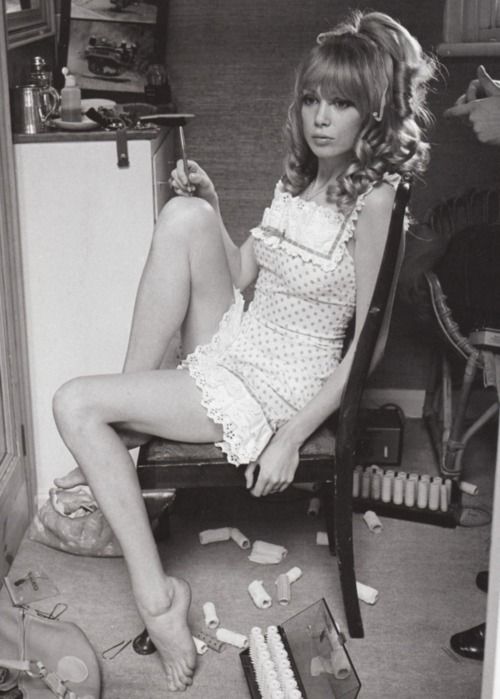
In 1970, Eric Clapton was experiencing emotional anguish over George Harrison’s wife Pattie Boyd. He recounts writing the song for Boyd after she asked him to get her a pair of bell-bottom jeans while he visited the US.
Clapton repackaged this album and the first thing he did was to ask his attorneys…what is Bobby Whitlock going to get out of this? Bobby played keyboards and wrote a lot of the songs with Eric. The attorneys told Eric he would get nothing because he sold all of his rights. He was down at one time and had to sell everything. Eric and his attorneys went to the publishing company and bought back all of Bobby’s rights and handed it over to him without Whitlock even knowing.
Bobby Whitlock:Well, unbeknownst to me, Eric and Michael took their attorneys in to the respective Warner/Chappel and Universal and all the other companies and bought back my rights to my income and restored them and gave them back to me. Out of the blue.
So all of my royalties have come back. And now it’s even more so, because it hasn’t been a month-and-a-half ago that I wrote him to explain how ‘Bell Bottom Blues’ came about, and I sent it to Eric and to Michael. Someone had come online and says something about, ‘Is this true that ‘Bell Bottom Blues’ was written about a pair of trousers?’
And I said, Yeah, well, it was that and this girl in France that Eric was seeing for a little while while we were there. I’d forgotten about Pattie [Boyd – subject of ‘Layla’] asking him about those pants. But anyway, before I would answer this and put it out publicly online, I decided, Well, I probably ought to write Eric.
Bobby Whitlock: “Eric met this girl, she was like a Persian princess or something, and she wore bell bottoms. She was all hung up on him – he gave her a slide that Duane (Allman) had given him and he wrapped it in leather and she wore it around her neck. She didn’t speak a word of English and they had to date through an interpreter. That relationship did not last but a week. He started the song over there, then when we got back to England, we finished it up in his TV room in Hurtwood Edge.”
Bell Bottom Blues Indeed!
Bell Bottom Blues
Bell bottom blues, you made me cry
I don’t want to lose this feeling
And if I could choose a place to die
It would be in your arms
Do you want to see me crawl across the floor to you?
Do you want to hear me beg you to take me back?
I’d gladly do it because
I don’t want to fade away
Give me one more day, please
I don’t want to fade away
In your heart I want to stay
It’s all wrong, but it’s all right
The way that you treat me baby
Once I was strong but I lost the fight
You won’t find a better loser
Do you want to see me crawl across the floor to you?
Do you want to hear me beg you to take me back?
I’d gladly do it because
I don’t want to fade away
Give me one more day, please
I don’t want to fade away
In your heart I want to stay
Do you want to see me crawl across the floor to you?
Do you want to hear me beg you to take me back?
I’d gladly do it ’cause
I don’t want to fade away
Give me one more day, please
I don’t want to fade away
In your heart I want to stay
Bell bottom blues, don’t say goodbye
I’m sure we’re gonna meet again
And if we do, don’t you be surprised
If you find me with another lover
Do you want to see me crawl across the floor to you?
Do you want to hear me beg you to take me back?
I’d gladly do it ’cause
I don’t want to fade away
Give me one more day, please
I don’t want to fade away
In your heart I want to stay
I don’t want to fade away
Give me one more day please
I don’t want to fade away
In your heart I want to stay
I don’t want to fade away
Give me one more day please
I don’t want to fade away
In your heart I want to stay
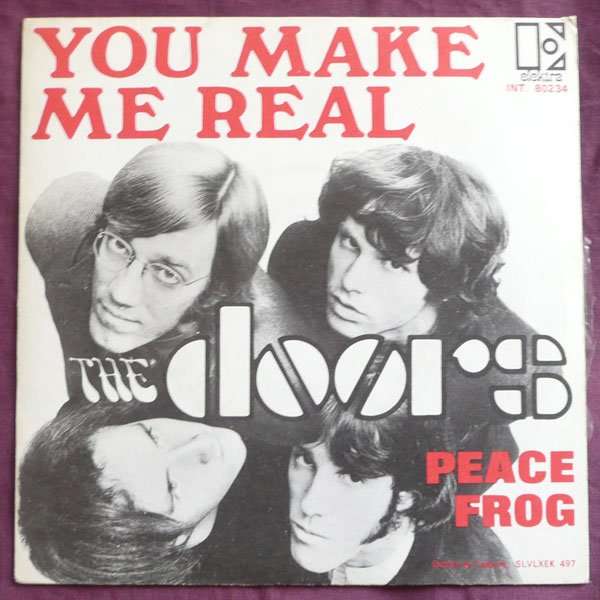
I hope everyone is having a great Sunday. I grabbed the album Morrison Hotel yesterday and was caught off guard by this song. I don’t remember it from when I originally played the album. The music is cool as hell with the guitar in a groove with the drums. I thought this could have been an instrumental and have been good…but the lyrics make it great.
Come to find out…the song started out as an instrumental as Robbie Krieger said: “I had written the music, we rehearsed it up, and it was really happening, but we didn’t have any lyrics and Jim wasn’t around. We just said, ‘Fuck it, let’s record it. He’ll come up with something.’ And he did. He took out his poetry book and found a poem that fit.”
I always liked album cuts…sometimes a little more than hits. This a great song on a Sunday to kick back to. I never thought of the Doors as the ultimate groove band but this one fits. Morrison Hotel peaked at #4 on the Billboard Album Charts, #3 in Canada, and #12 in the UK in 1970.
The lyrics about the Indians supposedly refer to a car accident that happened when he was a child. The accident involved some Indians and Morrisons thought the Indians joined his soul. The Blood in the streets in the town of New Haven lyric refers to when the singer was arrested in New Haven in 1967. Morrison was backstage with a girl. He explains it in the quote below.
Jim Morrison: “We started talking and we wanted some privacy and so went into this little show room. We weren’t doing anything. You know, just standing there talking, and then this little man in a little blue suit and a little blue cap came in there. He said ‘Whatcha doin’ there?’ ‘Nothin’.’ But he didn’t go away, he stood there and then he reached round behind him and brought out this little black can of something. It looked like shaving cream. And then he sprayed it in my eyes. I was blinded for about 30 minutes.”
Peace Frog
There’s blood in the streets
It’s up to my ankles
There’s blood in the streets
It’s up to my knees
Blood in the street
The town of Chicago
Blood on the rise
It’s followin’ me
Just about the break of day
She came in
And she drove away
Sunlight in her hair
Blood on the streets
Runs a river of sadness
Blood in the streets
It’s up to my thighs
The river runs down
The leg of the city
The women are crying
Red rivers of weeping
She came in town
And then she drove away
Sunlight in her hair
Indians scattered on dawn’s highway bleeding
Ghosts crowd the young child’s fragile
Egg-shell mind
Blood in the streets
In the town of New Haven
Blood stains the roofs
And the palm tress of Venice
Blood in my love
In the terrible summer
Bloody red sun of
Fantastic L.A.
Blood screams her brain
As they chop off her fingers
Blood will be born
In the birth of a nation
Blood is the rose of
Mysterious union
There’s blood in the streets
It’s up to my ankles
Blood in the streets
It’s up to my knees
Blood in the street
The town of Chicago
Blood on the rise
It’s followin’ me
What a beautiful song this is. I’ve really been diving into Texas songwriters. CB sent me this one and it’s fantastic. It’s a great one that I’ve been listening to for a few weeks.
The acoustic rhythm guitar in this is catchy and intricate at the same time. We have heard the phrase of a musician’s musician…well this is the same to other songwriters. I like good songwriting and this is a great example of it. The words flow out perfectly.
The song was written by Joe Ely and Will Sexton. The song was released in 1996 and was on the album Letter To Laredo. This is songwriting at its finest. Springsteen contributed to two songs on the album including this one. Bruce traveled to Austin around the spring of 1995 and joined Ely in the studio to record his parts.
Ely has 16 studio albums and 20 singles in his career so far. This album charted at #68 on the Billboard Country Charts. He has charted quite a few in the Charts.
Joe Ely: “I like to tell in a song where the location is, paint the background, and then bring it into a rhythmic world and try to find something that doesn’t take away from it, but adds to it.”
Joe Ely and Bruce Springsteen in 2001.
All Just To Get To You
I have stumbled on the plains Staggered in the wind Stood at a crossroad or two Cried to a river Swept to the sea All just to get to you
I have flagged a yellow cab Hopped a rusty freight Sang till my lips turned blue Flown a silver bird On the tops of the clouds All just to get to you
I ran too hard I played too Rough I gave my Love Not near Enough I bled too red I cried too blue I beat my fist Against the moon All just to get to you
I have run from St. Paul To Wichita Falls Call’d you from sunny Baton Rouge Hocked everything From my watch to my ring All just to get to you
I ran too hard I played too Rough I gave you Love Not near Enough I bled too red I cried too blue I beat my fist Against the moon All just to get to you
From the California Shore Where the mighty ocean roars To the lands of the Hopi and the Sioux I walked the desert sands Crossed the Rio Grande All just to get to you
I have stumbled on the plains Staggered in the wind Stood at a crossroad or two Cried to a river Swept to the sea All just to get to you
I went home and listened to Jimmie Rodgers in my lunch-break Bought five Woodbines at the shop on the corner And went straight back to work.
On my Max Picks I always notice when it’s too late that I missed a song that I wanted to include. I was telling halffastcyclingclub that I forgot this one in 1982. I didn’t find the song until around 1985 or 86 when I bought Tower Records out of any album with Van Morrison.
This song was on the Beautiful Vision album. Some Van songs grew on me but this one I liked the first time I heard it. This one has an autobiographic feel to it for a good reason. Van did have a job cleaning windows for a while in east Belfast. He captures a specific moment in his life and invites us to join him in reflecting on our own memories.
This was the early sixties when he was still a part-time musician. Not only does he touch on his job but tells us his early influences like Brownie McGhee and Jimmie Rodgers.
Leslie Holmes played with a band with Van called The Monarchs. Holmes helped Van finish the windows so they would make the gig that particular night. As I’ve said before…if you get a chance to see this man live…don’t miss it. He is the only performer where I can say his voice sounds better live than on record.
The album peaked at #44 on the Billboard 100, #22 in Canada, #31 in the UK, and #13 in New Zealand in 1982.
Leslie Holmes: “I played with The Monarchs for two years when the showband scene was at its peak, I enjoyed my time with Van who was a very talented musician and a lot of fun. In addition to the band, Van had a window-cleaning business in east Belfast, and one day I helped him to clean windows so that we could make our gig that night. So I have a special sense of identity with his song about cleaning windows.
“We travelled much of the country and the memorable places included the Orpheus Ballroom, the old Co-Op in York Street, the Flamingo in Ballymena, Moira Town Hall, the Floral Hall, and many others. After I left The Monarchs I did some fill-ins with the Witness Showband.”
Cleaning Windows
Oh, the smell of the bakery from across the street
Got in my nose
As we carried our ladders down the street
With the wrought-iron gate rows
I went home and listened to Jimmie Rodgers in my lunch-break
Bought five Woodbines at the shop on the corner
And went straight back to work.
Oh, Sam was up on top
And I was on the bottom with the v
We went for lemonade and Paris buns
At the shop and broke for tea
I collected from the lady
And I cleaned the fanlight inside-out
I was blowing saxophone on the weekend
In that down joint.
What’s my line?
I’m happy cleaning windows
Take my time
I’ll see you when my love grows
Baby don’t let it slide
I’m a working man in my prime
Cleaning windows (number a hundred and thirty-six)
I heard Leadbelly and Blind Lemon
On the street where I was born
Sonny Terry, Brownie McGhee,
Muddy Waters singin’ “I’m A Rolling Stone”
I went home and read my Christmas Humphreys’ book on Zen
Curiosity killed the cat
Kerouac’s “Dharma Bums” and “On The Road”
What’s my line?
I’m happy cleaning windows
Take my time
I’ll see you when my love grows
Baby don’t let it slide
I’m a working man in my prime
Cleaning windows…
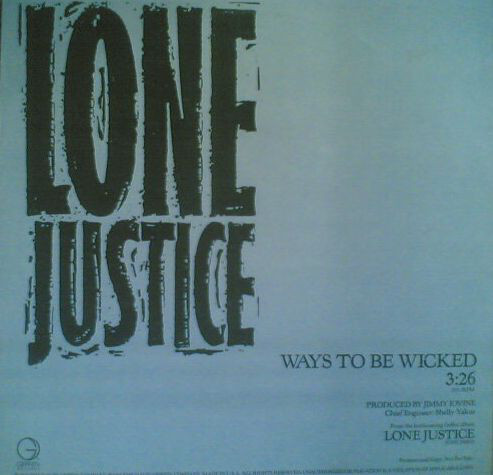
First time I heard this song I loved it. It was by a group called Lone Justice with lead singer Maria McKee. The song was Ways to Be Wicked, written by Tom Petty and Mike Campbell. When I am asked my favorite female singer of the 1980s…Maria Mckee is my answer by a wide margin.
In 1985 the song peaked at #29 in the Mainstream Rock Charts and #77 in the UK. This surprised me because I heard the song quite a bit and thought it charted higher. They had two more songs that come to mind. “I Found Love” and “Shelter“. They should have made it further than they did. Maria did have a number 1 in the UK with “Show Me Heaven” in 1990.
Lone Justice was formed in 1982 and played rockabilly and country music as part of the cowpunk scene. After signing with Geffen, the band recorded their debut album, and hit the road, opening for U2. The hype was in overdrive and the pressure was on.
The critics loved the album but it didn’t sell well. I first noticed them when they were on SNL and played this song. I personally thought this would hit the top ten…I was wrong yet again. The album could not meet the expectations of all of the hype and failed to connect with a rock audience.
In 2022 Lisa let me ramble and go on about my undying love for Maria McKee at her site.
Ways To Be Wicked
Honey, why you always smile
When you see me hurt so bad?
Tell me what I did to you, babe
That would make you act like that?
Well, I’ve been your fool before, honey
Yeah, and I probably will again
‘Cuz you ain’t afraid to let me have it
No, you ain’t afraid to stick it in
Well, you know so many
Ways to be wicked
Ooh, but you don’t know one little thing
About love
Well, I can take a little pain
Yeah, I can hold it pretty well
I can watch your little eyes light up
While you’re walkin’ me through Hell
Well, I’ve been your fool before, honey
Yeah, and I probably will again
‘Cuz you ain’t afraid to let me have it
No, you ain’t afraid to stick it in
Well, you know so many
Ways to be wicked
But you don’t know one little thing
About love
Those cobra eyes
Lie with a smile
Baby you take pride
In the devil down inside, yeah
Well, I can take a little pain
Yeah, I can hold it pretty well
I can watch your little eyes light up
While you’re walkin’ me through Hell
Well, I’ve been your fool before
Yeah, and I probably will again
You ain’t afraid to let me have it
No, you ain’t afraid to stick it in
Well, you know so many
Ways to be wicked
Ooh, but you don’t know one little thing
About love
Well, you know so many
Ways to be wicked
Yeah, but you don’t know one little, one little thing
About love
Yeah you know so many
Ways to be wicked
But you don’t know one little, one little
Heard this in the nineties when I still listened to the radio between changing tapes. I remember the video being used to find missing children. The music video for “Runaway Train” featured photographs and names of missing children in the style of a public service announcement. That was a great idea.
At the end of the original video, lead singer Dave Pirner appeared and said, “If you’ve seen one of these kids, or you are one of them, please call this number” before a missing children telephone helpline number appeared. The video was edited for use outside the US to include photos and names of missing children from wherever the video was to be shown. It drew awareness to the problem and was instrumental in reuniting several children with their families. The director said out of the 36 kids featured in the U.S. versions, they eventually found 21. I have a video at the bottom about a girl that was found through the video.
There is a special player in this song. This was a Hammond B3 organ was played by Booker T. Jones, who was a member of the group Booker T. & the M.G.’s. Jones played on many Soul classics of the ’60s and ’70s, mostly the Stax Records recordings, as his group served as their house band.
Lead singer Dave Pirner wrote this song and he said it was about depression. It took him a few years to write. Soul Asylum were label mates of The Replacements and were on Twin Tone Records at one time. They formed in 1981 in Minneapolis.
Runaway Train peaked at #5 on the Billboard 100, #1 in Canada, #7 in the UK, and #2 in New Zealand in 1993.
Here is a story of one that was found because of the video.
Runaway Train
Call you up in the middle of the night
Like a firefly without a light
You were there like a slow torch burning
I was a key that could use a little turning
So tired that I couldn’t even sleep
So many secrets I couldn’t keep
Promised myself I wouldn’t weep
One more promise I couldn’t keep
It seems no one can help me now
I’m in too deep
There’s no way out
This time I have really led myself astray
Runaway train never going back
Wrong way on a one way track
Seems like I should be getting somewhere
Somehow I’m neither here nor there
Can you help me remember how to smile
Make it somehow all seem worthwhile
How on earth did I get so jaded
Life’s mystery seems so faded
I can go where no one else can go
I know what no one else knows
Here I am just drownin’ in the rain
With a ticket for a runaway train
Everything is cut and dry
Day and night, earth and sky
Somehow I just don’t believe it
Runaway train never going back
Wrong way on a one way track
Seems like I should be getting somewhere
Somehow I’m neither here nor there
Bought a ticket for a runaway train
Like a madman laughin’ at the rain
Little out of touch, little insane
Just easier than dealing with the pain
Runaway train never comin’ back
Wrong way on a one way track
Seems like I should be getting somewhere
Somehow I’m neither here nor there
Runaway train never comin’ back
Runaway train tearin’ up the track
Runaway train burnin’ in my veins
Runaway but it always seems the same
It was love at first listen to this song. They had another hit that was larger in Don’t Dream It’s Over but this song is a perfect pop song. The lyric “bring life to frozen ground” still stands out to me and I cannot hear this song enough. As far as pop songs go it’s hard to beat this New Zealand band.
The song dates back to 1984 when Neil Finn did a demo of the song. He was still in Split Enz at that time. They split in 1985 so Finn and drummer Paul Hester formed Crowded House.
The song was written by Neil Finn and Mitchell Froom.
R.E.M. – Fall On Me
A musician friend of mine invited me over to listen to this album. We must have played it 5 times through by nighttime.
Bill Berry (drummer) said the song was specifically about Acid Rain, which occurs when the burning of fossil fuels releases sulfur dioxide and nitrogen oxides into the atmosphere, causing rain to be acidic and threatening the environment.
Michael Stipe said about the song: “I was reading an article in Boston when I was on tour with the Golden Palominos, and Chris Stamey showed me this article about this guy that did an experiment from the Leaning Tower of Pisa, whereby he dropped a pound of feathers and a pound of iron to prove that there was… a difference in the… density? What did he prove? I don’t even know. They fall just as fast.”
Steve Earle – Someday
Ever since I heard him in the mid to late 80s I liked Steve Earle. He opened up for Bob Dylan in 1988 and he was fantastic. His music was between country, folk, and rock. You can’t really put Earle in a box…and you shouldn’t. I’ve read reviewers compare him to Randy Newman, Bruce Springsteen, and Waylon Jennings in the same review. That is a great span of artists.
The song is about escaping the town you are living in. I knew a lot of people who wanted to escape the small town I grew up in. The song reminds me a little of The River by Bruce Springsteen in content. It’s a song that many people will be able to relate to.
The song was from his debut album Guitar Town. I remember he was being played on country radio and WKDF…Nashville’s number-one rock station back in the 80s. The album is ranked 489 on Rolling Stone Magazine’s top 500 albums. They called it a rocker’s version of country.
Georgia Satellites – Keep Your Hands To Yourself
A friend of mine who played guitar in high school got a bootleg of this song a year before it was officially released. His band was playing in the gym before we went on and they played this song. I thought they wrote it until I asked him. It’s a great-sounding song live.
It was an instant bar band song classic. It was a song you didn’t really have to rehearse…just one listen would do it. We learned it in one take… and again it was one of only a handful of times that we played a song in the top ten at the time. This is the kind of music I missed in the mainstream during the mid to late eighties.
This was the only big hit for the Georgia Satellites, although lead singer Dan Baird had a hit as a solo artist in 1992 with “I Love You Period.” They didn’t have another big hit but they did have some songs that got airplay on radio and MTV like Battleship Chains and a cover of Hippy Shake. This was one of the few straight-out rock and roll songs to hit the charts at this time.
Dwight Yoakam – Guitars, Cadillacs
Buck Owens made the Bakersville sound popular and it’s one of my favorite types of country. Yoakam and Steve Earle came out at around the same time and they were not like everyone else (George Jones has a funny quote about that at the bottom). They were a breath of fresh air in country music and they crossed over genres as well. They essentially brought the country back to being country and not southern rock pop with a twang.
It was released in 1986 and was the second single off of his debut album Guitars, Cadillacs, Etc., Etc. This song was written by Dwight Yoakam. Pete Anderson (producer) was a huge help in the making of the album. He provided some ideas music-wise, played the guitar, and even sang background vocals.
George Jones:‘We spent all these years trying not to be called hillbillies, and Dwight Yoakam and Steve Earle fucked it up in one day.’”
This song is not one of Ringo’s best songs but it probably is my secret favorite of his because of what it’s about. The song is about the status of the Beatles in early 1970.
I usually don’t describe what a song is about because I like the back stories to songs much more…and everyone interprets songs a different way…but this one is known to be about the other Beatles. This was the B side to It Don’t Come Easy…it’s a very basic simple song…no great work of art but it has a charm about it because it’s Ringo.
The first verse is about Paul… he talks about his farm, and his new wife Linda, and Paul was very quiet around this time and he stopped coming to Apple. He also told Ringo to get out of his house when Ringo delivered a message from the 3 Beatles for McCartney to delay releasing his debut album because of Let It Be releasing at the same time. They finally gave in to Paul. Ringo was wondering if Paul would play music with him when he came by again. And when he comes to town, I wonder if he’ll play with me.
The second verse is about John. Ringo sings about John and Yoko doing the bed in and what I thought was “Cocaine” as a kid was really a lesser drug…”Cookies.” He also references Yoko with “With his mama by his side, she’s Japanese.” At the end of the verse…unlike Paul he knows John will play music with him. And when he comes to town, I know he’s gonna play with me.
The third verse is about George. Ringo and George were extremely close in the Beatles and afterward. Things did pop up between them through the years but they remained friends. He describes George in the first line, Pattie Boyd Harrison in the second, and George’s famous mansion Friar Park in the 3rd. Ringo and George wrote together and George hung out with Ringo more than the other Beatles. He’s a long-haired, cross-legged guitar picker, um-um. With his long-legged lady in the garden picking daisies for his soup. A forty acre house he doesn’t see, ‘Cause he’s always in town playing for you with me.
The last verse was pretty much true…Ringo knew a little piano and guitar but that is about it other than drums. It’s the last verse that had to make Beatle fans happy at the time. “And when I go to town I wanna see all three.”
Early 1970
Lives on a farm, got plenty of charm, beep, beep.
He’s got no cows but he’s sure got a whole lotta sheep.
And brand new wife and a family,
And when he comes to town,
I wonder if he’ll play with me.
Laying in bed, watching tv, cookies!
With his mama by his side, she’s japanese.
They scream and they cried, now they’re free,
And when he comes to town,
I know he’s gonna play with me.
He’s a long-haired, cross-legged guitar picker, um-um.
With his long-legged lady in the garden picking daisies for his soup.
A forty acre house he doesn’t see,
‘Cause he’s always in town
Playing for you with me.
I play guitar, a – d – e.
I don’t play bass ’cause that’s too hard for me.
I play the piano if it’s in c.
And when I go to town I wanna see all three,
And when I go to town I wanna see all three,
And when I go to town I wanna see all three.
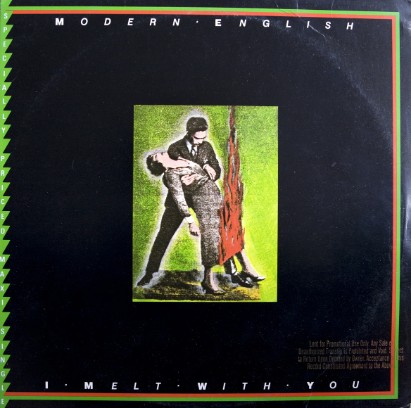
This was a 1983 New Wave song from the band Modern English. I wasn’t a big New Wave fan but I liked this song. I did like some of the songs I heard but music at the time began to miss something. It seemed to be either New Wave, Pop, or Heavy Metal…rock and roll wasn’t heard hardly at all on mainstream radio.
This song is dark but people and advertisers don’t care. The lead singer Robbie Grey said it was about a couple making love as an atom bomb drops and they melt together. At that time in the 80s the Cold War was going on and we would talk about it as teens. The single was released around the same time as other Cold War songs like Nena’s “99 Luftballons,” Frankie Goes to Hollywood’s “Two Tribes,” Time Zone’s “World Destruction,” Men at Work’s “It’s a Mistake,” Prince’s “1999,” and Culture Club’s “The War Song.” As long we are naming songs… let’s name some movies that touched on the subject. War Games, Red Dawn, and the frightening TV movie The Day After. The Day After was the most-viewed TV movie of all time with over 100 million viewers in 1983. It was truly frightening.
It peaked at #78 on the Billboard 100 which surprises me that it didn’t get higher. It recharted again in 1990 at #76. Again, I’m surprised at how low some of the songs of my youth charted. The song was first popularized when it was featured in the 1983 Nicolas Cage teen rom-com Valley Girl.
They were essentially a one-hit wonder in the US but not back in the UK where they had a few top twenty hits. They did have one other song in the Billboard 100 with Hands Across The Sea which peaked at #57 but it’s not remembered like this one.
During Covid, Modern English re-recorded a “From Quarantine” rendition by guitarist Gary McDowell, bassist Michael Conroy, keyboardist Stephen Walker, and drummer Roy Martin—from their respective homes during lockdown. Only drummer Roy Martin is not from the original band. The original drummer was Richard Brown and he couldn’t make it.
They have been reunited since 2010 and did a tour in 2022. Blogger Jim Everett Table Toss suggested checking out Nouvelle Vague’s cover of this song. I really like it…it’s really smooth and sleek.
Robbie Grey: “The amount of times we get told people got married to our song, made love to that song for the first time… whatever, it’s lovely. But literally, the lyrics are about a couple making love as the atom bomb drops and sort of melting together, but that’s quite good. I like the fact that it’s got layers to it — that people can get what they want from it. … I like the fact that it’s like a love song, but with a dark lyric.”
Robbie Grey: “I was definitely stoned when I wrote it, It was during the day, I remember it really well. I sat down on the floor of my flat in London, a cheap place in the housing association, and wrote the verse just straight off in about 10 minutes.”
Robbie Grey:“I’d always been shouting on songs before, I’d never really sung on a song. And there’s not really any singing on this either, it’s more spoken, but Hugh Jones the producer said, ‘Don’t shout into the microphone, just talk into it.’ I’d never done that before – I was a punk rocker. And so, I did. I just kind of stood back and mouthed the words. And I think that’s a lot of the attraction of the verses on ‘I Melt With You’ is that almost spoken quality.”
Nouvelle Vague – Melt With You
Melt With You
Moving forward using all my breath
Making love to you was never second best
I saw the world crashing all around your face
Never really knowing it was always mesh and lace
I’ll stop the world and melt with you
You’ve seen the difference and it’s getting better all the time
There’s nothing you and I won’t do
I’ll stop the world and melt with you
Dream of better lives the kind which never hates
(You should see why)
Trapped in the state of imaginary grace
(You should know better)
I made a pilgrimage to save this humans race
(You should see why)
Never comprehending the race has long gone bye
I’ll stop the world and melt with you
(Let’s stop the world) You’ve seen the difference and it’s getting better all
the time
(Let’s stop the world) There’s nothing you and I won’t do
(Let’s stop the world) I’ll stop the world and melt with you
The future’s open wide
**The future’s open wide
I’ll stop the world and melt with you
(Let’s stop the world) I’ve seen some changes but it’s getting better all the
time
(Let’s stop the world) There’s nothing you and I won’t do
(Let’s stop the world) I’ll stop the world and melt with you
I’ll stop the world and melt with you (Let’s stop the world)
You’ve seen the difference and it’s getting better all the time (Let’s stop the
world)
There’s nothing you and I won’t do (Let’s stop the world)
I’ll stop the world and melt with you (Let’s stop the world)
I’ll stop the world and melt with you (Let’s stop the world)
I’ll stop the world and melt with you (Let’s stop the world)
I’ll stop the world and melt with you (Let’s stop the world)
I’ll stop the world and melt with you (Let’s stop the world)
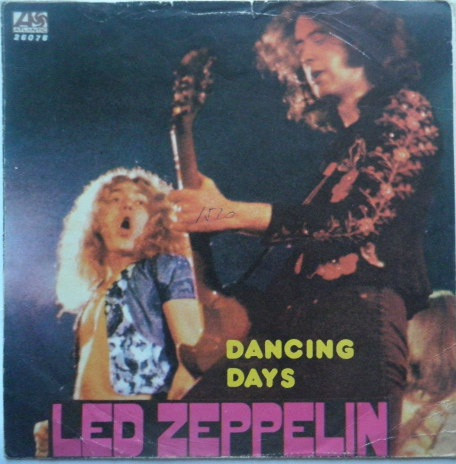
I like the strange riff that opens this one up. It sounds tonally off in some ways and that makes it appealing. While in Bombay, Page and Plant heard an Indian song that inspired this. The creative process for “Dancing Days” began with Jimmy Page’s guitar riff. Robert Plant then added the lyrics, which they were inspired by a girl he met in Bombay.
The term “dancing days” is thought to refes to high school. On a bootleg recording of the song from a concert on Jan. 14th, 1973 Robert Plant sings “Let’s go back to high school” in the song.
The song was on the Houses of the Holy album released in 1973. The funny thing is that the song Houses of the Holy would be on the Physical Graffiti album, not its namesake. This song was the B side to Over The Hills And Far Away rare single released in 1973. The single peaked at #51 on the Billboard 100 and #63 in Canada.
The band was determined not to repeat themselves after the success of Led Zeppelin IV. This album is diverse with songs Over The Hills and Far Away, The Ocean, The Rain Song, and the funk of The Crunge. This album was a perfect gateway into their next album Physical Graffiti.
The album peaked at #1 in the Billboard Charts, #1 in the UK, and #1 in Canada.
Dancing Days
Dancing days are here again
As the summer evenings grow
I got my flower, I got my power
I got a woman who knows
I said it’s alright, You know it’s alright
I guess it’s all in my heart
You’ll be my only, my one and only
Is that the way it should start?
Crazy ways are evident
In the way that you’re wearing your clothes
Sippin’ booze is precedent
As the evening starts to glow
You know it’s alright, I said it’s alright
You know it’s all in my heart
You’ll be my only, my one and only
Is that the way it should start?
You told your mamma I’d get you home
But you didn’t say I had no car
I saw a lion he was standing alone
With a tadpole in a jar
You know it’s alright, I said it’s alright
I guess it’s all in my heart, my heart
You’ll be my only, my one and only
Is that the way it should start?
So dancing days are here again
As the summer evenings grow
You are my flower, you are my power
You are my woman who knows
I said it’s alright, You know it’s alright
You know it’s all in my heart
You’ll be my only, my one and only
Is that the way it should start?
As I was listening to Robert Earl Keen…CB sent me a link to the Stooges. A change of pace to put it lightly. I went on a binge of Stooges songs. You know what’s great about this song? Hard-driving music that doesn’t let up. This was punk before there was punk. For an added bonus I’m posting Iggy’s friend right after this post.
In 1969 this was about as hard and loud as you could get on a record. And yes…when you listen to this song… you will hear Christmas sleigh bells in the background. So, it’s a holly jolly tune about sexual submission. Now that is punk!
The song would not have worked with the masses because of the sexually explicit lyrics. Guitarist Ron Ashton came up with the driving riff. They were all sitting around and just throwing out words. They came up with the word God but didn’t want to include that in this song so they turned the letters around backward.
This song is on their self-titled album was released in 1969. This was released as a single the same year. John Cale of The Velvet Underground produced the album. The song was written by The Stooges… Dave Alexander, Ron Asheton, Scott Asheton, and Iggy Pop.
Iggy Pop: “I was in a band called The Stooges in a little town in Michigan called Ann Arbor, we weren’t a very empowered group of people. We were basically a kind of far-fetched group of dreamers, and our dream was to have a little rock band. A lot of people used to laugh at us.”
“We used to get pretty stoked on hash and grass, and one thing that we’d do on this hash and grass, we’d sit around and we’d imagine these kind of savage tribes, like ‘How are the Mongols when they just came in and killed everybody?’ Think of how it must have been when these little guys with these fierce faces on their little ponies going ‘Wooooo!’ Just killing and riding over all opposition in their path, and that was the kind of thing we were talking about.”
Iggy Pop: “I used to do ‘I Wanna Be Your Dog,’ and people just stared in horror,” he recalled. “And then I would do ‘I Wanna Be Your Dog,’ and people would just drink their beer and watch, kind of musing. And it got to the point where I did it and people were grooving. When I go out and do it now go out, they know all the words in the verses. So, that’s a beautiful thing.”
I Wanna Be Your Dog
So messed up, I want you here In my room, I want you here Now we’re gonna be face-to-face And I’ll lay right down in my favorite place
And now I wanna be your dog And now I wanna be your dog And now I wanna be your dog
Well, come on
And now I’m ready to close my eyes And now I’m ready to close my mind And now I’m ready to feel your hand And lose my heart on the burning sands
And now I wanna be your dog And now I wanna be your dog And now I wanna be your dog
I love the rawness of this song and performance. I’m convinced there is no style that Bowie could not do. Since I posted his friend Iggy Pop this morning I thought I would post this Bowie song. I love this song because of its rawness and energy…I’m not surprised that it was recorded in the 1st take.
The two main influences for this song were said to be Iggy Pop and Cyrinda Foxe. Many of the lyrics reflect Iggy Pop’s lifestyle and stage antics. Cyrinda Foxe was an actress who starred in commercials for Jean Genie jeans. Legend has it that Bowie wrote this in Foxe’s apartment to entertain her. Foxe would appear in the song’s official video alongside Bowie.
The song was on Bowie’s album Aladdin Sane which was released in 1973. The album peaked at #17 on the Billboard Album Charts, #20 on the Canadian Charts, and #1 on the UK Charts in 1973. Bowie was prolific during this period. He would release another album Pin Ups later in the year. Here is a review of the Aladdin Sane from The Press Music Reviews. Whenever I want to look up anything Bowie I go to that blog.
The Jean Genie was the first song recorded for the album. It’s believed to have emerged from a jam on board the Spiders From Mars’ Greyhound tour bus, as they traveled between Cleveland and Memphis on 23 September 1972. It originally had the working title ‘Bussin”, and originated after Mick Ronson began playing the central riff on his new Les Paul guitar.
This song was released in 1972 and peaked at #2 in the UK, #71 on the Billboard 100, and #75 in Canada.
David Bowie: “Starting out as a lightweight riff thing I had written one evening in NY for Cyrinda’s enjoyment, I developed the lyric to the otherwise wordless pumper and it ultimately turned into a bit of a smorgasbord of imagined Americana … based on an Iggy-type persona. The title, of course, was a clumsy pun upon Jean Genet.”
David Bowie: “I wanted to get the same sound the Stones had on their very first album on the harmonica. I didn’t get that near to it, but it had a feel that I wanted – that ’60s thing.”
The Jean Genie
A small Jean Genie snuck off to the city
Strung out on lasers and slash-back blazers
Ate all your razors while pulling the waiters
Talking ’bout Monroe and walking on Snow White
New York’s a go-go, and everything tastes right
Poor little Greenie, ooh-ooh
Keep her comin’
The Jean Genie lives on his back
The Jean Genie loves chimney stacks
He’s outrageous, he screams and he bawls (Jean Genie)
Jean Genie, let yourself go, whoah
Sits like a man but he smiles like a reptile
She love him, she love him but just for a short while
She’ll scratch in the sand, won’t let go his hand
He says he’s a beautician and sells you nutrition
And keeps all your dead hair for making up underwear
Poor little Greenie, ooh-ooh
The Jean Genie lives on his back
The Jean Genie loves chimney stacks
He’s outrageous, he screams and he bawls (Jean Genie)
Jean Genie, let yourself go, whoah
He’s so simple-minded, he can’t drive his module
He bites on the neon and sleeps in a capsule
Loves to be loved, loves to be loved
Oh, Jean Genie lives on his back
The Jean Genie loves chimney stacks
He’s outrageous, he screams and he bawls (Jean Genie)
Jean Genie, let yourself go, whoah
Go!
Go!
The Jean Genie lives on his back
The Jean Genie loves chimney stacks
He’s outrageous, he screams and he bawls (Jean Genie)
Jean Genie, let yourself go, whoah



 Big Star album. Alex came into the studio a few times while the Replacements were working on the record (and laid down a guitar fill for “Can’t Hardly Wait”), but the band avoided the awkwardness of playing “Alex Chilton” whenever Chilton was around.







 PowerPop... An Eclectic Collection of Pop Culture