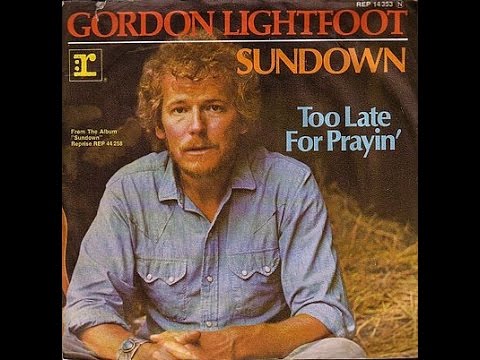
I first noticed Candian Gordon Lightfoot riding in the car with my sister …with the AM radio station playing this song. Sundown got a lot of airplay back then. It peaked at #1 in the Billboard 100, #1 in Canada, and #33 in the UK in 1974.
The inspiration for this song was his girlfriend Cathy Smith who would later have a romantic relationship with Richard Manuel of The Band and a fatal encounter with John Belushi.
The inspiration for this song came from Lightfoot worrying about his girlfriend, who was out at bars all day while he was at home writing songs. He recalled during a Reddit AMA: “I had this girlfriend one time, and I was at home working, at my desk, working at my songwriting which I had been doing all week since I was on a roll, and my girlfriend was somewhere drinking, drinking somewhere. So I was hoping that no one else would get their hands on her, because she was pretty good lookin’!”
“As a matter of fact, it was written just around Sundown,” he added, “just as the sun was setting, behind the farm I had rented to use as a place to write the album.”
Lightfoot most likely wrote this about the stormy relationship with his one time girlfriend Cathy Smith, who was later sentenced for delivering a lethal dose of heroin to John Belushi.
Sundown
I can see her lyin’ back in her satin dress In a room where ya do what ya don’t confess Sundown you better take care If I find you beenn creepin’ ’round my back stairs Sundown ya better take care If I find you been creepin’ ’round my back stairs
She’s been lookin’ like a queen in a sailor’s dream And she don’t always say what she really means Sometimes I think it’s a shame When I get feelin’ better when I’m feelin’ no pain Sometimes I think it’s a shame When I get feelin’ better when I’m feelin’ no pain
I can picture every move that a man could make Getting lost in her lovin’ is your first mistake Sundown you better take care If I find you been creepin’ ’round my back stairs Sometimes I think it’s a sin When I feel like I’m winnin’ when I’m losin’ again
I can see her lookin’ fast in her faded jeans She’s a hard lovin’ woman, got me feelin’ mean Sometimes I think it’s a shame When I get feelin’ better when I’m feelin’ no pain Sundown you better take care If I find you been creepin’ ’round my back stairs Sundown you better take care If I find you been creepin’ ’round my back stairs Sometimes I think it’s a sin When I feel like I’m winnin’ when I’m losin’ again
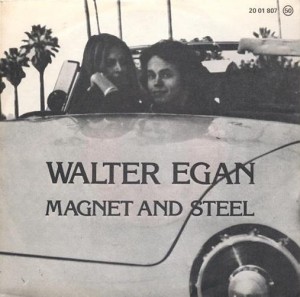
One of my favorite pop/rock songs. Beautifully crafted melody. In 1978 this song peaked at #8 in the Billboard 100. Walter wrote this song about Stevie Nicks and she sang on the track. The bass and drum sound in this song is fantastic.
Stevie Nicks sang on this track and provided inspiration for the lyrics. Walter Egan tells us about this song:
“In 1976 I was living in Pomona, California and I had a notion to write a song with the ‘stroll’ beat (made famous by Chuck Willis) and so began the rough outline of what was tentatively called ‘Don’t Turn Away Now.’ Now, this was also at the time of putting together my first album, Fundamental Roll, and my two new friends and producers, Lindsey Buckingham and Stevie Nicks and I were starting the recording process.
On the night when Stevie did the background vocals for my song ‘Tunnel o’ Love,’ my nascent amorous feelings toward her came into a sharper focus – I was smitten by the kitten, as they say. It was on my drive home at 3 AM from Van Nuys to Pomona that I happened to be behind a metal flake blue Continental with ground effects and a diamond window in back. I was inspired by the car’s license plate: “Not Shy.”
By the time I pulled into my driveway I had formulated the lyrics and come up with the magnet metaphor. From there the song was finished in 15 minutes.
It was especially satisfying to have Stevie sing on ‘Magnet,’ since it was about her (and me).”
This was used in the 1997 movie Boogie Nights.
This was Egan’s only Top 40 chart entry for his own recordings, though he also wrote Night’s first hit, “Hot Summer Nights,” which reached #18.
Magnet and Steel
Ooh ooh ah Now I told you so you ought to know Ooh it takes some time for a feelin’ to grow Ooh you’re so close now I can’t let you go Ooh and I can’t let go For you are a magnet and I am steel
I can’t hope that I’ll hold you for long Ooh you’re a woman who’s lost to your song Ooh but the love that I feel is so strong Ooh and it can’t be wrong
With you I’m not shy to show the way I feel With you I might try my secrets to reveal For you are a magnet and I am steel For you are a magnet and I am steel
I’ve always liked Tie-Dye shirts and whatever else that it is applied to. I’ve bought some things at street fairs and watched them as they did it. There is an art to doing it.
I’m astonished they did this in the 1920s.
Methods of tie-dye were formed in India, Japan, and Africa as early as the sixth century. the oldest known tie-dye tradition that is still practiced is an Indian method called Bandhani.
Tie-Dye was popular in the 1920s from home decorating to dresses.
In the sixties, tie-dye soared in America with the hippie movement. Hippies wanted to throw off the norm of the fifties with flashy and out of the norm clothes.
Before tie-dye became popular, Rit Dye was struggling. Don Price, a marketer for Hellmann’s Mayonnaise, began a marketing campaign for the dye in Greenwich Village, where many hippies lived. He went door to door, looking for artists who would use Rit for tie-dyeing. Then came Will and Eileen Richardson, two retired artists who made tie-dye pieces that Price showed to designers and fashion editors. After clothing designer Halston started using tie-dye in his designs, stars such as Janis Joplin were wearing it. Soon enough, tie-dye became a bandwagon the entire youth generation jumped on.
To this day you can go anywhere and buy anything tie-dyed you want…it’s not just for the counterculture anymore.
This song was the first I heard from the Pretenders. When I think of The Pretenders I think of this song. it wasn’t their best song but it is memorable. Most Pretenders songs were written solo by Hynde, but the group’s guitarist, James Honeyman-Scott, is also a credited writer on this track. The song peaked at #14 in the Billboard 100 and #1 in the UK in 1979.
In a VH1 interview, Hynde admitted to loathing the song, and said that since so many fans love it, she continues to play it.
Lead singer Chrissie Hynde grew up in Akron, Ohio and was a student at Kent State University in 1970 when four students were killed by members of the US National Guard. She left for England in 1973, where she formed the group with three guys from Hereford.
Chrissie Hynde rarely explained what her songs were about, but she let on with this one in a 1980 interview with Sounds: “It’s very lightweight pop type of song, nothing heavy about it. It’s along the lines of the guy who is feeling very insecure, not about pulling a girl but, say, trying to be accepted by the guys down the pub. It’s a front he’s putting up. It’s like buying a pair of new boots and you feel great but then you get home and see you spots in the mirror. Or take a couple of dexies and you’re in gear for the evening but on the train home it’s different.”
She had clearly internalized the British argot. “Pulling a girl” means finding a companion for the evening; “dexies” are Dexedrine pills, which give the user a jolt of energy. At the time, dexy abuse was common in the UK, especially amongst musicians and clubgoers. The band Dexys Midnight Runners took their name from the pill.
The song’s title came about after The Pretenders first-ever UK gig, when they were in the communal dressing room with The Strangeways, who they were supporting. Chrissie Hynde wanted to know whose trousers were sprawled over the back of a chair. One of The Strangeways Ada Wilson said: “I’ll have them if there’s any brass in the pockets.”
When Chrissie inquired what he meant by brass, it was explained to her that brass is a northern slang term for money. Chrissie fell in love with the expression and was inspired to write the song.
It usually doesn’t show up in printed lyrics, but at the end of the song, Hynde coos the line, “Oh and the way you walk.” She says that’s an important part of the song; it’s her telling the insecure peacock that she approves of his offering.
In the video, directed by Mark Robinson, lead singer Chrissie Hynde plays a waitress, implying that “brass” was the change she got from tips. Hynde worked as a waitress in the US before moving to London.
This was the breakout hit from the first Pretenders album, which was a triumph by any measure. In the UK, three singles were released before the album appeared. The first was a cover of The Kinks song “Stop Your Sobbing,” which was released in January 1979 and reached #34 in March 1979. “Kid” followed in June, going to #33 in August. In November, “Brass In Pocket” was released; it rose to the top in January 1980, and stayed at #1 for two weeks.
The album was also released in January 1980, and went to #1 in the UK. In America, it took a while for the group to get noticed. “Brass In Pocket” was the first single there, going to #14 in May 1980. “Stop Your Sobbing” followed, reaching #65 in July. The album is consistently cited as one of the greatest debuts in rock.
In an interview with the Observer newspaper from December 12, 2004, Chrissy Hynde said, “When we recorded the song I wasn’t very happy with it and told my producer that he could release it over my dead body, but they eventually persuaded me. So I remember feeling a bit sheepish when it went to #1.”
Brass in Pocket
Got brass in pocket Got bottle, I’m gonna use it Intention, I feel inventive Gonna make you, make you, make you notice
Got motion, restrained emotion Been driving Detroit leaning No reason, just seems so pleasing Gonna make you, make you, make you notice
[Chorus:] Gonna use my arms Gonna use my legs Gonna use my style Gonna use my side step Gonna use my fingers Gonna use my, my, my imagination
‘Cause I gonna make you see There’s nobody else here No one like me I’m special so special I gotta have some of your attention give it to me
Got rhythm I can’t miss a beat Got new skank it’s so reet Got something I’m winking at you Gonna make you, make you, make you notice
[Chorus]
‘Cause I gonna make you see There’s nobody else here No one like me I’m special, so special I gotta have some of your attention Give it to me ‘Cause I gonna make you see There’s nobody else here No one like me I’m special, so special I gotta have some of your attention
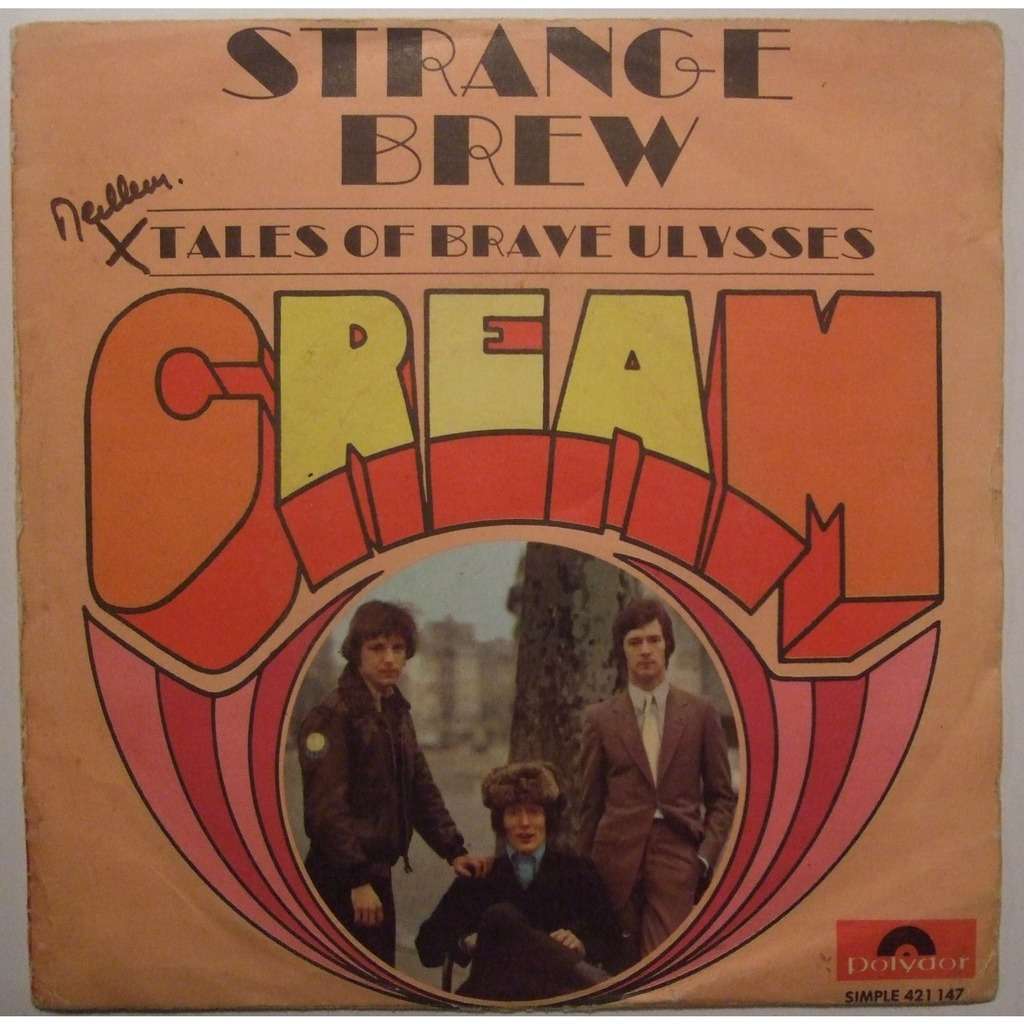
Great guitar lick and song. The song was based on an old blues song by Buddy Moss called Hey Lawdy Mama that Cream recorded. Eric Clapton took the lead vocal in this one. They reworked the song and the writing credits went to Felix Pappalardi, Gail Collins and Eric Clapton.
The song didn’t chart in the Billboard 100 but made it to #17 in the UK charts. A great classic Cream song.
When Cream performed the early version of this song as “Lawdy Mama,” Clapton and bass player Jack Bruce would share lead vocals. The band recorded both “Lawdy Mama” and “Strange Brew” at Atlantic Studios in New York on April 3, 1967. The band had spent the previous week in the city, performing daily at the “Music In The Fifth Dimension” show at the RKO Theater. These shows were organized by the influential disc jockey Murray the K, and provided great exposure for Cream in America. Other acts on the bill for some of these shows: The Who, Wilson Pickett and the Lovin’ Spoonful. Cream would complete the Disraeli Gears album when they returned to the United States the next month.
The lyrics refer to a female, which could mean drugs or be a more literal reference to a woman. Either way, she is “killing what’s inside of you.”
Cream had a very psychedelic sound, and this song was released in the Summer of Love, where it fit in quite well.
To craft “Strange Brew,” producer Felix Pappalardi added Eric Clapton’s vocal to a take of the band’s recording of “Lawdy Mama,” which appears as a bonus track on the 2004 re-release of Disraeli Gears, but didn’t make the original album. Jack Bruce wasn’t happy about this, especially since he wasn’t able to re-record his bassline. To keep the tenuous peace in the band during Cream’s reunion concerts in 2005, “Strange Brew” was omitted from their 19-song playlist, despite being one of their best known and loved songs.
Clapton got the idea for the album title after a roadie named Mick Turner told him about the derailleur gears on his bicycle. Derailleur, pronounced “Di-rail-yer,” are the kind of gears commonly found on 10-speed bikes. The roadie pronounced it “Disraeli,” which led to the title.
On Eric Clapton’s Crossroads boxed set, this is placed next to “Lawdy Mama,” the Blues song it is based on.
Strange Brew
Strange brew, kill what’s inside of you.
She’s a witch of trouble in electric blue, In her own mad mind she’s in love with you. With you. Now what you gonna do? Strange brew, kill what’s inside of you.
She’s some kind of demon messing in the glue. If you don’t watch out it’ll stick to you. To you. What kind of fool are you? Strange brew, kill what’s inside of you.
On a boat in the middle of a raging sea, She would make a scene for it all to be Ignored. And wouldn’t you be bored? Strange brew, kill what’s inside of you.
Strange brew, strange brew, strange brew, strange brew. Strange brew, kill what’s inside of you
This song came off of the great Document album. With some REM songs it takes a few listens for me but this one… the first time was enough to know I really liked it. It was recorded in the Sound Emporium in Nashville, Tennessee. The song peaked at #69 in 1988. The song was inspired by Subterranean Homesick Blues by Bob Dylan and you can tell.
Michael Stipe said: “The words come from everywhere. I’m extremely aware of everything around me, whether I am in a sleeping state, awake, dream-state or just in day to day life. There’s a part in ‘It’s The End Of The World As We Know It’ that came from a dream where I was at Lester Bangs’ birthday party and I was the only person there whose initials weren’t L.B. So there was Lenny Bruce, Leonid Brezhnev, Leonard Bernstein… So that ended up in the song along with a lot of stuff I’d seen when I was flipping TV channels. It’s a collection of streams of consciousness.”
Stipe claims to have a lot of dreams about the end of the world, destroyed buildings and the like. His stream-of-consciousness writing style in this is very similar to the way a dream moves.
This started off as a song called “Bad Day,” and had lyrics decrying the politics of the Reagan administration. R.E.M. finally released “Bad Day” on their 2003 hits compilation album, In Time: The Best of R.E.M. 1988-2003.
When R.E.M. played this live, the audience reacted with a party vibe that threw off the band. They thought the apocalyptic lyrics would create a more subdued response.
Michael Stipe said that the lyrics were written to make people smile. The words he used tend to make your mouth smile when you speak them. >>
In the last verse, the line, “The other night I tripped at Knox” refers to Knox College in Galesburg, Illinois, where the band had a night of fun.
This appears in the movies Dream A Little Dream, Independence Day, Tommy Boy and Chicken Little. >>
The government of the Soviet Union allowed this to appear on a 1990 Greenpeace album that was distributed there.
Billy Joel had a huge hit two years later when he used the rapid-vocal, stream of consciousness lyric style on “We Didn’t Start The Fire.”
This appeared in an episode of The Simpsons when Homer and Moe are fighting about Moe’s new bar. Homer opens his own bar in his garage and then lies to REM about why they are playing there. >>
Brett Anderson, lead singer of the all-girl band The Donnas, told Rolling Stone magazine that she is an “R.E.M. geek” and can recite all of the lyrics to the song.
It’s the End of the World as We Know It (And I Feel Fine)
That’s great, it starts with an earthquake Birds and snakes, and aeroplanes And Lenny Bruce is not afraid
Eye of a hurricane, listen to yourself churn World serves its own needs, Don’t mis-serve your own needs Speed it up a notch, speed, grunt, no, strength, The ladder starts to clatter With a fear of height, down, height Wire in a fire, represent the seven games And a government for hire and a combat site Left her, wasn’t coming in a hurry With the Furies breathing down your neck
Team by team, reporters baffled, trumped, tethered, cropped Look at that low plane, fine, then Uh oh, overflow, population, common group But it’ll do, save yourself, serve yourself World serves its own needs, listen to your heart bleed Tell me with the Rapture and the reverent in the right, right You vitriolic, patriotic, slam fight, bright light Feeling pretty psyched
It’s the end of the world as we know it It’s the end of the world as we know it It’s the end of the world as we know it and I feel fine
Six o’clock, T.V. hour, don’t get caught in foreign tower Slash and burn, return, listen to yourself churn Lock him in uniform, book burning, bloodletting Every motive escalate, automotive incinerate Light a candle, light a motive, step down, step down Watch your heel crush, crush, uh oh This means no fear, cavalier, renegade and steering clear A tournament, a tournament, a tournament of lies Offer me solutions, offer me alternatives and I decline
It’s the end of the world as we know it (I had some time alone) It’s the end of the world as we know it (I had some time alone) It’s the end of the world as we know it and I feel fine (time I had some time alone) I feel fine (I feel fine)
It’s the end of the world as we know it (time I had some time alone) It’s the end of the world as we know it (time I had some time alone) It’s the end of the world as we know it and I feel fine (time I had some time alone)
The other night I drifted nice continental drift divide Mountains sit in a line, Leonard Bernstein Leonid Brezhnev, Lenny Bruce and Lester Bangs Birthday party, cheesecake, jellybean, boom You symbiotic, patriotic, slam but neck, right, right
It’s the end of the world as we know it (time I had some time alone) It’s the end of the world as we know it (time I had some time alone) It’s the end of the world as we know it and I feel fine (time I had some time alone)
It’s the end of the world as we know it It’s the end of the world as we know it It’s the end of the world as we know it and I feel fine (time I had some time alone)
It’s the end of the world as we know it (time I had some time alone) It’s the end of the world as we know it (time I had some time alone) It’s the end of the world as we know it and I feel fine (time I had some time alone)
It’s the end of the world as we know it (time I had some time alone) It’s the end of the world as we know it (time I had some time alone) It’s the end of the world as we know it and I feel fine (time I had some time alone)
When I heard this song in 1990 I was thrilled because it sounded like the Faces of the 70s. It was clear rock and roll and had a timeless quality about it. It peaked at #26 in the Billboard 100, #40 in Canada and #45 in the UK. This song was originally recorded by Otis Redding, who wrote it with Allen Jones and Al Bell. It was the only cover song on The Black Crowes debut album, which sold over five million copies.
The two other versions that I like are Otis Redding and Grateful Dead version with Pigpen taking the lead version.
Running a compact 3:08, The Black Crows turned the song into a rocker, using guitars instead of horns and extending the song from Redding’s 2:18 original.
This was The Black Crowes’ third single, following “Twice As Hard” and “Jealous Again.” It made #45 in the US in December 1990, as the group was rapidly gaining momentum. After “She Talks To Angels” hit #30 in May 1991 – over a year after the album was released
“Hard To Handle” was reissued, this time going to #26 and becoming the highest-charting single for the band on the Hot 100. The group had been together for five years before signing a record deal with Def American, which prepared them well for the onslaught of success. Their live act had already been honed, and many who saw them remained lifetime fans as they became more of a jam band.
Hard To Handle
Baby here I am I’m the man on the scene I can give you what you want But you gotta’ come home with me
I have got some good old lovin’ And I got some more in store When I get through throwin’ it on You gotta’ come back for more
Boys will come along a dime by the dozen That ain’t nothing but ten cent lovin’ Pretty little thing, let me light your candle ‘Cause mama I’m sure hard to handle now, yessir’am
Action speaks louder than words And I’m a man of great experience I know you’ve got another man But I can love you better than him
Take my hand don’t be afraid I’m gonna prove every word I say I’m advertising love for free So you can place your ad with me
Boys will come along a dime by the dozen That ain’t nothing but ten cent lovin’ Pretty little thing, let me light your candle ‘Cause mama I’m sure hard to handle now, yessir’am
Yeah Hard to handle now Oh baby
Baby here I am I’m the man on the scene I can give you what you want But you gotta’ come home with me
I’ve got some good old lovin’ And I got some more in store When I get through throwin’ it on you You got to come a-runnin’ back for more
Boys will come along a dime by the dozen That ain’t nothing but ten cent lovin’ Pretty little thing, let me light your candle ‘Cause mama I’m sure hard to handle now, yessir’am
Hard Hard to handle now Oh yeah, yeah yeah yeah
Boys will come along a dime by the dozen That ain’t nothing but ten cent lovin’ Pretty little thing, let me light your candle ‘Cause mama I’m sure hard to handle now, yessir’am
Yeah So hard to handle now Oh yeah
Baby Good lovin’ Baby, baby Ohh, good lovin’ I need good lovin’ I got to have it, oh yeah Yeah So hard to handle, now, yeah
Robert Plant, Paul Rodgers, Freddie Mercury, and Mick Jagger gets brought up when talking about great lead singers. I’ve had this conversation with friends and musicians. Who was the best rock bass player, guitar player, drummer, and lead singer?
Steve Marriott rarely gets brought up by anyone because he is sadly not remembered as well as he should be. I’ve listened to Marriott for years and the guy still amazes me. He could sing blues, R & B, Rock, and Pop. He could do anything because not only was he a great singer a good songwriter and he was a very good guitar player.
He influenced many singers from the 60s and beyond. Below is the Small Faces doing “You Need Lovin'” and I think Robert Plant was listening. This was before Zeppelin.
The Small Faces played Rock, R & B, and Blues music but what they are famous for are the two pop singles Itchycoo Park and Lazy Sunday. Marriott was upset about Lazy Sunday being released as a single because he’d recorded the song as a joke and it was released despite his objections. They are also known for one of the best albums of the sixties Ogdens’ Nut Gone Flake. Q magazine placed Ogdens’ Nut Gone Flake at number 59 in its list of the 100 Greatest British Albums Ever. Steve Marriott and Ronnie Lane wrote most of the album.
Because of bad management, a pop image, and a lack of a follow up to Ogedens’ Nut Gone Flake the Small Faces broke up. Marriott wanted to play harder music so he and Peter Frampton started a band called Humble Pie.
Humble Pie had some great songs but nothing really caught on with the masses. That’s not always a bad thing but they never had a big song identifiable to them as some other bands do. They did have four top twenty albums but were more known as a live band…check out Performance Rockin’ the Fillmore
Their manager was Dee Anthony who had connections with the Mob. Everything was ok until Steve wanted to know where the money was at. Marriott began openly questioning Anthony’s business practices, the singer was summoned to a meeting at a social club in New York’s Little Italy. According to Marriott’s ex-wife, among those in attendance were John Gotti and several other members of the Gambino crime family. Marriott was quietly persuaded to forget about any money he thought he had coming to him.
The Small Faces reunited, without Lane, between 1976-1978 but punk was taking over and they were not successful. In 1980 Humble Pie reunited but didn’t have much luck either.
In 1981 Steve and Ronnie Lane made an album together that wasn’t released until 2000 after both were passed away. It was called The Legendary Majik Mijits and I really like the recording. You can tell they recorded it in 1981 but it contains some hidden gems.
Steve played many club gigs in the 80s, some you can still see on youtube. In 1991 while working on an album with Peter Frampton he flew back home and went to sleep with a lit cigarette and died of smoke inhalation…he was 44 years old.
A sad ending to a performer who could have been huge. Perhaps if he would have lived longer he would have revived his career and been more remembered today.
Steve had a huge voice that came out of his 5 foot 5 frame. When Jimmy Page was looking for a singer for his new band Page had thought about Marriott but he was managed by the notorious Don Arden, who had reportedly responded by asking how well Page thought he would play guitar with 10 broken fingers.
What other artists say about Steve Marriott
Keith Richards has said that Mariott is in his top 5 favorite artists and considered having Steve in the Stones to replace Mick Taylor when he left…an idea that Mick Jagger rejected.
“Probably, really, my favorite other bands ever, Steve Marriott’s, very much from the English point of view, the Small Faces, then he had Humble Pie.
Chris Robinson of The Black Crowes To me it’s so obvious I’m a Steve Marriott rip-off that I never think about Rod. I admit it. Steve Marriott is the guy, him and Paul Rodgers and Gregg Allman.
Robert Plant (about the Song Remains the Same)I wanted to be like, “Come on!” I wanted to be Steve Marriott, for fuck’s sake.
Paul RodgersI was rooting around in my cupboard the other day, actually, just yesterday, and I found a bunch of Steve Marriott live stuff and I put it on and MY GOD, that guy was unbelievable!
Documentary about Steve Marriott
Humble Pie with Marriott and Frampton.
Steve and Ronnie Lane in 1981. Some very good songs
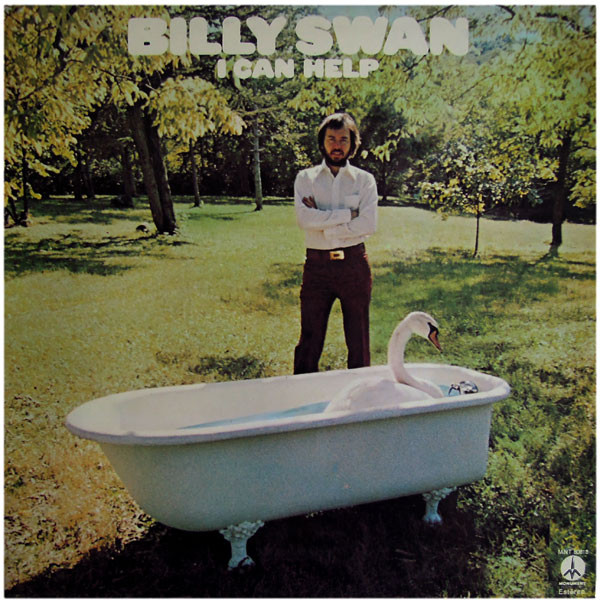
This song will stay with you…Billy was a one hit wonder but he did it right… #1 in the Billboard 100 in 1974. At the time Billy lived in Nashville and signed with Monument Records. He recorded the song in Young’un Sound Studio in Murfreesboro, TN. It is really hard not to like this song.
Fellow Beatle fan hanspostcard has mentioned this song sounds like a Ringo Starr type song…and I have to agree. Either way, it’s a good song. Now when I hear it…I hear Ringo singing it.
Kris Kristofferson and Rita Coolidge brought Billy Swan a little RMI organ as a wedding present. Billy was fiddling around with it when the chorus “I can help” appeared, and within a few minutes he had written the lyrics.
Swan often took his medium-sized dog to his recording sessions. While Swan was recording “I Can Help,” the dog became playful and started tugging at Swan’s pant leg. He finished the take – and earned the applause from the bandmates that is heard at the end of the released song.
Swan wrote Clyde McPhatter’s 1962 hit “Lover Please.” He went on to write some popular country songs, but this was his only hit as an artist
I Can Help
If you’ve got a problem, I don’t care what it is If you need a hand, I can assure you this I can help, I’ve got two strong arms, I can help It would sure do me good to do you good Let me help
It’s a fact that people get lonely, ain’t nothing new But a woman like you, baby, should never have the blues Let me help, I’ve got two for me, let me help It would sure do me good to do you good Let me help
When I go to sleep at night, you’re always a part of my dream Holding me tight and telling me everything I want to hear Don’t forget me, baby, all you gotta do is call You know how I feel about you, if I can do anything at all Let me help, if your child needs a daddy, I can help It would sure do me good to do you good, let me help
When I go to sleep at night, you’re always a part of my dream Holding me tight and telling me everything I wanna hear Don’t forget me, baby, all you gotta do is call You know how I feel about you, if I can do anything at all Let me help, if your child needs a daddy, I can help It would sure do me good to do you good, let me help
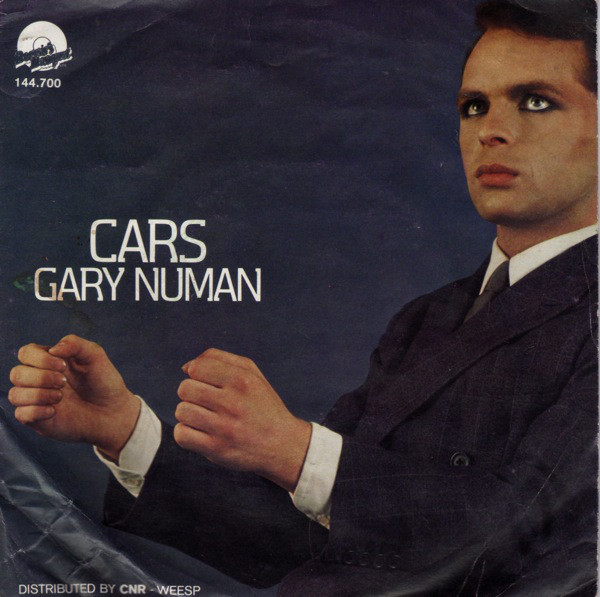
This song was released in 1979 was one of many signs a change was coming in music. The song peaked at #9 in the Billboard 100, #1 in the UK and #1 in Canada. The song was keyboard driven with a synth riff.
Gary Numan on the inspiration of the song. “A couple of blokes started peering in the window and for whatever reason took a dislike to me, so I had to take evasive action. I swerved up the pavement, scattering pedestrians everywhere. After that, I began to see the car as the tank of modern society.”
Numan has stated that he has Asperger syndrome, which is a mild form of autism, but until he was diagnosed, he had a lot of trouble relating to other people.
Even though the message of this song is that cars lead to a mechanical society devoid of personal interaction, it didn’t stop automakers from using it in commercials. Both Nissan and Oldsmobile have used it in ads.
A more clever approach came from Diehard, who created a commercial where Numan played the song on 24 car horns powered by just one of their batteries. Numan has no problem with his song being used in commercials, telling us, “I’m up for that, actually. I think any use of it at all. It would be great if it happened again.”
In the UK, this was used in an American Express commercial in the ’80s, as well as an ad for Carling beer that ran in 1996. The beer commercial gave the song new life in the UK.
TV series that have used this song in some form include The Simpsons, Family Guy, South Park and Two and a Half Men.
Numan made a video for this with special effects that look ridiculous now, but were cutting edge in 1979. When MTV went on the air in 1981, it was one of about 200 videos they had, so they played it over and over. This made the song a hit in the US.
Numan explained to Rolling Stone how he came up with this song’s synthesizer hook: “I have only written two songs on bass guitar and the first one was ‘Cars.’ I had just been to London to buy a bass and when I got home the first thing I played was that intro riff. I thought, ‘Hey, that’s not bad!’ In 10 minutes, I had the whole song. The quickest one I ever wrote. And the most famous one I’d ever written. More people should learn from that.”
Numan took his surname from a plumber in the telephone directory called Neumann Kitchen Appliances. He told NME he tried to find a two-syllable name, “because my real name Webb didn’t seem very cool.”
Cars
Here in my car I feel safest of all I can lock all my doors It’s the only way to live in cars.
Here in my car I can only receive I can listen to you It keeps me stable for days in cars.
Here in my car Where the image breaks down Will you visit me please If I open my door in cars
Here in my car You know I’ve started to think About leaving tonight Although nothing seems right in cars.
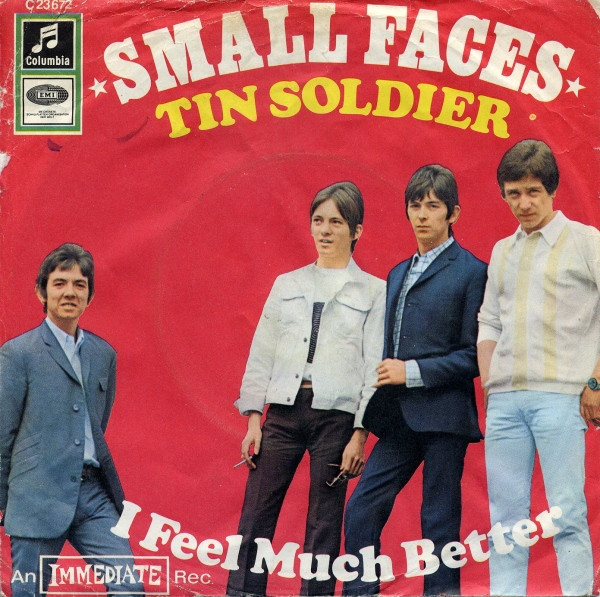
This a great R&B single from The Small Faces in 1967. It’s a song that Steve Marriott wrote about Jenny Rylance who he met in 1966 and ended up marrying her in 1968. This song was released right after Itchycoo Park. The band wanted to get back to the R&B music they wanted to be known for. P.P. Arnold was the female singer on this song.
The song peaked at #9 in the UK and #73 in the Billboard 100. This is a good representation of the band.
Tin Soldier
I am a little tin soldier that wants to jump into your fire You are a look in your eye A dream passing by in the sky I don’t understand And all I need is treat me like a man ‘Cause I ain’t no child Take me like I am I got to know that I belong to you Do anything that you want to do Sing any so song that you want me to sing to you I don’t need no aggravation I just got to make you I just got to make you my occupation, oh yeah (I got to know that I belong to you) (Do anything that you want to do) (Sing any so song that you want me to sing to you)
All I need is your whispered hello Smiles melting the snow, nothing heard Your eyes, they’re deeper than time Say a love that won’t rhyme without words So now I’ve lost my way I need help to show me things to say Give me your love before mine fades away, yeah, baby (I got to know that I belong to you) (Do anything that you want to do) (Sing any so song that you want me to sing to you)
Oh, no, no Oh, no I just want some reaction Someone to give me satisfaction All I want to do is stick with you,’cause I love you
We all know this song from the Wizard of Oz but this is a great version in its own right. I first heard this song in Life On Mars and will never forget it. Israel (IZ) fits “What a Wonderful World” in this and it is fantastic.
Hawaiian musician Israel Kamakawiwo’ole recorded this in a medley with “What a Wonderful World” for his 1993 album Facing Forward. This version was used in the films Finding Forrester, Meet Joe Black, Life on Mars and 50 First Dates as well as on the television show ER.
The song peaked at #22 on the Adult Contemporary Chart in 2004.
Over The Rainbow
Ooh, ooh, ooh Ooh, oohSomewhere over the rainbow Way up high And the dreams that you dream of Once in a lullabySomewhere over the rainbow Bluebirds fly And the dreams that you dream of Dreams really do come true someday, I wish upon a star Wake up where the clouds are far behind me Where trouble melts like lemon drops High above the chimney top That’s where you’ll find me somewhere over the rainbow Bluebirds fly And the dreams that you dare to Oh why, oh why can’t I? Well, I see trees of green and red roses too I’ll watch them bloom for me and you And I think to myself What a wonderful worldWell, I see skies of blue and I see clouds of white And the brightness of day I like the dark And I think to myself what a wonderful worldThe colors of the rainbow so pretty in the sky And also on the faces of people passing by I see friends shaking hands saying How do you do? They’re really saying I, I love you
I hear babies cry and I watch them grow They’ll learn much more then we’ll know And I think to myself what a wonderful world World
Someday I wish upon a star Wake up where the clouds are far behind me Where trouble melts like lemon drops High above the chimney top That’s where you’ll find me
Oh, somewhere over the rainbow Way up high And the dreams that you dare to Why oh, why can’t I?
Great seventies soul song from 1970. The Five Stairsteps were formed in Chicago in 1965 and comprised of Burke family members Clarence Jr., James, Aloha, Kenneth and Dennis.
They got their name when their mom noticed that her kids looked like stair steps when stood next to each other according to age. The song peaked #8 in the Billboard 100 and #3 in Canada.
Since Dear Prudence is the B side of the single I’ve included it at the bottom of the page. Very interesting cover of the Beatles song.
Ooh-oo child Things are gonna get easier Ooh-oo child Things’ll get brighter Ooh-oo child Things are gonna get easier Ooh-oo child Things’ll get brighter Some day, yeah We’ll get it together and we’ll get it all done Some day When your head is much lighter Some day, yeah We’ll walk in the rays of a beautiful sun Some day When the world is much brighter Ooh-oo child Things are gonna be easier Ooh-oo child Things’ll get be brighter Ooh-oo child Things are gonna be easier Ooh-oo child Things’ll get be brighter
Some day, yeah We’ll get it together and we’ll get it all done Some day When your head is much lighter Some day, yeah We’ll walk in the rays of a beautiful sun Some day When the world is much brighter Some day, yeah We’ll get it together and we’ll get it all done Some day When your head is much lighter Some day, yeah We’ll walk in the rays of a beautiful sun Some day When the world is much brighter Ooh-oo child Things are gonna get easier Ooh-oo child Things’ll get brighter Ooh-oo child Things are gonna get easier Ooh-oo child Things’ll get brighter Right now, right now(You just wait and see how things are gonna be)
Am I a big Devo fan? No, I’m not but I do like some of their songs. I do respect them…I can’t help but respect them. They had no peers…they did what they did better than anyone else…because they were the only ones that did it. Whatever it is. They are just so bizarre but I can’t help but admire them.
I showed my son the SNL clip of Devo when he was around 10-12 years old and I looked around at his confused look… his mouth was hung open. He asked me slowly…Dad, what was that? Son, that was Devo…it still works.
Whip It peaked at #14 in the Billboard 100, #11 in Canada and #51 in the UK. This song was by far their most successful though they barely missed the top 40 in 1981 with Working In a Coal Mine.
The song was written about whipping your problems but when the band heard that many people took the lyrics the wrong way…they made a video to play up to that thought.
Jerry Casale: “We made a video to it for like $15,000 that was shot in our rehearsal studio. We kind of magnified that myth that this was a song about whipping and sadomasochism. We decided to make the video feed that popular misconception and had a lot of fun doing it. It was one of the few times Devo worked like that, usually, we would start with a visual idea or story and write music to fit it. In this case, we didn’t originally have a video idea for ‘Whip It,’ and when people started thinking it was a song about whacking off or sadomasochism, we had these quack books that we would collect from junk stores or vintage magazine stores that served as inspiration or jokes. There was this one magazine that I found in a store in Santa Monica. It was a 1962 men’s girlie mag called Dude, I think.
There was a feature article on a guy who had been an actor and fell on hard times, he wasn’t getting parts anymore. He moved with his wife to Arizona, opened a dude ranch and charged people money to come hang out at the ranch. Every day at noon in the corral, for entertainment, he’d whip his wife’s clothes off with a 12-foot bullwhip. She sewed the costumes and put them together with Velcro. The story was in the magazine about how good he was and how he never hurt her. We had such a big laugh about it, we said, ‘OK, that’s the basis for the video. We’ll have these cowboys drinking beer and cheering Mark on as he’s in the barnyard whipping this pioneer women’s clothes off while the band plays in the corral.’
Back then, nobody cared. MTV had just started up in three cities, we had already shot five videos before Whip It, and nobody cared. There was no industry around it, there were no gatekeepers, there was no pecking order, there were no video commissioners, there were no representatives going, ‘No, you can’t do that, we won’t show that.’ There wasn’t enough money or power involved for anybody to care, so we were just considered crazy artists that went out and did whacko things. So we made the video and one day we started showing it in concerts and then MTV started playing it.”
Whip It
Crack that whip Give the past the slip Step on a crack Break your momma’s back
When a problem comes along you must whip it Before the cream sits out too long you must whip it When something’s going wrong you must whip it
Now whip it into shape Shape it up Get straight Go forward Move ahead Try to detect it It’s not too late to whip it Whip it good
When a good time turns around you must whip it You will never live it down unless you whip it No one gets their way until they whip it I say whip it whip it good I say whip it whip it good
Crack that whip Give the past the slip Step on a crack Break your momma’s back
When a problem comes along you must whip it Before the cream sits out too long you must whip it When something’s going wrong you must whip it
Now whip it into shape Shape it up Get straight Go forward Move ahead Try to detect it It’s not too late to whip it into shape Shape it up Get straight Go forward Move ahead Try to detect it It’s not too late to whip it Whip it good
and for the bonus Devo track of the day… Peek a Boo
All the Young Dudes was written and produced by David Bowie. Mott The Hoople had a cult following in England and Bowie was a big fan but they were about to break up. To stop them from breaking up he offered to produce their next album and give them a song…this song.
Mott the Hoople does a great job on this. This era is my favorite of David Bowie… All the Ziggy Stardust music (which this was originally written for) and the Hunky Dory album…not that any era of Bowie is bad.
David Bowie on writing the song for The Rise and Fall of Ziggy Stardust and the Spiders From Mars album
“Ziggy was in a rock ‘n’ roll band, and the kids no longer want rock ‘n’ roll,” Bowie explained to Rolling Stone in 1974. “There’s no electricity to play it. Ziggy’s adviser tells him to collect news and sing it, ’cause there is no news. So Ziggy does this, and there is terrible news. ‘All the Young Dudes’ is a song about this news. It is no hymn to the youth as people thought. It is completely the opposite.”
The song peaked at #37 in the Billboard 100 and #3 in the UK in 1972.
All The Young Dudes
Billy rapped all night ’bout his suicide How he’d kick it in the head when he was 25 Don’t wanna stay alive when you’re 25
Wendy’s stealing clothes from unlocked cars Freddy’s got spots from ripping off stars from his face Funky little boat race The television man is crazy Saying we’re juvenile delinquent wrecks Man I need a TV when I’ve got T. Rex Hey brother you guessed I’m a dude
All the young dudes Carry the news Boogaloo dudes Carry the news
All the young dudes Carry the news Boogaloo dudes Carry the news
Now Jimmy looking sweet though he dresses like a queen He can kick like a mule It’s a real mean team We can love Oh we can love And my brother’s back at home With his Beatles and his Stones We never got if off on that revolution stuff What a drag Too many snags Well I drunk a lot of wine And I’m feeling fine Gonna race some cat to bed Is this concrete all around Or is it in my head Oh brother you guessed I’m a dude
All the young dudes Carry the news Boogaloo dudes Carry the news
All the young dudes Carry the news Boogaloo dudes Carry the news









 PowerPop... An Eclectic Collection of Pop Culture