Songs can mark certain times in your life. When this one plays I remember my first car. It was a 1966 Mustang…not a good idea to give a classic car to a teenager.
I remember hearing this for the first time driving and thinking that this was not the same Robert Plant that a few years before was in Led Zeppelin. He was more subdued and you could tell he was changing his image a bit. The guitar is what stands out to me in this repetitive song. It had an elastic sound to it.
The song peaked at #39 in the Billboard 100 in 1984. I’m In The Mood was on The Principle fo Moments album which peaked at #8 in the Billboard album charts in 1983. I’m In The Mood was written by Robert Plant, Robbie Blunt, and Paul Martinez.
In The Mood
I’m in the mood for a melody I’m in the mood for a melody I’m in the mood
I’m in the mood for a melody I’m in the mood for a melody I’m in the mood
I’m in the mood for a melody I’m in the mood for a melody I’m in the mood
I can make you dance I can make you sing I can make you dance I can make you sing If you want me to
Oh I can make you dance I can make you sing I can make you dance I can make you sing If you want me to
Oh I can make you dance I can make you sing I can make you dance I can make you sing if you want me to
And your little song that you want to sing A little song that you want to sing sung in lieu
Here’s a little song that you want to sing A little song that you want to sing some of you
A little song that you want to sing A little song that you want to sing happy or blue
I’m in the mood, I’m in the mood, I’m in the mood
Why’d I end up doing it doin’ it doing it Do anything that you want me for if you want me to
Do it right gonna do it right Cause a matter of fact it’ll turn out to be strong If you want me to if you want me to Oh if you want me to if you want me to if you want me to
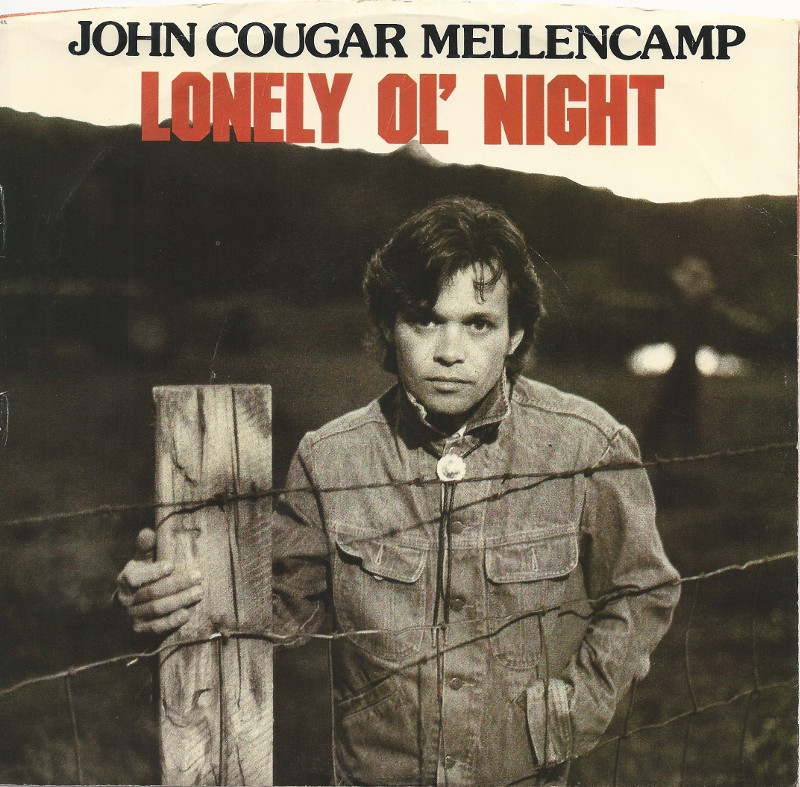
When I graduated high school in1985 this song was was all over the radio. It was on the Scarecrow LP and that album marked a change in Mellencamp’s songs. The change in his style started with the Uh Huh album that came out in 1983 but this one is when I became more of a fan.
This song peaked at #6 in the Billboard 100 in 1985. The Scarecrow album peaked at #2 on the Billboard album chart. Mellencamp’s Uh Huh started the transformation and this solidified his heartland Americana image.
The title and hook were lifted from dialogue in the 1963 movie Hud. When Brandon De Wilde’s character asks, “It’s a Lonesome old night, isn’t it?” Paul Newman replies, “Ain’t they all?”
From Songfacts
The lyrics, “He’s singing about standing in the shadows of love, I guess he feels awfully alone” refer to the song “Standing In The Shadows Of Love,” which was a #6 hit for the Four Tops in 1967. “Lonely Ol’ Night” reached the same plateau. >>
The Scarecrow album saw Mellencamp move to a more political direction in his songwriting, as he gave voice to American farmers, expressing their burdens in songs like “Rain on the Scarecrow” and “You’ve Got to Stand for Somethin’.” “Lonely Ol’ Night” was more typical of his earlier work, a romantic story set against a musical backdrop. Lyrically, it’s not far off from his 1980 track “Ain’t Even Done With The Night.”
Mellencamp borrowed from the movie again in his 1987 track “Paper in Fire” with the line, “We keep no check on our appetites.”
Lonely Ol’ Night
She calls me home She says baby it’s a lonely ol’ night I don’t know I’m just so scared and lonely all at the same time Nobody told me She was gonna work out this way no no no no no no I guess they knew We’d work it out in our own way
It’s a lonely ol’ night Can I put my arms around you? It’s a lonely ol nigh Custom made for two lonely people like me and you
Radio playin’ softly Some singer’s sad sad song He’s singing about Standing in the shadows of love I guess it feels awfully alone She says I know Exactly what he means yeah yeah yeah yeah yeah yeah And it’s a sad sad sad sad feeling When you’re living on those in betweens (But it’s OK)
It’s a lonely ol’ night Can I put my arms around you? It’s a lonely ol nigh Custom made for two lonely people like me and you
She calls me baby She calls everybody baby It’s a lonely ol’ night But ain’t they all?
It’s a lonely ol’ night Can I put my arms around you? It’s a lonely ol nigh Custom made for two lonely people like me and you
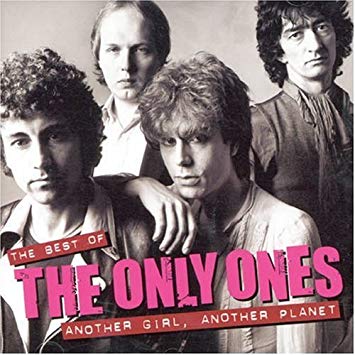
The Only Ones were a British band formed in 1976. Despite releasing three well-regarded albums between 1978 and 1980, The Only Ones faded away with this song as their best-known song and some critics say it’s a small masterpiece. Once the song gets going it is filled with guitar hooks.
Written by guitarist and lead vocalist Peter Perrett, “Another Girl, Another Planet” is as good as it got for The Only Ones. This uptempo number was the second track on their eponymous debut album. It was released twice as a single in 1978, both times on the CBS label. The first time it was backed by “Special View”, the second by “My Wife Says”.
This review by Allmusic is complimentary, to say the least.
In a world rife with injustice, the music industry has seen — if not perpetrated — more than its fair share of travesties (the sad saga of Badfinger comes immediately to mind). But one of the biggest involves, arguably, the greatest rock single ever recorded: the Only Ones’ “Another Girl, Another Planet.” The word “timeless” and “transcendent” get bandied about far too often when describing a song or an album, but in the case of “Another Girl,” even those terms are probably inadequate. The song marks that rare confluence of lyrical, instrumental, and vocal poetry that is so complete, so absolute, that it renders everything else — in, on, above, below, and around it — irrelevant while it plays.
The song did peak at 57 in the UK Charts when re-released in 1992. Its first chart appearance was in1981 at #44, for one week, on the New Zealand chart.
Other covers of this song included: Greg Kihn, The Replacements, Blink-182, The Dogs D’Amour, Beatsteaks and Babyshambles
From Songfacts
Although the song originally failed to chart, it has been re-released and covered more than once, and is surprisingly well known, although few would go as far as Andy Claps who in reviewing it for Allmusic said it is “that rare confluence of lyrical, instrumental, and vocal poetry that is so complete, so absolute, that it renders everything else – in, on, above, below, and around it – irrelevant while it plays.”
The song did eventually chart after being re-released in 1992, peaking at #57 in the UK.
Peter Perrett on writing the song: “I can remember what caused me to write ‘Another Girl, Another Planet.’ It would have been about April ’77 because we had it recorded by June. It was inspired by this girl from Yugoslavia. I didn’t go out with her, but she was like a total space cadet, which when I was really young I found interesting. She was just a bit weird- she’d say crazy things, and it just got me thinking that every girl has something to offer.
The Only Ones split in 1982 after being dropped by their label. They reformed in 2007 as a result of this song being used in a Vodafone advertising campaign.
Speaking about the writing of the song to Uncut August 2015,
It would have been written on my Guild acoustic. I think any good song should sound all right on acoustic guitar.”
Some radio stations refused to play the song because of its supposed drug content. Perrett told Uncut: “I put in drug-related imagery, but it wasn’t about drugs. At that time I was more addicted to sex and infatuation than I was to drugs.”
Another Girl, Another Planet
I always flirt with death I could kill, but I don’t care about it I can face your threats And stand up straight and tall and shout about it
I think I’m on another world with you, with you I’m on another planet with you, with you
You get under my skin I don’t find it irritating You always play to win But I won’t need rehabilitating, oh no
I think I’m on another world with you, with you I’m on another planet with you, with you
Another girl, another planet Another girl, another planet
Space travels in my blood There ain’t nothing I can do about it Long journeys wear me out But I know I can’t live without it, oh no
I think I’m on another world with you, with you I’m on another planet with you, with you
Another girl is loving you now Another planet, is holding you down Another planet
It doesn’t get much better than this. This song was off his self-titled debut album Marshall Crenshaw that peaked at #50 on the Billboard album charts in 1982. Marshall only had one chart hit and that was with Someday, Someway off of this same album…it just shows that life isn’t fair at times. Every song is good on this album…you cannot say that about most albums.
Songs like this… is the reason I do this on Fridays.
Marshall Crenshaw on the song: ‘Cynical Girl’ sounds like it just came off the top of my head in one pass; that’s probably what happened. Quite a few of my songs are like that: I just start singing and playing without any advance thought. But then, with ‘Cynical Girl’ and so many others, the words take time to arrive. I asked another person to take a crack at it first but the guy wrote something that had no cohesion. My idea for the lyrics came to me one day when I was walking out of traffic court, just out of the blue. The lyrics have an oddness to them, and humor too; they said some things that I wanted to say. People have sometimes asked me, ‘Who’s it about?’ ‘Did you find her yet?’, etc. It’s really not about a girl—that’s just off-the-shelf rock-and-roll language. To me, what the song says in a funny way is ‘I hate brain-dead mass-culture [stuff] and I want to hang around with people who feel the same.’ People have always really loved that song and identified with it and of course I love that!”
Cynical Girl
Well I’m goin’ out I’m goin’ out lookin’ for a cynical girl Who’s got no use for the real world I’m lookin’ for a cynical girl Well I hate TV
There’s gotta be somebody other than me Who’s ready to write it off immediately I’m lookin’ for a cynical girl
Well I’ll know right away by the look in her eye She harbors no illusions and she’s worldly-wise And I’ll know when I give her a listen that she She’s what I’ve been missin’ What I’ve been missin’ I’ll be lost in love
And havin’ some fun with my cynical girl Who’ll have no use for the real world I’m lookin’ for a cynical girl Well I’m goin’ out
I’m goin’ out lookin’ for a cynical girl Who’s got no use for the real world I’m lookin’ for a cynical girl
Yeah I’ll know right away by the look in her eye She harbors no illusions and she’s worldly-wise And I’ll know when I give her a listen that she She’s what I’ve been missin’ What I’ve been missin’ I’ll be lost in love
And havin’ some fun with my cynical girl Who’ll have no use for the real world I’m lookin’ for a cynical girl
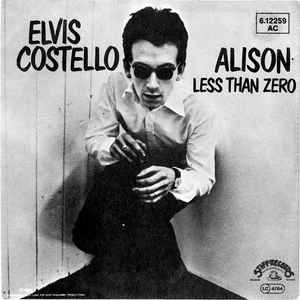
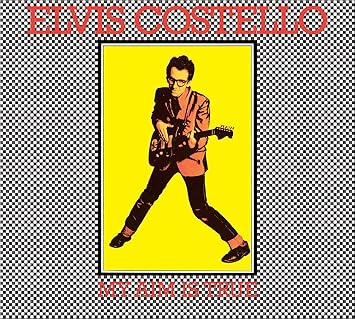
On Fridays, I could just start with his first album and post song after song and they would fit perfect. I was walking through a drug store in the late seventies as a kid and I saw this album cover…I thought what??? another person named Elvis? Who is this skinny guy?
While at the drug store the guy was playing this album and I heard Alison… That was the first thing I ever heard by Elvis. The album peaked at #32 in the Billboard Album Charts in 1978. His songs were different than a lot of the radio hits of the day…with different, I mean better.
Elvis Costello on the song: We put these cheap synth strings on the track before there were really even synths. They said, ‘The strings will make it a hit!’ It was never a hit.”
From Songfacts
Costello has never revealed who this song is about. In the liner notes to his Girls Girls Girls compilation album, he wrote, “Much could be undone by saying more.”
As is usually the case in Elvis Costello lyrics, the protagonist is sexually frustrated (see “Watching the Detectives”) and mad at the guy who always gets the girl. In this tale of unrequited love, “My aim is true” does not imply pure intentions; it means he wants to kill her.
The chorus is based on a song by The Detroit Spinners called “Ghetto Child.”
The line in this song, “My Aim Is True,” provided the title for the album.
My Aim Is True was Costello’s first album. He did not have a backing band at the time, so Nick Lowe, who produced the album, brought in a group called Clover. Huey Lewis was in the band, but didn’t participate in the sessions because they didn’t need a harmonica player. Alex Call was the lead singer of Clover, and he wasn’t needed on “Alison” either.
Call told us: “Elvis Costello was at that time Dec McManus, he was using his real name. He was just this mild-mannered, meek little songwriter who would hang out around Stiff Records, which was our management office. Elvis once said, ‘Man, I wish I could sing like you.’ They went and cut at this little place called Pathways – a little 8-track studio so small that all you had just enough space to play your instrument. They went in that first session, and in one session they cut ‘Alison’ and ‘Red Shoes’ and ‘Less Than Zero,’ these classic songs. I remember hearing them at this Rock ‘n’ Roll house we lived in outside of Headley, South of London called the Headley Grange House. John McFee (Clover bass player) brought back a reel-to-reel tape on one of those old Wollensak tape recorders. He played this stuff, and I mean, I was ready to quit after hearing that – it was so astounding. They did like three 8-12 hour sessions, and that was My Aim Is True. That is a classic record, just unbelievable. We were managed by the same guys and we hung out a lot with Nick. Nick produced a lot of our early sessions there. We made two albums with Mutt Lange, and nothing happened with the band. We came close in England to breaking a single, but it didn’t work and we ended up breaking up.” (Check out our interview with Alex Call.)
Linda Ronstadt recorded this on her 1978 Living in the USA album and released the song as a single. The single didn’t chart on the Hot 100 – a rare miss for Ronstadt, who was very popular at the time. The album, however, sold over two million copies, providing Costello with substantial royalties as the writer of one of its 10 tracks. He credits these earnings with keeping him afloat in the early years before he caught on.
There were two singles released in the US. The B-side of one has a mono version of “Alison,” the other has a live version of “Miracle Man” that was recorded on August 7, 1977 at the Nashville Rooms in London.
The B-side of the UK single is “Welcome to the Working Week.” A few copies were released with the A-side pressed on white vinyl while the B-side is the usual black.
This song was used in an episode of That 70’s Show when Hyde contemplates moving to New York to follow a girl who wants to start a punk rock band.
Linda Ronstadt was an early Elvis Costello admirer who was in the audience when he performed at Los Angeles’ Hollywood High in June 1978. When she recorded her version of “Alison,” she had one of her friends in mind: “A sweet girl but kind of a party girl type. I felt that she needed somebody to talk to her in a stern voice because she was getting married and she would have to change.”
One of Costello’s most enduring songs, he has performed it in concert for decades. “Some nights it comes to life in my head, and some nights it falls apart,” he told Rolling Stone in 2017.
The track’s producer, Nick Lowe, is one of Elvis Costello’s songwriting heroes. He told Uncut: “Since I was 17, I’ve wanted to write songs as good as Nick Lowe. ‘Alison’ was the result of a chemistry experiment involving Nick’s ‘Don’t Lose Your Grip on Love’ and a song by The Detroit Spinners.”
Some people think “Alison” is a murder ballad. “It isn’t,” Costello told Rolling Stone in 2002. “It’s about disappointing somebody. It’s a thin line between love and hate, as the (New York City R&B group) Persuaders sang.”
Alison
Oh, it’s so funny to be seeing you after so long, girl And with the way you look, I understand that you were not impressed But I heard you let that little friend of mine Take off your party dress
I’m not gonna get too sentimental Like those other sticky valentines ‘Cause I don’t know if you are loving somebody I only know it isn’t mine
Allison, I know this world is killing you Oh, Allison, my aim is true
Well, I see you’ve got a husband now Did he leave your pretty fingers lying in the wedding cake? You used to hold him right in your hand But it took all that he could take
Sometimes I wish that I could stop you from talking When I hear the silly things that you say I think somebody better put out the big light ‘Cause I can’t stand to see you this way
Allison, I know this world is killing you Oh, Allison, my aim is true My aim is true My aim is true My aim is true My aim is true My aim is true My aim is true My aim is true My aim is true My aim is true My aim is true My aim is true
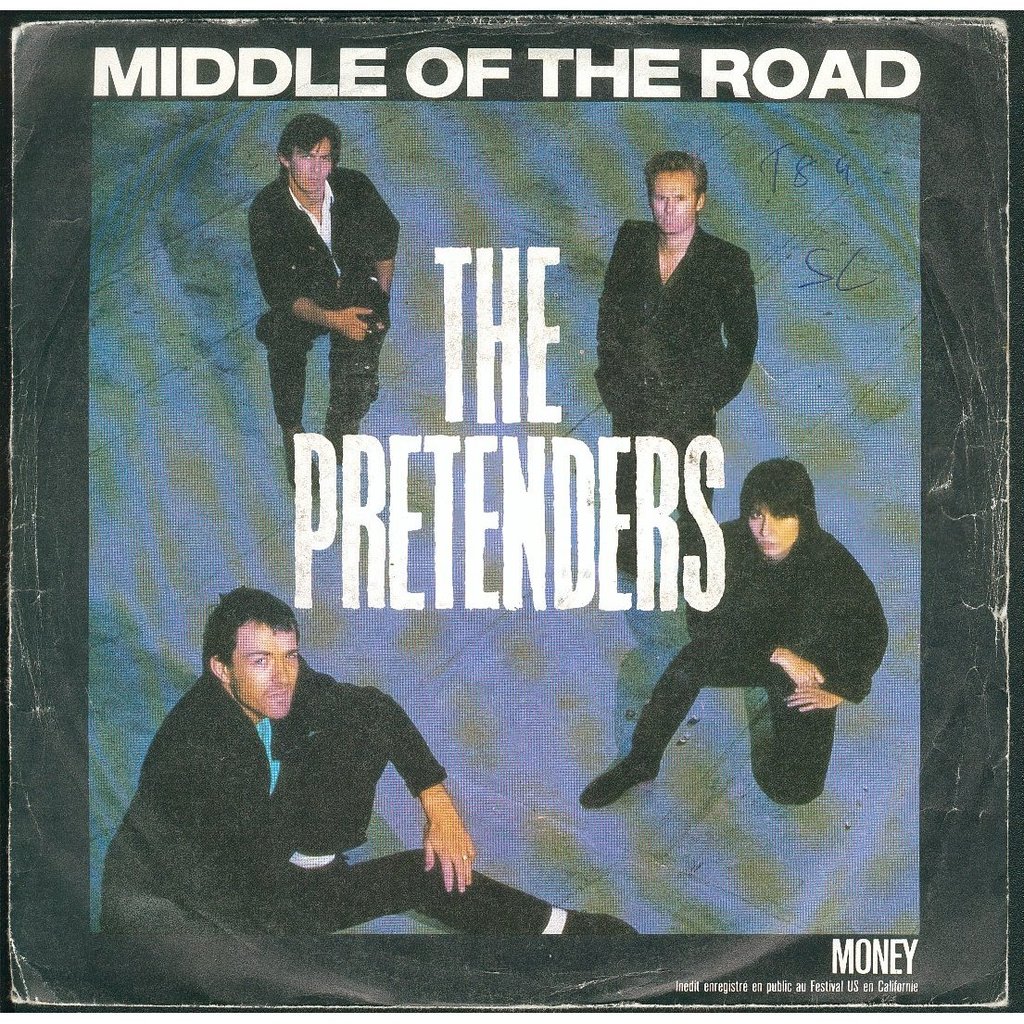
What strong song by Chrissie Hynde after two of her band members die and leaving Ray Davies.
She wrote this song, which finds her coping with transition and approaching middle age. Following the 1981 Pretenders album Pretenders II, two of the four band members – Pete Farndon and James Honeyman-Scott – died of drug overdoses, leaving just Hynde and drummer Martin Chambers, who remained the mainstays in the band amongst a rotating cast of guitarists and bass players.
This song peaked at #19 in the Billboard 100 in 1984.
From Songfacts
“Middle of the Road” is Chrissie Hynde’s credo. She told the Austin American-Statesman: “My personal discipline has been to try to stay in the middle, always, no matter what I’m doing. If I buy a jacket and it comes in three sizes, I want a medium. You have to learn how to temper yourself and hold back till you get to the end.”
Toward the end of the song, Hynde sings about the media hounding her. She has always tried to keep her private life to herself.
On this track, Hynde sings, “I got a kid, I’m 33.”
She was actually 32 when the song was released as a single in late 1983. In January that year, she had a daughter, Natalie, who she was raising as a single mother after leaving the father, Ray Davies from the Kinks.
A little after the 3-minute mark, Hynde lets loose one of the most famous yowls in rock. The feline inflection plays to the line, “I’m not the cat I used to be.”
Middle of the Road
The middle of the road is trying to find me I’m standing in the middle of life with my plans behind me Well I got a smile for everyone I meet As long as you don’t try dragging my bay Or dropping the bomb on my street
Now come on baby Get in the road Oh come on now In the middle of the road, yeah
In the middle of the road you see the darnedest things Like fat guys driving ’round in jeeps through the city Wearing big diamond rings and silk suits Past corrugated tin shacks full up with kids Oh man I don’t mean a Hampstead nursery When you own a big chunk of the bloody third world The babies just come with the scenery
Oh come on baby Get in the road Oh come on now In the middle of the road, yeah
The middle of the road is no private cul-de-sac I can’t get from the cab to the curb Without some little jerk on my back Don’t harass me, can’t you tell I’m going home, I’m tired as hell I’m not the cat I used to be I got a kid, I’m thirty-three
Baby, get in the road Come on now In the middle of the road Yeah
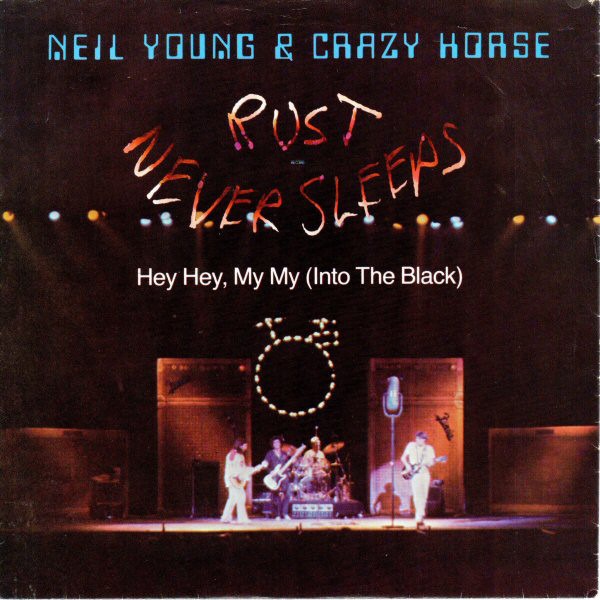
If death could be translated into a tone…Neil had it with his guitar when he played the Hey Hey, My My (Into The Black) intro. It’s one of the darkest, nastiest, ominous and distorted tones ever.
This is an alternate version of Young’s song “My My, Hey Hey (Out Of The Blue).” The lyrics are slightly different, and “Hey Hey, My My” is electric, while “My My, Hey Hey,” is acoustic. (At the bottom)
The two songs we are covering today are on Rust Never Sleeps. The album peaked at #8 on the Billboard album chart in 1979.
Ok… Now My My, Hey Hey (Out Of The Blue)… This song has the line (It’s better to burn out than to fade away) which I see is still being talked about to this day.
John Lennon expressed his disagreement with the “burn out or fade away” sentiment in this song: “I hate it. It’s better to fade away like an old soldier than to burn out. If he was talking about burning out like Sid Vicious, forget it. I don’t appreciate the worship of dead Sid Vicious or of dead James Dean or dead John Wayne. It’s the same thing. Making Sid Vicious a hero, Jim Morrison – it’s garbage to me. I worship the people who survive.”
Neil Young responded to the quote, saying that he was describing the paradoxical nature of the rock-and-roll lifestyle, not advocating it.
The line got responses from many rock stars and was included in Kurt Cobain’s suicide note.
From Songfacts
Young recorded this with the band Crazy Horse. It was the first time Young recorded with them since Zuma in 1975.
In the biography of Neil Young, Shakey by Jimmy McDonough, Neil points out that this song came about when he was jamming with the band Devo. The phrase, “Rust never sleeps” was uttered by Mark Mothersbaugh, and Neil, loving the impromptu line, acquired it.
The lyrics refer to “The King” and Johnny Rotten as rockers whose legacies live on. The king is Elvis Presley and Johnny Rotten was the lead singer of The Sex Pistols.
In The Complete Guide to the Music of Neil Young, Young explains why the line “rust never sleeps” appealed to him. “It relates to my career; the longer I keep on going the more I have to fight this corrosion. And now that’s gotten to be like the World Series for me. The competition’s there, whether I will corrode and eventually not be able to move anymore and just repeat myself until further notice or whether I will be able to expand and keep the corrosion down a little.”
This is the last song on the electric side of Rust Never Sleeps. The first side (first five songs on the CD) are acoustic.
The song has become a standby of Young’s live performances, being played at nearly every live show throughout his career, often as a closing song.
This was included on Live Rust, a concert album and video featuring Young playing against a backdrop of comically enormous amps and microphones.
Hey Hey, My My (Into the Black)
Hey hey, my my Rock and roll can never die There’s more to the picture Than meets the eye. Hey hey, my my.
Out of the blue and into the black You pay for this, but they give you that And once you’re gone, you can’t come back When you’re out of the blue and into the black.
The king is gone but he’s not forgotten This is the story of Johnny Rotten It’s better to burn out ’cause rust never sleeps The king is gone but he’s not forgotten.
Hey hey, my my Rock and roll can never die There’s more to the picture Than meets the eye.
My My, Hey Hey (Out Of The Blue)
My my, hey hey Rock and roll is here to stay It’s better to burn out Than to fade away My my, hey hey.
Out of the blue and into the black They give you this, but you pay for that And once you’re gone, you can never come back When you’re out of the blue and into the black.
The king is gone but he’s not forgotten This is the story of a johnny rotten It’s better to burn out than it is to rust The king is gone but he’s not forgotten.
Hey hey, my my Rock and roll can never die There’s more to the picture Than meets the eye. Hey hey, my my.
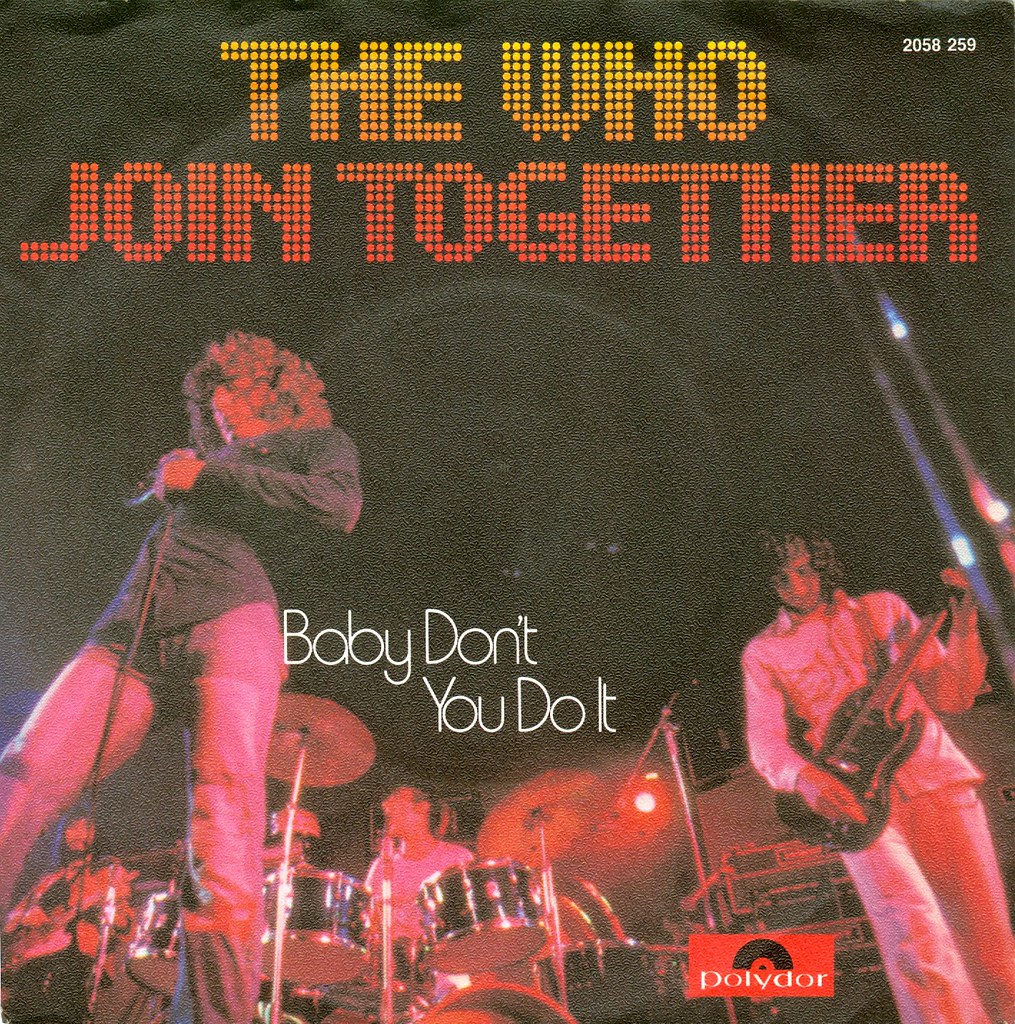
Great Who track that builds up through the song. The song peaked at #17 in the Billboard 100 in 1972.
Pete Townshend wrote the song in 1970 for his Lifehouse project, a Rock Opera that never came to be. Many of the songs Townshend wrote for Lifehouse ended up on the 1971 Who’s Next album. “Join Together” was recorded for the album, but didn’t make the cut. Instead, it was released as a single in the summer of 1972. Townshend has cited the song as one of his favorites, telling Melody Maker he thought it was “incredible” and was surprised the public didn’t like it as much as he did.
Roger Daltrey on Join Together: “I remember when Pete came up with ‘Join Together,’ he literally wrote it the night before we recorded it. I quite like it as a single, it’s got a good energy to it. But at that time I was still very doubtful about bringing in the synthesizer. I just felt that with a lot of songs we’d end up spending so much time creating these piddly one-note noises that it would’ve been better just doing it on a guitar. I mean, I’m a guitar man. I love the guitar; to me it’s the perfect rock instrument. I don’t think Pete did much with those sequencing things that he couldn’t have done on the guitar anyway.”
From Songfacts
A call to “join together with the band” seemed a little out of character for The Who, and especially Pete Townshend, who famously threatened to kill anyone who came on stage during their Woodstock performance. Taken less literally, it makes more sense as a plea to young people, urging them to unite and take action.
This was a live favorite for The Who. On their 1975-’76 tour, which included the largest indoor concert ever played to that point (70,000 at the Pontiac Silverdome in Michigan on December 6, 1975), they would play a slower version of the song as part of a jam that often included “Naked Eye,” “Roadrunner” and “My Generation.”
Pete Townshend created the intro using an ARP synthesizer, which he also used on “Who Are You?” Townshend, who was very good with keyboards, also used an organ on the track, a Lowrey Berkshire TBO-1. This instrument also shows up in “Baba O’Riley” and “Won’t Get Fooled Again.” When The Who performed the song live, the intro was played on a Jew’s harp by both lead singer Roger Daltrey and drummer Keith Moon.
Townshend also used two different harmonicas on the track: a chord harmonica and a bass harmonica (played live by bassist John Entwhistle).
In 2008, Nissan used this in commercials for their Maxima model. The concept was the practicality and sportiness joining together in the vehicle. In the ’00s, The Who made many licensing deals, opening the floodgates for their music to be used in movies, commercials and TV shows.
Join Together
When you hear this sound a-comin’ Hear the drummer drumming Won’t you join together with the band We don’t move in any ‘ticular direction And we don’t make no collections Won’t you join together with the band
Do you really think I care What you eat or what you wear Won’t you join together with the band There’s a million ways to laugh Ev’ry one’s a path Come on and join together with the band
Everybody join together Won’t you join together Come on and join together with the band We need to join together Come on join together Come on and join together with the band
You don’t have to play You can follow or lead the way Oh won’t you join together with the band We don’t know where we’re going But the season’s right for knowing Oh won’t you join together with the band
It’s the singer not the song That makes the music move along Oh won’t you join together with the band This is the biggest band you’ll find It’s as deep as it is wide Come on and join together with the band
Join together (Ev’rybody come on) join together Join together with the band Join together (Ev’rybody come on) join together Join together with the band
Playing For Change, a global nonprofit which helps provide music education to young people around the world has just released a collaborative version of Robbie Robertson‘s “The Weight,” the classic song recorded by The Band in 1968 for their debut album, Music From Big Pink
This song is what got me into the Allmans. Duane’s slide in the intro is all I needed to hear. The song was written by Blind Willie McTell who recorded it in 1928.
The Allman’s released it in 1971 on the Fillmore East Album.
From Gregg’s book…In around1967-68 Gregg Allman had upset his brother Duane and then Duane caught a cold or flu.
Gregg brought Duane a Taj Mahal album that included this song…this was before the Allman Brothters was formed. He bought Duane some Coricidin medicine for his cold and Duane had never played slide before…he took the medicine out of the bottle and used it for a slide…the rest is history.
Gregg Allman: So he kissed me on the cheek, and he said, “Man, that record you brought me is out of sight. There’s a guy called Jesse Ed Davis on there, this Indian dude, and he plays guitar with a damn wine bottle. Dig this.” And then I looked on the table and all these little red pills, the Coricidin pills, were on the table. He had washed the label off that pill bottle, poured all the pills out. He put on that Taj Mahal record, with Jesse Ed Davis playing slide on “Statesboro Blues,” and starting playing along with it. When I’d left those pills by his door, he hadn’t known how to play slide. From the moment that Duane put that Coricidin bottle on his ring finger, he was just a natural. Looking back on it, I think that learning to play slide was a changing moment in his life, because it was like he was back in his childhood—or maybe not his childhood, because it never seemed to me like Duane was a child, so it was more like going back to his first days of playing the guitar. He took to the slide instantly, and mastered it very quickly. He practiced for hours and hours at a time, playing that thing with a passion—just like he did when he first learned to play the guitar.
From Songfacts
This was played in sets by Hour Glass, one of the first bands Duane and Gregg Allman formed.
The band performed this at Duane Allman’s funeral, with Dickey Betts playing Duane’s guitar.
After Duane’s death, Betts played the slide guitar on this at concerts. He was reluctant to do so because he did not want to compete with Allman’s legend.
A previously unreleased studio version appears on their 1989 5-disk box set Dreams.
At the end of Duane Allman’s guitar solo, he hit an off-key note that his brother Gregg called the “note from hell.” The song made the album warts and all, as these things happen during live performances.
Statesboro Blues
Wake up momma, turn your lamp down low Wake up momma, turn your lamp down low You got no nerve baby, to turn Uncle John from your door
I woke up this morning, I had them Statesboro Blues I woke up this morning, had them Statesboro Blues Well, I looked over in the corner, and Grandpa seemed to have them too
Well my momma died and left me My poppa died and left me I ain’t good looking baby Want someone sweet and kind
I’m goin’ to the country, baby do you want to go? But if you can’t make it baby, your sister Lucille said she wanna go
I love that woman, better than any woman I’ve ever seen Well, I love that woman, better than any woman I’ve ever seen Well, now, she treat me like a king, yeah, yeah, yeah I treat her like a doggone queen
Wake up momma, turn your lamp down low Wake up momma, turn your lamp down low You got no nerve baby, to turn Uncle John from your door
I remember this series in the ’70s but I didn’t know much about Star Trek at that time. I started to watch the series a couple of years ago and it is really good. They were able to have more creatures and effects than the original series because of being limited in the effects they could use in the sixties with live-action.
Star Trek: The Animated Series by Filmation premiered in 1973 as a Saturday morning cartoon – four years after The Original Series’ final season. The series only produced 22 episodes and featured characters voiced by their original actors. It was the first Star Trek series to win an Emmy Award. It would run from 1973-1974
Gene Roddenberry did have full creative control over the series. Not only were the original members involved but the show introduced new crew members with a few alien ones.
The cartoon featured the first appearance of the Holodeck, which would later be used in Star Trek: The Next Generation.
One episode gave fans a deeper look into Spock’s troubled childhood, where he’s bullied for not being a full-blooded Vulcan. This episode’s story was so compelling that decades later filmmaker J.J. Abrams used the same details about Spock for his 2009 movie reboot.
As if I needed another reason to admire Leonard Nimoy…from wiki: Filmation was only going to use the voices of William Shatner, Leonard Nimoy, DeForest Kelley, Doohan and Barrett. Doohan and Barrett would also perform the voices of Sulu and Uhura. Nimoy refused to voice Spock in the series unless Nichelle Nichols and George Takei were added to the cast, claiming that Sulu and Uhura were proof of the ethnic diversity of the 23rd century and should not be recast. Nimoy also took this stand as a matter of principle, as he knew of the financial troubles many of his Star Trek co-stars were facing after the cancellation of the series.
Walter Koenig was the only original member not included because of money but because of Nimoy…the show did buy a script from Koenig so he would be paid also.
If you are a Star Trek fan you will enjoy this. Youtube has some complete episodes if you want to search. Amazon also has the series on DVD.
This song peaked at #34 in the Billboard 100 in 1981. The album There Goes the Neighborhood peaked at #20 in 1981.
This song began as an instrumental track written by Kenny Passarelli when he was the bass player in Joe’s band Barnstorm, which was active from 1972-1974. Barnstorm never released it, but Walsh and Passarelli worked it up for Walsh’s first solo album, The Smoker You Drink, the Player You Get, in 1973, with Walsh adding the lyrics…but it didn’t make it on the album.
Passarelli shopped it around, pitching it to Elton John and Hall and Oates. When Walsh was working on this album, he and Passarelli worked with the song again and it was released.
From Songfacts
Life’s been good to Joe Walsh, but what’s it all about? Sometimes it seems like life is just an illusion, and just when you start to comprehend it, it hits you right between the eyes.
Many musicians of his era looked to gurus or other zen masters to figure it all out, but Walsh seems to have sorted it out in this song, where he concludes that letting it all get to you is a waste of your day.
The Mariachi trumpets, played by the song’s co-writer Kenny Passarelli in what Walsh described as “a drunken stupor,” are nonsensical in a way that suits the song perfectly. Why are they there? Well, why are any of us here?
The phrase “a life of illusion” was used three years earlier in the title track to the film Grease, where Frankie Valli sings:
This is the life of illusion
Wrapped up in trouble
Laced with confusion
That song was written by Barry Gibb of the Bee Gees.
This was featured in the opening credits of the 2005 movie The 40 Year Old Virgin. It also appears in the 2010 movie Grown Ups and in the 2010 CSI: Miami episode “L.A.”
Life Of Illusion
Sometimes, I can’t help but feeling that I’m Living a life of illusion And oh, why can’t we let it be And see through the hole in this wall of confusion I just can’t help but feeling I’m living a life of Illusion
Pow, right between the eyes Oh how nature loves her little surprises Wow, it all seems so logical now It’s just one of her better disguises And it comes with no warning, nature loves her little surprises Continual crisis
Hey, don’t you know it’s a waste of your day Caught up in endless solutions That have no meaning Just another hunch, based upon jumping conclusions Backed up against a wall of confusion Caught up in endless solutions Living a life of illusion
Yeah when you call my name, I salivate like a Pavlov dog…One of the raunchiest riffs around. Combine that with the lyrics and you have a great little rock song. This is the Stones at the top of their game.
This song was the B side to Brown Sugar. Not a bad deal for your money. It’s another great song off of the Sticky Fingers LP. Here is a review of Sticky Fingers at Aphoristic’s site.
Below Andy Johns talks about the importance of Keith Richards…no matter if he was tardy a few times.
Andy Johns engineer: When we were doing “Bitch,” Keith was very late. Jagger and Mick Taylor had been playing the song without him and it didn’t sound very good. I walked out of the kitchen and he was sitting on the floor with no shoes, eating a bowl of cereal. Suddenly he said, Oi, Andy! Give me that guitar. I handed him his clear Dan Armstrong Plexiglass guitar, he put it on, kicked the song up in tempo, and just put the vibe right on it. Instantly, it went from being this laconic mess into a real groove. And I thought, Wow. THAT’S what he does
Bitch was written by Mick Jagger and Keith Richards, “Bitch” was recorded during October 1970 at London’s Olympic Studios, and at Stargroves utilizing the Rolling Stones Mobile studio.
From Songfacts
Love is the “bitch,” not any specific woman. Mick Jagger had many relationships he could base this on, including his breakup with Marianne Faithfull. He broke up with her after she tried to commit suicide while they were in Australia in late 1969 (Mick was filming Ned Kelly). As soon as Marianne recovered, Mick dumped her.
The Stones recorded this song, and many others on the album, at the Stargroves estate in Hampshire, England, using their mobile recording unit manned by engineer Andy Johns.
Despite (or maybe because of) the rather provocative title, this became one of the more popular Rolling Stones songs, often appearing in their setlists. It wasn’t released as a single but got plenty of play on rock radio.
In 1974, Elton John broke the “bitch” barrier on pop radio with “The Bitch Is Back,” which went to #4 in the US.
Along with “Under My Thumb,” this didn’t help the Stones’ image with women’s groups.
The album cover was designed by Andy Warhol. It was a close-up photo of a man in a pair of jeans complete with an actual zipper. The zipper caused problems in shipment because it scratched the record. They figured out that if they opened the zipper before shipment, it did minimal damage.
Speaking with Rolling Stone, Keith Richards said: “It comes off pretty smooth, but it’s quite tricky. There’s an interesting bridge you have to watch out for. Otherwise, it’s a straightforward rock and soul that we love. It’s Charlie Watts’ meat and potatoes.”
This features Bobby Keys on sax and Jim Price on trumpet. They provided horns on albums and tours for The Stones in the early ’70s.
The Goo Goo Dolls covered this in 1997 on the compilation album No Alternative.
The album title Sticky Fingers refers to the aptitude of a person who is likely to steal. It went well with the lawless image The Stones put forward.
Bitch
Feeling so tired, can’t understand it Just had a fortnight’s sleep I’m feeling so tired, I’m so distracted Ain’t touched a thing all week
I’m feeling drunk, juiced up and sloppy Ain’t touched a drink all night I’m feeling hungry, can’t see the reason Just ate a horse meat pie
Yeah when you call my name I salivate like a Pavlov dog Yeah when you lay me out My heart is beating louder than a big bass drum, alright
Yeah, you got to mix it child You got to fix it must be love It’s a bitch, yeah You got to mix it child You got to fix it but love It’s a bitch, alright
Sometimes I’m sexy, move like a stud Like kicking the stall all night Sometimes I’m so shy, got to be worked on Don’t have no bark or bite, alright
Yeah when you call my name I salivate like a Pavlov dog Yeah when you lay me out My heart is bumpin’ louder than a big bass drum, alright
I said hey, yeah I feel alright now Got to be a Hey, I feel alright now Hey hey hey Hey hey yeah Hey hey hey Hey hey yeah Hey hey hey Hey hey yeah Hey hey hey Hey hey yeah Hey hey hey
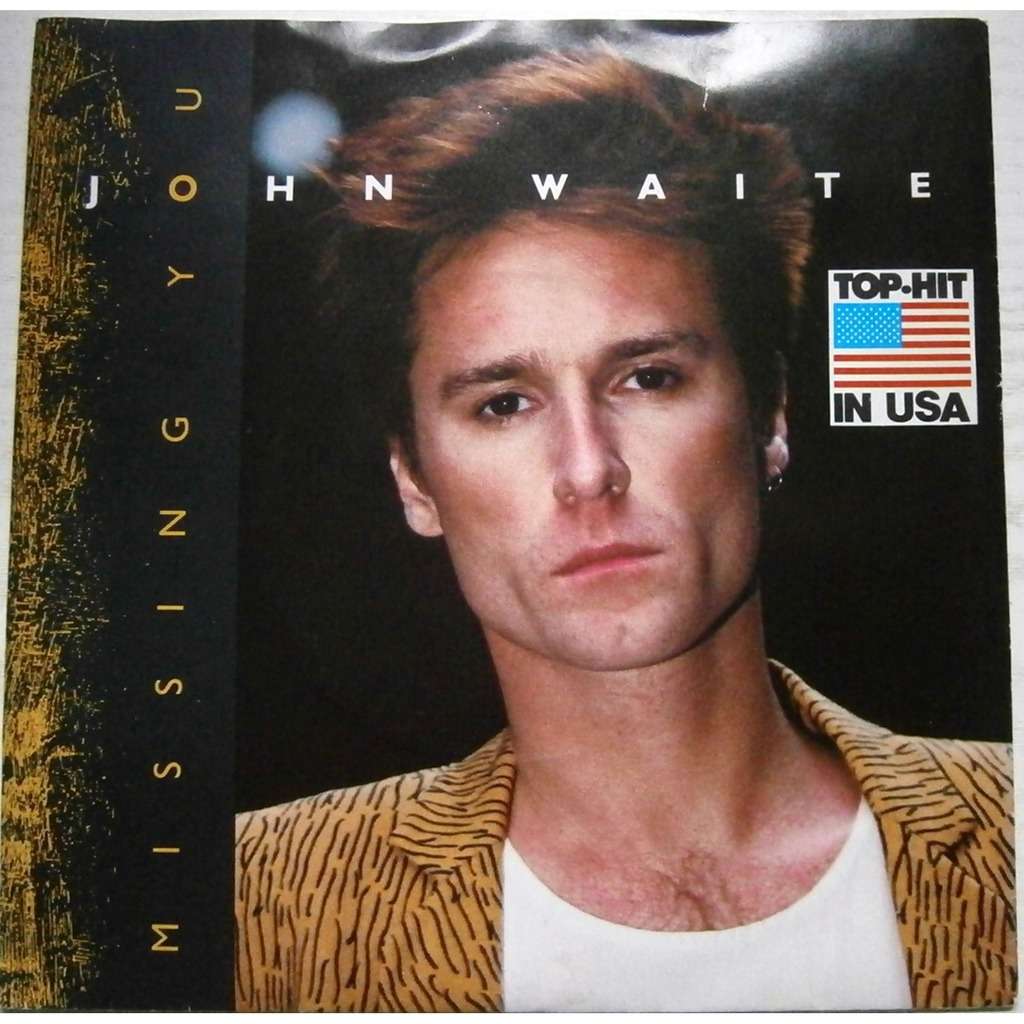
John Waite was inspired by Glen Campbell’s Wichita Lineman while writing this song. The song peaked at #1 in the Billboard 100, #1 in Canada, #9 in the UK and #18 in New Zealand in 1984.
The songwriters Mark Leonard and Charles Sandford wrote the music for this song. Sandford also wrote the Stevie Nicks hit “Talk To Me” and co-wrote “What Kind Of Man Would I Be?” for Chicago. Leonard wrote the music for the 1986 movie Back To School and also co-wrote “Let Me Be The One,” which was recorded by Terri Nunn. John Waite wrote the lyrics. He was going through troubles with his wife and they soon would get divorced.
John Waite: I was getting divorced. I was trying to get home because my marriage was in genuine trouble – everything was wrong and it had been wrong for a while. I’d met someone in New York City when I was making my first solo album. I was alone and I was friends with another girl I met. So Missing You was essentially about three different women, I think, looking back on it. I was singing about New York, and distance, the caving in of my marriage, and the options that I had. It was bittersweet – it was about the end of my marriage and the beginning of something new. Although, when I was singing ‘I ain’t missing you’, it was denial too.
From Songfacts
This song came at a very emotional time for Waite, who lays down his burdens in his sentimental lyrics and passionate vocal performance. In our interview with John Waite, he explained that the song was about a phone call.
Waite got married in his native England before moving to New York, where he recorded his first solo album, Ignition, which was released in 1984. The album was a disappointment, and after some squabbles with his record company (Chrysalis), he returned to England and settled into married life. After extricating from his contract, he signed a new deal with EMI and returned to New York, leaving his wife behind while he made his second album, No Brakes.
“My wife was a long way away,” Waite said in a Songfacts interview. “There were quite a few women in my life at the time, and it all came sort of floating to the top.”
Waite’s feelings poured out of him in the song – on one level, he missed his wife dearly, but on a more superficial plane he didn’t miss her at all, which is what he sang on the refrain: “I ain’t missing you at all.”
The song encapsulates the disconsolation that comes with long distance love. Waite and his wife would later divorce.
One of the more memorable parts of this song happened spontaneously. Said Waite: “I had no idea I was going to sing, ‘Missing you, since you’ve been gone away, I ain’t missing you no matter what my friends say.’ I had no idea I was going to sing that, and when it came out, it floored me. I stood back from the mic, and I thought, ‘F–k it. Number 1.’ I just knew. I just knew in my heart that it was that good.”
Tina Turner took this song to #12 in the UK when she recorded it on her 1996 album Wildest Dreams. Around the same time, the soul singer Millie Jackson also recorded the song, but Turner released her version first. Jackson told us: “I recorded ‘Missing You’ And I was all excited about it, it was gonna be my next single, and the guys at Muscle Shoals said, ‘Boy you got the song out quick! I heard it at a truck stop.’ And I’m trying to figure out how in the world did they hear my song at a truck stop when it won’t be out for two weeks. And of course it was Tina Turner and we had to pull the single and come back with a different one.”
John Waite was the lead singer of a group called the Babys, whose 1978 song “Every Time I Think Of You” reached #13 in the US. Waite cribbed a lyric from that song (which was written by the songwriters Jack Conrad and Ray Kennedy) to get him started on “Missing You.” Compare the opening lyrics to these songs:
“Every Time I Think Of You” – “Every time I think of you, it always turns out good.” “Missing You” – “Every time I think of you, I always catch my breath.”
Once he had the first line, the rest of the lyrics flowed downhill, and the rest of it was written in about 10 minutes. Waite told Songfacts: “I sang the whole first verse, bridge, and chorus without stopping. Then I had to stop, I was so overwhelmed. I stood back from the mic and I couldn’t speak. Then I just rolled the tape again and got on with it.”
Some of the symbolism in this song was inspired by Glen Campbell’s “Wichita Lineman” and Free’s “Catch A Train.” Both songs depict lonely scenarios far from a loved one.
The song was a last-minute addition to the album, but Waite had no trouble convincing his crew that it needed to be on the tracklist. “I took the tape down to the guys in the studio who were mixing, thinking the record was finished, and I knew it wasn’t, since we didn’t have ‘Missing You,'” he told us. “I played it in the control room and everybody stopped talking. It had that effect on people from the word go. It was one of those songs that defined a decade, really. It was one of the biggest. I think it’s been played about 9, 10 million times on American radio – it’s a huge thing.”
The video was in hot rotation on MTV, which helped the song climb to #1 in the US. In the clip, Waite gives a tortured performance, but what he was feeling at the time was more anxiety than heartbreak. “You can tell how shy I was at the time,” he told us. “I’m trying to sing this song and sort of look at the camera and then not look at the camera. I’m embarrassed, you know. I mean, it’s okay being on stage, because you’re in some sort of persona. But being filmed was a new experience for me on that level. I suppose it was kind of charming. But there was a million places I would rather be than being filmed at that point in my life.”
Kort Falkenberg III, who also did Waite’s video for “Change,” directed the clip. It was shot in downtown Los Angeles near Pershing Square. “The biggest thing I remember about ‘Missing You’ is that the night before I went down to Let It Rock, which was a clothes store on Melrose Avenue,” said Waite. “I bought a Johnson suit, this black two-piece suit from London that was a beautiful suit. Tiny. I was very thin at the time. And then I went and had all my hair shaved off. I thought, ‘If I’m going to do this, I’m going to go in whole hog, you know. I’m just going to do it flat out European.’
I showed up with a black suit and a crew cut, and it worked. I do everything on instinct, basically, and half of the time it’s a bullseye.”
Waite performed this on the short-lived ABC TV series Paper Dolls in 1984.
This was used in second episode of Miami Vice, “Heart of Darkness,” which aired September 28, 1984. At the time, it was the #1 song in America, landing at the top on September 22. Miami Vice spent big bucks on music and used many contemporary songs throughout the series’ five-year run. Exposure on the show also helped the artists because the show was undeniably cool. Phil Collins got the biggest boost when “In The Air Tonight” featured in the first episode.
Missing You
Everytime I think of you I always catch my breath And I’m still standing here And you’re miles away And I’m wonderin’ why you left
And there’s a storm that’s raging Through my frozen heart tonight
I hear your name in certain circles And it always makes me smile I spend my time thinkin’ about you And it’s almost driving me wild
And there’s a heart that’s breaking Down this long distance line tonight I ain’t missing you at all (Missing you) Since you’ve been gone away (Missing you) I ain’t missing you (Missing you) No matter what I might say (Missing you)
There’s a message in the wire And I’m sending you this signal tonight You don’t know how desperate I’ve become And it looks like I’m losing this fight In your world I have no meaning Though I’m trying hard to understand
And it’s my heart that’s breaking Down this long distance line tonight I ain’t missing you at all (Missing you) Since you’ve been gone away (Missing you) Oh hey, I ain’t missing you (Missing you) No matter what my friends say (Missing you)
And there’s a message that I’m sending out Like a telegraph to your soul And if I can’t bridge this distance Stop this heartbreak overload I ain’t missing you at all (Missing you) Since you’ve been gone away (Missing you) I ain’t missing you (Missing you) No matter what my friends say (Missing you)
I ain’t missing you (Missing you) I ain’t missing you, I can’t lie to myself (Missing you)
And there’s a storm that’s raging Through my frozen heart tonight I ain’t missing you at all (Missing you) Since you’ve been gone away (Missing you) I ain’t missing you (Missing you) No matter what my friends say (Missing you)
Ain’t missing you I ain’t missing you I ain’t missing you, I can’t lie to myself Ain’t missing you I ain’t missing you I ain’t missing you I ain’t missing you I ain’t missing you I ain’t missing you Ain’t missing you, oh no
No matter what my friends might say I ain’t missing you
This song is a great little rocker off of The River. This is one of many early Springsteen songs featuring cars. Some others were “Thunder Road,” “Backstreets,” and “Racing In The Street.” Bruce used the Cadillac image again in 1984 on “Pink Cadillac.”
The album The River peaked at #1 in the Billboard 100 in 1980.
Springsteen used Cadillac Ranch as a metaphor for the coming of death.
There is a real Cadillac Ranch.
In 1974 along Route 66 west of Amarillo, Texas, Cadillac Ranch was invented and built by a group of art-hippies from San Francisco. They called themselves The Ant Farm, and their silent partner was Amarillo billionaire Stanley Marsh 3. He wanted a piece of public art that would baffle the locals, and the hippies came up with a tribute to the evolution of the Cadillac tail fin. Ten Caddies were driven into one of Stanley Marsh 3’s fields, then half-buried, nose-down, in the dirt
From Songfacts
The Cadillac Ranch is a collection of 10 Cadillacs buried hood-first in a wheat field near Amarillo, Texas. Visitors are allowed to add graffiti to the cars, which are considered works of art.
Springsteen wrote this to energize his live shows and balance off the ballads on The River.
A live favorite, it is included on the box set Live 1975-1985.
Junior Johnson is mentioned in the second verse. He was a NASCAR racer in the ’50s and early ’60s before becoming a championship car owner. He won the second Daytona 500 in 1960 and was one of the first people to discover the drafting method of racing at the super speedways.
Cars were very important growing up in New Jersey. Springsteen’s first car was a ’57 Chevy with orange flames painted on the hood.
A photo in the program for the Born In The U.S.A. tour shows Springsteen at the Cadillac Ranch.
Cadillac Ranch
Well there she sits buddy just a-gleaming in the sun There to greet a working man when his day is done I’m gonna pack my pa and I’m gonna pack my aunt I’m gonna take them down to the Cadillac ranch
Eldorado fins, whitewalls and skirts Rides just like a little bit of heaven here on earth Well buddy when I die throw my body in the back And drive me to the junkyard in my Cadillac
Cadillac, Cadillac Long and dark shiny and black Open up your engines let ’em roar Tearing up the highway like a big old dinosaur
James Dean in that mercury forty-nine Junior Johnson runnin’ through the woods of Carolina Even Burt Reynolds in that black Trans Am All gonna meet down at the Cadillac ranch
Cadillac, Cadillac Long and dark shiny and black Open up your engines let ’em roar Tearing up the highway like a big old dinosaur
Hey little girlie in the blue jeans so tight Drivin’ alone through the Wisconsin night You’re my last love, baby you’re my last chance Don’t let ’em take me to the Cadillac ranch
Cadillac, Cadillac Long and dark shiny and black Pulled up to my house today Came and took my little girl away










 PowerPop... An Eclectic Collection of Pop Culture