One of my favorite John Mellencamp songs. Back when it was released I liked it because it was a catchy song. Now I like it more because I can relate to it about growing up. I will admit though…I always thought he said “That’s when a spoke was a spoke“… I thought what? Must be some crazy Indiana thing….then I thought…no that can’t be right…it must be “That’s when a smoke was a smoke“….Wrong again…it is… “That’s when a sport was a sport.”
The prominence of the accordion and violin in this are usually not associated with Rock and Roll but it makes the song sound fresh. The song peaked at #8 in the Billboard 100, #5 in Canada, and #4 in New Zealand.
It was on the album The Lonesome Jubilee released in 1987. The album peaked at #6 in the Billboard Album Chart in 1987.
Cherry Bomb
Well I lived on the outskirts of town In an eight room farmhouse, baby When my brothers and friends were around There was always somethin’ doin’ Had me a couple of real nice girlfriends Stopped by to see me every once in a while When I think back about those days All I can do is sit and smile
That’s when a sport was a sport And groovin’ was groovin’ And dancin’ meant everything We were young and we were improvin’ Laughin’, laughin’ with our friends Holdin’ hands meant somethin’, baby Outside the club “Cherry Bomb” Our hearts were really thumpin’ Say yeah yeah yeah Say yeah yeah yeah
The winter days they last forever But the weekends went by so quick Went ridin’ around this little country town We were goin’ nuts, girl, out in the sticks One night, me with my big mouth A couple guys had to put me in my place When I see those guys these days We just laugh and say do you remember when
That’s when a sport was a sport And groovin’ was groovin’ And dancin’ meant everything We were young and we were improvin’ Laughin’, laughin’ with our friends Holdin’ hands meant somethin’, baby Outside the club “Cherry Bomb” Our hearts were really thumpin’ Say yeah yeah yeah Say yeah yeah yeah
Say yeah yeah yeah Say yeah yeah yeah
Seventeen has turned thirty-five I’m surprised that we’re still livin’ If we’ve done any wrong I hope that we’re forgiven Got a few kids of my own And some days I still don’t know what to do I hope that they’re not laughing too loud When they hear me talkin’ Like this to you
That’s when a sport was a sport And groovin’ was groovin’ And dancin’ meant everything We were young and we were improvin’ Laughin’, laughin’ with our friends Holdin’ hands meant so much, baby Outside the club “Cherry Bomb” Our hearts were really thumpin’ Say yeah yeah yeah Say yeah yeah yeah
It doesn’t get much more seventies than this song.
This was released as the first single from the album, but it went nowhere. After Frankenstein went to #1, “Free Ride” was released again, this time going to #14 in America. The song lived on as a radio favorite.
Dan Hartman is credited as the only songwriter on this track even though Edgar Winter made some contributions. Winter didn’t get greedy, knowing that Hartman made some contributions to tracks that were credited to Edgar alone.
Free Ride is a song included in the Edgar Winter Group album They Only Come Out At Night in 1972. The initial riff is played by Dan Hartman who also sings lead on the song.
From Songfacts
The “free ride” can be literally interpreted as a road trip, but it’s really about a spiritual journey. The song was written and sung by Dan Hartman, who had recently joined the Edgar Winter Group, but Winter added the lyrics:
We got to do better, it’s time to begin
You know all the answers must come from within
The song offers salvation of sorts, with Hartman offering us direction when we don’t know where to turn:
So I’ve come here to give you a hand
And lead you into the promised land
The song isn’t an endorsement of a specific religion, but a call to look inside ourselves for answers. Winter was trying to make that message more clear in the lyrics he added.
Edgar Winter played Woodstock before he even released an album. That’s because his older brother, Johnny Winter, was a celebrated blues guitarist who used Edgar in his band. When Edgar struck out on his own in 1970, it was with a horn-heavy band he assembled for his first album. His next two albums were with a group he called White Trash, which had more jazz leanings. In 1972, he started clean with a new band: the Edgar Winter Group. Dan Hartman, who was in a Pennsylvania band called the Legends, was his first recruit. Hartman had already written “Free Ride” (which is one of the reasons Winter wanted him), so it was one of the first songs this new group recorded.
Hartman played guitar on the album version of the song, with Randy Jo Hobbs on bass and Johnny Badanjek on drums (when the group fully formed, it was with Ronnie Montrose on guitar, Chuck Ruff on drums, and Hartman on bass). Speaking with Songfacts, producer Rick Derringer said that on the single version, which they recorded later, he played lead guitar.
Winter was adept at keyboard, synthesizer, saxophone and drums. On “Free Ride,” he played a Hohner clavinet, which is what Stevie Wonder played on Superstition. Winter generated the wind sounds with his new toy: an ARP 2600 synthesizer, the instrument featured on the album’s big hit, “Frankenstein.”
This was produced by Rick Derringer, who produced the entire They Only Come Out at Night as well as Winter’s previous two albums. When Ronnie Montrose formed his own band in 1973, Derringer stepped in as guitarist for the Edgar Winter Group.
Free Ride
The mountain is high, the valley is low And you’re confused on which way to go So I’ve come here to give you a hand And lead you into the promised land, so
Come on and take a free ride (free ride) Come on and stand here by my side Come on and take a free ride
All over the country, I’ve seen it the same Nobody’s winning at this kind of game We gotta do better, it’s time to begin You know all the answers must come from within, so
Come on and take a free ride (free ride) Come on and stand here by my side Come on and take a free ride
Yeah, yeah, yeah, yeah
Ooh, ooh, ooh Ooh, ooh, ooh Ooh, ooh, free ride
Come on and take a free ride Yeah, yeah, yeah, yeah Come on and take a free ride Yeah, yeah, yeah, yeah
Come on and take a free ride Yeah, yeah, yeah, yeah Come on and take a free ride Yeah, yeah, yeah, yeah
Come on and take a free ride Yeah, yeah, yeah, yeah Come on and take a free ride Yeah, yeah, yeah, yeah
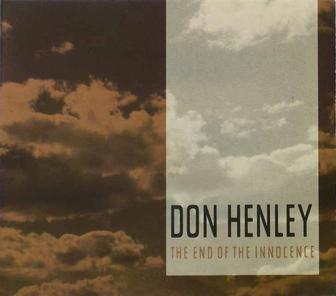
Bruce Hornsby played piano on this and wrote this with Henley. I did like Don Henley’s solo albums in the 80s. I had this album and I wore it out in the late 80s. This one is probably my favorite Henley album. I prefer his solo music to the Eagles.
When the Eagles broke up in 1980, Joe Walsh (loved The Confessor ) and Glenn Frey also launched solo careers. They all did fairly well, but Henley was the most successful. The Eagles re-formed in 1994 for their Hell Freezes Over tour.
The End of the Innocence peaked at #8 in the Billboard 100, #3 in Canada, and #48 in the UK.
The End of the Innocence album peaked at #8 in the Billboard Album Charts.
The End Of The Innocence was Henley’s third solo album. He didn’t release another for 11 years.
From Songfacts
The “Tired old man that we elected king” is a reference to US president Ronald Reagan. There are a lot of political overtones in the song, as Henley strongly opposed Reagan’s agenda.
The line about “Beating ploughshares into swords” is a distortion of Isaiah 2:4 in which Isaiah describes the end times: “And he shall judge among the nations, and shall rebuke many people: and they shall beat their swords into plowshares, and their spears into pruninghooks: nation shall not lift up sword against nation, neither shall they learn war any more.”
The inversion of the words most likely hints at the decline of the number of family farms and the increase in US military power in the ’80s as a signal of the end times of innocence.
David Fincher directed the music video. Around this time, he was taking the form to a new level, with cinematic textures and storylines that would later appear in his films (The Game, Fight Club, The Girl with the Dragon Tattoo). Other videos he directed around this time include Madonna’s “Vogue” and Aerosmith’s “Janie’s Got A Gun.”
Bob Dylan often performed this on his 2002 US tour.
You can’t the get original video on youtube from Donny…he doesn’t allow it…so here is a live version.
The End of the Innocence
Remember when the days were long And rolled beneath a deep blue sky Didn’t have a care in the world With mommy and daddy standing by
When happily ever after fails And we’ve been poisoned by these fairy tales The lawyers dwell on small details Since daddy had to fly
But I know a place where we can go Still untouched by man We’ll sit and watch the clouds roll by And the tall grass wave in the wind
You can lay your head back on the ground And let your hair fall all around me Offer up your best defense But this is the end
This is the end of the innocence O’ beautiful, for spacious skies But now those skies are threatening They’re beating plowshares into swords
For this tired old man that we elected king Armchair warriors often fail And we’ve been poisoned by these fairy tales The lawyers clean up all details
Since daddy had to lie But I know a place where we can go And wash away this sin We’ll sit and watch the clouds roll by
And the tall grass wave in the wind Just lay your head back on the ground And let your hair spill all around me Offer up your best defense
But this is the end This is the end of the innocence Who knows how long this will last Now we’ve come so far, so fast
But, somewhere back there in the dust That same small town in each of us I need to remember this So baby give me just one kiss
And let me take a long last look Before we say good bye Just lay your head back on the ground And let your hair fall all around me
Offer up your best defense But this is the end This is the end of the innocence
A 1966 Mustang is what I think of when I hear this song. That was my first car in 1983. My mom foolishly got me what is now a classic car. Not a good car to give a 16-year-old. When I heard this song I knew Robert wasn’t in Zeppelin anymore. It was a smart thing to distance himself at the time.
What I remember the most is the guitar parts played by Robbie Blunt. I remember the licks he plays just as much as the words Plant sings. It’s a great song to listen to on a long car trip.
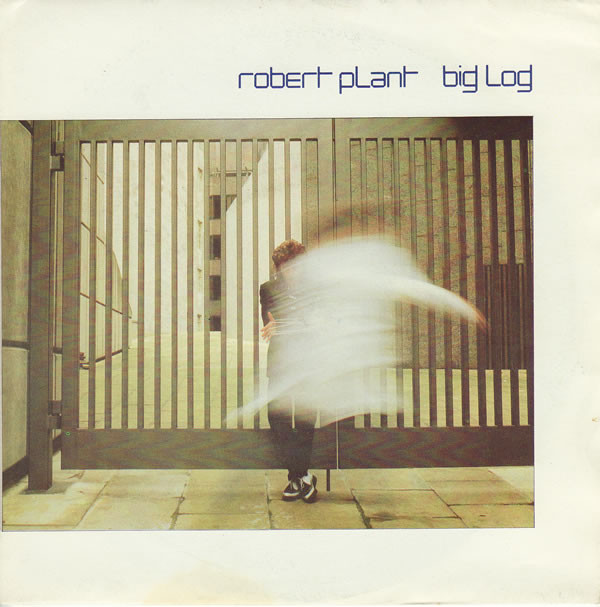
A Big Log is common lingo of tractor-trailer drivers. It is the book in which their road hours are logged, therefore the connection between the road and love and the countless hours we all log on both…
The song peaked at #20 in the Billboard 100, #23 in Canada, #11 in the UK, and #7 in New Zealand in 1983. The album was The Principle of Moments that peaked at #8 in the Billboard Album Chart, #7 in the UK, #1 in Canada, and #
Phil Collins played drums on this and 5 other tracks on the album. He also played drums on Plant’s previous album Pictures At Eleven.
From Songfacts
In the video, Plant’s classic car overheats at a desolate desert gas station, which causes him to muse upon lost love.
This was Robert Plant’s first hit as a solo artist after the break up of Led Zeppelin.
Some people know this song as “My Love Is In League With The Freeway.” The phrase “Big Log” does not appear in the lyrics.
The name “Big Log” is likely meaningless. Plant’s solo work (up until Now And Zen) and work with Led Zeppelin often featured songs with titles that had little or nothing to do with the lyrics. Also from The Principle Of Moments are the tracks “Messin’ With A Mekon,” “Horizontal Departure” and “Stranger Here… Than Over There.”
Big Log
My love is in league with the freeway It’s passion will rise as the cities fly by And the tail lights dissolve in the coming of night And the questions and thousands take flight
My love is miles in awaiting The eyes that just stare and the glance at the clock In the secret that burns and the pain that won’t stop And it’s fueled with the years
Leading me on (leading me on) Leading me down the road Driving me on (driving me on) Driving me down the road
My love is exceeding the limit Red eyed and fevered with the hum of the miles Distance and longing and my thoughts do collide Should I rest for a while and decide
Your love is cradled in knowing Eyes in the mirror still expecting their prey Sensing too well when the journey is done There is no turning back No There is no turning back
On the run
My love is in league With the freeway Oh with the freeway And the coming of the night time My love My love Is in league with the freeway
The “picture of you” Chrissie Hynde sings about is a picture she found in her wallet of Ray Davies, lead singer and songwriter of The Kinks. Hynde and Davies were a couple and had a daughter together. This song started off about him, but the meaning changed when Honeyman-Scott died.
The song turned into a tribute to James Honeyman-Scott, the Pretenders guitarist who died of a drug overdose in 1982 at age 26. Scott’s death was followed by bass player Pete Farndon’s 10 months later. Farndon had been kicked out of the band because of his drug problems and died of an overdose.
The song peaked at #5 in the Billboard 100, #5 in Canada, #14 in New Zealand, and #17 in the UK in 1983.
From Songfacts
This is a very emotional song. Chrissie Hynde would sometimes tear up when performing it.
A Chain Gang is a group of convicts who are chained together while they do manual labor, usually outside.
This was the first Pretenders single featuring Billy Bremner and Tony Butler, who replaced Farndon and Honeyman-Scott.
This was released as a single almost two years before the album came out.
Back On The Chain Gang
I found a picture of you, oh oh oh oh What hijacked my world that night To a place in the past We’ve been cast out of? Oh oh oh oh Now we’re back in the fight We’re back on the train Oh, back on the chain gang
A circumstance beyond our control, oh oh oh oh The phone, the TV and the news of the world Got in the house like a pigeon from hell, oh oh oh oh Threw sand in our eyes and descended like flies Put us back on the train Oh, back on the chain gang
The powers that be That force us to live like we do Bring me to my knees When I see what they’ve done to you But I’ll die as I stand here today Knowing that deep in my heart They’ll fall to ruin one day For making us part
I found a picture of you, oh oh oh oh Those were the happiest days of my life Like a break in the battle was your part, oh oh oh oh In the wretched life of a lonely heart Now we’re back on the train Oh, back on the chain gang
The Kinks are a band that I saw in 1983. Along with The Who and Paul McCartney they were among the best bands, I saw live.
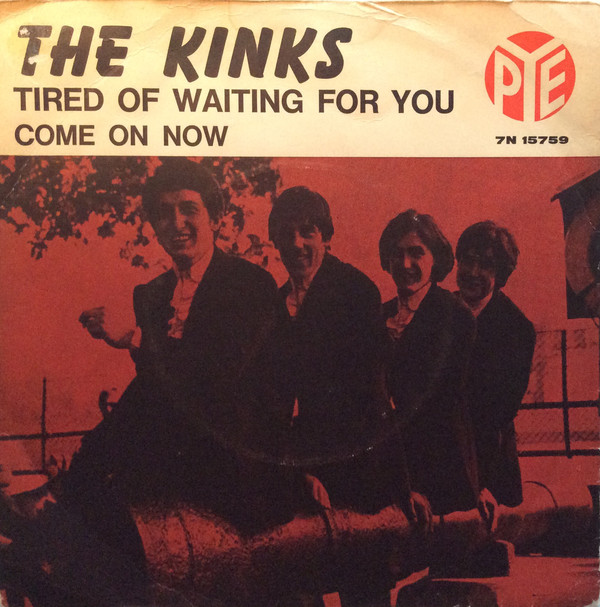
Kinks lead singer Ray Davies wrote this song while he was a student at Hornsey School of Art in London. Ray was running out of ideas, so he decided to record the song he had written in college. The group put down the backing track, but he couldn’t remember the words, so he went home and wrote them the next day on the train ride into the studio.
This was released as the first single from the album Kinda Kinks. “Tired of Waiting for You” was a hit, peaking at #6 in the Billboard 100, #1 in the UK, #3 in Canada in 1965.
Dave Davies:“The recording went well but there was something missing and it was my raunchy guitar sound. Ray and I were worried that putting that heavy-sounding guitar on top of a ponderous song might ruin it. Luckily it enhanced the recording, giving it a more cutting, emotional edge. In my opinion ‘Tired Of Waiting’ was the perfect pop record.”
From Songfacts
When the Kinks released their first album in 1964, they scored a huge hit with the Davies-penned “You Really Got Me,” which was followed by the sound-alike “All Day And All Of The Night.”
In this song, Ray Davies sings about a girl who has him under her spell. Problem is, she keeps stringing him along and it’s wearing him out. The vocal is suitably weary, lacking that adrenaline rush of their previous hits. This discontent would play out for real throughout 1965 as The Kinks were dispatched to one show after another, doing promotional appearances along the way. It quickly became clear that there was a great deal of animosity in the band and that they couldn’t keep up the pace for long.
Tired Of Waiting
So tired Tired of waiting Tired of waiting for you
So tired Tired of waiting Tired of waiting for you
I was a lonely soul I had nobody till I met you But you keep a-me waiting All of the time What can I do?
It’s your life And you can do what you want Do what you like But please don’t keep a-me waiting Please don’t keep a-me waiting
‘Cause I’m so tired Tired of waiting Tired of waiting for you
So tired Tired of waiting Tired of waiting for you
I was a lonely soul I had nobody till I met you But you keep a-me waiting All of the time What can I do?
It’s your life And you can do what you want Do what you like But please don’t keep a-me waiting Please don’t keep a-me waiting
‘Cause I’m so tired Tired of waiting Tired of waiting for you
So tired Tired of waiting Tired of waiting for you For you For you
The reason I like this song is caught in the intro. The guitar in this is a lot of fun. Unlike most Lynyrd Skynyrd songs this one was not partly written by Ronnie Van Zant. The new guitar player Steve Gaines wrote this before he joined them.
Gaines replaced Ed King as the band’s guitarist in 1976, but died in the 1977 plane crash that also claimed the lives of lead singer Ronnie Van Zant and Gaines’ sister Cassie, who was a backup singer for the group. This song provides a glimpse of songwriting and guitar talent.
Steve Gaines was a special talent. I personally believe he would have gone far in music outside of that band. There is guitar playing on Street Survivors that you never heard with that band before. Very sophisticated chord patterns and riffs with songs like “I Never Dreamed.”
This song was the B side to What’s Your Name.
From Songfacts
You won’t find diatribes on the complexities of interpersonal relationships in the Skynyrd catalog, but you will find simple explanations. This song is a great example.
Why do people get the blues? From digging what they can’t use. And if you want to hold on to a man, a good way to do it is through commitment. You only need to know a little about love – the rest you can guess.
This is a great example of Skynyrd guitarist Steve Gaines’ contributions to the band. He wrote the song himself, and also wrote or co-wrote three other songs on the album. as Van Zant sings about a guy who has a strong feeling that his girl is cheating on him.
Skynyrd guitarist Gary Rossington told Guitar School magazine, July 1993, that he’d never heard anybody, including the current guitarists in the band, play the picking on this song quite right – the way Steve Gaines did.
This is one of many Skynyrd songs that was never released as a single but endured as a classic track in their catalog. It earned lots of airplay on Classic Rock radio and became one of their most popular live songs, performed at most of their shows when they re-grouped after the plane crash.
Steve Gaines recorded this before he joined Lynyrd Skynyrd.
I Know A Little
Yes sir
Well the bigger the city, well the brighter the lights The bigger the dog, well the harder the bite I don’t know where you been last night But I think mama, you ain’t doin’ right
Say I know a little I know a little about it I know a little I know a little ’bout it I know a little ’bout love And baby I can guess the rest
Well now I don’t read that daily news ‘Cause it ain’t hard to figure Where people get the blues They can’t dig what they can’t use If they stick to themselves They’d be much less abused
Say I know a little Lord I do know a little about it I know a little I know a little ’bout it I know a little ’bout love Baby I can guess the rest Play me a little, oh yeah Yeah
Well if you want me to be your only man Said listen up mama, teach you all I can Do right baby, by your man Don’t worry mama, teach you all I can
Say I know a little Lord I do know a little about it I know a little I know a little ’bout it I know a little ’bout love Baby I can guess the rest Well I know a little ’bout love Baby I want your best
There are bands that are hard to tell apart from other bands…and then there are bands like Devo and The Talking Heads that sound like no one else.
Psycho Killer is a song from their 1977 album Talking Heads: 77. It was the only song from the album to appear on the Billboard charts, peaking at #92 in the Billboard 100.
Part of the chorus and the bridge are in French. The verse translates to “What I did, that evening, what she said, that evening fulfilling my hope I throw myself towards glory.” The chorus lyric “Qu’est-ce que c’est?” means “What is this?”
The lyrics were said to be inspired by the character Norman Bates in the movie Psycho.
David Byrne:“Chris and Tina helped me with some of the French stuff. I realized, ‘That holds up. That’s a song.’ I may have been inspired by other things when I was writing it, but I hadn’t heard anything quite like it before. I was also writing completely from the character’s point of view. We played it. People liked it. I thought, ‘Oh, I can do more.'”
From Songfacts
This was the result of lead singer David Byrne trying to write an Alice Cooper song, but it came out much more introspective. It ended up being about the thoughts of a murderer.
The “Fa Fa” part comes from an Otis Redding song called “Fa-Fa-Fa-Fa-Fa (Sad Song).” Redding and other Soul singers were a big influence on Talking Heads.
Byrne wrote this two years before it was recorded. It was Talking Heads’ first album.
Byrne never thought this would be a hit. He considered it a “silly song” at the time, and was surprised when it took off.
The Tom Tom Club, a group led by former Talking Heads Tina Weymouth and Chris Frantz, often plays this at their concerts with Tina singing the lead vocal.
This is the first song played in the Talking Heads movie Stop Making Sense.
An acoustic version was the flip side of the single.
This appears on the live albums Stop Making Sense and The Name Of This Band Is Talking Heads.
Artist to cover this song include Barenaked Ladies, Phish, Brand New, Local H and Velvet Revolver.
The 2017 Selena Gomez hit “Bad Liar” samples the bassline from this track. David Byrne has no problem with it. “I would have an issue if somebody took, say, ‘This Must Be The Place,’ which is a very personal love song,” he told Rolling Stone. “Other than that, yeah, repurpose the stuff.”
Psycho Killer
I can’t seem to face up to the facts I’m tense and nervous and I can’t relax I can’t sleep ’cause my bed’s on fire Don’t touch me I’m a real live wire
Psycho Killer Qu’est-ce que c’est Fa-fa-fa-fa-fa-fa-fa-fa-fa-far better Run run run run run run run away oh oh Psycho Killer Qu’est-ce que c’est Fa-fa-fa-fa-fa-fa-fa-fa-fa-far better Run, run, run, run, run, run, run, away oh oh oh Yeah yeah yeah yeah!
You start a conversation you can’t even finish it You’re talking a lot, but you’re not saying anything When I have nothing to say, my lips are sealed Say something once, why say it again?
Psycho Killer Qu’est-ce que c’est Fa-fa-fa-fa-fa-fa-fa-fa-fa-far better Run run run run run run run away oh oh oh Psycho Killer Qu’est-ce que c’est Fa-fa-fa-fa-fa-fa-fa-fa-fa-far better Run, run, run, run, run, run, run, away oh oh oh oh! Yeah yeah yeah yeah!
Ce que j’ai fais, ce soir la Ce qu’elle a dit, ce soir la Realisant mon espoir Je me lance, vers la gloire, OK Yeah yeah yeah yeah yeah yeah yeah yeah yeah yeah We are vain and we are blind I hate people when they’re not polite
Psycho Killer Qu’est-ce que c’est Fa-fa-fa-fa-fa-fa-fa-fa-fa-far better Run run run run run run run away oh oh oh Psycho Killer Qu’est-ce que c’est Fa-fa-fa-fa-fa-fa-fa-fa-fa-far better Run, run, run, run, run, run, run, away oh oh oh Yeah yeah yeah yeah oh!
After reading the John Entwistle biography I’ve been listening to the Who for the past week and a half. Tommy is not my favorite Who album…but the album does contain a lot of good songs. Tommy did make a huge mark in pop culture…a movie and Broadway play has been made from the story.
The riff is simple and powerful. A very good song that adds to Tommy. Like some of the other songs…I’m Free was written before Tommy was thought of but Pete fit what songs he had with the new ones to make the story.
Tommy was the breakthrough album for the Who in America. A concept album about a deaf, dumb, and blind boy who…you guessed it…loves pinball. On the album the Who’s sound is subdued but on tour, they presented it loud and aggressive as only the Who could be.
The album peaked at #4 in the Billboard Album Charts in 1970. I’m Free peaked at #37 in the Billboard 100 in 1969.
Pete Townshend: ‘I’m Free’ came from ‘Street Fighting Man.’ This has a weird time/shape and when I finally discovered how it went, I thought ‘well blimey, it can’t be that simple,’ but it was and it was a gas and I wanted to do it myself.
The guitar sound in this version sends shivers down my spine. Compare it to the album version below this one.
I’m Free
I’m free I’m free And freedom tastes of reality I’m free I’m free An’ I’m waiting for you to follow me
If I told you what it takes To reach the highest high You’d laugh and say ‘nothing’s that simple’ But you’ve been told many times before Messiahs pointed to the door And no one had the guts to leave the temple!
I’m free I’m free And freedom tastes of reality
I’m free I’m free An’ I’m waiting for you to follow me
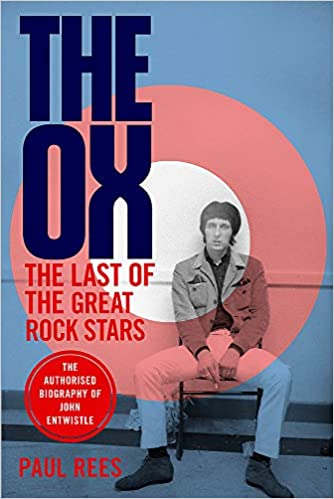
When I see the word “authorized” I get really skeptical that they will not tell the complete story. This one proved me wrong. John’s son Christopher had said that this book was going to be warts and all. He was correct in that. I was super excited to read this. In the past year, I re-read Pete Townshend’s autobiography, Roger Daltrey’s autobiography, and re-read Keith Moon’s biography by Tony Fletcher and to top it off the Kenney Jones biography.
John actually wrote 4 chapters himself in 1990 when he wanted to write his own book. He soon grew tired of it and just stored it away. Rees did manage to incorporate some of what he wrote that included stories about him and Moon I never heard. John Entwistle is the least written about of the four. Any info on him is nice and a lot of this was new to me. Rees goes over the highlights and you don’t get dragged down at any point. The only thing I didn’t like was…like Daltrey’s autobiography it’s short…only 320 pages long.
The book goes through the history of the Who that Who fans know but with a lot of anecdotes. I found out more about John’s life than I ever knew. You see where he developed his black humor and he was probably the best pure musician in that band. I would recommend this book to any rock music fan. You get some funny stories also…
One about the Who opening up for the Beatles and listening to them through monitors in the dressing room rolling on the floor laughing hearing The Beatles sing obscene words to their songs “I Want To Hold Your ****”…A Hard Day’s ****. because the screaming was so loud and they couldn’t be heard out front.
John was a bass hero of mine growing up. I started off learning trying to learn the riffs he did by slowing Who albums with my finger so the riffs would be slower…but they were still fast. Most bass players fill in the empty space but with the Who, there wasn’t much empty space because of Moon’s playing. He played what amounted to lead bass and it worked well…his harmonics made up for the lack of other instruments.
Keith Altham (journalist): John was an enigma. That he was the best bass guitarist of his generation is not in dispute, but because of the peculiar demands placed upon him by The Who he wasn’t a bass player in the accepted sense of the term because he didn’t play bass like anyone else, any more than Keith Moon played the drums like anyone else or, for that matter, Pete Townshend the guitar. “His playing was so dextrous and inventive that he was often indistinguishable from a second guitar.”
Lemmy:“He’s the best player in Rock and Roll ever…no contest”
John Entwistle:“I just wanted to play louder than anyone else …
Bill Wyman: John was the Jimi Hendrix of bass players
I featured this band a few months ago. Elizabeth Anne “Z” Berg the singer and guitarist wrote this song. It’s on the album Release Me which was released in 2010.
The band has some cool power pop songs. They were formed in Los Angeles in 2001 and unfortunately have been on an indefinite hiatus since 2013.
The Like’s lineup consisted of Z Berg (vocals and guitar), Tennessee Thomas (drums), Laena Geronimo (bass), and Annie Monroe (organ). The band released three extended plays (EPs) and two studio albums.
Their influences were The Kinks, Beatles, Dylan, Motown, and The Who. Also the Motown sound of the 60s.
Now the lead singer “Z Berg” is fronting a band called the Phases.
Z Berg interview in 2005: We timed this band perfectly so we’d never have to get a job. We started the band when we were all 15, and once we started, we were in school for the next three years and worked on the band during the summer and weekends. There was no real way to argue with it because we were playing shows, touring, and working a lot. So the worse day job I’ve ever had is being in a band, which is pretty lucky so far.
I Can See It In Your Eyes
Knock knock knock, you’re knocking On my window last night This fire’s been out for some time You told me it was over with her That’s not quite right You said I was your life So be min, so be mineThings are rough enough Won’t you toughen up Please just make up your mind How could I be so blindI can see it in your eyes I can see it in your eyes When you lie I see it in your eyesYou’ll never leave her will you, baby? I understand You’ll never grow up, or be a man And I’d wait a thousand years for you But this I demand Just tell me where I stand Take my hand, I know you canShe keeps calling me I can’t take it She thinks I’m really her friend I think we’re near in the endI can see it in your eyes I can see it in your eyes When you lie I see it in your eyes
So crooked mouths speak crooked words That ruin you for other girls I don’t know how to conjugate a lie My crooked eyes have crooked tears, You turned the tables on me, dear I was so shocked I couldn’t even cry
I can see it in your eyes Yes, I see it in your eyes When you lie I see it in your eyes Yeah, I see it in your eyes I can see it in your eyes
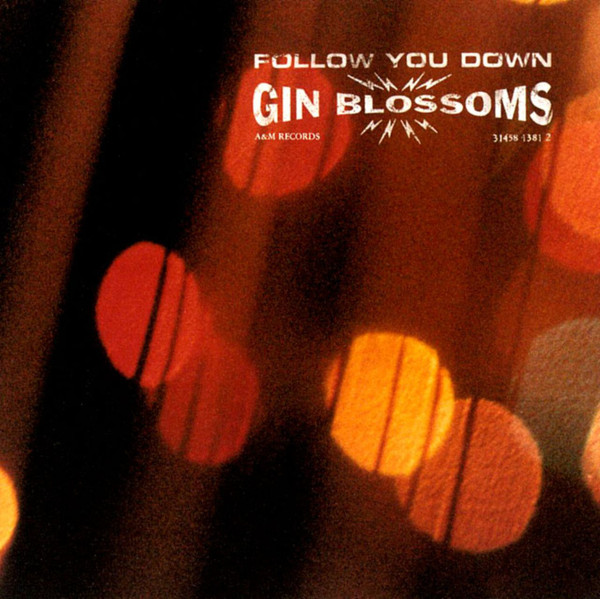
The Gin Blossoms made some good power pop in the 90s.
This song was released in 1996 and was part of a double A-side with Til I Hear It From You. The song peaked at #7 in the Billboard 100, #1 in Canada, and #30 in the UK in 1996. Billboard lists the song as Follow You Down/Til I Hear It From You. It did hit #1 in the Billboard Alternative Charts.
The song was on the album Congratulations… I’m Sorry and it peaked at #10 in the Billboard Album Charts in 1996.
The song was written by D. Scott Johnson, Jesse M. Valenzuela, Phillip Rhodes, Phillip N. Rhodes, Robin Wilson, and William Leen.
The Gin Blossoms broke up in early 1997 but reunited in 2002. They still perform to this day but with some personnel changes.
Follow You Down
Did you see the sky? I think it means that we’ve been lost Maybe one last time is all we need I can’t really help it If my tongue’s all tied in knots Jumping off a bridge is just the farthest That I’ve ever been
Anywhere you go, I’ll follow you down Anyplace but those I know by heart Anywhere you go, I’ll follow you down I’ll follow you down, but not that far
I know we’re headed somewhere I can see how far we’ve come But still I can’t remember anything Let’s not do the wrong thing And I’ll swear it might be fun It’s a long way down When all the knots we’ve tied have come undone
Anywhere you go, I’ll follow you down Anyplace but those I know by heart Anywhere you go, I’ll follow you down I’ll follow you down, but not that far
How you gonna ever find your place Running in an artificial pace Are they gonna find us lying face down in the sand So what the hell now we’ve already been forever damned
Anywhere you go, I’ll follow you down Anyplace but those I know by heart Anywhere you go, I’ll follow you down I’ll follow you down, but not that far
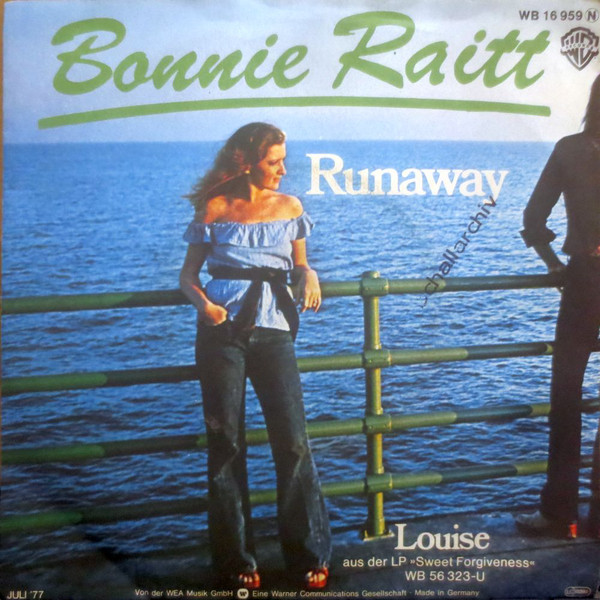
A couple of weeks ago we looked at Bonnie Raitt in the late 80s…Here she is in the 70s putting a new bluesy twist on Runaway. It was her breakthrough in the Singles Charts. It would be 12 more years before she broke through big with the album Nick of Time.
Del Shannon and his keyboard player, Max Crook, wrote with this while they were playing a club in their hometown of Battle Creek, Michigan. Crook played a keyboard called a “Musitron” on Del’s version of the song.
The Raitt version of Runaway peaked at #57 in the Billboard 100 and #79 in Canada. It was on the Sweet Forgivness album released in 1977 which peaked at #25 in the Billboard Album Charts.
Runaway
As I walk along I wonder what went wrong With our love, a love that was so strong And as I still walk on I think of the things We’ve done together while our hearts were young I’m a walking in the rain, to the bone I feel the pain Wishing you were here by me to end this misery And I wonder, I w-w-wonder, why, you ran away And I wonder if you will stay, my little runaway, my runaway I’m a walking in the rain, to the bone I feel the pain Wishing you were here by me to end this misery And I wonder, I w-w-wonder baby yeah, you know why, you ran away And I wonder if you will stay, my little runaway, my little runaway Come back baby (Run, run, runaway) You left me standing in the rain (Run, run, runaway) Come back baby (Run, run, runaway) Standing in the rain (Run, run, runaway)
The Babys had a brief career in the spotlight and had some hits. Back On My Feet Again, Isn’t It Time, and this one. They were a good opening act for many bands at that time but although having a few top 40 hits never did breakthrough big.
Internal conflicts led to the founder, guitarist, and keyboard player Michael Corby being removed from the group by Chrysalis Records in 1978. The three remaining members of the Babys…John Waite, Wally Stocker, and Tony Brock completed the album for a January 1979 release. Jonathan Cain would join in 1980 and his membership would be shortlived.
During a performance in Cincinnati on December 9, 1980 (the day after John Lennon had been murdered), John Waite was pulled from the stage by an overzealous fan during an encore and seriously injured his knee. Following a subsequent final performance by the group in Akron, Ohio, the remainder of the tour was canceled, and the group disbanded following the tour.
They broke up in 1981 and John Waite went solo and had a number 1 hit… and Jonathan Cain joined Journey. Wally Stocker and Tony Brock would later play in Rod Stewart’s band.
Every Time I Think Of You was written by Jack Conrad and Ray Kennedy and released in 1979 as the lead single from The Babys’ third studio album Head First.
The song peaked at #13 in the Billboard 100, #8 in Canada, and #41 in New Zealand in 1979.
Every Time I Think Of You
Every time I think of you It always turns out good Every time I’ve held you I thought you understood
People say a love like ours Will surely pass But I know a love like ours Will last and last
But maybe I was wrong not knowing how our love should go (How our love, how our love should go) But I wasn’t wrong in knowing how our love would grow (How our love, how our love would grow)
And every time I think of you (every time) Every time I think of you (every single time) It always turns out good
Seasons come and seasons go But our love will never die Let me hold you, darlin’ So you won’t cry
‘Cause people say that our love affair Will never last But we know a love like ours Will never pass
But maybe I was wrong not knowing how our love should go (How our love, how our love should go) But I wasn’t wrong in knowing how our love would grow (How our love, how our love would grow)
And every time I think of you (every time) Every time I think of you (every single time) It always turns out good
People say a love like ours Will surely pass But I know a love like ours Will last and last
But maybe I was wrong not knowing how our love should go (How our love, how our love should go) But I wasn’t wrong in knowing how our love would grow (How our love, how our love would grow)
And every time I think of you Every time I think of you Every time I think of you It always turns out good
Every time I think of you Every time I think of you Every time I think of you Every time I think of you
Every time I think of you Every time I think of you Every time I think of you Every time I think of you
Every time I think of you Every time I think of you
Rod Stewart has gone through many phases of his career. He started off as a rocker and his voice was one of the best around in an era of great voices in the late 60s and early 70s. I liked the Faces era and his early solo acoustic-based songs a lot. His Mercury albums are for the most part very good.
This song was on the B side of the UK single of The First Cut Is The Deepest in 1977 and it peaked at #1 in the UK…In America, it wasn’t released until 1979 and it peaked at #46 in the Billboard 100 in 1980. I didn’t’ hear the song until I got the Greatest Hits.
Danny Whitten wrote this song while he was in Crazy Horse. Danny was a creative force in the group as their rhythm guitarist and lead vocalist. Whitten was battling a heroin addiction at the time and died a year later when on November 18, 1972 he overdosed and died. Crazy Horse released a self-titled album with this song included.
Rod Stewart recorded this song for his 1975 album Atlantic Crossing, which was produced by Tom Dowd.
One interesting note…
The Sex Pistols topped the charts of most major British music publications with “God Save The Queen,” which mocked the monarchy and the celebrations. The Sex Pistols’ song suspiciously stalled at #2 on the official chart, placing behind Rod Stewart’s version of “I Don’t Want To Talk About It.” There were many accusations that the chart was rigged to avoid embarrassment in the week of the jubilee.
From Songfacts
Nils Lofgren, who was also in Crazy Horse, recalls in the book 1000 UK #1 Hits by Jon Kutner and Spencer Leigh: “Danny was a very soulful man and a good man and he was the one who got me in Crazy Horse. I loved his song, ‘I Don’t Want To Talk About It,’ and I think it is one of the greatest ballads ever. It has a very haunting lyric and put two lines into the song because Danny was so ill when he recorded it. He could still sing and play but he wasn’t bothered with much else. We said, ‘Danny, we’ve got to do this song, it’s a great song’ and he said, ‘It needs a second verse’ and this went on for months. He never could get it together and then we were in the studio and got in an argument, and he said, ‘Okay, well, one of you write it.’ I left the studio and wrote a couple of lines quickly and I said,’What about these” and he said, ‘Fine, let’s do it’. Danny and I sat opposite each other with acoustic guitars and Ry Cooder was playing slide on his lap and it came out beautifully.”
The Crazy Horse album was an assemblage of top-tier musicians and producers. Along with Danny Whitten and Nils Lofgren, Jack Nitzsche, Ry Cooder, Billy Talbot and Ralph Molina played on it, and it was produced by Nitzsche and Bruce Botnick.
It enjoyed just modest sales, but was adored by critics, including John Mendelsohn, who called this song an “unexaggerably lovely ballad” in his Rolling Stone review.
Whitten never got to perform the song with Crazy Horse, as his addiction pushed him out of the group. He was replaced by George Whitsell, who played on the group’s next album, Loose, released in 1972. Whitten picked up again with Neil Young’s band, but again his addiction led to his dismissal.
However, at the Christmas concerts Stewart gave in London that year, he was taken aback when his fans started singing the chorus to “I Don’t Want To Talk About It” along with him – continuing even when he dropped out to watch them. Because of their obvious enthusiasm for this song, Stewart’s label decided to issue it as his next single. Since so many of Rod’s followers already had Atlantic Crossing, a track from Night On The Town, “The First Cut Is The Deepest,” was included on the flip side and issues as a double-A side disc. The single went to #1 for four weeks in the UK.
In 1988 the duo Everything But The Girl recorded a cover version which bought them their first UK Top 10 hit when it climbed to #3.
They recorded the song at a time when they were frustrated with the lack of success from their first three albums and the constant criticism revolving around their change of sound with every record. Ben Watt of the duo explained to Q in 1996 that covering this song was in response to never being able to please everyone, stating: “When we did ‘I Don’t Want To Talk About It,’ we were almost trying to say, ‘F–k you then! We’ll do a cover version, that’s what you really meant.'” Watt angrily continued, “And of course it went to #3, and completely backfired again!”
EBTG vocalist Tracey Thorn echoed Watt’s thoughts in 2012 to The Quietus when asked about the annoyance of the song being added to the beginning of their album Idlewild when it became an unexpected success. Said Thorn: “Obviously the trouble with having a hit with something like a cover of a ballad, you attract a whole new set of listeners. Which is great, but on the other hand they start to pigeonhole you a little bit, and there was a period around that time where for a few years after where we did pick up an audience that began to get older and expect certain things from us.”
Stewart sang this song as a duet in his concert One Night Only! Live at Royal Albert Hall, with Amy Belle. Stewart told the audience, “A week ago this girl was busking the streets of Glasgow,” and he felt that it was his right to bring her into the limelight because “I was discovered busking at a train stop.”
Nils Lofgren recorded a new version of this song for his 2015 solo album UK2015 Face the Music Tour.
I Don’t Want To Talk About It
I can tell by your eyes
That you’ve probably been cryin’ forever
And the stars in the sky
Don’t mean nothin’ to you, they’re a mirror
I don’t wanna talk about it
How you broke my heart
If I stay here just a little bit longer
If I stay here, won’t you listen to my heart?
Whoa, heart
If I stand all alone
Will the shadow hide the color of my heart?
Blue for the tears, black for the night’s fear, heart
And the stars don’t mean nothin’ to you, they’re a mirror
I don’t wanna talk about it
How you broke my heart
If I stay here just a little bit longer
If I stay here, won’t you listen to my heart?
Whoa, heart, my heart, whoa, heart
I don’t wanna talk about it
How you broke my heart
If I stay here just a little bit longer
If I stay here, won’t you listen to my heart?
Whoa, heart, my heart, whoa, heart
My heart, whoa, heart, my heart, whoa, heart