I always liked this song because I could/can relate to it. I grew up in a small town where everyone knew everyone else. It had its drawbacks but was a great place to grow up.
Mellencamp wrote this about his experiences growing up in the small town of Seymour, Indiana. The media portrayed Mellencamp as the champion of small-town America when the song was released. While he has remained true to his roots and often returns to Seymour, he claims he was simply writing about his life, and not trying to make a statement.
The song is on what I always thought was his best album Scarecrow. Small Town peaked at #6 in the Billboard 100 in 1985. Scarecrow peaked at #2 in the same year in the Billboard Album Chart.
From Songfacts
The music Mellencamp listened to growing up in the ’60s was a huge influence on his work, and he often put bits of classics songs from that era in his tracks. On the bridge of “Small Town,” you can hear the riff from The Supremes song “Back in My Arms Again.”
Mellencamp believes this was a hit because it makes people feel good. He thinks many of his songs don’t do well because they make people confront problems, like the plight of American farmers.
Mellencamp would sometimes add the line “My wife was 13 years old growing up in a small town when I wrote this song,” referring to his wife, the model Elaine Irwin, who is 17 years younger. The couple split up in 2010.
Mellencamp wrote this song after having a number of conversations with folks from New York who seemed to think he – and everyone else from the middle of the country – was a rube. “I wanted to write a song that said, ‘you don’t have to live in New York or Los Angeles to live a full life,'” he told Rolling Stone in 2013. “I was never one of those guys that grew up and thought, ‘I need to get out of here.’ It never dawned on me. I just valued having a family and staying close to friends.”
Small Town
Well I was born in a small town And I live in a small town Probably die in a small town Oh, those small communities
All my friends are so small town My parents live in the same small town My job is so small town Provides little opportunity
Educated in a small town Taught the fear of Jesus in a small town Used to daydream in that small town Another boring romantic that’s me
But I’ve seen it all in a small town Had myself a ball in a small town Married an L.A. doll and brought her to this small town Now she’s small town just like me
No I cannot forget where it is that I come from I cannot forget the people who love me Yeah, I can be myself here in this small town And people let me be just what I want to be
Got nothing against a big town Still hayseed enough to say Look who’s in the big town But my bed is in a small town Oh, and that’s good enough for me
Well I was born in a small town And I can breathe in a small town Gonna die in this small town And that’s probably where they’ll bury me
This power pop band out of Charlotte, North Carolina sounded as close to Merseybeat music as you could get especially in the 80s. They formed in 1978 and are still together to this day! No need to state who their inspiration was…
They are yet another example that critical success doesn’t always translate to commercial success. This seems to be the fate of many power pop bands which I don’t understand. It makes me respect Tom Petty and the Cars much more than I already did.
The Spongetones have now released 9 LPs / CDs as well as been on a great number of compilations CDs. Plus there are solo CDs. If you’re in the Charlotte area, you’ll find that they are revered as local Rock Heroes
The A.V. Club (an entertainment website) says that “She Goes Out With Everybody” is the best Merseybeat song ever written and recorded by an American band.
She Goes Out With Everybody
She was a middle child of three
Squeezed and pushed from her family
She needed more than they could give
It takes much more than bread to live
She needed more than I could give
She goes out
(To get her fill)
She goes out
(Against her will)
She goes out
(To score a thrill)
She goes out with everybody
She goes out
(The walls have ears)
She goes out
(The walls have eyes)
She goes out
(The walls can tell)
She goes out with everybody
Became a woman at sixteen
To her that is what love means
She just got burned her first time
Bit his hook and she took his line
Think that she will end the next time
She goes out
(To get her fill)
She goes out
(Against her will)
She goes out
(To score a thrill)
She goes out with everybody
She goes out
(The walls have ears)
She goes out
(The walls have eyes)
She goes out
(The walls can tell)
She goes out with everybody
When she calls me
What do I say?
When she calls me
What do I say?
She’s a mother now with two of her own
Even with them she’s still alone
They need her more than she can give
It takes much more than bread to live
She will want more than they can give
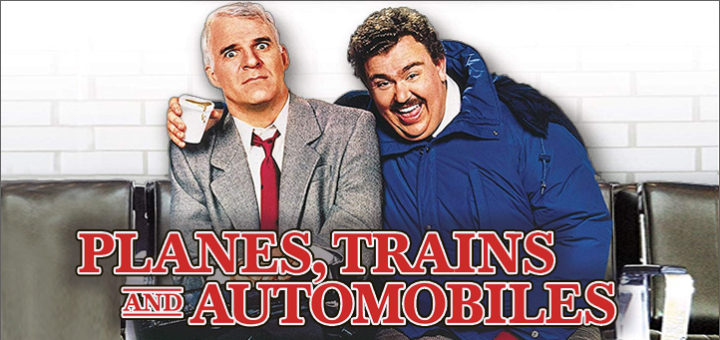
This is my go-to Thanksgiving movie. Steve Martin and John Candy are a great team in this comedy. Personally, I think this is John Candy’s greatest movie. I watch it every year and always looked forward to it.
The movie is full of great scenes and some good lines from Candy and Martin.
John Hughes is the Director and writer. He shot over 3 hours and had to edit it down. Below is a short plot. For those who haven’t seen it…you are missing a funny movie. It was rated R because of a one minute scene with the F-Bomb used 18 times by mostly Martin. The movie was released in 1987.
Short Plot
In New York, a marketing executive Neal Page wants to travel home to Chicago for Thanksgiving. He has difficulties getting a taxi and his flight is canceled. He meets in the airport the clumsy and talkative shower curtain ring salesman Del Griffith who has taken his cab and they travel side-by-side to Chicago. However the bad weather shuts down O’Hare Airport and they land at Wichita, Kansas. They both want to go to Chicago and they decide to travel together. Neal is cursed/blessed with the presence of Del Griffith, shower curtain ring salesman and all-around blabbermouth who is never short of advice, conversation, bad jokes, or company.
Along their journey, Neal changes his viewpoint about Del Griffith and his own behavior.
“Steve walks warily down the street…with the brim pulled way down low. Ain’t no sound but the sound of his feet…machine guns ready to go.”
Supposedly Steve McQueen is Steve in the opening lyrics. Steve died the year this was released on November 7, 1980.
You couldn’t go anywhere in 1980 without hearing someone sing, whistle, or hum this song. I remember the high school band did a version of it.
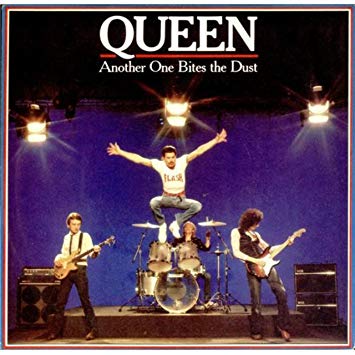
Brian May: “Freddie sung until his throat bled on Another One Bites The Dust. He was so into it. He wanted to make that song something special.”
The song peaked at #1 in 1980 in the Billboard 100. It was on the album The Game…which also peaked at #1 in 1980. While the band and producer Reinhold Mack were mixing the track, Brian May’s roadie suggested it be released as a single; the band didn’t like the idea but were finally talked into doing it when Michael Jackson, after a concert, suggested the same idea.
From Songfacts
This is one of the hardest Queen songs to understand. The opening line reads, “Steve walks warily down the street, his brim pulled way down low. Ain’t no sound but the sound of his feet, machine gun ready to go…” Also, the last phrase spoken in the song is not “Shoot Her” or “Shooter,” but “Shoot Out.”
Though probably not intentional unless someone did an excellent splicing job, the “another one bites the dust” line quite clearly says “decide to smoke marijuana” when played backwards. This is especially clear toward the end of the track when Mercury repeats the line with only the drums playing.
Queen bass player John Deacon wrote this song. All four members of Queen wrote songs, and each wrote at least one hit. Deacon also wrote “You’re My Best Friend.”
Deacon was influenced by the Chic song Good Times. In an interview with the New Musical Express, Chic bass player Bernard Edwards said: “Well, that Queen record came about because that bass player spent some time hanging out with us at our studio. But that’s OK. What isn’t OK is that the press started saying that we had ripped them off! Can you believe that? ‘Good Times’ came out more than a year before, but it was inconceivable to these people that black musicians could possibly be innovative like that. It was just these dumb disco guys ripping off this rock ‘n’ roll song.”
Deacon played most of the instruments on the track: lead and rhythm guitars, bass, reversed piano and additional percussion. Brian May did some guitar effects with harmonizer (in the interlude), and Roger Taylor played the drum loop. Surprisingly, there are no synthesizers.
The drum track and the handclaps were looped. They repeat throughout the song.
John Deacon claimed in a 1980 interview that Roger Taylor opposed the song’s drumbeat. This is backed up by the comments of several figures in the Days of our Lives documentary, who noted that Taylor hated having tape put on his drums to deaden the sound.
However, the drummer denied this in an interview with Mojo magazine in October 2008. He insisted: “I’d already had an ineffectual pop at that kind of music with ‘Fun It,’ on the Jazz album. I was never against ‘Another One Bites The Dust,’ but I was against releasing it as a single.”
In 1998, this was used in a commercial for AIWA sound systems. In the ad, a guy drives around with this blaring from his car stereo. At the end of the commercial, we realize he is driving a hearse.
During the production of the movie Rocky III, this was used in a key scene where Rocky is training for a fight. Producers could not get permission to use the song, so Sylvester Stallone hired Survivor to write an original song instead, which turned out to be “Eye Of The Tiger.”
Queen were originally reluctant to release this as a single, but backstage after a Queen gig at the Los Angeles forum, a visiting Michael Jackson convinced them it would be a hit. “Michael and all his brothers were all going, ‘That’s a fantastic track. You must release it,'” recalled Queen drummer Roger Taylor to Q magazine December 2009.
This meeting lead to several recordings and collaborations between Freddie Mercury and Jackson, all of which remain unreleased.
Weird Al Yankovic got his first chart placing with his parody of this song: “Another One Rides The Bus.” It bubbled under on the Hot 100, placing at #104 in 1981. After a few more minor hits, he landed “Eat It” at #12 in 1984.
This was the single that really broke the band in America, and it garnered a huge following amongst American disco audiences, with many fans and journalists convinced it was a black man singing lead vocals (these people obviously hadn’t heard of Queen before so didn’t know what Freddie looked like). The band occasionally were unsure of how to deal with this – Roger Taylor jokes in the Days of our Lives documentary of having fans shouting “you guys are bad!” in the street, and he had to ask “does that mean good or what?”
This was used in a 2016 commercial for the Hyundai Genesis that first aired on the Super Bowl. In the spot, Kevin Hart uses the Car Finder app to track down the guy who is using it to take his daughter on a date. After tormenting her suitor, Hart says, “A dad’s gotta do what a dad’s gotta do.”
Another One Bites The Dust
Oh, let’s go
Steve walks warily down the street With the brim pulled way down low Ain’t no sound but the sound of his feet, Machine guns ready to go
Are you ready, hey, are you ready for this? Are you hanging on the edge of your seat? Out of the doorway the bullets rip To the sound of the beat
Another one bites the dust Another one bites the dust And another one gone, and another one gone Another one bites the dust Hey, I’m gonna get you, too Another one bites the dust
How do you think I’m going to get along Without you when you’re gone? You took me for everything that I had And kicked me out on my own
Are you happy, are you satisfied? How long can you stand the heat? Out of the doorway the bullets rip To the sound of the beat
Another one bites the dust Another one bites the dust And another one gone, and another one gone Another one bites the dust Hey, I’m gonna get you, too Another one bites the dust
Hey Oh take it Bite the dust Bite the dust Hey Another one bites the dust Another one bites the dust oww Another one bites the dust hey hey Another one bites the dust eh eh
Oh shooter There are plenty of ways that you can hurt a man And bring him to the ground You can beat him, you can cheat him You can treat him bad and leave him when he’s down
But I’m ready, yes, I’m ready for you I’m standing on my own two feet Out of the doorway the bullets rip Repeating to the sound of the beat oh yeah
Another one bites the dust Another one bites the dust And another one gone, and another one gone Another one bites the dust Hey, I’m gonna get you, too Another one bites the dust
As far as power-pop songs go this one is in my top 5. I posted this back when I first started to blog but it’s perfect for a Friday.
A song by a British band called The La’s. A very good pop song that has no verses…it just repeats the chorus four different ways four different times. The song charted many times in different releases…it peaked at #49 on the 1991 Billboard 100 and #13 on the UK charts in 1990, #65 in 1999, #94 in 2012, and #59 in 1988 in the UK.
It was written by the singer Lee Mavers and recorded in 1988 and remixed and released again in 1990.
Many people think the song was about heroin. Paul Hemmings an ex-guitarist for the band denies that rumor. Either way, it is a perfectly constructed pop song.
It’s been covered by a lot of artists but probably most successfully by Sixpence None the Richer. I’ve always liked The La’s version the best.
From Songfacts
“There She Goes” is a song with one crazy story, so hang on. It was written by the Liverpool singer and guitarist Lee Mavers, and recorded by his band The La’s. The La’s released it on their only album, titled The La’s. “There She Goes” was released as a single, not once, not twice, but four times!
The first release scratched the UK Singles chart in 1988 at #51. The second release in 1990 was the peak, with #13 on the UK Singles and also charting in the US. The third release was in 1999, and it charted the UK Singles at #65. The fourth release was in 2008, on vinyl only for the song’s 20th anniversary, and charted again at #181.
While rumors persist that this song was inspired by “There She Goes Again” by the Velvet Underground, no definitive evidence supports it. The songs do have a similar theme and similar lyric styles, but completely different music. On the other hand, the common knowledge that this song is about heroin seems to be a sure bet. “Racing through my brain” and “Pulsing through my vein” exclude just about everything else, and newspapers in England ran stories about The La’s “ode to heroin.” La’s bassist John Power gave a rather evasive answer when asked about it, while La’s ex-guitarist Paul Hemmings flatly denied it.
La’s frontman Lee Mavers is a pretty enigmatic character. If you examine them closely, you’ll find a lot in common with Velvet Underground’s Lou Reed: Both had limited success with their first band but a steady cult following since, both are evasive of the media and reclusive, both are rumored to have written songs about drugs and to be heavily into drugs, and both are widely cited by other music artists as an influence out of step with their commercial success.
Covers of “There She Goes” include those done by Sixpence None the Richer, Robbie Williams, The Wombats and The Boo Radleys. Film soundtrack appearances include The Parent Trap, Fever Pitch, Girl, Interrupted and So I Married an Axe Murderer.
This song was an ironic airplay favorite in the UK when Maggie Thatcher resigned as Prime Minister in November 1990.
The La’s mainman Lee Mavers is a legendary perfectionist. The legend goes that he didn’t want the vintage studio equipment cleaned so the dust that had accumulated on it from the 1960s would remain.
“There She Goes”
There she goes There she goes again Racing through my brain And I just can’t contain This feeling that remainsThere she blows (there she blows again) There she blows again (there she blows again) Pulsing through my vein (there she blows again) And I just can’t contain This feeling that remainsThere she goes There she goes again She calls my name Pulls my train No one else could heal my pain But I just can’t contain This feeling that remainsThere she goes There she goes again Chasing down my lane And I just can’t contain This feeling that remainsThere she goes (there she goes again) There she goes (there she goes again) There she goes (there she goes again)
This video was banned by MTV because they feared it would upset their sponsors. So, being Neil being Neil…wrote a letter to MTV that stated:
MTV, you spineless twerps.
You refuse to play “This Note’s For You” because you’re afraid to offend your sponsors.
What does the “M” in MTV stand for: music or money?
Long live rock and roll.
This parody of commercial rock was banned by MTV for its critique of the music industry’s cozy relationship with corporate America. The song and video mocked advertisements and did not shy away from dropping company names– the title itself is a jab at Budweiser’s ad campaign of “This Bud’s For You.” The song also made fun of pop artists such as Michael Jackson and Whitney Houston. Jackson’s legal threats prompted MTV to ban the video. They changed their minds when the song became a hit on Canada’s MuchMusic channel…the same as the BBC did with My Generation when it became a hit.
He has stuck to his policy of refusing to license his music out for commercials, let alone appear in them himself.
Now the music business…if there is still a music business…promotes their music being in commercials to expand their audience.
From Songfacts
This song is Neil Young’s critique of artists who “sell out” and allow their songs to be used in commercials, something he has never done. The title is a play on Budweiser’s venerable ad campaign, “This Bud’s For You.” In addition to Bud, Young mentions Coke, Pepsi, and Miller in the lyric.
Artists like Young and Bruce Springsteen have never let their songs be used in commercials, feeling it cheapens their artistic integrity. Many other artists, like The Who and The Rolling Stones, have made lots of money by letting companies use their songs. Some classic rock artists like John Mellencamp resisted for years, but allowed their songs to be used for commercial purposes when they realized it was the best way to get them exposure. A band with a particularly interesting take on the subject is Devo, who feel it is part of their art.
The line, “I got the real thing, baby,” is a reference to the Coke slogan, “It’s the Real Thing,” which was introduced in 1969.
The line, “Ain’t singin’ for Spuds” refers to Spuds MacKenzie, the spokesdog for Bud Light. Introduced in 1987, Spuds was a bull terrier who appeared in their ad campaigns until 1989. Billed as “the original party animal,” Spuds became wildly popular and boosted sales of Bud Light significantly.
Directed by Julien Temple, the video is a parody of various ad campaigns. The opening noir is a sendup of the Michelob campaign that starred “practicing alcoholic” Eric Clapton. Michael Jackson, who was ripe for parody at the time, shows up in impersonator form for the line “ain’t singing for Pepsi” – later in the video his hair catches fire as it did when Jackson was shooting a commercial for the sugary beverage in 1984. Whitney Houston, who shilled for Diet Coke, gets a lookalike for the line “ain’t singing for Coke.”
Next up for mockery are the Calvin Klein “Obsession” commercials, one of the most memorable and baffling campaign’s of the ’80s. There were no rock stars associated with this one, but The Rolling Stones did have a tour sponsored by Jovan. Young’s video turns it into “Concession,” with a dialogue break in the style of the ads:
“Members of the jury, this man is on trial for his smell.” “Forgive me, but I am prettier than all of you.” “Liar, give me back my shoes.”
A faux-Spuds MacKenzie also shows up to mock Budweiser.
At the end of the clip, Young turns his beer around to reveal his own slogan: “Sponsored by Nobody.”
There was lots of raunchy debauchery on MTV around this time, but they had a strict policy against product placement, refusing to air videos where products were mentioned by name. This was designed to protect their advertisers and make their commercials more valuable (why would Pepsi buy airtime when they could put a can in a Duran Duran video?). Citing this policy, MTV banned the video, which generated a great deal of controversy and also proved Young’s point about corporate interests infiltrating music. The ban happened in early July 1988; Young sent an open letter to MTV stating:
Forced to admit they were refusing to air an excellent video to protect their sponsors, MTV went into damage control mode and agreed to air the video. They made it into an event, debuting the video on August 21 as part of a 30-minute special about the controversy. Then they awarded it Video of the Year at the 1989 MTV Video Music Awards. Young showed up to accept it.
Young discussed his reasons for accepting the award despite it being originally banned in an interview with Village Voice Rock and Roll Quarterly: “I dunno – must be the Perry Como in me. I could do the hard-line Marlon Brando thing, not accept the award, give it to the Indians. But that’s almost the predictable thing to do. You can’t get money to make videos if MTV won’t play them. In accepting the award I thought I’d be able to make more videos and get ’em played.”
MTV at the time was about as permissive as the cable landscape got – at least in terms of bawdy behavior. That’s why it was surprising anytime they deemed something not suitable for air. In 1992, Paul McCartney recorded a concert for MTV for their Up Close series, but the network edited out his song “Big Boys Bickering,” which was about politics and the environment. MTV claimed that the song was excised because of curse words in the lyrics, although it would have been easy enough to bleep them.
This wasn’t the first single from the album: “Ten Men Workin'” was. That song made inroads on rock radio and reached #6 on Billboard’s Album Rock Tracks chart in May 1988. “This Note’s For You,” predictably, had a harder time getting airplay because of the product mentions. It garnered the most attention during the video controversy, but still only reached #19 on that chart as radio stations continued to shy away from it.
This is the title track to the only album Young recorded with The Bluenotes as his backup band, members of which included Chad Cromwell on drums and Frank Sampedro on keyboards and a six-piece horn section. Befitting their name, This Note’s For You is a blues album.
This was released as a single with the A-side a live version recorded at The Palace in Los Angeles on April 14, 1988 and the B-side a studio cut from the album.
This Note’s For You
Don’t want no cash Don’t need no money Ain’t got no stash This note’s for you.
Ain’t singin’ for Pepsi Ain’t singin’ for Coke I don’t sing for nobody Makes me look like a joke This note’s for you.
Ain’t singin’ for Miller Don’t sing for Bud I won’t sing for politicians Ain’t singin’ for Spuds This note’s for you.
Don’t need no cash Don’t want no money Ain’t got no stash This note’s for you.
I’ve got the real thing I got the real thing, baby I got the real thing Yeah, alright.
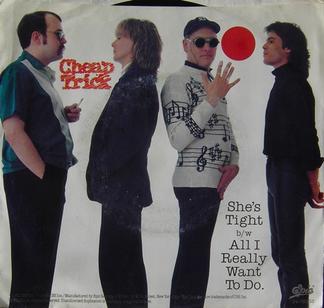
We had fun with this song in high school. I’m surprised it only peaked at #65 in 1982 because it got a lot of airplay and MTV exposure. The song was on the album One On One and it peaked at #39 in the Billboard Album chart in 1982. I liked the album and it had my favorite Cheap Trick song…If You Want My Love.
Cheap Trick does what Cheap Trick does best in this song. They give us a great edge with the guitar with Beatles type harmonies. The song was written by Rick Nielson as were most of their songs. I only got to see them in concert once but it was worth it. They didn’t take themselves seriously and had a good time as did everyone else.
She’s Tight
When I’m down I make a call. Got the number written on the wall. First it’s busy then I try again. Oh, who’s she talking to, could it be him?
I got the number and it starts to ring. I get excited and I start to dream. I start to fantasize of memory lane. Then she answers and she says right way. She says I’m home on my own, home all alone. So I got off the phone.
(She’s tight.) She’s ahead of her time. (She’s tight.) She’s one of a kind. (She’s tight.) She’s a talented girl. (She’s tight.) She’s got her head down tight.
I have something got to say to you. Amnesia and my train of thought. On the tip, tip of my tongue. I had a vision when I was young.
You floated in, we floated up. Through the window and down the hall. I had a smoke and went upstairs. Turned the door and opened the key. She spoke… I’m on my own, home all alone. So I got off the phone.
(She’s tight.) She’s ahead of her time. (She’s tight.) She’s one of a kind. (She’s tight.) She’s a talented girl. (She’s tight.) She’s got her head down tight.
(She’s tight.) She’s giving me the go. (She’s tight.) She’s giving me the high sign. (She’s tight.) We’ll turn off the lights. (She’s tight.) Pull down the shades. (She’s nice, she’s tight.) Turn on the cam’ra. (She’s nice, she’s tight.) And getting ready for action.
This is one of the first movies I ever rented. It was one of the few left on a shelf at the video store…remember those? I had never heard of it but it was a good comedy.
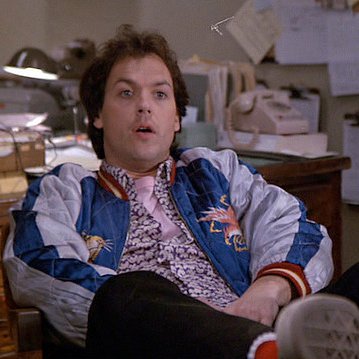
This little movie from the early 80s gets forgotten but it a very good comedy. Ron Howard directed this movie about straight-laced morgue attendant Chuck Lumley (Henry Winkler) who gets a wonderfully crazy co-worker Bill Blazejowski (Michael Keaton in his breakout role) who talks Chuck into running a brothel out of the morgue…Chuck and Bill become unlikely pimps (or Love Brokers) after a group of call girl’s pimp gets killed by being dropped out of a window. Chuck falls for one of the prostitutes who is his neighbor named Belinda (Shelley Long).
Henry Winkler plays a character far removed from his Happy Day’s character…the cool Fonz. Henry is very good in this movie and is perfect as the straight man for Michael Keaton.
Micheal Keaton is great in this movie. His timing is perfect and foreshadows some of his comedies such as Mr. Mom and Beetlejuice.
Shelley Long had reservations about playing a call girl but decided to do it…Long, Winkler, and Keaton worked really well together. This was released a few months before she starred in Cheers.
Something to watch for…Kevin Costner makes one of his first big-screen appearance in a nonspeaking role in this movie.
Some quotes:
Chuck Lumley: As we sit here and idly chat, there are woman, female human beings, rolling around in strange beds with strange men, and we are making money from that.
Bill Blazejowski: Is this a great country, or what?
If you get a chance to watch this movie…give it a chance. It even has a 80s music montage.
Yesterday I posted a Wings song so today I’ll even it up with John.
Great song but every time I hear it…it’s December 1980 again and I’m watching news stories about Lennon’s death. Double Fantasy was a strong comeback album for John…a little more Yoko than I would have liked but a good album all the same.
When it was released Ringo had said John Lennon sounds like Elvis at the beginning of this song…then he said no…he doesn’t sound like Elvis…he is Elvis. John Lennon himself said: “All through the taping of ‘Starting Over,’ I was calling what I was doing ‘Elvis Orbison.’ It’s like Dylan doing Nashville Skyline, except I don’t have any Nashville, being from Liverpool. So I go back to the records I know – Elvis and Roy Orbison and Gene Vincent and Jerry Lee Lewis.”
The song peaked at #1 in the Billboard 100, #1 in the UK, #1 in Canada and #2 in New Zealand.
From Songfacts
This song embodied the sense of renewal in Lennon and Yoko’s professional and personal lives during the writing and recording of Double Fantasy. “It was kinda obvious what ‘Starting Over’ was about,” said journalist David Sheff, who did the last major interview with Lennon, to Mojo. “He’d been untrusting of Yoko, she’d been untrusting of him, all that kind of stuff. But in that one song was this incredible optimism and joy.”
This was released in the United States October 27, 1980, which was the same day Mark David Chapman bought the gun he would use to kill Lennon on December 8. “Starting Over,” which came out in the UK on October 24, was Lennon’s first release since 1975. The Double Fantasy album was issued on November 17.
Lennon wrote this while vacationing in Bermuda earlier in the year.
Despite being the first single in five years from one of the most famous musicians on the planet, this song took a while to catch on. In America, it entered the Hot 100 on November 1, 1980 at #38 and made a slow but steady climb up the chart. Here’s the progression:
When Lennon was killed, fans quickly scooped up the single along with lots of other Lennon material, but it took a few weeks for the chart to reflect these sales. When it hit #1, it stayed there for five weeks.
This was recorded at The Power Station in New York City. Musicians included Tony Levin on bass, Earl Slick on guitar, and Andy Newmark on drums.
Double Fantasy was released on David Geffen’s record label, DGC. Many labels were competing for the album, but Geffen impressed Lennon when he wrote directly to Yoko and agreed to release it without hearing it first. All of Lennon’s previous albums were released on The Beatles’ label, Apple.
John and Yoko were considering doing a tour when this was climbing the charts.
This was one of the last songs recorded for the album. Lennon was not sure he should record it, but his producer and session musicians convinced him it would be a hit. It became the first single from Double Fantasy.
The day this was released, Yoko Ono hired a skywriter to write “Happy Birthday” above New York.
The copy of Double Fantasy that Mark Chapman asked Lennon to autograph might be the most valuable record in the world. The record, which figured in the court case, not only has Lennon’s autograph but also boasts Chapman’s fingerprints on the cover. In 2003, the record was sold for £525,000 but its value has since rocketed.
(Just Like) Starting Over
Our life together Is so precious together We have grown, we have grown Although our love is still special Let’s take a chance and fly away Somewhere alone
It’s been too long since we took the time No-one’s to blame, I know time flies so quickly But when I see you darling It’s like we both are falling in love again It’ll be just like starting over Starting over
Everyday we used to make it love Why can’t we be making love nice and easy It’s time to spread our wings and fly Don’t let another day go by my love It’ll be just like starting over Starting over
Why don’t we take off alone Take a trip somewhere far, far away We’ll be together all alone again Like we used to in the early days Well, well, well darling
It’s been too long since we took the time No-one’s to blame, I know time flies so quickly But when I see you darling It’s like we both are falling in love again It’ll be just like starting over Starting over
Our life together Is so precious together We have grown, we have grown Although our love still is special Let’s take a chance and fly away somewhere
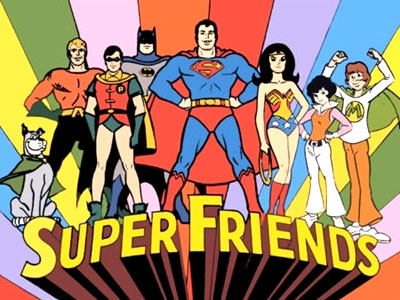
This was a must on Saturday morning. I wouldn’t find out till later but…Ted Knight did some of the dialogue such as “Meanwhile, at the Hall of Justice…” I think the first year (16 episodes) was the best. Altogether the show was on and off during its 13-year run and they ended up with 109 episodes.
Super Friends was produced by Hanna-Barbera in 1973. The show brought all the DC superheroes together and it told their stories. The first season was comprised of only 16 episodes, which were re-run through August 1974. The show was then canceled. Presumably from less than anticipated ratings.
The success of the Wonder Woman TV show in 1975, and probably the early development interest in the Superman movie led ABC to reconsider Super Friends. The original 16 episodes were re-run beginning in early 1976, while production began on a new series. To help promote the new series, DC also began publishing a Super Friends comic. While the stories there were independent of the show, they followed much the same style of the original series.
Beginning in mid-1977, E. Nelson Bridwell, writer of the Super Friends comic, learned of some of the cast changes (notably, the replacement of Wendy and Marvin with Zan and Jayna) after working on the book for several months and wrote the change into his stories, so by the time the new season of the show began in September 1977, the comic had already made the transition to the new characters.
The comic only survived until mid-1981, while the show continued into 1982. However, the show was only re-runs for the 1982-83 season and was canceled outright in the fall of ’83. The show was brought back again in 1984 and ran until September 1986.
The below link will give much more history to the show.
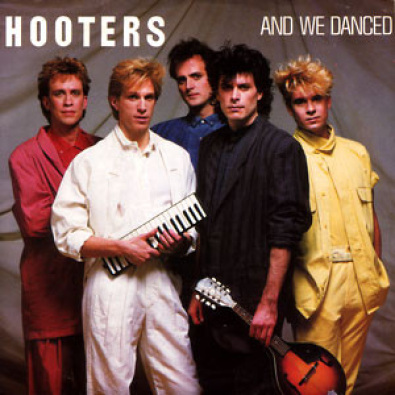
I remember hearing this song in the mid eighties and thinking that they were different than the usual bands at the time. Many bands from that era had an inflection in their voice that was down…monotoned…The Hooters were up…actually happy sounding.
The song peaked at #26 in the Billboard 100 in 1985.
Eric Bazilian and Rob Hyman are the founding members of The Hooters. They played most of the instruments on Cyndi Lauper’s 1983 debut album She’s So Unusual, and Hyman co-wrote “Time After Time.” The same year, The Hooters released their first album on an independent label and grew their following in the Philadelphia area. When Lauper’s album became a huge hit, it got the attention of Columbia Records, who signed the band.
From Songfacts
Rob Hyman told us: “Eric and I would take road trips to do writing. We would get away and especially since the band was playing so much, we would just kind of hole ourselves up. In this instance, we went into the Poconos outside the Philadelphia region and we rented a couple little cabins, brought some recording gear, set up a 4-track studio and threw around a lot of ideas. As is often the case for me, I think we did 10 or 12 tracks, and the last thing we did, probably on our last day, was write the chorus to ‘And We Danced.’ It had a slightly different feel, but materially it was there. That was the strongest bit we brought back from that writing trip. We had that flash – this is something really great, we’ll finish it another day. Had we just stayed with it that moment more, maybe we would have done it, but it ended up taking a lot more time. We threw around a lot of verses and rhythmic ideas. It was a different feel, and then it got into more of a rock and roll feel.”
The Hooters played this at Live Aid in 1985. They were the first band to perform on the Philadelphia stage, going on after an introduction ceremony that included Joan Baez singing “Amazing Grace.” Eric Bazilian told us how they got there: “That was a stroke of genius on the part of our manager, Steve Mountain. He managed to finagle that with Bill Graham and Larry Magid to get us on that stage. Our first record was just coming out, and it was the perfect time. That was our moment in destiny.”
The distinctive sound that leads off the song and plays throughout is a Melodica, a combination keyboard/harmonica instrument they played. The band called it a “Hooter,” which is where they got their name.
Regarding the images he came up with in the lyrics, Hyman told us: “The Bop Baby on a hard day’s night, the union hall – we just felt it was kind of a basic, workingman’s rock and roll record. In a sense, a bit of territory that maybe Springsteen or somebody would cover, a little of that nostalgia, a little of the no-frills kind of straight ahead lyrics. I think the ornamentation and the embellishments that the band did with the melodica and the mandolins and the sounds that we were dabbling in put a different flavor to it. But at its heart, it’s a simple rock and roll song that evokes some of those same feelings that Chuck Berry or The Beatles had. I think those images were just straight-ahead pictures for us.”
In addition to their work with The Hooters, Hyman and Bazilian have written and produced songs for many artists, including Joan Osborne, Ricky Martin, Dar Williams and Jon Bon Jovi. Bazilian wrote Osborne’s hit “One Of Us.” (Thanks to Rob and Eric for speaking with us. To learn more, check out their websites at http://www.robhyman.com and http://www.ericbazilian.com.)
And We Danced
She was a be-bop baby on a hard day’s night. She was hangin’ on Johnny , he was holdin’ on tight I could feel her coming from a mile away. There was no use talking, there was nothing to say When the band began to play and play.
And we danced like a wave on the ocean, romanced We were liars in love and we danced Swept away for a moment by chance And we danced and danced danced.
I met my be-bop baby at the Union Hall She cold dance all night and shake the paint off the walls. But when I saw her smile across a crowded room Well I knew we’d have to leave the party soon As the band began to play out of tune.
And we danced like a wave on the ocean, romanced We were liars in love and we danced Swept away for a moment by chance And we danced and danced danced.
The endless beat she’s walking my way Hear the music fade when she says Are we getting too close, do we dare to get closer The room is spinning as she whispers my name
And we danced like wave on the ocean, romanced We were liars in love and we danced Swept away for a moment by chance And we danced, danced, danced.
Sometimes I just have to hear some Devo to break the monotony. This is Devo from back in 1981. This song peaked at #43 in the Billboard 100, #8 in New Zealand and #17 in Canada. The song was not on their album New Traditionalists which was out at this time but it came packaged as a single included with the album.
It was also on the soundtrack of Heavy Metal.
It was written by Allen Toussaint in the early 1960s. Toussaint, as a pianist, writer, and producer, was part of the second wave of New Orleans’ Jazz and Blues culture. He worked with many big names from the era including Fats Domino, Chris Kenner, Benny Spellman, and Diamond Joe.
The song was made famous by Lee Dorsey in 1966.
From Songfacts on Working In A Coal Mine
Although “Working in the Coal Mine” sounds just like a jazz standard that could have been handed down from generation to generation of the American Old South, it was actually
In the ’60s, Toussaint wrote and produced several hits for Lee Dorsey, including “Ride Your Pony,” “Get Out of My Life Woman,” “Everything I Do Gonna Be Funky,” and “Holy Cow.”
In 1965, Toussaint wrote a song for Dorsey called “Work, Work, Work,” which was appropriate since Dorsey loved working on cars as much as he loved making music – he worked at a body shop and was often seen covered in grease. When he wrote for a specific artist, Toussaint would craft the song to that artist’s personality, which he did on “Working in the Coal Mine.”
Mining is very unpleasant work, but the incessant background vocals (“Workin’ in a coal mine, oops, about to slip down”) and Dorsey’s enthusiastic delivery turned the song – about a guy who is so tired from work that he can’t even have fun on Saturday – into a campy romp. An artist who didn’t appreciate and enjoy real work couldn’t have pulled it off, but Dorsey was the right man for the job. When he left the music business, he went back to bending fenders full-time.
That backing band on this track is The Meters, who were mainstays of the New Orleans funk sound. The Meters went on to work with Mick Jagger, Paul McCartney and Robert Palmer. They were also very successful recording on their own – in 1969 they hit #23 US with “Cissy Strut.”
A popular cover of this song was recorded by Devo and included on the soundtrack to the 1981 animated film Heavy Metal. Their version made #43 in the US.
In 1985, the country duo The Judds released the song on their album Rockin’ With The Rhythm.
This was recorded at J&M Studios in New Orleans, which was where just about every hit from that city was put to tape in the ’50s and ’60s. “Coal Mine” was one of the last hits recorded there, as financial problems led to its demise a few years later.
Dorsey’s label, Amy Records, commissioned a promotional film for his song (what would later be called a “music video”). The clip shows Dorsey emerging from the listening booth of a record store covered in dirt and wearing his work clothes. The clip was used to promote the song on British television shows.
You can also hear a snatch of this song in the Blaupunkt car stereo commercial of the ’90s. While we’re on the subject, we’re reminded of the fantastically popular (even record-breaking) indie video game Minecraft which has been storming the Internet gaming forums since its alpha release in 2010. Should the developers decide to create a TV advertisement, we can think of a song to recommend.
Working In A Coal Mine
Workin’ in the coal mine Goin’ on down, down Workin’ in a coal mine Oops, about to slip down Workin’ in a coal mine Goin’ on down, down Workin’ in a coal mine Oops, about to slip down
Five o’clock in the mornin’ I’m already up and gone Lord, I’m so tired How long can this go on?
Workin’ in the coal mine Goin’ on down, down Workin’ in a coal mine Oops, about to slip down Workin’ in a coal mine Goin’ on down, down Workin’ in a coal mine Oops, about to slip down
‘Cause I make a little money Haulin’ coal by the ton When Saturday rolls around I’m too tired for havin’ fun
Workin’ in the coal mine Goin’ on down, down Workin’ in a coal mine Oops, about to slip down Workin’ in a coal mine Goin’ on down, down Workin’ in a coal mine Oops, about to slip down
Lord I’m so tired How long can this go on?
Workin’ in the coal mine Goin’ on down, down Workin’ in a coal mine Oops, about to slip down Workin’ in a coal mine Goin’ on down, down Workin’ in a coal mine Oops, about to slip down
Five o’clock in the mornin’ I’m already up and gone Lord, I’m so tired How long can this go on?
Workin’ in the coal mine Goin’ on down, down Workin’ in a coal mine Oops, about to slip down Workin’ in a coal mine Goin’ on down, down Workin’ in a coal mine Oops, about to slip down
Songs can mark certain times in your life. When this one plays I remember my first car. It was a 1966 Mustang…not a good idea to give a classic car to a teenager.
I remember hearing this for the first time driving and thinking that this was not the same Robert Plant that a few years before was in Led Zeppelin. He was more subdued and you could tell he was changing his image a bit. The guitar is what stands out to me in this repetitive song. It had an elastic sound to it.
The song peaked at #39 in the Billboard 100 in 1984. I’m In The Mood was on The Principle fo Moments album which peaked at #8 in the Billboard album charts in 1983. I’m In The Mood was written by Robert Plant, Robbie Blunt, and Paul Martinez.
In The Mood
I’m in the mood for a melody I’m in the mood for a melody I’m in the mood
I’m in the mood for a melody I’m in the mood for a melody I’m in the mood
I’m in the mood for a melody I’m in the mood for a melody I’m in the mood
I can make you dance I can make you sing I can make you dance I can make you sing If you want me to
Oh I can make you dance I can make you sing I can make you dance I can make you sing If you want me to
Oh I can make you dance I can make you sing I can make you dance I can make you sing if you want me to
And your little song that you want to sing A little song that you want to sing sung in lieu
Here’s a little song that you want to sing A little song that you want to sing some of you
A little song that you want to sing A little song that you want to sing happy or blue
I’m in the mood, I’m in the mood, I’m in the mood
Why’d I end up doing it doin’ it doing it Do anything that you want me for if you want me to
Do it right gonna do it right Cause a matter of fact it’ll turn out to be strong If you want me to if you want me to Oh if you want me to if you want me to if you want me to
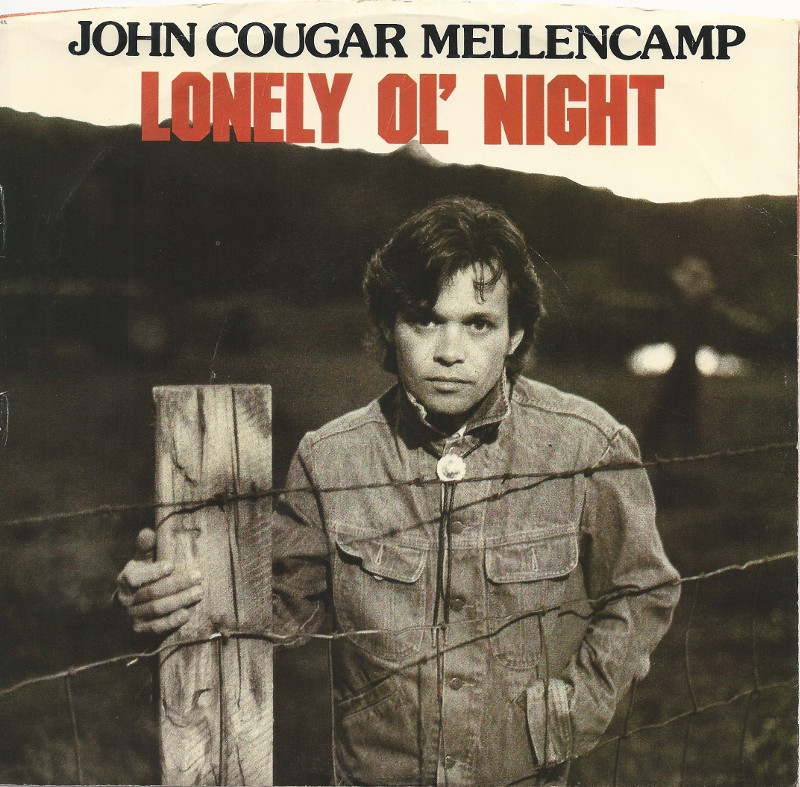
When I graduated high school in1985 this song was was all over the radio. It was on the Scarecrow LP and that album marked a change in Mellencamp’s songs. The change in his style started with the Uh Huh album that came out in 1983 but this one is when I became more of a fan.
This song peaked at #6 in the Billboard 100 in 1985. The Scarecrow album peaked at #2 on the Billboard album chart. Mellencamp’s Uh Huh started the transformation and this solidified his heartland Americana image.
The title and hook were lifted from dialogue in the 1963 movie Hud. When Brandon De Wilde’s character asks, “It’s a Lonesome old night, isn’t it?” Paul Newman replies, “Ain’t they all?”
From Songfacts
The lyrics, “He’s singing about standing in the shadows of love, I guess he feels awfully alone” refer to the song “Standing In The Shadows Of Love,” which was a #6 hit for the Four Tops in 1967. “Lonely Ol’ Night” reached the same plateau. >>
The Scarecrow album saw Mellencamp move to a more political direction in his songwriting, as he gave voice to American farmers, expressing their burdens in songs like “Rain on the Scarecrow” and “You’ve Got to Stand for Somethin’.” “Lonely Ol’ Night” was more typical of his earlier work, a romantic story set against a musical backdrop. Lyrically, it’s not far off from his 1980 track “Ain’t Even Done With The Night.”
Mellencamp borrowed from the movie again in his 1987 track “Paper in Fire” with the line, “We keep no check on our appetites.”
Lonely Ol’ Night
She calls me home She says baby it’s a lonely ol’ night I don’t know I’m just so scared and lonely all at the same time Nobody told me She was gonna work out this way no no no no no no I guess they knew We’d work it out in our own way
It’s a lonely ol’ night Can I put my arms around you? It’s a lonely ol nigh Custom made for two lonely people like me and you
Radio playin’ softly Some singer’s sad sad song He’s singing about Standing in the shadows of love I guess it feels awfully alone She says I know Exactly what he means yeah yeah yeah yeah yeah yeah And it’s a sad sad sad sad feeling When you’re living on those in betweens (But it’s OK)
It’s a lonely ol’ night Can I put my arms around you? It’s a lonely ol nigh Custom made for two lonely people like me and you
She calls me baby She calls everybody baby It’s a lonely ol’ night But ain’t they all?
It’s a lonely ol’ night Can I put my arms around you? It’s a lonely ol nigh Custom made for two lonely people like me and you
It doesn’t get much better than this. This song was off his self-titled debut album Marshall Crenshaw that peaked at #50 on the Billboard album charts in 1982. Marshall only had one chart hit and that was with Someday, Someway off of this same album…it just shows that life isn’t fair at times. Every song is good on this album…you cannot say that about most albums.
Songs like this… is the reason I do this on Fridays.
Marshall Crenshaw on the song: ‘Cynical Girl’ sounds like it just came off the top of my head in one pass; that’s probably what happened. Quite a few of my songs are like that: I just start singing and playing without any advance thought. But then, with ‘Cynical Girl’ and so many others, the words take time to arrive. I asked another person to take a crack at it first but the guy wrote something that had no cohesion. My idea for the lyrics came to me one day when I was walking out of traffic court, just out of the blue. The lyrics have an oddness to them, and humor too; they said some things that I wanted to say. People have sometimes asked me, ‘Who’s it about?’ ‘Did you find her yet?’, etc. It’s really not about a girl—that’s just off-the-shelf rock-and-roll language. To me, what the song says in a funny way is ‘I hate brain-dead mass-culture [stuff] and I want to hang around with people who feel the same.’ People have always really loved that song and identified with it and of course I love that!”
Cynical Girl
Well I’m goin’ out I’m goin’ out lookin’ for a cynical girl Who’s got no use for the real world I’m lookin’ for a cynical girl Well I hate TV
There’s gotta be somebody other than me Who’s ready to write it off immediately I’m lookin’ for a cynical girl
Well I’ll know right away by the look in her eye She harbors no illusions and she’s worldly-wise And I’ll know when I give her a listen that she She’s what I’ve been missin’ What I’ve been missin’ I’ll be lost in love
And havin’ some fun with my cynical girl Who’ll have no use for the real world I’m lookin’ for a cynical girl Well I’m goin’ out
I’m goin’ out lookin’ for a cynical girl Who’s got no use for the real world I’m lookin’ for a cynical girl
Yeah I’ll know right away by the look in her eye She harbors no illusions and she’s worldly-wise And I’ll know when I give her a listen that she She’s what I’ve been missin’ What I’ve been missin’ I’ll be lost in love
And havin’ some fun with my cynical girl Who’ll have no use for the real world I’m lookin’ for a cynical girl









 PowerPop... An Eclectic Collection of Pop Culture